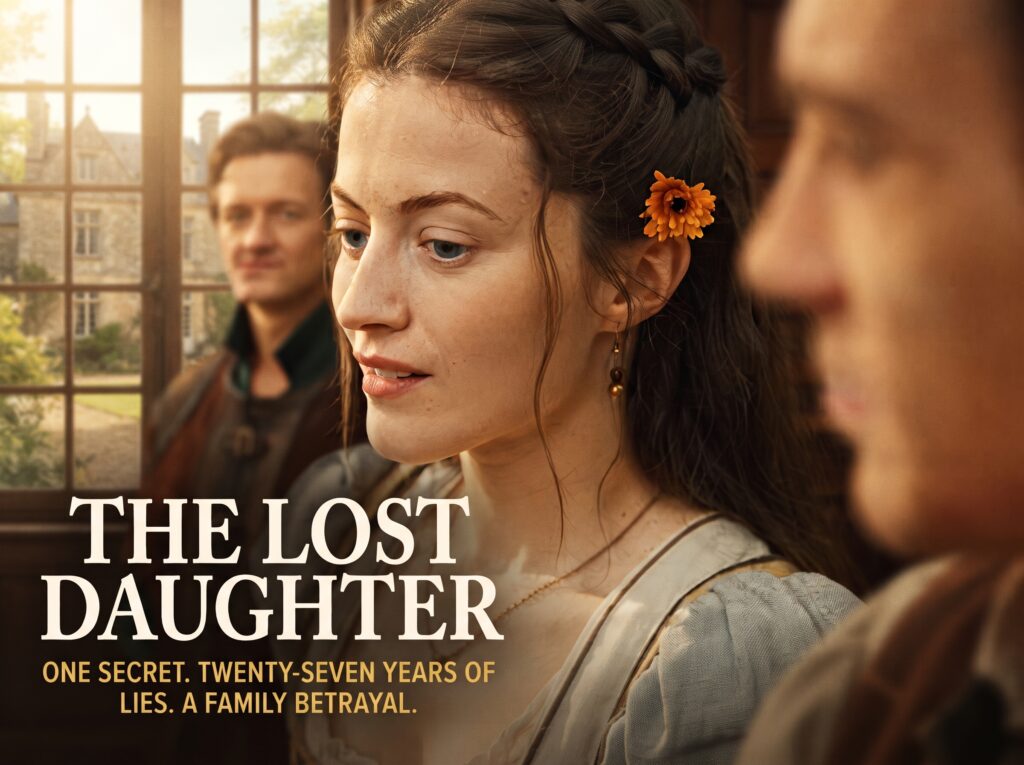
The village of Ashford was surrounded by green hills, narrow rivers, and fields that stretched toward the distant mountains.
It was a peaceful place where people knew one another, children played in the streets, and most families worked from sunrise until sunset.
But Eleanor had always felt that something about her life was different.
She lived with Thomas and Margaret Reed in a small cottage near the edge of the village.
Thomas was a hardworking farmer, and Margaret was a gentle woman who had raised Eleanor since childhood.
They had never treated her differently from their own children.
Yet there was one subject they refused to discuss.
Her birth.
Whenever Eleanor asked about her mother or father, Thomas would become uncomfortable.
“Your parents died when you were very young,” he always said.
“Do you remember them?” Eleanor once asked.
Thomas shook his head.
“No, sweetheart. You were too little.”
Margaret would usually change the subject.
Eleanor had learned not to ask.
At twenty-seven, she was known throughout the village for her kindness and beauty. Her long dark hair was usually tied loosely behind her head, and she often wore a small orange flower that grew beside the cottage.
She had little money, but she never complained.
One morning, while carrying a basket of vegetables to the village market, she met a young man named James Carter.
James worked as a traveling carpenter. He had recently arrived in Ashford and was staying at the local inn.
He was handsome, quiet, and polite.
Unlike many men who tried to impress Eleanor with promises, James treated her as an equal.
Their friendship developed slowly.
They talked near the river, walked through the village, and sometimes shared a simple meal after work.
One afternoon, James noticed the orange flower in her hair.
“Why do you always wear that?”
Eleanor smiled.
“My mother used to tell me that orange flowers represented hope.”
James looked at her.
“Your mother?”
Eleanor’s smile faded.
“At least, that’s what Margaret told me.”
James noticed the sadness in her voice.
“Do you not remember her?”
“No.”
He gently changed the subject.
But something about Eleanor’s answer stayed with him.
A few days later, a wealthy stranger arrived in Ashford.
His name was Edward Whitmore.
He wore an expensive dark coat, carried a silver walking stick, and traveled with two servants.
People immediately recognized that he was a man of considerable importance.
He entered the village tavern and asked the owner whether he knew a young woman named Eleanor Reed.
The tavern keeper pointed toward the market.
“She usually works near the fountain.”
Edward walked outside.
He found Eleanor arranging flowers beside a small wooden stall.
When he saw her face, he stopped.
His expression changed.
For several seconds, he simply stared.
Then he approached.
“Forgive me, miss. Are you Eleanor Reed?”
“Yes. Can I help you?”
He looked at the orange flower in her hair.
“Where did you get that?”
Eleanor smiled.
“It grows beside our cottage.”
Edward’s hands began to tremble.
“Does your mother know what that flower means?”
Eleanor frowned.
“My mother?”
Edward slowly removed a folded photograph from his coat.
It showed a beautiful young woman standing beside a wealthy nobleman.
The woman wore an orange flower in her hair.
Eleanor looked at the photograph.
The woman’s face was almost identical to hers.
“Who is she?” Eleanor whispered.
Edward swallowed.
“Your mother.”
Eleanor stepped backward.
“That’s impossible.”
Edward looked directly into her eyes.
“My name is Edward Whitmore. I served your grandfather, Lord Blackwood.”
He paused.
“And I’ve spent twenty years searching for you.”
5. PART 2 — THE MAN WHO CARRIED A TWENTY-YEAR SECRET
Eleanor refused to believe the stranger.
She returned home and showed the photograph to Margaret.
The moment Margaret saw it, her face lost all color.
“Where did you get this?”
“From a man named Edward Whitmore.”
Margaret sat down.
Thomas entered the room carrying a basket of firewood.
He noticed the photograph.
Then he looked at Margaret.
Neither spoke.
Eleanor became frightened.
“Please tell me what’s happening.”
Thomas placed the basket on the floor.
“Who else has seen that photograph?”
“Only me and the stranger.”
Thomas closed his eyes.
“Then we have very little time.”
Eleanor stared at him.
“Time for what?”
Margaret began crying.
Thomas sat beside his daughter.
“Twenty-seven years ago, your mother was a young woman named Catherine Blackwood.”
Eleanor looked at the photograph again.
“Blackwood?”
“She was the daughter of Lord William Blackwood, one of the wealthiest landowners in the region.”
Thomas explained that Catherine had fallen in love with a young stable worker named Michael Reed.
Michael was kind, intelligent, and hardworking.
But Lord Blackwood considered him unsuitable.
He wanted his daughter to marry Henry Ashford, the son of a powerful merchant family.
Catherine refused.
She married Michael in secret.
When Lord Blackwood discovered the marriage, he disowned her.
The couple moved away and attempted to build a new life.
Then Catherine became pregnant.
A few months before Eleanor’s birth, Michael disappeared.
Catherine was devastated.
She later received a letter claiming that Michael had been killed in a carriage accident.
But Thomas suspected the letter had been forged.
Margaret had been Catherine’s closest friend.
When Catherine gave birth to Eleanor, she was desperately ill.
She begged Thomas and Margaret to protect her baby.
“She made us promise that nobody from the Blackwood family would ever take you away,” Margaret whispered.
Eleanor began to cry.
“Why?”
“Because she believed someone was trying to kill her.”
Thomas nodded.
“Your mother died shortly after you were born.”
Eleanor stood.
“Why didn’t you tell me?”
“We wanted to protect you.”
“You let me believe you were my real parents!”
Margaret reached for her hand.
“We loved you as our own.”
Eleanor pulled away.
“I know. But I deserved to know who I was.”
Thomas lowered his head.
“You did.”
That evening, Eleanor sat alone outside the cottage.
James found her near the garden.
He sat beside her.
“What happened?”
She handed him the photograph.
James studied it.
Then his expression changed.
“Where did you get this?”
“From Edward Whitmore.”
James looked toward the road.
“Eleanor, there’s something you need to know about that family.”
She turned toward him.
“What?”
James took a deep breath.
“My father worked for the Ashford family.”
He paused.
“And I believe they were involved in your mother’s disappearance.”
6. PART 3 — THE LETTER HIDDEN INSIDE THE OLD HOUSE
The next morning, Eleanor went to see Edward Whitmore.
He was staying at the village inn.
When she entered his room, he immediately stood.
“Have you spoken with Thomas?”
“Yes.”
“And?”
“They told me about my mother.”
Edward nodded.
“Then it’s time you learned the rest.”
He opened a leather case and removed several documents.
The first was a marriage certificate.
It showed that Catherine Blackwood had legally married Michael Reed.
The second was a letter addressed to Lord William Blackwood.
It had been written by Catherine shortly before her death.
“My dear father,
I know you believe I have dishonored our family.
But I have never regretted marrying Michael.
He loved me without asking what I could give him.
He never cared about our wealth or our name.
If anything happens to me, please protect our daughter.
She deserves to grow up knowing that love is more important than money.
Your daughter,
Catherine.”
Eleanor read the letter twice.
Then she noticed another document.
It was a property agreement.
According to the agreement, Catherine had inherited a substantial portion of the Blackwood estate.
The land included several farms, a mill, and a large house overlooking the river.
“Why have I never heard about this?”
Edward looked at her.
“Because the inheritance was stolen.”
He explained that Henry Ashford had convinced Lord Blackwood to transfer the property into a private business trust.
Catherine had refused to sign the agreement.
Shortly afterward, Michael disappeared.
Then Catherine died.
The Blackwood estate eventually passed into the hands of Henry Ashford.
Edward believed the transfer had been fraudulent.
“Why didn’t you stop him?” Eleanor asked.
Edward looked ashamed.
“I tried. But Lord Blackwood became ill, and I was dismissed from the estate.”
“Then why search for me now?”
“Because I recently discovered something.”
He removed a small envelope.
Inside was a handwritten note.
It contained the name of a witness who had been present when Catherine signed her marriage certificate.
That witness was still alive.
Her name was Rose Miller.
Edward explained that Rose had worked as a housekeeper at Blackwood Manor.
She had witnessed a conversation between Henry Ashford and Lord Blackwood shortly before Catherine disappeared.
According to Rose, Henry had threatened Catherine.
He wanted her inheritance.
And he was prepared to destroy anyone who stood in his way.
Eleanor stood.
“Where can I find Rose?”
Edward gave her an address.
“She lives near the northern hills.”
James entered the room.
“I’ll go with you.”
Edward looked at him.
“You’re James Carter, aren’t you?”
James nodded.
Edward studied him carefully.
“Your father was Samuel Carter?”
James looked surprised.
“Yes.”
Edward slowly sat down.
“Then this story is more complicated than I thought.”
James frowned.
“What do you mean?”
Edward looked at both of them.
“Your father and Catherine Blackwood knew each other.”
Eleanor turned toward James.
James shook his head.
“I don’t understand.”
Edward lowered his voice.
“Samuel Carter was the last person to see Michael Reed alive.”
7. PART 4 — THE MAN WHO BETRAYED HIS BEST FRIEND
James returned to the village that evening with more questions than answers.
His father, Samuel Carter, lived alone in a small house outside Ashford.
He had retired years earlier after suffering a serious injury.
James rarely discussed his father’s past.
Samuel had always been a quiet man who avoided talking about the years before James was born.
When James entered the house, Samuel was repairing an old chair.
“Father, I need to ask you something.”
Samuel looked up.
“What is it?”
“Did you know a man named Michael Reed?”
The hammer slipped from Samuel’s hand.
He slowly stood.
“Where did you hear that name?”
“Edward Whitmore.”
Samuel looked toward the window.
Then he closed the door.
“Does Eleanor know?”
“Yes.”
Samuel sat down.
“I was afraid this day would come.”
He explained that Michael Reed had been his closest friend.
They had worked together at Blackwood Manor.
Michael was in love with Catherine.
Samuel had helped arrange their secret marriage.
But Henry Ashford discovered everything.
He offered Samuel money to reveal where the couple planned to escape.
Samuel refused.
Henry threatened to have his younger brother arrested for a crime he hadn’t committed.
Samuel became frightened.
He finally revealed the location.
Henry’s men intercepted Michael on the road.
They took him away.
Samuel never saw him again.
James stared at his father.
“You betrayed him?”
Samuel covered his face.
“I was young. I was terrified.”
“Did you know what happened to him?”
“No.”
James stepped backward.
“How could you keep this secret?”
Samuel looked at him.
“Because I believed Michael was dead.”
James shook his head.
“You let me grow up without knowing what kind of man you were.”
Samuel began crying.
“I know.”
Meanwhile, Eleanor and Edward traveled to the northern hills.
They found Rose Miller living in a small cottage surrounded by flowers.
She recognized Eleanor immediately.
“My goodness,” she whispered. “You have your mother’s eyes.”
Eleanor showed her the photograph.
Rose began crying.
“I wondered if I would ever see you.”
Then she revealed something unexpected.
Catherine had not died from illness alone.
Before her death, she had received a letter claiming Michael was alive and waiting for her near the river.
She traveled there secretly.
When she returned, she was frightened.
She told Rose that Henry’s men had followed her.
A few days later, Catherine became seriously ill.
Rose believed she had been poisoned.
Eleanor felt sick.
“Who did it?”
Rose shook her head.
“I cannot prove it. But I heard Henry telling someone that Catherine would never sign the inheritance papers.”
Edward looked at her.
“Who was he speaking to?”
Rose whispered a name.
“Lord Blackwood.”
Eleanor froze.
Her grandfather.
The man who had supposedly loved her mother.
He might have known what was happening all along.
8. PART 5 — THE GRANDMOTHER’S JEWELRY BOX
Eleanor returned to Ashford with a heavy heart.
She had discovered that her mother might have been murdered, that her father had disappeared, and that her grandfather might have helped conceal the truth.
But she still couldn’t understand why Thomas and Margaret had never told her everything.
That evening, she confronted Thomas.
“Did you know my mother was poisoned?”
Thomas looked at her.
“Who told you that?”
“Rose Miller.”
Thomas slowly sat down.
“Rose should have stayed out of this.”
Eleanor stepped closer.
“Then tell me the truth.”
Thomas opened a cupboard and removed an old wooden box.
“I promised Catherine I would never give this to you unless you were old enough to understand.”
Inside were several pieces of jewelry, a small silver key, and a letter.
The letter was written by Catherine.
“My darling Eleanor,
If you ever read this, I want you to know that you were the greatest happiness of my life.
Your father loved you before he ever saw your face.
If he is not beside you when you grow up, please don’t believe that he abandoned you.
There are people who will try to convince you that our family was destroyed by love.
They are wrong.
Our family was destroyed by greed.
I have hidden the truth inside the place where your grandmother kept her most precious memories.
The key will guide you.
Remember that the orange flower was never a symbol of wealth.
It was a symbol of hope.
All my love,
Mother.”
Eleanor pressed the letter against her chest.
Margaret sat beside her.
“Your mother wanted you to know the truth.”
Thomas handed Eleanor the silver key.
“Your grandmother’s jewelry box is still at Blackwood Manor.”
Eleanor looked at him.
“How do we get inside?”
Thomas hesitated.
“That estate belongs to Henry Ashford now.”
James entered the cottage.
“I know someone who can help.”
He explained that his father’s former employer still worked at Blackwood Manor.
His name was Peter.
Peter had been a young stable worker when Catherine disappeared.
He remembered the secret passageways beneath the estate.
James believed Peter could help them enter without alerting Henry.
The following morning, they traveled to Blackwood Manor.
The estate was magnificent.
Its stone walls, enormous gardens, and tall windows reflected the wealth of a family that had controlled the region for generations.
But Eleanor felt no admiration.
She felt that she was standing in the place where her mother’s life had been stolen.
Peter greeted them at the back entrance.
He was an elderly man with a kind face.
When he saw the silver key, he immediately understood.
“Your mother trusted me with something,” he said.
He led them to a small room beneath the staircase.
Inside was an old wooden chest.
Eleanor inserted the key.
The lock opened.
Inside lay a jewelry box.
But beneath the velvet lining was something else.
A folded property deed.
A collection of bank records.
And a small diary.
The diary belonged to her mother.
Eleanor opened the first page.
The final entry was dated only three days before Catherine’s death.
It contained a sentence that made her blood run cold.
Henry knows where Michael is. Father knows too. If I don’t survive, I want my daughter to know that the man who raised her grandfather’s name was the man who destroyed our family.
Eleanor looked at Edward.
“Who was my grandfather really?”
Edward closed his eyes.
“I think it’s time you met him.”
9. PART 6 — THE GRANDFATHER WHO HAD BEEN HIDING IN PLAIN SIGHT
Lord William Blackwood had not died.
For twenty years, the village had believed he had passed away shortly after Catherine’s death.
But Edward revealed that William had secretly moved to a small estate in the countryside.
He had been living under another name.
He had abandoned his title, his fortune, and his position.
Eleanor couldn’t understand.
“Why would a man disappear from his own family?”
Edward looked at her.
“Because he was ashamed.”
They traveled to the countryside.
The house was small, surrounded by trees and an overgrown garden.
An elderly man opened the door.
He looked at Eleanor.
Then he looked at the orange flower in her hair.
His hands began to shake.
“Catherine?”
Eleanor stepped forward.
“No. I’m Eleanor.”
The old man covered his mouth.
“My granddaughter.”
He invited them inside.
For a long time, nobody spoke.
Then William told them everything.
Henry Ashford had been his closest business associate.
He had gradually convinced William that Catherine’s marriage to Michael would destroy the family reputation.
William had agreed to help separate them.
He believed Michael was a gold digger.
But when Catherine became pregnant, William realized that he had made a terrible mistake.
He tried to reconcile with her.
Then Henry presented him with false evidence claiming Michael had stolen money from the estate.
William believed him.
He signed documents transferring Catherine’s inheritance to Henry.
When Catherine discovered the truth, she threatened to expose the fraud.
Henry became desperate.
He arranged for Michael to be taken away and convinced William that Catherine had died naturally.
William later discovered the truth.
But by then, Eleanor had disappeared.
Thomas had taken her away to protect her.
William was afraid that Henry would kill her if he tried to reclaim her.
“So you did nothing?” Eleanor asked.
William lowered his head.
“I was a coward.”
“You let me grow up without knowing my own family.”
“I know.”
“You let my mother die believing she had nobody.”
William began crying.
“I know, my child.”
Eleanor stood near the window.
She had imagined meeting her grandfather many times.
But she had never imagined feeling so disappointed.
Then William reached for a small photograph.
It showed Michael standing beside Catherine.
“Your father was not a criminal,” he said.
Eleanor turned.
“Where is he?”
William looked toward Edward.
“Henry kept him alive for years.”
Edward stepped forward.
“What?”
William nodded.
“Michael was imprisoned in an abandoned estate beyond the river. Henry used him as leverage to keep me silent.”
Eleanor felt her knees weaken.
“Is he still alive?”
William looked at her.
“I don’t know.”
But James noticed something.
A date had been written on the back of the photograph.
It was only four months old.
Someone had taken the picture recently.
And that meant Michael might still be alive.
10. PART 7 — THE MAN WHO NEVER STOPPED WAITING
James and Eleanor immediately began searching for the abandoned estate.
Thomas knew the location.
He had once traveled there with a group of farmers.
The estate stood beyond a narrow river, hidden among old trees.
When they arrived, they found the building nearly destroyed.
A broken gate hung from its hinges.
The windows were covered with wooden boards.
James entered first.
He found old blankets, food containers, and a small wooden chair.
Someone had been living there.
Then they heard a sound from the cellar.
A weak voice called out.
“Who’s there?”
Eleanor ran down the steps.
An elderly man was sitting on the floor.
His hair had turned gray, and his face was thin.
But his eyes were unmistakable.
She had seen them in the photograph.
“Father?”
The man looked up.
For several seconds, he couldn’t speak.
Then he reached toward her.
“Catherine?”
“No,” Eleanor whispered. “I’m Eleanor. Your daughter.”
Michael began crying.
He had spent twenty-seven years believing that his wife and daughter were dead.
Henry had told him that Catherine had died shortly after childbirth and that the baby had not survived.
Michael had never believed him completely.
He had written letters.
He had asked questions.
He had tried to escape.
But every attempt had failed.
Eleanor knelt beside him.
“I’m here, Father.”
Michael touched her face.
“You look just like your mother.”
She embraced him.
James stood at the doorway, overwhelmed by the reunion.
But the moment was interrupted by approaching horses.
Henry’s men had discovered them.
James helped Michael stand.
“Can you walk?”
Michael nodded weakly.
They escaped through the rear passage and crossed the river.
Thomas and Edward were waiting with a carriage.
When they reached Ashford, Michael was taken to the village doctor.
For several days, he remained weak.
But he was alive.
And for the first time in nearly three decades, Eleanor had both the truth and her father.
There was only one thing left to do.
Confront Henry Ashford.
11. PART 8 — THE MAN WHO STOLE EVERYTHING
Henry Ashford learned that Michael had escaped.
He immediately ordered his men to search the village.
But the people of Ashford were no longer willing to remain silent.
Farmers who had lost their land came forward.
Former servants provided letters.
Business partners revealed forged accounts.
And Edward Whitmore presented the original property records.
Henry’s entire fortune had been built on stolen property.
Yet he still believed he could control the situation.
He summoned Eleanor to Blackwood Manor.
She arrived with James.
Henry was waiting in the grand hall.
He smiled.
“So, the missing daughter has finally returned.”
Eleanor looked at him.
“You stole my mother’s inheritance.”
Henry poured himself a drink.
“Your mother was foolish. She married beneath her position and expected the world to reward her.”
“She loved my father.”
“Love is a poor substitute for money.”
Eleanor stepped closer.
“Where is the inheritance?”
Henry laughed.
“Long gone.”
James placed the bank records on the table.
“Not all of it.”
Henry’s smile disappeared.
Edward entered.
“We have evidence of the fraudulent transfers.”
Henry looked around.
For the first time, he realized he was surrounded.
He reached into his coat.
But before he could move, Thomas entered with two village guards.
Henry looked at Thomas.
“You?”
Thomas nodded.
“I should have spoken years ago.”
Henry laughed bitterly.
“All of you have come to destroy me.”
Eleanor shook her head.
“No. You destroyed yourself.”
She placed her mother’s diary on the table.
Then she opened it to the final page.
Henry looked at the handwriting.
His expression changed.
“Where did you get that?”
“My mother left it for me.”
Henry reached for the diary.
James stopped him.
Edward announced that the documents would be submitted to the authorities.
Henry’s control over the estate was finished.
But before the guards could take him away, he made one final attempt to hurt Eleanor.
“Do you think your father loves you? He never even came looking for you.”
Michael entered the hall.
He was still weak, but he stood upright.
“I searched every day.”
Henry went silent.
Michael looked directly at him.
“You stole my family. You stole my years. You stole my daughter’s childhood.”
He paused.
“But you never made me stop loving them.”
Henry was escorted away.
And Eleanor finally understood that the truth had not simply exposed a criminal.
It had restored a family.
12. PART 9 — THE FINAL LETTER FROM A MOTHER
Several weeks later, the legal investigation confirmed that Catherine’s inheritance had been fraudulently transferred.
The property was returned to Eleanor and her family.
The estate, the farms, and the mill were restored to their rightful ownership.
Henry Ashford was charged with fraud, unlawful imprisonment, and several other serious crimes.
But Eleanor was not satisfied.
She wanted to understand why her mother had been so afraid.
While sorting through the old diary, she discovered a final hidden page.
It contained a letter addressed to her.
“My dearest Eleanor,
If you have found this, then I hope you are surrounded by people who love you.
I want you to understand something.
Your father was never weak. He was a good man who trusted the wrong people.
Your grandfather was not always cruel. He became frightened of losing his position and made choices he could never undo.
But Henry was different.
He knew exactly what he was doing.
He believed that wealth gave him the right to decide who deserved happiness.
I refused to accept that.
If you ever meet your father, tell him that I never stopped loving him.
And if you ever find yourself choosing between wealth and love, remember that money can buy a beautiful house, but it cannot make that house a home.
I left an orange flower in the garden for you.
Whenever you see one, remember that even after the longest winter, something beautiful can grow again.
Your loving mother,
Catherine.”
Eleanor cried as she read the final words.
James placed his hand on her shoulder.
“She would be proud of you.”
Eleanor smiled through her tears.
“I wish she could have seen this.”
They walked together to the old garden.
An orange flower was growing near the stone wall.
Eleanor knelt and touched it gently.
For years, she had worn the flower without understanding why it mattered.
Now she knew.
It was the last gift her mother had left her.
That evening, Michael joined them in the garden.
He sat beside his daughter.
“Your mother loved this place.”
Eleanor smiled.
“Tell me about her.”
Michael laughed softly.
“Where should I begin?”
And for the first time, Eleanor heard stories about the woman who had given birth to her.
Stories about her laughter.
Her kindness.
Her stubbornness.
And the way she had always believed that love was stronger than money.
13. PART 10 — THE FLOWER THAT BROUGHT A FAMILY HOME
One year later, Blackwood Manor was no longer a place of fear.
The enormous gates stood open.
The gardens had been restored, and the old servants’ quarters had been converted into comfortable homes for families who had lost their property during Henry’s years of fraud.
Eleanor refused to live like the wealthy aristocrats who had once controlled the estate.
Instead, she invited Thomas and Margaret to live with her.
They had raised her, loved her, and protected her when she had nobody else.
She considered them her parents just as much as Michael.
Michael gradually recovered.
Although he had lost nearly three decades of his life, he refused to spend his remaining years thinking only about what had been taken from him.
He spent his mornings walking through the gardens and his afternoons helping restore the old workshops.
James remained beside Eleanor.
Their relationship grew stronger as the family rebuilt its life.
One spring morning, James approached her with a small wooden box.
“What is this?” Eleanor asked.
“Something I’ve been meaning to give you.”
She opened it.
Inside was a beautiful silver necklace with a small orange flower engraved on the pendant.
Eleanor smiled.
“It’s beautiful.”
James took her hand.
“I don’t have a grand estate or a wealthy family name.”
She looked at him.
“I know.”
“But I can promise you something.”
“What?”
“I will never make you question whether you belong somewhere. And I will never allow anyone to convince you that your worth depends on your family name.”
Eleanor’s eyes filled with tears.
She kissed him.
A few months later, they married in the garden where her mother had once walked.
Thomas gave her away.
Margaret sat in the front row, crying happily.
Michael stood beside his daughter.
Edward Whitmore attended as a witness.
And on the stone wall behind them, orange flowers bloomed in the afternoon sunlight.
Before the ceremony, Eleanor placed a small flower beside her mother’s photograph.
“Thank you, Mother,” she whispered.
“For leaving me something more valuable than an inheritance.”
James approached.
“What did you say?”
She smiled.
“I said that I finally understand what home means.”
He took her hand.
And together they walked toward their future.
The village never forgot what had happened at Blackwood Manor.
People remembered the wealthy man who believed money gave him the right to control other lives.
They remembered the daughter who refused to surrender her identity.
They remembered the father who survived decades of imprisonment because he never stopped loving his family.
And they remembered the small orange flower that had carried a mother’s message across twenty-seven years.
Years later, when Eleanor’s own daughter asked why she always kept an orange flower in her hair, she told her the story.
She explained that sometimes families are separated by lies, greed, and terrible decisions.
Sometimes people who should protect us are the ones who hurt us.
But she also explained that the truth can survive even when everyone tries to bury it.
Her daughter listened carefully.
Then she asked:
“Was the flower really magic?”
Eleanor smiled.
“No, sweetheart. It wasn’t magic.”
She placed the flower gently behind her daughter’s ear.
“It simply reminded us never to give up hope.”
And as the sunlight fell across the garden, Eleanor realized that her mother had been right all along.
A fortune could disappear.
A family name could be disgraced.
A beautiful mansion could become a prison.
But love, when protected by truth and courage, could survive almost anything.
THE END.