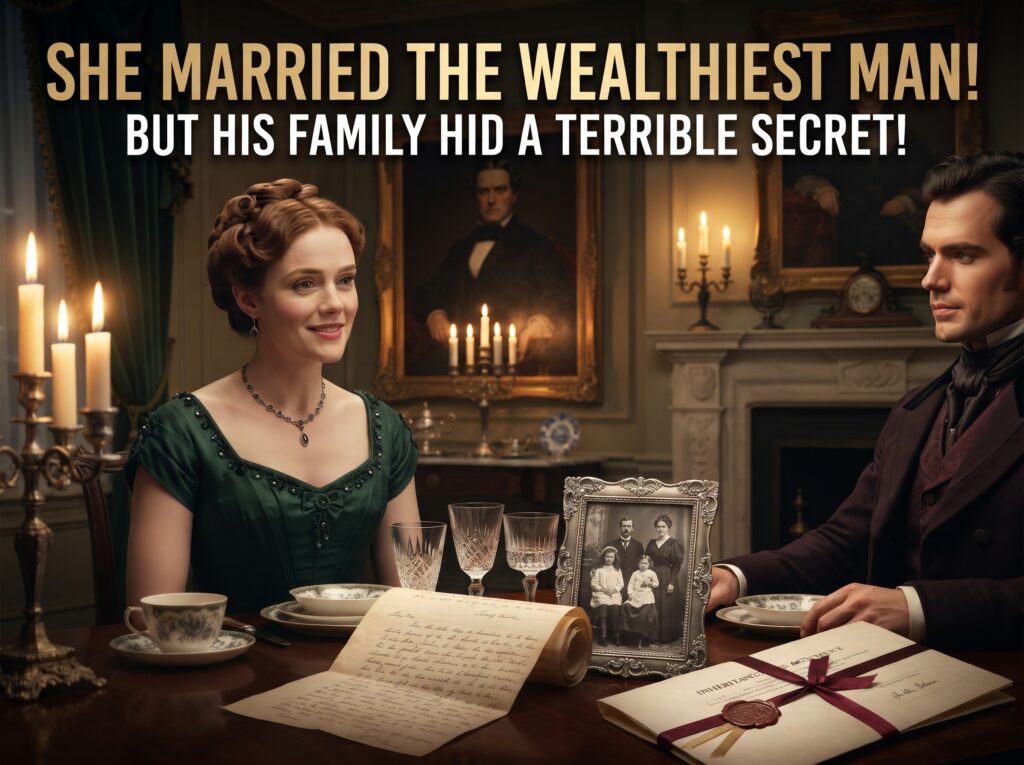
England, 1887.
The winter wind swept across the narrow streets of a small English town called Ashford.
Inside a modest cottage near the old church, Eleanor Whitmore sat beside her mother, Margaret, carefully repairing the sleeve of an old dress.
At twenty-six, Eleanor had already experienced more hardship than many people faced in an entire lifetime.
Her father had died when she was twelve.
Her mother had spent years working as a seamstress, sewing dresses for wealthy families who rarely remembered her name.
Their home was small, their furniture was old, and their savings were almost nonexistent.
Yet Eleanor had never complained.
She believed that happiness was not something purchased with money.
It was something created through kindness, loyalty, and love.
One afternoon, while delivering a repaired dress to the estate of Lord Alexander Harrington, Eleanor encountered a gentleman standing beside a broken carriage.
He wore a dark wool coat and carried himself with quiet confidence.
“Excuse me, miss,” he said. “Would you happen to know where I might find someone who can repair a carriage wheel?”
Eleanor looked at the damaged wheel.
“There’s a blacksmith near the church. But you won’t reach him before the rain.”
The gentleman smiled.
“Then I suppose I shall have to wait.”
Eleanor offered him the small umbrella she carried.
He looked surprised.
“And what will you use?”
“I can walk beneath the trees.”
He laughed softly.
“That sounds like a terrible arrangement.”
“Perhaps. But you look like someone who needs it more than I do.”
He accepted the umbrella.
His name was Alexander Harrington.
He was thirty-two years old and the only son of the Earl of Westbrook.
His family owned thousands of acres, several country estates, and one of the largest trading companies in England.
But Eleanor knew none of this.
To her, he was simply a gentleman with a damaged carriage and a surprisingly kind smile.
Before leaving, he asked her name.
“Eleanor.”
“Eleanor,” he repeated. “I hope we meet again.”
She smiled politely.
“Good afternoon, sir.”
She continued walking.
Alexander watched her disappear between the trees.
He had met hundreds of women at formal dinners and elegant parties.
Yet none had ever spoken to him with such effortless honesty.
Three weeks later, Alexander appeared at the cottage.
He brought a basket of food and a small package of medicine.
Margaret was ill, and Eleanor had been struggling to pay for her treatment.
“How did you know?” Eleanor asked.
“I made inquiries.”
“We cannot accept charity.”
Alexander placed the basket on the table.
“Then don’t consider it charity. Consider it repayment for the umbrella.”
Eleanor smiled despite herself.
Over the following weeks, Alexander visited several times.
He spoke with Margaret, helped repair the cottage roof, and brought books for Eleanor.
For the first time in years, the little house seemed filled with laughter.
But one evening, after Alexander had left, Margaret noticed something troubling.
She had recognized the family name on the carriage.
Harrington.
Her hands began trembling.
“Eleanor,” she whispered, “there is something about that family you must never forget.”
“What is it, Mother?”
Margaret looked toward the window.
“Your father once worked for them.”
Eleanor frowned.
“Why didn’t you tell me?”
Her mother closed her eyes.
“Because the Harrington family destroyed his life.”
And Eleanor realized that the man she was beginning to love might be connected to the greatest tragedy her family had ever suffered.
5. Part 2 — The Gentleman Who Fell in Love with a Poor Girl
Alexander returned the following Sunday.
This time, he brought no gifts.
He simply wanted to see Eleanor.
They walked together along the river, speaking about books, childhood memories, and the lives they wished they could have lived.
Eleanor told him she had once dreamed of becoming a teacher.
“But your family needed you,” Alexander said.
“Dreams are expensive when you are poor.”
He looked at her.
“Perhaps some dreams are worth fighting for.”
She smiled.
“And what about yours, Mr. Harrington?”
He was quiet for a moment.
“I wanted to marry someone who loved me before knowing my family name.”
Eleanor laughed.
“That sounds rather difficult for a gentleman like you.”
“Perhaps I have finally found someone.”
Her smile disappeared.
“Alexander…”
“I know what people will say. They will say you want my fortune. They will say I have lost my senses.”
“And perhaps they will be right.”
He shook his head.
“I don’t care.”
But Eleanor did care.
She knew what happened to poor women who married into wealthy families without their approval.
They were judged, humiliated, and sometimes abandoned.
When Alexander returned to his estate, his mother, Lady Catherine Harrington, was waiting in the drawing room.
“Where have you been?”
“Visiting a friend.”
“A friend?”
“Her name is Eleanor Whitmore.”
Catherine slowly placed her teacup on the table.
“Whitmore?”
“Yes.”
Her expression changed.
“Alexander, you must stop seeing that woman.”
He frowned.
“Why?”
“Because she is not suitable for this family.”
“That is not a reason.”
Catherine stood.
“Some families carry histories you know nothing about.”
Alexander stared at her.
“What history?”
She refused to answer.
That evening, Catherine sent a letter to her solicitor.
It contained a single instruction:
Find out everything about Eleanor Whitmore and her mother.
Two days later, the solicitor returned with a file.
Catherine opened it.
The moment she saw the name of Eleanor’s father, she went pale.
William Whitmore.
The man she had spent twenty years trying to erase from the family’s history.
6. Part 3 — The Letter Hidden Beneath the Floorboards
Eleanor could not forget her mother’s warning.
That night, while Margaret slept, she searched through an old wooden chest that had belonged to her father.
Inside were faded photographs, a pocket watch, and several letters tied together with a piece of blue ribbon.
Most were ordinary family correspondence.
But one envelope carried a name Eleanor had never expected to see.
Edward Harrington.
The father of Alexander.
She opened it carefully.
The letter was dated 1867.
It mentioned a business partnership, a disputed inheritance, and a sum of £12,000.
At the bottom was a sentence that made her heart race:
William Whitmore must accept responsibility for the missing funds, or the entire Harrington estate will collapse.
Eleanor read the letter again.
Her father had been accused of stealing money from the Harrington family.
But he had always told her that he had lost his position because he refused to participate in dishonesty.
Could the family have lied?
The following morning, Eleanor confronted her mother.
“Did Father steal money from the Harringtons?”
Margaret looked shocked.
“Absolutely not.”
“Then why do I have this letter?”
Margaret sat down.
“Your father discovered that Edward Harrington was using company accounts to hide money from his business partners.”
Eleanor felt her heart beating faster.
“What happened?”
“He tried to expose him. But Edward accused him of theft. Your father lost his position, his reputation, and eventually his health.”
“Why didn’t you tell me?”
“Because I wanted you to have a life that wasn’t defined by what happened to him.”
Eleanor looked at the letter.
“And Alexander?”
Margaret took her daughter’s hand.
“His father is gone, but his family still carries the consequences.”
Eleanor wanted to believe that Alexander was different.
But she now understood why his mother had been so frightened.
The following afternoon, Alexander arrived with a small velvet box.
Inside was a beautiful ring.
“Eleanor, I have never been more certain about anything in my life.”
He knelt before her.
“Will you marry me?”
Eleanor looked at the ring.
She loved him.
But she also knew that accepting meant entering a family that might have destroyed her father.
“Alexander, I need to ask you something.”
“Anything.”
“Did your father ever accuse a man named William Whitmore of stealing money?”
Alexander’s smile disappeared.
“Where did you hear that name?”
“My father was William Whitmore.”
Alexander slowly stood.
For the first time, he understood why his mother had been so desperate to separate them.
7. Part 4 — The Mother Who Feared the Truth
Alexander returned home that evening and confronted his mother.
“Tell me what happened to William Whitmore.”
Catherine refused to answer.
“That matter is finished.”
“It ruined a man’s life.”
“Your father protected this family.”
“By destroying an innocent man?”
Catherine slapped her hand against the table.
“Do not speak about your father that way!”
Alexander remained calm.
“I love Eleanor.”
Catherine stared at him.
“You cannot marry her.”
“Why?”
“Because she will never be accepted.”
“Then perhaps this family needs to change.”
Catherine’s face hardened.
“If you marry her, you will lose your inheritance.”
Alexander looked at his mother for a long moment.
Then he said something she had never expected.
“Then I will lose it.”
Meanwhile, Eleanor was struggling with her own decision.
She loved Alexander, but she could not forget the suffering her father had endured.
She visited his grave and placed a small bouquet of white flowers beside the stone.
“Father, I wish you could tell me what to do.”
A gentle rain began falling.
She remembered his words from childhood.
Never allow anyone’s wealth to make you feel smaller.
That evening, she wrote Alexander a letter.
She told him she loved him but could not marry into a family that refused to acknowledge the truth.
She placed the ring inside the envelope.
When Alexander received it, he immediately rode to her cottage.
But Eleanor was gone.
Margaret explained that her daughter had taken a position as a companion to an elderly widow in another town.
“She believes she is protecting you,” Margaret said.
Alexander looked devastated.
“She doesn’t understand. I don’t want the inheritance without her.”
Margaret studied him.
“Then prove that your love is stronger than your family’s money.”
Alexander returned to his estate with a decision.
He would find the truth about William Whitmore.
And he would not stop until his name was cleared.
8. Part 5 — The Secret Behind the Harrington Fortune
Alexander began examining his father’s business records.
For weeks, he searched through old account books, legal documents, and correspondence.
Most records appeared ordinary.
But one ledger contained a series of payments that did not match the company’s official reports.
The amounts were transferred into an account controlled by a former solicitor named James Fletcher.
Alexander recognized the name.
Fletcher had been his father’s closest adviser.
Unfortunately, he had died several years earlier.
Alexander visited Fletcher’s widow.
She was an elderly woman living in a quiet village outside London.
When she heard why Alexander had come, she became visibly uncomfortable.
“My husband kept many secrets,” she said.
“I need to know what happened to William Whitmore.”
The old woman looked toward the fireplace.
“Your father knew William was innocent.”
Alexander froze.
“What?”
“William discovered the missing money. Your father needed someone to blame before the business partners found out.”
“Why would he do that?”
“Because he had already spent the money.”
The widow explained that Edward Harrington had been struggling with enormous gambling debts.
He had secretly sold company assets to cover them.
When William discovered the truth, Edward arranged for him to be accused of theft.
But Fletcher had kept a copy of the original financial records.
The widow disappeared into another room.
When she returned, she carried a leather folder.
“Your father never knew my husband kept this.”
Inside were signed statements, original account entries, and a letter from Edward Harrington.
Alexander read it with trembling hands.
The letter confirmed everything.
William Whitmore had been innocent.
His father had knowingly destroyed him.
Alexander sat in silence.
Then he asked:
“Why didn’t your husband reveal this?”
The widow looked at him sadly.
“Fear, Mr. Harrington. He was afraid of losing everything.”
Alexander left with the folder.
He had finally found the truth.
But he had also discovered something much worse.
His family fortune had been built partly upon the suffering of the woman he loved.
9. Part 6 — The Woman Who Refused to Be Bought
Eleanor had settled into a small cottage in Bath.
She worked as a companion to Lady Margaret Ashcombe, a wealthy widow who enjoyed reading, gardening, and discussing history.
The work was peaceful.
But Eleanor missed Alexander.
Every evening, she found herself remembering their walks along the river.
She wondered whether he had forgotten her.
One afternoon, a carriage stopped outside the cottage.
Alexander stepped down.
Eleanor stood frozen.
“What are you doing here?”
“Looking for you.”
“You shouldn’t have come.”
“I know.”
He approached carefully.
“I found the truth about your father.”
Eleanor’s expression changed.
Alexander showed her the documents.
She read them slowly.
Then her eyes filled with tears.
“All these years…”
“Your father was innocent.”
Eleanor covered her mouth.
For the first time since childhood, she felt that someone had finally restored a piece of her father’s dignity.
“Thank you,” she whispered.
Alexander shook his head.
“You don’t need to thank me. I should have done this sooner.”
He explained that he had already submitted the evidence to the family’s former business partners and arranged for a formal correction of the accusations.
He also intended to compensate Margaret for the losses caused by the wrongful accusation.
Eleanor looked at him.
“How much?”
“Whatever is fair.”
She shook her head.
“I don’t want your money.”
“I know.”
“Then why offer it?”
“Because your father deserved justice. And because I cannot undo what my family did.”
Eleanor looked away.
For a moment, neither spoke.
Then Alexander reached into his coat.
He took out the engagement ring.
“I still want to marry you.”
Eleanor’s eyes filled with tears.
“But your inheritance…”
“I have made my decision.”
“And your mother?”
“She will have to accept that my happiness is not hers to control.”
Eleanor looked at him.
“Alexander, I don’t want to be the reason you lose everything.”
He smiled gently.
“You were never the reason. My family made its choices long before I met you.”
He placed the ring on the table.
“Take your time.”
Then he walked toward the door.
But before he left, Eleanor called his name.
“Alexander?”
He turned.
“Don’t go just yet.”
And for the first time in months, they embraced.
10. Part 7 — The Engagement Dinner That Changed Everything
Three months later, Alexander and Eleanor announced their engagement.
The announcement caused a sensation throughout London society.
Some considered Eleanor fortunate.
Others considered her unsuitable.
But nobody was more furious than Lady Catherine.
She arranged an elaborate engagement dinner at Harrington Manor.
Every important family in the county received an invitation.
Eleanor arrived wearing a beautiful emerald-green gown.
Her auburn hair was arranged in an elegant style, and a delicate necklace rested against her collarbone.
She looked nervous but determined.
Alexander greeted her at the entrance.
“You look beautiful.”
She smiled.
“You say that every time.”
“Because it remains true.”
Inside, the guests watched her carefully.
Several whispered behind their fans.
One elderly woman remarked that Eleanor looked more like a servant than a future countess.
Alexander heard her.
“Then perhaps we should all learn to judge people by their character rather than their clothing.”
The room fell silent.
Catherine approached.
“Eleanor, may I speak with you?”
They entered the drawing room.
Catherine closed the door.
“I have something to offer you.”
Eleanor remained standing.
“What is it?”
“A substantial financial settlement. Enough to provide you and your mother with a comfortable life.”
Eleanor looked at her.
“In exchange for what?”
“You will end your engagement.”
Eleanor shook her head.
“You still believe everything has a price.”
Catherine’s expression hardened.
“Do not be foolish. You have no idea what it means to become part of this family.”
“Perhaps not. But I know what it means to struggle, to lose someone, and to survive without money.”
Catherine said nothing.
Eleanor continued.
“I loved Alexander before I knew his name meant anything. I will not leave him because you think I am beneath you.”
She turned toward the door.
But Catherine spoke again.
“Your father would have wanted you to accept.”
Eleanor stopped.
“Do not use my father to control me.”
She opened the door.
Alexander was standing outside.
He had heard everything.
He took Eleanor’s hand.
“Mother, this dinner is over.”
Catherine looked at her son.
“You would embarrass your entire family for this woman?”
Alexander answered quietly.
“No. I would finally give this family something worth being proud of.”
He walked away with Eleanor.
That night, the engagement dinner became the talk of London.
But the most important event happened after midnight.
A servant delivered a sealed envelope to Eleanor’s bedroom.
Inside was an old photograph of her father.
On the back, someone had written:
Your father did not die because of his illness alone.
Eleanor’s hands began trembling.
There was more to the story.
11. Part 8 — The Last Promise of William Whitmore
Eleanor took the photograph to her mother the following morning.
Margaret stared at it for a long time.
Then she began crying.
“Where did you find this?”
“It was delivered last night.”
Margaret sat down.
“I should have told you years ago.”
Eleanor held her hand.
“Tell me what?”
Margaret explained that William had received threats after exposing Edward Harrington.
He had been warned to remain silent.
One evening, he returned home frightened and exhausted.
He told Margaret that he had discovered evidence proving the Harrington family’s wrongdoing.
But he also said something that Margaret had never forgotten.
“If anything happens to me, promise that Eleanor will never become part of their world.”
Margaret had promised.
For years, she believed that keeping Eleanor away from the Harringtons was the only way to protect her.
But William had also left something behind.
A small leather notebook.
Margaret had hidden it inside the cottage wall before the family lost their home.
She had never opened it.
Together, they returned to the old cottage.
The building had changed hands several times, but its original structure remained.
With the new owner’s permission, they searched the small bedroom where William had once worked.
Behind a loose wooden panel, they discovered the notebook.
Its pages contained names, dates, financial records, and personal notes.
One entry was especially important.
It referred to a payment made to a young woman named Catherine Ashford.
Catherine’s maiden name.
The payment had occurred several months before Edward Harrington married her.
Margaret turned pale.
Eleanor read the final entry.
If Edward refuses to confess, the truth must be delivered to his wife. She knows more than she admits.
Eleanor stared at her mother.
“Does Lady Catherine know what happened?”
Margaret slowly nodded.
“I think she does.”
The truth was becoming more complicated.
Catherine had not merely inherited a family secret.
She might have helped preserve it.
That evening, Eleanor asked Alexander to arrange another meeting with his mother.
This time, she intended to ask questions that nobody had dared to ask for twenty years.
12. Part 9 — The Confession Behind the Closed Doors
Lady Catherine received them in her private sitting room.
She looked tired.
The confidence she usually displayed had almost disappeared.
Eleanor placed the old notebook on the table.
“Do you recognize this?”
Catherine stared at it.
For several seconds, she did not move.
Then she sat down.
“Where did you get that?”
“It belonged to my father.”
Catherine closed her eyes.
Alexander stepped forward.
“Mother, what does it mean?”
Catherine looked at her son.
“Your father was not the only person who made mistakes.”
Eleanor felt her heart beating faster.
Catherine explained that before her marriage, she had been involved in a financial arrangement with Edward.
She had received money from him to persuade William Whitmore to abandon his investigation.
But William refused.
When Edward later accused him of theft, Catherine knew the accusation was false.
She remained silent.
She feared losing her position, her marriage, and the comfortable life she had built.
“I told myself it was none of my business,” she whispered.
“But it was my father’s life,” Eleanor replied.
Catherine began crying.
“I know.”
Alexander looked devastated.
“You allowed an innocent man to suffer.”
“I was afraid.”
“And you wanted me to marry someone else because of her father’s name?”
Catherine couldn’t answer.
Eleanor stood.
“For years, my mother believed she had failed to protect our family. She worked until her hands were damaged. She sold the few things we owned. She watched my father die believing nobody would ever clear his name.”
Catherine covered her face.
“I am sorry.”
Eleanor looked at her.
“An apology cannot return those years.”
“No. It cannot.”
“But you can stop hiding.”
Catherine slowly nodded.
She agreed to provide a written statement confirming what she knew.
She also agreed to restore William Whitmore’s name publicly and help establish a fund for families who had suffered from the company’s former financial misconduct.
Alexander took Eleanor’s hand.
“Will you forgive her?”
Eleanor looked at Catherine.
“Not today.”
She paused.
“But perhaps one day.”
For the first time, Catherine did not argue.
She understood that forgiveness could not be demanded.
It had to be earned.
Three weeks later, a formal announcement appeared in the local newspaper.
William Whitmore had been officially cleared of the accusations made against him.
For the first time in twenty years, his name was spoken with respect.
But Eleanor had one more surprise waiting for her.
A letter from the woman who had employed her in Bath.
Lady Margaret Ashcombe had passed away.
And she had left Eleanor something extraordinary.
13. Part 10 — The Wedding Beneath the Old Oak Tree
Lady Margaret Ashcombe’s solicitor arrived at Harrington Manor with a small box and a sealed document.
Eleanor was informed that the elderly widow had left her a modest country property, a collection of books, and £8,000 in savings.
The letter explained why.
Dear Eleanor,
You came into my home with very little, but you brought more kindness than anyone I have known in years.
You reminded me that a person’s worth is not measured by the size of their estate.
I hope this gift allows you to build a life that belongs entirely to you.
Eleanor cried as she read it.
She had spent her entire life believing that her future depended on the decisions of wealthy families.
Now she understood that she could create something of her own.
She and Alexander decided to use part of the inheritance to establish a small school for children from poor families.
They named it the Whitmore School.
Margaret would oversee the sewing and practical education classes.
Alexander arranged for the building to be renovated.
And Eleanor became its first teacher.
Their wedding took place in the following spring.
It was held beneath an enormous oak tree on the grounds of the old Harrington estate.
There were no extravagant royal guests or elaborate ceremonies.
Only family, close friends, and people who had supported them through difficult times.
Margaret wore a beautiful blue dress.
She stood beside her daughter, holding her arm.
“You look like your father would have imagined you,” she whispered.
Eleanor smiled through her tears.
“I wish he could be here.”
Margaret kissed her forehead.
“He is here in everything you are.”
At the end of the ceremony, Alexander took Eleanor’s hands.
“I cannot promise you a perfect life,” he said.
“But I promise you will never have to face its difficulties alone.”
Eleanor smiled.
“That is all I ever wanted.”
They kissed beneath the old oak tree.
Catherine watched from the front row.
After the ceremony, she approached Margaret.
“I know I cannot ask you to forget what happened.”
Margaret looked at her.
“No. You cannot.”
Catherine lowered her head.
“But I hope one day we can begin again.”
Margaret considered her words.
“Perhaps we can begin with the children at the school.”
Catherine smiled faintly.
“I would like that.”
Years passed.
The Whitmore School grew into a place where children from poor families could learn without feeling ashamed of their circumstances.
Alexander and Eleanor had two children.
Their home was filled with music, books, and laughter.
Margaret grew older, but she remained an important part of their lives.
Every Sunday, the family gathered for dinner.
One evening, when Eleanor was sitting beside the fireplace wearing her emerald-green dress, her granddaughter asked her a question.
“Grandmother, were you always rich?”
Eleanor laughed.
“No, darling.”
“Then how did you become so happy?”
Eleanor looked toward Alexander.
He was sitting near the window, reading a book.
She smiled.
“I discovered that the richest people are not always those who own the most.”
Her granddaughter tilted her head.
“What do they own?”
Eleanor gently touched her cheek.
“People who love them. Memories they can treasure. And the courage to begin again when life takes something away.”
She looked at the old family photograph resting on the mantelpiece.
It showed William Whitmore standing beside his young daughter.
For twenty years, his name had been buried beneath a lie.
Now his photograph stood proudly in the home of the family that had once destroyed him.
Eleanor finally understood something her father had tried to teach her.
Money can buy a beautiful house, but it cannot buy a loving family.
And sometimes the greatest inheritance isn’t land, gold, or an aristocratic title.
It is the courage to tell the truth, the strength to forgive, and the love that survives even when everything else is lost.
THE END.