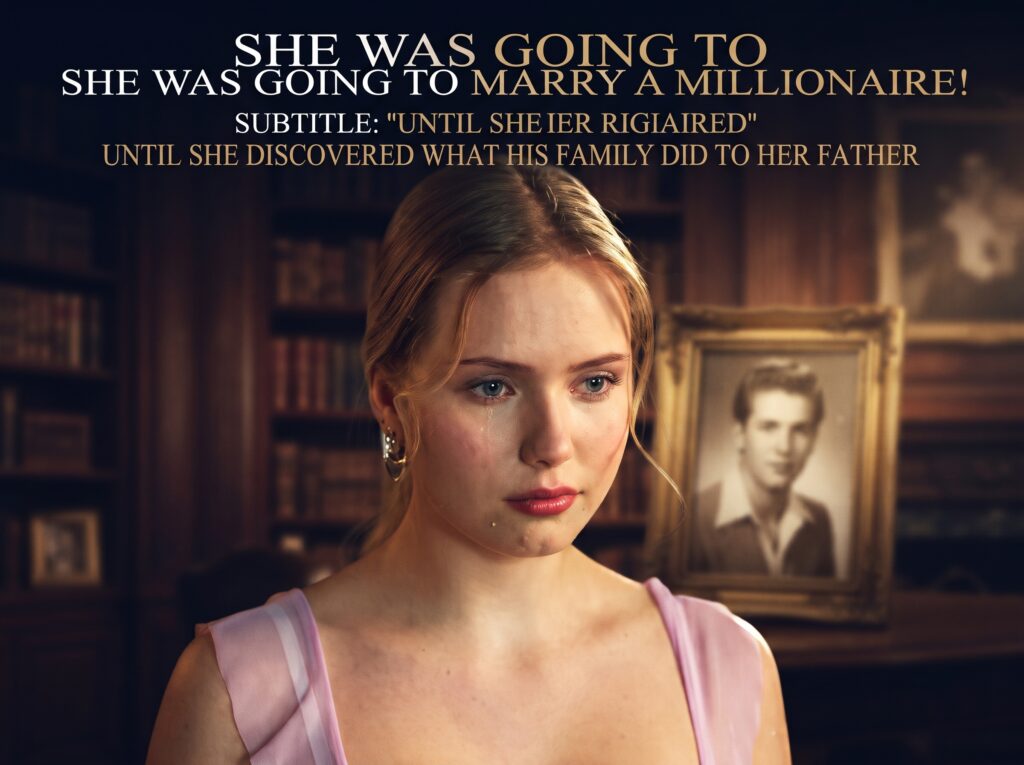
The Night She Discovered Why He Really Wanted to Marry Her
Emily Carter had learned very young that beautiful things were not always meant for people like her.
She grew up in a small two-bedroom apartment in Cleveland, Ohio, where the heating sometimes stopped working during winter and her mother kept a collection of unpaid bills inside an old kitchen drawer.
Her mother, Margaret, worked as a nurse’s assistant at a local hospital. She often returned home after midnight, exhausted, with swollen feet and barely enough energy to prepare dinner.
Emily never complained.
At sixteen, she began working weekends at a neighborhood bakery. At eighteen, she took a second job as a waitress. By twenty-two, she had saved enough money to move her mother into a slightly better apartment.
She had never expected anyone to rescue her.
Then she met Richard Whitmore.
Richard was thirty-one, handsome, confident, and the only son of a wealthy businessman who owned several hotels and commercial properties.
They met at a charity dinner where Emily was working as a temporary event assistant.
Richard noticed her because she was the only person in the room who seemed more interested in helping an elderly guest find her missing handbag than impressing the wealthy people around her.
“You don’t look like someone who enjoys these parties,” he said when he approached her.
“I enjoy helping people,” Emily answered. “The parties are just where I happen to work.”
Richard laughed.
It was the beginning of something neither expected.
He started visiting the small café where Emily worked. Sometimes he ordered coffee he never finished simply because he wanted to talk to her.
He remembered her favorite flowers, asked about her mother, and never made her feel embarrassed about her modest background.
For the first time in her life, Emily allowed herself to imagine a different future.
Six months later, Richard proposed.
He gave her a beautiful diamond ring and promised that she would never have to worry about money again.
Emily cried.
Not because of the ring, but because she believed someone had finally chosen her without judging where she came from.
However, Richard’s father, Charles Whitmore, was not pleased.
At their first formal dinner together, Charles barely looked at Emily.
“So, what does your family do?” he asked.
“My mother works at a hospital,” Emily replied.
“And your father?”
Emily lowered her eyes.
“I haven’t seen him since I was six.”
Charles put down his wineglass.
For a moment, something changed in his expression.
It was brief, but Emily noticed.
“Interesting,” he said.
She assumed he was simply uncomfortable.
She had no idea that he recognized the family name.
And she certainly did not know that the man she believed had abandoned her was connected to the Whitmore family in a way that could destroy everything.
Part 2 — The Woman Who Appeared Before the Engagement
The engagement celebration was scheduled for Saturday evening at the Whitmore estate.
The mansion stood on several acres of landscaped gardens outside Cleveland. White flowers decorated the entrance, crystal chandeliers illuminated the ballroom, and a string quartet played softly near the staircase.
Emily had never attended an event like it.
She wore a lavender dress selected by Richard’s mother, Helen. Her blonde hair was arranged elegantly, and a small pair of gold earrings completed the outfit.
Richard stood beside her, speaking with business partners.
“You look beautiful,” he whispered when he returned.
Emily smiled.
“Do you think your father will ever accept me?”
Richard’s smile disappeared briefly.
“Don’t worry about him. I love you. That’s what matters.”
Before Emily could answer, a woman approached.
She appeared to be in her late fifties. She wore a simple navy coat and carried a small brown envelope.
“Emily Carter?”
“Yes?”
“My name is Susan Miller. I knew your father.”
Emily felt her stomach tighten.
“My father?”
Susan nodded.
“I need to speak with you. Privately.”
Emily glanced toward Richard.
“Can it wait?”
“No,” Susan replied. “It has already waited twenty years.”
The woman’s voice trembled.
She opened the envelope and removed an old photograph.
Emily stared at it.
There were three people in the picture.
A younger Charles Whitmore stood beside a man Emily immediately recognized from the few photographs her mother had kept.
Her father.
Between them stood a little girl.
Emily.
Her hands began to shake.
“Where did you get this?”
“Your father gave it to me before he disappeared.”
Emily looked again.
On the back of the photograph, someone had written a date and six words.
The money was never meant for us.
“What money?” Emily whispered.
Susan looked toward the ballroom.
“Your father discovered something about Charles Whitmore. Something that was supposed to remain secret.”
Emily’s heart began beating faster.
“Why are you telling me this now?”
Susan hesitated.
“Because your engagement announcement is tonight. And I believe Richard is about to make the same mistake his father made twenty years ago.”
Before Emily could ask another question, Susan slipped a folded piece of paper into her hand.
“Read this before you marry him.”
Then she disappeared into the crowd.
Emily stood beneath the golden chandelier, holding a photograph that had suddenly turned her entire childhood upside down.
Part 3 — The Letter Her Mother Had Hidden
Emily did not return to the ballroom immediately.
She found an empty sitting room and closed the door.
Her hands trembled as she unfolded the paper.
The handwriting was familiar.
She had seen it on the birthday cards her mother kept in an old wooden box.
It belonged to her father.
My dearest Emily,
If you are reading this, then someone has finally decided to tell you the truth.
I did not leave because I stopped loving you.
I left because I discovered something that could have put your mother and you in danger.
There is money in an account that belongs to you. It was created before you were born. Your grandfather wanted it protected until you became an adult.
But someone changed the documents.
Someone used your name.
And the person responsible was someone I once trusted.
Emily stopped reading.
Her father had never abandoned her?
She sat down.
For twenty years, she had believed that he had simply decided his family was no longer important.
Her mother had never spoken badly about him. Whenever Emily asked questions, Margaret always said the same thing.
“Some people leave because they don’t know how to stay.”
Emily had interpreted that as a polite way of explaining abandonment.
Now she wondered whether her mother had been protecting her from something much worse.
The letter continued.
Your mother knows part of the truth. I asked her not to tell you until you were old enough to understand.
If you ever meet Charles Whitmore again, remember this: he knows where the money went.
And he knows why I disappeared.
Emily read the final sentence several times.
Then she heard footsteps outside.
“Emily?”
It was Richard.
She quickly folded the letter.
“Are you all right?”
She opened the door.
Richard looked concerned.
“Everyone is waiting for us.”
Emily stared at him.
“Do you know a man named Daniel Carter?”
Richard’s expression changed.
Only for a second.
But it was enough.
“Why are you asking about him?”
“Because he was my father.”
Richard looked away.
And Emily realized that he knew more than he had ever admitted.
Part 4 — The Secret Richard Never Told Her
Richard closed the sitting-room door.
“Emily, please listen to me.”
She stepped backward.
“How do you know my father’s name?”
Richard rubbed his forehead.
“My father told me something about him several years ago.”
“What?”
“That your father had worked for our family.”
Emily stared at him.
“Worked for your family?”
Richard nodded.
“He was an accountant. He handled some of my grandfather’s private investments.”
“Why didn’t you tell me?”
“Because I didn’t think it was important.”
“Not important?”
Her voice rose.
“Richard, I spent my entire childhood wondering why my father left. You knew he had a connection to your family, and you never thought I deserved to know?”
Richard tried to take her hand.
She pulled away.
“There is more,” he admitted.
Emily felt a cold sensation move through her body.
“Tell me.”
Richard looked toward the ballroom.
“My father said Daniel stole money from the family business. After the investigation began, he disappeared.”
“That’s not what the letter says.”
“What letter?”
Emily hesitated.
She knew she could no longer trust him blindly.
She handed him the photograph.
Richard studied it.
His face became pale.
“I’ve seen this picture before.”
“Where?”
“In my father’s study.”
Emily felt her eyes fill with tears.
“So this isn’t the first time you’ve seen my father.”
Richard said nothing.
“How long have you known?”
“Emily—”
“How long?”
“Since before I proposed.”
The silence that followed was more painful than any argument.
Emily removed the engagement ring.
Richard looked at her.
“What are you doing?”
“I need to know whether I fell in love with you or with a story you created for me.”
She placed the ring on the table.
Then she walked out.
Behind her, Richard remained standing in the sitting room, holding a photograph that his father had spent twenty years trying to destroy.
Part 5 — The Mother Who Finally Told the Truth
Emily drove straight to her mother’s apartment.
Margaret opened the door wearing her old blue cardigan.
She smiled when she saw her daughter.
But the smile disappeared when she noticed her expression.
“What happened?”
Emily placed the photograph on the kitchen table.
“Tell me about Dad.”
Margaret became very still.
For several seconds, neither woman spoke.
Then Margaret sat down.
“I was hoping you would never have to discover it this way.”
“Did he abandon us?”
Margaret closed her eyes.
“No.”
Emily began crying.
“Then why did you let me believe that?”
“Because I was afraid.”
Margaret explained everything.
Daniel Carter had worked as a financial accountant for Charles Whitmore’s father, Edward.
Edward had been a generous man who believed that wealth carried responsibility.
Before his death, he created a private trust intended to help several families who had worked for him.
One portion was reserved for Emily.
The money was supposed to provide education, housing, and financial security when she became an adult.
But after Edward died, Charles began changing the company’s financial records.
Daniel discovered irregular transfers.
When he confronted Charles, he was accused of stealing the money himself.
Daniel tried to prove his innocence.
But Charles had influence, lawyers, and powerful business connections.
Daniel was threatened.
Margaret remembered the night he left.
“He came home at two in the morning,” she said. “He held you while you slept. He kissed your forehead and cried.”
Emily covered her mouth.
“He told me that if he stayed, someone might use you to force him into silence.”
“Where did he go?”
Margaret shook her head.
“He promised he would return when he could prove the truth.”
“Did you ever hear from him?”
Margaret reached into a drawer.
She removed a small wooden box.
Inside were letters, bank statements, and several photographs.
“He sent these over the years.”
Emily picked up the oldest letter.
Her father had written about her first day of school.
Her eighth birthday.
Her graduation.
He had even written about the day she got her first job.
He had known about every important moment.
He had simply been unable to stand beside her.
Margaret wiped her eyes.
“I never stopped loving him. And he never stopped loving you.”
Emily held the letters against her chest.
For twenty years, she had believed she was unwanted.
Now she understood that sometimes the people who love us most are separated from us by circumstances we cannot see.
But one question remained.
If Daniel had evidence, why had he never returned?
Part 6 — The Man Who Had Been Waiting Twenty Years
The following morning, Emily received a telephone call.
The number was unfamiliar.
“Emily Carter?”
“Yes.”
“My name is Thomas Reed. I was a colleague of your father’s.”
Emily sat down.
“Do you know where he is?”
There was a pause.
“Yes. But before I tell you, I need to ask whether you still have the letter he left.”
Emily looked at the envelope on the kitchen table.
“I do.”
“Good. Your father has been trying to contact you.”
Her eyes filled with tears.
“Where is he?”
“He’s in a small town in Pennsylvania. He’s been working under his middle name.”
“Why?”
“Because the original investigation never ended. Your father believed the people responsible were still watching him.”
Emily immediately called her mother.
They arranged to meet Thomas at a small café two days later.
When he arrived, he carried a leather briefcase.
He looked older than the man in the photographs.
He placed several documents on the table.
“Your grandfather’s trust was worth approximately $1.8 million when it was established,” he explained.
Emily stared at him.
“What happened to it?”
“Most of the money was moved into several accounts controlled by companies connected to Charles Whitmore.”
Thomas showed her the records.
The transactions had been made over several years.
Some were labeled as business expenses.
Others appeared to be loans.
But the signatures were suspicious.
“Your father refused to approve these transfers,” Thomas continued. “He discovered that his name had been forged.”
Emily studied the documents.
“Why didn’t he go to the police?”
“He did. But the evidence disappeared before the investigation could move forward.”
Thomas closed the briefcase.
“Your father has something else. An original ledger. It contains the names of the people who approved every transaction.”
Emily looked at him.
“Can I see him?”
Thomas nodded.
“He wants to see you more than anything.”
Then he handed her a small photograph.
It showed a middle-aged man standing outside a modest house.
On the back was written:
I hope my daughter still remembers my voice.
Emily broke down.
For the first time in twenty years, she knew her father was alive.
And she was going to find him.
Part 7 — The Truth That Destroyed the Engagement
Richard spent the next three days trying to contact Emily.
He called her repeatedly, sent messages, and even visited her mother’s apartment.
Margaret refused to let him inside.
“She needs time,” she told him.
“I love your daughter.”
Margaret looked directly into his eyes.
“Then why did you allow your father to keep her family’s truth from her?”
Richard had no answer.
Meanwhile, Emily traveled to Pennsylvania with her mother and Thomas.
They arrived at a modest house surrounded by old trees.
A man was standing on the porch.
His hair had turned gray. His shoulders were slightly bent, and his face carried the exhaustion of someone who had spent too many years running from his past.
But Emily recognized his eyes.
“Dad?”
The man froze.
For a moment, he seemed unable to breathe.
Then he stepped down from the porch.
“Emily?”
She ran toward him.
Daniel caught his daughter in his arms.
Neither spoke.
They simply held each other while twenty years of unanswered questions came pouring out in tears.
“I’m sorry,” he whispered.
Emily shook her head.
“Don’t say that. Just tell me why you couldn’t come home.”
Daniel explained that he had spent years trying to collect enough evidence to clear his name. He had worked under different identities, moved between towns, and avoided contacting his family because he feared someone might discover their location.
He had never stopped watching from a distance.
He knew when Emily graduated.
He knew when she started working.
He knew when Margaret became ill.
But every time he considered returning, someone reminded him that Charles still had influence.
Emily listened quietly.
Then she asked the question she had been afraid to ask.
“Dad, did you know I was engaged to Richard?”
Daniel looked down.
“Yes.”
“Did you know his father was Charles?”
Daniel nodded.
“I knew.”
Emily swallowed.
“Why didn’t you warn me?”
Daniel took a long breath.
“Because I hoped Richard would be different.”
He looked toward the window.
“Your grandfather once believed the Whitmore family would protect us. I made the mistake of believing that their son might still have some of his father’s goodness.”
Emily lowered her eyes.
But Daniel was not finished.
He walked inside and returned with an old black ledger.
“This is why I stayed away.”
He placed it on the table.
Inside were records of every suspicious transaction, copies of original trust documents, and handwritten notes identifying the people involved.
And one name appeared repeatedly.
Charles Whitmore.
But another name appeared on the final page.
Richard Whitmore.
Emily stared at it.
Her heart sank.
Part 8 — The Name on the Final Page
Emily could barely speak.
“Why is Richard’s name here?”
Daniel turned the ledger toward her.
“Because he signed a document six months ago.”
“What document?”
“A transfer agreement involving the remaining assets of the trust.”
Emily shook her head.
“No. Richard wouldn’t steal from my family.”
Daniel did not argue.
He simply showed her a copy.
The document carried Richard’s signature.
It authorized the transfer of the remaining trust assets into a company controlled by Charles.
Emily felt physically sick.
She remembered Richard telling her that his father had never liked her.
She remembered his strange expression when she mentioned Daniel.
And she remembered how quickly he had tried to stop her from asking questions.
“Was he part of it?” she whispered.
“I don’t know,” Daniel replied. “The signature is real. But I don’t know what he was told before he signed.”
Emily spent the night reading the documents.
The next morning, she discovered something unusual.
The final transfer had never been completed.
Someone had stopped it.
A handwritten note was attached to the last page.
I cannot allow this to happen again.
The note was signed by Richard.
Emily stared at the handwriting.
Daniel examined it.
“This was written after the transfer agreement.”
“Then why did he sign the first document?”
“Perhaps he didn’t understand what he was signing. Or perhaps he discovered the truth afterward.”
Emily knew she needed to speak with him.
But this time, she would not accept another beautiful promise.
She wanted evidence.
She wanted honesty.
And she wanted to know whether the man she loved had chosen her or his family’s fortune.
That afternoon, Richard sent her one final message.
Meet me at the place where we first met. I have something your father deserves to see.
Emily read it twice.
Then she replied:
I’ll come. But this time, no more lies.
Part 9 — The Final Confrontation
The charity hall where Emily and Richard had first met looked exactly as she remembered.
The same wooden tables.
The same tall windows.
The same grand staircase.
Richard was waiting near the entrance.
He looked tired.
His usual confidence had disappeared.
“Thank you for coming,” he said.
Emily remained standing.
“What do you want?”
Richard handed her a folder.
Inside were original emails between him and his father.
The first message was dated six months earlier.
Charles had instructed Richard to approve a transfer involving a private family trust.
Richard had believed it was a routine business transaction.
But when he later examined the supporting documents, he discovered Emily’s name.
He began investigating.
The more he learned, the more he realized that his father had been involved in destroying Daniel Carter’s reputation.
“Why didn’t you tell me?” Emily asked.
Richard looked at the floor.
“Because I was afraid.”
“Afraid of what?”
“Of losing you. Of discovering that everything my father had built was based on something terrible. And of becoming the kind of man I had spent my entire life believing I wasn’t.”
Emily’s eyes filled with tears.
“So you decided I didn’t deserve the truth?”
“I know I was wrong.”
He handed her another document.
It was a sworn statement explaining how he had discovered the forged records and stopped the final transfer.
He had also contacted an independent attorney and agreed to testify.
“I can’t undo what my father did,” Richard said. “But I can help return what belongs to your family.”
Emily looked at him.
“Do you understand what you took from me?”
Richard nodded.
“Your trust.”
“No. You took twenty years of my father’s life from my understanding. You let me believe he had abandoned me. You watched me build a relationship with you while knowing that your family had destroyed mine.”
Richard’s eyes filled.
“I know.”
Emily placed the documents back inside the folder.
“Love isn’t supposed to make someone afraid to ask questions.”
Richard looked at her.
“I still love you.”
Emily’s voice softened.
“I loved you too. But I cannot marry someone simply because I remember who he was before I discovered who he became.”
For a long moment, neither spoke.
Then Emily walked toward the exit.
Richard did not follow.
For once, he understood that loving someone did not mean demanding another chance.
Sometimes it meant allowing them to leave.
Three weeks later, Charles Whitmore received a formal legal notice.
The original trust documents, bank records, and sworn statements had been submitted to the authorities.
The investigation was reopened.
And for the first time in twenty years, Daniel Carter’s name was no longer buried beneath an accusation he had never deserved.
But Emily’s greatest surprise was still waiting.
It arrived in a letter from her grandfather’s attorney.
Part 10 — The Inheritance That Was Never About Money
The attorney’s letter confirmed that the original trust had been established in Emily’s name.
After the fraudulent transfers were reviewed, a substantial portion of the money was recovered.
The final amount available to Emily, including interest and recovered assets, was just over $2.1 million.
But the letter contained something else.
Her grandfather had left a personal message with the original trust documents.
Emily opened it while sitting beside her father.
My dearest Emily,
You may never remember me, but I remember holding you when you were only a few weeks old.
Your father was a good man. Your mother was a brave woman. I wanted you to grow up knowing that your future did not have to be determined by the mistakes of others.
This money was never meant to make you wealthy.
It was meant to make sure you always had a choice.
Choose a life where you are loved for who you are, not for what you own.
With all my love,
Your grandfather.
Emily cried as she read the final sentence.
For years, she had believed that wealth was something other people inherited while she inherited only hardship.
Now she understood what her grandfather had truly wanted.
He had wanted her to have freedom.
The money allowed Emily to pay for her mother’s medical treatment, purchase a comfortable home, and establish a small scholarship for young women who had grown up in difficult financial circumstances.
Daniel moved back to Ohio.
For the first time in twenty years, he and Margaret could sit together at the same kitchen table.
Their relationship was not instantly repaired. Too much time had passed, and too many painful memories remained.
But they began slowly.
Coffee in the mornings.
Long walks in the park.
Old photographs.
Stories about the daughter they had both loved from a distance.
As for Richard, he eventually testified against his father and helped investigators recover additional records.
He sent Emily one final letter.
I understand if you never forgive me. I only hope that one day you remember that there was a time when I truly loved you.
Emily kept the letter.
But she did not answer it.
Months later, she met someone new at the community center where she volunteered.
His name was James.
He was a schoolteacher who had grown up in a working-class family. He did not own a mansion, drive an expensive car, or speak about business empires.
He brought her coffee after long meetings.
He remembered her mother’s birthday.
And when Emily told him about her past, he listened without trying to turn her pain into a story about himself.
One evening, they sat together on a park bench.
“Do you ever regret what happened?” James asked.
Emily thought for a moment.
“I regret losing so much time believing I wasn’t worth staying for.”
James gently took her hand.
“Maybe you were always worth staying for. You just hadn’t met the people who understood that yet.”
Emily smiled.
For the first time in years, she felt peaceful.
She had not found happiness in a millionaire’s mansion.
She had found it in the people who stayed when life became difficult.
And when her mother asked whether she would ever marry again, Emily laughed.
“Maybe,” she said. “But next time, I’ll make sure the man loves me even when there is nothing to inherit.”
That evening, she returned home and placed her grandfather’s letter inside a small wooden box beside her father’s old photograph.
The photograph no longer represented a family secret.
It represented a family that had survived.
And Emily finally understood the most important lesson of her life:
Money can give you comfort, but it cannot give you love. A beautiful house can impress the world, but only honest people can make it feel like home.
Sometimes, the greatest inheritance is not the fortune waiting in a bank account.
It is the truth that finally brings a family back together.