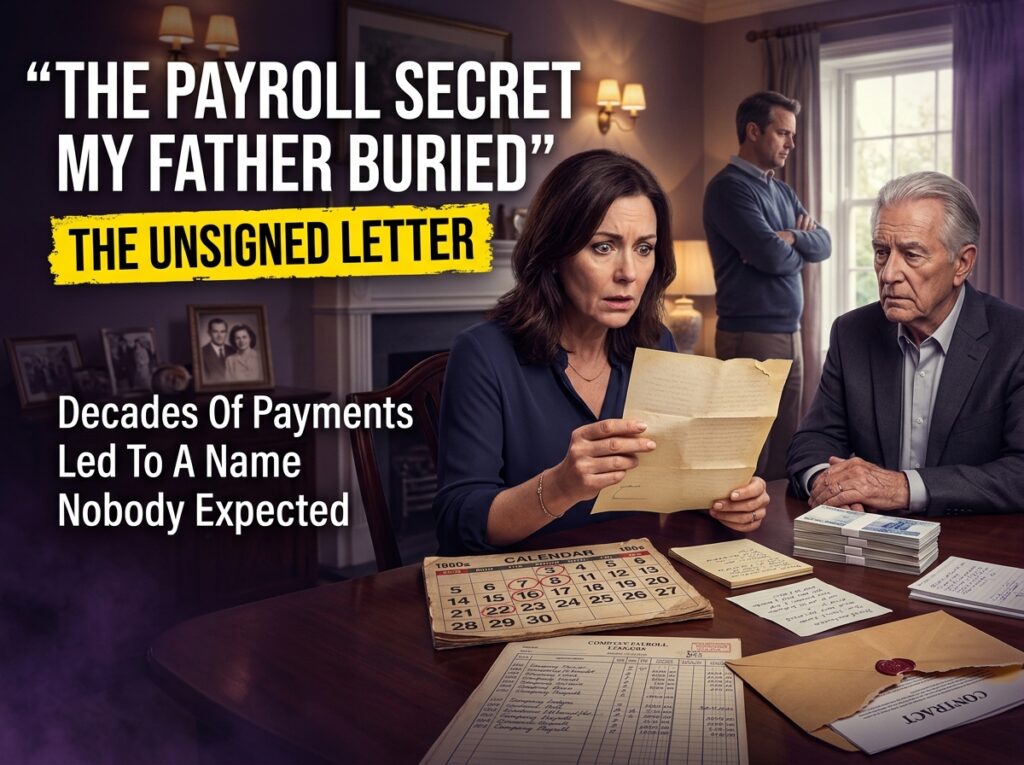
The meeting was supposed to settle my father’s estate.
Instead, it was the first time I realized that the story my family had told for twenty years might have been built around a lie.
We were sitting in the dining room of my parents’ old house, the same room where birthdays had been celebrated, arguments had ended in silence, and my father had always insisted that family disagreements should remain inside the family.
My older brother, Richard, sat beside the window. My aunt Margaret occupied the chair closest to the fireplace. Across from them was my father’s former business partner, Arthur Bennett, a thin, silver-haired man who had arrived carrying a leather folder.
Our solicitor, Mr. Collins, sat at the head of the table.
I had come expecting discussions about the house, the remaining company shares, and the documents needed to complete the estate. The property had been sold the previous week, and everyone seemed eager to finish the paperwork.
Then Arthur mentioned the payroll.
“The week the property was sold,” he said, “was also the week your father planned to correct the company records.”
Richard immediately looked up.
“We’ve already discussed the company,” he said. “Dad retired years ago. There is nothing left to correct.”
Arthur did not respond immediately.
He opened his folder and removed a sheet of paper.
“I’m not talking about the retirement accounts. I’m talking about the payroll records from the year the partnership changed.”
Aunt Margaret adjusted the sleeve of her cardigan.
“Arthur, surely this isn’t necessary.”
“It became necessary when the property was sold.”
The room fell quiet.
My father, Thomas Morgan, had owned a small manufacturing company with Arthur for nearly thirty years. They had started with a rented workshop, two secondhand machines, and a handful of customers. By the time I was old enough to understand what the company did, it employed dozens of people and occupied a large industrial building outside town.
Richard had always been presented as the natural successor. He worked in the business during his twenties and eventually became its managing director. I had taken a different path, working in administration elsewhere and visiting the company only occasionally.
When the partnership ended, the family explanation was simple: Arthur had wanted to sell, my father had refused, and their disagreement had become so bitter that they never reconciled.
According to Richard, Arthur had abandoned the business at a difficult time and left my father to rebuild it alone.
My father never contradicted that account.
Arthur, however, had never discussed the dispute with me.
Until now.
“What payroll records?” I asked.
Richard turned toward me.
“Old administrative paperwork. You don’t need to concern yourself with it.”
“Then why are we discussing it?”
“Because Arthur has never accepted that the business moved on without him.”
Arthur gave a tired sigh.
“I accepted the business moved on. What I never accepted was being blamed for something I didn’t do.”
Mr. Collins raised his hand.
“Let’s remain calm. If there are records relevant to the estate, we can examine them properly.”
Richard leaned back.
“Fine. Examine them. You’ll find nothing.”
Arthur closed his folder.
“Perhaps. But before anyone makes another statement about what happened, I want the original payroll ledger located.”
My aunt looked at him sharply.
“That ledger no longer exists.”
“How do you know?”
She opened her mouth, then closed it.
It was a small hesitation, but I noticed it.
So did Arthur.
He looked at her for several seconds before turning to Mr. Collins.
“That is exactly why I asked for this meeting.”
The discussion became uncomfortable after that. Richard questioned Arthur’s motives, my aunt complained about reopening old disagreements, and Mr. Collins repeatedly reminded everyone that no conclusion could be reached without evidence.
Eventually, we agreed to meet again after the remaining documents had been reviewed.
On the way out, Arthur stopped beside me.
“Your father trusted you more than you realize,” he said quietly.
I frowned.
“He rarely discussed the company with me.”
“That doesn’t mean he didn’t trust you.”
He handed me a business card.
“If you find anything unusual among the family records, call me before you show it to your brother.”
“Why?”
Arthur looked toward the dining room, where Richard was gathering the papers.
“Because there are people who have spent years defending a version of the past that they cannot afford to have questioned.”
He left before I could ask what he meant.
That evening, I returned to the old house to collect a box of personal documents. My father had kept years of correspondence in a cupboard beside his study. After his death, the family had agreed that I would sort the papers because I was the only one willing to spend time on the task.
Most of the documents were ordinary: utility bills, insurance policies, receipts, and letters from customers.
At the bottom of a box marked COMPANY RECORDS, I found a thin bundle tied with string.
The first pages contained meeting notes.
The next was a payroll summary.
Beneath it lay a single sheet of paper with my father’s company letterhead.
The heading read:
Notice of Resignation.
The letter stated that a senior employee intended to resign from the company effective immediately. It referred to a private agreement and requested that all outstanding wages be settled before the departure.
But the signature line was blank.
There was no date beside the signature.
Only a handwritten note in the margin:
Do not file until Thomas agrees.
I sat down.
Someone had prepared a resignation letter but never signed it. Someone had wanted the document held back until my father agreed to something.
I read it again, then checked the payroll summary beneath it.
A payment had been scheduled for the same week the resignation was supposed to take effect.
The amount was not remarkable by itself.
What disturbed me was the name beside the payment.
It had been crossed out.
I carried the papers into the study and switched on the desk lamp. My father had kept an old family calendar in the same cupboard, recording birthdays, business trips, appointments, and important household events.
I found the calendar for the year printed on the payroll summary.
One date had been circled.
Beside it, my father had written:
Arthur. Final meeting. No witnesses.
I looked at the unsigned resignation letter again.
For the first time, I wondered whether Arthur’s departure from the company had been as straightforward as Richard had always claimed.
And I began to suspect that the property sale had brought the family back to a secret my father had spent decades trying to keep buried.
<h2>Part 2</h2>
I did not tell Richard about the resignation letter the following morning.
I wanted to understand what I had found before allowing the family argument to become another contest between competing memories.
I spread the papers across the study desk and made a list of every date, name, and payment reference.
The resignation letter had been prepared in late September. The payroll summary covered the same period. The calendar entry referred to a final meeting between my father and Arthur.
A second payment appeared three months later.
Then another, almost exactly a year after that.
At first, I assumed the entries were ordinary business expenses. The company had paid contractors, suppliers, temporary workers, and consultants over the years. A recurring payment did not automatically mean anything suspicious.
But the references were inconsistent.
Some payments were labeled as consulting fees. Others were described as adjustments, reimbursements, or administrative costs. A few contained only initials.
The amounts varied, yet the payments continued across several years.
I checked the dates against the family calendar.
Each time one of the larger payments appeared, my father had written something beside the corresponding date.
Meeting.
Private matter.
Do not discuss.
One entry contained a name I recognized: Eleanor.
My mother.
She had never worked for the company, although she occasionally helped my father with correspondence. I remembered her spending long evenings at the dining table, writing letters while he reviewed invoices.
Why would her name appear beside a company payroll entry?
I searched the box again.
Behind the payroll summary was a small envelope containing copies of bank transfer instructions. The oldest was faded, and part of the reference number had become illegible.
The recipient’s name was missing.
However, the account reference matched one of the later payments.
I placed the documents in chronological order.
There was a pattern, but I could not yet explain it.
The payments began around the time Arthur left the company. They continued through years when the business appeared to be operating normally. They stopped briefly, then resumed shortly before my father’s retirement.
The final entry was dated several weeks before he died.
That payment had been marked with a single word:
Complete.
I stared at it.
Complete what?
The property had been sold only recently, yet the company records suggested that some private arrangement had continued for decades.
I called Arthur.
He answered after several rings.
“I found the resignation letter,” I said.
He was silent.
“Does it have a date?”
“Not beside the signature. The payroll summary suggests late September.”
“Read me the handwritten note.”
I did.
Arthur exhaled slowly.
“I was afraid that document might still exist.”
“What does it mean?”
“I cannot explain the entire matter over the phone. But I can tell you this: I never signed a resignation letter like that.”
“Then why was it prepared?”
“That is what I have been trying to establish.”
I looked at the blank signature line.
“Richard says you abandoned the company.”
“Richard was young when the partnership ended. He heard your father’s version of events.”
“Did you leave voluntarily?”
Arthur paused.
“I left the business. That is not the same as agreeing to everything that happened afterward.”
I asked him about the recurring payments.
He said he remembered certain transfers being made after the partnership changed, but he had not authorized every payment and did not have access to the full records after leaving.
“Could they have been made to settle a debt?”
“They could have been. Or they could have been wages, compensation, or something else. The records need to be examined together.”
“Do you know whose name was crossed out?”
“No. I never saw the copy you are describing.”
I felt frustration rising.
“Everyone seems to know something, but nobody will tell me the whole story.”
“Because nobody has the whole story,” Arthur replied. “Not even me.”
His answer surprised me.
I had imagined that he was waiting to reveal a dramatic accusation against my father. Instead, he sounded like a man who had spent years trying to understand why a relationship had ended without a proper explanation.
“Meet me tomorrow,” he said. “Bring copies of the documents, not the originals. We should have a solicitor present if we discuss anything that might affect the company or the estate.”
I agreed.
After the call, I went downstairs and found Richard in the kitchen.
He was holding a stack of property documents.
“Have you finished sorting Dad’s papers?” he asked.
“Not yet.”
“Good. I need the company records. The accountant says we should destroy anything that is no longer legally required.”
“Why destroy them before we’ve reviewed them?”
He frowned.
“Because keeping boxes of old paperwork serves no purpose.”
“What about the payroll records?”
His expression changed.
“What payroll records?”
I watched him carefully.
“The ones from the year Arthur left.”
Richard placed the papers on the counter.
“I told you not to get involved in that.”
“You told me there was nothing to find.”
“Because there is nothing relevant to the estate.”
“Then you won’t mind if I ask the solicitor to review them.”
He stepped closer.
“You have no idea what you’re reopening.”
“Then explain it to me.”
He looked toward the hallway, as though checking whether anyone else could hear us.
“Arthur is bitter. He has always wanted to make Dad look bad. Don’t let him use you.”
“Did Dad prepare an unsigned resignation letter?”
Richard went still.
For several seconds, neither of us spoke.
Then he said, “Where did you find that?”
His answer told me more than a denial would have.
I picked up my folder.
“Why does that document frighten you?”
Richard’s jaw tightened.
“It doesn’t frighten me.”
“Then why are you asking where I found it?”
He turned away.
“You’re making a mistake.”
“Maybe. But I’m going to find out what happened.”
I left him standing in the kitchen.
That evening, I reviewed the family calendar again.
The date of the final meeting matched the date of a payment made to an account whose recipient had been crossed out.
Beside the entry, my father had written a sentence I had not noticed before.
If she agrees, everything can remain as it is.
I read it several times.
She.
Not he.
The unsigned resignation letter might have been connected to a person the family had never discussed openly.
And if that was true, the secret might not concern Arthur’s departure alone.
It might concern someone whose future had depended on remaining invisible in the company records.
<h2>Part 3</h2>
Arthur chose a small office near the old industrial district for our meeting.
He arrived carrying two folders and a notebook. Mr. Collins joined us shortly afterward, explaining that he wanted to ensure the documents were handled carefully because some could relate to the company’s historical accounts.
I placed copies of the resignation letter, payroll summaries, and calendar entries on the table.
Arthur studied them without speaking.
When he reached the handwritten note, he removed his glasses.
“I recognize this handwriting,” he said.
“My father’s?”
“No. The note was written by someone in the accounts department.”
“Who?”
“Her name was Helen Ward. She handled payroll and bookkeeping for several years.”
I wrote the name down.
“Was she involved in the partnership dispute?”
Arthur shook his head.
“Not officially. But she was present when the company records were prepared. She knew how the payments were recorded and which documents were missing.”
“Do you know where she is now?”
“I haven’t spoken to her in decades.”
Mr. Collins asked whether Arthur had any correspondence from Helen that could help establish the context.
Arthur opened his second folder.
He had preserved several letters from the period following his departure. Most concerned customers, equipment, and the transfer of company responsibilities. One letter, however, referred to a payroll discrepancy.
It was addressed to Arthur but had never been sent.
The writer explained that an employee’s wages had been recorded under a temporary reference and that the supporting paperwork would be delivered after a private meeting.
The letter contained no name.
At the bottom, someone had written:
Thomas says the arrangement must remain confidential until the other matter is settled.
“Was this written by Helen?” I asked.
“Yes. I recognize her signature.”
“Did she explain what the other matter was?”
“No.”
Arthur looked at the unsigned resignation letter again.
“I remember asking your father about a resignation before I left. He told me that an employee had decided to leave and that the matter had been handled. I didn’t question it because I was dealing with the partnership dispute.”
“Could the letter have been intended for you?”
“I don’t think so. It refers to a senior employee, but it doesn’t identify the person. I was a partner, not an employee.”
Mr. Collins examined the payroll summaries.
“The recurring payments may be connected to the same arrangement, but we cannot assume that until the entries are reconciled with the underlying accounts.”
I agreed.
We needed the original payroll ledger and any supporting employment records. Without them, we could identify patterns but not determine their meaning with confidence.
Arthur told us that the company had used a small archive room at the industrial building. When the business changed ownership, some records had been transferred to a storage facility.
He had been told that the documents were destroyed after the required retention period, but he had never seen proof of that.
“Who handled the transfer?” I asked.
“Richard was responsible for the company administration by then.”
I thought about my brother’s reaction in the kitchen.
“Did Richard know about Helen?”
“He knew her name. She worked there before he took over.”
“Did he know about the payments?”
Arthur shook his head.
“I cannot say.”
Mr. Collins suggested that we request the available company records formally and preserve any remaining documents. He also recommended that we avoid accusing anyone until the financial entries could be verified.
I agreed.
After the meeting, Arthur walked with me toward the car park.
“Your father was not always the man people remember,” he said.
“What do you mean?”
“He was generous. He gave people work when nobody else would. He helped employees who were struggling. But he believed that helping someone meant taking control of the situation.”
“That sounds like him.”
“If a person needed money, he would provide it. If a person needed protection, he would arrange it. Then he expected the matter to remain private.”
“Was that what happened with you?”
Arthur stopped walking.
“Partly. Your father and I disagreed about the company. But there was also an arrangement involving an employee. I believed the arrangement should have been documented properly. Your father believed that the paperwork would expose something the employee had a right to keep private.”
“Did you leave because of that disagreement?”
“I left because the partnership had become impossible. I never received a complete explanation of the payroll matter.”
He looked toward the road.
“I have spent years wondering whether your father thought he was protecting someone or protecting himself.”
The question stayed with me on the drive home.
That evening, I searched the family records for Helen Ward.
I found a photograph of a company picnic. My father stood near the center, smiling beside several employees. Arthur was on one side, and a woman with dark hair stood near the back.
On the reverse, my mother had written the names of everyone in the photograph.
The woman was Helen.
I searched the next box and found a Christmas card addressed to my mother. Helen thanked her for a kindness and wrote that she would never forget what the family had done for her.
There was no explanation of the kindness.
But the card had been kept for more than thirty years.
I showed it to Claire, who had come to help me sort the remaining documents.
“Maybe your mother knew her personally,” she said.
“Perhaps.”
“Could the payments have been financial assistance?”
“They could have been. But why would the company record them as payroll?”
Claire studied the card.
“Maybe that was the easiest way to arrange regular payments without drawing attention to them.”
I considered the possibility.
If Helen had been helping someone whose identity needed to remain private, my father might have used the company payroll as a means of providing support.
But that would raise another question.
Why had the arrangement continued for decades?
I searched the calendar for the first date associated with Helen’s name.
It was earlier than the resignation letter by nearly ten years.
Beside it, my father had written:
Promise made.
The next entry appeared two months later.
First payment.
The payments might have begun long before Arthur left.
That meant the partnership dispute had not created the secret.
It had merely brought it into danger.
I placed the card beside the payroll records and returned to the unsigned resignation letter.
The blank signature line looked less like an unfinished administrative task and more like evidence of a decision that someone had refused to complete.
Whoever had been expected to sign the letter had apparently never agreed to leave.
And my father had spent decades managing the consequences.
<h2>Part 4</h2>
I found Helen Ward’s name in an old company directory at the public library.
The directory listed an address in a neighboring town, but it was more than twenty years old. I did not know whether she still lived there, and I was reluctant to contact someone who might have no desire to revisit a painful period of her life.
I asked Mr. Collins to help determine whether a legitimate route existed for contacting her. He explained that we could make a respectful inquiry without disclosing private financial information or assuming she had been involved in wrongdoing.
A week later, he received a response through a former colleague.
Helen was alive, living quietly in retirement, and willing to speak with us.
We arranged a meeting at her solicitor’s office.
She arrived carrying a small handbag and a notebook. Her hair had turned silver, and she walked with the careful movements of someone whose knees had become unreliable with age.
She recognized Arthur’s name immediately.
“I wondered when someone would ask about those records,” she said.
I showed her a copy of the unsigned resignation letter.
She studied it for a long time.
“I prepared this,” she said.
“Why was it never signed?”
“Because the person it concerned did not want to resign.”
“Who was that person?”
Helen closed the notebook.
“I need to understand what you have already found before I answer that.”
I told her about the payroll entries, the family calendar, and the recurring payments. I explained that my father had kept the documents and that we were trying to establish why the arrangement had continued.
Helen listened without interrupting.
When I finished, she looked at Arthur.
“Did Thomas ever tell you why he asked you to leave?”
Arthur shook his head.
“He said the partnership was finished. He never gave me the full explanation.”
Helen sighed.
“Thomas was trying to protect someone. He believed that if the person’s identity became known, the family would use it against them.”
“Who?” I asked.
She did not answer immediately.
“Before I tell you, you need to understand that the payments were not proof of theft. They were recorded because the company needed a way to account for money that Thomas had promised to provide.”
“Was the money paid to an employee?”
“Not always. Some payments covered wages. Others were intended to support a person who could not safely be identified in the company records. The accounting was imperfect, and I told Thomas that it could create serious problems.”
“Why didn’t he use a private account?”
“He believed the company could afford the payments and that keeping everything together would make it easier to monitor what had been paid.”
Arthur leaned forward.
“Did you tell him that the arrangement was putting the company at risk?”
“Repeatedly.”
“Then why did you continue processing the payments?”
Helen looked at him.
“Because the money was going where Thomas said it should go, and because I believed the person receiving it needed help. I should have insisted on proper documentation. But I was not in a position to overrule the owner.”
She turned back to me.
“Your father could be a difficult man. But when he made a promise to someone who was vulnerable, he took it seriously. Sometimes too seriously.”
I thought about the sentence in the family calendar.
If she agrees, everything can remain as it is.
“Was the person a woman?” I asked.
Helen nodded.
“Yes.”
“Was she connected to our family?”
Helen took a breath.
“She was connected to your family in a way Thomas never explained publicly.”
I felt my hands tighten around the edge of the table.
“Was she the reason Arthur left?”
“She was one reason the situation became impossible. Arthur wanted the company accounts to be transparent. Thomas believed transparency would expose the woman. Neither man trusted the other to handle the matter carefully.”
Arthur looked at her.
“I never wanted to expose anyone. I wanted the records to make sense.”
“I know that now,” Helen replied. “At the time, Thomas believed you would insist on a formal investigation, and he was afraid that the investigation would reveal the person’s identity.”
“Did you know the full story?”
“No. I knew enough to understand why Thomas was worried, but I was not told everything.”
She opened her notebook.
Inside was a list of dates and payment references she had copied years earlier. She had kept it because she feared that the original records might disappear.
The references matched several entries in my father’s payroll summaries.
At the bottom of the list was a note:
Final transfer pending signature.
I recognized the date.
It was the same week the property had been sold.
“Why did you keep this?” I asked.
“Because Thomas asked me to preserve a record of the payments. He said that one day the person might need proof that the money had been provided as promised.”
“Who was the person?”
Helen closed the notebook again.
“I believe you should ask the lawyer. Your father left instructions with him. I don’t know whether those instructions were ever carried out.”
I stared at her.
“What lawyer?”
“Not your current solicitor. A lawyer who handled a private agreement many years ago. Thomas told me that the final document would remain sealed until the property was sold or the person agreed to reveal their identity.”
I looked at Arthur.
He appeared as stunned as I felt.
“Do you know the lawyer’s name?” I asked.
Helen wrote it down.
Before we left, she offered one final warning.
“Do not assume that the person your family blamed was the person Thomas was protecting. And do not assume that the person he protected knew what he had done to keep the promise.”
Those words followed me all the way home.
My father had created a financial arrangement that continued for decades. He had concealed the recipient’s identity, allowed a resignation letter to remain unsigned, and kept a private agreement with another lawyer.
The payments had been recorded, but the reason for them had remained hidden.
And now the property sale had apparently triggered the final stage of an arrangement that had outlived nearly everyone who understood it.
<h2>Part 5</h2>
The lawyer’s name led us to a small legal practice that had since merged with a larger firm.
Mr. Collins contacted the successor firm and explained that we were seeking records connected to my father’s company and estate. After reviewing the available documentation, the firm confirmed that it held a sealed envelope relating to a historical agreement.
The envelope had been stored with instructions that it should not be opened until a specified event occurred.
That event, according to the file, was the sale of the property connected to the agreement.
The timing was too precise to ignore.
The property had been sold the previous week.
Mr. Collins arranged an appointment to review the document in accordance with the firm’s procedures.
Richard learned about the appointment before we attended.
He called me that evening.
“You’ve gone too far,” he said.
I was standing in the study with the unsigned resignation letter in front of me.
“What do you mean?”
“You’ve contacted former employees, dug through Dad’s records, and now you’re involving another law firm.”
“I’m trying to understand the company payments.”
“Those payments were handled years ago.”
“Then the records should explain them.”
Richard’s voice rose.
“Not everything needs to be dragged into the open.”
I remembered my aunt’s warning at the first meeting.
Some truths were better left buried.
“Why does everyone keep saying that?”
“Because Dad had reasons for doing things the way he did.”
“Did you know about the sealed agreement?”
Silence.
Then Richard said, “I know there was a private arrangement. I don’t know everything about it.”
“How much do you know?”
“Enough to know that opening that envelope could hurt someone.”
“Who?”
“I can’t tell you.”
“Can’t or won’t?”
He ended the call.
I sat in the study for a long time.
Richard’s reaction could have meant many things. He might have known the recipient’s identity. He might have been protecting someone out of loyalty. Or he might simply have been afraid that the discovery would undermine his own position in the company.
I refused to decide which explanation was correct without evidence.
The following morning, Claire accompanied me to the legal office.
The solicitor who received us explained that the envelope contained a private agreement, related correspondence, and a final instruction from my father. She emphasized that the firm needed to verify the relevant parties before disclosing sensitive information.
Mr. Collins provided the estate documents and the records we had gathered.
After the preliminary review, the solicitor opened the envelope in our presence.
The first page was an agreement signed by my father and another individual. It established a series of payments intended to support a person until a particular condition was fulfilled.
The second page listed payment dates.
They matched the entries in the payroll summaries.
The third page contained a reference to the unsigned resignation letter.
It explained that the letter was never to be filed unless the employee concerned personally chose to leave. The purpose had been to preserve the person’s ability to return to work without having to explain the private arrangement to the company.
I read the passage twice.
The resignation letter had not been prepared to force someone out.
It had been prepared as an option.
But someone had kept it among the records as though the matter had never been resolved.
The solicitor turned to the final instruction.
My father had written that the person receiving the payments should be given the opportunity to decide whether their identity could be disclosed after the property was sold.
He had also instructed that any remaining amount due under the agreement should be reviewed before the estate was distributed.
I looked at Mr. Collins.
“Does this mean the payments were a debt?”
“Not necessarily. We need to examine the full agreement and its terms. Some payments appear to have been support, while others may have been recorded as wages or compensation. We cannot classify every transfer without reconciling the records.”
The solicitor nodded.
“Your father was careful to distinguish the payment arrangement from the company’s ordinary payroll, even though the records were not consistently labeled.”
I thought about the recurring transfers.
They had looked like separate, harmless transactions because each one had been recorded under a different description.
Together, they formed a history of promises.
The agreement did not yet reveal the recipient’s full identity. A name had been replaced by a reference code, and the identifying page was held separately.
The solicitor explained that she could not disclose that page until the person’s rights and the conditions of the agreement had been reviewed.
I understood.
The person my father had protected deserved a choice.
But the existence of the agreement also raised a question about the property sale.
If the sale triggered the final review, someone had apparently known that the family would soon have to confront the arrangement.
Perhaps that explained Arthur’s insistence on examining the payroll.
Perhaps it explained Richard’s anxiety.
Perhaps it explained why my father had left the documents where they could eventually be found.
On our way out, Claire took my arm.
“At least we know he wasn’t trying to force someone out of the company.”
“Yes.”
“But he kept the arrangement secret for so long that everyone invented their own explanation.”
I nodded.
The agreement had been designed to protect a person’s future.
Yet the secrecy had allowed suspicion to grow around the people involved.
I thought of Arthur, who had been blamed for abandoning the company. I thought of Peter, whose reputation had been damaged in a different family dispute. I thought of my mother, who had kept calendars and letters because she knew that the public story was incomplete.
The pattern was becoming clear.
My father had made private decisions to protect people, but he had not always considered the damage that silence could cause to everyone else.
The final identifying page remained sealed.
We would have to wait for the legal review.
And when that page was finally turned toward us, the name beneath it would change the way I understood not only my father’s company but my own place in the family.
<h2>Part 6</h2>
The solicitor contacted us several days later.
The review had established that the agreement was validly preserved, but the identifying page could not simply be handed to the family. The person named in the document, if still living, had to be contacted or their legal representative identified before the information could be disclosed.
Mr. Collins agreed to coordinate the process.
Meanwhile, I continued examining the records that were already available.
The payroll ledger showed that the payments had begun more than thirty years earlier. They continued through periods when the company was profitable and through years when business was difficult.
The amounts changed according to the company’s circumstances.
Some entries were small enough to appear ordinary. Others were substantial. None could be understood properly without the agreement.
The most revealing detail was not the total.
It was the consistency.
My father had continued making payments even after Arthur left. He had continued after my mother became ill. He had continued during the years when he complained that the company was struggling to meet its obligations.
The final payments stopped only shortly before his death.
Someone had been relying on the arrangement for decades.
I took the records to Richard.
He was in his office, surrounded by documents related to the property sale.
“I need you to tell me what you know about the agreement,” I said.
He did not look up.
“I’ve already told you.”
“You said you knew there was a private arrangement. Did you know it involved recurring payments?”
Richard put down his pen.
“I knew Dad had been helping someone.”
“Who?”
“I don’t know the full details.”
“Did you know about the resignation letter?”
“Yes.”
The admission surprised me.
“Why didn’t you say so?”
“Because I didn’t know what it meant.”
“Richard, you knew the letter existed and that Dad was making payments. You must have had some idea.”
He rubbed his forehead.
“I was twenty-six when I first saw it. Dad told me that the employee had been given the option to leave or return when the circumstances were right. He said the matter was private and that I wasn’t to interfere.”
“Did he explain why the employee needed protection?”
“No.”
“Did you ever ask?”
“Once. He told me that it wasn’t my business.”
I sat down.
“Then why have you been telling everyone that Arthur abandoned the company?”
Richard’s face tightened.
“Because that is what Dad told us.”
“Did you know Arthur disputed it?”
“Of course. But Dad said Arthur had refused to accept the changes.”
“Did you know the payroll records might contradict that story?”
Richard looked away.
“I knew there were unresolved questions. I didn’t know what the records would show.”
I studied him.
“Why are you afraid of the identifying page?”
He was quiet for a long time.
Then he said, “Because if the person is who I think it is, this family will never be the same.”
“Who do you think it is?”
“I won’t guess.”
For once, I agreed with him.
We had already seen what happened when people turned suspicion into certainty.
I told him about the solicitor’s review and the need to respect the recipient’s privacy. Richard listened, then nodded.
“I understand that.”
“Do you?”
He looked at me.
“Yes. I don’t want anyone hurt because we opened an old document.”
“Neither do I. But I also don’t want the company records to continue supporting a story that may be wrong.”
Richard sighed.
“I know.”
It was the first time he had acknowledged that the family story might need to change.
After I left his office, I called Arthur.
I told him that the agreement had been found and that the resignation letter was an option rather than a completed resignation.
He was silent for a moment.
“That explains something,” he said.
“What?”
“Your father once told me that the employee had not chosen to leave. He said the company needed to remain open to their return. I assumed he meant someone who had taken time away for personal reasons.”
“Did you ever learn who?”
“No. Thomas refused to tell me.”
“Do you still believe he was trying to protect the person?”
Arthur considered the question.
“I believe he thought he was. Whether he made the right decisions is another matter.”
I asked whether he wanted the family to correct the account of his departure.
“Yes,” he said. “But I don’t want a new accusation made in my name. I want the records to be accurate.”
That evening, I wrote a draft statement explaining what had been established so far. It said that the unsigned resignation letter had not been filed, that the payments were connected to a private agreement, and that the circumstances of Arthur’s departure remained under review.
I sent it to Mr. Collins.
He approved the factual wording and advised us not to include the recipient’s identity until the legal review was complete.
We circulated the statement to the relatives who had attended the estate meeting.
My aunt called almost immediately.
“You should never have opened those papers,” she said.
“Why?”
“Because your father had reasons for keeping them private.”
“Then why did he leave instructions for them to be reviewed after the property was sold?”
She did not answer.
“Aunt Margaret, did you know who received the payments?”
“I knew your father was helping someone.”
“Who?”
“I cannot tell you.”
“Is that because you promised not to, or because you don’t want me to know?”
She began to cry.
“I made a promise to your mother.”
The words stopped me.
“My mother?”
“She asked me to protect the person’s identity until they were ready to speak. Your father believed the same thing.”
“Did my mother know what was in the agreement?”
“She knew more than I did.”
“Then why did she never tell us?”
“Because she believed the person deserved to make their own decision.”
I closed my eyes.
The secret had not belonged to my father alone.
My mother had participated in keeping it.
But perhaps she had understood something he had not: that protecting a person meant preserving their right to choose, not simply deciding what others were allowed to know.
I thanked my aunt for telling me what she could.
Before ending the call, she said, “When the lawyer turns that final page, remember that the name belongs to a person, not a scandal.”
I wrote the sentence in my notebook.
It was the best advice anyone had given me since the investigation began.
<h2>Part 7</h2>
The legal review took another week.
During that time, I learned more about my mother’s role in the arrangement.
She had not authorized the payments, but she had helped my father maintain a separate record of them. Her notebooks included dates, amounts, and brief descriptions of the circumstances surrounding several transfers.
The notes were careful and restrained.
She never described the recipient as a victim or a beneficiary. She simply recorded what had been promised and whether the promise had been fulfilled.
One entry read:
Payment delivered. No acknowledgment requested.
Another said:
Future protected. Identity remains private.
A third, written years later, was more troubling:
Thomas wants to explain. I told him the decision is not his to make.
I read that line repeatedly.
My mother had apparently challenged my father’s assumption that he could decide when the secret should be revealed.
She believed the recipient should control that decision.
I began to understand why she had kept the calendar and correspondence. She had been preserving a record not because she wanted to expose someone, but because she feared the truth would eventually be lost beneath the family’s assumptions.
I found a letter she had written to my father after one of their private discussions.
She acknowledged that he had helped someone in a difficult situation, but she warned him that the company records needed to be accurate.
You cannot protect one person’s future by allowing another person to carry a false accusation, she had written.
The words were unmistakable.
My mother had understood the cost of the arrangement.
She had not demanded that my father reveal the recipient’s identity. She had asked him to correct the record about Arthur and the company.
He had never done so publicly.
I took the letter to Arthur.
He read it in silence.
“Your mother understood the problem better than either of us,” he said.
“Why didn’t you contact her?”
“I did, once. She told me that she believed the truth would eventually emerge, but she could not reveal the private arrangement without the person’s consent.”
“Did you believe her?”
“Yes. Your mother was not someone who made promises casually.”
Arthur returned the letter.
“I was angry with your father for years. I thought he had chosen the company over our friendship. Perhaps he believed he was choosing one person’s future over everything else.”
“Does that excuse what happened?”
“No.”
His answer was immediate.
“Understanding why someone made a decision is not the same as saying the decision was right.”
We sat quietly.
For decades, Arthur had lived with the belief that my father had betrayed him. My father had lived with the fear that revealing the arrangement would harm someone he had promised to protect.
Neither man had found a way to resolve the conflict.
The secret had become larger than the original decision.
That afternoon, the solicitor contacted us.
The person named in the agreement had been located.
They were alive and had received a formal explanation of the documents. They had been given time to decide whether their identity could be disclosed to the family.
The solicitor would not tell us the name.
I respected that.
But she confirmed that the person had acknowledged receiving support under an arrangement made with my father.
That confirmation was significant. It showed that the payments had not simply been invented or fabricated by someone trying to claim a share of the estate.
However, the legal review was not complete. The exact obligations under the agreement still needed to be reconciled with the company accounts.
I asked whether the person wanted to meet us.
The solicitor said that no decision had been made.
After the call, Richard arrived at the house.
He had been quiet since our conversation in his office. Now he looked exhausted.
“I need to tell you something,” he said.
We sat at the dining table.
Richard explained that, years earlier, he had found a separate envelope in my father’s desk. It contained a brief note instructing him not to close a particular account until the private agreement had been reviewed.
He had assumed the account related to a former employee.
When he asked my father about it, my father told him that the money had been promised to someone who needed a chance to build a life without being dependent on the family.
Richard had not asked further questions.
“Why not?” I asked.
“Because I thought it was an arrangement between Dad and someone he had helped. I didn’t want to interfere.”
“Then why have you been trying to stop me from looking into it?”
He looked down at his hands.
“Because I knew the name might hurt you.”
I felt a chill.
“Hurt me how?”
“I don’t know whether the agreement names the person I suspect. But if it does, everything we believed about the company, the property, and the family could change.”
I waited for him to continue.
He did not.
“Richard, if you know something that affects the records, you need to tell the solicitor.”
“I will. I just need to be sure.”
“That is what the review is for.”
He nodded.
For the first time, I saw fear in my brother’s expression that seemed unrelated to money or inheritance.
It was the fear of someone who had spent years avoiding a possibility and now realized that the evidence might make it impossible to ignore.
Before he left, he asked me to promise that I would not announce the recipient’s identity without their consent.
I agreed.
We had come too far to repeat the mistakes that had caused the original conflict.
The name beneath the final page mattered.
But the person attached to that name mattered more.
<h2>Part 8</h2>
The solicitor called us to a formal meeting two days later.
Arthur attended, along with Richard, Aunt Margaret, and Mr. Collins. I brought the original calendar and a copy of my mother’s letter.
The solicitor explained that the recipient had reviewed the agreement and authorized the disclosure of their identity to the relevant family members.
She also made clear that the authorization did not permit us to publish the person’s private financial details or treat the document as proof of anything beyond what it actually established.
Everyone agreed.
Then she placed the sealed identifying page on the table.
For several seconds, nobody moved.
The paper looked ordinary. It had been stored carefully, protected from damage, and marked with the reference number that appeared in the payroll records.
Yet I felt as though the entire history of my family had narrowed to the space beneath one signature.
The solicitor turned the page toward us.
The name was Eleanor Morgan.
My mother.
I stared at it.
For a moment, the room seemed to lose all sound.
My mother had not been an employee of the company. She had not managed payroll. She had never been mentioned in the family account of Arthur’s departure.
Yet her name appeared as the person whose future the agreement had been designed to protect.
I looked at Richard.
He had gone pale.
Aunt Margaret covered her mouth.
Arthur leaned back slowly.
“Thomas,” he whispered, though my father was not there to hear him.
I looked again at the page.
My mother’s signature appeared beneath the acknowledgment.
It was the same careful handwriting I had seen on the family calendar and the notes in her notebooks.
I felt a wave of confusion.
“Why would my mother need payments from the company?”
The solicitor explained that the agreement did not mean my mother had been secretly employed or that she had taken money from the business. It documented an arrangement made by my father to provide financial security for her under circumstances that had not been recorded in the ordinary family papers.
The payments had been administered through company accounts because my father had promised to keep the arrangement private.
Some were recorded as temporary wages or reimbursements. Others were entered as adjustments. The inconsistent descriptions had made the payments difficult to interpret later.
But the agreement itself was clear about the purpose.
My father had wanted to ensure that my mother would have independent resources if their family circumstances changed.
I could barely speak.
My parents had been married for decades. I had never imagined that my mother needed protection from the uncertainty of her own household.
“Was she planning to leave him?” I asked.
The solicitor said the documents did not establish that.
“Did they have financial problems?”
“The agreement refers to a period of uncertainty, but it does not provide a complete explanation. We should not infer more than the records support.”
I looked at the calendar entries.
If she agrees, everything can remain as it is.
The note now made sense in a different way.
My father had been waiting for my mother to decide whether she wanted the arrangement to continue.
The unsigned resignation letter had not been hers to sign. It related to an employee whose departure had become part of the accounting confusion.
But the payments were connected to my mother’s independent financial security.
Arthur looked at the solicitor.
“Why was my departure connected to this?”
She explained that Arthur had objected to the way the payments were recorded. He had asked for clearer documentation, and my father had feared that a full review would reveal the private agreement.
The dispute had grown until the partnership could no longer continue.
Arthur had left without knowing that the person being protected was my mother.
My father had allowed him to believe the disagreement was simply about business.
I turned to Richard.
“You suspected it was Mum.”
He nodded slowly.
“I found a reference to her name in Dad’s desk years ago. I didn’t know what it meant. I thought it might have been an insurance arrangement or something related to the house.”
“Why didn’t you tell me?”
“Because Dad asked me to keep the papers private, and I didn’t understand them well enough to challenge him.”
The explanation hurt, but I could see that Richard had not known the full truth.
He had inherited my father’s silence and mistaken it for a responsibility.
Aunt Margaret began to cry.
“Your mother wanted to know that she could stand on her own if she ever needed to,” she said. “She loved your father, but she didn’t want her future to depend entirely on his decisions.”
I looked at her.
“Did she know he was recording the payments through the company?”
“Yes. She knew about the arrangement. She did not know how much trouble it would cause Arthur.”
Arthur closed his eyes.
“I wish Thomas had told me enough to understand what I was being asked to accept.”
“So do I,” I said.
The solicitor gave us time to absorb the information.
The name beneath the final page had not revealed a hidden fortune or a criminal conspiracy.
It had revealed something more personal.
My father had wanted my mother to have choices.
But in trying to preserve her privacy, he had created a secret that damaged his business partnership, confused the company accounts, and allowed his family to build an inaccurate story about what happened.
The money had mattered.
The secrecy had mattered more.
And the person my father had been trying to protect was the woman whose old calendar had helped me discover the truth.
<h2>Part 9</h2>
The revelation changed the atmosphere of the meeting.
Richard no longer argued that Arthur had abandoned the company without reason. Aunt Margaret stopped insisting that the records should remain private. Even Mr. Collins, who had spent weeks carefully separating facts from assumptions, seemed relieved that the central question had finally been answered.
But I was not relieved.
I kept looking at my mother’s name.
Why had she needed an arrangement that guaranteed her independent resources? Why had my father believed the agreement needed to remain secret? And why had he chosen a method of recording the payments that created so much confusion?
The solicitor reminded us that the agreement could answer only the questions it addressed. It confirmed the recipient, the purpose of the payments, and the conditions under which the records could be reviewed.
It did not tell us everything about my parents’ private relationship.
I accepted that.
Some questions belonged to the people who had lived through them, and both my parents were gone.
Still, I wanted to understand what had happened.
Aunt Margaret explained that my mother had once considered returning to work after taking time away to raise us. My father had supported the idea, but the company had been experiencing financial uncertainty, and the family had been concerned about what would happen if the business failed.
My mother had wanted to ensure that she would have savings of her own.
She did not want to leave the marriage. She wanted the freedom to make decisions without fear of losing her financial security.
My father had agreed to help.
The arrangement was intended to be temporary, but it continued because the company’s circumstances changed repeatedly. Eventually, the payments became part of a long-term agreement.
My mother had kept her own records because she wanted to know exactly what had been promised.
She had also insisted that the agreement be reviewed if the company or the family property was sold.
That was why the property sale had triggered the final legal review.
The secret had not been created to steal money from the company.
It had been created to give my mother a choice.
But my father had handled it badly.
Arthur explained that he had discovered irregular entries in the payroll and asked for the supporting documents. My father refused to disclose the private agreement, and the disagreement became personal.
Arthur had believed the company needed transparent records. My father had believed that revealing the arrangement would violate his promise to my mother.
Neither man found a way to separate the accounting problem from the private agreement.
Eventually, Arthur left.
The family later described his departure as abandonment because that was the version my father had given them.
Now we knew that the story was incomplete.
Arthur did not demand compensation or ask the family to condemn my father.
He asked only that the company records be corrected and that his departure no longer be described as an act of betrayal.
Richard agreed.
“I repeated what Dad told me,” he said. “I never checked the original records.”
Arthur nodded.
“I understand. But now that we know, the account needs to change.”
We prepared a statement documenting what the evidence established. It explained that the payments had been made under a private agreement intended to provide financial security for my mother, that the unsigned resignation letter had not been filed, and that Arthur’s departure had been connected to a disagreement about the company’s handling of the records.
The statement did not speculate about my parents’ private conversations or make claims beyond the available evidence.
We sent it to the relatives who had attended the original estate meeting.
Some apologized to Arthur.
Others were embarrassed that they had repeated the story without questioning it.
One cousin argued that my father had acted out of love and therefore should not be criticized.
I understood the sentiment, but I disagreed with the conclusion.
Love might explain why my father wanted to protect my mother. It did not erase the consequences of the choices he made.
A private promise could have been documented properly. The payments could have been accounted for transparently while protecting the details my mother wanted kept private. Arthur could have been given enough information to understand why the records required special handling.
Instead, the secret became a source of suspicion.
The company lost a partner.
The family inherited an inaccurate story.
And decades later, we were still trying to separate the facts from the assumptions.
That evening, I returned to my parents’ old house.
I sat in the study and opened my mother’s calendar.
The dates were familiar now.
The first payment.
The meeting with Arthur.
The note about the promise.
The final transfer.
For years, I had looked at the calendar as a collection of ordinary reminders. Now I understood that my mother had used it to preserve a record of decisions she did not want forgotten.
She had known that people might eventually misunderstand the payments.
She had known that my father might not explain the arrangement.
And she had left enough clues for someone willing to ask questions to discover the truth.
I found one final note at the bottom of the page.
The money is only useful if the choice remains hers.
I sat very still.
That was what my father had been trying to provide.
Not a fortune.
Not a secret inheritance.
A choice.
My mother had wanted to know that she could support herself if she needed to. She had wanted to remain in the marriage because she chose to, not because she had no financial alternative.
The arrangement had been her safeguard.
The secrecy had been my father’s attempt to protect it.
But by hiding the agreement from everyone except those directly involved, he had made it impossible for others to understand the decisions surrounding the company.
I closed the calendar.
For the first time, I felt that I could remember my father and mother without forcing their story into a simple judgment.
They had loved each other.
They had made mistakes.
They had tried to protect one another.
And they had left behind a secret that could only be understood when the records were read together.
<h2>Part 10</h2>
Several months after the meeting, the company records were formally reviewed and the relevant historical entries were documented.
The work was neither dramatic nor quick. Accountants compared the surviving payroll summaries with the agreement, and the solicitor recorded which conclusions were supported by the documents.
Some gaps remained.
A few receipts had been lost, and several descriptions could not be reconciled with certainty. We did not invent explanations to fill those spaces.
The final record acknowledged what we knew and what we could not prove.
Arthur’s departure was no longer described as abandonment. The company statement explained that the partnership had ended amid a disagreement about confidential payments and the documentation surrounding them.
The unsigned resignation letter was preserved with the other records, along with the note explaining that it was not to be filed unless the employee chose to leave.
The agreement concerning my mother was retained through the proper legal process.
Richard and I also changed the way we handled the remaining estate documents. We stopped treating every old paper as something to be discarded once its immediate purpose had passed.
We created an organized archive of the records that mattered, with clear notes explaining their dates and relevance.
It was a small practical change, but it meant that future family members would not have to reconstruct the same history from fragments.
Arthur visited the old house one final time before returning to his own home.
We sat in the dining room where the first meeting had taken place.
“I spent a long time believing your father had chosen the company over our friendship,” he said.
“Do you still believe that?”
He considered the question.
“I believe he chose secrecy over trust. He thought he was protecting someone, and perhaps he was. But he underestimated what the secrecy would cost.”
I nodded.
“Would you have stayed if he’d told you?”
“Possibly. I would at least have understood why the records needed special treatment. I could have helped him find a way to document the payments without exposing your mother’s private circumstances.”
“Then perhaps the partnership didn’t have to end.”
“Perhaps. We cannot know that now.”
He looked around the dining room.
“Your mother understood something your father struggled with. A person can deserve privacy without everyone else being forced to live with a false story.”
I remembered her note.
The money is only useful if the choice remains hers.
Arthur shook my hand before leaving.
“I am glad you found the records,” he said. “Not because they made your father look better or worse, but because they allowed us to stop guessing.”
After he left, Richard and I remained at the table.
For years, we had argued about the company in ways that reflected the stories we had inherited. Richard had defended our father because he believed loyalty required it. I had defended Arthur because I thought the documents proved the family story was wrong.
Neither of us had possessed the whole picture.
“We should have questioned the story earlier,” Richard said.
“We didn’t know what was missing.”
“We knew Arthur had never agreed with Dad’s version.”
“Yes. We could have listened more carefully.”
He looked at the folder beside me.
“Do you think Mum would have wanted all of this brought into the open?”
I thought about the agreement and the conditions she had insisted upon.
“I think she wanted her choice respected. And I think she wanted the records to be accurate.”
Richard nodded.
“Then I suppose that’s what we should remember.”
We agreed that the private details of the arrangement would remain protected, while the correction to the company history would be preserved with the estate documents.
It was not necessary for every relative to know every detail of my mother’s financial life.
But it was necessary for them to stop repeating a story that had unfairly blamed Arthur.
That distinction became the most important lesson I took from the entire experience.
Privacy was not the same as deception.
Silence was not the same as loyalty.
And protecting someone did not give a person the right to rewrite another person’s history.
I still visit the old house occasionally.
The study is quieter now. The cupboards have been emptied, the furniture rearranged, and the boxes of paperwork replaced with shelves holding the records we decided to preserve.
My mother’s calendar sits in a protective sleeve.
The unsigned resignation letter is kept with the company documents.
The payroll summaries remain beside the agreement, where their relationship can be understood rather than guessed at.
Sometimes I take out the calendar and look at the dates.
I imagine my mother sitting at the dining table, writing notes while the rest of the family went about their lives. She could not have known exactly how the records would be interpreted decades later.
But she knew that details mattered.
She knew that a promise could become a burden if nobody recorded what it meant.
And she knew that a person’s future should not depend entirely on someone else’s willingness to tell the truth.
My father had wanted to protect her.
That was the generous part of the story.
He had also concealed the arrangement so completely that another man lost his business partnership and his reputation became attached to a version of events that was not accurate.
That was the painful part.
Both belonged in the same history.
I no longer think of the final page as the moment when a family secret was exposed. It was the moment when the secret finally became understandable.
The name beneath the signature was not evidence of wrongdoing.
It was evidence of a promise.
The money had been recorded through a company payroll because my father believed he could manage the arrangement privately. The payments continued because he had made a commitment to provide my mother with financial independence. The resignation letter remained unsigned because the person it concerned had not chosen to leave.
And the property sale triggered the review because my mother had insisted that the agreement should not remain unresolved forever.
None of that erased the consequences of secrecy.
But it allowed us to stop confusing those consequences with the original intention.
I used to believe family history was a story passed from one generation to the next, with the older members responsible for telling the younger ones what had happened.
Now I understand that family history is also a collection of records, choices, omissions, and questions.
Sometimes the story everyone agrees upon is incomplete because the person who knew the truth was afraid to speak.
Sometimes the person who kept quiet was protecting someone who deserved privacy.
And sometimes the people who repeat the story are not trying to deceive anyone. They simply trust the person who told it first.
That is why evidence matters.
That is why dates matter.
And that is why an unsigned letter, a forgotten calendar, or a series of payments that appear harmless on their own can change everything.
My father left us more than a company and a property to divide.
He left us a responsibility to understand what happened before deciding what it meant.
I cannot ask him why he chose secrecy when he could have chosen a more transparent way to protect my mother. I cannot know whether Arthur would have stayed or whether the partnership could have survived.
Those questions belong to the past.
But I can decide what we do with the truth we have recovered.
We can preserve the documents.
We can correct the story.
We can respect my mother’s privacy without continuing to misrepresent Arthur’s departure.
And we can teach the next generation that loyalty does not require blind agreement.
The most valuable thing hidden in those records was never the total of the payments.
It was the reason they had been made.
My mother wanted the freedom to choose her future.
My father wanted to protect that freedom, but he failed to consider how his silence would affect everyone around him.
The family spent decades trying to understand the consequences without knowing the promise at the center of it.
Now we know.
When I close the folder, I no longer feel the same urgency that drove me to investigate the company payroll. I have stopped searching for a single villain or a final accusation.
The records have given us something more useful than that.
They have given us a more honest story.
And if there is one thing I hope our family remembers, it is this:
The truth does not always destroy the people we love. Sometimes it releases them from the story we made them carry.