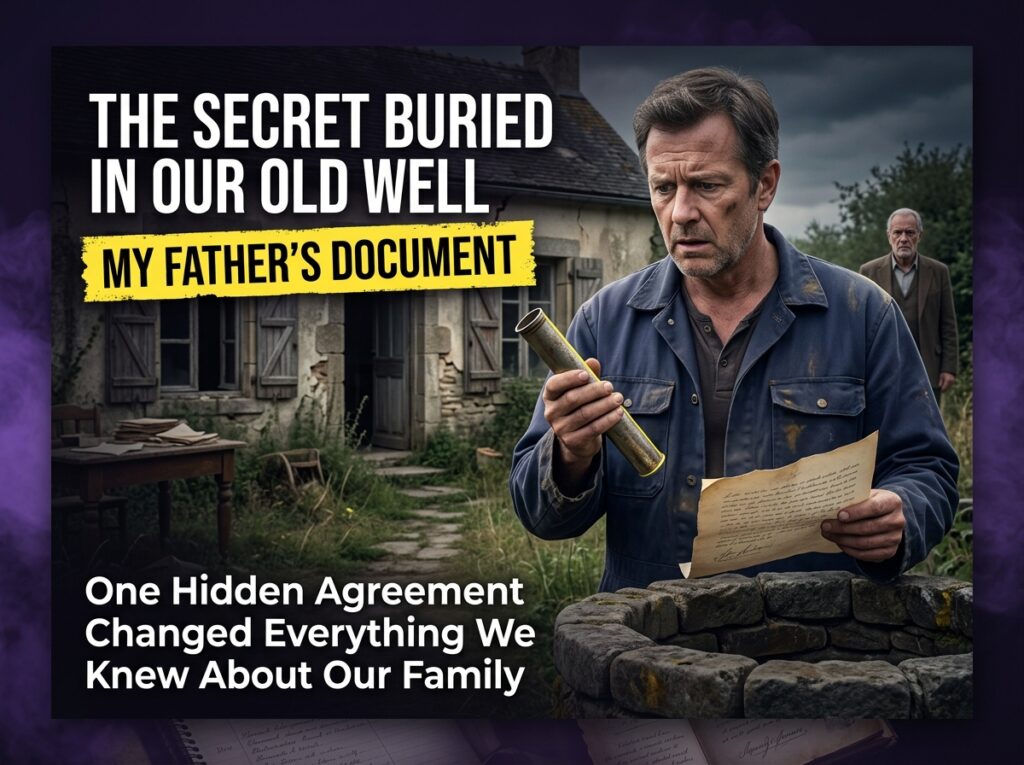
I spent my adult life working two jobs so my children would never fear losing their home. Then a buyer offered cash for an abandoned cottage, and an old well revealed a document sealed inside a metal tube. One phone call changed everything I believed about my family.
For most of my adult life, I worked two jobs and kept every receipt because I never wanted my children to know the fear of losing a home. Then a routine conversation revealed how little I understood about my own family. A buyer offered cash for the abandoned cottage, but the old well revealed a document sealed in a metal tube. The first clue seemed too small to matter. But when I compared it with the dates in my old notebook, I realized the same story had been repeated to me for years. Before I could decide what to do, my phone rang. The caller said one sentence that made me realize the real story had not even begun.
For most of my adult life, I believed that a person’s worth could be measured by how much they were willing to sacrifice for the people they loved.
I worked two jobs, sometimes three when money was particularly tight. I repaired equipment during the day and spent several evenings a week cleaning offices after closing. On weekends, I accepted whatever small jobs I could find. I kept every receipt, recorded every payment, and stored old bills in labeled envelopes because I knew exactly what it felt like to worry about losing a home.
When I was young, my mother used to sit at our kitchen table with unpaid bills spread before her. She would move the papers into neat piles, calculate the totals, and then stare at the figures as though they might change if she waited long enough.
I remembered the quiet way she cried when she thought nobody was watching.
I promised myself that my children would never experience that kind of fear.
For years, I kept that promise.
My wife, Elaine, and I raised our children in a modest house that always needed something repaired. The roof leaked during heavy rain, the kitchen floor creaked near the refrigerator, and the heating system made a noise like a tractor whenever winter arrived.
But the mortgage was paid on time.
The electricity stayed connected.
There was food in the cupboards, and our children never had to hear us argue about whether we could afford their school supplies.
Whenever money became tight, I took another shift.
Elaine worried that I was working too much.
“You don’t have to carry everything alone,” she told me one evening.
I was sitting at the kitchen table, checking a stack of receipts while she prepared dinner.
“I’m not carrying everything alone,” I said. “I’m carrying it for the people I love.”
She looked at me for a long moment.
“Sometimes those aren’t the same thing.”
I laughed because I thought she was being philosophical.
Years later, I would remember that conversation differently.
Our family had always owned a small piece of land outside town. It included an abandoned cottage, a neglected garden, and an old stone well that my grandfather had helped maintain decades earlier.
The cottage had been empty for years. Its windows were dusty, the wooden shutters hung crookedly, and weeds had grown over the path leading to the front door.
My father, Thomas, had inherited the property from his parents. When he died, the land passed through the family, eventually becoming part of the estate that I believed we would settle when the time came.
Nobody lived there.
Nobody seemed to want it.
Yet every time I suggested selling the property, my mother had reacted as though I had proposed selling the family name.
“Not that place,” she would say.
“Why not? It costs money to maintain, and nobody uses it.”
“It’s not the right time.”
“When will the right time come?”
She would look toward the window.
“When we understand what it means.”
I assumed she was attached to the cottage because of childhood memories. My father had grown up there, and my mother had spent many summers visiting his family before they married.
I never pushed her too hard.
There were more immediate problems to solve, and I had learned that arguing about the past rarely paid the bills in front of me.
Then my mother died.
The funeral brought relatives together who had not spoken to one another for years. There were quiet conversations in the garden, awkward embraces near the doorway, and disagreements about documents that seemed to appear from nowhere.
My older brother, Richard, insisted that the estate had already been discussed.
My sister, Claire, said she remembered a different conversation.
I tried to keep everyone calm.
“We can sort out the paperwork later,” I said. “Nobody needs to fight today.”
They agreed, but the arguments continued in smaller conversations.
The cottage was mentioned several times. Richard believed we should sell it. Claire thought we should preserve it. I had no strong opinion either way.
I wanted the estate settled fairly, and I wanted my children to have something secure when they eventually needed it.
That was all.
Several months later, a property buyer named Mr. Collins contacted me.
He explained that he had been looking at properties in the area and had learned that our family owned the abandoned cottage and surrounding land.
“I would like to make an offer,” he said.
“How much?”
He gave me a figure that made me sit straighter in my chair.
It was more money than I had expected. Enough to repair our own house, put something aside for our children, and stop accepting every extra shift simply because I was afraid of what might happen if I didn’t.
“Why do you want that particular property?” I asked.
“The location has potential.”
“What kind of potential?”
“That is something we would discuss after an initial inspection.”
I told him I would need to speak with my family.
When I mentioned the offer to Richard, he immediately supported it.
“Take the money,” he said. “That cottage has been sitting there for years. Dad would have understood.”
Claire was less enthusiastic.
“Did he explain why he wants it?”
“He says the location has potential.”
“That’s not an answer.”
“It’s a property offer, Claire. Buyers don’t usually explain every reason they want to purchase something.”
She folded her arms.
“Then at least look at the place before agreeing.”
I promised I would.
The next morning, I drove to the property with a notebook, a flashlight, and a folder containing the old ownership papers.
I intended to inspect the cottage, take photographs, and prepare for a straightforward sale.
Instead, I found the well.
The stone cover had shifted, exposing a narrow gap beside the rim. I remembered my father warning me never to lean over it when I was a child.
I moved closer and noticed something metallic lodged between two stones.
At first, I thought it was a discarded tool.
Then I saw the sealed end.
It was a narrow metal tube, dark with age and partly hidden beneath a loose section of masonry.
I pulled it free.
Something rattled inside.
I stood beside the well, holding the tube in both hands, and felt the first unmistakable sensation that something was wrong.
I had come to inspect an abandoned cottage.
But somebody had hidden something inside the old well.
And whatever it was, somebody had wanted it to survive.
<h2>Part 2</h2>
I carried the metal tube to the cottage and placed it on the kitchen counter.
The room smelled of dust, damp wood, and the faint mineral scent that old buildings seem to retain even after years without occupants. Sunlight entered through a cracked window, illuminating the abandoned furniture and the cobwebs stretched between the ceiling beams.
I had visited the cottage many times as a child, but I had never thought of it as a place that held secrets.
To me, it had always been a building my father refused to sell.
I examined the tube.
It was about the length of my forearm, with a sealed cap at one end and a threaded metal cover at the other. There were no obvious labels, only a small mark near the rim that looked like an old manufacturer’s stamp.
I tried turning the cap.
It did not move.
After several minutes, I wrapped the tube in a cloth and took it home.
My wife, Elaine, had been gone for several years by then, and the house felt particularly quiet that afternoon. I put the tube on my workbench and searched through my tools for something that might open it without damaging whatever was inside.
Eventually, the cap loosened.
A rolled document emerged.
The paper had been protected from moisture, although its edges were yellowed and brittle. It was tied with a thin piece of faded string.
I carefully untied it and spread the document across the bench.
The first thing I noticed was a date.
The second was a signature.
My father’s name appeared near the bottom.
Above it was a paragraph referring to the cottage, the surrounding land, and an agreement made between members of the family.
The handwriting was difficult to read, but a few phrases stood out.
Preservation of the property.
Beneficial use.
The original arrangement.
I read the document several times.
It appeared to be a statement or agreement relating to the land, but I could not tell whether it was a draft, a copy, or a legally executed instrument.
There was no obvious title.
No lawyer’s letterhead.
No clear explanation of why it had been placed inside a metal tube and hidden in the well.
I took photographs and called Claire.
“I found something at the cottage,” I told her.
“What kind of something?”
“A document hidden inside the well.”
She went silent.
Then she asked, “What does it say?”
“I’m not sure yet. It has Dad’s signature and refers to an agreement about the property.”
“Don’t give it to Richard.”
Her answer surprised me.
“Why would I give it to Richard?”
“Because he will take it and tell everyone what it means before anybody has read it properly.”
“Claire, I haven’t even figured out what it is.”
“Then don’t let anyone rush you.”
I looked at the document again.
“Did you know something was hidden there?”
“No.”
“Then why are you so worried?”
She hesitated.
“I remember Dad telling Mum that some papers had to be kept safe. I thought he meant the house deeds.”
“Did he mention the well?”
“No. But he became very angry whenever anyone suggested clearing it out.”
I remembered that anger.
When I was twelve, I had once tried to remove a loose stone near the well because I wanted to retrieve a ball that had fallen behind it.
My father had caught me and ordered me away.
“Never move those stones,” he had said.
I had assumed the well was dangerous.
Now I wondered whether he had been protecting something.
That evening, I opened my old notebooks.
I had kept them for decades, recording work expenses, mortgage payments, repairs, and household costs. The notebooks were not diaries, but they contained dates and short notes that helped me reconstruct events long after they had happened.
I found entries from the years surrounding my father’s death.
One noted a conversation about selling the cottage.
Another recorded an expense for repairing the well’s stone covering.
A third mentioned a payment my father had made to someone whose initials were unfamiliar.
The date beside that payment matched the date on the document.
I placed the notebook beside the paper.
Then I found another entry from several years later.
The same initials appeared again.
I checked the dates.
The payments seemed to form a pattern, although I could not tell what the pattern meant.
For years, I had believed the family had repeated the same story because nobody wanted to argue about an old property.
Now I wondered whether the story had been repeated because it concealed something important.
I called Richard.
“I found an old document at the cottage,” I said. “It appears to concern Dad and the land.”
“What kind of document?”
“I need to have it examined.”
“Why? If it’s a deed, bring it to me. I can deal with the paperwork.”
“I’m not handing it over until we know what it is.”
His voice sharpened.
“You’re making this more complicated than it needs to be.”
“Maybe. But the document was hidden in a well. I think we should understand why.”
There was a pause.
Then Richard said something that made my stomach tighten.
“Whatever you found, it cannot change what Dad already decided.”
I had not told him what the document said.
I had not even told him that it contained a possible agreement.
Yet he sounded certain.
“How do you know what Dad decided?”
Richard ended the call without answering.
I stood beside the workbench, looking at the metal tube.
For the first time, I suspected that my brother knew more about the cottage than he had admitted.
Before I could decide what to do, my phone rang again.
The caller was a man who introduced himself as a retired records clerk.
He said he had heard that I was examining the old property papers.
Then he asked whether I had found a document in a metal tube.
I gripped the phone.
“Who told you about that?”
He ignored my question.
Instead, he said, “Before you show that document to your family, you need to know why your father hid it.”
<h2>Part 3</h2>
I asked the caller to identify himself again.
His name was Peter Lawson. He said he had worked in the local records office for more than thirty years before retiring.
“I knew your father,” he explained. “Not personally in the way a friend knows someone, but I handled documents connected to the property.”
“What documents?”
“That depends on what you found.”
I disliked the way he avoided giving a direct answer.
“Mr. Lawson, I found a paper with my father’s signature hidden in a metal tube inside an old well. It refers to an agreement concerning our cottage. If you know something about it, tell me.”
He sighed.
“I can’t explain the whole matter over the telephone. The records need to be checked first.”
“Everyone keeps telling me that.”
“Because documents can be misunderstood when they’re separated from the records around them.”
He gave me an address and asked me to meet him the following afternoon.
I considered refusing. I had already spoken with my brother and sister, and I did not want strangers directing me through a family dispute.
But Peter knew about the tube before I had told him where I found it.
That fact alone made the meeting necessary.
The next day, I took the document to a solicitor who agreed to make a preliminary assessment. She warned me that the paper’s appearance and my father’s signature did not establish its legal effect. We would need to determine whether it was an executed agreement, a draft, or a copy of another record.
She also advised me not to alter it or circulate it widely until its condition and provenance had been documented.
I followed her instructions.
Then I drove to Peter’s address.
He lived in a small house near the old town center. A collection of potted plants lined the front steps, and a brass number hung crookedly beside the door.
He was in his seventies, with thin white hair and a careful way of moving. When I introduced myself, he studied my face.
“You look like your father,” he said.
“People used to tell me that.”
He invited me inside.
His living room contained shelves of books, old photographs, and boxes of neatly labeled papers. He asked me to sit at a small table near the window.
I placed a photograph of the document in front of him.
He leaned forward without touching it.
“Where did you find this?”
“Inside the well at the cottage.”
He closed his eyes briefly.
“I was afraid it might still be there.”
“You knew it existed?”
“I knew your father had prepared something. I did not know where he had put it.”
“What was it?”
Peter studied the photograph.
“It appears to be a copy of a declaration associated with a family property arrangement. But I would need to see the complete paper and compare it with the records before saying more.”
I felt my patience thinning.
“Why did my father hide it?”
“That is the question I hoped you would ask.”
Peter explained that the property had once been part of a larger estate belonging to my grandparents. Over time, different portions had been occupied, transferred, or used by relatives.
The cottage was only one part of the story.
The old well had served people beyond the immediate household. The land around it had been used for gardening, storage, and access between neighboring properties.
When the family’s financial circumstances worsened, my grandfather considered selling part of the estate.
My father had opposed the sale.
He believed the property should remain available to the family and to certain people who had depended on it for years.
“But Dad inherited it,” I said. “He had the right to decide what to do with it.”
“Perhaps. But ownership and the history of an agreement are not always the same question. That is why the original records matter.”
Peter explained that, during his time at the records office, he had seen references to an arrangement involving the property. Some documents were complete; others referred to attachments or earlier agreements that were not always present in the modern file.
He had never been responsible for deciding who owned the land. His job had been to record and retrieve documents, not determine disputes.
“Did you see this particular paper?” I asked.
“I saw a reference to something similar. Your father came to the office more than once. He was trying to establish what had been agreed before the property passed to him.”
“Why didn’t he tell us?”
Peter looked toward the window.
“I cannot speak for him. But I remember him saying that he did not want the family to fight over something nobody fully understood.”
I thought about the way Richard had reacted to my discovery.
Whatever you found, it cannot change what Dad already decided.
The sentence sounded different now.
Perhaps Richard had known about the old arrangement. Perhaps he had heard only part of the story. Or perhaps he was repeating what our father had told him without understanding the documents himself.
I asked Peter whether the old agreement had been legally registered.
He said he could not confirm that without checking the relevant records.
“Then what can you tell me?”
He looked directly at me.
“Your father was not the first person in the family to hide a document. There was an earlier paper, and it disappeared before the property passed to him.”
My hands tightened around the edge of the table.
“Who had it?”
“I don’t know.”
“Was it a deed?”
“I don’t know that either.”
“What did it say?”
Peter shook his head.
“That is the problem. We know a record existed because other documents refer to it. But the record itself has not been located.”
He stood and walked to a cabinet.
From a drawer, he removed a small notebook containing handwritten reference numbers and dates.
He showed me an entry from the year my father had visited the records office.
Beside the property reference was a note.
Original instrument requested. Not located.
I recognized the date.
It was the same date recorded in my old notebook beside the payment my father had made.
I felt the room grow strangely quiet.
“Why would he make a payment on the same day he searched for a missing document?”
Peter looked at the note.
“I cannot tell you that.”
“Could it have been a legal fee?”
“Possibly. It could also have been payment for something entirely unrelated. We would need evidence.”
I understood his caution, but it left me with more questions than answers.
Before I left, Peter gave me a copy of the reference entry and advised me to ask the records office for the full file.
I returned to my car and sat behind the wheel.
The metal tube had led me to a document.
The document had led me to Peter.
And Peter had revealed that my father had searched for another missing paper years earlier.
I had believed the cottage was simply an abandoned property nobody wanted to maintain.
Now I knew that several people had spent years trying to understand its history.
The most troubling part was that my father had apparently been searching for a document that nobody could find.
And if he had hidden the paper I discovered in the well, he might have intended it to lead someone toward the missing original.
<h2>Part 4</h2>
I returned to the records office the following morning.
The building had changed since my last visit. The old counter had been replaced, the waiting area was brighter, and a new electronic system had been installed beside the shelves of historical registers.
But the smell of paper remained the same.
I presented the reference number Peter had given me and requested the complete file concerning the cottage.
The clerk asked for identification and explained that some records would require additional processing.
I filled out the forms and waited.
While I sat in the waiting area, I opened my old notebook.
The payment my father had made on the date of his records-office visit was listed beside a short note: P.L.—property papers.
The initials matched Peter Lawson.
I called him.
“I found the payment entry,” I said. “My father paid you on the same day he searched for the missing document.”
Peter was silent.
Then he said, “I remember receiving money from your father, but I cannot recall the precise circumstances.”
“Was it for helping him find the records?”
“It may have been for copying documents or reimbursing expenses. I would need to check my own records.”
“Did you ever give him an original document?”
“No. I was not authorized to remove original records from the office.”
I believed him, but I could hear uncertainty in his voice.
I asked whether he had kept any personal notes.
“I will look,” he said.
Before we ended the call, he added, “Do not assume that a payment proves wrongdoing. Your father was meticulous about paperwork. He sometimes paid for copies, searches, and certified records.”
That sounded plausible.
It also reminded me how little I knew about my father’s private efforts to preserve the property.
The clerk returned with a folder.
Several documents referred to the cottage and the surrounding land. There were old maps, transfer records, and correspondence relating to the property’s history.
One letter described an agreement made between my grandparents and another household.
The agreement appeared to concern the use of a section of land near the well. It referred to access, maintenance, and a promise that the route should remain available under certain circumstances.
But the file did not contain the original agreement.
Instead, there was a note stating that an attachment had been referenced in an earlier filing but was not present in the current archive.
I read the note several times.
The missing paper might have explained the purpose of the arrangement.
Without it, the surviving documents left important questions unanswered.
I requested copies of the relevant pages.
Then I noticed a separate entry involving my father.
Several years before his death, he had asked for information about the same missing attachment.
A handwritten note beside the entry stated that he had been advised to search the family archive.
I sat back.
My father had known the document was missing.
He had tried to find it.
And he had eventually hidden another document in the well.
I called Richard.
“Did Dad ever talk to you about an agreement involving the cottage?”
“No.”
“Did he ever mention a missing document?”
“Why are you asking me this again?”
“Because the records show that he searched for one.”
Richard exhaled sharply.
“He searched for plenty of things. Dad kept every old paper he could find.”
“Did he ever tell you that the cottage could not be sold?”
“No. He said it should stay in the family.”
“Why?”
“Because it was ours.”
“Did he say anything about an old agreement?”
Richard was quiet.
Then he said, “I remember him arguing with Uncle Peter about something. I was younger. I didn’t know what they were discussing.”
“When?”
“Maybe a year before Dad died. Peter came to the house, and they spoke in the garage. Dad told me to leave them alone.”
“Did you hear anything?”
“Only that Dad said the family had already paid what it owed.”
My stomach tightened.
“What did Peter say?”
“I don’t remember. Dad told me to go inside.”
The call ended with no further explanation.
I wrote the conversation in my notebook.
The phrase paid what it owed seemed connected to the old agreement, but I could not establish how.
Perhaps my father had been talking about a financial debt. Perhaps he had been referring to an obligation connected to the land. Perhaps Richard’s memory was incomplete.
I refused to draw a conclusion without evidence.
That afternoon, Peter called me back.
He had found an old envelope containing notes from his time at the records office.
One entry referred to a meeting with my father and a question about a missing instrument.
The note stated that my father had been concerned about a future sale of the property.
Beside it was a sentence Peter had written to himself:
He believes the family has misunderstood the original arrangement.
I stared at those words.
My father had not simply wanted to keep the cottage because of sentimental attachment.
He had believed that the family misunderstood the agreement governing it.
I asked Peter whether he knew what my father meant.
“No,” he replied. “He did not explain the full matter to me.”
“Then why did he trust you with it?”
“I was a records clerk. He wanted help finding documents, not someone to take sides.”
I thought about that distinction.
Perhaps my father had been trying to uncover the truth without starting a family argument.
Perhaps he had been afraid that an incomplete explanation would cause more harm than silence.
But his silence had not protected us.
It had left the next generation with fragments, suspicions, and a property buyer whose offer might force the issue into the open.
When I returned home, I found a message from Mr. Collins.
He wanted to know whether the family was ready to proceed with the sale.
I called him and asked for more time.
“Is there a problem with the title?” he asked.
“I haven’t established that.”
“Then what is delaying the decision?”
“There are historical records that need to be reviewed.”
He paused.
“I understand. But I should tell you that my interest in the property is time-sensitive.”
“Why?”
“I have a development proposal under consideration.”
“What kind of development?”
“I would prefer to discuss that after the purchase.”
I refused to commit.
After the call, I returned to the document from the well.
For the first time, I wondered whether the buyer’s interest in the cottage had anything to do with the missing agreement.
I had assumed he wanted the land because of its location.
But if the property carried an old obligation, the nature of his proposed development might matter.
I needed to know what he planned to build.
And I needed to discover whether he already knew about the missing document.
<h2>Part 5</h2>
Mr. Collins agreed to meet me at a café near the town center.
He arrived carrying a leather folder and placed it beside his coffee.
“I hope we can move forward,” he said. “I have already spent time assessing the property.”
“I haven’t agreed to sell it.”
“I understand. But I thought the offer might be attractive, especially given the condition of the cottage.”
“It is attractive. That doesn’t mean I understand why you want the land.”
He opened his folder and showed me a preliminary plan.
The proposal involved several small residential units and access improvements. The cottage itself would be removed or substantially altered, depending on the final design.
The old well appeared on the site plan.
A red line crossed the area around it.
“What does this line represent?” I asked.
“An access route.”
“Access for whom?”
“That would depend on the final arrangement.”
I looked at the plan again.
The route appeared to follow the same path described in the historical documents.
“Did you know the land had an old access agreement?”
Mr. Collins took a sip of coffee.
“I was aware there were historical records to review.”
“Who told you?”
“My surveyor identified some older references.”
“Did you see the agreement?”
“Not the original.”
“Then why are you proposing to build across the route?”
“The plan is preliminary. We would address any legal restrictions before proceeding.”
His answer was reasonable, but it did not satisfy me.
I asked whether the development depended on gaining unrestricted use of the land.
He explained that the proposed layout could change if access requirements or other obligations affected the site.
I asked him to provide the complete plan and any reports he had commissioned.
He agreed to send them.
When I returned home, I told Claire about the meeting.
She was alarmed.
“If that route was important to people in the past, we shouldn’t agree to anything until we understand the agreement.”
“I haven’t agreed to anything.”
“Good. What did the buyer say?”
“He knew there were historical records, but he hadn’t seen the original document.”
“Do you believe him?”
“I don’t know.”
Claire looked toward the window.
“Mum always said the cottage had to stay as it was.”
“She said it wasn’t the right time to sell.”
“Maybe she knew more than she told us.”
I thought about that possibility.
My mother had died before the current investigation began, and I had no evidence that she knew the full details. Still, her reaction to the cottage had always been unusually strong.
Perhaps she had inherited the same uncertainty my father had tried to resolve.
That evening, I searched through boxes of family papers.
I found old photographs, school certificates, household bills, and letters from relatives who had moved away. I also found several notebooks belonging to my mother.
They contained recipes, grocery totals, and lists of household expenses.
Near the back of one notebook was a page with a date matching the entry in my own records.
Beside it, my mother had written:
Tom says the original must be found before anyone sells the cottage.
Below that sentence was another note.
Do not let Richard decide alone.
I sat very still.
My mother had known that my father was searching for the original document.
She had also been concerned about Richard’s involvement.
But the note did not explain why.
I called Claire and read it to her.
She asked me to send a photograph.
After examining it, she said, “I remember Mum arguing with Richard about the cottage. She told him it wasn’t his decision to make.”
“When?”
“Not long before Dad died. I thought they were arguing about money.”
“Did she say anything else?”
Claire tried to remember.
“She said that the land belonged to the family, but the promise attached to it belonged to more than the family.”
I wrote down her words.
They echoed the language in the document from the well.
Preservation of the property.
Beneficial use.
The original arrangement.
The pieces were beginning to fit, but I still did not know the full story.
I called Richard again.
This time, I asked him about the argument with our mother.
He denied remembering it.
“You’re digging into things that were settled years ago,” he said.
“Were they settled?”
“Yes.”
“Then why did Dad search for the missing document?”
“I don’t know.”
“Why did Mum write that you shouldn’t decide alone?”
Richard’s voice changed.
“Where did you find that?”
“In her notebook.”
He fell silent.
I waited.
Finally, he said, “Dad made promises that were not his to make.”
My heart began to pound.
“What promises?”
“I don’t know the whole story.”
“Then tell me what you do know.”
Richard hesitated.
“I remember Dad saying that the cottage had been kept for a reason. He said that if the original agreement was ever found, it could change everything.”
“Change what?”
“I don’t know.”
I thought about the buyer’s offer and the old well.
“Did you know about the metal tube?”
“No.”
“Did you know where the document was hidden?”
“No.”
His answer came quickly.
I could not determine whether he was telling the truth.
But I now knew that he had heard our father speak about an agreement that could change the family’s understanding of the property.
Before ending the call, I asked him one final question.
“Why did you tell me that whatever I found couldn’t change what Dad decided?”
Richard was silent for so long that I thought he had disconnected.
Then he said, “Because Dad told me the decision had already been made.”
“What decision?”
He ended the call.
I stared at my phone.
The family story I had accepted for decades was beginning to unravel.
My father had believed the original agreement mattered.
My mother had warned against allowing Richard to decide alone.
Richard remembered a decision that had already been made.
And the buyer wanted the property quickly.
I returned to my notebook and wrote down every date I could find.
The next clue would have to come from the records, not from another conversation in which somebody refused to tell me everything.
<h2>Part 6</h2>
The following week, the records office contacted me.
The clerk had located an additional reference in an older register. It pointed to a document filed under a previous description of the property, before the cottage and surrounding land had been recorded under the current parcel number.
The original instrument was not in the main archive.
However, a note indicated that a copy might have been deposited with a local solicitor decades earlier.
The solicitor’s firm had since changed ownership, but some historical files had been transferred to a successor practice.
I contacted the firm and explained the circumstances.
After verifying my identity and the relevant property details, they agreed to search their archive.
The process took several days.
During that time, Mr. Collins called twice.
He said the offer would remain available for a limited period, but he needed an answer soon.
I told him I could not make a decision while the property’s history remained uncertain.
He sounded frustrated.
“Your family has owned the place for generations,” he said. “Surely you know whether there is an agreement.”
“That is exactly what I’m trying to establish.”
He ended the call politely, but I sensed that the delay had become a problem for him.
I told Claire about the calls.
She suggested that we arrange a family meeting.
“Everyone should hear the same information at the same time,” she said. “Otherwise, we’ll spend another twenty years arguing about what somebody remembers.”
I agreed.
Richard was reluctant, but he eventually came.
We met at my house on a Saturday afternoon. I laid out the document from the well, copies of the historical records, my mother’s notebook, and the notes Peter had provided.
For the first time, I explained everything in chronological order.
The property had been inherited from our grandparents.
There had been an old agreement concerning the land and the route near the well.
Our father had searched for a missing document.
Our mother had written that the original needed to be found before the cottage was sold.
And the current buyer wanted to develop the property.
Richard listened with his arms folded.
When I finished, he said, “None of this proves that we cannot sell the cottage.”
“No,” I replied. “It proves that we should understand the documents before deciding.”
Claire leaned forward.
“Why did Dad tell you the decision had already been made?”
Richard looked at her.
“I didn’t say that.”
“You told him Dad had already decided.”
“I meant Dad had decided to keep the cottage.”
“Then why did he search for a missing agreement?”
Richard rubbed his forehead.
“I don’t know.”
I placed my mother’s notebook in front of him.
“She wrote that you shouldn’t decide alone.”
He read the sentence and pushed the notebook away.
“Mum worried about everything.”
“She was worried about this,” Claire said.
Richard stood.
“I am not going to be accused of something because I wanted to sell an abandoned building.”
“Nobody has accused you of that,” I said. “We’re asking what you know.”
He walked toward the door, then stopped.
For a moment, I thought he might finally explain what he remembered.
Instead, he said, “If you find the original, you’ll understand why Dad wanted it hidden.”
He left before either of us could respond.
Claire looked at me.
“That sounded like a confession.”
“It sounded like a man who knows something but doesn’t want to say it.”
“Do you think he hid the document?”
“I don’t know.”
I refused to turn suspicion into certainty.
The metal tube had been hidden in the well, but we had no proof of who placed it there. The document had my father’s signature, yet its legal status remained uncertain. Richard’s words suggested that he knew more about the family’s history, but they did not establish wrongdoing.
I called Peter and explained what had happened.
He listened carefully.
“Your father wanted the original found,” he said. “That is what I remember most clearly. He was not trying to make the document disappear forever.”
“Then why did he hide the copy?”
“Perhaps he wanted to protect it until he could locate the original. Perhaps he feared someone would destroy it. I cannot say.”
I asked whether my father had ever mentioned Richard.
Peter hesitated.
“He said the family had different ideas about what should happen to the property. He worried that the disagreement would become personal.”
“Did he say Richard was involved?”
“No.”
I appreciated the distinction.
The next day, the solicitor’s firm called.
They had found a file connected to the property, but it was incomplete. One envelope contained a copy of an agreement and a covering letter from my grandfather.
The firm wanted me to attend in person before releasing copies of the material.
I arranged an appointment.
When I arrived, a solicitor showed me the envelope.
The covering letter was dated decades earlier.
My grandfather had written that the attached agreement should be preserved with the property records because it explained the purpose for which the land had been retained.
He also noted that the document was not to be treated as a simple division of the estate among the heirs.
I read the sentence twice.
The old agreement was not merely about who owned the cottage.
It concerned why the land had been preserved and how it was intended to be used.
The solicitor explained that the copy would need to be compared with the surviving title records and the document found in the well. The original might still be missing, and the legal implications could not be determined from the covering letter alone.
I requested certified copies of everything.
Before leaving, I asked whether the file contained any evidence of a later amendment.
The solicitor checked the index.
There was a reference to a subsequent document, but the file did not contain it.
I felt the familiar disappointment.
Every answer led to another missing piece.
Yet this time, I had a clearer understanding of the question.
My grandfather had wanted the agreement preserved because it explained the purpose of the property.
My father had searched for the original.
My mother had warned against allowing one person to decide alone.
And now I had to determine whether the family had misunderstood an obligation that had been recorded long before I was born.
As I left the office, my phone rang.
It was Peter.
“I found something in my old notes,” he said. “It concerns the amendment.”
“What does it say?”
He took a breath.
“The amendment was requested by someone in your family after your father died.”
<h2>Part 7</h2>
I asked Peter to send me a copy of the note.
He agreed, but warned me that it was only a reference entry, not proof of what had happened.
The note identified a date and the name of the person who had requested information about the amendment.
It was Richard.
The entry showed that he had visited the records office several years after our father’s death. He had asked whether the old agreement could be changed or withdrawn.
The clerk’s note stated that the request could not be processed without the relevant instrument and a review of the property’s title.
I read it several times.
Richard had not simply remembered our father’s decision to keep the cottage.
He had investigated whether the old agreement could be changed.
I called him.
He answered after several rings.
“Did you visit the records office to ask about changing the agreement?”
There was a long silence.
“Who told you that?”
“Peter’s notes.”
Richard sighed.
“Yes.”
“Why?”
“Because I wanted to know what the agreement meant.”
“You told me you knew nothing about it.”
“I said I didn’t know the whole story.”
“You asked whether it could be changed.”
“That doesn’t mean I did anything wrong.”
“I didn’t say you did. I’m asking why.”
He sounded tired.
“Because I thought Dad had left us a property we could never use. I wanted to understand whether that was true.”
I could understand the frustration.
Richard had spent years believing the cottage was an asset trapped by an old promise. He wanted the family to benefit from its value, just as I did.
But there was more.
“Did you find the amendment?”
“No.”
“Did you ever see the original agreement?”
“No.”
“Then why did you tell me that whatever I found couldn’t change Dad’s decision?”
Richard was silent.
Finally, he said, “Because I was afraid the family would start fighting again.”
“That isn’t an answer.”
“It’s the only one I have.”
I wanted to believe him.
But I also knew he had withheld information.
I asked him to attend another meeting with Mr. Bennett, our solicitor, so that we could discuss the documents together.
He refused at first, then agreed after I explained that nobody was accusing him of fraud or misconduct.
The meeting took place two days later.
Mr. Bennett reviewed the available records and explained that the old agreement’s legal effect depended on its wording, execution, and relationship to the registered title. Any amendment would have to be authenticated and assessed before it could be treated as valid.
Richard admitted that he had wanted to know whether the property could be sold without considering the old arrangement.
He had not found the missing amendment.
He had not altered the records.
He had not hidden the tube.
Those facts did not explain every detail of his behavior, but they changed the nature of the dispute.
He had been trying to understand whether the family could sell the property.
He had also been afraid that the discovery of the old agreement would prevent the sale and create another argument.
“Why didn’t you tell us?” Claire asked.
Richard stared at the table.
“Because I knew how Dad felt about the cottage. I thought if I told you I had tried to change the agreement, you’d believe I wanted to destroy everything he cared about.”
“Did you?”
“No,” he said. “I wanted to know what we were allowed to do.”
His answer was not entirely satisfying, but I believed that it could be true.
For years, we had allowed the cottage to become a symbol of different things.
To me, it represented security and the possibility of giving our children something valuable.
To Claire, it represented our parents and the history of the family.
To Richard, it had become a frustrating asset whose future seemed controlled by a promise nobody could explain.
To our father, it appeared to represent a responsibility he believed should survive his death.
And to our mother, it was a source of worry she had never been able to resolve.
We had been arguing about the property without agreeing on what it meant.
Mr. Bennett recommended that we postpone any sale until the missing amendment could be located or its absence properly documented.
Richard objected.
“We could lose the buyer.”
“We could also make a decision we cannot easily reverse,” I replied.
He shook his head.
“I need the money from this property.”
That was the first time he had said it plainly.
I asked what he meant.
Richard explained that his finances had become strained after a business venture failed. He had debts, and he had hoped the sale would provide enough money to settle them.
He had not told the family because he was ashamed.
I understood then why the buyer’s offer had mattered so much to him.
But his financial difficulties did not determine the property’s legal status, and they could not answer the historical questions.
I told him I was sorry he had been struggling.
I also told him that we could not sell the land simply because one of us needed the money.
“We have to understand what Dad agreed to,” I said. “Then we can decide what is possible.”
Richard looked away.
For the first time, I saw how much resentment he had carried.
He believed our father had left us an inheritance that might be impossible to use. I believed my father had left us a responsibility we had never understood.
Neither of us had the complete story.
That evening, Peter sent another message.
He had located a reference to a private letter written by our father shortly before his death.
The letter had not been included in the official property file.
Peter believed it might have been kept with our family’s personal records.
I returned to the boxes in my study.
If the letter still existed, it might explain why my father had hidden the document in the well.
And it might finally tell us what he had been trying to protect.
<h2>Part 8</h2>
The letter was inside an old envelope tucked behind a folder of insurance papers.
My father’s handwriting was unmistakable.
He had written the date in the upper-right corner and addressed the letter to my mother.
The paper was folded twice, and the ink had faded in places.
I sat down before reading it.
My father had never been a man who explained his feelings easily. He worked hard, spoke carefully, and believed that problems were best handled privately.
When he was worried, he became quiet.
When he was angry, he usually left the room rather than say something he might regret.
I had inherited more of those habits than I wanted to admit.
The letter began by acknowledging that the family had disagreed about the cottage for years.
My father wrote that he understood why Richard wanted to sell it and why my mother wanted to preserve it.
He also wrote that neither of them had the full picture.
The land is ours in one sense, he wrote, but it was not kept for us alone.
I paused.
The sentence echoed the language in the old agreement.
He explained that his parents had accepted the property with an understanding that a particular section would remain available for a purpose connected to the surrounding community.
The agreement had been made when the land was worth far less than it was now.
The cottage and well were part of the same arrangement.
My father believed the original document contained conditions that had not been properly reflected in the later family records.
He had spent years trying to locate it.
But the letter did not accuse anyone of stealing it.
Instead, he wrote that the paper had disappeared during a period of family financial difficulty, when several documents had been moved between houses and offices.
He suspected that it had been misplaced, not necessarily destroyed.
The metal tube, he explained, contained a copy of a declaration he had prepared after reviewing the records available to him.
He had hidden it because he feared the copy would be discarded or misunderstood before the original could be found.
I read that passage twice.
My father had hidden the document to preserve it.
He had not necessarily intended it to remain secret forever.
The letter continued:
If I cannot find the original, I want the next person who discovers this copy to know that the property must not be treated as an ordinary asset until the arrangement has been understood.
I felt a wave of sadness.
He had tried to leave us a warning, but he had not told us where the warning was.
He had placed it in a well and trusted that somebody would eventually find it.
I understood his fear, but I could not help wishing he had chosen a more direct way to communicate.
The next paragraph referred to the missing amendment.
My father had learned that an amendment might have been requested, but he could not establish whether it had been completed or properly recorded.
He had been concerned that someone might assume the agreement had been changed simply because a later document was mentioned in the records.
That concern explained why he had continued searching.
The letter ended with a sentence addressed to my mother.
If we cannot finish this, please make sure the children understand that the land is not a prize. It is a promise whose meaning they must discover before they decide what to do with it.
I lowered the paper.
For decades, I had believed my father wanted to keep the cottage because he could not let go of the past.
Now I understood that he had been trying to protect a promise whose details had become uncertain.
I called Claire and asked her to come over.
When she arrived, I showed her the letter.
She read it slowly, then wiped her eyes.
“Mum knew,” she said.
“She knew Dad was searching for the original.”
“That’s why she kept telling us not to sell.”
I nodded.
“But we still don’t know exactly what the agreement required.”
Claire sat beside me.
“At least now we know why they were afraid of losing the papers.”
We called Richard and asked him to join us.
He arrived later that evening.
I showed him the letter.
He read it without speaking.
When he reached the final paragraph, he placed the paper on the table.
“I thought Dad was just being stubborn,” he said.
“So did I.”
Richard looked at the document from the well.
“He should have told us.”
“Yes,” I said. “He should have.”
For the first time, none of us argued.
We had discovered that our parents had been trying to preserve something they did not fully understand themselves. Their silence had been motivated by fear, but it had left us with an incomplete history.
We agreed to continue the search for the original agreement and the missing amendment.
We also agreed not to proceed with the sale while the review continued.
Mr. Collins was informed that the family needed additional time.
He was disappointed but accepted that we could not provide a final answer immediately.
That night, I returned to my old notebooks.
The dates, payments, and references no longer seemed like random fragments. They showed how my father had tried to follow the paper trail, how my mother had worried about the consequences, and how Richard had later searched for a way to change the arrangement.
But one question remained.
If my father had hidden the declaration to preserve it, why had he chosen the well?
The answer might have been simple: it was a place he believed nobody would disturb.
Yet the tube had been positioned between stones near the cover, not deep inside the well.
Someone had placed it where it could eventually be found.
And if my father had intended the document to guide the next generation, perhaps the hiding place was not meant to keep it secret forever.
It was meant to delay its discovery until the right questions were being asked.
<h2>Part 9</h2>
The next morning, Peter called with news from the records office.
A former employee had found a reference to the missing amendment in a separate index that had not been digitized. The entry did not contain the document itself, but it identified the solicitor who had prepared it and the year it had been submitted.
That gave us another place to search.
Mr. Bennett contacted the successor firm and requested the relevant archive records.
While we waited, I returned to the cottage.
I wanted to examine the well again, not because I expected to find another document, but because I needed to understand the place where my father had hidden the first one.
I walked around the stone rim, checking the gaps between the blocks.
The metal tube had been wedged beneath a loose stone, protected from direct rain and sunlight.
It had not been thrown into the well.
It had been placed carefully.
I imagined my father standing there years earlier, holding the tube and deciding where to leave it.
Perhaps he had believed that nobody would disturb the well.
Perhaps he had wanted the document to survive until the original could be found.
Or perhaps he had known that one day a buyer’s offer would force the family to examine the property more closely.
I could not know his exact intention.
But I understood why he had been reluctant to sell.
The cottage was no longer merely a building with a damaged roof.
It was the last physical reminder of an agreement that had shaped several generations of family decisions.
I returned home and wrote a detailed timeline in my notebook.
I included the dates from the document, the records-office entries, my father’s letter, my mother’s notes, and Richard’s visit to the archive.
The pattern showed that the family had been discussing the property for decades, but each generation had inherited only part of the information.
My grandparents had made an agreement.
My father had tried to locate the original.
My mother had feared that the property would be sold before the agreement was understood.
Richard had investigated whether it could be changed.
And I had discovered the declaration just as a buyer was preparing to make an offer.
The same story had been repeated in different forms.
Each person had believed they were solving a problem.
Each had acted on incomplete information.
And each had left something unexplained for the next generation.
The solicitor’s office called that afternoon.
They had located a file connected to the amendment.
The document appeared to have been prepared, but the available copy did not establish whether all required steps had been completed. It would need to be compared with the registered records and the original agreement.
Mr. Bennett arranged a meeting for the following week.
Until then, we agreed not to make assumptions.
Richard called me that evening.
“I owe you an apology,” he said.
I was surprised.
“For what?”
“For acting as though the decision had already been made. I didn’t know everything, but I wanted the sale to happen because I needed the money. I was afraid that if we examined the agreement, we’d discover the property couldn’t be sold.”
“Did you think Dad had hidden something from us?”
“I thought he had made a promise that trapped us. I didn’t understand why he had done it.”
I looked toward the window.
“Neither did I.”
Richard admitted that he had known our father was searching for the missing document, but he had never seen the declaration hidden in the well. He had assumed that the search was over when our father died.
He had not known about the tube.
I believed him, although I understood that the final conclusion would depend on the documents, not merely on our memories.
“Do you still want to sell the cottage?” I asked.
“I still need money,” he said honestly. “But I don’t want to sell something we don’t understand.”
It was the first time we had discussed the issue without turning it into an argument.
I told him that we would need to consider everyone’s circumstances once the legal position was clear.
He agreed.
Later that night, I sat alone with my father’s letter.
The sentence about the land being a promise rather than a prize stayed with me.
I had spent my adult life keeping receipts because I feared losing our home. I believed that financial security came from working harder, saving more, and making sure every bill was paid.
Those habits had protected my family.
But I had assumed that the value of property could be measured in money and divided according to what each person needed.
My father had understood that some obligations could not be calculated so easily.
I still believed our family deserved clarity. I still believed my parents should have explained their concerns while they were alive.
But I no longer thought the solution was simply to sell the cottage and divide the proceeds.
The old agreement might contain obligations that affected the property. Even if some of its provisions were no longer enforceable, its history deserved to be understood before we made a decision.
The next week, we would examine the amendment.
If it changed the original agreement, we needed to know how.
If it did not, we needed to understand why it had been prepared.
And if the original remained missing, we would have to decide what could responsibly be established from the evidence that survived.
For the first time, I was not searching for a person to blame.
I was searching for the truth.
Then, just before midnight, an email arrived from Mr. Bennett.
The subject line read:
Historical Property Agreement — Urgent Review
The message contained a scanned page from the newly located file.
Near the bottom was a signature I recognized immediately.
It was my father’s.
But beside it was another name.
A name I had seen before in my mother’s notebook.
And the note beneath the signatures suggested that the agreement had involved someone our family had never discussed.
<h2>Part 10</h2>
I read the scanned page several times before calling Mr. Bennett.
He explained that the document was a copy from the historical solicitor’s archive. It appeared to be connected to the amendment, but the legal significance of the signatures and wording still needed to be verified.
He would not draw a final conclusion from a scan alone.
I appreciated that caution.
After decades of incomplete explanations, I had learned how dangerous it could be to decide what a document meant before examining the surrounding evidence.
The additional name belonged to a person who had been connected to the property before my father inherited it.
My mother had mentioned the person in her notebook, but only in passing. There was no evidence that the person had acted improperly, and the available records did not establish why the name appeared beside my father’s signature.
The discovery gave us another question to investigate, not a reason to accuse someone.
Over the following weeks, the solicitor compared the historical records, the declaration found in the well, the surviving agreement, and the available copy of the amendment.
The review clarified parts of the property’s history, but some questions remained unresolved because the original instrument could not be located.
We learned enough to understand why my father had been reluctant to sell the cottage without further examination. The surviving documents indicated that the property had been associated with an arrangement whose purpose extended beyond a simple inheritance.
However, the records did not justify treating every old statement as a current legal restriction. Any future sale or development would have to take account of the obligations that could actually be established.
We informed Mr. Collins that we were not ready to proceed.
He eventually withdrew his offer.
For a moment, I regretted losing the money. The sale could have paid off several outstanding expenses and given our children a more secure financial future.
But I knew we could not make an irreversible decision simply because the offer was attractive.
The cottage remained standing.
The well remained covered.
And the metal tube was placed in a secure archive alongside the documents that had finally given it context.
Richard was disappointed, but he no longer insisted that the land should be sold immediately. Claire began organizing the family papers so that the next generation would not have to reconstruct the story from scattered notebooks and incomplete memories.
I continued keeping my receipts.
Old habits do not disappear simply because we discover something new about ourselves.
But I changed the way I stored them. Alongside the household bills and work expenses, I created a separate file for the property’s history. Every document was dated, labeled, and copied. I included notes explaining what had been established and what remained uncertain.
I did not want our children to inherit another mystery.
One afternoon, I visited the cottage with them.
We walked through the rooms, opened the shutters, and looked at the old well from a safe distance. The property needed repairs, and we still had to decide what its future should be.
But the conversation was different now.
Instead of arguing about how much money we could make, we discussed the history, the people who had depended on the land, and the questions we still needed to answer.
I told them about my father searching for the original agreement.
I told them about my mother’s warning.
I told them how Richard had tried to understand whether the property could be sold, and how I had mistaken his frustration for certainty.
Most importantly, I told them that we should never confuse suspicion with proof.
We might never recover every missing document. We might never know precisely why each person made the choices they did.
But we could preserve the evidence that survived and refuse to turn unanswered questions into family accusations.
As we left the cottage, I paused beside the old well.
For years, I had thought the well was simply a dangerous relic that needed to be covered and forgotten.
Now it reminded me of something else.
My father had hidden a document there because he believed it mattered. He had hoped that someone would find it and understand why the property could not be treated as an ordinary asset until its history had been examined.
He had not found a perfect way to pass that responsibility to us.
Neither had my mother.
And I had nearly repeated their mistakes by assuming that a buyer’s offer was the only question worth answering.
I still believe in financial security. I still believe that children should not have to grow up fearing that they will lose their home. I still believe that working hard, saving money, and keeping careful records can protect a family from unnecessary hardship.
But I have learned that some things cannot be protected by money alone.
A family can inherit a house without understanding the promises attached to it.
It can inherit land without knowing why previous generations preserved it.
And it can inherit documents without understanding the people who signed them.
The old well did not give us every answer.
It gave us a reason to stop repeating a story we had never properly examined.
I do not know whether we will eventually keep the cottage, restore it, or find a way to use the land that respects its history. Those decisions will depend on the evidence, the legal position, and the needs of the people involved.
What I know is that we will make them with our eyes open.
I spent most of my life working two jobs because I wanted my children to feel secure. I thought that meant paying the bills, protecting the house, and leaving them something valuable.
Now I understand that security also means leaving them the truth, even when the truth is incomplete or uncomfortable.
My parents were not perfect.
They made decisions out of fear, loyalty, and a desire to protect something they did not fully understand. Their silence caused confusion, and their unfinished search became our burden.
But their actions also taught me that a family history should not be reduced to the price a buyer is willing to pay.
The cottage may be worth a great deal of money.
The land may eventually be sold or used in a new way.
The old agreement may turn out to have fewer legal consequences than my father feared, or it may establish responsibilities we must continue to respect.
We will find out as much as the surviving records allow.
Until then, the property will not be treated as a prize for one person or a solution to another person’s financial problems.
It will be treated as something whose history deserves to be understood.
I returned home that evening and opened my notebook.
On a fresh page, I wrote the date and recorded what we had learned.
Then I added one final sentence:
The real inheritance was not the cottage. It was the responsibility to discover why it had been kept.
For the first time, I felt that the story my parents had left behind was no longer repeating itself.
We were finally asking the questions they had been too afraid, too uncertain, or too exhausted to answer.
And that was where our family’s next chapter would begin.