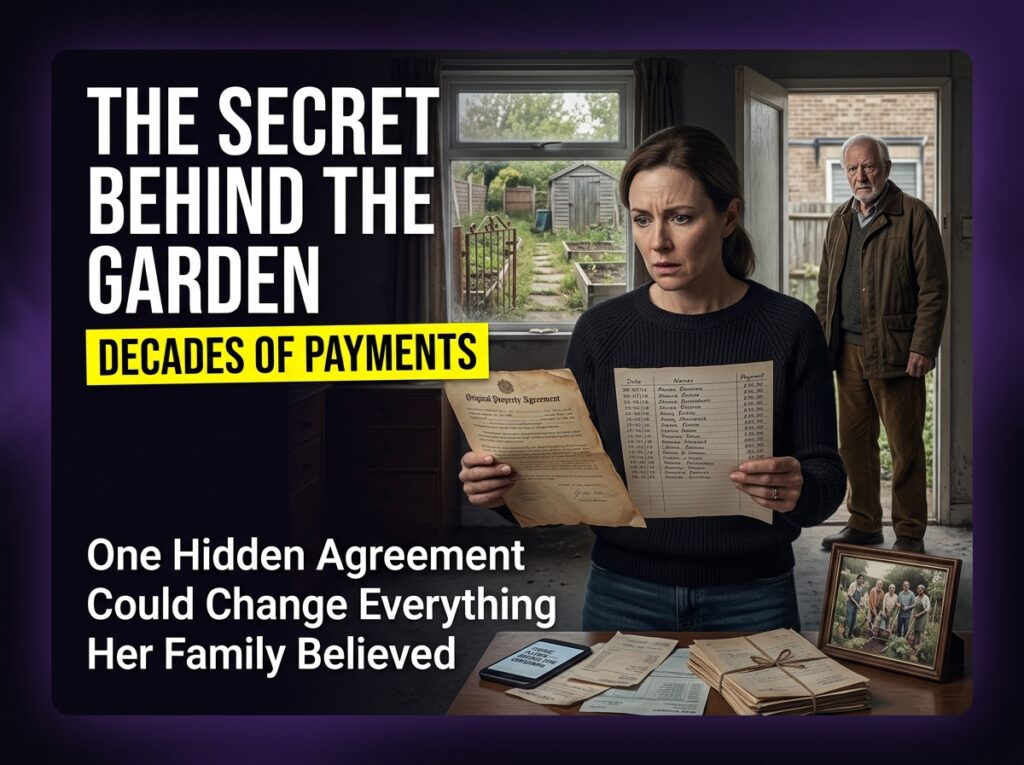
The house had been silent for months, and I assumed its secrets had died with its owner. Then a pensioner everyone underestimated brought up a neighborhood garden while clearing out an old room. Every conversation about a neighborhood garden ended the same way: a forced smile, a changed subject, and a warning that some truths were better left buried. I nearly let the matter go, until I noticed something unusual in a bundle of records that had been left behind. Inside, I found a list of names. It looked ordinary until I compared it with the records everyone had accepted without question. I found a trail of payments that appeared harmless individually, but together revealed a pattern that had continued for decades. I had to decide whether exposing the truth would finally bring justice or destroy the only relationships I had left. Just before I could confront them, my phone lit up with a message from an unknown number: ‘If you want the truth, come alone—and bring the original.’
The first thing I noticed when I returned to my late aunt Eleanor’s house was the silence.
It was not the ordinary silence of an empty building. It felt heavier than that, as though the rooms had been holding their breath for months and had finally forgotten how to speak.
The curtains remained closed. A thin layer of dust covered the hallway table, and the clock above the fireplace had stopped at 4:17. In the kitchen, a cup still sat beside the sink, exactly where Eleanor had apparently left it before her final illness.
She had been gone for four months.
During that time, I had visited the house only when necessary. There had been paperwork to complete, bills to settle, and difficult conversations with relatives who seemed more interested in the property’s value than in the woman who had lived there.
Eleanor had never married. She had no children. After my parents died, she became the closest thing I had to a second mother.
She taught me how to mend a torn sleeve, how to recognize when someone was lying, and how to make a small amount of money last until the end of the month.
Most importantly, she taught me that a person’s character was revealed by what they did when nobody was watching.
I had remembered those lessons when caring for her during her final years.
I had also remembered the promises she made about the house.
“Don’t let anyone rush you,” she told me one afternoon, when the pain medication had finally allowed her to sit comfortably by the window.
“Rush me about what?”
She looked toward the garden.
“Decisions that cannot be undone.”
I assumed she meant the inheritance.
Now, standing in the silent hallway, I wondered whether she had been talking about something else.
My relatives had already begun arguing about the estate. My cousin Martin wanted the house sold as quickly as possible. His sister, Helen, believed Eleanor had promised her the garden furniture and several antique pieces.
Neither of them had been particularly interested in visiting Eleanor while she was ill.
Yet after her death, they suddenly remembered every conversation in which she had supposedly promised them something.
I wanted the house cleared, the bills settled, and the remaining belongings distributed fairly.
I did not want another family dispute.
That was why I had come that morning with cardboard boxes, a notebook, and a plan to finish clearing the upstairs rooms.
I began with the smallest bedroom.
It had once been Eleanor’s sewing room. Shelves lined the walls, and a narrow desk stood beneath the window. The drawers contained old thread, buttons, folded fabric, and several notebooks filled with handwritten lists.
I placed the notebooks in a box marked PERSONAL PAPERS.
Then I heard someone knocking at the back door.
The man standing outside was Walter Hayes, a pensioner who lived three houses away.
He was in his late seventies, with a thin frame, weathered hands, and a habit of wearing the same brown jacket regardless of the weather.
Most people in the neighborhood regarded him as harmless but unimportant. He spent his mornings repairing things, his afternoons tending plants, and his evenings walking slowly along the street.
When the neighborhood association discussed anything complicated, Walter was usually ignored.
Eleanor had treated him differently.
She often brought him tea and listened to his stories about the old days.
“You’re clearing the house?” he asked.
“Trying to.”
He glanced toward the upstairs windows.
“Have you reached the back room?”
“Not yet.”
He nodded slowly.
“Be careful what you throw away.”
I smiled politely.
“Most of it is old paperwork.”
“That’s what people said about the garden records.”
I stopped.
“What garden records?”
Walter looked over his shoulder toward the overgrown land behind the neighboring houses.
“The neighborhood garden. Eleanor kept records about it for years.”
“I know she liked gardening.”
“That wasn’t what I meant.”
He appeared about to say something more, but then his expression changed.
“Never mind. It’s probably better if you ask someone else.”
“Ask whom?”
He adjusted his jacket.
“Nobody who wants to answer.”
Then he walked away.
I watched him cross the street, wondering what he had meant.
The neighborhood garden was a small patch of land behind several older houses. When I was a child, people grew vegetables there, shared tools, and gathered on summer evenings. Eleanor had occasionally taken me there, although I had not visited in years.
The garden had become neglected after the original volunteers grew older.
I assumed it had little connection to the house.
Still, Walter’s warning bothered me.
I returned to the sewing room and opened another drawer.
Inside were envelopes containing utility bills, receipts, and bank statements. Most were ordinary household records. Some were so old that the ink had faded.
I was about to close the drawer when I noticed a narrow bundle tied with string.
The papers inside had been arranged carefully.
On top was a handwritten list of names.
There were fourteen of them.
Beside each name was a date and an amount of money.
At first, I thought it was an old record of charitable donations. Eleanor had helped several families over the years, especially those who struggled to pay their bills.
But something about the dates made me hesitate.
They extended across nearly thirty years.
And the payments continued long after some of the people on the list had moved away.
I looked again at the first name.
Then I recognized the second.
Both belonged to people who had served on the neighborhood garden committee.
I unfolded the next page.
At the bottom, Eleanor had written a sentence in her familiar handwriting.
Never discuss the garden payments without the original.
I read it twice.
Then I heard footsteps in the hallway.
Martin had arrived earlier than expected.
“What are you doing with those papers?” he asked from the doorway.
I turned toward him.
“Looking through Aunt Eleanor’s records.”
His eyes moved to the bundle in my hands.
For a brief moment, his expression changed.
Then he smiled.
“You know how she was. She kept everything.”
I folded the paper.
“Did you know she kept records about the neighborhood garden?”
Martin’s smile disappeared.
“Put those papers back.”
I stared at him.
“Why?”
“Because you don’t understand what you’re looking at.”
He stepped closer.
And for the first time since Eleanor’s death, I wondered whether clearing the house would be the easiest part of discovering what she had left behind.
Martin did not leave until I had placed the papers back inside the drawer.
He stood beside the desk, watching me with an expression I could not interpret.
“There’s no reason to turn this into another family problem,” he said.
“I haven’t done anything.”
“Good. Then leave the garden records alone.”
I closed the drawer.
“Why does the garden matter so much?”
He rubbed his forehead.
“It doesn’t matter. That’s the point. It’s a patch of land that nobody uses properly anymore.”
“Then why are you worried about an old list?”
“I’m not worried.”
He said it too quickly.
I had known Martin for most of my life. We had spent holidays together, attended the same family gatherings, and helped each other through several difficult periods.
But since Eleanor’s death, our conversations had become strangely tense.
He wanted the house sold. He had also insisted that the garden was irrelevant to the estate.
I had assumed he was impatient.
Now I was no longer sure.
“What do you know about the payments?” I asked.
He picked up his coat.
“Nothing.”
“Then you shouldn’t mind me checking.”
His jaw tightened.
“Listen to me. Some people in this neighborhood have spent years making accusations about that garden. Eleanor was kind enough to help them, and they repaid her by dragging her into disputes.”
“What disputes?”
“Old arguments. Land boundaries. Money. Things that should have ended years ago.”
He moved toward the door.
“Don’t make the same mistake she did.”
After he left, I sat at the desk for nearly ten minutes.
I could have obeyed him.
It would have been easier to finish clearing the house, arrange the sale, and avoid another argument with the only close relatives I had left.
But Eleanor had written that the original document mattered.
Walter had warned me about the records.
And Martin had reacted as though he knew exactly what the list contained.
I reopened the drawer.
This time, I removed the entire bundle and carried it downstairs.
I spread the papers across the dining table and began sorting them by date.
The earliest records were almost thirty years old. They included receipts for seeds, garden tools, fencing materials, and small repairs.
Nothing seemed unusual.
Then I found a series of bank withdrawals.
The amounts varied, but the dates followed a pattern. A payment would be made near the beginning of a month, followed by another a few weeks later.
Sometimes the money went to a person on the list.
Sometimes it went to a local business.
Sometimes the recipient’s name was abbreviated.
I compared the dates with Eleanor’s household accounts.
Several payments appeared to have been made on days when she had visited the garden.
I began to wonder whether she had been funding the project herself.
But the total was larger than I expected.
Over the years, the records accounted for a considerable amount of money. It was not enough to make Eleanor wealthy or impoverished, but it was too much to dismiss as occasional charity.
Then I noticed something else.
The payments continued during periods when Eleanor had been ill.
Some had been made by standing order. Others appeared to have been transferred from an account I did not recognize.
The records contained no clear explanation.
I needed another source of information.
I called Walter.
He answered after several rings.
“I need to ask you about the garden,” I said.
There was a pause.
“Have you found something?”
“An old list of names and a series of payments.”
He exhaled slowly.
“I was afraid of that.”
“Why?”
“Because if those records still exist, someone is going to have to explain them.”
“Can you explain them?”
“Not over the telephone.”
I asked him to meet me at the garden.
He agreed to come the following morning.
Before ending the call, he said, “Bring the list, but don’t bring Martin.”
The next day, I walked to the garden carrying copies of the records.
The place looked smaller than I remembered. Several wooden beds had collapsed, and weeds covered the narrow paths. A rusted gate hung crookedly from its hinges.
Walter was waiting beside an old shed.
He looked at the papers without touching them.
“These are Eleanor’s records,” he said.
“Yes.”
“Did you find the original?”
“What original?”
He closed his eyes briefly.
“Then the important document is still missing.”
I showed him the handwritten list.
“Who are these people?”
“Some were volunteers. Some were residents who helped maintain the garden. Others had responsibilities that nobody talked about.”
“What responsibilities?”
Walter looked toward the neighboring houses.
“When the garden was established, the land was supposed to remain available to the neighborhood. Not just to the people who happened to own the houses around it.”
“Who owned it?”
“That is what the original document explained.”
I felt a chill despite the mild weather.
“Are you saying the garden belongs to everyone?”
“I’m saying the agreement was more complicated than that.”
He told me that decades earlier, several families had contributed money and labor to maintain the garden. Eleanor’s relatives had helped organize the arrangement.
The payments were meant to cover maintenance and preserve access to the land.
But over time, the original volunteers had died or moved away. New residents knew little about the arrangement. The records became fragmented, and the neighborhood association began treating the garden as though it were merely an informal community project.
“Why didn’t someone explain this?” I asked.
“People tried. But whenever the subject came up, someone insisted the matter had already been settled.”
“Who?”
Walter looked at me.
“That depends on which year you’re asking about.”
I wanted to press him, but he seemed exhausted.
Instead, I asked about the original document.
He said Eleanor had kept it for years. She had shown him a copy once, although he could not remember where she stored it afterward.
“She believed the document would protect the garden,” he said. “But she also believed that revealing it without understanding the payments could hurt people who had nothing to do with the original dispute.”
I thought about Martin’s warning.
“Was my cousin involved?”
Walter looked away.
“I cannot answer that without seeing more records.”
Then he reached into his jacket and removed a small envelope.
Inside was a faded photograph of the garden, taken decades earlier.
Several people stood beside the old wooden gate. Eleanor was among them, younger and smiling.
Beside her stood a man I recognized from a family photograph.
My grandfather.
On the back, someone had written:
The day we agreed that nobody would be turned away.
I stared at the words.
Walter watched me carefully.
“That was the promise,” he said.
“Then why has everyone been hiding it?”
He folded his hands.
“Because keeping a promise can become inconvenient when the land becomes valuable.”
I returned to Eleanor’s house with the photograph and the list of names.
For the first time, I understood why she had kept so many records. She had not simply been organizing household expenses or documenting charitable donations.
She had been preserving evidence of an arrangement that had slowly disappeared from public memory.
But the photograph did not prove who owned the garden or what obligations remained. I needed the original agreement.
I searched the sewing room again.
I opened every drawer, examined the backs of the notebooks, and checked the envelopes containing old insurance documents. I found several letters from my grandfather, but none mentioned the location of the original.
Then I remembered a cupboard beneath the stairs.
Eleanor had always kept it locked.
When I was younger, she told me it contained cleaning supplies and old tools. After her death, I had found the key in a kitchen drawer but had never bothered to open it.
I fetched the key and turned it in the lock.
Inside were boxes of documents, a small metal cashbox, and a stack of gardening books.
The cashbox was locked.
I searched the surrounding shelves and found a small envelope containing another key.
Inside the box were bank statements, receipts, and a collection of letters tied with blue ribbon.
One letter was addressed to Eleanor by a woman named Margaret Price.
The date was almost twenty years old.
Dear Eleanor, it began. I am writing because the payments have started again, and I do not understand why nobody is willing to explain them to the committee.
The letter described a disagreement about the garden’s expenses. Margaret believed that certain payments were being recorded under misleading descriptions.
She had asked for a complete account.
The response, according to the letter, had been a warning to stop asking questions.
I read the page twice.
The same pattern had appeared in the conversations I had experienced since Eleanor’s death.
A question was raised.
Someone became uncomfortable.
The subject changed.
And the person asking was told that reopening the matter would hurt the family.
I continued reading.
Margaret had written that she was considering stepping down from the garden committee because she could no longer explain the accounts to the residents.
At the bottom, she added a sentence that made my hands tremble.
If anything happens to the original records, please remember that the list of names is not the agreement itself.
I placed the letter beside the list.
She had known about the records.
She had also known that the list alone could not establish the full truth.
I searched the cashbox again.
Beneath a pile of receipts, I found a small notebook containing a series of initials and amounts. The entries matched several payments from the larger bundle.
One set of initials appeared repeatedly beside transactions made to a company that no longer existed.
Another matched the name of a local solicitor who had retired years earlier.
I photographed the pages and contacted our family’s solicitor.
She agreed to examine the documents, but warned me not to draw conclusions before the payments had been verified.
“The records may indicate a pattern,” she said. “But we need to establish who made each payment, why it was made, and whether it was connected to the land agreement.”
I understood.
Still, the more I examined the records, the more convinced I became that Eleanor had been trying to preserve something important.
That evening, Martin called.
“Have you finished clearing the house?”
“Not yet.”
“What’s taking so long?”
“I’m examining the old records.”
He sighed.
“I told you not to get involved in the garden.”
“You also told me you knew nothing about the payments.”
“Because I don’t.”
“Then why are you so worried?”
He became silent.
Finally, he said, “Because you’re making accusations without understanding what happened.”
“I’m trying to understand what happened.”
“Then stop digging through things that don’t concern you.”
The call ended before I could respond.
I sat in the dining room, surrounded by papers.
For years, I had believed my family was ordinary. We argued about money, disagreed about holidays, and occasionally avoided difficult conversations. Nothing suggested that a neighborhood garden could become the center of a decades-long mystery.
Now the records seemed to connect people who had barely spoken to one another in years.
I called Walter again.
He agreed to meet me the following morning.
When I arrived at his house, he had prepared a folder containing photocopies of old meeting minutes.
The documents showed that the garden committee had discussed the payments several times. Each meeting ended with a vague resolution to review the accounts later.
The review never appeared to have been completed.
“Who was responsible for the accounts?” I asked.
“Different people at different times.”
“Was Eleanor one of them?”
“She kept records, but she wasn’t always the person authorizing the payments.”
“Who was?”
Walter tapped a line in the minutes.
“The committee treasurer. And, during certain years, the person responsible for the land.”
I read the name.
It belonged to a man who had died before Eleanor.
“Why was he responsible for both?”
“Because the original agreement gave him a particular duty. But the records do not explain whether that duty was transferred to someone else.”
“Was it transferred to my family?”
“I don’t know.”
I looked at the meeting minutes.
One entry mentioned a missing document. Another referred to an original that had been temporarily removed for legal review.
There was no record of its return.
I asked Walter whether he had ever seen the original.
“Once,” he said.
“Where?”
“In Eleanor’s house.”
“When?”
“Years ago, after a committee meeting.”
“What did it look like?”
“A folded document inside a brown envelope. Eleanor told us it was the paper that explained everything.”
I asked him where she had kept it.
He thought for a moment.
“She said she had placed it somewhere nobody would search during an ordinary house clearance.”
My mind returned to the locked cupboard.
But we had already searched it.
Unless the original was hidden inside one of the objects rather than among the papers.
I asked Walter whether he remembered anything else.
He looked at me for a long time.
“Yes,” he said. “I remember the last person who asked to see it.”
“Who?”
“Martin.”
I did not confront Martin immediately.
Instead, I returned to the house and searched the cupboard again, this time paying attention to the objects rather than the paperwork.
The gardening books had belonged to Eleanor’s father. Their covers were worn, and several pages had fallen loose.
I removed each book from the shelf.
Inside the last one, I found a folded envelope.
It was brown, brittle, and sealed with old adhesive.
On the front, Eleanor had written:
Original agreement. Do not separate from supporting records.
I sat down on the floor.
For several seconds, I could not move.
I had spent days searching through the papers, convinced that the original had been lost. Yet it had been hidden in a place I had passed repeatedly.
I opened the envelope carefully.
Inside was a document bearing several signatures and a date from decades earlier. It described an arrangement concerning the garden and the land surrounding it.
The wording was formal, but the central purpose was clear enough to understand.
The garden was intended to remain available for community use under the terms of the agreement. Certain responsibilities had been assigned to named individuals, including the maintenance of the grounds and the recording of contributions.
The document also referred to a separate schedule of payments.
I recognized the list from the sewing-room drawer.
But the agreement contained a warning: the payment records were not to be treated as proof of ownership or authority to change the arrangement.
I understood why Margaret had written that the list was not the agreement itself.
The list showed money changing hands.
The original explained the responsibilities that were supposed to govern those payments.
I photographed the document and placed it in a protective folder.
Then I called our solicitor.
She advised me to bring the original to her office and avoid making any changes to the property until its legal status had been reviewed.
I agreed.
Before I could leave, Martin arrived.
He saw the folder in my hands.
“What’s that?”
“The original agreement.”
His face went pale.
“Where did you find it?”
“In Eleanor’s gardening books.”
He stared at the envelope.
For a moment, I thought he might reach for it.
Instead, he sat down.
“I hoped she had destroyed it,” he said quietly.
The admission shocked me.
“You knew it existed?”
“Yes.”
“How?”
Martin rubbed his hands together.
“Eleanor showed it to me years ago. She said the garden couldn’t be sold or developed without examining the agreement.”
“Why didn’t you tell me?”
“Because I thought the matter had already been settled.”
“That isn’t an answer.”
He looked toward the window.
“The garden land is worth more than it used to be. Several people have wanted to acquire it. Eleanor refused every offer because she believed the agreement still mattered.”
“Did you try to sell it?”
“No. But I spoke to someone who wanted to buy the surrounding property.”
“Who?”
“A developer.”
“Did you show him the agreement?”
“No.”
“Did you tell him about the payments?”
Martin shook his head.
“I told him the family records were incomplete. He said the title would need to be checked.”
I stared at him.
“Then why did you tell me to leave the records alone?”
“Because I was afraid you’d accuse me of trying to take the garden away from the neighborhood.”
“Did you?”
“No.”
His answer came with unexpected force.
“I wanted to know whether the agreement could be changed. I thought if it had become obsolete, we could sell the land and use the money to settle the estate.”
“Did you ask Eleanor?”
“Yes. She refused to discuss it.”
“Why?”
“She said the agreement wasn’t ours to change without understanding who it protected.”
I looked at the original.
“Who did it protect?”
“I don’t know.”
Martin admitted that he had asked Eleanor for the document shortly before her final illness. She refused to give it to him and warned him not to involve the developer.
He had not known where she stored it.
After her death, he assumed it had been lost.
“Why didn’t you tell the rest of us?” I asked.
“Because I didn’t want another argument. I thought we could settle the estate first and deal with the garden later.”
“That is exactly how the problem continued for decades.”
He lowered his head.
I wanted to be angry, but I could see the fear behind his expression.
He had been trying to protect himself from a financial problem. In doing so, he had helped preserve the silence that had surrounded the garden for years.
I placed the original on the table.
“We need to find out what this document means.”
Martin nodded.
Then he looked at the envelope.
“There’s something else you should know.”
“What?”
“Eleanor told me that if the original was ever found, the person holding it would receive a warning.”
I felt my stomach tighten.
“What kind of warning?”
“I don’t know. She never explained.”
At that moment, my phone vibrated.
A message appeared from an unknown number.
If you want the truth, come alone—and bring the original.
I read the message several times.
The wording was identical to the sentence in the screenshot of my own discovery, and seeing it on my phone made the situation feel suddenly real.
Someone knew I had found the original.
Someone knew I was investigating the payments.
And someone wanted me to bring the document to a private meeting.
Martin watched my expression.
“What is it?”
I showed him the message.
He stood so quickly that his chair scraped across the floor.
“Don’t answer it.”
“Why?”
“Because we don’t know who sent it.”
“That is why I need to find out.”
He shook his head.
“You have the original. Give it to the solicitor and let her handle this.”
I understood his concern, but I also knew that whoever sent the message might have information we needed.
I called Walter and told him what had happened.
He became unusually quiet.
“Did the message include a location?”
“No.”
“Then don’t go anywhere until we know more.”
“Do you recognize the wording?”
He hesitated.
“Yes.”
“From where?”
“From a letter Eleanor received several years ago.”
I asked him to explain.
Walter said that someone had sent Eleanor a note warning her to stop asking questions about the garden payments. He had not seen the original letter, but Eleanor had shown him a copy.
The message had been anonymous.
“What did she do?” I asked.
“She kept searching.”
“Did she tell the police?”
“No. She believed the person was trying to frighten her rather than harm her.”
“Was she right?”
“I don’t know.”
Walter agreed to meet me at the garden that afternoon.
I did not bring the original document. I took a photocopy instead and left the original in the solicitor’s secure custody.
The decision felt cautious, but it also felt sensible.
When I arrived, Walter was standing beside the gate.
He looked older than he had the previous day.
“I need to tell you something about the payments,” he said.
“All right.”
“Not everyone on the list was receiving money.”
I frowned.
“What do you mean?”
“Some names were connected to payments made on behalf of the garden. Others were listed because they had received money temporarily and were expected to repay it.”
“Why?”
“Because the agreement allowed certain expenses to be advanced when the garden needed repairs. But the money was supposed to be recorded properly.”
“Was it?”
“Sometimes.”
He explained that the garden had suffered several difficult periods. Fences had been damaged, water pipes had broken, and the neighboring houses had needed repairs to a shared access path.
The committee had sometimes paid expenses directly rather than waiting for formal approval.
Over time, those temporary arrangements became difficult to track.
Some payments were reimbursed.
Others were carried forward.
And a few were recorded under descriptions that no longer made sense to the people examining the accounts.
“That could explain some of the payments,” I said.
“Yes. But not all of them.”
He pointed to the photocopy.
“Look at the dates beside these three names.”
I checked the entries.
The dates were close together, but the amounts differed.
Walter explained that the three people had served on the committee during a period when the garden’s financial records had been transferred between treasurers.
A sum of money had been moved into a separate account to cover future maintenance.
The transfer was legitimate according to the minutes, but the records showing how the money had later been used were incomplete.
“Did anyone steal it?” I asked.
“I don’t know.”
“Did Eleanor know?”
“She suspected that the accounts were wrong. She never told me she had proof of theft.”
That distinction mattered.
I had been tempted to believe the list exposed a deliberate scheme.
But the evidence could support several explanations, and I could not accuse anyone simply because the payments looked suspicious.
“What did Eleanor think had happened?” I asked.
Walter looked toward the garden.
“She believed someone had changed the story to make the agreement look less important than it was.”
“Who?”
“She never told me.”
I asked why he had not mentioned this earlier.
“Because I didn’t want you to think the entire neighborhood was involved in something dishonest. Most people simply trusted the records they were given.”
I understood.
A long-running misunderstanding could become dangerous without everyone involved acting maliciously.
But someone had sent the anonymous message.
And someone wanted the original document.
Before leaving, I asked Walter whether he knew who had sent the warning to Eleanor.
He shook his head.
“I never found out.”
Then he looked at me with a seriousness I had not seen before.
“But I remember one thing she said.”
“What?”
“She said the person who understood the payments would also understand why the garden had been protected.”
Our solicitor examined the original agreement and the supporting records.
She confirmed that the document was important, but she cautioned that its precise legal effect would depend on the property’s title, the history of the arrangement, and any later changes that could be established.
The payment list was evidence worth investigating, not proof of wrongdoing.
I appreciated her honesty.
I had begun to see how easily suspicion could become a substitute for facts.
The solicitor recommended that the family obtain a complete accounting of the payments and establish which records were missing.
She also advised us to inform the relevant property authorities before making any decision about selling or developing the land.
Martin agreed to cooperate.
For the first time, he admitted that he had spoken to the developer about the possibility of acquiring the property. He had not signed an agreement or transferred ownership, but he had allowed the developer to believe that the family might be willing to sell.
He apologized to me.
“I should have told you,” he said.
“Yes, you should have.”
“I thought I could find out whether the agreement still mattered before involving everyone.”
“That’s what Dad and Eleanor tried to do. Look where the silence left us.”
Martin nodded.
We arranged a meeting with the remaining members of the neighborhood garden committee.
Several were elderly. Others had moved into the area more recently and knew little about the original arrangement.
When I placed the agreement on the table, the room fell silent.
One woman recognized her father’s signature.
Another remembered being told that the garden had to remain open to residents.
A third said she had always believed the property belonged entirely to Eleanor’s family.
The discussion became heated.
People remembered different things.
Some believed the garden was a shared asset.
Others believed the family had simply allowed neighbors to use private land.
Nobody could explain the payments completely.
We agreed to review the records before making accusations.
The committee appointed an independent accountant to examine the available transactions. The accountant would compare the receipts, bank statements, meeting minutes, and handwritten list.
It was the first time in years that anyone had attempted to assemble the entire financial history.
Meanwhile, the anonymous messages continued.
The second arrived two evenings later.
You have the wrong person in mind.
I stared at the screen.
I had not told anyone whom I suspected.
I had not even decided whether I suspected a particular person.
I showed the message to our solicitor, who advised me to preserve the communications and avoid responding until we had a better understanding of the situation.
The third message arrived the following morning.
The names are not the secret. The missing years are.
That sentence changed the direction of my investigation.
I returned to the payment records and arranged them chronologically.
The earliest transactions were well documented. The middle years contained gaps. The most recent payments were recorded in Eleanor’s handwriting, but several lacked receipts.
I compared those dates with the committee minutes.
There was a period of nearly five years during which the garden had received very little formal funding.
Yet the grounds had continued to be maintained.
Someone had paid for repairs, tools, and supplies without recording the expenses properly.
I checked the list again.
One name appeared throughout that period.
Walter Hayes.
I called him.
He answered quietly.
“I think I understand why your name appears so often,” I said.
He did not respond.
“Walter, did you pay for the garden expenses yourself?”
After a long pause, he said, “Some of them.”
“Why didn’t you tell anyone?”
“Because I didn’t want to embarrass the people who needed help.”
He explained that several residents had fallen into financial difficulty. Some were elderly and living on limited incomes. Others had lost work or faced unexpected medical expenses.
The garden had been a source of food, company, and dignity for many of them.
Walter had occasionally paid for repairs and supplies when the committee could not raise enough money.
Eleanor had reimbursed some of his expenses.
Other payments had gone directly to residents who had helped maintain the grounds.
The records were incomplete because Walter had never expected to be repaid for everything.
“You gave people money?” I asked.
“I paid for what needed doing.”
“Why didn’t you tell the committee?”
“Because the garden wasn’t supposed to become a place where people had to explain their poverty before they could grow vegetables.”
I sat down.
For years, the payments had looked suspicious because we had examined them without understanding the circumstances behind them.
Some represented legitimate expenses.
Some were informal loans.
Others were acts of generosity.
But the missing records still mattered.
I asked Walter whether he had received the anonymous messages.
“No,” he said. “But I know who might have sent them.”
“Who?”
He hesitated.
“Someone who believes that revealing the truth will hurt the people Eleanor was trying to protect.”
Walter refused to name the person over the telephone.
He said he wanted to examine the remaining records first because he did not want me to confront anyone based on a suspicion.
I agreed.
We met at the garden the following afternoon.
He brought a cardboard box containing old receipts, committee notices, and several letters Eleanor had given him years earlier.
Most of the papers concerned routine expenses.
One letter, however, was different.
It had been written by Eleanor and addressed to a former committee treasurer.
She thanked him for maintaining the accounts during a difficult period, then asked him to explain why several payments had been recorded without supporting receipts.
The reply was attached.
The treasurer acknowledged that some records had been lost when the committee changed offices. He also admitted that certain payments had been made informally to help residents who could not afford their share of the garden expenses.
He had intended to replace the missing paperwork later.
He never did.
The letter did not establish that money had been stolen, but it explained why the records were inconsistent.
I asked Walter whether the treasurer was still alive.
“No. He died many years ago.”
“Then why has nobody corrected the accounts?”
“Because each new committee inherited the old records and assumed someone else had already checked them.”
The explanation was painfully ordinary.
No single person had necessarily planned to conceal everything. A temporary arrangement had become permanent. Missing receipts had been treated as an inconvenience. Later committees had relied on incomplete summaries.
Eventually, the accepted version of events became more important than the evidence.
I looked at the letter again.
“Why would someone send me anonymous warnings now?”
Walter stared at the garden gate.
“Because the original agreement could change how people understand the land. And because the payments reveal who knew about the agreement when the records were incomplete.”
“Who knew?”
“That is what the missing years might establish.”
I asked him to explain.
He pointed to a series of entries from the period when Eleanor had begun questioning the accounts.
Several payments had stopped shortly after she requested a review.
Others had continued under different descriptions.
The names on the list suggested that certain people had remained involved even after the committee stopped discussing the agreement openly.
One of those names belonged to a former neighborhood association chair.
Another belonged to a local solicitor who had handled property matters for several families.
The third was connected to Martin.
I felt my stomach tighten.
“Why is Martin’s name there?”
Walter studied the page.
“I don’t know. It could refer to a payment made on behalf of the family, or to an expense he authorized. We need the underlying records.”
I remembered Martin’s reaction when I found the list.
He had been frightened, but perhaps he had feared being blamed for something he had not done.
I could not assume his involvement meant wrongdoing.
That evening, the independent accountant sent an initial report to the committee.
The report identified three categories of payments: documented garden expenses, reimbursements to residents, and transactions that could not yet be verified.
The accountant found no basis for declaring that the entire sum had been stolen.
However, several transactions required further investigation because the supporting records were missing.
The report also recommended that the committee correct its historical accounts and preserve the original agreement.
I read the report carefully.
It did not provide the dramatic answer I had imagined when I first discovered the list.
Instead, it revealed a long chain of small decisions.
A missing receipt.
An informal loan.
An expense paid without approval.
A committee that failed to follow up.
A family that avoided uncomfortable questions.
Over time, those small omissions had created a story that nobody could fully explain.
I called Martin and told him about the report.
He sounded relieved.
“So there was no theft?”
“That’s not what the report says. It says the evidence isn’t enough to establish that the money was stolen.”
“That’s different.”
“Yes.”
He sighed.
“I should have listened to Eleanor.”
“We all should have.”
Then I told him about the entries connected to his name.
He became quiet.
“I remember paying for a fence repair when I was younger,” he said. “Dad asked me to help because the committee had run out of money.”
“Did you receive reimbursement?”
“No. I never asked for it.”
“Do you have any records?”
“I might have an old receipt somewhere.”
I asked him to look.
Before we ended the call, he said something that stayed with me.
“Maybe the person sending those messages isn’t trying to hide theft. Maybe they’re trying to stop us from blaming the wrong people.”
I thought about the words.
You have the wrong person in mind.
Perhaps the anonymous caller had been warning me against an accusation.
But why had they insisted that I bring the original?
I still needed an answer.
<h2>Part 8</h2>
The next message arrived late on a Thursday evening.
Tomorrow. Six o’clock. The old garden shed. Bring the original. Come alone.
I showed it to our solicitor.
She advised me not to meet an unknown person in an isolated location without considering my safety. I agreed that I would not take unnecessary risks, and we discussed ways to arrange a safe, public meeting if the sender could be identified.
I did not take the original document with me.
Instead, I sent a message asking the person to identify themselves.
The reply came within minutes.
You will know me when you see me.
The following morning, Walter called.
“I think I know who has been contacting you,” he said.
“Who?”
“Margaret Price’s daughter, Anna.”
I remembered the old letter from Margaret, the woman who had questioned the garden accounts years earlier.
“What does Anna know?”
“Her mother spent years trying to understand the payments. Before she died, she told Anna that the garden records had been used to make people believe the arrangement no longer mattered.”
“Why didn’t Anna contact us directly?”
“Because she believed the family would dismiss her, just as they dismissed her mother.”
I asked Walter whether he had told Anna about my discovery.
“No. But she may have heard that you found the original.”
I searched Eleanor’s papers for Margaret’s address.
An old envelope contained a forwarding address for her daughter.
I called the number listed in a local directory and left a message.
A woman returned the call that afternoon.
She introduced herself as Anna Price.
“I understand you’ve been looking at my mother’s records,” she said.
“Yes.”
“Then you know she was not imagining things.”
“I know she raised questions about the payments.”
“She raised questions for years. Every time she asked for an explanation, someone told her the matter had already been settled.”
I asked Anna why she had sent the messages.
“Because I needed to know whether you had found the original agreement or just another copy.”
“Why does that matter?”
“Because the copies were never enough to settle the argument. The original contains a handwritten addition that my mother believed was important.”
My heart began to beat faster.
“What addition?”
“A note about the responsibilities of the people who maintained the garden.”
“Did your mother see the original?”
“Yes. She was on the committee when Eleanor brought it to a meeting.”
I asked Anna to explain what the note said.
She refused.
“I won’t discuss it until I know the document is authentic.”
“I have already shown it to a solicitor.”
“Then arrange a meeting with her present.”
I agreed.
We arranged to meet at the solicitor’s office the following afternoon.
Anna arrived carrying a folder of her mother’s papers.
She was in her fifties, with tired eyes and a firm manner. She placed the folder on the table and looked at the original agreement.
For several moments, she said nothing.
Then she pointed to a handwritten note in the margin.
“This is what my mother was trying to explain.”
The note stated that the garden’s maintenance responsibilities were not limited to the original committee members. They were intended to continue through successive stewards, provided the arrangement remained legally effective and the relevant conditions were met.
It did not prove that the property could never be sold.
It did not establish that every payment had been proper.
But it showed that the agreement had been designed to survive changes in the people responsible for maintaining the garden.
Anna explained that her mother had believed later committees had treated the arrangement as though it had expired simply because the original volunteers had died or moved away.
She had repeatedly asked for a review.
Instead, the issue had been postponed.
“Why did you send the messages?” I asked.
Anna looked at the document.
“Because I wanted the original preserved before someone sold the land and declared the old agreement irrelevant.”
“Why not tell me who you were?”
“Because I didn’t know whether you were investigating the truth or trying to prove that your family owned everything without restrictions.”
I understood her fear.
She had watched her mother become isolated because she asked questions nobody wanted to answer.
I asked whether she knew who had been responsible for the missing records.
“No,” she said. “But my mother believed the most important evidence was not in the payment amounts. It was in the dates when the payments stopped and started again.”
Our solicitor reviewed the relevant entries.
The dates corresponded with changes in the committee’s leadership and the periods when the original agreement had been questioned.
They did not identify a culprit, but they suggested that the garden’s administration had changed whenever the agreement came under scrutiny.
The evidence was still incomplete.
Yet the pattern was becoming clearer.
The garden had not simply been neglected.
Its history had been gradually reduced to a version that was easier for people to accept.
And now we had to decide whether to correct that history publicly, knowing that some of the people involved had acted out of fear, confusion, or a desire to protect their own interests.
The committee met the following week.
For the first time in decades, the original agreement was examined alongside the payment records, meeting minutes, and letters from former members.
Our solicitor explained what the documents could establish and what remained uncertain.
The agreement demonstrated that the garden had been subject to a historical arrangement. Its present legal effect still required proper review, but it could not responsibly be ignored.
The payments showed that people had contributed money and covered expenses over many years. Some transactions were documented. Others remained unexplained.
The records did not justify accusing any individual of theft.
They did, however, reveal that the committee had repeatedly failed to maintain a complete account of the garden’s finances.
The committee agreed to commission a full historical review, preserve the original agreement, and suspend any decision to sell or develop the land until the relevant legal questions had been addressed.
Martin attended the meeting.
He acknowledged that he had spoken to a developer without understanding the full history. He apologized for discouraging me from examining the records.
“I thought I was preventing another family argument,” he said. “Instead, I helped keep everyone in the dark.”
Nobody applauded.
Nobody immediately forgave him.
But several people thanked him for speaking honestly.
Anna presented her mother’s letters and asked that they be included in the archive.
Walter brought the old photograph of the garden and placed it beside the original agreement.
The image showed a group of neighbors standing together, holding gardening tools and smiling at the camera.
They looked ordinary.
They had no idea that their small community project would become the subject of arguments decades later.
I studied the photograph.
I recognized Eleanor, my grandfather, and several people whose names appeared on the list.
They had not looked like people involved in a grand scheme.
They looked like neighbors who had agreed to maintain a place where everyone could grow food, share what they had, and ask for help without embarrassment.
Perhaps that was why the garden had mattered so much to Eleanor.
She had seen what it meant to people who had little else.
The committee voted to restore the garden’s records and investigate whether the original arrangement could be preserved under the current legal framework.
The decision did not settle every question.
Some payments remained unexplained.
Some records had probably been lost permanently.
The identity of the person responsible for the anonymous messages was no longer a mystery, but the deeper question of why the accounts had been allowed to deteriorate remained complicated.
Anna admitted that she had sent the messages because she feared the original would disappear before anyone took the matter seriously.
She apologized for asking me to meet her alone.
“I thought you would refuse if I told you who I was,” she said.
“You could have been honest from the beginning.”
“I know.”
I accepted her apology, although I told her that fear was no excuse for making someone feel threatened.
She agreed.
In the weeks that followed, the garden began to change.
Volunteers cleared the weeds, repaired the gate, and replaced several damaged boards. Walter supervised the work, though he insisted that he was too old to do more than offer advice.
Martin helped repair the fence.
Anna organized her mother’s letters.
I worked with the solicitor to preserve the original agreement and ensure that copies were securely stored.
The process was slow.
It required patience, money, and difficult conversations.
But it was honest.
One afternoon, while clearing the shed, I found a small envelope tucked behind a loose wooden panel.
Inside was a handwritten note from Eleanor.
It was dated only a few months before her death.
If someone finds this, please understand that the garden was never meant to make anyone rich. It was meant to make sure nobody had to face hardship alone.
Below that, she had written:
The records matter because promises matter. But people matter more than the paper.
I sat on an overturned bucket and read the note again.
For weeks, I had been searching for evidence that would identify a person responsible for the missing records.
Instead, Eleanor had left me a reminder of why the truth mattered.
It was not enough to expose mistakes.
We also had to understand the people who had lived with them.
That did not mean excusing wrongdoing.
It meant separating deliberate harm from human error, and refusing to let suspicion replace evidence.
I carried the note to the committee.
When Walter read it, he removed his glasses and wiped his eyes.
“That sounds like Eleanor,” he whispered.
For the first time, I felt that we were beginning to honor her wishes.
Then our solicitor called with an update.
The historical review had uncovered one final discrepancy in the payments.
A transfer made during the last year of Eleanor’s life had no matching receipt, no clear authorization, and no explanation in the committee minutes.
The amount was not enormous.
But the recipient’s name was missing.
Our solicitor asked whether we could identify the original bank account.
I looked at the list of names.
The transfer had occurred only weeks before Eleanor died.
And the reference number matched a note in her private notebook.
We had uncovered the history of the garden.
But there was still one payment nobody could explain.
The final discrepancy took another month to investigate.
Our solicitor obtained the available bank records and compared them with Eleanor’s notebook and the committee’s historical accounts.
The transfer had been made to cover expenses connected with the garden, but the original recipient could not be conclusively identified from the surviving records.
It was possible that the payment had been made to a contractor whose business had closed.
It was also possible that the money had been used to reimburse a volunteer.
Without the missing receipt, neither explanation could be established with certainty.
I had hoped for a final revelation that would explain every transaction and identify everyone responsible for the years of confusion.
Instead, I learned that some questions would remain unanswered.
That was difficult to accept.
But it was better than inventing an explanation simply because uncertainty made us uncomfortable.
The committee documented the unresolved payment, retained the supporting evidence, and adopted new procedures for recording every future expense.
The original agreement was preserved.
The legal review continued, and the family agreed not to sell or develop the land until the relevant questions had been properly resolved.
The garden was reopened to the neighborhood.
On the first Saturday, people arrived carrying tools, plants, and bags of soil. Children ran between the raised beds while older residents showed them how to prepare the ground.
Walter stood beside the gate, watching everything with quiet satisfaction.
I walked over to him.
“You were right about the garden,” I said.
He smiled.
“About what?”
“That it mattered more than I understood.”
He looked toward the people working in the beds.
“It matters because of what happens here. The records only explain how we got here.”
I thought about Eleanor.
She had spent years preserving documents that most people would have thrown away. She had recorded payments, kept letters, and protected an agreement whose importance was gradually forgotten.
I had initially assumed her records contained evidence of a secret financial scheme.
What they revealed was more complicated.
There had been mistakes, incomplete accounts, and people who avoided difficult questions. There had also been generosity, unpaid labor, and neighbors who had quietly helped one another through difficult times.
The truth did not make every person innocent.
It did not make every decision acceptable.
But it showed that the story was not as simple as the accusations we had inherited.
Martin came to the garden later that afternoon.
He had brought a box of tools and several bags of compost.
“I should have listened to Eleanor,” he said.
“You said that already.”
“I know. But I wanted to say it again.”
We stood beside the gate.
For years, our relationship had been strained by unspoken resentment. We had each assumed the other was acting out of self-interest.
The investigation had not erased those feelings, but it had given us a reason to speak honestly.
“I thought selling the property would solve the estate problems,” Martin admitted. “I didn’t want to believe there might be obligations we hadn’t understood.”
“I wanted the same thing. I just approached it differently.”
He nodded.
“Do you think we can repair things between us?”
I considered the question.
“I think we can start by not hiding things from each other.”
It was not a promise that everything would be easy.
It was a promise we could keep.
Over the following months, the family archive grew.
We included the original agreement, the payment records, Eleanor’s letters, the old photograph, and the notes that had helped us understand the garden’s history.
We also included the accountant’s report and a clear record of the transactions that remained unresolved.
Nobody would have to begin the investigation from the beginning again.
Nobody would have to rely solely on a story repeated by someone who could no longer remember where it began.
I kept a copy of the records in the house.
Sometimes I opened the folder and read Eleanor’s note.
The records matter because promises matter. But people matter more than the paper.
The sentence became a guide for the decisions that followed.
When a volunteer asked whether a small expense needed to be recorded, I said yes.
When a committee member disagreed with a decision, we wrote down the reasons and allowed everyone to ask questions.
When someone suggested that the garden might be worth selling, we did not treat the suggestion as a betrayal. We examined the proposal, considered the agreement, and sought proper advice.
We had learned that preserving a promise did not require pretending that circumstances never changed.
It required understanding the promise before deciding how to honor it.
One evening, I returned to Eleanor’s house to finish the last of the clearing.
The rooms no longer felt as silent as they had on the morning I found the list.
The furniture had been sorted. The papers had been preserved. The garden outside was alive with people again.
I stood in the sewing room and looked at the desk where I had first discovered the bundle of records.
I remembered how quickly I had suspected that someone was hiding money.
I remembered Martin telling me to put the papers away.
I remembered Walter’s warning and Anna’s anonymous messages.
Most of all, I remembered the fear I had felt when I realized that the only relationships I had left might be destroyed by the truth.
For a time, I believed that exposing the past meant choosing between justice and family.
Now I understood that the real choice had been whether to let silence continue making our decisions for us.
The truth had hurt people.
It had exposed mistakes and forced us to admit that some of our assumptions were wrong.
But it had also given us a way forward.
We had not recovered every missing receipt.
We had not identified the recipient of the final unexplained payment.
We had not settled every legal question surrounding the property.
Yet we had stopped pretending those uncertainties did not exist.
That was enough to begin.
Before leaving, I walked through the garden one final time.
Walter was locking the shed.
He raised a hand when he saw me.
“Everything all right?” he asked.
“Yes,” I said. “I think it is.”
He smiled and continued toward his house.
I stayed beside the gate, listening to the wind move through the leaves.
For decades, people had argued about the garden without fully understanding the agreement that protected it. Payments had been recorded incompletely. Questions had been postponed. Warnings had replaced explanations.
The original document had survived because Eleanor believed that someone would eventually need it.
She had been right.
But the most important discovery was not the list of names or the unexplained payments.
It was the realization that a family could inherit a problem without understanding how it began, and that the only way to stop passing it down was to examine it honestly.
I locked the gate and returned to the house.
The clock above the fireplace still showed 4:17. I had not repaired it, and I no longer felt any urgency to do so.
Some things could wait.
Others could not.
The truth had not destroyed every relationship I had left. It had tested those relationships, forced us to confront uncomfortable facts, and shown us which bonds could survive an honest conversation.
I could not promise that the family would never argue again.
I could promise that we would no longer use silence as a substitute for trust.
And whenever someone asked about the old neighborhood garden, I would tell them the story as accurately as I could.
Not as a tale of a hidden fortune.
Not as a story about a single villain.
But as a reminder of what happens when a promise outlives the people who made it, and the next generation forgets to ask why it mattered.
The house had been silent for months.
I had assumed its secrets had died with Eleanor.
I was wrong.
Her records had survived, and they had given us something more valuable than a simple answer.
They had given us the opportunity to make a different choice.