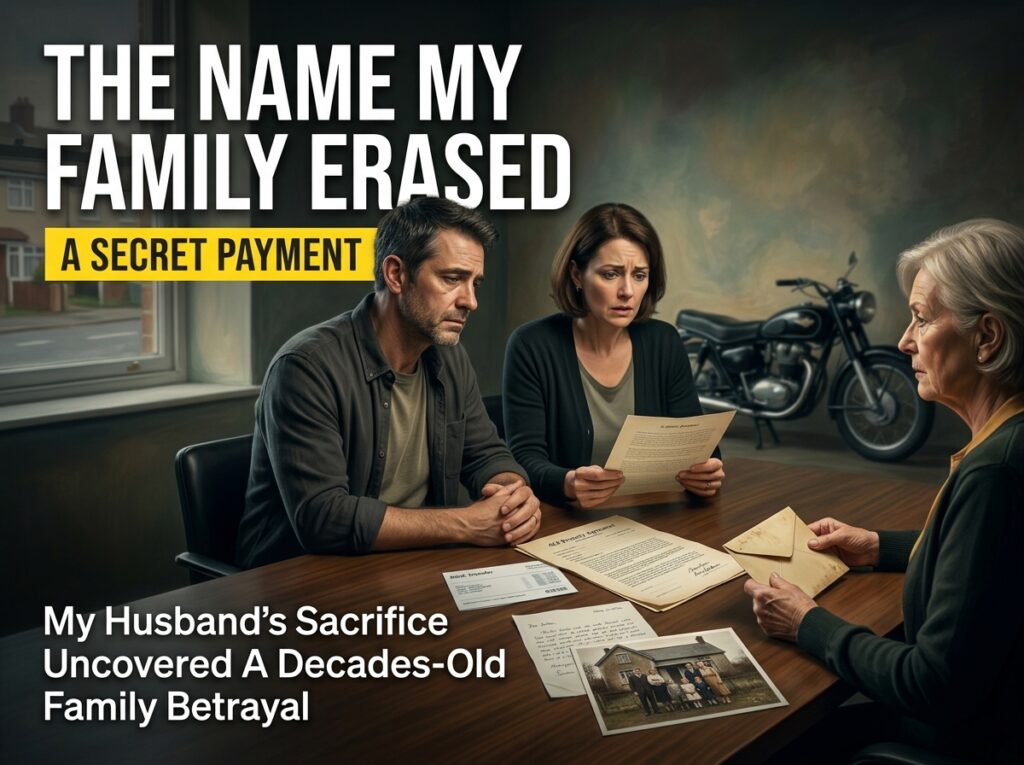
I knew something was wrong the moment I saw the empty space in our garage.
My husband, Daniel, had owned that motorcycle for twenty-three years. It was an old black machine with a worn leather seat, a small scratch near the fuel tank, and chrome that he polished whenever life became too complicated. He had bought it before we married, back when he worked long shifts at a repair shop and dreamed of taking long rides along the coast.
He never called it an investment. He never called it an asset.
It was simply his motorcycle.
When money became tight, I suggested selling it. We had a leaking roof, two overdue bills, and a car that needed repairs. Daniel refused.
“I can fix the roof next month,” he told me. “I’ll pick up extra work.”
“And the car?”
“I’ll manage that too.”
He always said he would manage.
That was one of the things I loved about him, although there were times when his stubbornness frightened me. Daniel believed that a person should protect the things that reminded them who they were. He had lost his father young, worked through years of financial hardship, and built a life from almost nothing. The motorcycle represented the one part of his past he had never been willing to surrender.
So when I opened the garage one Thursday morning and found its usual parking space empty, I assumed he had taken it out for a ride.
Then I noticed the empty hooks on the wall.
His helmet was gone too.
When Daniel came home that evening, he looked exhausted. He placed his keys on the kitchen counter, washed his hands, and asked whether I had eaten.
I stared at him.
“Where’s your motorcycle?”
He stopped drying his hands.
For a moment, neither of us spoke.
“I sold it,” he finally said.
I thought I had misheard him.
“You did what?”
“I sold it.”
“Why?”
He pulled out a chair and sat down. His eyes remained fixed on the table.
“I needed the money.”
“For the roof? The car? The bills?”
“No.”
The answer frightened me more than any explanation could have.
I sat opposite him.
“Daniel, we have been married for twenty-seven years. If we need money, we discuss it. We don’t sell something that important without telling each other.”
“I know.”
“Then tell me where the money went.”
He rubbed his forehead.
“I made a payment.”
“To whom?”
“Someone who needed it.”
“Who?”
He looked up at me, and I saw something in his expression I had rarely seen before.
Fear.
“It’s complicated,” he said.
I almost laughed because the word sounded so inadequate.
“You sold the motorcycle you’ve loved since before we met, and you gave the money to someone we have never met. How can you expect me not to ask questions?”
He stood up and walked toward the window.
“I promised someone I would take care of it.”
“Who did you promise?”
He didn’t answer.
I waited until the silence became unbearable.
“Is this about your family?”
His shoulders tightened.
That was all the confirmation I needed.
Daniel had never been particularly close to his relatives. His father had died years earlier, and disagreements over an old family property had divided the remaining members. There were stories about debts, a disputed transfer, and a person who supposedly abandoned everyone when the family needed help.
But the details changed depending on whom I asked.
His aunt said the property had been sold to settle an obligation. His older cousin insisted the debt had been repaid. Daniel’s brother claimed that a relative had taken money and disappeared.
Daniel himself rarely discussed it.
Whenever I asked, he said the same thing.
“It’s over. We can’t change what happened.”
Now he had sold the one possession he treasured most to make a payment connected to that supposedly finished dispute.
I asked him whether the payment was a loan.
“No.”
“An inheritance?”
“No.”
“Then what was it?”
He looked at me.
“An obligation.”
I wanted to ask a hundred questions, but something stopped me. Daniel was not a careless man. He had never gambled, hidden major purchases, or spent our savings recklessly. If he had made this decision, there was a reason.
The problem was that he seemed terrified to tell me what it was.
That night, he barely slept.
I lay beside him listening to the clock in the hallway. Whenever I turned toward him, his eyes were open.
Just before dawn, I heard him whisper a name.
It was not the name of anyone I recognized.
The following morning, I searched the kitchen drawer where he kept old receipts. I found the motorcycle sale agreement, a bank withdrawal slip, and a transfer confirmation.
The payment had been made to an account under a name I had never heard before.
I copied the details and placed everything back exactly as I had found it.
Then I noticed the date.
The payment had been made on the anniversary of a family event Daniel had always refused to discuss.
And beneath the transaction reference was a handwritten note:
Final payment before the records are reopened.
I read it twice.
I didn’t know what the records were.
But I knew the payment had not been an ordinary act of generosity.
Someone had been waiting for it.
And my husband had apparently believed he had no choice but to pay.
<h2>Part 2</h2>
For three days, I tried to convince myself that there was an innocent explanation.
Perhaps Daniel had borrowed money years ago and was finally repaying it. Perhaps he had promised to help someone who had fallen into hardship. Perhaps the family dispute involved a debt that nobody had properly documented.
Every explanation seemed possible until I examined the paperwork again.
The motorcycle sale agreement showed the amount Daniel had received. The transfer confirmation showed that nearly all of it had gone to the unfamiliar account. The dates matched, and the transaction reference appeared on a separate page among Daniel’s older documents.
It was not a clerical error.
I waited until Saturday morning to ask him again.
He was making coffee when I placed the papers on the table.
“I need you to tell me the truth.”
He stared at the documents.
“Where did you find these?”
“In the kitchen drawer. You left them there.”
He sat down slowly.
“I didn’t want you to worry.”
“You sold your motorcycle and transferred the money to a stranger. I’m already worried.”
He pressed his palms against his eyes.
“It’s not what you think.”
“Then explain what it is.”
For a moment, I thought he might finally tell me everything. His expression softened, and he reached for my hand.
“There are things about my family I should have explained a long time ago.”
“Then start now.”
He opened his mouth.
His phone rang.
He looked at the screen, and the color drained from his face.
“Who is it?” I asked.
“Nobody.”
He silenced the call.
A second later, a message appeared.
He turned the phone over before I could read it.
“Daniel.”
“Please,” he said. “Not today.”
I pulled my hand away.
“You don’t get to decide when I’m allowed to know what is happening in our own marriage.”
He looked genuinely ashamed.
“I know.”
“Then why are you treating me like a stranger?”
He had no answer.
Later that afternoon, he left the house, saying he needed to speak with someone. He did not tell me where he was going.
I waited until his car disappeared down the street before taking out the paperwork again.
The unfamiliar account name had been written on the transfer confirmation, but another reference appeared beside it. It looked like an abbreviated file number.
I recognized the format.
Several years earlier, Daniel had helped his aunt organize documents concerning the family property. I remembered seeing similar reference numbers on copies of land records and old legal correspondence.
I found the folder we had kept after helping her move house.
Most of its contents were ordinary: tax receipts, property assessments, copies of letters, and documents that had never been collected by their original owners.
Near the bottom, I discovered an old agreement.
The first page described a family property arrangement involving Daniel’s father and two other relatives. The second page contained a list of obligations.
The third page was missing.
I checked the folder again.
There was a faint rectangular mark where another document had once rested. Someone had removed the page carefully, leaving the remaining papers undisturbed.
I photographed the agreement and compared its reference number with the one on Daniel’s payment confirmation.
They matched.
The payment was connected to the old family arrangement.
I called Daniel’s aunt, Margaret.
She answered cheerfully, asking whether we were planning to visit the following weekend.
I told her I needed to ask about the property records.
Her voice changed.
“What records?”
“The old agreement concerning your family’s property.”
A pause followed.
“Why are you looking at that?”
“I found a document connected to it. Daniel made a payment to someone whose name I don’t recognize.”
She said nothing.
I explained that the payment had been made recently and that Daniel had sold his motorcycle to fund it.
Margaret’s breathing became audible over the phone.
“Did he tell you who received the money?”
“No.”
“Then you should ask him.”
“I have. He refuses to explain.”
She sighed.
“Some matters were settled a long time ago.”
“Then why is someone still receiving payments?”
“I don’t know anything about that.”
Her answer was immediate, almost rehearsed.
I asked whether she recognized the account name.
She refused to answer.
Instead, she told me that Daniel had always been a good man and that I should trust him.
“I do trust him,” I replied. “That’s why I need to understand what he’s doing.”
Margaret lowered her voice.
“Please don’t contact anyone else about this until you’ve spoken to Daniel.”
The call ended shortly afterward.
I remained at the kitchen table, staring at the missing page.
Two members of the family had now reacted as though my questions were dangerous.
Daniel was frightened.
Margaret was evasive.
And someone had received money that appeared to be connected to a family agreement.
I searched the remaining papers for the unfamiliar name. It appeared in a letter dated decades earlier, but the sentence containing it had been partly covered by a fold.
I flattened the paper carefully.
The letter referred to a beneficiary whose name had been removed from later copies of the agreement.
The next line stated that the beneficiary had not been formally released from the arrangement.
I felt my stomach tighten.
If the beneficiary had never been formally released, why had everyone insisted the matter was settled?
I called Daniel again.
He did not answer.
A message arrived ten minutes later.
Please don’t investigate this. I will explain when the time is right.
I read it repeatedly.
Then I looked at the old agreement and the missing third page.
I had spent years believing that the family dispute was simply an unpleasant chapter in Daniel’s past.
Now I suspected that someone had been trying to keep the chapter closed.
And the person who had finally reopened it was my husband.
<h2>Part 3</h2>
The next morning, I went to the bank.
I took copies of the transfer confirmation, the old agreement, and the motorcycle sale receipt. I did not expect the bank to reveal private information about another customer, but I wanted to understand whether the transaction had been processed correctly.
The representative listened carefully as I explained the situation.
She examined the reference number and asked whether I had any authority to access the account that received the payment.
I did not.
She explained that she could not disclose the recipient’s private banking information. However, she could confirm whether the documents I possessed were sufficient to begin a formal inquiry into the transfer.
They were.
She advised me to preserve the original paperwork and seek independent legal advice before making accusations.
I left the bank feeling frustrated but determined.
That afternoon, I found a solicitor who had no connection to Daniel’s family.
Her name was Ms. Bennett.
I explained the motorcycle sale, the payment, and the old property agreement. She listened without interrupting, then examined the copies.
“Do you know whether your husband made this payment voluntarily?” she asked.
“He says he made a promise.”
“That does not tell us whether he understood the legal basis for the payment.”
She pointed to the reference number.
“This appears to connect the transfer to a historical arrangement. We need the complete agreement and any amendments made afterward.”
I told her that one page was missing.
She asked whether the original document had been signed by all the relevant parties.
I couldn’t tell.
Ms. Bennett advised me not to confront Daniel’s relatives until we knew what the agreement actually required.
“If a beneficiary was removed from later copies, we need to establish who made the change, whether it was authorized, and whether the original arrangement remained legally effective.”
I asked whether someone could simply erase a name from a document.
“Someone can alter a copy. That doesn’t mean the alteration changes the legal rights established by the original document.”
Her answer gave me some relief.
At least the missing name might still be recoverable from an original record.
I asked her to help me obtain the complete agreement through the appropriate channels.
While she began the process, I returned home and searched the filing cabinet again.
This time, I looked beyond the obvious folders.
Behind a stack of insurance papers, I found a small envelope containing photocopies of old legal documents. Several pages carried handwritten notes, and one had a list of dates.
The first date matched the beginning of the family dispute.
The second matched the anniversary of the payment Daniel had made.
The third was a date I recognized from a story his father had told once, during a family dinner.
It was the day someone had left the family home.
According to the version I had always heard, the person had taken money and disappeared.
But the note beside the date said something different.
Left before the final meeting. No release signed.
I read the sentence several times.
It did not prove that the person had been innocent. It did not explain why they had left or what the dispute had involved.
But it contradicted the idea that the matter had been formally settled.
I called Daniel.
He answered this time.
“I found another document,” I said.
He became silent.
“It says the beneficiary left before the final meeting and never signed a release.”
“Where did you find that?”
“In your family’s papers.”
He exhaled sharply.
“You shouldn’t have gone through those documents.”
“They concern a payment you made with money from your motorcycle. They concern our marriage, too, because you have been hiding this from me.”
“I know.”
“Then tell me who received the money.”
He hesitated.
“I can’t give you the whole story over the phone.”
“Why not?”
“Because someone else deserves to explain it.”
“Who?”
He did not answer.
I heard a door close on his end of the call.
“Daniel, are you with someone?”
“Yes.”
“Who?”
He lowered his voice.
“I need you to trust me for one more day.”
I wanted to refuse.
I wanted to demand an answer and tell him that trust could not survive endless secrets.
But something in his voice made me stop.
He sounded less like a man protecting himself and more like someone who had promised to protect another person.
“All right,” I said. “One day.”
He thanked me and ended the call.
That evening, I placed the documents in a locked drawer.
I did not know whether Daniel was protecting an innocent person, paying an old debt, or participating in something that could harm our family.
But I knew that someone had altered the official copies of the agreement.
And until I discovered who had done it, I could not be certain that the story Daniel’s relatives had repeated for decades was true.
<h2>Part 4</h2>
Daniel came home shortly before midnight.
He looked as though he had aged several years in a single day. His shirt was wrinkled, his eyes were red, and he carried a small brown envelope that he held tightly against his chest.
I was waiting in the living room.
“Where have you been?”
He placed the envelope on the table.
“Trying to do something I should have done years ago.”
I looked at the envelope.
“Is that the explanation?”
“Part of it.”
I asked him to sit down.
For several minutes, he struggled to find the right words. Then he told me that the payment had been made to someone connected to the original family agreement.
He would not yet tell me the person’s name.
“Why did you sell the motorcycle?” I asked.
“Because I didn’t have enough money in my own account, and I had promised that the payment would be made before the records were reopened.”
“Who made you promise?”
“My father.”
I stared at him.
“Your father died years ago.”
“I know.”
“Then why are you still carrying out a promise he made?”
Daniel opened the envelope.
Inside was a letter written in his father’s handwriting.
The paper had yellowed with age, and the edges were soft from being handled. Daniel explained that his father had given him the letter shortly before he died.
The letter referred to the old family property and a person who had left after a bitter dispute. It said that the family had never obtained a signed release from that person’s interest in the arrangement.
It also contained a promise.
If the person could not be found, Daniel was to preserve the records and ensure that the outstanding obligation was addressed when the opportunity arose.
I read the letter carefully.
It did not explain everything. It did not name the recipient of the recent payment. It did not establish whether the beneficiary still had a legal claim.
But it made one thing clear.
Daniel’s father had not believed the matter was settled.
“Why didn’t you tell me about this when we married?” I asked.
“Because I thought it would end with me.”
“And when you realized it hadn’t?”
“I tried to find the person.”
“Did you?”
Daniel nodded.
He said he had received information several months earlier suggesting that the beneficiary was still alive. He had contacted someone who agreed to help arrange communication, but the person had refused to speak until a payment was made.
Daniel had believed that paying would allow the family to move forward.
“So you sold your motorcycle to pay for a conversation?”
He looked down.
“I sold it to keep a promise.”
I wanted to be angry. I was angry.
But I could also see the years of fear and guilt in his face.
“Did you know the beneficiary’s name had been removed from the official copies?”
“No. I only learned that recently.”
“From whom?”
“Someone who had access to the original records.”
“Who?”
Daniel shook his head.
“I promised not to reveal that person’s identity until the beneficiary had a chance to speak.”
I stood up and walked to the window.
For years, I had believed that Daniel’s family avoided the past because the dispute was embarrassing. I had assumed they wanted to forget an argument over property and money.
Now I understood that someone might have been denied the opportunity to tell their side.
But I still did not know whether Daniel’s actions were helping that person or allowing another relative to manipulate him.
I turned back.
“You cannot ask me to trust a promise when you refuse to tell me what it means.”
“I know.”
“Then what happens next?”
He slid the envelope toward me.
“There is a meeting.”
“When?”
“Tomorrow.”
“Where?”
He hesitated.
“An office on the edge of town.”
I asked whether Ms. Bennett could attend.
“No. The person asked to speak privately first.”
“That sounds suspicious.”
“I thought so too.”
“Then why agree?”
“Because they said they would finally explain why the name had been removed.”
He reached for my hand.
“I want you there, even if they asked me to come alone.”
I stared at him.
The unknown caller had not yet contacted me. I had not received any mysterious message. But I knew the meeting would change something.
I agreed to go with him, provided we informed Ms. Bennett of the location and kept the documents secure.
Daniel accepted.
Before bed, I examined his father’s letter one more time.
At the bottom, beneath the signature, was a sentence written in smaller handwriting:
The person who deserves the apology is still waiting.
<h2>Part 5</h2>
The office stood at the end of a narrow street lined with repair shops and small businesses.
There was no sign outside, only a number beside the door.
Daniel parked across the road.
Neither of us moved immediately.
“Are you sure this is the right place?” I asked.
He checked the address on his phone.
“Yes.”
I noticed that his hands were shaking.
“You don’t have to do this alone,” I said.
He looked at me.
“I know.”
We crossed the street together.
Inside, the waiting room was almost empty. A receptionist checked our names and asked us to wait. A few minutes later, an older man appeared in the doorway.
He looked at Daniel for a long time.
“You came,” he said.
Daniel nodded.
The man turned toward me.
“And you brought your wife.”
“She knows about the payment,” Daniel replied.
The man seemed relieved, although his expression remained guarded.
He introduced himself as Mr. Harris.
He explained that he had been helping preserve records connected to the old family agreement. He was not a member of Daniel’s family, but he had known several of the people involved when the original dispute occurred.
He led us into a small office.
On the desk lay a thick folder.
“I was told the family had settled everything,” I said.
Mr. Harris shook his head.
“That is what some people wanted everyone to believe.”
He opened the folder.
Inside were copies of letters, account records, and property documents. Several pages contained names that had been crossed out or covered by later copies.
He showed us one document in particular.
The original agreement named a beneficiary who had never signed a formal release. A later version omitted the name, but there was no corresponding amendment showing that the change had been properly authorized.
“Who removed it?” I asked.
“We are still establishing that,” he replied. “The records passed through several hands.”
I asked whether the beneficiary was alive.
Mr. Harris nodded.
“Yes.”
Daniel leaned forward.
“Then why haven’t they contacted us?”
“Because they believed your family knew what had happened and had chosen to ignore it.”
I felt a sudden ache in my chest.
For decades, someone had apparently believed that the family had deliberately erased them from the agreement.
Mr. Harris explained that the beneficiary had left after a dispute over the property and a promise of financial compensation. They had expected the family to honor the agreement, but the promised meeting never occurred.
Over time, copies of the documents circulated without the beneficiary’s name. The family began treating those copies as proof that the matter had been settled.
But the original records told a different story.
“Why did Daniel have to make a payment?” I asked.
Mr. Harris explained that the money was intended to address an outstanding obligation associated with the agreement. It was not proof that the beneficiary had surrendered any rights, and it did not settle the property dispute by itself.
Daniel had been told that making the payment would demonstrate that the family was finally willing to acknowledge the past.
“Who requested it?” I asked.
Mr. Harris closed the folder.
“The beneficiary did not want money to be the first thing discussed. The payment was a condition someone else insisted upon before arranging this meeting.”
“Who?”
He looked toward the door.
“I believe you should hear that directly from the person involved.”
I felt frustration rising again.
We had come here because everyone kept telling us that someone else would explain.
I asked Mr. Harris whether he could at least confirm that the beneficiary had received the money.
He showed us a receipt.
The transfer had been received, but the accompanying note made clear that accepting the payment did not constitute a final settlement of the dispute.
I read it carefully.
Daniel had not purchased forgiveness.
He had only completed one step toward a conversation that should have happened years earlier.
Mr. Harris asked us to wait while he made a telephone call.
When he returned, he looked troubled.
“The beneficiary is willing to speak with you,” he said. “But there is one condition.”
“What condition?”
“They want to know whether your family is prepared to hear the truth without demanding that they forgive anyone.”
Daniel looked at me.
I thought about the years of silence, the missing page, and the name that had disappeared from official copies.
“Yes,” I said. “We are prepared to listen.”
Mr. Harris nodded.
“Then we need to arrange another meeting.”
Before he could continue, my phone vibrated.
An unknown number appeared on the screen.
The message contained only one sentence:
You have been told the reason for the payment. You have not been told who ordered the name removed.
<h2>Part 6</h2>
I showed the message to Daniel and Mr. Harris.
Neither man appeared surprised, although both became more cautious.
Mr. Harris asked whether I recognized the number.
I did not.
He advised me not to respond until the sender’s identity could be verified.
Daniel looked at the old folder.
“Someone wants us to believe the name was removed deliberately.”
“Perhaps it was,” I said. “But we need evidence.”
Mr. Harris agreed.
He explained that several versions of the agreement had been preserved over the years. The original included the beneficiary’s name, while later copies omitted it. Some were clearly photocopies of earlier documents, but others had been prepared on different dates.
The problem was that the family had relied on those later copies without checking whether they were supported by a valid amendment.
I asked whether the missing name could have been removed by mistake.
“It is possible,” he said. “But the repeated omission across multiple versions makes it important to establish who prepared each copy and why.”
He showed us a document register.
Several entries identified the people who had requested copies of the agreement. One name appeared more frequently than the others.
It belonged to Daniel’s uncle, Robert.
Robert had managed family paperwork after Daniel’s grandfather died. He had also been the person most insistent that the dispute was settled.
I remembered meeting him at family dinners. He was always polite, always confident, and always ready to change the subject when anyone mentioned the property.
Daniel stared at the register.
“My uncle told us the original had been destroyed.”
Mr. Harris looked at him.
“The register suggests that copies were requested long after that claim was made.”
I asked whether Robert could have removed the beneficiary’s name.
“We cannot conclude that from this document alone,” Mr. Harris replied. “It shows that he requested copies. It does not establish who altered them.”
Daniel appeared devastated.
His uncle had helped raise him after his father died. He had attended our wedding, helped repair our first house, and stood beside Daniel at several difficult moments in his life.
The possibility that he had concealed the agreement seemed almost impossible to accept.
“Why would he do it?” Daniel asked.
Mr. Harris did not speculate.
“That is a question we need to put to him when the records are complete.”
I looked again at the message on my phone.
The sender knew about the meeting and the payment. They also knew that we had discovered the missing name.
Someone was following the investigation closely.
I asked Mr. Harris whether the beneficiary had sent the message.
He could not say.
He promised to contact the beneficiary through the established channel and ask whether they had sent any communication.
Before we left, he gave us a copy of the document register and advised us to have Ms. Bennett review it.
On the drive home, Daniel barely spoke.
Finally, he said, “If my uncle did this, I don’t know how I’ll face him.”
“We don’t know that he did.”
“But he knew the records existed.”
“So did several other people.”
Daniel gripped the steering wheel.
“I spent years believing my family had made a terrible mistake. I never thought someone might have chosen to keep it hidden.”
I understood his fear.
A mistake could be corrected. A deliberate act would require a different kind of reckoning.
When we arrived home, I called Ms. Bennett and explained what had happened.
She reviewed the document register and requested the underlying records through the appropriate process.
She also advised us not to accuse Robert or anyone else until the evidence was verified.
That evening, I found another envelope beneath the papers Daniel had brought home.
It was addressed to him in his father’s handwriting.
Inside was a short note.
If the original agreement is ever found, ask who attended the final meeting and who was absent.
There was no explanation.
No names.
Only that sentence.
I looked at the dates in the document register.
The final meeting had been scheduled decades earlier.
According to the records, three family members had attended.
The beneficiary was not among them.
And neither was the person who had signed the minutes.
<h2>Part 7</h2>
Ms. Bennett found the minutes of the final meeting in an archived file.
The document had been preserved by the office that handled the original property arrangement. It listed the attendees, the matters discussed, and the decisions recorded.
But the minutes contained a serious inconsistency.
The agreement stated that any change affecting the beneficiary required their participation or formal written authorization. The minutes described a discussion about closing the arrangement, yet there was no record that the beneficiary had attended or consented.
The signature at the bottom belonged to a witness.
It was not the beneficiary’s signature.
Ms. Bennett explained that this did not automatically prove the decision was invalid. We needed the complete file and the relevant legal context. But the missing consent was significant enough to warrant further examination.
I asked whether Robert had attended the meeting.
His name appeared on the list.
Daniel stared at the page.
“He told me he wasn’t involved in the final decision.”
The minutes did not establish that Robert had personally altered the later copies. They did, however, show that he had been present when the family discussed the arrangement.
I called him.
He answered in his usual cheerful voice.
“Daniel! How are you?”
Daniel put the call on speaker with my agreement.
“I need to ask you about the old property agreement,” he said.
There was a brief silence.
“What about it?”
“We found the original.”
Robert exhaled.
“Where?”
“That doesn’t matter. We found it.”
Daniel asked why the beneficiary’s name had disappeared from later copies.
Robert said he had no idea what Daniel was talking about.
We asked whether he had attended the final meeting.
He admitted that he had.
“Then why did you tell me you weren’t involved?”
“I said I wasn’t responsible for the decision.”
“That isn’t what you told me.”
Robert’s voice hardened.
“The matter was complicated. Your father understood that.”
“My father kept the original records because he didn’t believe the matter was settled.”
“Your father worried too much.”
Daniel asked whether the beneficiary had ever signed a release.
Robert did not answer directly.
Instead, he said that the family had made an arrangement years ago and that everyone should move on.
I interrupted.
“Someone has been waiting for an apology for decades. Do you know who that person is?”
Robert fell silent.
Then he said, “You have no idea what happened back then.”
“Then explain it.”
“I will not discuss this over the phone.”
He ended the call.
Daniel sat motionless for several minutes.
I wanted to reassure him, but I could not promise that the truth would be painless.
Later that evening, Mr. Harris contacted us.
The beneficiary had agreed to meet.
The meeting would take place at a neutral location, with Ms. Bennett available to advise us about the documents and any legal questions.
We were not to bring other relatives without permission.
Daniel agreed.
Before the meeting, he wrote a letter.
He explained that he had sold the motorcycle because he believed the payment was necessary to acknowledge the unresolved obligation. He apologized for hiding the decision from me and admitted that he had allowed fear of the family dispute to control his actions.
He did not ask me to forgive him immediately.
He simply said he should have trusted me enough to tell me the truth.
I read the letter and took his hand.
“I am angry that you hid this from me,” I said. “But I understand why you wanted to make things right.”
He nodded.
“I don’t know what the beneficiary will say.”
“Neither do I.”
“What if they refuse to forgive us?”
I thought about the missing name and the years of unanswered questions.
“Then we listen anyway.”
The following morning, we prepared for the meeting.
Ms. Bennett reviewed the original agreement, the document register, and the meeting minutes. She reminded us that the purpose was to understand the evidence, not to force anyone into a particular outcome.
Before we left, I received another message from the unknown number.
This time, it contained a photograph.
The photograph showed an old family gathering outside the property.
Robert stood near the doorway.
Daniel’s father was beside him.
And at the far edge of the picture was a person whose face had been carefully scratched away.
<h2>Part 8</h2>
The photograph had been taken decades earlier, before the family dispute became the story everyone repeated.
I recognized the house immediately. The garden fence was still intact, and the old shed stood behind my grandfather. Several relatives were gathered around a wooden table.
The scratched face belonged to the missing beneficiary.
Someone had deliberately damaged the photograph.
I showed it to Ms. Bennett.
She advised me to preserve the original image and avoid drawing conclusions about who had altered it. The damage could have happened at any point, and the person who sent the photograph might not have been the person responsible.
Still, it confirmed that the beneficiary had once been part of ordinary family life.
They had not always been a stranger.
The meeting took place in a small conference room at Ms. Bennett’s office. Mr. Harris arrived first, carrying the original agreement and the relevant correspondence.
Daniel and I waited quietly.
Then the door opened.
An older woman entered.
She had silver hair, a dark blue coat, and a small handbag held tightly in both hands. She paused when she saw Daniel.
For several seconds, neither of them spoke.
Then she said, “You look like your father.”
Daniel stood.
“I’ve been told that.”
She looked at the folder on the table.
“Have you read the original agreement?”
“Yes.”
“And the minutes?”
“Yes.”
“Then you know my name was never supposed to disappear.”
Daniel lowered his eyes.
“I know.”
She sat down.
Her name was Eleanor.
She had been part of Daniel’s father’s family long before the property dispute divided them. She explained that she had left after years of arguments over how the family property should be managed.
She had not wanted to abandon the family.
She had wanted the agreement honored.
When she asked for a written explanation, she was told that the matter would be resolved at a final meeting. She was never given a proper opportunity to attend.
Later, she received a copy of the agreement that did not include her name.
She challenged the omission, but the relatives handling the paperwork told her that the document had been amended.
She asked to see the amendment.
No one produced it.
Eventually, she stopped asking.
“I was tired,” she said. “I had spent years trying to prove that I had not abandoned something I had been promised. Every time I asked, someone told me I was bitter, greedy, or unable to let the past go.”
Daniel listened without interrupting.
Eleanor explained that she had not wanted the family to suffer. She had wanted someone to acknowledge that the original agreement existed and that she had never signed away her interest.
She had received the recent payment, but she did not regard it as a settlement.
“I accepted it because Daniel said he wanted to begin making things right,” she said. “But money cannot replace the years I spent being told I had no right to ask questions.”
Daniel’s eyes filled with tears.
“I am sorry.”
Eleanor looked at him.
“You weren’t responsible for what happened when you were a child.”
“But I knew there was something wrong. I kept telling myself it was over.”
She nodded slowly.
“That is how these things continue. Everyone inherits the silence, and eventually nobody remembers who began it.”
I asked whether she knew who had removed her name from the later copies.
She looked at the documents.
“I have my suspicions. But I never had proof.”
Ms. Bennett explained that the available records established inconsistencies in the documentation but did not yet identify who had altered the copies.
Eleanor accepted that.
She did not demand that anyone be accused.
She wanted the original agreement recognized, the relevant records corrected where appropriate, and the outstanding questions resolved through a proper process.
Daniel asked why she had agreed to meet now.
She looked at him for a long time.
“Because your father tried to contact me before he died.”
Daniel was stunned.
“What?”
“He sent me a letter. He said he wanted to explain what had happened and make sure the agreement was reviewed.”
“Why didn’t I know?”
“I don’t know. I never received another letter from him.”
She reached into her handbag and produced an envelope.
Inside was a copy of the letter.
It was dated several months before Daniel’s father died.
The letter apologized for the family’s silence and promised that the original records would be preserved.
But at the bottom, a sentence had been added in another hand.
Do not contact the family until the payment has been made.
Eleanor said she had obeyed because she believed the instruction came from someone authorized to manage the agreement.
Now she wondered whether that instruction had been genuine.
Ms. Bennett examined the handwriting.
She did not identify it immediately.
Instead, she asked Eleanor whether she had kept the original envelope.
Eleanor nodded.
She placed it on the table.
The postmark showed that the letter had been sent from the same town where Robert had lived at the time.
<h2>Part 9</h2>
The letter did not prove that Robert had written the added instruction.
It did, however, provide another piece of evidence that required examination.
Ms. Bennett arranged for the document to be reviewed alongside the original agreement, the meeting minutes, and the copies from the archived files.
The handwriting could not be conclusively attributed to a particular person from the available samples alone. More records would be needed.
Eleanor was disappointed but not surprised.
“I have lived with uncertainty for most of my life,” she said. “I can wait a little longer for an honest answer.”
Daniel apologized again.
This time, Eleanor accepted his apology for the way he had handled the recent payment and the secrecy surrounding it.
She did not forgive the entire family on his behalf, and she did not claim that the past no longer mattered.
She simply acknowledged that he had taken the first step toward correcting it.
The next weeks were difficult.
Robert refused to discuss the documents directly, although he eventually agreed to provide records through his representative. Several relatives insisted that reopening the dispute would destroy the family.
Others said that the money was too old to matter.
I found myself thinking about how often people use the word family to end conversations rather than begin them.
When I raised the issue, I was told that I was making things worse.
But the records had existed long before I began asking questions.
The problem was not that I had discovered them.
The problem was that everyone had relied on incomplete copies for so long that the incomplete version had become accepted as the truth.
Ms. Bennett continued reviewing the documents.
The original agreement established that Eleanor had been named as a beneficiary. The later copies omitted her name, but no valid release had been located in the records we examined.
The minutes showed that a meeting had taken place without her.
The correspondence showed that she had repeatedly asked for clarification.
And Daniel’s recent payment had been made under an arrangement that did not, by itself, settle the underlying dispute.
The evidence did not yet establish who was responsible for every change or whether any particular person had acted unlawfully. Those questions required further review.
But Eleanor’s right to have the original agreement examined was no longer in doubt.
Daniel and I also had to address what had happened between us.
He admitted that he had allowed his father’s unfinished promise to become a secret he carried alone. He had believed that protecting me meant keeping me away from the dispute.
Instead, he had left me frightened and confused.
“I thought I could fix it before you ever had to know,” he said one evening.
“You can’t protect me from something that affects our life by hiding it from me.”
“I understand that now.”
He looked toward the garage.
“I still miss the motorcycle.”
I reached for his hand.
“I know.”
“I didn’t sell it because I stopped loving it.”
“I know that too.”
He told me that the buyer had been a local mechanic who planned to restore the machine. Daniel had not wanted to sell it, but he had believed the payment would allow Eleanor to begin discussing the unresolved agreement.
He had made the decision without consulting me because he feared I would ask questions he could not answer.
I was still hurt.
But I understood that the secrecy had come from fear rather than a desire to betray our marriage.
We agreed that any further financial decisions would be discussed openly.
Meanwhile, the investigation continued.
One afternoon, Ms. Bennett called to say that a new record had been located among the documents supplied by Robert’s representative.
It was an instruction concerning the preparation of the later copies.
The document did not name the person who had physically removed Eleanor’s name, but it identified who had requested that the copies be produced.
The request had been made shortly before the final meeting.
Robert’s name appeared on it.
Daniel sat beside me as I read the document.
Neither of us spoke.
We still did not know why Robert had requested the copies or whether he had understood the consequences.
We could not assume that the instruction alone established wrongdoing.
But it was the clearest connection yet between him and the versions of the agreement that had excluded Eleanor.
Ms. Bennett advised us to let the formal review continue.
Then she told us something else.
Robert had requested a private meeting with Daniel.
He wanted to explain why he had asked for the copies.
And he had insisted that Eleanor should not attend.
<h2>Part 10</h2>
Daniel did not immediately agree to meet Robert.
For years, his uncle had been one of the people he trusted most. The thought that Robert might have helped create the confusion surrounding Eleanor’s name was painful enough without the possibility that he had knowingly kept the truth hidden.
We discussed the request with Ms. Bennett.
She advised that any meeting should take place in a neutral setting and that Daniel should not sign anything or agree to a settlement without independent advice.
Eleanor was informed that Robert had requested the meeting. She did not object, but she made one thing clear.
“I am willing to hear an explanation,” she said. “I am not willing to pretend the missing years never happened.”
Daniel agreed.
The meeting took place at Ms. Bennett’s office.
Robert arrived carrying a folder.
He looked older than I remembered, and for the first time I noticed how carefully he avoided looking at Eleanor.
He sat down and opened the folder.
“I never intended for this to go on for so long,” he said.
Eleanor remained silent.
Robert explained that the original property dispute had been more complicated than the family stories suggested. There had been debts, disagreements over ownership, and fears that the property would be lost if the arrangement was not completed quickly.
He claimed that he had believed removing Eleanor’s name from certain copies would simplify the paperwork while the family worked toward a settlement.
But the settlement never happened.
The later copies circulated without the original agreement attached. People began relying on them, and the omission became increasingly difficult to correct.
“Why didn’t you tell everyone?” Daniel asked.
Robert looked down.
“Because I was afraid.”
“Afraid of what?”
“Of admitting that I had allowed the documents to become misleading. Of reopening the dispute. Of losing the trust of the family.”
Eleanor’s expression did not change.
“You were afraid of losing their trust, so you allowed them to believe I had abandoned my rights?”
Robert swallowed.
“I thought I could correct it later.”
“When?”
He had no answer.
He admitted that he had requested the copies, but he disputed the suggestion that he had personally forged a signature or deliberately destroyed the original agreement. The available evidence did not establish those allegations, and Ms. Bennett made it clear that they could not be treated as proven.
What mattered now was that the original agreement had been recovered and the omission could be addressed through the appropriate legal process.
Robert apologized to Eleanor.
It was not a dramatic apology. He did not make excuses about how difficult the past had been or insist that everyone had made mistakes.
He simply acknowledged that he had allowed fear to determine what the family was told.
Eleanor listened.
Then she said, “I spent decades believing that nobody remembered what was promised to me. I wondered whether I had misunderstood the agreement, whether I had been selfish, and whether leaving had made me responsible for everything that followed.”
Robert lowered his head.
“I am sorry.”
“I believe you are sorry now,” she replied. “But I need you to understand that your apology cannot give me those years back.”
He nodded.
The meeting did not resolve every legal question. The financial arrangement still required formal review, and the parties needed independent advice about the property’s history and any remaining interests.
But the central fact could no longer be denied.
Eleanor had been named in the original agreement.
She had never been found to have signed a formal release.
And later copies had circulated without her name.
The family had treated the matter as settled without establishing that the original conditions had been satisfied.
That was the truth we could finally acknowledge.
Over the following months, the remaining issues were handled through the appropriate legal channels. The relevant documents were preserved, the conflicting records were examined, and the beneficiaries received advice about their rights.
There was no instant reconciliation.
Some relatives remained angry. Others struggled to accept that a decision made decades earlier could still affect the present.
But Eleanor no longer had to defend her right to ask questions.
Daniel and I began rebuilding the trust that had been damaged by his secrecy. He never pretended that selling the motorcycle had been an easy decision. I never pretended that hiding it from me had been acceptable.
We learned to discuss difficult things before they became impossible to explain.
One afternoon, Daniel received a message from the mechanic who had purchased the motorcycle.
The restoration was progressing well, and the mechanic sent a photograph of the machine with its original black paint carefully repaired.
Daniel studied the photograph for a long time.
“Do you regret selling it?” I asked.
“Sometimes.”
He put the phone down.
“But I regret the years of silence more.”
I understood.
The motorcycle had been a possession he loved. Losing it hurt, but the loss had not destroyed his life.
The hidden agreement had done something different. It had allowed a family to build its memories around an incomplete story, leaving one person waiting for an apology that should have come decades earlier.
I thought about the unknown caller’s message: Come alone if you want to hear the rest.
At the time, I had believed the truth would arrive as one final revelation, something that would explain every mystery and allow us to close the past forever.
Instead, the truth came in pieces.
A receipt.
A missing page.
An old agreement.
A list of dates.
A letter that had never reached its intended recipient.
And finally, a person who had waited years to be heard.
The most important discovery was not that a name had been removed from a document.
It was that the family had allowed the absence of that name to become a story about the person who had lost it.
Eleanor had been described as difficult, ungrateful, and unwilling to move on. The evidence showed that she had repeatedly asked for clarification and had never received a complete explanation.
She had not been waiting for money alone.
She had been waiting for someone to acknowledge that her questions had always mattered.
I still cannot say that every mystery surrounding the old agreement has been resolved. Some details remain uncertain, and the formal process was necessary to determine what could be established from the records.
But we no longer have to pretend that the matter was settled simply because discussing it made us uncomfortable.
Daniel’s father had left him a promise.
Daniel had tried to honor it in secret.
And I had discovered that protecting a family does not mean protecting every version of its past.
Sometimes it means allowing the people who were left out to speak.
Sometimes it means admitting that a decision made long ago caused harm, even if nobody wants to accept responsibility for it.
And sometimes the first step toward peace is not a payment, a document, or a signature.
It is a sincere apology, offered without demanding forgiveness in return.