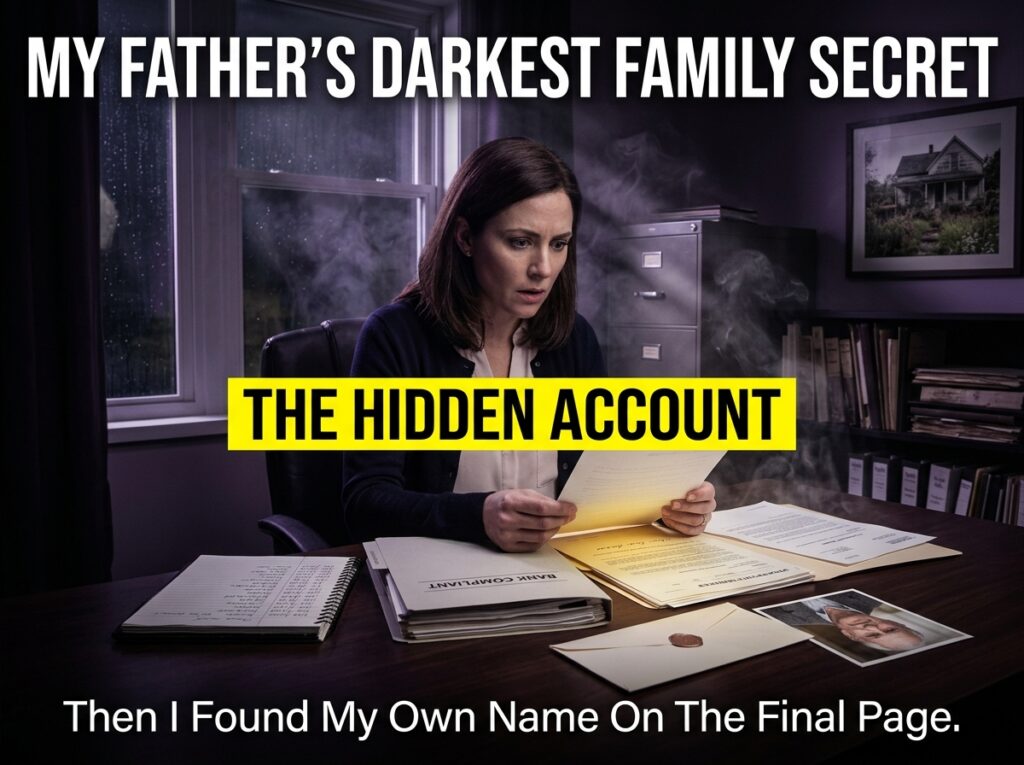
The first time I saw my father’s name on a financial document that had nothing to do with our family, I assumed somebody had made a mistake.
It was a Tuesday morning, and I was sitting in a small office at the bank, answering questions that should have taken no more than twenty minutes. I had been asked to verify a few details connected to my late father’s estate. His accounts had been reviewed before, but the bank had recently introduced an additional compliance check, and several older records required clarification.
I expected to confirm his date of birth, provide a copy of his death certificate, and return to work.
Instead, the woman behind the desk turned her monitor toward me.
“Do you recognize this name?” she asked.
I leaned forward.
My father’s full name appeared in a field marked Emergency Contact.
Beneath it was an account number I had never seen before.
“No,” I said. “What account is that?”
She checked the screen again.
“It’s not an account held in your father’s name. His details appear in the contact information.”
“Whose account is it?”
“I’m afraid I can’t disclose another customer’s personal information without the appropriate authorization. The reason we’re asking is that your father’s details appear in several records we’re reviewing.”
“Several?”
She hesitated.
“More than one.”
I sat back.
My father, Michael, had died eighteen months earlier. He had been a quiet man who kept his financial affairs organized in a metal filing cabinet in his study. He paid his bills on time, saved every important receipt, and wrote the date on the outside of envelopes before putting them away.
He had not been wealthy, but he had been careful.
After his death, my older brother Daniel and I spent weeks sorting through his paperwork. We found insurance policies, property tax receipts, old bank statements, and letters from people whose names we barely recognized. Everything seemed ordinary, if painfully incomplete.
We had assumed we knew the important parts of his life.
Now the bank was telling me that his name appeared on accounts belonging to people I had never met.
“How many records are we talking about?” I asked.
The woman turned back to her screen.
“I can’t give you a definitive number until the review is complete. But there are enough entries that we need to verify why his details were recorded.”
“Was he financially responsible for these accounts?”
“That hasn’t been established. An emergency contact isn’t necessarily an account owner or guarantor.”
Her answer should have reassured me.
Instead, I began wondering why so many strangers had been given my father’s name and telephone number.
Before I left, she provided a reference number and explained that the compliance team might contact me if further information was needed. She also recommended that I review any family records that might clarify my father’s professional or personal connections.
I drove home with the reference number written on the back of a receipt.
That evening, I opened the filing cabinet in my father’s old study.
The room still smelled faintly of paper, furniture polish, and the cedar blocks he used to keep insects away from his books. Daniel had suggested selling the house after the estate was settled, but I had asked him to wait. I wasn’t ready to empty the place where our father had spent nearly forty years.
I started with the oldest folders.
There were records from his years as a bookkeeper, correspondence with a local property company, and receipts from a small business he had helped a friend establish. Most of the names meant nothing to me.
Then I found a notebook.
Its pages contained columns of dates, amounts, initials, and short notes. Some entries had been crossed out. Others were marked with a small black star.
On the inside cover, my father had written a sentence in his familiar handwriting.
Keep every record. People forget what they promise.
I read it twice.
My father had often said that paperwork mattered because memories changed when money became involved. I had thought it was simply the advice of a careful man who had spent his working life balancing accounts.
Now I wasn’t so sure.
I photographed several pages and returned them to the folder.
The following morning, I called Daniel.
“Did Dad ever act as an emergency contact for people outside the family?”
There was a pause.
“Why are you asking?”
“The bank found his name on several unrelated accounts.”
Daniel gave a short laugh.
“Probably old work records. Dad helped everyone. You know that.”
“Do you know anyone who used him as an emergency contact?”
“No. And I wouldn’t worry about it. He’s been gone for eighteen months. Whatever records remain are probably just outdated.”
I looked at the notebook on my desk.
“Then why are there so many?”
Daniel’s voice hardened.
“Because Dad knew a lot of people. Don’t turn this into something it isn’t.”
He ended the call before I could ask another question.
For the first time, I wondered whether my brother knew more about our father’s paperwork than he wanted me to discover.
That afternoon, the bank called again.
The compliance officer had located additional records, including an account that had received a recent payment.
And when she read me the date of that payment, I recognized it immediately.
It was yesterday.
<h2>Part 2</h2>
I barely slept that night.
Every time I closed my eyes, I saw the date written in the notebook and heard Daniel telling me not to turn the matter into something it wasn’t.
I wanted to believe him.
My brother and I had always been different. Daniel was confident, practical, and quick to dismiss problems that did not have an immediate solution. I was the one who kept old letters, remembered birthdays, and asked questions long after everyone else had decided a conversation was over.
After our father died, those differences became more pronounced.
Daniel wanted the estate settled quickly. He believed the house should be sold, the remaining possessions divided, and the family allowed to move forward. I wanted to understand the details of our father’s life before we decided what to do with everything he had left behind.
We argued about furniture, documents, and the cost of maintaining the house.
Eventually, we agreed to disagree.
Now I wondered whether Daniel’s impatience had been about more than grief.
The next morning, I returned to the bank.
The compliance officer, a woman named Mrs. Ellis, met me in a private office. She explained that the institution was reviewing a group of historical records because certain details had appeared repeatedly across unrelated accounts.
“Your father’s name was recorded as an emergency contact in multiple files,” she said. “That alone doesn’t establish wrongdoing. People sometimes use the details of a trusted friend or colleague when opening accounts.”
“But some of these accounts were opened years apart.”
“Yes.”
“And one received a payment yesterday.”
“That is correct.”
“From whom?”
She turned a page in the file.
“The payment was made into an account we’re not yet able to discuss in full. We are verifying the source of the funds and the account’s relationship to the records connected to your father.”
I felt my patience slipping.
“Why did you contact me if you can’t tell me anything?”
“Because your father’s estate records identify you as a person who may be able to provide relevant information. We are not asking you to investigate anyone. We are trying to establish why these records contain his details.”
That distinction mattered.
I was not the owner of every account in which my father had been named. I had no right to demand private information simply because I was his daughter.
But I could ask whether his name had been used appropriately, and I could provide documents that might help explain the connections.
Mrs. Ellis showed me a list of reference numbers, with the personal details of the account holders removed.
There were more entries than I had expected.
Some dated back more than twenty years.
Others were much more recent.
I recognized the names of two local businesses my father had occasionally helped with bookkeeping. The remaining entries meant nothing to me.
“Did he work for all these people?” I asked.
“We haven’t established that.”
“Then what do they have in common?”
“That’s part of the review.”
I pointed to a date near the bottom of the page.
“This is the payment you mentioned?”
“Yes.”
“Why is it unusual?”
Mrs. Ellis considered her answer.
“The timing is unusual because the account had been inactive for a period before the payment. However, an unusual transaction isn’t automatically an improper one.”
I understood the caution, but I could not stop thinking about the notebook.
Before I left, I asked whether I could submit copies of my father’s records.
“Certainly,” she said. “Please keep the originals and provide copies where possible.”
That afternoon, I scanned the notebook and sent the relevant pages to the bank.
Then I called my aunt Margaret.
She was my father’s younger sister and the person who had known him longest. Since his death, she had been the keeper of family stories, although she rarely spoke about the years before I was born.
When I explained the bank’s findings, she became unusually quiet.
“Did the bank mention a property?” she asked.
I froze.
“No. Why?”
“I was just wondering.”
“Which property, Aunt Margaret?”
“I don’t know what you’re talking about.”
“You just asked whether the bank mentioned one.”
She sighed.
“Your father handled many things privately. He didn’t tell me everything, and he certainly wouldn’t have wanted you worrying about old business.”
“What old business?”
“The past is the past.”
I gripped the phone.
“Why does everyone keep telling me that?”
“Because some things become more painful when you dig them up.”
I asked her whether she knew about the accounts.
She said she did not.
I asked whether she had ever seen the notebook.
She said no.
Then she told me to stop contacting the bank and let the estate matters remain settled.
When the call ended, I sat in the quiet kitchen, staring at the folder of copied records.
Daniel had dismissed the accounts as outdated paperwork.
My aunt had warned me not to investigate.
Neither had answered a single question.
That evening, I returned to the notebook and compared its dates with the bank’s list.
Several entries matched.
Others were marked with the same small black star.
The last starred entry corresponded to the date of the most recent payment.
Beside it, my father had written three words.
Do not transfer.
I photographed the page and sent it to Mrs. Ellis.
Her response arrived the following morning.
She asked whether I could come to the bank again, because the compliance team had identified a connection between the recent payment and another account.
And this time, she said, the connection involved a property.
<h2>Part 3</h2>
The word property brought back memories I had spent years avoiding.
When I was a child, my father sometimes drove us past an old house on the edge of town. It stood behind a low stone wall, with a narrow driveway and a garden that had grown wild around the trees. I remembered a weathered gate, a row of tall windows, and a wooden sign that had been removed long before I was old enough to read it.
Whenever I asked whose house it was, my father changed the subject.
Daniel once told me that it belonged to a family who had left town after a financial dispute. Aunt Margaret said the property had been sold years ago. Neither explanation seemed important at the time.
Now I wondered whether the house had any connection to the accounts.
At the bank, Mrs. Ellis had arranged for another officer to join us. His name was Mr. Patel, and he specialized in reviewing historical financial records.
He began by explaining that the bank had identified a relationship between one of the accounts and a property-related transaction. The available records were incomplete, and the review had not yet established who ultimately benefited from the arrangement.
“We need to be careful about what we conclude,” he said. “The documents may show a connection without proving that every person named in them understood the full arrangement.”
I nodded.
“Can you tell me what the connection is?”
He placed a summary on the table.
It referred to a payment associated with a property transaction and an account that had received funds from a source connected to the family.
The address was partially obscured because the bank was still confirming which details could be disclosed.
But I recognized the road.
It was the road where the old house stood.
I looked up.
“That property has been empty for years.”
“Has it?” Mr. Patel asked.
“At least, that’s what I thought.”
He made a note.
“That may be relevant. We have records suggesting that the property was involved in more than one transaction.”
“More than one?”
“Two separate transfers appear in the documentation. We are checking whether the records refer to the same property and whether the transfers were completed correctly.”
I remembered the unusual signature mentioned in one of the notebook’s entries.
“Could someone have transferred the property without the proper owner’s knowledge?”
“That depends on the documents and the circumstances. We cannot determine that from the information we have today.”
I left the bank with a list of public records I could request and a warning not to approach anyone based on assumptions.
That evening, I searched the local property registry.
The first record showed an ownership transfer from many years earlier. The second showed another transfer under a different name.
Both entries referred to the same address.
The dates were separated by only a short period.
I printed the records and compared the signatures.
They were not identical, but something about them looked familiar. Each began with a large, looping initial and ended with a sharp line that cut across the final letters.
I returned to my father’s notebook.
On a page near the back, I found a similar signature beside a reference to a witness.
I could not tell whether it was the same person.
The next morning, I visited Aunt Margaret.
She opened the door but did not invite me inside.
“I need to ask you about the house on the old road,” I said.
Her expression changed.
“What house?”
“The one Dad used to drive past when we were children.”
She looked over my shoulder, as if checking whether someone had followed me.
“Why are you asking about that now?”
“Because the property appears in records connected to the accounts.”
Aunt Margaret shook her head.
“You need to leave that alone.”
“Why?”
“Because your father made a promise.”
“To whom?”
She pressed her lips together.
For several seconds, neither of us spoke.
Then she stepped aside and let me enter.
We sat in her living room, surrounded by photographs of family weddings, birthdays, and holidays. I noticed that one picture frame had been turned toward the wall.
It showed the old house.
I recognized the gate immediately.
“Why is that photograph turned around?” I asked.
Aunt Margaret glanced at it.
“Because I don’t like looking at it.”
“Did Dad own the property?”
“No.”
“Did he help someone buy it?”
She looked down at her hands.
“He helped people who had nowhere else to turn.”
“Who?”
“I can’t answer that.”
I felt my throat tighten.
“Everyone says Dad was a good man. I’m not questioning that. I’m trying to understand why his name appears in dozens of financial records and why nobody will tell me what happened.”
Aunt Margaret’s eyes filled with tears.
“Your father spent years trying to keep the family together. He believed that if the truth came out, it would destroy people who were already suffering.”
“Which people?”
She stood abruptly.
“Please go home.”
I remained seated.
“Aunt Margaret, was Daniel involved?”
She stopped.
For a moment, I thought she might answer.
Instead, she turned away and whispered, “Ask your brother why he never wanted that house sold.”
I left without another word.
On the drive home, I called Daniel.
He answered immediately.
“Did Dad ever tell you why the old property was never sold?” I asked.
Silence.
Then he said, “Who have you been talking to?”
I felt my heart begin to race.
“Why does that matter?”
“Because you’re making a mistake.”
“What mistake?”
Daniel’s voice became cold.
“You’re opening something that should have stayed closed.”
Then he hung up.
<h2>Part 4</h2>
For the first time since the investigation began, I was afraid.
Until then, I had treated the mystery as a problem of missing information. If I could find the right document, compare the dates, and ask the right person, I believed the truth would become clear.
Daniel’s reaction changed that.
He had not asked what I found.
He had not asked whether the bank had contacted me again.
He had known immediately which part of the family history I was investigating.
I spent the next morning organizing everything into separate folders: bank correspondence, property records, my father’s notebook, and notes from conversations with relatives.
I wrote down what was confirmed and what remained uncertain.
Confirmed: my father’s name appeared as an emergency contact in numerous unrelated accounts.
Confirmed: a hidden account had received repeated deposits from a source connected to the family.
Confirmed: the most recent payment had arrived only yesterday.
Confirmed: the property had been transferred twice under different names.
Uncertain: who owned the hidden account, who had authorized the payments, and why my father had been involved.
Uncertain: whether Daniel knew the full history.
I added a final question.
Why was everyone afraid of the property?
The public registry provided another clue.
The property had once been associated with a small business that had closed decades earlier. Its records referred to a financial dispute and a transfer of ownership, but several supporting documents were missing.
The official history was incomplete.
I contacted the local registry office and asked how I could inspect the available documents. The clerk explained the procedure and told me that some records were held in an older archive.
I submitted a request.
While I waited, I visited the road where the house stood.
I had not been there since childhood.
The gate was still there, although the paint had peeled away. The garden was overgrown, and the front windows were covered from the inside. A new lock hung on the gate.
I stayed outside the property.
A small metal plate had been attached to the wall near the entrance. It contained a name and a reference number.
I wrote them down.
The name did not belong to my father or anyone I recognized.
When I returned to my car, I found a folded piece of paper beneath the windshield wiper.
There was no envelope and no signature.
The message contained a single sentence.
Stop asking about the old house.
I looked around the road.
A delivery van passed at the end of the street, but nobody else was visible.
I placed the note in a folder and drove away.
I did not know whether the message was a serious warning or an attempt to frighten me. I decided not to assume either possibility was correct.
That evening, I called Mrs. Ellis and explained what had happened.
She advised me to preserve the note and avoid confronting anyone. The bank would continue its review independently, and she reminded me that the financial records did not authorize me to enter private property or access information belonging to other customers.
I agreed.
Then I called Helen, a solicitor recommended by a colleague, and arranged a consultation about the property records and my father’s estate.
Helen listened carefully.
“Your father’s name appearing as an emergency contact does not automatically make him responsible for those accounts,” she explained. “Likewise, a financial record connected to a property does not establish ownership. We need to identify the actual legal documents and determine whether there was a valid transfer.”
“Can the property be transferred twice under different names?”
“It can happen for legitimate reasons, but the circumstances matter. If the signatures or supporting records are questionable, the registry and relevant authorities may need to examine them.”
I gave her copies of the public records and my father’s notebook entries.
She recommended that I obtain certified copies where available and keep a record of every person who had provided information.
Before I left, she asked whether I knew the person whose name appeared on the property plate.
“No.”
“Then don’t contact them until we understand their role.”
I promised I would not.
The next afternoon, the registry office called.
The archive had located an older file associated with the property’s first transfer. It contained a reference to a witness whose name had been omitted from the public summary.
The clerk said the file could be inspected by appointment.
I asked for the earliest available time.
“Tomorrow morning,” she replied.
I wrote down the appointment and thanked her.
Then I opened my father’s notebook to the page marked with a black star.
Beside the same date, he had written a short note I had not noticed before.
If the file is found, contact the witness first.
There was no name.
Only a telephone number.
I stared at it, wondering why my father had left instructions that seemed to anticipate the exact problem I was facing.
I called the number.
A man answered after the fourth ring.
When I explained who I was, he became silent.
Then he asked a question that made my hands go cold.
“Has Daniel seen the original file?”
<h2>Part 5</h2>
I did not answer the man’s question immediately.
“Why are you asking about my brother?” I said.
“Because your father told me that if anyone came looking for the file, I needed to know whether Daniel had already seen it.”
“Who are you?”
“My name is Robert Hale. I was a witness to a transaction involving your family many years ago.”
I sat down at the kitchen table.
“Which transaction?”
“I can’t explain everything over the telephone.”
“Then tell me where we can meet.”
He hesitated.
“Not at the house. Not at your father’s old office. Somewhere public, during the day.”
We agreed to meet at a café near the registry office the following morning.
After the call, I contacted Helen and told her about Robert. She advised me to ask only for information he was willing to provide and to avoid signing anything or accepting original documents without understanding their significance.
I agreed.
The following morning, I arrived at the café early.
Robert was already there, sitting near the window with a brown envelope on the table. He was an older man with silver hair and a carefully pressed jacket. When I approached, he stood and looked at my face for a long moment.
“You look like your father,” he said.
I sat down.
“Did you know him well?”
“Well enough to know he carried a burden that wasn’t entirely his.”
I glanced at the envelope.
“Is that the original file?”
“No. I have copies of some records, but the original belongs in the proper archive. I won’t take it out of the official process.”
I appreciated his caution.
He opened the envelope and showed me several photocopied pages. The documents referred to the property, the old business, and a financial arrangement made during a period of serious difficulty.
One page contained the name of a person who did not appear in the public registry summary.
Another included a handwritten note beside the witness section.
I recognized the signature.
It resembled the unusual mark I had found in my father’s notebook and the signatures on the property transfers.
“Who signed these documents?” I asked.
Robert pointed to the relevant line.
“The person who arranged the transfer. But the signature isn’t the whole story. The important question is whether the person had the authority to do it.”
I studied the dates.
The first transfer had occurred during the year my father had once described as the hardest of his life. I remembered that period only through fragments: long telephone calls, relatives arguing behind closed doors, and my father coming home late with a look of exhaustion.
I had been too young to understand.
“What happened to the business?” I asked.
“It was in trouble. The owner owed money, and people were afraid the property would be lost.”
“Was my father involved?”
“Yes, but not in the way the family later described.”
I felt my chest tighten.
“What did they say he did?”
Robert looked down at the papers.
“That he was responsible for the loss.”
“Was he?”
“Your father took responsibility for some things because he believed it would protect someone else. But the records I saw suggested that another person had benefited from the arrangement.”
I thought of Aunt Margaret’s warning.
I thought of Daniel’s reaction.
“Who benefited?”
Robert closed the envelope.
“I don’t want to name someone based on incomplete copies. The original file needs to be reviewed, and the person whose rights may have been affected deserves to be heard.”
“Do you know who that person is?”
“I believe I do.”
“Is that person still alive?”
Robert looked at me.
“Yes.”
The answer settled heavily between us.
For decades, my family had treated the property dispute as a finished matter. My father had been blamed, the business had disappeared, and the house had remained outside the family’s ordinary conversations.
Yet someone connected to the original transaction was still alive.
Someone might have been waiting for the records to be examined properly.
I asked Robert why he had not spoken earlier.
“Your father asked me to wait until the records could be reviewed without putting anyone at risk of losing their rights. He believed that one day someone would find the missing file.”
“Why didn’t he tell us?”
“Perhaps he thought he was protecting you. Perhaps he was afraid of what would happen if the family learned the whole story. I can’t tell you what he was thinking.”
I understood that Robert was not claiming to know everything.
He was giving me a piece of a history that had been hidden for years.
Before we parted, he handed me copies of the documents and wrote down the reference number of the archive file.
“Do not accuse anyone yet,” he said. “Let the records speak first.”
I promised.
On the way home, I called Helen and arranged to bring her the copies.
But before I reached my apartment, Daniel called.
His voice was unusually controlled.
“I heard you’ve been meeting people about Dad’s old property.”
I gripped the steering wheel.
“Who told you?”
“That doesn’t matter. I want you to stop.”
“Why?”
“Because you’re going to damage the family over something that happened before you understood any of it.”
“Then help me understand it.”
He went quiet.
I waited.
Finally, he said, “You have no idea what Dad was trying to protect.”
“What was he protecting?”
Daniel took a breath.
Then he said, “If you read that file, you may never look at me the same way again.”
<h2>Part 6</h2>
I did not tell Daniel whether I believed him.
I simply said that I would not stop reviewing the records until I understood why our father’s name had appeared in so many financial files.
He ended the call without saying goodbye.
For the rest of the day, I found myself returning to his final sentence.
You may never look at me the same way again.
It could have been a warning about something he had done. It could have been an attempt to frighten me away from a truth that would hurt the family. Or it could have meant that he knew our father had made sacrifices I had never understood.
I could not decide which possibility was most likely.
Helen examined the copies Robert had provided.
She confirmed that they were potentially relevant, but she warned me that photocopies could not establish the authenticity of the signatures or the legal effect of the transaction. The original file would need to be examined by the appropriate people.
She also explained that the property records and the bank records might be connected without proving that the same person controlled every account.
“We need to resist the temptation to make the evidence tell a larger story than it supports,” she said.
I appreciated that.
My father’s reputation mattered to me, but I did not want to replace one family story with another unsupported one.
I wanted to know what had happened.
The next morning, I visited the registry office.
A clerk led me into a small reading room and brought out a file containing copies of the available historical documents. I signed the access register and read each page carefully.
The first transfer referred to a property owner who had been struggling financially. The second recorded a change in ownership under a different name.
There were references to a loan, a repayment agreement, and a witness statement.
But the statement itself was missing.
A note in the archive index explained that the document had been removed for safekeeping decades earlier. The person responsible for removing it had been recorded in a separate register.
I asked to see that register.
The clerk checked the reference and returned with a thin ledger.
The entry showed the date the statement had been taken out of the archive.
Beside it was a signature.
I recognized the surname.
It belonged to someone who had attended our family gatherings when I was young.
I could not remember much about the person, only a quiet voice and a habit of sitting at the end of the table without joining the conversation.
The clerk explained that the original document had never been formally returned.
I copied the reference number and asked whether the archive could contact the person who had signed the register.
The clerk said she would need to follow the office’s procedures.
I thanked her and left.
Outside, I called Robert.
He listened as I described the ledger entry.
“I wondered whether that record still existed,” he said.
“Do you know who removed the statement?”
“I know who was recorded as taking it. I don’t know what happened afterward.”
“Could that person still have it?”
“Possibly. But we need to establish that before drawing conclusions.”
I asked him whether my father had known the statement was missing.
“Yes,” Robert replied. “He spent years trying to locate it.”
That answer changed how I understood the notebook.
The starred dates were not simply a record of money. They might have been reminders of events my father had tried to reconstruct.
I asked Robert whether the hidden account had been part of that effort.
“I can’t confirm that,” he said. “But I know your father believed the financial records could help establish what happened to the property.”
“Why were there deposits until yesterday?”
Robert paused.
“Yesterday?”
I told him about the bank’s finding.
He asked me to send the relevant date and reference number through Helen, so the information could be checked properly.
“I don’t want you to assume the recent payment came from the person you suspect,” he said. “The records need to establish the source.”
I agreed.
That evening, Aunt Margaret called me.
She sounded exhausted.
“I heard you went to the archive,” she said.
“Yes.”
“Did you find the ledger?”
“How do you know about the ledger?”
She did not answer.
Instead, she said, “Your father wanted the truth to come out, but only when the right person was ready to hear it.”
“Who was the right person?”
“You.”
I sat down slowly.
“Why me?”
“Because you were the one person in the family who hadn’t been told what to believe.”
I felt a lump rise in my throat.
“Did Dad leave instructions for me?”
Aunt Margaret began to cry.
“Yes,” she whispered. “But I don’t know whether I should tell you where they are.”
I asked her to meet me the next day.
She agreed.
Before hanging up, she said something that stayed with me all night.
“Whatever you find, remember that your father was not the only person who kept a secret.”
<h2>Part 7</h2>
Aunt Margaret arrived at my apartment the next afternoon carrying a small cardboard box.
She placed it on the table but did not remove her coat.
“I should have told you sooner,” she said.
I pulled out a chair for her.
“Then tell me now.”
She opened the box.
Inside were old photographs, a few folded letters, and a sealed envelope with my father’s handwriting on the front.
My name was written beneath the address.
I recognized the letters immediately. They were slightly slanted, with the final strokes of each word extending farther than necessary.
I had seen that handwriting on birthday cards and school notes. I had also seen it in the notebook that started the investigation.
“Why didn’t you give me this after Dad died?” I asked.
“Because he asked me not to.”
“What did he say?”
“That you should receive it only if the financial records were ever reviewed properly and the missing witness statement was found.”
I stared at her.
“Did you know about the hidden account?”
“I knew your father had been keeping records. I did not know the full details of the account.”
“Did you know Daniel was involved?”
Aunt Margaret lowered her eyes.
“I knew Daniel had been told a different version of the property story.”
“By whom?”
“I don’t know everything. I only know that the family agreed not to discuss the matter, and your father carried the blame.”
I felt anger rise in my chest.
“You let me believe the same story.”
“I was afraid.”
“Of what?”
“Of losing the family completely.”
Her answer was quiet, but it hurt more than I expected.
I had spent years believing that silence meant there was nothing more to say. Now I understood that silence could be a decision, and decisions could shape the lives of people who had never been told the truth.
Aunt Margaret pushed the envelope toward me.
“Read it when you’re ready.”
I waited until she had gone before opening it.
The letter was dated several years earlier.
My father explained that he had kept records because he feared the property dispute had never been properly resolved. He wrote that the public story did not match the documents he had seen, and that the missing witness statement was essential to understanding what had happened.
He did not accuse any relative directly.
Instead, he described his regret that the family had allowed an incomplete account of the past to become the only account anyone was willing to hear.
One sentence was underlined.
Do not confuse protecting someone with allowing them to escape responsibility.
I read it several times.
At the bottom of the letter, my father referred to a second set of financial records and an account intended to preserve funds until the property dispute could be clarified.
He did not provide the account number.
He wrote that the relevant documents had been placed with the records of a trusted professional, who had agreed to keep them until the original witness statement could be located.
I called Helen and asked her to review the letter.
She reminded me that the document was useful evidence of my father’s intentions, but it did not prove the legal status of the account or the property.
We agreed to contact the bank through the established process and ask whether the account reference could be identified from the available records.
Meanwhile, I called Robert.
He was silent for a moment when I described the letter.
“Your father was trying to make sure the documents survived,” he said. “He didn’t want the story to depend on what any one relative remembered.”
“Did he know who had the missing statement?”
“I believe he suspected, but he never told me that he was certain.”
“Could Daniel have seen it?”
“I don’t know.”
I thanked him and ended the call.
The next morning, the bank confirmed that the hidden account was part of the ongoing review. Its records indicated a relationship to the property-related arrangement, but the institution needed to verify the supporting documents before it could disclose further details.
I forwarded the response to Helen.
Then I sat alone in my father’s old study and read his letter again.
For the first time, I understood why he had kept so many records.
He had not trusted memory to preserve the truth.
He had trusted paper.
The dates, signatures, deposits, and missing documents were pieces of a history that the family had tried to simplify until only one version remained.
My father had known that the story was incomplete.
He had also known that I might one day be the person willing to question it.
I looked at the notebook on the desk.
The most recent payment had arrived only yesterday.
Whatever the hidden account was intended to preserve, someone was still maintaining it.
And whoever that person was had continued making payments long after my father could no longer explain why.
<h2>Part 8</h2>
The next bank meeting was attended by Mrs. Ellis, Mr. Patel, Helen, and me.
The compliance team had compared the account references with the information I had provided from my father’s notebook and letter. They had also reviewed the dates associated with the property transfers.
The results established a connection between the hidden account and the older property-related arrangement, but several legal questions remained unresolved.
Mr. Patel placed a summary on the table.
“The records indicate that the account was funded by someone connected to your family,” he said. “The deposits were made over an extended period, and the most recent payment was recorded yesterday. However, we are still verifying the identity and authority of the person responsible for the payments.”
“Can you tell me the account holder’s name?”
“We can explain the information that relates to your father’s records and your own role in the review. We cannot disclose unrelated personal information without the appropriate basis.”
I understood the limitation.
“Does the account belong to the person who owns the property?”
“The documents do not yet establish that.”
“Then what do we know?”
Mrs. Ellis turned to another page.
“We know that the financial arrangement references the property. We know that your father was listed as an emergency contact in multiple accounts. We know that the records contain references to a witness statement that was removed from the archive. And we know that the account received a recent payment.”
I looked at Helen.
“Can the missing statement resolve the questions about ownership?”
“It may help establish what happened during the original transaction,” she replied. “But the legal consequences will depend on its contents and the other evidence.”
I asked whether the bank could provide a complete copy of the final account record.
Mr. Patel said the request was being processed.
He also explained that the compliance team had found a reference to another account in the same documentation.
That account was linked to a separate property-related record.
I felt the familiar tightness in my chest.
“Another property?”
“Yes.”
“Is it the same one that appears in the old transfer documents?”
“We haven’t established that. The references may concern separate transactions.”
I thought of my father’s letter, which mentioned a second set of financial records.
The pieces seemed to be connected, but I could not yet see the complete picture.
After the meeting, Helen helped me request the relevant public property records and confirm the procedure for obtaining certified copies.
We also contacted the registry office about the missing witness statement.
The clerk said the office had identified the person who signed the removal ledger, but it needed to determine whether the document was still held privately or had been transferred to another archive.
I asked whether the person could be contacted.
The clerk said the office would follow its procedures.
That evening, Daniel arrived at my father’s house without warning.
I found him standing in the study doorway, looking at the folders on the desk.
“You’ve gone too far,” he said.
I placed the notebook down.
“I haven’t accused anyone of anything.”
“You’ve contacted the bank, the registry, and people Dad knew decades ago. You’re making this public.”
“I’m trying to understand what happened.”
“Why can’t you accept that Dad handled things his own way?”
“Because his records contradict the story we were told.”
Daniel shook his head.
“You don’t know the whole story.”
“Then tell me.”
He looked at the notebook.
For a moment, I thought he might sit down.
Instead, he walked to the window.
“Dad made decisions that affected people. He believed he could fix everything quietly. Sometimes he made things worse.”
“Did he lose the property?”
Daniel rubbed his forehead.
“That’s what everyone was told.”
“Was it true?”
He did not answer.
I stepped closer.
“Did you know about the hidden account?”
He turned sharply.
“Who told you about that?”
“The bank found it.”
Daniel’s face changed.
He looked less angry than frightened.
“Listen to me,” he said. “There are things about the property that could destroy more than a family argument. People built their lives around what they believed happened. If you expose everything now, you may hurt someone who had nothing to do with the original dispute.”
“Then who did?”
He stared at me.
For a moment, I thought he might finally say the name.
Instead, he whispered, “You have no idea what Dad promised.”
“Who did he promise it to?”
Daniel walked out without answering.
I stood in the doorway, listening to his footsteps fade down the hall.
On the desk, my father’s notebook lay open to the most recent starred entry.
Beneath the date, I noticed a small mark that I had not seen before.
It was a reference to a page number.
I turned to that page.
There was a name, an account reference, and a brief instruction written in my father’s hand.
Only the beneficiary should open the final record.
<h2>Part 9</h2>
I showed the instruction to Helen the next morning.
She read it carefully and reminded me that a handwritten note could indicate my father’s intention without automatically granting me legal authority over a financial account.
“We need to identify the record it refers to,” she said. “Then we can determine who is entitled to access it.”
I agreed.
The reference number in the notebook matched an entry in the archive’s index. The record was described as a supplementary file connected to the original property transaction.
I submitted a formal request to inspect it.
The registry office responded that the file had been located but could not be released immediately because it contained information requiring additional review.
I waited three days.
During that time, I tried to continue my ordinary life. I went to work, paid my bills, and prepared meals. But every quiet moment brought me back to the same question.
Why had my father written that only the beneficiary should open the final record?
I had assumed the account was connected to a family member who had secretly funded it. The property records suggested that someone had benefited from a disputed transfer. My father’s letter indicated that money had been preserved until the missing statement could be found.
But none of those facts explained why my name might be connected to the arrangement.
I had never owned the old house.
I had never worked for the business that had closed.
I had not been involved in the original dispute.
I was a child when the property changed hands.
What possible role could I have now?
Helen advised me not to guess.
Instead, we prepared a list of questions for the registry office and the bank. We asked whether the supplementary file identified a beneficiary, whether it referred to the hidden account, and whether the documents could be reviewed by an independent professional.
The registry office agreed to arrange an appointment once its review was complete.
Meanwhile, Robert called to say that he had remembered another detail about the missing witness statement.
He believed the witness had been present when the original agreement was signed, but the public records did not accurately reflect the person’s role.
“Do you know who the witness was?” I asked.
“I have a strong suspicion, but I won’t name anyone until we can compare the original statement with the other records.”
“Could the witness still be alive?”
“Yes.”
I felt a sudden rush of hope.
If the witness was still alive, perhaps they could explain what my father had been trying to preserve.
Robert said he would provide the information to Helen so it could be checked properly.
The following afternoon, the registry office called.
The supplementary file was ready for inspection.
I arrived with Helen and presented the required identification. A clerk brought us into the reading room and placed a sealed folder on the table.
The outer cover contained the same reference number I had found in my father’s notebook.
Inside were several pages of financial records, a reference to the second property, and a document describing the intended beneficiary arrangement.
Helen reviewed the pages first.
She then looked at me.
“The file appears to connect the hidden account to the older property dispute,” she said. “But we need to examine the final page carefully.”
I turned it over.
The page contained a reference to another account, another property, and a second beneficiary.
Beside the beneficiary’s name was a signature or notation written in unfamiliar handwriting.
I read the name.
It was mine.
For a moment, the room seemed to fall silent.
I had expected to find my father’s name, Daniel’s name, or the name of the person who had signed the property transfers.
I had not expected to find myself.
“That isn’t my handwriting,” I whispered.
Helen leaned closer.
“No. But we cannot determine who wrote it from this page alone.”
“Why would my name be here?”
“We need to establish the purpose of the document and whether it was validly prepared.”
I looked at the reference to the second property.
The address was different from the old house.
I did not recognize it.
Beneath the address was a note referring to the missing witness statement.
The file had brought me closer to the truth about my father, but it had also opened another question.
If someone had recorded me as a beneficiary, who had made that decision?
And why had nobody told me?
Before we left, Helen requested certified copies of the documents and arranged for the original to remain in the archive.
I signed the inspection register and returned the folder.
As I walked toward the exit, my phone rang.
The caller’s number was unfamiliar.
I answered.
A woman’s voice spoke quietly.
“My name is Eleanor,” she said. “I knew your father. I’ve been waiting for someone to find that record.”
I stopped walking.
“How do you know what I found?”
“Because I helped prepare the documents.”
My hand tightened around the phone.
“Why is my name on the final page?”
There was a long silence.
Then Eleanor said, “Because your father believed you were the only person in the family who might choose the truth over the money.”
<h2>Part 10</h2>
I asked Eleanor to meet with Helen present.
She agreed.
Two days later, we sat together in the solicitor’s office. Eleanor was an elderly woman with a calm voice and careful manner. She carried a folder of her own, but she did not open it until Helen had explained the purpose of the meeting.
“I want to be clear,” Helen said. “We’re here to understand the documents, not to make assumptions about anyone’s legal rights. If you have original records, we’ll need to establish their authenticity and arrange for them to be examined properly.”
Eleanor nodded.
“That is exactly what I want.”
She opened the folder and removed several copies of letters and financial records. The dates corresponded with entries in my father’s notebook.
She explained that she had known my father through the old business and had helped organize paperwork during the period when the property dispute began.
She did not claim to know every detail. Some transactions had been handled by other people, and she had not witnessed every conversation or payment.
But she remembered that my father had been troubled by the official story.
“He believed the family had accepted an explanation that left out an important person,” she said. “He thought the missing witness statement could help correct that.”
“Why didn’t he correct it himself?” I asked.
“He tried. He collected records and contacted people who might have known what happened. But he was afraid that making accusations without complete evidence would hurt the wrong person.”
I thought of the letter in which my father had written that people forget what they promise.
“He left me instructions,” I said.
Eleanor nodded.
“He wanted the documents preserved until someone could examine them without being pressured by the family.”
“Why did he name me as a beneficiary?”
She looked at Helen before answering.
“The documents indicate that your name was included in a later arrangement. I can explain what I remember, but the legal meaning must be established from the records themselves.”
Helen reviewed the papers Eleanor had brought.
Some appeared to correspond with the supplementary file. Others were letters that had not been included in the archive.
One referred to the second property and described an arrangement intended to preserve an interest until the original dispute could be resolved.
Another mentioned the hidden account and instructed that the funds should not be transferred without the relevant supporting documents.
The most recent letter was dated much later.
It referred to a payment made only recently.
I felt a chill.
“Who made that payment?”
Eleanor shook her head.
“I don’t know. I only know that someone continued maintaining the arrangement.”
Helen asked whether Eleanor had the original witness statement.
“No,” she replied. “But I know who may have it.”
She gave us the name of a person who had been associated with the archive decades earlier. The name matched the entry in the removal ledger.
Helen wrote it down and explained that we would need to verify the information through the appropriate process.
I asked Eleanor why she had waited so long to contact me.
“Your father asked me to wait until the records were found,” she said. “He believed the truth would be more difficult to dismiss if the documents were examined together. I did not want to interfere with the process or put the wrong person under suspicion.”
I thought of Daniel’s anger, Aunt Margaret’s fear, and the years my father had spent keeping records that nobody else wanted to discuss.
“Did my father know who benefited from the property transfer?”
“He had a suspicion. He was never willing to state it as a fact without the missing statement.”
“Was Daniel involved?”
Eleanor looked down at the table.
“I can’t answer that from my own knowledge. I won’t accuse your brother simply because he was afraid of the investigation.”
Her answer disappointed me, but I respected it.
The evidence had already taught me how easily suspicion could become a family story repeated until everyone treated it as truth.
I did not want to do the same thing to Daniel.
Over the following weeks, Helen coordinated the review of the bank and property records. The relevant institutions were asked to verify the documents, identify the legal status of the accounts, and determine what further steps were appropriate.
I did not receive every answer immediately.
Some records required additional authentication. Some questions could only be answered by people who had been involved in the original transactions. And the legal meaning of the beneficiary designation needed to be established before anyone could decide what should happen to the funds or the properties.
But the mystery was no longer a collection of disconnected papers.
The emergency-contact records, the hidden account, the property transfers, the missing witness statement, and my father’s private instructions had become parts of the same investigation.
I also began to understand why my father had left the final record for me.
He had not chosen me because I was the most powerful member of the family, or because he believed I could solve everything alone.
He had chosen me because I was willing to ask questions without deciding in advance who was guilty.
That did not make the work easy.
Daniel remained distant. Aunt Margaret struggled with the fact that she had kept the letter for so long. I had to accept that some family relationships might never return to the way they had been.
But I no longer believed that silence was the same as peace.
The records still needed to be examined, and the legal questions still needed to be resolved. I would not claim ownership of money or property merely because my name appeared on a page. I would not accuse someone without evidence, and I would not allow the family’s fear to decide what could be investigated.
I would follow the documents wherever they led.
One evening, I returned to my father’s study and placed his notebook beside the letter he had left for me.
The room was quiet.
I remembered him sitting at the desk, writing dates in neat columns and keeping every receipt, even when the amount seemed too small to matter.
As a child, I had thought he was simply careful with money.
Now I understood that he had also been trying to preserve a history that people around him wanted to forget.
I could not change the years he had spent carrying that burden. I could not give him the chance to explain every decision or ask why he had waited so long to leave instructions.
But I could respect the one thing he had made clear.
The truth mattered more than the comfort of a story that everyone had agreed to believe.
I closed the notebook and placed it in the locked cabinet with the verified copies of the records.
For the first time since the bank called, I felt that I could breathe without waiting for another relative to tell me to stop.
I did not yet know who had funded the hidden account, why the property had been transferred twice, or what the missing witness statement would ultimately prove. Those questions would be answered only when the evidence had been properly examined.
But I knew that my father’s name had been tied to a history far more complicated than the one our family remembered.
And I knew that my own name had been written into that history without my understanding.
The next chapter would not be decided by rumors, fear, or loyalty to a particular relative.
It would be decided by the records, the people willing to speak honestly, and the evidence that had survived long enough to be found.
For years, I had believed that protecting a family meant keeping its secrets.
Now I understood that a family could not truly heal while the truth remained hidden.
My father had left me more than a mystery.
He had left me the responsibility to ask the questions he had never been able to answer.
And this time, I intended to see the process through to the end.