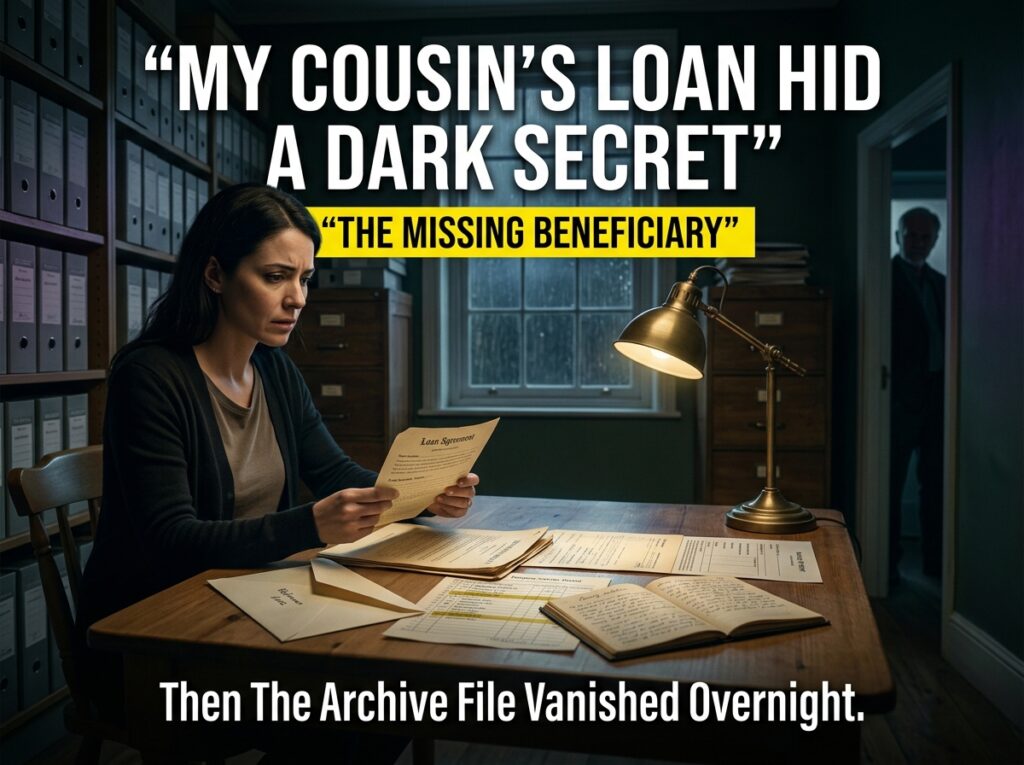
The envelope arrived on a Wednesday afternoon, just as I was preparing to close the curtains against the approaching rain.
It had been pushed beneath my apartment door. My name was written across the front in black ink, and there was no return address. The envelope looked ordinary enough, except for a narrow strip of clear tape running along its back.
Someone had opened it before delivering it to me.
I noticed the tape immediately, but I was more concerned about what lay inside.
There were copies of a loan agreement, several financial statements, and a letter from my cousin, Daniel. The letter was short, direct, and strangely confident.
He claimed that I had guaranteed a loan years earlier and that the lender had begun demanding repayment. According to him, the family had discussed the matter before, and I had agreed to help if the original borrower failed to pay.
I had no memory of such a conversation.
Daniel and I had grown up attending many of the same family gatherings, but we had never been particularly close. He was older than me, confident in his opinions, and accustomed to speaking as though he had already considered every possible objection.
His letter ended with a sentence that made my hands tighten around the paper.
You know what you promised. Please don’t make this more difficult than it needs to be.
I spread the documents across the kitchen table.
The contract listed a substantial loan secured against a family property. Beneath the names of the borrower and lender was a section for guarantors.
My name appeared there.
At first glance, the signature resembled mine. But the date printed beside it was impossible.
The agreement had been signed years before Daniel and I met.
I remembered the period because my family had been living in another town. I was still attending school, and Daniel was someone I knew only by reputation through our relatives. We had not met in person until a family gathering several years later.
I checked the date again.
There was no reasonable explanation for my signature appearing on that document.
I called Daniel.
He answered after several rings.
“Did you get the papers?” he asked.
“Yes. Tell me why my name is on this contract.”
“Because you guaranteed the loan.”
“The date is from before we met.”
He sighed as though I had raised an inconvenience rather than a serious problem.
“The paperwork is old. Dates get confusing when documents are copied.”
“Dates don’t get confusing enough to make me sign something before I know the people involved.”
“Look, I didn’t create the contract. I’m trying to settle an old family matter.”
“Then show me the original.”
There was a pause.
“I don’t have it.”
“Who does?”
“The archive should have it.”
“Which archive?”
“The regional records office. That’s where the original documents were kept.”
I wrote down the name of the office.
“Why didn’t you check the original before asking me to pay?”
“I was told the claim was legitimate.”
“By whom?”
Daniel did not answer.
Instead, he told me that several relatives had already discussed the matter and that everyone wanted it resolved quietly.
I asked him to send me the names of the people involved.
He refused.
“You don’t need to drag everyone into this,” he said. “Just look at the contract and tell me how you intend to settle it.”
“I intend to find out who put my name on it.”
He ended the call.
I returned to the paperwork, determined to find something that would explain the impossible date.
A second page contained a reference to a beneficiary. The name had been blacked out on the photocopy, leaving only the final letter visible.
I turned to the next page.
There was another reference to the same beneficiary, but the name had been removed there too. The black marks were uneven, as though someone had covered the original words by hand before copying the page.
I held the papers toward the window, hoping the underlying writing might show through.
Nothing did.
Then I noticed the envelope again.
The strip of tape across the back had trapped a tiny piece of paper beneath its edge. I carefully lifted the corner with my fingernail.
A handwritten mark appeared beside the date on the envelope’s inner flap.
It was a small letter followed by two numbers.
I could not tell whether it was a filing reference, an initial, or a note left by the person who had opened it.
But it had not been mentioned in Daniel’s letter.
I photographed the envelope and every page before putting the documents away.
That evening, I searched my old family correspondence for anything connected to the loan. I found references to a property dispute from decades earlier, but nothing that mentioned a guarantee in my name.
My mother had once told me that a family disagreement had cost someone their home and reputation. She never explained the details. Whenever I asked, she would say that the matter was too old to reopen.
At the time, I had accepted her answer.
Now I wondered whether the missing beneficiary was connected to that story.
I placed the papers in a drawer and decided not to tell anyone about the handwritten mark until I understood what it meant.
I wanted one quiet night to think.
But sometime after midnight, I woke to the sound of my phone vibrating on the bedside table.
A message had arrived from an unknown number.
It contained only one sentence.
If you have the envelope, do not let your cousin know you noticed the mark.
I sat upright in the darkness.
Whoever had sent the message knew about the envelope.
And someone had been watching what happened after it reached my door.
<h2>Part 2</h2>
By morning, the apartment felt different.
The envelope remained inside the drawer, exactly where I had left it, but I could no longer look at it as an ordinary piece of correspondence. Someone had opened it before I received it. Someone had altered or concealed information in the copies. And now an unknown person was warning me not to tell Daniel what I had noticed.
I read the message again.
There was no name, no explanation, and no request for money.
I replied with a simple question.
Who are you?
The message showed as delivered, but no answer came.
I called Daniel again.
He sounded irritated when he answered.
“Have you decided what you’re going to do?”
“Not yet.”
“The lender expects a response.”
“Then send me the lender’s contact details.”
“I already told you the records are at the archive.”
“That isn’t the lender’s contact information.”
He sighed.
“Why are you making this so complicated?”
“Because someone sent me a contract dated before we met, and the beneficiary’s name has been removed from every copy.”
Silence followed.
It was brief, but I noticed it.
“What beneficiary?” he asked.
“The name blacked out on the second and third pages.”
“I don’t know anything about that.”
“Then you won’t mind if I ask the archive to explain it.”
“You should leave the old records alone.”
The words were quiet, almost pleading.
I leaned against the kitchen counter.
“Why?”
“Because there are things you don’t understand.”
“Then explain them.”
He ended the call.
I stared at the screen, feeling a growing certainty that the missing name mattered more than the disputed guarantee.
I took the envelope from the drawer and examined it under a brighter light. The handwritten mark looked like a capital R followed by the numbers 17.
I wrote it in my notebook.
Then I photographed the envelope’s front, back, tape, and inner flap, preserving the images with the date and time.
I did not want to damage the original any further.
After breakfast, I called the regional records office.
A clerk answered and asked what kind of documents I was seeking.
I explained that I had received a copy of a historical loan agreement and wanted to locate the original file.
“Do you have a file number?” she asked.
I gave her the reference printed on the contract.
She typed for several moments.
“That file is in the historical collection,” she said. “You’ll need to make an appointment to inspect it.”
“Does the file include a beneficiary designation?”
“I can’t confirm the contents without reviewing the record.”
“Has anyone accessed it recently?”
“I’m not able to provide access details over the telephone.”
I understood the restriction, but I needed to know whether the file still existed.
“Can you at least confirm that it hasn’t been withdrawn or transferred?”
She paused.
“According to the catalogue, the file is available for review.”
I made an appointment for the following morning.
Before ending the call, I asked whether the archive used handwritten reference marks on envelopes.
“Sometimes,” she replied. “Older correspondence may have accession numbers or internal handling notes.”
“Would R-17 mean anything?”
“I couldn’t tell you without seeing the record.”
I thanked her and wrote down the appointment time.
Then I called Aunt Margaret, the oldest surviving member of my mother’s side of the family.
She had known my grandparents and remembered the years when the disputed property had been part of our family business.
When I explained the contract, she became unusually quiet.
“Did Daniel send it to you?” she asked.
“Yes.”
“Did he explain the beneficiary?”
“No. He says he doesn’t know anything about it.”
Aunt Margaret sighed.
“Your grandfather kept a record of everyone who helped the family during the flood years. Some of those arrangements were never properly explained.”
“Was there a loan?”
“Yes. The family borrowed money to protect the property. There was a disagreement about repayment, and someone was blamed for what happened afterward.”
“Who?”
“I don’t want to tell you the wrong name.”
“Do you remember anyone being removed from the family records?”
She hesitated.
“There was a person whose name stopped appearing in the documents. People said they had betrayed your grandfather, but I never saw proof.”
“Was the person alive when you last heard about them?”
“I believe so.”
“Did anyone apologize?”
“No.”
Her answer was almost a whisper.
I asked whether she had kept any letters or financial records.
“I may have an old notebook,” she said. “I’ll look for it.”
After we hung up, I opened the folder again and compared the dates on the contract with the notes in my own notebook.
The handwritten mark beside the date continued to trouble me.
It looked too deliberate to be accidental, but I could not connect it to the beneficiary.
I had spent years believing that the family dispute was simply a disagreement over money. Now it seemed that someone had erased a person’s name and allowed the rest of the family to believe a story that might never have been true.
At noon, an email arrived confirming my archive appointment.
The message included instructions for requesting historical files and a reminder that some records might require special handling.
I printed the confirmation and placed it beside the contract.
Then I noticed something strange.
The appointment confirmation referred to the file by the same reference I had found on the envelope.
R-17.
The mark had not been a random note.
It was connected to the archive file.
I looked at the clock.
The next morning, I would finally see the original.
Unless someone reached it first.
<h2>Part 3</h2>
I arrived at the regional archive fifteen minutes before my appointment.
The building stood behind the courthouse, a square stone structure with narrow windows and a heavy wooden entrance. A brass plaque beside the door explained that the records collection contained property deeds, business agreements, court filings, and private correspondence dating back more than a century.
Inside, the air smelled of paper and furniture polish.
A clerk named Helen checked my appointment confirmation and asked me to complete a request form.
“Are you researching a family property dispute?” she asked.
“Something like that.”
“Do you know the names of the original parties?”
I gave her the names from the contract.
She studied the form, then looked at me again.
“Have you brought identification?”
I handed it over.
After making a copy, she asked me to wait while she retrieved the file.
I sat beside a row of filing cabinets, listening to the muted sounds of people turning pages in the reading room. I had imagined that seeing the original document would immediately answer my questions. Instead, I felt increasingly nervous.
What if the signature was genuine?
What if I had forgotten something important?
And what if the missing beneficiary had a legitimate reason for being removed?
I reminded myself that I had come to establish facts, not to prove a theory.
Helen returned with a grey archival box.
“This is the file associated with your reference,” she said. “Please use the supports provided, and don’t remove anything from the room.”
She placed the box on the table.
The first folder contained the original loan agreement. The paper had yellowed, and the ink had faded, but the dates and signatures were still legible.
I compared the signature in the guarantor section with the photocopy Daniel had sent.
The original did not contain my name.
I leaned closer.
The guarantor section was blank.
Someone had added my name to the copy after the original document was created.
I called Helen over.
“Could you look at this?”
She examined the page.
“It appears that the copy differs from the original,” she said. “I can’t determine who altered it, but the difference should be documented.”
I photographed the relevant sections in accordance with the archive’s rules and recorded the discrepancy in my notes.
My hands were shaking.
For the first time, I had proof that the contract Daniel sent me was not an exact copy of the original agreement.
But the missing beneficiary remained unexplained.
I turned to the next folder.
It contained payment receipts, correspondence, and a handwritten register of transactions. Several pages referred to the family property, and the dates matched those I had already found in the lender’s statements.
Then I came across a sheet with a list of beneficiaries.
The names had been typed in a single column, with brief descriptions beside them.
One line had been cut out.
Not crossed through or covered with ink.
Cut out.
Someone had removed a narrow strip of paper from the original sheet.
I stared at the gap.
The cut was clean, as though a sharp blade had been used.
Beside the missing line was the same handwritten reference I had seen on the envelope.
R-17.
I asked Helen whether the file contained any notes explaining the removal.
She checked the following pages.
“There’s a reference to a supplementary statement,” she said. “It should be in the next folder.”
She reached for the second folder and opened it.
The folder was empty.
A small card inside indicated that the supplementary statement had been transferred to another collection.
“Can you tell me where it went?”
“I’ll need to check the catalogue.”
She took the reference and walked to the desk.
While I waited, I examined the remaining papers.
There were several letters from the years following the flood. One was addressed to my grandfather, and another referred to a person whose name had been replaced with the words former beneficiary.
The letter explained that the person had fulfilled the conditions of an agreement and expected the family to acknowledge the arrangement.
The writer also asked that the person’s name be restored to the records.
No reply was attached.
I read the letter twice.
Someone had not merely removed a name from a list. They had received a request to restore it and apparently failed to do so.
Helen returned.
“The supplementary statement is listed under a different reference,” she said. “It was moved during a catalogue reorganization.”
“Can we request it?”
“We can, but it may take some time. The collection is large.”
I completed the request form.
Before leaving, I asked whether the archive kept a record of who had accessed the file.
“We maintain a sign-out register for files that leave secure storage,” she explained. “Some older collections have additional handling records.”
“Could I see those?”
“Not without a separate review. Access records contain administrative information, and requests must be assessed.”
I accepted that answer.
As I returned the documents to their protective sleeves, I noticed a faint pencil mark on the inside cover of the box.
It was almost invisible.
The mark read:
See original witness.
I photographed it and added it to my notes.
Outside, I called Daniel.
“I saw the original contract,” I told him.
“And?”
“My name isn’t on it.”
He did not speak.
“The guarantor section is blank. Someone added my name to the copy you sent.”
“Are you sure?”
“Yes.”
“Then somebody must have made a mistake.”
“Someone removed a beneficiary’s name from the original records too.”
His breathing changed.
“What do you mean?”
“The name was cut out of a list. There was also a request to restore it.”
Daniel went quiet.
I asked whether he knew anything about the missing beneficiary.
“I told you I don’t know,” he said.
“Then why did you send me a contract without checking the original?”
“I was given the copy. I thought it was accurate.”
“By whom?”
He hesitated.
Then he said, “You need to stop going to the archive.”
I felt a chill.
“Why?”
“Because you’re going to make things worse.”
“For whom?”
He did not answer.
I ended the call and returned home.
That evening, I received an email from the archive confirming that my request for the supplementary statement had been registered.
The estimated processing time was several days.
I printed the message and placed it with my photographs.
Then my phone rang.
The caller identified herself as Helen from the archive.
“We have a problem with the file you inspected,” she said.
“What kind of problem?”
“The original collection has been marked for an urgent inventory review.”
“Why?”
“I can’t discuss the internal details over the telephone. But I wanted you to know that the supplementary statement may not be available when you return.”
I gripped the phone.
“Why wouldn’t it be available?”
She paused.
“Because the original file has been reported missing.”
<h2>Part 4</h2>
I returned to the archive the following morning.
Helen met me at the entrance to the reading room. She looked tired, and the usual calmness in her expression had been replaced by concern.
“The file was present when I inspected it yesterday,” I said.
“Yes.”
“And now it’s missing?”
“The box was returned to secure storage after your appointment. When the inventory was checked, the original file could not be located.”
“Who had access?”
“We’re reviewing the handling records.”
“Could it have been transferred to another room?”
“We’ve checked the usual locations.”
I wanted to demand more information, but I knew Helen could not reveal details that had not been verified.
Instead, I asked whether the missing file had been reported to the appropriate authorities.
“The archive has begun its formal missing-record procedure,” she replied. “We are preserving the remaining documentation and reviewing the access log.”
I requested a written confirmation that I had inspected the original contract and that the file was missing afterward.
Helen agreed to provide a record of my appointment and the material I had been authorized to inspect.
Before leaving, I asked about the sign-out sheet.
“Is it possible that someone removed the file without recording it?”
“It’s possible, but we cannot assume that happened. The review will examine whether the file was transferred, miscatalogued, or removed improperly.”
I understood the distinction.
But I could not ignore the timing.
The day after I discovered that my name had been added to a contract and a beneficiary’s name had been cut out of the original records, the file disappeared.
Someone had a reason to prevent the evidence from being examined.
I called Helen, the solicitor, and explained what had happened.
She advised me to preserve every photograph, email, and document and not to confront anyone until the archive completed its initial review.
“If the file was deliberately removed, a direct confrontation could alert the person responsible,” she said. “Let the records establish who accessed it.”
I followed her advice.
That afternoon, I visited Aunt Margaret.
She had found the old notebook she had mentioned during our earlier conversation. Its cover was brown, and the pages were filled with dates, amounts, and names written in my grandfather’s handwriting.
She placed it on the table.
“I don’t know whether this will help,” she said. “But I remember him keeping it in a locked drawer.”
I opened the notebook.
The first entries described the family’s business expenses. Later pages listed payments made after the flood.
One entry caught my attention.
The date matched the original loan repayment.
Beside it, my grandfather had written:
Obligation fulfilled. Beneficiary to be acknowledged when records are restored.
I read the line aloud.
Aunt Margaret looked at the page.
“That sounds like your grandfather.”
“Do you know who he meant?”
“No.”
I continued turning the pages.
Near the back, I found a list of names and several short notes. One name had been underlined twice. The note beside it read:
Present when agreement confirmed. Must not be forgotten.
The name belonged to a woman named Eleanor Shaw.
I had heard of Eleanor, though I knew very little about her. She had once worked with my grandparents and had been mentioned in family conversations as someone who left town after a disagreement.
I showed Aunt Margaret the entry.
“Do you remember her?”
Her expression changed.
“Yes. She was close to your grandmother.”
“What happened to her?”
“The family said she had betrayed them. After that, nobody mentioned her.”
“Was she the beneficiary?”
“I don’t know.”
I copied the page and searched the public records for Eleanor’s name.
Several years-old references appeared, including a business registration and an address in a nearby town. I could not determine whether she still lived there.
I asked Aunt Margaret whether she remembered a letter from Eleanor.
“There was one,” she said. “Your grandmother received it shortly before she died. She kept it in a blue envelope.”
“Do you know what happened to it?”
“No. Your father may have seen it when he sorted her belongings.”
I returned to my father’s old filing cabinet and searched through the remaining correspondence.
I found the blue envelope at the bottom of a box containing photographs and household bills.
It was empty.
On the front, Eleanor’s name had been written in my grandmother’s handwriting.
Inside the flap was a brief note.
Keep this with the original. Never separate them.
The note was dated in the same year as the loan repayment.
I photographed it and called Helen.
She agreed that the note might be relevant, but we could not establish what the original referred to or whether the envelope had once contained the missing beneficiary statement.
I placed it in a protective sleeve.
Then I called the archive again and asked whether Eleanor Shaw’s name appeared in the handling records.
The clerk promised to check.
An hour later, Helen called me back.
“We found the sign-out sheet,” she said.
“Does it identify the person who removed the file?”
“It identifies someone who signed for a related collection shortly before the file was reported missing.”
“Who?”
She hesitated.
“I think you should come in and inspect the record yourself.”
I arrived later that afternoon.
Helen placed a photocopy of the sign-out sheet on the desk.
The handwriting was familiar.
The name belonged to someone who had attended our last family dinner.
Someone who had sat beside me, listened while Daniel demanded repayment, and insisted that the matter should be settled quietly.
And according to the time recorded on the sheet, that person had signed for the collection while claiming to be sitting beside me.
<h2>Part 5</h2>
I stared at the sign-out sheet until the letters blurred.
The name was unmistakable.
It belonged to my uncle, Peter.
He had been present at the family dinner where Daniel first raised the loan dispute. He had sat beside me, asked whether I had been sleeping well, and complained about the weather. When Daniel mentioned the outstanding debt, Peter had advised everyone to remain calm and avoid unnecessary accusations.
He had appeared concerned, even sympathetic.
But the sign-out sheet recorded that Peter had accessed a related archive collection during the same period.
The time was particularly troubling.
Peter had told the family that he had been with me at a restaurant during that hour, helping me review some paperwork. I remembered the evening clearly because Daniel had called while we were there.
If the archive record was accurate, Peter could not have been where he claimed.
I asked Helen whether the signature had been verified.
“Not yet,” she replied. “The archive is comparing it with other records. The sign-out sheet establishes that someone signed under that name, but further examination is needed before we can conclude who made the entry.”
I photographed the sheet with permission and took it to Helen, my solicitor.
She advised me not to accuse Peter directly.
“We need to establish whether the signature is genuine and what collection was accessed,” she said. “There may be an innocent explanation, although the timing is concerning.”
I agreed.
Still, I could not forget Peter’s behavior at the family dinner.
He had asked several questions about the envelope and the loan documents. At the time, I had thought he was simply trying to understand the dispute.
Now I wondered whether he had been checking how much I knew.
I called him that evening.
“Uncle Peter, I need to ask you about the old family records.”
He responded with a warm laugh.
“What records?”
“The loan agreement and the beneficiary list.”
There was a brief silence.
“Why are you looking into that?”
“Because someone added my name to a contract I never signed.”
“These things happened a long time ago. You shouldn’t let old paperwork upset you.”
“The original file has disappeared from the archive.”
His tone changed.
“What do you mean, disappeared?”
“The archive is investigating.”
“Then let them investigate. You have no reason to get involved.”
“I have every reason. My name is on the contract.”
He sighed.
“Listen to me. Your grandfather made arrangements that nobody fully understood. People tried to protect the family. If you keep reopening everything, you could hurt people who don’t deserve it.”
“Did you access the archive?”
He did not answer immediately.
Then he said, “I haven’t been there in years.”
I looked at the sign-out sheet beside me.
“Are you certain?”
“Of course.”
I asked him whether he had been with me at the restaurant on the evening recorded in the register.
“Yes,” he said quickly.
“Then why does the archive record show your name at that time?”
Silence.
I could hear him breathing.
Finally, he said, “Those records are old. The dates may be wrong.”
“The record is from this month.”
He ended the call.
I sat quietly for several minutes.
The conversation had not established that Peter had removed the file. But his denial and sudden silence made it clear that he knew more about the records than he wanted to admit.
The next morning, Helen received confirmation that the sign-out entry was being examined.
She also received an update from the archive concerning the missing supplementary statement.
The catalogue showed that it had been transferred to a separate collection several years earlier, but the receiving inventory did not list it.
That meant the statement might have disappeared before the current investigation began.
I returned to the notebook and compared the dates.
My grandfather had written about restoring the beneficiary’s name after the debt was paid. My grandmother had kept a letter from Eleanor and instructed that it remain with the original. The archive contained a record showing that a related collection had been accessed by Peter.
The pieces were beginning to form a pattern.
But I still needed to locate Eleanor.
I contacted the business registry and asked whether the old address associated with her name had been updated. I was directed to a public directory that contained a more recent entry.
It appeared to belong to an elderly woman living in a quiet residential neighborhood.
I did not go to the address immediately.
Instead, I wrote a letter explaining who I was, what I had found, and why I wanted to speak with her.
I included copies of the relevant notebook entry and my contact information.
I told her that I did not expect her to explain anything she did not wish to discuss.
Two days later, a reply arrived.
The envelope was handwritten in the same careful style as the letters in the archive.
Inside was a short note.
I have waited a long time for someone in your family to ask about the original agreement. If you are serious about finding the truth, come on Saturday. Bring the photograph of the missing page.
At the bottom, Eleanor had written an address.
I showed the letter to Helen.
She advised me to keep the meeting in daylight, tell a trusted person where I was going, and avoid promising anything before reviewing the evidence.
I agreed.
On Saturday morning, I placed the photograph, the notebook copy, and the blue envelope into a folder.
Then I drove to the address.
Eleanor was waiting at the door.
She was older than I had imagined, with silver hair and a walking stick. Yet when she looked at me, her expression was steady.
“You look like your grandmother,” she said.
I felt my throat tighten.
“Did you know her well?”
“Very well.”
She stepped aside to let me enter.
Then she looked at the folder in my hands.
“Did you bring the original?”
“No. I brought copies.”
She nodded.
“Good. I wouldn’t want it to disappear too.”
<h2>Part 6</h2>
Eleanor’s living room was filled with photographs, books, and carefully arranged boxes of old correspondence.
She offered me tea and asked me to sit near the window.
For several minutes, she spoke about my grandmother.
They had worked together when the family business was still thriving. My grandmother had handled correspondence, while Eleanor helped maintain the accounts and record the agreements made with suppliers and lenders.
“We were young,” Eleanor said. “We thought that if we kept everything in writing, nobody could later pretend the truth was different.”
“What happened?”
“The flood changed everything. Your grandfather was frightened of losing the property. The business was struggling, and the family needed money quickly.”
She explained that a loan had been arranged with the help of several people. The agreement included conditions about repayment and the protection of the property.
Eleanor had witnessed part of the arrangement.
“I wasn’t the person who borrowed the money,” she said. “But I was present when the final repayment was acknowledged.”
“Did you receive the money?”
“No. I was named because I had witnessed the agreement and was supposed to help ensure that the records were corrected afterward.”
I looked at the notebook entry.
“Was your name removed from the beneficiary list?”
Eleanor’s eyes filled with tears.
“Yes.”
“Why?”
“Because someone decided that I should not be recognized as part of the agreement. I was told that the family wanted to forget the whole matter.”
“Did you know the debt had been paid?”
“I had the receipt. I also had a copy of the agreement.”
“Where are they now?”
She looked toward a cabinet.
“I kept them for many years. Then I was warned that if I continued asking for the records to be corrected, I would be accused of interfering in the family’s affairs.”
“Who warned you?”
Eleanor shook her head.
“I will not name someone without evidence. I learned a long time ago that accusations can be used to silence people.”
I respected her caution.
She opened the cabinet and removed a small wooden box. Inside were several folded letters, a photograph of the old business, and a sealed envelope.
The envelope bore my grandmother’s handwriting.
For the original archive file.
Eleanor handed it to me.
“I was supposed to return this to your family after the agreement was completed. But when I tried, I was told the matter had been settled and that my involvement was no longer needed.”
“Did you return it?”
“No. I kept it because I feared the original would be altered.”
I examined the envelope.
It was old, but the seal appeared intact.
I did not open it immediately.
Instead, I asked Eleanor whether she had a copy of the original agreement.
She produced a folded document from the box.
The paper matched the description of the missing supplementary statement.
The beneficiary’s name was visible.
Eleanor Shaw.
Beneath her name was a paragraph explaining her role in the agreement. She had been designated to receive a portion of the proceeds if the property was transferred after the loan had been repaid, provided the conditions of the agreement were met.
The document did not establish that she automatically owned the property. It established that her role and potential entitlement had been recorded in the original arrangement.
I looked at her.
“Your name was removed from the official copies.”
“Yes.”
“And you waited all these years for an apology?”
She nodded.
“I didn’t want money as much as I wanted the truth acknowledged. I had spent years being treated as though I had betrayed people I had helped.”
I felt ashamed.
My family had repeated the accusation without knowing the evidence. Even when I was young, I had heard Eleanor’s name mentioned as someone who could not be trusted.
I had never asked why.
“I’m sorry,” I said.
Eleanor looked at me for a long time.
“You were not the person who made the decision.”
“But I grew up accepting the story.”
“So did many others.”
I asked whether she knew who had removed her name from the archive copies.
She looked down at the document.
“I suspected someone who had access to the records, but I never saw them do it.”
“Was that person Peter?”
She did not answer.
Instead, she opened another envelope and removed a letter from my grandmother.
The letter described the family’s decision to keep the original agreement separate from the copies. My grandmother had worried that the beneficiary designation could be lost if the records were transferred without careful review.
The letter also referred to a witness who would need to confirm the agreement if anyone later challenged the property transfer.
At the bottom was a note.
If the name disappears, the original must speak for itself.
I photographed the letter and the agreement.
Then I asked Eleanor why she had waited so long to contact my family.
“I tried,” she said. “I wrote letters. I asked for meetings. Eventually, I was told that no one wanted to hear from me again.”
She looked at me with a sadness that seemed older than either of us.
“I had no power to force people to listen. All I could do was keep the documents safe.”
I thanked her for trusting me.
Before I left, she handed me a final piece of paper.
It was a copy of an archive receipt showing that the supplementary statement had been accepted into the collection decades earlier.
The receipt included a reference number and a signature.
I recognized the name immediately.
Peter.
Eleanor watched my expression.
“You know him?”
“He’s my uncle.”
She nodded slowly.
“Then you should ask him why he signed for the document—and why it never appeared in the official copies.”
<h2>Part 7</h2>
I took Eleanor’s documents to Helen the following morning.
She examined the agreement, the letter from my grandmother, and the archive receipt. She then arranged for the documents to be authenticated and compared with the records already held by the archive.
The results did not answer every question, but they established that Eleanor’s copy was consistent with the historical agreement and the dates in the other records.
The archive receipt was especially important.
It showed that the supplementary statement had been accepted into the collection decades earlier. Peter’s signature appeared beside the entry.
The receipt did not prove that he had removed the document, but it established that he had handled it.
Helen requested a formal interview with the archive staff responsible for the missing-file review.
At the same time, she advised me to speak to Peter only through an arranged meeting.
I agreed.
Peter responded to the request with an angry telephone call.
“Why are you involving solicitors?” he demanded.
“Because a historical record has disappeared.”
“You don’t know what happened to it.”
“That’s why the archive is investigating.”
“You’ve been talking to Eleanor.”
“Yes.”
He fell silent.
Then he said, “You should never have brought her into this.”
“She was part of the original agreement.”
“She was never supposed to be involved in the property.”
“Her name is in the original document.”
“That document was never meant to be used again.”
I felt my stomach tighten.
“What do you mean?”
Peter realized what he had said.
“I mean the matter was settled a long time ago.”
“Then why was her name removed?”
“I don’t know.”
“Why did you sign for the supplementary statement?”
“I handled many documents for the family.”
“Why did the archive file disappear after I inspected it?”
“I had nothing to do with that.”
His answers came too quickly.
I asked whether he remembered the family dinner when he had claimed to be sitting beside me.
“Of course.”
“The sign-out sheet records your name at the archive during that same period.”
“Then the sheet is wrong.”
“Eleanor also has a receipt bearing your signature.”
He stopped speaking.
For several seconds, I heard only the faint hum of the telephone line.
Finally, he said, “You don’t understand what you’re risking.”
“Tell me.”
He ended the call.
Helen advised me to preserve the recording of the call only if it had been lawfully obtained and to keep a written record of what was said. We agreed not to draw conclusions from Peter’s reaction alone.
Meanwhile, the archive completed part of its review.
The sign-out sheet had been signed by someone using Peter’s name, but the archive could not yet confirm whether the signature was his. The missing file remained unlocated.
The investigation was expanding, and the evidence had to be handled carefully.
Aunt Margaret visited me that evening.
She had heard that Eleanor’s documents had been found.
“I should have gone to see her years ago,” she said.
“Did you know she was still alive?”
“I suspected she was. But I believed the family had a reason for keeping its distance.”
“What reason?”
Aunt Margaret looked at the floor.
“Your grandfather said she had broken an agreement. Nobody explained what that agreement was, and after he died, people simply repeated what he had said.”
“Did my father believe the story?”
“He questioned it. I remember him asking Peter for the original documents. Peter told him the file had been lost.”
I sat down.
“When was this?”
“Years ago. Your father was trying to organize the estate records.”
That was the same period when my father had begun keeping his own notes about the property.
I searched his old filing cabinet again and found a small notebook containing dates and brief observations.
One entry read:
Peter says the original is missing. Eleanor says it was returned. Ask archive.
Another entry, written several months later, said:
No answer. Do not confront until proof found.
My father had known that the accounts differed.
He had been searching for evidence.
I showed the notes to Aunt Margaret.
She covered her mouth with one hand.
“He never told me.”
“Perhaps he was trying to protect you.”
“Or perhaps he thought I wouldn’t believe him.”
We sat quietly for several minutes.
Then she said, “There is something else. After your father asked about the file, Peter visited him. They argued. I heard Peter say that the family would be destroyed if the truth came out.”
I wrote down the statement.
“Did your father say anything afterward?”
“He told me that some secrets were being kept for the wrong reasons.”
I thought about the envelope, the missing beneficiary, and the file that had disappeared from the archive.
My father had tried to investigate the matter and had stopped when he could not find the original.
Now the same evidence was emerging again.
The next morning, Helen called.
The archive had located a secondary inventory sheet from the period when the supplementary statement was accepted.
The sheet recorded a transfer to a private collection.
The receiving name was not Eleanor’s.
It was Peter’s.
<h2>Part 8</h2>
The secondary inventory sheet changed the investigation again.
It suggested that the supplementary statement had been moved out of the main collection under Peter’s name. The transfer had been recorded as temporary, but no return entry could be found.
Helen asked the archive to provide a certified copy and explain the procedure used for such transfers.
The staff confirmed that the record required further review. They could not say whether the transfer had been authorized correctly or whether the document had been returned under another reference.
But it was now clear that Peter had been connected to the document’s handling.
I called Daniel.
“Did Peter give you the contract?”
He hesitated.
“Why are you asking?”
“Because the original contract doesn’t contain my signature, and Peter’s name appears on the archive records.”
Daniel sounded unsettled.
“He gave me a folder of papers and said the family needed to settle the debt.”
“Did he show you the original?”
“No.”
“Did he explain the beneficiary?”
“He said it was an old arrangement that had already been resolved.”
“Then why did you demand payment from me?”
“I thought the lender was pursuing the debt.”
“You should have checked.”
“I know.”
For the first time, Daniel sounded genuinely ashamed.
He explained that Peter had approached him several months earlier, claiming that the family property remained tied to an unresolved loan. Peter said that the lender was prepared to close the matter if the family paid a final amount.
Daniel had been worried about the cost of a legal dispute. He believed that settling the claim would protect the family from further trouble.
“Did Peter tell you the beneficiary’s name had been removed?”
“No.”
“Did he tell you about Eleanor?”
“He said she had caused the original problem.”
I closed my eyes.
The old story had survived because each person passed it to the next without examining the evidence.
Daniel had accepted Peter’s account. I had accepted the family’s version of Eleanor. My relatives had accepted my grandfather’s accusations. And the documents that might have corrected the story had been separated from the official records.
“Will you give Helen a statement explaining what Peter told you?” I asked.
Daniel was quiet.
Then he agreed.
It was an important step, but it did not establish who had removed the beneficiary’s name or why the archive file had disappeared.
Helen arranged for Daniel’s statement to be recorded and preserved with the other evidence.
She also contacted the lender to clarify whether any outstanding debt remained.
The lender’s review found that the original obligation had been marked as satisfied in the historical account. The later records required additional examination, but there was no basis for treating my disputed signature as proof that I had guaranteed the original loan.
The demand against me was suspended while the records were reviewed.
I felt an enormous weight lift from my shoulders.
For weeks, I had lived with the fear that I might be held responsible for a debt I had never agreed to pay. Now the central claim had been challenged with evidence.
But the beneficiary mystery remained.
Eleanor had waited decades for her name to be restored. My grandmother’s letter showed that the original agreement was meant to be preserved. The archive receipt connected Peter to the supplementary statement.
Yet no one had established what happened to the document after it was transferred.
I asked Helen whether the private collection listed on the inventory sheet could be located.
She said the archive was tracing the reference through its historical transfer records.
Several days later, a clerk called.
The collection had been moved to a storage facility during an earlier reorganization. Some boxes had been recatalogued, but one group remained under a temporary number.
The clerk asked me to provide the reference from the old inventory.
I read it aloud.
There was a pause.
“That number corresponds to a box transferred under a family representative’s authorization,” she said.
“Whose authorization?”
“I’ll need to check the supporting record.”
I gave her the details and waited.
An hour later, she called again.
The supporting record had been found.
It included a signed receipt acknowledging the transfer of the supplementary statement into private custody.
The signature was Peter’s.
Helen requested a copy and arranged for the document to be preserved.
The next morning, Peter called me.
His voice was cold.
“You’ve gone too far.”
“I’ve asked the archive to establish what happened to the records.”
“You don’t know what the family agreed.”
“Then explain it.”
He was silent.
Finally, he said, “The beneficiary was never supposed to receive the property.”
“Then why was the name in the original agreement?”
“Because people made promises during a crisis. Those promises were not practical.”
“That was not your decision to make.”
He ended the call.
I told Helen about the conversation.
She reminded me that Peter’s statements did not replace documentary proof. We would continue through the formal process and avoid making public accusations until the evidence had been properly assessed.
I agreed.
But that night, I received another message from the unknown number.
The missing file is not the only thing Peter kept. Ask him about the letter your grandmother sealed.
<h2>Part 9</h2>
I looked at the blue envelope on my desk.
My grandmother’s note was still visible inside the flap.
Keep this with the original. Never separate them.
I had shown the envelope to Eleanor, but I had not opened the sealed letter she had given me. I wanted to make sure the contents were documented properly, and Helen had advised me to preserve the original condition until we could arrange a careful examination.
The next morning, I took the envelope to her office.
She photographed the seal, recorded its condition, and supervised the opening.
Inside was a letter written by my grandmother several months after the original debt had been repaid.
The letter explained that Eleanor’s role in the agreement had been acknowledged by the parties involved. It also stated that the beneficiary designation was to remain with the original file so that the arrangement could be verified if the property was ever transferred.
My grandmother had written that she feared the family would forget the details once the immediate crisis had passed.
She had been right.
The letter did not prove that Eleanor automatically owned the property. It did, however, confirm that her designation was deliberate and that the family had been instructed to preserve it.
At the bottom of the page was a final note.
If anyone removes her name, ask who benefits from the silence.
I felt a chill.
The question was no longer simply why Eleanor’s name had disappeared.
It was who had benefited from its disappearance.
Helen added the letter to the evidence file and requested that the archive compare its contents with the missing supplementary statement.
The archive’s review continued.
The secondary collection was located, and the box associated with the transfer was recovered. It contained several unrelated documents, but the supplementary statement was not inside.
Instead, the box contained a receipt indicating that the statement had been removed again.
The date matched the period when Peter had told my father that the original was missing.
The receipt named the person who had taken it.
Peter.
I stared at the document.
This time, the record was not merely a sign-out entry. It was a receipt for the specific supplementary statement that had disappeared.
Helen arranged for the archive to authenticate the receipt and preserve it for the investigation.
We still did not know where the document was now, but we had established that it had been transferred under Peter’s name and later removed again.
I asked whether we should confront him.
Helen advised against an informal confrontation.
“We have evidence of the document’s handling,” she said. “We do not yet know what happened to it afterward or whether other people were involved. The next step is to request a formal explanation and preserve the opportunity for him to respond.”
A letter was sent through the appropriate channel.
Peter did not reply immediately.
Meanwhile, Eleanor agreed to provide a formal statement about the original agreement, her role as beneficiary, and the efforts she had made to restore her name to the records.
Daniel also provided his statement about receiving the disputed contract from Peter.
The evidence now came from several independent sources.
The original agreement had no signature from me.
The repayment record showed that the debt had been cleared.
The beneficiary designation had been removed from official copies.
The archive records connected Peter to the supplementary statement.
And my grandmother’s letter confirmed that Eleanor’s name was meant to remain with the original file.
Still, I felt no sense of victory.
Eleanor had spent decades waiting for an apology. My father had spent years searching for the missing record. Daniel had made a demand he could not substantiate. And the family had allowed an accusation to define a person’s life.
I visited Eleanor again.
She listened as I explained the latest findings.
“Does this mean my name will be restored?” she asked.
“It means we have stronger evidence to ask for it to be corrected. The formal process still has to be completed.”
She nodded.
“I can wait a little longer.”
I sat beside her.
“Why didn’t you tell the story publicly years ago?”
“Because I wanted the truth acknowledged, not another argument. I thought the family would eventually look at the documents and understand.”
“Did you ever hate us?”
She considered the question.
“I was hurt. I was angry. But hatred would have required me to spend the rest of my life carrying their decision with me.”
I looked down at my hands.
“I’m sorry we didn’t listen.”
She touched my arm.
“Then make sure you listen now.”
When I returned home, an email from the archive was waiting.
The formal review had located an additional handling record.
It showed that the supplementary statement had been removed from the private collection on the same day Peter claimed to have been sitting beside me.
The receiving signature was unclear, but the time matched the original sign-out sheet.
Someone had used the archive records to move the document without returning it to the main collection.
The archive asked whether I could identify the person whose name appeared on the receipt.
I opened the attachment.
The name was not Peter’s.
It belonged to someone else in the family.
Someone who had been sitting at the dinner table when Daniel demanded repayment.
Someone who had insisted that the dispute should remain private.
And someone who had never been mentioned in any of the earlier explanations.
<h2>Part 10</h2>
I took the final handling record to Helen the following morning.
She compared the name with the family correspondence and the archive records already collected.
The signature required further authentication, but the person identified on the receipt was a relative who had helped manage the family’s affairs during the years after my grandfather’s death.
I will call him Thomas.
Thomas had been present at the family dinner where Daniel first demanded repayment. He had advised everyone to settle the dispute quietly and warned me that reopening the records could damage relationships that had lasted for decades.
I had assumed he was trying to prevent an argument.
Now I understood why his name mattered.
He had been connected to the private transfer of the supplementary statement, and the timing placed him among the people who might have known where the document had gone.
Helen arranged a formal meeting with Thomas through the appropriate process.
He arrived carrying a small folder.
For several minutes, he refused to look at the documents spread across the table.
Helen explained the purpose of the meeting and asked him to respond to the archive records.
Thomas admitted that he had received a sealed envelope from Peter many years earlier. He said he believed it contained routine business correspondence and had stored it with other family papers.
“Did you know it contained the supplementary statement?” Helen asked.
“No.”
“Did you open it?”
“Not at the time.”
“Where is it now?”
Thomas looked at the folder he had brought.
“I found it recently.”
My heart began to pound.
He removed a sealed envelope and placed it on the table.
The reference R-17 was written beside the date.
It was the same mark I had discovered on the envelope Daniel sent me.
Thomas explained that he had found the envelope among papers he was preparing to organize. When he recognized the reference, he realized it might be connected to the old property dispute.
He had not known what to do with it.
“Why didn’t you return it to the archive?” Helen asked.
“I was afraid that the family would accuse me of hiding it.”
“Why did you attend the family dinner and tell everyone to settle the matter quietly?”
“Because I knew the records might reopen the old dispute. I thought if the debt was paid, we could stop arguing.”
“But you had the envelope.”
“I had only recently found it.”
His explanation was possible, but it did not settle every question. The archive would need to authenticate the envelope and establish how it had moved between collections.
Helen documented his statement and arranged for the envelope to be preserved.
Inside was a copy of the missing supplementary statement.
The beneficiary’s name was clearly visible.
Eleanor Shaw.
The document confirmed that her role had been recorded in the original agreement and that the property arrangement was subject to the conditions set out in the contract. It did not automatically establish ownership, but it directly contradicted the claim that Eleanor had never been part of the agreement.
Thomas said he had not known the envelope’s contents when he received it from Peter.
Helen made it clear that his account would be compared with the archive records before any conclusion was reached.
For the first time, however, we had a copy of the missing statement that could be examined without relying solely on Eleanor’s records.
The family could no longer pretend the beneficiary had never existed.
In the weeks that followed, the archive completed further checks on the handling records. The lender continued reviewing the later collections, and the property registry examined the transfer documents.
The results did not answer every question about who had authorized each payment or why the property had changed hands. Those matters required their own review.
But the central facts were now supported by evidence.
The original agreement did not contain my signature.
The debt had been paid.
Eleanor had been named in the original arrangement.
Her name had been removed from copies that later became the family’s accepted record of events.
And the supplementary statement had been transferred through a chain of private custody before a copy was finally recovered.
Daniel withdrew his demand that I repay the original loan. He apologized for trusting the paperwork without verifying it.
Peter disputed some of the conclusions and declined to provide a complete explanation for every transfer. His role remained subject to the documentary review, and I refused to claim more than the evidence established.
The family could not resolve decades of hurt in a single meeting.
Aunt Margaret apologized to Eleanor for accepting the old accusations without asking to see the records. Thomas agreed to provide the documents he had found and cooperate with the archive’s review.
I visited Eleanor one final time after the supplementary statement had been authenticated.
She sat near the window, the afternoon light falling across the photographs on her table.
“They found your name,” I said.
She nodded.
“And the agreement is now part of the formal review.”
She closed her eyes.
For a moment, she looked as though she might cry, but she only took my hand.
“I never wanted to spend my life proving that I had existed in a document,” she said. “I wanted someone to admit that the story told about me was wrong.”
“I’m sorry it took so long.”
“So am I.”
We sat together in silence.
I thought about my grandmother’s letter, the missing file, and the mark beside the date. I thought about my father searching for the original record and stopping when he could not find it. I thought about Daniel’s demand and how easily I might have paid simply to avoid a family argument.
If I had done that, the missing beneficiary might have remained hidden for another generation.
I could not restore the years Eleanor had lost. I could not erase the shame she had carried or force everyone involved to agree on what had happened.
But I could stop repeating a story that the evidence no longer supported.
When I returned home, I placed the recovered documents in a secure folder with copies of the original receipts, the archive records, and my grandmother’s letter.
I kept the envelope with the handwritten mark.
It had arrived as a warning, and for a long time I had believed the mark was the most frightening part of the mystery.
Now I understood that the mark had been a reference—a small trace connecting the disputed contract to a record someone had tried to keep out of sight.
The greater danger had been the silence surrounding it.
The family had allowed an accusation to become history because nobody wanted to challenge the people who repeated it. A beneficiary had been erased from official copies, and the person behind the name had waited decades for an apology.
I had begun by trying to prove that I did not owe a debt.
I ended by understanding that the truth of a family cannot be measured by the amount of money it possesses or the property it passes down.
It is measured by whether its members are willing to admit when they have been wrong.
The records were not the end of the story. The financial review and property questions still needed to be resolved, and no document could repair every relationship damaged by years of silence.
But Eleanor’s name was no longer missing from the evidence we had recovered.
And that mattered.
I closed the folder and placed it beside my father’s old notebook.
For the first time, I felt that I had done what he had tried to do: preserve the evidence, ask the difficult questions, and refuse to let a convenient explanation replace the truth.
The debt had been paid long before my cousin demanded repayment.
The real cost had been measured in lost years, broken trust, and an apology that should never have taken so long.
I could not change the past.
But I could make sure that the next generation would not inherit the same lie.