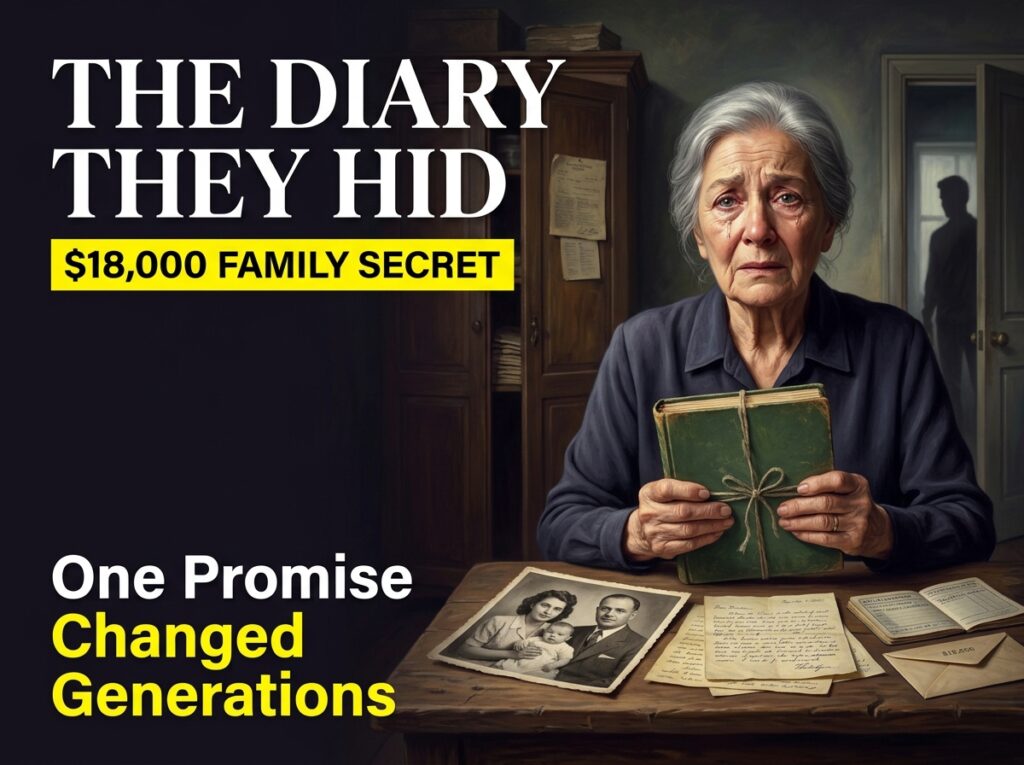
Part 1 — The Diary Tied With String
Evelyn, 81 never expected a rented room above a bakery to become the place where everything changed. The hardest part was realizing how many people had known about it before me. For years, the grandson who visited every Sunday had been part of a story that seemed settled, but one detail had never made sense.
There were bills to pay, people depending on me, and memories I didn’t know how to explain. Even $18,000 seemed less important than the question nobody would answer: why had this been kept secret for so long? I tried to carry on as usual, but the silence around the subject only made it harder to ignore.
Then, in 2009, I found a diary tied with string. At first I assumed it belonged to an old argument or a forgotten promise, but the details did not fit. The first page named a person the family had been told was a stranger. Suddenly, the story I had been told for years felt incomplete, and I realized that asking the wrong person might make everything worse.
Before anyone could ask more, Grandma pointed to a locked cupboard and said, “The rest is in there.” I had to decide whether to confront the people closest to me or follow the clue quietly before it disappeared.
I remember the smell of the bakery more clearly than I remember the weather that morning.
Fresh bread rose through the floorboards, mixing with the scent of old wood and the lavender soap I kept beside my little sink. I had lived in that rented room for almost three years. It was not the home I had imagined for my old age, but it was warm, affordable, and close enough to the shops that I could buy what I needed without asking anyone for help.
My grandson, Daniel, visited every Sunday.
He always knocked twice, waited a moment, then knocked once more. He said he had developed the habit when he was a boy because I used to pretend I hadn’t heard him the first time.
“Grandma, I know you’re in there,” he would call.
And I would laugh before opening the door.
Daniel was thirty-two in 2009, a thoughtful young man who had inherited his mother’s dark eyes and his father’s habit of looking away when he was worried. He brought groceries, fixed whatever needed fixing, and sat beside my window while I told him stories about the family.
There were things I never told him.
Not because I wanted to deceive him, I told myself, but because some memories become heavier with age. I had spent decades believing that certain questions were better left unanswered.
Then came the diary.
I found it while searching through an old suitcase that had belonged to my late husband, Arthur. The suitcase had followed me through three homes, two major family arguments, and more years than I cared to count. I had intended to sort through it after moving into the room above the bakery, but I kept postponing the task.
That morning, I pulled out a stack of old letters, a photograph album, and a small wooden box containing buttons and broken pieces of jewelry.
Beneath them lay a diary wrapped in faded brown paper.
Three lengths of string held it shut.
The cover was dark green, worn at the corners. There was no name on the front, only a faint mark where something had once been written.
I nearly put it back.
Then I noticed the date on the first loose page: 1968.
I untied the string.
The first page contained a name I had not seen written in decades.
Thomas Bell.
I sat very still.
My family had always described Thomas as a stranger who had briefly worked with my father before disappearing from our lives. Whenever his name came up, my older relatives insisted he had never been close to us.
My husband had once told me that Thomas was a man from the past who had no place in our future.
But the diary began with a sentence that made my hands tremble.
“Thomas came today. He says the promise must be kept, even if the family never forgives us.”
I read it again.
Then I turned the page.
There were references to money, a locked cupboard, and a promise that had apparently involved $18,000. The amount seemed impossible at first. I wondered whether I had misunderstood the handwriting or whether the number referred to something else.
But the same figure appeared again.
And again.
I heard footsteps on the stairs below and hurriedly closed the diary.
A few seconds later, Daniel knocked twice, paused, and knocked once more.
“Grandma? It’s me.”
I placed the diary on the table and opened the door.
He came inside carrying a paper bag from the bakery downstairs.
“I brought you those little rolls you like.”
“Thank you, darling.”
He put the bag down and looked at me.
“Are you all right? You look pale.”
I considered telling him what I had found.
Instead, I asked whether he remembered a man named Thomas Bell.
The smile disappeared from his face.
“Where did you hear that name?”
The question frightened me more than any answer could have.
I had not told him about the diary.
I had not shown him the page.
And yet, before he even knew why I was asking, my grandson seemed to recognize the name.
Part 2 — The Sunday Visit That Changed Everything
Daniel sat down slowly.
For years, I had watched him move around my little room as though it belonged to him as much as it belonged to me. He knew which chair creaked, which cupboard stuck, and which window needed a firm push before it would close.
That Sunday, he remained beside the door.
“Grandma, why are you asking about Thomas Bell?”
“I found an old diary.”
His eyes moved toward the table.
“Where?”
“In your grandfather’s suitcase.”
He did not approach it.
“Perhaps you should put it away.”
“Why?”
“Because old family papers can be misleading.”
I almost smiled at the familiar phrase. It was the same explanation I had heard whenever someone uncovered a document that contradicted the family story.
“Have you read it?” I asked.
“No.”
“Then how do you know it is misleading?”
He rubbed his hands together.
“I don’t know. I just think you should leave it alone.”
I looked at my grandson, the boy who had once cried because he thought a lost kitten would be cold outside. I remembered how he used to sit beside me while I baked, asking questions about people whose photographs hung in the hallway.
He had always wanted to know where everyone came from.
Now he was asking me not to look.
“Daniel, what do you know about Thomas?”
He stared at the floor.
“I know the family doesn’t talk about him.”
“That isn’t the same as knowing nothing.”
He sighed.
“Grandma, I don’t want you getting upset.”
“I am already upset.”
He finally sat down.
He told me that his mother, Margaret, had mentioned Thomas when he was a teenager. She had said he was connected to an old disagreement involving money and a property that had once belonged to my family.
Whenever Daniel asked for more details, Margaret changed the subject.
He had assumed the matter concerned an old business failure.
“Did your mother ever say he was a stranger?” I asked.
“Yes.”
“And did you believe her?”
“At the time.”
I opened the diary and showed him the first page.
He read the sentence silently.
Then he looked up.
“Grandma, who wrote this?”
“I don’t know yet.”
He turned the page carefully.
There were entries written in different styles. Some were neat and precise, while others slanted sharply across the paper, as though the writer had been in a hurry.
The earliest entries mentioned my father, Edward, and a young man who had worked with him. Later pages referred to a family promise that had been made after an argument.
One entry read:
“Edward says the money must remain untouched until the child knows the truth. Thomas agrees. We must not let anyone change the arrangement.”
Daniel read it twice.
“What child?” he asked.
“I don’t know.”
Another entry mentioned a cupboard that had been locked after a family gathering.
The cupboard was described as being in the old family house, the place where I had lived before my husband’s death and before I rented the room above the bakery.
I remembered that cupboard.
It had stood in a narrow room beside the kitchen. My father kept important documents inside it, and he had always carried the key on a chain attached to his belt.
After he died, the cupboard remained locked.
My husband had told me that the key had been lost and that the contents were of no importance.
I had never questioned him.
Now the diary seemed to be pointing directly at that forgotten room.
Daniel closed the book.
“Grandma, I think you should speak to Mum before going any further.”
“Why?”
“Because she may know what this means.”
“And if she doesn’t want to tell me?”
He did not answer.
I looked at the diary again.
The $18,000 appeared in several entries, but no page explained precisely where the money had come from or why it had been preserved. It was linked to a promise, a person the family called a stranger, and a child whose identity remained unclear.
I asked Daniel whether he had ever heard of a locked cupboard containing old papers.
His expression changed.
“Why?”
“Because the diary says the rest is there.”
He stood abruptly.
“Grandma, please. Don’t go back to that house.”
“Why not?”
He looked as though he wanted to tell me something, but the words would not come.
Finally, he said, “Because the last time someone tried to open that cupboard, the family nearly fell apart.”
Then he picked up his coat.
Before leaving, he turned back.
“If Mum calls you, please don’t tell her about the diary until I speak to her.”
The door closed behind him.
I remained at the table for a long time.
My grandson had come to visit as he always did.
But he had left carrying a fear that seemed much older than he was.
And I began to wonder whether the secret had been passed down through the family like an inheritance nobody wanted to receive.
Part 3 — The $18,000 Promise
That evening, I took the diary to the window and read as much as the fading light allowed.
The entries began in 1968 and continued intermittently for several years. The writer did not identify themselves on every page, but the handwriting resembled my father’s in some places and my mother’s in others.
I recognized several details about our old home: the cracked blue tiles beside the fireplace, the pear tree near the back fence, and the cupboard that had always been kept locked.
The diary described a disagreement between my father, Edward, and Thomas Bell.
According to the entries, Thomas had worked with my father on a property arrangement. The two men had agreed to set aside money until a particular family matter could be resolved.
The sum was $18,000.
The diary did not explain whether the money had been deposited in a bank, held in cash, or connected to a property sale. It only repeated that the money was not to be used until the promise had been fulfilled.
I found an entry dated three days after a family gathering.
“Thomas says the child must be told when the time is right. Edward fears the family will never forgive the truth. We have agreed to keep the documents safe until someone is brave enough to ask.”
I put the diary down.
Who was the child?
And what truth could cause an entire family to turn against the people who had promised to reveal it?
I thought of my daughter, Margaret, and my son, Peter. Both had grown up in the old family house. Margaret had been the careful one, always concerned about appearances and what the neighbors might say. Peter had been restless and independent, leaving home as soon as he could.
Neither had ever mentioned Thomas Bell.
My husband, Arthur, had been different. He had known my father for years and had helped manage the family finances after Edward became ill. He had also been the person who insisted that Thomas was a stranger.
Arthur was gone now.
I could not ask him why he had said it.
But I could look for the documents he had left behind.
The following morning, I visited the old family house.
Margaret had inherited the property after my husband’s death, although she had allowed me to keep some of my belongings there. The house had been sold once, then bought back through a later family arrangement, and it now stood empty while repairs were being discussed.
I still had a key.
The front door opened with a familiar groan.
Dust lay across the hallway. The furniture had been covered, and sunlight filtered through the curtains in pale strips.
I walked toward the narrow room beside the kitchen.
The cupboard was still there.
It was taller than I remembered, made of dark wood with brass handles and a small keyhole. My father had kept it locked even when the rest of the house was full of people.
I ran my fingers over the handle.
There was no key.
I searched the drawers in the nearby desk, then opened a box of old household tools. Nothing fit the lock.
I did not want to force it open. If the cupboard contained original records, I could damage them.
Instead, I looked behind it.
The diary had mentioned a small mark on the wall near the cupboard. I had assumed it was a stain, but when I moved a stack of old boxes, I found a faint pencil line at knee height.
Beneath it was a tiny metal hook.
Something had once hung there.
I searched the room and found a small envelope tucked inside the back of a drawer. It contained a brass key attached to a paper label.
The label read:
“For the cupboard. Do not use until the family is ready.”
I stared at the words.
My father had not lost the key.
Someone had hidden it.
I returned to the cupboard and inserted the key.
It turned, but the door did not open immediately. The wood had swollen with age, and I had to pull gently on the handle.
At last, the door moved.
Inside were several folders, an old photograph album, a metal cash box, and a thick envelope bearing my father’s handwriting.
I did not open them.
Not yet.
I stood in front of the cupboard, feeling the weight of the decision ahead of me.
Whatever was inside had been hidden for decades.
And I was no longer certain that the family would welcome what I found.
Part 4 — The Photograph of the Stranger
I carried the folders to the kitchen table and opened the first one.
It contained property documents, bank correspondence, and handwritten notes. Several pages referred to the $18,000, but none gave a complete account of its final destination.
The second folder contained letters between my father and Thomas Bell.
The letters were formal at first, discussing payments and property boundaries. Later, the tone became more personal.
Thomas wrote about a promise made to someone who had been treated unfairly. My father replied that he wanted the matter resolved before his death.
One letter ended with a sentence that made me stop reading.
“You know the child has a right to understand where they came from. We cannot keep calling me a stranger simply because the truth is inconvenient.”
I read it again.
Then I opened the photograph album.
Most of the photographs were familiar: family gatherings, birthdays, holidays, and people standing proudly in front of the old house.
Halfway through the album, I found a photograph I had never seen before.
It showed my father standing beside Thomas Bell. Between them stood a young woman holding a baby.
I recognized the woman immediately.
She was my younger sister, Rose.
Rose had died when she was only twenty-seven. The family rarely discussed her death. We had been told that she had become ill after leaving home and that the baby she had given birth to had been taken in by relatives.
I had been too young and too overwhelmed by the events of that period to ask many questions.
My mother had said the child’s father was unknown.
The photograph contradicted that story.
Thomas stood beside Rose with one hand resting gently on the baby’s blanket. My father was smiling at them both.
On the back of the photograph, someone had written:
“Rose, Thomas, and Daniel — the family must keep its promise.”
I sank into the chair.
Daniel.
My grandson’s name.
The baby in the photograph could not have been my grandson; the dates did not fit. But the name was the same, and the diary had repeatedly referred to a child whose identity needed to be protected.
I checked the date.
The photograph had been taken decades before my grandson was born.
Perhaps the name had been passed down. Perhaps it referred to another person.
I could not know from the photograph alone.
But I now had evidence that Thomas had been close to my sister, Rose. He had not been a stranger.
The family had known him.
My father had known him.
And the baby in the photograph was part of a promise the family had apparently agreed to keep.
I searched the album for more photographs. I found two others showing Thomas with Rose, both taken near the old house. In one, my mother stood in the background, watching them.
She was not smiling.
I wondered whether she had opposed their relationship or whether she had been afraid of something else.
The metal cash box remained closed.
I opened the envelope with my father’s handwriting.
Inside was a note dated shortly before his death.
“Evelyn, if you are reading this, it means the cupboard has finally been opened. I wanted to explain everything myself, but I was afraid the truth would hurt the people I loved. That fear became an excuse to wait, and waiting made the secret heavier.”
I had to stop reading.
My father had known that the secret was wrong.
He had also known that someone would eventually find it.
The note continued:
“The $18,000 was kept aside because Rose and Thomas were promised that their child would not be denied the truth about the family. The money was never meant to buy silence. It was meant to help the child when the truth could safely be told.”
I read the paragraph again.
The money was connected to a child.
But whose child was it?
And why had the family chosen to call Thomas a stranger?
Part 5 — The Name Nobody Wanted to Hear
I took the photograph and my father’s note back to the rented room above the bakery.
For the first time in years, I felt afraid of what the family might say when they learned I had opened the cupboard.
I had spent most of my life believing that the past was fixed. The people who were gone could not return, and the decisions they had made could not be changed.
But the diary and the photograph showed that the story I had accepted was incomplete.
That afternoon, I called my daughter, Margaret.
She answered while she was at work and sounded distracted.
“Mother, is everything all right?”
“I opened the cupboard at the old house.”
The silence on the other end was immediate.
“Why would you do that?”
“Because I found the key.”
“Where?”
“In the desk.”
She exhaled sharply.
“You shouldn’t have touched those things.”
“Then why were they hidden?”
“They’re old papers, Mother. They won’t help anyone.”
“I found photographs of Rose and Thomas Bell.”
Margaret stopped speaking.
I waited.
Finally, she said, “You need to put those documents back.”
“I found Dad’s note. He wrote that the $18,000 was meant to help Rose’s child.”
“Mother, please.”
“Who was the child?”
She did not answer.
I felt my heart beating faster.
“Margaret, was Rose’s child adopted by someone in our family?”
She whispered something I could not understand.
Then she said, “I can’t talk about this now.”
She hung up.
I sat with the phone in my hand.
My daughter had not asked what the photograph showed. She had not asked whether the diary was genuine. She had not questioned the note.
She had reacted as though she already knew what I had found.
I called my son, Peter.
He answered from another city and listened quietly while I explained the diary and the cupboard.
When I mentioned the photograph of Rose, he sighed.
“I wondered when someone would find those papers.”
“You knew?”
“I knew there was a secret. I didn’t know all the details.”
“What did you know?”
Peter told me that, years earlier, he had overheard an argument between my father and Arthur. They had been discussing Rose’s child and whether the family should tell the truth about the child’s parentage.
Arthur had insisted that revealing the truth would destroy the family. My father had argued that the child deserved to know.
Peter had been young, and he had not understood the full conversation.
He had never asked about it again.
“Why didn’t you tell me?” I asked.
“Because Dad said it wasn’t my place. And after he died, everyone acted as if the matter had been settled.”
“Who was the child?”
Peter hesitated.
“I believe it was connected to Daniel, your grandson. But I don’t know exactly how.”
I stared at the wall.
My grandson Daniel had been visiting me every Sunday for years. He had brought groceries, fixed my shelves, and listened to stories about our family.
He had never told me that he knew anything about Thomas Bell.
Perhaps he had known only the name.
Perhaps he knew much more.
I asked Peter whether he had ever seen the $18,000.
“No. I only heard about it in the argument.”
“Do you know where the money is now?”
“I don’t know, Mum. But if Dad’s note is accurate, it was meant to be kept until the child could be told the truth.”
I thanked him and ended the call.
For a long time, I sat without moving.
My family had hidden a story about Rose, Thomas, and a child. The money was connected to that story, but I still did not understand the precise relationship between the child in the photograph and my grandson.
I needed to speak with Daniel.
But first, I needed to understand what the documents actually established.
I would not accuse my grandson of being part of a secret simply because his name appeared in an old diary.
I had learned enough to know that the family had already made too many assumptions.
Part 6 — Daniel’s Question
Daniel came to see me on Sunday, as he always did.
He brought bread, milk, and a small pot of flowers for the windowsill. When he entered the room, he looked at the table and immediately noticed the photograph album.
“Grandma,” he said quietly, “you opened the cupboard.”
I nodded.
He set the groceries down.
“Did you find the letter?”
“I found several letters. I found a photograph of Rose and Thomas Bell. I found Dad’s note about the $18,000.”
Daniel pulled out a chair.
For a moment, neither of us spoke.
Then he said, “I think I should tell you what I know.”
I waited.
He explained that he had heard the name Thomas Bell from his mother when he was a teenager. She had told him that Thomas was connected to an old family matter and that he should never ask about it.
Years later, he had found an envelope among his mother’s papers. Inside was a copy of a letter addressed to someone named Thomas. The letter mentioned a promise and a sum of money, but it did not explain the full story.
Daniel had shown it to Margaret.
She had told him to destroy it.
He had not.
Instead, he had kept the copy in a folder because he believed it might someday be important.
“Why didn’t you tell me?” I asked.
“Because I didn’t know what it meant. Mum said it was a private matter, and I thought I was being disrespectful by asking.”
I understood the feeling. Our family had taught its younger members that questions about certain people were not merely uncomfortable; they were disloyal.
I showed him the photograph.
He studied it carefully.
“I’ve never seen this before.”
“Do you recognize the baby?”
“No.”
I felt relieved, though the mystery remained.
I showed him my father’s note and explained what it said about the $18,000.
Daniel read it slowly.
Then he looked up.
“Grandma, why would they keep money for a child and never tell the child?”
“That is what we need to find out.”
He asked whether I had opened the metal cash box.
I shook my head.
“I was afraid there might be documents inside that needed to be preserved.”
Daniel offered to help me take it to a locksmith or a professional who could open it without damaging the contents. I agreed.
Before we finished, he asked me something I had not expected.
“Grandma, do you think Mum knew all along?”
“I think she knew something. I don’t know how much.”
“She always said Thomas was a stranger.”
“I know.”
“Then why did she look frightened when you mentioned him?”
I reached across the table and took his hand.
“Because sometimes people spend so long protecting a story that they become afraid of what will happen if anyone questions it.”
Daniel looked down.
“I don’t want our family to break apart.”
“Neither do I.”
“Then why are we doing this?”
I thought about my father’s note.
“Because staying together should not require us to pretend that something untrue is true.”
He nodded, although I could see that he was struggling with the idea.
We made arrangements to have the cash box opened safely.
For the first time since I found the diary, I felt that I was not following the clue alone.
My grandson was beside me.
And he wanted the truth as much as I did.
Part 7 — What Was Inside the Cash Box
The cash box was opened by a locksmith who recorded its condition before beginning. We wanted to preserve the documents and avoid damaging anything that might later be important.
Inside were several envelopes, an old bank passbook, and a folded document sealed with a strip of paper.
The passbook showed a series of deposits made over several years. The entries were difficult to read, but the account history appeared to be connected to the $18,000 mentioned in the diary.
There was no guarantee that the balance had remained untouched or that the funds were still available. The records were old, and the account’s status would need to be verified with the relevant financial institution.
Still, the passbook gave us something concrete to investigate.
The folded document was a letter written by Thomas Bell.
It began by addressing my father and mother.
Thomas explained that he had loved Rose and that they had intended to raise their child together. But after Rose became ill, the family had disagreed about what should happen next.
Some relatives believed that the child would have a more stable life if raised within the family without public discussion of Thomas’s role. Others believed that the truth should be recorded and that Thomas should remain part of the child’s life.
The letter did not describe every argument. It did say that the family had agreed to preserve documents and money for the child’s future.
Thomas had signed the letter.
My father had signed beneath him.
My mother’s signature appeared at the bottom.
I held the paper carefully.
The family had not simply forgotten Thomas.
They had participated in a plan that acknowledged his relationship with Rose and his connection to the child.
The next envelope contained a list of names and dates. One entry referred to a child being placed with relatives after Rose’s death. Another recorded the $18,000 as money intended for the child’s future, subject to conditions that were not fully explained in the documents we had found.
A third envelope contained a letter addressed to Margaret.
The letter was from my father.
“Your mother and I agreed that the child should not be forced to carry our disagreements,” he wrote. “But we also agreed that the truth must not be erased. When the time is right, the child must be told who Thomas was and why the money was set aside.”
The letter was dated several months before my father’s death.
I sat quietly.
My father had wanted the truth to be told.
Yet the family had continued calling Thomas a stranger.
The final envelope contained a small photograph of Rose holding the same baby. On the back, Thomas had written:
“One day, I hope this child will know that they were loved by both sides of the family.”
I began to cry.
For decades, we had spoken about the past as if Thomas had been an outsider who appeared briefly and disappeared. The documents showed that he had been part of Rose’s life and that the family had made a promise concerning the child.
But the documents did not yet establish the child’s identity or explain exactly how Daniel was connected to the story.
We needed to be careful.
The next step was to verify the family records and the account history. I did not want to tell Daniel that he was the child mentioned in the documents unless the evidence supported it.
He agreed.
We gathered the papers, made secure copies, and arranged for the relevant records to be reviewed.
The locked cupboard had finally opened.
But the most important question was still waiting.
Part 8 — The Truth Margaret Had Carried
Margaret arrived at my room three days later.
She did not knock twice and wait for the third. She knocked once and opened the door before I could answer.
She looked at the documents spread across the table.
“So you’ve found everything.”
“Not everything,” I said. “But enough to know that Thomas was not a stranger.”
Margaret sat down.
For a long time, she said nothing.
Then she told me that she had learned about the promise when she was young. Our father had explained that Rose and Thomas had a child together, but the family had disagreed about how to handle the situation after Rose died.
Margaret had been told that the child would be raised by relatives and that Thomas would not be publicly acknowledged as the father.
She said she had believed the decision was necessary to protect the child from gossip and conflict.
“But why keep calling him a stranger?” I asked.
“Because people kept asking questions. It was easier to say he had no connection to us than explain what happened.”
“Was it easier for the child?”
Margaret looked away.
“No.”
She admitted that she had seen the diary years earlier. She had also known about the locked cupboard and the money. She had not known where all the documents were kept, but she understood that the $18,000 had been set aside for the child’s future.
“Why didn’t you tell me?” I asked.
“Because I was afraid you would ask questions I couldn’t answer. I was afraid the family would blame me for keeping the secret.”
“You let me believe Thomas was a stranger.”
“I know.”
She began to cry.
“I thought I was protecting everyone. By the time I realized how much harm the silence had caused, I didn’t know how to undo it.”
I thought about the years we had lost to that decision.
Rose had died without the family openly acknowledging the relationship she had chosen. Thomas had been kept at a distance. The child had grown up with an incomplete story. The money had remained tied to a promise that nobody wanted to explain.
And now, decades later, the same silence had reached Daniel.
“Do you know who the child was?” I asked.
Margaret nodded slowly.
“I believe it was connected to Daniel’s family history, but I never saw the complete record. Dad told me that the details would have to be verified before anyone made a claim.”
“Then why did you tell Daniel not to ask?”
“Because I was afraid the truth would change how he saw us.”
I looked at my daughter.
“It already has.”
She wiped her face.
“I know.”
I told her that we were going to verify the records before drawing conclusions. The diary and letters gave us a credible reason to investigate, but they did not answer every question. We would need to establish the child’s identity, the nature of the promise, and the status of the $18,000.
Margaret agreed to cooperate.
Before she left, she stood beside the window and looked down toward the bakery entrance.
“Do you think Dad would forgive us?” she asked.
I considered the question.
“I think he wanted us to tell the truth. I don’t know what he would say about the years we spent avoiding it.”
She nodded.
For the first time, Margaret did not ask me to put the papers away.
She asked whether she could help organize them.
It was a small change, but it mattered.
The family was finally moving from protecting the secret to examining it.
Part 9 — The Promise Belonged to the Child
The review of the documents took time.
The family records, photographs, letters, and bank passbook were examined together. We also sought the records needed to verify the account and establish what could be established about the child mentioned in the diary.
Some details became clearer.
The records supported the conclusion that Rose and Thomas had been in a relationship and that they had a child. They also showed that my parents had agreed to preserve documents and money for that child’s future.
However, the records we initially found did not establish every aspect of the child’s identity or the current legal status of the $18,000. The account needed to be traced, and the relevant family records had to be compared before any conclusion could be reached about entitlement to the money.
I was relieved that we had not rushed to announce an answer.
For years, my family had relied on a story because it was easier than confronting uncertainty. I did not want to repeat that mistake by treating a photograph or a diary entry as proof of everything we hoped to discover.
Daniel accompanied me to a meeting with the professional reviewing the records.
He asked careful questions and took notes. He did not demand the money. He wanted to understand why the family had kept the relationship secret and what the documents actually meant.
That impressed me.
After the meeting, we sat outside and watched people cross the street.
“Grandma,” he said, “if this money was meant for the child, what happens if we never find out who the child was?”
“Then we keep looking through the proper records, and we accept what can be proved.”
“And if the truth changes everything?”
I took his hand.
“Then we learn how to live with the truth instead of making another secret to hide it.”
He nodded.
Later that week, Margaret gave us a letter she had kept for years. It was written by our father and addressed to her shortly before he died.
In it, he repeated that the promise had been made for the child’s future, not to buy anyone’s silence or reward anyone for keeping a secret.
The letter ended:
“If we have made mistakes, the child should not have to pay for them. Tell the truth when you can, and do not let fear decide what the child deserves to know.”
I read those words several times.
They were not a complete answer, but they explained the intention behind the money.
The $18,000 was not simply a forgotten inheritance. It was connected to a promise made after a painful family disagreement, intended to provide support for a child whose story had been hidden.
The family had failed to fulfill the promise in the way my father had hoped.
But we could still choose to stop hiding the truth.
We continued the review of the account and the records. The money was not released immediately, and no one claimed it as their own without establishing the proper basis. The process had to determine what remained of the original funds and who, if anyone, was legally entitled to receive them.
That uncertainty no longer frightened me as much as it once had.
We were finally asking the right questions.
Part 10 — What Evelyn Finally Told Her Grandson
On the following Sunday, Daniel arrived with the usual paper bag from the bakery.
He knocked twice, waited, then knocked once more.
I opened the door before he could call my name.
“You’re early,” I said.
“Only by five minutes.”
He smiled, but his eyes moved toward the table.
The diary lay open beside the photograph of Rose and Thomas. The letters had been arranged in a neat stack, and the passbook rested in a protective folder.
I had spent the morning reading my father’s final note again.
For years, I had believed that keeping the family together meant protecting people from painful truths. I had watched arguments begin and end without resolution. I had accepted explanations because challenging them seemed unkind, disrespectful, or dangerous.
I thought silence was a form of mercy.
Now I understood that silence could become another burden passed from one generation to the next.
Daniel sat beside me.
“Have we found out everything?” he asked.
“Not everything.”
“Do we know what happened to the $18,000?”
“We know why the money was set aside, and we have records that connect it to the promise. But the account and the legal entitlement still need to be verified.”
He nodded.
“And Thomas?”
“We know he was not a stranger. The records support that he loved Rose and that he was part of the promise made for their child.”
Daniel looked at the photograph.
“Why did they hide that?”
“Because they were afraid of what people would say. They were afraid of arguments, blame, and the possibility that the truth would change the family.”
“Did it?”
I looked at him.
“It changed how I understand our past. But it doesn’t change the fact that we can choose to treat one another with honesty now.”
He was quiet for a while.
Then he asked, “Do you think Grandma Rose knew this would happen?”
I smiled sadly.
“I think she wanted her child to know they were loved. I think she hoped the family would keep its promise. I can’t tell you everything she thought, but the letters show that her future mattered to the people who made that agreement.”
Daniel reached for the photograph.
He studied the young woman holding the baby, then gently placed it back on the table.
“I wish I could have met her.”
“So do I.”
We spent the afternoon organizing the documents and preparing the questions that remained for the professional reviewing the account. We agreed not to make claims that the records could not support, and not to hide any document simply because it made someone uncomfortable.
The $18,000 might eventually be released according to the outcome of the review. It might take more time to establish exactly what remained and who was entitled to it. We could not promise a result before the evidence and the legal process were complete.
But we could fulfill the part of the promise that depended on us.
We could stop calling Thomas a stranger.
We could acknowledge Rose’s relationship and the child whose future our family had once agreed to protect.
And we could tell Daniel the truth we had spent years avoiding.
As evening approached, he helped me tie the diary with its original string. I had considered putting it back in the cupboard, but I decided it belonged where the family could find it, alongside the letters and photographs.
The locked cupboard had been opened.
The secret had been spoken.
And the past, though still incomplete, no longer belonged to silence alone.
Before Daniel left, he hugged me.
“Thank you for telling me, Grandma.”
I held him tightly.
“I should have told you sooner.”
He stepped back and smiled gently.
“At least you told me now.”
After he left, I sat beside the window and listened to the bakery downstairs closing for the evening. The smell of warm bread had always comforted me, and it did so again.
I thought about my father, Rose, Thomas, and all the people who had tried to protect the family in ways that had eventually hurt it.
I could not repair every mistake they had made. I could not bring Rose back or return the years Thomas had lost. I could not guarantee that the financial questions would be resolved exactly as we hoped.
But I could stop passing the silence forward.
The diary had begun with a warning that the promise must be kept, even if the family never forgave those involved.
I now understood what that meant.
The promise had never been about money alone.
It was about a child’s right to know where they came from, to understand the love that existed before they were born, and to receive an honest account of the choices that shaped their life.
The $18,000 was important because it represented that promise. But it could not replace the truth, and it could not erase the damage caused by hiding it.
At eighty-one, I had learned that a family does not become stronger by pretending its past was perfect.
It becomes stronger when someone is brave enough to open the cupboard, untie the string, and read the words everyone else was afraid to see.
And sometimes, the most important inheritance is not money, property, or a house.
It is the truth that finally allows the next generation to live without carrying the same secret.