The room above the bakery smelled of warm bread, cinnamon, and the faint dampness of old wood.
Ethan had lived there for nearly six months when he first began to suspect that his family had never told him the complete truth about a person from their past.
At twenty-three, he was still learning how to manage life on his own. Rent came due whether he felt ready or not. Groceries cost more than he expected, and the small stack of bills on his desk seemed to grow whenever he thought he had finally caught up.
The room was not much to look at. A narrow bed stood against one wall, a secondhand desk occupied the corner beside the window, and a small cupboard held most of his belongings. The floor creaked whenever he crossed the room at night.
Yet Ethan liked it.
Downstairs, the bakery opened before sunrise. By the time he woke, the smell of fresh bread had already slipped through the floorboards. Sometimes, when the baker was in a generous mood, Ethan received a paper bag containing rolls that had not sold the previous evening.
For someone trying to stretch every dollar, those small kindnesses mattered.
His family had helped him move into the room, although he had insisted on paying his own expenses. He wanted to prove that he could manage without depending on them for every decision.
He called home regularly, visited when he could, and tried not to complain about his difficulties.
There were already enough worries in the family.
His mother had bills to manage. His older relatives had their own responsibilities, and everyone seemed to carry memories that appeared whenever a conversation turned toward the past.
Ethan had grown accustomed to certain subjects being avoided.
One name, in particular, was rarely mentioned.
Whenever he asked about the woman his family had known years earlier, the answers changed depending on whom he asked. One relative said she had moved away. Another claimed she had stopped visiting after a disagreement. Someone else insisted that the matter had been settled long ago.
Nobody seemed to remember exactly when she had left.
Nobody explained why a bank clerk still appeared to remember her.
Ethan had heard about the clerk several times, usually in passing. An older family member once mentioned meeting someone at a bank who remembered the woman and asked whether she was still connected to the family.
The question had been dismissed as an ordinary coincidence.
Ethan had accepted that explanation because he had no reason to challenge it.
Then came the $37.
It was not a large amount, but it had appeared in an old conversation that Ethan overheard while visiting home. Two relatives were discussing expenses and a payment that had supposedly been made years earlier.
When Ethan asked what the money had been for, the conversation stopped.
His aunt told him it was an old matter that no longer concerned him.
His mother said there was nothing worth worrying about.
Neither answer satisfied him.
Still, Ethan had no documents, no clear memory of the original conversation, and no reason to believe that a small payment could explain anything important.
He returned to his life above the bakery.
For several weeks, he concentrated on work, rent, and the ordinary problems of becoming independent.
Then, on a rainy Saturday afternoon, he visited the family home to help clear out a storage area.
The house had accumulated years of belongings. Boxes stood beneath the stairs, old kitchen appliances occupied a corner of the garage, and a collection of tools had been pushed into a cupboard that nobody seemed to use anymore.
Ethan volunteered to sort the tools.
He found hammers with worn wooden handles, screwdrivers in a cracked plastic case, and several metal objects whose purposes he could not identify.
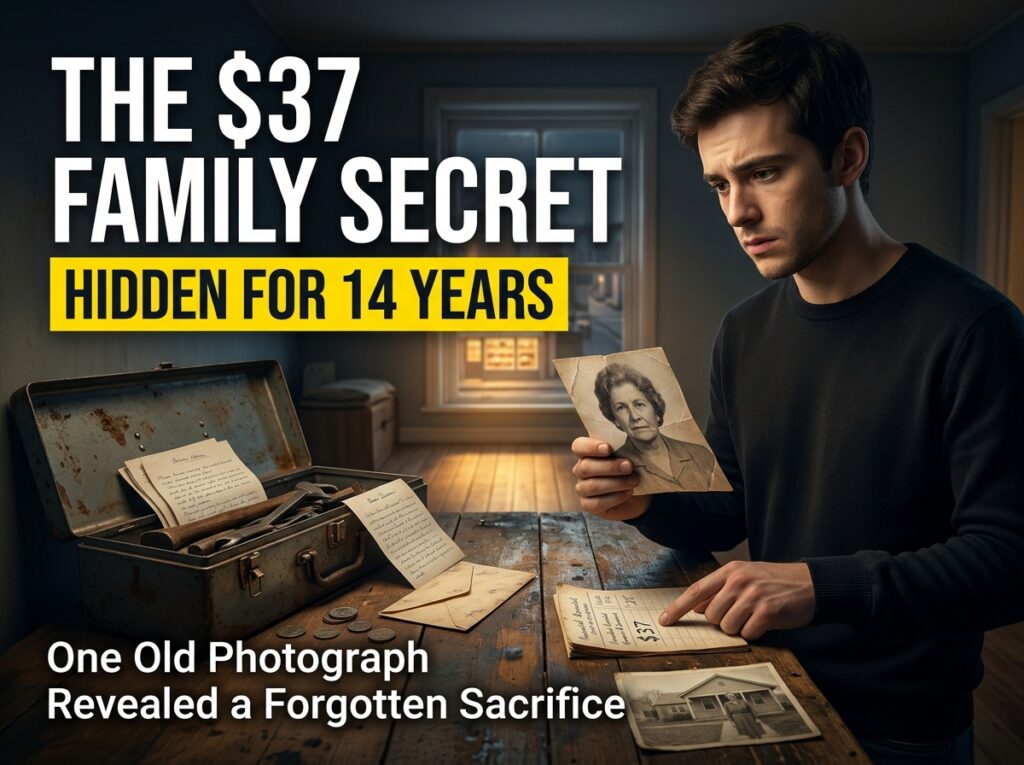
At the back of the cupboard sat an old toolbox.
Its surface was scratched, and a thin layer of dust covered the lid. Ethan remembered seeing it when he was younger, although he could not recall who had last used it.
He lifted it onto the workbench and opened it.
Inside were ordinary tools, folded instruction sheets, and a small collection of receipts.
Beneath a metal wrench lay a photograph.
Ethan picked it up.
The image showed a woman standing outside a building he did not recognize. She was holding a paper bag and looking toward the person taking the picture.
Something about her face seemed familiar.
He turned the photograph over.
There was a date written on the back.
The date was fourteen years earlier.
Ethan felt a strange uneasiness.
The woman in the photograph appeared to be connected to the family story nobody wanted to explain. Yet he could not immediately remember her name.
He searched the toolbox again and found several folded pages tucked beneath the removable tray.
They contained handwritten lists of expenses, small payments, and notes about sacrifices someone had made to help another person.
The amounts were modest.
Some entries referred to groceries. Others mentioned transportation, repairs, and money set aside for an unnamed purpose.
Then Ethan saw the number.
$37.
It appeared beside a date matching the period when the photograph had been taken.
He stared at the page.
The amount was exactly the one he had heard discussed at home.
For the first time, the family mystery had become something he could examine rather than merely wonder about.
He gathered the photograph and pages, placed them carefully in a folder, and returned the tools to the box.
Before leaving, he looked at the photograph one more time.
The woman was smiling faintly, but there was something serious in her expression, as though the picture had been taken during a difficult period rather than an ordinary afternoon.
Ethan wanted to show the photograph to his mother immediately.
Then he remembered how the conversation about the $37 had ended.
He decided to wait until he understood more.
Back in his rented room, the bakery below him had already closed for the evening. The familiar smell of bread had faded, leaving the building quiet except for the occasional creak of the floorboards.
Ethan spread the pages across his desk.
The notes appeared to record years of small sacrifices made for someone whose name was missing from most of the entries.
Someone had paid for things the family apparently never discussed.
Someone had kept careful records.
And someone had placed the photograph inside a toolbox where it remained hidden for fourteen years.
Ethan turned to the final page.
At the bottom was a name he had not heard in his family for as long as he could remember.
He read it once.
Then again.
He knew the name.
He simply could not understand why it had been written there.
Part 2
Ethan spent most of Sunday examining the papers.
He arranged them by date, trying to determine whether the entries formed a continuous record or whether several unrelated documents had been stored together.
The handwriting was consistent across most of the pages. Whoever had written them appeared to have kept a careful account of small expenses over a period of years.
Some entries included brief explanations.
Food and transport.
Repair paid.
Keep the rest aside.
Others were little more than dates followed by amounts.
The $37 payment appeared twice.
The first entry showed the amount beside a date fourteen years earlier.
The second appeared several months later, accompanied by a short note that was difficult to read.
Ethan wondered whether the money had been paid twice or whether the second entry referred to a repayment.
He could not tell.
He checked the photograph again.
The woman stood outside what looked like a modest building with a narrow entrance. Behind her, a sign was partly visible, but the image was too faded to read.
On the reverse, beneath the date, someone had written a few words.
For everything you gave up.
Ethan felt a small ache in his chest.
The phrase suggested gratitude, but he did not know who had written it or who was supposed to receive it.
He placed the photograph beside the handwritten pages.
The records contained references to sacrifices, but there was no complete explanation of what those sacrifices had been for. One entry mentioned missed work. Another referred to a journey that had cost more than expected. Several entries described money being set aside despite other expenses.
The notes seemed personal.
They did not read like the records of someone managing a household budget.
They read like the private account of someone trying to remember every small thing another person had done.
Ethan wondered whether the woman in the photograph had been helping his family during a difficult period.
Perhaps she had lent someone money.
Perhaps she had cared for a relative.
Perhaps the $37 had been part of a promise that was never properly acknowledged.
He refused to choose an explanation without evidence.
That afternoon, he called his mother.
“Do you remember an old toolbox at the house?” he asked.
“Of course. Why?”
“I found a photograph inside it.”
His mother paused.
“What photograph?”
He described the woman and the date.
“Did you read the writing on the back?” she asked.
“Yes.”
“What did it say?”
Ethan repeated the words.
There was a silence.
“Where are the papers?” his mother asked.
“In my room.”
“You should bring them home.”
“Why?”
“They belong with the family.”
“Do you know who the woman is?”
His mother did not answer immediately.
“I think you should bring the papers home, Ethan.”
He felt frustration rising.
“You keep telling me what to do without answering the question.”
“I’m not trying to upset you.”
“Then tell me what you know.”
His mother sighed.
“I remember hearing about someone who helped the family a long time ago. But I don’t know all the details.”
“Was it the woman in the photograph?”
“I can’t be sure.”
“Do you remember the $37?”
Another pause followed.
“I remember that amount being mentioned.”
“What was it for?”
“I don’t know.”
Ethan leaned back in his chair.
He had hoped that the photograph would provide a simple answer. Instead, it seemed to have made everyone more cautious.
“Why didn’t anyone tell me about this before?” he asked.
“Because it happened a long time ago.”
“That doesn’t explain why nobody will talk about it.”
His mother sounded tired.
“Some things happened when you were young. The adults involved had reasons for keeping certain details private.”
“Private from me?”
“Yes.”
The answer hurt more than Ethan expected.
He had never believed that his family owed him every detail of their past. But the secrecy now seemed connected to a person whose sacrifices had been carefully recorded and then almost completely forgotten.
“Did she do something wrong?” he asked.
“No,” his mother replied quickly.
The speed of her answer caught his attention.
“Then why is her name on the last page?”
His mother went quiet.
“Ethan, I need to go. We can talk about this when you come home.”
The call ended.
Ethan stared at his phone.
His mother had denied that the woman did anything wrong, but she had not explained why the name was significant.
He placed the phone beside the papers and returned to the list of expenses.
One entry mentioned a payment made after a visit to the bank. Another referred to a document that needed to be kept safe.
The handwriting beside that entry was different from the rest.
Ethan examined it carefully.
The note read:
Ask the clerk before making any decision.
He looked again at the photograph.
The bank clerk who remembered the woman had been mentioned in family conversations for years. Perhaps the clerk had known about the payments. Perhaps the records had once been discussed at the bank.
But Ethan could not know whether the reference concerned the same person.
He needed to establish the woman’s identity first.
He searched through the family photographs he had been given permission to examine. Several showed relatives at birthdays, weddings, and gatherings outside the old house.
In one image, the woman appeared at the edge of a group.
This time, Ethan recognized her.
Her name was Margaret.
He had heard the name when he was younger, but the adults had stopped mentioning her long ago.
Ethan searched his memory for an explanation.
He remembered a woman who had visited the family house occasionally, carrying bags of groceries and speaking quietly with his mother. He remembered that the adults treated her with a mixture of affection and sadness.
Then, at some point, she had disappeared from the family’s life.
No one had explained why.
Ethan looked at the final page again.
Margaret’s name was written at the bottom.
Beneath it was a sentence that made his stomach tighten.
She must never be blamed for what happened.
Ethan sat motionless.
The records were no longer simply a collection of old expenses.
Someone had written an explicit warning about blame.
And the person being protected was the same woman whose photograph had been hidden inside the toolbox.
Part 3
On Monday morning, Ethan took the photograph to the bakery owner, Mrs. Collins.
She had known the neighborhood for decades and often remembered details that younger residents had forgotten.
Ethan showed her the image while she prepared the first trays of bread.
“Do you recognize this woman?” he asked.
Mrs. Collins adjusted her glasses.
“That looks like Margaret.”
“You knew her?”
“Not well, but I remember her. She used to come through this neighborhood years ago.”
“Do you remember where she lived?”
Mrs. Collins considered the question.
“I remember that she stayed somewhere nearby for a while. I think she worked at a bank, or perhaps she knew someone who did.”
Ethan felt his attention sharpen.
“Did she help families with money?”
“I couldn’t tell you that. But she was always carrying paperwork. She seemed like someone who had a lot to manage.”
“Do you remember why she stopped visiting?”
Mrs. Collins returned the photograph.
“No. I remember that people stopped talking about her, but I never knew why.”
Ethan thanked her and went upstairs.
The photograph now connected Margaret to the neighborhood and perhaps to the bank. But he still lacked the information needed to understand the $37.
He decided to visit the bank branch his family had mentioned.
The branch was older than most of the buildings around it. Its exterior had been renovated, but the entrance and the broad windows still looked much as they had in the photographs Ethan had seen of the neighborhood years earlier.
Inside, he explained that he had discovered historical papers referring to a bank clerk and an old payment.
He made it clear that he was not asking to see anyone else’s private account information.
The employee at the desk listened and explained that the bank could not identify a transaction based only on a name and an old handwritten note. If Ethan believed he was entitled to access specific records, he would need to follow the formal process.
He understood.
Before leaving, he asked whether the bank had a public way to forward a message to a retired employee.
The employee explained that she could not disclose personal contact details but could tell him how to submit an inquiry.
Ethan wrote a brief letter.
He included Margaret’s name, the approximate date, and the reference to a payment of $37. He asked whether a former employee might remember the circumstances surrounding the paperwork, without requesting confidential information about any customer.
Then he returned to the bakery.
For the next few days, he tried to focus on work.
But the phrase from the final page continued to trouble him.
She must never be blamed for what happened.
Why would someone write that unless there had been a disagreement?
And why had Margaret’s sacrifices been recorded so carefully if the family no longer wanted to discuss her?
Ethan decided to ask his aunt.
She was one of the few relatives who had known Margaret personally.
When Ethan showed her the photograph, her expression changed.
“Where did you find that?”
“In the toolbox.”
His aunt sat down.
“I wondered where it had gone.”
“You know the photograph?”
“Yes.”
“Who wrote the notes?”
“I don’t know for certain.”
Ethan placed the page with the $37 entry in front of her.
“Do you remember this payment?”
His aunt studied it.
“I remember Margaret helping your family. There were times when money was tight, and she did what she could.”
“Was the $37 something she gave us?”
“I think so, but I can’t be sure.”
“Why was it recorded?”
“Margaret liked to keep track of things. She didn’t want people to forget what had been promised.”
Ethan looked at the list of sacrifices.
“Was she expecting the money back?”
His aunt shook her head.
“Not necessarily. Sometimes she helped because someone needed help. Other times, there was an agreement to repay her.”
“Which was this?”
“I don’t know.”
Ethan felt the familiar frustration return.
Everyone seemed to remember a different fragment, but nobody could explain how those fragments fitted together.
“Why did she stop visiting?” he asked.
His aunt looked away.
“There was a disagreement.”
“About the money?”
“Partly.”
“What happened?”
“I wasn’t there for every conversation.”
Ethan waited.
His aunt finally said that Margaret had been trying to help the family through a difficult period. She had paid for small necessities, offered practical support, and sometimes put aside money even when her own circumstances were not easy.
But when a later problem arose, people began arguing about what had been promised.
Some believed Margaret had offered help without expecting anything in return.
Others believed there had been an agreement that needed to be honored.
The $37 became one of the details people remembered, even though no one could agree on what it meant.
“Did Margaret do something wrong?” Ethan asked.
His aunt shook her head.
“I never believed she did.”
“Then why did the family stop talking about her?”
His aunt’s eyes filled with sadness.
“Because it was easier than admitting that we didn’t know how to resolve the disagreement.”
Ethan sat quietly.
For the first time, someone had admitted that the family story was not complete.
His aunt explained that Margaret had eventually left the neighborhood. She had not been seen at family gatherings for years, and people began to assume that she wanted nothing more to do with them.
Nobody had made a serious effort to correct that assumption.
Ethan looked at the photograph.
He imagined Margaret carrying groceries to the house, making payments that others might have forgotten, and carefully recording every sacrifice so that the details would not disappear.
Then he imagined her name becoming something the family avoided.
“Do you know where she went?” he asked.
His aunt shook her head.
“No. But the bank clerk might remember.”
Ethan returned to his room that evening with more questions than answers.
Yet one thing had changed.
His aunt did not believe Margaret had done anything wrong.
The warning on the final page might not have been an attempt to hide wrongdoing.
It might have been an attempt to prevent someone from being blamed for a problem nobody understood.
And Ethan was beginning to wonder whether his family had spent fourteen years protecting the wrong part of the story.
Part 4
The bank replied to Ethan’s inquiry four days later.
A former employee named Helen had agreed to receive a letter from him. She could not promise to remember the payment, but she was willing to discuss what she recalled about the general circumstances.
Ethan wrote again, explaining that he had found a photograph of Margaret and handwritten pages recording small payments and sacrifices.
He did not include private financial details beyond the information already written on the papers.
Helen responded the following week.
She remembered Margaret.
According to Helen, Margaret had visited the branch several times during a period when she was helping someone close to her. She had been concerned that a small financial arrangement might later be misunderstood.
“I remember that she wanted the details written down,” Helen explained during their telephone conversation. “She was worried that people would remember the amount but forget the reason for it.”
Ethan sat down.
“Do you remember the $37?”
“I remember a small payment being discussed, but I cannot confirm that it was the same one in your document.”
“Was Margaret trying to recover money?”
“I can’t say. I remember her asking how to keep a record of an arrangement so that everyone understood what had been agreed.”
Ethan thought about the handwritten pages.
“They recorded every sacrifice,” he said. “It looks as though she was keeping track of everything she did for the family.”
“That is possible,” Helen replied. “But you would need to interpret those records in their full context.”
Ethan appreciated her caution.
He asked whether Margaret had ever complained about the family.
Helen thought for a moment.
“I remember that she seemed worried about being misunderstood. She wanted the paperwork to be clear so that nobody would later say she had promised something she hadn’t.”
Ethan felt a chill.
The note in the toolbox had warned that Margaret must never be blamed for what happened.
Helen’s recollection suggested that Margaret had been concerned about the same possibility.
“Did she ever explain what had happened?” he asked.
“Not to me in detail. I was a bank clerk, not a participant in her personal affairs. I remember the concern about documentation, but I can’t tell you what happened between the people involved.”
Ethan thanked her.
The call did not establish whether the payment had been made, whether the money had been repaid, or why the family disagreement had occurred.
But it confirmed that Margaret had been concerned about keeping a record of an arrangement.
Ethan returned to the pages.
He noticed that the entries were not all written at the same time. Some had been added months after the original dates, and a few contained short reminders about promises that had not yet been fulfilled.
One entry read:
Wait until everyone understands.
Another said:
Do not let them turn this into blame.
He copied both phrases into his notebook.
The pages suggested that the person keeping the records had anticipated a misunderstanding.
Perhaps Margaret had written them herself.
Perhaps another family member had kept the notes on her behalf.
Ethan could not tell.
He needed to identify the handwriting.
He showed copies to his aunt, who believed that some entries resembled Margaret’s writing, while others looked different.
That possibility troubled him.
If multiple people had contributed to the records, the pages might represent a shared effort to document the arrangement rather than one person’s private account.
Ethan asked his mother whether she recognized the handwriting.
She examined the pages for several minutes.
“I recognize Margaret’s writing on some of these,” she said. “But I don’t think she wrote everything.”
“Who else might have?”
His mother did not answer immediately.
“Your grandmother used to keep records of household expenses. Some of these entries look like hers.”
“Why would they be mixed together?”
“Perhaps they were keeping track of the same arrangement.”
Ethan looked at the photograph again.
The idea changed the way he understood the toolbox.
It might not have been a place where someone had hidden evidence.
It might simply have been where someone had stored papers that no longer seemed important after the family stopped discussing the matter.
But that did not explain the final page.
The warning about blame remained.
Ethan returned to his mother’s question.
“Did Grandma believe Margaret had done something wrong?”
His mother sighed.
“I don’t think she ever knew exactly what happened. She was upset about the disagreement, but I remember her saying that Margaret had helped the family when we needed it.”
“Then why did everyone stop talking about her?”
“Because the disagreement hurt people. And after Margaret left, nobody knew how to bring the subject up without starting another argument.”
Ethan felt a mixture of sadness and frustration.
A disagreement had become silence.
Silence had become an accepted story.
And the accepted story had survived long after the people involved stopped remembering its details.
He gathered the papers and returned them to the folder.
The next day, he planned to ask his grandmother about the records.
She was the one person who might recognize both handwritings.
But when he called, his mother answered instead.
“Grandma isn’t feeling well today,” she said. “Perhaps you can visit another time.”
Ethan agreed, although he felt uneasy.
He had waited fourteen years without knowing these documents existed.
Now, with each new conversation, he felt that time mattered more than he had realized.
He did not want to pressure anyone.
He simply wanted to understand what the family had forgotten.
And the longer he waited, the more he feared that the last people who remembered Margaret might take their memories with them.
Part 5
Ethan visited his grandmother the following weekend.
She was sitting beside the living-room window with a blanket over her knees. A small table stood beside her chair, covered with reading glasses, a cup of tea, and several old photographs.
When Ethan showed her the photograph of Margaret, she took it gently.
For a long time, she said nothing.
“I wondered what happened to this,” she finally whispered.
“You recognize her?”
“Of course. Margaret helped us when things were difficult.”
Ethan sat beside her.
“Do you remember the $37?”
His grandmother looked at the handwritten page.
“I remember a payment around that amount. I don’t remember whether it was exactly thirty-seven dollars.”
“What was it for?”
She studied the page.
“Some expenses had to be covered. Margaret helped with things that needed paying, and we tried to keep track of what was given and what was promised.”
“Was the money supposed to be repaid?”
“Some of it, perhaps. But I can’t tell you which amounts.”
Ethan showed her the pages recording the sacrifices.
His grandmother recognized her own handwriting on several entries. She explained that she had kept track of household expenses, while Margaret had written down some of the things she had done to help.
The records had been placed together because the two women wanted to make sure that everyone understood the arrangement.
“Why was it necessary to record everything?” Ethan asked.
“Because people remember things differently when they are frightened,” his grandmother replied. “We didn’t want anyone to think that a gift was a debt or that a promise had been forgotten.”
Ethan thought about the arguments that had followed.
“Did someone accuse Margaret of taking money?”
His grandmother shook her head.
“Not exactly. There was confusion about what had been agreed. Some people thought she was supposed to do more. Others believed the family had already done enough.”
“And Margaret left because of that?”
His grandmother looked toward the window.
“She left because she was hurt. She had tried to help, and suddenly people were arguing about what her help meant.”
Ethan felt a deep sadness.
Margaret had apparently given time, money, and effort to the family during a difficult period. Yet instead of remembering the help, people had become caught up in a disagreement about the details.
“Why didn’t anyone contact her afterward?” he asked.
His grandmother closed her eyes.
“I think we were ashamed. We thought she wanted to be left alone. We also thought that if we stopped talking about the argument, it would eventually stop hurting.”
“But it didn’t.”
“No,” she whispered. “It simply became something nobody wanted to explain.”
Ethan looked at the final page.
“Who wrote that she must never be blamed?”
His grandmother took the page and studied the handwriting.
“I think your grandfather wrote that.”
“Why?”
“Because he knew how much Margaret had done for us. He was worried that people would remember the disagreement and forget the sacrifices.”
Ethan read the sentence again.
She must never be blamed for what happened.
It no longer looked like a warning intended to conceal a secret.
It looked like a plea to remember someone fairly.
His grandmother explained that his grandfather had been deeply concerned about the family’s difficulties. He had wanted the records kept together so that the family could review them if the disagreement ever came up again.
But after Margaret left, the papers were stored away.
Years passed.
The family dealt with other problems, and the records became part of the clutter that accumulated in the house.
Nobody deliberately destroyed them.
Nobody made an effort to bring them back into the conversation.
Eventually, the story was reduced to a few sentences repeated whenever Margaret’s name arose.
Ethan felt overwhelmed by the simplicity of it.
He had expected to discover a dramatic secret, perhaps a hidden account or an unpaid debt that someone had concealed for years.
Instead, he was finding evidence of ordinary people struggling to understand one another during a difficult period.
The $37 had mattered because money was scarce.
The handwritten pages had mattered because people were trying to keep promises clear.
The photograph had mattered because Margaret had once been an important part of the family’s life.
And the silence had lasted because nobody knew how to admit that the disagreement had never been properly resolved.
“Do you know where Margaret went?” Ethan asked.
His grandmother shook her head.
“Not exactly. I remember that she moved away. Someone said she was staying with relatives.”
“Did you ever try to contact her?”
“Once. I sent a letter, but I never received a reply.”
Ethan looked up.
“When?”
“A few months after she left.”
“Do you still have a copy?”
His grandmother thought for a moment.
“I might. Your grandfather kept copies of important letters.”
Ethan helped her search a small box of documents stored beneath the table.
They found old bills, greeting cards, and several letters tied together with string.
Near the bottom was a folded sheet bearing Margaret’s name.
Ethan carefully opened it.
It was a copy of the letter his grandmother had sent years earlier.
The letter expressed regret about the disagreement and asked Margaret to contact the family when she felt ready.
But a note written across the top indicated that the letter had been returned undelivered.
Ethan stared at the handwriting.
Margaret might never have received the apology.
His grandmother touched his arm.
“I always hoped she knew we were sorry.”
Ethan looked at the returned letter.
For fourteen years, the family had assumed Margaret wanted nothing to do with them.
But the only letter they had sent had never reached her.
The silence might not have been a decision at all.
It might have been another misunderstanding.
And somewhere beyond the family home, Margaret might still believe that nobody had ever tried to make things right.
Part 6
Ethan returned to his rented room with copies of the documents his grandmother had allowed him to examine.
He placed the returned letter beside the photograph and read it again.
The words were simple.
His grandmother had acknowledged the disagreement, expressed regret, and explained that the family had never intended to forget Margaret’s help.
The letter did not contain a detailed account of the $37 payment, but it showed that at least one person had wanted to repair the relationship.
Yet the letter had never been delivered.
Ethan wondered whether Margaret had moved before it arrived or whether the address had been incomplete.
He could not know.
He called his mother and explained what he had found.
For several seconds, she said nothing.
“Grandma never told me about the returned letter,” she finally said.
“She might have thought it was too painful to discuss.”
“Perhaps.”
“Do you know where Margaret went?”
His mother remembered that Margaret had once stayed with a relative in another town. She could not recall the address, but she remembered the name of the area.
It was a small lead, but Ethan decided to pursue it.
He searched old family directories and asked relatives whether anyone had kept in contact with Margaret.
Most had no information.
One remembered receiving a greeting card many years earlier, but the sender’s address was no longer available.
Another recalled hearing that Margaret had worked in an office after leaving the neighborhood.
Nobody knew where she lived now.
Ethan began to understand how easily someone could disappear from a family’s daily life without anyone making a deliberate decision to forget them.
People moved.
Addresses changed.
Letters went missing.
And as years passed, the absence itself became part of the story.
He did not want to assume that Margaret would welcome contact after so long. If he found a reliable way to reach her, he would explain who he was and allow her to decide whether she wanted to respond.
Meanwhile, he continued examining the financial records.
The entries suggested that Margaret had helped with groceries, transport, and several household expenses. Some had been described as gifts, while others appeared to involve an expectation that the money would be repaid.
The $37 entry did not specify which category applied.
Without the original context, Ethan could not responsibly conclude that the amount was a debt or a gift.
He wrote that distinction in his notebook.
He also noted that the family’s surviving documents did not establish that anyone had taken money improperly.
The story was becoming clearer, but Ethan wanted to avoid turning an old misunderstanding into a new accusation.
A week later, he received a message from an older relative who had been helping clear the family house.
The relative had found another envelope in a cabinet.
Inside was a short note written by his grandfather.
It referred to the records kept by Margaret and his grandmother and asked that they remain together so the family would not forget the help they had received.
There was also a reference to a second photograph.
Ethan arranged to collect it.
When he arrived, the relative handed him a small envelope.
The photograph inside showed Margaret standing beside Ethan’s grandfather outside a building that appeared to be the same one shown in the first photograph.
This time, a sign above the entrance was visible.
It identified the building as a community office.
On the back, his grandfather had written a date and a short message.
The day we agreed to make things right.
Ethan stared at the words.
The date was several months after the original disagreement.
If his grandfather had written that the family had agreed to make things right, perhaps there had been a meeting to resolve the problem.
But the records did not explain what had been agreed or whether Margaret had received the promised apology.
Ethan called his aunt.
She remembered hearing that his grandfather had met Margaret after she left, although she had never known what they discussed.
“Did they settle the disagreement?” Ethan asked.
“I thought they had,” his aunt replied. “But I don’t know what happened afterward.”
“Did anyone tell the family?”
“I remember your grandfather saying that the matter needed time.”
Ethan looked at the photograph.
Perhaps his grandfather had tried to repair the relationship privately.
Perhaps Margaret had accepted the apology but chosen not to return.
Or perhaps the meeting had not achieved what he hoped.
The photograph could not answer those questions.
Still, it changed Ethan’s understanding of the timeline.
The family had not simply stopped caring about Margaret.
At least one person had made an effort to reach her.
The effort had not restored the relationship, and the family had never properly explained what happened afterward.
Ethan placed both photographs beside the returned letter.
He now had evidence of the help Margaret had given, the family’s regret, and an attempt to repair the disagreement.
But the person at the center of the story had still not been heard.
If Ethan wanted to understand the past, he needed to find a way to contact Margaret herself.
Part 7
The first reliable lead came from a retired neighbor who remembered Margaret’s relatives.
Ethan explained that he had discovered old family records and hoped to deliver a message, provided Margaret was comfortable receiving it.
The neighbor did not have a current address but remembered the name of a community organization where Margaret had once volunteered.
Ethan contacted the organization through its public contact channel.
He did not ask for Margaret’s private information. Instead, he requested that a message be forwarded if they were able to reach her.
In the message, he explained that he was the grandson of the family Margaret had helped many years earlier.
He mentioned the photograph, the handwritten records, and the returned letter.
He did not accuse anyone of wrongdoing or demand an explanation.
He simply said that the family had found documents that changed its understanding of the past, and he wanted to offer Margaret the opportunity to speak if she wished.
Several days passed.
Ethan continued his ordinary routine, working during the day and returning to the rented room above the bakery at night.
The bakery owner noticed that he seemed distracted.
“Something troubling you?” Mrs. Collins asked one evening.
Ethan considered giving the usual answer.
Instead, he explained that he had found old records about a woman who had once helped his family and had apparently been forgotten after a disagreement.
Mrs. Collins listened.
“Sometimes people remember the argument because it’s easier than remembering the help,” she said.
Ethan looked at her.
“Do you think people can forget someone without meaning to?”
“Of course. They stop talking, then they stop asking, and eventually the silence feels normal.”
Her words stayed with him.
He had spent years assuming that the family had deliberately hidden Margaret’s story.
Now he could see how the silence might have grown without any single person deciding that she should be forgotten.
That did not make the consequences less painful.
But it made the truth more complicated than a simple accusation.
A week after sending the message, Ethan received a reply through the organization.
Margaret had received his message and was willing to speak with him.
Ethan felt a rush of nervousness.
He had imagined this moment many times, but he had not decided what he would say if she agreed to meet.
He wrote back, thanking her and offering several possible times.
They arranged to meet at a public café in the town where she now lived.
Before the meeting, Ethan reviewed the documents one final time.
He brought copies of the photographs, the handwritten records, and the returned letter. He left the originals safely stored with his family.
He also wrote down the questions he wanted to ask.
What had the $37 been for?
Why had the records been kept?
What happened at the meeting with his grandfather?
And why had the family believed Margaret wanted no further contact?
He reminded himself that he might not receive answers to every question.
Margaret was entitled to her own memories, and those memories might differ from the family’s.
The day of the meeting arrived.
Ethan traveled to the café and waited near the window.
When Margaret entered, he recognized her from the photographs.
She was older now, with silver hair and a careful expression. She paused at the entrance before approaching his table.
“Ethan?”
“Yes.”
“I’m Margaret.”
They shook hands and sat down.
For a moment, neither knew what to say.
Then Ethan placed the photograph on the table.
“I found this in an old toolbox.”
Margaret looked at it.
Her expression changed.
“I wondered what had happened to that photograph.”
Ethan felt his heart beat faster.
“You remember it?”
“Of course.”
He showed her the handwritten pages.
She examined them carefully, recognizing some of the entries.
“I kept records because I didn’t want anyone to forget what had been promised,” she said. “Not because I wanted to hold every small thing over someone’s head.”
Ethan nodded.
“That’s what I hoped.”
Margaret looked at him.
“Did your family tell you why I left?”
“They said there was a disagreement, but nobody could explain exactly what happened.”
Margaret folded her hands.
“Then perhaps it’s time you heard my side.”
Ethan leaned forward.
He had spent fourteen years without knowing that the photograph existed.
He had spent years hearing Margaret’s name only in fragments.
Now, at last, the person whose sacrifices had been recorded in the toolbox was ready to explain what she remembered.
But before she began, Margaret asked him a question.
“Did you find the letter your grandmother sent me?”
Ethan nodded.
“It was returned undelivered.”
Margaret looked down.
“I never received it.”
Then she lifted her eyes.
“And I never knew she had tried to reach me.”
Part 8
Margaret began by explaining that she had never intended to become part of a family dispute.
She had known Ethan’s grandparents for years and had grown close to them during a period when their household faced financial pressure.
When expenses became difficult to manage, Margaret offered help where she could.
Sometimes she brought groceries.
Sometimes she covered a small expense.
Sometimes she gave up time she might otherwise have spent working or caring for her own responsibilities.
She did not consider those acts extraordinary.
“They were people I cared about,” she said. “When someone needs help and you can give it, you try.”
Ethan showed her the pages recording the sacrifices.
Margaret recognized her handwriting on several entries.
“I kept these because I was afraid the details would be lost,” she explained. “There were gifts, and there were payments that were supposed to be repaid. I wanted everyone to understand which was which.”
“What about the $37?”
Margaret studied the entry.
“I remember that amount. It was connected to an expense that needed to be covered at the time. But I would need the full record to tell you whether it was the same payment written here.”
Ethan appreciated her honesty.
“Did you expect the family to repay you?”
“For some expenses, yes. For others, no. I never expected them to treat every act of kindness like a debt.”
She explained that the confusion began when several expenses were discussed together.
Some relatives believed the family had already repaid what it owed.
Others believed there were still amounts that needed to be reviewed.
Margaret had tried to clarify the records, but the conversations became increasingly tense.
She remembered feeling that her intentions were being questioned.
“I wasn’t angry because of the money alone,” she said. “I was hurt because I thought people who knew me would understand why I had helped.”
Ethan looked at the photograph.
“Did someone accuse you of taking money?”
“Not in those exact words. But I felt that people were beginning to see my help as something suspicious.”
She explained that she had asked for the records to be reviewed together so everyone could understand what had been given, what had been repaid, and what remained uncertain.
Instead, the disagreement spread.
People began repeating different versions of the conversation.
Some thought Margaret was demanding repayment for everything she had done.
Others believed she had promised to cover more expenses than she could afford.
Neither interpretation reflected the full situation.
Margaret had wanted the family to acknowledge the difference between gifts and agreed payments.
She had also wanted the records to be accurate.
When the arguments continued, she decided to leave the neighborhood.
“I thought some distance would allow everyone to calm down,” she said. “I didn’t want a disagreement about money to destroy relationships that had mattered to me for years.”
“Did you expect to return?”
“At first, yes.”
Ethan asked about the meeting with his grandfather.
Margaret confirmed that they had met several months after she left.
His grandfather had apologized for the way the disagreement had developed and acknowledged that the records had not been properly understood.
They discussed the possibility of correcting the misunderstandings.
But Margaret had been reluctant to return immediately.
She needed time to decide whether the relationships could recover.
“He told me that the family would not blame me for what had happened,” she said. “He wanted the records kept together so that nobody would forget what I had done.”
Ethan felt a deep sadness.
His grandfather’s note had not been a vague warning.
It had reflected a promise to protect Margaret from being unfairly blamed.
“Why didn’t you come back?” Ethan asked.
Margaret considered the question.
“I thought the family needed time. I also believed your grandmother would contact me when she was ready.”
“But she sent a letter.”
Margaret nodded.
“Which I never received.”
Ethan explained that the letter had been returned undelivered.
Margaret looked at the table for a long moment.
“I spent years believing that the family had decided to move on without me,” she said. “I thought they had accepted the disagreement as the end of our relationship.”
She had not known that his grandmother tried to apologize.
His grandmother had not known that the letter never reached Margaret.
Each had interpreted the silence as a decision by the other.
Ethan felt a painful familiarity.
It was the same pattern he had seen throughout the story: people assuming they understood another person’s intentions without having the full information.
“What happened to the records after the meeting?” he asked.
Margaret explained that she had given her grandfather copies of the pages she had kept. He had wanted the family to retain them so that the details would not be lost.
She had assumed the records would remain safely stored.
She had no idea they would eventually be forgotten inside a toolbox.
Ethan looked at the photographs.
The discovery had not uncovered a hidden fortune or a secret crime.
It had uncovered the remains of an attempt to help, an argument about how that help should be understood, and an apology that never reached the person who needed to hear it.
But there was still one question.
“Why did the bank clerk remember you?” Ethan asked.
Margaret explained that she had visited the bank to ask about keeping records of an arrangement. She wanted to make sure the payments were documented clearly, so that no one would later confuse a gift with a debt.
The clerk had remembered her because she had been unusually concerned about making the terms clear.
Ethan finally understood the connection between the photograph, the handwritten pages, and the bank.
They were all part of the same attempt to preserve an accurate account of what had happened.
Margaret looked at him.
“Your family wasn’t wrong to remember the disagreement,” she said. “But I hope they remember the help, too.”
Ethan nodded.
He had come searching for a secret.
Instead, he had found a person who had spent years believing that her kindness had been forgotten.
And he now understood that the most important thing he could do was carry the truth back to the family without turning it into another accusation.
Part 9
Ethan returned home with copies of Margaret’s account and the documents she had agreed to share.
He did not immediately confront his relatives.
He wanted to give everyone a chance to hear what Margaret had said without assuming that every difference in memory was evidence of dishonesty.
He began with his grandmother.
They sat together at the kitchen table, where the old photograph and returned letter lay between them.
“Margaret received my message?” his grandmother asked.
“Yes. She never received your letter.”
His grandmother closed her eyes.
“For all these years, I thought she didn’t want to hear from us.”
“She thought the same about us.”
His grandmother looked at the returned letter.
“I wish we had known.”
Ethan explained what Margaret remembered about the $37 and the other expenses.
His grandmother listened carefully.
Some details matched her own memories. Others were different, especially regarding which amounts had been gifts and which had been expected to be repaid.
But Margaret had not claimed that the records were complete.
She had acknowledged that some details were uncertain.
The important point was that the disagreement had never been fully resolved in the way the family had assumed.
His grandmother asked whether Margaret had been angry with them.
“She was hurt,” Ethan replied. “But she didn’t want the family to remember her as someone who had done something wrong.”
His grandmother wiped her eyes.
“I never believed she was a bad person.”
“Then we need to stop telling the story as though we know exactly why she left.”
His grandmother nodded.
They agreed to share the documents with the relatives who wanted to understand what had happened.
A few days later, Ethan arranged a small family gathering.
He brought copies of the photographs, the handwritten pages, the returned letter, and his grandfather’s note.
He began by explaining what the records established.
Margaret had helped the family during a difficult period.
The $37 appeared in the records, but the surviving documents did not establish every detail of the payment.
Some expenses had been gifts, while others had involved agreements about repayment.
A disagreement developed because people remembered those arrangements differently.
Margaret left the neighborhood after feeling that her intentions were being questioned.
His grandfather later met with her and attempted to repair the relationship.
His grandmother sent a letter, but it was returned undelivered.
The family had assumed that Margaret did not want further contact, while Margaret believed the family had chosen to move on without her.
Nobody at the table spoke for several moments.
Then Ethan’s aunt admitted that she had repeated the explanation that Margaret left because she no longer wanted to help.
“I believed that was what happened,” she said. “I never asked her.”
Another relative explained that they had heard a different version, one in which Margaret had demanded repayment for every sacrifice she had made.
The documents did not support that simplified account either.
Gradually, the family began to see how the story had changed as it passed from one person to another.
Each person had remembered a fragment.
Each had added an assumption.
Eventually, the assumptions had become part of the family’s accepted history.
Ethan showed them his grandfather’s note.
She must never be blamed for what happened.
His aunt read it twice.
“I think we forgot why he wrote this,” she said.
Ethan nodded.
His grandfather had wanted the family to preserve the records because he knew that a disagreement could overshadow years of kindness.
The note had been intended to prevent exactly what had happened.
Instead, the records had been stored away, and the warning had survived without its full context.
Ethan explained that Margaret was willing to speak with the family again if they approached her respectfully.
Nobody was required to agree about every detail of the past.
But they could acknowledge the uncertainty rather than repeating accusations that the evidence did not establish.
His grandmother asked whether Margaret would accept an apology.
“I think she would appreciate hearing from you,” Ethan said. “But she should be allowed to decide what happens afterward.”
The family agreed to write a letter.
This time, they checked the address carefully and made sure the message reached Margaret through a channel she had agreed to use.
The letter did not attempt to settle the $37 or declare that every disagreement had been resolved.
It acknowledged the help Margaret had given, the pain caused by years of silence, and the fact that the family had allowed assumptions to replace a direct conversation.
Ethan’s grandmother signed it.
Several other relatives added their names.
When the letter was sent, Ethan felt a sense of relief he had not expected.
The past had not become simple.
The family still could not account for every payment or reconstruct every conversation.
But they had stopped pretending that they knew more than they did.
They had also stopped treating Margaret’s absence as proof that she had abandoned them.
For the first time in fourteen years, the family was willing to remember the whole story, including the kindness, the confusion, the failed communication, and the apology that had never arrived.
Ethan returned to his room above the bakery that evening.
He placed the photograph on his desk, beside the folder containing the copies of the records.
The room smelled of warm bread as it always did.
But the photograph no longer felt like a mysterious object hiding a secret.
It felt like a reminder of a person whose story had almost disappeared.
Ethan knew that the next conversation with Margaret would matter.
Not because it would reveal a hidden fortune or solve every financial question, but because it would determine whether the family could finally turn an old apology into a real attempt at reconciliation.
Part 10
Margaret received the family’s letter several days later.
She called Ethan that evening.
“I read it,” she said.
He sat down at his desk.
“What did you think?”
“I think your grandmother has carried that sadness for a long time.”
Ethan felt relieved.
“Would you like to see her?”
Margaret was quiet for a moment.
“Yes. I think I would.”
They arranged a meeting at the family home.
When Margaret arrived, Ethan’s grandmother was waiting near the front door. For a moment, the two women simply looked at each other.
Then his grandmother stepped forward.
“I’m sorry,” she said.
Margaret took her hands.
“I know.”
“I should have found a way to contact you.”
“I should have tried again, too.”
Neither tried to explain away the years that had passed.
They sat together and spoke about the people they had known, the difficulties they had faced, and the small acts of kindness that had once connected them.
They did not resolve every disagreement.
They did not reconstruct every payment.
But they were able to talk without treating the past as a contest in which one person had to be right and another had to be wrong.
Ethan watched them from the kitchen doorway.
He thought about the $37 that had started his investigation.
It had seemed like such a small amount.
Yet it had become a symbol of a much larger misunderstanding. The family had remembered the money but forgotten the circumstances surrounding it. They had remembered the disagreement but lost sight of the help that came before it.
The photograph had survived because someone had placed it inside a toolbox.
The handwritten pages had survived because someone had believed the details mattered.
The apology had failed because a letter never reached its destination.
None of those things required a grand conspiracy.
They required only the ordinary mistakes people make when they are frightened, hurt, or unwilling to ask another question.
After the visit, Margaret agreed that the family could keep copies of the records and photographs. She wanted the documents preserved, not as evidence against anyone, but as a reminder of what had happened.
Ethan helped organize them into a folder.
He placed the photograph first, followed by the handwritten pages, the returned letter, and his grandfather’s note.
On the inside cover, he wrote a brief explanation of what the family now knew and what remained uncertain.
He made sure to record that the surviving documents did not establish every detail of the $37 payment.
He also wrote that the family’s understanding of Margaret’s departure had been incomplete and that the letter sent by his grandmother had never reached her.
It was important to him that the next generation would not inherit the same assumptions.
The folder was stored safely with the other family records.
The old toolbox was cleaned and returned to the cupboard, but Ethan no longer thought of it as an ordinary container for forgotten tools.
It had held the beginning of a story that his family had almost allowed to disappear.
Weeks passed.
Ethan continued working and paying rent for his room above the bakery. His financial situation did not suddenly improve, and the family still had ordinary problems to manage.
The $37 did not become a fortune.
No hidden account appeared.
No dramatic revelation explained every detail of the past.
Instead, something quieter happened.
The family began speaking about Margaret again.
They remembered the groceries she had brought, the expenses she had helped cover, and the time she had given when others were struggling.
They also remembered that she had been hurt by the disagreement and that the family had allowed the silence to continue.
Those memories no longer had to compete with a story that cast her as the person responsible for everything that went wrong.
One afternoon, Ethan visited Margaret again.
They sat together in a small garden outside her home.
“I used to think I was looking for a secret,” he told her.
“What do you think now?”
“I think I was looking for an explanation. But I didn’t realize how much of the story had been lost simply because nobody wanted to talk about it.”
Margaret smiled faintly.
“People don’t always forget because something is unimportant. Sometimes they forget because remembering hurts.”
Ethan considered that.
He had learned that the past could be distorted without anyone deliberately inventing a lie. A person could repeat an incomplete explanation, another could accept it, and eventually an assumption could become a family truth.
He could not change the years Margaret had spent away.
He could not recover the conversations that had never happened.
But he could make sure that the family remembered her fairly.
Before he left, Margaret handed him a copy of the photograph.
“Keep this with the records,” she said. “Not because I want everyone to remember the disagreement, but because I want them to remember that we were once part of one another’s lives.”
Ethan accepted it carefully.
Back in his rented room above the bakery, he placed the photograph on his desk.
The late-afternoon light fell across the image, illuminating Margaret’s face and the faint writing on the back.
For everything you gave up.
He finally understood why those words had mattered.
They were not a demand for repayment.
They were an acknowledgment of sacrifices that had almost been forgotten.
Ethan looked at the photograph for a long time.
He had begun his search believing that the truth would be hidden in a payment, a document, or a name on the final page.
Instead, the discovery had taught him to question the stories people accepted without examining them.
The $37 had mattered, but it had never been the whole story.
The records had mattered, but they could not explain every human decision.
And the name on the last page had mattered because it belonged to someone who deserved to be remembered for more than a disagreement.
Ethan switched off the desk lamp and listened to the quiet sounds of the bakery below.
For fourteen years, the photograph had remained hidden in a toolbox.
Now it had a place where it could be seen.
And the person in it was no longer simply a name the family avoided.
She was Margaret: someone who had helped when help was needed, someone who had been hurt, and someone who had finally been given the chance to tell her side of the story.
Ethan had not uncovered a perfect answer.
He had uncovered a truth that was more valuable than the secret he first imagined.
Sometimes, the smallest forgotten detail can reveal how much a family has misunderstood.
And sometimes, the most important thing we can recover from the past is not money, but the truth about the people who once stood beside us.