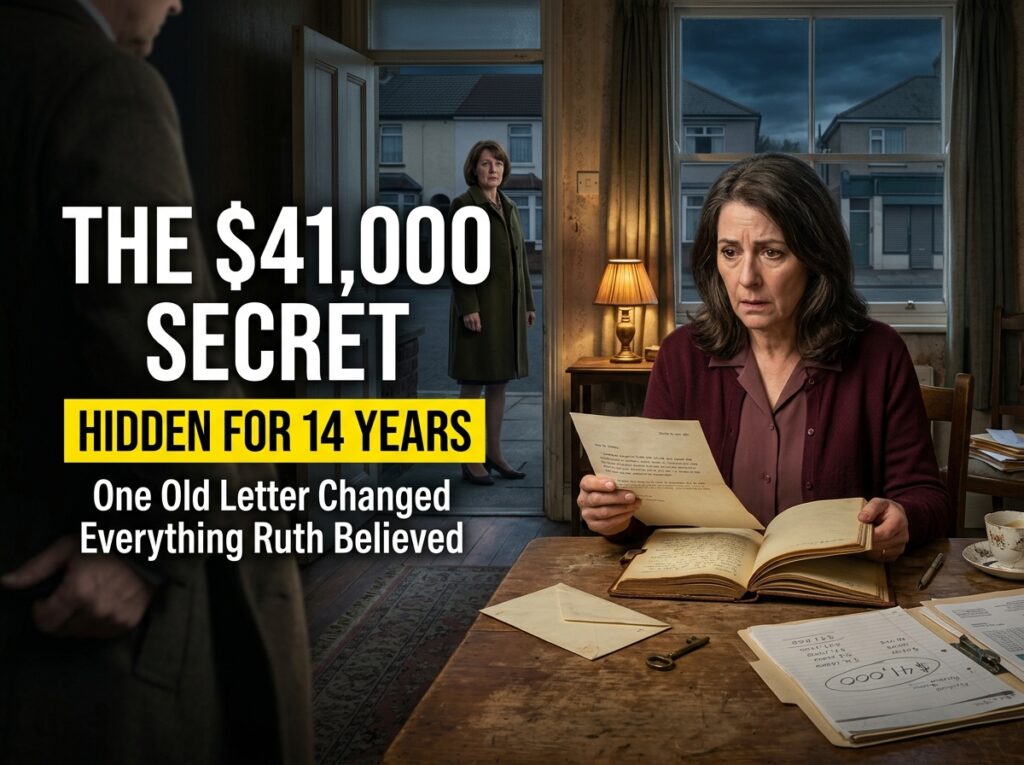
The shops on Bell Street closed one by one as evening settled over the neighborhood.
Ruth stood beside the window of her rented room, watching the last customers hurry toward the bus stop. The bakery downstairs had already switched off its display lights, and the smell of fresh bread lingered in the stairwell. Across the street, Margaret was pulling the curtains in her front room.
At fifty-eight, Ruth had learned that a quiet street did not necessarily mean a peaceful life.
She had rented the room above the bakery for three years. It was not the home she had imagined for herself, but it was affordable, and the landlord rarely complained when her payments arrived a few days late. The small kitchen had barely enough space for one person, and the bedroom window rattled whenever the wind came from the east. Still, she had made the place comfortable.
A framed photograph stood on the windowsill. It showed Ruth several years younger, smiling beside people she had once believed would always be part of her life.
She rarely looked at it anymore.
There were bills to pay, groceries to buy, and relatives who sometimes needed help. Ruth had never been wealthy, but she had managed her money carefully. She knew which shops reduced their prices before closing, which bills could wait a few days, and how to stretch a modest meal across two evenings.
The $41,000 was different.
It was an amount that had haunted the family for fourteen years, although nobody seemed willing to explain precisely what had happened to it.
Some said it had been used to settle an old obligation. Others insisted that the matter had been handled privately. Whenever Ruth asked for the original paperwork, someone changed the subject.
Eventually, she stopped asking.
She told herself that whatever had happened belonged to the past.
That was what everyone wanted her to believe.
Her neighbor Margaret had been particularly firm about it.
They had never been close, but fourteen years earlier, when Ruth was struggling through the most difficult period of her life, Margaret had seemed to know something about the family disagreement. She had watched Ruth with a mixture of suspicion and pity, as though she had already decided what kind of woman Ruth was.
Once, when Ruth returned from a difficult appointment, Margaret had stopped her beside the gate.
“Some people make their own troubles,” she had remarked.
Ruth had stared at her.
“You don’t know anything about my troubles.”
Margaret had tightened her grip on her shopping bag.
“I know enough to understand that the past cannot always be repaired.”
The comment had stayed with Ruth long after the conversation ended.
She had wanted to ask what Margaret knew, but pride stopped her. She would not beg a neighbor for an explanation about a matter her own family refused to discuss.
Now, years later, Margaret still lived across the street. They exchanged brief greetings when necessary, but neither made an effort to begin a conversation.
Ruth had almost forgotten the incident when the knock came.
It was a little after seven.
She opened the door expecting the bakery owner, who occasionally brought upstairs a package delivered to the wrong address.
Instead, she found a man she did not recognize.
He appeared to be in his early sixties. His coat was damp from the evening air, and he held a brown envelope against his chest.
“Are you Ruth?” he asked.
“Yes. Who are you?”
“My name is Arthur Bennett. I used to work with your former colleague, Peter Lawson.”
Ruth frowned.
Peter had worked in the same office as her years earlier. He had been a quiet, dependable man who rarely involved himself in other people’s affairs. They had not spoken for a long time.
“What do you want with me?”
Arthur looked down at the envelope.
“I think Peter wanted you to have this.”
Ruth did not reach for it.
“Why didn’t he bring it himself?”
Arthur hesitated.
“Because he kept it for fourteen years, and I believe he was afraid of what might happen if the truth came out.”
The hallway seemed to grow colder.
“What truth?”
Arthur glanced toward the stairs, then back at her.
“I cannot explain everything here. But the $41,000 your family has been arguing about was not what you were told.”
Ruth gripped the doorframe.
For fourteen years, she had heard that amount mentioned in whispers and arguments. She had believed it was connected to a decision made during the worst year of her life.
She had never expected a stranger to arrive at her door and question the explanation she had accepted.
“Who told you about that money?” she asked.
“Peter.”
“How did Peter know?”
“Because he was there when part of the arrangement was discussed.”
Ruth stared at the envelope.
“Then why did he wait fourteen years?”
Arthur’s expression changed.
“That is one of the questions the letter may help you answer.”
He held the envelope out.
Ruth accepted it, although her fingers had begun to tremble.
Before she could ask another question, Arthur looked past her toward the street.
“Please don’t confront your family until you’ve read everything.”
“Why?”
“Because the person who kept the truth from you may not be the person you suspect.”
Then he walked down the stairs.
Ruth remained in the doorway until she could no longer hear his footsteps.
Inside the envelope was a folded letter and a small key attached to a paper tag.
The tag contained three words.
Look in the notebook.
Ruth stared at the message.
She had no idea which notebook Arthur meant.
But she was beginning to understand that the past she had tried so hard to leave behind had never been as settled as everyone claimed.
Part 2
Ruth locked the door before opening the letter.
She sat at the kitchen table, placed the envelope beneath the lamp, and carefully unfolded the paper inside.
The handwriting was unmistakably Peter’s.
She recognized the narrow letters and the way he crossed his sevens. During their years working together, he had written hundreds of notes in that distinctive hand.
The letter was dated several months earlier.
Dear Ruth,
If you are reading this, it is time to tell the truth.
I have carried something for fourteen years that should never have been mine to carry alone. I believed that staying silent would protect you from another painful confrontation. Instead, my silence allowed people to believe things that were not true.
The $41,000 was discussed as though everyone understood what it meant. They did not. Some people believed the matter had been settled. Others knew that important questions remained unanswered.
I cannot ask you to trust my memory after so many years. Please look at the notebook before you decide what to believe.
There are things I should have explained when we still worked together. I am sorry I waited.
Peter.
Ruth read the letter twice.
It offered no complete explanation of the money, but it confirmed that Peter believed the family’s accepted version of events was incomplete.
She turned the paper over.
Nothing else was written there.
The small key lay beside her cup.
Ruth examined it beneath the light. It was an ordinary brass key, slightly tarnished, with a narrow paper tag attached to its ring. The tag carried a handwritten number: 14.
She could not tell whether the number referred to a drawer, a locker, a storage box, or something else.
She put the key and letter into the envelope and began searching her room.
She owned several notebooks.
One contained her household budget. Another held recipes she had collected over the years. A third contained telephone numbers, addresses, and reminders.
None appeared connected to Peter.
Then she remembered the box in the wardrobe.
It held the belongings she had kept from her former home: photographs, old work documents, birthday cards, and papers she had never been able to throw away.
Ruth dragged the box onto the floor and opened it.
Dust rose into the lamplight.
She removed a stack of folders and found an old notebook beneath them. Its brown cover had faded, and the corners were worn smooth.
She recognized it immediately.
Fourteen years earlier, she had kept records of household expenses and important conversations. During that difficult period, she had written down dates and amounts because she was afraid she would forget details that might later matter.
She had stopped using the notebook when the family disagreement became too painful.
She could not remember why she had packed it away.
Ruth opened the cover.
The first pages contained familiar entries about groceries, electricity bills, and payments for ordinary expenses. The handwriting was hers.
She turned several pages.
Near the middle, she found a reference to the $41,000.
The entry was brief.
Payment discussed. Confirmation still required. Peter has a copy of the correspondence.
Ruth felt her stomach tighten.
She had no memory of writing the sentence.
She checked the date.
It was the same period when the family had argued about the money.
Another entry appeared on the following page.
Do not sign anything until the original documents are returned.
Ruth sat back.
She remembered being under enormous pressure during that year. She had been trying to keep her finances in order while dealing with family responsibilities and a series of painful disagreements.
She remembered people telling her that the arrangement had been completed.
She remembered feeling ashamed that so much money had become a source of conflict.
But she did not remember being warned not to sign anything.
She continued reading.
Several pages contained references to conversations with Peter. Others mentioned a former colleague who had asked questions about the paperwork.
Some entries were incomplete.
One page had been torn out.
Ruth carefully examined the binding. The missing page had been removed deliberately rather than falling out through ordinary wear.
The discovery troubled her more than she expected.
Someone had taken a page from a notebook she had kept for years.
She could not establish who had removed it or when.
She also could not remember what had been written there.
She returned to the letter and examined the key.
The number 14 might refer to the fourteen years that had passed. It might also identify a specific place where Peter had kept the original correspondence.
She decided to call Arthur.
The number was written on the back of the envelope.
When he answered, Ruth asked him about the key.
“Peter asked me to give it to you,” Arthur explained. “He said it belonged with the records he kept from your old workplace.”
“Where are those records?”
“There is a storage cabinet in the office archive. The key may open one of the compartments.”
“Does the cabinet still exist?”
“As far as I know. But you’ll need permission to access the records.”
Ruth looked at the notebook.
“Why didn’t Peter tell me this himself?”
Arthur sighed.
“He was ashamed of waiting so long. He believed that if he explained everything now, people would accuse him of interfering in a family matter.”
“Was he involved in the $41,000 arrangement?”
“He was involved in the paperwork. That is all I can say with confidence.”
Ruth thanked him and ended the call.
She had more questions than answers, but the evidence was beginning to form a pattern.
Her notebook showed that confirmation had been required.
It warned her not to sign anything until the original documents were returned.
Peter’s letter said the $41,000 had never been properly understood.
And the missing page might contain the explanation she needed.
Ruth placed the notebook beside the envelope.
She would have to contact her former workplace and ask whether the old archive was still available.
But first, she wanted to understand why Peter had kept the correspondence for fourteen years.
If the documents proved that the arrangement had been misunderstood, someone might have spent years living with the consequences of a decision that had never been properly explained.
And Ruth feared that the person most affected might have been herself.
Part 3
The following morning, Ruth called her former workplace.
The company had changed its name twice since she had left, and the receptionist needed several minutes to locate the department responsible for archived records.
When Ruth finally explained why she was calling, the woman asked her to hold.
A man answered a few minutes later.
“Mrs. Ruth?” he asked. “My name is Michael Harris. I oversee the records department. What can I do for you?”
Ruth explained that she had received an old key from someone connected to Peter Lawson and wanted to identify the cabinet it belonged to.
Michael asked for the number on the tag.
“Fourteen,” she replied.
There was a pause.
“That may be one of the older storage compartments,” he said. “Some of those records were retained when the company reorganized. Do you have any documents explaining why you need access?”
“I have a letter from Peter and a notebook containing references to correspondence he kept.”
“Can you send copies?”
Ruth agreed.
Michael told her that he would check the archive and call her back.
For the rest of the morning, Ruth tried to continue with her usual responsibilities.
She paid a bill, bought groceries, and collected a prescription for a relative. Yet her thoughts kept returning to the notebook.
The $41,000 had always seemed like an enormous, complicated problem that everyone else understood better than she did.
Now she was beginning to suspect that the family had been arguing over an explanation that nobody had properly verified.
At noon, her phone rang.
Michael had found a cabinet marked with the same number as the tag.
It had not been opened in years.
“We cannot simply release company records,” he explained. “But there are documents that may belong to you personally. If you can establish your connection to them, we can arrange a supervised review.”
Ruth agreed to bring the letter and notebook.
She spent the afternoon gathering the documents she would need.
Before leaving the room, she looked across the street.
Margaret was watering a row of plants outside her house.
Ruth considered approaching her, but decided against it.
She had no reason to believe Margaret knew anything about Peter’s correspondence. The neighbor’s earlier judgment had been painful enough without Ruth turning every person in the neighborhood into a suspect.
Instead, she locked the notebook in her drawer and went to the archive.
The office building looked different from the one Ruth remembered. The entrance had been renovated, the reception area was brighter, and the old wooden desks had been replaced with modern furniture.
Michael met her near the elevators.
He was a careful, serious man who asked to see the documents before taking her to the archive room.
After examining the letter, he nodded.
“Peter’s name appears in our older records. He handled several administrative matters before he left.”
“Did he work on the $41,000 arrangement?”
“I cannot confirm that from this letter alone.”
Ruth appreciated his caution.
Michael led her to a small room containing rows of storage cabinets.
Cabinet fourteen stood at the end of the second row.
The brass key turned with some resistance, but the lock opened.
Inside were several folders and envelopes, all labeled with dates.
Michael removed the items that appeared connected to Ruth’s former employment and placed them on a table.
“We’ll review these together,” he said.
Ruth began with a folder containing old correspondence.
The first few pages were ordinary workplace records.
Then she found a letter addressed to Peter.
It referred to a financial arrangement involving the $41,000 and stated that the final paperwork had not yet been confirmed.
Ruth’s hands began to tremble.
The letter had been written during the same period as the entries in her notebook.
She read it carefully.
It did not establish that anyone had stolen money or deliberately deceived her. It showed that the paperwork had remained incomplete at the time the letter was written.
Another document referred to an outstanding confirmation.
A third listed the names of people who had been consulted.
Ruth recognized her own name.
Beside it was a handwritten note.
Awaiting direct confirmation.
She stared at the words.
“Does this mean I never confirmed the arrangement?” she asked.
Michael examined the page.
“It means this document does not show that confirmation was received. We would need the complete file to establish whether it happened elsewhere.”
Ruth nodded.
She did not want to make the same mistake that had shaped the family disagreement: treating an incomplete record as proof of a complete story.
She continued reviewing the papers.
Near the bottom of the folder, she found a photocopy of a letter written by Peter.
It was addressed to a former colleague named Arthur Bennett.
The letter stated that Ruth had been under pressure during the relevant period and that the family had begun treating the financial arrangement as settled without resolving all the questions attached to it.
Peter had asked Arthur to preserve the correspondence.
He had also written that the original notebook might contain a reference to a missing page.
Ruth looked up.
“Peter knew the page was missing?”
Michael nodded toward the letter.
“That is what it appears to say.”
Ruth read the passage again.
The missing page was not merely an accidental loss.
Peter had known about it.
But the letter did not explain who had removed it or what it contained.
Michael gave her copies of the personal correspondence she was permitted to receive and explained that the remaining company records would need further review.
Ruth thanked him.
She left the building carrying a folder that felt heavier than its contents.
For the first time, she had evidence that the family had treated an unresolved arrangement as settled.
But she still did not know why.
And the reference to the missing notebook page suggested that someone had been aware of the uncertainty long before Peter finally decided to contact her.
Part 4
Ruth spent the next two evenings comparing the documents from the archive with the entries in her notebook.
She created a timeline, placing each letter beside the date it referred to.
The earliest records showed that the financial arrangement had been discussed during a difficult period in her life.
Later documents referred to missing confirmation and questions that remained unresolved.
The family, however, had eventually accepted that the matter was finished.
Ruth could not find the exact point when that change had occurred.
She needed someone who had been present when the original discussions took place.
The obvious person was Margaret.
Ruth disliked the idea of asking her neighbor for help. Margaret had judged her during the hardest year of her life, and Ruth had spent a long time trying not to care about her opinion.
Yet the old notebook contained several references to conversations that had taken place near Margaret’s house.
Ruth crossed the street that evening.
Margaret answered the door with a surprised expression.
“Ruth. Is everything all right?”
“I need to ask you about something that happened fourteen years ago.”
Margaret’s face became serious.
“Come in.”
They sat in the front room.
Ruth placed a copy of the archive letter on the table.
“Do you remember the $41,000 arrangement?”
Margaret looked at the page.
“I remember people arguing about it.”
“Do you remember whether the paperwork was ever completed?”
“I don’t know.”
“Did you know Peter was involved?”
Margaret hesitated.
“I knew he had been asked to help with some of the correspondence.”
“Why didn’t you tell me?”
Margaret looked uncomfortable.
“Because I thought it had already been dealt with.”
Ruth leaned forward.
“That is what everyone keeps saying. But the documents show that confirmation was still outstanding.”
Margaret read the letter again.
“I never saw this.”
“Did you hear anyone say that I had agreed to the arrangement?”
Margaret thought for a moment.
“I remember someone saying that you understood what was happening. I don’t remember who said it.”
“Did you believe them?”
“At the time, yes.”
Ruth felt a familiar ache.
The family had apparently accepted a claim about her understanding without checking whether she had actually confirmed anything.
Margaret continued.
“I remember that year. People were worried about the money, and there were arguments about what should happen next. Your family seemed to believe that if they stopped talking about it, the problem would go away.”
“Did anyone ask me directly?”
Margaret shook her head.
“Not that I remember.”
Ruth looked down at the letter.
She had spent fourteen years wondering why people seemed so certain that she had accepted the arrangement, when she could not remember giving the confirmation they described.
Now she was beginning to see how the misunderstanding might have developed.
Someone had said that she understood.
Others had repeated the statement.
Eventually, the repetition had become more convincing than the missing evidence.
“Do you remember Peter visiting this street?” Ruth asked.
Margaret nodded.
“He came to see someone once. I remember because he looked upset when he left.”
“Did he speak to you?”
“Briefly. He asked whether I knew where your family was keeping some documents.”
Ruth sat up.
“What did you tell him?”
“I told him I didn’t know.”
“Did he say what the documents were?”
“He mentioned correspondence about the financial arrangement. He seemed concerned that people were making decisions without looking at the original papers.”
Ruth felt her pulse quicken.
“Did he find them?”
“I don’t know.”
Margaret folded her hands.
“I should tell you something else. At the time, I believed you had made a decision that hurt the family. I heard people talking about the $41,000, and I assumed they knew what they were saying.”
“But you never asked me.”
“No.”
“Why?”
Margaret looked away.
“Because I thought asking would make me part of the disagreement. I wanted to stay out of it.”
Ruth let out a slow breath.
Margaret’s silence had helped the family’s assumptions survive, but it had not necessarily been deliberate deception.
She had chosen not to get involved, and in doing so, she had allowed a version of events to stand without checking it.
“Do you still believe I was responsible for what happened?” Ruth asked.
Margaret looked directly at her.
“I don’t know enough to say that you were responsible for anything. I should never have judged you as though I did.”
It was not the apology Ruth had once imagined receiving.
It was quieter and more honest.
She thanked Margaret and returned to her room.
That night, she found another entry in the notebook.
It was written near the date of Peter’s visit.
Peter says the original letter must be found. Without it, people will keep believing the wrong thing.
Ruth stared at the sentence.
The original letter.
Peter had not merely preserved a copy of the correspondence. He had been searching for a document he believed was essential to correcting the misunderstanding.
And someone had apparently known that its absence was allowing the wrong story to continue.
Ruth looked again at the missing page in her notebook.
She had no proof that the page contained the original letter’s location.
But the timing made the possibility difficult to ignore.
If she could discover who had removed the page, she might finally understand why the truth had remained hidden for so long.
Part 5
Ruth called Arthur the following morning.
She told him what she had learned from the archive and asked whether Peter had ever explained the missing page.
Arthur was quiet for several seconds.
“He told me that he believed someone had removed it because the page referred to a conversation nobody wanted to revisit.”
“Did he know who removed it?”
“No. He had a suspicion, but he never gave me a name he could prove.”
“What did the page contain?”
“He thought it referred to the original letter and the person who had been responsible for keeping it.”
Ruth closed her eyes.
The original letter was becoming the center of everything.
It might explain why the $41,000 had been treated as settled even though the surviving records showed that confirmation was still outstanding.
But without it, Ruth could not establish what had actually been agreed.
“Did Peter ever find the letter?” she asked.
“I don’t believe he did.”
“Then why did he keep the correspondence for fourteen years?”
Arthur sighed.
“Because he thought someone would eventually ask the right questions. He also felt guilty about not speaking sooner.”
Ruth understood that feeling better than she wanted to admit.
She had remained silent because she was afraid of being judged. Peter had remained silent because he feared causing another confrontation. Margaret had stayed out of the disagreement because she believed it was safer not to interfere.
Their reasons were different, but the result had been the same.
The truth had become harder to find.
Arthur gave Ruth the name of a former office administrator who might remember how the original papers had been handled.
Her name was Helen Carter.
Ruth recognized the name from the old company directory. Helen had worked in the records office during the period when the financial arrangement was being discussed.
Ruth contacted her through a public business directory and explained that she was trying to locate old correspondence.
Helen agreed to speak with her.
They met at a café near the former office.
Helen was in her sixties, with short gray hair and a careful manner. She listened while Ruth explained the situation, then asked to see the copies of the documents.
After reading them, she nodded slowly.
“I remember this file.”
Ruth leaned forward.
“Do you remember the original letter?”
“I remember that there was a letter requesting confirmation of the arrangement. I also remember that people disagreed about whether the paperwork was complete.”
“Was the confirmation ever received?”
Helen looked at the documents.
“I cannot say for certain. I remember searching for it because Peter asked me to check the file.”
“What did you find?”
“A copy of the request, but not the signed confirmation.”
Ruth felt a chill.
“Did Peter know?”
“Yes. He was concerned that the absence of the confirmation would be misunderstood.”
“Why didn’t he tell me?”
Helen gave a sad smile.
“I think he was afraid that people would accuse him of taking sides.”
“Was he taking sides?”
“Not as I understood it. He wanted the documents to be complete. He believed that everyone deserved to know what had actually been agreed.”
Ruth looked at the notebook.
“Do you remember a missing page?”
Helen nodded.
“Peter once asked whether a page had been removed from a handwritten record. He thought it might have contained a reference to the original letter.”
“Did you find it?”
“No.”
Helen explained that the office had been reorganized several times. Some records were transferred, others were stored separately, and a few personal documents had been returned to former employees.
She could not establish whether the original letter had been lost during those changes or removed before the records were archived.
Ruth thanked her for being careful about what she remembered.
Before they parted, Helen gave Ruth a copy of an old inventory.
It listed the documents that had been stored in the archive and included a reference to a sealed envelope that had not been accounted for.
The date matched the period when the financial arrangement was discussed.
Ruth stared at the inventory.
“Could that be the original letter?”
“It is possible,” Helen said. “But the description is too vague to establish that.”
“Where was the envelope stored?”
“The inventory says it was transferred with a group of personal papers. I don’t know where those papers went afterward.”
Ruth felt both hope and frustration.
The missing envelope might contain the answer.
But the records offered no clear explanation of who had received it.
She returned home and placed the inventory beside Peter’s letter.
For the first time, she had a specific lead.
The original correspondence had existed, and the office had recorded an envelope that was later unaccounted for.
Someone might still have it.
And if the envelope contained the missing confirmation—or evidence that no confirmation had ever been received—Ruth might finally be able to separate what had happened from what everyone had merely believed.
Part 6
The inventory led Ruth to a name she had not considered before.
The personal papers had been transferred to an employee named Samuel Reed, who had managed the office during the final months of the old arrangement.
Ruth remembered Samuel as a reserved man who preferred to stay behind his desk rather than become involved in workplace disagreements. He had left the company several years later.
She searched through her old address book but found no current contact details.
For a while, she considered giving up.
The documents she had already found explained much of the misunderstanding. They showed that the $41,000 arrangement had been discussed without a complete record of final confirmation.
Perhaps the original letter had been lost.
Perhaps the decision had been completed through another process that the surviving documents did not capture.
She could not rule out either possibility.
But the inventory suggested that someone had taken responsibility for the personal papers.
If those papers still existed, they might answer the questions that had followed her for fourteen years.
Ruth contacted Helen Carter again.
Helen remembered that Samuel had retired to a nearby town. She did not have his address, but she recalled that he had occasionally attended reunions organized by former employees.
Ruth asked whether she could help make contact.
Helen agreed to pass along a message.
Two days later, Samuel called.
“I understand you’re looking for an old envelope,” he said.
Ruth sat down.
“Yes. It may have contained correspondence about a financial arrangement involving $41,000.”
Samuel was silent.
“I remember the file,” he finally said.
“Do you remember the envelope?”
“I remember taking some personal papers home when the office was reorganized. I was supposed to return them, but I cannot remember whether I returned everything.”
Ruth felt her heart beating faster.
“Do you still have the papers?”
“I have several boxes in storage. I can look, but I can’t promise anything.”
She thanked him and waited.
For the next three days, Ruth tried not to think about the search.
She paid her bills, cleaned the room, and visited the bakery downstairs to help Mr. Ellis carry a delivery into the storeroom.
Yet every time her phone rang, she wondered whether Samuel had found the envelope.
On Friday afternoon, he called again.
“I found something that might be what you’re looking for.”
Ruth gripped the phone.
“What is it?”
“An old envelope containing correspondence and a handwritten note. I haven’t examined everything, but the dates appear to match.”
“Can I see it?”
“Yes. But I want you to understand that the papers are old, and I cannot guarantee that they are complete.”
Ruth agreed to meet him the following morning.
Samuel lived in a quiet residential area outside town. He welcomed her into a small study and placed a cardboard box on the desk.
Inside were old office records, personal letters, and several envelopes tied together with string.
Samuel carefully removed one envelope.
Its paper was yellowed, and the flap had been opened and resealed.
Ruth recognized the handwriting on the front.
It was hers.
Her name had been written in the same narrow script she had used fourteen years earlier.
For several seconds, she could not speak.
“Do you remember writing it?” Samuel asked.
“No.”
He handed it to her.
Inside were two pages.
The first was a letter Ruth had written during the difficult year. It described her understanding of the financial arrangement and asked for clarification about the outstanding confirmation.
The second page was a handwritten response.
Ruth read the first letter slowly.
She had not been certain what she was agreeing to. She had asked for the original paperwork to be returned and for the final conditions to be explained before she signed anything.
The wording matched the warning in her notebook.
She turned to the response.
The writer acknowledged her questions and stated that the arrangement should remain unresolved until the necessary documents had been reviewed.
There was no signed confirmation from Ruth.
There was no statement that she had accepted the final terms.
Ruth looked up.
“This means I never confirmed the arrangement.”
Samuel considered his answer.
“It means these papers do not show that you did. I cannot say whether another document exists elsewhere.”
Ruth nodded.
She had learned to be careful with conclusions.
The envelope did not prove what had happened to every dollar. It did not identify anyone as responsible for the missing confirmation.
But it showed that she had asked for clarification and that the arrangement was still being treated as unresolved in the surviving correspondence.
“Why wasn’t this sent to me?” she asked.
Samuel looked troubled.
“I don’t know. I believe it was placed with the records because someone wanted it preserved. I should have checked whether it was returned to you.”
Ruth studied the envelope.
“Did anyone ask you to keep it?”
“I remember being told that the papers should remain together until the matter was settled. I cannot remember who gave the instruction.”
“Was it Peter?”
“I don’t know.”
Samuel offered to let Ruth make copies.
She photographed both pages and recorded the dates and the envelope’s condition. She did not take the original documents without his permission.
Before she left, Samuel gave her one more paper.
It was a small inventory note written in a different hand.
The note referred to a conversation about a missing notebook page.
Ruth felt her breath catch.
The note said that the page had been removed before the papers were transferred.
No name was recorded.
But the date was significant.
It was several weeks after Ruth had written the warning in her notebook and before the family began treating the arrangement as settled.
Someone had removed the page while the original correspondence was still being handled.
Ruth returned to her room with copies of the documents and a new understanding of what the evidence could establish.
She had not simply forgotten an agreement she had made.
The surviving correspondence showed that she had asked for clarification and that the matter had still been unresolved.
But the person who removed the notebook page remained unknown.
And without knowing why it had been removed, Ruth could not understand how the family had become so certain that the arrangement was finished.
Part 7
Ruth laid the new documents across her table and compared them with the old notebook.
The dates aligned.
The notebook recorded her concern about signing anything before the original papers were returned.
The letter showed that she had asked for clarification.
The response acknowledged that the arrangement should remain unresolved until the relevant documents had been reviewed.
And the inventory note established that a page had been removed from her notebook before the papers were transferred.
Ruth could now see how the misunderstanding might have developed.
Someone had seen the financial arrangement discussed and assumed that the necessary decisions had been made.
Others had repeated that assumption.
When the original confirmation could not be found, the absence of the document was treated as an administrative problem rather than a reason to reconsider the story.
But one question remained.
Who had removed the page?
Ruth considered the people who had handled the records.
Peter had preserved correspondence.
Samuel had stored the personal papers.
Helen Carter had maintained the office archive.
Margaret had heard the family discussing the arrangement.
And several relatives had been involved in the original financial conversations.
Any one of them might have known something about the missing page.
But knowing that a page had been removed did not prove that anyone had deliberately tried to conceal the truth.
Ruth needed to find out what the page contained before deciding what its disappearance meant.
She called Peter’s former colleague, Arthur.
“I found the original correspondence,” she explained. “It shows that I asked for clarification before confirming the arrangement.”
Arthur was quiet.
“Then Peter was right to keep the papers.”
“He was right to preserve them. But he waited fourteen years to tell me.”
“I know. He regretted that.”
“Did he ever tell you why he believed the missing page mattered?”
Arthur took a breath.
“He thought it might contain the name of the person who was supposed to return the original letter to you.”
Ruth looked at the inventory note.
“Did he know who that person was?”
“He suspected someone had taken responsibility for delivering the papers, but he never found proof.”
Ruth thanked him and ended the call.
Later that afternoon, Daniel arrived.
Ruth had not told him about the new documents yet. She wanted to understand what he remembered before showing him the evidence.
“Do you remember the year everyone argued about the $41,000?” she asked.
Daniel nodded.
“I remember that people were worried. I thought the money had been accounted for.”
“Who told you that?”
“I cannot remember exactly. Several people seemed to believe it.”
“Did you ever see a signed confirmation from me?”
Daniel frowned.
“No. I assumed it existed because everyone said the arrangement was complete.”
Ruth showed him the copy of her letter.
He read it carefully.
Then she showed him the response.
Daniel’s expression changed.
“I’ve never seen this before.”
“The correspondence shows that I asked for clarification. It doesn’t show that I confirmed the final arrangement.”
Daniel sat down.
“Then we may have misunderstood what happened.”
“Yes.”
He looked at the documents again.
“Why didn’t anyone check?”
“Because everyone believed someone else had checked.”
Daniel shook his head.
“I repeated what I was told. I thought I was helping to end the arguments.”
“I know. But I lived with the consequences.”
He lowered his eyes.
“I’m sorry.”
Ruth believed that he meant it.
She was no longer interested in forcing him to admit something the evidence could not establish. She wanted him to acknowledge that the family’s confidence had exceeded its knowledge.
Daniel asked whether the missing page might have contained the confirmation.
“It might have contained a reference to the letter,” Ruth said. “We don’t know what was written on it.”
“Could someone have removed it because it contradicted what they believed?”
“Possibly. But we have no proof of that.”
Daniel nodded slowly.
For once, neither of them tried to make the mystery simpler than it was.
They reviewed the dates together and created a list of questions that remained unanswered.
Who had been responsible for delivering the original correspondence?
Why had the notebook page been removed?
Had the financial arrangement been completed through another process?
And why had the family accepted that it was settled without locating the final confirmation?
They agreed that any further investigation should focus on those questions rather than on blaming individuals.
Before Daniel left, Ruth showed him the letter from Peter.
He read the final sentence.
I am sorry I waited.
Daniel stared at it.
“Perhaps he was afraid of what the truth would do to the family.”
“Perhaps,” Ruth replied. “But keeping silent did not protect us.”
After he left, Ruth returned to the notebook.
She examined the binding again, looking for signs that might reveal when the page had been removed.
The paper near the missing section was worn, but there was no reliable way to establish who had taken it.
She was about to close the book when she noticed faint writing on the inside of the back cover.
The marks were almost invisible beneath the faded brown surface.
Ruth tilted the notebook toward the lamp.
Slowly, the words became clearer.
They appeared to be the beginning of a name.
The rest had been obscured by a dark stain.
Ruth stared at the faint letters.
They were not enough to identify a person with confidence.
But the name began with the same initial as someone who had been responsible for handling the family’s documents.
She took a photograph and placed the notebook carefully back on the table.
For the first time, she had a possible lead connected directly to the missing page.
But she also knew that a partial name was not proof.
Before she confronted anyone, she needed to determine whether the handwriting could be identified.
And she needed to ask Peter one final question: had he ever seen the original notebook before the page disappeared?
Part 8
Peter did not answer his phone when Ruth called the following morning.
She tried again after lunch, then left a message explaining that she had found the original correspondence and wanted to ask about the missing notebook page.
He returned her call that evening.
“I was hoping you would find those papers,” he said.
“Why didn’t you tell me about the letter sooner?”
Peter sighed.
“I thought I was protecting you from another argument. I believed that if I waited until I had the complete file, I could explain everything clearly.”
“But you never found the complete file.”
“No.”
“And while you waited, everyone continued believing that I had accepted an arrangement I had never confirmed.”
“I know.”
His answer carried no defense.
Ruth sat beside the window, watching the lights appear across the street.
“Did you ever see my notebook before the page was removed?”
“Yes,” Peter said. “I saw it when you brought some of the records to the office. You wanted help understanding the correspondence.”
“Do you remember the page?”
“I remember that you had written a note about the original letter. I cannot recall the exact wording.”
“Did you remove it?”
“No.”
The answer came quickly.
Ruth waited.
Peter continued.
“I remember asking someone to keep the notebook with the other documents. I thought it was important that everything remain together. When I saw it again, the page was missing.”
“Who had access to it?”
“Several people. I cannot say who removed it.”
Ruth felt disappointed, but not surprised.
The evidence still did not establish who had taken the page.
“Did you ever suspect anyone?”
“I had suspicions, but I never found proof. I don’t want you to make the same mistake the family made by treating a suspicion as a fact.”
Ruth looked at the faint writing on the back cover.
She understood his warning.
For years, people had filled gaps in the story with their own interpretations. She would not allow the same thing to happen simply because she was the person asking questions now.
“Peter, why did you keep the letter for fourteen years?”
He was quiet for a long time.
“Because I was afraid that telling you would force everyone to admit that the matter had never been properly resolved. I thought that would create another painful confrontation. I also worried that people would blame me for not speaking sooner.”
“And now?”
“Now I realize that my silence allowed the misunderstanding to continue.”
Ruth thanked him for being honest.
They agreed to meet the following week and review the surviving documents together.
After the call, Ruth placed the phone on the table.
She felt no sudden relief.
The mystery had not been solved, and she still did not know what had happened to the $41,000.
But the evidence had changed the question she was asking.
She was no longer trying to discover which person had betrayed her.
She was trying to establish how an incomplete financial arrangement had become a settled family story—and why the missing documents had never been recovered.
The following afternoon, Margaret came to Ruth’s door.
She carried a small photograph.
“I found this while clearing a drawer,” she explained. “I thought it might be relevant.”
Ruth took the photograph.
It showed several people standing outside the former office building. She recognized Peter and two former colleagues. In the background, a woman was holding a folder.
Ruth enlarged the image on her phone.
The woman appeared to be carrying the same type of notebook Ruth had found in her wardrobe.
“Do you know when this was taken?” Ruth asked.
“Fourteen years ago, I think. I found it among some papers I had kept from that time.”
“Who is the woman?”
Margaret studied the photograph.
“I believe her name was Caroline. She worked with Peter for a while.”
Ruth recognized the name from the old company directory.
Caroline had been responsible for organizing files during the office’s reorganization.
“Do you know where she is now?”
“I haven’t spoken to her in years.”
Ruth examined the photograph again.
It did not prove that Caroline had removed the missing page. She might simply have been carrying a notebook that belonged to someone else.
But it provided a new person to contact.
Ruth searched her old address book and found Caroline’s former telephone number. It was disconnected.
She tried a public professional directory and eventually located a current business contact.
She sent a brief message explaining that she was researching an old set of records and wanted to ask about the office archive.
Caroline replied the next morning.
She remembered Ruth and agreed to speak with her.
They arranged a telephone conversation for that evening.
Caroline confirmed that she had helped transfer records when the office was reorganized. She also remembered Peter’s concern about the missing correspondence.
“I remember a notebook being discussed,” she said. “But I cannot say whether it was yours.”
“Do you remember the original letter?”
“I remember a sealed envelope that someone was supposed to return to the person who had written it.”
“Was it returned?”
“I don’t know. I was not responsible for delivering it.”
Ruth asked whether Caroline had ever handled the notebook.
“I may have. We moved dozens of files, and several personal papers were mixed in with the office records. I cannot remember every item.”
Ruth thanked her for being careful about what she could recall.
Before ending the call, Caroline added something that made Ruth pause.
“Peter once said that the most important thing was not the missing money. It was that someone had been allowed to believe they had agreed to something they never fully understood.”
Ruth closed her eyes.
That was exactly what the surviving documents suggested.
The amount of money had become the center of the family’s arguments, but the underlying problem was the absence of clear agreement.
Caroline could not identify the person responsible for the missing page.
She could not establish whether the original confirmation had ever been signed.
But her recollection supported Peter’s concern that the family’s version of events had become more certain than the evidence justified.
After the call, Ruth sat quietly with the photograph in her hands.
The stranger who had arrived at her door had promised proof that the past had never left her.
She now had letters, receipts, a notebook, and an archive inventory.
Together, they showed that important questions had remained unresolved.
But the final explanation was still missing.
And the closer Ruth came to understanding the truth, the more she realized that the family had not simply lost a document.
It had lost the habit of asking whether its own story was correct.
Part 9
Ruth met Peter at a quiet café near the old office building.
He looked older than she remembered, and his hands trembled slightly as he placed his folder on the table.
“I’m glad you agreed to meet,” she said.
“I should have done this years ago.”
Ruth opened the folder.
They reviewed the letters, the inventory, and the copies of the financial records. Peter explained which documents he remembered handling and which details he could no longer recall.
He confirmed that he had never seen a signed final confirmation from Ruth.
He also admitted that he had assumed someone else had verified the arrangement because several relatives had spoken as though it was complete.
“That was my mistake,” he said. “I should have checked the original records instead of trusting what people said.”
Ruth listened.
She had spent years wanting someone to admit that the story she had been given did not make sense. Now that Peter was acknowledging the uncertainty, she felt sadness more than anger.
“Did you know the money had been transferred?” she asked.
“I knew that the amount had been discussed and that financial transactions had taken place. But I never had a complete record showing how every part of the arrangement was finalized.”
“Then how did everyone become so certain that the matter was settled?”
“Because the arguments stopped. People took that as a sign that the problem had been resolved.”
Ruth looked at the papers.
The explanation was painfully simple.
The family had wanted an ending.
The paperwork had offered none.
Rather than continue living with uncertainty, everyone had accepted the most convenient conclusion.
Peter had done the same thing.
He had believed that the matter would eventually be corrected, and he had waited for someone else to reopen it.
“I was afraid that if I told you what I knew, the family would accuse me of interfering,” he said. “I also knew that I had waited too long. The longer I remained silent, the harder it became to explain why I had said nothing.”
Ruth nodded.
“I understand why you were afraid. But I needed the truth more than I needed everyone to be comfortable.”
Peter lowered his eyes.
“I know that now.”
They continued reviewing the documents.
The evidence supported a clear conclusion about one important point: the surviving records did not establish that Ruth had confirmed the final arrangement.
The original letter showed that she had requested clarification.
The response indicated that the arrangement should remain unresolved until the necessary documents were reviewed.
The archive inventory showed that an envelope had later become unaccounted for.
And the notebook contained a warning that she should not sign anything until the original papers were returned.
But the records did not prove what had happened to every dollar, nor did they establish that any particular person had deliberately concealed the truth.
Ruth decided that this distinction needed to be made clear to the family.
She would not allow the discovery to become another accusation based on incomplete evidence.
That evening, she invited Daniel, Helen, and Margaret to meet her.
She explained that she had found the original correspondence and that it changed the way the family needed to understand the old arrangement.
Daniel read the letters carefully.
Helen examined the dates.
Margaret listened while Ruth explained how the missing confirmation had contributed to the misunderstanding.
Nobody argued.
For the first time, the family discussed the $41,000 without treating one person’s memory as the final answer.
They agreed that the financial records needed to be preserved and, if necessary, reviewed by an appropriate financial or legal professional to determine whether any unresolved obligations remained.
They also agreed that the documents did not justify accusing anyone of theft or deliberate deception.
That decision mattered to Ruth.
She had wanted answers, but she did not want the search for truth to create another cycle of blame.
After the meeting, Daniel stayed behind.
“I used to think that keeping quiet was the same as protecting the family,” he said.
Ruth looked at him.
“Sometimes silence protects people. Sometimes it protects a misunderstanding.”
Daniel nodded.
“I wish I had asked more questions.”
“So do I.”
They sat together for a while.
Ruth felt that their relationship had changed. Daniel no longer seemed determined to defend the old explanation, and she no longer felt that she had to convince him that her memories mattered.
The past was still painful.
But they were finally looking at it together.
Before leaving, Daniel asked whether Ruth had discovered who removed the notebook page.
“No,” she replied. “And I won’t accuse anyone without evidence.”
“Do you think we’ll ever know?”
“I don’t know.”
He looked at the documents.
“After all these years, that seems strange.”
Ruth gave a small, tired smile.
“It is strange. But not knowing everything doesn’t mean we have to keep pretending we do.”
After Daniel left, Ruth placed the papers in a secure folder.
The $41,000 remained incompletely explained.
The missing page had not been recovered.
And the identity of the person who removed it remained uncertain.
Yet Ruth finally understood the most important part of the story.
The family had treated an unresolved arrangement as though it had been confirmed. She had been left to carry the consequences of a decision that the surviving documents did not show she had accepted.
The truth was not a dramatic accusation.
It was a correction.
And for Ruth, that correction was enough to begin rebuilding a life that had been shaped for fourteen years by a misunderstanding.
Part 10
The street was quiet when Ruth returned to her room that evening.
The shops had closed, the bakery downstairs had switched off its lights, and the last bus had passed the corner. Across the street, Margaret’s curtains glowed softly in the darkness.
For years, Ruth had associated that quiet street with the judgment she had never been able to escape.
Now she saw it differently.
The street had not changed. The houses were the same, the shops opened and closed at the same hours, and the people continued their ordinary routines.
What had changed was Ruth’s understanding of the past.
She sat at her table and opened the folder containing the documents she had collected.
The notebook lay on top.
Its cover was worn, and several pages had become fragile with age. She turned to the entry that mentioned the $41,000.
For fourteen years, that amount had represented an unresolved argument, a painful memory, and a question nobody seemed willing to answer.
Now she understood that the amount alone had never explained the disagreement.
The surviving correspondence showed that she had requested clarification before confirming the arrangement. The response acknowledged that further review was needed. The final confirmation was missing from the records she had found.
Those facts did not establish what had happened to every dollar.
They did not prove that anyone had deliberately deceived her.
But they did show that the family’s certainty had been misplaced.
The arrangement had been treated as settled even though the available documents did not establish that Ruth had accepted its final terms.
She had spent years believing that she was responsible for a decision she could not remember making.
That belief had shaped how she saw herself and how she understood the people around her.
She had felt ashamed of needing help. She had assumed that her family had grown tired of her problems. She had accepted Margaret’s judgment because she thought other people must know something she did not.
Now she could finally separate those assumptions from the evidence.
Her sister Helen had made payments because she wanted to help.
Peter had preserved correspondence because he believed the arrangement had been misunderstood.
Margaret had accepted an explanation without checking whether it was correct.
Daniel had repeated what he had been told because he believed the matter had been resolved.
Each person had made choices that affected Ruth.
Some had acted out of kindness. Others had acted out of fear, embarrassment, or a desire to avoid another argument.
Their intentions did not erase the consequences.
But understanding those intentions allowed Ruth to stop treating the past as a simple story of betrayal.
She could acknowledge the harm without inventing a villain.
She could ask questions without turning every uncertainty into an accusation.
And she could recognize that an apology, while important, did not automatically restore fourteen lost years.
The next morning, Ruth visited Helen.
Her sister welcomed her into the kitchen and placed two cups of tea on the table.
For a few minutes, they spoke about ordinary things.
Then Helen asked, “Do you feel better now that you know more?”
Ruth considered the question.
“I feel different,” she replied. “I don’t think I have every answer. But I no longer believe the explanation I was given was complete.”
Helen nodded.
“I wish I had spoken sooner.”
“So do I.”
Ruth reached across the table and took her sister’s hand.
“I don’t want us to spend the rest of our lives regretting the years we lost. I want us to be honest with each other from now on.”
Helen’s eyes filled with tears.
“I can do that.”
They agreed to meet more often.
They would not pretend that the past had never happened, and they would not force themselves to resolve every painful memory in a single conversation.
Instead, they would rebuild their relationship through ordinary acts of trust: a telephone call, a shared meal, an honest answer when something was difficult to discuss.
When Ruth returned to Bell Street, Margaret was waiting outside her house.
“I wanted to ask how you’re doing,” she said.
Ruth stopped beside the gate.
“I’m managing.”
Margaret looked nervous.
“I know I cannot undo the way I judged you. I believed I understood what happened, but I didn’t have the whole story.”
Ruth studied her neighbor.
For years, she had imagined that she would feel satisfied when Margaret admitted she had been wrong.
Instead, she felt a quiet sadness for the time they had spent treating each other as strangers.
“I cannot promise that things will be the same between us,” Ruth said. “But I don’t want us to continue living with an assumption that neither of us ever properly questioned.”
Margaret nodded.
“That’s fair.”
They said goodbye without making promises they could not keep.
Ruth returned upstairs and opened the window.
The smell of fresh bread drifted into the room.
For the first time in years, she did not feel the need to look across the street to see whether Margaret was watching.
She had stopped measuring herself through someone else’s judgment.
That afternoon, Arthur sent a brief message asking whether the letter had helped.
Ruth thanked him and explained that the correspondence had clarified part of the mystery but had not resolved every question about the financial arrangement.
She also thanked him for bringing Peter’s letter to her.
Without that visit, she might never have reopened the notebook.
Peter called a few days later.
He apologized again for waiting so long.
Ruth told him that she appreciated his honesty, but she also hoped he understood how much his silence had cost her.
“I do,” he said. “I cannot change the past, but I can make sure I don’t repeat the same mistake.”
That was all Ruth needed to hear.
She did not ask him to defend himself further.
Instead, she told him that the documents would be preserved and that any remaining financial questions would be reviewed properly rather than settled through assumptions.
Peter agreed.
The notebook returned to its place in the drawer beside Ruth’s bed.
She kept the letters and copies of the correspondence in a separate folder, along with a written timeline explaining what had been confirmed and what remained uncertain.
She did not keep the records because she wanted to relive the disagreement.
She kept them because the truth deserved to be preserved accurately.
A week later, Ruth sat by the window with a cup of tea and watched the shops close for the evening.
The street was quiet again.
The bakery’s lights dimmed, and a shopkeeper across the road pulled down a metal shutter. Somewhere nearby, a radio played softly behind a closed window.
Ruth thought about the stranger who had arrived with an envelope.
She thought about Peter’s letter, the notebook, the missing page, and the $41,000 that had shaped so much of her life.
The mystery had not ended with a dramatic confession.
There had been no single person who could explain every detail, no recovered page that revealed every hidden decision, and no document that resolved every financial question.
Instead, the truth had emerged through fragments.
A letter showed that Ruth had requested clarification.
An archive record showed that the original correspondence had not been fully accounted for.
A notebook preserved the warning she had once written to herself.
Together, those records revealed that the family had treated an unresolved arrangement as settled without having the evidence to support that conclusion.
It was less dramatic than the story Ruth had feared.
It was also more useful.
She no longer needed to blame herself for agreeing to something the surviving documents did not show she had confirmed.
She no longer needed to assume that everyone who had remained silent had deliberately betrayed her.
And she no longer needed to wait for someone else to decide whether she deserved an explanation.
At fifty-eight, Ruth had spent enough years carrying questions that other people refused to discuss.
She could not recover those years, but she could choose what she did with the ones ahead.
She could speak openly with Helen.
She could ask Daniel to verify information rather than repeat what he had heard.
She could accept Margaret’s apology without pretending that the old judgment had never hurt.
And she could leave the unresolved financial details to a proper review instead of allowing them to become another source of family accusation.
As the evening grew darker, Ruth closed the folder and placed it in the drawer.
The notebook had once seemed like a collection of old expenses and forgotten promises.
Now it represented something more important.
It reminded her that the past could be misunderstood, that silence could allow an incomplete story to become accepted truth, and that asking questions was not an act of disloyalty.
Sometimes, it was the only way to protect the people we loved from living with a mistake for the rest of their lives.
Ruth turned off the lamp.
The room above the bakery was still small. Her bills still needed paying, and her responsibilities had not disappeared.
But the burden she carried was no longer the same.
She did not have every answer.
She had something better than the false certainty she had lived with for fourteen years.
She had evidence, an honest understanding of what remained unknown, and the freedom to stop blaming herself for a story that had never been properly explained.
Outside, the quiet street settled into darkness.
Ruth went to bed knowing that the past would always be part of her life.
It no longer had to determine what happened next.