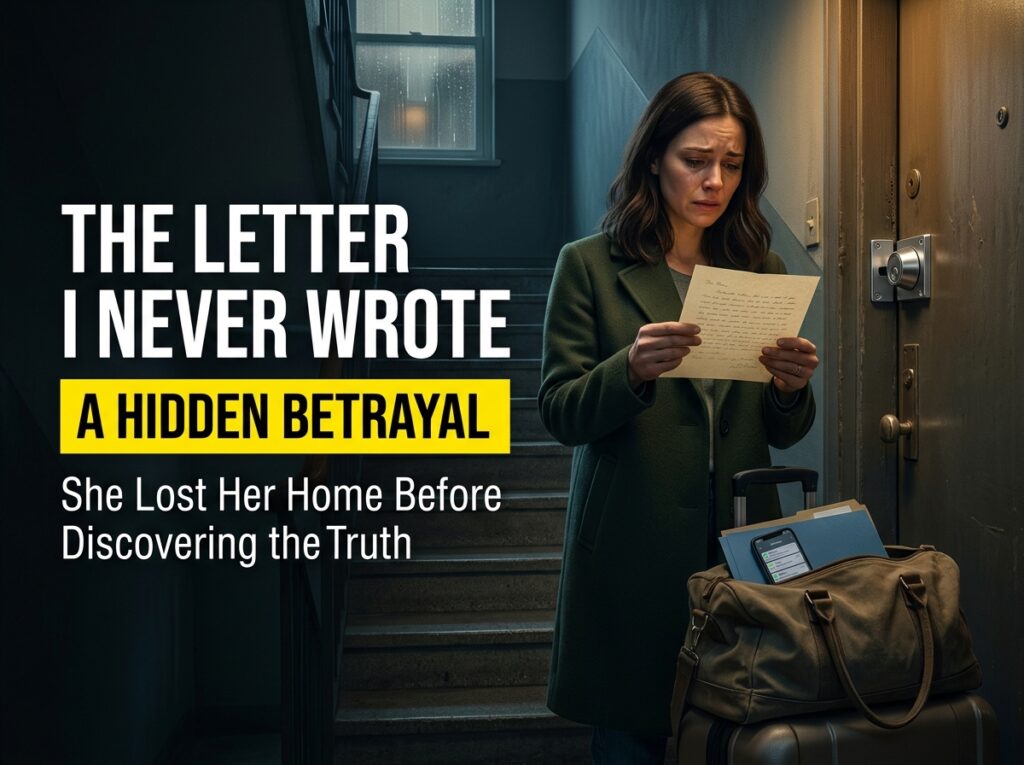
The first thing I noticed was the lock.
It was new, bright silver against the old brown door, and it looked so ordinary that I almost convinced myself I had made a mistake.
I tried my key.
It wouldn’t turn.
I pulled it out, checked the number beside the door, and tried again. Apartment 3B. The apartment where I had lived for five years. The apartment where Daniel and I had celebrated birthdays, argued about money, made up over late-night dinners, and planned a future that suddenly seemed to have belonged to someone else.
I tried the key a third time.
Nothing.
My grocery bag slipped against my wrist. Inside were eggs, bread, and a small carton of milk. I had bought them with the last money I could comfortably spend before payday.
I stood in the dim stairwell, staring at the door.
Then I called Daniel.
His phone rang six times before voicemail answered.
“Daniel, it’s me. The lock has been changed. Please call me.”
I waited, listening to the silence.
Five minutes later, I called again.
He rejected the call.
I sent a message.
I’m outside our apartment. What’s happening?
The reply arrived almost immediately.
I’m sorry, Jade. You need to stay somewhere else tonight.
I read it twice.
Somewhere else?
I typed a response, erased it, and tried again.
What do you mean? Where am I supposed to go?
This time, he didn’t answer.
I had known we were struggling. I wasn’t blind to the overdue electricity notice on the kitchen counter or the way Daniel had started checking his phone whenever I mentioned our savings. I knew his business idea had failed, and I knew he had been borrowing money to cover expenses.
But I also knew I had been sending my share of the rent every month.
Or at least, I believed I had.
Daniel had offered to handle the household payments because he said keeping everything in one place would make budgeting easier. I had agreed. I worked long shifts at a medical reception desk, and I was tired of calculating every grocery purchase while trying to keep our relationship from becoming another thing we couldn’t afford.
“Let me handle it,” he had told me. “You have enough to worry about.”
I had kissed him and thanked him.
Now I wondered how many times he had looked me in the eye while knowing something I didn’t.
A door opened behind me.
Mrs. Alvarez, our neighbor, stepped into the hallway.
“Oh, Jade.”
Her expression told me she already knew.
“Have you seen Daniel?” I asked.
She hesitated. “The building manager was here this afternoon.”
“Why?”
She looked at the new lock.
“They said the rent hadn’t been paid for months.”
My fingers tightened around the grocery bag.
“That’s impossible. I’ve been transferring money.”
“I don’t know the details, sweetheart. I’m sorry.”
I called the building manager.
After checking the records, he explained that several rent payments had been missed. Notices had been sent to the email address associated with our account, which Daniel had managed.
I felt as though the stairs had shifted beneath me.
“How long?” I asked.
“Three months, according to our records.”
I sat down on the bottom step.
Three months.
I remembered Daniel telling me that the rent had increased. I remembered skipping lunch so I could put more money toward our bills. I remembered asking whether we should cancel our weekend plans, and his reassuring smile when he told me there was no need.
I had believed we were making sacrifices together.
Apparently, I had been sacrificing for a situation I didn’t understand.
The building manager eventually arranged supervised access for me to retrieve essential belongings. I packed two bags while trying not to look at the things I couldn’t take.
Our photographs.
The blue sofa we had bought secondhand.
The chipped mug Daniel always used.
The small table where I had once imagined us helping our children with homework.
I left almost everything behind.
When I stepped back into the stairwell, I carried two bags and the terrible feeling that my life had become smaller in a single afternoon.
I had nowhere permanent to go, so I called my younger sister, Emma.
She answered on the second ring.
“Jade? What’s wrong?”
I tried to speak, but my voice broke.
“Can I stay with you tonight?”
“Of course. Where are you?”
I gave her the address.
“Don’t move,” she said. “I’m coming.”
While I waited, I checked my phone.
There was a new message from an unknown number.
Jade, I heard what happened. Before you blame Daniel for everything, you need to look at the money.
My heart began to pound.
Another message followed.
Find the blue folder. Don’t let anyone throw it away.
I stared at the screen.
The blue folder was still inside the apartment.
And Daniel had always insisted that I never needed to know what was inside it.
Part 2: The Folder He Told Me to Ignore
Emma arrived twenty minutes later.
She didn’t ask why I was standing outside the building with two bags. She didn’t ask why Daniel hadn’t come to help me. She got out of her car, wrapped her arms around me, and held me until I stopped shaking.
“You’re coming home with me,” she said.
“Just for a few days.”
“Jade, we’ll figure it out.”
At her apartment, she made tea and gave me clean clothes. I sat at her kitchen table while she listened to everything I knew.
When I finished, she asked, “How much money have you been giving Daniel for rent?”
“Half every month. Sometimes more when his business was struggling.”
“And he never showed you the payments?”
“He said the accounts were complicated.”
Emma’s expression hardened.
“That’s not an answer.”
“I know.”
“Did you ever check the bank statements?”
I looked down at my tea.
“No.”
She sighed, then reached across the table.
“I’m not blaming you. I just want you to understand that you don’t have to trust someone blindly to prove you love them.”
I wanted to defend Daniel.
I wanted to explain that he hadn’t always been secretive, that he used to show me every receipt, that we had once laughed about how neither of us could save money without a written budget.
But every defense sounded weaker than the fact that I was sleeping on my sister’s sofa because he had stopped paying the rent.
The following morning, I returned to the apartment building.
With the building manager’s permission, I collected the remaining personal documents I needed. I found the blue folder beneath a stack of old household papers in the bedroom.
It was thicker than I remembered.
Inside were bank statements, printed emails, business invoices, and pages of handwritten calculations. Some documents were years old. Others were dated only a few weeks earlier.
I carried the folder to Emma’s kitchen.
For hours, I spread the papers across the table.
At first, the numbers meant little to me. Daniel had always been better at managing spreadsheets. But I recognized our joint account number, the regular deposits from my salary, and the transfers that had once been described as rent payments.
Several transfers had gone to a company I didn’t recognize.
I wrote down the dates and amounts.
Then I checked our old messages.
On one date, Daniel had told me he needed money for a car repair.
On another, he had said our electricity bill had doubled.
A third transfer had supposedly gone into our emergency savings.
The bank statements showed that the money had gone somewhere else.
I called the bank.
The representative explained that I could request records for the joint account and report any transaction I believed was unauthorized. She could not tell me who had physically initiated every transfer, but she could explain the documented transaction history.
I asked her to send me the records.
When they arrived, I printed them and returned to the folder.
Near the bottom was a payment authorization.
My name appeared beside Daniel’s.
I stared at the signature.
It looked like mine.
The capital J curved beneath the line. The final stroke of my surname rose slightly, just as it did when I signed birthday cards.
But I couldn’t remember signing that document.
I called Emma into the kitchen.
“Look at this.”
She studied it.
“Do you remember signing it?”
“No.”
“Could Daniel have asked you to sign something else that night?”
I closed my eyes.
A memory surfaced: Daniel sitting beside me at the kitchen table, several pages spread in front of him. He had said the papers were needed to reorganize the business accounts.
I had been exhausted after work.
“Just sign here,” he had said. “I’ll explain everything tomorrow.”
I remembered signing something.
I didn’t remember this authorization.
The date was from six months earlier, when Daniel’s business had begun experiencing serious financial problems.
I searched the folder for related documents and found an invoice for a loan repayment.
The payment amount matched one of the transfers from our savings.
Then I noticed a handwritten note in the margin.
Use the revised letter. Keep the original with the other records.
I read it again.
The revised letter.
What letter?
I searched the folder until my hands hurt, but I couldn’t find it.
That evening, I contacted the unknown number.
Who are you? What do you know about the money?
The reply took several minutes.
Someone who should have told you the truth earlier.
I typed another question.
What’s in the revised letter?
The answer arrived almost immediately.
Your handwriting. A statement you never wrote. And a promise Daniel believes you made.
I sat very still.
Then a final message appeared.
If you want to understand why he left, you need to remember the night you separated.
I knew the night.
I remembered the argument, the rain against the windows, and Daniel standing beside the kitchen table with a letter in his hand.
What I didn’t remember was what happened to that letter after I walked away.
Part 3: The Night We Stopped Trusting Each Other
The night Daniel and I separated had begun with a question.
“How much money do we have left?” I had asked.
He was standing beside the kitchen counter, scrolling through his phone.
“Enough to get through the month.”
“That’s not what I asked.”
He looked up.
“Jade, I’m handling it.”
“You’re handling everything. I don’t even know how much we owe anymore.”
His expression changed.
“Do you think I enjoy this?”
“No. But I need to understand what’s happening.”
He put his phone down.
“The business is struggling. I made some decisions that didn’t work out. I’m trying to fix them.”
“With our savings?”
He didn’t answer.
I remember the silence more clearly than anything he said afterward.
I asked whether he had borrowed money without telling me. He admitted that he had taken out a loan, but he insisted it was temporary.
“When the next contract comes through, I’ll pay everything back,” he said.
“What if it doesn’t?”
“It will.”
“What if it doesn’t, Daniel?”
He walked away from the counter.
“Why are you always expecting the worst?”
“Because I’m the one who has to live with the consequences when you refuse to tell me what’s happening.”
He stared at me as though I had struck him.
For a moment, I regretted saying it.
Then he opened a drawer and removed a folded sheet of paper.
“I need you to sign something.”
I looked at it.
“What is it?”
“A statement for the financing company. It confirms that we discussed the situation.”
“We did discuss it. What does that have to do with this?”
“It just needs your acknowledgment.”
I took the paper, but he pulled it back before I could read it properly.
“Please, Jade. I can’t deal with another argument tonight.”
I was exhausted. I had spent the day answering complaints at work, and I had barely eaten.
I wanted the conversation to end.
“Leave it on the table,” I said. “I’ll look at it tomorrow.”
Daniel folded the paper and placed it inside the blue folder.
That was the last night we slept in the same bed.
The following morning, I found a message telling me he needed space. When I returned from work, he had taken some clothes and left.
We argued through text messages for several days.
Eventually, I told him I couldn’t continue a relationship in which every financial question became a fight.
He replied that he understood.
We stopped talking regularly.
I assumed the relationship had ended because the pressure had become too much for both of us.
Now, after reading the bank records, I wondered whether the separation had been the end of something—or whether it had been a way for Daniel to avoid answering questions he could no longer control.
I returned to the folder and searched for the statement he had shown me.
I found the folded paper in a pocket at the back.
It was not the authorization I had seen at the bank.
It was a different document, containing a brief paragraph about our shared expenses and a blank signature line.
I had never signed it.
At the bottom, someone had written a date three weeks earlier than the date of the authorization.
I checked the document number against the bank records.
They didn’t match.
There were at least two versions of the same arrangement, and I had only ever seen one of them.
The unknown person had promised that the revised letter would explain what happened.
I sent another message.
I remember the night we separated. What am I supposed to remember?
The response came after midnight.
The person who brought Daniel the paperwork wasn’t the person who signed it.
I sat upright.
Who brought it?
This time, the answer was only a name.
Vanessa.
I remembered her from Daniel’s old workplace.
She had helped him with his business accounts after he lost his job. I had met her twice, and both times she had been friendly, asking how we were managing and whether Daniel had found enough work.
I had never thought much about her.
Now I opened my contacts and searched for her number.
Before I could call, another message arrived.
Don’t confront her yet. First, look at the anniversary letter Daniel kept.
I stared at the screen.
My anniversary letter had been a private gift, written years before the business existed.
And I suddenly remembered that Daniel had once scanned it to keep a digital copy.
Someone had apparently found a way to turn a letter written in love into evidence of a promise I had never made.
Part 4: The Woman Who Prepared the Documents
I contacted Vanessa the following morning.
I kept the message simple.
I need to ask you about some financial documents you prepared for Daniel. Can we meet?
She replied within ten minutes.
Yes. There’s something I should have told you.
We met in a café near the library.
Vanessa arrived carrying a brown envelope. She looked nervous, and when she sat down, she kept both hands around her coffee cup.
“I assume you’ve seen the bank statements,” she said.
“Some of them.”
“And the authorization?”
I nodded.
“Did you prepare it?”
“I prepared an earlier draft.”
“Did you see me sign it?”
“No.”
Her answer was immediate.
I took the disputed document from my bag.
“Then why is my name here?”
Vanessa examined it without touching the signature.
“That’s not the version I prepared.”
“How can you tell?”
“The wording is different. I remember leaving the acknowledgment section blank because Daniel said he wanted to discuss it with you first.”
I felt my stomach tighten.
“What happened afterward?”
“Daniel asked me to revise the paperwork. He said there had been a misunderstanding about the money and that he needed a corrected statement.”
“Did you write the sentence saying I accepted responsibility?”
“No.”
“Did you add my signature?”
“No.”
I studied her face.
She looked frightened, but I couldn’t tell whether she was afraid of the truth or of being blamed for it.
“Why didn’t you tell me earlier?”
Vanessa lowered her eyes.
“Because I thought Daniel would sort it out himself. I knew he was in trouble, but I didn’t understand how much money was involved.”
“Did you know our rent wasn’t being paid?”
“No.”
“Did you know he was using our savings?”
“I knew some money was going toward the business. I didn’t know he was taking money you believed was being used for household bills.”
Her answer did not absolve her of everything, but it gave me a clearer picture of what she knew.
She opened the envelope.
Inside were two documents.
The first was the draft she had prepared. It contained the same basic information as the disputed letter, but the acknowledgment section was blank.
The second was an email printout.
It showed that Daniel had asked her to prepare revised paperwork after a disagreement with the financing company.
At the bottom, someone had added a handwritten note.
Use the wording from the personal letter.
I felt cold.
“What personal letter?”
Vanessa hesitated.
“Daniel’s anniversary letter from you. He had a scanned copy in a shared folder.”
I stared at her.
“Who had access to that folder?”
“Daniel. Me, for the business paperwork. And possibly the former coworker who helped with the financing.”
“Who was that?”
“Marcus.”
I remembered hearing the name. Marcus had been involved in the business before withdrawing when it began losing money.
“Did Marcus have access to the revised documents?”
“I can’t say for certain. He had access to some business files, but I don’t know which ones he opened.”
I looked at the email again.
The phrase personal letter had been written beside a document reference.
I asked Vanessa whether she had saved the original files.
She nodded.
“I kept the drafts because I was worried about the way things were being handled.”
“Why?”
“Because Daniel kept changing the explanation. First, he said the money was an investment. Then he said it was a temporary loan. Later, he said you had agreed to cover the repayments.”
I felt anger rising.
“He told you I agreed?”
“He said you understood the arrangement.”
“But he never showed me the full documents.”
“I know that now.”
She pushed the envelope toward me.
“I should have asked more questions. I thought I was helping him prepare paperwork, and I didn’t want to interfere in your relationship.”
I took the documents.
“Not asking questions didn’t protect anyone.”
Vanessa nodded, tears gathering in her eyes.
“I know.”
I left the café and went directly to Claire, the solicitor helping me with the dispute.
She reviewed the drafts and explained that the differences could be important, but they needed to be examined alongside the original files and electronic records.
“We cannot conclude who altered the document from these copies alone,” she said. “But the different versions give us a basis to ask further questions.”
I agreed.
That evening, Daniel called.
“I heard you met Vanessa.”
“How did you hear?”
“She told me.”
“What did you expect her to tell me?”
He sighed.
“Jade, I never wanted your name involved in this.”
“But it was involved.”
“I know.”
“Did you tell Vanessa I had agreed to cover the business repayments?”
Silence.
“Daniel?”
“I told her we had discussed the situation.”
“That’s not the same thing.”
“No.”
“Did you tell her I had signed the revised letter?”
He took a long breath.
“I thought you had signed the earlier paperwork.”
I closed my eyes.
“You thought, or you knew?”
“I thought.”
For the first time, he sounded uncertain rather than defensive.
I asked him about Marcus.
He said Marcus had helped with the financing and had been present during several discussions about the business.
“Could he have accessed the files?”
“Yes.”
“Could he have altered the document?”
“I don’t know.”
I was tired of that answer.
But this time, I understood that neither of us could establish the truth through speculation.
“We need the original files,” I said.
Daniel agreed to provide whatever records he still had.
Before ending the call, he said, “Jade, there’s something else. The final letter wasn’t the only thing that disappeared from the folder.”
“What else?”
“The original repayment plan.”
I looked down at Vanessa’s envelope.
“Who had it?”
Daniel’s voice dropped.
“Marcus.”
Part 5: The Missing Repayment Plan
Marcus had been Daniel’s business partner for almost a year.
I remembered him as a confident man who spoke quickly and always seemed to have another opportunity waiting around the corner. When Daniel first discussed opening a delivery service, Marcus had convinced him that the market was ready for a small company that could handle local deliveries more personally than the larger operators.
I had been cautious.
Daniel had been enthusiastic.
“He’s done this before,” Daniel had told me. “He understands how businesses work.”
I had asked whether they had written a proper agreement.
“Of course,” Daniel had replied.
Now I wondered how many of those agreements had been changed after I stopped asking questions.
According to Daniel, the original repayment plan had been created before the business ran into serious trouble. It outlined the money borrowed, the payments expected, and the responsibilities of each partner.
Marcus had kept a copy.
When the business failed, he withdrew and stopped responding to Daniel’s messages.
Daniel believed Marcus had taken the repayment plan with him.
“Why didn’t you tell me about this earlier?” I asked.
“Because I was embarrassed.”
“Everything seems to have been hidden because somebody was embarrassed.”
He didn’t answer.
I asked for Marcus’s contact information.
Daniel sent it to me that afternoon.
I called once.
No answer.
I left a message explaining that I was trying to establish what had happened to the business funds and the disputed documents.
Two days passed before he replied.
I have nothing to do with your relationship problems. Speak to Daniel.
I wrote back.
This isn’t about our relationship. It’s about financial records that include my name.
His response was immediate.
You should be careful about accusing people when you don’t understand the agreements you signed.
I read the message several times.
It sounded like a warning.
I forwarded it to Claire.
She advised me not to continue the argument by text. Instead, she sent a formal request for the business records that could be relevant to my financial dispute.
Marcus did not respond immediately.
Meanwhile, the bank completed another stage of its review. The records showed that money from our joint account had been transferred to cover several business-related obligations.
The bank could not determine from the transfer history alone whether every payment had been authorized appropriately.
Some transactions had been initiated through the account’s normal online access. Others were connected to documents whose validity remained in question.
I was relieved to have the records, but they did not solve the problem.
I still needed to understand why my handwriting appeared on a statement I had never seen.
One evening, Emma found me sitting on the floor beside the blue folder.
“You haven’t eaten,” she said.
“I’m trying to understand the dates.”
“Jade, you can’t solve everything tonight.”
“What if I miss something?”
She sat beside me.
“You have the records. You have a solicitor. You don’t have to do all of this alone.”
I leaned my head against the wall.
For months, I had tried to protect Daniel from the consequences of his decisions because I thought that was what love required.
Now I was learning to protect myself without feeling guilty.
The following morning, Claire called.
“Marcus has responded to the document request.”
I sat down.
“What did he say?”
“He says he has a copy of the original repayment plan and an earlier version of the disputed letter.”
My heart began pounding.
“Can we see them?”
“He has agreed to provide copies through the formal process.”
I closed my eyes in relief.
Then Claire added, “There is one complication.”
“What?”
“Marcus says the original repayment plan contains a clause that may explain why your name was included in the financing documents.”
I gripped the phone.
“What clause?”
“He hasn’t provided the complete document yet.”
“Why not?”
“He says he wants the request clarified before releasing it.”
I felt my hope falter.
Every answer seemed to open another door.
That evening, I received an email from Marcus.
It contained one attachment.
The file was named Repayment_Plan_Original.pdf.
I opened it.
The first page showed the business loan and the repayment schedule.
The second page listed Daniel and Marcus as responsible parties.
The third page contained a section about additional financial support.
My name appeared there.
Beside it was a reference to an agreement dated six months earlier.
I stared at the screen.
I had never signed a business agreement with Marcus.
At the bottom of the page, a handwritten note said:
See personal letter for confirmation.
I knew which letter he meant.
And I finally understood that the mysterious document was not simply a record of a debt.
Someone had been using it to connect me to an agreement I had never knowingly accepted.
Part 6: A Promise Taken Out of Context
Claire reviewed the repayment plan and the attached records.
She explained that the document raised questions about how my name had been added, but its wording alone did not establish that I was legally responsible for the business debt.
“We need the underlying agreement and the complete document history,” she said. “Until then, we shouldn’t assume that this clause is valid or enforceable against you.”
I felt a little relief.
For weeks, I had feared that the missing money might become a debt I would spend the rest of my life repaying.
Now I understood that a name appearing on a document was not the same as proof that I had knowingly agreed to its terms.
Claire asked me to provide examples of my ordinary handwriting from around the relevant period.
I gave her old cards, personal notes, and the anniversary letter Daniel had kept.
She arranged for the disputed documents to be reviewed by an appropriate specialist.
While we waited, I tried to return to ordinary life.
I went to work.
I bought groceries.
I learned which bus reached my rented room fastest.
I called Emma when I felt overwhelmed, and I stopped checking my phone every few minutes to see whether Daniel had written.
But the anniversary letter continued to trouble me.
I had written it during our second year together, when we were still learning how to live as a couple.
Daniel had been working long shifts at the printing company. I had wanted him to know that I appreciated his effort, even when we had little money.
The letter had contained a promise that I had believed with my whole heart.
Whatever happens, we’ll face it together.
Those words were never intended to mean that I would accept financial responsibility for decisions made without my knowledge.
They meant that we would tell each other the truth.
We would discuss difficult choices.
We would face consequences together because we had made decisions together.
Someone had taken those words and placed them beside a document about money.
It felt like a violation of something I could not replace.
One afternoon, I visited Daniel to collect a box of personal belongings he had found among his remaining possessions.
We met in the lobby of his temporary accommodation.
He looked thinner than I remembered.
“I’ve been thinking about what you said,” he told me.
“Which part?”
“That I kept choosing silence.”
I waited.
“I thought if I could solve the business problem, everything would go back to normal. I kept telling myself that the next payment would fix the last one.”
“And every time it didn’t, you hid more.”
He nodded.
“I was ashamed.”
“I understand shame, Daniel. I’ve been ashamed of needing help. I’ve been ashamed of not having enough money. But I never used those feelings as a reason to hide the truth from you.”
He looked down.
“I know.”
I asked him why he had kept the anniversary letter.
He said he had saved it because it was one of the first things I had ever written to him.
“It reminded me that someone believed in me,” he said.
I felt a sharp ache in my chest.
“I did believe in you.”
He nodded.
“That’s what makes it worse.”
For a moment, neither of us spoke.
Then he told me something I hadn’t expected.
The original repayment plan had been prepared before the business began losing money. At the time, Marcus had suggested that Daniel might eventually need additional support to keep the business operating.
Daniel had refused to involve me.
He said he didn’t want my income or savings tied to the business.
But when the business began to fail, he returned to the financing arrangement and tried to renegotiate the terms.
During those discussions, Marcus had asked for evidence that Daniel had a reliable source of financial support.
Daniel had shown him our household budget and mentioned my salary.
“I told him you weren’t part of the business,” Daniel said. “I told him I would handle the debt myself.”
“Then why was my name added?”
“I don’t know.”
I studied his face.
He looked genuinely troubled, but I couldn’t use his expression as proof.
“Did you give Marcus the anniversary letter?”
“No. I never gave it to him.”
“Could he have accessed it through the shared folder?”
Daniel nodded slowly.
“Yes.”
We agreed that the records needed to establish what had happened.
Before I left, Daniel handed me the box.
Inside were some of my old books, a winter coat, and a photograph from our first holiday together.
I held the photograph for a moment.
Then I placed it back.
“I don’t hate you,” I told him.
He looked surprised.
“But I can’t keep living inside the consequences of your decisions.”
He nodded, tears in his eyes.
“I understand.”
I wanted to believe him.
But when I returned to my room, another email was waiting.
The handwriting review had begun.
And the specialist had found something unusual in the disputed letter.
The signature and the final sentence did not appear to have been produced in the same way.
Someone had assembled the statement from more than one source.
The question was no longer simply whether the handwriting was mine.
It was who had put the pieces together—and why.
Part 7: The Signature That Told a Different Story
The handwriting review took longer than I expected.
During that time, Claire obtained additional records from the financing company and the business account. The documents showed that several versions of the letter had existed before the final copy was submitted.
The earliest version contained no signature.
A later version included a signature resembling mine.
The final version contained the handwritten statement claiming that I accepted responsibility for the financial arrangement.
The wording had changed between versions.
The dates mattered, too.
The earliest draft had been prepared before the night Daniel and I argued. The final version had been submitted afterward.
That meant the letter could not simply be treated as a document I had signed during our last conversation.
Still, we needed to establish how the signature and statement had been added.
Claire explained that the electronic records might identify which account had created or uploaded the final file, although they might not prove who was physically using the computer.
I understood.
The investigation was becoming a process of separating what we knew from what we suspected.
We knew that money had been transferred from our joint account.
We knew that Daniel had concealed financial problems from me.
We knew that several versions of a document bearing my name existed.
We did not yet know who had created the final statement.
Then Vanessa called.
“I found something in my old email,” she said. “Something I should have noticed earlier.”
She forwarded a message chain from the week the final document had been submitted.
The first message was from Daniel to Vanessa.
He asked her whether the revised letter had been uploaded.
Vanessa replied that she had uploaded the unsigned draft.
Daniel then asked why the financing company had received a version containing a signature.
Vanessa’s response was brief.
I didn’t add one.
I read the exchange several times.
The messages did not prove who had altered the document, but they supported what Vanessa had told me about the draft she prepared.
I forwarded them to Claire.
Later that afternoon, Marcus contacted us through the solicitor.
He agreed to provide the original repayment plan and additional records concerning the disputed letter.
When Claire received the files, she called me into her office.
“The original plan contains a reference to your anniversary letter,” she said.
I stared at her.
“What does it say?”
She showed me the relevant page.
A note indicated that the personal letter had been used as a source for the wording in the later statement.
I felt sick.
“Who wrote that note?”
“We can’t determine that from the document alone.”
“Does it mean Marcus copied my handwriting?”
“Not necessarily. It means the record identifies your personal letter as a source. We need to be careful about drawing conclusions beyond the evidence.”
I nodded.
Then she showed me the handwriting specialist’s preliminary findings.
The signature appeared consistent with a reproduction rather than a fresh handwritten signature. The final sentence also showed characteristics suggesting it had been assembled from an existing source.
The findings did not identify the person responsible.
But they supported my belief that I had not personally written the statement as it appeared in the final document.
I felt relief so intense that I had to sit down.
For months, I had wondered whether I had forgotten signing something important.
I had blamed myself for being careless.
Now I had evidence that the disputed document required further scrutiny.
But another question remained.
Why had someone gone to such lengths to make it appear that I had accepted responsibility for the business debt?
That evening, Daniel called.
“I’ve seen the preliminary findings,” he said.
“Claire sent you the relevant information?”
“Yes.”
He was quiet for a moment.
“I need to tell you something about Marcus.”
I waited.
“When the business began failing, Marcus wanted me to transfer the remaining money from our account into the business. He said it would keep the company operating long enough to recover.”
“And you agreed?”
“I refused at first.”
“What happened afterward?”
“He told me I was putting everything at risk by hesitating. He said the financing company needed reassurance that the money would be available.”
I felt my stomach tighten.
“Did he threaten you?”
“Not exactly. He said the business would collapse and that I’d be responsible for the losses.”
Daniel explained that he had continued negotiating with Marcus for weeks. During that time, he had hidden the full extent of the financial problem from me.
He admitted that he had made payments from our shared account without properly discussing them.
He also admitted that he had allowed Marcus to believe I understood more about the arrangement than I actually did.
“Why?” I asked.
“Because I wanted to keep the business alive. And because I was afraid that if I told you everything, you’d leave.”
I closed my eyes.
His fear had been real.
So had the damage he caused.
“Daniel, you cannot use my love as a substitute for my consent.”
“I know.”
“Do you?”
He didn’t answer.
I ended the call feeling no closer to forgiving him.
The next morning, Claire received a new message from Marcus.
He claimed he had never intended the disputed letter to create a false impression. He said the document had been prepared to summarize what he believed Daniel had told him about our finances.
But he still had not explained who added the signature or the handwritten statement.
Then, near the end of the message, he made an unexpected admission.
He had kept a separate copy of the original repayment plan because he believed Daniel might later deny the terms of their agreement.
Attached to the email was a scanned note from the day the plan had been prepared.
The note contained a sentence that changed the direction of the investigation.
Daniel says Jade has not agreed to guarantee the debt.
For the first time, I had a written record showing that Marcus had been told I had not agreed to take responsibility.
And that meant the later letter could not simply be explained as an innocent misunderstanding.
Part 8: The Truth Behind the Final Message
Claire asked Marcus to explain the note.
Through the solicitor, he confirmed that Daniel had told him I had not agreed to guarantee the business debt when the original repayment plan was prepared.
He said the later paperwork had been intended to document discussions that occurred after that point.
But the records did not establish that I had knowingly accepted responsibility.
Marcus maintained that he had not personally added my signature to the final letter.
I wanted to believe that the truth would become simple once everyone had been asked the right questions.
Instead, each person offered a different part of the story.
Daniel admitted hiding the financial problems.
Vanessa confirmed that she had prepared an unsigned draft.
Marcus acknowledged that he had known I had not initially agreed to guarantee the debt.
The financing company confirmed that the final version had been submitted through Daniel’s business account.
And the handwriting review suggested that the signature and statement had been reproduced.
The remaining question was who had prepared the final document.
Claire reminded me that the available records might never establish every detail.
“We can pursue the evidence as far as it goes,” she said. “But we shouldn’t make an accusation simply because one explanation seems more likely than another.”
I understood.
I also knew that I needed to make decisions about my own future, regardless of whether every unanswered question was resolved.
The financial company agreed to continue reviewing my disputed authorization and the transactions connected to the debt.
Until the review was complete, I kept every communication, avoided signing new agreements without independent advice, and refused to make promises about repayments I had not agreed to.
For the first time, I felt that I was participating in my own life again.
Then Daniel asked to meet.
He said he had found the original anniversary letter in an old storage box. He wanted to give it back because he believed it might be relevant to the investigation.
We met in a café.
He placed the envelope on the table.
“I should have protected this,” he said.
I looked at him.
“What do you mean?”
“I should never have allowed it to become part of a business dispute.”
“You didn’t necessarily know what someone would do with it.”
“No. But I knew the folder was shared. I knew other people could access the files.”
He looked down.
“I was careless with something that mattered to you.”
I opened the envelope.
The paper was slightly faded. The little flowers I had drawn around the edges were still visible.
I read the final paragraph.
Whatever happens, we’ll face it together.
My eyes filled with tears.
“I meant this,” I whispered.
Daniel nodded.
“I know.”
“But I meant that we would tell each other the truth. I didn’t mean that you could make decisions for me and call it love.”
He closed his eyes.
“I know.”
I folded the letter.
For a moment, I wanted to ask him whether he had ever considered how different things might have been if he had told me the truth at the beginning.
Perhaps I would have been angry.
Perhaps I would have refused to help.
Perhaps we would have separated earlier.
But at least I would have been able to make my own decision.
Instead, I asked him the question I had carried for months.
“Did you ever intend to let me know how bad things had become?”
He thought for a long time.
“At first, yes. Then I kept waiting for the situation to improve. After a while, I was more afraid of telling you than I was of the debt.”
I nodded slowly.
That was the answer I had expected.
It was also the answer that finally allowed me to stop searching for a more comforting explanation.
Daniel had not hidden the truth because I was too weak to hear it.
He had hidden it because he was afraid of what I might do if I knew.
I stood and placed the letter in my bag.
“I’m not going to make a decision about our relationship today,” I said. “But I am going to protect myself from now on.”
He nodded.
“I understand.”
I left the café without promising to return.
That evening, I sat in my small rented room and read the latest message from the unknown number.
It was the person who had first warned me about the money.
I had asked repeatedly for their identity.
This time, the answer came with a photograph.
It showed a handwritten note beside the original repayment plan.
The handwriting looked familiar.
Not mine.
Not Daniel’s.
It belonged to someone I had known long before the business existed.
Someone who had once helped me with a personal problem when I was younger.
Someone I had trusted enough to share private letters with.
The message beneath the photograph contained only one sentence.
I know who had access to the original letter, and I should have told you before Daniel left.
I stared at the name attached to the message.
It was Emma’s.
Part 9: The Person I Never Thought to Question
I called Emma immediately.
She answered, but when I asked whether she had contacted me from the unknown number, she went silent.
“Jade, where are you?”
“At my room. Did you send me those messages?”
She took a breath.
“Yes.”
I gripped the phone.
“Why?”
“Because I knew about the letter.”
The room seemed to grow colder.
“What do you mean, you knew?”
Emma asked me to come to her apartment.
I arrived twenty minutes later, carrying the photograph of the note and the copy of the repayment plan.
She was waiting at the kitchen table.
“I should have told you earlier,” she said.
I sat opposite her.
“Start at the beginning.”
Emma explained that several months before Daniel and I separated, he had asked her for help finding documents connected to the business.
He said he was trying to understand the repayment schedule and needed copies of old financial records.
Emma had helped us organize household paperwork in the past, so she had access to some of the documents I kept in a shared storage folder.
She had also seen the anniversary letter.
“I didn’t know he was going to use it for anything financial,” she said. “He told me he needed an example of your handwriting because the financing company had questioned one of the documents.”
I stared at her.
“And you gave it to him?”
“I sent him the scan. I thought he was trying to correct a mistake.”
“Did you know about the disputed statement?”
“No.”
“Did you know money was being taken from our savings?”
“I knew he was struggling. I didn’t know he had stopped paying the rent.”
I wanted to believe her, but the revelation hurt.
She had known Daniel was asking for something connected to my handwriting, and she had not told me.
“Why didn’t you call me?”
“Because he said you already knew about the financing arrangement. He told me you were upset with him, but that you had agreed to help.”
I looked down at the photograph.
“Did you believe him?”
“At the time, yes.”
Emma began crying.
“I know I should have asked you. I should have checked. But I thought I was helping him fix a problem, not helping him hide one.”
I sat very still.
For months, I had wondered whether Daniel had used my trust against me.
Now I was learning that people around us had acted on assumptions rather than asking me what I actually knew.
Emma had not necessarily created the disputed letter. Her account did not establish who had added the signature or the final statement.
But she had provided access to the original handwriting sample.
And she had kept that fact from me.
“Is there anything else?” I asked.
She wiped her face.
“Yes.”
She opened a drawer and removed an old notebook.
“I found this among Mom’s things when I was helping you move.”
Inside were handwriting exercises we had completed as children.
My name appeared on several pages.
So did Emma’s.
She explained that she had recognized the same distinctive flourish in the disputed letter and had remembered that Daniel had once asked her about the anniversary letter.
That was why she had warned me.
She had not wanted to accuse him without evidence, but she realized that the handwriting sample might be connected to the document.
“Why did you use an unknown number?” I asked.
“I was afraid you’d dismiss me if I told you immediately. You were already hurt, and I didn’t know how much Daniel had told you.”
I felt anger and sadness rising together.
“You could have trusted me with the truth.”
“I know.”
I looked at my sister.
For years, we had promised each other that we would never let a relationship come between us.
Now we were sitting at the same table where she had once helped me plan my future, discussing a secret that had nearly destroyed my life.
I didn’t know whether I could forgive her immediately.
But I knew I needed to understand what had happened.
“Did you keep any messages from Daniel?”
Emma nodded.
She opened her phone and searched her old conversations.
One message from Daniel stood out.
Please don’t tell Jade about the letter until I understand what happened. I don’t want her to think I deliberately involved her.
Emma had replied:
Then you need to explain it to her yourself.
The message was dated several weeks before our separation.
I stared at the screen.
Daniel had known there was a problem with the letter before he left.
He had known I might be connected to a financial arrangement I did not understand.
And he had chosen not to tell me.
Emma watched me carefully.
“I didn’t know what else to do.”
I took a breath.
“I understand why you were frightened. But next time, please don’t decide what I can handle.”
She nodded.
We spent the next hour documenting the messages and preserving the original records.
I sent them to Claire.
The following day, Claire reviewed the new evidence and explained that it helped establish how the anniversary letter had become accessible to people involved in the business.
However, it still did not prove who had prepared the final document.
I accepted that.
I no longer needed to know every detail before I could decide what to do next.
I needed to protect my finances, understand my legal position, and rebuild my life without depending on people who had repeatedly withheld important information.
That evening, I returned to my room and placed the anniversary letter inside a drawer.
For months, I had thought the most painful discovery would be learning that Daniel had lied.
But the deeper pain came from realizing how many people had made decisions about my life without asking me what I wanted.
I could not change their choices.
I could decide what happened next.
And that was finally enough.
Part 10: The Truth I Chose for Myself
The months that followed were not easy.
The financial review continued, and there were still questions about the business transactions and the disputed authorization. Claire helped me understand which claims could be challenged and which matters required further evidence.
I learned to keep copies of every document.
I learned to ask for explanations before signing anything.
I learned that a person could be kind, frightened, ashamed, or genuinely sorry and still make choices that caused serious harm.
Most importantly, I learned that I did not have to solve another person’s problems at the expense of my own security.
I found a small room close enough to work that I could walk there on clear mornings. The rent was affordable, and the landlord provided a written agreement that I read carefully before signing.
I opened an individual savings account.
I arranged for my salary to be deposited directly into it.
I made a budget that accounted for food, rent, transport, and a small emergency fund.
For the first time in years, I knew exactly where my money went.
The numbers were not impressive.
Some months, I saved very little.
But the money was mine, and every decision was one I understood.
Emma and I slowly began repairing our relationship.
It took time.
I loved my sister, but I needed her to understand that protecting someone did not mean keeping them uninformed.
She apologized more than once.
Eventually, I accepted that she had made a mistake out of fear and misplaced trust. That did not mean I had to pretend the mistake hadn’t hurt me.
We learned to speak more honestly.
When Daniel contacted me, I listened to what he had to say, but I no longer allowed his explanations to determine how I felt about myself.
He apologized for hiding the debt.
He apologized for allowing the rent to go unpaid while telling me everything was under control.
He apologized for failing to tell me about the disputed letter when he first learned there was a problem.
I believed that some of his regret was sincere.
But regret could not restore the years in which I had made decisions without knowing the facts.
One afternoon, he asked whether I thought we might ever get back together.
I considered the question carefully.
There had been a time when I would have answered immediately.
I would have told him that I loved him, that everyone made mistakes, and that we could rebuild if we tried hard enough.
Now I understood that love alone could not guarantee a safe or honest relationship.
“I don’t know what the future holds,” I told him. “But I can’t return to the life we had.”
He nodded.
“I understand.”
“I hope you learn from this. I hope you stop hiding things when you’re afraid.”
“I will try.”
I appreciated the answer, but I did not make it my responsibility to ensure he kept that promise.
We said goodbye.
For the first time, it felt like a goodbye I had chosen rather than one forced upon me.
A few weeks later, Claire updated me on the financial review.
The disputed letter had not established that I had knowingly accepted responsibility for the business debt. The available records supported my challenge to the authorization, and the company was reviewing the remaining transactions through the appropriate process.
There were still financial matters to resolve, and the review did not automatically return all the money that had disappeared.
But I had a clearer understanding of my position.
I was no longer trying to prove my innocence to people who had already made assumptions about me.
I was following a process, preserving evidence, and making informed decisions.
That evening, I took the anniversary letter from my drawer.
I read it once more.
The paper carried the words I had written years earlier, when I believed love meant standing beside someone through every difficulty.
I still believed in standing beside people.
I still believed in forgiveness, compassion, and giving someone a chance to make things right.
But I no longer believed that love required silence.
The promise I had written was never meant to give another person permission to make decisions for me.
It was meant to describe a future in which two people faced the truth together.
I folded the letter and placed it in a small box with photographs and other memories.
I didn’t destroy it.
I didn’t need to erase the past to move forward.
The next morning, I opened my curtains and let the sunlight into my room.
My phone was quiet.
There were no urgent messages about missing payments, no unexplained transfers, and no one asking me to sign something I didn’t understand.
I made coffee and checked my budget.
Rent paid.
Electricity paid.
Groceries accounted for.
A small amount moved into savings.
It was an ordinary morning.
And that was what made it precious.
For months, I had believed my life had fallen apart because I had lost the apartment, the money, and the man I loved.
But I had lost something long before the lock was changed.
I had lost the ability to trust my own understanding of my life because someone else kept deciding what I was allowed to know.
Rebuilding meant learning to trust myself again.
It meant accepting help without surrendering control.
It meant asking questions even when the answers might hurt.
And it meant understanding that a promise made in love could never replace the truth.
I still had bills to pay.
I still had difficult days.
I still wondered what might have happened if Daniel had told me everything before the debt grew beyond his control.
But those questions no longer decided what I did next.
I had two bags when I left the apartment.
Now I had a room of my own, a plan for my future, and the freedom to make choices with my eyes open.
The final line of the mysterious letter had looked like my handwriting.
For a long time, that resemblance had frightened me more than the missing money.
I had worried that I had forgotten something important, that I had somehow agreed to a decision I couldn’t remember making.
But I finally understood that the appearance of my handwriting did not mean I had chosen those words.
My name could be placed on a page without my permission.
My memories could be used by someone who misunderstood them—or wanted to make them serve a different purpose.
But my future was still mine.
And no one else would get to write it for me.