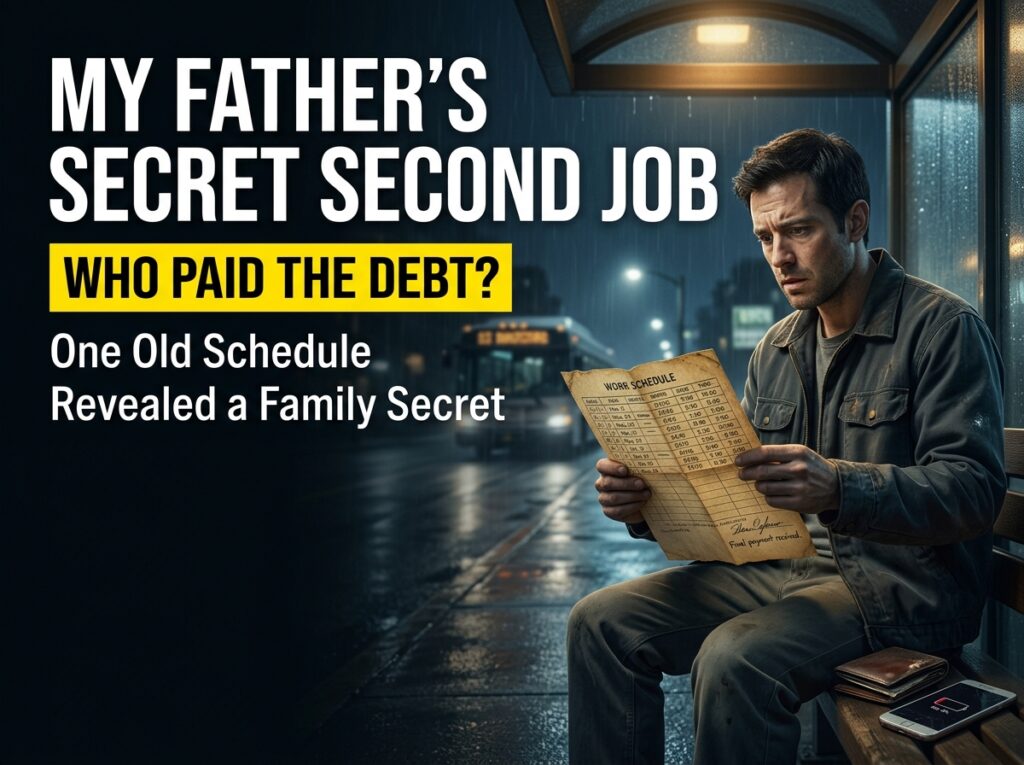
The last bus of the night was running late, and I was too tired to care.
My feet hurt after a long shift. My phone battery was nearly empty, and I had exactly enough money in my wallet for the bus fare and a cheap breakfast the following morning.
I had started counting every dollar without even realizing it.
Rent was due in four days. The electricity bill was sitting unopened on my kitchen table, and my refrigerator contained half a carton of milk, some bread, and a container of rice I had cooked two nights earlier.
I kept telling myself that things would improve after my next paycheck.
I had been saying the same thing for weeks.
My father, Robert, would have recognized the expression on my face. He had spent most of his life working extra hours without telling anyone how tired he was. When money became tight, he took another shift. When his car needed repairs, he worked weekends. When someone asked how he was managing, he always gave the same answer.
“One day at a time.”
I used to think that was wisdom.
Lately, I wondered whether it had simply been the only way he knew how to survive.
I was checking the bus timetable when I noticed a folded piece of paper beneath the bench.
At first, I thought it was a receipt. I nearly kicked it aside, but the heading caught my attention.
It was a work schedule.
The paper was old and yellowed at the edges, with several handwritten shifts arranged in neat columns. The dates were from years earlier, when my father had worked at a warehouse during the day and taken additional evening shifts somewhere else.
I recognized his handwriting immediately.
He had always written in careful block letters, as if he believed a person’s words mattered more when they were easy to read.
I picked up the paper and unfolded it.
The schedule listed his regular warehouse hours, followed by another set of shifts at a small repair business across town.
I knew about the warehouse.
I had never known about the second job.
My father had died two years earlier, and I had spent weeks sorting through his belongings. I had found old photographs, insurance papers, a broken watch, and envelopes filled with receipts. I had thought I knew the important details of his life.
Apparently, I didn’t.
At the bottom of the schedule was a signature.
Beneath it was a date.
I checked the date twice.
It was from the year my father had told us he was working overtime to help cover some unexpected household expenses.
I remembered those months clearly. My mother had been worried about money, and my father had come home late several nights in a row. When I asked whether something was wrong, he said the warehouse was short-staffed.
I had believed him.
Why wouldn’t I?
He was my father.
I folded the schedule and put it in my jacket pocket just as the bus arrived.
During the ride home, I couldn’t stop thinking about the second job. I wondered how long he had worked there and why he had never mentioned it.
Then I remembered something else.
Three months before my breakup with Claire, she had asked me whether my father had ever borrowed money from anyone.
I had laughed because the question seemed so strange.
“My father would rather work himself into the ground than borrow money,” I had told her.
She hadn’t laughed.
Instead, she had looked away and said, “I hope that’s true.”
At the time, I assumed she was worried about our finances. We had been arguing about bills, rent, and the money we had been saving for a future together.
I had no idea she might have known something I didn’t.
When I reached my apartment, I placed the schedule on the kitchen table beside the unpaid electricity bill.
The two papers looked strangely similar.
Both represented something I had been trying to avoid.
One was a reminder of what I owed.
The other was a reminder of what I didn’t know.
I took a photograph of the schedule and enlarged the signature.
My father’s name was clear.
But beneath it, almost hidden by a fold, was a short handwritten note.
Final payment received.
I read the words aloud.
Final payment for what?
I turned the paper over.
The back was blank except for a faint mark where someone had written something in pencil.
I couldn’t make out the words in the dim kitchen light.
I held the paper beneath the lamp.
A name began to emerge.
And when I finally recognized the first letters, I realized the mystery wasn’t about my father’s second job alone.
It was connected to the relationship I had lost.
Part 2: The Father Who Never Asked for Help
The next morning, I called my mother.
She answered while I was getting dressed for work.
“Eli? Is everything all right?”
“I found something of Dad’s.”
“What did you find?”
“An old work schedule. It says he had a second job.”
There was a pause.
“Where did you find it?”
“At the bus stop near my apartment.”
“That doesn’t make sense. Your father never worked at a bus stop.”
“I know, Mom. The paper was left there.”
She sighed.
“What else does it say?”
I told her about the dates and the note at the bottom.
She went quiet again.
“Mom?”
“I’m listening.”
“Did Dad work somewhere else when I was younger?”
“He did a few things over the years.”
“Why didn’t I know about this one?”
“Because he didn’t want you worrying about money.”
I leaned against the kitchen counter.
“How long did he work there?”
“I can’t remember exactly.”
“Was there a debt?”
She didn’t answer.
I looked at the schedule lying on the table.
“Mom, I’m asking because the paper has the words ‘final payment received’ written on it.”
“I don’t know what that means.”
It was possible she was telling the truth.
My father had kept many things to himself, and my mother had spent years trying to respect his privacy. But I knew her voice well enough to recognize when she was struggling with something.
“Did Dad ever tell you he owed someone money?”
She took a slow breath.
“He helped someone once.”
“Who?”
“I don’t remember the details.”
“Was it connected to Claire?”
The silence that followed was different.
“What makes you ask that?”
I felt my stomach tighten.
“Because Claire once asked whether Dad had borrowed money. And now I have a schedule with a note about a final payment.”
My mother lowered her voice.
“Eli, you need to be careful about what you assume.”
“I’m not assuming anything. I’m trying to understand.”
“I know.”
“Then please tell me what you remember.”
She promised to look through my father’s old documents and call me later.
After we hung up, I went to work, but I could barely concentrate.
My relationship with Claire had lasted almost five years. We had met when I was working evenings at a grocery store and she was studying for a professional qualification.
She used to bring me coffee during my breaks.
When I was promoted, she celebrated by making dinner in our tiny apartment. When her mother became ill, I helped her with appointments and paperwork. We had been through enough difficult days that I believed we could survive almost anything.
Then the money problems started.
First, our rent increased.
Then my hours were reduced.
Claire’s income was inconsistent, and we began using our savings to cover the difference. I thought we were making ordinary sacrifices while we waited for better opportunities.
But she became increasingly worried about my father’s involvement in our finances.
One evening, she asked whether he had ever offered to help us with a payment.
I told her he had occasionally given me money when I was younger, but I had never asked him to support our relationship.
She looked as if she wanted to say something else.
Instead, she told me she was tired.
A few weeks later, she left.
Her explanation had been simple.
“I can’t keep living with questions you won’t answer.”
I had been hurt and confused.
I thought she meant I wasn’t communicating enough about our future.
Now I wondered whether she had been referring to something more specific.
That afternoon, my mother called again.
She had found a folder containing some of my father’s old paperwork.
“There are a few things you should see,” she said. “But I don’t want you making accusations until you’ve read everything.”
I agreed to visit her after work.
When I arrived, she placed the folder on the table.
Inside were old wage slips, a bank statement, and a photocopy of a handwritten agreement.
The agreement referred to a loan.
My father’s signature appeared at the bottom.
So did another signature.
I recognized the first name immediately.
Claire.
I looked at my mother.
“Why was Claire’s name on a document Dad signed?”
My mother clasped her hands together.
“I was hoping you would never have to ask that question.”
Part 3: The Agreement Hidden in the Folder
I read the agreement three times.
It was brief, written in plain language, and dated nearly four years earlier.
The document recorded an arrangement involving a loan and a repayment schedule. My father’s name appeared beside the person providing the money. Claire’s name appeared in the section acknowledging the arrangement.
But the document did not clearly explain why the money had been borrowed or what it had been used for.
I looked at my mother.
“Did you know about this?”
“Yes.”
“Why didn’t you tell me?”
“Because your father asked me not to.”
I felt anger rising, but I forced myself to listen.
“He said he was helping someone through a difficult period,” she continued. “He believed it would be settled quickly.”
“Was that someone Claire?”
My mother looked down.
“Yes.”
The answer seemed to change the shape of the room.
Claire had never told me she had borrowed money from my father.
I had never known she had signed an agreement with him.
I couldn’t understand how something so significant could have existed outside my knowledge while we were building a life together.
“How much was it?” I asked.
My mother gave me the amount written on the document.
It was substantial enough to explain why my father might have taken a second job.
It was also close to the amount I had been trying to understand in our missing savings.
I sat down.
“What did Claire need the money for?”
My mother shook her head.
“Your father never told me everything. He said she had a problem she was embarrassed about.”
“Did he lend her the money himself?”
“He helped arrange it. Some of it came from his savings, and some came from extra work he took on.”
I stared at the schedule I had brought with me.
“So he worked two jobs to repay a debt connected to Claire?”
“Not exactly. He was trying to recover what he had put into the arrangement.”
“What does that mean?”
My mother looked distressed.
“He believed the money would be returned. When it wasn’t, he kept working and tried to cover the shortfall.”
I thought about the times my father had declined invitations because he was tired.
I remembered him falling asleep in his chair during a family gathering and apologizing when I woke him.
I had assumed he was simply getting older.
Now I wondered how much of his exhaustion had come from a financial burden he had never discussed with me.
“Why did he protect her?”
My mother took a breath.
“He believed she loved you. He didn’t want one financial problem to destroy your relationship.”
I almost laughed.
Instead, I felt a painful pressure behind my eyes.
“Did Claire know he was working extra hours because of her?”
“I don’t know.”
“Did she repay him?”
My mother pointed to the note on the agreement.
“There’s a record of several payments. I think your father received some of the money back.”
“Some?”
“That’s all I know.”
I took photographs of the documents and asked whether I could keep copies.
My mother agreed.
Before I left, she told me something else.
“Your father was proud of you, Eli. He didn’t want you to think he was struggling.”
I looked at her.
“He could have told me.”
“He thought he was protecting you.”
I knew those words too well.
Everyone seemed to believe that hiding painful information was a form of love.
But all it had done was leave me trying to understand a mystery after the people involved had already made their decisions.
That evening, I searched my old emails for Claire’s name and the amount recorded on the agreement.
I found a message from her dated several months after the loan had been arranged.
I need more time. I promise I’ll make it right.
My father had replied:
I know. Just tell me when you can pay the next amount.
There was no anger in his response.
No threat.
Only patience.
I wondered whether he had been protecting Claire from someone else, or whether he had simply believed she would eventually repay him.
Then I found another email, dated a week before Claire and I separated.
It was addressed to my father.
The subject line read:
We need to talk about Eli.
Part 4: The Conversation Nobody Told Me About
The email contained only three sentences.
I can’t keep pretending he doesn’t know.
If he finds out the truth from someone else, I don’t think he’ll ever forgive me.
Please tell me what you think I should do.
I read it until the words blurred.
Claire had written to my father about me.
She had been afraid I would discover something, and she had asked him for advice.
I couldn’t tell whether she meant the original loan, the missing money, or something else entirely.
I called her.
For several seconds, neither of us spoke.
Then she said, “Eli.”
“I found the agreement.”
Her breathing changed.
“What agreement?”
“The one you signed with my father.”
She was silent.
“How long have you known about it?” I asked.
“Since he first helped me.”
“And you never told me.”
“I wanted to.”
“Then why didn’t you?”
“Because I was ashamed.”
I sat down.
“Of what?”
She started crying.
“I made a mistake, Eli. I thought I could fix it before anyone had to know.”
I remembered my father’s second job schedule.
The note about the final payment.
The unanswered questions that had followed our breakup.
“Was the money connected to our savings?”
“Some of it was.”
My stomach tightened.
“What do you mean, some of it?”
Claire explained that the original loan had been arranged before we began experiencing serious financial problems. She had been dealing with an obligation she had not told me about, and my father had agreed to help her manage it.
She had made repayments when she could.
Then her circumstances changed, and she fell behind.
When my father needed the money returned, she had promised to make up the difference.
But the money did not arrive as expected.
I asked whether she had used money from our shared savings to repay him.
She said she had made a transfer from the account, believing she could replace it before I noticed.
I closed my eyes.
“Why didn’t you ask me?”
“Because I was afraid you’d think I’d been lying to you from the beginning.”
“You were lying to me.”
“I know.”
The simplicity of her answer hurt more than an excuse would have.
I asked whether my father had known she was using money from our shared account.
She said he had known about one payment but had not understood the full situation.
I could not verify her account from the conversation alone. I needed the bank records and the original documents.
But for the first time, I had a possible explanation for the missing money.
The debt had begun with Claire.
My father had helped her.
She had struggled to repay him.
And when our own finances became difficult, she had tried to cover the shortfall without telling me.
I asked why she had left.
She took a long breath.
“Because I knew you were going to discover it. I thought leaving would give me time to fix everything.”
I felt the same anger I had felt when Daniel—no, when I had imagined the story as something simpler than it was—had tried to make sense of the dates. There had been no clean separation between love and money, between protection and deception.
“You left me with the bills,” I said.
“I know.”
“You let me believe we had lost our savings because of ordinary expenses.”
“I know.”
“And you never told me my father had taken a second job because he was trying to help you.”
She began crying harder.
“I never wanted him to suffer.”
“Then why did you let him?”
She had no answer.
I ended the call because I was too upset to continue.
The following morning, I took the documents to a solicitor and asked for help understanding the financial arrangement. I wanted to know what the agreement established, which transfers could be verified, and whether any of the money had been taken without my informed consent.
I was tired of trying to solve everything through conversations that ended in tears.
That afternoon, Claire sent me a message.
There is one thing I haven’t told you about the original loan.
I asked her what it was.
Her reply came several minutes later.
Your father didn’t lend me the money because I asked him to.
I stared at the screen.
Then another message arrived.
He offered because he knew who I was trying to protect.
Part 5: The Person Claire Was Protecting
I called Claire immediately.
“What do you mean, my father knew who you were trying to protect?”
She asked me to meet her in a public place.
I chose a small café near the station.
When she arrived, she looked exhausted. She had lost weight, and her hands trembled slightly as she set her cup on the table.
I had once known every expression on her face.
Now I struggled to understand what she was feeling.
“Start from the beginning,” I said.
Claire explained that the original financial problem had not started with her own spending.
Several years earlier, someone close to her had asked for help with a debt. She had agreed to help, believing the money would be repaid quickly.
It wasn’t.
The amount grew, and she found herself trying to cover payments she could no longer afford.
She had been frightened of telling her family because she believed they would blame her for getting involved.
When my father learned about the situation, he offered to help arrange a repayment plan.
“Why would he do that?” I asked.
“Because he knew the person.”
“Who?”
She hesitated.
“I can’t give you a name without explaining the whole situation.”
“Then explain it.”
She told me that my father had recognized the problem as something that could damage more than one person’s finances. He had believed that a structured repayment arrangement might prevent the debt from becoming worse.
He had taken on extra work because he expected the money to be returned.
But the repayments had not arrived as promised.
When Claire began struggling, my father agreed to give her more time.
That was when the handwritten agreement had been updated.
I asked whether the person she had originally helped had ever repaid anything.
“Some money came back,” she said. “Not enough.”
“Who was it?”
She looked down at her hands.
“I promised I wouldn’t tell anyone.”
I felt anger rising again.
“You made that promise before or after you borrowed money from my father?”
“Before.”
“And you kept it even when the secret started affecting our life together?”
“Yes.”
I pushed my cup away.
“I don’t understand how you could ask me to build a future with you while keeping something like this from me.”
“I thought I could fix it.”
“You keep saying that.”
“Because it’s true.”
“It might be true, but it doesn’t change what happened.”
She nodded.
“I know.”
I asked whether the money transferred from our shared savings had gone toward the original debt.
She said some of it had.
She also acknowledged that she had not been honest with me about the account balance when I asked.
I felt the old mixture of sadness and anger return.
I had been working extra hours, postponing purchases, and worrying about rent while believing we were both making sacrifices for the same future.
Meanwhile, she had been trying to solve a problem I didn’t know existed.
I asked whether my father had known she was using the shared savings.
“He knew about one payment,” she said. “He didn’t know how much pressure you were under.”
“And you didn’t tell him?”
“No.”
I looked out at the street.
For a long time, I had thought my father had kept the second job secret because he didn’t want me worrying about money.
Now I understood that his silence had been connected to a larger arrangement involving someone he had tried to protect.
I asked Claire whether she still had the original messages from my father.
She said she did.
I asked her to preserve them and provide copies through the solicitor.
Before we left, she reached for my hand.
“Eli, I know I hurt you.”
I looked at her.
“I don’t know whether I can forgive you.”
“I understand.”
“But I need the truth. All of it.”
She nodded.
“I’ll tell you what I can.”
I stood and left the café.
I was not ready to forgive her, and I was not ready to decide whether any part of our relationship could be repaired.
But I finally understood that the secret had begun long before the breakup.
It had grown through a series of promises, each one intended to solve the previous problem.
And the person at the center of it was still unnamed.
That evening, I opened the photograph of the old work schedule and enlarged the writing on the back.
The name was clearer now.
It was not Claire’s.
It was not my mother’s.
It was someone whose name I had not spoken in years.
Part 6: The Name on the Back
I spent most of the night trying to remember why the name seemed familiar.
It belonged to Michael, a man who had once worked with my father at the warehouse.
I remembered him visiting our house when I was a teenager. He had brought a box of tools for my father and stayed for dinner. They had spoken quietly in the kitchen while my mother and I watched television.
Later, I learned that Michael had left the warehouse after a disagreement about money.
My father never explained what had happened.
I had assumed they had simply lost touch.
Now his name appeared on a work schedule connected to a debt my father had spent years trying to settle.
The next morning, I searched through my father’s old address book.
Michael’s number was still there.
I called it.
A man answered after several rings.
“Hello?”
“Is this Michael?”
“Yes.”
“My name is Eli. I was Robert’s son.”
There was a long silence.
“I know who you are,” he said.
I felt my stomach tighten.
“Then you know why I’m calling.”
“I wondered when you would find out.”
I gripped the phone.
“What did my father owe you?”
Michael sighed.
“Your father didn’t owe me money in the way you think.”
“Then why is your name on the schedule?”
“Because I was the person who arranged the second job.”
I sat down.
Michael explained that he had known about the extra work because he had helped my father find it. The repair business needed someone dependable for evening shifts, and my father had been willing to work.
At first, Michael said, it was simply an opportunity to earn additional income.
But later, my father had asked him to keep the schedule private.
“Why?”
“Because he didn’t want you to know he was working so much.”
“Was the work connected to Claire’s debt?”
Michael hesitated.
“Partly.”
I felt anger rise again.
“How could it be partly connected?”
“Your father wanted to make sure the money was available when the repayment deadline arrived. He believed he was helping Claire get out of a difficult situation.”
“Did he know who she was protecting?”
“Yes.”
“Who?”
Michael took a long breath.
“Your father wanted to tell you himself. He kept putting it off.”
I asked whether Michael had seen the original agreement.
He said he had seen a copy but had not been involved in the loan itself.
He also explained that the note on the schedule referred to a payment my father had received after working several additional shifts.
It was not proof that the debt had been fully settled.
It was a record of one payment.
I felt foolish for assuming the words meant more than they did.
The paper was only one piece of the story.
“What happened to the money?” I asked.
Michael told me that some of the funds had been repaid, but the remaining amount had been disputed. He did not have the complete financial records and could not tell me exactly where every payment had gone.
I asked him for the names of anyone who might have known more.
He gave me one.
It was a name I recognized from my childhood.
My father’s older brother, David.
I hadn’t spoken to David in nearly six years.
He and my father had argued after a family gathering, and neither had made much effort to repair the relationship.
I had never known what caused the argument.
Now I wondered whether it had been connected to the debt.
Before we ended the call, Michael said something that stayed with me.
“Your father wasn’t trying to hide a fortune, Eli. He was trying to keep a promise.”
I looked at the schedule.
I had imagined the paper might reveal a secret account or an explanation for every missing dollar.
Instead, it showed how hard my father had worked to fulfill an obligation he believed he had accepted.
I thanked Michael and called my uncle.
He answered cautiously.
When I told him about the work schedule and the agreement, he went silent.
Then he asked, “Has Claire told you who the original debt belonged to?”
“No.”
David sighed.
“Then you need to hear what happened from the person who was there.”
“Who?”
He gave me an address.
It belonged to a small repair shop on the other side of town.
And the person who owned it was the last person I expected to be connected to my father’s second job.
Part 7: My Father’s Unfinished Promise
The repair shop was still open when I arrived.
A bell rang above the door, and a man behind the counter looked up.
He was older than I remembered, with gray hair and thick glasses. But I recognized him immediately.
It was Thomas, the man who had given my father the second job.
He invited me into a small office at the back.
“I wondered whether you’d come,” he said.
I sat opposite him.
“Everyone seems to have been expecting me to discover this.”
“Not everyone. Your father hoped you wouldn’t have to.”
“Why?”
Thomas folded his hands.
“Because he believed the problem would be settled before it reached you.”
I told him about the agreement, the missing money, and the name on the back of the schedule.
He listened without interrupting.
Then he explained that Claire had approached my father after becoming involved in a debt she could not repay. My father had known the person connected to the original arrangement and believed he could help prevent the situation from getting worse.
Thomas had offered my father additional shifts so he could earn money without borrowing more.
My father accepted.
He never asked Thomas for special treatment. He simply worked the hours available and put aside as much as he could.
“Was the money supposed to go to Michael?” I asked.
“No. Michael helped arrange the work. The debt was connected to someone else.”
“Who?”
Thomas looked at me carefully.
“Your father didn’t want me to name that person without giving you the context.”
I was exhausted by the constant delays.
“I’ve spent weeks trying to understand what happened. I found the schedule by accident. I discovered the agreement because my father kept it in a folder. I learned about the transfers because my relationship fell apart. How much more context do I need?”
Thomas accepted my frustration.
“You’re right. You deserve a clear answer.”
He opened a drawer and removed a thin folder.
Inside were copies of payment records and a letter my father had written several years earlier.
The letter explained that he had agreed to help Claire because she had been trying to protect someone she loved from a financial crisis.
He believed that person would repay the debt.
But the repayments had stopped.
My father had continued working extra hours because he did not want Claire to face the consequences alone.
The letter did not identify the person directly.
Instead, it referred to an old family obligation and a promise made long before the loan.
I read it twice.
“What family obligation?”
Thomas looked uncomfortable.
“I think you should speak to your uncle.”
I called David from the shop.
He answered immediately.
“Thomas told you about the letter?” he asked.
“Yes.”
David sighed.
“I should have told you years ago.”
I waited.
He explained that the original debt had been connected to a failed family business. My father had agreed to help someone close to us settle an obligation that had never been properly documented.
Claire had become involved while trying to protect that person.
My father had helped her because he believed she was acting out of loyalty rather than dishonesty.
But the arrangement had become more complicated when the money wasn’t repaid.
“Who was the person?” I asked.
David was quiet for several seconds.
Then he said my name.
Not mine.
My father’s.
“Your father was trying to protect his own brother.”
I stared at the phone.
“Uncle David?”
“No,” he said. “Your father’s younger brother. Your uncle Peter.”
I barely remembered Peter. He had left the family when I was young, after a dispute over money and the sale of a small property.
I had been told he moved away and didn’t want contact.
Now I understood that the family had never fully explained what happened.
My father had tried to settle an obligation connected to Peter.
Claire had helped because she had become involved in the same financial problem.
And I had been left to believe that the missing money was simply the result of ordinary expenses and a failed relationship.
I asked David where Peter was now.
“I don’t know for certain,” he said. “But your father received a letter from him shortly before he died.”
“Where is it?”
David took a breath.
“Your mother has it.”
Part 8: The Letter My Mother Kept
I went straight to my mother’s house.
She opened the door before I knocked a second time.
When I told her what David had said, she looked as if she had been waiting for the conversation.
She went to her bedroom and returned with a small envelope.
The paper was worn, and the address had faded.
My father’s name was written on the front.
Inside was a letter from Peter.
He explained that he had learned about the debt and wanted to make things right. He acknowledged that my father had taken on too much responsibility for a problem that had never been his alone to solve.
He also wrote that he had made a payment toward the debt.
At the bottom was a name and a date.
I looked at the date.
It was the same date written on the back of the second job schedule.
The final payment had not been made by Claire.
It had not been made by my father.
It had been made by Peter.
I read the letter again, trying to understand what that meant.
My father had worked extra shifts to keep the repayment arrangement alive.
Claire had made some payments and had hidden the truth from me.
My mother had helped arrange a transfer because she believed she was protecting our future.
But Peter, the person at the center of the original family obligation, had eventually paid the remaining amount.
The debt had been settled.
The missing money, however, was still a separate matter.
The records showed that some funds had been moved from the shared account, and Claire had acknowledged using part of that money toward the debt. We still needed to establish the full amount and determine whether every transfer had been properly authorized.
I asked my mother why she had never shown me the letter.
“Your father asked me to keep it until I understood what it meant,” she said.
“And did you?”
“Not completely.”
“Then why keep it secret?”
“Because Peter had been gone for years. Your father was afraid the letter would reopen an old family argument.”
I sat down.
“Everyone has been afraid of something.”
My mother nodded.
“I know.”
We read the letter together.
Peter wrote that he had never intended for my father to carry the burden alone. He had delayed repaying the money because he had been struggling financially himself, and by the time he could make the payment, my father had already taken on extra work.
The letter ended with an apology.
It wasn’t a dramatic confession.
It didn’t explain every missing dollar or repair every broken relationship.
But it established something important.
My father had not worked those extra shifts because he wanted to hide a fortune.
He had worked because he believed a promise mattered, even when keeping it was exhausting.
I felt a mixture of sadness and relief.
I had spent weeks searching for someone to blame.
Now I understood that the story had been shaped by several people making imperfect decisions under pressure.
Some had hidden the truth to protect themselves.
Others had hidden it because they believed they were protecting someone else.
And my father had kept working because he wanted to make sure an old obligation did not destroy the lives of the people connected to it.
I asked my mother whether she knew where Peter was now.
She shook her head.
“I haven’t heard from him in years.”
I folded the letter carefully.
“I want to find him.”
“Why?”
“Because I need to hear the rest of the story from him.”
My mother looked frightened.
“What if he doesn’t want to talk?”
“Then I’ll respect that. But I can’t keep living with half the truth.”
She nodded slowly.
Before I left, she handed me the original second job schedule.
I turned it over again.
The name of the person who had paid the debt was now clear.
Peter.
For the first time, the paper made sense.
But I still had one question.
Why had Claire believed she needed to protect him at the cost of our relationship?
Part 9: The Truth Behind the Breakup
Peter agreed to meet me after I sent him a copy of the letter.
We arranged to meet at a café in the town where he lived.
When he arrived, he looked older than I remembered. His hair was almost entirely gray, and he walked with the careful movements of someone who had learned to live with pain.
He recognized me immediately.
“You look like your father,” he said.
I didn’t know how to respond.
We sat down.
I placed the letter on the table.
“I want to understand what happened.”
Peter nodded.
He explained that the original debt had come from a failed family business. He had borrowed money to keep it running, believing a contract would bring in enough income to repay everything.
The contract never materialized.
My father had helped him cover part of the shortfall, and Claire had become involved because she had been trying to prevent Peter’s financial problems from affecting another person in her family.
She had borrowed money from my father to help settle the obligation.
But she had not told me because she was afraid I would blame her for becoming involved in a problem that had begun before our relationship.
My father had kept the arrangement private because he believed Peter could eventually repay the money.
For a while, everyone had been trying to manage the debt separately.
That was why the records looked so confusing.
Payments had been made through different accounts, at different times, by different people.
And when one person fell behind, another stepped in to cover the shortfall.
“Why didn’t you tell me?” I asked.
Peter lowered his head.
“Because I was ashamed.”
“That seems to be the answer everyone gives.”
“I know.”
He explained that he had eventually found enough money to make the final payment, but he had delayed contacting the family because he feared the old dispute would begin again.
He had sent the letter to my father as confirmation that the debt had been settled.
My father had kept it.
But he had died before he could explain everything to me.
I asked whether Peter knew that Claire had used money from our shared savings.
He said he had not known the details until after the breakup.
He had believed the payments were being made through the original arrangement.
I told him what Claire had admitted.
Peter looked genuinely distressed.
“Your father never wanted you to lose anything because of this.”
“But I did.”
He nodded.
“I know.”
We spent another hour reviewing the dates and amounts.
Peter could explain the original debt and his final payment, but he could not account for every transfer from the savings account. Those records would still need to be reviewed separately.
I accepted that.
I no longer expected one conversation to solve everything.
Before we left, Peter gave me a copy of the payment confirmation.
It matched the date and amount recorded in the letter.
I thanked him.
He looked at me for a long moment.
“Your father worked those extra hours because he believed he could keep the family together.”
I felt my throat tighten.
“He should have told me.”
“Yes,” Peter said. “He should have.”
For once, someone had not tried to defend the silence.
On the journey home, I thought about Claire.
She had been frightened, ashamed, and determined to protect someone she believed needed help. But she had also made decisions that affected my money and my future without giving me the information I needed.
I could understand her reasons without pretending they had been harmless.
When I called her, I told her what Peter had explained.
She listened quietly.
“I never wanted to hurt you,” she said.
“I know.”
“I thought if I could help him, everything would be all right.”
“But you never told me what was happening.”
“I was afraid.”
“So was I.”
Neither of us spoke for a while.
Then I told her that I was not ready to rebuild the relationship.
She began to cry, but she did not argue.
“I understand,” she said.
We ended the call gently.
I did not feel triumphant.
I felt sad for the future we had imagined and for the years in which we had mistaken silence for loyalty.
But I also felt something I hadn’t felt since the breakup.
Peace.
The mystery was no longer controlling every thought I had.
I knew why my father had worked the second job.
I knew who had paid the debt.
I knew why Claire had hidden the arrangement.
And I knew that the remaining financial questions could be addressed through evidence rather than guesses.
For the first time, I could begin moving forward without waiting for someone else to decide when I deserved the truth.
Part 10: The Promise I Kept for Myself
The months that followed were not easy.
I still had rent to pay, bills to manage, and financial records to sort through. The bank review continued, and I worked with a solicitor to understand the implications of the transfers from the shared account.
Some questions were answered.
Others remained unresolved.
But I no longer treated every unanswered question as proof that something terrible was waiting around the corner.
I made a budget.
I arranged my finances so that I could see exactly what came in and what went out.
I stopped assuming that another person understood my situation better than I did.
And when I needed help, I learned to ask for it without pretending I was fine.
My relationship with my mother changed, too.
We began talking more honestly about money, work, and the things we had spent years hiding from one another.
Sometimes, she told me stories about my father that I had never heard.
She remembered how he used to bring home small treats after long shifts, pretending they were leftovers from work because he didn’t want us to think he had spent money on us.
She remembered how he had once taken a second job for several months to help a neighbor whose house had been damaged by a storm.
“He never knew how to say no when someone needed help,” she said.
I smiled sadly.
“He also never knew how to tell us when he needed help himself.”
She nodded.
“That was his weakness.”
I thought about the old schedule.
For years, I had believed that strength meant enduring difficulty without complaint. My father had lived that way, and I had followed his example.
But I was beginning to understand that carrying every burden alone was not the same as being strong.
Sometimes, it simply meant that the people who loved you never had the chance to help.
I kept the schedule in a folder with the original agreement, Peter’s letter, and the bank records.
Not because I wanted to remain trapped in the past, but because I wanted to remember what had happened and what I had learned from it.
The schedule no longer looked like a mysterious clue.
It looked like a record of my father’s effort.
The words Final payment received no longer frightened me.
They reminded me that a debt had eventually been settled, even if the process had caused years of worry and confusion.
And the name on the back reminded me that people could make mistakes, disappear for a time, and still return to take responsibility for what they had done.
I did not know whether I would ever speak to Claire about rebuilding our relationship.
For now, we remained apart.
I wished her well, but I no longer believed that love required me to reopen a door simply because someone regretted leaving.
Trust had to be rebuilt through honesty and consistent actions.
It could not be restored by an apology alone.
One evening, several months after finding the schedule, I was waiting at the same bus stop.
My shift had ended late, and the street was quiet. The bench had been replaced, and the timetable had a new frame.
I sat down and looked at the place where I had found the paper.
For a moment, I remembered how frightened I had been that night.
I had been worried about rent, food, and whether I could afford to begin again.
I had thought the paper might explain everything.
In a way, it had.
But the most important discovery was not the identity of the person who paid the debt.
It was the realization that I had spent too long allowing other people’s secrets to determine how I understood my own life.
I could respect my father’s desire to protect the family without repeating his silence.
I could understand Claire’s fear without accepting her decisions.
I could forgive my mother for trying to help without pretending that hiding the truth had been harmless.
And I could let go of the belief that every mystery had to be solved before I was allowed to move forward.
The bus arrived.
I stood, adjusted my jacket, and climbed aboard.
My phone buzzed as I found a seat.
It was a message from my mother.
I made enough dinner for two. Come over if you want.
I smiled and replied:
I’ll be there after I get home.
It was a small exchange.
No hidden meaning.
No unspoken promise.
Just an invitation and an honest answer.
When I reached my apartment, I paid the electricity bill, checked my account balance, and put the old schedule back in its folder.
Then I turned off the kitchen light and went to bed.
I still had a future to build.
I still had difficult conversations ahead of me.
But I no longer believed that I had to carry every problem alone.
My father had worked extra hours because he wanted to keep a promise.
I would honor him by keeping a different promise to myself.
I would ask questions when something didn’t make sense.
I would speak when I was frightened.
I would help people when I could, but I would not sacrifice my own security to protect a secret I didn’t understand.
And I would never again mistake silence for love.
Because the truth had hurt.
The breakup had hurt.
The missing money had hurt.
But the greatest relief came when I finally stopped waiting for other people to decide when I was ready to know what had happened.
I could face the truth, even when it was painful.
I could rebuild, even when the future was uncertain.
And I could remember my father not only as the man who worked two jobs to keep a promise, but as the man whose story taught me that even the strongest people sometimes need to let others help them.
The paper I found at the bus stop had been folded, forgotten, and left behind.
I had picked it up because I thought it might explain the money.
Instead, it helped me understand the people I loved—and the person I needed to become.
I no longer needed to pretend everything was fine.
I only needed to take the next honest step.
And this time, I knew I could.