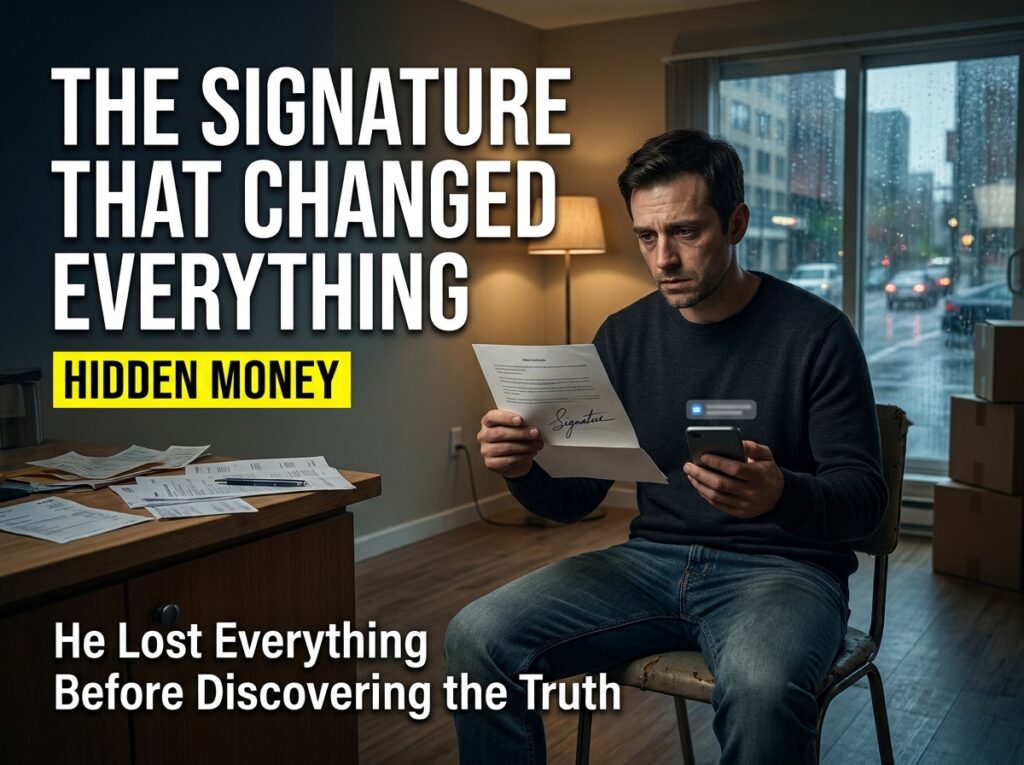
The apartment sounded different after the furniture was gone.
Before, every room had carried some familiar noise. The old refrigerator hummed in the kitchen. The wooden dining chairs scraped across the floor whenever we sat down to eat. The couch creaked beneath us when we watched television late at night, and the bedroom wardrobe complained whenever one of its doors was opened too quickly.
Now there was only the refrigerator, the pipes in the walls, and the occasional footsteps of the neighbors upstairs.
I had sold the couch on a Tuesday, the dining table the following morning, and the small television that evening. By Thursday, the living room looked like a place someone had abandoned in a hurry.
I kept telling myself it was temporary.
One bad month would not define the future.
I repeated those words whenever I looked at the empty space where our furniture had stood. I repeated them when I opened the kitchen cupboard and found only two plates, a chipped mug, and a bag of rice. I repeated them when another payment reminder appeared on my phone.
I had always believed that if I worked hard enough, I could recover from almost anything. Money could be earned again. Furniture could be replaced. A difficult season could become a story we told later, perhaps with a little laughter about how we had survived it.
What I had not expected was how difficult it would be to recover from something I could not explain.
The relationship had ended weeks earlier, but its consequences were still arriving.
There were bills with both our names attached to them. There were promises about payments that had never been completed. There were messages I could no longer read without wondering whether the person who wrote them had been telling me the truth.
Most painful of all, there were memories that seemed to belong to a different life.
I could still picture the evening we bought the dining table. We had argued over the price, laughed at our inability to assemble it correctly, and eaten takeaway food while sitting on the floor because we had forgotten to buy chairs.
The table had been cheap, but we had treated it like a beginning.
We promised that when we had more money, we would buy something better.
We never did.
When I sold it, the buyer asked whether I wanted help carrying it downstairs.
“No, thank you,” I said.
I wanted to carry it myself. I wanted to feel the weight of something we had built together, even if all I could do now was take it apart and let it go.
After the buyer left, I stood in the empty apartment and stared at the marks the table legs had left on the floor.
Then I sat against the wall and counted the money.
It was enough to cover one bill and part of another.
I placed the notes in an envelope and wrote the date on the front.
That evening, my sister called.
“How are things?” she asked.
“Fine.”
“You sound tired.”
“I’m working too much.”
“Have you eaten?”
“Yes.”
I had eaten two slices of bread that afternoon, but I didn’t want to explain that.
My family had spent months worrying about me. They had asked whether I needed help, whether the relationship was really over, and whether there was anything they could do.
I had answered every question with some version of the same sentence.
I’m managing.
I was afraid that if I admitted how close I was to losing everything, they would ask questions I wasn’t ready to answer.
Why had the money disappeared?
Why had the bills become impossible to manage?
Why had the person closest to me left without giving me a clear explanation?
I didn’t know how to answer those questions without admitting that I had trusted someone with nearly every part of my life and had no idea what they had done with that trust.
“Are you sure you’re all right?” my sister asked.
I looked at the envelope on the floor.
“Yes,” I said. “I just need a little time.”
She was quiet for a moment.
“Time for what?”
“To sort everything out.”
She didn’t push me. She only reminded me that I could call whenever I needed help.
After we hung up, I sat in the kitchen and opened my banking application.
I checked the balance again, even though I knew it wouldn’t have changed.
Then I opened the list of recent transactions.
There were ordinary expenses: groceries, transport, electricity, and the small payments I had made to keep the apartment running.
But there were other transactions, too.
Transfers I remembered making without thinking much about them. Payments I had assumed were connected to our plans. Amounts that had once seemed manageable but now looked frightening when I added them together.
I had reviewed the numbers before, but never carefully.
At the time, I had believed the problem was temporary. We had both been working, and there had always been a reason to believe the next month would be easier.
Now I wondered whether I had been looking at the wrong problem.
The money had not simply disappeared overnight.
It had gone somewhere, in separate amounts, on different dates.
And someone had known more about those movements than I did.
I closed the application.
I wasn’t ready to investigate everything that evening. I had spent too many nights trying to understand what had gone wrong, only to end up staring at the ceiling until morning.
But before I went to bed, I made myself a promise.
I would stop pretending that everything was fine.
I would find out what had happened, even if the answer hurt.
The next morning, I began with the paperwork I had been avoiding.
And beneath a stack of old bills, I found the first clue that made me question the entire story I had been telling myself.
Part 2
The paper was folded into quarters and tucked between an electricity notice and a receipt from a grocery store.
At first, I thought it was another payment reminder. I nearly dropped it into the pile of documents I intended to sort later.
Then I noticed the handwriting.
It was familiar, although I couldn’t immediately remember where I had seen it.
I unfolded the paper and smoothed it against the kitchen counter.
The document contained a few lines about a transfer, followed by a date and a signature. There was no long explanation, no dramatic confession, and nothing that immediately revealed why it mattered.
But the date stopped me.
It was from a period when I had believed our financial problems were beginning to improve.
I remembered that month clearly. We had discussed paying off the oldest bill, replacing the broken washing machine, and putting a little money aside for emergencies.
The person I loved had told me not to worry.
“We’re getting through it,” they had said. “Just give me a little time.”
I had believed those words because I wanted to believe them.
Now the paper suggested that something had happened on the very day I remembered that conversation.
I checked the date against my messages.
The first conversation I found was ordinary. We had discussed dinner, work, and whether I could stop at the store on my way home.
Then, later that evening, I had received a message.
Don’t worry about the payment. I’ve taken care of it.
I had responded with a heart.
That was all.
I remembered feeling relieved. I had been exhausted, and the idea that one more problem had been handled seemed like a small miracle.
But the paper in front of me carried a signature that didn’t match the name I had expected.
I read it again.
Then I searched the old messages for the amount written on the document.
I found it in a conversation from several days earlier. I had asked whether we could afford the next round of bills. The reply had reassured me that the money was available.
There was no explanation of where it had come from.
I had not asked.
That realization embarrassed me more than I expected. I had always thought of myself as careful with money. I checked prices, compared bills, and kept receipts whenever I made a purchase that mattered.
Yet I had allowed the most important financial decisions in my life to remain vague because asking questions felt like an accusation.
Whenever I expressed concern, the conversation had somehow turned into a discussion about trust.
“Don’t you believe me?” they would ask.
Of course I believed them, I would say.
I had believed them because I loved them. I had believed them because we had built a life together. I had believed them because the alternative was too frightening to consider.
I opened another folder.
Inside were bank statements, rent notices, and a list of expenses we had once prepared together. I spread everything across the counter and began comparing the dates.
The same amount appeared twice.
One entry was recorded as a payment. The other appeared to be a transfer.
I checked the numbers again, then wrote them on the back of an envelope.
It wasn’t enough to prove that anyone had done something wrong. There could have been a legitimate explanation. The payment might have been moved between accounts, or the document might have belonged to a transaction I had forgotten.
But I could no longer dismiss the questions simply because I was afraid of the answers.
I decided to contact the bank and request the records available to me.
The employee I spoke with was patient. She explained that I could obtain statements for my own account and that any information about a shared account would depend on the account’s ownership and access arrangements.
I made a list of the documents I needed.
Then I sat at the kitchen counter and looked at the signature again.
It was written with a slight upward curve at the end, as if the person had been in a hurry.
I knew that handwriting.
I had seen it on a birthday card, on a note left beside the front door, and on the small reminders that used to appear on our refrigerator.
It belonged to the person who had left me.
For several minutes, I couldn’t move.
The discovery did not tell me what had happened to the money. It did not explain why the signature was there or whether the transaction had been authorized.
But it connected the document to someone I had spent weeks trying not to think about.
I picked up my phone.
Their name was still saved in my contacts. I had considered deleting it many times, but each time I had stopped, telling myself that I wasn’t ready to make the separation feel permanent.
I opened our conversation.
The last message was short.
I need space. Please don’t make this harder than it already is.
I had read it so many times that I could remember every word without looking.
I typed a new message.
I found a document connected to the money. I need you to explain it.
I stared at the screen, waiting for the familiar fear to rise.
It came, but something else came with it.
For the first time, I was more afraid of remaining confused than I was of hearing the truth.
I pressed send.
The message showed as delivered.
Minutes passed.
Then an hour.
I put the phone down and tried to work, but I kept looking at it.
Finally, a reply appeared.
Where did you find that?
I read the words twice.
There was no greeting. No question about how I was doing. No surprise that I had found a document connected to the money.
Only a question about where I had found it.
My hands began to tremble.
I typed:
Why does that matter?
The reply came quickly.
Because there are things you don’t understand.
I looked at the empty apartment, the unpaid bills, and the envelope containing the money from the furniture sale.
Then another message arrived.
Please don’t speak to anyone about this until we have talked.
I stared at the screen.
I had spent weeks believing that the relationship had ended because we had run out of money, patience, or hope.
Now I wondered whether the breakup had been the final consequence of something that had begun long before I realized there was a problem.
And for the first time, I understood that the person I needed to question might not be the only person who knew the truth.
Part 3
I didn’t answer the second message.
I placed my phone beside the document and walked to the window. Across the street, a delivery driver was unloading boxes from a van. A woman hurried past with a shopping bag tucked beneath her arm. Somewhere above me, a child was laughing.
The world continued as though nothing had happened.
I envied that ordinary certainty.
For weeks, I had been trying to rebuild my life around a simple explanation: the relationship had become difficult, the money had run out, and the person I loved had decided to leave.
It was painful, but understandable.
Now the explanation no longer held together.
I returned to the kitchen and read the document again. The signature was unmistakable. The date matched the transaction I had found in the bank records. And the amount was close to the figure we had discussed paying toward our outstanding bills.
I remembered that conversation.
We had been sitting on the floor because the dining table had already been sold. I had brought home a bag of groceries, and the person I loved had been sorting through envelopes.
“We need to be realistic,” I had said. “We can’t keep paying everything at once.”
“I know.”
“Maybe we should tell the landlord we’re going to be late.”
“No. I’ve got something arranged.”
“What does that mean?”
“It means you don’t have to worry about it.”
I had wanted to ask another question, but I remembered the expression on their face. They had looked exhausted, almost frightened. I thought another question might become another argument, so I had let the subject drop.
At the time, silence had seemed kind.
Now I wondered whether my silence had made it easier for someone to hide a decision from me.
I opened the message conversation again.
There are things you don’t understand.
I typed a reply.
Then explain them.
I waited.
No response came.
That afternoon, I visited the bank to request the statements and transaction details I could legally access. I brought identification, the document, and the list of dates I had prepared.
The employee checked the information and explained what could be provided immediately. Some records were available through my own account. Other transactions would require additional verification because they involved an account with separate ownership or access permissions.
I asked whether the signature alone could establish who had authorized a transfer.
“No,” she explained. “We would need to review the transaction records and the relevant account documentation. A signature on a paper can be important, but its meaning depends on the document and the circumstances.”
I appreciated her honesty.
I had come hoping someone would look at the paper and tell me what it meant. Instead, I was reminded that the truth would require more than suspicion.
I requested copies of the available statements and asked what steps I should take if the records suggested that a transaction had been made without proper authorization.
The employee explained the bank’s review process and recommended keeping the original document safe.
I left with a folder of records and no final answer.
Still, I felt better than I had the previous day.
I had taken one step that did not depend on anyone else’s willingness to explain themselves.
On the way home, I stopped at a small grocery store and bought bread, eggs, and vegetables. I had begun calculating every purchase in my head, but I forced myself to choose what I needed rather than what cost the least.
When I returned to the apartment, I made dinner and ate at the kitchen counter.
Afterward, I arranged the papers in chronological order.
The first relevant transaction had occurred months before the breakup. The next had followed several weeks later. There were smaller amounts scattered between them, some clearly connected to ordinary expenses and others requiring more explanation.
The pattern was incomplete, but it was no longer invisible.
I found an old message in which I had asked whether we could use part of our savings to cover a late bill.
The answer had been immediate.
Don’t touch that money. It’s already accounted for.
At the time, I had assumed the money was reserved for rent or another household expense.
Now I wanted to know what it had actually been reserved for.
I checked the date.
It was two days after the signature on the document.
I added it to my notes.
Then I remembered something else.
The night we separated, the person I loved had asked me an unusual question.
If you found out I had made a mistake, would you still want to know everything?
I had been too hurt to think carefully.
“What kind of mistake?” I had asked.
They had shaken their head.
“Forget it.”
I had interpreted the exchange as another attempt to avoid discussing our problems. I had told them that I couldn’t keep living with unanswered questions.
They had looked at me for a long time before saying, “Maybe that’s exactly why we can’t do this anymore.”
I had believed those words meant that our relationship had reached its end.
Now I wondered whether they had been trying to tell me something else.
My phone rang.
For a moment, I thought it might be them.
Instead, the caller was my older brother.
He asked how I was managing and whether I needed help with the apartment.
I told him I was working through some financial records.
He became quiet.
“What kind of records?”
“Transfers and payments I didn’t fully understand.”
“Is this connected to the breakup?”
“Yes.”
He sighed.
“I was afraid there was more to that story.”
I sat down.
“What do you mean?”
He hesitated before answering.
“Someone contacted me a while ago. They asked whether you were doing all right, but they didn’t want you to know they’d called.”
My stomach tightened.
“Who?”
“I don’t want to guess. I didn’t recognize the number, and the person didn’t give me a full explanation.”
“What did they say?”
“They asked whether you’d received anything in writing about the money.”
I stared at the papers spread across the counter.
“Did you tell them anything?”
“I said I didn’t know what they were talking about.”
He paused.
“Why? What have you found?”
I explained the document and the messages, leaving out nothing except the parts I was still struggling to say aloud.
When I finished, my brother didn’t immediately respond.
Then he asked, “Did the person give you a name?”
“No.”
“Did they say why you needed to receive something in writing?”
“No. They only asked me not to speak to anyone until we had talked.”
My brother exhaled slowly.
“Be careful. Don’t let anyone pressure you into making decisions before you understand what the documents mean.”
“I won’t.”
After we hung up, I wrote down everything he had told me.
The situation had become more complicated, but one thing was clear: someone else had known that the money and the relationship were connected.
And that person had been asking about evidence before I even knew it existed.
I returned to the document and examined the bottom edge.
The signature was not the only mark.
Beneath it was a short reference number, partly obscured by a crease.
I copied the number into my notes.
Then I searched the statements for a matching reference.
I found it on a transaction made shortly before the breakup.
The destination account was not identified by a person’s name in the summary. It was listed only by a partial reference and the name of the financial institution.
I wrote down the details and placed the paper inside the folder.
I had spent weeks believing that the money was the thing that had destroyed our relationship.
Now I suspected the money was only evidence of a decision that someone had been trying to keep hidden.
And the next person I spoke to might finally explain why.
Part 4
The following morning, I called the number printed beside the transaction reference.
I had to make several attempts before reaching someone who could explain the process for investigating an unfamiliar payment. I provided the information I was entitled to share, answered questions about my own account, and asked whether the reference number could be connected to the document I had found.
The employee could not confirm the identity of another account holder over the phone. They explained that the bank would need to review the relevant records and that any disclosure would depend on the applicable permissions.
I understood.
I wasn’t looking for someone to reveal private information they had no right to share. I wanted to know whether the payment had been recorded correctly and whether I had misunderstood the arrangement.
The employee explained how to submit the document for review.
I followed the instructions, saved the confirmation number, and placed it in my folder.
It was a small step, but it gave me something solid to hold on to.
While I waited, I began sorting through the belongings that remained in the apartment.
There wasn’t much left.
A suitcase, a box of books, a few kitchen utensils, and the clothes hanging in the bedroom. I had kept these things because I needed them, not because they carried sentimental value.
But every object seemed connected to a memory.
The blue mug had been a gift from the person who left me. The coat beside the door had been bought during a winter when we couldn’t afford anything new. The blanket on the bed had come from a relative who believed that every home should contain something warm enough for two people to share.
I folded the blanket and placed it in a box.
I was tired of feeling that the apartment belonged to the past.
That afternoon, I visited the landlord to discuss the outstanding rent. I explained that I had sold furniture to cover part of the amount and was arranging a payment plan for the remainder.
The landlord listened carefully.
“I appreciate you telling me directly,” they said. “I can’t promise that there won’t be consequences if payments continue to be missed, but if you keep me informed, we can discuss what is possible.”
I thanked them.
The conversation was uncomfortable, but it was honest.
When I returned home, I thought about how different it felt to discuss a difficult problem with someone who did not ask me to trust a vague promise.
There was no guarantee that the situation would work out. There was only a clear explanation of what was known, what remained uncertain, and what needed to happen next.
I wanted that kind of clarity in every part of my life.
That evening, I opened the box containing our old photographs.
I hadn’t looked at them since the separation.
The first photograph showed us standing outside a small restaurant, smiling because the wind had blown my hair across my face. In another, we were sitting on the floor of the apartment, surrounded by boxes from the day we moved in.
There was a picture of us holding the keys to the front door.
We looked so certain.
I wondered whether certainty had been the problem all along. We had believed that because we loved each other, we would always find a way through whatever happened.
But love had not prevented financial mistakes. It had not made difficult conversations easier. And it had not stopped one person from deciding what the other person should be allowed to know.
I placed the photographs back in the box.
I didn’t want to destroy them. I didn’t want to pretend the good moments had never happened.
I only wanted to stop using those memories as evidence that everything afterward must have been a misunderstanding.
My phone vibrated.
It was a message from the person who had left.
Can we talk tomorrow?
I looked at the screen for a long time.
Then I replied.
Yes. But I need answers about the document and the transfers. I won’t agree to anything until I understand what happened.
The response came several minutes later.
I understand.
I wanted to believe that.
We arranged to meet at a café near the center of town. I chose the location because it was public and because I didn’t want either of us to feel trapped in the apartment where so much of the conflict had taken place.
The next day, I arrived early and chose a table near the window.
I brought the document, the bank statements, and my notes.
When the person I loved walked in, I almost didn’t recognize them.
They looked tired. Their clothes were clean but worn, and their eyes carried the same strain I had seen during the final weeks of our relationship.
For a moment, I wanted to ask whether they were eating properly, whether they had found somewhere comfortable to live, and whether they were getting enough sleep.
The questions came naturally because caring about someone doesn’t disappear just because the relationship ends.
But I had learned that concern could not replace the answers I needed.
They sat down.
“You look different,” they said.
“So do you.”
Neither of us smiled.
I placed the document on the table.
“Tell me what this is.”
They looked at the signature.
Their face changed.
“I was afraid you’d find that.”
“Why?”
They took a breath.
“Because I knew it would look like I had hidden something from you.”
“Did you?”
They looked down at their hands.
“Yes.”
The answer was quiet, but it was the first direct one I had received.
I felt my chest tighten.
“What did you hide?”
They looked at the paper again.
“The truth about the money.”
I waited.
They explained that a financial decision had been made before the relationship ended. It had involved an obligation they believed they could manage privately. At the time, they thought the arrangement would be temporary and that the money could be restored before it affected our plans.
They had been wrong.
When I asked why they hadn’t told me, they said they had been ashamed.
They feared I would see them as irresponsible. They worried that I would question every decision they had made. And they believed that if they could correct the problem before I discovered it, the relationship would survive without being damaged by the truth.
I listened without interrupting.
Then I asked the question that had been waiting in my mind for weeks.
“If you were trying to protect our relationship, why did you leave?”
Their eyes filled with tears.
“Because I couldn’t see a way to tell you everything.”
“That isn’t an answer.”
“I know.”
They rubbed their face.
“I thought leaving would stop the damage from getting worse.”
I stared at them.
“You thought breaking up with me would solve the money problem?”
“I thought if I wasn’t asking you to build a future with me, I could deal with it without dragging you into it.”
“But I was already involved. We had shared bills. We had shared plans. We had made decisions based on money that wasn’t where I thought it was.”
“I know.”
I looked out the window.
A bus stopped at the corner, and people climbed aboard. A man carried a paper bag from the bakery. Two children hurried past, laughing.
Ordinary life continued, indifferent to the fact that I was sitting across from someone who had once promised to face every problem with me.
I turned back.
“Did you ever intend to tell me before you left?”
They hesitated.
“I wanted to.”
“When?”
“I don’t know.”
“Did you think about telling me on the night we separated?”
Their eyes lifted.
“Yes.”
“Then why didn’t you?”
They opened their mouth, but the answer did not come.
I placed the paper back in the folder.
“I can’t keep doing this,” I said. “I can’t ask a question, wait for you to become frightened, and then accept another promise that you’ll explain it later.”
They nodded, crying silently.
“I know I’ve hurt you.”
“Yes.”
“I never wanted you to lose everything.”
I looked around the café, thinking about the empty apartment and the furniture I had sold.
“Wanting something doesn’t stop it from happening.”
They lowered their head.
For the first time, I felt that the conversation might actually end without another argument.
Then they looked up and said, “There’s one more thing you need to know.”
I waited.
They glanced toward the door, as though checking whether someone had followed them.
“The document you found wasn’t supposed to come to you first.”
My stomach tightened.
“Who was supposed to receive it?”
They hesitated.
Then they gave me a name.
It was someone I had never expected to become part of our relationship.
Part 5
I asked them to repeat the name.
They did, more quietly this time.
I recognized it from an old message, although I had never met the person. The name had appeared once during a conversation about a payment that had supposedly been handled. I remembered asking who the person was, and I remembered receiving a brief answer that had seemed sufficient at the time.
“They helped with the arrangement,” my former partner explained.
“What arrangement?”
“The one connected to the money.”
I felt my patience thinning.
“You keep referring to an arrangement as though I should already know what it means. I don’t. I need you to explain it in plain language.”
They nodded.
The original decision, they explained, had been made before the relationship reached its most difficult stage. Money had been moved under an agreement that involved more than one person. The intention, according to the explanation I was given, had been to settle an obligation without allowing it to interfere with our household expenses.
But the agreement had not worked as planned.
Some payments were delayed. Other amounts were handled differently from what had originally been discussed. The money became entangled with our shared expenses, and the situation grew more difficult to explain each time another bill arrived.
I listened carefully.
There were details I could not verify, and I made a note of each one.
“Who knew about the agreement?” I asked.
“Two other people.”
“Did they know about our shared savings?”
“One of them did.”
“And did they know you were using money we had set aside together?”
They hesitated.
“I don’t know exactly what they understood.”
I shook my head.
“That’s what everyone keeps saying. Nobody knows exactly what anyone else understood, but somehow everyone made decisions that affected me.”
They looked at me with a mixture of shame and exhaustion.
“I know how it sounds.”
“It sounds as though I was the only person who didn’t know what was happening in my own life.”
They began to cry.
I wanted to comfort them. I could see how frightened they were, and some part of me still responded to that fear as naturally as breathing.
But I stayed where I was.
“I need the documents,” I said. “Not another explanation based on what you remember.”
They nodded.
“I can get them.”
“When?”
“Give me a few days.”
I almost laughed at the familiar request.
A few days had become weeks. Weeks had become months. And every delay had left me with less money and fewer answers.
“I’ll give you until Friday,” I said. “If you can’t provide the records, I’ll continue through the bank’s formal process.”
They agreed.
We left the café separately.
On the walk home, I thought about how often I had confused patience with loyalty. I had believed that staying calm, avoiding difficult questions, and giving someone more time were signs of love.
Sometimes they were.
But patience could also become a way of avoiding reality.
I had been so afraid of losing the relationship that I had accepted uncertainty as the price of keeping it.
Now the relationship was gone, and I was still paying that price.
When I reached the apartment, I found a missed call from my brother.
I called him back.
“I spoke to the person who contacted me,” he said.
My heart began beating faster.
“What person?”
“The one who asked whether you had received something in writing.”
“Who were they?”
He gave me the same name I had just heard at the café.
For several seconds, I couldn’t speak.
My brother continued.
“They said they wanted to make sure the documents reached the right person. They didn’t explain the whole situation, but they seemed worried that you would misunderstand what happened.”
“Did they say why they were worried?”
“They said the relationship had ended before the financial arrangement had been fully resolved.”
I sat down.
“Did they tell you anything about the money?”
“Only that there were records showing where it had gone. They said you should request them rather than rely on anyone’s explanation.”
I closed my eyes.
At least one person involved appeared to understand what I had needed all along.
Not reassurance.
Not another promise.
Records.
“Did they give you a way to contact them?” I asked.
My brother read out a number.
I wrote it down, then waited until we finished speaking before calling.
The call went to voicemail.
I left a brief message explaining who I was and asking for a conversation about the document and the financial arrangement.
I did not accuse anyone. I did not mention what my former partner had told me. I simply asked for an explanation and said I was trying to establish the facts.
An hour later, I received a reply.
I can meet you tomorrow. Please bring the document you found.
The following afternoon, I met the person at a quiet office near the center of town.
They introduced themselves and explained that they had been involved in the arrangement as an intermediary. They had not controlled every transaction, but they had retained copies of certain documents because the original agreement required records to be kept.
I showed them the paper with the signature.
They studied it carefully.
Then they looked at me.
“Who gave you this?”
“I found it among my bills.”
They frowned.
“That isn’t where it should have been.”
“Where should it have been?”
“In the file that was supposed to be provided when the arrangement was completed.”
“Was it completed?”
They paused.
“No.”
The answer made my stomach tighten.
“Why not?”
“Because the final conditions were never confirmed.”
“What conditions?”
They opened a folder and removed a copy of the original agreement.
I read the first page.
It described a financial obligation and set out how the money was to be handled. There were dates, amounts, and signatures. Some of the language was unfamiliar, but the general purpose was clear enough: the funds were not simply available for anyone to use without regard to the agreement.
I turned to the next page.
There was a section about authorization and the responsibilities of the people involved.
My former partner’s name appeared beside one responsibility.
Another person’s name appeared beside a different one.
At the bottom was a reference to the final reconciliation, which had not been completed.
“Why wasn’t I told?” I asked.
The intermediary looked uncomfortable.
“I cannot answer for your former partner. I can only tell you that the agreement was never intended to replace an honest discussion between people sharing financial responsibilities.”
“Did you know our savings were being used?”
“I knew that some money had moved through an account connected to your household. I did not know the full circumstances of every transfer.”
“Did you approve the payments?”
“I approved certain steps under the arrangement. That does not mean I approved every transaction or knew how the money was being described to you.”
I looked at the agreement again.
It was becoming clear that the money had not simply vanished. There was a history behind it, and the people involved had understood different parts of that history.
But one question remained.
“Why was this document kept from me?”
The intermediary took a breath.
“Because someone believed that telling you the truth would force a decision they weren’t ready for you to make.”
I stared at them.
“What decision?”
They looked down at the page.
“I think you should ask the person who signed the final instruction.”
I turned the document over.
There was another signature on the last page, written in the same distinctive hand as the paper I had found at home.
And beneath it was a sentence that had been crossed out so heavily that I could barely read the words.
I leaned closer.
I recognized the first two words.
If Andre…
The rest was hidden beneath the ink.
Part 6
I asked whether I could have a copy of the agreement.
The intermediary explained that they could provide the records they were authorized to share, but they would not release documents belonging to other parties without the appropriate permission. They offered to help identify which records I could request through the bank and which would need to be obtained directly from the people involved.
I agreed.
I had learned not to treat one person’s explanation as the entire truth.
Before leaving, I asked about the crossed-out sentence.
“Do you remember what it said?”
They studied the page.
“I remember that it concerned what should happen if you discovered the arrangement before the final reconciliation.”
“What was supposed to happen?”
“I can’t say with certainty without the original instruction.”
“Who has it?”
They hesitated.
“Your former partner may have a copy.”
I thanked them and returned home.
The phrase If Andre… stayed in my mind all evening.
It might have been a routine condition. It might have referred to a requirement that I approve a payment. It might have been part of an instruction about what to do if the agreement failed.
I refused to decide what it meant without evidence.
Instead, I wrote down the questions I needed answered.
Who had authorized each transfer?
Which payments had been made under the original agreement?
How much money remained outstanding?
Why had the final reconciliation never been completed?
And what did the crossed-out sentence say?
The next morning, I contacted the bank again and asked how to request a complete review of the transactions connected to the document. I supplied the reference number and explained that I had found a signed paper that appeared to relate to the payments.
The employee confirmed the process and told me what supporting information would be needed.
I organized the documents carefully and submitted the request.
Then I waited.
Waiting had become a familiar part of my life, but it felt different now. I was no longer waiting for someone to decide whether I deserved an explanation. I was waiting for records that could be checked independently.
That afternoon, I called my former partner.
They answered after the third ring.
“I need the original instruction,” I said.
There was a long silence.
“Who told you about that?”
“The person who kept the agreement.”
They exhaled sharply.
“I was going to tell you.”
“When?”
“Soon.”
I closed my eyes.
“Please don’t say that again.”
They were quiet.
I explained that I had requested the bank records and that I wanted every document connected to the arrangement. I told them I was not going to make accusations before the evidence was complete, but I was also not going to stop asking questions because the answers were uncomfortable.
“I understand,” they said.
“Do you have the original instruction?”
“Yes.”
“Can I see it?”
Another pause.
“I need to find it.”
“Please do that.”
I ended the call before the conversation could turn into another argument.
For the next two days, I focused on practical matters.
I worked extra hours, kept the landlord informed, and prepared a payment schedule for the bills that were still outstanding. I stopped checking my phone every few minutes and began sleeping through more of the night.
The uncertainty remained, but it no longer controlled every hour.
On Friday afternoon, a message arrived.
I found the instruction. Can we meet tonight?
I agreed.
We met in a small public garden near the apartment where we had once lived together. It was a place we had visited often when we needed to talk without the distractions of home.
The benches were damp from an earlier shower. The air smelled of wet soil, and a few people walked along the path carrying umbrellas.
My former partner arrived with a brown envelope.
They looked as though they had not slept well.
“I should have given you this earlier,” they said.
I held out my hand.
They hesitated before passing it to me.
Inside was a copy of the instruction and a short handwritten note.
I read the instruction first.
It confirmed that the financial arrangement was subject to a final review and that certain transfers required documentation before the money could be considered settled. It also stated that any remaining amount had to be accounted for before the agreement could be closed.
The instruction did not explain why the process had stopped.
Then I read the note.
It was written in the same hand as the document I had found among my bills.
The first sentence read:
If Andre asks about the money, do not tell him that everything has been resolved.
I looked up.
“What does this mean?”
My former partner rubbed their hands together.
“It means the money wasn’t resolved when I said it was.”
“You told me it was handled.”
“I know.”
“You let me believe our bills were covered.”
“I thought I could finish everything before you found out.”
I looked back at the note.
The next line was more difficult to read.
He must be allowed to decide what happens next.
I read it again.
“Who wrote this?”
They hesitated.
“I did.”
The garden seemed to go quiet around me.
“You wrote this?”
“Yes.”
“Why?”
They looked away.
“Because I knew I had taken away your choice.”
I felt anger rise, but beneath it was something more painful.
The note showed that they had understood the problem.
They knew that I deserved to make my own decisions. They knew that I should not be left believing that our financial difficulties had been settled when they had not.
And yet they had continued to keep the truth from me.
“Why didn’t you follow your own instruction?” I asked.
They began to cry.
“Because I was afraid.”
“Of what?”
“That you’d leave.”
I stared at them.
“You were afraid I would leave if I knew the truth, so you left first?”
They nodded.
I could not speak for a moment.
The logic was heartbreaking in its simplicity. They had tried to protect the relationship from the consequences of a decision, but in doing so, they had created a second betrayal.
I had not left because the money was missing.
I had been left to discover that the person I loved had decided I could not be trusted with the truth.
I placed the note back in the envelope.
“I need time,” I said.
“I understand.”
“No. I need you to understand that I cannot make a decision about us while I am still trying to discover what happened to our money.”
They nodded again.
I stood and walked away.
For the first time, I did not look back to see whether they were watching me.
Part 7
The bank’s response arrived the following week.
It was not a complete answer, but it was the first independent account of the transactions I had been trying to understand.
The records showed that several transfers had been made over a period of months. Some corresponded to expenses I recognized. Others were connected to the financial arrangement described in the documents.
The bank could confirm the dates, amounts, and account references available within the scope of its review. It could not determine from the statements alone why each person had made a particular decision or whether every transfer had been consistent with the original agreement.
That distinction mattered.
I had spent so long trying to discover a single explanation that I had begun to think one document would settle everything.
Instead, the records gave me a clearer timeline.
The first transfer had occurred before I noticed the financial trouble. The next had taken place after my former partner told me that the bills were under control. Several smaller transactions followed, and the final one occurred shortly before the separation.
I spread the statements across the kitchen counter and compared them with the documents I had already collected.
There were gaps.
One payment had been recorded in the agreement but did not appear in the account summary I had received. Another transfer had a reference number that did not match the handwritten note.
I wrote both down and requested clarification.
Then I made a separate list of what was known.
The shared savings had been used.
The financial arrangement had not been completed.
My former partner had known that the money was not fully accounted for.
And I had been told that the problem was under control.
Those facts were enough to explain why I had felt that something was wrong long before I found the signature.
They were not enough to explain everything.
I needed to know who had received the remaining money and why the final instruction had been crossed out.
I called the intermediary and asked whether the missing payment could be reconciled.
They agreed to review the reference and compare it with the documents they held.
A few days later, they contacted me.
“The payment was recorded under a different reference,” they explained. “That is why it did not appear where you expected it.”
“Can you tell me where it went?”
“I can provide the information available in the agreement, but the destination account will need to be verified through the appropriate process.”
I thanked them and requested the relevant document.
While I waited, I began to see how the confusion had grown.
A payment had been made under one reference. A later document used another. Someone had treated the two records as if they described the same transaction, even though that had never been confirmed.
The mistake might have been administrative.
It might have reflected a misunderstanding.
Or it might have concealed a decision that someone had not wanted to explain.
I could not know yet.
I was determined not to turn uncertainty into an accusation simply because I was hurt.
But I also refused to accept uncertainty as a reason to stop investigating.
That evening, my brother came to visit.
He looked around the nearly empty apartment and shook his head.
“I wish you’d told me things had become this bad.”
“I didn’t want everyone worrying about me.”
“We were already worried.”
I sat down on the floor beside him.
“I thought I could fix it before anyone found out.”
He gave me a sad smile.
“Sounds familiar.”
I understood what he meant.
I had been trying to protect my family from worry in much the same way my former partner had tried to protect me from the truth.
The difference was that I had begun to recognize what silence was costing me.
My brother asked whether I wanted help paying the remaining bills.
I told him I would accept help with groceries if he could manage it, but I did not want him to take on my debts.
He agreed.
Before leaving, he placed a small bag of food on the counter and told me that I didn’t have to prove my strength by struggling alone.
After he left, I put the groceries away and sat in the quiet apartment.
I thought about the furniture I had sold, the money I had counted, and the messages I had reread until I could no longer tell whether I was remembering the relationship or searching it for evidence.
For the first time, I allowed myself to consider that both could be true.
The relationship had contained real affection.
It had also contained decisions I had not been allowed to understand.
I did not need to erase one truth to accept the other.
The following morning, I received another document from the intermediary.
It showed the missing reference and explained how the payment had been recorded. But it also contained a handwritten annotation beside the amount.
The note was brief.
Hold until final approval.
I read it several times.
The money had not simply been transferred and forgotten. Someone had instructed that it be held until a condition was met.
I looked through the earlier papers to find a matching phrase.
It appeared in the original agreement, in the section about the final reconciliation.
The arrangement had required a confirmation that had never been supplied.
That meant the unresolved payment was not just a missing piece of bookkeeping. It was connected to the reason the entire arrangement had remained open.
I called the intermediary again.
“Who was responsible for providing the final approval?”
They checked their records.
“According to this copy, your former partner was responsible for submitting the confirmation.”
I closed my eyes.
“So they knew the arrangement wasn’t complete.”
“Yes.”
“Did they tell you why they didn’t submit it?”
“No. I don’t have a record of an explanation.”
I thanked them and ended the call.
I sat very still.
For weeks, I had wondered whether the person I loved had been protecting me, using me, or hiding a truth they were too ashamed to say aloud.
The records did not establish that they had set out to hurt me. They did establish that they had known the arrangement was unresolved and had failed to tell me.
That was enough to explain the damage.
But there was still the final instruction, the one they had written themselves.
He must be allowed to decide what happens next.
I looked at the signature.
The handwriting was familiar, but the thought behind the sentence felt distant from the person who had left me with the bills.
I wondered whether they had written it during a moment of honesty and then spent months trying to escape the consequences.
Or whether the note had been intended for someone else entirely.
I picked up my phone and sent a message.
I need to know who the final instruction was meant for.
The reply did not arrive that evening.
It came the next morning.
It was meant for you.
Part 8
I read the message several times.
It was meant for you.
The answer should have been simple, but it opened another question.
If the instruction had been meant for me, why had I never received it?
I called my former partner.
They answered immediately.
“What did you mean when you said the instruction was meant for me?”
There was a long pause.
“It was supposed to explain what happened if the arrangement couldn’t be completed.”
“Then why did you keep it?”
“I was afraid of what you would do with the information.”
I leaned against the kitchen counter.
“You keep saying you were afraid. I need to understand what you believed would happen.”
They took a breath.
“I thought you’d end the relationship as soon as you knew how much money had been used.”
“You had already ended the relationship.”
“I know.”
“Then what were you protecting?”
They did not answer.
I waited.
Finally, they said, “I wanted to fix everything before you had to make a decision.”
I closed my eyes.
There it was again.
They had believed that if they could restore the money, finish the arrangement, and make the financial trouble disappear, I would never need to know what had happened.
They had wanted to return to the future we had planned without revealing how close we had come to losing it.
But that future had depended on trust, and they had treated trust as something they could repair after the fact.
“You don’t get to decide what information I’m allowed to use when choosing my own future,” I said.
“I know.”
“You don’t get to tell me that everything is fine when it isn’t.”
“I know.”
“And you don’t get to leave me with the consequences of your decisions and call it protection.”
They began to cry.
I felt the old instinct to comfort them rise inside me, but I let the silence remain.
After a while, they asked whether I had read the final message.
“What final message?”
“The one that was supposed to accompany the instruction.”
I sat down.
“There was another message?”
“Yes.”
“Where is it?”
“I thought it was with the original document.”
“It wasn’t.”
They sounded genuinely surprised.
“I don’t know where it is, then.”
I looked at the folder on the counter.
The copy of the instruction had included the crossed-out sentence, but not a separate message. I had assumed the note was all there was.
“What did the message say?”
“I don’t remember every word.”
I felt frustration rising again.
“You wrote it, and you don’t remember?”
“I wrote it a long time ago.”
“What do you remember?”
They hesitated.
“I remember that it explained why the arrangement had been made. It also said that you should be allowed to decide whether you wanted to continue the relationship once you understood what had happened.”
I stared at the wall.
The thought was so close to the truth I had been searching for that it hurt.
They had understood that I deserved a choice.
They had even written it down.
Yet when the time came to give me that choice, they had hidden the message and left.
“Did you want me to leave?” I asked.
“No.”
“Did you think I would?”
“Yes.”
“Then why not let me decide?”
They began to cry harder.
“Because I couldn’t bear to watch you choose to leave me.”
I sat quietly.
For the first time, I understood something about the breakup that had nothing to do with the bank records.
The person I loved had been trying to avoid a future they feared. They had believed that if I learned the truth, I would make a decision they could not control.
So they made the decision for both of us.
They left first.
It was not an act of protection. It was an act of fear.
And although I could understand that fear, I could not accept the harm it had caused.
I asked them to search for the missing message.
They agreed.
Over the next few days, I continued organizing the financial records. I made a spreadsheet of the dates, amounts, and references so I could see which transactions had been verified and which still needed explanation.
I requested confirmation of the unresolved payment and kept copies of every response.
The process was slow, but each verified detail removed another layer of confusion.
I discovered that some of the money had been used for the obligation described in the original agreement. Other transfers had been made while the arrangement was still awaiting approval. The records did not support a simple conclusion that every payment had been improper, but they did show that the process had not been completed as required.
I asked for clarification wherever the documents disagreed.
I also made a decision about the relationship.
I would not agree to reconcile while the financial questions remained unresolved. I would not let nostalgia turn into an obligation to forgive. And I would not accept another explanation simply because the person offering it was distressed.
If there was a future for us, it would have to begin with honesty.
Not a promise of honesty later.
Honesty now.
One evening, I received a call from the intermediary.
They had located an additional record in the archived file.
“It may be the message you’re looking for,” they said. “I can’t tell you what it says, but the date matches the original instruction.”
I asked whether I could collect a copy.
They explained the steps required to verify my connection to the document and arrange access.
I completed the process.
The following afternoon, I returned to the office.
The intermediary placed a sealed envelope on the desk.
“This was attached to the instruction,” they said. “It was not included in the copy you received earlier.”
I looked at the envelope.
My name was written on the front.
Andre.
The handwriting belonged to the person I had loved.
I did not open it immediately.
For weeks, I had imagined that one final document would explain everything. But each answer had led to another question, and I was beginning to understand that the truth might not arrive as a single revelation.
Still, this envelope was different.
It had been addressed to me before the relationship ended.
Someone had written something they believed I needed to know, then failed to give it to me.
I placed it carefully inside my folder.
As I left the office, my phone rang.
It was my former partner.
“Did you find it?” they asked.
“Yes.”
Their voice trembled.
“Please read it before you decide anything about us.”
I stopped walking.
“I haven’t decided anything about us.”
“I know. I just need you to understand why I did what I did.”
I looked at the envelope in my hand.
“Then let the message explain what it can. After that, I’ll decide what I need to do.”
I ended the call.
For the first time, I felt ready to read the truth without asking it to save the relationship.
Part 9
I waited until I was home before opening the envelope.
The apartment was quiet, and the afternoon light fell across the kitchen counter. I placed the envelope beside the financial records and took a moment to steady myself.
I had spent weeks searching for answers.
Now I was afraid that the message would confirm everything I feared, or reveal something so complicated that I would have to begin the search again.
I opened it carefully.
Inside was a single sheet of paper.
The handwriting was familiar, but less controlled than the writing on the financial documents. Some letters were pressed deeply into the page, as though the writer had paused and returned to the sentence more than once.
It began with my name.
Andre,
I don’t know when you will read this. I only know that I should have told you the truth before things reached the point where we could no longer speak without hurting each other.
I stopped reading.
The words were not dramatic. They did not accuse anyone else or attempt to explain the financial arrangement in a single sentence.
They began with an admission.
I continued.
The message described the months before the breakup, when the money had first become difficult to manage. The writer had believed that the arrangement would be completed quickly. They had thought the remaining funds could be restored and the shared bills brought up to date before I noticed how serious the problem had become.
But the arrangement had not been completed.
Each delay had made the next conversation more difficult. Instead of telling me what had happened, the writer had continued trying to solve the problem privately.
The message acknowledged that this had been a mistake.
It also described the fear behind it.
I kept telling myself that I was protecting you from worry. The truth is that I was protecting myself from the possibility that you would see me differently.
I read the sentence twice.
It was the first time the person I loved had explained the difference between their intention and their behavior so clearly.
They had wanted to protect me, but they had also wanted to avoid shame.
They had wanted to preserve the relationship, but they had been unwilling to let me decide whether the truth changed how I felt about it.
I continued reading.
The message explained that the writer had intended to provide the financial records once the final reconciliation was complete. They had believed that presenting a settled account would prevent unnecessary conflict.
But the reconciliation had not happened.
The message did not prove that every decision had been innocent. It did not erase the money that had been used without my informed agreement. And it did not explain every transaction.
Instead, it admitted that the writer had allowed fear to become a reason for silence.
Then I reached the paragraph that made my hands tremble.
When I left, I told myself I was giving you a chance to start again without me. I thought that if I removed myself from the situation, you would no longer have to carry the consequences of my mistakes.
I stopped.
I remembered the night we separated.
The empty apartment. The unfinished conversation. The way the person I loved had stood near the door, unable to look at me.
I had asked whether there was someone else.
They had said no.
I had asked whether they no longer loved me.
They had looked at me for a long time before answering.
“I don’t know how to make this right.”
At the time, I had heard that as a refusal to try.
Now I wondered whether it had been the only honest sentence they could manage.
I read the next lines.
I wanted you to be angry with me if that was what you needed. I wanted you to have the freedom to decide what happened next. But when the moment came, I was too afraid to give you the whole truth.
I put the letter down.
I felt grief, but it was not the same grief I had felt when the furniture was sold or when I first saw the signature.
This was the grief of understanding how a relationship could be damaged by someone who still cared.
The writer had not described a plan to destroy our life. They had described a series of frightened decisions, each made in the hope that the next one would repair the previous mistake.
The money was still missing from the account in which I had expected it to remain. The bills were still real. The records still needed to be reconciled.
But the breakup had not been caused by one sudden failure.
It had grown from a pattern of avoiding the truth until the truth became impossible to avoid.
I continued reading.
The final paragraph began with an apology.
It did not ask me to forgive. It did not demand that I remember the good years or promise that love could overcome the damage.
It said only that I deserved to know what had happened before I decided whether the relationship had any future.
Then came the final sentence.
I read it once.
Then again.
The last sentence changed everything I believed about our relationship, but it did not explain why they had left.
I sat with the letter for a long time.
The message had given me a clearer understanding of the fear and shame behind the silence. It had shown me that the person I loved had recognized, at least in writing, that I deserved a choice.
But it had not answered the most important question.
If they believed I deserved the truth, why had they walked away instead of giving it to me?
The letter suggested that they had wanted to protect me from the consequences of their mistakes. It also suggested that they had wanted to protect themselves from my response.
Both things could be true.
I folded the letter and placed it beside the financial records.
For weeks, I had believed that finding the missing money would restore the shape of my life. I thought that once I understood where it had gone, I would understand why the relationship had ended.
Instead, the documents had revealed a more complicated truth.
The money had been part of the problem.
The silence had made it worse.
And the decision to leave had created a wound that no bank statement could repair.
I looked around the apartment.
There was still no couch. The dining table was gone. The shelves were empty, and the walls seemed larger than they had before.
But the space no longer felt like evidence of my failure.
It was simply a place where I was beginning again.
I picked up my phone and sent a message.
I’ve read the letter.
The reply came quickly.
Do you understand now?
I looked at the words.
I understood more than I had before.
But understanding was not the same as forgiveness, and forgiveness was not the same as returning.
I typed:
I understand why you were afraid. I still don’t understand why you left without telling me the truth.
The response did not arrive immediately.
I set the phone down and began preparing dinner.
For once, I did not wait beside it.
Part 10
The next morning, I woke before the alarm.
For a few seconds, I forgot about the letter, the bank statements, and the months I had spent trying to understand why everything had fallen apart.
Then I remembered.
I made coffee and sat at the kitchen counter, looking at the folder beside the window.
I had once imagined that the truth would arrive with a clear ending. Someone would explain the missing money, apologize for the decisions that had been made, and give me a reason that made the pain easier to bear.
But real explanations did not always provide the closure people hoped for.
Sometimes they simply revealed how much damage could grow from a decision that seemed manageable at the time.
I had learned that the financial arrangement was incomplete. I had learned that money from our shared savings had been used without my informed agreement. I had learned that the person I loved had known more about the situation than they had told me.
And I had learned that fear had played a part in the decision to leave.
Those facts mattered.
They gave me a way to separate what could be verified from what remained uncertain. They allowed me to stop blaming myself for every unanswered question.
But they did not tell me what I should feel.
I still loved parts of the person I had known. I remembered the quiet kindness, the ordinary jokes, and the nights when we had sat together planning a future that seemed possible.
Those memories were not lies simply because the relationship had ended badly.
Yet the good memories could not make the hidden decisions acceptable.
I had to hold both truths at once.
That was harder than choosing one person to blame, but it felt more honest.
Over the next few weeks, I continued working through the financial records. I followed up on the unresolved transactions and kept the bank’s responses with the documents I had already collected.
I made a practical budget based on what I could afford, not what I hoped someone else would eventually provide.
I paid the bills I could pay and arranged a plan for the remaining amounts. I stopped promising myself that everything would be fixed by the following month.
Instead, I focused on the next payment, the next shift at work, and the next small decision that would make life more manageable.
The apartment slowly began to feel like mine again.
I bought a secondhand chair and placed it beside the window. I found a small table at a local shop and carried it home myself. I arranged my books on a shelf and put the old photographs in a drawer where I could look at them when I wanted to, rather than whenever I passed an empty wall.
These were ordinary things.
But after months of feeling that my life was being shaped by decisions I did not understand, ordinary choices felt important.
My family began to see the difference.
When my sister called, I stopped telling her that everything was fine.
I told her when I was worried. I told her when a payment had been delayed. I told her when I needed someone to listen without immediately trying to solve the problem.
She did not always have an answer.
Sometimes she simply stayed on the phone while I talked.
That was enough.
My brother helped me move the new table into the apartment. As we set it beside the window, he looked around the room.
“You’ve made a lot of progress,” he said.
“I still have a long way to go.”
“Everyone does.”
I laughed.
It was the first time in weeks that the sound felt natural.
One afternoon, my former partner asked whether we could meet.
I considered the request before agreeing.
We met at the same café where we had discussed the document. This time, I brought no folder of statements. The financial records were still being handled, and I would continue to deal with them through the appropriate process.
I wanted the conversation to be about something else.
When they arrived, they looked nervous.
“I’ve been thinking about what you said,” they began.
I waited.
“You were right. I made decisions that affected both of us without giving you a choice. I kept telling myself I was protecting you, but I was also trying to protect myself from being judged.”
I listened.
“I can’t undo what happened,” they continued. “I can’t give you back the months you spent worrying or the things you had to sell. I can only be honest about what I did and take responsibility for the consequences.”
It was the clearest apology I had received.
I believed that they meant it.
But I also knew that an apology could not erase the past.
“Thank you for saying that,” I replied.
They looked at me.
“Do you think we could try again?”
The question was quiet.
For a moment, I imagined what it would mean to return. We could begin slowly. We could speak more honestly. We could try to rebuild the trust that had been damaged.
But I also imagined the nights I had spent wondering whether the next bill would be paid, the shame I had felt when selling the furniture, and the fear that had followed every unexplained transaction.
I could not pretend those experiences had not changed me.
“I don’t know,” I said.
Their expression fell, but they nodded.
“I understand.”
“I still care about you,” I continued. “But I need to know that I can trust someone without having to investigate every part of my life to find out what they’re hiding.”
“I know.”
“And I need time to discover who I am outside this relationship. I spent too long trying to keep everything together because I thought losing us would mean losing everything.”
They looked down at the table.
“I never wanted you to feel that way.”
“I believe you. But it happened anyway.”
We sat quietly.
I realized that I no longer needed them to become a villain in order to move forward. I could acknowledge their fear, recognize their mistakes, and still decide that I needed distance.
Compassion did not require me to return.
Love did not require me to accept another uncertain promise.
And understanding did not mean that the consequences had disappeared.
When we left the café, we walked together as far as the corner.
Then we stopped.
“Take care of yourself,” they said.
“You too.”
They turned toward the bus stop.
I watched them go, but I did not follow.
The feeling that came afterward was not relief exactly. It was a mixture of sadness and quiet determination.
I had lost a relationship I once believed would last. I had lost money, furniture, and the comfort of a future that seemed settled.
But I had not lost the ability to begin again.
That evening, I returned to my apartment and cooked a simple meal. I sat at the small table beside the window and ate slowly, listening to the ordinary sounds of the building.
The refrigerator hummed.
Someone upstairs moved a chair.
A car passed on the street below.
The apartment no longer sounded empty.
It sounded like a place where life was continuing.
I thought about the paper with the signature, the messages that had arrived too late, and the letter that had changed how I understood the breakup.
I still did not know every detail of why the person I loved had left. I might never receive an explanation that answered every question.
But I no longer needed every unanswered question to determine what I did next.
I could continue to seek clarity about the money. I could protect my finances, rebuild my savings, and ask for help when I needed it. I could remember the relationship without allowing its ending to define the rest of my life.
Most importantly, I could stop confusing silence with peace.
Real peace would not come from avoiding every difficult conversation. It would come from knowing that I could face an uncomfortable truth without surrendering my right to choose.
I had once believed that the worst thing we could lose was money.
Then I thought the worst thing was love.
Now I understood that losing trust could make both feel impossible to recover.
Trust was not built by promising that everything would be all right. It was built by telling the truth when everything was not all right, by sharing responsibility when a decision affected two people, and by allowing someone else to choose what happened next.
I could not change the choices that had been made for me.
But I could decide how I would live from that point forward.
I folded the letter and placed it in the drawer with the old photographs. I did not throw it away. It was part of my story, and I no longer needed to hide from it.
Then I turned off the kitchen light and walked into the bedroom.
Tomorrow, there would be another bill to check, another shift at work, and another small step toward a more stable life.
I would take them one at a time.
The future was still uncertain.
But it was mine to face.
And for the first time since the furniture had been sold, I felt that I could.