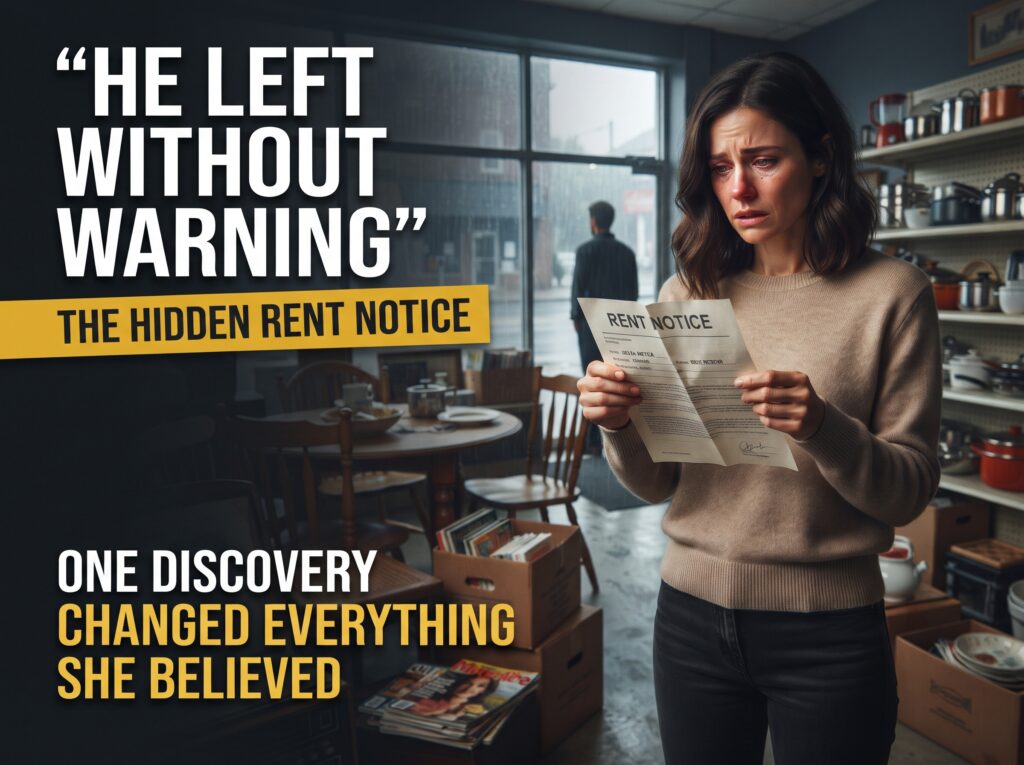
The secondhand store was the last place I expected to find a piece of my old life.
I had passed it dozens of times without stopping. Its windows were crowded with mismatched chairs, old lamps, boxes of kitchen utensils, and furniture that seemed to belong to people who had moved away in a hurry. A faded sign above the entrance promised affordable household goods, but to me the place had always looked like a final destination for things nobody wanted anymore.
That afternoon, I understood how quickly a home could become a collection of unwanted objects.
My boyfriend and I had once furnished our apartment with secondhand pieces. We had been proud of that. We found a small dining table with scratches along its edges, two chairs that did not match, and a sofa whose cushions had faded unevenly. We could not afford anything expensive, but we made the place comfortable.
He used to say that the furniture did not matter as long as we had each other.
I had believed him.
Then the bills started arriving faster than we could pay them.
At first, we treated the situation as a temporary inconvenience. We canceled subscriptions, stopped ordering food, and planned every grocery purchase. I learned how to stretch a bag of rice across several meals. He accepted additional work whenever it was available.
Whenever I became frightened, he reminded me that difficult months did not define a lifetime.
“We’ll get through this,” he would say, sitting across from me at our little kitchen table. “One bad month won’t destroy our future.”
I would reach for his hand and try to believe him.
But the months continued to get worse.
Eventually, we sold the television. Then the sofa. After that came the table and chairs. Each sale was accompanied by another promise that we would replace everything when our circumstances improved.
I never imagined that one day I would walk into a secondhand store and see the remains of our relationship displayed for strangers.
I had gone there hoping to find a small blue mug that belonged to me. It had a hairline crack near the handle, and my boyfriend used to tease me because I refused to throw it away. I wanted something familiar, something that reminded me that our life had existed beyond the final argument.
Instead, I found the rent notice.
It was tucked between a stack of magazines and a cardboard box filled with miscellaneous household papers. The sheet was creased down the middle, and one corner had been torn away.
I recognized the apartment address immediately.
For several seconds, I simply stared at it.
Both our names were printed near the top.
I picked it up, expecting to see another reminder of an unpaid balance. We had received plenty of those. But as I read the details, I noticed a reference number and a handwritten notation near the bottom.
The dates did not match the story my boyfriend had told me.
According to the notice, an arrangement had been discussed before he left. Someone had made a decision involving our financial obligations while I still believed we were planning our future together.
My hands began to tremble.
I checked the notice again, reading every line slowly. The amount listed was different from the figure I remembered him giving me. There was also a second name, written beneath a signature I recognized.
I had never seen that name connected to our rent.
“Excuse me,” I said to the woman behind the counter. “Do you know where this paper came from?”
She looked up from the labels she was writing.
“That was with a box of belongings someone brought in. Why?”
“Do you remember who brought them?”
She studied my face before answering.
“I’m not sure. Let me check the receipt.”
I waited beside the counter, holding the notice against my chest. The store suddenly felt smaller. Every object seemed to remind me of something I had lost: a chipped plate like the ones we used for dinner, a lamp resembling the one that had stood beside our sofa, a wooden shelf that looked almost identical to ours.
The woman returned with a small receipt.
She turned it toward me.
The handwriting was familiar.
My boyfriend had written his name across the bottom.
I felt the floor shift beneath me, although I knew I had not moved.
He had not simply left our apartment and abandoned the life we had built. He had brought our belongings here, and somehow this notice had ended up among them.
Why would he sell the things we had struggled to buy while keeping a document connected to our rent?
And why had he never told me about the arrangement?
I thanked the woman, folded the paper carefully, and walked outside.
Rain was falling over the street. Cars passed through shallow puddles, sending water against the curb. I stood beneath the awning and pulled out my phone.
His number was still saved in my contacts.
For weeks, I had avoided calling him because I feared another unanswered call would finally convince me that he was gone for good.
This time, I pressed the button.
The phone rang.
Once.
Twice.
Then his recorded greeting began.
I almost ended the call without speaking. Instead, I waited for the tone.
“I found the rent notice,” I said. “I know you were involved in an arrangement before we separated. Please call me. I need you to explain what happened.”
I stopped, swallowing the words I wanted to say next.
Then I ended the call.
I slipped the notice into my bag and started toward the bus stop.
I had gone into the store searching for a reminder of the life I had lost.
I left with the first piece of evidence that suggested I had never understood what had happened to it.
By the time I reached home, the rain had soaked through my shoes.
My apartment was cold, and the electricity meter showed that I had less credit remaining than I had expected. I turned on the kitchen light, placed my bag on the table, and took out the notice.
Two unpaid bills lay beside the sink.
I moved them aside and spread the paper flat.
I needed to know whether I had misunderstood it.
My boyfriend had always been careful with numbers. He remembered payment dates, calculated our expenses in his head, and knew exactly how much money we could spend without putting the rent at risk. I had trusted him because he seemed more confident than I was.
Whenever I asked about our savings, he told me not to worry.
Whenever a bill arrived, he promised that he had a plan.
I had thought his confidence meant he understood our situation.
Now I wondered whether it meant he had simply learned how to hide his fear.
I opened the drawer where I kept old correspondence. Most of the documents were ordinary: electricity statements, receipts, letters from the landlord, and notes reminding us when payments were due.
I found our original rental agreement.
Both our names appeared on it.
The signatures looked normal, and the dates matched my memory of moving into the apartment. But the agreement did not explain the separate arrangement mentioned on the notice.
I needed another source of information.
I took out my phone and opened our old messages.
The conversations went back more than a year. There were photographs of meals we had cooked, reminders about groceries, jokes about the broken washing machine, and messages exchanged during his late shifts.
I searched for the words rent, payment, and money.
At first, I found nothing unusual.
Then I reached a conversation from the week before the date written on the notice.
I had asked him whether we were going to be able to pay everything that month.
His answer had been immediate.
I’ve handled it. Please don’t worry.
Two days later, I had sent him a message thanking him for working so hard.
He replied with a heart and wrote that everything he did was for our future.
I remembered that conversation clearly. I had been sitting on the floor, sorting through clothes we planned to sell. I had felt guilty that he was carrying so much responsibility.
I had told him that we would find a way to make things easier.
He had answered that I had already done enough.
At the time, those words had felt loving.
Now they seemed carefully chosen.
I continued searching until I found another message, sent late at night.
I just need you to trust me a little longer.
I read it several times.
There had been no argument that evening. I had not accused him of anything. I had simply asked whether we should postpone buying groceries until the following day.
Why had he asked for my trust as though I had already questioned it?
I checked the date.
It was two days after the notice’s reference date.
My chest tightened.
I searched the conversation again, looking for an explanation. There were messages about work, meals, and ordinary household problems, but nothing about the arrangement.
I began to understand that the missing information was not an oversight.
Someone had decided not to tell me.
I was still staring at the screen when a message arrived from my friend Clara, who had helped us move into the apartment.
How are you holding up?
I typed that I was fine, then deleted it.
Instead, I told her about the notice.
Her response took several minutes.
Where did you find that?
I explained.
Another pause followed.
Then she wrote, Olivia, I think you should speak to me before you contact anyone else.
I called her immediately.
She answered in a whisper.
“Are you alone?”
“Yes. What’s going on?”
“I don’t know everything.”
“Clara, please. I need you to tell me what you know.”
She sighed.
“Your boyfriend came to see me before he left. He was frightened. He said there was something he needed to fix, and he asked me not to tell you until he had sorted it out.”
I gripped the phone.
“What did he need to fix?”
“He didn’t explain everything. He said it involved money and a decision he regretted.”
“Did he tell you about the rent arrangement?”
“Not directly.”
“Then why did you agree to keep quiet?”
“Because he said telling you at that moment would make everything worse.”
I looked at the notice on the table.
“Everything was already getting worse.”
“I know,” Clara whispered. “I know that now.”
“Who else was involved?”
She hesitated.
“I think you should meet me tomorrow. There are things I can’t explain properly over the phone.”
“Where?”
She gave me an address near the property office that had handled our rental agreement.
Before we ended the call, she said one more thing.
“Olivia, whatever you find, please don’t assume you understand the whole story yet.”
I stared at the notice after she hung up.
For the first time, I understood why the dates had frightened me so much. They did not merely suggest that my boyfriend had hidden a financial problem.
They suggested that he had been hiding it while asking me to trust him.
And Clara seemed to know more about that decision than she wanted to admit.
I barely slept that night.
Every time I closed my eyes, I imagined the moment I had found the notice. I remembered the handwriting on the receipt, the name beneath the signature, and the message asking me to trust him longer.
I had spent weeks trying to understand why my boyfriend had left. I had replayed our final argument so many times that I could remember the exact expression on his face when he picked up his coat.
He had looked exhausted.
I had mistaken that exhaustion for indifference.
Now I wondered whether it had been fear.
The next morning, I left early and took a bus toward the property office. Clara was waiting outside beneath a narrow awning, holding a paper cup of coffee she had barely touched.
“You look terrible,” she said softly.
“So do you.”
She gave a faint, uncomfortable smile.
“I suppose neither of us has been sleeping.”
I wanted to ask her everything at once, but I knew that if I let my anger take over, she might retreat into silence again.
Instead, I showed her the rent notice.
“Tell me what you know about this.”
She read it carefully.
“I recognize the reference number,” she said.
“From where?”
“Your boyfriend showed me a document with the same number.”
“When?”
“Before you separated.”
“Why?”
“He wanted advice. He said he had made a promise to someone and couldn’t keep it.”
I felt my stomach tighten.
“Was that promise connected to our money?”
“I think so.”
“You think so, or you know so?”
Clara looked at me.
“I know he was worried about money. I don’t know exactly what he had agreed to do.”
I studied her face, trying to decide whether she was telling me the truth.
“Who was the other person?”
She gave me a name.
I had heard it before, though I had never thought much about the person behind it. They had been part of my boyfriend’s life long before we met. I knew they had once been close, but I had assumed their friendship had faded over time.
“What did this person want from him?” I asked.
“I don’t know.”
“Did they ask him for money?”
“I never heard him say that.”
“Then why was he frightened?”
Clara looked down at the pavement.
“He said that if he couldn’t settle the matter, it would affect someone who had nothing to do with it.”
I felt a chill move through me.
“Someone like me?”
She did not answer.
We entered the property office together.
A man behind the desk listened as I explained that I had found a notice connected to an agreement I did not remember authorizing. He asked to see the document and compared its reference number with the records available to him.
“I remember this case,” he said. “There was a discussion about the outstanding balance and a proposed payment arrangement.”
“Who made the arrangement?”
“Your boyfriend attended a meeting. He told us he was dealing with the matter on behalf of the household.”
“But I wasn’t there.”
The man nodded.
“According to the records I can see, you weren’t present at that meeting.”
“Then why is my name on the notice?”
“Because you were both named on the tenancy.”
He explained that the notice did not, by itself, establish that I had agreed to every arrangement discussed. To understand what had happened, I would need copies of the relevant documents and clarification of which payments had been received.
I asked how to request them.
He gave me the necessary information and advised me to obtain independent advice if I believed my name had been used without authorization.
I thanked him.
Outside, Clara remained silent until we reached the corner.
“Did you know he was going to the office?” I asked.
“Yes.”
“Did you know he was making arrangements involving our rent?”
“I knew he was trying to solve a problem. I didn’t know he was making decisions that would affect you.”
“But you knew enough to keep me in the dark.”
She closed her eyes.
“I’m sorry.”
I wanted to accept the apology, but I could not pretend it answered my questions.
“Why did he tell you instead of telling me?”
“Because he was ashamed. He said you had already sacrificed too much, and he couldn’t bear the thought of disappointing you again.”
I shook my head.
“Then he should have trusted me enough to let me decide what I could bear.”
Clara began to cry.
“I know.”
For a moment, I felt sorry for her. She had been placed in a difficult position, and perhaps she had believed she was helping someone she cared about.
But her intentions did not change the fact that I had been left to face the consequences alone.
I thanked her for coming with me and returned home.
There, I gathered every document I could find. I placed the rent notice beside our rental agreement, then searched the drawer where we had kept old receipts.
At the bottom of a small metal box, I found an envelope bearing my name.
The handwriting belonged to my boyfriend.
Inside was a short note.
If Olivia asks about the agreement, tell her to look at the payments first.
Beneath the sentence was a date and a bank reference number.
I recognized the date immediately.
It was the day he had told me that our financial troubles were finally under control.
I looked from the note to the rent notice.
The two documents were connected.
And whatever had happened to our money, he had known about it long before he left.
The bank reference number gave me something I had not possessed before: a way to ask specific questions.
I visited the bank the following morning with my identification, the note, and the account information I had available.
I explained that I had discovered documents suggesting that a payment or transfer might be connected to a financial arrangement made before my breakup. I was careful not to accuse anyone. I wanted to know what the records actually showed.
The employee listened patiently.
“We can review transactions on an account you own or are authorized to access,” she said. “But we can’t disclose another person’s private account information simply because their name appears on a document.”
“I understand. I want to establish what happened to my own money.”
She asked me to complete a request and reviewed the relevant statement.
After several minutes, she returned with a printed record.
“There is a transaction on the date you’ve identified,” she explained. “The reference number appears here. I can’t tell you the purpose of the payment from this entry alone.”
I thanked her and stepped away from the counter.
The amount was larger than I expected.
It was money I remembered saving with my boyfriend for a deposit on a future home. We had discussed buying a small place someday, somewhere with a kitchen large enough for a proper table and a window where I could grow herbs.
We had saved slowly.
Some weeks, I had skipped lunch at work. He had accepted extra shifts. Whenever one of us suggested spending the money, the other reminded them why we were saving.
When the balance had dropped unexpectedly, he told me that an emergency expense had forced us to use part of it.
I had accepted his explanation because I trusted him.
Now the bank statement showed that a transfer had occurred on the date written on the note.
I could not establish from the statement alone where the money had gone or why. But the timing matched the period when he had assured me that everything was fine.
I sat on a bench outside the bank and opened our old messages.
On that very day, he had sent me a photograph of two cups of coffee.
One day we’ll have our own place, he had written. No more worrying about rent.
I remembered smiling at my phone.
I had been sitting on the floor of our apartment, surrounded by boxes, believing that we had finally found a way through the worst of our troubles.
Now the message felt almost unbearable.
I called him.
This time, he answered.
“Olivia?”
“I found the bank reference.”
Silence followed.
“I have a statement showing a transaction on the date you told me everything was under control. I need you to explain it.”
“I can’t explain everything over the phone.”
“You have said that every time I’ve asked you a question.”
“I know.”
“No, I don’t think you do. I have been trying to survive without knowing whether the person I trusted most was telling me the truth.”
His voice grew quiet.
“I never wanted you to suffer.”
“But I did suffer. I suffered while you knew there was something I needed to understand.”
He exhaled slowly.
“I thought I could fix it before you found out.”
“Fix what?”
He hesitated.
“I made an agreement. I thought I could settle it quickly. When I realized I couldn’t, I panicked.”
“Was the money from our savings?”
“I need to see the statement.”
“Why? You know the date.”
“Because I don’t want to give you an answer that turns out to be wrong.”
His response surprised me. For once, he seemed to understand that guessing would only make things worse.
I told him I would keep the statement safe and request whatever additional records were available.
Then I asked the question that had been tormenting me.
“Did you leave because you wanted to end our relationship?”
He was silent for so long that I thought the call had dropped.
“No,” he finally said. “But I knew I couldn’t keep pretending everything was fine.”
“Then why didn’t you tell me?”
“Because I was ashamed of what I’d done.”
“What did you do?”
He began to answer, but I heard a door close somewhere behind him.
“Listen to me,” he said urgently. “Don’t sign anything. Don’t agree to pay anyone anything until you’ve seen the complete records.”
My grip tightened around the phone.
“Who would ask me to pay?”
He did not answer.
“Who is the other person?”
“I have to go.”
“Wait—”
The call ended.
I sat there with the phone pressed against my ear, listening to the dead line.
His warning had made one thing clear: he believed I might soon be asked to accept responsibility for something I did not fully understand.
I returned home and placed the bank statement in the folder with the rent notice and the handwritten note.
Then I searched our old messages again.
This time, I found a conversation from the night before our separation.
I had asked whether we needed to worry about an arrangement connected to the rent.
He had replied:
Please trust me until tomorrow. After that, everything will make sense.
Tomorrow had come and gone.
He had left instead of explaining.
And I was beginning to suspect that the reason he had left was written somewhere in the documents I had only just begun to understand.
The next few days became a search through the ordinary things I had once ignored.
I checked old receipts, emails, and messages. I wrote down dates and compared them with the documents from the property office and the bank. Whenever I found something that seemed important, I recorded what it proved and what it did not prove.
I was tired of allowing fear to turn every unanswered question into a certainty.
The handwritten note had mentioned payments. The rent notice showed that an arrangement had been discussed before the breakup. The bank statement confirmed that a transaction had occurred on the date I had identified.
But none of those facts explained the entire story.
I needed the person whose name appeared on the notice.
I contacted Clara and asked whether she could help me arrange a conversation. She said she would try, although she warned me that the person might refuse to meet.
That afternoon, I received a message from an unfamiliar number.
We need to talk about the documents you found.
I stared at the screen.
I asked who was messaging me.
The answer came several minutes later.
Someone who knows why the payments were made.
I considered blocking the number. I had spent too long being pulled into conversations where someone else controlled the information. But if this person genuinely knew something about the arrangement, I needed to hear what they had to say.
I replied that I would meet only in a public place, that I would not sign anything, and that I would not agree to any payment without understanding the records.
The response was brief.
Tomorrow. The café beside the property office. Bring the notice.
I spent the evening preparing.
I put the original notice in a protective folder and made copies of the other documents. I wrote down the questions I wanted answered.
Who had initiated the arrangement?
What was the purpose of the transfer?
Why had my name been included?
And what had happened on the night my boyfriend left?
I knew the last question might be the most difficult to answer.
I also knew I could no longer afford to let someone else’s discomfort prevent me from asking it.
The following morning, I arrived at the café early.
A woman entered ten minutes after the agreed time. She looked around the room before approaching my table.
“Olivia?”
“Yes. Who are you?”
“My name is Helen. I was involved in the arrangement connected to your rent.”
I asked her to identify herself before I showed her the original document. Once I was satisfied that she was the person named in the records, I placed the notice on the table.
She examined it carefully.
“I knew you would eventually find this,” she said.
“Then you know what happened?”
“I know part of it.”
I felt my patience thinning.
“Everyone seems to know part of it. I need someone to tell me what actually happened.”
Helen nodded.
“Your boyfriend came to me because he believed he had run out of options. He was frightened and ashamed. He thought he could settle the matter without involving you.”
“Why did he need your help?”
“Because of a financial commitment he had made.”
“Was it a loan?”
“Not exactly.”
“Then what was it?”
She opened her bag and removed an envelope.
“I brought copies of the records I have. Some of the details will need to be verified, but they may help you understand the arrangement.”
I read the documents slowly.
They connected the payment arrangement to the period before our breakup. They also showed that my boyfriend had been trying to resolve an obligation while keeping me unaware of how serious the situation had become.
I asked whether the transfer from our savings had been used to pay that obligation.
Helen explained that the records she possessed did not establish every transaction or its purpose. She could not honestly tell me where all the money had gone.
For once, someone had admitted the limits of their knowledge.
I appreciated that more than she could have known.
“Why did he leave?” I asked.
Helen looked down at the table.
“I think you should hear that from him.”
“I tried. He won’t tell me.”
“He may believe that telling you the truth will cause more harm.”
“That isn’t his decision anymore.”
She looked at me for a long moment.
“No,” she said. “It isn’t.”
Then she removed a final page from the envelope.
“This is something he gave me on the night you separated. He asked me to keep it in case he couldn’t come back.”
My heart began to race.
“Why would he give you something on the night he left?”
“Because he believed he might not be able to explain himself later.”
She slid the page toward me.
The handwriting was his.
If Olivia ever asks why I left, tell her I was trying to keep her from making the same mistake I made.
I read the sentence twice.
It explained nothing about the money, but it made the breakup feel less like a sudden decision and more like the end of something that had been unfolding for much longer.
“Did he tell you what mistake he meant?”
“No.”
“Did he tell you where he was going?”
“No. He only said that he hoped he could make things right.”
I held the note carefully.
I still did not know whether he had been protecting me, protecting himself, or trying to keep another person’s secret.
But Helen believed there was another record that might explain why he had been so determined to settle the matter before I discovered it.
And she believed the person holding that record had been involved on the night my boyfriend disappeared.
I called my boyfriend that evening.
I told him about the meeting with Helen and read him the sentence from the note.
He did not deny writing it.
“I thought I could fix everything before you had to know,” he said.
“You keep saying that. What was the mistake?”
“I made a commitment without thinking through the consequences. When I realized I couldn’t keep it, I tried to solve the problem quietly.”
“Why did it involve our rent?”
“Because the problem affected money I had expected to replace before the bills came due.”
I closed my eyes.
“Did you use our savings?”
“I made a transfer. I should have told you.”
“That isn’t an answer to the question.”
He took a breath.
“I need to see the full statement before I can explain every detail. I know money moved, but I don’t want to tell you something about the recipient or the purpose that I can’t verify.”
His answer frustrated me, but it was more honest than the reassurances I had received before.
“Then help me get the records.”
“I will.”
“All of them. No more secret agreements, no more asking other people to speak for you.”
“I understand.”
I wanted to believe him, but trust could not be restored by a single conversation. I had spent weeks discovering how little I knew about decisions that had affected my life.
We arranged to meet the following day in a public café.
When I arrived, he was already there. He looked exhausted, his shoulders bent beneath a worn coat. For a moment, I remembered the man who used to sit across from me at our kitchen table, drawing plans for a future we both believed we could reach.
Then I remembered the rent notice.
I sat down and placed my folder between us.
“Tell me about the night you left.”
He looked at the folder rather than at me.
“I had been trying to resolve the financial commitment for weeks. I thought I could pay what was needed and put everything behind us. But I couldn’t do it.”
“Why didn’t you tell me?”
“Because I was ashamed. I knew you had already sacrificed so much. I thought that if you knew how bad things had become, you would feel responsible for helping me.”
“I was already responsible for our shared expenses. I was already frightened about the rent. You didn’t protect me by hiding the truth.”
“I know that now.”
“Do you? Because you still left me to deal with everything alone.”
His eyes filled with tears.
“I thought leaving would stop you from being pulled into something you hadn’t agreed to.”
“What was I supposed to be pulled into?”
He hesitated.
“An agreement. A responsibility. Something I should never have allowed to become your problem.”
I asked him whether he had been planning to ask me to sign a document.
“At one point, I thought I might have to ask you to help me settle it,” he admitted. “Then I realized I couldn’t ask you to take responsibility for something you didn’t understand.”
“So you left instead.”
“Yes.”
I felt anger rise, but beneath it was a sadness I had carried for weeks.
“I would rather have faced a difficult truth with you than spent all that time believing I wasn’t worth an explanation.”
He lowered his head.
“I know.”
For the first time, he did not try to defend himself.
He told me that the person involved in the arrangement had contacted him again. They had mentioned another record, one they believed would clarify what had happened.
“Who has it?” I asked.
“I don’t know where the original is now.”
“But you know who was involved.”
He gave me the name.
It matched the second name on the rent notice.
I wrote it down beside the dates in my notebook.
“We’re going to request the full records,” I said. “If my name has been used to suggest that I agreed to something, I need to know exactly what was submitted and by whom.”
He nodded.
Before we left, he reached into his coat and took out a small envelope.
“I found this among my things after I left. I think it belongs to you.”
My name was written across the front in unfamiliar handwriting.
Inside was a copy of a document connected to the same financial arrangement.
Near the bottom was a statement suggesting that I had been informed of the agreement.
I stared at it.
“I never saw this.”
“I know.”
“Then why does it suggest that I agreed?”
He looked as confused as I felt.
“I don’t know.”
For the first time, we were facing the same uncertainty.
We agreed to preserve the document and obtain the original record before drawing conclusions. I would not sign anything or accept any financial responsibility based on a page whose history I did not understand.
When I returned home, I placed the envelope beside the rent notice.
The dates were close enough to suggest a connection.
But the document had raised a question that neither of us could answer.
Someone had recorded that I had agreed to something I had never seen.
And the answer to that mystery might explain why my boyfriend had been so frightened on the night he left.
The following days were quieter than I expected.
I had imagined that discovering the document would immediately lead to an explanation. Instead, I found myself waiting for replies, requesting records, and trying to understand the difference between what the paperwork appeared to say and what had actually happened.
I had to remind myself that uncertainty was not proof.
The statement suggesting that I had agreed to the arrangement was serious, but I did not know who had prepared it or whether it had been used to make any decision. I needed the original records and a proper review.
I kept copies of everything and wrote down each conversation.
Meanwhile, I continued dealing with the ordinary responsibilities that had not disappeared simply because I had discovered a mystery.
I worked my shifts, bought groceries carefully, and arranged payments according to what I could afford. I stopped borrowing money to cover expenses without first understanding whether I had other options.
Some evenings, I still missed my boyfriend.
I missed the familiar sound of his key in the door and the way he would ask whether I had eaten. I missed our plans, even the unrealistic ones. I missed believing that if we were patient enough, everything would eventually become easier.
But I no longer confused missing someone with needing to trust them.
One evening, he called.
“The person whose name appears on the document has contacted me,” he said.
“What do they want?”
“They want to meet and discuss the arrangement.”
“Will they bring the original record?”
“They said they would.”
I agreed to attend, provided that the meeting took place somewhere public and that I would not be asked to sign anything.
He accepted those conditions.
The next afternoon, we met in a small office near the property agency. The person who arrived carried a thick envelope and appeared deeply uncomfortable.
They placed the envelope on the table.
“I understand you have questions,” they said.
“I have a document suggesting I agreed to an arrangement I never saw. I have a rent notice with my name on it, and I have a bank statement showing a transaction that coincides with the dates involved. I need to understand what happened.”
The person nodded.
They removed several pages from the envelope and spread them across the table.
The first was the original record associated with the arrangement. The others contained supporting information that had not appeared in the copies I had seen.
I read every page carefully.
The documents confirmed that a financial commitment had been discussed before the breakup. They also showed that my boyfriend had been trying to resolve it while concealing the seriousness of the situation from me.
But I could not establish every detail from the documents alone.
I asked who had prepared the statement containing my name.
The person explained what they knew and acknowledged that some details required further verification. They could not establish from memory alone exactly how the wording had been chosen or what information had been provided at the time.
I asked for copies of the full record and any supporting documents.
They agreed.
Then I reached the final page.
There was my name.
Beside it was a statement suggesting that I had been informed of the arrangement and had agreed to its terms.
My hands began to shake.
“I never signed this,” I said.
My boyfriend leaned forward.
“I told you she didn’t know.”
The room fell silent.
I turned toward him.
“You knew this statement existed?”
“Not this exact page,” he replied. “I knew there had been discussions that made it sound as though you were involved.”
“And you still didn’t tell me.”
He looked down.
“I was afraid.”
“You were afraid, so you let me believe that I had done something wrong. You let me think our financial troubles were simply bad luck. You let me face the bills without understanding why they had become so difficult to manage.”
He did not argue.
The person who had brought the envelope explained that the record had been retained because there had been disagreement about what was discussed and what had actually been agreed.
They had delayed bringing it forward because they believed the matter could be resolved privately.
I looked at them.
“Keeping it private did not make the problem disappear. It only meant I was the last person to understand what was happening.”
They nodded.
I asked that the documents be preserved and reviewed properly. I wanted to know who had prepared the statement, how it had been used, and whether any financial obligation had been assigned to me on the basis of consent I had never given.
No one objected.
When the meeting ended, I walked outside with my boyfriend.
The rain had stopped, and the pavement shone beneath the afternoon light.
“Are you going to forgive me?” he asked.
I looked at him.
“I don’t know.”
He nodded, accepting the answer.
“I wish I had told you everything.”
“So do I.”
I could see that he wanted to say more. Perhaps he wanted to ask whether there was still a future for us.
But I could not promise him one.
I still cared about him. That feeling had not disappeared simply because I had learned things that hurt me. Yet caring about someone did not require me to ignore what they had done.
We said goodbye without making promises.
I returned home with the documents in my bag, knowing that the truth was finally becoming clearer.
But one question remained.
Why had the person who prepared the statement believed that I had agreed to something I had never seen?
And what had happened on the night my boyfriend left that made him believe silence was the only way to protect me?
I spent the next week organizing the records and seeking independent advice.
The process was slower than I wanted, but it was necessary. I had learned that a document could raise important questions without answering them. I needed to know whether the statement had any legal effect, what the original agreement contained, and how the bank transactions related to the arrangement.
I refused to let anyone rush me.
My boyfriend helped gather the information he could access. For the first time, he was answering questions instead of telling me not to worry.
It did not erase the past, but it allowed us to speak more honestly.
He admitted that he had delayed telling me about the financial commitment because he believed he could settle it before it affected our relationship. When the situation became harder to manage, he began asking other people for help.
Each delay made the next conversation more difficult.
Eventually, he had become so frightened of the truth that he believed leaving would prevent me from being drawn into the problem.
“I thought I was giving you a chance to start again without me,” he said during one conversation.
“You didn’t give me a chance,” I replied. “You made the decision for me.”
He accepted that.
I told him that I could understand being frightened without excusing his silence. If he had trusted me enough to explain what was happening, we might have faced the problem together. Instead, he had left me to discover it through old papers and strangers.
He said he was sorry.
This time, I believed that he regretted what he had done.
But regret was not the same as repair.
The following morning, I received a call from the office handling my records request. They had located another document associated with the reference number.
The employee explained that the document needed to be reviewed before a copy could be released. They could not discuss its contents over the phone, but they confirmed that the date matched the night of our separation.
I asked whether it might clarify the statement containing my name.
They could not say.
I thanked them and ended the call.
I sat at the kitchen table, looking at the folder beside me.
For months, I had treated the truth as a single revelation that would make everything suddenly understandable. Now I was learning that the truth could arrive in pieces, each one requiring patience and careful examination.
I had to accept that some questions would remain unanswered until the records were available.
Then my phone rang again.
It was my boyfriend.
“The person who brought the envelope contacted me,” he said.
“What did they say?”
“They believe the original record will explain why the statement was written that way.”
“Do they have it?”
“They say they do.”
I took a slow breath.
“Then we need to see it.”
He agreed to arrange another meeting.
Before we ended the call, he said something that made me pause.
“They also said there was something I should have told you about the night we broke up.”
I felt the familiar tightening in my chest.
“What?”
“They wouldn’t explain it to me over the phone.”
“Why not?”
“They said you needed to hear it from the person who was there.”
I looked toward the window.
For weeks, I had been searching for an answer to the same question: why had he left without warning?
Now someone was telling me that the answer depended on a conversation I had never known had taken place.
I asked for the person’s name.
He gave it to me.
It was the same name that appeared on the original notice.
I agreed to attend the meeting, but I made one condition clear.
“I will listen to whatever they have to say. I will read every document. But I will not accept responsibility for something I never agreed to, and I will not let anyone tell me what I should believe before I have seen the evidence.”
My boyfriend said he understood.
After the call, I took the rent notice from its folder and turned it over once more.
The faint impression of writing was still visible near the lower corner.
She must never be asked to sign.
I had wondered whether those words were a warning, a confession, or an attempt to protect me.
Now I understood that I could not determine their meaning from the sentence alone.
I needed the complete story.
And the person who had kept the original record had finally agreed to show it to me.
The meeting took place the following afternoon.
I arrived early and chose a seat near the window. My folder rested on the table, containing the rent notice, the bank statement, the handwritten note, and copies of every document I had received.
My boyfriend arrived a few minutes later.
He looked at the folder but did not touch it.
“I know you have every reason not to trust me,” he said.
“I need you to understand that this meeting isn’t about making me trust you again. It’s about finding out what happened.”
He nodded.
The person we were waiting for entered carrying an envelope.
They sat opposite us and placed it on the table.
“I have the original record,” they said. “I also have a note relating to the night you separated.”
I felt my hands grow cold.
“Why wasn’t this brought forward earlier?”
“Because I believed the situation could be resolved privately. I thought that if the financial arrangement was settled, the rest would no longer matter.”
“But it does matter,” I replied. “I have spent weeks wondering whether the person I loved had been protecting me or using me. The truth matters even if the money can be recovered.”
The person nodded and opened the envelope.
The first document was the original record associated with the financial arrangement. It contained information that matched the reference number on the rent notice and the dates I had been tracking.
I read it carefully.
The record confirmed that the arrangement had been discussed before the breakup and that my boyfriend had attempted to resolve a financial obligation without explaining its full consequences to me.
It also showed that my name had been included in a statement about the arrangement.
But the document did not, by itself, establish that I had knowingly agreed to its terms.
I asked whether the person could explain how that statement had been prepared.
They described the circumstances as they remembered them, acknowledging that they could not verify every detail without additional records.
I listened without interrupting.
Then I asked for the note relating to the night we separated.
The person hesitated before removing another page.
“This is the part your boyfriend didn’t know how to explain,” they said.
I looked at the handwriting.
It was not my boyfriend’s.
The note referred to a conversation that had taken place before he left. According to the person who had written it, my boyfriend had been trying to determine whether I would be expected to take responsibility for the financial commitment.
He had been told that the matter could be resolved if the required documents were completed.
But I had never agreed to complete them.
The note did not establish that anyone had deliberately falsified my consent. It did, however, confirm that there had been uncertainty about what I had been told and what I had actually accepted.
I looked at my boyfriend.
“Is this why you left?”
He nodded slowly.
“I thought you might be asked to sign something. I was afraid that if I told you how bad things had become, you would agree to help me because you loved me.”
“You should have trusted me enough to let me decide.”
“I know.”
“Instead, you left me believing that you had stopped loving me.”
He closed his eyes.
“I never stopped caring about you.”
I wanted those words to be enough.
They were not.
Caring about someone did not erase the weeks of fear, the unpaid bills, or the decisions made without my knowledge. If we were ever to have a future, it would have to be built on honesty rather than the belief that one person should protect the other from difficult choices.
I turned back to the documents.
“What happens now?”
The person explained that the records would need to be reviewed and the remaining questions resolved through the appropriate process. There would be no instant answer to every financial issue, but the original documents gave us a clearer basis for determining what had happened.
I asked for copies.
Then I made a final request.
“I want every future communication about this matter in writing. No more secret arrangements. No more messages passed through other people.”
They agreed.
When the meeting ended, I left with the original record copied into my folder and a clearer understanding of the circumstances surrounding the breakup.
I still did not know every detail of the financial commitment. I still needed to verify the transactions and establish whether anyone had attempted to assign an obligation to me without my consent.
But I no longer believed that the relationship had ended simply because my boyfriend had stopped caring.
He had been frightened, ashamed, and unwilling to trust me with the truth.
That did not excuse his choices.
It did explain why the final weeks of our relationship had felt so confusing.
Outside, the air was cool and the clouds were beginning to clear.
My boyfriend walked beside me without asking whether I would come back.
For once, he allowed me to decide what happened next.
I told him that I needed time.
He said he understood.
Then we parted.
I returned home and placed the documents in the drawer where I kept important papers.
The mystery had not ended with a single dramatic revelation. It had ended with a clearer account of what had happened, a record of what still needed to be verified, and the understanding that I had a right to make my own decisions.
I had come looking for an apology or a reason.
What I found was more complicated than either.
And for the first time, I was ready to face that complexity without letting it take away my peace.
The following morning, I woke before the alarm.
For several seconds, I lay still, listening to the quiet sounds of the building. Somewhere above me, a neighbor moved a chair across the floor. Outside, a vehicle passed through the street, and a door closed in the distance.
The world had continued while I was trying to understand mine.
I got out of bed and made tea.
The kitchen was small, and the table still carried a faint scratch from the days when my boyfriend and I had eaten dinner there. I used to think of that scratch as a reminder of the life we had built together. Now I saw it differently. It was a reminder that something could remain after the people who created it had changed.
I took the folder from the drawer and checked its contents.
The rent notice was there, along with the bank statement, the handwritten note, and the copies of the documents we had obtained. I had made a list of the remaining questions and the steps required to resolve them.
There was still work to do.
The financial records needed further review. I had to establish which obligations were mine and which were not. I had to follow the proper process for questioning any document that suggested I had consented to an arrangement I had never seen.
None of that would happen overnight.
But I was no longer afraid to begin.
For weeks, I had believed that my greatest problem was the money we had lost. I had counted every coin, postponed every unnecessary purchase, and worried about every bill that arrived.
Those worries had been real. I could not pretend otherwise.
Yet the uncertainty had damaged something deeper.
I had begun to doubt my own judgment. I wondered whether I had ignored obvious signs, whether I had been foolish to trust my boyfriend, and whether I had somehow failed to be the person he needed.
Finding the documents forced me to confront those questions.
I had trusted him because we had built a life together. I had believed his promises because he had given me reasons to believe them. When he told me that everything would be fine, I had accepted his reassurance because I loved him.
That did not make me foolish.
It made me someone who had expected honesty from the person closest to her.
I could acknowledge that I had missed warning signs without accepting responsibility for decisions I had not made.
That distinction changed everything.
Over the next few weeks, I continued gathering records and following the advice I had received. I kept copies of every communication and asked for written clarification whenever something was unclear. I stopped agreeing to arrangements simply because someone sounded frightened or insisted that I needed to act quickly.
My boyfriend cooperated with the process.
He answered questions he had previously avoided and acknowledged the decisions he had made without telling me. He did not ask me to take responsibility for his mistakes, and he did not insist that I forgive him because he had been frightened.
That mattered.
It did not erase the harm, but it allowed us to speak without repeating the same arguments.
One afternoon, we met for coffee.
We sat across from each other at a small table near the window. Neither of us mentioned the future immediately. We talked about the records, the progress of the requests, and the practical steps still required to understand the financial situation.
Eventually, he placed his cup down.
“I know I can’t ask you to forget what happened,” he said.
“No, you can’t.”
“I wish I had told you the truth when things first started going wrong.”
“So do I.”
He looked at me.
“I thought I was protecting you. I kept telling myself that if I could solve the problem before you knew about it, you wouldn’t have to suffer.”
I watched him carefully.
“Did you ever consider that I might have wanted to help you?”
“Yes. But I was ashamed.”
“And you thought leaving would make that shame easier to carry?”
He nodded.
I took a slow breath.
“I loved you enough to face difficult things with you. But I cannot be the only person who decides that our relationship is worth fighting for. You made decisions that affected both of us, then kept me outside those decisions because you were afraid of how I would react.”
“I know.”
“I don’t know what will happen between us. I can’t promise that we’ll return to the way things were.”
“I understand.”
For the first time, his answer did not feel like another attempt to persuade me.
He was allowing me to choose.
That was something he should have done from the beginning.
We finished our coffee and walked outside together. The afternoon was bright, and the pavement had dried after the previous night’s rain.
At the corner, we stopped.
He asked whether I was going home.
“Yes,” I said.
“Would you like me to walk with you?”
I considered the question.
Then I shook my head gently.
“Not today.”
He accepted my answer.
We said goodbye without making promises.
As I walked home, I realized that I was not thinking about whether he would call me later. I was thinking about the groceries I needed to buy, the payment I had arranged, and the small repairs I wanted to make in my apartment.
Ordinary things.
Things that belonged to me.
I had spent so much time waiting for someone else to explain my life that I had forgotten I could continue living while I searched for answers.
That evening, I opened the cupboard and found the blue ceramic mug I had once searched for at the secondhand store. Its handle still had the tiny crack I remembered.
I washed it carefully and placed it beside the kettle.
For a moment, I thought about the woman I had been when my boyfriend first promised that we would get through anything together.
She had believed that love meant being patient, staying calm, and trusting the person she loved to know what was best.
I wished I could tell her something.
I wished I could tell her that she did not have to earn honesty by being understanding. She did not have to prove her love by accepting uncertainty. And she did not have to surrender her right to make decisions in order to save a relationship.
She could love someone and still ask questions.
She could care about their fear without allowing that fear to determine her future.
And she could walk away from a situation that hurt her without pretending that the love had never been real.
I sat beside the window with my tea and watched the evening settle over the street.
The bills had not disappeared. The financial questions had not all been resolved. I still had difficult conversations ahead of me, and I knew that rebuilding my confidence would take time.
But I no longer felt that my life was waiting for someone else’s permission to begin again.
I had found the rent notice in a store filled with the things we had sold. At first, I thought it was simply evidence of another loss.
Instead, it had forced me to ask questions I had been too frightened to ask before.
The truth had hurt.
It had changed how I remembered the relationship and made me reconsider promises I had once accepted without hesitation.
But not knowing had hurt me, too.
It had made me doubt myself, blame myself, and imagine explanations that were sometimes more painful than the facts I eventually discovered.
I could not recover every lost hour or undo every decision made without me.
I could not promise that love would never disappoint me again.
What I could do was refuse to build my future around another person’s silence.
I took the folder from the table and placed it in the drawer beside my other important documents. Then I closed the drawer, turned off the kitchen light, and carried my mug to the window.
For the first time in weeks, I felt no need to check my phone.
I was still rebuilding.
I was still learning how to trust myself again.
But I was no longer waiting for someone else to decide when I deserved the truth.
And that was where my new beginning started.
Olivia discovers a hidden rent notice in a secondhand store and uncovers secret financial decisions, missing money, and the truth behind her boyfriend’s sudden departure.