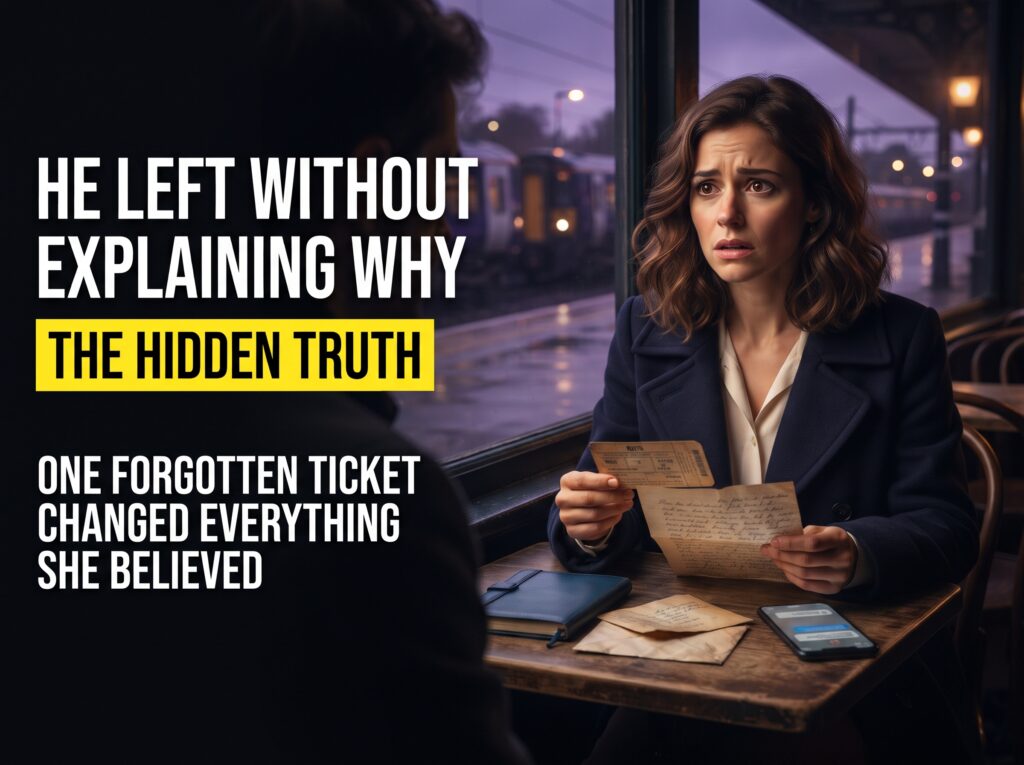
Ruth had always believed that love was supposed to make life easier to understand.
Not easier in the sense that everything went perfectly. She had never expected a life without arguments, disappointments, or difficult choices. Her parents had taught her that people could love each other deeply and still hurt one another. Her grandmother had taught her that forgiveness was sometimes more complicated than saying the right words.
But Ruth believed that when two people truly loved each other, they eventually found a way to tell the truth.
Even if it took years.
Even if the truth was painful.
Even if admitting it meant losing the person they were trying to protect.
For a long time, she believed Daniel shared that understanding.
He had been the person she called when something wonderful happened and the person she wanted beside her when everything went wrong. He remembered how she took her coffee, which songs made her sad, and the particular silence she fell into when she was worried about someone she loved.
He had known her before she learned how to hide her disappointment behind a smile.
He had known her when she still believed that the future was something two people could build simply by choosing one another every morning.
And then, one night, he disappeared from her life.
There was no dramatic argument that Ruth could remember as the beginning of the end. No accusation shouted across a room. No confession that made the past suddenly understandable.
There had been a conversation, a few unanswered questions, and a final exchange of words that Ruth had spent years trying to interpret.
Daniel had looked at her as though he wanted to explain something.
Then he had said, “Maybe we should stop making promises we can’t keep.”
Ruth had stared at him.
“What does that mean?”
He had lowered his eyes.
“I don’t know how to make this better.”
“Then tell me what happened.”
“I can’t.”
Those two words had become the walls around everything she could no longer understand.
She had waited for him to explain.
He had never returned.
Years passed, but Ruth did not entirely stop loving him. She stopped talking about him, stopped checking the places where they used to meet, and stopped telling her friends that she sometimes wondered whether he was happy.
She learned to make a life without answers.
She worked, paid her bills, helped her family, and became the dependable person everyone expected her to be. When people asked about her relationships, she gave brief explanations that left no room for further questions.
“We wanted different things.”
“It was a long time ago.”
“Some things simply don’t work out.”
Those answers were not lies.
They were just not the whole truth.
The whole truth was that Ruth had never understood how a person who once promised to stay could leave without explaining why.
She had wondered whether she had missed a warning sign. Perhaps Daniel had been unhappy for months. Perhaps she had been too focused on their future to recognize that he no longer wanted the same one.
Or perhaps he had loved her until the moment love became inconvenient.
That was the possibility she found hardest to accept.
She could forgive a person for changing their mind. She could even understand that a relationship might end despite the best intentions of both people.
What she could not understand was being denied the chance to know what had happened.
For years, she had told herself that not knowing was better than discovering something that would make the loss worse.
Then, on an ordinary Thursday afternoon, a forgotten drawer changed everything.
Ruth had spent the morning sorting through the belongings she kept in a small apartment above the secondhand bookshop where she worked. She was preparing to repaint the bedroom, and she had decided that the first step was to remove anything she no longer needed.
There were old receipts, photographs, birthday cards, and notebooks she had not opened since her twenties.
She placed most of them in a cardboard box.
The drawer at the bottom of her desk was different. It contained the things she had never been able to throw away because she could not decide whether they mattered.
A broken watch.
A ribbon from a birthday present.
A photograph of her parents when they were young.
And a small envelope with no name on it.
Ruth had no memory of putting the envelope there.
She opened it carefully.
Inside was a train ticket, faded at the edges and creased down the middle.
The destination was a town several hours away.
The date was nearly a decade old.
Ruth looked at it for a long time.
She had not taken a long train journey that year. At least, she did not remember taking one. She had certainly never traveled to the town printed on the ticket.
She turned it over.
On the back was a short handwritten sentence.
If you ever need to understand what happened, remember where the journey began.
Ruth felt a cold sensation move through her chest.
She recognized the handwriting.
It was hers.
<h2>Part 2</h2>
Ruth sat on the floor beside the open drawer, holding the ticket between her fingers.
The handwriting was unmistakable. The letter R had the same narrow curve she had used since childhood, and the final letters of each word leaned slightly to the right.
She turned the ticket over again, searching for another clue.
There was no name, no explanation, and no indication of who had kept it.
She checked the date.
It was the day she and Daniel had first met.
For a moment, she felt almost foolish.
Perhaps she had taken the train with a friend and simply forgotten. Perhaps she had written the sentence during one of her old attempts to keep a diary. People forgot things, especially when life became busy.
But the ticket carried a destination that had no obvious connection to her life.
And she knew she had never written a diary entry about a journey to that town.
She returned to the desk and emptied the remaining contents of the drawer.
At the bottom lay a small notebook with a blue cover.
Ruth remembered it immediately.
She had bought it during the first year she worked at the bookshop. She used to write down quotations, unfinished thoughts, and sentences she wanted to remember. She had abandoned it after a few months because she found herself writing the same worries repeatedly.
She opened it.
The first pages contained ordinary entries about work and family. There were descriptions of rainy mornings, complaints about an unreliable heating system, and a list of books she wanted to read.
Then she found the date printed on the ticket.
Beneath it was a short entry.
I met someone today who made me feel as though I had known him longer than I had. He asked me why I was standing alone at the station when the rain started. I told him I was waiting for a train. He said that was obvious, but it didn’t answer his question.
Ruth smiled despite herself.
She remembered the conversation.
She had been standing beneath the station awning with a book tucked inside her coat. The rain had begun suddenly, and everyone had crowded beneath the narrow shelter.
Daniel had been standing a few feet away, holding a paper bag that had begun to tear at the bottom.
When one of his oranges rolled onto the wet pavement, Ruth had picked it up and handed it back.
He had thanked her.
Then he had asked why she was standing alone.
She had told him she was waiting for a train.
He had laughed.
“That is the most technically correct answer I’ve ever heard.”
She had rolled her eyes.
“And you ask the most unnecessary questions.”
He had smiled.
“Only when I’m hoping someone will give me an interesting answer.”
They had talked for nearly twenty minutes before her train arrived.
Ruth had remembered the conversation for years because it was the first time she had met someone who could make her laugh without making her feel as though she needed to perform for him.
The notebook entry continued.
He asked whether I believed people could meet at the wrong time and still be right for each other. I told him I didn’t believe in the wrong time. I believed people made choices and then found ways to explain them.
Ruth paused.
She did not remember saying that.
It sounded like her, but it also sounded like something she might have written after the fact, when she had already learned how complicated love could become.
The next line was more troubling.
He said that one day I might understand why some journeys begin long before we know where we’re going.
Ruth closed the notebook.
The ticket and the note had been hidden together for years. Someone had kept them in the drawer, or perhaps Ruth had placed them there herself and forgotten.
But the sentence on the ticket suggested that she had intended to return to it.
Why?
She searched the notebook for further references to the train station.
There were several entries about Daniel, but nothing about a trip to the town printed on the ticket.
She checked her phone for old photographs, searching the dates around their first meeting. Most of the pictures had been transferred to cloud storage years earlier.
She found a photograph of herself standing outside the station.
Daniel was beside her.
He was looking toward the camera, but Ruth was looking at him.
She remembered taking the photograph. They had met for coffee several days after their first conversation, and Daniel had insisted that they return to the station because he wanted to see whether she still thought his questions were unnecessary.
She had laughed and told him that she had not changed her opinion.
The photograph was ordinary.
But the next image in the album was not.
It showed a train platform at night, empty except for a man standing beside a timetable.
The date was several weeks later.
Ruth zoomed in.
The man was too far away to identify clearly, but his coat looked like Daniel’s.
She searched the photographs around it.
There were no others from that evening.
Her memory offered only fragments: a phone call she had received at work, a hurried conversation with Daniel, and a promise that he would explain something when they had more time.
She had never understood what he meant.
Ruth returned to the notebook and read the final entry from that month.
I think he is frightened of something he hasn’t told me. I want to ask him what it is, but I am afraid that if I ask the wrong question, he will stop talking altogether.
Below it, in different handwriting, was a sentence she had never noticed before.
Don’t let her travel alone.
Ruth stared at the words.
They did not belong to her.
The letters were smaller and more tightly spaced, and the ink appeared darker than the writing around them.
Someone had written in her notebook.
Someone who knew about the journey.
Someone who had been worried about her traveling alone.
She looked again at the ticket.
For the first time, Ruth considered that the mystery might not concern Daniel’s disappearance alone.
It might concern something that had happened before he left.
<h2>Part 3</h2>
Ruth spent the following morning trying to establish whether she had ever traveled to the town printed on the ticket.
She began with her bank records.
The journey had taken place so long ago that some statements were no longer available through her online account. She contacted the bank and requested an archive of the transactions from that period.
While she waited, she searched through old emails and messages.
She found a conversation with her friend Hannah, who had moved abroad several years earlier.
The exchange had taken place a few days before Ruth and Daniel’s final conversation.
Hannah had asked whether Ruth was still planning to go away for the weekend.
Ruth had replied that she was not sure.
Daniel says it’s important, but he won’t tell me why.
Hannah had answered:
If you don’t feel comfortable going, you should tell him.
Ruth had written:
I trust him. I just wish he would explain.
The conversation ended there.
Ruth read the messages repeatedly.
She had no memory of planning a trip.
She remembered being worried about Daniel, but she could not recall why.
She called Hannah.
The number was still active, though the call went to voicemail. Ruth left a message asking her to call when she had time.
Then she searched her old calendar.
There was an entry for a train journey on the date printed on the ticket.
The destination was abbreviated.
The note beside it contained three words.
Meet at six.
Ruth felt her pulse quicken.
She opened the calendar details.
The appointment had been created on her phone, but the location field had been edited several times. The original location was no longer visible.
She checked the history.
The last edit had been made the night before the journey.
The change had removed the destination entirely.
Ruth sat back in her chair.
Someone had altered the calendar entry.
It could have been her. She might have changed the details for a perfectly ordinary reason.
But she could not remember doing so.
She called the railway company and asked whether they could verify the ticket.
The representative explained that the ticket was too old for the ordinary online system, but the serial number suggested it had been issued through a staffed station rather than purchased through the website.
The company could not tell her who had used it.
Ruth thanked the representative and ended the call.
She was beginning to understand how little a single clue could prove.
The ticket established that a journey had been planned. The calendar showed that she had intended to meet someone. The notebook suggested that Daniel had been worried about a journey.
None of those details explained why she could not remember what happened.
At noon, her phone rang.
Hannah was calling from an unfamiliar number.
“Ruth? I got your message.”
Ruth gripped the phone.
“Do you remember me planning a trip with Daniel?”
There was a pause.
“Which trip?”
“The one from years ago. To a town several hours away.”
Hannah did not answer immediately.
“Why are you asking me about that now?”
“Because I found a ticket.”
Another silence followed.
Then Hannah said, “I thought you had thrown it away.”
Ruth felt the room become very still.
“You knew about the ticket?”
“I knew you had one.”
“What happened?”
Hannah sighed.
“Ruth, I don’t think I should explain this over the phone.”
“Everyone keeps saying that to me.”
“I’m not trying to make things worse.”
“Then help me understand.”
Hannah’s voice softened.
“I remember you being frightened. You called me the night before you were supposed to go. You said Daniel had asked you to meet him somewhere, but he wouldn’t tell you who else would be there.”
Ruth closed her eyes.
The memory remained out of reach.
“Did I go?”
“I don’t know. You stopped answering my messages the next day.”
“Why didn’t you call me?”
“I did. Several times. Then Daniel called me and said you needed some time.”
Ruth opened her eyes.
“Daniel called you?”
“Yes.”
“What did he say?”
“He said you were upset and that I shouldn’t pressure you.”
Ruth felt anger rise through her.
“He had no right to tell you that.”
“I know that now.”
“Did he say why I was upset?”
Hannah hesitated.
“He said something had happened at the station.”
Ruth looked at the ticket on her desk.
“What happened?”
“I don’t know. He wouldn’t explain.”
The two women remained silent for a moment.
Then Hannah added, “There was something else. You asked me to keep a letter for you. You said you didn’t want to read it until you were ready.”
Ruth’s mouth went dry.
“What letter?”
“I don’t remember the details. You gave it to me in a sealed envelope. I kept it for a while, but when I moved overseas, I sent it back to your old address.”
Ruth searched her memory.
Nothing.
“Do you remember when?”
“About a month after you and Daniel stopped seeing each other.”
Ruth thanked her and ended the call.
She looked around the apartment.
The drawer had contained a ticket, a notebook, and a message in unfamiliar handwriting. Her calendar showed a journey she could not remember. Her friend remembered a letter that Ruth had apparently asked her to keep.
The clues were no longer isolated.
They were connected to a night that both Ruth and Daniel had avoided discussing.
She opened her email and searched for messages from Hannah around the time the letter had been returned.
She found an email with a photograph attached.
The image showed a brown envelope on a table.
The address was hers.
Beneath the address, in handwriting she recognized, were the words:
Open this only when you are ready to know why he left.
<h2>Part 4</h2>
Ruth spent the afternoon searching for the envelope.
She began with the desk, then moved to the filing cabinet, the bookshelves, and the cupboard beneath the kitchen sink where she kept old documents she had not yet sorted.
She found tax records, insurance forms, expired warranties, and several letters from people she had not spoken to in years.
The envelope was nowhere to be found.
She returned to the photograph Hannah had sent.
The envelope had been addressed to Ruth’s old apartment, the one she had shared with a roommate before moving above the bookshop.
That building had been sold, and the apartments had been renovated.
The landlord who managed the property had retired.
Ruth called the building’s current management office and explained that she was trying to recover an old letter that might have been returned to the sender.
The person who answered said the office no longer retained mail from former tenants.
Ruth thanked her and hung up.
She felt foolish for expecting the past to have preserved every object she had lost.
People moved. Buildings changed hands. Papers were discarded.
Memories faded.
Yet the more she discovered, the less she believed that ordinary forgetfulness explained everything.
She returned to the notebook.
The entry about the journey had been written in her handwriting, but the unfamiliar sentence beneath it suggested that someone else had handled the book.
She examined the paper carefully.
The page containing the sentence was slightly thinner than the others, as though it had been removed from another notebook and inserted later.
Ruth turned to the binding.
One stitch had been replaced.
Someone had repaired the notebook.
She took photographs and sent them to a local book conservator whose contact details she found online. The conservator agreed to examine it the following day.
Before going to bed, Ruth opened the calendar again.
She studied the entry marked Meet at six.
The date was the same date she had found on the ticket.
But the time had changed.
The original entry had been for six in the evening. The edited version showed six in the morning.
Someone had changed the time as well as removing the destination.
Ruth stared at the screen.
She remembered waking early that day and feeling that she had forgotten something important. She remembered receiving a message from Daniel, but she could not remember its contents.
She searched her archived messages.
Most of the conversation had been preserved, but a section was missing.
The gap covered several hours on the day of the journey.
There was no indication of whether the messages had been deleted intentionally or lost during a phone transfer.
Ruth felt her old fear returning.
What if she had chosen to forget?
What if the missing memories were connected to something she had done or said that she could not bear to remember?
She had always imagined Daniel as the person who had kept the truth from her.
But the clues suggested that she might have participated in the silence.
Perhaps she had asked him to leave.
Perhaps she had written the note herself because she wanted to protect someone.
Perhaps the relationship had ended for a reason she had once understood but later lost.
The uncertainty frightened her more than the possibility that Daniel had simply stopped loving her.
The next morning, Ruth took the notebook to the conservator.
He examined the binding, the paper, and the altered stitch.
“This has been repaired at least twice,” he said.
“Can you tell when?”
“Not precisely. But the inserted page is older than the adhesive used to attach it.”
Ruth leaned forward.
“Does that mean someone removed it and put it back?”
“It suggests that the page was separated from the notebook at some point. Whether it was removed deliberately, I can’t say.”
He examined the unfamiliar handwriting.
“The ink is different from the surrounding entries. Whoever wrote this used a heavier pen.”
“Could you identify the person?”
“No. But I can tell you something else.”
He pointed to the final words.
The sentence Don’t let her travel alone had been written on the reverse side of a page containing a faint impression.
The impression was too light to read clearly, but under angled light, several words became visible.
Ruth leaned closer.
The words appeared to read:
If she asks about the letter, tell her nothing until…
The rest was unreadable.
Ruth felt her stomach tighten.
The note had not simply warned someone to accompany her.
It had instructed someone to keep information from her.
She thanked the conservator and returned home.
On the way, she stopped at the station where she had first met Daniel.
The awning had been replaced. The timetable had been modernized, and the small café near the entrance had become a convenience store.
But the platform remained familiar.
Ruth stood where she remembered waiting for her train.
She tried to reconstruct the night of the journey.
She remembered Daniel’s face, pale beneath the platform lights.
She remembered a woman standing beside him.
She remembered hearing her own voice ask a question.
Then the memory disappeared.
Ruth closed her eyes and breathed slowly.
When she opened them, a man was standing near the ticket machine.
He was watching her.
For a moment, she thought she recognized him.
Then he turned away and walked toward the exit.
Ruth followed him with her eyes.
She could not be certain that she had seen him before.
But she knew one thing.
Someone else remembered that night.
And someone else had been waiting for her to remember it, too.
<h2>Part 5</h2>
Ruth returned to the station the following evening.
She told herself that she was being practical. If the journey had taken place, the station might still hold records that could help her understand where she had gone.
But beneath that explanation was a more personal reason.
She wanted to see whether the memory would return.
She arrived shortly before six.
The platform was crowded with commuters returning home. People stood beneath the lights, checking their phones and watching the departure board.
Ruth walked slowly past the ticket machines.
She stopped near the place where she had first spoken to Daniel.
For several minutes, nothing happened.
Then she noticed a woman standing beside a pillar.
The woman was in her sixties, with short gray hair and a dark coat. She held a small paper bag and watched the platform with an expression of quiet concentration.
Ruth did not recognize her.
But when the woman looked up, something in her face made Ruth stop.
The woman appeared startled.
Then she approached.
“Are you Ruth?”
Ruth’s heart began to beat faster.
“Yes. Do I know you?”
The woman looked toward the departure board.
“My name is Margaret. I knew Daniel.”
Ruth felt a wave of emotion move through her.
“How?”
Margaret hesitated.
“I was there that night.”
Ruth gripped the strap of her bag.
“What happened?”
Margaret looked at her carefully.
“I think you should sit down.”
They went to a small café near the station entrance.
Margaret ordered tea but barely touched it.
She explained that she had known Daniel through a community organization where he volunteered. He had been helping a family facing a difficult legal dispute, and he had been trying to find someone who could provide evidence in their case.
The details were complicated, but the family had been threatened with losing their home. Daniel had discovered documents that might help them challenge the decision.
“He was frightened,” Margaret said. “Not because he had done anything wrong, but because he knew someone was trying to stop him from speaking.”
Ruth listened without interrupting.
“Why did he ask me to come to the station?”
Margaret looked down at her hands.
“He wanted to give you something.”
“What?”
“A letter.”
Ruth felt a cold sensation move through her.
“The letter Hannah mentioned?”
Margaret nodded.
“Daniel believed it was safer for you to keep the letter than for him to carry it. He thought someone might search his belongings.”
Ruth stared at her.
“Then why did he leave me?”
“He thought you were in danger.”
The words seemed to change the air around them.
Ruth leaned forward.
“What danger?”
Margaret explained that Daniel had discovered a connection between the family dispute and someone he knew personally. He believed the person had access to private information and could use it to pressure people who were helping the family.
He did not know whether Ruth was being watched, but he feared that she could become involved without understanding the risks.
“So he decided to disappear?”
“He decided to keep you away from the investigation.”
“By refusing to tell me anything?”
Margaret looked pained.
“He thought you would insist on helping him.”
Ruth felt anger rise.
“Of course I would have. I loved him.”
“I know.”
“Then he should have trusted me enough to tell me the truth.”
Margaret did not argue.
For a long time, Ruth had imagined that Daniel’s silence meant he had stopped caring. The possibility that he had left because he cared too much was almost harder to bear.
It did not excuse what he had done.
It did not explain why he had allowed her to believe she was unworthy of an honest answer.
But it changed the question she had been asking herself for years.
Perhaps Daniel had not abandoned her because she was difficult to love.
Perhaps he had made a decision on her behalf because he was afraid.
Ruth looked at Margaret.
“Did he give me the letter?”
“I don’t know. I saw him put an envelope in your bag, but I left before you read it.”
Ruth remembered standing on the platform, searching through her bag for her ticket.
She remembered a conversation with Daniel that had ended abruptly.
She remembered being angry.
Then she remembered a woman’s voice saying that the train was arriving.
“Did I get on the train?”
Margaret nodded.
“You did.”
Ruth closed her eyes.
The memory returned in fragments.
The doors opening.
The cold air.
Daniel standing on the platform with his hands at his sides.
Her own voice asking him to come with her.
His answer.
I can’t.
She had stepped onto the train.
She remembered looking through the window as it began to move.
Daniel had remained where he was.
Ruth opened her eyes.
“Where was I going?”
Margaret gave her the name of the town printed on the ticket.
It was the location of a small legal office where the family involved in the dispute had arranged to meet a solicitor.
Ruth had been carrying the letter that contained evidence of the original agreement.
But she had never arrived at the office.
Instead, she had left the train at an earlier station and returned home.
Ruth stared at Margaret.
“Why?”
Margaret’s expression changed.
“Because someone called you.”
“Who?”
“I don’t know. But after you received the call, you became frightened. You said you had to go home.”
Ruth could barely speak.
She remembered the phone ringing.
She remembered a voice telling her that Daniel had lied to her.
She remembered feeling suddenly unable to trust anything she had been told.
And she remembered deciding that she would rather lose him than continue living with unanswered questions.
But she could not remember who had called.
Margaret reached into her bag and removed a folded sheet of paper.
“This was left with me in case you ever came looking.”
Ruth unfolded it.
The handwriting was Daniel’s.
If Ruth asks what happened, tell her that I wanted to explain. Tell her that I waited for her to come back.
Ruth read the sentence twice.
Then she looked at Margaret.
“Did he ever come back to the station?”
Margaret nodded.
“He waited until the last train left.”
<h2>Part 6</h2>
Ruth did not sleep that night.
She sat at the kitchen table with Daniel’s note beside her and the old ticket beneath her hand.
The memories that had returned were incomplete, but they were enough to change the story she had told herself for years.
Daniel had not simply disappeared.
He had been trying to protect someone involved in a dispute. He had carried a letter containing evidence. He had arranged for Ruth to travel to a solicitor’s office.
Then someone had called her.
And everything had changed.
Ruth opened her old notebook and searched for the date of the journey.
There was another entry she had overlooked.
It had been written the day after she returned home.
I don’t know who to believe. Daniel says he cannot explain everything yet. Hannah says I should stay away from the whole situation. Someone else says that if I trust him, I will regret it.
Beneath the entry was a second paragraph.
I asked him whether he loved me. He said yes. I asked him whether he trusted me. He didn’t answer.
Ruth remembered that conversation.
She had called Daniel the following evening, demanding an explanation.
He had tried to tell her that he could not discuss the case until the solicitor had reviewed the evidence.
She had accused him of making decisions without her.
He had said that he was trying to keep her safe.
She had told him that she did not need protection from someone who refused to trust her.
Then she had ended the call.
For weeks afterward, they had exchanged only a few messages.
Eventually, Daniel sent her a final note saying that he could not continue asking her to wait for him.
Ruth had interpreted the message as a farewell.
She had not understood that he might have believed he was releasing her from a danger she did not know existed.
Still, one question remained.
Who had called her at the station?
Ruth searched her old phone backups.
She found a record of a call from an unknown number on the date of the journey. The call had lasted less than a minute.
She could not recover the audio or the message that followed it.
But the number was still listed in the archived records.
She copied it and searched online.
The number no longer existed.
She tried the local telephone directory archives and found a business listing associated with the same exchange. It belonged to a private office that had closed several years earlier.
The office had been connected to property management.
Ruth felt her heart begin to race.
The dispute Daniel had been investigating involved a family threatened with losing their home.
The caller might have been connected to the people trying to stop him.
She called her lawyer and explained what she had found.
The lawyer advised her not to contact anyone involved until the documents had been reviewed.
Ruth agreed.
She did not want to turn an old mystery into a new conflict without understanding the evidence.
But she also refused to let the past remain hidden simply because someone had told her that knowing the truth would hurt.
The next morning, she met Hannah at a café.
Hannah looked older than Ruth remembered, but her smile was familiar.
They talked about their families, their work, and the years they had spent apart.
Eventually, Ruth placed the ticket on the table.
“I need you to tell me everything you remember about that night.”
Hannah looked at it for a long time.
“I remember you calling me after you returned home. You were crying, but you wouldn’t tell me why.”
“What did I say?”
“You said Daniel had chosen someone else over you.”
Ruth felt a familiar ache.
“Did I say who?”
“No. You said you couldn’t tell whether he had been lying to you or trying to protect you.”
Ruth looked down at the table.
That was exactly how she had felt.
Hannah continued.
“You also said someone had told you that Daniel was using you to carry documents. You thought he had brought you into the situation because he wanted to avoid being caught.”
Ruth closed her eyes.
The memory returned in pieces.
A voice on the phone.
A warning about the letter.
The suggestion that Daniel had chosen her because no one would suspect a young woman carrying an ordinary envelope.
She had believed the caller.
She had believed that Daniel had used her trust to make her part of something she did not understand.
But now she knew that he had been trying to give her the evidence so she could deliver it safely.
“Did I ever tell you who called me?”
Hannah shook her head.
“No. You said you didn’t want to know.”
Ruth felt a wave of sadness.
She had spent years blaming Daniel for withholding the truth, but she had also chosen silence when someone offered her a frightening explanation.
She had been hurt, confused, and afraid.
She had wanted to protect herself from further disappointment.
And in doing so, she had allowed a stranger’s warning to become the final explanation for the end of her relationship.
Hannah reached across the table.
“You were trying to survive something you didn’t understand.”
Ruth nodded.
“I know.”
“But you don’t have to keep believing the worst version of what happened.”
Ruth looked at the ticket.
For years, she had treated the past as a closed door.
Now she understood that she had never truly known what was on the other side.
<h2>Part 7</h2>
Ruth began searching for Daniel’s whereabouts.
She did not expect to find him immediately. His old phone number had been disconnected, and his social media accounts had disappeared years earlier.
She started with the community organization where he had volunteered.
The organization had changed its name, but its records showed that Daniel had worked there for several years after their separation.
He had helped families dealing with housing disputes, financial problems, and legal challenges.
Then, one day, he had stopped volunteering.
There was no public explanation.
Ruth contacted the organization’s former director, a retired solicitor named Mr. Harris.
He agreed to meet her.
They sat in his office, surrounded by shelves of old case files.
Ruth explained that she was trying to understand an incident involving a train journey and a letter.
Mr. Harris listened without interrupting.
When she mentioned Daniel’s name, he removed his glasses.
“I wondered whether someone would eventually ask about him.”
Ruth felt a sudden rush of hope.
“You know what happened?”
“I know part of it.”
He explained that Daniel had been assisting a family whose home was at risk because of a disputed property agreement. The family believed they had a legal right to remain in their house, but the original documents had disappeared.
Daniel had discovered that a copy of the agreement might still exist.
He had been trying to deliver the evidence to a solicitor who could challenge the decision.
Ruth listened carefully.
“Was the letter I was carrying part of that evidence?”
“Yes. At least, that was what Daniel believed.”
“What happened after I left the train?”
Mr. Harris sighed.
“The solicitor never received the letter.”
“Because I returned home.”
“Yes.”
Ruth felt a knot tighten in her chest.
“Did Daniel blame me?”
“No.”
The answer came so quickly that she looked up.
“He was worried about you. He thought someone had frightened you into abandoning the journey.”
“Did he know who called me?”
“No. But he suspected the caller was connected to the people trying to stop the case.”
Ruth stared at him.
“Why didn’t he tell me?”
“He tried. But by then, you had stopped speaking to him.”
She remembered the unanswered calls and the messages she had deleted because seeing his name made her feel sick.
Mr. Harris continued.
“Daniel believed that contacting you again would put you under more pressure. He thought you needed time to feel safe.”
“So he left me alone.”
“He made a decision. Whether it was the right one is another question.”
Ruth appreciated his honesty.
She did not want Daniel turned into a perfect man who had done everything correctly. He had withheld information. He had made choices without consulting her. He had allowed fear to shape their relationship.
But he had not necessarily abandoned her because he no longer loved her.
That distinction mattered.
Mr. Harris opened a cabinet and removed a folder.
Inside was a copy of the property agreement and a letter Daniel had written after the case was suspended.
The letter explained that the original evidence had never reached the solicitor. Without it, the legal challenge had become more difficult.
The family eventually reached a temporary settlement, but the dispute had never been fully resolved.
Ruth felt sick.
“Did the family lose their home?”
Mr. Harris hesitated.
“They were forced to leave the property, but they received assistance finding another place. Daniel continued helping them afterward.”
Ruth looked down.
She had never known that the journey was connected to a family facing eviction.
She had never known that the letter might have helped them keep their home.
She had believed the worst thing that happened that night was the end of her relationship.
Now she understood that the consequences had reached beyond the two of them.
“Did Daniel ever talk about me?” she asked.
Mr. Harris smiled sadly.
“More often than he intended.”
Ruth felt tears sting her eyes.
“What did he say?”
“That he wished he had explained everything sooner. He believed you deserved the truth, but he was afraid that telling you would expose you to the same pressure he was facing.”
“Did he ever try to find me?”
Mr. Harris nodded.
“He asked about you several times. Eventually, he stopped because he thought you had moved on.”
Ruth looked away.
She had moved on in the way people do when they have no other choice. She had built a life, made friends, and learned to live with the uncertainty.
But she had never stopped wondering whether Daniel had loved her.
Mr. Harris handed her another document.
It was a list of people connected to the original property dispute.
One name had been highlighted.
Ruth recognized the surname.
It belonged to the person who had managed the private office associated with the unknown phone number.
“Do you know where this person is now?” she asked.
Mr. Harris shook his head.
“I don’t. But someone contacted the organization recently asking whether Daniel was still involved in the case.”
Ruth looked up sharply.
“When?”
“Several weeks ago.”
“Who contacted you?”
Mr. Harris opened a small notebook.
“I wrote down the number.”
He turned the page toward her.
Ruth stared at it.
It was the same number she had found in her archived phone records.
<h2>Part 8</h2>
Ruth left Mr. Harris’s office with a copy of the number and a new understanding of the past.
She had spent years thinking that the story ended when Daniel stopped calling.
Now she knew that the legal dispute had continued long after their separation. Someone had tried to keep the original evidence from reaching the solicitor, and someone had recently begun asking about Daniel again.
The mystery was no longer simply about why he had left.
It was about who had been determined to prevent the truth from being known.
Ruth contacted her lawyer and shared the information.
The lawyer advised her that the old case records would need to be handled carefully. A phone number alone could not establish who had made the call, and the passage of time might make it difficult to prove what had happened.
But the number provided a useful lead.
Ruth began looking through old correspondence from the period surrounding the breakup.
She found an envelope tucked inside a book Daniel had once given her.
The envelope was empty.
Inside the flap, someone had written a date.
It matched the date of the call from the unknown number.
Ruth examined the book’s cover.
Daniel had given it to her during their first year together, telling her that the story reminded him of the way she looked at the world.
She had kept it because the inscription inside was in his handwriting.
For Ruth, who always asks the question everyone else is afraid to ask.
She sat with the book for a long time.
Perhaps Daniel had known that she would eventually want answers.
Perhaps he had hoped that she would keep asking questions even after he was gone.
She searched the book’s pages and found a small folded sheet of paper.
It contained an address.
The address belonged to a residential building in the town printed on the train ticket.
Ruth felt her heart pound.
The address might have been connected to the original meeting.
She checked the date on the paper.
It was the same date as the journey.
Someone had written the address before the ticket was issued.
Ruth called the building’s management office and explained that she was trying to identify a former resident who had lived there years earlier.
The manager could not provide private information, but he confirmed that the building had once housed a small legal practice.
The practice had since closed.
Ruth searched the public records and discovered that the solicitor who worked there had retired. She located a professional contact address and sent a letter explaining that she was trying to understand an old matter involving Daniel.
Several days passed.
Ruth continued working at the bookshop, but her thoughts kept returning to the letter.
She wondered whether she would ever recover enough information to reconstruct the journey.
She also wondered what she would do if she discovered that Daniel had been wrong about everything.
What if he had been protecting someone who did not deserve protection?
What if the evidence had never been as important as he believed?
What if the call had come from someone who was genuinely trying to warn her?
Ruth had learned that the truth was not always a single dramatic revelation. Sometimes it was a collection of small facts that made one explanation more likely than another.
She wanted to be fair to Daniel.
But she also wanted to be fair to herself.
He had made choices that affected her life without giving her the information she needed to make her own decisions.
Even if his intentions had been good, she had been left to carry the consequences.
One evening, her lawyer called.
The retired solicitor had replied.
He remembered Daniel and the disputed property agreement. He had kept some of the correspondence because the case had troubled him for years.
He agreed to meet Ruth the following week.
Ruth felt hope rise in her chest.
At last, someone who had been present during the original events might be able to explain the missing letter and the reason for the journey.
She prepared a folder containing the ticket, the notebook, the photograph, and the old messages.
She made copies of everything and wrote a timeline of the events as she understood them.
The night before the meeting, she received a message from an unknown number.
You have been asking questions about a night you don’t fully remember.
Ruth stared at the screen.
A second message arrived.
If you want the truth, stop looking for Daniel.
She read it twice.
Then a third message appeared.
He is not the person you should be afraid of.
Ruth felt her hands grow cold.
She called her lawyer, who advised her to preserve the messages and avoid responding.
Ruth saved screenshots and placed her phone on the table.
For years, she had believed that the past was dangerous only because it could hurt her feelings.
Now she understood that someone might still have a reason to keep the events of that night hidden.
And whoever that person was had noticed that she was getting closer.
<h2>Part 9</h2>
The retired solicitor’s office was located above a small pharmacy on a quiet street.
Ruth arrived early and waited in the reception area, holding her folder against her chest.
When the solicitor appeared, she recognized his name from the old documents.
He was in his seventies, with silver hair and a careful way of speaking. He invited her into his office and offered her a chair beside the window.
Ruth explained what she had discovered.
She showed him the ticket, the notebook, the photograph, and the messages from the unknown number.
He studied each item.
When he reached the final message, he looked troubled.
“Someone has been watching this matter for a long time,” he said.
“Do you know who?”
“I have suspicions, but I cannot give you a name without evidence.”
Ruth nodded.
She appreciated that he would not pretend to know more than he did.
The solicitor explained that Daniel had contacted him years earlier about a property agreement involving a family who had been threatened with eviction.
The agreement appeared to contain a clause protecting the family’s right to remain in the property, but the original document was missing.
Daniel believed that a copy existed in the records of a private office that had handled the transfer.
The solicitor had arranged to examine the copy when Daniel contacted him again.
The meeting was scheduled for the evening of Ruth’s train journey.
“Why was I involved?” Ruth asked.
“Daniel believed you could deliver the letter without attracting attention.”
“He could have told me.”
The solicitor nodded.
“Yes. He could have.”
Ruth waited.
“He was worried that the people involved in the dispute were monitoring his movements. He thought that if you carried the document, it would be less likely to be intercepted.”
Ruth felt anger rise.
“He used me without telling me what I was carrying.”
“I believe he thought he was protecting you.”
“That doesn’t make it right.”
“No,” the solicitor said. “It doesn’t.”
He opened a drawer and removed a copy of an old letter.
The letter had been written by Daniel shortly after the journey.
It explained that Ruth had received a phone call warning her not to deliver the document. Daniel believed the caller had deliberately misrepresented the situation to make her distrust him.
The solicitor had tried to contact Ruth afterward, but the address Daniel provided was outdated.
“Why didn’t Daniel contact me himself?”
“He did, initially. But after you stopped responding, he believed that further contact might make things worse.”
Ruth looked down at the letter.
She remembered how she had interpreted his silence.
She had believed it proved that he did not care enough to fight for their relationship.
But the letter suggested that he had been afraid of making her life more difficult.
The solicitor continued.
“The person who called you was connected to the office that held the disputed records. We never established precisely who made the call, but we believed the purpose was to prevent the letter from reaching me.”
“Did the person succeed?”
“Yes. The evidence never arrived, and the family lost the opportunity to challenge the decision at that time.”
Ruth felt the weight of the answer.
For years, she had believed that her relationship had ended because Daniel had chosen to leave.
Now she understood that an unknown person had deliberately interfered with their lives.
But the story was still incomplete.
The solicitor turned to the final page of the letter.
“There was one more thing Daniel asked me to do.”
He removed a sealed envelope from a filing cabinet.
It was addressed to Ruth.
The handwriting was Daniel’s.
“He asked me to keep this until you came looking for the truth.”
Ruth stared at the envelope.
“How long have you had it?”
“Since the year you separated.”
“Why didn’t you send it?”
“Daniel asked me not to. He believed that you should receive it only if you chose to investigate the matter yourself.”
Ruth felt tears gather in her eyes.
She had spent years wishing that Daniel would explain himself.
Now, when an explanation was finally within reach, she was afraid to open it.
The solicitor placed the envelope on the desk.
“You don’t have to read it here,” he said.
Ruth picked it up.
The paper was old, but the seal remained intact.
She slid a finger beneath the flap.
Inside was a single sheet of paper.
Daniel’s handwriting filled the page.
Ruth,
If you are reading this, it means you have decided that the truth matters more than the comfort of believing you already know what happened.
I am sorry I asked you to carry something without explaining why. I am sorry I thought silence would protect you. I am sorry that I allowed you to believe my leaving meant you were not worth staying for.
Ruth stopped reading.
Her hands were shaking.
She continued.
I loved you. I did not stop loving you because you asked questions or because you were frightened. I left because I believed someone was using our relationship to get to the evidence. I thought that if I disappeared, they would stop looking for you.
I was wrong about many things. I was wrong to make that decision alone. But I need you to know that I never wanted you to feel abandoned.
Ruth pressed the letter against her chest.
The solicitor waited quietly.
At the bottom of the page, Daniel had written a final sentence.
If you ever discover who called you that night, ask them why they needed you to believe I had lied.
Ruth looked up.
The solicitor’s expression had changed.
He was staring at the letter as though he had recognized something in the handwriting.
“What’s wrong?” Ruth asked.
He did not answer immediately.
Then he reached for the folder she had brought.
“Ruth, I think we need to examine the final message again.”
She opened her phone.
The unknown sender had written that Daniel was not the person she should be afraid of.
The solicitor read the message twice.
Then he looked at Ruth.
“I know someone who used to speak exactly like this.”
“Who?”
He closed the folder.
“I don’t want to accuse anyone without proof. But there is a person who has been connected to every stage of this story.”
Ruth felt her pulse quicken.
“Where can I find them?”
The solicitor gave her an address.
It belonged to a small café near the station where she and Daniel had first met.
He told her that the person had recently contacted him, asking whether Ruth had begun investigating the old case.
Ruth looked at the address.
She recognized the street.
It was the same place where she had received the first message that changed her life.
She put the phone away.
For years, she had believed that the most painful part of the story was Daniel’s disappearance.
Now she was beginning to understand that someone else had shaped the memory she carried of him.
And that person was still waiting.
<h2>Part 10</h2>
Ruth arrived at the café shortly before sunset.
The place had changed very little. The tables were still close together, and the windows still reflected the station lights after dark. A small bell hung above the door, ringing softly when she entered.
She looked around.
Most of the tables were occupied by commuters and people waiting for trains. A couple sat beside the window, sharing a pastry. An elderly man read a newspaper near the counter.
Ruth chose a table at the back.
She placed Daniel’s letter on the table and waited.
For several minutes, nothing happened.
Then her phone vibrated.
Are you here?
Ruth stared at the message.
She typed a reply.
Yes.
The response arrived almost immediately.
Look across from you.
Ruth raised her eyes.
A person was sitting at the table opposite hers.
For a moment, she could not breathe.
The face was familiar, though the years had changed it. The hair was darker than she remembered, with gray beginning to show at the temples. The expression was careful, almost apologetic.
Ruth knew that face.
It belonged to the person who had sent the message.
She read the message again, because the person who sent it was sitting across from her.
The stranger placed a phone on the table.
“I know you have questions,” the person said.
Ruth looked at the phone, then at the face across from her.
“Did you call me that night?”
The person did not answer immediately.
Instead, they looked toward the station.
“I did.”
Ruth felt a surge of anger so strong that she had to place both hands flat on the table.
“Why?”
“Because I believed you were about to make a mistake.”
“You told me Daniel was using me.”
“I told you what I thought you needed to hear.”
“You made me believe he had betrayed me.”
The person lowered their eyes.
“I know.”
Ruth struggled to keep her voice steady.
“You knew I loved him. You knew I trusted him. You knew that if I believed he had lied to me, I would leave.”
“I thought leaving would keep you safe.”
“Safe from what?”
The person took a long breath.
“The people involved in the property dispute had discovered that Daniel was trying to recover the original agreement. They believed the document could expose decisions that had been made years earlier. I was afraid that if you delivered the letter, you would become part of the dispute.”
“So you lied to me.”
“Yes.”
The admission was quiet.
It did not make the damage smaller.
Ruth looked down at Daniel’s letter.
“Did you know he was trying to protect me?”
“I knew he was frightened for you. I didn’t agree with the way he handled it.”
“Then why didn’t you tell me the truth?”
The person across from her looked older suddenly.
“Because I was afraid you would refuse to listen. You trusted Daniel more than anyone, and I believed you would follow him into a situation you didn’t understand.”
Ruth felt tears gathering in her eyes.
“You could have explained the danger. You could have given me a choice.”
“I know.”
“You took that choice away from me.”
The person nodded.
For a long time, neither spoke.
Ruth had imagined many possible explanations for the end of her relationship. She had imagined betrayal, indifference, and the possibility that Daniel had simply changed his mind.
She had never imagined that someone close enough to know her fears would deliberately use them against her.
“Did you know he kept trying to contact me?” she asked.
“Yes.”
“Did you know he waited for me at the station?”
The person looked away.
“Yes.”
Ruth closed her eyes.
She remembered Daniel standing on the platform, his face pale beneath the lights.
She remembered asking him to come with her.
She remembered his refusal.
She had interpreted it as proof that he was choosing someone else over her.
Now she understood that the moment had been shaped by information she had never been allowed to know.
She opened her eyes.
“Did you ever tell him what you had done?”
“No.”
“Why not?”
“Because I thought the truth would make everything worse.”
Ruth gave a small, bitter laugh.
“That’s what everyone says when they decide someone else cannot be trusted with the truth.”
The person did not defend themselves.
Ruth looked at the letter again.
Daniel had apologized for the choices he had made. He had admitted that his silence had hurt her. He had not asked her to forgive him or to return to the past.
He had simply wanted her to know that he had loved her.
For years, Ruth had believed that she needed Daniel to return before she could finally understand what had happened.
But she was beginning to see that understanding did not require the past to become perfect.
Daniel had made mistakes.
She had made mistakes.
And someone else had made a choice that changed the course of their lives.
None of those truths erased the love they had shared.
None of them could return the years they had lost.
But the truth finally belonged to Ruth.
She folded Daniel’s letter carefully and placed it inside her bag.
“Why did you contact me now?” she asked.
The person across from her looked at the phone.
“Because I heard you had found the ticket. I thought you would eventually discover the rest, and I couldn’t keep pretending I had done nothing.”
Ruth studied the face across from her.
“Do you expect me to forgive you?”
“No.”
“Do you want me to?”
The person hesitated.
“I want you to understand why I did it. But I know that doesn’t make it right.”
Ruth looked through the window at the station.
People were arriving and leaving, carrying bags, checking their watches, and hurrying toward trains that would take them somewhere else.
She thought about the young woman she had been on that rainy day, standing beneath the station awning with a book tucked inside her coat.
She had believed that the right person would always tell her the truth.
She had believed that love meant never having to question whether someone was protecting her or controlling her.
Now she understood that love alone could not guarantee honesty. People could love someone and still make selfish decisions. They could believe they were protecting someone while taking away the very freedom they wanted to preserve.
And forgiveness, if it came, would not require her to pretend that the harm had never happened.
Ruth stood.
“I don’t know whether I can forgive you,” she said. “But I know I won’t keep carrying a story that someone else wrote for me.”
The person nodded.
Ruth picked up her bag and walked toward the door.
The bell rang softly as she stepped outside.
For a moment, she stood beneath the evening sky and looked toward the station platform.
She did not know where Daniel was now. She did not know whether they would ever meet again, or whether the letter would be the last thing she received from him.
But she no longer believed that his silence had been proof that she was unworthy of love.
She had spent years asking why he left.
Now she knew that the answer was more complicated than the story she had told herself.
And she knew that the next part of her life did not have to be determined by the worst thing that had happened to her.
She could grieve the years she had lost.
She could acknowledge the mistakes Daniel had made.
She could refuse to excuse the person who had interfered with her life.
And she could still choose to move forward.
Ruth returned home and placed the train ticket beside Daniel’s letter.
She opened her notebook to the first entry about their meeting.
Then she took a pen and wrote beneath it:
I used to believe that not knowing the truth was the same as being protected from it. I know now that silence can keep a wound open long after the person who caused it has gone.
She paused.
Then she added one final sentence.
The past may explain why I became who I am, but it does not get to decide who I become next.
Ruth closed the notebook.
Outside, the city settled into the quiet of another ordinary evening.
The ticket remained on the table, its destination printed in faded letters.
For years, Ruth had treated it as evidence of a journey she could not remember.
Now it represented something else.
A journey she had finally finished.
Not because every question had been answered, or because the people who had hurt her had found the right words to make everything better.
But because she had stopped allowing their silence to define her life.
And for the first time in years, Ruth felt that the future belonged to her again.