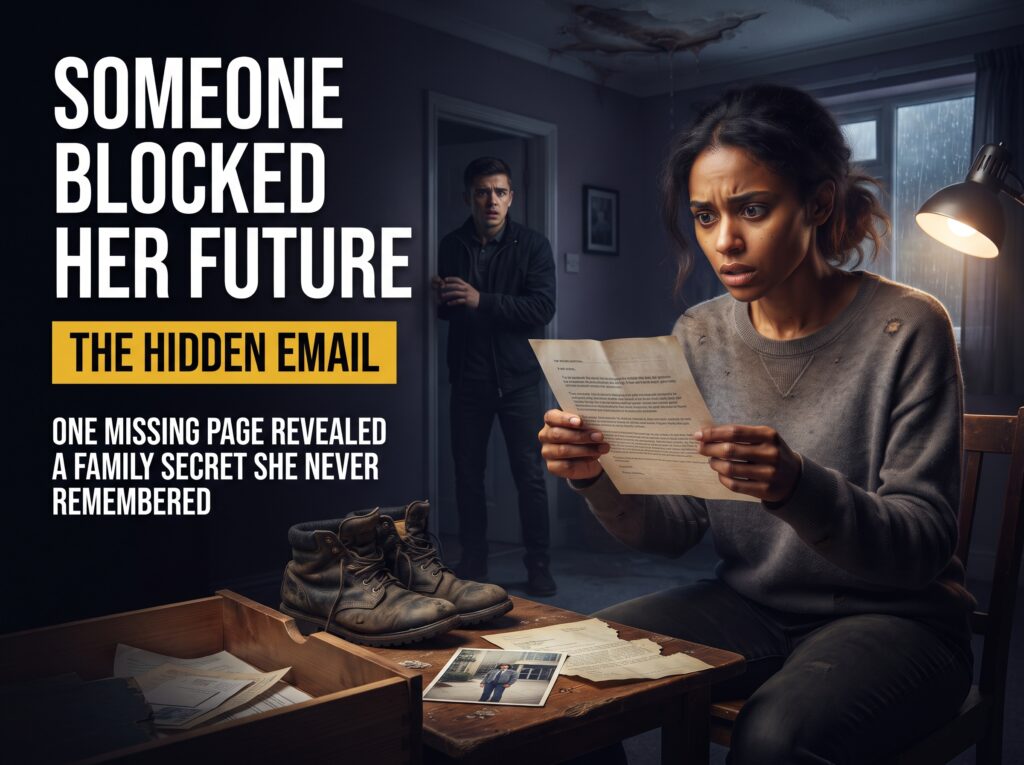
The rain began before sunrise, tapping against the corrugated roof of Amara’s rented room until the sound became impossible to ignore.
She lay beneath a thin blanket, watching a drop of water gather at the ceiling seam above her bed. It swelled, trembled, and finally fell into the plastic bowl she had placed on the floor the previous evening.
Plink.
Another drop followed.
Plink.
Amara closed her eyes.
She had learned that complaining did not repair a ceiling, fill an empty cupboard, or persuade an employer to reconsider an application. Most mornings, she simply got up, moved the bowl, and prepared for another day of pretending that her circumstances were temporary.
On the chair beside her bed sat a pair of worn work boots. She had polished them the previous night, carefully brushing dirt from the seams and checking that the laces were still strong enough to last another week.
They were the only decent shoes she owned.
At the bottom of her bag lay a folder containing copies of her certificates, references, and dozens of printed job applications. Some employers had never responded. Others had sent polite rejection emails. A few had invited her to interviews, only to cancel at the last minute.
At first, she blamed the economy.
Then she blamed her lack of experience.
Eventually, she began to wonder whether there was something about her that made people reluctant to give her a chance.
Her younger brother, Daniel, had an answer whenever she mentioned it.
“Maybe you expect too much,” he had told her the previous month. “You can’t keep blaming everyone else because your life isn’t working out.”
He had said it while sitting at their mother’s dining table, scrolling through his phone as Amara explained that another employer had withdrawn an interview invitation.
She remembered looking at him and wondering how her own brother could make her feel so small.
Daniel had always been more confident than she was. He could enter a room full of strangers and leave with three new contacts, a promise of help, and somebody’s phone number. When he spoke, people listened.
Amara was different.
She thought before answering. She apologized too quickly. She believed promises even after experience had taught her to be cautious.
For years, she had assumed these differences explained why their lives had taken such different directions.
Daniel had recently started working for a local recruitment company. He dressed well, spoke about important clients, and occasionally offered advice about the job market.
Sometimes he even joked about Amara’s situation.
“At this rate, your certificates will be antiques before anyone hires you.”
Everyone laughed.
Amara laughed too, because refusing to laugh would have made the room uncomfortable.
But the words stayed with her.
That morning, she dressed in a plain gray sweater and dark trousers. She packed her documents, pulled on her work boots, and checked her phone.
There were no new messages.
She had applied for a position at a logistics company three weeks earlier. The job paid enough to cover her rent, groceries, and the small amount she sent to her mother each month. It was not glamorous, but it offered stable hours and the possibility of promotion.
The recruiter had seemed interested during their first conversation.
Then the company had stopped responding.
Amara had sent two polite follow-up emails.
Nothing.
She was about to leave when her phone vibrated.
A message from her mother appeared.
Please come by this evening. We need to discuss something about the family papers.
Amara stared at the screen.
Her mother rarely asked everyone to gather unless something serious had happened.
She typed a reply.
Is everything okay?
The answer came a minute later.
Yes. Just come before dinner.
Amara slipped the phone into her pocket and stepped outside.
The rain had softened to a mist, leaving the street shining beneath the gray morning sky.
As she walked toward the bus stop, she noticed a familiar car parked across the road.
Daniel was inside.
He was speaking on his phone, one hand resting on the steering wheel. When he saw her, he stopped talking and looked away.
Amara raised her hand.
He did not wave back.
She continued walking, telling herself he probably had not seen her clearly.
But as the bus pulled away from the stop, she glanced through the window.
Daniel was still watching her.
And when he realized she had noticed, he quickly lowered his phone and drove off.
<h2>Part 2</h2>
By late afternoon, the rain had returned.
Amara reached her mother’s house shortly before six. The front door was unlocked, and the smell of fried onions drifted from the kitchen.
Her mother, Miriam, stood at the stove. Daniel sat at the dining table with his phone beside a stack of papers.
Their aunt, Beatrice, was there too.
She was a quiet woman who had helped Miriam raise the children after their father died. She had always been kind to Amara, although lately she seemed to grow uncomfortable whenever the conversation turned to money or the past.
“You’re late,” Daniel said.
Amara glanced at the clock.
“It’s six minutes before six.”
“I meant you should have come earlier.”
“For what?”
He shrugged.
“Never mind.”
Miriam placed a plate on the table.
“Sit down, Amara. We need to talk.”
Amara took the empty chair.
Her mother explained that she had been reviewing old family records because a property-related matter needed clarification. Some documents had to be located, and she wanted everyone to help before anything was submitted.
“Which documents?” Amara asked.
“The old folder from your father’s study,” Miriam replied. “The one with the certificates and correspondence.”
Amara remembered the folder.
After her father died, Miriam had kept his papers in a wooden drawer beneath the cabinet in the spare room. The family had rarely opened it. There were old receipts, property records, letters, and several documents no one seemed to understand.
“I thought Aunt Beatrice had taken the folder,” Amara said.
Beatrice looked up sharply.
“Why would you think that?”
“Because you asked me about it last year.”
“I asked whether you had seen it. That isn’t the same thing.”
Daniel tapped his fingers against the table.
“Can we stop arguing over something so simple?”
Amara looked at him.
“Nobody is arguing.”
“You’re always making everything difficult.”
Miriam sighed.
“Please. We need to find the papers, not fight.”
After dinner, they searched the spare room.
The wooden drawer was heavier than Amara remembered. Its handle had loosened, and she had to pull twice before it opened.
Inside were old envelopes, a faded notebook, a small tin containing buttons, and several empty plastic sleeves.
But the folder was gone.
Amara moved the papers aside.
“Where is the blue folder?”
Nobody answered.
She looked inside the drawer again.
A thin strip of dust marked the space where something rectangular had been resting. Whatever had occupied that space had been removed recently.
Daniel stood behind her.
“Maybe Mom moved it.”
Miriam shook her head.
“I haven’t touched that drawer.”
“Then Aunt Beatrice took it,” Daniel said.
Beatrice’s face reddened.
“I did no such thing.”
Amara noticed that Daniel was looking at the clock.
It was the third time she had caught him doing so that evening.
“Why are you in such a hurry?” she asked.
“I’m not.”
“You keep checking the time.”
“Because I have somewhere to be.”
“Then go. We’ll find the folder.”
Daniel picked up his phone.
“Fine.”
He walked toward the door, but before leaving, he turned back.
“Amara, don’t start imagining things. You’ve had enough problems lately.”
The words landed harder than they should have.
She waited until he had left before returning to the drawer.
Beneath the notebook, she found a small torn corner of paper. It contained only a few handwritten words.
…before the appointment.
The rest had been ripped away.
Amara turned the fragment over.
There was a faint impression of blue ink on the reverse, but no complete sentence.
She placed it in her pocket.
Later, while helping her mother clear the table, she asked whether Daniel had been handling the family documents.
Miriam hesitated.
“He offered to organize them.”
“When?”
“Several weeks ago.”
“Did he take anything from the drawer?”
“I don’t know.”
Amara watched her mother’s face.
“Mom, is there something you’re not telling me?”
Miriam turned toward the sink.
“Not everything is as straightforward as you think.”
“What does that mean?”
“It means I am tired, and I don’t want another argument tonight.”
Amara went home feeling as though she had walked into a room where everyone knew the ending of a story except her.
She placed the torn paper beside her job applications.
Then she opened her laptop.
The recruitment company that had canceled her interview had sent a final email that morning.
Following a further review, we regret to inform you that your application will not proceed.
Amara read the message twice.
The sender’s name was unfamiliar.
But the email address belonged to the same company where Daniel worked.
<h2>Part 3</h2>
Amara barely slept that night.
The discovery that Daniel’s company had handled her application did not prove anything. He worked in recruitment, and the company employed dozens of people. It was possible that he had never seen her application.
Yet she remembered his reaction when she had mentioned the interview.
He had been unusually interested in the name of the employer.
“Which department?” he had asked.
“Warehouse operations.”
“Who interviewed you?”
“I don’t remember the surname.”
“Did they ask about your employment history?”
“Why are you asking so many questions?”
He had smiled.
“Just curious.”
At the time, she had thought he was trying to help.
Now every small detail seemed to carry a second meaning.
The following morning, Amara called the recruitment company directly.
She asked to speak with the person responsible for her application.
A receptionist transferred her to a woman named Natalie, who reviewed the record while Amara waited.
“Your application was initially marked as suitable,” Natalie said. “You passed the basic screening.”
“Then why was my interview canceled?”
There was a pause.
“The file contains a note indicating that additional concerns were raised about your reliability.”
Amara gripped the phone.
“What concerns?”
“I can’t give you confidential information about another employee’s communications, but the note says that someone familiar with your circumstances advised us to review your references.”
“My references are genuine.”
“I understand.”
“Who gave you that information?”
Natalie hesitated.
“I can’t disclose that over the phone.”
Amara took a breath.
“Can you tell me whether the person was an employee of your company?”
“I would recommend submitting a formal request for your application records.”
The call ended without an answer.
Amara sat motionless at the kitchen table.
Someone had contacted the company.
Someone had questioned her reliability.
Someone had done it after she had passed the initial screening.
She opened her folder and checked the references she had submitted. One was from a former supervisor at a small warehouse where she had worked temporarily. The other came from a training coordinator who had praised her attendance and work ethic.
There was nothing in either reference that should have disqualified her.
She searched her email for the original application correspondence.
At first, she found only routine messages.
Then she noticed an email from the recruitment company that had arrived on the day her interview was canceled.
The message contained a link to a candidate portal, but the link had expired.
Below it was a short sentence:
Please contact us if you believe this decision was made using incorrect information.
Amara clicked the reply option and began typing.
Before she could finish, a new message appeared from an unfamiliar address.
The subject line read:
You need to look at your brother’s records.
There was no greeting.
No explanation.
Only a short message.
If you want to know why your applications keep failing, check the email hidden in your work boots. Don’t tell Daniel.
Amara stared at the screen.
She looked toward the boots beside the door.
For several minutes, she did nothing.
The message could have been a cruel joke. Someone might have known about her financial struggles and decided to make them worse.
But the reference to Daniel made her hands cold.
She picked up the boots.
The left one was ordinary.
The right one felt slightly heavier.
Amara turned it upside down and examined the sole. The lining had begun to separate near the heel. She pulled gently at the loose edge and discovered a folded piece of paper tucked inside.
It was an email printed on ordinary office paper.
The sender’s name had been crossed out, but the date was visible.
The email had been sent several weeks earlier.
It read:
Please place the applicant’s file on hold. We have been advised that she may not be suitable for a position involving confidential records. Do not proceed with the interview until this matter is reviewed.
Beneath the message was a reply.
Understood. I will make the necessary changes.
Amara felt her heart pound.
The sender’s address belonged to the recruitment company.
The reply came from an account associated with an internal administrative office.
She turned the paper over.
A short handwritten note had been added at the bottom.
This was not the first time.
Amara sat on the edge of her bed.
For years, she had believed that her failures were separate events. One employer had chosen someone else. Another had stopped responding. A third had canceled an interview without explanation.
Now the events seemed connected.
She opened the original email on her laptop and compared the printed copy with the message she had received from the anonymous sender.
The dates matched.
But one detail was missing.
The printed email referred to an attachment.
The attachment was not included.
Amara searched the paper for a filename.
Near the bottom, almost hidden beneath the fold, she found a reference to a document called Applicant Review — A.M.
The initials were hers.
She looked again at the handwritten note.
This was not the first time.
Someone had been keeping records of the interference.
And someone wanted her to find them.
<h2>Part 4</h2>
Amara returned to her mother’s house that afternoon.
She waited until Miriam had gone to the market before entering the spare room. The missing folder still occupied her thoughts, and she had begun to suspect that it contained the original evidence connecting her family to the events described in the email.
She opened the drawer and removed everything.
The buttons spilled across the floor. Old receipts slid beneath the cabinet. A photograph of her father fell face down beside her foot.
She picked it up carefully.
He had been standing outside a building with a sign above the entrance. The lettering was faded, but she could make out the name of a company.
It was the same company where Daniel had recently started working.
Amara turned the photograph over.
Her father’s handwriting appeared on the back.
For the work that must be finished.
She remembered the phrase.
When she was younger, she had heard her father say that some unfinished matters could follow a family for years. She had assumed he was talking about business.
Now she wondered whether he had been referring to something more personal.
She searched the drawer again and found a small envelope wedged beneath the bottom panel.
It was empty.
A narrow strip of paper had been glued inside, but the writing had been removed.
The missing page had not simply been misplaced.
Someone had deliberately taken it.
Amara photographed the drawer, the torn fragment, and the envelope before returning everything to its original position.
Then she called Daniel.
“Where are you?”
“At work. Why?”
“I found an email about my job applications.”
Silence.
“What email?”
“One that says someone asked the recruitment company to put my application on hold.”
Daniel gave a short laugh.
“And you think that has something to do with me?”
“I didn’t say that.”
“You’re implying it.”
“Then help me understand why the email was hidden in my boots.”
Another pause followed.
“What are you talking about?”
“Someone sent me a message telling me where to look.”
Daniel’s voice became sharper.
“You need to stop listening to strangers. People know you’re struggling, and they’re taking advantage of you.”
“Who knows I’m struggling?”
“Everyone.”
Amara looked at the family photograph on the floor.
“Did you handle my application?”
“No.”
“Did you contact anyone at the company?”
“No.”
“Can you swear to that?”
“Amara, I’m not doing this.”
He ended the call.
She stood in the empty room, holding the phone.
A few minutes later, a message arrived.
You are making a mistake. Leave this alone.
The number was hidden.
Amara read it again.
She had not told Daniel that the email referred to an attachment, nor had she mentioned the missing folder.
Yet his response had been immediate and defensive.
She called her aunt Beatrice.
“Do you remember the old company where Dad worked?”
“Of course.”
“Did Daniel ever have access to Dad’s papers?”
Beatrice was silent.
“Why are you asking?”
“Because I think someone removed a document from the drawer.”
“What document?”
“I don’t know yet.”
Beatrice sighed.
“Your father kept a record of everything. He believed that written evidence was safer than a promise.”
“Did he have problems with anyone?”
“Your father had disagreements, like everyone. But he was careful about his work.”
“Did he ever say anything about my job applications?”
“No.”
“Did he ever say anything about Daniel?”
Another pause.
“Amara, your brother was young when your father died.”
“That’s not what I asked.”
Beatrice lowered her voice.
“Your father once told me that he worried about what Daniel would do if he ever discovered the truth about the family records.”
Amara felt a chill.
“What truth?”
“I don’t know.”
“Then why did he say it?”
“Because he believed somebody had been changing documents.”
Amara stared at the open drawer.
“Which documents?”
“I never saw them. He said he had copies of the originals, and that one day someone might try to make the family believe a different version of events.”
Amara thought about the missing page.
The anonymous email.
The recruitment records.
The strange way Daniel had reacted when she mentioned the folder.
“Did Dad say who might do it?”
Beatrice’s answer was almost a whisper.
“He said the person responsible would be someone the family trusted.”
<h2>Part 5</h2>
The next day, Amara submitted a formal request to the recruitment company.
She attached the email she had discovered in her work boot and asked for a copy of the information used to assess her suitability for employment.
She did not accuse Daniel.
She did not mention the missing family document.
She simply asked for an explanation of the decision that had affected her application.
Two days later, Natalie called.
“We’ve reviewed your request,” she said. “There are inconsistencies in the record.”
“What kind of inconsistencies?”
“The file contains an internal note that was not properly authorized. It appears someone submitted information that had not been independently verified.”
Amara sat down.
“Was the information false?”
“We haven’t completed the review, but the references you provided do not support the concerns recorded in the system.”
“Can you tell me who submitted the note?”
Natalie hesitated.
“I can confirm that the note was entered using an internal account. We are investigating whether the account was used by the person assigned to it.”
“Could somebody else have used it?”
“Yes. That’s one of the questions we’re examining.”
Amara thanked her and ended the call.
She felt relief, but it was mixed with a growing sense of dread.
Someone had interfered with her applications.
The company was now investigating.
But the person responsible might have been using someone else’s account.
The next step would be to establish who had access.
That evening, she received another message from the anonymous sender.
The missing page is not in the drawer anymore. Look at the old photograph of your father. Check the date.
Amara retrieved the photograph.
The date was written in small numbers beneath the company name.
It was the same week the first suspicious note had appeared in her recruitment records.
She enlarged the image on her phone.
Behind her father stood another person, partially obscured by a doorway.
Amara had never noticed the figure before.
The person wore a dark jacket and held a folder under one arm.
She showed the photograph to Beatrice.
Her aunt studied it for a long time.
Then she sat down.
“I know that jacket.”
“Whose is it?”
“Your father owned one like it.”
“Then why is it on someone else?”
Beatrice looked at her.
“Because your father gave his jacket to Daniel.”
Amara felt her stomach tighten.
“When?”
“After he started helping at the office. Daniel was proud of being involved in the family business.”
“Was he working there when Dad died?”
“Only occasionally.”
Amara looked again at the photograph.
The figure’s face was hidden, but the posture was familiar.
She could not prove it was Daniel.
Still, the possibility unsettled her.
“Why would Dad have kept this photograph?”
“Because he kept everything connected to the work.”
Beatrice turned the photograph over.
The handwriting on the back was unmistakable.
For the work that must be finished.
She ran her finger over the words.
“Your father was worried about a document,” she said. “He told me that the original had to remain with the family because someone had tried to change a copy.”
“What document?”
“I never knew.”
“Could it be the missing page?”
“Possibly.”
Amara took the photograph home and examined it beneath a desk lamp.
A faint line of writing appeared along the bottom edge, partly covered by a stain.
She could make out a date and the initials A.M.
Her initials.
But the date was several years before she had begun applying for jobs.
She searched her own papers for anything bearing the same date.
Eventually, she found an old school notebook in a storage box. Her handwriting covered the first few pages. Near the back was a sentence she had written during a school exercise.
I promise I will never allow someone else to decide what I am worth.
Amara stared at the words.
She had written them as a teenager.
Now the sentence felt like a warning from a younger version of herself.
The initials in the photograph were followed by a short phrase.
Original statement attached.
Amara looked toward the drawer in her memory.
The missing page might not have been a financial record.
It might have been a statement written by her.
But she had no memory of writing one.
<h2>Part 6</h2>
Amara searched her belongings for the next two days.
She checked old notebooks, school files, letters, and boxes she had not opened since moving into the rented room. She found receipts, certificates, and photographs, but nothing that explained why a document bearing her initials had been stored among her father’s business records.
On Friday morning, she received a call from the recruitment company.
Natalie told her that the investigation had identified a serious procedural breach.
“We have evidence that an application review was altered without proper authorization,” she explained. “We’re checking whether other candidates were affected.”
“Was my application deliberately blocked?”
“The evidence suggests that the decision was influenced by information that should not have been accepted without verification.”
Amara swallowed.
“Can you tell me whether the person responsible knew me personally?”
“We’re not in a position to confirm that yet.”
The answer was careful, but it told her enough to understand that the problem was real.
After the call, she sat beside the leaking ceiling and watched rainwater gather in the bowl.
She had spent years believing that she simply wasn’t good enough.
She had blamed her qualifications, her clothes, her lack of connections, and the fact that she had never been comfortable promoting herself.
Now she wondered how many opportunities had disappeared because somebody had decided she did not deserve them.
The thought was almost unbearable.
Her phone rang.
It was her mother.
“Daniel says you’ve been contacting his workplace,” Miriam said.
“I contacted a company that rejected my application.”
“He says you’re accusing him of interfering.”
“I’m asking questions.”
“He’s your brother.”
“I know.”
“Then why are you doing this to him?”
Amara closed her eyes.
“Why are you asking me to protect him before you know what happened?”
Miriam did not answer.
“Mom, did Dad leave a document with my name on it?”
A long silence followed.
“Where did you hear that?”
“Did he?”
Miriam’s voice trembled.
“There was a statement.”
“What statement?”
“It concerned the family business.”
“What did it say?”
“I don’t remember every detail.”
“Did I write it?”
Her mother breathed out slowly.
“Yes.”
Amara felt the room become very still.
“What did I write?”
“You were young. Your father asked you to sign something related to a family arrangement.”
“Why?”
“He said it was a formality.”
“What kind of arrangement?”
“I don’t know all the details.”
Amara gripped the phone.
“Did I agree to something that affected Daniel?”
“I don’t know.”
“Did the statement have anything to do with employment?”
“No. It was about the family records.”
Amara thought about the photograph and the missing page.
“Why didn’t anyone tell me?”
“Because your father said it was better to keep the papers together until everything was settled.”
“Was everything settled?”
Her mother began to cry.
“No.”
Amara waited.
Finally, Miriam said, “Your father believed that somebody had been using the family name to change records. He wanted you to keep a copy of the original statement because he thought you might be the only person who could confirm what had happened.”
“Then why was the page removed?”
“I don’t know.”
Amara felt a wave of anger.
“You knew about this and let me believe I was failing because I wasn’t good enough.”
“I never wanted that for you.”
“But you knew there was a document.”
“I was afraid.”
“Of what?”
“Of what the truth would do to this family.”
Amara looked at the papers scattered across her table.
“Mom, the truth is already doing something to this family. The only difference is that I’m the one who has been suffering without knowing why.”
Miriam began to sob.
Amara wanted to comfort her.
Instead, she asked one final question.
“Who removed the page?”
Her mother whispered something that Amara could barely hear.
Then the call ended.
Amara sat motionless, replaying the last few seconds.
She had heard a name.
Daniel.
<h2>Part 7</h2>
Amara did not confront her brother immediately.
She wanted evidence that could stand on its own, evidence that would not disappear when someone denied what she had seen.
She began with the family documents.
Her father had kept copies of important records in several places. Beatrice remembered a small storage cabinet in the old office where he had worked, although the building had since changed ownership.
They visited the property together.
The current tenant allowed them to examine a few boxes that had been left in a locked storage area. Most contained ordinary paperwork, but one box held copies of letters, meeting notes, and a list of document references.
Amara found her father’s handwriting on the final page.
If the original is ever challenged, compare it with the signed statement held by A.M.
She read the sentence aloud.
Beatrice looked worried.
“That must be the page your father wanted you to keep.”
“Why would he put it in my name?”
“Because he trusted you.”
Amara examined the surrounding papers.
A reference number appeared beside the note. It matched the number written on the back of the photograph.
The documents also mentioned a family arrangement involving access to company records.
Daniel’s name appeared several times.
At first, the entries seemed harmless. He had helped organize files and deliver paperwork. But the dates became troubling when Amara compared them with the period in which her job applications began to fail.
She photographed every page and made copies.
On the way out, Beatrice stopped beside the door.
“Amara, there’s something I should have told you years ago.”
Amara turned.
“What?”
“Your father asked me to watch over you. He believed you were the only person in the family who would refuse to sign something without understanding it.”
“Then why didn’t he explain what the statement meant?”
“He intended to. He said he would sit down with you when you were older.”
“But he died before he could.”
Beatrice nodded.
“And after that, everyone was afraid to reopen the matter.”
Amara looked at the old building.
“Who was afraid?”
“Your mother. Daniel. Even I was afraid.”
“Of Daniel?”
Beatrice hesitated.
“Of losing the family we still had.”
Amara understood the fear, but she could no longer accept it as an excuse.
That evening, she compared the reference number with the email hidden in her work boots.
The number appeared in a small attachment field.
The attachment had been removed from the printed email, but its name remained visible in the original digital record.
AM_Statement_Final.pdf.
Amara felt a chill.
The missing page was not merely connected to her father.
It had been attached to the email concerning her employment.
Someone had used the same reference across two separate matters.
She contacted Natalie and asked whether the recruitment company could preserve the original digital records for the investigation.
Natalie agreed.
Then Amara searched her own email account for the attachment name.
She found no direct match.
But a message from several years earlier contained a reference to a family document she had never opened.
The sender was her father’s old business address.
The email had arrived shortly before he died.
Its subject line read:
Please keep the original.
The body contained only three sentences.
You may not remember signing the statement. That does not mean it was unimportant. Keep your copy safe, and do not let anyone tell you that your memory is proof that it never happened.
Amara stared at the screen.
The message had been sent to her account, but she had forgotten it existed.
She searched the attachments.
One file was missing.
The system displayed a warning that the original attachment could no longer be downloaded.
Someone had removed the document from the family drawer.
Someone had interfered with her job applications.
And both events appeared to lead back to the same missing statement.
<h2>Part 8</h2>
Amara arranged to meet Daniel at a small café near his workplace.
She chose a public place because she wanted the conversation to remain calm. She also brought printed copies of the email, the photograph, and the notes she had found in the old office.
Daniel arrived twenty minutes late.
He sat down, ordered a coffee, and glanced at the papers.
“What is all this?”
“I want you to explain why the same document reference appears in the family records and the email about my application.”
Daniel did not touch the papers.
“You’ve been digging through Dad’s old files?”
“Yes.”
“Why?”
“Because somebody removed a page from the family drawer.”
“Maybe Mom moved it.”
“She says she didn’t.”
Daniel leaned back.
“Then maybe Aunt Beatrice took it.”
“She didn’t.”
“How can you be sure?”
“Because I found the note Dad left explaining where the original statement was supposed to be kept.”
For the first time, Daniel looked genuinely unsettled.
Amara continued.
“I also found the email you told me never existed.”
“I never said it didn’t exist.”
“You told me to stop listening to strangers.”
“Because strangers are contacting you with anonymous messages.”
“Then why are you afraid of what I might discover?”
Daniel looked around the café.
“Lower your voice.”
Amara felt her heart pounding.
“Did you interfere with my job applications?”
“No.”
“Did you use your access to the recruitment system to change my records?”
“No.”
“Did you remove the original statement?”
Daniel stood abruptly.
“This conversation is over.”
Amara remained seated.
“If you leave, I’ll give the evidence to the people investigating the recruitment company.”
He froze.
Slowly, he turned back.
“What evidence?”
“The email, the document references, and the records showing that someone entered an unauthorized note about my reliability.”
Daniel looked at the papers.
His expression had changed.
“You don’t understand what that statement means.”
“Then explain it.”
He sat down again.
For several seconds, he seemed unable to speak.
Finally, he said, “Dad believed the family business belonged to all of us. But the records didn’t reflect what he had promised.”
“What promise?”
“He said that you would have a share in the business if you chose to work there.”
Amara frowned.
“I never wanted to work in the business.”
“That’s not the point.”
“Then what is?”
Daniel rubbed his forehead.
“The statement was supposed to confirm that you had agreed to keep certain records confidential until the property arrangement was settled.”
“Did I agree to that?”
“You signed it.”
“I don’t remember signing it.”
“You were young.”
“How young?”
Daniel looked away.
“Old enough to understand what Dad asked you to do.”
“Then why did he tell me to keep the original safe?”
Daniel did not answer.
Amara leaned forward.
“Did the statement contain something that would affect your position in the company?”
He looked at her sharply.
“Who told you that?”
“No one. I’m asking you.”
Daniel stared at the papers.
Then he said, “The original showed that Dad had made a promise to you. If it came to light, the business records would have to be reviewed.”
“What did that have to do with my job applications?”
He was silent.
Amara felt the pieces coming together.
“Someone wanted me to stop asking questions.”
Daniel’s face tightened.
“You’re making assumptions.”
“Then tell me the truth.”
He looked at her for a long time.
Finally, he whispered, “I didn’t think it would go this far.”
Amara felt her stomach drop.
“What did you do?”
Daniel opened his mouth.
Before he could answer, his phone rang.
He looked at the screen and immediately stood.
“I have to go.”
“Daniel—”
“I said I have to go.”
He walked out of the café without touching his coffee.
Amara watched him cross the street.
A car was waiting near the corner.
The driver lowered the window.
Daniel leaned toward it, spoke briefly, and handed the driver a large envelope.
The car pulled away.
Amara could not see the driver’s face.
But she recognized the envelope.
It was the same kind her father had used to store the original family documents.
<h2>Part 9</h2>
Amara followed the car at a distance, taking care not to lose sight of it in the afternoon traffic.
She did not know who was inside, and she had no intention of confronting anyone alone. She simply wanted to establish where the envelope was going.
The car eventually stopped outside an office building.
The driver entered through the main doors.
Amara waited several minutes before following.
At the reception desk, she asked whether a person named Daniel had an appointment.
The receptionist checked a list.
“Not today.”
Amara looked toward the corridor.
“Does your office handle family property records?”
The receptionist nodded cautiously.
“We handle a range of legal and administrative matters.”
Amara showed her the reference number from her father’s notes.
The receptionist’s expression changed.
“Where did you get that?”
“My father kept it in his records.”
The woman studied the number again.
“Please wait here.”
She disappeared into the corridor.
Amara sat down.
Ten minutes passed.
Then fifteen.
Finally, a man in a dark suit approached.
“My name is Mr. Collins. I understand you’re asking about an old document.”
“Yes.”
“May I see your identification?”
She provided it.
He examined the document reference and asked her to follow him into a small meeting room.
A folder lay on the table.
Its cover bore the same reference number.
Mr. Collins explained that the office had once been involved in preparing records for a family business arrangement. The file contained a copy of a statement signed by Amara when she was younger.
“Is this the original?” she asked.
“No. This is a copy.”
“Where is the original?”
“We don’t know.”
Amara opened the folder.
The first pages contained routine correspondence. The final page was a statement written in her own handwriting.
She recognized the shape of the letters immediately.
But she had no memory of writing the document.
The statement appeared to confirm that she had voluntarily relinquished a claim connected to the family business.
At the bottom was her signature.
Amara felt cold.
“I never agreed to this.”
Mr. Collins looked concerned.
“You appear to have signed it.”
“I don’t remember signing it, and I don’t understand what it says.”
He studied the document.
“The wording is complicated. It would be important to establish the circumstances in which it was signed.”
Amara looked at the date.
It was a day she remembered clearly.
Her father had been in the hospital.
She had spent the afternoon visiting him, then returned home exhausted.
She remembered Daniel asking her to sign a stack of papers.
He had told her they were routine forms related to the business.
She had trusted him.
“Can you tell me who submitted this copy?”
Mr. Collins checked the file.
“The most recent submission came from an individual connected to the family business.”
“Who?”
He turned the page.
The name appeared beneath the entry.
Daniel.
Amara closed her eyes.
For years, she had believed that her brother’s cruel comments were simply the result of impatience and immaturity. She had assumed he was embarrassed by her struggles and frustrated that she had not achieved the same success he had.
Now she understood that his behavior might have served another purpose.
If she remained unemployed, she would have fewer resources to investigate the family records.
If she continued doubting herself, she might never challenge the statement.
And if she never challenged the statement, the original promise made by her father could remain hidden.
Mr. Collins explained that the document would need to be reviewed by a qualified legal professional. He made no judgment about whether the statement was valid, but he agreed to preserve the copy and record Amara’s concerns.
Before leaving, she asked one final question.
“Why would someone submit this document again after so many years?”
Mr. Collins looked at the file.
“Because somebody appears to have wanted the matter settled before it could be questioned.”
Amara left the office with a copy of the record and a growing sense that the family secret had never truly been buried.
It had been managed.
Every time the evidence threatened to surface, someone had moved it, hidden it, or used it to silence the person who might challenge it.
That evening, she received a message from the anonymous sender.
You have the document now. Ask Daniel who told him to use your signature.
Amara read it twice.
Then she looked at the statement.
The handwriting was hers.
The signature was hers.
But she had never knowingly written the document.
And the person who could explain how it had happened was sitting in her mother’s house.
<h2>Part 10</h2>
Amara returned to her mother’s house the following morning.
Daniel was already there.
He stood in the kitchen, holding a cup of coffee. When Amara entered, he looked at the papers in her hand and immediately put the cup down.
“You found it,” he said.
It was not a question.
Amara placed the document on the table.
“Tell me who asked you to submit this.”
Daniel stared at the signature.
For a long time, he said nothing.
Then he sat down.
“I was told it would settle the matter.”
“By whom?”
He rubbed his face.
“Someone who worked with Dad.”
“Name.”
Daniel looked toward Miriam, who had entered the kitchen behind them.
His voice became quieter.
“Mr. Collins wasn’t the person who told me what to do. He only handled the paperwork. The person who contacted me was an old business partner of Dad’s.”
“Why would he want my signature?”
“Because Dad had made a promise that could change how the business was divided.”
Amara waited.
Daniel explained that their father had discovered irregularities in the family records before his death. He had believed that someone had been changing documents connected to the property and the business.
Rather than confront the person immediately, he had gathered copies of the original records and prepared a statement intended to protect Amara’s interests.
Daniel had been helping with the paperwork at the time.
After their father became ill, the business partner approached him with an offer. If Daniel helped settle the outstanding matter, he would receive a position and financial security within the company.
Daniel had been struggling himself.
He had debts, unpaid expenses, and no guarantee that the business would continue operating.
He had convinced himself that the arrangement was harmless.
“I thought the statement only confirmed that you didn’t want to be involved,” he said.
“But you knew Dad had promised me something.”
“Yes.”
“And you knew the document could affect that promise.”
Daniel lowered his head.
“Yes.”
Amara felt tears gather in her eyes.
“You let me believe I was failing because I wasn’t good enough. You watched me struggle to pay rent. You mocked me when I told you about my applications.”
“I didn’t know how to stop what I had started.”
“You could have told me.”
“I was afraid.”
“Of what?”
“Of losing everything.”
Amara looked at the document.
“You were afraid of losing everything, so you let me lose opportunities I might never get back.”
Daniel began to cry.
“I know.”
“No, you don’t. You thought I was weak because I couldn’t find work. You thought my life was proof that I had made the wrong choices. You never considered that somebody might have been making choices for me.”
He covered his face.
“I am sorry.”
Amara remained silent.
Her mother sat beside them.
For years, Miriam had believed that silence was the safest way to keep the family together. She had watched Daniel become increasingly defensive and Amara become increasingly discouraged, telling herself that the problem would eventually resolve itself.
It had not.
Instead, the silence had given the person responsible more time to protect their own interests.
Miriam reached for Amara’s hand.
“I should have told you what your father left behind.”
Amara looked at her.
“Yes.”
“I was afraid that the truth would destroy the family.”
Amara glanced at Daniel.
“The family was already being damaged. We just weren’t allowed to talk about it.”
Her mother began to cry.
Amara did not turn away.
She loved her mother, but she could no longer carry the burden of everyone else’s fear.
Daniel explained that he had submitted the statement through the old business partner’s office. Later, after joining the recruitment company, he had recognized Amara’s name on an application.
He had not been instructed to interfere with her employment directly, he claimed. But he had passed along information about her financial difficulties and suggested that she might be unreliable.
He had told himself he was protecting the family from further questions.
The recruitment company had accepted information that should have been independently verified.
That decision had cost Amara opportunities, time, and confidence.
It had also created a record that she was now determined to challenge.
Amara contacted the recruitment company and provided the new information. She also arranged to obtain independent legal advice about the family document. She made no assumptions about what the final outcome would be, but she refused to let the matter disappear again.
Daniel agreed to cooperate with the investigation.
It did not undo what he had done.
It did, however, mean that the truth would no longer depend on whether he felt comfortable telling it.
In the weeks that followed, Amara began applying for jobs again.
This time, she kept copies of every application and every response. She asked employers to clarify decisions that seemed inconsistent, and she refused to interpret silence as proof that she was unworthy.
The recruitment company eventually confirmed that her application had been affected by unauthorized information. They apologized and offered to reconsider her candidacy.
Amara accepted the opportunity to be assessed fairly.
She did not expect the world to become kind overnight.
She only wanted the chance to stand on her own merits.
One rainy evening, she returned to her rented room and found the bowl beneath the leaking ceiling almost full.
She emptied it, placed it back in position, and sat beside the window.
Her work boots stood near the door.
For a moment, she remembered the email hidden inside them and the fear she had felt when she realized someone might have deliberately blocked her future.
She had spent years believing that her circumstances defined her.
Now she understood that the setbacks had not been the whole story.
There had been choices made behind her back, documents hidden from her, and people who had mistaken silence for protection.
But there had also been evidence.
A photograph.
An old email.
A missing page.
And the handwriting she recognized even when she could not remember the words.
Amara opened her notebook and wrote a sentence.
My past may explain what happened to me, but it does not get to decide what happens next.
She placed the notebook beside her certificates.
The ceiling still leaked.
The rent was still due.
Her future remained uncertain.
But the uncertainty no longer felt like proof that she had failed.
For the first time in years, she believed she had the right to question what had happened, to demand that her voice be heard, and to build a life that did not depend on keeping everyone else comfortable.
She had not recovered the years she lost.
She could not force her brother to become the person she once believed he was.
And she could not erase the fact that the final line of the missing document had been written in her own handwriting, despite her complete lack of memory of writing it.
But she could choose what happened next.
The truth had reached her at last.
And this time, she would not hide it away.