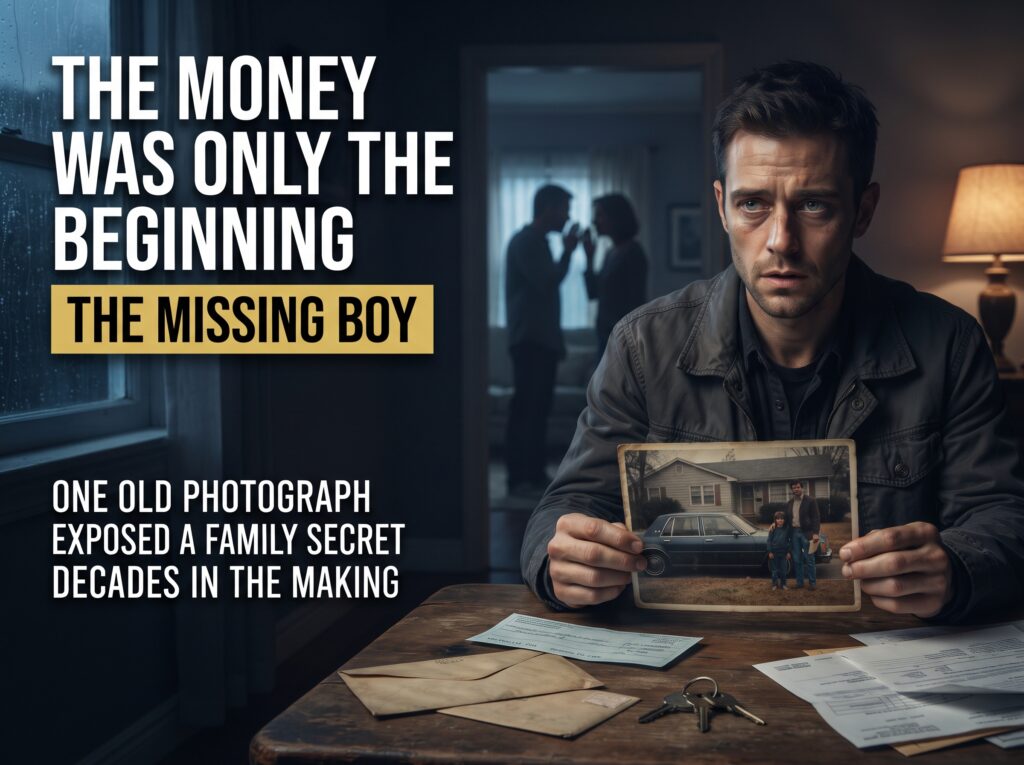
The borrowed car smelled of damp upholstery, old coffee, and the cold air that slipped through the passenger-side window whenever Miles turned a corner.
He had been living out of it for eleven days.
At first, he told himself it was temporary. He would find another job, replace the money he and his partner had saved, and return to the small apartment where they had once planned their future. He had repeated that promise so many times that it had begun to sound like something another person had told him.
Now he sat outside his childhood home, watching the curtains move behind the front windows.
His mother knew he was there. She had seen the car arrive and had probably recognized him through the glass. But she had not come outside.
That was the first thing that felt different.
His family had always been the sort to open the door before a visitor reached the steps. When Miles was young, his mother would hear his footsteps halfway down the street and begin preparing tea. His father, before his death, had kept the porch light on even when everyone was already home.
Yet that afternoon, the house looked strangely closed.
Miles checked his phone.
No new messages.
He opened the conversation with the person who had promised to stay beside him through everything. The last message remained exactly where it had been for eleven days.
I need some time. Please don’t make this harder than it already is.
He had read those words hundreds of times.
They had shared a home, bills, grocery lists, and a savings account they called their future fund. They had put money aside for emergencies and talked about buying a small house someday. They had even joked about the kitchen they would build, although neither of them had ever agreed on the color of the cabinets.
Then, almost overnight, the money disappeared.
A transfer had been made from their shared savings account. The amount was large enough to leave them unable to cover their rent and several overdue bills. His partner insisted the transfer had been necessary, but offered no clear explanation.
Three days later, the relationship ended.
Miles had not told his family the whole story. He said the breakup had been difficult and that the financial trouble was being sorted out. He did not explain that he had spent two nights sleeping in a borrowed car because he could not afford a room.
He was ashamed of how quickly his life had fallen apart.
More than that, he was ashamed that he still wanted the person who had left him to come back.
A knock sounded against the driver’s window.
Miles turned.
His younger sister, Hannah, stood beside the car, holding a mug in both hands.
He lowered the window.
“Are you planning to sleep here all day?” she asked.
“I was thinking about it.”
“Mom says you should come inside.”
“She could have come out and told me herself.”
Hannah glanced toward the house.
“She’s upset.”
“About what?”
“Everything.”
Miles almost laughed.
That was the answer his family had given him for years whenever an uncomfortable question appeared. Everything was difficult. Everyone was tired. Now was not the right time.
He took the mug from Hannah.
“Did Mom tell you about the money?”
Hannah looked at him sharply.
“What about it?”
“The transfer.”
“I thought your partner handled that.”
“That’s what they told me.”
“Then why are you asking me?”
Because he had begun to suspect that the transfer was not simply a mistake. Because his partner had refused to show him the complete bank record. Because the few explanations he received seemed to change depending on the day.
And because the previous evening, while searching for a phone charger in his family’s old storage room, he had discovered an empty drawer where his father used to keep important documents.
Miles had asked his mother about it.
She had said she did not remember what was inside.
Hannah glanced at the house again.
“Just come inside,” she said quietly. “Please.”
Miles followed her.
His mother stood in the kitchen, wiping an already clean counter. She looked older than he remembered, although he knew that was partly because he had been too distracted to notice how much time had passed.
She kissed his cheek.
“Have you eaten?”
“Not really.”
“I’ll make something.”
“Mom, I need to ask you something.”
She continued wiping the counter.
“Can it wait until after lunch?”
“No.”
Her hand stopped.
Miles looked at her.
“Did Dad keep any bank documents in the storage room?”
His mother’s face changed so quickly that he almost missed it.
Then she turned away.
“Your father kept everything. You know that.”
“Where are they now?”
“I don’t know.”
“The drawer is empty.”
She folded the cloth.
“Perhaps someone cleared it out.”
“Who?”
His mother did not answer.
Hannah appeared in the doorway. Her eyes moved from Miles to their mother and back again.
For a moment, the three of them stood in silence.
Then Miles understood something that frightened him more than the missing money.
His family was not merely worried about his breakup.
They were afraid of what he might discover.
<h2>Part 2</h2>
The next morning, Miles returned to the borrowed car before sunrise.
He had barely slept. Every time he closed his eyes, he remembered the expression on his mother’s face when he mentioned the empty drawer.
He had grown up believing that his father had been an ordinary man who worked hard, paid his bills, and tried to keep the family together. After his death, Miles had helped sort through the paperwork and had found nothing unusual.
But his father had also been a careful man.
He kept receipts for household repairs, wrote dates on the backs of photographs, and stored important documents in envelopes labeled with the names of the people they concerned.
An empty drawer meant something.
Miles drove to the apartment he had shared with his partner. The building stood on a narrow street lined with small shops and aging houses. Their apartment was on the second floor, above a bakery that opened before dawn.
He had not been back since the breakup.
His partner had agreed to leave his belongings in a box near the entrance, but when he arrived, there was no box.
Instead, a handwritten note had been pushed beneath the door.
I have the rest of your things. I’ll arrange a time.
Miles read it twice.
He knocked.
No one answered.
The bakery owner, who had known them for years, came outside carrying a tray.
“You looking for your partner?” she asked.
“I’m looking for my things.”
She looked uncomfortable.
“They moved some boxes last week.”
“Where?”
“I don’t know. Someone came with a van.”
Miles felt his stomach tighten.
“Who?”
The woman shook her head.
“I’m sorry. I didn’t see clearly.”
He thanked her and returned to the car.
For several minutes, he sat with his hands on the steering wheel, trying to decide whether he should call his partner again.
Instead, he opened the bank application on his phone.
The shared account had been closed. He could still see a limited transaction history, but the transfer details were incomplete. He remembered asking the bank for a full statement before the breakup. At the time, he had assumed the missing information was a technical problem.
Now he searched his email for the original document.
He found it in an old message attachment.
The statement showed the date of the transfer, the amount, and a reference number. The recipient’s name had been abbreviated, but the final four digits of the destination account were visible.
Miles recognized them.
They belonged to an account associated with a business his father had once used.
He stared at the screen.
His father had died six years earlier. The business had been closed long before that.
Why would money from his shared savings account have been transferred to an account connected to his father’s old business?
He searched through his messages and found an old conversation with his partner.
Months earlier, they had discussed opening a separate account for their future house. His partner had asked whether Miles knew the details of his father’s old business accounts.
He had thought it was an innocent question.
Now the message looked different.
He called the bank.
After several security questions, a representative confirmed that the transfer had been processed using an authorization document. The representative could not disclose all the details over the phone, but she told him that the document had been submitted several days before the breakup.
“Can you tell me who authorized it?” Miles asked.
“I can tell you that the signature on the document is not the same as the name associated with the destination account.”
“Then whose signature is it?”
“I can’t confirm that without a formal review.”
“Was it my signature?”
There was a pause.
“I recommend that you visit a branch with identification and request the original transaction record.”
Miles thanked her and ended the call.
The transfer had been arranged before the relationship ended.
His partner had not simply moved the money in the panic of a breakup. Someone had planned the transfer, prepared the paperwork, and selected an account connected to a business that no longer existed.
He drove to the bank.
The clerk examined his identification and the printed statement. After a short wait, she returned with a copy of the transaction slip.
“Is there a problem?” she asked.
“I think someone moved our savings without explaining why.”
She studied the document.
“The transfer was authorized through a signed instruction.”
“By whom?”
She pointed to the signature line.
Miles looked down.
The signature was unfamiliar.
But the name written beneath it made his hands go cold.
It belonged to someone who had attended his father’s funeral.
Someone his family had insisted was no longer part of their lives.
Miles folded the paper and placed it in his pocket.
Outside the bank, his phone rang.
It was his partner.
For the first time in eleven days, they were calling him.
Miles answered.
“Where is the money?” he asked.
His partner did not say hello.
Instead, they whispered, “Whatever you found, don’t take it to your family.”
Then the call ended.
<h2>Part 3</h2>
Miles spent the afternoon trying to decide what the warning meant.
If his partner had nothing to hide, the obvious response would have been to explain the transfer. Instead, they had warned him away from his own family.
He returned to his childhood home and parked behind the garage, where he could sit without being seen from the kitchen windows.
The transaction slip lay on the passenger seat.
He read the name again.
Edward Vale.
Edward had been his father’s business partner for nearly twenty years. He had attended family gatherings, helped Miles find his first summer job, and once lent him money when his university expenses exceeded his savings.
After Miles’s father died, Edward disappeared from their lives.
His mother said they had disagreed over the business. His older brother, Daniel, said Edward had moved away. Hannah remembered him as a kind man who brought chocolates whenever he visited.
No one had mentioned him in years.
Yet his name had appeared on a document connected to Miles’s missing money.
Miles called Daniel.
His brother answered from work.
“What do you want?”
“Do you remember Edward Vale?”
Daniel went silent.
“Why?”
“I found his name on a bank transaction.”
“What transaction?”
“The transfer from my savings account.”
Daniel’s voice sharpened.
“You need to leave that alone.”
Miles stared through the windshield.
“That’s the second time someone has told me that.”
“Then perhaps you should listen.”
“Did Dad owe him money?”
“No.”
“Did Edward have access to Dad’s accounts?”
“Not anymore.”
“Then why is his name on a transfer made last month?”
Daniel exhaled.
“I don’t know.”
“You answered too quickly.”
“Because I know how this ends. You start asking questions, you make accusations, and before long everyone is fighting.”
“Someone already took our savings.”
“Your partner moved the money.”
“Who told you that?”
“Everyone knows.”
“Everyone knows because someone told them. I want to know what actually happened.”
Daniel lowered his voice.
“Come home tonight. We can talk.”
Miles agreed, although he suspected his brother intended to persuade him to stop investigating.
That evening, the family gathered in the living room.
His mother sat in her usual chair. Daniel stood beside the fireplace, while Hannah remained near the hallway.
Miles placed the transaction slip on the coffee table.
“Edward Vale authorized a transfer from my shared account before the breakup. The money went to an account connected to Dad’s old business.”
His mother looked at Daniel.
Daniel did not look back.
“Do you know where Edward is?” Miles asked.
“No,” his brother replied.
“Have you spoken to him recently?”
“No.”
“Then why did you tell me to leave this alone?”
“Because you don’t know what you’re getting into.”
Miles felt anger rising.
“Then explain it to me.”
His mother finally spoke.
“Your father made mistakes.”
“What mistakes?”
“Financial ones.”
“Did he owe Edward money?”
She shook her head.
“Not exactly.”
Miles waited.
His mother looked toward the window.
“There were agreements made years ago. Things we didn’t understand at the time.”
“What agreements?”
“I can’t explain all of it.”
“Why not?”
“Because I promised your father.”
Miles almost laughed.
Another promise. Another reason to remain silent.
“Everyone in this family seems to have promised someone something,” he said. “And somehow I’m the only person who has lost everything.”
Hannah moved closer.
“Miles, please.”
“No. I need one honest answer.”
Daniel sat down.
“Edward helped Dad keep the business alive during a difficult period. When Dad died, there were records that needed to be settled. Some documents were never completed.”
“That was six years ago.”
“I know.”
“Then why did money move last month?”
Daniel rubbed his forehead.
“Because someone believed the agreement was still valid.”
“Who?”
No one answered.
Miles picked up the slip.
“Fine. I’ll ask Edward myself.”
His mother rose suddenly.
“You cannot.”
The urgency in her voice startled everyone.
Miles turned toward her.
“Why?”
She seemed to struggle for words.
“Because he might tell you something that isn’t true.”
“How would I know that unless I hear it?”
His mother sat down again.
For the first time, Miles noticed that her hands were trembling.
He had spent years believing his family was simply uncomfortable discussing money. Now he suspected the missing savings were only one piece of something much older.
He left the house without another word.
Outside, Hannah followed him.
“Wait.”
He stopped beside the car.
She reached into her coat pocket and pulled out a small folded note.
“I found this in Dad’s old desk,” she whispered. “I was going to tell you, but Daniel said it would only make things worse.”
Miles unfolded it.
The handwriting was his father’s.
If Edward returns, ask him what happened the week after the car disappeared.
Miles looked at his sister.
“What car?”
Hannah shook her head.
“I don’t know.”
But when he asked where she had found the note, she pointed toward the garage.
And Miles remembered that his father had once owned a car that vanished without explanation.
<h2>Part 4</h2>
The following morning, Miles went to the public records office.
He had no clear idea what he was searching for. His father’s old business had been dissolved, and Edward’s last known address was several years out of date.
Still, he believed the car mentioned in the note might provide a starting point.
He remembered it now: a dark blue sedan that his father had kept beneath a cover at the back of the garage. Miles had been twelve when it disappeared. He remembered asking where it had gone and being told that it had been sold.
But no one had ever mentioned a buyer.
At the records office, he searched the vehicle registration archives. After several requests and a long wait, an employee located an old entry.
The car had been transferred to a company registered under Edward’s name.
The date was October 17, 1989.
Miles stared at the record.
The same date appeared on a photograph he had found in his father’s papers years earlier. He remembered three adults standing beside the sedan, but the photograph had been placed inside an envelope with a note instructing the reader not to discard it.
He had never understood why it mattered.
Now he wondered whether the car had been connected to the transfer of something more important than money.
He requested a copy of the record and returned to the borrowed car.
His phone showed a message from an unknown number.
You are looking in the wrong place.
A second message arrived.
Find the photograph.
Miles called the number.
It was disconnected.
He drove home and searched the old boxes in the garage. He found receipts, insurance papers, and a stack of photographs from family holidays.
The photograph he wanted was missing.
He checked the storage cupboard.
Empty.
He checked his mother’s bedroom, where old albums were kept in a cabinet beneath the window.
One album had been removed.
He found his mother in the kitchen.
“Where is the photograph of Dad’s old car?”
She froze.
“What photograph?”
“The one with Dad, Edward, and two other people.”
She put down the knife she was using to cut vegetables.
“Why are you looking for that?”
“Because the car was transferred to Edward’s company on a date connected to the missing money.”
His mother closed her eyes.
“Oh, Miles.”
“Please don’t tell me to stop.”
She leaned against the counter.
“Your father believed he was protecting someone.”
“Who?”
“I don’t know.”
“Mom, you cannot keep saying that.”
She looked at him with an expression he could not understand.
“Sometimes people make promises because they believe they are doing the right thing. Then the years pass, and the promise becomes more important than the reason it was made.”
Miles shook his head.
“That doesn’t explain anything.”
“No,” she said softly. “It doesn’t.”
He left the kitchen and searched the storage room again.
Behind a cabinet, he found a small metal box containing old keys. One key was labeled with the name of a storage company.
He recognized the company.
It was located near the industrial district, several miles from the family home.
He drove there that afternoon.
The clerk checked the key and explained that the storage unit had been rented under his father’s name for more than thirty years. The account had remained active through a series of renewals, but payments had recently been made by someone else.
“Who paid them?” Miles asked.
The clerk examined the record.
“An individual using the name Edward Vale.”
Miles felt his pulse quicken.
“Can I see what’s inside?”
“Not without the proper authorization.”
He explained the situation and provided the documents he had gathered. The clerk told him that the matter would need to be reviewed before access could be granted.
As Miles returned to the car, he noticed an older vehicle parked across the street.
A man sat behind the wheel.
When their eyes met, the man looked away and drove off.
Miles wrote down the license plate.
Then he noticed something else.
The car had the same distinctive dent above the rear wheel as the sedan in his father’s photograph.
It could not be the same vehicle.
The old car had supposedly disappeared decades earlier.
Yet someone had been watching him from behind its wheel.
<h2>Part 5</h2>
Miles returned to the storage company the next day with additional paperwork.
He had spent the night reviewing his father’s old documents and had found a letter authorizing him to access certain records connected to the family business.
The clerk accepted the letter and arranged for a supervisor to accompany him to the unit.
The door rolled upward with a harsh metallic sound.
Inside stood several cardboard boxes, a filing cabinet, and a small wooden table. Dust covered almost everything, except for a narrow space beside the filing cabinet where something had recently been moved.
Miles stepped inside.
The first box contained business records. The second held old tax returns and correspondence. The third contained photographs.
He found the picture he had been searching for.
His father stood beside the dark blue sedan. Edward was on his right, and two other adults stood near the rear door.
One of them was a woman Miles did not recognize.
The other was a boy.
The boy appeared to be around ten years old.
His face had been partially obscured by a crease in the photograph, but the expression was clear. He looked frightened.
On the back, his father had written:
October 24, 1989. One week later.
Miles turned the photograph over again.
One week later than what?
He opened the filing cabinet.
A folder marked with his father’s initials contained a collection of letters. Some were addressed to Edward. Others were unsigned.
The earliest letter was dated October 17, 1989.
It read:
The arrangement has changed. The boy cannot remain where he is. You must move him before anyone discovers what happened.
There was no signature.
The next letter was dated October 20.
The transfer must be completed before the end of the month. The money is not the problem. The records are.
Miles read the sentence again.
The money is not the problem.
The records are.
He began searching more urgently.
At the bottom of the filing cabinet, he found an envelope containing a bank statement, a vehicle registration record, and a handwritten list of names.
One name had been crossed out.
Another had been circled.
The circled name was his father’s.
Beneath it, someone had written:
He knows.
Miles sat down.
For the first time, he considered the possibility that his father had not been an innocent participant in the events of 1989. Perhaps he had helped arrange something and later regretted it. Perhaps Edward had been protecting him. Perhaps the money transferred from Miles’s account was connected to an obligation that had never been settled.
He searched the remaining boxes until he found a small envelope addressed to himself.
His name was written in his father’s familiar handwriting.
Inside was a single sheet of paper.
Miles,
If you are reading this, someone has finally begun asking questions about the money and the car. I wish I could have explained everything to you while I was alive, but I was afraid that the truth would hurt people who had already suffered enough.
Do not trust the first explanation you receive. Do not assume that the person who appears guilty is the person who made the decision. Find the photograph taken one week later. It will tell you what I could never say aloud.
I am sorry.
There was no signature.
Miles folded the letter and placed it in his pocket.
The photograph was the key. He needed to understand why the boy had been moved, who had authorized the transaction, and why the car had been preserved in a storage unit for decades.
Before leaving, he examined the filing cabinet one last time.
Behind the bottom drawer, he found a small compartment containing a key and a torn piece of paper.
The paper showed part of an address.
Only the street name was visible.
Miles recognized it immediately.
It was the street where his childhood home stood.
<h2>Part 6</h2>
Miles returned home and searched the family house from top to bottom.
The torn paper had led him back to the place where the mystery had begun, but he could not understand why his father had connected the storage unit to their home.
He examined the garage, the attic, and the cupboards beneath the stairs.
Nothing.
Then he remembered the old wooden chest in his father’s bedroom.
It had been kept beside the wardrobe for as long as Miles could remember. His mother had always said it contained blankets and old household items.
Miles moved the chest into the center of the room and opened it.
Beneath the blankets lay a false bottom.
He lifted it carefully.
Inside were three envelopes, a small notebook, and a photograph wrapped in tissue paper.
The photograph showed the dark blue sedan parked outside a modest house. The same frightened boy stood beside the rear door, holding the hand of the woman from the earlier picture.
The date on the back was October 24, 1989.
This was the photograph taken one week after the car had disappeared.
Miles turned it over.
His father’s handwriting read:
He was alive. He was not where they said he was.
Miles felt his knees weaken.
Who was the boy?
He opened the first envelope.
It contained a letter from Edward.
You told me the boy would be returned to his family. You said the transfer was temporary and that the money would be used to secure his future. But the records show that he was moved without the consent of the person who had the right to decide.
The letter continued.
If this becomes public, everyone involved will be forced to explain what happened. I will not allow the child to suffer because the adults were too frightened to tell the truth.
Miles placed the letter on the bed.
The second envelope contained a bank statement from the old business account. Several deposits had been made over the years, each bearing a reference number that matched the recent transfer from Miles’s savings.
The amounts were small at first, then increased.
The final deposit had been made shortly before the breakup.
Someone had been maintaining an account connected to an event that occurred decades earlier.
The third envelope contained a handwritten note.
The money was never meant to be taken. It was meant to be returned when the truth could be told.
Miles read it several times.
The missing savings might not have been stolen for personal gain. They might have been transferred to settle an old obligation, although that did not explain why the transaction had been hidden from him or why his partner had left.
He needed to speak to Edward.
That evening, he called the number listed in the old business records.
A man answered.
“Hello?”
“Edward Vale?”
“Who is this?”
“My name is Miles. My father was your business partner.”
There was a long silence.
Then the man said, “I wondered when you would call.”
Miles gripped the phone.
“You know about the transfer.”
“Yes.”
“Why was money moved from my account?”
“Because someone believed it was time to settle what your father left unfinished.”
“Who authorized it?”
“I cannot explain everything over the phone.”
“Then tell me where to meet you.”
Edward gave him an address and a time.
Before ending the call, he added one warning.
“Bring the photograph taken on October 24, 1989. And do not bring your brother.”
Miles looked at the family photograph on the bed.
“Why not?”
Edward’s voice became quiet.
“Because your brother knows who the boy is.”
<h2>Part 7</h2>
The meeting took place in a small café near the edge of town.
Edward was older than Miles remembered. His hair had thinned, his shoulders had narrowed, and his hands trembled slightly when he lifted his cup.
But his eyes were the same.
“You look like your father,” he said.
Miles placed the photograph on the table.
“Then you should know why I’m here.”
Edward examined the image.
For several seconds, he did not speak.
“Your father wanted this to be different,” he finally said.
“What happened in 1989?”
Edward looked toward the window.
“There was a boy who needed protection. His family situation was complicated, and several adults believed they knew what was best for him. Your father agreed to help temporarily. He thought he could keep the boy safe until the situation was resolved.”
“Who was the boy?”
Edward looked at him.
“His name was Thomas.”
Miles did not recognize the name.
“Where is he now?”
“I don’t know.”
“You’re lying.”
Edward did not argue.
“I know where he was taken. I know who arranged the move. But I lost contact with him years ago.”
“Why was he moved?”
“Because someone wanted control over a set of records that could change the ownership of a property and the distribution of an inheritance.”
Miles thought of the bank statements.
“The money?”
“Part of it.”
“And my father?”
Edward looked down at his hands.
“Your father helped create the arrangement. He believed it would protect the boy. Later, he realized that the arrangement had been used to keep him away from the people who loved him.”
Miles felt anger rise.
“Why didn’t he tell us?”
“Because he was ashamed.”
“That doesn’t excuse it.”
“No,” Edward said. “It doesn’t.”
Miles took the bank statement from his pocket.
“Why was my savings account involved?”
Edward examined the reference numbers.
“Someone discovered that the old account was still active. They believed the money should be returned to settle a debt connected to the original arrangement.”
“Who?”
“I suspect your partner was approached by someone who knew about the account.”
“Approached how?”
“With documents and promises. Perhaps they were told that transferring the money would resolve everything.”
Miles remembered the sudden change in his partner’s behavior. The late-night calls. The explanations that never quite matched. The way they had become distant in the weeks before the breakup.
“Did my partner know what the money was for?”
“I don’t know.”
“Then why did they leave?”
Edward sighed.
“Because someone may have convinced them that staying with you would make the situation worse.”
Miles stared at him.
“Who would do that?”
Edward did not answer.
Instead, he pushed the photograph back across the table.
“Look at the woman beside the boy.”
Miles examined the image.
He had assumed she was a relative or someone who had helped care for Thomas.
But there was something familiar about her face.
He studied the shape of her eyes, the curve of her mouth, and the way she held the boy’s hand.
Then he realized who she was.
It was his mother.
Miles looked up.
“Why was my mother there?”
Edward closed his eyes.
“Because she was the person who wanted to bring Thomas home.”
The café seemed to fall silent around them.
Miles thought of his mother’s fear, the empty drawer, and the documents she had refused to explain.
“Then why did she never tell us?”
Edward’s answer came slowly.
“Because the person who took the boy told her that if she spoke, he would disappear forever.”
<h2>Part 8</h2>
Miles drove home without turning on the radio.
His mother was waiting in the kitchen.
She looked at him and immediately understood that he had discovered something important.
“You spoke to Edward,” she said.
“Yes.”
She lowered her head.
“Then you know.”
“I know you were there when Thomas was taken away.”
His mother sat down.
For a long time, she did not speak.
Finally, she told him what she remembered.
In 1989, a boy had come to their home under circumstances she had never fully understood. His name was Thomas, and his situation was supposed to be temporary. Miles’s father had promised that the child would be safe while the adults responsible for him resolved a family dispute.
His mother had cared for Thomas for several weeks.
She remembered him as a quiet boy who woke from nightmares and often asked when he could see his family again.
Then, one morning, Thomas was gone.
His father said the arrangement had ended and that the boy had been returned to the people responsible for him.
But his mother had never believed the explanation.
She had searched for him privately, contacting old acquaintances and visiting addresses she found in the family papers.
Eventually, someone warned her to stop.
The warning was specific: if she continued asking questions, Thomas would be moved somewhere she could never find him.
“I was afraid,” she said. “Your father told me he was trying to fix everything, and I believed him. I thought if I waited, the truth would come out.”
“But it didn’t.”
“No.”
“Why did you let the lie continue?”
She looked at him with tears in her eyes.
“Because every year that passed made it harder to explain why I had stayed silent.”
Miles sat opposite her.
He was angry, but he could also see the years of regret in her face.
“Did Dad ever find Thomas?”
“He believed he had found him once. He received a photograph, but the person who sent it refused to provide an address.”
“The photograph from October 24?”
She nodded.
“Your father kept it hidden because he thought it was the only proof that Thomas was still alive.”
Miles placed the photograph on the table.
“Why did someone use my savings account?”
His mother looked at it carefully.
“I don’t know.”
“Did my partner know about Thomas?”
She hesitated.
“Your partner came here several weeks before the breakup.”
Miles felt his stomach tighten.
“What?”
“They asked me about your father’s business. They wanted to know whether the old account still existed.”
“Why didn’t you tell me?”
“Because I thought they were trying to help.”
“Help whom?”
“I don’t know.”
Miles stood and walked toward the window.
His partner had been asking questions about his father before the breakup. The transfer had been arranged days before the relationship ended. And someone had convinced them that the money needed to be moved.
He remembered the warning on the phone.
Whatever you found, don’t take it to your family.
Perhaps his partner had been afraid.
Perhaps they had been manipulated.
Or perhaps they had known exactly what they were doing.
Miles turned back to his mother.
“Who was responsible for taking Thomas?”
She wiped her face.
“Your father never told me the whole story. But he said there was one person who had arranged the transfer and controlled the documents.”
“Who?”
His mother looked toward the hallway.
“Daniel.”
Miles felt the words land like a physical blow.
His brother had told him to stop investigating. He had warned him against contacting Edward. He had insisted that the transfer was simply a matter of money.
And now his mother was saying that Daniel had been connected to the original arrangement.
Miles reached for his phone.
Before he could call his brother, a message arrived from an unknown number.
It contained a photograph of an envelope.
Written across the front was Miles’s full name.
Beneath it was a short message.
Ask Daniel what happened the following week.
<h2>Part 9</h2>
Miles found Daniel at the family home after dark.
His brother was sitting in the living room, staring at the television without watching it. When Miles entered, Daniel turned down the volume.
“You spoke to Edward,” Daniel said.
Miles placed the photograph on the table.
“I know about Thomas.”
Daniel’s face went pale.
For a long moment, neither brother moved.
Then Daniel stood.
“You don’t understand what happened.”
“Then explain it.”
“It was supposed to be temporary.”
“That’s what everyone says.”
“Because it’s true.”
“Then why did Thomas disappear?”
Daniel rubbed his face.
“Because the people involved believed they were protecting him.”
“From what?”
“From a family dispute that had become dangerous.”
Miles felt anger rising.
“Who decided that he should be taken away?”
Daniel looked toward the hallway.
“I did not make that decision.”
“But you knew about it.”
Daniel did not answer.
Miles stepped closer.
“Did you sign the documents?”
“Yes.”
“Did you know Thomas would not be returned?”
“I thought he would be.”
“When did you discover the truth?”
Daniel looked down.
“Years later.”
“How many years?”
“More than I want to admit.”
Miles sat down.
The room seemed smaller than it had when he was a child. The same photographs hung on the walls, showing birthdays, holidays, and family gatherings. Every picture now looked like evidence of something that had been carefully concealed.
“Why did you tell me to stop investigating?”
Daniel’s voice broke.
“Because I thought the money would be enough to settle the matter. I believed that if the account was closed and the documents were returned, no one would need to talk about Thomas again.”
“Who moved the money?”
Daniel hesitated.
“Your partner.”
Miles stared at him.
“Why?”
“Someone approached them with the old records. They were told that the transfer would resolve the outstanding agreement and prevent the family from being dragged into a legal dispute.”
“Did my partner know the money belonged to both of us?”
“Yes.”
“Did they know I would be left with nothing?”
Daniel looked away.
“I don’t know what they were told.”
Miles felt a cold emptiness settle inside him.
“Did you ask them to leave me?”
“No.”
“Did you tell them to hide the transfer?”
Daniel remained silent.
“Daniel.”
His brother sat down again.
“I told them not to tell you until the matter was resolved.”
Miles felt as though the floor had shifted beneath him.
“You helped arrange it.”
“I thought I was protecting you.”
“You took away my choice.”
Daniel began to cry.
“I know.”
Miles looked at the photograph.
The boy standing beside his mother had been treated as a problem to be moved, an inheritance complication to be managed, a secret to be kept.
And decades later, the same pattern had repeated itself.
Money had been moved without explanation. Documents had been hidden. People had been told to remain silent because someone else believed they knew what was best.
“Where is Thomas now?” Miles asked.
Daniel shook his head.
“I don’t know.”
“Do you have proof that he was moved?”
Daniel looked toward the study.
“There’s an envelope in Dad’s old desk.”
Miles followed him into the room.
Daniel opened the bottom drawer and removed a sealed envelope.
Inside was a photograph taken one week after the original transfer.
Thomas stood beside an unfamiliar man outside a small house.
The date was clear.
October 24, 1989.
On the back, someone had written:
The boy has been delivered. The family must never learn where he went.
Miles felt his hands begin to shake.
Then he noticed the man standing beside Thomas.
He recognized the face.
It was not Edward.
It was someone who had attended his father’s funeral, someone who had spent decades insisting that Thomas had never existed.
Daniel watched him carefully.
“Do you know who that is?” he asked.
Miles nodded slowly.
He knew the man.
But what frightened him most was the realization that the person in the photograph had been standing beside him at a family gathering only a few months earlier.
<h2>Part 10</h2>
Miles spent the night studying the photograph.
He compared it with the old family albums, checking the shape of the man’s face, the position of his eyes, and the distinctive scar near his left temple.
There was no doubt.
The man was Robert Hale, a former associate of his father who had remained close to the family for decades.
Robert had attended birthdays and funerals. He had offered advice when Miles struggled financially and had once helped Daniel negotiate a business loan.
He had also told the family, more than once, that Thomas had probably left the country and never wanted to return.
Miles remembered those conversations now.
Robert had always spoken with certainty.
He had known where Thomas was supposed to have gone.
The following morning, Miles arranged to meet him.
Robert agreed to see him at his office, a modest building on the edge of town. When Miles arrived, Robert greeted him warmly and offered him a seat.
“You look tired,” Robert said.
“I haven’t been sleeping well.”
“Family trouble?”
“Something like that.”
Miles placed the photograph on the desk.
Robert’s expression changed.
For several seconds, he did not speak.
Then he leaned back.
“Where did you find this?”
“In my father’s documents.”
Robert looked at the photograph again.
“That was a long time ago.”
“Who is the boy?”
“You already know.”
“His name was Thomas.”
Robert closed his eyes.
“Yes.”
“Why was he taken away?”
Robert remained silent.
Miles felt anger rise, but he forced himself to speak calmly.
“I am not here to threaten you. I want to understand what happened.”
Robert looked at him.
“Your father believed he was doing the right thing. So did I, at first. There was a dispute over property and money, and everyone involved was afraid that the truth would ruin their lives.”
“Whose lives?”
“Everyone’s.”
“That isn’t an answer.”
Robert sighed.
“Thomas had a right to remain with the people who loved him. But the adults involved believed that moving him would prevent a larger conflict. I was asked to help arrange it.”
“Who asked you?”
Robert looked down.
“Your father.”
Miles felt his chest tighten.
“My father arranged it?”
“He agreed to the original plan. He believed Thomas would be returned when the dispute was resolved.”
“And when he wasn’t?”
“Your father tried to reverse the arrangement. But by then, too many people had become involved.”
“Why didn’t anyone tell us?”
“Because every person believed someone else would eventually explain it.”
Miles thought of his mother, his brother, his partner, and Edward. Each had been waiting for someone else to take responsibility.
“Where is Thomas now?”
Robert hesitated.
“I have not seen him in years. But I know the name he used after leaving.”
He wrote an address on a sheet of paper and slid it across the desk.
Miles looked at the name.
Thomas was alive.
For decades, he had been living under a different identity, unaware that people had spent years arguing over the circumstances of his disappearance.
Miles thanked Robert and left.
He did not immediately contact Thomas. He wanted to verify the information and understand whether Thomas wished to be found. After several days of careful inquiries, he learned that the address was current and that Thomas had built a quiet life away from the people who had made decisions on his behalf.
Miles sent a letter.
He explained who he was, included copies of the photographs, and told Thomas what he had discovered about the old arrangement.
He did not demand a response.
He did not promise that every question could be answered.
He simply offered the truth.
Several weeks later, Thomas replied.
The letter was brief.
He confirmed that he remembered the house, the garden, and a woman who had cared for him when he was young. He had spent years wondering why he had been moved and why the people who had promised to explain everything never returned.
He agreed to meet.
Their first conversation was difficult.
Thomas had no desire to be treated as a missing piece of someone else’s family puzzle. He wanted to understand what had happened, but he also wanted to protect the life he had built.
Miles listened.
He told Thomas about the photograph, the documents, and the money that had been transferred from his shared savings account. He explained that his family had tried to settle an old obligation without giving him the full story.
Thomas was not surprised.
He said that people had made promises about money and paperwork for as long as he could remember. He had learned to distrust explanations that arrived without evidence.
Miles understood.
He had spent weeks discovering how easily a family could turn silence into a tradition.
The meeting did not repair every relationship. Daniel had to face the consequences of his involvement in the transfer. Miles’s partner eventually admitted that they had agreed to move the money after being shown documents they did not fully understand. They had been promised that the arrangement would be temporary, but fear and shame had kept them from explaining it.
Miles did not immediately forgive them.
He could understand how someone might be frightened and still hold them responsible for the choices they made.
The savings were not restored overnight. The family had to seek proper advice, review the old records, and establish what could legally be recovered. Some questions remained unanswered, and not everyone was willing to admit the full extent of their involvement.
But the central lie had finally been exposed.
Thomas had not simply disappeared.
He had been moved by adults who believed they could solve a difficult problem by controlling what other people were allowed to know.
Years later, the same pattern had nearly destroyed Miles’s relationship and left him without a home.
The borrowed car had been only the beginning.
One afternoon, Miles returned to his childhood house and sat with his mother in the garden. They looked through the photographs together, including the picture taken one week after Thomas had been moved.
His mother touched the edge of the photograph.
“I should have kept searching,” she whispered.
Miles took her hand.
“You should have been told the truth.”
She nodded, tears in her eyes.
For a long time, neither spoke.
The house remained the same. The porch light still flickered when the weather changed, and the old kitchen clock still lost three minutes every week.
But Miles no longer believed that a familiar place guaranteed an honest history.
He had learned that the most damaging secrets were not always kept by strangers. Sometimes they were protected by people who loved one another, people who believed that silence was kinder than the truth.
He could not recover every year Thomas had lost. He could not undo the decisions his father and brother had made, or restore the trust that had broken during his relationship.
But he could stop repeating the same mistake.
He could ask questions.
He could insist on honest answers.
And he could refuse to let another person decide that he was better off not knowing.
The money had been the first clue, but it had never been the whole story.
The photograph had shown what the family tried to hide: someone they believed was missing had been alive, moved, and deliberately kept out of sight.
Miles kept a copy of it beside his father’s old letter.
Not as a reminder of the family he had lost, but as proof that the past could be questioned and the truth could still be found.
Sometimes, the hardest part of discovering a secret was not learning what had happened.
It was accepting that the people you trusted had known—and had allowed you to live without the truth.