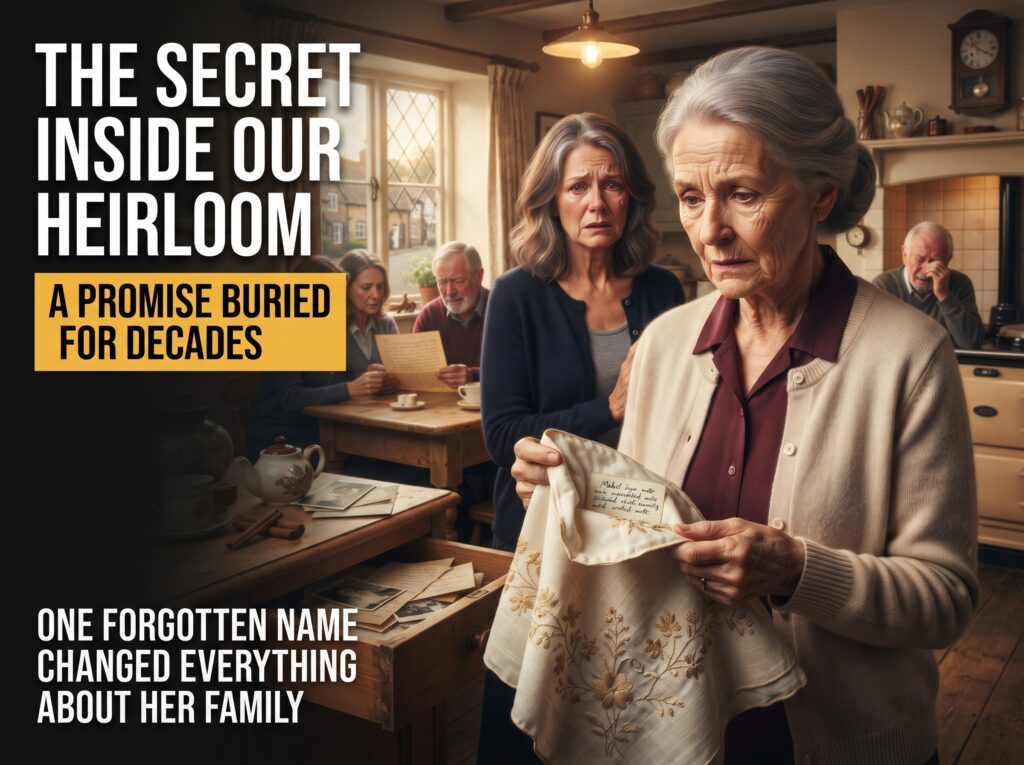
The cinnamon had been simmering in the kitchen since early morning.
Mabel liked to prepare it that way whenever the family gathered. A little cinnamon, brown sugar, and orange peel were enough to fill the old village house with the smell she remembered from her childhood.
It was a small tradition, but traditions were important to her.
At seventy-eight, Mabel had learned that the things people remembered were rarely the things they expected to remember. They forgot expensive presents, fashionable clothes, and elaborate celebrations. But they remembered the smell of a kitchen, the sound of someone laughing in another room, and the feeling of being welcomed home.
She had spent almost her entire life in that house.
Her father had built it with his own hands, and her mother had filled it with furniture, photographs, embroidered curtains, and small objects collected over the years.
Among those belongings was an old family heirloom.
It was a beautifully embroidered linen cloth that had been passed down through generations. It was usually kept folded inside a wooden drawer in the sitting room.
People admired its delicate stitching, the faded golden flowers, and the intricate patterns around its edges.
Whenever visitors asked about it, Mabel’s children explained that it had belonged to their great-grandmother.
Some believed it was valuable because of its age.
Others believed it was worth money because of the craftsmanship.
Mabel had never cared much about its financial value.
To her, it represented the women who had lived in the house before her.
Her mother had embroidered part of it. Her grandmother had repaired the damaged corners. And Mabel remembered sitting beside her grandmother as a little girl, watching her hands move carefully through the fabric.
There had been a particular phrase her grandmother repeated whenever she worked on it.
“Never throw away something simply because you don’t understand why it was kept.”
Mabel had carried those words into adulthood.
That afternoon, the house was unusually busy.
Her eldest daughter, Margaret, had arrived before lunch. Her younger daughter, Helen, was helping prepare the table, while Mabel’s grandson was carrying chairs into the dining room.
Everyone seemed occupied.
But something felt wrong.
When Mabel entered the sitting room, Margaret stopped speaking.
Helen immediately picked up a glass.
Her grandson looked toward the kitchen.
Mabel noticed all three reactions.
“Have I interrupted something?”
“No, Mother,” Margaret replied.
“Then why did everyone suddenly become quiet?”
“We were discussing dinner.”
Mabel looked at the table.
The plates were already arranged.
“About dinner?”
Margaret smiled.
“Yes.”
Mabel did not believe her.
She walked toward the wooden cabinet.
The drawer containing the family heirloom was slightly open.
She pulled it farther.
The embroidered cloth was gone.
Mabel stared at the empty space.
“Where is it?”
Helen turned around.
“What?”
“The cloth. The family heirloom.”
Margaret immediately approached.
“I put it somewhere safe.”
“Why?”
“It needed cleaning.”
“Then why didn’t you tell me?”
Margaret glanced at Helen.
It was a small movement, almost invisible.
But Mabel had spent decades learning to recognize the things people tried not to say.
“Bring it back,” she said.
“Mother, please don’t make this difficult.”
Mabel slowly closed the drawer.
She looked at her daughter.
“I have lived long enough to know when something is being hidden from me.”
Nobody answered.
Outside, a village church bell rang.
Inside the house, the smell of cinnamon continued to drift through the rooms.
And for the first time in many years, Mabel wondered whether the family heirloom had been kept for a reason nobody had ever told her.
That evening, she decided to search for it herself.
<h2>Part 2</h2>
Mabel waited until the house became quiet.
Margaret had gone home, Helen was upstairs, and her grandson had left to meet friends.
She returned to the sitting room carrying a small lamp.
The wooden cabinet had belonged to her grandmother. Its handles were worn, and one corner had been repaired several times.
Mabel opened the first drawer.
Old photographs.
The second contained birthday cards, letters, and several envelopes tied together with a faded ribbon.
The third drawer was almost empty.
She examined it carefully.
Something was missing.
She remembered seeing a small wooden box there only a few weeks earlier.
It had contained needles, thread, and several pieces of embroidered fabric.
She pulled the drawer completely out.
Behind it, she found a folded sheet of paper.
The paper was yellow with age.
There was no address, no date, and no signature.
Only one sentence:
What was promised must remain protected, even when the people who made the promise are gone.
Mabel read it twice.
She recognized the handwriting.
It belonged to her mother.
She sat down.
Her mother’s handwriting had been familiar to her for more than sixty years. She remembered the grocery lists, birthday cards, Christmas messages, and little notes left beside the kitchen sink.
But why would her mother write something like this?
Mabel turned the paper over.
Nothing.
She searched the drawer again.
Behind a loose wooden panel, she discovered a small bundle of thread.
It was the same golden thread used in the family heirloom.
Her fingers trembled.
She remembered something from her childhood.
One winter evening, when she was perhaps ten years old, her grandmother had been sitting beside the fireplace repairing the embroidered cloth.
Mabel had asked why she spent so much time working on something nobody used.
Her grandmother had looked at her and smiled.
“One day, someone will need it.”
“Who?”
“Someone who knows how to look.”
Mabel had laughed.
At the time, she thought it was another one of her grandmother’s mysterious sayings.
Now it seemed different.
She returned to the kitchen and made herself a cup of tea.
On the wall hung an old family photograph taken outside the house.
Her grandmother stood in the middle.
Her mother was beside her.
Several relatives stood behind them.
Mabel studied their faces.
There was something strange about the photograph.
One person appeared to have been standing at the far end, but the image had been cropped.
She had never noticed it before.
She removed the photograph from the wall and examined the back.
A date was written in blue ink.
October 17.
Below it were three initials.
Mabel recognized two.
The third was unfamiliar.
She took the photograph upstairs and compared the date with the old family calendar she kept in a cupboard.
October 17 had been an important day.
It was the date her grandmother had supposedly left the village for several months.
But the photograph proved she had been home.
Mabel felt a chill.
Why had the family repeated a different story for so many years?
She opened the old notebook containing her mother’s handwriting.
Several pages were filled with household accounts.
Near the back, she found a sentence written in the margin.
The cloth must never be sold, because it carries more than memories.
Mabel placed the notebook beside the photograph.
The words seemed to connect.
The heirloom was not valuable because of the fabric.
It was valuable because of what had been hidden inside it.
But the cloth was missing.
And the only person who knew where it had gone was her eldest daughter.
The following morning, Mabel telephoned Margaret.
“Bring the cloth home.”
There was a pause.
“Why?”
“Because I want to see it.”
“Mother, I told you. It’s being cleaned.”
“Then tell me where.”
Another silence followed.
Finally, Margaret said something that made Mabel’s stomach tighten.
“Please stop looking through Grandmother’s belongings.”
Mabel gripped the telephone.
“Why?”
“Because some things should remain where they were left.”
Mabel slowly replied.
“That is exactly what I have been trying to understand.”
<h2>Part 3</h2>
The next morning, Mabel visited the village market.
She had not planned to go shopping, but she needed to speak to someone who had known her grandmother.
There were only a few people left who remembered those days.
Most had moved away, and several had passed on.
One person remained particularly clear in her memory.
An elderly woman named Rose.
Rose had been her grandmother’s closest friend.
They had grown up together, worked together, and spent countless afternoons exchanging stories over tea.
Mabel found her sitting outside a small grocery shop.
“Rose?”
The old woman looked up.
For a moment, she did not recognize her.
Then her face brightened.
“Mabel! Look at you.”
They embraced.
Rose studied her.
“You look just like your mother.”
Mabel smiled.
“People keep saying that.”
They sat together on a wooden bench.
After exchanging a few ordinary stories, Mabel carefully mentioned the family heirloom.
Rose’s expression changed.
“The embroidered cloth?”
“Yes.”
“Why are you asking?”
“I found something strange.”
Mabel showed her the small note.
Rose read it without speaking.
Then she folded it carefully.
“Where did you find this?”
“In the old cabinet.”
Rose looked toward the road.
“Your mother should have destroyed it.”
Mabel felt her heart beating faster.
“Why?”
Rose hesitated.
“Because your grandmother wanted the family to remember something different.”
“Remember what?”
“That the cloth was never meant to belong to one person.”
Mabel frowned.
“I don’t understand.”
Rose sighed.
“Your grandmother was a generous woman. She helped people when nobody else would. But she also kept promises that were difficult to explain.”
“Was the cloth connected to someone outside our family?”
Rose did not answer.
Instead, she asked, “Have you spoken to Margaret?”
“Yes.”
“And what did she say?”
“Nothing useful.”
Rose gave a sad smile.
“That sounds like your mother.”
Mabel leaned closer.
“Please tell me what happened.”
Rose looked at her hands.
“When we were young, there was a woman who lived near the old mill. Her name was Clara. She had a little girl and very little money. Your grandmother helped her whenever she could.”
Mabel listened carefully.
“I remember hearing about Clara.”
“Do you remember what happened to her?”
“Only that she left the village.”
Rose nodded.
“That’s what everyone was told.”
“What really happened?”
Rose’s eyes became wet.
“Your grandmother believed that Clara deserved something the rest of the family had never appreciated.”
“What?”
“A place to belong.”
Mabel stared at her.
Rose continued.
“Your grandmother kept the embroidered cloth because it contained a record of something she had promised Clara. There were names, dates, and a message hidden in the lining.”
“Was Clara related to us?”
Rose looked away.
“That is a question you should ask the person who knows where the original document is.”
“Who?”
Rose stood slowly.
“I have already said too much.”
Mabel reached for her hand.
“Please.”
Rose looked at her with great sadness.
“Your grandmother once told me that if the truth ever came out, someone would have to explain why an entire family had spent so many years pretending one person never existed.”
Mabel felt her throat tighten.
“Who was that person?”
Rose shook her head.
“I promised I would not say.”
Mabel watched her walk away.
She returned home with more questions than answers.
But one detail remained in her mind.
Clara.
The woman from the old mill.
The woman who had supposedly left the village.
And the woman whose story had been connected to the family heirloom.
That evening, Mabel searched through the village telephone directory.
She found several people with the surname Clara had used.
Only one entry appeared to be connected to the old mill.
She wrote down the address.
Then she noticed something else.
The address was the same one written on the back of the old family photograph.
<h2>Part 4</h2>
Mabel drove to the old mill the following afternoon.
The road had changed considerably since her childhood.
Several houses had been renovated, the village shop had become a café, and the old stone bridge had been repaired.
But the mill remained almost exactly as she remembered it.
It stood beside a narrow stream, with faded wooden doors and ivy growing along the walls.
Mabel parked outside.
For several minutes, she remained in the car.
She remembered visiting the place with her grandmother.
There had been a woman who always greeted them.
A little girl had sometimes played near the doorway.
Mabel could not remember the girl’s name.
She walked toward the entrance.
A man opened the door.
He appeared to be in his late sixties.
“Can I help you?”
“I’m looking for someone who used to live here.”
“Who?”
“Clara.”
The man’s expression changed.
“Who told you about her?”
“My grandmother.”
He studied Mabel.
“What was your grandmother’s name?”
“Elizabeth.”
The man stepped backward.
For a moment, he seemed unable to speak.
Then he opened the door wider.
“Come inside.”
The room smelled of old wood and dust.
Several shelves contained tools and boxes.
The man introduced himself as Thomas.
He explained that he had inherited the property from his father.
Mabel sat at a small table.
“Do you remember Clara?”
Thomas nodded.
“Everyone remembered her.”
“What happened to her?”
He looked toward the window.
“She left.”
“Why?”
“That’s what people said.”
Mabel recognized the hesitation.
“Did you know my grandmother?”
“Yes.”
“Did she visit Clara?”
“Often.”
“Was there something between them?”
Thomas rubbed his forehead.
“Your grandmother was trying to help.”
“With what?”
“Something that involved the family.”
Mabel waited.
Thomas finally opened a cupboard and removed an old wooden box.
Inside were several letters.
Most had faded beyond recognition.
One contained the same golden thread that had been used in the heirloom.
Mabel picked it up.
A small handwritten mark appeared on the paper.
The initials matched those on the back of the family photograph.
“Who wrote this?”
Thomas shook his head.
“I don’t know.”
Mabel examined the letter.
It referred to an agreement made decades earlier.
The wording was difficult to understand, but one sentence was clear.
The promise remains until the family acknowledges what it did.
Mabel looked up.
“What did my family do?”
Thomas leaned back.
“That is something your daughter might know.”
Mabel’s expression changed.
“Margaret?”
Thomas nodded.
“She came here several months ago.”
Mabel felt her stomach tighten.
“What did she want?”
“She asked whether the old documents were still here.”
“Did you give them to her?”
“No.”
“Why?”
Thomas looked at the box.
“Because I didn’t believe she was ready to understand them.”
Mabel placed the letter on the table.
“Then perhaps you should explain them to me.”
Thomas was silent for a long time.
Finally, he said, “Your grandmother made an agreement with Clara. It concerned a piece of land and something that belonged to the family.”
Mabel thought about the heirloom.
“Was the cloth connected to the agreement?”
“Yes.”
“How?”
Thomas shook his head.
“I don’t have the complete record.”
“Who does?”
He looked directly at her.
“Your eldest daughter.”
Mabel stood.
For the first time, she understood why Margaret had been so anxious to remove the heirloom.
Her daughter had not simply hidden an old piece of fabric.
She had been trying to keep something from being discovered.
And the person who knew the complete story was living in the same family house where Mabel had spent nearly eighty years.
<h2>Part 5</h2>
Mabel returned home just before sunset.
Margaret’s car was parked outside.
She entered the kitchen and found her daughter sitting at the table.
The old embroidered cloth was beside her.
Mabel stopped.
“You brought it back.”
Margaret looked up.
“Mother, we need to talk.”
Mabel placed her handbag on the counter.
“Yes. We do.”
Margaret touched the fabric.
“Where have you been?”
“At the old mill.”
Her daughter’s face became pale.
“Why?”
“Because I wanted to understand why you have been hiding things from me.”
Margaret closed her eyes.
“Did you speak to Thomas?”
“Yes.”
“Then you know he doesn’t understand everything.”
“He knows you came looking for the documents.”
Margaret looked toward the window.
“That was a mistake.”
Mabel pulled out a chair.
“Tell me what is happening.”
Margaret remained silent.
Mabel placed the old note on the table.
Then she added the photograph and the letter from the wooden box.
“I found these.”
Margaret looked at each item.
Her hands began to shake.
“Where did you get the letter?”
“Thomas.”
“You shouldn’t have gone there.”
“Why?”
“Because he doesn’t know the whole story.”
“Then you tell me.”
Margaret stood and walked toward the sink.
For several moments, she stared outside.
Finally, she said, “Grandmother made a promise to Clara.”
Mabel nodded.
“I know.”
“She promised that Clara’s child would never be forgotten.”
Mabel looked at her.
“Why?”
Margaret turned.
“Because Clara’s child was connected to our family.”
“How?”
Margaret’s eyes filled.
“I don’t know how to explain it.”
“Start at the beginning.”
Margaret returned to the table.
She unfolded the embroidered cloth.
The fabric was beautiful, despite its age.
The golden flowers had faded slightly, and several sections had been repaired.
Margaret turned it over.
Along the inner edge was a line of stitching that looked different from the rest.
Mabel leaned closer.
“What’s that?”
Margaret carefully opened the lining.
A tiny piece of folded paper was hidden inside.
Mabel stared at it.
The handwriting was familiar.
Her mother’s.
Margaret unfolded it.
There was a date.
A signature.
And one sentence:
The person who deserves the truth must never be made to pay for the mistakes of those who came before.
Mabel read it slowly.
“What does this mean?”
Margaret wiped her eyes.
“It means Grandmother wanted someone to receive something that had been promised to them.”
“Who?”
Margaret shook her head.
“I don’t know.”
Mabel looked at her daughter.
“You’re lying.”
Margaret flinched.
“Mother!”
“You came here looking for the documents. You knew about Clara. You knew where the cloth was. And now you’re telling me you don’t know anything?”
Margaret lowered her head.
“I was trying to protect you.”
“From what?”
Margaret looked at the old note.
“From a truth that could change everything you believe about this family.”
Mabel felt tears gathering.
“I am seventy-eight years old. I have buried people I loved, watched this family grow, and carried memories that I thought I understood.”
She paused.
“Do not tell me I am too old to know the truth.”
Margaret began crying.
Then she said something that made Mabel’s heart sink.
“The person who kept the original document is still alive.”
“Who?”
Margaret shook her head.
“I cannot tell you.”
Mabel stood.
“Then I will find out myself.”
<h2>Part 6</h2>
Mabel spent the following morning examining the old family photographs.
She arranged them across the dining table according to their dates.
The earliest photograph showed her grandmother outside the family home.
The next showed her mother beside the old mill.
Another showed a group of women standing together during a village celebration.
Clara appeared in two of them.
In the first, she was holding a little girl.
In the second, she was standing beside Mabel’s grandmother.
Mabel studied the child’s face.
Something about her seemed familiar.
She searched through the remaining photographs.
Then she found one taken several years later.
The little girl was older.
She stood beside Margaret.
Mabel stared at the photograph.
She remembered that day.
It had been a summer gathering.
Margaret had told her that the child was a visitor from another village.
But why was she standing beside her?
And why did the photograph have a different date written on the back?
Mabel turned it over.
There was a message.
For the family who promised to remember.
The handwriting belonged to Clara.
Mabel felt her chest tighten.
She telephoned Thomas.
“I need to speak to you again.”
“About what?”
“Clara’s daughter.”
There was a pause.
“Why?”
“Because I found another photograph.”
Thomas sighed.
“Come back tomorrow.”
Mabel did not want to wait.
“Please. I need to know.”
Thomas remained silent.
Then he said, “There was a woman who used to visit your grandmother every year. She carried a small box and always asked whether the promise had been kept.”
“What was her name?”
“I don’t remember.”
“Was she Clara’s daughter?”
“I think so.”
Mabel closed her eyes.
“Do you know where she lives?”
Thomas gave her an address.
It was outside the village.
Mabel wrote it down.
Before ending the call, she asked one more question.
“Did she ever speak to my mother?”
“Yes.”
“When?”
“Several weeks before your grandmother died.”
Mabel felt a strange heaviness.
Her mother had known about the woman.
Margaret had known about Clara’s daughter.
And now, decades later, the family was still hiding the truth.
Mabel spent the afternoon preparing to leave.
She placed the photographs inside a folder and wrapped the small note in tissue paper.
Then she noticed an envelope beneath the kitchen telephone.
It had been placed there recently.
Her name was written on the front.
Mabel opened it.
Inside was a short message.
You have been asking questions that should have remained unanswered. Please stop before you hurt someone who has already suffered enough.
There was no signature.
Mabel read it twice.
She was not frightened.
She was angry.
For most of her life, she had believed that family meant protecting one another.
But she was beginning to understand that people sometimes used the word protection to hide their own mistakes.
She placed the message in her handbag.
Then she called a taxi.
She would find Clara’s daughter.
And this time, she would not allow anyone to change the subject.
<h2>Part 7</h2>
The address led Mabel to a small house on the edge of the village.
It stood beside a narrow road lined with old trees.
A garden surrounded the property, and several flowerpots stood near the entrance.
Mabel knocked.
A woman opened the door.
She appeared to be in her late sixties.
Her hair was silver, and she wore a simple blue cardigan.
“Can I help you?”
Mabel introduced herself.
The woman’s expression changed immediately.
“You’re Elizabeth’s granddaughter.”
Mabel nodded.
“Yes.”
The woman looked at her for a long moment.
Then she stepped aside.
“Come in.”
The living room was filled with photographs.
Some showed children.
Others showed weddings and family celebrations.
Mabel noticed one picture on the mantelpiece.
It was Clara.
The woman followed her gaze.
“My mother.”
Mabel sat down.
“Then you’re the person I’ve been looking for.”
The woman nodded.
“My name is Anne.”
Mabel placed the photograph on the table.
Anne picked it up.
Her expression softened.
“I haven’t seen this in years.”
“Do you know what the family promise was?”
Anne looked at her.
“Your grandmother told you nothing?”
“She died before she could explain.”
Anne put the photograph down.
“Then perhaps it is time.”
Mabel waited.
Anne began speaking about her childhood.
She remembered visiting the old family house.
She remembered Mabel’s grandmother preparing food for everyone.
She remembered Margaret.
And she remembered the embroidered cloth.
“Your grandmother promised my mother that the truth would not disappear with her generation.”
“What truth?”
Anne looked toward the window.
“My mother believed she had been given something that belonged to her. But the family never acknowledged it.”
“Was it land?”
Anne nodded.
“Partly.”
Mabel thought about the old documents.
“Was the heirloom connected to the agreement?”
“Yes. Your grandmother kept the proof hidden inside it.”
Mabel leaned forward.
“What proof?”
Anne opened a small cabinet.
Inside was a collection of letters.
She removed a folded document.
It contained a description of an agreement between two families.
There were dates, signatures, and a reference to an inheritance.
Mabel read the first page.
The details were difficult to understand.
But one thing was clear.
Her grandmother had promised that a particular person would receive something that had been withheld for years.
“Why didn’t anyone fulfill the promise?”
Anne looked at her.
“Because the person who controlled the family documents refused.”
“Who?”
Anne shook her head.
“I don’t want to accuse someone without proof.”
Mabel examined the signatures.
One belonged to her grandmother.
Another belonged to Clara.
The final signature was unfamiliar.
But it had appeared before.
Mabel remembered seeing it on the back of the old photograph.
She looked up.
“Who signed this?”
Anne stared at the document.
Then she said, “Someone who told your family they knew nothing about the agreement.”
Mabel felt a chill.
“Do you know where that person is?”
Anne nodded.
“Yes.”
“Will you tell me?”
Anne hesitated.
Then she reached for a small notebook.
She opened it to the final page.
A name was written there.
Mabel recognized the handwriting.
It belonged to her eldest daughter.
She stared at the page.
Margaret had been involved far longer than she had admitted.
<h2>Part 8</h2>
Mabel returned to the village with the document inside her handbag.
She did not go home immediately.
Instead, she visited the church where her mother had been buried.
The church stood at the center of the village.
Its stone walls had darkened with age, and the wooden doors were worn from years of use.
Mabel sat in the back pew.
She remembered coming there as a young woman with her mother.
They had attended weddings, funerals, baptisms, and holiday services.
Her mother had always believed that the truth eventually found its way into the world.
But she had also believed that some truths needed time.
Mabel wondered whether that belief had become an excuse.
She took out the document.
The signatures were clear.
Her grandmother.
Clara.
And the person whose name had appeared in Anne’s notebook.
There was another page attached to the back.
It contained a short handwritten statement.
If this agreement is ever questioned, the original must be presented before the family makes any further decisions.
Mabel read the sentence again.
The original.
Where was it?
Anne had shown her a copy.
Thomas had shown her letters.
The heirloom contained a hidden note.
But nobody had shown her the original document.
She returned home.
Margaret was waiting in the kitchen.
“Where have you been?”
Mabel placed the document on the table.
“With Anne.”
Her daughter looked at the papers.
Then she sat down.
“What did she tell you?”
“Enough.”
Margaret covered her face.
Mabel looked at her.
“How long have you known?”
Her daughter did not answer.
“How long, Margaret?”
“Since before Grandmother died.”
Mabel closed her eyes.
“Why didn’t you tell me?”
“Because I thought it would destroy the family.”
“Which part of the family?”
Margaret looked up.
“The part that still believed we were doing the right thing.”
Mabel slowly sat down.
“Your grandmother left instructions.”
“Yes.”
“She wanted the promise fulfilled.”
Margaret nodded.
“Then why didn’t you do it?”
Margaret began crying.
“Because I was afraid of what would happen if the original document came out.”
“What would happen?”
“It would mean admitting that something had been taken from someone who had every right to receive it.”
Mabel looked at her daughter.
“Was it money?”
Margaret shook her head.
“Not only money.”
“Then what?”
Margaret looked toward the old wooden cabinet.
“Land. A home. A family history. And something much more painful.”
Mabel felt her eyes fill.
“Tell me.”
Margaret reached for the old embroidered cloth.
She placed it between them.
Then she opened the lining and removed a second piece of paper.
It was smaller than the first.
A date was written at the top.
Beneath it was a familiar phrase.
Mabel recognized it immediately.
It was the same phrase her grandmother had used whenever she repaired the cloth.
Never throw away something simply because you don’t understand why it was kept.
But this time, another sentence followed.
The truth belongs to the person whose name was removed.
Mabel stared at the paper.
“Who removed the name?”
Margaret looked toward the door.
“I think you already know.”
<h2>Part 9</h2>
The following afternoon, Mabel gathered the documents.
She placed the photograph, the letters, the hidden note, and the copied agreement inside a large envelope.
She had decided to confront the person who could explain everything.
Anne had agreed to accompany her.
They drove to a house outside the village.
It was an old property with a small garden and a wooden gate.
Mabel recognized it from the address book.
The person who lived there had been part of the family gatherings for years.
Someone who had attended birthdays, weddings, and funerals.
Someone who had stood beside Mabel’s mother and promised that everything was being handled.
The door opened.
An elderly man stood in the entrance.
He looked surprised to see Mabel.
“Is something wrong?”
Mabel held up the envelope.
“I need to ask you something.”
The man looked at Anne.
Then he stepped aside.
They entered.
The living room was quiet.
A large clock stood against the wall.
Its ticking seemed unusually loud.
Mabel placed the envelope on the table.
“I found these.”
The man looked at the papers.
His expression changed.
“Where did you get them?”
“From people who were tired of keeping the secret.”
He sat down.
Mabel removed the photograph.
Then the old agreement.
Then the tiny note from the embroidered cloth.
“I want you to explain why this promise was never fulfilled.”
The man stared at the documents.
For several seconds, he did not speak.
Then he said, “Your grandmother made a mistake.”
Mabel shook her head.
“She made a promise.”
“She didn’t understand what it would cost.”
“Then why did everyone keep telling us that the family heirloom was valuable because of its age?”
The man looked down.
“Because it was easier than explaining what was inside it.”
Mabel placed the final document on the table.
“Who signed this?”
The man stared at the signature.
His hands began to tremble.
Anne spoke quietly.
“You know exactly who it was.”
The man looked at her.
“Please don’t.”
Mabel leaned forward.
“I have spent decades believing that I understood my family. I am too old to waste whatever time I have left pretending that silence is the same as peace.”
The man began crying.
Mabel had expected anger.
Perhaps even denial.
But she had not expected tears.
“Why are you crying?” she asked.
He wiped his face.
“Because I thought nobody would ever find it.”
“Find what?”
“The original agreement.”
Mabel felt her heart beat faster.
“Where is it?”
He looked toward a cabinet.
Then he slowly stood and opened a small drawer.
Inside was a leather folder.
He placed it on the table.
Mabel opened it.
The original document was there.
It contained the same signatures as the copy, but there were additional pages.
One page included a handwritten statement.
Mabel read the date.
Then she read the name.
Her fingers went cold.
She knew the name.
It belonged to someone who had attended every important family gathering.
Someone who had always insisted that they knew nothing about the old agreement.
Someone who had sworn repeatedly that the entire story was a misunderstanding.
Mabel looked up.
The man across from her was crying harder now.
“Why did you say you knew nothing?” she whispered.
He did not answer.
Anne looked at the document.
Then she looked at Mabel.
And in that moment, Mabel understood that the secret had never been buried because nobody remembered it.
It had been buried because the person responsible had been standing among them all along.
<h2>Part 10</h2>
Mabel did not speak for several minutes.
She simply stared at the name on the original document.
Outside, the afternoon light was fading.
The old clock continued ticking.
The man opposite her wiped his eyes and looked down at his hands.
“Your grandmother asked me to keep it safe,” he finally said.
Mabel raised her eyes.
“Safe from whom?”
“From the family.”
“Which family?”
He swallowed.
“Everyone.”
Mabel slowly closed the folder.
“That is not an answer.”
He looked at her.
“I was young when it happened. I believed I was helping. Your grandmother asked me to make sure that nobody used the agreement against the people who had signed it.”
“But you knew what it meant.”
“Yes.”
“And you let everyone believe there was nothing.”
He nodded.
Mabel felt a deep sadness.
She had spent years remembering the family as a collection of imperfect but loving people.
Now she understood that some of those imperfections had been deliberate.
She looked at Anne.
“Did your mother know?”
Anne nodded.
“She knew enough to understand that something had been taken from her.”
Mabel returned her attention to the document.
“Then why didn’t she fight?”
“Because she trusted your grandmother.”
The words hurt more than Mabel expected.
Her grandmother had been the person who taught her that promises mattered.
The person who taught her to care for others.
The person who had made the family heirloom.
Yet she had also participated in a decision that allowed an entire family history to be hidden.
Mabel thought about the tiny note stitched into the lining.
The words suddenly made sense.
The truth belongs to the person whose name was removed.
It was not simply a message.
It was an instruction.
She carefully placed the original document back inside the folder.
“Who else knows?”
The man shook his head.
“Only the people involved.”
“Then we need to stop pretending.”
He looked frightened.
“Your daughter will be angry.”
“She already is.”
“Your family may never be the same.”
Mabel looked at him.
“Perhaps it was never what we thought it was.”
She returned home that evening.
Margaret was waiting in the kitchen.
The cinnamon was still simmering.
The smell brought Mabel back to her childhood, to the days when her grandmother had stood beside the stove and reminded her that family was not something people could simply inherit.
It was something they had to choose to protect.
Mabel placed the original document on the table.
Margaret looked at it.
Then she began to cry.
“You found it.”
“Yes.”
“Who had it?”
Mabel did not answer immediately.
Instead, she unfolded the document and placed it in front of her daughter.
Margaret read the name.
Her face changed.
For a moment, she looked as though she might collapse.
“That can’t be right.”
“It is.”
“But he told us he knew nothing.”
“I know.”
Margaret covered her mouth.
Mabel pulled out a chair.
“Sit down.”
Her daughter lowered herself into it.
For a long time, neither spoke.
Then Margaret whispered, “What happens now?”
Mabel looked at the old embroidered cloth.
“We tell the truth.”
“What about everyone else?”
“They deserve to know.”
“What about the promise?”
Mabel touched the golden stitching.
“We find out what it meant to the person who was supposed to receive it.”
Margaret looked at her mother.
“Do you think the family can survive this?”
Mabel considered the question.
She thought about the years of silence, the missing photographs, the hidden letters, and the people who had spent their lives pretending that nothing had happened.
“I don’t know,” she answered honestly.
Then she reached across the table and held her daughter’s hand.
“But I know we cannot build another generation on a lie.”
The following morning, Mabel invited the family to the house.
She placed the heirloom in the center of the table.
Beside it were the original agreement, the photographs, and the letters.
Nobody spoke when they entered.
Some looked confused.
Others looked frightened.
Mabel waited until everyone was seated.
Then she began.
“For years, we have told the same story. We have repeated it so many times that we eventually stopped questioning whether it was true.”
She looked around the room.
“We have hidden names, removed photographs, and kept documents away from people who had every right to see them.”
Margaret lowered her head.
Mabel continued.
“I am not here to decide who deserves forgiveness. I am here because I don’t want the next generation to inherit a secret they never created.”
She opened the original document.
And for the first time in decades, the family heard the complete story.
Some cried.
Some became angry.
Others simply sat in silence.
But nobody left.
Mabel watched their faces.
She knew that the days ahead would not be easy. There would be difficult conversations, apologies that might never be accepted, and questions that would take time to answer.
But something had changed.
The secret was no longer hidden inside an heirloom.
It was finally out in the open.
Later that afternoon, Mabel returned to the kitchen.
She folded the embroidered cloth carefully and placed it inside the wooden cabinet.
But this time, she did not lock the drawer.
She left it slightly open.
When Margaret came to stand beside her, Mabel smiled sadly.
“Do you remember what Grandmother used to say?”
Margaret nodded.
“Never throw away something simply because you don’t understand why it was kept.”
Mabel looked at the cloth.
“She was right. But I think she forgot something.”
“What?”
“Sometimes, the most important thing we can keep is the truth.”
Outside, the village church bell began to ring.
Mabel stood beside her daughter, listening.
For the first time in many years, the house felt quiet without feeling uncomfortable.
The past had not disappeared.
It had not been repaired in a single afternoon.
But it had finally been acknowledged.
And Mabel understood something she wished she had learned much earlier.
Growing older did not automatically mean understanding the past.
Sometimes, it meant finally becoming brave enough to question the stories everyone else had accepted.
The family heirloom had never been valuable because of its fabric, its age, or the golden stitching.
Its true value had always been the promise hidden inside it.
A promise that someone had waited a lifetime to see fulfilled.
And now, at last, the truth belonged to the people who had spent their lives waiting for it.