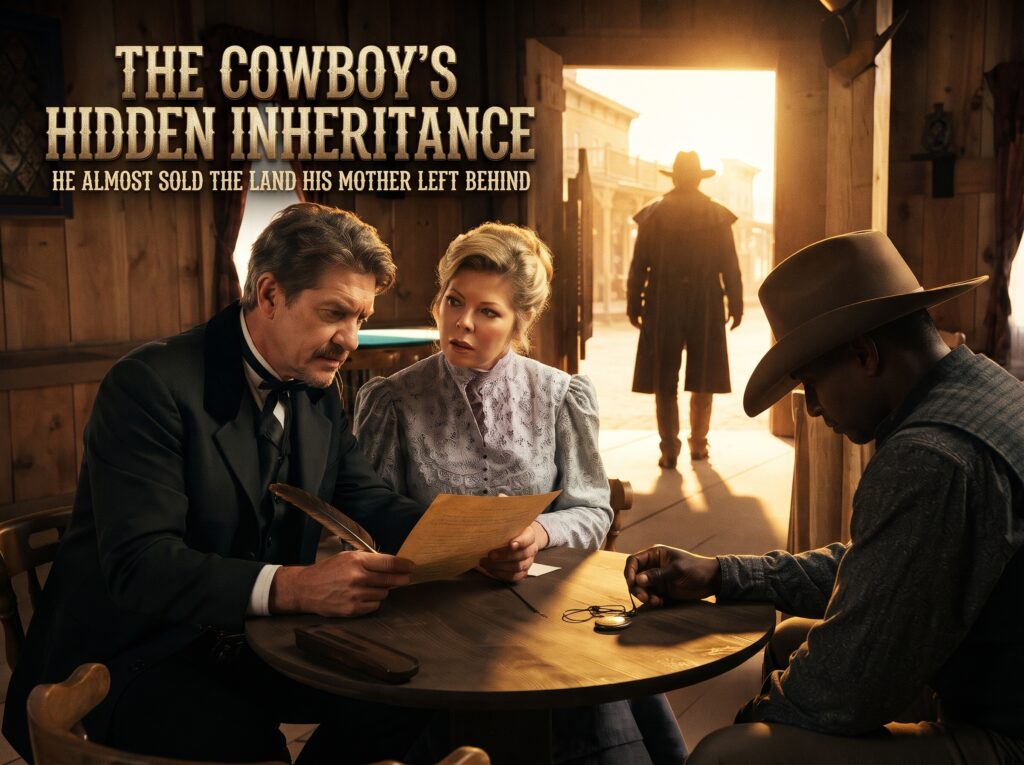
In the spring of 1887, the small frontier town of Red Creek was changing.
Railroad companies were moving west, wealthy businessmen were buying farmland, and families who had lived on the same land for generations were suddenly discovering that their homes were worth fortunes.
Jacob Miller had no interest in becoming rich.
He wanted to keep the ranch his father had built.
The Miller Ranch stood outside Red Creek, surrounded by rolling grassland, a freshwater creek, and hundreds of acres of open country.
Jacob was thirty-four years old.
He had spent most of his life working with horses, repairing fences, and looking after cattle.
His father, Thomas Miller, had died eight years earlier.
Since then, Jacob had managed the ranch alone.
His mother, Elizabeth, had passed away the previous winter.
Her death had left him with more than grief.
It had left him with debts.
The previous summer, a terrible drought had destroyed much of his cattle business. He borrowed money to purchase feed, repair the well, and pay the workers.
Unfortunately, the following winter was even worse.
By March, he owed nearly twelve thousand dollars.
The man who held the debt was a wealthy businessman named Charles Whitmore.
Charles owned several properties in Red Creek and wanted to expand his holdings.
He had offered Jacob enough money to clear his debts if he agreed to sell the ranch.
Jacob had refused three times.
But now he had no choice.
Or at least, that was what he believed.
On Thursday morning, Jacob rode into town and entered the office of the Red Creek Trading Company.
Charles was waiting at a round wooden table.
Beside him sat his wife, Margaret, wearing a beautiful lavender dress.
A young woman named Clara stood near the window.
Clara was Margaret’s niece and had been staying with the Whitmore family for several months.
She had known Jacob since childhood.
“You’re late, Miller,” Charles said.
“I came as quickly as I could.”
Charles pointed toward the chair.
“Sit down. Let’s finish this business.”
Jacob removed his hat.
“I want the agreement exactly as we discussed.”
“Of course.”
Charles opened a leather folder.
“The ranch, the buildings, the livestock, and all rights to the surrounding property. In exchange, I will settle your outstanding debt and provide an additional payment.”
Jacob examined the papers.
He had barely slept the previous night.
His mother’s old house was falling apart, and he had received another warning from the bank.
He needed money.
Charles handed him a pen.
“Your father would have wanted you to make the sensible decision.”
Jacob looked up.
“Don’t bring my father into this.”
Margaret lowered her eyes.
Clara looked uncomfortable.
Charles smiled.
“Then let’s simply sign.”
Jacob reached for the pen.
But before he could write his name, Clara noticed something on the last page.
A property description.
It included a parcel of land Jacob had never agreed to sell.
She recognized the location immediately.
It was the old northern pasture where Elizabeth Miller had spent countless afternoons.
“Mr. Miller,” Clara whispered.
Jacob looked at her.
“What?”
She pointed toward the document.
“That land shouldn’t be included.”
Charles immediately closed the folder.
“Clara, this is a private business meeting.”
But Clara had already seen enough.
She knew something was wrong.
And she wasn’t going to remain silent.
5. Part 2 — The Woman Who Remembered His Mother
Clara had grown up in Red Creek.
Her father had been a schoolteacher, and her mother had died when she was young.
After her father’s death, Margaret had invited her to live with the Whitmore family.
Clara was twenty-six.
She had learned to read legal documents while helping her father maintain the town’s records.
She was also one of the few people who remembered Elizabeth Miller well.
Elizabeth had been a quiet woman.
She rarely attended social gatherings and never discussed her family’s private affairs.
But she had once told Clara something that had stayed with her.
“Never allow anyone to convince you that land is only dirt and grass,” Elizabeth had said. “Sometimes the ground beneath your feet carries the history of people who sacrificed everything to protect it.”
At the time, Clara hadn’t understood.
Now she did.
After the meeting ended, she waited until Jacob left the office.
“Jacob!”
He turned.
“Clara?”
She hurried toward him.
“You cannot sign those papers.”
Jacob sighed.
“Please don’t start.”
“I’m serious.”
“Charles is paying my debts. What else am I supposed to do?”
“Have you read the entire agreement?”
“Yes.”
“Then you haven’t noticed the northern pasture?”
Jacob frowned.
“What about it?”
“It’s included in the sale.”
“So?”
Clara looked around before lowering her voice.
“Your mother told my father that nobody was ever supposed to sell that land.”
Jacob became impatient.
“Clara, my mother is gone.”
“I know.”
“Then why are we discussing something she said years ago?”
“Because she left something behind.”
Jacob stared at her.
“What?”
Clara hesitated.
“An envelope.”
“Where?”
“I don’t have it.”
“Then who does?”
Clara looked toward the trading company.
“Margaret.”
Jacob frowned.
“Why would my mother leave something with Mrs. Whitmore?”
“Because they were friends long before Charles came to Red Creek.”
Jacob shook his head.
“That makes no sense.”
Clara stepped closer.
“Your mother trusted Margaret with something important. I think Charles knows about it.”
Jacob looked at her for a long moment.
Then he said:
“If you know something, tell me.”
“I can’t. Not until I see the original document.”
Jacob put on his hat.
“I have until tomorrow morning to sign. After that, Charles says he’ll take me to court.”
He walked toward his horse.
Clara watched him leave.
She knew that if Jacob signed the agreement, there might be no way to recover the northern pasture.
And she knew that Charles had been waiting years for that exact moment.
That evening, Clara confronted Margaret.
She found her aunt sitting alone in the dining room.
“Where is Elizabeth Miller’s letter?”
Margaret dropped her sewing.
“Don’t ask me that.”
“Why?”
“Because you don’t understand what you’re getting involved in.”
Clara approached the table.
“Jacob is about to lose his mother’s land.”
Margaret looked toward the doorway.
Then she whispered:
“Your uncle will destroy anyone who interferes.”
Clara felt her heart beating faster.
“Then perhaps it’s time someone stopped being afraid of him.”
Margaret stood and walked to a locked cabinet.
She removed a small envelope.
“Your mother would have wanted you to know the truth.”
Clara opened it.
Inside was a handwritten letter.
And the first sentence made her hands tremble.
Margaret, if Charles ever tries to purchase the Miller Ranch, make sure Jacob knows what lies beneath the northern pasture.
6. Part 3 — The Secret Beneath the Northern Pasture
The following morning, Clara rode to the Miller Ranch.
Jacob was repairing a fence when she arrived.
He looked surprised.
“You shouldn’t be here.”
“Neither should you be selling that land.”
Clara handed him the envelope.
Jacob opened it carefully.
His mother’s handwriting was unmistakable.
My dear Margaret,
If my son ever finds himself in a position where he must sell the ranch, please remind him that the northern pasture is not ordinary property.
Your husband knows why the railroad surveyors came here three years ago.
He also knows that the land contains something that belongs to the Miller family.
I have placed the original ownership documents somewhere safe.
Please make sure Jacob receives them before he signs anything.
Jacob read the letter twice.
“What does this mean?”
Clara shook her head.
“I don’t know.”
“Why would Charles know about railroad surveyors?”
“Because he has been buying land around the town.”
Jacob looked toward the northern hills.
He remembered his father speaking about a railroad survey that had taken place years earlier.
Thomas had refused to sell part of the property.
Jacob had never understood why.
His father had simply said:
“Some land is worth more than the money someone offers you.”
Jacob folded the letter.
“Where are the original documents?”
“Your mother didn’t say.”
“Then we need to find them.”
They spent the morning searching the old farmhouse.
They checked drawers, cupboards, trunks, and boxes filled with family photographs.
At first, they found nothing.
Then Jacob remembered an old wooden clock that had belonged to his grandfather.
The clock had stopped working years earlier.
He removed it from the wall and noticed that the back panel was loose.
Inside was a small leather pouch.
It contained three documents.
The first was the original deed to the northern pasture.
The second was a map.
The third was a letter signed by a railroad engineer.
Jacob examined the map.
It showed a proposed railway line running through the Miller Ranch.
A red circle marked the northern pasture.
The railroad intended to build a major freight station there.
Jacob looked at Clara.
“How much would this land be worth?”
She studied the engineer’s letter.
“More than Charles is offering you.”
Jacob felt anger rising inside him.
Charles wasn’t trying to help him escape debt.
He was trying to purchase the land before its true value became public.
But the map contained another surprise.
The railroad line wasn’t the only thing marked.
There was a small symbol near the old creek.
It appeared to identify a mineral survey.
Jacob turned the map over.
On the back, his father’s handwriting read:
The railroad is only the beginning. Never let anyone separate the northern pasture from the creek.
Jacob looked at Clara.
“There’s more here than we know.”
Before she could answer, a horse approached the farmhouse.
A man in a black hat rode through the gate.
It was Charles Whitmore.
He had come to collect the signed agreement.
And he was carrying a gun.
7. Part 4 — The Man Who Wanted Everything
Charles dismounted slowly.
His expensive black coat looked out of place against the dusty ranch buildings.
He glanced at the papers in Jacob’s hand.
“Good morning, Miller.”
Jacob folded the map.
“What are you doing here?”
“I came to make sure we’re still in agreement.”
“I’m not signing anything today.”
Charles smiled.
“That’s unfortunate.”
Jacob stood between him and the farmhouse.
“Your agreement includes land that isn’t for sale.”
“All your land is for sale when you owe money.”
“Not anymore.”
Charles’s expression hardened.
“Do you understand what happens when a man refuses to repay his debts?”
“I understand perfectly.”
Charles looked toward Clara.
“You’ve been filling his head with nonsense.”
Clara stepped forward.
“His mother left documents proving the northern pasture has a separate ownership history.”
Charles laughed.
“Documents can be interpreted in many ways.”
“Not when they’re original deeds.”
For a moment, Charles said nothing.
Then he looked directly at Jacob.
“Your mother was a stubborn woman.”
Jacob clenched his jaw.
“Don’t speak about her.”
“She made mistakes. Your father made mistakes. Now you’re repeating them.”
“What do you want?”
Charles removed a folded paper from his coat.
“I have a new offer. I’ll settle the entire debt and pay you twice what we originally discussed.”
Jacob stared at him.
“Why?”
“Because I want the ranch.”
“Why that badly?”
Charles stepped closer.
“Because the railroad is coming, and I intend to own every acre around it.”
Jacob looked at Clara.
She had been right.
Charles wanted the northern pasture because it would become extremely valuable once the railway station was built.
But there was something else.
Margaret had been watching from the farmhouse doorway.
She approached slowly.
“Charles, stop.”
He turned.
“Go inside.”
“No.”
He stared at his wife.
Margaret’s voice trembled.
“I know about the original agreement.”
Charles’s face changed.
“What agreement?”
“The agreement you made with Thomas Miller.”
Jacob looked at her.
“My father?”
Margaret nodded.
“Your father sold Charles the southern section of the property years ago. But he refused to sell the northern pasture because Charles promised that the creek would remain protected.”
Jacob frowned.
“Why would my father make that agreement?”
Margaret looked at Charles.
“Because your father discovered that the water beneath the pasture supplied three nearby farms.”
Charles laughed bitterly.
“That agreement was never legally binding.”
Margaret shook her head.
“It was signed by witnesses.”
Jacob stepped forward.
“Who were they?”
Margaret looked at Clara.
Then she said:
“Your father, your grandfather, and my own father.”
Charles turned toward her.
“Enough!”
But Margaret continued.
“Your uncle has been hiding those papers for years.”
Jacob froze.
“My uncle?”
Margaret nodded.
“Henry Miller.”
Jacob hadn’t seen his uncle in more than fifteen years.
And he had always believed Henry had left town after an argument with his father.
Now he wondered whether that argument had been about the land.
8. Part 5 — The Brother Who Disappeared
Henry Miller had been the older brother of Jacob’s father.
He had worked alongside Thomas on the ranch before leaving Red Creek.
The family had always said the brothers had disagreed over money.
Jacob remembered his father becoming angry whenever Henry’s name was mentioned.
After Thomas died, Jacob received a short letter from his uncle.
It contained no explanation.
Only an address in Colorado.
Jacob had never written back.
Now, with Margaret’s revelation, everything felt different.
That afternoon, Clara found an old newspaper clipping in the leather pouch.
It reported that Henry Miller had been accused of stealing money from a local land company.
The article claimed he had disappeared before facing charges.
Jacob read it carefully.
“Why would my uncle steal from a land company?”
Margaret looked at the clipping.
“Because he discovered that Charles was secretly buying water rights.”
Jacob stared at her.
“Water rights?”
Margaret explained that the northern pasture contained a natural underground spring.
The spring fed the creek that supplied several farms.
Charles wanted control of the water before the railroad arrived.
If he owned the spring, he could charge the surrounding farmers for access.
Jacob looked at the map.
Suddenly, the small symbol near the creek made sense.
The land wasn’t valuable simply because of the railway.
It contained the most important water source in the region.
And Charles wanted it.
Clara examined the newspaper.
“Henry didn’t steal money, did he?”
Margaret shook her head.
“No. He discovered that Charles had been using a company account to purchase water rights illegally. When Henry threatened to expose him, Charles accused him of theft.”
Jacob felt sick.
“My father knew?”
“Yes.”
“Then why didn’t he tell me?”
Margaret looked toward the window.
“Because your father believed protecting his brother would put your entire family in danger.”
Jacob sat down.
His father had carried the secret alone.
And his mother had continued protecting the land after his death.
Suddenly, the ranch was no longer simply a family property.
It was the center of a battle that had lasted more than twenty years.
Jacob looked at Clara.
“We need to find Henry.”
Clara nodded.
But before they could leave, a rider appeared in the distance.
He carried a letter.
The envelope was addressed to Jacob.
Inside was a single sentence.
Your uncle is alive, and he has the original agreement. But if you want to see him again, come alone.
At the bottom was a name.
Charles Whitmore.
9. Part 6 — The Price of Silence
Jacob wanted to ride immediately.
Clara stopped him.
“You’re not going alone.”
“Charles specifically said—”
“Charles doesn’t get to decide what happens to you.”
Margaret agreed.
“Your uncle has been waiting years for this moment. We need to be careful.”
They decided to visit the town sheriff, Samuel Cooper.
Samuel had known Thomas Miller for decades.
When Jacob showed him the letter, the sheriff’s expression changed.
“Whitmore has finally gone too far.”
“Can you help us find Henry?” Jacob asked.
Samuel studied the letter.
“I know someone who might.”
The sheriff sent a telegram to a former railroad employee in Colorado.
Three days later, a reply arrived.
Henry Miller was alive.
He had been living under his mother’s maiden name in a small mining town.
And he had recently returned to the region.
Jacob was stunned.
“Why didn’t he come home?”
Samuel sighed.
“Because he believed Charles would have him arrested.”
That evening, Jacob and Clara rode toward an abandoned railway station.
A man was waiting near the old platform.
He was older than Jacob remembered from childhood photographs.
His hair had turned almost completely white.
But his eyes were familiar.
“Uncle Henry?”
The man turned.
For a moment, neither spoke.
Then Henry approached and embraced him.
“Your father would have been proud of you.”
Jacob stepped back.
“Why did you leave?”
Henry looked toward the hills.
“Because I failed your father.”
He explained that Charles had offered him money to surrender the northern pasture’s water rights.
Henry had refused.
Charles then arranged for false financial records to be presented to the authorities.
Henry faced the possibility of prison.
Thomas begged him to leave town until the evidence could be recovered.
Henry agreed.
But he never returned.
“Your father protected me,” Henry said. “And I allowed him to carry the burden alone.”
Jacob shook his head.
“What happened to the agreement?”
Henry reached inside his coat.
He removed a folded document.
“This is the original agreement between your father and Charles.”
Jacob opened it.
The document stated that the northern pasture and its water rights would remain under Miller family ownership permanently.
It also contained a clause preventing the property from being sold without the approval of the Miller family heirs.
Jacob read the final paragraph.
His grandfather had added a handwritten note.
This land is not simply an inheritance. It is a responsibility to the families who depend upon its water.
Jacob looked up.
“Then Charles can’t legally buy it.”
Henry nodded.
“Not without breaking the agreement.”
Clara smiled.
For the first time in days, she felt hopeful.
But Henry wasn’t finished.
“There is something else.”
He handed Jacob another document.
It was a copy of a letter from Charles to a railroad executive.
The letter discussed plans to obtain the northern pasture through financial pressure.
It also mentioned a payment to a local official.
Jacob read the name.
Sheriff Samuel Cooper.
His face went pale.
10. Part 7 — The Sheriff Who Took the Money
Jacob couldn’t believe what he was reading.
“Samuel Cooper?”
Henry nodded.
“I don’t know whether he accepted the money, but his name is on the payment record.”
Clara shook her head.
“That doesn’t prove he betrayed us.”
“You’re right,” Henry said. “But we must investigate.”
They returned to Red Creek before sunrise.
Jacob went directly to the sheriff’s office.
Samuel was sitting behind his desk.
When Jacob placed the document in front of him, the sheriff looked at it for a long time.
Then he sighed.
“I wondered when this day would come.”
Jacob’s expression hardened.
“Did you take Charles’s money?”
Samuel stood.
“Yes.”
Clara gasped.
The sheriff continued.
“But I didn’t take it to help him steal your ranch.”
“Then why?”
Samuel explained that Charles had threatened to close several businesses and force families out of their homes unless the sheriff cooperated.
The money had been used to pay for legal assistance for several farmers facing eviction.
But Samuel admitted he had made a terrible mistake.
He had allowed Charles to believe he could control the sheriff’s office.
“I thought I could keep him from hurting people,” Samuel said. “Instead, I gave him power.”
Jacob looked at him.
“Will you testify?”
Samuel nodded.
“Yes.”
The sheriff gathered his records and began preparing a formal statement.
But Charles was already aware that Henry had returned.
He had men watching the ranch.
That afternoon, one of them approached the farmhouse.
He carried a message.
Charles wanted to meet Jacob at the trading company.
Jacob refused.
The messenger placed a second envelope on the table.
Inside was a photograph of the old farmhouse.
Someone had written:
Your mother should have accepted the first offer.
Jacob felt his blood run cold.
He looked at Clara.
Charles wasn’t simply trying to buy the ranch anymore.
He was threatening the family.
Margaret immediately arranged for a neighboring rancher to watch the property.
Henry stayed with Jacob.
And Clara took the original documents to the town bank for safekeeping.
But she never arrived.
Her horse returned alone.
And a few minutes later, a second message reached the ranch.
This time, it was addressed to Jacob.
Bring the original deed to the abandoned mill. Come alone. Your young lady is waiting.
Jacob reached for his rifle.
Henry grabbed his arm.
“Don’t let him turn you into the man he wants you to be.”
Jacob looked at his uncle.
“He’s taken Clara.”
“Then we bring her home. But we do it together.”
11. Part 8 — The Woman Who Refused to Be Silent
Clara was being held inside an abandoned mill outside town.
Charles stood near the window.
“You should have stayed out of this.”
Clara sat in a wooden chair, her hands tied.
“You should have stopped stealing from people.”
Charles laughed.
“You think the world works through kindness?”
“No. I think it works through people who finally refuse to be frightened.”
Charles stepped closer.
“Where are the documents?”
“Safe.”
“Where?”
She looked directly at him.
“You’ll never find them.”
Charles became angry.
He turned toward the door.
“Bring her outside.”
At that moment, a sound came from the mill entrance.
A horse.
Then another.
Jacob and Henry had arrived.
But they weren’t alone.
Sheriff Cooper had accompanied them, along with two deputies.
Charles looked through the window.
His expression changed.
“How did you find this place?”
Jacob stepped inside.
“Because you made the mistake of thinking everyone could be bought.”
Charles reached toward his gun.
The sheriff raised his weapon.
“Don’t.”
For a long moment, nobody moved.
Then Charles slowly lowered his hand.
Henry approached Clara and cut the rope.
Jacob held her shoulders.
“Are you hurt?”
She shook her head.
“I’m all right.”
Charles looked at the documents in Henry’s hand.
“You have no idea what you’re doing.”
Jacob faced him.
“We know exactly what we’re doing.”
Charles began laughing.
“You think one old deed can stop a railroad company?”
Jacob answered:
“No. But the truth might.”
The sheriff explained that the original documents, payment records, and witness statements would be submitted to the territorial authorities.
Charles’s face turned pale.
He had believed he could control the entire town.
But he had forgotten something important.
The people of Red Creek had depended on one another long before he arrived.
And now they were standing together.
Charles was arrested that afternoon.
But the greatest surprise came two days later.
A railroad representative arrived in Red Creek.
He carried a letter confirming the proposed railway route.
The northern pasture was not only part of the new railway development.
It was scheduled to become the site of a major freight and water station.
Jacob stared at the letter.
The ranch was worth far more than anyone had imagined.
And suddenly, he understood why Charles had been so desperate to take it.
12. Part 9 — The Final Agreement
The town gathered inside the trading company office.
The same round table where Jacob had nearly signed away his inheritance stood in the center of the room.
This time, Jacob sat beside Henry.
Clara stood behind them.
Margaret occupied the chair near the window.
The railroad representative placed a proposal on the table.
“We would like to negotiate an agreement with the Miller family.”
Jacob examined the documents.
The railroad offered a substantial payment for a limited right-of-way.
The northern pasture would remain family property.
The creek would remain protected.
And the water rights would be managed under a permanent agreement.
Jacob looked toward Henry.
“What do you think?”
Henry smiled.
“Your father would have liked that.”
Margaret added:
“Your mother would have wanted the families of Red Creek protected too.”
Jacob considered the proposal.
Then he asked the representative:
“What happens to the farms that depend on the creek?”
The representative explained that the railroad would fund improvements to the water system and guarantee continued access for local farmers.
Jacob nodded.
“Then we can discuss it.”
He signed the agreement.
But unlike the document Charles had prepared, this one protected the property and the people who depended on it.
After the meeting, Clara approached him.
“Your father would be proud.”
Jacob smiled.
“I wish he could have seen this.”
She took his hand.
“He can see it through what you do.”
Jacob looked at her.
For years, he had believed he needed to protect the ranch alone.
Now he understood that the people around him were part of what made it worth protecting.
He turned toward the open doorway.
The sunlight was falling across the dusty street.
For the first time in many months, he felt hopeful.
But one final letter was waiting for him at home.
It had arrived from the county records office.
The envelope contained a document that had been missing for twenty-three years.
It was Elizabeth Miller’s original will.
And it revealed that the ranch wasn’t the only thing she had left to her son.
She had also left him something that would change his future.
13. Part 10 — The Inheritance His Mother Really Wanted
Jacob opened the will at the farmhouse.
Henry, Clara, and Margaret sat around the kitchen table.
The document confirmed that Elizabeth had left Jacob the Miller Ranch, including the northern pasture and its water rights.
But there was another provision.
Elizabeth had also created a small fund using money inherited from her own family.
The fund was intended to help the families of Red Creek survive difficult years.
Jacob read the final paragraph.
My son, if you ever receive this letter, remember that your father and I did not work all our lives so that you could become the richest man in the territory.
We worked so you could live without fear.
The ranch is your home. The water belongs to the land. And the land should never become a weapon against the people who depend upon it.
Use what we leave you wisely.
Jacob lowered the paper.
He looked at Henry.
“Why didn’t you tell me?”
Henry shook his head.
“I didn’t know about the fund.”
Margaret smiled gently.
“Your mother wanted it to remain a surprise until the property was secure.”
Jacob looked through the window.
Beyond the fence, the northern pasture stretched toward the creek.
He remembered his childhood.
His father teaching him to ride.
His mother preparing dinner after long days working outside.
His uncle repairing the barn.
They had never been wealthy.
But they had been happy.
And now he understood what his parents had tried to protect.
Not gold.
Not power.
Not the largest ranch in the territory.
A home where people could live without being afraid of losing everything.
Over the following months, Jacob established the Miller Family Land Fund.
It helped struggling farmers repair wells, purchase livestock, and keep their properties.
Henry returned to the ranch.
Margaret visited regularly.
And Clara became an important part of Jacob’s life.
One evening, as the sun disappeared behind the hills, Jacob found Clara sitting on the old wooden porch.
“Are you thinking about leaving Red Creek?” he asked.
She smiled.
“Why would I leave?”
“I don’t know. Perhaps you deserve somewhere more exciting.”
Clara looked at him.
“I spent years watching people chase money, land, and power. I think I’ve had enough excitement.”
Jacob laughed.
Then he became serious.
“Clara, I owe you more than I can ever repay.”
She shook her head.
“You don’t owe me anything.”
“You saved my family’s ranch.”
“No. Your mother protected it. Your father protected it. Your uncle protected it. I simply helped you discover the truth.”
Jacob took her hand.
“Then perhaps we can build something together.”
Clara smiled.
And for the first time, Jacob kissed her.
It wasn’t a grand celebration.
There were no expensive gifts or crowded parties.
Only two people sitting on an old wooden porch, watching the sunset over the land that had brought them together.
Years later, the people of Red Creek would still tell the story of the cowboy who nearly sold his family’s ranch.
They would remember the businessman who tried to take it.
They would remember the woman who refused to remain silent.
And they would remember the old documents that changed everything.
But Jacob remembered something else.
He remembered the words his mother had written.
The land is not yours simply because your name appears on a deed. It is yours because you are willing to protect what it means.
And that became the most important lesson he ever learned.
THE END.