Twenty years earlier, four ambitious men had gathered around a small conference table in a rented office in Chicago.
They had little money, few connections, and almost no chance of competing with the country’s largest financial institutions.
But they had something they believed was more valuable than money.
Trust.
Their names were Richard Anderson, Michael Bennett, Thomas Carter, and David Mitchell.
Richard was the visionary. He could convince investors to finance almost anything.
Michael understood banking and investments.
Thomas was responsible for construction and property development.
David handled the company’s legal affairs and financial structure.
Together, they founded American Continental Holdings.
Their first project was a small commercial building outside Chicago. It wasn’t impressive, but it was profitable.
Then came another building.
Then another.
Within ten years, they controlled dozens of properties, several investment companies, and a network of financial partnerships.
Their company became one of the most influential private investment groups in the country.
Newspapers called them self-made billionaires.
Business magazines photographed them standing together beneath their corporate logo.
At charity events, they appeared inseparable.
But behind the photographs, their friendship was beginning to collapse.
Richard believed he deserved more control because he had created the original business idea.
Michael believed the company’s success depended on his financial expertise.
Thomas felt he was doing the hardest work while receiving the least recognition.
David rarely complained, but he knew more about the company’s finances than anyone else.
One evening, during a private dinner, Richard raised a glass.
“To twenty years of success.”
Michael smiled.
“And another twenty years.”
Thomas laughed.
“Provided nobody kills me with another construction project.”
David remained quiet.
Richard noticed.
“Something bothering you?”
David placed his glass down.
“There are some numbers I don’t understand.”
“What numbers?”
“Several transfers from our development accounts.”
Richard’s smile disappeared.
“That’s accounting. Speak to the finance department.”
“I already did.”
“And?”
“They couldn’t explain them.”
Michael leaned forward.
“How much money are we talking about?”
David looked at the three men.
“Almost $900 million.”
Nobody laughed.
Richard slowly placed his glass on the table.
“Then perhaps you should be more careful about what you accuse people of.”
David replied quietly.
“I’m not accusing anyone.”
But he had already begun investigating.
And what he discovered would eventually bring all four men before a government committee.
Part 2 — The Missing Nine Hundred Million
The first suspicious transaction appeared in an annual financial report.
It was listed as an international property investment.
The company had supposedly transferred $42 million to purchase land in another country.
But the property did not exist.
Michael discovered the discrepancy during a routine review.
He immediately contacted David.
“Have you seen account 7719?”
David opened his laptop.
“Yes.”
“Where did the money go?”
“That’s what I’m trying to determine.”
Michael examined the transaction.
The payment had been authorized using two executive signatures.
One belonged to Richard.
The other belonged to Thomas.
Michael frowned.
“Did Thomas approve this?”
“I haven’t spoken to him yet.”
“Then we need to.”
They contacted Thomas, who arrived at the office less than an hour later.
When he saw the transaction, his expression changed.
“I never approved this.”
Michael looked at David.
“Then somebody forged his signature.”
David nodded.
“Possibly.”
Thomas stood up.
“This is serious. We need to notify the board.”
Michael hesitated.
“Not yet.”
Thomas stared at him.
“Why not?”
“Because we don’t know whether this is one mistake or something larger.”
David closed the laptop.
“It’s larger.”
He opened another file.
There were dozens of suspicious transactions.
Some had been transferred through shell companies. Others had passed through private investment funds.
The money had moved between different banks before disappearing into accounts with unknown beneficiaries.
Thomas looked sick.
“How long has this been happening?”
David answered.
“At least six years.”
Michael leaned back.
“Six years?”
David nodded.
“And I believe someone inside the company has been coordinating it.”
Thomas looked toward the window.
“Who?”
David didn’t answer immediately.
Instead, he printed a document and placed it on the table.
It contained the authorization history for the largest transfer.
At the bottom were two signatures.
One belonged to Richard Anderson.
The other belonged to David Mitchell.
Thomas stared at them.
“David, why is your signature there?”
David looked at his friend.
“Because I approved the original transaction.”
Michael stood up.
“Then you were involved?”
“No. I approved an entirely different investment. Someone changed the destination account afterward.”
Thomas shook his head.
“You’re telling us someone used your authorization to steal nearly a billion dollars?”
David nodded.
“And I think Richard knows exactly who did it.”
Part 3 — The Man Who Knew Too Much
Three days later, Richard called a private executive meeting.
He arrived carrying a leather briefcase.
Michael, Thomas, and David were already waiting.
Richard placed the briefcase on the table.
“I understand there have been questions about some financial transactions.”
Thomas crossed his arms.
“Questions? Nearly $900 million has disappeared.”
Richard remained calm.
“Those figures are exaggerated.”
David pushed a financial report toward him.
“Then explain these transfers.”
Richard barely looked at the document.
“Our accountants are investigating.”
Michael interrupted.
“We have been investigating for weeks.”
Richard turned toward him.
“Then perhaps you should leave the investigation to people who understand international finance.”
David’s expression hardened.
“I understand enough to recognize a fraudulent transaction.”
Richard smiled coldly.
“Be careful, David.”
“Why?”
“Because accusations have consequences.”
Thomas slammed his hand on the table.
“Enough! We built this company together. If someone stole the money, we’re going to find out who.”
Richard looked at him.
“Do you really believe this company would have survived without me?”
Thomas stood.
“We survived because all four of us worked together.”
Richard closed his briefcase.
“That was twenty years ago.”
He walked toward the door.
Before leaving, he turned around.
“Tomorrow, the board will receive my recommendation. I suggest everyone prepares accordingly.”
The following morning, Thomas discovered that his executive access had been suspended.
His company email no longer worked.
His security credentials had been deactivated.
And an internal announcement claimed he was being investigated for financial misconduct.
Someone had made him the primary suspect.
But the most disturbing discovery came later that afternoon.
David received an anonymous message containing a photograph.
It showed Richard entering a private bank with a woman nobody recognized.
Beneath the photograph was a short sentence:
The money wasn’t stolen to make Richard rich. It was stolen to buy something much more important.
David stared at the screen.
Then another message arrived.
Find the account belonging to the woman in the photograph.
Part 4 — The Secret Account
The woman was identified as Victoria Hayes.
She was a financial consultant who had worked with several international investment companies.
According to public records, she had no connection to American Continental Holdings.
But David discovered that Victoria controlled three private companies.
All three had received money from Richard’s offshore accounts.
The largest transfer was $125 million.
Michael studied the documents.
“Who is she?”
David shook his head.
“I don’t know yet.”
Thomas looked at the photograph.
“Maybe she’s Richard’s business partner.”
“Possibly.”
Michael noticed something.
“Look at the date.”
The photograph had been taken eighteen months earlier.
That was before the missing money became publicly known.
David searched for Victoria’s previous employment history.
He discovered that she had once worked as a legal assistant for a government contractor.
Her employer had been involved in a major defense procurement project.
Thomas looked concerned.
“Are we investigating a financial scandal or something involving the government?”
David answered.
“I don’t know anymore.”
That evening, David received a phone call from an unknown number.
A woman’s voice spoke quietly.
“Mr. Mitchell?”
“Who is this?”
“You need to stop investigating Richard.”
“Why?”
“Because you don’t understand what you’re dealing with.”
“Then explain it.”
There was a pause.
“Your company didn’t lose $900 million.”
David frowned.
“What?”
“The money was transferred deliberately. It was payment for an agreement.”
“What agreement?”
The woman lowered her voice.
“An agreement that was never supposed to become public.”
Before David could ask another question, the call ended.
He immediately called Michael.
“Something is happening beyond the company.”
Michael replied.
“What do you mean?”
“I think the money was connected to a government contract.”
Neither man slept much that night.
And by morning, the investigation had taken a dangerous turn.
Part 5 — The Chairman’s Betrayal
The next day, Thomas received an envelope at his home.
There was no return address.
Inside were copies of several company documents and a handwritten note.
Richard is preparing to blame you. Don’t trust Michael. Ask David about the original authorization.
Thomas immediately called David.
“What did you do?”
David sounded confused.
“What are you talking about?”
Thomas explained the note.
David became silent.
Finally, he said, “I need to tell you something.”
They met that evening at a small restaurant outside the city.
David arrived carrying a folder.
“I found something in the original company records.”
He placed a document on the table.
It was a shareholder agreement signed twenty years earlier.
The agreement showed that all four men owned equal shares of the company.
But there was a second agreement.
It gave Richard the authority to make certain financial decisions without consulting the other shareholders.
Thomas studied it.
“Why have I never seen this?”
“Because the second agreement was never distributed to the other partners.”
Thomas looked at him.
“Who signed it?”
David hesitated.
“Richard.”
“And you?”
“I prepared it.”
Thomas stared at his friend.
“You helped him?”
David shook his head.
“I was told it was a temporary administrative arrangement. I didn’t know he would use it to control the company.”
Thomas stood up.
“You should have told us.”
“I know.”
“How long have you known?”
David looked down.
“Four years.”
Thomas stepped backward.
For four years, David had known Richard possessed authority that could be used against the other partners.
And he had said nothing.
“Why?”
David’s voice broke.
“Because Richard threatened my family.”
Thomas sat down slowly.
“What did he threaten?”
David opened the folder.
Inside was a photograph of his daughter leaving school.
Beside it was a copy of a private message.
Richard had written:
You have a beautiful family, David. It would be unfortunate if your decisions affected them.
Thomas looked at the photograph.
For the first time, he understood that the company scandal was not simply about money.
It was about power.
And Richard had spent years making sure nobody dared challenge him.
Part 6 — The Government Investigation Begins
Three months later, the scandal became public.
A financial newspaper published an investigation titled:
THE MISSING $900 MILLION: INSIDE AMERICA’S MOST SECRETIVE CORPORATE EMPIRE.
Within hours, the company’s stock-related investments collapsed.
Major investors demanded answers.
Banks froze several accounts.
Government investigators began contacting former employees.
And the four founding partners received official summonses.
They were required to appear before a special Senate investigation committee.
Richard immediately hired one of the country’s most expensive legal teams.
Michael hired an experienced financial attorney.
Thomas hired a criminal defense lawyer.
David refused to discuss his legal arrangements.
The night before the hearing, Michael called Thomas.
“Are you ready?”
“No.”
“Neither am I.”
“What do you think Richard will say?”
Michael remained silent.
Then he answered:
“He’ll say whatever keeps him out of prison.”
Thomas looked at the documents spread across his dining table.
“Do you think he will blame us?”
“I think he’s already preparing to.”
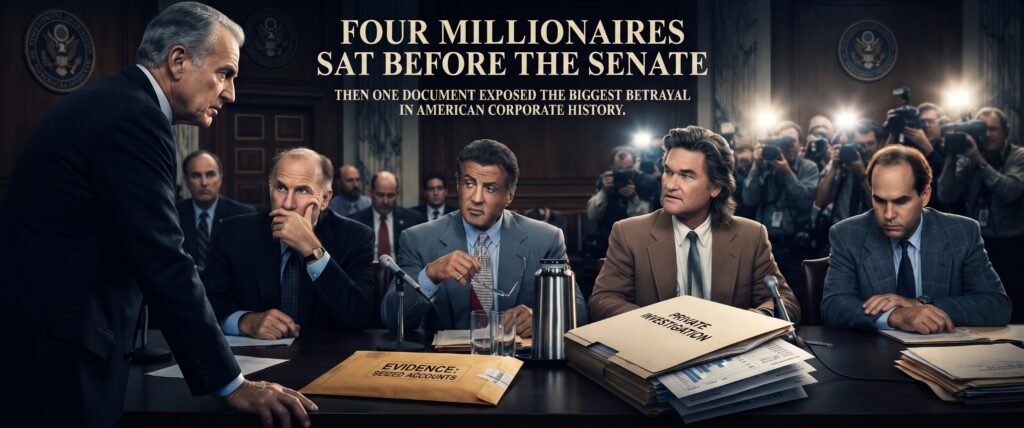
At 8:30 the following morning, the four men entered the hearing room.
Cameras flashed.
Reporters shouted questions.
Their lawyers directed them toward their assigned seats.
Richard sat at one end of the table.
Michael sat beside him.
Thomas followed.
David took the final seat.
The committee chairman entered.
Senator Richard Hayes was a serious-looking man in his late sixties. He had spent decades investigating financial misconduct and had little patience for wealthy executives who believed their money made them untouchable.
He opened the hearing.
“This committee is investigating the disappearance of approximately $900 million from American Continental Holdings. We will establish who authorized the transfers, who benefited from them, and whether any public officials were involved.”
Richard adjusted his tie.
Michael looked toward the cameras.
Thomas stared at the table.
David remained motionless.
Then the senator addressed them.
“Before we begin, I want to make something clear. This investigation is not about how successful your company became. It is about what happened to the money entrusted to it.”
He opened a folder.
“And I have reason to believe that one of you has been lying.”
Part 7 — The Witness Nobody Expected
The first two hours of questioning produced little information.
Richard denied knowing about the suspicious transfers.
Michael explained the company’s investment structure.
Thomas described the construction projects.
David admitted that he had prepared several financial agreements but denied authorizing fraudulent payments.
The committee seemed frustrated.
Then Senator Hayes announced a new witness.
A woman entered the room.
She was approximately fifty years old, dressed in a dark blue business suit, and carrying a thick folder.
Richard immediately recognized her.
Victoria Hayes.
His expression changed.
The senator introduced her as a former financial consultant who had worked with several companies connected to the missing funds.
Victoria took the witness seat.
“Ms. Hayes,” the senator began, “did you personally receive money from American Continental Holdings?”
She nodded.
“Yes.”
“How much?”
“Approximately $125 million.”
The room erupted in whispers.
Richard leaned toward his lawyer.
Senator Hayes continued.
“Why did you receive this money?”
Victoria opened her folder.
“Because I was instructed to hold it on behalf of Richard Anderson.”
Richard immediately shook his head.
“That’s a lie.”
The senator raised his hand.
“Mr. Anderson, you will have an opportunity to respond.”
Victoria continued.
“I was told the money belonged to a private investment arrangement. I later discovered that the original transfers had been made using falsified company documents.”
The senator turned toward Richard.
“Did you authorize these transactions?”
Richard’s lawyer requested a recess.
But Victoria had not finished.
She removed a photograph.
It showed Richard meeting a government procurement officer at a private hotel.
The date was clearly visible.
Senator Hayes examined it.
“Who is this individual?”
Victoria replied:
“His name is Robert Ellis. He was responsible for approving a major federal construction contract.”
The room fell silent.
“Are you suggesting that company money was used to influence a government contract?”
Victoria nodded.
“Yes.”
Richard stood up.
“This hearing is becoming ridiculous!”
The senator looked directly at him.
“Then you should have no difficulty answering our questions.”
Victoria placed another document on the table.
It contained a list of payments.
One payment had been made to an account belonging to a woman named Emily Carter.
Thomas suddenly raised his head.
He recognized the name.
Emily was his daughter.
And he had not seen her in nearly fifteen years.
Part 8 — The Daughter Who Had Been Used as a Pawn
Thomas requested permission to speak.
The senator nodded.
“Go ahead, Mr. Carter.”
Thomas pointed toward the document.
“Who is Emily Carter?”
Victoria looked at him.
“Your daughter.”
Thomas became pale.
“Why is her name on that account?”
Victoria hesitated.
“She received money from an account connected to Richard Anderson.”
Thomas shook his head.
“My daughter has nothing to do with this company.”
“She was listed as the beneficiary of a private trust.”
Thomas stood up.
“That’s impossible.”
The senator intervened.
“Mr. Carter, please remain calm.”
Thomas sat down slowly.
For years, he had believed Emily was living a quiet life with her mother in California.
He had no idea she was connected to the financial investigation.
During a short recess, he contacted his attorney.
They discovered that a trust had been established in Emily’s name when she was only eleven years old.
It contained $18 million.
The original beneficiary documents had been signed by someone claiming to be her legal guardian.
But Thomas had never authorized such an arrangement.
When the hearing resumed, the senator announced that the committee had located additional documents.
They showed that Richard had used Emily’s trust to disguise part of the missing money.
The discovery changed everything.
Thomas was no longer simply a business partner being questioned about a financial scandal.
He was the father of a young woman whose identity had been used in a financial scheme.
He turned toward Richard.
“You used my daughter?”
Richard said nothing.
Thomas’s voice became louder.
“She was a child!”
Richard finally responded.
“I never intended to hurt her.”
Thomas stared at him.
“You stole her future to protect your company.”
Richard looked away.
But the most painful revelation was still to come.
David had discovered that the original trust documents had been prepared using information from a private family file.
Someone inside the company had deliberately accessed Emily’s personal records.
And the authorization had come from Michael Bennett.
Thomas turned toward him.
Michael’s face went white.
“Thomas, I can explain.”
Thomas shook his head.
“Not here.”
Part 9 — The Last Document
The committee adjourned for several days while investigators examined the newly discovered trust records.
During that time, the four men were interviewed separately.
Michael admitted that he had approved access to the family records.
But he insisted he had not known how Richard intended to use them.
David produced an email showing that Richard had instructed Michael to provide information about several family members.
The purpose was to establish private trusts that could be used as temporary holding accounts.
Michael had followed the instructions because he believed the arrangement was legitimate.
But there was one document that nobody had yet examined.
It was found in an old safe belonging to the company’s original legal department.
The document was a private agreement signed by all four founders twenty years earlier.
It stated that no partner could use company funds to create personal trusts or transfer assets without written approval from the other three.
The agreement had been hidden because Richard had instructed the legal department to remove it from the company’s official records.
David had kept a copy.
When the hearing resumed, Senator Hayes placed the agreement on the table.
“Mr. Anderson, are you familiar with this document?”
Richard examined it.
His expression changed.
“Yes.”
“Did you sign it?”
Richard hesitated.
“Yes.”
“Then why did you authorize transactions that violated its terms?”
Richard looked toward his lawyer.
The senator continued.
“Did you also instruct employees to conceal the agreement?”
Richard remained silent.
Then David requested permission to speak.
He explained that Richard had been planning to sell American Continental Holdings to an international investment group.
The sale would have allowed him to transfer the missing funds into a new financial structure.
The other three partners would have been left responsible for the company’s debts.
The senator looked toward Richard.
“Is that true?”
Richard finally spoke.
“I built that company.”
Thomas answered immediately.
“We built it together.”
Richard’s voice rose.
“You would have nothing without me!”
Michael looked at him.
“And you would have nothing without our trust.”
For the first time, Richard had no convincing response.
But Senator Hayes had one final question.
“Mr. Anderson, where is the remaining money?”
Richard stared at the table.
After several seconds, he whispered:
“Most of it is gone.”
“Where?”
Richard closed his eyes.
“Transferred to another account.”
“Whose account?”
Richard looked up.
Then he gave the name of the person nobody expected.
His own daughter.
Part 10 — The Cost of Betrayal
The investigation continued for another year.
Financial investigators traced several offshore accounts and recovered a substantial portion of the missing assets.
Richard Anderson faced criminal charges related to fraud, conspiracy, and financial misconduct.
Other individuals connected to the scheme were also investigated.
The company underwent a complete restructuring.
But the most important changes happened outside the courtroom.
Thomas finally contacted his daughter, Emily.
They met at a small restaurant near the coast.
She was thirty-two years old now.
For years, she had believed her father had abandoned her.
Thomas approached her table slowly.
“Emily?”
She looked up.
“Dad?”
He nodded.
She stood.
Neither knew what to say.
Finally, Emily hugged him.
“I thought you didn’t want to see me.”
Thomas’s eyes filled with tears.
“I never stopped wanting to see you.”
“Then why did you disappear?”
Thomas took a deep breath.
“I made mistakes. I trusted the wrong people. And I was afraid.”
Emily looked down.
“I received money from an account I didn’t understand. I thought it was something you had arranged for me.”
Thomas shook his head.
“I never knew about it.”
They sat together for nearly three hours.
For the first time, Thomas explained everything.
He told her about the company, the investigation, the missing money, and the betrayal.
Emily listened quietly.
When he finished, she took his hand.
“I don’t care about the money.”
Thomas looked at her.
“What do you care about?”
“Having my father back.”
He couldn’t speak.
Outside, the evening sunlight reflected across the water.
Thomas finally understood that the greatest loss of the entire scandal wasn’t the $900 million.
It was the years he had lost with his daughter.
Meanwhile, Michael and David worked with the new board to restore the company.
They created independent financial controls and established a fund to compensate affected investors.
Thomas refused to return to executive management.
Instead, he established a foundation helping families affected by financial fraud.
The foundation’s first project provided legal assistance to elderly people who had lost their savings through fraudulent investment schemes.
At its opening ceremony, Thomas stood before a small audience.
He looked toward Emily, who sat in the front row.
“I once believed success meant building something so powerful that nobody could take it away from you.”
He paused.
“But I learned that a company can survive financial losses. A fortune can be rebuilt. A reputation can sometimes be restored.”
His voice became emotional.
“But time is different. You cannot buy back the years you spent believing the wrong people.”
He looked at his daughter.
“And you cannot put a price on the people who still love you after everything falls apart.”
The audience stood and applauded.
Months later, the four founding partners were no longer friends.
Their company had a new leadership team.
Their empire had changed forever.
But one thing had finally become clear.
The greatest betrayal wasn’t simply the theft of $900 million.
It was the destruction of four families who had trusted one another.
And when the truth finally came out, the money was the easiest thing to count.
The years of lost trust were worth far more.
THE END.