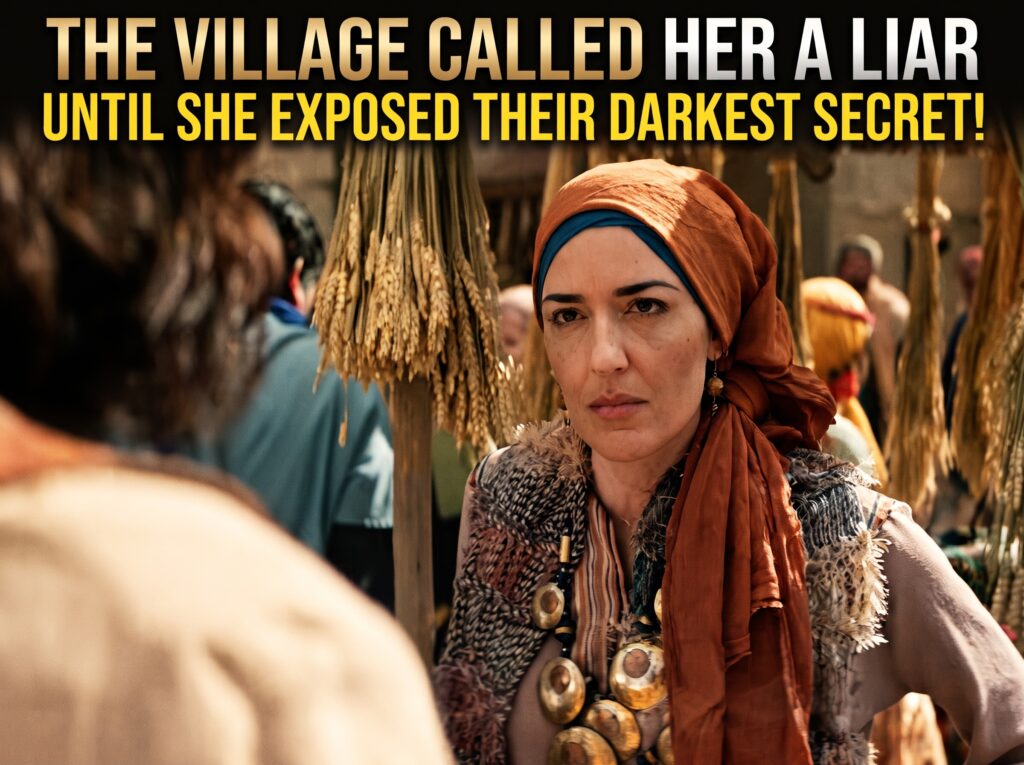
Mariam had not visited the village of Al-Nur for twelve years.
When she was seventeen, she had watched her father being taken away by armed men. Her mother had begged the village chief to help, but nobody intervened.
By the following morning, the family home had been sealed.
Their land was transferred to the powerful Haddad family, and rumors spread that Mariam’s father had stolen money from the village treasury.
Mariam and her mother escaped to a distant town.
Her mother died five years later, leaving behind a small leather bag.
Inside were three things: an old photograph, a silver key, and a folded letter.
The letter contained only one sentence:
Your father trusted the wrong man. Find the truth beneath the old olive tree.
For years, Mariam had wondered what it meant.
Now she had returned.
As she walked through the marketplace, people recognized her.
Some looked away.
Others whispered.
At the center of the market stood Youssef Haddad, the wealthiest landowner in the region.
He was older now, but his authority remained unquestioned.
When he saw Mariam, he stopped speaking.
“You should have stayed away,” he said.
Mariam answered quietly.
“I stayed away for twelve years. Now it’s your turn to answer my questions.”
Part 2 — The Photograph From the Past
Mariam visited the home of an elderly woman named Fatima.
Fatima had once worked for her father.
When she opened the door, she almost dropped the cup in her hand.
“Mariam?”
Mariam embraced her.
“I need your help.”
Fatima looked toward the street before allowing her inside.
“What are you searching for?”
“The truth about my father.”
Fatima became silent.
Then she disappeared into another room and returned with an old photograph.
It showed three men standing beside an olive tree.
One was Mariam’s father.
Another was Youssef Haddad.
The third man was the former village chief, Hassan.
On the back of the photograph were four words:
The land belongs to us.
Mariam looked up.
“Why did my father keep this?”
Fatima’s eyes filled with tears.
“Because he discovered that the land your family owned contained something more valuable than anyone imagined.”
“What?”
“An agreement signed by the founders of this village.”
Fatima explained that generations earlier, Mariam’s family had donated part of their land to establish the village.
But they had never surrendered ownership of the surrounding farmland.
Youssef had forged documents to claim everything.
And Mariam’s father had discovered the fraud.
Part 3 — The Secret Beneath the Olive Tree
That evening, Mariam returned to the abandoned family property.
The house was falling apart.
The windows were broken, the garden was overgrown, and the wooden door barely remained attached to its hinges.
She remembered playing there as a child.
Her father had often told her that the oldest olive tree was the most important thing on the property.
She found the tree behind the ruined house.
Using the silver key, she opened a small metal compartment hidden beneath a loose stone.
Inside was a sealed envelope.
Her father’s handwriting was unmistakable.
My beloved daughter,
If you are reading this, I may no longer be able to protect you.
Never trust a man simply because the entire village respects him.
The truth is hidden in the land records. The original agreement is not in the courthouse. It is with the person who witnessed my final meeting.
Mariam read the letter twice.
Who was the witness?
She searched the envelope again.
At the bottom was a name.
SALIM.
The village had believed Salim died many years ago.
But Mariam remembered something her mother once whispered.
Salim had escaped.
Part 4 — The Man Who Came Back From the Dead
Mariam searched for Salim for three days.
Finally, a shepherd directed her toward a small house beyond the mountains.
An elderly man opened the door.
He had a long white beard and walked with a wooden stick.
Mariam showed him the photograph.
His hands began to tremble.
“Where did you get this?”
“My father kept it.”
Salim sat down.
“I thought everyone had forgotten.”
“Please tell me what happened.”
Salim explained that he had witnessed Youssef and Hassan preparing false property records.
Mariam’s father had refused to cooperate.
The two men accused him of stealing money and arranged for his arrest.
But there was something else.
Before disappearing, Mariam’s father had entrusted Salim with the original land agreement.
Salim had hidden it because he feared for his life.
“Do you still have it?” Mariam asked.
The old man nodded.
Then he looked toward the window.
“Yes. But if I give it to you, they will come after both of us.”
Mariam took his hand.
“They already destroyed my family. I won’t let them destroy another.”
Part 5 — The Village Chief’s Warning
The following morning, Mariam returned with Salim.
Word spread quickly.
By midday, the marketplace was crowded.
Youssef approached them with several men.
“You’re making a terrible mistake,” he told Mariam.
She stood her ground.
“Why are you frightened of an old document?”
Youssef stepped closer.
“Your father was a dishonest man.”
Salim interrupted.
“Your father was an honest man, Mariam. And I saw what they did to him.”
The crowd became silent.
Hassan, the former village chief, appeared from behind the merchants.
He looked much older than in the photograph.
“Enough,” he said.
Mariam turned toward him.
“You were there that night.”
Hassan didn’t answer.
“You watched my father being taken away. You knew he was innocent.”
Hassan lowered his eyes.
Youssef shouted at him to remain silent.
But something inside the old chief finally broke.
He admitted that the land records had been altered.
He also confessed that he had accepted money to keep quiet.
The villagers began murmuring.
For the first time in twelve years, someone had spoken the truth publicly.
Part 6 — The Document That Could Change Everything
Salim opened a wooden box inside the village courthouse.
Inside was a document protected by several layers of cloth.
It carried the original signatures of the village founders.
Mariam’s family had retained legal ownership of the farmland.
The Haddad family had no right to sell it.
A lawyer from the regional city examined the document.
After several days of investigation, he confirmed that the signatures and seals were consistent with the historical land records.
But there was another discovery.
Youssef had sold portions of the disputed land to several wealthy investors.
If the original ownership documents were accepted, those transactions could be challenged.
The village was suddenly divided.
Some people supported Mariam.
Others feared losing their livelihoods.
Mariam understood that recovering her family’s property would not automatically restore justice.
She needed to protect the villagers who had built their lives on that land.
She announced that she would pursue the legal case without demanding that innocent families immediately leave their homes.
Her decision surprised everyone.
Even Salim.
“Your father would be proud,” he said.
Part 7 — The Confession Nobody Expected
One evening, Youssef visited Mariam alone.
He looked exhausted.
“I need to tell you something.”
Mariam remained standing.
“Speak.”
He admitted that he had helped forge the documents.
But he claimed that Hassan had been the one who arranged her father’s arrest.
Mariam listened without showing emotion.
“Why tell me now?”
Youssef placed a small envelope on the table.
“Because I found something after your father disappeared.”
Inside was a second letter.
It had been written by Mariam’s father.
The letter revealed that he had not simply discovered the land fraud.
He had also uncovered an agreement involving the village’s water supply.
Youssef and Hassan had secretly diverted water from several farming families to protect their own crops.
Her father had threatened to expose them.
That was why they had destroyed his reputation.
Mariam looked at Youssef.
“Where is my father?”
The old man lowered his head.
“I don’t know.”
For twelve years, she had believed he was dead.
Now she had a reason to investigate his disappearance.
Part 8 — The Final Witness
A former guard named Ibrahim contacted Mariam.
He had worked at the regional detention center when her father was arrested.
He remembered the case.
But what he revealed changed everything.
Mariam’s father had never been transferred to the prison where the official records claimed he died.
Instead, he had been released under a false identity after agreeing to leave the region.
The guard had helped arrange the release.
“Why didn’t you tell anyone?” Mariam asked.
“I was afraid.”
“Where is he?”
Ibrahim handed her a small address.
It belonged to a village near the coast.
Mariam traveled there the following morning.
She walked through narrow streets until she reached a modest house with blue shutters.
An elderly man was sitting outside.
His hair had turned completely white.
But she recognized his eyes immediately.
“Father?”
The man looked up.
For several seconds, neither moved.
Then he stood.
“Mariam?”
She ran toward him.
He held her as if he were afraid she might disappear.
He had survived, but years of fear had kept him away.
And now he finally knew that his daughter had discovered the truth.
Part 9 — Justice in the Marketplace
Mariam returned to Al-Nur with her father.
The news spread throughout the village.
People gathered in the marketplace.
Some cried.
Others apologized.
Her father stood beside her beneath the hanging wheat bundles.
“I never wanted this village to suffer,” he said.
“I only wanted the truth to survive.”
The legal investigation continued.
Hassan confessed to his involvement.
Youssef eventually admitted to falsifying the land documents and concealing the water agreement.
The court ordered the disputed transactions to be reviewed and recognized the original family’s ownership rights, subject to the rights of innocent occupants and buyers.
Mariam chose to establish a community land trust.
The families who had lived and worked there for generations would not be abandoned.
The land would be protected, and the village’s water resources would be shared fairly.
For the first time in many years, the people of Al-Nur could look at each other without fear.
Part 10 — The Daughter Who Restored Her Father’s Name
Six months later, the marketplace looked different.
The old wheat bundles still hung from the wooden beams.
The merchants still argued over prices.
Children still ran between the stalls.
But something had changed.
Mariam’s father sat beneath the old olive tree.
His daughter brought him a cup of tea.
“Do you regret coming back?” he asked.
She smiled.
“Not for one second.”
He looked toward the village.
“I lost twelve years.”
Mariam took his hand.
“But you didn’t lose the truth.”
Her father began to cry.
For so long, he had believed that his name would remain stained forever.
Now the village knew what had happened.
The people who had once called his daughter a liar now greeted her with respect.
But Mariam never demanded apologies.
She knew that rebuilding trust required more than a public confession.
One afternoon, Fatima visited them.
She brought the old photograph of the three men.
Mariam placed it inside a wooden frame.
Not to remember the men who betrayed her father.
But to remember the day the truth finally came into the light.
And beneath the photograph, she wrote a simple sentence:
“A family can lose its land, its home, and its fortune. But when it refuses to surrender the truth, it can still find its way home.”
THE END.