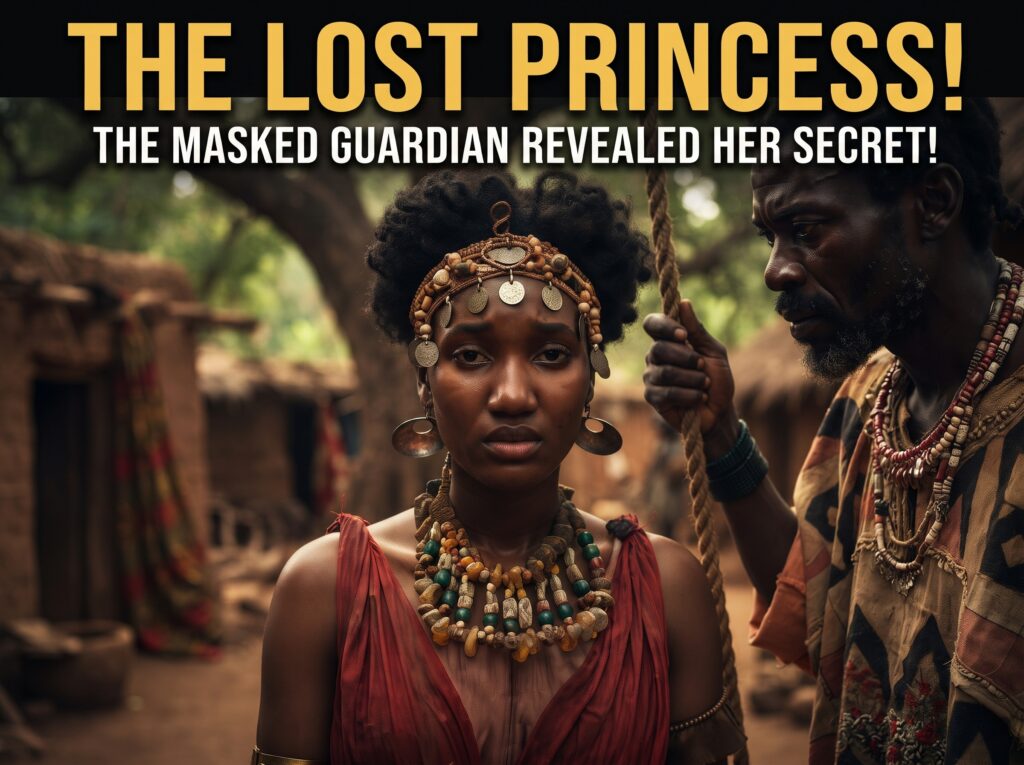
Long before the village gathered beneath the ancient trees, Amara had lived a quiet life with her mother, Nala.
Their home stood near the edge of the forest, far from the grand houses belonging to the village elders.
They were not wealthy.
Nala made beautiful necklaces and bracelets from colorful stones, while Amara collected firewood, fetched water, and helped sell their handmade decorations in the village market.
Although they lived simply, Amara had always been curious about her mother’s past.
Whenever she asked about her father, Nala changed the subject.
Whenever she asked why they never visited the royal palace, her mother became uncomfortable.
And whenever Amara touched the small silver ornament she wore around her forehead, Nala would gently tell her:
“Never lose this, my daughter. One day, you will understand why it belongs to you.”
Amara had never understood.
The ornament was old and unusual. It had been passed down to her when she was a baby.
One morning, while preparing for the village festival, Amara noticed that her mother was unusually nervous.
Nala kept looking toward the forest.
“Mother, is something wrong?”
Nala forced a smile.
“No, my child.”
“You have barely slept.”
Nala placed both hands on her daughter’s shoulders.
“Listen carefully. If anyone asks you about your birth, tell them you know nothing.”
Amara laughed nervously.
“Why would anyone ask that?”
Her mother did not answer.
Instead, she entered their small bedroom and returned with a folded piece of cloth.
Inside was a beautiful necklace decorated with red and golden stones.
“Take this.”
Amara examined it.
“Where did you get it?”
“It belonged to someone very important.”
“Who?”
Nala looked toward the doorway.
“Your father.”
Amara had never heard her mother mention a necklace belonging to her father.
“Was he a warrior?”
Nala smiled sadly.
“He was a good man.”
“Is he still alive?”
Nala’s eyes filled with tears.
“I don’t know.”
Before Amara could ask another question, someone knocked violently on the door.
Nala froze.
Three men entered.
They wore the uniforms of the village guards.
Their leader, Darius, looked at Amara.
“Are you Amara, daughter of Nala?”
“Yes.”
“You must come with us.”
“Why?”
Darius held up a small golden necklace.
“This sacred royal treasure was discovered inside your house.”
Amara looked at her mother.
Nala immediately understood what had happened.
“She knows nothing about this!”
Darius ignored her.
“By order of the village council, she must answer before the elders.”
Amara was taken away.
As the guards led her through the village, people gathered to watch.
Some whispered.
Others pointed.
A few shouted accusations.
Amara searched the crowd for her mother.
But Nala had disappeared.
And that frightened her more than anything else.
5. PART 2 — THE MASKED GUARDIAN
The village council gathered beneath an enormous tree known as the Tree of Kings.
For generations, important decisions had been made beneath its branches.
Marriage agreements, disputes over land, royal ceremonies, and punishments had all taken place there.
At the center stood Chief Bako.
He was an elderly man with a commanding presence and a reputation for never changing his decisions.
Beside him stood a mysterious figure known as the Masked Guardian.
The guardian wore patterned ceremonial clothing and a decorated head covering.
Nobody in the village knew his true identity.
He had served the royal family for many years, but he rarely spoke.
Amara was brought before them.
Chief Bako raised his hand.
“Amara, you have been accused of stealing the royal necklace.”
“I did not steal it.”
“Then explain how it entered your house.”
“I don’t know.”
“Who else has access to your home?”
“My mother.”
The chief looked toward the crowd.
“Where is Nala?”
Nobody answered.
Amara stepped forward.
“Please, I want to see my mother.”
The chief ignored her.
“You will answer the questions first.”
A village elder approached with the golden necklace.
“Do you recognize this?”
Amara examined it.
She had never seen the necklace before.
But she recognized the symbol engraved on its central stone.
It was the same symbol found on her silver forehead ornament.
She touched her forehead.
The elder noticed.
“Where did you get that?”
“My mother gave it to me.”
The elder stepped backward.
Chief Bako became suspicious.
“Remove it.”
Amara shook her head.
“No.”
The chief became angry.
“You are standing before the council. You will obey.”
The Masked Guardian suddenly moved.
He placed one hand on the rope and stepped closer to Amara.
For the first time, he spoke.
“Leave the ornament where it is.”
Everyone turned.
Chief Bako frowned.
“You have no authority to question my decision.”
The guardian looked at Amara.
“Where is your mother?”
“I don’t know.”
He studied her face.
Then he looked at the silver ornament again.
Something about it seemed familiar.
He had seen the same design many years earlier.
On the forehead of a young queen.
A queen who had disappeared during a terrible night of betrayal.
The guardian slowly lowered the rope.
6. PART 3 — THE SECRET BENEATH THE NECKLACE
That evening, Amara was locked inside an old stone building near the council grounds.
She sat alone, thinking about her mother.
She remembered Nala’s frightened expression.
She remembered the necklace.
And she remembered the guardian’s unusual reaction when he saw her silver ornament.
A little after midnight, someone opened the door.
Amara quickly stood.
A woman entered carrying a small lantern.
It was an elderly healer named Sefa.
Amara recognized her immediately.
Sefa had treated her when she was a child.
“Come with me,” the woman whispered.
“Where is my mother?”
“I don’t know. But I know why the elders are afraid of you.”
Amara followed her through a narrow passage.
They eventually reached a small room beneath an abandoned building.
Sefa locked the door.
Then she placed a wooden box on the table.
Inside were old royal documents.
Amara looked confused.
“What is this?”
Sefa opened a faded photograph.
It showed a beautiful young woman wearing a royal crown.
Amara recognized the face.
It was remarkably similar to her own.
“Who is she?”
“Queen Amina.”
Amara stepped closer.
“Why are you showing me this?”
Sefa looked directly into her eyes.
“Because she was your mother.”
Amara shook her head.
“No. My mother is Nala.”
“Nala raised you. But she was not the woman who gave birth to you.”
Amara felt the room spinning.
Sefa explained that twenty years earlier, Queen Amina had given birth to a daughter.
The royal family celebrated.
But the celebration did not last long.
That same night, a group of men entered the palace.
The queen disappeared.
Her husband, King Adisa, was declared dead.
And the royal baby was never found.
The kingdom was told that the entire royal family had been destroyed.
But Sefa knew the truth.
Nala had been one of the queen’s closest servants.
She had escaped with the baby and raised her as her own daughter.
Amara touched her silver ornament.
“Is this why my mother gave me this?”
Sefa nodded.
“It is the royal symbol of your family.”
Amara began crying.
“Why did nobody tell me?”
“Because the people who destroyed your family still control the council.”
Amara looked up.
“Who?”
Sefa hesitated.
Then she whispered:
“Chief Bako.”
7. PART 4 — THE MAN WHO STOLE THE THRONE
Chief Bako had not always been a powerful man.
Twenty years earlier, he had been the royal family’s most trusted adviser.
King Adisa considered him a brother.
He had been responsible for protecting the palace, managing the royal treasury, and advising the king on matters of war and peace.
But Bako wanted more.
He wanted the throne.
When Queen Amina gave birth to a daughter, Bako realized that the royal family would continue.
He secretly arranged an attack on the palace.
His men were ordered to eliminate the king and capture the queen.
But Nala managed to escape with the baby.
Bako believed the child had died.
He declared himself the temporary ruler.
Over time, he transformed that temporary position into permanent power.
He controlled the village council.
He controlled the guards.
He controlled the royal treasury.
And he made sure that nobody dared to question his authority.
Now Amara had returned.
And the symbol on her forehead threatened everything he had built.
Meanwhile, the Masked Guardian had begun investigating the necklace.
He went to the old palace archive and searched through the surviving royal records.
There he found an ancient drawing.
It showed the royal symbol.
The same silver ornament Amara wore.
The guardian removed his mask.
His name was Kalen.
He had served King Adisa as a young soldier.
On the night of the palace attack, he had been wounded while protecting the royal family.
He believed the queen and her child had died.
But now he remembered something.
Before the queen disappeared, she had given him a small wooden token.
She told him:
“If my daughter ever returns, protect her as you protected me.”
Kalen had kept that token for twenty years.
He now understood why Amara’s face had troubled him.
He had seen her as a baby.
She had the same eyes as Queen Amina.
The following morning, he secretly visited Amara.
He placed the wooden token on the table.
“Do you know what this is?”
Amara shook her head.
“It belonged to your mother.”
“My mother?”
“Your birth mother.”
Amara looked at him.
“Who are you?”
Kalen removed his mask.
“I was your father’s soldier.”
For the first time, Amara understood that the stranger holding the rope had not been preparing to punish her.
He had been trying to protect her.
8. PART 5 — THE MOTHER WHO SACRIFICED EVERYTHING
Amara could not stop thinking about what she had discovered.
She had grown up believing she was the daughter of a poor village woman.
Now she was being told that she was the last surviving member of a royal family.
But she had only one question.
“Where is Nala?”
Kalen looked down.
“I don’t know.”
Amara became angry.
“Everyone knows something about my family except me. I need to find my mother.”
Kalen promised to help.
Together, they left the old building and followed the narrow path toward the forest.
Sefa had told them that Nala sometimes visited an abandoned healing house beyond the river.
They found her there.
Nala was sitting beside a small fire, preparing medicinal herbs.
When she saw Amara, she immediately stood.
“My child!”
Amara ran toward her.
She embraced her mother tightly.
Then she stepped back.
“Why didn’t you tell me?”
Nala began crying.
“I wanted to protect you.”
“Who am I?”
Nala looked toward Kalen.
He nodded.
She finally spoke.
“Your birth name is Princess Amara Amina.”
Amara covered her mouth.
Nala explained everything.
The night Queen Amina gave birth, the palace was attacked.
Nala was ordered to protect the baby.
She escaped through a secret passage with the child.
The queen remained behind to distract the attackers.
Before they separated, Amina gave Nala the silver ornament.
She told her to keep it safe until the day her daughter was old enough to understand her identity.
Nala had taken Amara to a distant village.
She changed her name and raised her as her own.
For twenty years, she lived with the fear that Bako’s men would discover the truth.
Amara held her mother’s hands.
“Why didn’t you tell me I was a princess?”
Nala smiled sadly.
“Because I wanted you to become a good person before anyone told you that you were important.”
Amara began crying.
“I don’t want a throne. I want my mother.”
Nala embraced her.
“You will always have me.”
But their reunion was interrupted by shouting outside.
Bako’s guards had discovered their hiding place.
Kalen grabbed his weapon.
“Get behind me!”
The guards surrounded the building.
Bako’s voice echoed from outside.
“Bring me the girl!”
Amara looked at her mother.
Nala took her hand.
“Whatever happens, never let them take away the person you are.”
Then the door burst open.
9. PART 6 — THE GUARDIAN’S FINAL PROMISE
Kalen fought to protect Amara and Nala.
The guards surrounded him.
He was outnumbered, but he refused to surrender.
Amara and Nala escaped through the rear entrance.
They ran toward the river.
But another group of soldiers appeared.
Their leader raised his weapon.
“Stop!”
Amara stepped in front of her mother.
“Don’t touch her!”
The soldier laughed.
“You are in no position to give orders.”
Suddenly, a horn sounded from the forest.
A group of villagers emerged.
They were led by Sefa and several elderly farmers.
They had heard the truth.
For years, Bako had taken their land, increased their taxes, and punished anyone who questioned his authority.
Now they understood why he had feared the royal family.
Amara was the rightful heir.
The villagers surrounded the guards.
The soldiers hesitated.
Their leader looked toward the forest.
Then he lowered his weapon.
Meanwhile, Kalen had been captured.
Bako ordered that he be brought to the council grounds.
The chief was furious.
“You should have remained silent.”
Kalen looked at him.
“I served a king. I never promised to serve a thief.”
Bako struck the table.
“Where is the princess?”
Kalen smiled.
“Somewhere you will never find her.”
Bako ordered the guards to prepare the execution platform.
But before they could carry out the order, a messenger arrived.
He carried a royal document recovered from the palace archive.
It was signed by King Adisa.
The document declared that if the royal family disappeared, the rightful heir would be protected by the village council until she came of age.
It also named Kalen as the royal guardian.
Bako read the document.
His hands began trembling.
He realized that the people he had trusted were no longer certain they wanted to protect him.
His authority was collapsing.
And Amara was coming back.
10. PART 7 — THE TRUTH BEFORE THE VILLAGE
By sunrise, the entire village had gathered beneath the Tree of Kings.
Amara arrived wearing her red dress.
Nala walked beside her.
Sefa carried the royal documents.
And behind them came dozens of villagers who had decided to stand against Bako.
The chief stood at the center.
He tried to appear calm.
“Why have you returned?”
Amara stepped forward.
“Because you accused an innocent woman of stealing what already belonged to her family.”
Bako laughed.
“You have no proof.”
Sefa raised the documents.
“We have the royal records.”
Bako turned toward the villagers.
“These papers are lies!”
Then Kalen appeared.
He was injured but alive.
Two villagers supported him.
He approached the chief.
“Twenty years ago, I watched your men attack the palace.”
Bako’s expression changed.
Kalen continued.
“I watched you order the king’s guards to turn against their own people. I watched Queen Amina sacrifice herself so her daughter could escape.”
Bako shouted:
“Enough!”
But the guardian refused to stop.
“I carried the royal child out of the palace. I watched Nala raise her in poverty. I protected her identity because I believed the truth would one day return.”
He turned toward Amara.
“Today, that day has come.”
The villagers began whispering.
Amara stepped forward.
“My name is Amara Amina. I am the daughter of King Adisa and Queen Amina.”
She held up the silver ornament.
“This belonged to my mother. I do not ask you to believe me because I claim to be royal. I ask you to examine the truth.”
Then she looked directly at Bako.
“Tell them what happened to my father.”
Bako remained silent.
“Tell them why you destroyed the palace.”
He looked around.
Nobody was defending him.
Finally, he spoke.
“Your father was weak.”
Amara’s eyes filled with tears.
“He was your king.”
“He trusted people too easily!”
“And you betrayed him.”
Bako suddenly reached toward his guards.
But nobody moved.
For the first time in twenty years, the chief had no one willing to obey him.
11. PART 8 — THE LAST LETTER OF QUEEN AMINA
After Bako was placed under guard, the village elders began examining the royal records.
But Amara still wanted to know what had happened to her father.
The documents proved that King Adisa had disappeared during the palace attack.
They did not prove whether he had died.
Kalen remembered one final secret.
Before the queen disappeared, she had told him that the king had hidden a letter beneath the royal throne.
The palace had been abandoned for twenty years.
Nobody had entered its private chambers since the attack.
Amara, Nala, Kalen, and Sefa traveled there together.
The building was covered in dust.
Broken windows allowed sunlight to fall across the old stone floor.
Amara entered the throne room.
She had dreamed about this place without knowing why.
Kalen moved toward the throne.
He removed a loose stone beneath it.
Behind the stone was a small wooden compartment.
Inside was a letter.
Amara opened it.
It was written by her father.
My beloved daughter,
If you are reading this, then you have survived the darkness that entered our home.
I do not know whether I will live long enough to see you again.
But I want you to remember something.
You were not born to rule because you are better than other people.
You were born into responsibility.
Your mother taught me that a kingdom is not its palace, its gold, or its crown.
It is the people who wake before sunrise, the mothers who feed their children, the farmers who work the land, and the families who deserve justice.
If you ever return, do not seek revenge.
Restore what was taken.
Protect those who cannot protect themselves.
And never forget the woman who raised you when the world believed you were gone.
Your loving father, Adisa.
Amara held the letter against her chest.
Nala cried quietly.
For twenty years, she had carried the burden of protecting the child of the king.
Now she finally understood that the queen had trusted her with something greater than a royal inheritance.
She had trusted her with the future of an entire kingdom.
But there was one more surprise.
At the bottom of the box was a second document.
It contained the names of the families whose land Bako had stolen.
And the list was much longer than anyone had imagined.
12. PART 9 — THE FALL OF THE FALSE KING
The investigation revealed that Bako had not simply stolen the throne.
He had stolen the lives of hundreds of families.
He had taken farmland from widows, forced farmers to work without payment, and confiscated homes belonging to families who refused to obey him.
Some villagers had disappeared.
Others had been forced to leave their ancestral homes.
The royal records contained the names of everyone who had suffered.
Amara decided that the truth would be revealed publicly.
A second gathering was organized beneath the Tree of Kings.
This time, the villagers came not to witness a punishment but to hear the truth.
The elders examined the evidence.
Kalen testified about the palace attack.
Sefa presented the documents.
Nala described how she had escaped with the royal baby.
And the villagers told their own stories.
One elderly farmer stepped forward.
“My father lost his land because he refused to work for Bako.”
A woman began crying.
“My husband disappeared after questioning the royal treasury.”
Another villager raised his voice.
“We were told the royal family had abandoned us. We believed it because nobody dared to speak.”
Amara listened to every person.
She did not interrupt.
She did not promise that everything could be repaired immediately.
She simply listened.
When everyone had spoken, she turned toward Bako.
“You took twenty years from my family.”
Bako looked at her.
“You think you can rule these people?”
“No. I think these people deserve to decide their future.”
The elders announced that Bako would face judgment under the kingdom’s laws.
His fraudulent claims were revoked, his stolen property was returned to the royal estate, and the investigation into the disappearance of the king continued.
But Amara refused to celebrate his downfall.
She had not come to the village to replace one powerful ruler with another.
She wanted a different future.
She asked the elders to create a council where ordinary families could participate in decisions about land, farming, education, and village resources.
The people agreed.
For the first time in twenty years, the village began to rebuild its government.
But Amara had one final decision to make.
She had been offered the royal crown.
And everyone expected her to accept it.
13. PART 10 — THE DAUGHTER WHO CHOSE HER PEOPLE
Several months passed.
The old palace was restored.
The damaged village homes were repaired.
Families who had lost their land received compensation, and the village school reopened.
Amara visited the farms every week.
She listened to the workers.
She helped organize the rebuilding of the roads.
She also established a small medical center so that families would no longer have to travel for hours to receive treatment.
Nala remained by her side.
Sometimes they sat beneath the trees and remembered their old life.
One afternoon, Kalen approached them.
He carried a beautiful golden crown.
“The elders have agreed,” he said. “The kingdom is ready for its queen.”
Amara looked at the crown.
It was decorated with precious stones.
It was beautiful.
But she remembered her father’s letter.
She remembered the people who had lost their homes.
And she remembered the years her mother had spent protecting her.
“Do you believe I should accept it?” she asked Kalen.
He smiled.
“That is not my decision.”
Amara looked at Nala.
“What do you think, Mother?”
Nala held her daughter’s hand.
“I think your father would have wanted you to choose the kind of life that allows you to sleep peacefully at night.”
Amara looked toward the village.
Children were playing near the fountain.
Farmers were returning from the fields.
Women were selling vegetables in the marketplace.
The people were smiling again.
She finally understood what her father had meant.
The crown was not a reward.
It was a responsibility.
On the day of the ceremony, the villagers gathered beneath the Tree of Kings.
Amara wore her traditional red dress.
Her colorful necklaces rested against her chest.
The silver ornament remained on her forehead.
Kalen stood beside her.
He placed the golden crown on her head.
The crowd became silent.
Amara stepped forward.
“I did not come here to take power from you.”
She paused.
“I came here because my family was destroyed by people who believed power belonged to them.”
She looked at the villagers.
“I cannot promise that our future will be perfect. But I promise that no family should lose its home because someone is wealthy. No child should be punished for asking questions. And no woman should have to hide her identity to survive.”
The villagers began applauding.
Nala stood near the front.
Tears rolled down her cheeks.
Amara stepped away from the throne and walked toward her.
She embraced her mother.
“Thank you for saving me.”
Nala kissed her forehead.
“You were never just a princess to me. You were always my daughter.”
Amara smiled.
“And you will always be my mother.”
That evening, the village celebrated beneath the stars.
The drums played.
The children danced.
And the people gathered around the ancient tree that had witnessed both their suffering and their freedom.
Kalen watched Amara from a distance.
For twenty years, he had carried the memory of a lost queen.
Now he had witnessed the return of her daughter.
But the greatest thing Amara inherited was not the palace, the crown, or the royal treasure.
It was the courage to restore what had been broken.
And the village finally understood that a true queen is not someone who sits above her people.
A true queen is someone who stands beside them when they have nothing left.
THE END.