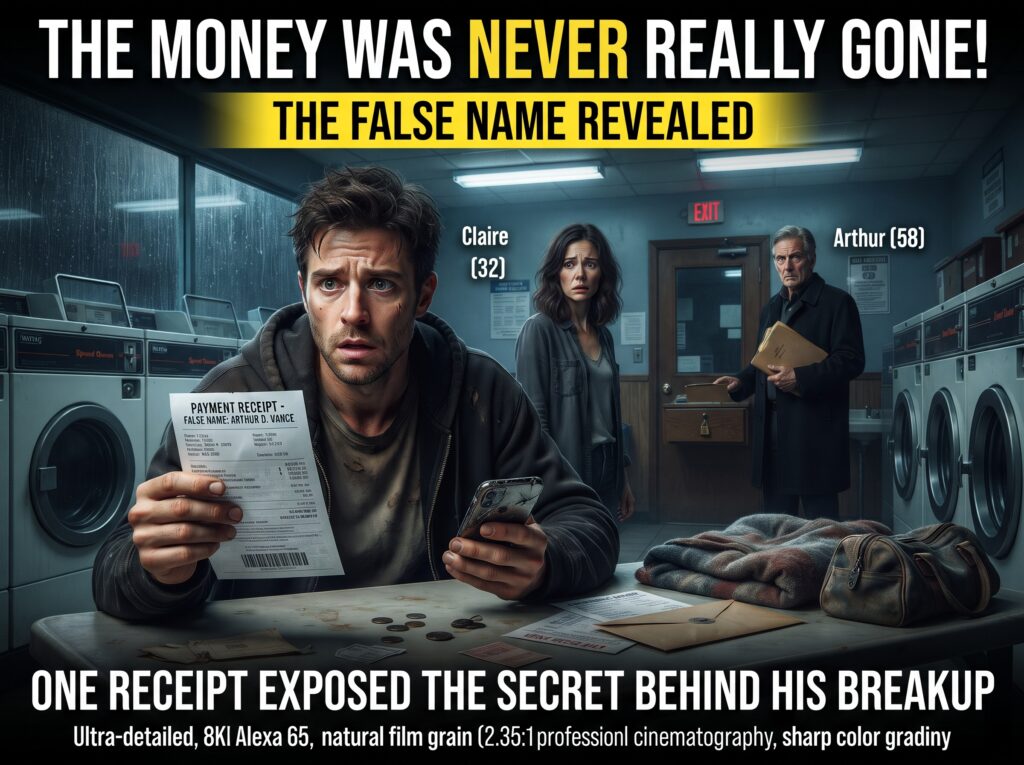
The laundromat never truly became quiet.
Even after midnight, washing machines hummed, dryers rattled, and fluorescent lights buzzed above rows of plastic chairs. To most people, it was simply a place to wash clothes. To Leo, it had become the closest thing he had to a home.
He had been sleeping there between shifts for eleven nights.
During the day, he worked at a warehouse loading deliveries. At night, he helped clean a small restaurant. When both jobs were finished, he returned to the laundromat, where the owner allowed him to rest in a corner as long as he didn’t interfere with the customers.
Leo never told his family.
His mother believed he was staying with a coworker. His younger sister, Emily, thought he was temporarily renting a room. Even his closest friends believed he was managing better than he actually was.
He had become very good at pretending.
The worst part wasn’t the uncomfortable floor or the cold air coming through the entrance.
It was remembering how different his life had been only a few months earlier.
He and Claire had shared a small apartment above a grocery store. It wasn’t beautiful, but they had made it theirs. They had bought secondhand furniture, painted the bedroom themselves, and placed a small photograph from their first holiday on the kitchen shelf.
They had planned to save enough money to move somewhere better.
“One day,” Claire used to say, “we’ll look back at this apartment and laugh.”
Leo would smile.
“We’ll probably miss it.”
“Not the broken heating.”
“Definitely not that.”
Those conversations had seemed ordinary.
Now they felt like memories belonging to somebody else.
Their financial problems had started gradually.
First, the electricity bill increased.
Then the rent became difficult to manage.
After that, Claire began saying that unexpected expenses were taking most of their money.
Leo didn’t question her.
He worked additional shifts, skipped meals, and sold personal belongings whenever they needed something.
When the refrigerator stopped working, he sold his old watch.
When the rent was overdue, he sold his bicycle.
When another bill arrived, he sold the television.
Eventually, he sold the last valuable thing he owned: a small collection of tools his father had given him.
Claire had promised they would get through everything together.
But one evening, she placed a suitcase beside the bedroom door.
“I can’t keep doing this,” she said.
Leo looked at the suitcase.
“What do you mean?”
“I need some time.”
“Time for what?”
She couldn’t look at him.
“I don’t know anymore.”
He stepped closer.
“Is this because of the money?”
Claire remained silent.
“Tell me what I can do.”
“Nothing, Leo.”
Those words hurt more than an argument would have.
She left the following morning.
There was no dramatic goodbye.
No explanation.
Just an empty side of the wardrobe and a message saying she needed him not to contact her for a while.
Leo tried to respect her decision.
But the rent didn’t disappear when she left.
Neither did the bills.
Within weeks, the landlord demanded payment.
Leo sold what remained of his belongings and tried to find another place.
Eventually, he had nowhere to go.
That was how he ended up in the laundromat.
On the twelfth morning, the owner approached him while he was folding the blanket he used at night.
“Leo, someone came looking for you yesterday.”
He looked up.
“Who?”
“Didn’t leave a name. Just left something at the counter.”
The owner handed him a small paper envelope.
Leo recognized the handwriting immediately.
It belonged to Claire.
Inside was a receipt.
He unfolded it.
The payment was substantial.
The date was from several months earlier.
The name on the receipt wasn’t Claire’s.
It wasn’t Leo’s either.
It was a false name.
And beneath it was a reference number connected to an address he had never seen.
Leo stared at the paper.
For the first time since Claire left, he wondered whether their financial problems had ever been what she claimed.
<h2>Part 2</h2>
Leo carried the receipt everywhere that day.
He placed it inside his jacket pocket while working at the warehouse. During his lunch break, he took it out and examined every line.
The payment had been made at a financial services office.
The amount was almost exactly what he and Claire had once saved for their future apartment.
He remembered that money.
They had spent nearly two years putting it aside.
At first, they saved small amounts from their wages. Sometimes it was twenty dollars. Sometimes fifty. Whenever one of them received overtime pay, they added a little more.
Claire had kept the savings account.
She always said she was better at organizing finances.
Leo had never minded.
He trusted her.
But when their financial problems began, Claire told him that the savings had disappeared.
She said the money had been used to cover household expenses.
Leo remembered asking her to show him the account.
She had become upset.
“Why don’t you believe me?”
“That’s not what I mean.”
“Then what do you mean?”
“I just want to understand where everything went.”
Claire had stared at him.
“We’re struggling enough without you questioning every decision I make.”
He apologized.
He had apologized many times during those final months.
Now he wondered whether he should have asked more questions.
After finishing his shift, he visited the financial services office printed on the receipt.
A woman behind the counter examined it.
“Can you tell me who made this payment?” Leo asked.
“I’m sorry. We can’t disclose customer information.”
“It’s connected to my savings.”
“Do you have an account reference?”
He showed her the number.
She typed something into the computer.
Her expression changed slightly.
“Is there a problem?” Leo asked.
She looked at him again.
“Are you Leo?”
He felt his stomach tighten.
“Yes.”
The woman paused.
“Then I suggest you contact the person who arranged this transaction.”
“Who?”
She turned the screen away.
“I can’t discuss that.”
Leo leaned forward.
“Please. I’ve lost my home. I’ve lost almost everything. If someone used my name or my money, I need to know.”
The woman softened.
“I understand. But I can’t give you another person’s financial information.”
She printed a small document and passed it across the counter.
It contained a reference number and a date.
At the bottom was a handwritten note.
Ask for the original authorization.
Leo looked up.
“Who wrote this?”
The woman shook her head.
“I don’t know.”
He left with the paper.
Outside, the afternoon traffic moved through the streets as if nothing had happened.
Leo sat on a bench and called Claire.
The call went straight to voicemail.
He tried again.
Nothing.
Then he sent a message.
I found the payment receipt. I need you to explain it.
A few minutes later, his phone vibrated.
It was Claire.
Please leave it alone.
Leo read the message several times.
He typed:
Why was the payment made under a false name?
There was no reply.
He waited almost an hour.
Then another message appeared.
You don’t understand what you’re getting involved in.
Leo felt his hands tightening around the phone.
Then help me understand.
The typing indicator appeared.
Disappeared.
Appeared again.
Finally, Claire sent one sentence.
Ask the person who told you our money was gone.
Leo stared at the screen.
He had never told Claire about the woman at the financial office.
He had never mentioned the original authorization.
Yet she seemed to know exactly what he had discovered.
He put the phone away.
Something had connected their missing savings, the false name, and the person who had encouraged him to believe that their relationship had simply failed because of poverty.
And he was beginning to suspect that Claire hadn’t been the only person hiding something.
<h2>Part 3</h2>
The next morning, Leo returned to the laundromat and asked the owner whether he could use the small office telephone.
The owner, Mr. Harris, looked concerned.
“You still haven’t found somewhere to stay?”
“Not yet.”
“You’re welcome to keep using the back room for another few days. But you need to sort this out.”
“I know.”
Mr. Harris studied his face.
“Is this about that woman?”
Leo looked up.
“What woman?”
“The one who used to come here.”
Leo stopped folding his blanket.
“Claire?”
Mr. Harris nodded.
“When?”
“Several times. Usually in the afternoon.”
Leo felt something cold move through him.
“Why didn’t you tell me?”
“I didn’t know you two had separated.”
“What did she do?”
Mr. Harris hesitated.
“She asked whether you were still sleeping here.”
Leo stood.
“When?”
“About a week ago.”
“Did she leave anything?”
Mr. Harris looked toward the counter.
“There was an envelope. But I didn’t open it.”
Leo followed his gaze.
A small envelope was tucked beneath the register.
His name was written on the front.
He took it carefully.
Inside was a photograph of Claire standing beside an older man outside a building.
The man wore a dark coat and held a leather folder.
Leo recognized the building.
It was the same address printed on the payment receipt.
On the back of the photograph, Claire had written:
He knows what happened to the money.
Leo called her again.
This time, she answered.
“Where did you get that photograph?” he asked.
Claire became quiet.
“Leo, please don’t.”
“Who is the man?”
“I can’t explain.”
“You keep saying that.”
“Because I don’t know how to tell you.”
“Then start with the truth.”
He heard her breathing.
Finally, she said:
“His name is Arthur.”
“Who is Arthur?”
“Someone who knew your father.”
Leo frowned.
“My father?”
“Yes.”
His father had died six years earlier.
He had been a quiet man who worked as a mechanic and rarely discussed his personal affairs.
Leo remembered him as someone who valued honesty above everything else.
He also remembered a small locked cabinet in his father’s garage.
After the funeral, the family had emptied the garage, but nobody had been able to find the key.
Leo had assumed it contained old tools.
“Why would someone who knew my father be connected to our savings?”
Claire whispered:
“Because the money wasn’t originally ours.”
Leo felt the ground shift beneath him.
“What?”
“Your father left something behind.”
“Claire, what are you talking about?”
She began crying.
“I wanted to tell you.”
“When?”
“Before I left.”
“But you didn’t.”
“I was afraid.”
“Of me?”
“No. Of what would happen if you knew.”
Leo closed his eyes.
For months, he had believed that Claire had abandoned him because she no longer wanted a life filled with financial struggle.
Now she was telling him that the money they had saved might never have belonged to them.
He asked for the address.
Claire refused.
Then he heard a door close on her end.
Someone spoke.
A man’s voice.
Claire whispered:
“I have to go.”
The call ended.
Leo immediately looked at the photograph.
Arthur’s face was partially visible.
He had an expression that seemed strangely familiar.
Leo enlarged the image.
Then he recognized the small silver ring on the man’s right hand.
His father had worn an identical one.
And suddenly, Leo remembered a name he hadn’t heard since childhood.
Arthur had been his father’s closest friend.
<h2>Part 4</h2>
Leo spent the afternoon searching through old family photographs.
He found one inside a box of belongings he had kept after his father’s funeral.
It showed his father standing beside Arthur outside a garage.
Both men were younger.
Both were smiling.
On the back, his father had written:
For the day Leo understands.
Leo read the sentence several times.
He had no memory of receiving the photograph.
He also had no idea what his father had meant.
He called his younger sister, Emily.
“Do you remember Arthur?”
“Which Arthur?”
“Dad’s friend. The one who worked with him.”
Emily was quiet.
“Why are you asking?”
“I found an old photograph.”
She sighed.
“I thought we weren’t supposed to talk about him.”
Leo sat down.
“Why?”
“Because Dad had a falling-out with him.”
“About what?”
“I don’t know. Mom always said it was a business problem.”
Leo remembered that his father had owned a small repair shop before selling it.
He had believed the business failed because of unpaid loans.
But perhaps there was more to the story.
“Did Dad leave any documents?”
“Not that I know of.”
“Think carefully.”
Emily paused.
“There was a metal cabinet in the garage.”
Leo closed his eyes.
“I remember it.”
“Mom said Dad kept important papers there.”
“Do you know what happened to it?”
“I think Arthur collected it after the funeral.”
Leo stood.
“Why would he do that?”
“I don’t know.”
The call ended.
Leo looked again at the photograph.
Arthur had collected his father’s documents.
Arthur had been connected to the address on the receipt.
And Claire had been communicating with him.
Everything seemed connected.
That evening, Leo visited the old family house.
His mother had moved into a smaller apartment, but the garage remained largely untouched.
He found the old workbench.
The shelves were dusty.
Several empty boxes sat against the wall.
He searched carefully.
Behind a stack of wooden panels, he discovered a narrow metal drawer.
It was locked.
Leo tried several keys from his father’s old key ring.
None worked.
Then he noticed a small label.
The words were almost faded.
Private agreement — A.H.
He photographed it.
He returned to the laundromat and showed Mr. Harris.
The owner examined the label.
“That looks familiar.”
“How?”
“Your father once brought something like that here. Years ago, before you started coming around.”
“What did he bring?”
“A document box. He said he needed somewhere safe to keep it.”
Leo felt his heart beating faster.
“Where is it?”
Mr. Harris shook his head.
“I don’t know. He collected it later.”
“Who collected it?”
The owner hesitated.
“Arthur.”
Leo sat down.
For years, Arthur had apparently held something that belonged to his father.
Now a false-name payment had led him back to the same man.
He looked at the photograph again.
There was something else in the background.
A sign above the building.
It carried the name of a small financial company.
Leo searched for it.
The company had closed several years earlier.
But its records had been transferred to another office.
He wrote down the new address.
Then his telephone rang.
It was an unknown number.
A woman spoke quietly.
“Leo?”
“Yes.”
“My name is Rebecca. I worked with your father.”
Leo frowned.
“How did you get my number?”
“Arthur gave it to me.”
“Why?”
“Because he believes you found the receipt.”
Leo looked toward the door.
“What does he want?”
Rebecca paused.
“He wants to explain why your father made the payment under a false name.”
<h2>Part 5</h2>
Rebecca agreed to meet Leo at a small public library.
She arrived carrying a brown folder.
She was in her early forties and wore a simple gray coat. Her expression suggested that she had rehearsed the conversation several times.
“Thank you for coming,” she said.
Leo sat opposite her.
“I don’t have much time.”
“I understand.”
He placed the receipt on the table.
“Tell me what this is.”
Rebecca opened the folder.
Inside were copies of several old financial documents.
She explained that Leo’s father and Arthur had once operated a small business together.
The business had earned a reasonable income, but it had also accumulated debts.
During that period, Leo’s father had discovered that some money was being moved through accounts he didn’t recognize.
He confronted Arthur.
Arthur denied knowing anything.
The disagreement ended their partnership.
But the money was never fully recovered.
Leo looked at her.
“How much?”
Rebecca gave him a figure.
It was far larger than he expected.
His father had apparently spent years trying to recover the missing amount.
Some payments were returned.
Others were transferred into a protected account.
That account had eventually been connected to Leo.
“Why?”
“Your father wanted the money protected for you.”
Leo shook his head.
“I never knew about it.”
“That was intentional.”
“Why would he hide money from his own son?”
Rebecca looked down.
“He was afraid the people involved would take it.”
Leo examined the documents.
The false name appeared on several transactions.
One signature looked familiar.
It belonged to Arthur.
“Was Claire involved?”
Rebecca nodded.
“She discovered the account while helping Daniel—”
“Daniel?”
Rebecca corrected herself.
“Sorry. Arthur. She was trying to understand the documents.”
Leo stared at her.
“Why was Claire helping him?”
“Because she believed your relationship was suffering because of money that should have been available to you.”
Leo felt his throat tighten.
“So she knew?”
“She knew some of it.”
“Why didn’t she tell me?”
Rebecca closed the folder.
“Because the person who controlled the account warned her not to.”
“Who controlled it?”
Rebecca didn’t answer.
Instead, she showed him a transfer record.
The payment on the receipt had been made from a separate account.
It had been authorized under a false identity.
But the original funds had come from the protected account.
Leo looked at the dates.
The first transfer had happened shortly before his relationship with Claire began to deteriorate.
The final one had been made only days before she left.
“Where is the money now?”
Rebecca hesitated.
“Most of it is still there.”
Leo felt a sudden rush of hope.
“How much?”
She gave him the balance.
It was enough to change his life.
Enough to pay his debts.
Enough to find a home.
Enough to start again.
But before he could ask another question, Rebecca closed the folder.
“You need to understand something first.”
“What?”
“Your father didn’t leave this money to you without conditions.”
Leo frowned.
“What conditions?”
Rebecca looked directly at him.
“The money was never meant to be released until the person who received the original payment explained why it was made.”
Leo stared at her.
“Who received it?”
Rebecca removed another document.
At the bottom was a signature.
Leo recognized it immediately.
It belonged to Claire.
<h2>Part 6</h2>
Leo left the library feeling as though the world had become unfamiliar.
Claire’s signature was on the document.
She had received the original payment.
That explained the false-name receipt.
It explained the unfamiliar address.
It explained why she had asked him to stop investigating.
But it didn’t explain why she had left.
He returned to the laundromat.
Mr. Harris noticed his expression.
“Bad news?”
“Maybe.”
Leo placed the documents on the counter.
The owner read the first page.
“That’s a lot of money.”
“Money that belonged to my father.”
“Then why aren’t you taking it?”
“Because I don’t understand why Claire received it.”
Mr. Harris looked at him.
“Have you asked her?”
“She won’t tell me.”
The owner leaned against the counter.
“Sometimes people hide things because they’re ashamed. Sometimes they hide things because they’re afraid.”
Leo nodded.
But he had spent too long making excuses for people.
He wanted evidence.
He wanted the truth.
That evening, he visited the address on the original receipt.
It was an old office building.
Most of the rooms were empty.
A small sign indicated that the financial company had moved.
Leo knocked on the only occupied office.
A man opened the door.
He was in his late fifties.
His hair was gray, and he wore a dark suit.
Leo recognized him from the photograph.
Arthur.
“Leo,” the man said.
“You know me.”
“I’ve been expecting you.”
Leo stepped inside.
“Why did you take my father’s money?”
Arthur looked tired.
“I didn’t take it.”
“Then why was it transferred under a false name?”
Arthur closed the door.
“Because your father wanted to protect it.”
“From whom?”
Arthur didn’t answer.
Leo placed the receipt on the desk.
“Why did Claire receive the money?”
Arthur studied the document.
Then he looked at Leo.
“Because she was the only person who could help us.”
“Help you do what?”
“Complete the agreement.”
Leo felt his anger rising.
“She left me with nothing.”
Arthur nodded.
“I know.”
“She knew I was sleeping in a laundromat.”
“I know.”
“Then why didn’t she tell me?”
Arthur walked toward a cabinet.
He unlocked it and removed a thick folder.
“Because she was trying to protect you from something your father had been investigating for years.”
Leo stared at him.
“What?”
Arthur placed the folder on the desk.
Inside were photographs, transfer records, and a handwritten letter.
Leo recognized his father’s handwriting.
He opened the letter.
The first sentence made his hands tremble.
If Leo ever discovers the account, tell him that the money was never the real problem.
Leo looked up.
“What does that mean?”
Arthur sat down.
“It means someone knew about the account before your father died.”
“Who?”
Arthur pointed to the next page.
There was a list of names.
One of them belonged to a person Leo had never expected to see.
His own sister, Emily.
<h2>Part 7</h2>
Leo read the name again.
Emily.
His younger sister had been the person he trusted most after Claire.
She had helped him arrange his father’s funeral.
She had encouraged him to keep the family home.
She had even told him that he should stop worrying about the old business because everything had been settled.
Now her name appeared in the financial records.
“Why is Emily here?”
Arthur looked at the document.
“She contacted us several months ago.”
“About what?”
“She wanted access to the account.”
Leo shook his head.
“She doesn’t know anything about the account.”
“She knew enough.”
Arthur explained that Emily had discovered some old paperwork while helping their mother move.
She had found a reference to the protected account.
At first, she believed it contained money that their father had forgotten to distribute.
She contacted Arthur.
He told her the account was protected by the original agreement.
Emily became angry.
She believed that Leo had been given something that should have belonged to both children.
Leo felt sick.
“Did she take money?”
Arthur hesitated.
“Not directly.”
“What does that mean?”
“She arranged for someone else to request a withdrawal.”
“Who?”
Arthur looked toward the folder.
“Claire.”
Leo stood.
“So Claire was helping Emily?”
“Not willingly.”
Arthur explained that Claire had initially contacted him because she wanted to understand why their financial situation had become so difficult.
She had discovered that the account was being targeted.
When she refused to cooperate, Emily threatened to reveal something about Claire’s own financial history.
Leo felt the room spinning.
“What financial history?”
Arthur handed him another document.
It showed a series of small transfers.
They had begun years earlier.
Some were connected to a loan.
Others were connected to an account Leo had never heard about.
The payments had been made before Claire and Leo separated.
Leo looked at Arthur.
“Was she stealing from me?”
“No.”
“Then what was she doing?”
Arthur sighed.
“She was repaying a debt.”
“Whose debt?”
Arthur turned to the final page.
The original borrower was not Claire.
It was Emily.
Leo stared at the name.
His sister had borrowed money years earlier.
The debt had become difficult to repay.
Claire had discovered it and quietly agreed to help.
But Emily had eventually used the family agreement to request additional money.
When Claire refused, the situation became dangerous.
She had been caught between protecting Leo’s inheritance and protecting his sister.
“Why didn’t she tell me?” Leo whispered.
Arthur looked at him.
“Because she believed you would choose your sister.”
Leo couldn’t answer.
He remembered all the times Emily had asked for help.
He remembered the money he had given her.
He remembered Claire telling him that they couldn’t keep supporting everyone while struggling themselves.
He had accused Claire of being selfish.
He had defended Emily.
And all the while, the secret had been growing.
Arthur opened another drawer.
He removed a sealed envelope.
“This is the last thing your father left.”
Leo took it.
His name was written on the front.
The handwriting was unmistakable.
Inside was a short letter.
My son, if you are reading this, it means the people I trusted have finally forced the truth into the open. Don’t judge anyone until you know who benefited from your silence.
Leo looked at Arthur.
“Who benefited?”
Arthur didn’t answer.
Instead, he handed him a photograph.
It showed three people standing outside the family home.
His father.
Emily.
And Claire.
The photograph had been taken only a few weeks before his father died.
Leo recognized the date.
It was the same date printed on the first false-name payment.
<h2>Part 8</h2>
Leo called Emily immediately.
She answered on the fourth ring.
“Leo?”
“Where are you?”
“At home. Why?”
“I need you to come to the old house.”
Emily hesitated.
“What’s happened?”
“I found Dad’s documents.”
There was silence.
Then she said:
“What documents?”
“The account.”
He heard her breathing change.
“Leo, you shouldn’t be looking into that.”
The words sounded painfully familiar.
Claire had said almost the same thing.
Arthur had said it.
Even Rebecca had warned him.
Everyone wanted him to stop.
But nobody wanted to explain why.
“Come to the house,” he repeated.
Emily agreed.
Leo arrived first.
He sat in the living room with the photograph on the table.
The old family house had been quiet since their father’s death.
Their mother had moved away, and neither sibling visited often.
But the walls still held memories.
A height chart marked on the kitchen doorway.
A broken clock their father had refused to replace.
A photograph from Emily’s graduation.
When Emily arrived, she looked nervous.
She stopped when she saw the papers.
“Where did you get those?”
“Arthur.”
Her expression changed.
“Why would he give them to you?”
“Because they’re mine.”
Emily sat down.
Leo placed the photograph in front of her.
“Tell me what happened.”
She looked at the image.
Then she began crying.
“I didn’t want this.”
“Didn’t want what?”
“Any of it.”
Leo waited.
Emily explained that she had discovered the old account while helping their mother sort through documents.
She had been struggling financially.
A loan she had taken years earlier had become difficult to manage.
She believed their father had left enough money for both children.
When she discovered that the account was connected to Leo, she felt betrayed.
She believed he had been given something she deserved equally.
So she contacted Arthur.
He refused to release the money.
Then she contacted Claire.
At first, Claire tried to help her.
She paid several installments using money she had saved.
But the debt continued growing.
Eventually, Emily asked Claire to request money from the protected account.
Claire refused.
Emily became desperate.
She had already told several people that the money belonged to the family.
She was afraid they would discover that she had no right to access it.
“Why did you let me think Claire had taken our money?” Leo asked.
Emily looked down.
“I didn’t tell you that.”
“You told me she was hiding something.”
“I was angry.”
“You let me believe she had abandoned me because we were poor.”
Emily wiped her face.
“I thought you would forgive her and forget about everything else.”
Leo stared at her.
“You knew I was sleeping in a laundromat.”
She began crying harder.
“I didn’t know it was that bad.”
“You didn’t ask.”
He looked at the documents.
“Did Claire leave because of you?”
Emily shook her head.
“Not exactly.”
“What does that mean?”
Emily took a deep breath.
“She left because she discovered something about the account that neither of us knew.”
Leo felt his heart beating faster.
“What?”
Emily reached into her bag and removed a folded letter.
It was addressed to Claire.
The date was from the week before their separation.
Leo unfolded it.
The first line was written in his father’s handwriting.
The money you have been trying to protect is not Leo’s inheritance alone.
Leo stopped reading.
He looked at Emily.
“Who else is named in this agreement?”
Emily whispered:
“Your father included someone he never told either of us about.”
<h2>Part 9</h2>
Leo returned to Arthur’s office the following morning.
He carried the letter and the photograph.
Arthur examined both.
For several seconds, he said nothing.
Then he opened the original agreement.
There were three beneficiaries.
Leo.
Emily.
And a third person.
A person whose name had been concealed beneath an additional page.
“Who is it?” Leo asked.
Arthur looked at him.
“Your father’s first child.”
Leo felt his chest tighten.
“My father had another child?”
Arthur nodded.
“Before he married your mother.”
Leo sat down.
He had never heard anything about a first child.
His father had always spoken about his life before marriage as if it had been ordinary.
There had been no stories of another family.
No photographs.
No mention of another child.
“Where is this person?”
Arthur explained that the child had been raised by another family after a complicated agreement between the adults.
His father had continued providing financial support.
The protected account had been established to ensure that all three children would receive what he believed was fair.
Leo looked at the documents.
“Why was the third person hidden?”
“Your father believed that revealing the arrangement would destroy his marriage.”
“Did my mother know?”
Arthur hesitated.
“She knew something. Not everything.”
Leo remembered his mother’s silence whenever he asked about his father’s earlier years.
He remembered how she avoided discussing the period before they moved into the family home.
He had never questioned it.
Now he wondered whether his entire understanding of his family had been incomplete.
Arthur continued.
“Your father wanted the money protected until all three beneficiaries could be informed.”
“Then why did Claire know?”
“She discovered the documents after your father’s death.”
“Why didn’t she tell me?”
“She was trying to find the third person before anyone could interfere with the account.”
Leo thought about the false-name receipt.
The unfamiliar address.
The payments.
The arguments.
The nights Claire had told him they needed to be patient.
Perhaps she had not been hiding another relationship.
Perhaps she had been trying to prevent a family dispute from destroying what remained of their lives.
But he still couldn’t understand why she had left.
Arthur opened the final folder.
Inside was an official notice.
The third beneficiary had contacted the account administrator.
They had requested information about the money.
And they had provided a statement claiming that Leo and Emily had known about the agreement for years.
Leo shook his head.
“That’s impossible.”
Arthur pointed to the signature.
It belonged to Claire.
Leo felt the room become silent.
He read the statement again.
Claire had apparently signed a document confirming that she had discussed the account with both siblings.
But she had never told him anything.
“Why would she sign this?”
Arthur looked toward the window.
“Because she was trying to protect the third beneficiary.”
“From whom?”
“From the person who wanted the money released immediately.”
Leo felt anger rising.
“Who?”
Arthur finally answered.
“Emily.”
Leo stared at him.
But before he could respond, Arthur’s telephone rang.
He answered.
Listened.
Then slowly lowered the receiver.
“What happened?” Leo asked.
Arthur looked frightened.
“The third beneficiary has arrived.”
<h2>Part 10</h2>
The office door opened.
A woman entered carrying a small brown handbag.
She looked to be in her early forties.
Her hair was dark, her expression tired, and her eyes moved immediately toward the documents on the desk.
Leo stood.
“Who are you?”
The woman looked at him.
“My name is Anna.”
Arthur closed the door.
“Anna is your father’s first child.”
Leo couldn’t speak.
For several seconds, he simply stared at her.
She looked at the photograph.
Then she looked at him.
“You have his eyes,” she said quietly.
Leo felt something break inside him.
All his life, he had believed he understood his family.
He had believed his father had been a hardworking man whose only great regret was leaving his children too soon.
Now he was learning that his father had carried a secret for decades.
Anna sat down.
She explained that she had known about the account for several years.
She had never wanted to take anything from Leo or Emily.
She had only wanted to know why her father had disappeared from her life.
She had received occasional letters and financial support, but she had never been allowed to become part of the family.
When she finally learned about the protected account, she contacted Arthur.
She wanted the original agreement honored.
But Emily had become frightened that revealing the third beneficiary would affect her own financial situation.
Claire had discovered the truth while trying to understand the mysterious payments.
She had contacted Anna.
She had tried to arrange a meeting.
But when Emily learned what was happening, she threatened to expose Claire’s involvement in the payments.
Claire became frightened.
She believed Leo would blame her.
And she was right.
Leo looked down.
He remembered the last argument with Claire.
He remembered telling her that they couldn’t keep living with secrets.
She had answered:
“Then maybe you should ask yourself why everyone is so afraid to tell you the truth.”
He had thought she was being cruel.
Now he understood that she had been trying to warn him.
Anna placed a document on the desk.
It was the final statement from their father.
He had written it shortly before his death.
The message was simple.
He apologized for hiding the truth about his first child.
He explained that the money had been set aside for all three children.
And he asked them not to let the inheritance become another reason to destroy the family.
Leo read the letter twice.
He felt anger.
He felt grief.
He felt ashamed.
But most of all, he felt exhausted.
He had spent months believing that the worst thing he had lost was money.
He had sold his possessions.
He had lost his apartment.
He had slept between washing machines because he couldn’t afford a room.
But the truth was that his family had been falling apart long before he knew there was a secret to uncover.
He looked at Anna.
“Did Claire know you?”
Anna nodded.
“She was the first person who treated me like I belonged to your family.”
Leo lowered his head.
“Where is she now?”
Anna gave him an address.
He visited Claire that afternoon.
She opened the door and froze when she saw him.
For several seconds, neither spoke.
Then Leo said:
“I know about the account.”
Claire closed her eyes.
“I thought you would.”
“I know about Emily.”
She looked away.
“And Anna.”
Claire’s eyes filled with tears.
Leo stepped inside.
“Why didn’t you tell me?”
“Because I promised your father I would help protect the agreement.”
“You could have trusted me.”
“I wanted to.”
“Then why did you leave?”
Claire sat down.
“Because I was afraid that if I stayed, I would become the reason you lost your family.”
Leo looked at her.
“You left me thinking I wasn’t worth staying for.”
Claire began crying.
“I know.”
They sat quietly.
There was no easy apology.
No immediate forgiveness.
No promise that everything would return to normal.
But for the first time, there were no more hidden documents between them.
The following weeks were difficult.
The financial agreement was reviewed.
The account was divided according to the original instructions.
Emily eventually acknowledged what she had done and began taking responsibility for her debts.
Anna remained in contact with Leo.
And Leo finally found a small apartment of his own.
It wasn’t expensive.
It wasn’t beautiful.
But it had a proper bed, a working kitchen, and a window overlooking a quiet street.
One evening, Claire visited.
She brought two cups of coffee.
They sat at the kitchen table.
Neither knew what to say.
Finally, Leo looked at her.
“I used to think being poor was the worst thing that could happen to us.”
Claire nodded.
“Me too.”
“But it wasn’t.”
“What was?”
Leo looked at the coffee.
“Believing that we had to face everything alone.”
Claire reached across the table.
This time, he took her hand.
They did not know whether their relationship could be rebuilt.
But they had finally stopped pretending that the truth was something they needed to fear.
And Leo understood something his father had never managed to teach him.
Money can disappear.
Homes can be lost.
Promises can be broken.
But a secret kept in the name of love can hurt more deeply than the truth it was meant to protect.
Because the greatest loss isn’t always what someone takes from you.
Sometimes, it’s the years you spend believing you were abandoned when the people you loved were fighting a battle you never knew existed.