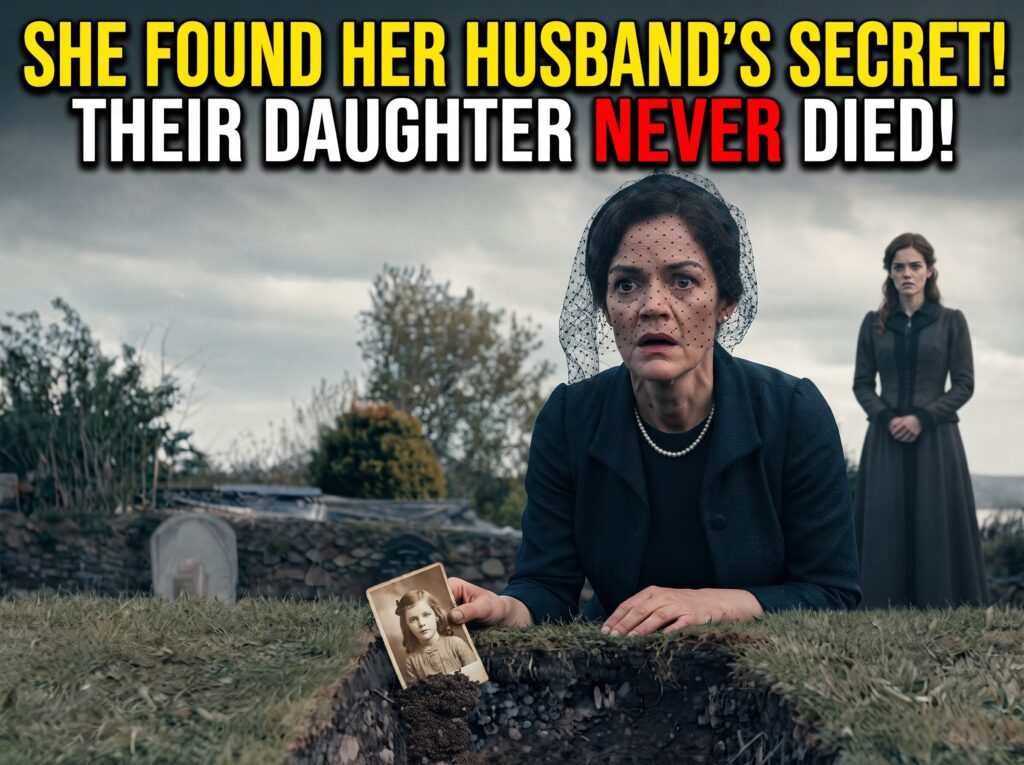
The rain had stopped, but the cemetery remained cold.
Margaret stood beside her husband’s freshly dug grave, wearing the navy-blue mourning dress she had chosen for his funeral. A black lace veil covered her dark hair, and a small white handkerchief rested between her fingers.
Around her, the last guests were slowly leaving.
Some offered their condolences. Others whispered among themselves.
Margaret barely heard them.
For twenty years, Edward had been her husband, her closest friend, and the person she trusted most.
Now he was gone.
She knelt beside the grave and placed a single white rose on the earth.
“You promised we’d grow old together,” she whispered.
Her eyes filled with tears.
“You promised me.”
A few steps behind her stood Edward’s younger sister, Beatrice.
“Margaret, we should go. The weather is getting worse.”
Margaret didn’t turn.
“Please give me another minute.”
Beatrice sighed.
“Edward wouldn’t want you sitting here all afternoon.”
Margaret finally looked at her.
“You don’t know what Edward wanted.”
Beatrice’s expression hardened.
“I knew my brother longer than you did.”
Then she walked toward the cemetery gate.
Margaret remained alone.
As she reached for her handkerchief, she noticed something beneath the white rose.
A small cream-colored envelope.
Her name was written across it.
Margaret.
She looked around.
Nobody was nearby.
She opened the envelope carefully.
Inside was an old photograph of Edward standing beside a young woman in a pale dress.
Margaret recognized Edward immediately.
But she had never seen the woman.
On the back of the photograph were five handwritten words.
Do not trust his family.
Beneath them was a date.
Twenty years earlier.
Margaret felt a chill move through her body.
Why had someone left this at her husband’s grave?
And why did the date correspond to the year their first child supposedly died?
She turned the photograph over again.
The young woman was wearing a small silver necklace.
Margaret recognized it.
It was the necklace Edward had once told her belonged to his mother.
She had seen it in his locked study.
The same study Beatrice had insisted should be cleared before the end of the week.
Margaret slowly stood.
For the first time since Edward’s death, she felt something stronger than grief.
She felt fear.
PART 2 — THE MARRIAGE BUILT ON SILENCE
Twenty years earlier, Margaret had been a young woman from a respectable but financially struggling family.
She met Edward at a summer gathering at the Ashford estate.
He was kind, thoughtful, and different from the wealthy men her parents wanted her to marry.
Edward loved horses, old books, and long walks through the countryside.
Margaret loved the way he listened.
Their relationship developed quickly.
But his family disapproved.
Edward’s mother, Lady Catherine, believed Margaret was not suitable for the Ashford family.
“Love is not enough to maintain a family name,” she told her son.
Edward disagreed.
“I am marrying Margaret, not the family name.”
Despite the objections, they married.
Their first years together were happy.
They restored an old cottage on the estate, planted roses, and dreamed of raising children.
Then Margaret became pregnant.
Edward was overjoyed.
He began preparing a nursery and bought a small wooden cradle.
But the delivery was difficult.
Margaret remembered very little of that night.
She remembered pain, the sound of rain against the hospital windows, and Edward holding her hand.
When she woke, he was sitting beside her.
His face was pale.
“Where is our baby?” she asked.
Edward looked down.
“I’m sorry, my love.”
The baby had supposedly died shortly after birth.
Margaret fell into a deep depression.
Edward held her through the darkest months.
Eventually, they learned to live with the loss.
But Edward never allowed anyone to discuss the hospital or the delivery.
Whenever Margaret asked questions, he became distant.
“Please, Margaret. Let us leave that night behind us.”
She wanted to believe him.
She had no reason to suspect that the greatest secret of their marriage was connected to the child they had buried in their memories.
Now, standing in the empty bedroom of their old house, Margaret remembered that Edward had kept every document from that hospital.
She opened his desk.
Most of the drawers were empty.
But one small compartment remained locked.
She tried several keys.
None worked.
Then she remembered the silver necklace in the photograph.
Perhaps the photograph was not simply a warning.
Perhaps it was a clue.
PART 3 — THE WOMAN IN THE PHOTOGRAPH
Margaret took the photograph to the village.
She visited Mrs. Eleanor Whitmore, an elderly woman who had known Edward’s family for decades.
Eleanor studied the picture.
Her hands began to shake.
“Where did you get this?”
“It was left at Edward’s grave.”
Eleanor looked toward the window.
“That woman is Clara.”
“Who is Clara?”
“She worked at the Ashford estate many years ago.”
“What happened to her?”
Eleanor hesitated.
“She left shortly after your wedding.”
“Why?”
“I don’t know.”
Margaret placed the photograph on the table.
“Do you recognize the necklace?”
Eleanor nodded slowly.
“It belonged to Lady Catherine. She gave it to Clara shortly before Clara disappeared.”
Margaret frowned.
“Why would Edward have a photograph with her?”
Eleanor leaned closer.
“Because Clara was present the night your child was born.”
Margaret felt her breath catch.
“What?”
Eleanor stood and closed the curtains.
“Listen carefully. There were things happening in that house that nobody dared discuss.”
“Tell me.”
“Your mother-in-law was afraid that the child would change Edward’s inheritance arrangements.”
Margaret shook her head.
“That makes no sense.”
“Edward was expected to inherit the estate, but the family trust had certain conditions. Your child would have changed everything.”
Margaret stood.
“Are you saying someone took my baby?”
Eleanor looked at her sadly.
“I’m saying that night was not as simple as you were told.”
Margaret left the cottage in a daze.
On the way home, she stopped beside the old chapel.
A woman was waiting near the gate.
She appeared to be in her early forties.
She wore a dark coat and carried a small leather handbag.
“Mrs. Ashford?”
Margaret turned.
“Yes?”
The woman looked at her for a long moment.
“My name is Clara.”
Margaret’s heart began racing.
Clara looked toward the road.
“I think it’s time you learned what happened to your daughter.”
PART 4 — THE CHILD WHO NEVER DIED
Margaret couldn’t speak.
For twenty years, she had believed her daughter had died.
Now a woman standing before her was telling her that the child might have survived.
“Where is she?” Margaret whispered.
Clara opened her handbag.
She removed a small folded piece of paper.
“I don’t know where she is now. But I know she was alive when I last saw her.”
Margaret gripped the paper.
“Who took her?”
Clara looked away.
“Lady Catherine arranged everything.”
Margaret stepped backward.
“No. Edward would never have allowed that.”
Clara’s eyes filled with tears.
“Edward didn’t know the whole truth at first.”
“What does that mean?”
Clara explained that Margaret’s daughter had been born alive.
But Lady Catherine believed the child would threaten the family inheritance.
She arranged for the baby to be taken to another family.
Clara had worked at the estate and had witnessed the arrangements.
She was instructed to tell Margaret that the child had died.
But she couldn’t live with the lie.
She secretly contacted Edward.
He discovered what had happened and confronted his mother.
“Why didn’t he tell me?” Margaret cried.
Clara lowered her eyes.
“Your recovery was difficult. Edward was afraid that the truth would destroy you. Then his mother threatened to have you declared unfit to care for the child.”
Margaret stared at her.
“So he stayed silent?”
“He tried to find your daughter. For years.”
“Did he succeed?”
Clara handed her another photograph.
It showed a little girl standing in front of a stone cottage.
On the back was a name.
Anne.
Margaret touched the photograph.
Her daughter had a small birthmark near her left eyebrow.
The little girl in the picture had the same mark.
Margaret began to cry.
“She was alive.”
Clara nodded.
“Yes.”
“All these years…”
Clara reached for her hand.
“I’m sorry.”
Margaret pulled away.
“Don’t tell me you’re sorry. Tell me where my daughter is.”
Clara gave her an address.
It was in a village several hours away.
Margaret looked at the paper.
For twenty years, she had visited an empty grave in her heart.
Now she had a chance to find the child she had lost.
PART 5 — THE LETTER EDWARD NEVER SENT
Before leaving, Margaret returned to the Ashford estate.
She went directly to Edward’s study.
She examined the desk again.
This time, she noticed a small indentation beneath the locked compartment.
She pressed it.
A hidden drawer opened.
Inside was a bundle of letters tied with a faded blue ribbon.
The first letter was addressed to Margaret.
She recognized Edward’s handwriting.
My dearest Margaret,
I have spent twenty years trying to find the courage to tell you what happened.
Our daughter lived.
I saw her after she was taken away. I tried to bring her home, but my mother had already arranged everything.
I was young, frightened, and weak. I thought I could correct the situation quietly.
Instead, I allowed the lie to grow.
Every year, I told myself I would tell you tomorrow.
Tomorrow became another year.
I know there is no excuse.
You deserved the truth.
Our daughter is called Anne. I believe she is still alive.
If I am no longer here when you discover this, please find her.
Tell her that I never stopped loving her.
And tell her that her mother never stopped waiting.
Edward.
Margaret pressed the letter against her chest.
She cried until she could barely breathe.
Then she found another document.
It was a copy of a legal agreement signed by Lady Catherine.
The agreement transferred money to a family in exchange for taking custody of the child.
Margaret was horrified.
But another detail caught her attention.
Edward had signed a separate document years later.
It transferred ownership of a small cottage to Anne.
He had never stopped trying to provide for his daughter.
He had been searching.
And he had been carrying the guilt alone.
Margaret packed the letters and photographs.
She was going to find Anne.
But before she could leave, Beatrice entered the study.
“What are you doing?”
Margaret held up the documents.
“Tell me the truth.”
Beatrice looked at them.
Her face went pale.
“Where did you find those?”
“In Edward’s desk.”
Beatrice moved toward her.
“Give them to me.”
“No.”
“Margaret, you don’t understand.”
“Then explain it.”
Beatrice stared at her.
Then she whispered:
“Mother didn’t act alone.”
Margaret froze.
“What?”
Beatrice looked directly at her.
“Edward helped her.”
PART 6 — THE SECOND BETRAYAL
Margaret felt as though the room had tilted.
“Edward helped her?”
Beatrice nodded.
“He agreed to the arrangement at first.”
Margaret shook her head.
“You’re lying.”
“He believed Mother would find a better family for the child. He was terrified that the scandal would ruin the estate.”
Margaret’s eyes filled.
“Then why did he spend twenty years searching for her?”
“Because he regretted it.”
Beatrice sat down.
“Mother controlled everything. She threatened to disinherit him if he brought the child home. He was weak.”
Margaret looked at the letters.
“Why didn’t you tell me?”
Beatrice said nothing.
“Why did you let me believe my baby was dead?”
“Because Mother ordered us to.”
Margaret stepped closer.
“You were a woman. You knew what it meant to lose a child.”
Beatrice began crying.
“I know.”
“No, you don’t.”
Margaret gathered the documents.
“You will never understand what you took from me.”
Beatrice stood.
“Mother is dead now. There’s nothing we can change.”
Margaret turned.
“You’re wrong. I can still find my daughter.”
Beatrice lowered her voice.
“Do you really think she’ll want to meet you?”
Margaret stopped.
Beatrice continued.
“She has a family. A life. You are a stranger to her.”
Margaret felt the words cut deeply.
But she refused to turn back.
“Then I will let her decide whether she wants to know me.”
She walked out of the estate.
For the first time, Margaret understood something painful.
The people who had shared her husband’s family name had known the truth.
They had watched her grieve.
They had attended the funeral.
And they had allowed her to kneel beside a grave for twenty years while her daughter was alive somewhere in the world.
She would never forgive them easily.
But she would not let their cruelty stop her from finding Anne.
PART 7 — THE DAUGHTER AT THE COTTAGE
The journey took Margaret most of the day.
When she finally reached the village, the sun was beginning to disappear.
She found the cottage described in Edward’s letter.
A small garden surrounded it.
A young woman was standing outside, hanging white sheets on a line.
Margaret stopped at the gate.
“Excuse me.”
The young woman turned.
“Can I help you?”
Margaret tried to speak.
But the words wouldn’t come.
The young woman smiled politely.
“Are you looking for someone?”
Margaret looked at her face.
She saw Edward’s eyes.
And her own smile.
“Are you Anne?”
The woman frowned.
“Yes. Who are you?”
Margaret’s hands began trembling.
“My name is Margaret Ashford.”
Anne became still.
“Why are you here?”
Margaret took a breath.
“I think I’m your mother.”
Anne stared at her.
Then she laughed nervously.
“That’s impossible.”
Margaret opened her handbag and removed the old photograph.
She showed Anne the birthmark near her eyebrow.
Then she placed Edward’s letter in her hands.
Anne read the first few lines.
Her expression changed.
“My father told me I was adopted.”
Margaret nodded.
“I didn’t know you were alive.”
Anne’s eyes filled with tears.
“Why didn’t you come sooner?”
Margaret couldn’t answer.
She wanted to explain everything.
But how could she explain twenty years of lies in a few sentences?
“I looked for you,” she whispered. “Your father looked for you too.”
Anne stepped backward.
“Please go.”
Margaret lowered her head.
“All right.”
She placed the photographs and letters on the small garden table.
“I won’t force you to believe me. But everything is here.”
Then she walked toward the gate.
Behind her, she heard Anne crying.
“Wait!”
Margaret turned.
Anne was holding the photograph.
“Did he really know about me?”
Margaret nodded.
“He never forgot you.”
Anne covered her mouth.
“Then why did he never come?”
Margaret looked at the sky.
“Because he made a terrible mistake, and he spent the rest of his life trying to find the courage to correct it.”
Anne began crying.
Margaret took one small step toward her.
But she waited.
This time, she would not force anyone to do anything.
PART 8 — THE WOMAN WHO HAD RAISED HER
Anne invited Margaret inside.
There, Margaret met Thomas and Evelyn, the couple who had raised her.
Evelyn was an elderly woman with gentle eyes.
She listened quietly as Margaret explained the letters.
When Margaret finished, Evelyn began to cry.
“We always knew there was more to the story.”
Anne turned toward her.
“You knew?”
Evelyn nodded.
“We were told that your birth parents had died. We believed it for many years.”
Margaret felt her heart sink.
Evelyn continued.
“Your father contacted us when you were a child. He asked whether we could arrange a meeting. But Lady Catherine’s lawyer threatened to take you away from us if we allowed it.”
Margaret stared at her.
“Edward knew where she was?”
“Yes. He visited the village twice. He watched you playing in the garden from the road.”
Anne covered her face.
“All those years?”
Evelyn nodded.
“He never approached because he believed it would cause you pain.”
Margaret began crying.
She imagined Edward standing outside the garden, watching his daughter grow up from a distance.
She remembered the evenings when he returned home unusually quiet.
She remembered the times he had looked at old photographs and refused to explain his sadness.
Now she understood.
Anne took Margaret’s hand.
“Did he love me?”
Margaret looked at her.
“More than you can imagine.”
Anne cried.
“Then I wish I had known him.”
Margaret gently touched her daughter’s cheek.
“So do I.”
For a long time, they sat together.
There was no sudden embrace that erased twenty years.
There were too many unanswered questions.
Too much grief.
Too much lost time.
But something had begun.
A mother and daughter were finally sitting in the same room.
And neither wanted the moment to end.
PART 9 — THE LAST SECRET IN THE WILL
Several weeks later, Margaret and Anne returned to the Ashford estate.
They were accompanied by a solicitor.
Edward’s will contained one final surprise.
The solicitor opened a sealed envelope.
“Mr. Ashford requested that this letter be read if his daughter was ever found.”
Margaret looked at Anne.
The solicitor began reading.
To my daughter, Anne,
I do not know whether you will ever read these words.
I cannot ask you to forgive me.
I made a decision that changed your life before you were old enough to understand what was happening.
I allowed fear and family pressure to silence me.
Your mother suffered because of my weakness.
You grew up without knowing the truth.
There were years when I stood outside your village and watched you play. I wanted to run toward you. I wanted to tell you that I was your father.
But I was afraid of causing more pain.
I have left you the cottage and a share of the estate. Not because money can replace what you lost, but because you deserve something that was always yours.
If you choose never to forgive me, I will understand.
But please know that you were loved.
Your father,
Edward.
Anne began to cry.
Margaret held her hand.
The solicitor continued.
“The estate also contains a separate provision ensuring that Anne receives her inheritance independently of the remaining family members.”
Beatrice, who had been sitting near the window, looked shocked.
“Mother never told me about this.”
The solicitor closed the document.
“Your mother was not the final authority on your father’s wishes.”
For the first time, Margaret saw Beatrice without the confidence she had carried for so many years.
But Margaret felt no satisfaction.
She only felt sadness.
Edward’s final gift had restored something.
It had given Anne a place in the family history.
But it could not return the twenty years they had lost.
PART 10 — THE GRAVE THAT FINALLY BROUGHT THEM TOGETHER
One year after Edward’s funeral, Margaret returned to the cemetery.
The sky was pale, and a gentle wind moved through the trees.
She wore the same navy-blue dress.
The black lace veil rested over her dark hair.
But this time, she wasn’t alone.
Anne walked beside her.
They carried two white roses.
Margaret knelt beside Edward’s grave.
She placed one rose on the earth.
“Edward,” she whispered, “I found her.”
Anne stood quietly.
Margaret looked up.
“Would you like to say something?”
Anne slowly knelt beside her.
She placed the second rose on the grave.
“Hello, Father.”
Her voice broke.
“I wish we had met. I wish you had told me the truth. I wish I had known you.”
She wiped away her tears.
“But I hope you knew that I was loved.”
Margaret reached for her daughter’s hand.
Together, they sat beside the grave.
After a long silence, Anne spoke.
“Do you think he knew we would come here together?”
Margaret smiled sadly.
“I think he hoped.”
Anne rested her head against her mother’s shoulder.
For twenty years, Margaret had believed she was mourning a child who had died.
For twenty years, Edward had carried the guilt of a secret he never found the courage to reveal.
And for twenty years, Anne had grown up believing she was simply a child who had been given away.
Now the truth had finally brought them together.
It could not restore the years.
It could not erase the betrayal.
But it could give them a future.
Margaret looked at her husband’s grave.
“I loved you, Edward. But I wish you had trusted me enough to tell me the truth.”
She stood and took Anne’s hand.
Then they walked slowly toward the cemetery gate.
Behind them, two white roses rested on the earth.
One for a husband who had carried a terrible secret.
And one for a daughter who had finally found her way home.
THE END.
FINAL EMOTIONAL MESSAGE
Sometimes the deepest wounds are not caused by the people who leave us.
They are caused by the people who keep the truth from us.
A mother can lose twenty years without ever knowing her child is alive. A father can spend a lifetime regretting one decision. And a family can remain divided until someone finally finds the courage to speak.
The truth may arrive too late to restore the past.
But it is never too late to give the future a chance.