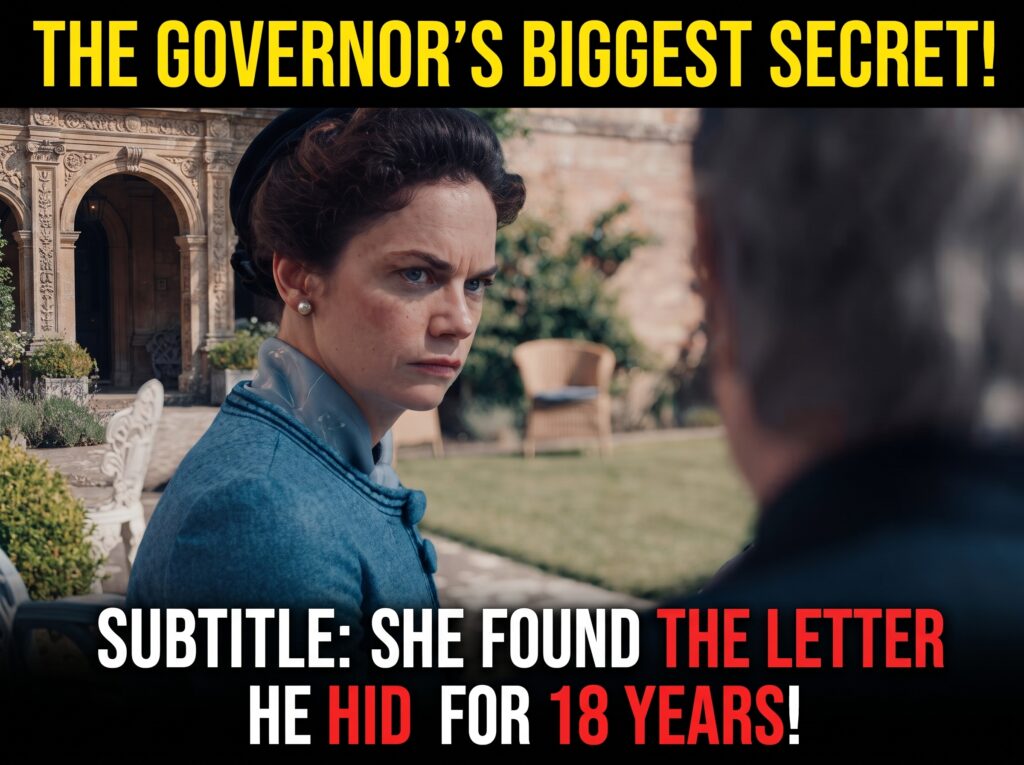
The gardens of Whitmore Hall were unusually quiet that afternoon.
Eleanor Whitmore stood beside a stone pathway, wearing her favorite blue jacket. Her dark hair was carefully arranged, and her pearl earrings caught the afternoon sunlight.
Across from her stood Governor Richard Ashford, the most powerful man in the county.
For eighteen years, he had controlled the Whitmore estate, managed its money, and made decisions on behalf of Eleanor’s family.
He had always treated her as a child.
But Eleanor was no longer a child.
“You’re asking me to sign away my father’s remaining property,” she said.
Richard adjusted his coat.
“I’m asking you to be sensible.”
“That property belonged to my father.”
“Your father was deeply indebted when he died.”
“Then show me the documents.”
Richard smiled coldly.
“I have explained the situation many times.”
“No. You’ve told me what you want me to believe.”
His expression changed.
“Be careful, Eleanor. Accusing a man of dishonesty is a serious matter.”
She stepped closer.
“Then perhaps you should stop behaving like one.”
Richard stared at her.
For the first time, he seemed uncertain.
He had expected Eleanor to remain obedient, grateful, and frightened.
He had not expected her to investigate.
“You have no understanding of the sacrifices I made for this family,” he said.
Eleanor’s eyes narrowed.
“My mother made sacrifices too. Yet you spent eighteen years telling everyone she was a thief.”
Richard turned away.
“That matter was settled long ago.”
“Not for me.”
He stopped.
Eleanor continued.
“I want access to my father’s private records. I want the original inheritance documents, and I want to know why my mother was removed from this estate.”
Richard’s voice became colder.
“Your mother brought disgrace upon this family.”
“That’s what you’ve always said.”
“Because it’s true.”
“Then why did she write to me three days before she died?”
Richard looked at her.
Eleanor had never mentioned that letter.
She reached into her handbag and removed a folded piece of paper.
“She told me that one day I would understand everything.”
Richard’s face went pale.
“Where did you get that?”
“From my mother’s belongings.”
He reached toward the letter.
Eleanor pulled it away.
“No. You’ve taken enough from my family.”
Richard stared at her with an expression she had never seen before.
Fear.
And that was when Eleanor understood something important.
Her mother had not been a thief.
She had been silenced.
PART 2 — THE MOTHER THEY CALLED A THIEF
Eighteen years earlier, Eleanor had been a little girl living at Whitmore Hall.
Her father, Lord James Whitmore, owned a magnificent country estate, several farms, and a successful textile business.
Her mother, Margaret, was gentle and intelligent.
She often spent her afternoons teaching Eleanor to read beneath the large oak tree in the garden.
“Never believe everything people tell you,” Margaret used to say.
“Why, Mama?”
“Because sometimes people tell lies to protect themselves.”
Eleanor would laugh.
She had no idea how important those words would become.
Lord James trusted Richard Ashford completely.
Richard had been his childhood friend and business adviser.
He was welcomed into the family and given access to important financial documents.
But Richard wanted more.
He wanted Whitmore Hall.
He wanted the land.
And most importantly, he wanted control of the family fortune.
One evening, Lord James discovered that money had disappeared from the business accounts.
He confronted Richard privately.
“What have you done with the investment funds?”
Richard remained calm.
“I have managed them according to your instructions.”
“I gave no such instructions.”
The argument continued for hours.
Margaret heard raised voices from the corridor.
Later that night, James told his wife something that frightened her.
“Richard is not the man I believed him to be.”
A few weeks later, James died unexpectedly after a sudden illness.
The family was devastated.
Margaret was left alone with her young daughter.
Richard immediately stepped forward.
He offered to manage the estate until Eleanor became an adult.
Margaret initially accepted.
She believed he was helping them.
But soon, strange things began happening.
Financial documents disappeared.
Servants were dismissed.
Letters addressed to Margaret were intercepted.
Then Richard accused her of stealing money from the estate.
He produced documents that appeared to prove it.
Margaret denied everything.
But Richard had already influenced the local authorities and persuaded several important families that she was guilty.
Margaret was forced to leave Whitmore Hall.
Eleanor was told that her mother had abandoned her.
The little girl cried for weeks.
Richard told her that Margaret had chosen money over her daughter.
But Margaret never stopped writing.
She sent letters every month.
Most never reached Eleanor.
And every letter that did arrive was intercepted by Richard’s household staff.
Until one day, Margaret became seriously ill.
Her final letter was never delivered.
It remained hidden in the hands of an elderly servant named Thomas.
And now, eighteen years later, Eleanor was finally beginning to uncover the truth.
PART 3 — THE SERVANT WHO REMEMBERED EVERYTHING
That evening, Eleanor returned to her bedroom.
She could not stop thinking about Richard’s expression.
He had looked frightened when she mentioned her mother’s letter.
She knew there was something hidden.
But where?
A gentle knock interrupted her thoughts.
It was Thomas, the elderly former head servant of Whitmore Hall.
“Miss Eleanor, may I speak with you?”
“Of course, Thomas.”
He entered slowly and closed the door.
“I heard about your conversation with Governor Ashford.”
Eleanor sighed.
“Everyone seems to hear everything in this house.”
Thomas smiled sadly.
“Some things are difficult to keep secret.”
He reached into his coat and removed a small leather pouch.
“I have something that belongs to you.”
Eleanor opened it.
Inside was a silver locket.
She recognized it immediately.
It had belonged to her mother.
“Where did you find this?”
“Your mother gave it to me before she left the estate.”
Eleanor opened the locket.
Inside was a tiny photograph of herself as a child.
On the other side was an engraved sentence.
The truth will always find its way home.
Eleanor’s eyes filled with tears.
Thomas sat beside the window.
“Your mother never stole anything. She discovered that Richard had been transferring money from your father’s accounts into his own.”
“Why didn’t anyone defend her?”
“Because Richard had already arranged everything. He controlled the documents, the witnesses, and the people who were supposed to investigate.”
“Did my father know?”
Thomas nodded.
“Your father discovered the truth shortly before his death.”
Eleanor looked up.
“Then why didn’t he expose Richard?”
“He prepared evidence. But he became ill before he could take it to the authorities.”
Thomas reached into his coat again.
This time, he removed a small brass key.
“Your father gave this to me. He said I should keep it until you were old enough to understand.”
Eleanor stared at it.
“What does it open?”
“The old library.”
She frowned.
“The library has been locked for years.”
Thomas nodded.
“Because Richard ordered it.”
“What’s inside?”
Thomas looked directly at her.
“The truth about your father’s final days.”
PART 4 — THE LOCKED LIBRARY
The following morning, Eleanor and Thomas entered the old library.
Dust covered the furniture.
The curtains were closed, and the smell of old paper filled the room.
At the far end stood a large wooden cabinet.
Eleanor tried the brass key.
It opened the lock.
Inside were several boxes of documents.
Thomas helped her remove them.
The first contained financial records.
The second contained correspondence between Richard and several businessmen.
The third contained a sealed envelope addressed to Lord James’s daughter.
Eleanor opened it carefully.
Her father’s handwriting was unmistakable.
My dearest Eleanor,
If you are reading this, I fear I may not have lived long enough to protect what belongs to you.
There are people who will tell you that your mother betrayed this family.
Do not believe them.
Margaret is the most honest person I have ever known.
Richard has been stealing from our business for years. I discovered the evidence, but he knows that I know.
If anything happens to me, please find the original property deed and the second will.
Your mother knows where the documents are hidden.
Love always,
Father.
Eleanor read the letter twice.
Then she noticed something strange.
The second will was mentioned, but it wasn’t in the box.
“Thomas, where is the original deed?”
Thomas shook his head.
“I don’t know. Your father hid it somewhere.”
Eleanor continued searching.
At the bottom of the cabinet, she found a small envelope containing a photograph of her parents standing beside the oak tree.
On the back, her father had written:
Where our daughter first learned to read.
Eleanor looked toward Thomas.
“The oak tree.”
They hurried outside.
The old tree stood in the center of the garden.
Its branches had grown larger over the years, but the stone bench beneath it remained.
Eleanor remembered sitting there with her mother.
She ran her fingers along the underside of the bench.
There was a small metal compartment.
Inside was another envelope.
And inside that envelope was a document bearing her father’s signature.
It was the original deed to Whitmore Hall.
The estate had been transferred into Eleanor’s name before her father’s death.
Richard had never legally owned it.
Eleanor’s hands trembled.
For eighteen years, he had lived in her father’s house, controlled her inheritance, and treated her like a guest.
But the estate had always belonged to her.
Then Thomas noticed another document.
It was a copy of Richard’s signature authorizing a transfer of money into an account under his own name.
Eleanor stared at it.
“He’s been stealing from us.”
Thomas nodded.
“And now he knows you’re getting close.”
PART 5 — THE GOVERNOR’S WARNING
Richard Ashford received news of the discovery that afternoon.
He summoned Eleanor to his private office.
The room was filled with expensive furniture, portraits, and books.
He stood beside the fireplace.
“I understand you’ve been searching through the old library.”
Eleanor remained standing.
“Yes.”
“You had no permission.”
“I don’t need your permission to examine my father’s belongings.”
Richard smiled.
“You have become very difficult.”
“I have become curious.”
“Curiosity can be dangerous.”
Eleanor placed the deed on his desk.
Richard looked down.
For several seconds, he said nothing.
Then he slowly picked up the document.
“Where did you find this?”
“Where my father left it.”
“This document is invalid.”
“Then prove it.”
Richard placed it down.
“You don’t understand the legal arrangements surrounding this estate.”
“I understand enough to know that you’ve been living here using property that belongs to me.”
His face darkened.
“Your father was not thinking clearly when he signed that document.”
“Interesting. You said the same thing about my mother when she accused you of stealing.”
Richard walked toward the window.
“You should leave this matter alone.”
“No.”
“Eleanor, I have protected you since childhood.”
“You separated me from my mother.”
“Your mother was unstable.”
“You lied to me.”
“I gave you a comfortable life.”
“You gave yourself my inheritance.”
Richard turned sharply.
“Be careful!”
Eleanor stood her ground.
“Why? Are you afraid I’ll discover something else?”
Richard approached her.
“You have no idea what I am capable of.”
Eleanor held his gaze.
“Neither do you know what I am capable of when I stop being afraid.”
She collected the document and walked out.
Richard remained beside the fireplace.
His hands were trembling.
For eighteen years, he had believed the past was buried.
Now the daughter of the woman he had destroyed was beginning to uncover everything.
And he was running out of time.
PART 6 — THE WOMAN WHO NEVER STOPPED WAITING
Eleanor knew she needed to find her mother.
Thomas told her that Margaret had spent her final years in a small village near the coast.
She had died only three years earlier.
But she had left behind a small cottage.
Eleanor traveled there immediately.
The cottage was modest.
Its windows overlooked the sea, and a small garden surrounded the entrance.
An elderly neighbor named Mrs. Collins answered the door.
When Eleanor introduced herself, the woman’s eyes filled with tears.
“You’re Margaret’s daughter.”
Eleanor nodded.
Mrs. Collins invited her inside.
“Your mother spoke about you every day.”
Eleanor lowered her head.
“Did she know I was alive?”
“Of course. She tried to contact you for years.”
“Why didn’t she come to find me?”
“She did. But Richard’s people always stopped her.”
Eleanor sat down.
Mrs. Collins brought out a wooden box.
“She asked me to give you this if you ever came.”
Inside were dozens of letters.
Each one was addressed to Eleanor.
Some were written when she was a child.
Others were written during her teenage years.
One was dated only a few weeks before Margaret died.
Eleanor opened it.
My darling Eleanor,
I don’t know whether you will ever read these words.
I have missed your voice, your laughter, and the little questions you used to ask beneath the oak tree.
People have told you that I abandoned you.
But every morning I wake up wishing I could hold you again.
I never chose to leave you.
I was forced away.
If you ever discover the truth, please don’t spend your life hating everyone.
I want you to be strong, but I also want you to remain kind.
You are my greatest blessing.
Your loving mother.
Eleanor began sobbing.
She pressed the letter against her chest.
For eighteen years, she had believed her mother had forgotten her.
Now she understood that Margaret had spent every one of those years waiting.
Mrs. Collins gently placed a hand on her shoulder.
“Your mother never stopped loving you.”
Eleanor looked toward the sea.
“I wish I had known.”
That evening, she found another envelope.
It contained a photograph of her mother holding a small wooden box.
Written on the back were the words:
The final evidence is hidden where the old clock stopped.
Eleanor immediately remembered the clock in Whitmore Hall.
It had stopped at eleven minutes past nine.
The exact time her father had died.
She knew what she had to do.
PART 7 — THE FINAL PIECE OF EVIDENCE
Eleanor returned to Whitmore Hall before dawn.
Thomas was waiting in the entrance.
“Did you find her letters?”
Eleanor nodded.
“And I think I know where the final evidence is.”
They went directly to the grand hallway.
The old grandfather clock stood beside the staircase.
Its hands had remained frozen at eleven minutes past nine for eighteen years.
Thomas opened the wooden panel at the back.
Inside was a small compartment.
There was a second brass key.
Eleanor opened it.
A bundle of documents fell onto the floor.
The first was a signed statement from Lord James.
It confirmed that Richard had stolen money from the business.
The second was a letter from a bank manager describing suspicious financial transfers.
The third was a medical report concerning James’s final illness.
Eleanor read it carefully.
Her father had been treated by a doctor who had later resigned and disappeared from the county.
There was a note attached.
The doctor was paid by Richard Ashford.
Eleanor felt sick.
Had Richard caused her father’s death?
The documents did not prove that, but they revealed that Richard had interfered with the medical arrangements and concealed important correspondence.
Thomas shook his head.
“Your father was suspicious of him, but he never imagined Richard would go this far.”
Eleanor gathered the documents.
“We need to take these to the authorities.”
Before Thomas could answer, footsteps sounded behind them.
Richard stood at the entrance.
His face was pale.
“What are you doing?”
Eleanor turned.
“Finding the evidence you thought you’d destroyed.”
Richard stared at the papers.
Then he laughed.
“You think a few old documents will defeat me?”
“They prove you stole from this family.”
“They prove nothing.”
“Then why are you frightened?”
Richard stepped forward.
“Give them to me.”
“No.”
He reached for the documents.
Thomas moved between them.
“Enough, sir.”
Richard looked at the elderly servant.
“You should have kept your mouth shut.”
Thomas stood firm.
“I kept quiet for eighteen years. Not another day.”
Eleanor seized the opportunity.
She carried the documents toward the door.
Richard shouted after her.
“You will regret this!”
She stopped and looked back.
“No, Mr. Ashford. The only thing I regret is believing you.”
PART 8 — THE TRIAL OF A POWERFUL MAN
The investigation lasted several months.
Richard used his influence to delay the proceedings.
He hired expensive lawyers and attempted to discredit Eleanor.
But the evidence was extensive.
The bank records matched the documents found in the library.
Several former employees came forward.
They described how Richard had ordered them to destroy financial records.
Mrs. Collins testified about Margaret’s repeated attempts to contact her daughter.
Thomas provided the original correspondence.
The authorities also located the doctor who had treated Lord James.
He confirmed that Richard had pressured him to keep certain medical details confidential.
The case became the biggest scandal the county had seen in decades.
At the hearing, Richard sat confidently beside his lawyer.
Eleanor entered wearing her blue jacket.
She looked toward him.
For a moment, she remembered the young girl who had once been afraid to speak in his presence.
But that girl was gone.
The judge examined the documents.
Richard’s lawyer argued that Eleanor was motivated by revenge.
“She has spent years believing a story told by her disgraced mother,” he said.
Eleanor stood.
“My mother was called a thief because she discovered the truth.”
The judge looked at her.
“Do you have anything further to say?”
Eleanor held up the final letter from her father.
“My father wrote this before he died. He knew Richard was stealing from the family. He wanted me to know that my mother was innocent.”
The courtroom became silent.
The judge read the letter.
Then he examined the original property deed.
Richard’s lawyer stopped speaking.
The evidence could no longer be dismissed.
Richard was found guilty of financial fraud and the unlawful transfer of estate assets.
The court ordered him to repay the stolen money and recognize Eleanor’s legal ownership of Whitmore Hall.
But the greatest victory was not the property.
It was the restoration of Margaret’s name.
For eighteen years, she had been remembered as a dishonest woman.
Now the truth was public.
And the people who had once turned away from her daughter were beginning to understand what they had done.
PART 9 — THE LETTER THAT CHANGED EVERYTHING
After the trial, Eleanor returned to the cottage where her mother had lived.
She spent days reading every letter.
Then she discovered something hidden beneath the lining of the wooden box.
A small envelope.
It contained a letter from Lord James to Margaret.
It was dated three days before his death.
My beloved Margaret,
I have discovered everything.
Richard has been stealing from the estate. I have arranged for Eleanor to inherit Whitmore Hall, and I have placed the original documents somewhere he will never find them.
I fear I may not have much time.
If anything happens to me, please protect our daughter.
And if you are forced to leave, remember that the truth is stronger than the people who try to bury it.
I am sorry that I could not protect you both.
Your loving husband,
James.
Eleanor sat silently.
Her father had known.
Her mother had known.
And both had tried to protect her.
She had spent eighteen years believing that her parents had abandoned her.
Now she understood that they had sacrificed everything to keep her safe.
She returned to the garden.
The old wooden bench remained beneath the tree.
She remembered sitting there as a child, listening to her mother read stories.
Eleanor closed her eyes.
“I found it, Mama.”
She placed the letter beside her.
“I found the truth.”
For the first time in many years, she felt at peace.
But there was one more thing she needed to do.
She wanted to restore the garden.
Not for the estate.
Not for the family name.
For her mother.
PART 10 — THE LADY IN BLUE
One year later, Whitmore Hall looked different.
The gardens had been restored.
The old library was open again.
The family portraits had been cleaned, and Margaret’s photograph now stood proudly in the entrance hall.
Eleanor had established a small charitable fund for women who had been wrongly accused, abandoned, or separated from their children.
She had also reopened the estate’s school for local children.
One afternoon, she stood in the garden wearing her blue jacket.
The same jacket she had worn the day she confronted Richard.
Thomas approached.
“Miss Eleanor, there is someone here to see you.”
“Who?”
“Mrs. Collins.”
Eleanor smiled.
“Please bring her in.”
The elderly woman entered carrying a small package.
“I found something else among your mother’s belongings.”
Eleanor opened it.
Inside was a little blue ribbon.
She recognized it immediately.
It had belonged to her childhood dress.
A note was attached.
For my little girl, who always believed the world was bigger than the walls of this house.
Eleanor smiled through her tears.
Mrs. Collins watched her quietly.
“Your mother would be proud.”
Eleanor looked toward the oak tree.
“I hope so.”
She walked to the stone bench and sat down.
For eighteen years, she had lived beneath the shadow of a lie.
She had been told her mother was dishonest, her father was weak, and the man who controlled her inheritance was her protector.
But the truth had survived.
It had waited in letters, photographs, locked drawers, and the memories of people who refused to forget.
Eleanor had not won because she was powerful.
She had won because she refused to remain silent.
As the afternoon sun moved across the garden, she placed the blue ribbon beside her mother’s photograph.
Then she whispered:
“I am home, Mama.”
And for the first time, Whitmore Hall truly felt like home.
THE END.