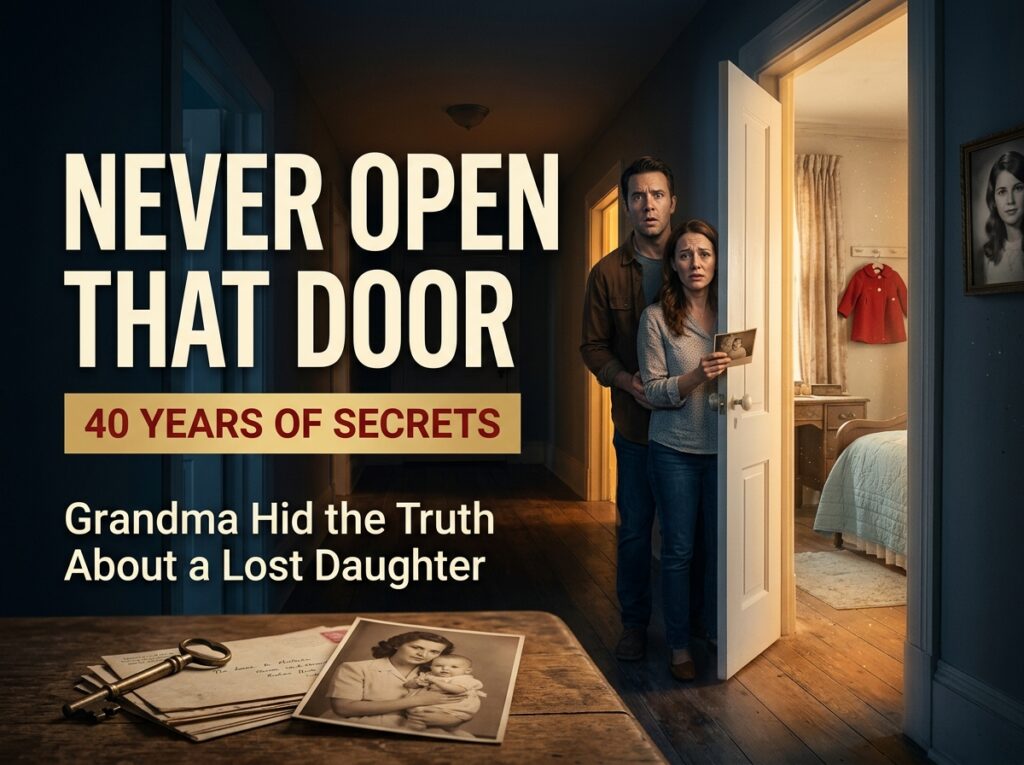
For forty years, Grandma kept one bedroom locked and made us promise never to enter it. She said the room belonged to someone who would never come home. After her funeral, my brother found a key taped beneath her favorite chair. We thought we were about to uncover an old family secret. We had no idea that opening that door would reveal why Grandma had spent her entire life protecting a lie—and why someone in our family had been so desperate to keep the truth buried.
Part 1: The Door at the End of the Hall
The first thing I noticed after Grandma Eleanor died was how quiet the house had become.
For as long as I could remember, her old farmhouse had been filled with familiar sounds: the ticking grandfather clock in the hallway, the soft creak of the stairs, the kettle whistling in the kitchen, and Grandma humming to herself while she prepared breakfast.
Now there was only silence.
My brother, Daniel, stood beside me in the narrow hallway, staring at the white door at the far end. Its brass handle had darkened with age, and three scratches ran down the wood near the lock.
That door had fascinated me since childhood.
We had been forbidden to touch it.
“Don’t even think about it,” Grandma used to warn whenever she caught us looking in that direction. “Some doors are closed for a reason.”
When I was eight, I asked what was inside.
She had stopped folding laundry and looked at me with such sadness that I never asked again.
“A room belonging to someone who isn’t coming home,” she whispered.
I assumed she meant my grandfather, who had died before I was born. But when I mentioned it, Grandma shook her head.
“Your grandfather had his own room. This one is different.”
And that was all she ever said.
For forty years, the bedroom remained locked. Grandma dusted the hallway outside it every Saturday, but she never allowed anyone to clean inside. She replaced the curtains in every other room, repaired the broken windows, and repainted the kitchen twice. Yet the mysterious bedroom remained untouched.
Even my father, Robert, refused to discuss it.
Whenever Daniel and I asked, he would grow angry.
“Your grandmother has her reasons,” he would say. “Leave the matter alone.”
As adults, we eventually stopped asking. Life carried us away from the farmhouse. Daniel moved to another state, and I built a life in the city. We returned for holidays, birthdays, and occasional Sunday dinners, but the locked bedroom became little more than an unsettling family tradition.
Then Grandma suffered a stroke.
For three weeks, I sat beside her hospital bed, holding her thin hand while machines beeped softly around us. Sometimes she recognized me. Sometimes she called me by my mother’s name, even though my mother was still alive.
On her final evening, she opened her eyes and gripped my fingers.
“Emily,” she whispered.
“I’m here, Grandma.”
“Did you keep your promise?”
I leaned closer. “What promise?”
Her eyes filled with tears.
“The door. You mustn’t let them open it.”
Before I could ask what she meant, she closed her eyes again.
She died the following morning.
At the funeral, our relatives spoke about her kindness, her cooking, and the way she had helped neighbors without expecting anything in return. My father stood stiffly beside the grave, his face pale and unreadable.
Daniel cried openly. I couldn’t.
All I could think about was that locked bedroom.
Three days after the funeral, our father told us he intended to sell the farmhouse.
“We can’t maintain it,” he explained over dinner. “Your grandmother is gone, and there’s no reason to keep the property.”
Daniel nodded reluctantly. I agreed that the house would be difficult to manage, but something inside me resisted the idea of leaving before we understood what Grandma had protected for so long.
That evening, Daniel and I returned to the farmhouse to sort through her belongings.
We worked until sunset, packing old photographs, clothes, books, and boxes of letters. Near the fireplace, Daniel discovered a wooden chair that Grandma had kept for decades. Its cushion was worn, and one of its legs had been repaired with a strip of metal.
“Remember this chair?” he asked.
“Of course. She always sat here after dinner.”
Daniel lifted the cushion to check for a label. Something small fell onto the floor.
A brass key.
We both froze.
It was old, with a narrow stem and a round head decorated with a tiny flower. A folded piece of paper had been wrapped around it.
My hands trembled as I opened the note.
Grandma’s handwriting was unmistakable.
If you are reading this, I am gone. Before you decide what to do, remember that the truth can hurt people who never caused the lie.
Below that sentence, she had written one more line.
Emily, if you must open the door, do not let your father enter the room first.
Daniel read the note twice.
“Why would she say that?”
I couldn’t answer.
From somewhere outside, a car engine rumbled up the gravel driveway.
We looked through the window.
Our father had arrived.
And when he stepped into the hallway and saw the key in my hand, every trace of color vanished from his face.
“Where did you get that?” he demanded.
Neither of us spoke.
He crossed the room so quickly that Daniel stepped between us.
“Give it to me,” Father said.
“Why?” I asked.
His eyes flicked toward the locked bedroom.
“Because,” he whispered, “if you open that door, this family will never be the same again.”
Part 2: The Key That Made My Father Tremble
“Then tell us what is inside,” Daniel demanded.
Our father stared at him, then at me. His hands were shaking, although he tried to hide it by curling them into fists.
“Your grandmother was confused near the end,” he said. “She was frightened by things that didn’t make sense. Whatever she wrote, whatever you think you’ve discovered, it doesn’t change anything.”
“Grandma wasn’t confused when she made us promise not to open that room,” I replied. “She wasn’t confused when she hid this key.”
“Emily, please.”
I had rarely heard my father say that word. He was a proud man who preferred commands to requests. Even when he was wrong, he usually found a way to make his decisions sound final.
But now he looked afraid.
Daniel held up the key. “Who does that room belong to?”
Father’s jaw tightened.
“No one.”
“That isn’t what Grandma said.”
“Your grandmother said many things.”
“Then why are you so scared of a bedroom?”
He looked at Daniel as though his own son had struck him.
For several seconds, no one moved. The grandfather clock ticked behind us. Outside, wind rattled the windows, and a loose branch scraped against the farmhouse wall.
Finally, Father reached for the key.
Daniel moved his hand away.
“Not until you tell us the truth.”
“The truth?” Father gave a short, bitter laugh. “You think you want the truth because you believe it will answer every question you’ve ever had. You don’t understand what it can cost.”
“Then let us decide whether we can afford it.”
Father looked toward the locked door again.
“I won’t allow you to open it.”
“You don’t own this house yet,” I said quietly. “Grandma left it to the family. We haven’t even read the will.”
His expression changed.
It was a small change, almost invisible, but I saw it. For the first time, I wondered whether his desire to sell the farmhouse had something to do with the room.
He turned away.
“Do whatever you want,” he muttered. “But when you learn what’s behind that door, don’t come asking me to explain it.”
He left without another word.
Daniel watched his car disappear down the driveway.
“Something happened here,” he said.
“I know.”
“No, Emily. Something happened that Dad has spent his whole life trying to hide.”
I looked at the key in my palm.
The metal was cold, and the flower engraved on its head had been worn almost smooth by time.
We could have waited. We could have respected Grandma’s final request and walked away. But her note had given us two instructions that seemed impossible to reconcile: remember that the truth could hurt innocent people, and do not let our father enter the room first.
Whatever waited inside, Grandma had believed we needed to find it.
Daniel approached the door.
“Are you ready?”
I wasn’t. But I nodded.
The key slid into the lock with surprising ease.
For a moment, it wouldn’t turn. Daniel gently moved it back and forth until something clicked inside the mechanism.
Then the lock opened.
The sound seemed much louder than it should have been.
I rested my hand on the handle.
A smell drifted through the narrow gap as the door moved inward: old paper, cedarwood, and the faint sweetness of dried flowers.
The curtains were drawn. Dust floated in the thin light from the hallway. A large bed stood against the far wall, covered with a pale blue quilt. Beside it sat a wooden writing desk, a dressing table, and a small bookshelf filled with children’s books.
On the wall hung a framed photograph of a young woman holding a baby.
The woman looked familiar.
Not because I recognized her face, but because she had my eyes.
Daniel stepped into the room behind me.
“What is this place?” he whispered.
I walked toward the photograph. The young woman wore a simple white dress and had dark hair pinned loosely behind her ears. She was smiling down at the infant in her arms.
On the back of the frame, someone had written a name.
Margaret.
Our grandmother’s name.
Below it were four words in faded ink:
Margaret and her daughter.
I turned the photograph over again.
“Grandma had a daughter?” I asked.
Daniel shook his head slowly.
“We’re her grandchildren. We would have known.”
We searched the room without touching anything unnecessarily. The wardrobe contained neatly folded dresses, a pair of worn shoes, and a child’s red coat. On the desk sat a glass bottle of dried roses, an empty inkwell, and a stack of letters tied with a blue ribbon.
I opened the top drawer.
Inside lay a tiny silver bracelet engraved with a name.
LUCY.
Beneath it was a hospital identification band, yellowed with age. Most of the writing had faded, but the date remained visible.
The date was forty years earlier.
The same year Grandma had first locked the bedroom.
Daniel pulled a chair toward the desk and untied the ribbon around the letters.
The first envelope was addressed to Margaret Carter, our grandmother. The handwriting was unfamiliar, but the letter inside began with a sentence that made my stomach tighten.
Mother, I know you told me never to return, but I cannot keep living without knowing whether my little girl is safe.
Daniel looked up at me.
“Who wrote this?”
I turned the page over.
At the bottom was a signature.
Anna.
Our father’s name was Robert Carter. His younger sister, according to the few family stories we had heard, had died as a baby. We had never seen a photograph of her. Grandma never spoke about her.
But the letters suggested someone named Anna had lived long enough to write them.
Someone who had a daughter.
Someone who had been forbidden to come home.
We heard a car door slam outside.
Daniel hurried to the window.
“Dad’s back.”
I gathered the letters, my hands shaking.
Father entered the house moments later. His footsteps moved rapidly down the hall, then stopped at the open bedroom door.
He looked at the photograph in my hand.
For a long time, he said nothing.
Then his face crumpled in a way I had never witnessed before.
“Close the door,” he whispered.
“Dad, who was Anna?”
He pressed one hand against the wall to steady himself.
“My sister,” he said.
The room seemed to tilt around us.
“You told us your sister died as a baby,” Daniel said.
Father closed his eyes.
“That is what your grandmother told everyone.”
“But Anna was alive forty years ago.”
He stared at the letters.
“Yes.”
“Where is she now?”
Father opened his mouth, but no words came out.
Then he looked at the tiny silver bracelet in my hand and said something that made the blood drain from my face.
“Your grandmother didn’t just lose Anna.”
He swallowed hard.
“She lost Anna’s daughter, too.”
Part 3: The Child Nobody Was Allowed to Remember
Father sat on the edge of the bed as though his legs could no longer support him.
For several minutes, he didn’t speak. His eyes moved from the photograph to the letters, then to the little red coat hanging inside the wardrobe.
Daniel stood beside the desk with his arms folded.
“You’re going to tell us everything,” he said.
Father nodded, but the movement was slow and uncertain.
“Anna was five years younger than me,” he began. “She was stubborn, clever, and kinder than anyone in our family deserved. When we were children, she used to sneak food from the kitchen and leave it for stray animals behind the barn. Your grandfather would get angry because he thought kindness made people weak.”
“Grandma never mentioned her,” I said.
“Your grandmother loved Anna more than anyone. That’s why what happened destroyed her.”
Father rubbed his face.
“When Anna was twenty, she fell in love with a young man named Michael Reed. He worked at a repair shop outside town. He didn’t come from a wealthy family, and your grandfather considered him beneath us. He forbade Anna from seeing him.”
“Did she listen?” Daniel asked.
Father almost smiled.
“Of course not.”
Anna and Michael continued meeting in secret. When Anna discovered she was pregnant, she believed her parents would eventually accept the situation. She was wrong.
“Your grandfather told her that she had disgraced the family,” Father continued. “He said she could end the relationship, give up the child, and return home as if nothing had happened. Anna refused.”
Grandma, then in her early fifties, tried to protect her daughter. She arranged for Anna to stay in the locked bedroom while the family decided what to do.
It was supposed to be temporary.
But one night, Michael disappeared.
He had been accused of stealing money from the business where he worked. The police questioned him, and he left town before the investigation was completed. Anna believed her father had arranged the accusation to drive Michael away.
Without Michael, Anna had nowhere to go.
She gave birth to a little girl named Lucy in a nearby hospital. Grandma brought the baby home and placed her in the bedroom at the end of the hall.
For a short time, Anna and Lucy lived there together.
“Why didn’t you tell us?” I asked.
Father’s eyes filled with tears.
“Because I was a coward.”
The words came out so quietly that I almost didn’t hear them.
He explained that our grandfather had threatened to disown Anna and throw Grandma out of the farmhouse if they continued protecting her. He claimed the family would be ruined by scandal. He insisted that Anna was unstable and that the child would be better off with strangers.
Grandma fought him for weeks.
But the pressure grew unbearable. The family’s business was struggling, and our grandfather controlled nearly every penny. He threatened to leave his wife with nothing.
Then a social worker visited the house.
“She was told that Anna couldn’t care for the baby,” Father said. “The report claimed Anna was emotionally unwell and had no stable income. Your grandfather arranged for Lucy to be placed with another family.”
I stared at him.
“Arranged how?”
“I don’t know every detail. I was twenty-three. I knew something was wrong, but I believed my father when he said he was doing what was best for everyone.”
“You were an adult,” Daniel said sharply. “You knew your sister was being separated from her baby.”
Father flinched.
“I know.”
“What happened to Anna?”
“She left the house three days later. She said she would find Michael, recover Lucy, and return when she could prove that she was capable of raising her daughter.”
“Did she ever come back?”
Father stared at the floor.
“Yes.”
The word hung between us.
“Several times,” he continued. “She wrote letters. She came to the farmhouse once, but your grandfather refused to let her inside. He said she had abandoned her family and had no right to return.”
“What about Grandma?”
“She tried to help her. Secretly, at first. She sent money and letters. But your grandfather found out. He told her that if she contacted Anna again, he would have her committed to a hospital and declare her incapable of managing the family property.”
I couldn’t understand how the grandmother who had raised us with such tenderness could have allowed this to happen.
“Did she stop helping Anna?”
Father shook his head.
“No. She hid the letters. She kept them in this room. She spent years trying to find Lucy.”
He pointed toward the desk.
“Every time a letter arrived, she would read it in here. Then she’d lock the door again. Eventually, the room became the only place where she could admit what had happened.”
I looked at the bed, the little coat, and the bracelet.
Grandma had kept an entire life sealed away from us.
But one question remained.
“If she spent years trying to find Lucy, why didn’t she tell us? Why didn’t she ask us to help?”
Father’s answer was almost inaudible.
“Because she found her.”
Daniel stepped closer.
“What?”
“Your grandmother found Lucy twenty-seven years ago.”
I felt my heart begin to pound.
“Then where is she?”
Father looked toward the window.
“She was living less than an hour from here.”
“Is she still alive?”
“I believe so.”
“Then why didn’t Grandma bring her home?”
Father pressed his palms against his eyes.
“Because when she finally found Lucy, your grandmother discovered something that changed everything.”
He reached into his coat pocket and removed a folded sheet of paper. It was old and creased, with a date written across the top.
“I found this in your grandmother’s desk last month,” he said. “I didn’t understand what it meant at the time.”
Daniel took the paper.
It was a copy of a letter, addressed to Grandma Eleanor. The signature at the bottom was Anna’s.
Mother, I know you found my daughter. I know you know where she lives. But please, if you have any love left for me, don’t tell her who I am until you know what Robert did.
Daniel slowly lowered the page.
We both looked at our father.
“What did you do?” I asked.
Father didn’t answer.
Instead, he stared at the photograph of Anna holding her baby.
And for the first time in my life, I saw not only fear in his face, but shame so deep that it seemed to have aged him decades in a single moment.
Part 4: The Lie My Father Carried
“Tell us what you did,” Daniel repeated.
Father rose from the bed and walked to the window. Outside, the garden Grandma had tended for decades was beginning to disappear beneath weeds. A row of roses drooped along the fence, their petals scattered across the ground.
“I didn’t take Lucy away from Anna,” he said at last. “But I helped make it possible.”
He explained that when our grandfather decided Anna was unfit to raise her child, he asked Robert to sign a statement supporting the claim. Father had recently started working in the family business and depended on his father’s approval. He wanted to inherit the company one day. He wanted the farmhouse. He wanted to believe that obeying his father was the same as doing the right thing.
The statement said Anna had abandoned Lucy and was unable to provide a safe home.
“I knew it wasn’t true,” he admitted. “I knew Anna loved that baby. But I signed it anyway.”
Daniel stepped back as though the floor had shifted.
“You helped take a child from her mother.”
“I was young.”
“You were twenty-three!”
“I know!”
Father’s voice cracked, and he covered his mouth.
For the first time, I understood that he had not simply forgotten his sister. He had spent forty years avoiding the person he had helped destroy.
“What happened after you signed it?” I asked.
“The child was placed with a couple who wanted to adopt. I was told they would give her a good life. My father said it was better than letting Anna drag the family through a scandal.”
“And Anna?”
“She returned to the house and begged me to tell her where Lucy was. I refused. I told her I didn’t know.”
He looked at us with desperate eyes.
“I thought the arrangement would be temporary. I thought she’d recover, find work, and eventually be allowed to see her daughter. But our father made sure that never happened.”
“Did you ever try to correct the statement?” Daniel asked.
“No.”
The answer was immediate.
It was also devastating.
Father told us that Anna eventually left town. She spent years moving between small apartments and temporary jobs. She wrote to Grandma regularly, sometimes asking for money, sometimes simply asking whether her daughter was happy.
Grandma kept every letter.
She also kept trying to find Lucy.
When our grandfather died, Grandma finally had access to old family papers. She discovered that Lucy’s adoption records had been handled through a private agency that no longer existed. It took years of letters, inquiries, and help from a retired social worker before she located the family who had adopted Lucy.
By then, Lucy was a grown woman with children of her own.
“She had been told she was adopted,” Father said. “But she believed her birth mother had willingly given her up.”
I felt sick.
“Grandma knew that was a lie.”
“Yes.”
“Then why didn’t she tell Lucy the truth?”
Father stared at the floor.
“Because she was afraid.”
“Afraid of what?”
“That Lucy would hate Anna. That she would hate this family. That she would never forgive the people who had separated them.”
Daniel shook his head.
“So Grandma decided to make the choice for her.”
Father didn’t defend her.
The locked bedroom suddenly seemed less like a shrine and more like a prison. Grandma had preserved every object connected to Anna and Lucy, but she had also kept the truth hidden from the very people who needed it most.
I walked to the desk and opened another envelope.
Inside was a photograph of a woman standing beside a lake. She was older than the woman in the first picture, perhaps in her late thirties. Her dark hair was streaked with gray, and her eyes were unmistakably the same as mine.
On the back, Grandma had written:
Anna, taken the last time I saw her.
There was another photograph behind it.
A young woman stood in front of a small house, holding a little boy by the hand. She was smiling, but her eyes carried the same sadness I had seen in Anna’s first photograph.
Grandma had written a name beneath it.
Lucy Reed. Her first day at school.
I turned to Father.
“You know where Lucy lives, don’t you?”
He hesitated.
“Your grandmother kept her address in a separate envelope. I saw it when I searched the desk.”
“Why were you searching her desk?”
He looked away.
“I was looking for the property documents.”
The admission raised another question.
“Were you planning to sell the farmhouse before we found the room?”
“Yes.”
“And if we had never opened that door?”
He had no answer.
Daniel took the photograph from me and studied Lucy’s face.
“We have to find her.”
Father shook his head.
“You can’t simply arrive at her home and tell her that her entire life was built on a lie.”
“No,” I said. “But we can stop protecting the people who told it.”
I searched through the letters until I found an envelope marked with a recent date. Inside was a handwritten address in a town called Bellweather, along with a note from Grandma.
Lucy has two children. She deserves the truth, but the truth must be given with love. I have failed her once by allowing her to be taken. I will not fail her again by pretending she never existed.
My eyes filled with tears.
Grandma had known what needed to be done.
She had simply been unable to take the final step.
I folded the note carefully and put it in my bag.
“We’re going to Bellweather,” I said.
Father looked terrified.
“Emily, wait.”
I turned toward him.
“Did you know Anna was still alive when Grandma died?”
He swallowed.
“Yes.”
“Did Grandma?”
Father’s eyes filled with tears.
“Yes.”
The room fell silent.
Then he said, “Anna died six months ago.”
Part 5: The Woman Who Had Been Waiting
We drove to Bellweather the next morning.
The journey took fifty minutes, but it felt much longer. Daniel drove while I held Grandma’s envelope in my lap. Inside were Lucy’s address, several letters, and a photograph of a modest blue house surrounded by trees.
Neither of us spoke much.
I kept thinking about Anna. She had spent decades searching for the daughter who had been taken from her, and she had died before we ever knew she existed.
I wondered whether she had been alone at the end.
I wondered whether she had forgiven our father.
Most of all, I wondered what Grandma had meant when she wrote that Lucy deserved the truth.
When we arrived, a woman was watering flowers beside the front steps. She appeared to be in her late sixties, with silver hair and a gentle expression. A small dog slept near her feet.
She looked up as our car stopped.
“Can I help you?”
I stepped out, clutching the envelope.
“Are you Lucy Reed?”
The watering can slipped slightly in her hand.
“Who wants to know?”
“My name is Emily Carter. This is my brother, Daniel. Our grandmother was Eleanor Carter.”
For a moment, the woman’s expression remained blank.
Then she slowly set the watering can on the ground.
“Eleanor Carter,” she repeated.
“Yes.”
“Is she alive?”
I couldn’t bring myself to answer immediately.
Lucy closed her eyes.
“Oh,” she whispered.
The sound was small, but it carried years of disappointment.
“She promised she would come,” Lucy said. “She promised me she would tell me everything one day.”
I felt my throat tighten.
“You knew Grandma?”
Lucy nodded.
“She contacted me when I was in my thirties. At first, she said she was an old family friend. She sent me photographs and asked questions about my childhood. Eventually, she told me that she had known my birth mother.”
She looked at the envelope in my hands.
“Did she finally send you?”
“She died three days ago.”
Lucy covered her mouth.
For several seconds, she stood perfectly still. Then she turned toward the house and gestured for us to follow.
Inside, the living room was warm and filled with family photographs. A man in a fishing hat smiled from one frame. Two children stood beside him in another. On the mantelpiece sat a photograph of Lucy with a younger woman who had the same dark eyes as Anna.
“That’s my daughter, Grace,” Lucy explained. “And the man is my husband, Peter. He died five years ago.”
She brought us tea, though none of us drank it.
“I had a good childhood,” she said after a while. “My adoptive parents loved me. They never hid the fact that I was adopted. They told me my birth mother had been young and unable to care for me.”
“Did you believe them?” Daniel asked.
“I had no reason not to. They were wonderful people.”
She glanced toward the photograph on the mantelpiece.
“But when I started asking questions, the records were incomplete. The agency had closed, and nobody could tell me where my birth mother had gone. I wrote to every address I could find.”
“Did you ever meet Anna?”
Lucy’s eyes filled with tears.
“Once.”
She rose and walked to a cabinet. From the bottom drawer, she removed a small box tied with a white ribbon.
“I met her when I was thirty-seven. Eleanor arranged it.”
Inside the box were several letters, a child’s drawing, and a photograph of a woman sitting on a park bench.
Anna.
“She was waiting when I arrived,” Lucy continued. “She stood up, and I knew immediately who she was. I didn’t need anyone to explain it. We looked so much alike.”
“What happened?” I asked.
Lucy stared at the photograph.
“I asked her why she had given me away.”
The words hurt to hear.
“What did she say?”
“She said she hadn’t. She said she had fought for me, written letters, gone to court, and begged to be allowed to see me. She said she had never stopped looking.”
Lucy wiped her cheek.
“I thought she was lying. I was angry. My whole life, I’d believed I had been unwanted, and suddenly a stranger was telling me that everyone had been wrong.”
“Did you believe her eventually?”
“Not that day.”
Lucy told us she had left the meeting after an argument. Anna had tried to follow her, but Lucy had driven away. She had received letters afterward, but she was too hurt to answer them.
Years passed.
Then, six months before Anna’s death, Lucy received a telephone call from a hospital. Anna had been admitted after a fall. She had listed Lucy as a contact, but the hospital could not locate her immediately.
Lucy arrived too late to speak with her mother.
“She was unconscious when I got there,” Lucy whispered. “She died the next morning.”
She looked down at the box.
“Afterward, I received a letter. Eleanor had written it for Anna because Anna’s hands were too weak to write much anymore.”
Lucy removed a folded page.
The letter began with a single sentence:
My darling daughter, I am sorry I let you believe that you were unwanted.
Lucy began to cry.
I reached across the table and held her hand.
“We found the bedroom,” I told her.
She looked up.
“What bedroom?”
“The room Grandma kept locked for forty years. It was full of your mother’s belongings. Her photographs, her letters, your little coat, your bracelet. Grandma saved everything.”
Lucy stared at me.
Then she whispered, “The red coat?”
I nodded.
She rose so quickly that her chair scraped against the floor.
“My mother told me about that coat. She said she had knitted it while she was pregnant. She wanted to bring it to me when I started school, but she wasn’t allowed.”
Lucy covered her face.
“I thought she’d made it up.”
I took the photograph of the bedroom from my bag and showed it to her. We had taken pictures before leaving the farmhouse, hoping they might help explain what we’d found.
Lucy touched the screen with trembling fingers.
For a long time, she couldn’t speak.
Then she looked at us with an expression I would never forget.
“Did you find the letters?”
“Yes.”
“All of them?”
“Most of them.”
Lucy stood and walked toward the window.
“Then there is something you need to know,” she said. “Your grandmother wasn’t the only person who knew what happened.”
She turned back toward us.
“My adoptive father received a letter shortly before he died. He told me never to open it unless Eleanor contacted me again.”
Lucy returned to the cabinet and took out another envelope.
The paper was brittle. The writing on the front was unmistakable.
To be opened only when the truth about Lucy Reed is finally revealed.
She placed it on the table.
The signature at the bottom belonged to our grandfather.
Part 6: The Letter Grandfather Left Behind
Daniel and I stared at the envelope.
Our grandfather had been dead for more than twenty years. In our memories, he was a stern man who rarely smiled, a man who believed that obedience was more important than affection. We knew he had controlled the family business and made most of the decisions in the farmhouse.
But we had never imagined that he had left behind a message about Lucy.
“Have you read it?” I asked.
Lucy shook her head.
“My adoptive father said it wasn’t his secret to reveal. He kept it in his desk until he died. I found it among his papers and promised myself I would wait until I understood why it mattered.”
She looked at us.
“Perhaps this is the moment.”
Daniel carefully opened the envelope.
Inside was a letter, several pages long. The first lines were written in a firm, unmistakable hand.
If this letter has been opened, then the family has finally decided to confront the truth I spent my life trying to control.
Daniel stopped reading.
“He knew,” he said.
I nodded.
The letter described how our grandfather had arranged for Lucy to be removed from Anna’s care. He admitted that he had pressured a social worker, exaggerated Anna’s financial difficulties, and persuaded Robert to sign a statement that was not true.
But there was more.
Our grandfather had also discovered that Michael Reed had not stolen money from his employer. The accusation had been fabricated by a business partner who wanted Michael removed from a contract. Our grandfather had learned the truth but allowed the accusation to stand because it gave him an excuse to separate Anna from the man she loved.
Michael, believing that Anna had chosen her family over him, had left town.
For years, Anna had believed he had abandoned her.
He had never known that she was waiting for him.
I pressed a hand to my mouth.
“What happened to Michael?”
Lucy turned another page.
“I found out something about him after my adoptive father died,” she said. “He never returned to this town, but he wrote to my birth mother once. She never received the letter.”
The letter had been returned to the sender and preserved among the old papers.
Daniel continued reading our grandfather’s confession.
I told myself that I was protecting the family. In truth, I was protecting my pride. I could not accept that Anna had chosen a man I considered unworthy. I could not accept that my daughter had made a decision without my permission. So I used my money, my reputation, and my influence to take away her choices.
For the first time, the room in the farmhouse made sense.
Grandma had locked the bedroom because it contained evidence of the cruelty committed in her own home. She had preserved the letters because she could not bear to destroy the only proof that Anna had loved Lucy and fought to keep her.
But keeping the evidence had not undone the damage.
The letter continued.
Robert signed the statement because I threatened to remove him from the business. He was weak, but I made certain he understood that obedience would be rewarded. I cannot excuse what he did. I can only admit that I taught him to value his future more than his sister.
Father had not been innocent.
But neither had he acted alone.
Our grandfather had built a family in which fear was mistaken for respect and silence was mistaken for loyalty. Grandma had resisted him in secret, but she had also allowed the lie to continue long after he was gone.
Lucy read the final page herself.
It contained a confession about the money our grandfather had placed in an account for her. He had intended to provide financial support, but the account had never been properly transferred to her name. Some of the funds had later been used to cover family debts.
Lucy lowered the letter.
“I don’t want his money,” she said.
“You might have a legal claim,” Daniel replied.
“Perhaps. But money isn’t what I needed from him.”
She folded the letter.
“I needed to know why my mother cried every time she saw a little girl in a red coat.”
We sat with her for a long time.
Before we left, Lucy agreed to come to the farmhouse. She wanted to see the room where her mother had lived and to collect the few belongings that remained.
But she asked one thing of us.
“Don’t make me meet Robert yet,” she said. “I need to understand what happened before I decide whether I can look at him.”
We promised.
On the drive home, Daniel remained silent until we reached the main road.
“Dad has to face this,” he said.
“Yes.”
“And we have to stop pretending Grandma did nothing wrong.”
I looked out at the passing fields.
I had always thought of Grandma as the safest person in my life. She had baked bread for us, sat beside our beds when we were sick, and remembered every birthday. The idea that she had allowed Lucy to grow up believing she was unwanted made my chest ache.
Yet I could also imagine her alone in that bedroom, reading Anna’s letters long after everyone else had gone to sleep.
She had tried to preserve a truth she was too afraid to reveal.
Perhaps she had believed that keeping the evidence was a form of justice.
But a truth locked away for forty years could not heal anyone.
When we arrived at the farmhouse, Father was waiting on the porch.
He stood as we approached.
“Did you find her?” he asked.
“Yes,” I replied. “We found Lucy.”
He closed his eyes.
“Did you tell her?”
“We told her what we knew.”
He nodded, swallowing hard.
Then Daniel held up the letter from our grandfather.
“There’s something else you need to read.”
Father looked at the envelope.
He recognized the handwriting immediately.
“No,” he whispered.
“Yes,” Daniel said. “You need to read it.”
Father backed away from us.
“I can’t.”
“You’ve had forty years to decide whether you could.”
He turned toward the door, but I stepped in front of him.
“Dad, Grandma is gone. Anna is gone. You can’t protect them by keeping the truth hidden anymore.”
He looked at me, his eyes full of fear.
Then he whispered the sentence that changed everything.
“I didn’t just sign that statement. I knew where Lucy was placed, and I could have told Anna.”
He began to cry.
“And when I finally tried to help her, it was already too late.”
Part 7: The Confession in the Kitchen
We sat around the kitchen table where Grandma had served us countless Sunday dinners.
The old oilcloth still covered the surface. A crack ran through one of the tiles near the sink, and the kitchen clock had stopped at 4:17. Everything looked ordinary, which somehow made Father’s confession more painful.
He placed our grandfather’s letter in front of him.
“I signed the statement because I wanted my father to trust me,” he said. “I told myself Anna would eventually understand. I told myself the people who adopted Lucy would give her a better life.”
Daniel leaned forward.
“Did you ever see Lucy after she was placed with the family?”
“Once.”
“When?”
“About a year later. I went to the town where she lived. I watched her playing in a garden with another child. She looked happy.”
“And you left without telling Anna?”
Father nodded.
“I was afraid my father would find out.”
I felt anger rise in my chest.
“You watched your sister’s daughter play, knowing Anna believed she had been abandoned, and you did nothing?”
“I know how it sounds.”
“It sounds exactly like what you did.”
Father bowed his head.
He explained that he had spent years trying to convince himself he had made the right decision. When Anna wrote to the farmhouse, he sometimes read the letters before Grandma could hide them. He knew she was desperate to find Lucy, but he told himself that revealing the truth would only create more pain.
Then, after our grandfather died, Father had a chance to make things right.
He found the adoption address in an old file and contacted Lucy’s adoptive father anonymously. He intended to arrange a meeting between Anna and her daughter.
But when the adoptive father asked why he was contacting them, Father panicked. He feared that the truth would expose his role in the separation and destroy his reputation.
So he withdrew.
“I told myself I would try again later,” he said. “Then years passed. Anna became ill. Your grandmother found Lucy herself, and I thought the matter would finally be resolved.”
“But it wasn’t,” I said.
“No.”
“Why did Grandma never tell us?”
Father stared at the table.
“She was ashamed of me. She was ashamed of herself, too. She believed she had failed Anna by not standing up to your grandfather. And after she found Lucy, she became afraid of causing another wound.”
“She didn’t get to decide what Lucy could handle,” Daniel said.
“I know.”
I looked at my father. I wanted to hate him, but what I felt was more complicated. He was not a stranger who had done something cruel and disappeared. He was the man who had taught me to ride a bicycle, waited outside my school when I was sick, and carried me to bed when I fell asleep on the sofa.
He was also the man who had allowed a mother and daughter to lose forty years together.
Both truths existed at once.
“Lucy doesn’t want to meet you yet,” I told him.
He nodded.
“I wouldn’t expect her to.”
“She may never want to.”
“I understand.”
But Daniel wasn’t finished.
“What did you mean when you said it was already too late?”
Father looked toward the hallway.
“Six months before Anna died, your grandmother received a letter from her. Anna was seriously ill. She wanted to see Lucy one last time, but she was afraid Lucy would reject her again.”
He pulled a folded page from his pocket.
“I found this after Grandma died. She never sent it.”
The letter was addressed to Lucy.
My darling girl, I have spent most of my life waiting for a moment when I could tell you the truth without hurting you. I see now that there is no such moment. I can only ask you to believe that I loved you from the beginning. If you cannot forgive me, I will understand. But please never believe that I chose to live without you.
Lucy had never received the letter.
Grandma had kept it in her desk.
I stared at the page until the words blurred.
“She could have sent this,” I whispered.
“Yes,” Father said. “But she was afraid.”
Daniel stood and walked to the window.
“Everyone was afraid,” he said. “Grandpa was afraid of losing control. Dad was afraid of losing his inheritance. Grandma was afraid of exposing the family. Anna was afraid Lucy would never believe her. And Lucy was left with the consequences of all of it.”
No one answered.
That evening, we called Lucy and told her about the unsent letter. She listened quietly.
“I want to read it,” she said at last.
“We’ll bring it to you,” I promised.
There was a long pause.
“Emily?”
“Yes?”
“I’m not ready to forgive your father. I don’t know whether I ever will be. But I don’t want to spend the rest of my life living inside the anger they left me.”
Her words stayed with me long after the call ended.
The next morning, Daniel and I drove back to Bellweather with the letter.
Lucy read it at her kitchen table. When she finished, she folded it carefully and placed it inside the box with Anna’s other letters.
Then she looked up.
“I want to see the bedroom.”
We returned to the farmhouse together.
As we walked down the hallway, Lucy slowed. She touched the wall beside the locked room, then rested her hand on the brass handle.
“I’ve imagined this place my whole life,” she whispered.
I opened the door.
The sunlight fell across the blue quilt, the writing desk, and the little red coat.
Lucy stepped inside.
For a long time, she didn’t move.
Then she walked to the wardrobe, took down the coat, and held it against her chest.
“She made this for me,” she whispered.
“Yes.”
Lucy sat on the bed and began to cry.
Not loudly. Not dramatically.
She simply bent forward and cried for the baby she had been, the mother she had lost, and the forty years neither of them could ever recover.
We sat beside her.
No one asked her to forgive anyone.
No one told her to be grateful for the life she had been given.
For the first time, she was allowed to grieve the life that had been taken from her.
When she finally looked up, her eyes were red, but her expression had changed.
“I want this room opened,” she said. “I don’t want it locked again.”
Daniel nodded.
“It won’t be.”
Lucy looked toward the doorway.
“But first, I need to know one more thing.”
She turned to our father, who had remained in the hallway.
“Robert,” she said quietly, “why did you never tell my mother where I was?”
Father stood frozen.
Then he stepped into the room, lowered himself into the chair beside the desk, and began to tell her the truth.
Part 8: The Apology That Could Not Repair Forty Years
Father didn’t try to make himself look innocent.
That was the first thing Lucy noticed.
He told her about the statement he had signed, the address he had discovered, and the visit when he had watched her playing in the garden. He told her about the letters he had hidden from himself as much as from Anna, and about every opportunity he had allowed fear to take away.
When he finished, Lucy sat very still.
“Did my mother ever know you had seen me?” she asked.
“No.”
“Did she die believing you had no idea where I was?”
Father’s voice broke.
“Yes.”
Lucy looked away.
For several seconds, I thought she might ask him to leave. Instead, she walked to the writing desk and picked up the photograph of Anna holding her as a baby.
“My mother spent forty years wondering whether I was safe,” she said. “And you knew I was safe. You knew I had a family. You knew I was growing up.”
Father nodded, tears running down his face.
“I did.”
“You could have told her.”
“Yes.”
“You could have given her one photograph. One letter. One sentence telling her I was alive and loved.”
“Yes.”
“But you didn’t.”
“No.”
Lucy set the photograph down.
“I don’t know what to do with your apology.”
“You don’t have to do anything with it,” Father replied. “I have no right to ask you to forgive me.”
She studied him for a long time.
“That’s the first honest thing you’ve said to me.”
He lowered his eyes.
After a while, Lucy asked to be alone in the bedroom. We left her there for nearly an hour. Daniel and I waited in the kitchen while Father sat at the table, turning his wedding ring around his finger.
“I don’t expect either of you to understand why I did it,” he said.
“We understand why,” Daniel replied. “You wanted to keep what you had.”
Father looked up.
“Your place in the business. Grandpa’s approval. Your inheritance,” I added. “You were afraid of losing all of it.”
He nodded.
“But understanding isn’t the same as excusing you,” Daniel continued.
“I know.”
We had spent most of our lives believing that family loyalty meant defending one another, no matter what. We had confused silence with love because our father had taught us that certain questions were too dangerous to ask.
Now we were beginning to understand that silence could also be a weapon.
When Lucy returned to the kitchen, she carried the red coat folded over her arm.
“I want to take this home,” she said.
“Of course,” I replied.
“And I want copies of every letter. Every photograph. Every document that mentions my mother or me.”
“We’ll make them.”
She glanced toward Father.
“I am not ready to have a relationship with you. I might never be. But I don’t want to spend another day pretending the past didn’t happen.”
Father nodded.
“That’s fair.”
Lucy took a deep breath.
“I also want to know what happened to Michael Reed.”
The name seemed to strike Father like a physical blow.
“Your grandfather’s letter says Michael never knew Anna was waiting for him,” Lucy continued. “If he is alive, I want to find him. If he is dead, I want to know whether he ever learned the truth.”
Father looked toward Daniel.
“There may be records at the old repair shop. It closed years ago, but the owner kept his account books. Your grandfather knew the man who ran it.”
“Do you know his name?” Daniel asked.
“Peter Lawson.”
The name was familiar. Peter Lawson had been our grandfather’s accountant and business adviser for many years. He was elderly now, but Father believed he still lived in the neighboring town.
Daniel wrote down the name.
“We’ll contact him.”
Before Lucy left, she walked back into the bedroom one final time. She stood beside the bed and touched the blue quilt.
“Do you know what hurts most?” she asked me.
“What?”
“My mother was not a story. She was a real person who lived, worked, loved, and grew old. Yet everyone treated her as if she were a problem to be hidden.”
I didn’t know what to say.
Lucy looked at the little room.
“I don’t want her life remembered only for what happened to her. I want to know who she was before all this. What made her laugh. What songs she liked. Whether she loved the sea. Whether she was happy when she was young.”
I thought of Grandma’s letters, the photographs, and the tiny objects she had preserved.
“We’ll help you find those things,” I promised.
That evening, Lucy returned to Bellweather with the red coat and a box of letters. Father remained at the farmhouse, sitting alone in the kitchen.
Daniel and I stayed, too.
We had planned to sort through the property documents, but neither of us could concentrate. Instead, we sat with our father until the light faded.
Eventually, he spoke.
“I don’t know how to make this right.”
“You can’t give Anna her life back,” I said. “You can’t give Lucy her childhood back. You can’t make Grandma send the letters she kept.”
He stared at the table.
“But you can stop lying,” Daniel said. “You can tell the truth about what happened. You can help Lucy find the records. You can make sure nobody destroys the evidence.”
Father nodded slowly.
“And you can accept that she may never forgive you,” I added.
He looked at me.
“Will you forgive me?”
It was the question I had been dreading.
“I love you,” I said. “But I need time to understand who you are now that I know what you did.”
His eyes filled again.
“I understand.”
For once, he didn’t ask us to make him feel better.
The following morning, Daniel contacted Peter Lawson.
The old accountant agreed to meet us, but when Daniel mentioned Anna and Michael Reed, the man went quiet.
Then he said something that made Daniel immediately call me back.
“Your grandfather wasn’t the only person who kept a secret,” Daniel told me. “Peter says he has documents that prove Michael tried to contact Anna years later.”
I looked at Grandma’s locked bedroom.
We had found the truth she had hidden.
But there was still another truth waiting to be uncovered.
Part 9: The Last Letter from Michael Reed
Peter Lawson lived in a small house at the edge of town, surrounded by carefully trimmed hedges and a garden full of roses. He was nearly ninety, with a silver walking stick and a voice that sounded stronger than his age suggested.
He greeted us at the door and led us into a study crowded with books, old account ledgers, and filing cabinets.
“I wondered whether this day would ever come,” he said.
Daniel glanced at me.
“You knew about Anna?”
Peter lowered himself into an armchair.
“I knew some of what happened. Not everything. I was young when your grandfather began his campaign against Michael Reed. I worked for the family business and believed that following instructions was the same as doing honest work.”
The similarity to Father’s confession was impossible to ignore.
Peter opened a cabinet and removed a thick folder.
“Your grandfather asked me to keep certain documents separate from the official accounts. He said they were private matters. At the time, I didn’t understand why a personal disagreement required so much secrecy.”
He placed several papers on the table.
The first was a copy of the accusation against Michael. The second was a letter from Michael’s employer, confirming that the missing money had been found and that Michael had not stolen it.
The third was a letter addressed to Anna Carter.
It had never been delivered.
Peter explained that Michael had left town after being accused of theft. He had struggled to find work because rumors followed him. For years, he believed Anna had accepted her family’s decision and moved on with her life.
Eventually, he learned that the accusation against him might have been false. He returned to the region and tried to contact Anna.
“Your grandfather intercepted the letter,” Peter said. “He told Michael that Anna had married someone else and wanted nothing to do with him.”
My stomach tightened.
“He lied to both of them,” I whispered.
Peter nodded.
“He believed he was preventing a scandal. In reality, he was destroying two lives to protect his pride.”
Daniel picked up the letter.
“Why didn’t you tell anyone?”
Peter looked ashamed.
“Because I was afraid. I had a wife and children. Your grandfather controlled the business, and he had already shown what he was willing to do to people who disobeyed him. I told myself I would reveal everything when he could no longer hurt anyone.”
“But you waited until now,” Daniel said.
“Yes.”
Peter did not defend himself.
“I have spent decades knowing that my silence helped preserve a lie. I cannot undo that. But I can finally stop protecting it.”
He handed us another envelope.
“This one came from Michael’s daughter. I kept it because I believed it might contain information about him.”
Inside was a letter from a woman named Helen Reed, written nearly thirty years earlier. She explained that her father, Michael, had died after a long illness. Before his death, he had told her about Anna, the young woman he had loved before leaving town.
He had never stopped wondering what had happened to her.
My father kept one photograph of Anna in his wallet until the day he died, Helen had written. He told me that he had loved her, but that she had chosen her family over him. He never knew she had been searching for him.
I pressed the letter to my chest.
Michael had died believing Anna had rejected him.
Anna had died believing Michael had abandoned her.
Lucy had grown up believing her mother had given her away.
And Grandma had spent forty years trying to preserve the truth without finding the courage to reveal it.
Four lives had been shaped by one man’s determination to control the people he loved.
“Can we contact Helen?” I asked.
Peter nodded and gave us her last known address. She had moved several times, but he believed her daughter still lived in the same region.
Daniel photographed every document. We made copies of the records and asked Peter to prepare a written statement describing what he knew. He agreed.
Before we left, he took my hand.
“Your grandmother came to see me once,” he said. “About fifteen years ago. She asked whether I could help her find the original report about Lucy’s adoption.”
“What did you tell her?”
“That I would look. I found it, but I never sent it to her.”
“Why not?”
Peter looked at the floor.
“Because the report implicated people I had worked with. I was afraid that releasing it would bring legal trouble. I thought your grandmother would find another way.”
I stared at him.
“Everyone kept waiting for someone else to do the right thing.”
He nodded, tears shining in his eyes.
“Yes.”
When we returned to the farmhouse, we gave Father the documents.
He read Michael’s letter twice, then sat down heavily.
“I could have found him,” he whispered. “Even after my father died, I could have looked for him.”
“Yes,” Daniel said.
Father placed the letter on the table.
“I thought keeping quiet would prevent more pain. I didn’t understand that silence was the thing causing it.”
That evening, I called Lucy and read her the letter from Michael’s daughter.
She listened without interrupting.
When I finished, she remained quiet for a long time.
“So my mother wasn’t abandoned by everyone,” she said finally. “There was someone who loved her.”
“Yes.”
“And he died without knowing she had never stopped looking for him.”
“Yes.”
Lucy took a trembling breath.
“I wish they had been given the chance to speak.”
“So do I.”
The next week, Lucy and I contacted Helen Reed. She was surprised to hear from us, but she agreed to meet. She brought her father’s photograph of Anna, along with a small box of his personal belongings.
Lucy held the photograph for a long time.
For the first time, she could see her mother as a young woman who had been loved—not only as the frightened daughter who had lost her child.
We spent the afternoon sharing letters and photographs, piecing together memories from people who had known Anna and Michael before their lives were torn apart.
There were no miraculous reunions. No sudden restoration of the years they had lost.
But the truth was finally becoming larger than the lie.
When we returned to the farmhouse, Lucy asked to see the locked bedroom once more.
She stood in the doorway, then looked at me.
“I think I know what this room was meant to be,” she said.
“What?”
“Not a place to hide the past.”
She stepped inside.
“A place where someone hoped the past would still be waiting when we were finally brave enough to face it.”
We opened the curtains.
Sunlight filled the room for the first time in decades.
And for the first time, the door remained unlocked.
Part 10: The Door We Left Open
We did not sell the farmhouse.
At first, that decision had little to do with sentiment. We needed time to organize the letters, preserve the photographs, and determine what the old documents meant. There were legal questions about the adoption records and the account our grandfather had established in Lucy’s name. We consulted an attorney and agreed not to make promises until the facts were clear.
But as the weeks passed, the house began to feel different.
Daniel repaired the loose boards on the porch. I cleaned the kitchen and opened the windows. Lucy visited when she could, bringing photographs and stories about the life she had built.
She didn’t come every week, and she didn’t pretend that our family had become whole overnight.
Some days, she spoke about Anna with warmth. Other days, she grew angry when she remembered what had been taken from her. We learned not to tell her how she should feel.
Father changed, too.
He began writing down everything he remembered about Anna and our grandfather. He contacted former employees of the family business and helped locate additional records. When we discovered that some documents had been altered, he gave a formal statement describing his role and the pressure our grandfather had placed on him.
It cost him more than he expected.
Some relatives stopped speaking to him. Others accused him of dragging old family matters into the present. A few insisted that our grandfather had been a good man who had made difficult decisions.
Father no longer argued with them.
“He was my father,” he told us one evening. “I loved him. But loving him doesn’t mean I have to lie about him.”
That was the first time I understood how different honesty could be from punishment.
We did not erase the good memories we had of our grandfather. He had helped neighbors after storms, taught Daniel how to repair a fence, and built the farmhouse where our family had gathered for decades. Those things were true.
So was the harm he had caused.
A person could do good things and still commit terrible wrongs. A family could love someone and still need to tell the truth about them.
The two facts did not cancel each other out.
Lucy eventually decided that she wanted the bedroom to become a small memorial to Anna and Michael. Not a shrine to suffering, but a place where their lives could be remembered honestly.
We kept the blue quilt and the little red coat. We placed the photographs in protective frames and organized the letters in chronological order. The hospital bracelet went into a glass case, beside the silver bracelet engraved with Lucy’s name.
The room became a record of a mother who had loved her child, a daughter who had survived a childhood without her, and a family that had taken too long to face its mistakes.
Lucy brought her children to see it.
Her daughter, Grace, stood beside the desk and read the letters quietly. Her son asked why the room had been locked for so long.
Lucy looked toward the open door.
“Because people thought that hiding something painful would make it disappear,” she said. “But pain doesn’t disappear when you hide it. It waits for someone to find it.”
Later that afternoon, we sat together in the garden. The roses had begun to bloom again, and the farmhouse windows reflected the soft gold of the setting sun.
Lucy held Anna’s photograph in her lap.
“I used to imagine what my mother would have said if we had been given more time,” she told me.
“What do you imagine now?”
She smiled sadly.
“I imagine that she would have wanted to know whether I was happy. Whether I had people who loved me. Whether I had children of my own.”
“She would have wanted all those things.”
“I know.”
Lucy looked at the photograph again.
“For years, I thought the most important question was why she gave me away. Now I know the real question is why everyone who knew the truth allowed me to believe that she had.”
I had no answer.
There was no answer that could repair what had happened.
We could not return Anna’s lost years. We could not give Lucy the childhood she should have had. We could not undo the decisions our grandfather had made or the silence our father had chosen.
All we could do was refuse to continue them.
Before Lucy left that evening, she walked down the hallway and stopped outside the bedroom.
“Do you mind if I leave the door open?” she asked.
“No,” I said. “I think Grandma would have wanted that.”
Lucy rested her hand on the brass handle.
“Perhaps,” she replied. “But I think she was afraid of what would happen if we saw everything clearly.”
She turned toward me.
“I wish she had trusted us enough to tell us.”
“So do I.”
Lucy stepped away from the doorway.
For a moment, I remembered being a little girl, standing at the other end of the hall and wondering what could possibly be so terrible that a family would build its life around keeping one room locked.
Now I understood.
The room had never contained a monster, a treasure, or a supernatural secret.
It contained the ordinary objects of an ordinary life: photographs, letters, a child’s coat, and the evidence of love that had been denied the chance to grow.
The terrible thing was not what we found behind the door.
It was what people had done to keep it hidden.
That night, I sat alone in the bedroom and read Grandma’s final note once more.
If you are reading this, I am gone. Before you decide what to do, remember that the truth can hurt people who never caused the lie.
For a long time, I had thought she was warning us not to open the door.
Now I understood that she was warning us to be careful with the truth once we found it.
The truth could hurt Lucy. It could destroy our image of our grandfather. It could force our father to face what he had done. It could change the way we remembered our family.
But the truth could also give Lucy something she had been denied for most of her life: the knowledge that her mother had loved her.
I folded the note and placed it in the box beside Anna’s letters.
Then I turned off the light and left the door open.
The following morning, sunlight reached the far end of the hallway. It fell across the bedroom floor, touched the blue quilt, and illuminated the photographs on the wall.
For the first time in forty years, the room no longer looked abandoned.
It looked as though someone might come home.
And although Anna never would, Lucy had finally found her way back.
Not to the childhood she had lost.
Not to the mother she had buried.
But to the truth.
Sometimes, I think about the promise Grandma made us keep. I wonder whether she believed the door was protecting us, or whether she was protecting herself from the day we would finally ask the questions she could no longer avoid.
I will never know for certain.
What I do know is this: the locked bedroom was never the real secret.
The real secret was the silence that surrounded it.
And when we finally opened the door, we discovered that the most painful family truths are not always the ones that destroy a family.
Sometimes, they are the ones that give a family its first chance to become honest.
We still visit the farmhouse. Lucy comes when she feels ready, and sometimes we sit together in the bedroom, reading Anna’s letters aloud. Father joins us occasionally, though he never asks Lucy to forgive him. He has learned that an apology is not a key that unlocks another person’s heart.
Some doors must be opened slowly.
Some wounds take a lifetime to heal.
And some truths arrive too late to save the people who needed them most.
But even then, the truth can still save the living from repeating the past.
Grandma told us never to open the locked bedroom.
We finally did.
And behind that door, we found the one thing our family had spent forty years trying to hide:
Not a shameful woman.
Not an unwanted child.
Not a disgrace.
We found a mother who had never stopped loving her daughter.
And we found the courage to stop pretending otherwise.