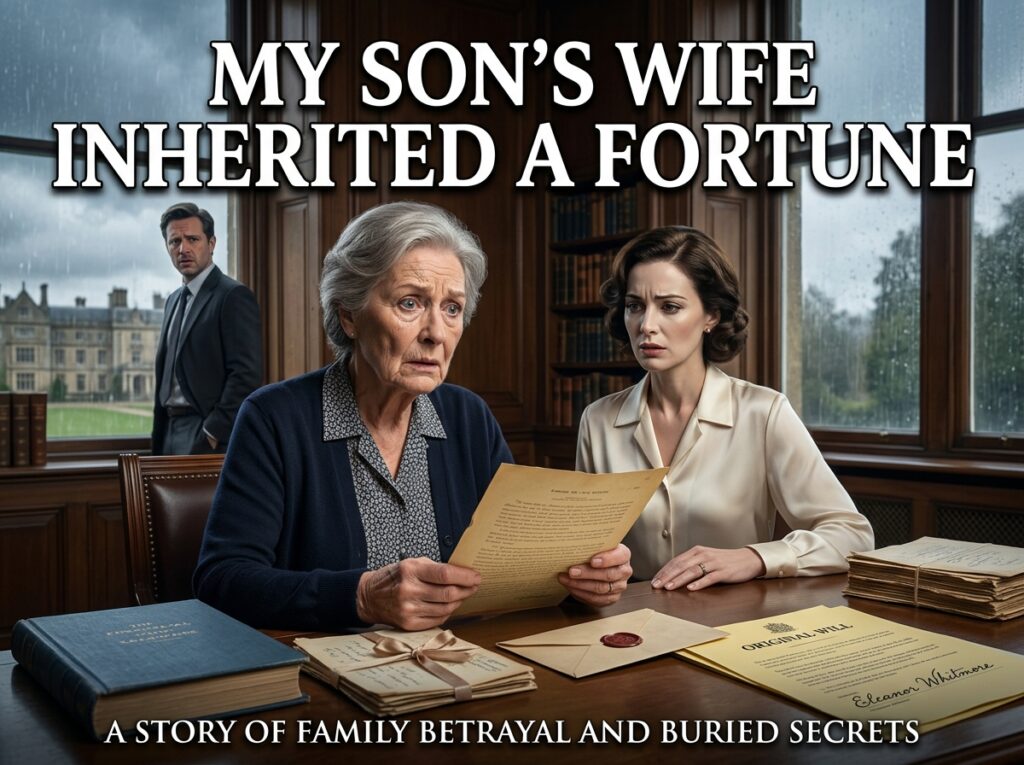
When my wealthy brother left his entire fortune to my son’s wife, I thought someone had deceived him. But mysterious bank transfers, secret letters, and a debt buried for decades led me toward a truth that could destroy everything my family believed about its inheritance.
The morning my brother’s will was read, I discovered that money could turn a family into strangers before anyone had even touched a single banknote.
I was seventy-five years old, and I had lived long enough to understand that grief changed people. Some became quiet. Some became angry. Others began counting what a dead person had left behind before the flowers on the coffin had wilted.
I had never imagined my own son would become one of those people.
My brother, Richard Whitmore, had been a wealthy man. He owned a magnificent country estate, several investment portfolios, a luxury apartment overlooking the river, and bank accounts containing more money than most people could earn in several lifetimes.
But Richard had never been a man who measured family by money.
At least, that was what I had believed.
We had grown up together in a modest house where our parents taught us that wealth was something to be earned, protected, and passed on responsibly. Richard was three years older than me. When our father died, Richard had already established himself as a successful businessman. I was married, raising a family, and struggling to make ends meet.
Although our lives had taken different directions, we remained close.
Or so I thought.
Richard died on a rainy Tuesday morning after a short period of declining health. His housekeeper found him resting in his favorite armchair, a book open beside him and his reading glasses folded neatly on the table.
The doctors said his heart had simply stopped.
I received the news from his solicitor, a man named Mr. Bennett, who had handled Richard’s affairs for nearly twenty years.
I cried when I heard.
My brother was the last person alive who remembered our childhood exactly as I did. He was the last person who could tell me stories about our parents without confusing the details. Losing him felt like losing the final living piece of the family we had once been.
My son, Daniel, came to the funeral with his wife, Claire.
Claire was thirty-eight, elegant, confident, and always perfectly dressed. She had married Daniel four years earlier, and although I had tried to welcome her into our family, there had always been something about her that made me uneasy.
It was not anything I could easily explain.
She was polite. She remembered birthdays. She brought expensive gifts at Christmas and never forgot to compliment my cooking.
Yet I sometimes caught her watching people with an expression that disappeared the moment they looked back.
At Richard’s funeral, she cried harder than I expected.
She stood beside my son, holding his arm, her face buried against his shoulder.
I assumed she was simply moved by the occasion.
I was wrong about many things that day.
Three weeks after the funeral, Mr. Bennett called me and asked me to attend the formal reading of Richard’s will.
I expected the meeting to be brief. Richard had no children, and our parents had been dead for decades. I assumed he would divide his estate between me and Daniel, perhaps leaving a few personal belongings to old friends.
Daniel and Claire accompanied me to the solicitor’s office.
The room smelled of polished wood and old paper. Rain tapped against the tall windows. Mr. Bennett sat behind his desk with a thick folder in front of him.
He began reading.
Richard had left instructions regarding his funeral, his charitable donations, and several small gifts to former employees.
Then Mr. Bennett reached the main estate.
I straightened in my chair.
“To my niece-in-law, Claire Whitmore, I leave the entirety of my remaining estate, including my country property, investment accounts, residential apartment, and all funds held in my personal bank accounts, subject to the provisions set out in this will.”
For several seconds, I could not understand the words.
Claire was not Richard’s blood relative.
She had known him for only a few years—or so I believed.
My fingers tightened around the arms of my chair.
“I’m sorry,” I whispered. “Would you read that again?”
Mr. Bennett looked uncomfortable.
He repeated the sentence.
Daniel immediately turned toward his wife.
Claire stared at the floor, her lips slightly parted.
Then my son smiled.
“That’s wonderful,” he said. “Uncle Richard must have had his reasons.”
Wonderful.
That was the word he chose while I sat beside him, feeling as though someone had reached into my chest and removed the last certainty I possessed.
I turned toward Claire.
“Did you know about this?”
She looked at me with wet eyes.
“No, Eleanor. I swear I didn’t.”
But her hand was already resting on Daniel’s knee, and I noticed something that made my stomach tighten.
She did not look surprised.
She looked frightened.
And when Mr. Bennett closed the folder, I saw the corner of another document tucked beneath the will. It bore Richard’s signature, but the date was almost a year old.
Before I could ask about it, the solicitor placed the papers inside his briefcase.
“I’m afraid that’s all for today,” he said.
I stood slowly.
As we walked toward the door, I heard Claire whisper to Daniel.
“Please don’t let your mother make trouble over this.”
I stopped.
She had said it so quietly that perhaps she believed I could not hear.
But I had heard every word.
And for the first time since my brother died, my grief began to change into something else.
I wanted to know why Richard had given everything to a woman who had entered our family only four years earlier.
More importantly, I wanted to know what Claire was so afraid I might discover.
Daniel drove me home that afternoon.
Claire remained in the passenger seat, staring through the windshield while the city moved past us in gray streaks of rain.
I sat in the back, watching my son’s reflection in the rearview mirror.
When Daniel was a child, he used to ask me why people argued over money when they could simply share what they had. I had told him that money often revealed what people already carried inside them.
I wondered whether he remembered that conversation.
“Your uncle loved Claire,” Daniel said eventually.
I looked up.
“Did he?”
“Of course he did. Why else would he leave her everything?”
“That is exactly what I want to understand.”
Daniel sighed.
“Mother, please. Uncle Richard was wealthy. He could do whatever he wanted with his money.”
“I know that.”
“Then what’s the problem?”
“The problem is that I barely remember Richard mentioning her before your wedding.”
Claire turned around.
“Perhaps you weren’t paying attention.”
Her answer was so quick that I stared at her.
“Perhaps,” I said.
Daniel shook his head.
“Here we go again.”
I wanted to remind him that I had never accused his wife of anything. I had asked a question, and he had answered with anger.
But I was too tired to fight.
When we reached my house, Daniel helped me out of the car. Before he left, I caught his sleeve.
“Did your uncle ever give you money?”
He frowned.
“What?”
“Money. A loan, perhaps. Anything substantial.”
“No. Why?”
“Did he ever offer?”
Daniel looked toward the street.
“Not that I remember.”
His hesitation lasted only a moment, but I noticed it.
“Daniel?”
“Mother, I don’t know. Why are you asking me these questions?”
“Because I am trying to understand what happened.”
“Nothing happened. A dying man made a decision. You don’t have to like it.”
He kissed my cheek and returned to the car.
Claire did not say goodbye.
For several nights, I slept badly.
I kept remembering the look on Claire’s face when the will was read. I replayed her whispered words in the corridor. Most of all, I remembered the document bearing Richard’s signature and the date that Mr. Bennett had tried to hide.
On Friday morning, I called the solicitor.
“I need to see my brother’s papers,” I told him.
“Mrs. Whitmore, the estate belongs to the named beneficiary. I cannot disclose confidential financial records simply because you are a relative.”
“I am not asking you to give me confidential bank statements. I am asking whether my brother left any explanation for his decision.”
There was a pause.
“Richard was very specific about his wishes.”
“Did he explain them?”
“He left a letter to accompany the will.”
My heart began beating faster.
“What did it say?”
“I’m afraid I cannot read private correspondence to you without the appropriate authorization.”
“Then may I ask Claire to show it to me?”
“That’s entirely your decision.”
I thanked him and hung up.
That afternoon, I visited Claire at the house she shared with Daniel.
The property had been purchased shortly after their marriage. It was a modern home with wide windows, pale stone floors, and a garden that looked as though nobody had ever been permitted to step on the grass.
Claire opened the door wearing a cream-colored blouse and tailored trousers.
“Eleanor. What a surprise.”
“I need to speak with you.”
Her smile faded.
“Is something wrong?”
“I want to know what Richard wrote in his letter.”
She folded her arms.
“What letter?”
“The one that accompanied his will.”
For a moment, her expression changed.
Then she laughed softly.
“Oh, that. It was just a personal note. Nothing important.”
“May I read it?”
“No.”
The answer came without hesitation.
I looked at her carefully.
“Why not?”
“Because it was written to me.”
“Then you must understand why I’m curious. My brother left you everything he owned. I think I deserve to know what made him do that.”
Claire’s face hardened.
“You don’t deserve anything, Eleanor. That is the problem. You think being related to someone gives you a claim over their life.”
Her words hurt because they contained a truth I could not completely deny. Richard had been entitled to make his own decisions.
But Claire had misunderstood something else.
I was not demanding his money.
I was asking about my brother.
“I loved Richard,” I said quietly.
“And I loved him too.”
The statement startled me.
Claire seemed to realize what she had said. She glanced toward the hallway, then looked back at me.
“How long did you know him?” I asked.
“Long enough.”
“Before you married Daniel?”
She said nothing.
I stepped closer.
“Claire, did you know my brother before you met my son?”
Her face drained of color.
Then a car pulled into the driveway.
Daniel had returned early from work.
Claire immediately opened the door wider.
“Your mother is accusing me of something,” she called.
My son hurried inside.
“What is going on?”
I looked from him to his wife.
“I asked her whether she knew Richard before your wedding.”
Daniel stared at me as if I had committed some unforgivable offense.
“Get out, Mother.”
I thought I had misheard him.
“Daniel—”
“Get out of our house.”
Claire stood behind him, one hand resting against his shoulder.
I left without another word.
But as I reached the gate, I heard them arguing inside.
Daniel’s voice rose first.
Then Claire said something that made me stop walking.
“You promised me that the past would stay buried.”
I stood in the rain, my heart pounding.
The past.
Not a misunderstanding. Not a family disagreement.
A past.
And suddenly, I knew my investigation had only begun.
<h2>Part 3</h2>
The following Monday, I went to Richard’s house.
It had been closed since the funeral, except for occasional visits by the housekeeper and the people responsible for maintaining the property. The large iron gates stood between two stone pillars, and the trees along the driveway had begun dropping their leaves.
Richard had once told me that he wanted to live in that house until the day he died.
Now it belonged to Claire.
The thought still felt unnatural.
Mrs. Collins, his housekeeper of twenty-two years, answered the door.
She was a small woman in her late sixties with silver hair and gentle eyes. When she saw me, she embraced me without speaking.
We remained that way for several seconds.
“I miss him,” she whispered.
“So do I.”
She led me into the sitting room, where Richard’s favorite armchair stood beside the fireplace. His reading glasses were still on the side table. A blanket lay folded over the back of the chair.
For one foolish moment, I imagined he might walk through the door.
Then reality returned.
“Have you been all right?” I asked Mrs. Collins.
“As well as anyone can be.”
“Has Claire been here?”
She hesitated.
“Yes.”
“When?”
“Several times before Mr. Richard died. And twice since the funeral.”
“Before he died?”
Mrs. Collins looked uncomfortable.
“I thought you knew.”
“I didn’t.”
She sat opposite me.
“Miss Claire used to visit in the evenings. She always asked whether Mr. Richard was alone. Sometimes she stayed for hours.”
“How long had that been happening?”
“I cannot say exactly. Perhaps a year before he passed away.”
My hands grew cold.
A year.
That meant Claire had been visiting Richard before her marriage to Daniel, possibly before she had even met him.
“Did she tell you why she came?”
“She said Mr. Richard had asked her to help him with some personal matters.”
“What kind of matters?”
“Banking, mostly. Letters. Documents.”
I looked toward the staircase.
“Did Richard seem different after she started visiting?”
Mrs. Collins considered the question.
“He became more secretive. He asked me to keep certain telephone calls private. He also began receiving letters that he would read alone.”
“Did he seem afraid of her?”
“No.” She paused. “But sometimes, after she left, he looked very sad.”
The answer troubled me more than a direct accusation would have.
I asked whether Richard had kept any personal notebooks.
Mrs. Collins shook her head.
“His solicitor collected several boxes of documents after the funeral. But Mr. Richard kept a small desk in the library. He always said the most important things were the things he never put in official files.”
She led me into the library.
The room smelled of old books and polished leather. Sunlight filtered through tall windows, illuminating dust floating above the carpet.
Richard’s desk stood against the far wall.
Its drawers had been emptied, but one small compartment remained locked.
I recognized the keyhole. When we were children, Richard had owned a similar wooden box in which he kept coins, letters, and other treasures. He had always been protective of it.
“Do you know where the key is?” I asked.
Mrs. Collins shook her head.
“I believe Mr. Richard kept it on his key ring.”
The key ring had gone to the solicitor.
I examined the desk carefully. Beneath the lower drawer, I found a narrow envelope taped to the wood.
My name was written on it.
Eleanor.
The handwriting was unmistakably Richard’s.
My hands trembled as I opened it.
Inside was a single sheet of paper.
Ellie,
If you are reading this, I have probably failed to explain something that should have been discussed between us a long time ago.
Do not judge the decisions I made during my final year until you have learned what our parents did for us, and what I promised them in return.
The money was never as simple as you believed.
Find the blue ledger.
Richard.
I read the letter twice.
Then I sat down.
Our parents had died decades earlier. I remembered their small house, their modest savings, and the years our father had spent building his business from almost nothing.
What could Richard possibly have meant by saying the money was never as simple as I believed?
Mrs. Collins returned with tea, but I barely noticed her.
“Did Mr. Richard ever mention a blue ledger?” I asked.
Her expression changed.
“Yes.”
I nearly dropped the letter.
“What did he say?”
“He asked me never to throw away a blue book kept in the old storage room. I thought it was an account book from his early business days.”
“Where is it?”
“I don’t know. The room was cleared after the funeral.”
We searched the storage room together.
There were old photographs, broken lamps, boxes of Christmas decorations, and several cartons of books. After nearly an hour, Mrs. Collins found a wooden chest beneath a stack of folded curtains.
Inside lay a blue ledger bound in faded cloth.
I opened it.
The first pages contained names, dates, and amounts written in Richard’s handwriting. Some entries were more than forty years old.
Then I saw a familiar name.
Our father.
Beside it was a sum so large that I had to read the figures twice.
Below it, Richard had written four words.
Loan from our parents.
My throat tightened.
I turned the page.
There were payments, withdrawals, and calculations spanning several decades. The final pages contained entries from the year before Richard’s death.
Beside one payment, he had written:
Balance must be settled before the estate is divided.
But the most disturbing entry appeared on the following page.
It referred to a bank transfer made shortly before Claire’s wedding.
The recipient’s name had been carefully scratched out.
Someone had tried to erase it.
I leaned closer, examining the indentation left by the pen.
Under the scratched-out letters, I could just make out a few remaining marks.
The recipient’s surname began with W.
Whitmore.
Our family name.
I looked at Mrs. Collins.
“Who had access to this room after Richard died?”
She hesitated.
“Mr. Bennett’s assistant came once. And Claire came alone last Thursday.”
I closed the ledger.
For the first time, I wondered whether Claire had inherited Richard’s fortune because he loved her.
Or whether she had been the final person in a transaction that had begun before I was even old enough to understand money.
<h2>Part 4</h2>
I spent the next several days studying the blue ledger.
My eyesight was not what it had once been, and the handwriting grew increasingly difficult to read toward the end. I used a magnifying glass and made notes in a small exercise book, recording dates, amounts, and every reference to our parents.
The more I examined the records, the more uncomfortable I became.
Richard had borrowed money from our parents shortly after he began his first business. At the time, he was barely thirty. Our father had believed in him, and our mother had agreed to let Richard use a substantial portion of their savings.
They had not called it an investment.
They had called it a family loan.
I remembered the arguments that followed.
Our father had worried about the money. Our mother had defended Richard, saying that one day he would repay every penny.
I had been twenty-nine, married, and struggling to raise Daniel. I had heard the arguments through the thin walls of our parents’ kitchen, but I had never understood how much money was involved.
Richard had eventually become wealthy.
Our parents had died believing that the loan would be repaid before the family estate was divided. But when their property was sold, I received only a modest share, while Richard retained the majority of the proceeds.
He told me that our parents had settled their financial affairs before they died.
I had believed him.
Now I was looking at a ledger suggesting otherwise.
I contacted an old family accountant named Peter Lawson, who had retired nearly fifteen years earlier.
He remembered our father immediately.
“Arthur Whitmore was a careful man,” Peter told me over the telephone. “He never liked debt, even when he was lending money.”
“Do you remember a large loan to Richard?”
There was a pause.
“I do.”
“How large?”
“Mrs. Whitmore, that was a long time ago.”
“I know. But I need to understand what happened.”
Peter sighed.
“Your father gave Richard the money to expand his business. It was meant to be repaid over time. Richard promised that once he had become established, he would settle the debt before either of you inherited anything further from the family.”
“Did he repay it?”
“I never saw a final settlement.”
My fingers tightened around the receiver.
“Are you certain?”
“As certain as I can be. I remember preparing a summary of the outstanding balance. Your father wanted everything documented.”
“Do you still have a copy?”
“Possibly. I kept some old files, although I cannot promise that particular document survived.”
I thanked him and gave him my address.
Three days later, an envelope arrived.
Inside was a photocopy of a financial statement dated forty-one years earlier. The document listed the original loan, several repayments, and a substantial outstanding balance.
At the bottom, Peter had written a note.
No evidence of full repayment found in surviving records.
I sat at my kitchen table for a long time.
The amount was staggering.
Even after adjusting for the payments Richard had made, the unpaid balance represented a fortune.
I thought of the country estate, the apartment, and the investment accounts that Claire had inherited.
Could Richard have spent his final year arranging to repay the debt?
If so, why had he given the estate to Claire?
And who was the person he believed had been forgotten?
I returned to the ledger.
A series of recent entries caught my attention. They referred to monthly transfers, each one made to the same account. The payments had begun shortly before Claire married Daniel and continued until several months before Richard died.
The amounts varied, but the total was significant.
There was also a reference to a loan account bearing the initials E.W.
My initials.
Eleanor Whitmore.
I read the entry again.
Had Richard been repaying me?
I had never lent him money. I had never even possessed enough money to make such a loan.
Unless the initials referred to someone else.
I called Peter.
“Did our father ever create a separate account for family money?”
“Yes,” he replied. “There was a reserve account that your mother managed after your father died.”
“What happened to it?”
“I thought the funds were distributed when the house was sold.”
“Were they?”
“I would need to examine the original records.”
I asked him to look.
That evening, Daniel arrived at my house without calling first.
He looked exhausted.
“Claire told me you’ve been contacting people about Uncle Richard’s money.”
“I have.”
“Why?”
“Because I think he owed our parents a substantial amount of money.”
Daniel stared at me.
“What are you talking about?”
I showed him the financial statement.
He read it slowly, then shook his head.
“This proves nothing about Claire.”
“I haven’t said that it does.”
“You’re trying to take her inheritance away.”
“No. I’m trying to understand why Richard left everything to her.”
“Maybe he trusted her more than he trusted you.”
The words landed like a slap.
I looked at my son, searching for the little boy who used to sit beside me at the kitchen table while I helped him with his homework.
“Do you truly believe that?”
Daniel looked away.
“Claire has done nothing wrong.”
“Then why is she frightened of the past?”
His head snapped up.
“What did she tell you?”
“She didn’t need to tell me anything. I heard her.”
He paced across the room.
“You don’t understand our marriage.”
“Then explain it to me.”
He opened his mouth, but no words came.
Finally, he said, “Some things are better left alone.”
After he left, I sat in silence.
I had spent seventy-five years believing that family secrets eventually came to light because people could not carry them forever.
But I was beginning to understand that some secrets survived precisely because the people who knew them had learned to call silence loyalty.
And my son had just asked me to remain silent.
<h2>Part 5</h2>
Peter Lawson called the following morning.
“I found something,” he said.
His voice was unusually serious.
“What is it?”
“Your parents maintained a reserve account for a purpose they never fully explained to me. It was funded partly by business proceeds and partly by savings accumulated over many years.”
“Was it included in their estate?”
“Not in the way you might expect. Some of the money was transferred before their deaths.”
“To whom?”
“I cannot confirm the recipient without examining the original transfer documents. But I remember that your father wanted the funds protected for someone who had not yet received their fair share.”
I sat down.
“Who?”
“I don’t know. Arthur told me the arrangement was private.”
I thought of the scratched-out name in Richard’s ledger.
Whitmore.
“Could the account have been connected to Richard’s loan?”
“It is possible.”
Peter promised to continue searching.
After the call, I returned to Richard’s house.
Mrs. Collins let me into the library, where I examined the ledger again. This time, I focused on the dates surrounding Claire’s wedding.
Three weeks before the wedding, Richard had recorded a large transfer from one of his investment accounts. Two days later, a payment had been made to a separate account.
The recipient was identified only by initials.
C.W.
Claire Whitmore.
My heart began to race.
Why would Richard transfer money to Claire before she married Daniel?
Perhaps it was a gift. Perhaps he had been helping her financially. But the amount was far too large to dismiss as ordinary generosity.
The next entry mentioned a loan repayment.
Then another transfer appeared several months later.
I copied every entry into my notebook.
As I was preparing to leave, Mrs. Collins approached me with a small cardboard box.
“I found these in the back of Mr. Richard’s wardrobe,” she said. “They were mixed in with some old papers. I thought you should see them.”
Inside were several letters tied together with a faded ribbon.
The earliest was dated more than five years before Claire’s marriage to Daniel.
The handwriting on the envelope was unfamiliar.
I opened the first letter.
Dear Richard,
I cannot continue pretending that the money belongs to you. You know where it came from, and you know what our parents intended. I have waited long enough for the truth to be acknowledged.
Please do not ask me to remain silent again.
Eleanor.
I stopped breathing.
The letter was addressed to Richard, but I had never written it.
I turned it over.
The handwriting on the envelope was the same as the writing inside. Yet the signature at the bottom was not mine.
It belonged to a woman named Eleanor Whitmore.
I had an aunt with that name.
My father’s younger sister.
Aunt Eleanor had died when I was a child, and I remembered very little about her. She had left the family after a bitter disagreement with our father and moved to another part of the country.
We rarely spoke about her.
My mother had once told me that Aunt Eleanor had been treated unfairly over money, but when I asked for details, she had changed the subject.
I had assumed the matter had been settled before my aunt died.
Now I was holding a letter suggesting otherwise.
The remaining letters revealed fragments of an old conflict. Aunt Eleanor had apparently believed that our father had promised her a share of the family money. Richard had taken responsibility for managing the funds after our father’s death, but the promised payment had never arrived.
In one letter, Aunt Eleanor accused Richard of using money that did not belong to him.
In another, she warned him that the debt would eventually have to be repaid.
The final letter was dated only eighteen months before Richard died.
Richard,
You cannot carry this secret forever. The person who should have received the money has already been forgotten by almost everyone in the family. But forgetting someone does not erase what was promised.
If you cannot repay the debt while you are alive, you must make certain the truth survives you.
Do not let another generation inherit a lie.
I lowered the letter.
Aunt Eleanor had been dead for decades.
Who was the forgotten person she meant?
And why had Richard kept these letters hidden?
I placed them carefully back inside the box.
Then I noticed a photograph tucked beneath the ribbon.
It showed Richard standing beside a young woman outside a bank. The photograph was old enough that the colors had faded, but the woman’s face remained clear.
She had dark hair, a narrow chin, and a serious expression.
I recognized her.
Claire.
She looked younger, perhaps in her twenties, but there was no mistaking her features.
On the back of the photograph, Richard had written a date.
It was seven years before Claire married Daniel.
Below the date were six words.
She came to collect the truth.
I stared at the photograph until my eyes began to blur.
Claire had known Richard long before she became my daughter-in-law.
She had not merely appeared in his life during his final year.
She had been part of a story that stretched back decades.
I put the photograph in my handbag and drove home.
That evening, I called Claire.
She answered after the third ring.
“What do you want, Eleanor?”
“I found the letters.”
Silence.
“The letters from Aunt Eleanor,” I continued. “And the photograph of you with Richard.”
I heard her draw a sharp breath.
“Where did you get those?”
“In his house.”
“You had no right to take his personal things.”
“They were addressed to my brother. I have every right to ask what they mean.”
“You don’t understand.”
“Then help me understand.”
Her voice grew thin.
“Please stop looking into this.”
“Did Richard owe your family money?”
“No.”
“Did he owe my aunt money?”
A long silence followed.
Then Claire said, very quietly, “Your aunt wasn’t the person who lost the most.”
Before I could ask what she meant, she hung up.
I stood in the middle of my kitchen, holding the telephone.
For the first time, I realized that the fortune might not have been the real prize.
It might have been a payment.
And Claire might have been waiting years to collect it.
<h2>Part 6</h2>
I did not sleep that night.
Every time I closed my eyes, I saw the photograph of Claire standing beside my brother. She looked younger, but her expression was unmistakable: serious, determined, and almost painfully familiar.
She had not entered our family by accident.
The next morning, I visited the local bank where Richard had maintained one of his oldest accounts. I knew the manager, Mr. Harris, because he had helped me resolve a small issue with my savings several years earlier.
I did not ask him to reveal confidential information about Richard’s accounts. Instead, I explained that I had found records suggesting an old family loan and wanted to know whether any historical documents might help establish the origin of the funds.
He listened carefully.
“Mrs. Whitmore, I cannot disclose your brother’s private transactions without the proper authority,” he said. “But if there is a legitimate question about the administration of his estate, his solicitor may be able to request the relevant records.”
“Could you at least tell me whether banks retain evidence of old transfers?”
“Sometimes. It depends on the institution, the account, and the retention period.”
I thanked him.
Before I left, he asked a question that stopped me at the door.
“Did your brother ever mention a trust established by your parents?”
I turned around.
“A trust?”
He nodded.
“I remember seeing a reference to an old family trust in a document connected to his accounts. I cannot say what it contained, and I would not want you to draw conclusions from my memory alone. But you should ask his solicitor whether such an arrangement exists.”
I left the bank with more questions than answers.
At home, I searched through the family documents I had kept for decades. Birth certificates, insurance papers, photographs, old Christmas cards, and letters from relatives filled two filing cabinets in my study.
I found my parents’ marriage certificate, their wills, and the documents relating to the sale of their house.
I found nothing about a trust.
Then I remembered a small wooden box my mother had kept in her bedroom. After she died, I had taken it home, intending to sort through its contents later. The box had remained untouched in my attic for more than twenty years.
I climbed the narrow stairs and found it beneath a stack of old blankets.
The lock was broken, but the contents were intact.
Inside lay several pieces of jewelry, my mother’s prayer book, and a packet of envelopes.
The first contained a letter from my father to Richard.
Richard,
The money I gave you was never intended to make you the owner of everything we built. It was meant to help you establish your business while preserving the rights of those who could not protect themselves.
You promised that the loan would be repaid before the family estate was divided. Your mother trusted you, and so did I.
I hope you will honor that trust.
The letter was dated forty-three years earlier.
I read it twice.
The next document was a handwritten agreement between my father and Richard. It described the original loan and required repayment before the final distribution of the family assets.
But the final page contained a paragraph that changed everything.
The remaining balance shall be settled for the benefit of Eleanor Whitmore, daughter of Arthur and Margaret Whitmore, whose share is to be protected independently of any subsequent arrangement made between the remaining family members.
I stared at the name.
Eleanor Whitmore.
My aunt.
Not me.
The forgotten person was my father’s sister.
She had been promised a share of the family wealth, but the money had never reached her.
Why had I never known?
I searched the box for further documents.
Beneath the agreement was a letter written by my mother.
Ellie,
If you are reading this, then Richard has finally decided to confront what happened. I pray he has done the right thing.
Your father wanted his sister to be treated fairly. But family pride made that impossible while he was alive. Richard promised to correct the mistake when he had enough money to do so.
I hope that one day you will understand why we kept the truth from you.
Mother.
I sat on the attic floor, surrounded by the remains of a family history I had never truly understood.
My parents had hidden the arrangement from me.
Richard had carried the debt for decades.
And Claire had somehow become connected to it.
I returned to the photograph and examined the date again.
Seven years before her marriage.
Perhaps Claire had been working for my aunt’s estate. Perhaps she had discovered the old records while researching her own family. Perhaps she had been trying to recover money that had been withheld from someone she loved.
But why had Richard given her the entire fortune?
I telephoned Mr. Bennett.
“I need to speak with you urgently.”
He agreed to see me the following afternoon.
When I arrived, he looked troubled.
I placed copies of the old agreement and my father’s letter on his desk.
“Did you know about this?”
He examined the documents without speaking.
Finally, he nodded.
“Yes.”
My heart sank.
“You knew Richard owed our aunt money?”
“I knew there was an unresolved family obligation. I did not know every detail of its origin.”
“Then why did you allow him to leave his entire estate to Claire?”
“Because he instructed me to prepare his will that way.”
“Did he explain why?”
Mr. Bennett removed his glasses.
“Richard believed that Claire was the only person capable of completing a particular settlement.”
“What settlement?”
He looked at me for a long moment.
Then he opened a drawer and removed a sealed envelope.
“This was left with instructions that it should be opened only if someone challenged the distribution of the estate.”
My mouth went dry.
“Who was it intended for?”
“The person who could prove that the original family debt remained unpaid.”
He placed the envelope on the desk.
My name was written across the front.
And beneath it, in Richard’s handwriting, were the words:
The truth must be read in the presence of the beneficiary.
<h2>Part 7</h2>
I returned to Mr. Bennett’s office the following morning with Claire.
She had resisted my request to attend, but after I told her about the envelope, she finally agreed.
Daniel came with her.
He looked angry from the moment he entered the room.
“I don’t understand why we’re doing this,” he said. “Mother has been investigating Claire for weeks. What more does she want?”
“I want the truth,” I replied.
Claire sat beside him without looking at me.
Mr. Bennett placed the sealed envelope on his desk.
“Before I open this, I must make something clear,” he said. “The legal validity of Mr. Richard’s will is a separate question from the historical debt described in these documents. We are here because he left specific instructions concerning the records.”
Daniel folded his arms.
“Then read it.”
Mr. Bennett broke the seal.
Inside was a letter, several pages of financial records, and a copy of an older agreement.
He began reading the letter aloud.
To whoever is present,
If this letter has been opened, it means that someone has finally discovered the debt I carried for most of my life.
I borrowed money from our parents when I was young. They trusted me because I was their son. I told myself that I would repay them when my business became successful.
But success made it easier to delay the truth.
When our father died, I convinced myself that the debt could be settled through the eventual distribution of the family estate. When our mother died, I convinced myself that the remaining money was sufficient to cover my obligations.
I was wrong.
The person who suffered most was my father’s sister, Eleanor. She was promised a share of the family assets, but the arrangement was never completed. I knew this, and I allowed the years to pass without correcting it.
I glanced at Claire.
She was staring at the desk.
Mr. Bennett continued.
I cannot undo the years of silence. I cannot restore the life she might have lived if she had received what was promised. But I can ensure that the debt is no longer ignored.
During the final years of my life, I began arranging the repayment. I transferred funds into designated accounts and instructed my solicitor to preserve the relevant documents.
I also asked Claire to help me locate the surviving records. She had already been searching for the truth long before she became part of our family.
Daniel turned toward his wife.
“What does that mean?”
Claire did not answer.
Mr. Bennett continued reading.
Claire did not manipulate me. She came to me with evidence that I had spent decades trying not to face. She asked for nothing that did not belong to someone else.
I gave her my estate because she agreed to administer the final settlement. The property, investments, and bank deposits are not a reward for affection. They are the means by which I intend to fulfill an obligation that should have been honored long ago.
My heart pounded.
“So the estate was never really hers?” I whispered.
Mr. Bennett looked up.
“The will leaves the estate to Claire. But the letter explains the purpose behind that decision. The exact legal consequences depend on the terms of the estate and the documents governing the debt.”
Claire finally raised her eyes.
“I never wanted your brother’s money,” she said.
Daniel stared at her.
“Then why didn’t you tell me?”
“Because I promised Richard I would not reveal the matter until the records were assembled.”
“You married me while keeping this secret?”
“I married you because I loved you.”
“But you knew my uncle before we met.”
“Yes.”
The room seemed to shrink around us.
Daniel stood.
“How long?”
Claire closed her eyes.
“Seven years before our wedding.”
He looked as though she had struck him.
“Seven years?”
“I was helping my mother’s cousin investigate an old family claim. Richard was the only person who could explain what had happened to the money.”
“And you never told me?”
“I wanted to tell you. But Richard asked me to wait until he could prove the debt and arrange the repayment. By the time we met, I had already promised him I would protect the documents.”
Daniel laughed bitterly.
“So our marriage was built on a secret.”
“No,” Claire said. “The secret existed before you. Our marriage was real.”
I watched my son struggle with the revelation.
For years, he had defended Claire against suspicions he believed were born from jealousy. Now he was discovering that his wife had concealed a significant part of her past.
But I also understood something I had not understood before.
Claire had been carrying a burden that did not belong to her.
Mr. Bennett placed the remaining documents on the desk.
“There is one more matter,” he said.
He unfolded the old agreement.
“This document names the person who was meant to benefit from the original family settlement.”
He turned the page toward us.
The name was clear.
Eleanor Whitmore.
My aunt.
Beneath it was a second document, a record of a transfer made decades earlier.
The amount had been enormous even by the standards of Richard’s wealth.
But the transfer had been reversed.
Someone had withdrawn the funds before the payment could be completed.
The authorization bore Richard’s signature.
He had known exactly what he was doing.
I looked at the man who had once been my beloved brother, represented now only by ink on old paper.
He had not merely forgotten the debt.
At some point, he had chosen to delay it.
And the reason he had finally decided to repay it remained hidden in the last document Mr. Bennett had not yet opened.
<h2>Part 8</h2>
Daniel refused to speak to Claire during the drive home.
She sat beside him with her hands clasped tightly in her lap, staring out of the window. I followed them in a taxi because I wanted to be there when they confronted what had happened.
When we arrived, Daniel went directly into the study.
Claire remained in the hallway.
“Please don’t hate him for this,” she said quietly.
I looked at her.
“Your husband?”
She nodded.
“He has spent his whole life believing his family was honest with him. Today he learned that we all kept something from him.”
“You kept something from him too.”
“Yes.”
“Why?”
Claire took a long breath.
“Because I thought I could finish the work before it hurt anyone.”
“That is what everyone says when they keep a secret.”
She lowered her eyes.
“I know.”
For the first time, I saw her not as the polished woman who had entered my family, but as someone who had spent years trying to resolve a problem created long before she was born.
“What happened to my aunt?” I asked.
Claire looked toward the study.
“Richard told me that she had been forced to leave the family after a dispute over money. He said your grandfather had promised her a share of the family business, but when the business was sold, her portion disappeared.”
“My father.”
“Yes.”
I felt a familiar ache in my chest.
“My father was a good man.”
“I believe he loved his family,” Claire replied. “But people can love someone and still treat them unfairly.”
I had no answer.
She continued.
“Your aunt tried to recover the money for years. She wrote to Richard, hired people to search old records, and eventually gave up. By the time I learned about the matter, she had been dead for many years.”
“Why did you care?”
Claire looked directly at me.
“Because she was my grandmother.”
The words seemed to echo through the hallway.
I stared at her.
“Your grandmother?”
Claire nodded.
“My mother’s mother was Eleanor Whitmore. She was your father’s younger sister.”
I sank into the nearest chair.
All these years, I had known my aunt only as a name associated with a family disagreement. I had never known that her descendants were still living with the consequences of what had happened.
Claire sat beside me.
“My mother told me very little about her childhood. She grew up hearing that our family had been cheated, but she never knew how much money was involved. When she died, I found a box of letters and began looking for answers.”
“And that led you to Richard?”
“Yes.”
“How?”
“I worked for a financial records company. One of our clients had old documents connected to a business Richard once owned. I recognized the family name and began investigating.”
She paused.
“I met Richard years before I met Daniel. He was shocked when I showed him the letters. At first, he insisted that everything had been settled. But when I showed him the original correspondence, he began looking through his own records.”
“And he discovered the debt was real.”
“He discovered that it had never been properly settled.”
I thought of the blue ledger, the transfers, and the missing name.
“Why did he leave you the estate?”
“Because he wanted the debt repaid using money he had accumulated after borrowing from the family. He believed that the estate was large enough to settle the obligation and provide a clear accounting of what remained.”
“Then why didn’t he simply leave the money to you as his beneficiary and tell you to pay the debt?”
“He was afraid that the family would fight over the estate before the records could be examined. He thought that if he placed the responsibility in my hands, I could gather the documents, arrange an independent accounting, and make sure the money went where it was supposed to go.”
I stared at her.
“You could have told me.”
“I could have. But Richard was ashamed. He wanted to confess everything himself, and he kept postponing the conversation. When his health began to fail, he asked me to wait until his solicitor had secured the records.”
“And you agreed.”
“Yes.”
I looked toward the study.
Daniel stood in the doorway.
“How much of our marriage was real?” he asked.
Claire rose.
“All of it.”
“You knew who I was when we met?”
“No. I knew your surname, but I did not know you personally. Richard introduced us at a charity event. He never told me to pursue you.”
“But you knew that marrying me would bring you closer to the family.”
Claire’s eyes filled with tears.
“I never planned to marry you. I fell in love with you.”
Daniel shook his head.
“I don’t know what to believe.”
He went back into the study and closed the door.
Claire did not follow him.
That night, I returned to my own home and spread the documents across my kitchen table.
I began to understand why Richard had chosen such an unusual arrangement.
He was trying to correct a historical wrong while protecting the estate from the very people who might benefit from its confusion.
But there was still a question no one had answered.
Why had the original payment to my aunt been reversed?
Who had authorized the withdrawal?
And why had Richard waited until the end of his life to admit what he had done?
I found the answer in a letter tucked between two pages of the old agreement.
It was written by our father.
Richard,
Your mother does not know what I have decided. I am transferring the money temporarily because I need to protect the business from a legal claim. Once the matter is resolved, you must restore your aunt’s share immediately.
Do not let this become a permanent arrangement.
Your father.
I read the letter several times.
My father had initiated the transfer.
Richard had allowed the delay to become permanent.
Neither man had corrected it.
And the family had spent decades treating the silence as if it were proof that everything had been settled.
The debt had passed from one generation to another, hidden beneath respectability, until a young woman found the records and refused to let them disappear again.
I placed the letter back in its envelope.
Then I noticed a note written in Richard’s hand at the bottom of the page.
The original will contains the name of the person whose share was never paid.
I froze.
The will we had read at the solicitor’s office had been only a copy of the final document.
Richard had referred to an original will.
A document that might contain the final answer.
I called Mr. Bennett immediately.
“I need to see the original will.”
His response was quiet.
“I was wondering when you would ask.”
<h2>Part 9</h2>
Mr. Bennett arranged a meeting for the following afternoon.
This time, he asked Daniel and Claire to attend as well. He explained that he had located an earlier will in a secure archive, along with an envelope Richard had instructed him to preserve.
When we arrived, the solicitor had placed several documents on the desk.
The first was a will dated nearly twenty years earlier.
The second was a more recent document bearing Richard’s signature.
The third was a sealed envelope marked:
To be opened only after the family debt has been identified.
Daniel sat beside Claire but did not touch her hand.
Mr. Bennett began by explaining that the earlier will had been superseded by later documents. Its legal status would need to be assessed alongside the final will and the relevant estate arrangements.
“I want to make it clear,” he said, “that finding an earlier will does not automatically invalidate the later one. What matters is the full set of documents, the circumstances in which they were created, and the applicable law.”
I nodded.
“Please show us what Richard wanted us to see.”
Mr. Bennett opened the older will.
The first pages contained familiar provisions. Richard had made gifts to employees, charities, and several longtime friends.
Then we reached a paragraph referring to the family estate.
I acknowledge that a portion of the wealth used to establish my business originated in funds entrusted to me by my parents. I further acknowledge that a portion of those funds was intended for my father’s sister, Eleanor Whitmore.
My hands began to tremble.
The document continued.
Any remaining obligation connected to that arrangement shall be settled before the final distribution of my estate. The person entrusted with administering the settlement must preserve the original records and provide a complete accounting to the descendants of the intended beneficiary.
Daniel leaned forward.
“So Claire was appointed to settle the debt.”
Mr. Bennett nodded.
“That appears to have been the purpose of the arrangement. The final will gives her the estate, while the accompanying documents describe the obligation Richard wanted her to address.”
“But what happens if the estate is worth more than the debt?” I asked.
“That depends on the terms of the will, the debt, and any enforceable trust or settlement. The records need to be reviewed by the appropriate professionals before anyone can determine the final distribution.”
Claire looked down.
“I told Richard I didn’t want to be given everything.”
Mr. Bennett glanced at her.
“He was adamant that you were the only person he trusted to complete the accounting.”
“Why me?” Daniel asked bitterly. “Why not my mother?”
“Because your mother was not involved in locating the original records,” Claire replied. “And because Richard knew the discovery would be painful for her.”
I looked at my son.
“Painful truths are still truths.”
He said nothing.
Mr. Bennett opened the sealed envelope.
Inside was a letter addressed to the family.
To Eleanor, Daniel, and Claire,
I have spent too many years allowing silence to protect me from the consequences of my own decisions.
When our parents entrusted me with their money, I believed I was acting for the good of the family. I intended to build a business that would provide security for all of us. But I became so focused on success that I stopped asking whether the arrangements I made were fair.
I delayed repaying the loan. I failed to restore the money intended for my sister. And when the family estate was divided, I allowed everyone to believe that the matter had been resolved.
I told myself that I would correct the mistake later.
Later became forty years.
I cannot ask forgiveness from those who have died. I can only make certain that the truth is no longer hidden.
I stopped reading the copy in Mr. Bennett’s hands and looked at the original will.
Something was missing.
The letter referred to Richard’s sister, but the name had been crossed out in one place and rewritten in another. The alteration was accompanied by a witness’s initials.
I pointed to it.
“Why was this changed?”
Mr. Bennett examined the document.
“I cannot tell from the page alone. The alteration appears to have been made before the will was executed, but we would need to establish the circumstances.”
“Who witnessed it?”
He checked the signature page.
One name was clear.
The other was partially obscured by an old seal.
Claire leaned forward.
“I recognize that name.”
Everyone turned toward her.
She touched the paper carefully.
“It belongs to my mother.”
Daniel stared at her.
“Your mother witnessed Richard’s will?”
“Not this one,” Claire said. “The signature belongs to a letter she signed years later. Richard asked her to confirm that she had received copies of the old family correspondence.”
Mr. Bennett compared the documents.
Claire was right.
The signature had been attached to a separate acknowledgment that had somehow been filed with the earlier will.
It was not proof that Claire’s mother had witnessed the will itself, but it established that she had been involved in preserving the historical records.
Then Mr. Bennett found another paper at the bottom of the envelope.
It was a handwritten statement from Richard.
The original will must be read in full before the estate is finally distributed. The first page identifies the person whose money established the fortune. Without that page, the family will misunderstand everything that follows.
Mr. Bennett looked at us.
“The original document is complete,” he said. “The copy we reviewed previously omitted a supplementary page that was kept separately.”
He reached into the archive folder and removed a single sheet.
The paper was old and yellowed.
At the top was Richard’s name.
Below it were the words:
Declaration of the Original Family Funds.
I leaned forward, but Mr. Bennett did not immediately turn the page toward us.
“There is one complication,” he said. “This document may affect the accounting of the estate, but it does not, by itself, establish who is legally entitled to every asset. We will need to examine the underlying records and obtain appropriate legal advice.”
“I understand,” I said.
“Then I think you should read the first page yourselves.”
He placed it on the desk.
Daniel reached for it, but Claire stopped him.
“No,” she whispered. “Your mother should read it first.”
I looked at her.
For the first time since the will had been announced, she was not protecting herself.
She was giving me the chance to face the truth.
I lifted the page.
And as I read the first sentence, I understood why Richard had been so determined to keep the document hidden until the family debt could be properly identified.
<h2>Part 10</h2>
The first sentence of the original declaration was simple.
The fortune described in this document was established in part through funds entrusted to Richard Whitmore by his parents, Arthur and Margaret Whitmore, including money intended for their daughter, Eleanor Whitmore.
I read the words again.
My aunt’s name seemed to rise from the paper like a voice returning from a room that had been locked for decades.
The document continued by describing the original loan, the intended repayment, and the obligation to preserve my aunt’s share independently of any later family arrangement.
It did not mean that every asset Richard owned automatically belonged to her descendants. It did not erase the legal questions surrounding the will. But it proved that the fortune had a history far more complicated than anyone had admitted.
The wealth Claire had inherited had not appeared from nowhere.
It had been built, in part, with money entrusted to Richard under conditions he had failed to honor.
And the person whose share had disappeared was not a distant stranger.
She was my father’s sister.
My aunt.
A woman whose name had almost vanished from our family.
I placed the page on the desk and covered my mouth with my hand.
Daniel sat very still.
“Mother,” he whispered.
I shook my head.
For years, I had thought that the greatest injustice was Richard’s decision to leave his fortune to Claire rather than to someone related to him by blood.
I had been wrong.
The deeper injustice was that we had spent decades treating an unpaid debt as if it were a forgotten inconvenience. We had allowed money to become respectable simply because enough time had passed.
My aunt had lost more than a financial inheritance.
She had lost her place in the family story.
Claire was the first person in years who had tried to restore it.
Mr. Bennett gathered the documents into separate folders.
“We will arrange an independent review of the estate, the original loan, and the historical records,” he said. “No one should assume that the matter is settled until the relevant obligations and legal rights have been properly established.”
Claire nodded.
“I’ll cooperate with everything.”
Daniel looked at her.
“Why didn’t you tell me?”
She did not try to defend herself this time.
“Because I was afraid that you would see me differently. I had spent years trying to recover something that belonged to my family, and when I met you, I didn’t know how to separate that history from my feelings for you.”
“You should have trusted me.”
“I should have.”
Her answer was quiet and sincere.
Daniel turned away.
“I don’t know whether I can forgive you yet.”
“I understand.”
He looked at her again.
“But I want to know the truth. All of it. No more secrets.”
Claire nodded.
“No more secrets.”
The independent review took several months.
Accountants examined the surviving records. Lawyers reviewed the wills, the historical agreements, and the documents relating to the original family funds. Some questions could be answered with certainty; others remained difficult because the people who had made the original arrangements were long dead.
The final accounting established the outstanding obligation that Richard had spent his final years trying to address. The estate was reviewed in accordance with the applicable legal documents, and the appropriate settlement was arranged for the descendants of my aunt.
The process was not simple.
There were disagreements about the value of the original loan, the effect of the old transfers, and how much of Richard’s accumulated wealth could properly be connected to the family funds.
But the records were no longer hidden.
For the first time in decades, our family had to face the difference between what we believed we owned and what we had been entrusted to protect.
Claire did not celebrate the inheritance.
She attended every meeting, answered every question, and provided the documents she had collected over the years. She sold some personal investments to make the settlement easier to administer, although the final arrangements were made through the estate’s formal process rather than through private promises.
She also established a fund in my aunt’s name to preserve the surviving letters and records.
When I asked her why, she said, “Because people should know she existed.”
Those words stayed with me.
Daniel and Claire’s marriage did not return to what it had been overnight. Trust, once broken, did not rebuild itself simply because the truth had finally emerged. They attended counseling and learned to speak about the past without treating every question as an accusation.
I did not interfere.
For the first time in many months, I understood that love could not be demanded as payment for suffering. Daniel had to decide whether he could forgive his wife, and Claire had to accept that honesty was not optional simply because she believed her intentions were good.
As for me, I began visiting my aunt’s grave.
Her headstone stood in a quiet cemetery several hours from my home. The first time I went, I brought flowers and the copy of my father’s letter.
I sat beside her grave and told her what I had learned.
I apologized for never asking more questions when I was young. I apologized for accepting the family story without examining the parts that did not make sense.
I knew she could not hear me.
Still, I felt lighter after speaking.
One afternoon, Claire accompanied me.
She stood a respectful distance away while I placed fresh flowers beside the headstone.
“I wish I could have known her,” she said.
“So do I.”
We stood together in silence.
After a while, Claire asked, “Do you think Richard was a bad man?”
I considered the question.
“No,” I said. “But I think he made a bad decision, then spent so long avoiding it that the decision became part of who he was.”
“Can someone make that right?”
“Sometimes. But making something right doesn’t mean pretending it never happened.”
Claire nodded.
We returned to the car without discussing the inheritance again.
Months later, Mr. Bennett sent me a copy of the completed estate accounting. It contained every surviving transfer, every verified repayment, and a detailed explanation of the final settlement.
I placed it beside the blue ledger in my study.
The documents no longer frightened me.
They reminded me that truth could be painful without being destructive. What destroyed families was not always the secret itself, but the years spent protecting it from the people who deserved to know.
I still missed Richard.
I missed his laughter, his stubbornness, and the way he used to call me Ellie when nobody else was listening.
I wished he had told me everything while he was alive.
I wished he had found the courage to apologize before illness made his choices for him.
But I also understood why he had written the letter.
He had wanted the truth to survive him.
And it had.
One evening, Daniel visited me alone. He brought a small box containing photographs and several letters Claire had discovered among her mother’s belongings.
We spent hours looking through them.
There were photographs of my aunt as a young woman, standing beside my grandparents in front of their old house. There were letters describing ordinary family occasions, birthdays, arguments, and reconciliations that never quite happened.
For the first time, I saw my aunt as more than a name attached to an old dispute.
She had been a person who had loved her family, expected fairness, and waited too long for an apology that never came.
Daniel held one of the photographs.
“She looks like you,” he said.
I smiled sadly.
“Perhaps that’s why your grandfather found it so easy to forget how much she mattered. Families can become very good at ignoring the people who remind them of their mistakes.”
He placed the photograph carefully back in the box.
“I’m sorry I told you to leave our house.”
I reached for his hand.
“You were frightened.”
“That doesn’t excuse it.”
“No. But it explains it.”
He looked at me for a long moment.
“I don’t want to become like the people in these letters.”
“Then don’t hide from the truth when it becomes uncomfortable.”
He nodded.
Before he left, he asked whether I thought Claire had ever truly loved him.
I looked at my son.
“I think love and secrecy can exist in the same person. That doesn’t make the secrecy harmless. What matters now is what she does with the truth, and what you decide you can forgive.”
He thanked me and went home.
Later that night, I returned to the study and opened the blue ledger.
The pages were fragile now, and some of the ink had faded. I turned to the final entry Richard had written before his death.
The debt must be settled. The name must be restored.
Beneath those words, he had written one final sentence.
Let the next generation inherit the truth, even if they inherit nothing else.
I closed the ledger.
For years, I had believed that inheritance meant houses, money, investments, and the things a family could divide among its children.
Now I understood that inheritance was also the burden of unfinished promises. It was the truth hidden inside old documents, the pain passed from one generation to another, and the responsibility to stop pretending that time could turn an injustice into something acceptable.
My daughter-in-law had inherited a fortune that was never entirely what it appeared to be.
But the greatest revelation was not that Claire had received Richard’s wealth, or that my brother had concealed a debt for decades.
It was that the person everyone had forgotten had never stopped mattering.
And the first page of the original will had finally given her name back to the family.
When my wealthy brother left his entire fortune to my son’s wife, I thought someone had deceived him. But mysterious bank transfers, secret letters, and a debt buried for decades led me toward a truth that could destroy everything my family believed about its inheritance.
The morning my brother’s will was read, I discovered that money could turn a family into strangers before anyone had even touched a single banknote.
I was seventy-five years old, and I had lived long enough to understand that grief changed people. Some became quiet. Some became angry. Others began counting what a dead person had left behind before the flowers on the coffin had wilted.
I had never imagined my own son would become one of those people.
My brother, Richard Whitmore, had been a wealthy man. He owned a magnificent country estate, several investment portfolios, a luxury apartment overlooking the river, and bank accounts containing more money than most people could earn in several lifetimes.
But Richard had never been a man who measured family by money.
At least, that was what I had believed.
We had grown up together in a modest house where our parents taught us that wealth was something to be earned, protected, and passed on responsibly. Richard was three years older than me. When our father died, Richard had already established himself as a successful businessman. I was married, raising a family, and struggling to make ends meet.
Although our lives had taken different directions, we remained close.
Or so I thought.
Richard died on a rainy Tuesday morning after a short period of declining health. His housekeeper found him resting in his favorite armchair, a book open beside him and his reading glasses folded neatly on the table.
The doctors said his heart had simply stopped.
I received the news from his solicitor, a man named Mr. Bennett, who had handled Richard’s affairs for nearly twenty years.
I cried when I heard.
My brother was the last person alive who remembered our childhood exactly as I did. He was the last person who could tell me stories about our parents without confusing the details. Losing him felt like losing the final living piece of the family we had once been.
My son, Daniel, came to the funeral with his wife, Claire.
Claire was thirty-eight, elegant, confident, and always perfectly dressed. She had married Daniel four years earlier, and although I had tried to welcome her into our family, there had always been something about her that made me uneasy.
It was not anything I could easily explain.
She was polite. She remembered birthdays. She brought expensive gifts at Christmas and never forgot to compliment my cooking.
Yet I sometimes caught her watching people with an expression that disappeared the moment they looked back.
At Richard’s funeral, she cried harder than I expected.
She stood beside my son, holding his arm, her face buried against his shoulder.
I assumed she was simply moved by the occasion.
I was wrong about many things that day.
Three weeks after the funeral, Mr. Bennett called me and asked me to attend the formal reading of Richard’s will.
I expected the meeting to be brief. Richard had no children, and our parents had been dead for decades. I assumed he would divide his estate between me and Daniel, perhaps leaving a few personal belongings to old friends.
Daniel and Claire accompanied me to the solicitor’s office.
The room smelled of polished wood and old paper. Rain tapped against the tall windows. Mr. Bennett sat behind his desk with a thick folder in front of him.
He began reading.
Richard had left instructions regarding his funeral, his charitable donations, and several small gifts to former employees.
Then Mr. Bennett reached the main estate.
I straightened in my chair.
“To my niece-in-law, Claire Whitmore, I leave the entirety of my remaining estate, including my country property, investment accounts, residential apartment, and all funds held in my personal bank accounts, subject to the provisions set out in this will.”
For several seconds, I could not understand the words.
Claire was not Richard’s blood relative.
She had known him for only a few years—or so I believed.
My fingers tightened around the arms of my chair.
“I’m sorry,” I whispered. “Would you read that again?”
Mr. Bennett looked uncomfortable.
He repeated the sentence.
Daniel immediately turned toward his wife.
Claire stared at the floor, her lips slightly parted.
Then my son smiled.
“That’s wonderful,” he said. “Uncle Richard must have had his reasons.”
Wonderful.
That was the word he chose while I sat beside him, feeling as though someone had reached into my chest and removed the last certainty I possessed.
I turned toward Claire.
“Did you know about this?”
She looked at me with wet eyes.
“No, Eleanor. I swear I didn’t.”
But her hand was already resting on Daniel’s knee, and I noticed something that made my stomach tighten.
She did not look surprised.
She looked frightened.
And when Mr. Bennett closed the folder, I saw the corner of another document tucked beneath the will. It bore Richard’s signature, but the date was almost a year old.
Before I could ask about it, the solicitor placed the papers inside his briefcase.
“I’m afraid that’s all for today,” he said.
I stood slowly.
As we walked toward the door, I heard Claire whisper to Daniel.
“Please don’t let your mother make trouble over this.”
I stopped.
She had said it so quietly that perhaps she believed I could not hear.
But I had heard every word.
And for the first time since my brother died, my grief began to change into something else.
I wanted to know why Richard had given everything to a woman who had entered our family only four years earlier.
More importantly, I wanted to know what Claire was so afraid I might discover.
Daniel drove me home that afternoon.
Claire remained in the passenger seat, staring through the windshield while the city moved past us in gray streaks of rain.
I sat in the back, watching my son’s reflection in the rearview mirror.
When Daniel was a child, he used to ask me why people argued over money when they could simply share what they had. I had told him that money often revealed what people already carried inside them.
I wondered whether he remembered that conversation.
“Your uncle loved Claire,” Daniel said eventually.
I looked up.
“Did he?”
“Of course he did. Why else would he leave her everything?”
“That is exactly what I want to understand.”
Daniel sighed.
“Mother, please. Uncle Richard was wealthy. He could do whatever he wanted with his money.”
“I know that.”
“Then what’s the problem?”
“The problem is that I barely remember Richard mentioning her before your wedding.”
Claire turned around.
“Perhaps you weren’t paying attention.”
Her answer was so quick that I stared at her.
“Perhaps,” I said.
Daniel shook his head.
“Here we go again.”
I wanted to remind him that I had never accused his wife of anything. I had asked a question, and he had answered with anger.
But I was too tired to fight.
When we reached my house, Daniel helped me out of the car. Before he left, I caught his sleeve.
“Did your uncle ever give you money?”
He frowned.
“What?”
“Money. A loan, perhaps. Anything substantial.”
“No. Why?”
“Did he ever offer?”
Daniel looked toward the street.
“Not that I remember.”
His hesitation lasted only a moment, but I noticed it.
“Daniel?”
“Mother, I don’t know. Why are you asking me these questions?”
“Because I am trying to understand what happened.”
“Nothing happened. A dying man made a decision. You don’t have to like it.”
He kissed my cheek and returned to the car.
Claire did not say goodbye.
For several nights, I slept badly.
I kept remembering the look on Claire’s face when the will was read. I replayed her whispered words in the corridor. Most of all, I remembered the document bearing Richard’s signature and the date that Mr. Bennett had tried to hide.
On Friday morning, I called the solicitor.
“I need to see my brother’s papers,” I told him.
“Mrs. Whitmore, the estate belongs to the named beneficiary. I cannot disclose confidential financial records simply because you are a relative.”
“I am not asking you to give me confidential bank statements. I am asking whether my brother left any explanation for his decision.”
There was a pause.
“Richard was very specific about his wishes.”
“Did he explain them?”
“He left a letter to accompany the will.”
My heart began beating faster.
“What did it say?”
“I’m afraid I cannot read private correspondence to you without the appropriate authorization.”
“Then may I ask Claire to show it to me?”
“That’s entirely your decision.”
I thanked him and hung up.
That afternoon, I visited Claire at the house she shared with Daniel.
The property had been purchased shortly after their marriage. It was a modern home with wide windows, pale stone floors, and a garden that looked as though nobody had ever been permitted to step on the grass.
Claire opened the door wearing a cream-colored blouse and tailored trousers.
“Eleanor. What a surprise.”
“I need to speak with you.”
Her smile faded.
“Is something wrong?”
“I want to know what Richard wrote in his letter.”
She folded her arms.
“What letter?”
“The one that accompanied his will.”
For a moment, her expression changed.
Then she laughed softly.
“Oh, that. It was just a personal note. Nothing important.”
“May I read it?”
“No.”
The answer came without hesitation.
I looked at her carefully.
“Why not?”
“Because it was written to me.”
“Then you must understand why I’m curious. My brother left you everything he owned. I think I deserve to know what made him do that.”
Claire’s face hardened.
“You don’t deserve anything, Eleanor. That is the problem. You think being related to someone gives you a claim over their life.”
Her words hurt because they contained a truth I could not completely deny. Richard had been entitled to make his own decisions.
But Claire had misunderstood something else.
I was not demanding his money.
I was asking about my brother.
“I loved Richard,” I said quietly.
“And I loved him too.”
The statement startled me.
Claire seemed to realize what she had said. She glanced toward the hallway, then looked back at me.
“How long did you know him?” I asked.
“Long enough.”
“Before you married Daniel?”
She said nothing.
I stepped closer.
“Claire, did you know my brother before you met my son?”
Her face drained of color.
Then a car pulled into the driveway.
Daniel had returned early from work.
Claire immediately opened the door wider.
“Your mother is accusing me of something,” she called.
My son hurried inside.
“What is going on?”
I looked from him to his wife.
“I asked her whether she knew Richard before your wedding.”
Daniel stared at me as if I had committed some unforgivable offense.
“Get out, Mother.”
I thought I had misheard him.
“Daniel—”
“Get out of our house.”
Claire stood behind him, one hand resting against his shoulder.
I left without another word.
But as I reached the gate, I heard them arguing inside.
Daniel’s voice rose first.
Then Claire said something that made me stop walking.
“You promised me that the past would stay buried.”
I stood in the rain, my heart pounding.
The past.
Not a misunderstanding. Not a family disagreement.
A past.
And suddenly, I knew my investigation had only begun.
The following Monday, I went to Richard’s house.
It had been closed since the funeral, except for occasional visits by the housekeeper and the people responsible for maintaining the property. The large iron gates stood between two stone pillars, and the trees along the driveway had begun dropping their leaves.
Richard had once told me that he wanted to live in that house until the day he died.
Now it belonged to Claire.
The thought still felt unnatural.
Mrs. Collins, his housekeeper of twenty-two years, answered the door.
She was a small woman in her late sixties with silver hair and gentle eyes. When she saw me, she embraced me without speaking.
We remained that way for several seconds.
“I miss him,” she whispered.
“So do I.”
She led me into the sitting room, where Richard’s favorite armchair stood beside the fireplace. His reading glasses were still on the side table. A blanket lay folded over the back of the chair.
For one foolish moment, I imagined he might walk through the door.
Then reality returned.
“Have you been all right?” I asked Mrs. Collins.
“As well as anyone can be.”
“Has Claire been here?”
She hesitated.
“Yes.”
“When?”
“Several times before Mr. Richard died. And twice since the funeral.”
“Before he died?”
Mrs. Collins looked uncomfortable.
“I thought you knew.”
“I didn’t.”
She sat opposite me.
“Miss Claire used to visit in the evenings. She always asked whether Mr. Richard was alone. Sometimes she stayed for hours.”
“How long had that been happening?”
“I cannot say exactly. Perhaps a year before he passed away.”
My hands grew cold.
A year.
That meant Claire had been visiting Richard before her marriage to Daniel, possibly before she had even met him.
“Did she tell you why she came?”
“She said Mr. Richard had asked her to help him with some personal matters.”
“What kind of matters?”
“Banking, mostly. Letters. Documents.”
I looked toward the staircase.
“Did Richard seem different after she started visiting?”
Mrs. Collins considered the question.
“He became more secretive. He asked me to keep certain telephone calls private. He also began receiving letters that he would read alone.”
“Did he seem afraid of her?”
“No.” She paused. “But sometimes, after she left, he looked very sad.”
The answer troubled me more than a direct accusation would have.
I asked whether Richard had kept any personal notebooks.
Mrs. Collins shook her head.
“His solicitor collected several boxes of documents after the funeral. But Mr. Richard kept a small desk in the library. He always said the most important things were the things he never put in official files.”
She led me into the library.
The room smelled of old books and polished leather. Sunlight filtered through tall windows, illuminating dust floating above the carpet.
Richard’s desk stood against the far wall.
Its drawers had been emptied, but one small compartment remained locked.
I recognized the keyhole. When we were children, Richard had owned a similar wooden box in which he kept coins, letters, and other treasures. He had always been protective of it.
“Do you know where the key is?” I asked.
Mrs. Collins shook her head.
“I believe Mr. Richard kept it on his key ring.”
The key ring had gone to the solicitor.
I examined the desk carefully. Beneath the lower drawer, I found a narrow envelope taped to the wood.
My name was written on it.
Eleanor.
The handwriting was unmistakably Richard’s.
My hands trembled as I opened it.
Inside was a single sheet of paper.
Ellie,
If you are reading this, I have probably failed to explain something that should have been discussed between us a long time ago.
Do not judge the decisions I made during my final year until you have learned what our parents did for us, and what I promised them in return.
The money was never as simple as you believed.
Find the blue ledger.
Richard.
I read the letter twice.
Then I sat down.
Our parents had died decades earlier. I remembered their small house, their modest savings, and the years our father had spent building his business from almost nothing.
What could Richard possibly have meant by saying the money was never as simple as I believed?
Mrs. Collins returned with tea, but I barely noticed her.
“Did Mr. Richard ever mention a blue ledger?” I asked.
Her expression changed.
“Yes.”
I nearly dropped the letter.
“What did he say?”
“He asked me never to throw away a blue book kept in the old storage room. I thought it was an account book from his early business days.”
“Where is it?”
“I don’t know. The room was cleared after the funeral.”
We searched the storage room together.
There were old photographs, broken lamps, boxes of Christmas decorations, and several cartons of books. After nearly an hour, Mrs. Collins found a wooden chest beneath a stack of folded curtains.
Inside lay a blue ledger bound in faded cloth.
I opened it.
The first pages contained names, dates, and amounts written in Richard’s handwriting. Some entries were more than forty years old.
Then I saw a familiar name.
Our father.
Beside it was a sum so large that I had to read the figures twice.
Below it, Richard had written four words.
Loan from our parents.
My throat tightened.
I turned the page.
There were payments, withdrawals, and calculations spanning several decades. The final pages contained entries from the year before Richard’s death.
Beside one payment, he had written:
Balance must be settled before the estate is divided.
But the most disturbing entry appeared on the following page.
It referred to a bank transfer made shortly before Claire’s wedding.
The recipient’s name had been carefully scratched out.
Someone had tried to erase it.
I leaned closer, examining the indentation left by the pen.
Under the scratched-out letters, I could just make out a few remaining marks.
The recipient’s surname began with W.
Whitmore.
Our family name.
I looked at Mrs. Collins.
“Who had access to this room after Richard died?”
She hesitated.
“Mr. Bennett’s assistant came once. And Claire came alone last Thursday.”
I closed the ledger.
For the first time, I wondered whether Claire had inherited Richard’s fortune because he loved her.
Or whether she had been the final person in a transaction that had begun before I was even old enough to understand money.
<h2>Part 4</h2>
I spent the next several days studying the blue ledger.
My eyesight was not what it had once been, and the handwriting grew increasingly difficult to read toward the end. I used a magnifying glass and made notes in a small exercise book, recording dates, amounts, and every reference to our parents.
The more I examined the records, the more uncomfortable I became.
Richard had borrowed money from our parents shortly after he began his first business. At the time, he was barely thirty. Our father had believed in him, and our mother had agreed to let Richard use a substantial portion of their savings.
They had not called it an investment.
They had called it a family loan.
I remembered the arguments that followed.
Our father had worried about the money. Our mother had defended Richard, saying that one day he would repay every penny.
I had been twenty-nine, married, and struggling to raise Daniel. I had heard the arguments through the thin walls of our parents’ kitchen, but I had never understood how much money was involved.
Richard had eventually become wealthy.
Our parents had died believing that the loan would be repaid before the family estate was divided. But when their property was sold, I received only a modest share, while Richard retained the majority of the proceeds.
He told me that our parents had settled their financial affairs before they died.
I had believed him.
Now I was looking at a ledger suggesting otherwise.
I contacted an old family accountant named Peter Lawson, who had retired nearly fifteen years earlier.
He remembered our father immediately.
“Arthur Whitmore was a careful man,” Peter told me over the telephone. “He never liked debt, even when he was lending money.”
“Do you remember a large loan to Richard?”
There was a pause.
“I do.”
“How large?”
“Mrs. Whitmore, that was a long time ago.”
“I know. But I need to understand what happened.”
Peter sighed.
“Your father gave Richard the money to expand his business. It was meant to be repaid over time. Richard promised that once he had become established, he would settle the debt before either of you inherited anything further from the family.”
“Did he repay it?”
“I never saw a final settlement.”
My fingers tightened around the receiver.
“Are you certain?”
“As certain as I can be. I remember preparing a summary of the outstanding balance. Your father wanted everything documented.”
“Do you still have a copy?”
“Possibly. I kept some old files, although I cannot promise that particular document survived.”
I thanked him and gave him my address.
Three days later, an envelope arrived.
Inside was a photocopy of a financial statement dated forty-one years earlier. The document listed the original loan, several repayments, and a substantial outstanding balance.
At the bottom, Peter had written a note.
No evidence of full repayment found in surviving records.
I sat at my kitchen table for a long time.
The amount was staggering.
Even after adjusting for the payments Richard had made, the unpaid balance represented a fortune.
I thought of the country estate, the apartment, and the investment accounts that Claire had inherited.
Could Richard have spent his final year arranging to repay the debt?
If so, why had he given the estate to Claire?
And who was the person he believed had been forgotten?
I returned to the ledger.
A series of recent entries caught my attention. They referred to monthly transfers, each one made to the same account. The payments had begun shortly before Claire married Daniel and continued until several months before Richard died.
The amounts varied, but the total was significant.
There was also a reference to a loan account bearing the initials E.W.
My initials.
Eleanor Whitmore.
I read the entry again.
Had Richard been repaying me?
I had never lent him money. I had never even possessed enough money to make such a loan.
Unless the initials referred to someone else.
I called Peter.
“Did our father ever create a separate account for family money?”
“Yes,” he replied. “There was a reserve account that your mother managed after your father died.”
“What happened to it?”
“I thought the funds were distributed when the house was sold.”
“Were they?”
“I would need to examine the original records.”
I asked him to look.
That evening, Daniel arrived at my house without calling first.
He looked exhausted.
“Claire told me you’ve been contacting people about Uncle Richard’s money.”
“I have.”
“Why?”
“Because I think he owed our parents a substantial amount of money.”
Daniel stared at me.
“What are you talking about?”
I showed him the financial statement.
He read it slowly, then shook his head.
“This proves nothing about Claire.”
“I haven’t said that it does.”
“You’re trying to take her inheritance away.”
“No. I’m trying to understand why Richard left everything to her.”
“Maybe he trusted her more than he trusted you.”
The words landed like a slap.
I looked at my son, searching for the little boy who used to sit beside me at the kitchen table while I helped him with his homework.
“Do you truly believe that?”
Daniel looked away.
“Claire has done nothing wrong.”
“Then why is she frightened of the past?”
His head snapped up.
“What did she tell you?”
“She didn’t need to tell me anything. I heard her.”
He paced across the room.
“You don’t understand our marriage.”
“Then explain it to me.”
He opened his mouth, but no words came.
Finally, he said, “Some things are better left alone.”
After he left, I sat in silence.
I had spent seventy-five years believing that family secrets eventually came to light because people could not carry them forever.
But I was beginning to understand that some secrets survived precisely because the people who knew them had learned to call silence loyalty.
And my son had just asked me to remain silent.
<h2>Part 5</h2>
Peter Lawson called the following morning.
“I found something,” he said.
His voice was unusually serious.
“What is it?”
“Your parents maintained a reserve account for a purpose they never fully explained to me. It was funded partly by business proceeds and partly by savings accumulated over many years.”
“Was it included in their estate?”
“Not in the way you might expect. Some of the money was transferred before their deaths.”
“To whom?”
“I cannot confirm the recipient without examining the original transfer documents. But I remember that your father wanted the funds protected for someone who had not yet received their fair share.”
I sat down.
“Who?”
“I don’t know. Arthur told me the arrangement was private.”
I thought of the scratched-out name in Richard’s ledger.
Whitmore.
“Could the account have been connected to Richard’s loan?”
“It is possible.”
Peter promised to continue searching.
After the call, I returned to Richard’s house.
Mrs. Collins let me into the library, where I examined the ledger again. This time, I focused on the dates surrounding Claire’s wedding.
Three weeks before the wedding, Richard had recorded a large transfer from one of his investment accounts. Two days later, a payment had been made to a separate account.
The recipient was identified only by initials.
C.W.
Claire Whitmore.
My heart began to race.
Why would Richard transfer money to Claire before she married Daniel?
Perhaps it was a gift. Perhaps he had been helping her financially. But the amount was far too large to dismiss as ordinary generosity.
The next entry mentioned a loan repayment.
Then another transfer appeared several months later.
I copied every entry into my notebook.
As I was preparing to leave, Mrs. Collins approached me with a small cardboard box.
“I found these in the back of Mr. Richard’s wardrobe,” she said. “They were mixed in with some old papers. I thought you should see them.”
Inside were several letters tied together with a faded ribbon.
The earliest was dated more than five years before Claire’s marriage to Daniel.
The handwriting on the envelope was unfamiliar.
I opened the first letter.
Dear Richard,
I cannot continue pretending that the money belongs to you. You know where it came from, and you know what our parents intended. I have waited long enough for the truth to be acknowledged.
Please do not ask me to remain silent again.
Eleanor.
I stopped breathing.
The letter was addressed to Richard, but I had never written it.
I turned it over.
The handwriting on the envelope was the same as the writing inside. Yet the signature at the bottom was not mine.
It belonged to a woman named Eleanor Whitmore.
I had an aunt with that name.
My father’s younger sister.
Aunt Eleanor had died when I was a child, and I remembered very little about her. She had left the family after a bitter disagreement with our father and moved to another part of the country.
We rarely spoke about her.
My mother had once told me that Aunt Eleanor had been treated unfairly over money, but when I asked for details, she had changed the subject.
I had assumed the matter had been settled before my aunt died.
Now I was holding a letter suggesting otherwise.
The remaining letters revealed fragments of an old conflict. Aunt Eleanor had apparently believed that our father had promised her a share of the family money. Richard had taken responsibility for managing the funds after our father’s death, but the promised payment had never arrived.
In one letter, Aunt Eleanor accused Richard of using money that did not belong to him.
In another, she warned him that the debt would eventually have to be repaid.
The final letter was dated only eighteen months before Richard died.
Richard,
You cannot carry this secret forever. The person who should have received the money has already been forgotten by almost everyone in the family. But forgetting someone does not erase what was promised.
If you cannot repay the debt while you are alive, you must make certain the truth survives you.
Do not let another generation inherit a lie.
I lowered the letter.
Aunt Eleanor had been dead for decades.
Who was the forgotten person she meant?
And why had Richard kept these letters hidden?
I placed them carefully back inside the box.
Then I noticed a photograph tucked beneath the ribbon.
It showed Richard standing beside a young woman outside a bank. The photograph was old enough that the colors had faded, but the woman’s face remained clear.
She had dark hair, a narrow chin, and a serious expression.
I recognized her.
Claire.
She looked younger, perhaps in her twenties, but there was no mistaking her features.
On the back of the photograph, Richard had written a date.
It was seven years before Claire married Daniel.
Below the date were six words.
She came to collect the truth.
I stared at the photograph until my eyes began to blur.
Claire had known Richard long before she became my daughter-in-law.
She had not merely appeared in his life during his final year.
She had been part of a story that stretched back decades.
I put the photograph in my handbag and drove home.
That evening, I called Claire.
She answered after the third ring.
“What do you want, Eleanor?”
“I found the letters.”
Silence.
“The letters from Aunt Eleanor,” I continued. “And the photograph of you with Richard.”
I heard her draw a sharp breath.
“Where did you get those?”
“In his house.”
“You had no right to take his personal things.”
“They were addressed to my brother. I have every right to ask what they mean.”
“You don’t understand.”
“Then help me understand.”
Her voice grew thin.
“Please stop looking into this.”
“Did Richard owe your family money?”
“No.”
“Did he owe my aunt money?”
A long silence followed.
Then Claire said, very quietly, “Your aunt wasn’t the person who lost the most.”
Before I could ask what she meant, she hung up.
I stood in the middle of my kitchen, holding the telephone.
For the first time, I realized that the fortune might not have been the real prize.
It might have been a payment.
And Claire might have been waiting years to collect it.
<h2>Part 6</h2>
I did not sleep that night.
Every time I closed my eyes, I saw the photograph of Claire standing beside my brother. She looked younger, but her expression was unmistakable: serious, determined, and almost painfully familiar.
She had not entered our family by accident.
The next morning, I visited the local bank where Richard had maintained one of his oldest accounts. I knew the manager, Mr. Harris, because he had helped me resolve a small issue with my savings several years earlier.
I did not ask him to reveal confidential information about Richard’s accounts. Instead, I explained that I had found records suggesting an old family loan and wanted to know whether any historical documents might help establish the origin of the funds.
He listened carefully.
“Mrs. Whitmore, I cannot disclose your brother’s private transactions without the proper authority,” he said. “But if there is a legitimate question about the administration of his estate, his solicitor may be able to request the relevant records.”
“Could you at least tell me whether banks retain evidence of old transfers?”
“Sometimes. It depends on the institution, the account, and the retention period.”
I thanked him.
Before I left, he asked a question that stopped me at the door.
“Did your brother ever mention a trust established by your parents?”
I turned around.
“A trust?”
He nodded.
“I remember seeing a reference to an old family trust in a document connected to his accounts. I cannot say what it contained, and I would not want you to draw conclusions from my memory alone. But you should ask his solicitor whether such an arrangement exists.”
I left the bank with more questions than answers.
At home, I searched through the family documents I had kept for decades. Birth certificates, insurance papers, photographs, old Christmas cards, and letters from relatives filled two filing cabinets in my study.
I found my parents’ marriage certificate, their wills, and the documents relating to the sale of their house.
I found nothing about a trust.
Then I remembered a small wooden box my mother had kept in her bedroom. After she died, I had taken it home, intending to sort through its contents later. The box had remained untouched in my attic for more than twenty years.
I climbed the narrow stairs and found it beneath a stack of old blankets.
The lock was broken, but the contents were intact.
Inside lay several pieces of jewelry, my mother’s prayer book, and a packet of envelopes.
The first contained a letter from my father to Richard.
Richard,
The money I gave you was never intended to make you the owner of everything we built. It was meant to help you establish your business while preserving the rights of those who could not protect themselves.
You promised that the loan would be repaid before the family estate was divided. Your mother trusted you, and so did I.
I hope you will honor that trust.
The letter was dated forty-three years earlier.
I read it twice.
The next document was a handwritten agreement between my father and Richard. It described the original loan and required repayment before the final distribution of the family assets.
But the final page contained a paragraph that changed everything.
The remaining balance shall be settled for the benefit of Eleanor Whitmore, daughter of Arthur and Margaret Whitmore, whose share is to be protected independently of any subsequent arrangement made between the remaining family members.
I stared at the name.
Eleanor Whitmore.
My aunt.
Not me.
The forgotten person was my father’s sister.
She had been promised a share of the family wealth, but the money had never reached her.
Why had I never known?
I searched the box for further documents.
Beneath the agreement was a letter written by my mother.
Ellie,
If you are reading this, then Richard has finally decided to confront what happened. I pray he has done the right thing.
Your father wanted his sister to be treated fairly. But family pride made that impossible while he was alive. Richard promised to correct the mistake when he had enough money to do so.
I hope that one day you will understand why we kept the truth from you.
Mother.
I sat on the attic floor, surrounded by the remains of a family history I had never truly understood.
My parents had hidden the arrangement from me.
Richard had carried the debt for decades.
And Claire had somehow become connected to it.
I returned to the photograph and examined the date again.
Seven years before her marriage.
Perhaps Claire had been working for my aunt’s estate. Perhaps she had discovered the old records while researching her own family. Perhaps she had been trying to recover money that had been withheld from someone she loved.
But why had Richard given her the entire fortune?
I telephoned Mr. Bennett.
“I need to speak with you urgently.”
He agreed to see me the following afternoon.
When I arrived, he looked troubled.
I placed copies of the old agreement and my father’s letter on his desk.
“Did you know about this?”
He examined the documents without speaking.
Finally, he nodded.
“Yes.”
My heart sank.
“You knew Richard owed our aunt money?”
“I knew there was an unresolved family obligation. I did not know every detail of its origin.”
“Then why did you allow him to leave his entire estate to Claire?”
“Because he instructed me to prepare his will that way.”
“Did he explain why?”
Mr. Bennett removed his glasses.
“Richard believed that Claire was the only person capable of completing a particular settlement.”
“What settlement?”
He looked at me for a long moment.
Then he opened a drawer and removed a sealed envelope.
“This was left with instructions that it should be opened only if someone challenged the distribution of the estate.”
My mouth went dry.
“Who was it intended for?”
“The person who could prove that the original family debt remained unpaid.”
He placed the envelope on the desk.
My name was written across the front.
And beneath it, in Richard’s handwriting, were the words:
The truth must be read in the presence of the beneficiary.
<h2>Part 7</h2>
I returned to Mr. Bennett’s office the following morning with Claire.
She had resisted my request to attend, but after I told her about the envelope, she finally agreed.
Daniel came with her.
He looked angry from the moment he entered the room.
“I don’t understand why we’re doing this,” he said. “Mother has been investigating Claire for weeks. What more does she want?”
“I want the truth,” I replied.
Claire sat beside him without looking at me.
Mr. Bennett placed the sealed envelope on his desk.
“Before I open this, I must make something clear,” he said. “The legal validity of Mr. Richard’s will is a separate question from the historical debt described in these documents. We are here because he left specific instructions concerning the records.”
Daniel folded his arms.
“Then read it.”
Mr. Bennett broke the seal.
Inside was a letter, several pages of financial records, and a copy of an older agreement.
He began reading the letter aloud.
To whoever is present,
If this letter has been opened, it means that someone has finally discovered the debt I carried for most of my life.
I borrowed money from our parents when I was young. They trusted me because I was their son. I told myself that I would repay them when my business became successful.
But success made it easier to delay the truth.
When our father died, I convinced myself that the debt could be settled through the eventual distribution of the family estate. When our mother died, I convinced myself that the remaining money was sufficient to cover my obligations.
I was wrong.
The person who suffered most was my father’s sister, Eleanor. She was promised a share of the family assets, but the arrangement was never completed. I knew this, and I allowed the years to pass without correcting it.
I glanced at Claire.
She was staring at the desk.
Mr. Bennett continued.
I cannot undo the years of silence. I cannot restore the life she might have lived if she had received what was promised. But I can ensure that the debt is no longer ignored.
During the final years of my life, I began arranging the repayment. I transferred funds into designated accounts and instructed my solicitor to preserve the relevant documents.
I also asked Claire to help me locate the surviving records. She had already been searching for the truth long before she became part of our family.
Daniel turned toward his wife.
“What does that mean?”
Claire did not answer.
Mr. Bennett continued reading.
Claire did not manipulate me. She came to me with evidence that I had spent decades trying not to face. She asked for nothing that did not belong to someone else.
I gave her my estate because she agreed to administer the final settlement. The property, investments, and bank deposits are not a reward for affection. They are the means by which I intend to fulfill an obligation that should have been honored long ago.
My heart pounded.
“So the estate was never really hers?” I whispered.
Mr. Bennett looked up.
“The will leaves the estate to Claire. But the letter explains the purpose behind that decision. The exact legal consequences depend on the terms of the estate and the documents governing the debt.”
Claire finally raised her eyes.
“I never wanted your brother’s money,” she said.
Daniel stared at her.
“Then why didn’t you tell me?”
“Because I promised Richard I would not reveal the matter until the records were assembled.”
“You married me while keeping this secret?”
“I married you because I loved you.”
“But you knew my uncle before we met.”
“Yes.”
The room seemed to shrink around us.
Daniel stood.
“How long?”
Claire closed her eyes.
“Seven years before our wedding.”
He looked as though she had struck him.
“Seven years?”
“I was helping my mother’s cousin investigate an old family claim. Richard was the only person who could explain what had happened to the money.”
“And you never told me?”
“I wanted to tell you. But Richard asked me to wait until he could prove the debt and arrange the repayment. By the time we met, I had already promised him I would protect the documents.”
Daniel laughed bitterly.
“So our marriage was built on a secret.”
“No,” Claire said. “The secret existed before you. Our marriage was real.”
I watched my son struggle with the revelation.
For years, he had defended Claire against suspicions he believed were born from jealousy. Now he was discovering that his wife had concealed a significant part of her past.
But I also understood something I had not understood before.
Claire had been carrying a burden that did not belong to her.
Mr. Bennett placed the remaining documents on the desk.
“There is one more matter,” he said.
He unfolded the old agreement.
“This document names the person who was meant to benefit from the original family settlement.”
He turned the page toward us.
The name was clear.
Eleanor Whitmore.
My aunt.
Beneath it was a second document, a record of a transfer made decades earlier.
The amount had been enormous even by the standards of Richard’s wealth.
But the transfer had been reversed.
Someone had withdrawn the funds before the payment could be completed.
The authorization bore Richard’s signature.
He had known exactly what he was doing.
I looked at the man who had once been my beloved brother, represented now only by ink on old paper.
He had not merely forgotten the debt.
At some point, he had chosen to delay it.
And the reason he had finally decided to repay it remained hidden in the last document Mr. Bennett had not yet opened.
<h2>Part 8</h2>
Daniel refused to speak to Claire during the drive home.
She sat beside him with her hands clasped tightly in her lap, staring out of the window. I followed them in a taxi because I wanted to be there when they confronted what had happened.
When we arrived, Daniel went directly into the study.
Claire remained in the hallway.
“Please don’t hate him for this,” she said quietly.
I looked at her.
“Your husband?”
She nodded.
“He has spent his whole life believing his family was honest with him. Today he learned that we all kept something from him.”
“You kept something from him too.”
“Yes.”
“Why?”
Claire took a long breath.
“Because I thought I could finish the work before it hurt anyone.”
“That is what everyone says when they keep a secret.”
She lowered her eyes.
“I know.”
For the first time, I saw her not as the polished woman who had entered my family, but as someone who had spent years trying to resolve a problem created long before she was born.
“What happened to my aunt?” I asked.
Claire looked toward the study.
“Richard told me that she had been forced to leave the family after a dispute over money. He said your grandfather had promised her a share of the family business, but when the business was sold, her portion disappeared.”
“My father.”
“Yes.”
I felt a familiar ache in my chest.
“My father was a good man.”
“I believe he loved his family,” Claire replied. “But people can love someone and still treat them unfairly.”
I had no answer.
She continued.
“Your aunt tried to recover the money for years. She wrote to Richard, hired people to search old records, and eventually gave up. By the time I learned about the matter, she had been dead for many years.”
“Why did you care?”
Claire looked directly at me.
“Because she was my grandmother.”
The words seemed to echo through the hallway.
I stared at her.
“Your grandmother?”
Claire nodded.
“My mother’s mother was Eleanor Whitmore. She was your father’s younger sister.”
I sank into the nearest chair.
All these years, I had known my aunt only as a name associated with a family disagreement. I had never known that her descendants were still living with the consequences of what had happened.
Claire sat beside me.
“My mother told me very little about her childhood. She grew up hearing that our family had been cheated, but she never knew how much money was involved. When she died, I found a box of letters and began looking for answers.”
“And that led you to Richard?”
“Yes.”
“How?”
“I worked for a financial records company. One of our clients had old documents connected to a business Richard once owned. I recognized the family name and began investigating.”
She paused.
“I met Richard years before I met Daniel. He was shocked when I showed him the letters. At first, he insisted that everything had been settled. But when I showed him the original correspondence, he began looking through his own records.”
“And he discovered the debt was real.”
“He discovered that it had never been properly settled.”
I thought of the blue ledger, the transfers, and the missing name.
“Why did he leave you the estate?”
“Because he wanted the debt repaid using money he had accumulated after borrowing from the family. He believed that the estate was large enough to settle the obligation and provide a clear accounting of what remained.”
“Then why didn’t he simply leave the money to you as his beneficiary and tell you to pay the debt?”
“He was afraid that the family would fight over the estate before the records could be examined. He thought that if he placed the responsibility in my hands, I could gather the documents, arrange an independent accounting, and make sure the money went where it was supposed to go.”
I stared at her.
“You could have told me.”
“I could have. But Richard was ashamed. He wanted to confess everything himself, and he kept postponing the conversation. When his health began to fail, he asked me to wait until his solicitor had secured the records.”
“And you agreed.”
“Yes.”
I looked toward the study.
Daniel stood in the doorway.
“How much of our marriage was real?” he asked.
Claire rose.
“All of it.”
“You knew who I was when we met?”
“No. I knew your surname, but I did not know you personally. Richard introduced us at a charity event. He never told me to pursue you.”
“But you knew that marrying me would bring you closer to the family.”
Claire’s eyes filled with tears.
“I never planned to marry you. I fell in love with you.”
Daniel shook his head.
“I don’t know what to believe.”
He went back into the study and closed the door.
Claire did not follow him.
That night, I returned to my own home and spread the documents across my kitchen table.
I began to understand why Richard had chosen such an unusual arrangement.
He was trying to correct a historical wrong while protecting the estate from the very people who might benefit from its confusion.
But there was still a question no one had answered.
Why had the original payment to my aunt been reversed?
Who had authorized the withdrawal?
And why had Richard waited until the end of his life to admit what he had done?
I found the answer in a letter tucked between two pages of the old agreement.
It was written by our father.
Richard,
Your mother does not know what I have decided. I am transferring the money temporarily because I need to protect the business from a legal claim. Once the matter is resolved, you must restore your aunt’s share immediately.
Do not let this become a permanent arrangement.
Your father.
I read the letter several times.
My father had initiated the transfer.
Richard had allowed the delay to become permanent.
Neither man had corrected it.
And the family had spent decades treating the silence as if it were proof that everything had been settled.
The debt had passed from one generation to another, hidden beneath respectability, until a young woman found the records and refused to let them disappear again.
I placed the letter back in its envelope.
Then I noticed a note written in Richard’s hand at the bottom of the page.
The original will contains the name of the person whose share was never paid.
I froze.
The will we had read at the solicitor’s office had been only a copy of the final document.
Richard had referred to an original will.
A document that might contain the final answer.
I called Mr. Bennett immediately.
“I need to see the original will.”
His response was quiet.
“I was wondering when you would ask.”
<h2>Part 9</h2>
Mr. Bennett arranged a meeting for the following afternoon.
This time, he asked Daniel and Claire to attend as well. He explained that he had located an earlier will in a secure archive, along with an envelope Richard had instructed him to preserve.
When we arrived, the solicitor had placed several documents on the desk.
The first was a will dated nearly twenty years earlier.
The second was a more recent document bearing Richard’s signature.
The third was a sealed envelope marked:
To be opened only after the family debt has been identified.
Daniel sat beside Claire but did not touch her hand.
Mr. Bennett began by explaining that the earlier will had been superseded by later documents. Its legal status would need to be assessed alongside the final will and the relevant estate arrangements.
“I want to make it clear,” he said, “that finding an earlier will does not automatically invalidate the later one. What matters is the full set of documents, the circumstances in which they were created, and the applicable law.”
I nodded.
“Please show us what Richard wanted us to see.”
Mr. Bennett opened the older will.
The first pages contained familiar provisions. Richard had made gifts to employees, charities, and several longtime friends.
Then we reached a paragraph referring to the family estate.
I acknowledge that a portion of the wealth used to establish my business originated in funds entrusted to me by my parents. I further acknowledge that a portion of those funds was intended for my father’s sister, Eleanor Whitmore.
My hands began to tremble.
The document continued.
Any remaining obligation connected to that arrangement shall be settled before the final distribution of my estate. The person entrusted with administering the settlement must preserve the original records and provide a complete accounting to the descendants of the intended beneficiary.
Daniel leaned forward.
“So Claire was appointed to settle the debt.”
Mr. Bennett nodded.
“That appears to have been the purpose of the arrangement. The final will gives her the estate, while the accompanying documents describe the obligation Richard wanted her to address.”
“But what happens if the estate is worth more than the debt?” I asked.
“That depends on the terms of the will, the debt, and any enforceable trust or settlement. The records need to be reviewed by the appropriate professionals before anyone can determine the final distribution.”
Claire looked down.
“I told Richard I didn’t want to be given everything.”
Mr. Bennett glanced at her.
“He was adamant that you were the only person he trusted to complete the accounting.”
“Why me?” Daniel asked bitterly. “Why not my mother?”
“Because your mother was not involved in locating the original records,” Claire replied. “And because Richard knew the discovery would be painful for her.”
I looked at my son.
“Painful truths are still truths.”
He said nothing.
Mr. Bennett opened the sealed envelope.
Inside was a letter addressed to the family.
To Eleanor, Daniel, and Claire,
I have spent too many years allowing silence to protect me from the consequences of my own decisions.
When our parents entrusted me with their money, I believed I was acting for the good of the family. I intended to build a business that would provide security for all of us. But I became so focused on success that I stopped asking whether the arrangements I made were fair.
I delayed repaying the loan. I failed to restore the money intended for my sister. And when the family estate was divided, I allowed everyone to believe that the matter had been resolved.
I told myself that I would correct the mistake later.
Later became forty years.
I cannot ask forgiveness from those who have died. I can only make certain that the truth is no longer hidden.
I stopped reading the copy in Mr. Bennett’s hands and looked at the original will.
Something was missing.
The letter referred to Richard’s sister, but the name had been crossed out in one place and rewritten in another. The alteration was accompanied by a witness’s initials.
I pointed to it.
“Why was this changed?”
Mr. Bennett examined the document.
“I cannot tell from the page alone. The alteration appears to have been made before the will was executed, but we would need to establish the circumstances.”
“Who witnessed it?”
He checked the signature page.
One name was clear.
The other was partially obscured by an old seal.
Claire leaned forward.
“I recognize that name.”
Everyone turned toward her.
She touched the paper carefully.
“It belongs to my mother.”
Daniel stared at her.
“Your mother witnessed Richard’s will?”
“Not this one,” Claire said. “The signature belongs to a letter she signed years later. Richard asked her to confirm that she had received copies of the old family correspondence.”
Mr. Bennett compared the documents.
Claire was right.
The signature had been attached to a separate acknowledgment that had somehow been filed with the earlier will.
It was not proof that Claire’s mother had witnessed the will itself, but it established that she had been involved in preserving the historical records.
Then Mr. Bennett found another paper at the bottom of the envelope.
It was a handwritten statement from Richard.
The original will must be read in full before the estate is finally distributed. The first page identifies the person whose money established the fortune. Without that page, the family will misunderstand everything that follows.
Mr. Bennett looked at us.
“The original document is complete,” he said. “The copy we reviewed previously omitted a supplementary page that was kept separately.”
He reached into the archive folder and removed a single sheet.
The paper was old and yellowed.
At the top was Richard’s name.
Below it were the words:
Declaration of the Original Family Funds.
I leaned forward, but Mr. Bennett did not immediately turn the page toward us.
“There is one complication,” he said. “This document may affect the accounting of the estate, but it does not, by itself, establish who is legally entitled to every asset. We will need to examine the underlying records and obtain appropriate legal advice.”
“I understand,” I said.
“Then I think you should read the first page yourselves.”
He placed it on the desk.
Daniel reached for it, but Claire stopped him.
“No,” she whispered. “Your mother should read it first.”
I looked at her.
For the first time since the will had been announced, she was not protecting herself.
She was giving me the chance to face the truth.
I lifted the page.
And as I read the first sentence, I understood why Richard had been so determined to keep the document hidden until the family debt could be properly identified.
<h2>Part 10</h2>
The first sentence of the original declaration was simple.
The fortune described in this document was established in part through funds entrusted to Richard Whitmore by his parents, Arthur and Margaret Whitmore, including money intended for their daughter, Eleanor Whitmore.
I read the words again.
My aunt’s name seemed to rise from the paper like a voice returning from a room that had been locked for decades.
The document continued by describing the original loan, the intended repayment, and the obligation to preserve my aunt’s share independently of any later family arrangement.
It did not mean that every asset Richard owned automatically belonged to her descendants. It did not erase the legal questions surrounding the will. But it proved that the fortune had a history far more complicated than anyone had admitted.
The wealth Claire had inherited had not appeared from nowhere.
It had been built, in part, with money entrusted to Richard under conditions he had failed to honor.
And the person whose share had disappeared was not a distant stranger.
She was my father’s sister.
My aunt.
A woman whose name had almost vanished from our family.
I placed the page on the desk and covered my mouth with my hand.
Daniel sat very still.
“Mother,” he whispered.
I shook my head.
For years, I had thought that the greatest injustice was Richard’s decision to leave his fortune to Claire rather than to someone related to him by blood.
I had been wrong.
The deeper injustice was that we had spent decades treating an unpaid debt as if it were a forgotten inconvenience. We had allowed money to become respectable simply because enough time had passed.
My aunt had lost more than a financial inheritance.
She had lost her place in the family story.
Claire was the first person in years who had tried to restore it.
Mr. Bennett gathered the documents into separate folders.
“We will arrange an independent review of the estate, the original loan, and the historical records,” he said. “No one should assume that the matter is settled until the relevant obligations and legal rights have been properly established.”
Claire nodded.
“I’ll cooperate with everything.”
Daniel looked at her.
“Why didn’t you tell me?”
She did not try to defend herself this time.
“Because I was afraid that you would see me differently. I had spent years trying to recover something that belonged to my family, and when I met you, I didn’t know how to separate that history from my feelings for you.”
“You should have trusted me.”
“I should have.”
Her answer was quiet and sincere.
Daniel turned away.
“I don’t know whether I can forgive you yet.”
“I understand.”
He looked at her again.
“But I want to know the truth. All of it. No more secrets.”
Claire nodded.
“No more secrets.”
The independent review took several months.
Accountants examined the surviving records. Lawyers reviewed the wills, the historical agreements, and the documents relating to the original family funds. Some questions could be answered with certainty; others remained difficult because the people who had made the original arrangements were long dead.
The final accounting established the outstanding obligation that Richard had spent his final years trying to address. The estate was reviewed in accordance with the applicable legal documents, and the appropriate settlement was arranged for the descendants of my aunt.
The process was not simple.
There were disagreements about the value of the original loan, the effect of the old transfers, and how much of Richard’s accumulated wealth could properly be connected to the family funds.
But the records were no longer hidden.
For the first time in decades, our family had to face the difference between what we believed we owned and what we had been entrusted to protect.
Claire did not celebrate the inheritance.
She attended every meeting, answered every question, and provided the documents she had collected over the years. She sold some personal investments to make the settlement easier to administer, although the final arrangements were made through the estate’s formal process rather than through private promises.
She also established a fund in my aunt’s name to preserve the surviving letters and records.
When I asked her why, she said, “Because people should know she existed.”
Those words stayed with me.
Daniel and Claire’s marriage did not return to what it had been overnight. Trust, once broken, did not rebuild itself simply because the truth had finally emerged. They attended counseling and learned to speak about the past without treating every question as an accusation.
I did not interfere.
For the first time in many months, I understood that love could not be demanded as payment for suffering. Daniel had to decide whether he could forgive his wife, and Claire had to accept that honesty was not optional simply because she believed her intentions were good.
As for me, I began visiting my aunt’s grave.
Her headstone stood in a quiet cemetery several hours from my home. The first time I went, I brought flowers and the copy of my father’s letter.
I sat beside her grave and told her what I had learned.
I apologized for never asking more questions when I was young. I apologized for accepting the family story without examining the parts that did not make sense.
I knew she could not hear me.
Still, I felt lighter after speaking.
One afternoon, Claire accompanied me.
She stood a respectful distance away while I placed fresh flowers beside the headstone.
“I wish I could have known her,” she said.
“So do I.”
We stood together in silence.
After a while, Claire asked, “Do you think Richard was a bad man?”
I considered the question.
“No,” I said. “But I think he made a bad decision, then spent so long avoiding it that the decision became part of who he was.”
“Can someone make that right?”
“Sometimes. But making something right doesn’t mean pretending it never happened.”
Claire nodded.
We returned to the car without discussing the inheritance again.
Months later, Mr. Bennett sent me a copy of the completed estate accounting. It contained every surviving transfer, every verified repayment, and a detailed explanation of the final settlement.
I placed it beside the blue ledger in my study.
The documents no longer frightened me.
They reminded me that truth could be painful without being destructive. What destroyed families was not always the secret itself, but the years spent protecting it from the people who deserved to know.
I still missed Richard.
I missed his laughter, his stubbornness, and the way he used to call me Ellie when nobody else was listening.
I wished he had told me everything while he was alive.
I wished he had found the courage to apologize before illness made his choices for him.
But I also understood why he had written the letter.
He had wanted the truth to survive him.
And it had.
One evening, Daniel visited me alone. He brought a small box containing photographs and several letters Claire had discovered among her mother’s belongings.
We spent hours looking through them.
There were photographs of my aunt as a young woman, standing beside my grandparents in front of their old house. There were letters describing ordinary family occasions, birthdays, arguments, and reconciliations that never quite happened.
For the first time, I saw my aunt as more than a name attached to an old dispute.
She had been a person who had loved her family, expected fairness, and waited too long for an apology that never came.
Daniel held one of the photographs.
“She looks like you,” he said.
I smiled sadly.
“Perhaps that’s why your grandfather found it so easy to forget how much she mattered. Families can become very good at ignoring the people who remind them of their mistakes.”
He placed the photograph carefully back in the box.
“I’m sorry I told you to leave our house.”
I reached for his hand.
“You were frightened.”
“That doesn’t excuse it.”
“No. But it explains it.”
He looked at me for a long moment.
“I don’t want to become like the people in these letters.”
“Then don’t hide from the truth when it becomes uncomfortable.”
He nodded.
Before he left, he asked whether I thought Claire had ever truly loved him.
I looked at my son.
“I think love and secrecy can exist in the same person. That doesn’t make the secrecy harmless. What matters now is what she does with the truth, and what you decide you can forgive.”
He thanked me and went home.
Later that night, I returned to the study and opened the blue ledger.
The pages were fragile now, and some of the ink had faded. I turned to the final entry Richard had written before his death.
The debt must be settled. The name must be restored.
Beneath those words, he had written one final sentence.
Let the next generation inherit the truth, even if they inherit nothing else.
I closed the ledger.
For years, I had believed that inheritance meant houses, money, investments, and the things a family could divide among its children.
Now I understood that inheritance was also the burden of unfinished promises. It was the truth hidden inside old documents, the pain passed from one generation to another, and the responsibility to stop pretending that time could turn an injustice into something acceptable.
My daughter-in-law had inherited a fortune that was never entirely what it appeared to be.
But the greatest revelation was not that Claire had received Richard’s wealth, or that my brother had concealed a debt for decades.
It was that the person everyone had forgotten had never stopped mattering.
And the first page of the original will had finally given her name back to the family.