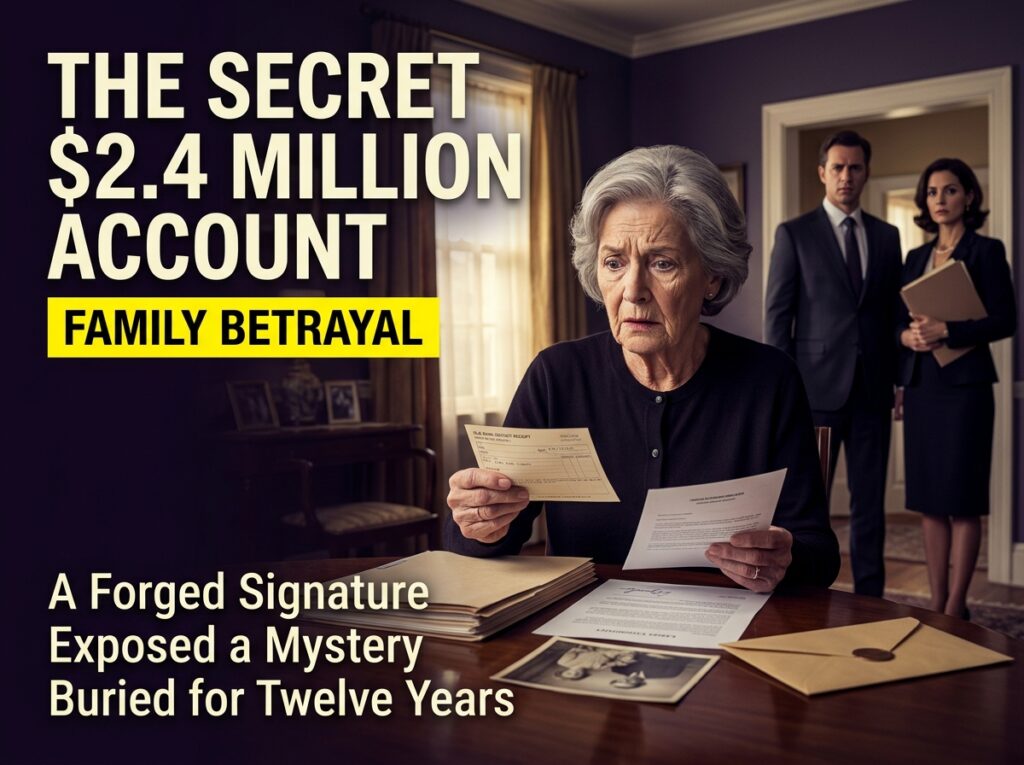
At 78, Margaret believed her greatest mistake was trusting her late husband with every penny she had saved. But three weeks after his funeral, a bank manager called to inform her that a secret account containing $2.4 million had been opened in her name—and someone had attempted to withdraw the entire fortune that morning. Margaret immediately suspected her eldest son, Daniel, who had spent years demanding that she sell her ancestral home to pay his business debts. When she confronted him, he swore he knew nothing about the money. Then her daughter-in-law arrived with a lawyer and produced a document claiming Margaret had already transferred the property and all her remaining assets to her son. The signature looked exactly like Margaret’s, but she had never signed that document. As the family gathered for an emergency meeting, the bank manager called again with one chilling revelation: the person who created the secret account had been dead for twelve years. And the name on the original deposit receipt was someone Margaret had buried herself.
The telephone rang at ten seventeen on a Tuesday morning, just as Margaret Whitmore was folding her late husband’s shirts into a cardboard box.
For three weeks, she had been living in a house that seemed to have forgotten how to breathe. The clocks still ticked, the kitchen tap still dripped, and the old wooden staircase still complained beneath her feet. Yet everything that had once made the house feel alive had disappeared with Edward.
At seventy-eight, Margaret had learned that grief was not always the dramatic pain people described. Sometimes it was reaching for two cups of tea before remembering that only one person remained to drink them.
She had placed Edward’s favorite blue shirt on top of the others when the telephone rang again.
“Hello?”
“Mrs. Whitmore? My name is Andrew Collins. I’m the senior manager at Northbridge Private Bank. I’m calling about an account registered in your name.”
Margaret frowned. She had never used Northbridge Private Bank. Edward handled most of their financial affairs, but he had always insisted that their money was ordinary: his pension, their savings, and the modest income from a small property they rented years ago.
“What account?”
“There appears to be a substantial deposit associated with your identity. Before I disclose further information, I need to verify a few details.”
Margaret answered his questions. Her date of birth. Her address. Her husband’s full name.
Then Andrew paused.
“Mrs. Whitmore, I’m afraid there’s something urgent you need to know. An account containing approximately two million four hundred thousand dollars was opened in your name. This morning, someone attempted to withdraw the entire balance.”
Margaret gripped the edge of the kitchen counter.
“Two million four hundred thousand?”
“Yes, ma’am.”
“That’s impossible. I’ve never had that kind of money.”
“I understand this is unexpected. The attempted withdrawal triggered our security procedures. The account is temporarily restricted while we investigate.”
“Who opened it?”
“That is part of what we’re trying to establish. The original account documents are being retrieved from our archives.”
Margaret looked toward the staircase. Edward’s study was upstairs, behind a door she had barely opened since his funeral.
“Did my husband open it?”
“I can’t confirm that yet. But there is one more concern. The withdrawal request was supported by documentation claiming that control of your assets had recently been transferred to another party.”
A cold sensation moved through Margaret’s chest.
“What party?”
“I’d rather discuss that with you in person, Mrs. Whitmore. Could you come to the bank this afternoon?”
She agreed, wrote down the appointment, and slowly lowered the telephone.
For several minutes, she remained perfectly still.
Then she thought of Daniel.
Her eldest son had spent the last four years telling her that the family’s ancestral home was an expensive burden. He had failed to make his business profitable, borrowed from people he refused to identify, and repeatedly insisted that selling the house would solve everything.
“It’s just an old building, Mum,” he had told her during their last argument. “You can’t eat memories.”
“This house belonged to your grandfather,” she had replied. “He built it with his own hands.”
“And now it’s keeping you poor.”
Margaret had refused to sell. Daniel had left without saying goodbye.
Three weeks later, Edward died unexpectedly, and Daniel began asking questions about the will before the flowers at the funeral had wilted.
Now a fortune she had never known existed had attracted an attempted withdrawal.
Margaret looked at the photograph beside the kitchen clock. Edward stood there in his gardening clothes, one hand resting on her shoulder. His smile was the same gentle smile that had persuaded her to trust him for fifty-two years.
“Edward,” she whispered, “what did you do?”
At two thirty, Margaret arrived at Northbridge Private Bank carrying her handbag and a folder containing every financial document she could find.
Andrew Collins met her in a private office. He was in his early fifties, with silver beginning to show at his temples. He offered her tea, but she declined.
“I want the truth,” she said.
Andrew placed a thick file on the desk.
“Then we need to begin with a document that predates the account itself.”
He opened the file and turned a page toward her.
It contained a faded deposit receipt, a date from twelve years earlier, and a handwritten name.
Margaret leaned forward.
The moment she recognized the handwriting, her fingers began to tremble.
Because the name on the receipt belonged to someone who should never have been connected to her husband’s money.
And someone Margaret had believed would remain buried in the past forever.
“Who is this?” Margaret asked.
Andrew did not answer immediately. He watched her face as though he expected her to recognize something beyond the name.
“Mrs. Whitmore, this receipt is one of the original documents connected to the account. It records the first substantial deposit. We believe the account remained inactive for several years before additional funds were placed into it.”
Margaret read the name again.
Thomas Bell.
Her younger brother had been dead for twelve years.
She had attended his funeral on a cold November morning, stood beside his grave, and watched the earth cover the coffin. She had been forty-six when their father died and fifty-seven when Thomas followed him. By then, they had barely spoken for almost a decade.
Thomas had not been an easy man. He was charming when he wanted something and stubborn when anyone challenged him. Their father had left the family property to Margaret, believing she would protect it, while Thomas received money intended to help him establish his own business.
He lost most of it.
Afterward, he accused Margaret of being their father’s favorite. She accused him of wasting the opportunities he had been given. Their arguments became so bitter that she eventually refused to answer his letters.
The final letter arrived a month before his death.
Margaret had placed it in a drawer without opening it.
She had told herself there would be time later.
There was never a later.
“Thomas couldn’t have opened this account,” she said. “He died twelve years ago.”
“The receipt is dated before his death,” Andrew explained. “The account itself was created under a different registration process. Some records were transferred into our current system, which is why it took time to locate them.”
“But why is my name on it?”
“That is the question we are investigating.”
Margaret stared at the papers.
“Was Edward involved?”
“We have found references to your husband in the archive. I don’t want to draw conclusions until the records have been authenticated.”
She felt suddenly exhausted.
Edward had always been careful with money. He compared prices, repaired broken furniture rather than replacing it, and saved every receipt. He had never been wealthy, but he believed that a person who spent less than they earned could protect a family from most disasters.
Yet he had apparently known something about an account containing millions.
“Did someone try to take the money today?”
“Yes. The request was submitted through an intermediary who claimed to hold legal authority over your assets. We stopped the transaction because the supporting documents raised several inconsistencies.”
“Can you tell me who submitted it?”
Andrew shook his head. “We are verifying the identity of the person behind the request. Our compliance team is involved now.”
Margaret closed her eyes briefly.
Daniel had been the first person she thought of, but the receipt made the situation more complicated. Thomas had been dead for twelve years. Edward had been alive when the account was created. And somebody had apparently attempted to use documents claiming that Margaret had transferred her property.
She returned home just before five.
A dark sedan was parked outside the ancestral house. She recognized it immediately: Daniel’s car.
Her son stood on the porch beside his wife, Victoria. Victoria was elegantly dressed, her pale coat buttoned neatly at the throat. A leather folder rested beneath her arm.
“Where have you been?” Daniel demanded as Margaret unlocked the door.
“At the bank.”
His expression changed.
“What bank?”
“Northbridge.”
Victoria glanced at Daniel. It was a tiny movement, but Margaret noticed it.
“Why were you at Northbridge?” Daniel asked.
“Because a manager called me about an account in my name.”
For the first time, Daniel appeared genuinely unsettled.
“What account?”
“A secret account containing two million four hundred thousand dollars.”
The silence that followed was so complete that Margaret could hear the old wall clock ticking in the hallway.
Victoria recovered first.
“That’s wonderful news, Margaret,” she said, though her smile looked strained. “Perhaps we should sit down and discuss what it means for the family.”
“The family?” Margaret repeated. “I didn’t know there was a family meeting.”
Daniel stepped inside without waiting for an invitation.
“Mum, listen. There may be an explanation. If Dad set something up, we need to make sure everything is handled properly.”
“Handled by whom?”
“By us.”
Margaret looked at her son.
“You mean by you.”
His jaw tightened.
“Why do you always assume the worst of me?”
“Because every conversation we have ends with you asking me to sell this house.”
Daniel looked away.
Victoria placed her folder on the dining table.
“We actually came to discuss the property,” she said. “There’s something you need to see.”
She opened the folder and removed several pages.
At the top was Margaret’s full legal name. Beneath it was a statement declaring that she had transferred ownership of the ancestral home and her remaining assets to Daniel.
Margaret read the first paragraph twice.
Then she reached the signature.
It looked exactly like hers.
The loops were correct. The final stroke curved upward in the same way she had signed birthday cards and Christmas letters for decades.
But she had never signed that document.
“That’s a forgery,” Margaret said.
Daniel’s face hardened.
“Be careful what you accuse people of.”
“I know my own signature.”
Victoria slid another paper across the table.
“Then perhaps you should explain why the transfer was witnessed and notarized.”
Margaret looked at the date.
It was a day when she had been recovering from pneumonia, barely able to leave her bedroom.
And the witness named on the document was a man who had died years before.
Margaret pushed the document away.
“I was sick that week,” she said. “I could barely walk downstairs. I certainly wasn’t transferring my house to anyone.”
Victoria folded her hands.
“The document appears legally complete. If you believe it is fraudulent, we can arrange for it to be reviewed.”
“You arrived with a lawyer’s paperwork and expect me to believe this is an innocent misunderstanding?”
“We’re trying to protect everyone’s interests,” Victoria replied.
“Whose interests? Mine?”
Daniel pulled out a chair and sat down.
“Mum, nobody wants to take anything from you. We’re trying to prevent a legal mess.”
“Then why did you bring this document without warning me?”
“Because you never listen when we try to discuss the future.”
Margaret looked at him for a long moment. She remembered him as a little boy, running through the garden with scraped knees and pockets full of stones. He had once cried because a neighbor’s dog had been injured. She had held him in her arms and promised that being kind would always matter more than being rich.
Somewhere along the way, he had learned to measure kindness by what it could buy.
“Did you know about the bank account?” she asked.
“No.”
“Did you try to withdraw the money?”
“Absolutely not.”
“Then why are you here with a document transferring everything I own?”
Daniel stood so abruptly that his chair scraped across the floor.
“Because you’re seventy-eight, Mum! You can’t keep living like this forever. The house needs repairs. The roof leaks. The heating system is ancient. You refuse to make sensible decisions because you’re attached to a building.”
“I’m attached to the people who lived in it.”
“Dad is gone.”
The words struck harder than Margaret expected.
Daniel seemed to regret them, but he did not apologize.
For a moment, Margaret could only look at him.
“Yes,” she said quietly. “Your father is gone. And three weeks after I buried him, you arrived to tell me what should happen to everything he left behind.”
Victoria closed the folder.
“Perhaps we should let the lawyers handle this.”
“That would be wise,” Margaret answered.
Daniel stared at her.
“Are you threatening me?”
“No. I’m finally listening to what you’ve been telling me.”
She picked up the papers, placed them carefully back inside the folder, and handed it to Victoria.
“You can leave now.”
“Mum—”
“Please.”
Daniel’s expression shifted from anger to something almost frightened.
“You don’t understand what you’re doing.”
“Then explain it to me.”
He said nothing.
When they left, Margaret locked the front door and leaned against it. Her legs felt weak. She had spent years telling herself that Daniel was under pressure, that his business troubles had changed him temporarily, that the boy she raised was still somewhere inside the difficult man who now stood before her.
But the document had forced her to consider something she had avoided.
Perhaps Daniel did not merely want the house.
Perhaps he believed he was entitled to it.
She returned to Edward’s study.
Dust had settled on the desk. His reading glasses lay beside an empty coffee cup, and the calendar still showed the month he died. Margaret opened the top drawer and found the usual collection of receipts, pencils, and instruction manuals.
The second drawer contained insurance papers.
The third was locked.
She tried the small brass key from Edward’s key ring. It turned with a soft click.
Inside were several envelopes, a notebook, and a photograph she had never seen before.
Edward stood beside Thomas in front of a brick building. Both men were younger, perhaps in their forties. Thomas was smiling broadly, one hand resting on Edward’s shoulder.
Margaret turned the photograph over.
On the back, Edward had written a date and five words.
For the day she asks.
Her throat tightened.
She opened the notebook.
The first page contained a list of bank branches, account references, and dates. Some entries were crossed out. Others had small marks beside them. Near the bottom, Edward had written her name and the words Do not tell Daniel until the documents are secure.
Margaret sat down slowly.
Why had her husband written Daniel’s name beside a warning?
She turned the page and found a short note.
Thomas was right about one thing. The money was never the real danger. It was who would come looking for it.
Margaret read the sentence again.
Then she heard a sound outside the study door.
Someone was standing in the hallway.
“Who’s there?” she called.
The footsteps stopped.
A moment later, the front door opened and closed.
Margaret hurried downstairs, but the hallway was empty. Through the front window, she saw a vehicle pulling away from the curb.
It was not Daniel’s sedan.
It was a black car she had never seen before.
On the study desk, the notebook lay open beside the photograph.
And the next page, which Margaret had not yet read, had been torn out.
Margaret did not sleep that night.
She kept the photograph beside her bed and the notebook beneath her pillow, though she knew paper could not protect her from whatever had begun. Every sound from the old house made her sit up. The wind rattling the windows reminded her of footsteps, and the heating pipes sounded like someone whispering behind the walls.
At six in the morning, she called Andrew Collins.
“I need to see the original account documents,” she told him. “And I need to know whether my husband left anything with your bank.”
Andrew was quiet for a moment.
“Mrs. Whitmore, our legal department has located an archived instruction attached to the account. It was sealed under a verification requirement that has only recently been triggered.”
“What instruction?”
“I can’t read the full contents over the telephone. But I can tell you that it references a second document, apparently held outside the bank.”
“Where?”
“The record doesn’t specify.”
Margaret gripped the receiver.
“Was my brother’s name on it?”
“Yes.”
She closed her eyes.
“Then I’m coming in.”
At the bank, Andrew led her to a secure room. A second employee joined them, introduced herself as Helen Price from the bank’s compliance department, and placed a collection of scanned documents on the table.
The first showed the account’s opening date. The second recorded deposits made over several years. The third was a letter bearing Edward’s signature.
Margaret recognized his handwriting immediately.
The funds must remain untouched until Margaret receives independent confirmation of the original source. No member of the family is to be given control solely on the basis of an inheritance claim.
“Why would Edward write that?” she asked.
Helen folded her hands.
“We can’t establish his intentions from one letter. We can establish that the instruction was recorded and that the account was subject to additional safeguards.”
Margaret studied the deposit records.
Some entries were ordinary bank transfers. Others referenced companies she had never heard of. A few were marked with codes that Helen said required further investigation.
“Was this money stolen?”
“We have no evidence establishing that,” Helen said. “That’s why we’re reviewing the original source documentation before any transaction is permitted.”
“Then why did someone try to withdraw it?”
“We believe the request was connected to the transfer document you reported yesterday.”
Margaret felt a pulse of anger beneath her fear.
“Can you tell whether my signature is genuine?”
“The bank can arrange for a qualified document examiner to review it. We cannot make a final determination from the scan alone.”
“Do it.”
Helen nodded.
Then Andrew removed a thin envelope from the file.
“This was stored with the account’s original instructions. It contains a note from your brother.”
Margaret stared at it.
“Thomas wrote something?”
“The note was never opened by the bank. It was marked for delivery to you if the account became active under the conditions specified.”
She took the envelope. Her brother’s handwriting crossed the front in uneven blue ink.
Margaret. If you are reading this, Edward kept his promise.
Her eyes blurred.
For twelve years, she had remembered Thomas as the angry younger brother who blamed her for everything. She had remembered their last argument, the accusations they had thrown at each other, and the way she had turned away when he asked her to listen.
She had never remembered his face at the hospital, because she had not visited him.
“I can’t,” she whispered.
Andrew moved a box of tissues closer but said nothing.
Margaret opened the envelope.
Inside was a single sheet of paper.
Margaret,
I know you may never forgive me. I know I gave you plenty of reasons not to. But our father was wrong about one thing: he believed keeping the house would keep the family together. It didn’t. We let pride turn every memory into a weapon.
I made mistakes with the money Father gave me. I lost the business, lied about the debts, and blamed you because it was easier than admitting I had failed. I cannot undo any of that.
Edward helped me protect what remained. Some of it came from the sale of the company shares Father left in my name. Some came from years of careful investment after I finally stopped trying to impress people who did not care whether I survived.
The account is not a reward for forgiving me. It is a safeguard for you. If the money reaches you, use it to live without fear. Do not let anyone convince you that love requires you to surrender your home.
There is another document. Edward knows where it is.
Your brother, Thomas.
Margaret lowered the letter.
The room seemed to tilt around her.
“Was the money legally his?” she asked.
Helen answered carefully.
“The letter suggests that some funds originated from assets belonging to him, but we’ll need to verify the complete transaction history. We cannot establish ownership from this letter alone.”
Margaret nodded. For the first time since the call, she felt the mystery opening rather than closing.
Thomas had not left her a fortune because he expected forgiveness. He had apparently arranged for money to reach her without asking her to forget what had happened between them.
But Edward had known where another document was hidden.
And someone had already entered the house looking for it.
The following morning, Margaret returned to the ancestral house with a locksmith.
She had spent half the night considering the torn page from Edward’s notebook. Whoever had entered the house might have wanted the notebook, the photograph, or something hidden elsewhere. She could not be certain, but she would not wait for another visitor to decide what she was allowed to know.
The locksmith examined the damaged lock on the study window.
“Someone may have forced this,” he said. “I can’t tell you when, but the latch isn’t sitting properly.”
Margaret thanked him and asked him to replace it.
When he had gone, she began searching the room methodically. She checked the desk, the filing cabinet, the shelves, and the boxes Edward had kept beneath the window. She found old tax returns and receipts for repairs to the house, but nothing that explained the account.
Then she remembered the library.
Her father had built a small reading room at the back of the house. He called it his study, though it had become a place for family photographs, old books, and the occasional argument. After his death, Margaret had preserved the room exactly as it was.
A framed photograph of her father stood above the fireplace.
She lifted it from its hook and found a shallow wooden compartment behind the frame.
Inside was a brass key and a folded note.
The house remembers what people forget.
Margaret stared at the words.
Her father had used that expression when she was a child. Whenever she asked why he kept old letters and broken objects, he would tell her that houses carried stories in their walls.
She examined the brass key. It was small, with a distinctive notch at the tip.
She tried it on the locked cabinet beneath the library desk.
It turned.
Inside lay a metal document box, a bundle of letters tied with string, and a sealed envelope bearing both Edward’s and Thomas’s names.
Margaret sat on the floor.
The letters dated back more than twenty years. Some concerned Thomas’s failed business. Others contained notes about investments and property. Several were written by Edward, who appeared to have helped Thomas negotiate debts and sell remaining company shares.
One letter was different.
It was addressed to Edward alone.
If Daniel ever discovers the account, he will believe it belongs to him. He has been asking questions about the house and the old company. Do not let him confuse access with ownership.
Margaret’s stomach tightened.
The letter was signed by Thomas.
She read it twice before placing it beside the others.
There were no accusations that Daniel had stolen anything. No proof that he knew the account existed. But the warning made it impossible to dismiss the connection between the bank account, the forged transfer document, and his repeated demands for the house.
Margaret opened the sealed envelope.
Inside was a notarized statement, a copy of a share-sale agreement, and a handwritten list of assets. The documents suggested that Thomas had arranged for a portion of his remaining wealth to be protected for Margaret. Edward had apparently acted as a trusted intermediary, ensuring the money could not be accessed without independent verification.
At the bottom of the statement was a reference to a solicitor named Arthur Bennett.
Margaret remembered him. Arthur had advised her father and handled several property matters before retiring.
She searched through the letters until she found an address.
Then she called the number listed beside it.
A woman answered.
“Bennett Legal Services.”
“My name is Margaret Whitmore. I believe your office may have records concerning my late brother, Thomas Bell.”
There was a pause.
“Mrs. Whitmore,” the woman said, “I’m afraid Mr. Bennett passed away some years ago. However, the firm retained certain archived files. May I ask what matter you’re calling about?”
Margaret glanced at the documents.
“A secret account. A property transfer that I never signed. And a letter warning my husband that someone might try to claim money that wasn’t theirs.”
The woman’s tone changed.
“Please don’t send those documents to anyone yet. I’ll need to speak with our senior solicitor.”
“Why?”
“Because Mr. Bennett left specific instructions regarding your brother’s estate. He said that if you ever contacted us about a protected account, we were to arrange a meeting immediately.”
Margaret felt her pulse quicken.
“What did he leave?”
“I can’t disclose that until your identity has been verified.”
“When can I come?”
“Tomorrow morning.”
After the call, Margaret returned the documents to the metal box and locked it.
For the first time, she had something more substantial than suspicion. She had letters, a legal statement, and a name connected to the account.
But before she could reach the solicitor’s office, her telephone rang.
It was Daniel.
“Mum, we need to talk,” he said. His voice was unusually controlled. “Victoria says you’ve been contacting lawyers and digging through Dad’s things.”
“I’m entitled to know what my husband left me.”
“You’re making a mistake.”
“Then tell me what it is.”
He hesitated.
“Someone is asking questions about Thomas’s money. If you keep pushing, you may lose everything.”
Margaret went still.
“How do you know what Thomas’s money has to do with this?”
Daniel said nothing.
Then the line went dead.
Margaret called Daniel back, but he did not answer.
She left a message asking him to explain what he meant. When no reply came, she called Victoria. Her daughter-in-law answered on the fourth ring.
“Daniel is upset,” Victoria said.
“So am I.”
“He thinks you’re allowing strangers to manipulate you.”
“Your husband threatened that I might lose everything if I continued investigating my own finances.”
“He didn’t mean it that way.”
“What did he mean?”
Victoria sighed.
“Margaret, you have to understand that Daniel is under enormous pressure. His business has been struggling for months. There are creditors, legal expenses, and people who keep demanding money. He thought the house might give him a way out.”
“And what did you think?”
“I thought we could find a solution.”
“By forging my signature?”
“I didn’t forge anything.”
“Then why did you bring that document to my home?”
Victoria fell silent.
Margaret waited, but no explanation came.
Finally, Victoria said, “You should speak to Daniel.”
“I have been trying to do that for years.”
She ended the call.
The next morning, Margaret went to Bennett Legal Services. A senior solicitor named Helen Ward met her in a conference room and asked to see the documents.
Helen examined the account references, the share-sale agreement, and Thomas’s letters.
“This is a complex matter,” she said. “But it appears your brother took steps to preserve certain assets and establish conditions for their release.”
“Can you tell me whether the money belongs to me?”
“I can tell you what these documents suggest. I cannot confirm the account’s full legal status until the bank’s records have been reconciled with the estate papers.”
Margaret nodded.
“And the transfer of my house?”
Helen studied the document Victoria had presented.
“If you did not sign it, the next step is an independent examination of the signature and verification of the witnessing details. We should also establish whether the named witness was alive and authorized to act on that date.”
“He was dead.”
“Then that is a significant concern.”
Helen arranged for copies of the relevant documents to be preserved and advised Margaret not to sign any new papers or hand over original records without legal review.
Before Margaret left, the solicitor opened a separate file.
“There is one more matter. Mr. Bennett recorded an instruction concerning a letter from your brother. It was not to be released until the bank confirmed that the account had been accessed or challenged.”
She placed a sealed envelope on the table.
Margaret recognized Thomas’s handwriting immediately.
For Margaret, if the past returns.
Inside was a short letter and a photocopy of an old company record.
Thomas wrote that years earlier, when his business had begun to collapse, he had discovered irregularities in a series of transactions involving a business associate. He had feared that reporting them would expose his own mistakes and damage the family. Edward had urged him to preserve the evidence and separate his remaining assets from the disputed dealings.
The letter did not identify anyone as guilty of a crime. It did, however, explain why Thomas had been so desperate to keep certain records private.
I was ashamed of the debts I created, he wrote. I was even more ashamed that I let that shame turn into anger at you. If the account is ever challenged, do not assume the person seeking it knows what it contains. They may only know that it exists.
Margaret read the final paragraph.
If Daniel has become involved, remember that desperation can make a person believe a lie is the same as a solution. But do not let sympathy make you surrender the truth.
She folded the letter carefully.
Helen Ward leaned forward.
“Mrs. Whitmore, do you know whether Daniel had access to your husband’s papers?”
“He visited the house frequently.”
“Could he have known about the account?”
“I don’t know.”
“Then we need to establish what he knew and when he knew it.”
Margaret looked at the documents spread across the table. For years, she had believed that keeping family secrets was a form of protection. Her father had concealed his disappointment in Thomas. Thomas had hidden his debts. Edward had kept the account from her. She had concealed her fear that Daniel was no longer the son she remembered.
Every silence had been intended to prevent pain.
Yet the silence had allowed the mystery to grow.
That afternoon, Helen called with an update. The bank’s preliminary review had found discrepancies in the attempted withdrawal request. The transfer document would be referred for independent examination, and the account would remain restricted while the bank investigated.
Margaret felt relief, but it was incomplete.
“What happens now?” she asked.
“We establish the facts. We preserve the evidence. And we make sure no one can move your assets without lawful authority.”
After the call, Margaret returned to the house and placed Thomas’s letter in the metal document box.
Then she heard a knock at the door.
Victoria stood on the porch alone.
She looked pale, and her hands were trembling.
“Margaret,” she said, “I need to tell you something about the document Daniel brought to your house.”
Margaret stepped aside and allowed Victoria to enter.
Her daughter-in-law did not remove her coat. She remained in the hallway, looking at the staircase and the closed door to Edward’s study.
“Is Daniel with you?” Margaret asked.
“No.”
“Does he know you’re here?”
Victoria hesitated.
“No.”
Margaret led her into the kitchen and put the kettle on. She had no desire to comfort the woman who had presented a document claiming that Margaret had surrendered her home, but she wanted to hear what Victoria had to say.
When they sat down, Victoria placed both hands around the untouched cup.
“The transfer document wasn’t something Daniel created from nothing,” she began. “He received a copy from someone who said it was already valid.”
“Who?”
“He won’t tell me.”
“Did you believe it was genuine?”
“At first, yes. It had your signature and a witness’s name. Daniel said you had agreed to transfer the house but had forgotten because you were ill.”
Margaret stared at her.
“You believed I would forget giving away my home?”
Victoria’s eyes filled with tears.
“I wanted to believe him. We were in trouble, Margaret. The business was failing. Daniel had borrowed money to keep it going, and the people he owed were becoming aggressive. He told me the house would solve everything.”
“So you brought the document here.”
“Yes.”
“Did you know about the account?”
“No. I swear I didn’t.”
Margaret believed that Victoria was frightened. Whether she was telling the whole truth was another matter.
“Why come now?”
Victoria looked down at her hands.
“Because Daniel has been meeting someone. He says the person can help him recover money that belongs to the family. But yesterday I overheard him say that if the bank released the funds, all our problems would be over.”
Margaret felt the familiar coldness return.
“Did he say who the person was?”
“No. But I saw a name on a paper in his office. Thomas Bell.”
Margaret sat back.
“Where did he get it?”
“I don’t know.”
“Victoria, I need you to understand something. If you have information about a fraudulent document or an attempted unauthorized withdrawal, you must tell the truth to the lawyers and the bank. You cannot hide what you know simply because Daniel is your husband.”
Victoria nodded, crying silently.
“I love him,” she said. “But I don’t know what he’s become.”
Margaret looked at her for a long moment.
Neither did she.
Before Victoria left, Margaret asked her to preserve any messages, letters, or documents related to the transfer. She told her not to remove or alter anything and to speak honestly with the solicitor.
When the door closed, Margaret remained in the hallway.
She remembered Daniel at eight years old, standing in that same place with a broken model airplane. He had been afraid she would be angry. She had knelt, examined the broken wing, and shown him how to repair it.
“You can fix most things if you tell the truth about how they broke,” she had said.
He had believed her then.
That evening, Helen Ward called.
“The bank has received additional information concerning the withdrawal attempt,” she explained. “We are coordinating with the appropriate investigators. I cannot discuss every detail, but the account remains protected.”
“What about the signature?”
“The preliminary examination has identified features that require further investigation. We’re waiting for a formal report.”
Margaret told Helen about Victoria’s visit. The solicitor advised her to record the conversation while it was still fresh in her memory and to avoid confronting Daniel alone.
Afterward, Margaret went upstairs to Edward’s study.
She examined the remaining notebook pages, looking for a reference to the person who had visited the house. The handwriting became less legible toward the back, but one entry caught her attention.
If the original receipt is found, check the second ledger. The account number is not the whole story.
She searched the drawers again and discovered a narrow space beneath the desk’s bottom panel. A thin ledger had been tucked inside.
Its pages recorded transactions connected to Thomas’s former business. Some entries referred to payments, others to the sale of assets, and several carried the initials of people Margaret did not recognize.
Near the center was a note in Edward’s handwriting.
The person who knows where the money came from may not be the person who has the right to claim it.
Margaret closed the ledger.
The mystery was no longer simply about a fortune hidden from her. It was about a history that had been divided among people who were no longer alive to explain themselves.
And Daniel had somehow found his way into that history.
At nine thirty, her telephone rang.
It was Daniel.
“Mum, we need to meet tomorrow,” he said.
“Why?”
“Because I can explain the account.”
Margaret’s heart began to pound.
“Then explain it now.”
“I can’t do it over the phone.”
“Are you going to tell me the truth?”
A long silence followed.
“I’m going to tell you what I know,” he finally said.
Margaret agreed to meet him at the solicitor’s office, with Helen Ward present.
After she ended the call, she looked at the photograph of Edward and Thomas.
For the first time, she wondered whether the next truth would bring her family together—or finally reveal how far apart they had become.
<h2>Part 8</h2>
Daniel arrived at Bennett Legal Services ten minutes late.
He wore the same charcoal suit he had worn to his father’s funeral, but he looked as though he had not slept. His eyes were red, and he kept checking his telephone until Helen Ward asked him to switch it off.
Margaret sat opposite him with her hands folded in her lap.
“Tell me what you know,” she said.
Daniel rubbed his face.
“About six months ago, a man contacted me. He said he had information about Dad’s financial affairs and a way to recover money connected to an old family investment.”
“What was his name?”
“Martin Shaw.”
Margaret did not recognize it.
“He knew about Thomas,” Daniel continued. “He knew about the business Thomas lost, and he knew Dad had helped him with some of the paperwork. He said there was an account connected to the old transactions.”
“Did he tell you the amount?”
“Not at first.”
“When did you learn about the $2.4 million?”
“A few weeks ago.”
Margaret’s voice remained steady.
“And you decided to try to get it.”
“I thought it might belong to the family.”
“Which family?”
He flinched.
“I thought it was money Dad had set aside.”
“Then why did you tell me you knew nothing about it?”
“Because I didn’t know whether the account was real. Martin said we needed to establish control of the estate before the bank would release anything.”
Helen interrupted.
“Mr. Whitmore, did you submit the withdrawal request?”
Daniel looked at the solicitor, then back at his mother.
“I gave Martin copies of some documents. I didn’t personally submit the request.”
“That wasn’t my question,” Helen said.
Daniel swallowed.
“I helped him prepare the paperwork.”
Margaret felt as though a door had closed inside her.
“You helped him use a document claiming I had transferred my house?”
“He said it was necessary to establish the family’s authority over the account.”
“Did you believe I had signed it?”
Daniel looked away.
“I wanted to believe it.”
“That is not the same thing.”
“No.”
Helen asked whether Daniel had any written communications with Martin Shaw. He said he did and agreed to preserve them for the investigation.
Margaret watched her son as he spoke. He did not look like a mastermind. He looked frightened, ashamed, and desperate to find a version of events in which his intentions could excuse his actions.
“Why didn’t you ask me?” she said.
Daniel’s eyes filled.
“Because I knew you would say no.”
“To what?”
“To selling the house. To letting me manage the money. To anything that might help me.”
Margaret leaned forward.
“You could have asked me for help. You could have told me your business was failing. You could have admitted you were frightened. Instead, you chose to make decisions about my life without me.”
“I thought I could fix everything before you found out.”
“By risking everything I had?”
Daniel lowered his head.
Helen explained that the bank would continue its investigation and that the legal team would review the transfer document. She made it clear that the facts had to be established independently and that Daniel’s account did not resolve the matter.
Before the meeting ended, Daniel reached into his jacket and placed a folded sheet on the table.
“Martin gave me this,” he said. “He told me to keep it in case anything went wrong.”
Helen opened it carefully.
It was a copy of an old deposit record, but unlike the receipt Margaret had seen at the bank, this one contained an additional reference at the bottom.
A second account number.
Andrew Collins confirmed the reference when Helen contacted the bank. It led to a separate archived record, not another accessible fortune, but a document linked to the original account’s creation.
The record contained the name of the person who had certified the initial paperwork.
Margaret read it once.
Then again.
It was not Thomas’s name.
It was Edward’s.
She looked at the solicitor.
“My husband signed the original account documents?”
“The archive indicates that he witnessed part of the initial registration,” Helen said. “We need the original record to establish the precise nature of his role.”
Margaret felt a complicated wave of grief and anger. Edward had not merely known about the money. He had been involved in arranging it.
Daniel looked at her.
“I didn’t know Dad was connected to it until Martin showed me the record.”
“Did you ask Martin where he obtained it?”
“He said he had access to old company files.”
“And you believed him?”
“I wanted the money to be real.”
Margaret turned away.
For fifty-two years, she had trusted Edward to be honest with her. Now she was learning that he had kept an entire financial history separate from their life together.
Yet Thomas’s letter suggested that Edward had been trying to protect her.
She could not decide whether she felt betrayed or grateful.
Perhaps both feelings could exist at the same time.
Helen arranged for the bank to preserve the second record and requested further verification of Martin Shaw’s role. Daniel agreed to provide the communications he had kept.
As they prepared to leave, Margaret stopped her son.
“One more question. Did Martin tell you who originally created the secret account?”
Daniel hesitated.
“He said the answer was in the original deposit receipt.”
Margaret’s stomach tightened.
“And what did he say about the person who made the deposit?”
Daniel looked directly at her.
“He said that person had been dead for twelve years.”
The bank manager called Margaret the following afternoon.
“Mrs. Whitmore, we have completed an initial review of the original deposit receipt and the related registration records. I would like you to come in with your solicitor.”
Margaret arrived with Helen Ward shortly before three.
Andrew Collins had placed several documents on the conference table. Beside them lay a photograph of the original receipt, a certified copy of the account registration, and a statement from the archive department.
“We have now confirmed that the account was created through a series of arrangements involving your late brother and your husband,” Andrew said. “However, the account’s present ownership and the authority required to release the funds must be determined through the documented instructions and applicable legal procedures.”
Margaret looked at the receipt.
Thomas’s name appeared beside the original deposit.
Edward’s signature appeared on a related certification.
The two men had apparently worked together to preserve the funds, but the records did not yet answer every question about the source of the money.
“What about the attempted withdrawal?” she asked.
“The request relied on the transfer document you reported. That document remains under examination. We have not released any funds.”
“And Daniel?”
“He has provided information concerning the intermediary who assisted him. The bank is cooperating with the appropriate investigation.”
Margaret nodded.
She was relieved that the money had not disappeared, but the word protected no longer brought her the comfort it once had. The account was protected by rules, documents, and restrictions. It had not been protected from the damage that secrecy could cause within a family.
Helen turned to the second archived record.
“This appears to be the document your brother referred to in his letter. It establishes that the funds were intended to be held for your benefit, subject to verification of their origin and the fulfillment of the account’s conditions.”
Margaret read the passage slowly.
It did not promise that every dollar would automatically become hers. It required a proper review of the source of the funds, the original instructions, and any competing legal claims.
But it confirmed that Thomas had not intended the money to be treated as an ordinary inheritance available to whichever relative demanded it first.
“Why did he hide this from me?” she asked.
Andrew answered gently.
“The documents suggest that he wanted to protect the money from disputes connected to his former business. Your husband appears to have helped him maintain that arrangement.”
Margaret thought of the years she had spent believing Thomas had died angry and Edward had left her with nothing beyond their ordinary savings.
Neither belief had been entirely true.
Thomas had regretted their estrangement. Edward had kept a promise that he had never explained to her. And Daniel had been willing to risk her home because he had mistaken the existence of money for permission to claim it.
When she returned home, Daniel was waiting on the porch.
“I heard from Helen,” he said. “She told me the bank is still investigating.”
“Yes.”
“I’m sorry, Mum.”
Margaret unlocked the door but did not invite him inside immediately.
“Are you sorry you tried to claim my assets, or are you sorry the bank stopped you?”
Daniel’s face crumpled.
“I don’t know how to answer that.”
“Then you need to think about it.”
He looked down at his shoes.
“My business is finished. I owe money I can’t repay. I was terrified of losing everything.”
“You were not the only person who was frightened.”
“I know.”
“No, Daniel. You know now that there are consequences. That is not the same as understanding what you did to me.”
He wiped his eyes.
“I thought the money would save us.”
“Money cannot save a family that refuses to tell the truth.”
For a long time, neither spoke.
Finally, Daniel asked whether she would ever forgive him.
Margaret looked at the house behind her. Every room held a memory: her father reading beside the fireplace, Thomas laughing in the garden, Edward repairing a broken chair, Daniel running down the stairs with a schoolbag bouncing against his back.
She wanted to tell her son that everything would be all right. She wanted to take his hand and erase the months of fear.
But she had learned that forgiveness could not be used to avoid the truth.
“I don’t know,” she said. “But I know we cannot begin by pretending nothing happened.”
Daniel nodded.
He left without asking for the house again.
That night, Margaret returned to Edward’s study and opened the notebook. She placed Thomas’s letter beside it, then laid the old deposit receipt between them.
For the first time, she understood that the money was only one part of what the two men had left behind.
There was also a history of regret, an attempt at repair, and a warning that had arrived too late to prevent every mistake.
The bank still had work to do. The legal investigation was not finished. Margaret could not know what would happen to Daniel or whether their relationship would recover.
But she no longer felt compelled to protect the family from the truth.
If there was to be any future for them, it would have to begin with what had really happened.
And for the first time in years, Margaret was ready to let the truth speak for itself.
Winter settled over the ancestral house slowly.
The garden grew quiet, and the branches of the old apple tree scratched softly against the kitchen window. Margaret continued to visit the bank and work with Helen Ward while the account records were reviewed. She kept copies of every document and asked questions whenever an explanation was unclear.
The process took time.
There were old transactions to verify, instructions to interpret, and questions about the attempted withdrawal that could not be answered by one person alone. Margaret learned not to mistake a promising letter for a final legal decision or an apology for proof that everything had changed.
Eventually, the bank confirmed the account’s documented purpose and the steps required to protect Margaret’s interests. The funds were not released simply because she was a widow or because Thomas had written a moving letter. They were handled according to the verified records and the legal review.
The forged transfer document remained a separate matter, and the investigation continued.
Margaret did not sell the house.
She repaired the leaking roof, replaced the faulty heating system, and hired a gardener to help restore the neglected flowerbeds. For the first time in years, she made decisions about the property without having to defend them to Daniel.
One afternoon, she found a box of old photographs in the library.
She sat on the floor and sorted through them slowly. There was Thomas at seventeen, grinning beside a bicycle. There was Edward holding a newborn Daniel. There was a photograph of Margaret’s parents standing outside the house on the day they finished the front porch.
At the bottom lay the unopened letter Thomas had sent shortly before his death.
Margaret had found it years ago and hidden it away, unable to face the possibility that her brother had wanted to make peace.
Now she opened it.
The letter contained no financial instructions and no explanation of the account. It was simply an attempt to apologize.
Thomas wrote that he had spent too much of his life trying to prove he was as successful as their father. When his business failed, he had blamed Margaret because she still possessed the home he had lost the right to call his own.
He admitted that he had confused envy with injustice.
I don’t expect you to forgive me, he wrote. I only hope that someday you can remember me as your brother, not just as the man who hurt you.
Margaret pressed the letter against her chest.
“I should have answered,” she whispered.
There was no one in the room to hear her. No one who could tell her that she had done the best she could with the hurt she understood at the time.
She cried for Thomas, for Edward, and for the years in which silence had seemed safer than an honest conversation.
She also cried for Daniel.
Her son visited several weeks later. He came alone, carrying a small paper bag from the bakery Margaret had always loved.
“I know this doesn’t fix anything,” he said, placing it on the table.
“No,” Margaret replied. “It doesn’t.”
He nodded.
“I’ve started meeting with someone about the business debts. I’m giving the investigators everything I have about Martin. I’m not asking you for money.”
Margaret watched him carefully.
“Why are you telling me this?”
“Because I should have told you the truth before anyone had to ask.”
She poured him a cup of tea.
They spoke about practical matters first. The weather. The repairs. The old apple tree that needed pruning. Eventually, Daniel asked about Thomas’s letter.
Margaret showed it to him.
He read it in silence.
“I didn’t know Uncle Thomas felt that way,” he said.
“Neither did I.”
“Do you think he would have forgiven me?”
Margaret considered the question.
“I can’t answer for a man who has been dead for twelve years. But I think he understood what fear can do to people. Understanding it is not the same as excusing it.”
Daniel folded the letter carefully and returned it.
“I’m sorry, Mum.”
This time, he did not ask her to say that everything was forgiven.
Margaret reached across the table and placed her hand over his.
“I love you,” she said. “But loving you does not mean I can pretend you didn’t hurt me. If we are going to rebuild our relationship, we must do it honestly.”
“I understand.”
“I hope you do.”
He stayed for another hour. When he left, he did not mention the bank account or the house.
Margaret watched him walk down the path and felt neither complete relief nor complete certainty. Trust would take longer to rebuild than it had taken to damage.
That evening, she returned to Edward’s study one final time.
She placed the photograph of Edward and Thomas beside the framed picture of her parents. Then she laid the deposit receipt and the letters in a new archival box, preserving them not as treasures to be hidden but as records of what had happened.
She could not change the years of silence. She could not ask Thomas why he had waited so long to reach out, or ask Edward why he had believed secrecy was the best way to protect her. She could not know whether Daniel would become the man she remembered from childhood.
But she could decide what happened next.
At seventy-eight, Margaret had once believed her greatest mistake was trusting her late husband with every penny she had saved.
Now she understood that the money had never been the whole story.
The fortune had exposed the fear beneath Daniel’s demands, the regret behind Thomas’s silence, and the love Edward had tried to express through a promise he never explained. It had also shown Margaret how easily family members could turn their own pain into permission to hurt someone else.
She closed the study door and walked downstairs.
In the kitchen, she made one cup of tea and carried it to the window. The ancestral house stood quietly around her, full of memories but no longer held hostage by them.
For the first time since Edward’s death, Margaret did not feel that she was waiting for someone else to explain her life.
The house was still hers to care for. The truth was no longer hidden in a drawer. And whatever came next, she would meet it with her eyes open.
Some inheritances arrived as money, property, or old family documents.
Others arrived as difficult truths that could not be ignored.
Margaret had received both.
And she finally understood that the most valuable thing she could leave behind was not a fortune, but a family that had learned—however painfully—that love without honesty could become another kind of loss.