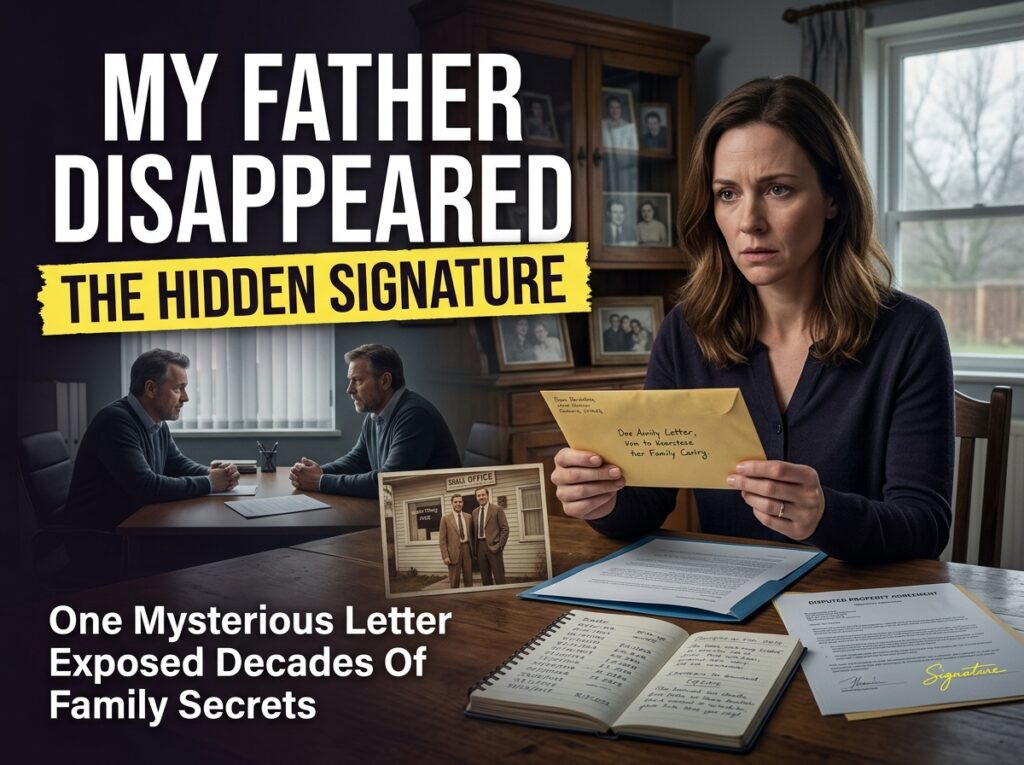
My father disappeared when I was seventeen, and my family spent years insisting he had abandoned us. Then I found a property agreement dated that very day, a signature that looked wrong, and a second envelope addressed in handwriting I thought I would never see again.
The second envelope arrived on a Thursday, three days after I found the property agreement hidden behind my parents’ wedding photograph.
It was waiting on the doorstep when I returned from work, tucked between a supermarket flyer and a letter from the electricity company. The paper was yellowed around the edges, and my name had been written across the front in dark blue ink.
I knew the handwriting before I even touched it.
My father had a distinctive way of writing the letter C. He began with a small upward curve, then brought the line around in a narrow circle. When I was a child, I used to recognize his notes on the refrigerator before I could read the words.
The handwriting on the envelope was almost identical.
My hands went cold.
For several seconds, I stood outside with the envelope pressed against my chest, listening to the ordinary sounds of the neighborhood. Somewhere nearby, a dog barked. A car door slammed. Someone was laughing behind a garden fence.
The world continued as though nothing extraordinary had happened.
But my father had been missing for decades.
I carried the envelope inside and placed it on the kitchen table.
Daniel was upstairs, finishing a work call. I considered opening it immediately, but something stopped me. I wanted another person in the room, someone who could witness what I was about to discover.
When Daniel came downstairs, he found me staring at the envelope.
“What happened?”
“Look at this.”
He examined the handwriting.
“Who sent it?”
“There’s no return address.”
“Could it be from your aunt?”
I shook my head.
“It’s Dad’s handwriting.”
Daniel looked at me carefully.
“You’re sure?”
“I would recognize it anywhere.”
He pulled out a chair and sat opposite me.
“Then open it.”
I slid my finger beneath the flap.
Inside was a single sheet of paper folded into thirds. The writing was faded, but the words were clear enough to read.
Claire,
If you have found the agreement, you have already discovered that the story you were told about my disappearance was incomplete.
Do not confront anyone until you understand what happened to the original document.
The date matters. So does the signature.
Look in the notebook you kept when you were seventeen. You wrote down something that everyone else wanted you to forget.
I am sorry I left you with so many questions.
Dad.
I read the letter twice.
Then I read it a third time, searching for a date, a location, or any indication of when it had been written.
There was nothing.
No signature beyond the single word Dad. No explanation of where he had been. No assurance that he was alive when the letter was sent.
Daniel reached for the paper.
“Let me see.”
I handed it to him.
“This could be someone imitating his handwriting,” he said.
“I know.”
“Someone might have found the old documents and decided to frighten you.”
“Why would they know about the notebook?”
He did not answer.
I stood abruptly and went to the spare room. My old notebook was in a box beside the cabinet, beneath school photographs and a stack of birthday cards. I brought it downstairs and opened it to the pages from the year my father disappeared.
The paper was brittle. Some entries had faded, and a few pages had come loose from the binding.
I searched the dates.
There were ordinary observations about school, friends, and family dinners. Then I found the entry I had read before.
Dad told me not to sign anything unless I understood it. He said promises can be changed on paper, but the truth doesn’t change.
Below it, I noticed a line I had overlooked.
Uncle Robert came back for the blue folder. Mum said Dad had already taken it.
I stared at the sentence.
The blue folder.
It had appeared in my childhood notebook, and now my father’s letter referred to something I had written when I was seventeen.
I turned to Daniel.
“Someone knew about this notebook.”
He looked from the page to the envelope.
“Or someone read the same records your father did.”
I thought about the property agreement, the strange date, and my uncle’s refusal to answer my questions.
Then I noticed a final detail on the envelope.
Near the lower corner, almost hidden beneath a crease, were two handwritten initials.
R.M.
Robert Mercer.
My uncle’s name.
I felt the room tilt around me.
Either he had sent the envelope, or someone wanted me to believe he had.
And for the first time, I understood that finding the truth about my father might mean discovering what the people closest to me had spent years trying to hide.
<h2>Part 2</h2>
I did not sleep that night.
I placed the envelope, the letter, and the notebook on the dining table and examined them beneath the brightest lamp in the house. The paper appeared old, but I knew that appearances could be misleading. Someone could have stored a newer letter in an old envelope. Someone could have copied my father’s handwriting from a birthday card.
I needed facts.
At eight the next morning, I called my aunt Helen.
She answered with her usual greeting, but her voice changed when I mentioned the letter.
“What did it say?” she asked.
I read it aloud.
She did not interrupt.
When I finished, I heard her take a slow breath.
“Claire, where did that envelope come from?”
“It was delivered to my house.”
“Was there a return address?”
“No.”
“And you’re certain the handwriting is your father’s?”
“Yes.”
She remained silent long enough for me to wonder whether the call had disconnected.
“Aunt Helen, do you know something about this?”
“I know your father was worried about the property agreement. I told you that before.”
“You also told me you didn’t know what happened on the day he disappeared.”
“I didn’t see him leave.”
“That isn’t what I asked.”
Her breathing became uneven.
“Please don’t do anything impulsive.”
“I’m trying to understand what happened.”
“Then talk to a solicitor. Don’t accuse your uncle without knowing the facts.”
I gripped the telephone.
“Why would I accuse him if there was nothing to hide?”
“Because people can misunderstand old documents. Because families remember things differently. Because a terrible event can make ordinary details seem suspicious.”
“Is that what happened to you?”
She said nothing.
I realized that my aunt was not going to answer my questions over the telephone.
I thanked her and ended the call.
Daniel found me standing beside the window.
“You should let a professional examine the letter,” he said.
“I intend to.”
“And perhaps you should stop calling your relatives until you have something definite.”
I turned toward him.
“Why?”
“Because you’re upsetting everyone.”
“Everyone seems to be upset whenever I ask what happened to my father.”
“Claire, I understand that you want answers. But this investigation is taking over your life.”
I looked at the papers on the table.
“It’s been part of my life since I was seventeen. The only difference is that I finally have something to investigate.”
Daniel rubbed his face.
“I don’t want to fight with you.”
“Neither do I.”
We stood in silence.
I knew he was worried about me. He had watched me spend evenings searching through old records and weekends calling relatives. He had seen how little I slept.
But his concern did not make the documents disappear.
That afternoon, I contacted a solicitor named Eleanor Bennett, whose firm specialized in estate disputes and property records. I explained that I had found an old agreement bearing a disputed signature, a notebook containing references to my father’s disappearance, and a letter apparently written by my father.
She agreed to see me the following week.
Until then, she advised me to preserve the originals, make secure copies, and avoid confronting anyone about the alleged signature.
I followed her instructions.
I placed the original agreement and both envelopes in separate protective sleeves. I photographed the notebook pages and recorded the date the second envelope had arrived.
Then I returned to the cabinet.
The blue folder mentioned in my notebook had never been among the papers I inherited from my mother. I searched every shelf, removed the drawers, and examined the back panel.
Nothing.
I looked through the family photographs again.
In one picture, taken during a summer gathering when I was sixteen, my father stood beside the cabinet with a blue folder tucked beneath his arm. My uncle Robert was standing opposite him, one hand resting on the dining table.
They were not smiling.
I had never noticed that before.
I enlarged the photograph on my computer. The folder had a small white label near its edge, but the writing was too blurred to read.
I checked the date written on the back.
It was three weeks before my father’s disappearance.
The following morning, I called my cousin Stephen, Robert’s son.
I asked whether he remembered a blue folder among his father’s belongings.
“Why are you asking?”
“I found an old photograph of Dad holding one.”
Stephen hesitated.
“My father has boxes of documents in his study. He doesn’t let anyone touch them.”
“Could you ask him?”
“I can try, but he won’t like it.”
“Please.”
He promised to call back.
That evening, he sent me a message.
Dad says he doesn’t know anything about a blue folder. He told me to stop asking.
I read the message several times.
Then I opened the old notebook again.
The sentence was still there.
Uncle Robert came back for the blue folder. Mum said Dad had already taken it.
Someone had wanted that folder badly enough to return to our house for it.
And if my father had taken it before he disappeared, it might contain the original agreement—or the evidence that explained why he had challenged the signature.
I began to wonder whether the folder had been missing all these years because someone had been looking for it too.
<h2>Part 3</h2>
Eleanor Bennett’s office was in an old brick building above a pharmacy. The waiting room smelled of coffee and paper, and the walls were covered with framed certificates.
I arrived carrying the documents in a locked folder.
Eleanor was in her early fifties, with short silver-streaked hair and a calm manner that made it easy to speak without feeling rushed. She listened as I explained the history of my father’s disappearance, the disputed agreement, and the letters I had recently received.
When I finished, she opened the folder.
“Let’s begin with what we can establish,” she said.
She examined the property agreement, comparing its wording with the documents I had found in the cabinet. Then she looked at the note from my father and the second envelope.
“The agreement refers to a transfer of rights connected to your grandmother’s estate,” she explained. “The signature is important, but we also need to know whether the person signing had authority to do so and whether all the required conditions were met.”
“Can we determine whether my father signed it?”
“Not from this copy alone. We would need verified examples of his handwriting and, ideally, the original document.”
I told her about the blue folder.
She wrote down the details.
“Your notebook may be important because it was written at the time. However, we must distinguish between what you personally observed and what you recorded after hearing someone else’s account.”
I understood.
My childhood notebook was not a legal verdict. It was a record of what I had seen, heard, and believed when I was seventeen.
But it contained details that had survived long after my memory had become uncertain.
Eleanor examined the page mentioning the blue folder.
“Do you remember seeing your uncle return to the house?”
“I remember him visiting frequently. I don’t remember that particular visit.”
“Then the entry is a useful lead, but not proof of what happened.”
She turned to the second envelope.
“The paper and handwriting should be examined separately. We should also investigate how it was delivered and whether the initials on the outside have any significance.”
“Could my father have sent it?”
“He could have. But we cannot assume that simply because the handwriting resembles his.”
Her caution frustrated me, although I knew it was necessary.
For most of my life, I had lived with uncertainty. Now that I finally had evidence, I wanted it to provide answers immediately.
Eleanor explained that the first step would be to obtain the complete estate records and identify the original agreement’s last known location.
She also wanted to examine the documents connected to my grandmother’s property.
“What was the property worth?” I asked.
“The current value is not the first question,” she replied. “We need to establish what your grandmother owned, what was transferred, and whether the transfer was valid.”
I nodded.
I had never been interested in the property for its financial value. I wanted to understand why it had become so important that my father and uncle could no longer speak about it honestly.
Before I left, Eleanor gave me a list of documents to locate, including my grandmother’s will, the estate inventory, and any correspondence from the solicitor who had prepared the disputed agreement.
I spent the next several days searching.
Some documents were easy to find. Others had been misplaced or destroyed when my mother moved house. I contacted the firm that had taken over the old solicitor’s practice and requested access to any surviving files.
While waiting, I returned to the photograph of my father and uncle.
I recognized the building in the background.
It was the old Mercer family office, a small property near the land that had belonged to my grandmother. The building had been sold years earlier, but I remembered visiting it as a child.
My father had once told me that my grandmother kept important papers there.
I searched the photograph collection for other pictures taken at the same location.
I found one showing my father standing outside the office with a key in his hand. On the reverse, my mother had written:
The last summer before everything changed.
The photograph had been taken shortly before my father’s disappearance.
I showed it to Eleanor.
She suggested that we investigate whether the building had been used to store estate documents and whether any records had survived its sale.
A local property archive confirmed that the building had once been used as an office by my grandmother’s estate administrator. The records also showed that the property had changed hands several times.
There was no immediate evidence that my father’s missing folder had been stored there.
Still, the location gave us another place to search.
That evening, I called my aunt Helen again.
I told her about the old office.
She was quiet for a moment.
“Your grandmother kept papers there,” she admitted. “Your father used to help her organize them.”
“Did he have a key?”
“Yes.”
“Did Uncle Robert?”
“I believe so.”
“Was there a blue folder?”
“I remember seeing one.”
My heart began to race.
“What was in it?”
“I don’t know.”
“Did Dad take it?”
Helen sighed.
“I remember Robert asking for it after your father disappeared. Your mother said she didn’t know where it was.”
The room seemed to grow smaller.
My childhood notebook had not been wrong.
Robert had returned for the folder.
My mother had said my father had already taken it.
And my aunt remembered the same conversation.
I thanked her and called Eleanor immediately.
She listened carefully, then said, “This gives us a reason to investigate the folder’s last known location. It still doesn’t establish what it contained, but we now have more than one recollection pointing in the same direction.”
I looked at the old photograph on my desk.
For decades, the blue folder had been a forgotten detail in a childhood notebook.
Now it had become the one missing object that might connect the property agreement, my father’s disappearance, and the second envelope.
And if the folder still existed, it might finally reveal why someone had been so determined to keep it out of my hands.
<h2>Part 4</h2>
The old Mercer office had been converted into a private accounting practice, but the property archive retained a set of photographs taken before the building was renovated.
Eleanor requested access to the surviving records.
While we waited, I drove past the building.
The front windows were newer, and the old wooden sign had disappeared. The entrance had been moved to the side, where a narrow passage led toward a small courtyard.
I stood across the street, trying to reconcile the modern building with the place I remembered from childhood.
My grandmother had brought me there once when I was about ten. I remembered a desk covered in papers, a brass lamp, and a tall cabinet with a lock. My father had been standing near the window, explaining something to her in a quiet voice.
When I asked what they were discussing, he smiled.
“Family business, sweetheart.”
I had laughed because I thought he meant a secret family project.
Now I wondered whether he had been talking about the disputed property.
A week later, Eleanor called.
The archive had located an inventory of items removed from the building during its sale. It listed several filing cabinets, office furniture, and a collection of documents transferred to the estate administrator.
One item was described as a blue document folder containing correspondence relating to the Mercer property.
I read the words twice.
The folder had existed.
It had been recorded in an official inventory.
But the transfer record did not identify the person who had received it.
“Could it still be with the estate administrator?” I asked.
“Possibly,” Eleanor replied. “The administrator’s firm has closed, but we can investigate whether the files were transferred to another practice.”
I thanked her.
Then I called my uncle Robert.
I told him the archive had found a record of the blue folder.
He did not answer immediately.
“What archive?” he asked.
I explained.
“That inventory is decades old,” he said. “You cannot assume the folder still exists.”
“Did you ever have it?”
“I told you I don’t remember.”
“Did you take it from the office?”
“Claire, this is becoming ridiculous.”
“Why?”
“Because you are trying to turn ordinary family history into an accusation.”
“Then tell me what was in the folder.”
He sighed.
“I cannot remember the contents of every folder from forty years ago.”
“Do you remember asking Mum for it after Dad disappeared?”
There was a pause.
“Your mother was upset. I was trying to find the estate papers.”
“Why?”
“Because the property had to be dealt with.”
“Was that before or after you told the solicitor the agreement was settled?”
His voice became cold.
“I will not discuss this over the telephone.”
He ended the call.
I stared at the screen.
I was beginning to recognize a pattern. Every time I asked a question that could be answered with a clear fact, the conversation shifted toward my behavior, my emotions, or the supposed danger of disturbing the family.
The papers remained unanswered.
I told Eleanor what had happened.
She advised me to keep our requests formal and factual. She also reminded me that my uncle’s refusal to answer did not prove that he had done anything unlawful.
I knew that.
But his silence was becoming another part of the story.
Two days later, I received a call from a retired solicitor named Martin Shaw. Eleanor had contacted him because his former firm had handled some of the estate administrator’s files.
He remembered the Mercer property.
“I wasn’t involved in the original dispute,” he explained, “but our office received boxes of old correspondence when another practice closed.”
“Would those boxes have included a blue folder?”
“I can’t say without checking the inventory.”
He asked me to send the reference number from the archive record.
That evening, he called back.
He had found an entry matching the description, but the file had been transferred to a secure records facility after his firm moved offices.
“I can arrange a search,” he said. “However, I should warn you that the records may be incomplete.”
I thanked him.
For the first time, I felt that the missing folder might be found.
The following week, Martin confirmed that the archive facility had located a box containing Mercer estate documents.
He could not yet confirm whether the blue folder was inside.
Eleanor arranged an inspection.
On the day of the appointment, I arrived early. The records facility was a plain building on the edge of town, with metal shelving, numbered boxes, and a reception desk behind a glass partition.
Martin met us there.
He had brought a list of the surviving files and a pair of cotton gloves for handling the older papers.
We opened the first box.
It contained routine correspondence, invoices, and copies of property records.
The second box held estate accounts and letters about the disputed transfer.
The third contained photographs and several envelopes marked with my grandmother’s name.
But there was no blue folder.
I felt my hope slipping away.
Martin checked the inventory again.
“The record says it was included in the original transfer,” he said. “But the receiving inventory is incomplete.”
“Could someone have removed it?”
“It’s possible. It’s also possible the folder was stored separately or misidentified.”
I looked at the empty box.
We had found evidence that the folder existed, but not the folder itself.
Then Eleanor noticed a small notation beside the original inventory entry.
It was a reference to a separate storage number.
Martin checked the catalogue.
The number belonged to a box that had been transferred to another facility several years later.
He made a telephone call.
After a short conversation, he turned toward us.
“They have another box under the same estate reference.”
I felt my heart begin to pound.
“Can we see it?”
“They need to retrieve it from secure storage. It won’t be available today.”
Eleanor made the necessary arrangements.
As we left the building, Martin gave me a cautious smile.
“I don’t want to raise your hopes unnecessarily, but it appears the file was moved rather than destroyed.”
I held on to that possibility.
The blue folder might still exist.
And if it did, it could contain the original agreement my father had spent his final days trying to recover.
<h2>Part 5</h2>
The second archive box arrived five days later.
Martin called to confirm that it had been located, and Eleanor arranged another inspection. This time, I barely slept the night before.
I kept thinking about the possibility that the folder might contain a letter explaining where my father had gone. I knew that was only one possibility, but after so many years, it was difficult not to imagine the answer waiting inside.
When we arrived, the archivist placed the box on a table and checked the reference number against the catalogue.
The lid came off with a dry scrape.
Inside were several bundles of correspondence tied with cotton ribbon, a stack of estate accounts, and a blue folder with a faded white label.
I recognized it immediately from the photograph.
My hands trembled.
Eleanor asked the archivist to photograph the contents before we disturbed anything. Then she opened the folder.
The first pages were routine letters concerning the administration of my grandmother’s estate. The next few contained notes about the property transfer.
Then we found a handwritten letter from my father.
It was dated two days before he disappeared.
I have examined the proposed agreement and cannot accept that it reflects the original instructions left by my mother.
The document appears to transfer rights that were never intended to pass to Robert alone.
I have asked for the original to be produced, but I have not received it.
Until the original is examined and the relevant parties have given their consent, I do not consider the matter settled.
I read the letter slowly.
My father had been explicit. He had objected to the transfer and asked for the original document.
The next page was a copy of a letter from Robert to the estate administrator.
It stated that the family had reached an understanding and that the transfer should proceed.
There was no indication that my father had agreed.
Eleanor compared the dates.
“Your father’s objection came first,” she said. “Robert’s letter followed shortly afterward.”
I stared at the papers.
“Then the agreement was never settled.”
“We cannot make that conclusion yet. We need to establish whether a later agreement was made or whether the transfer was completed under some other authority.”
She turned to the next bundle.
There were receipts, meeting notes, and copies of correspondence. One note referred to a meeting scheduled for the day my father disappeared.
Beside the entry was a handwritten remark:
Original to be returned to solicitor. No further action until consent confirmed.
The note was unsigned.
I felt my pulse quicken.
It suggested that someone had intended to return the original document and halt further action until the necessary consent was obtained.
But the next record was dated two days later.
It stated that the transfer would proceed.
No explanation was provided.
I asked Eleanor whether the change could be challenged.
“Potentially, depending on the original agreement and the authority under which the transfer was recorded. We need the full title history and any subsequent transactions.”
I nodded.
The folder contained one more item: a small envelope with my father’s initials written on the front.
It was empty.
Inside was a note from the estate administrator stating that the original agreement had been sent to Robert for safekeeping.
The date matched the receipt we had already found.
I looked at Eleanor.
“So Robert had the original.”
“The record indicates that he received it.”
“And Dad wanted it returned.”
“Yes.”
“Then why did Robert keep it?”
“We don’t know.”
I felt a sudden wave of anger.
For years, my uncle had insisted that the property dispute was settled and that my father had left because he could not face his responsibilities. Yet the records showed that my father had objected in writing, requested the original, and asked that the transfer be stopped until the proper consent was obtained.
Robert had received the document.
The transfer had proceeded.
And my father had disappeared.
The connection was impossible to ignore, even though it did not establish what had happened to him.
Eleanor reminded me that the property dispute and the disappearance were separate questions. One might help explain the circumstances surrounding the other, but neither could be treated as proof of the other.
I understood her point.
Still, I could not stop thinking about my father leaving the house that morning, kissing my mother goodbye, and promising to return before dinner.
Had he believed he could resolve the dispute that day?
Had he planned to come home and tell us what he had discovered?
I might never know.
As we continued examining the folder, we found a final letter addressed to my mother.
It was dated several weeks after my father disappeared.
The letter had never been opened.
My mother’s name was written on the front, and beneath it was a note in the estate administrator’s handwriting.
To be delivered personally. Do not leave with another family member.
I stared at the envelope.
“Why wasn’t this delivered?”
Martin checked the file.
There was no delivery receipt and no record of a returned letter.
Eleanor carefully opened the envelope under the archivist’s supervision.
Inside was a short note.
Mrs. Mercer,
I am writing to confirm that the original property agreement remains outstanding. Until the original is produced and the question of consent is resolved, I cannot certify that the proposed transfer has been completed in accordance with the estate instructions.
I recommend that no further action be taken until the matter has been reviewed.
The letter was signed by the estate administrator.
I felt a chill.
Weeks after my father disappeared, the administrator had still considered the agreement unresolved.
Yet my uncle had continued telling the family that the matter was finished.
Eleanor made copies of the letter and added it to the growing file.
When we left the archive, I carried the knowledge that my father had been telling the truth about the disputed agreement.
I still did not know what happened to him.
But I finally understood why he had insisted that the original document mattered.
The property transfer had proceeded while a fundamental question remained unanswered.
And somewhere, my uncle had held the paper that might explain why.
<h2>Part 6</h2>
The discovery of the blue folder changed the investigation.
Until then, I had been working with copies, recollections, and fragments of old correspondence. Now we had a more complete record of my father’s objections and the estate administrator’s concerns.
Eleanor began preparing a formal chronology.
She listed every known event: the original estate instructions, the proposed property agreement, my father’s written objection, Robert’s letter claiming the matter had been settled, the cancelled meeting, and the subsequent transfer.
The timeline revealed a series of contradictions.
The agreement appeared to have been prepared before all the necessary consent had been obtained. My father had objected. The estate administrator had requested the original. Robert had received it, but the transfer later proceeded without a clear record showing that the outstanding issues had been resolved.
The records did not prove that Robert had forged the signature, but they provided a reason to investigate whether the agreement had been executed properly.
Eleanor also contacted the land registry to obtain the complete title history.
While we waited, I began to understand how the dispute had affected my family.
My grandmother had died believing that the property would remain connected to her family. My father had tried to preserve that intention. My uncle had believed that settling the estate required a different approach.
Perhaps Robert had genuinely thought he was protecting the family’s financial interests. Perhaps he had convinced himself that my father’s consent would eventually follow.
But even if he had acted out of fear or misguided loyalty, the consequences had been real.
My mother had spent years waiting for her husband.
I had grown up believing that my father had abandoned us.
And a property dispute had become a secret that nobody wanted to discuss.
One evening, I sat at the dining table with Daniel and explained what we had found.
He listened without interrupting.
When I finished, he said, “It sounds as though your father was trying to stop the transfer.”
“Yes.”
“And your uncle wanted it to go ahead.”
“Yes.”
“But you still don’t know what happened to your father.”
I shook my head.
“No.”
Daniel reached for my hand.
“I wish I could give you an answer.”
“So do I.”
For once, he did not tell me to stop investigating. He simply sat beside me while I looked through the documents.
That meant more to me than he probably realized.
A few days later, Eleanor received the land registry records.
The title history showed that the property had been transferred after the disputed agreement. However, the record included a reference to an additional instrument that was not present in the blue folder.
That instrument was described as a declaration of consent.
Its reference number appeared nowhere in the correspondence we had examined.
Eleanor requested a copy.
The registry confirmed that the declaration had been filed, but the archived image was incomplete. The signature page was missing from the digital record.
“We need the original or a certified complete copy,” Eleanor explained. “Without it, we cannot establish who signed the declaration or what authority it relied upon.”
I stared at the reference number.
Another missing document.
Another gap in a story that had already consumed months of my life.
“Could the declaration contain my father’s signature?”
“It could. But we cannot assume that.”
“What if someone signed his name?”
“Then we would need evidence establishing that the signature was unauthorized and that the declaration was used improperly.”
I nodded.
I had learned that every suspicion required proof.
Still, I could not ignore the pattern.
My father had challenged the agreement.
The estate administrator had questioned whether the transfer was complete.
Robert had received the original document.
The property had been transferred.
And the declaration supposedly resolving the dispute had an incomplete signature record.
I asked Eleanor to investigate the declaration’s filing history.
She agreed.
Meanwhile, I called my cousin Stephen.
I told him about the blue folder and asked whether his father had ever discussed the property with him.
“He said your father was determined to stop the transfer,” Stephen replied. “He used to say that Dad had made things unnecessarily difficult.”
“Did your father ever say where the original agreement was?”
“No. But I remember him keeping a locked drawer in his study. He said it contained documents that shouldn’t be handled by anyone else.”
“Do you know what happened to them?”
“Not exactly. He moved some papers after my mother died.”
I asked whether he would be willing to speak to Eleanor.
He agreed.
The following week, Stephen provided a statement describing what he remembered about his father’s documents and the property dispute. He did not claim to know what happened to my father, but he confirmed that Robert had been concerned about the missing original.
That statement became another piece of the record.
Then, just as I began to believe we were moving forward, a letter arrived from my uncle’s solicitor.
Robert disputed several aspects of our chronology. He maintained that he had acted in good faith and argued that the property transfer had been completed through the proper legal process.
He also denied knowing what had happened to the original agreement after it left his possession.
I read the letter twice.
Eleanor advised me not to respond emotionally.
“We have records that need to be examined,” she said. “His position does not erase those records, and our concerns do not establish wrongdoing by themselves.”
I understood.
But the letter left me with a difficult realization.
My uncle was prepared to defend his actions formally, yet he still had not explained why he had told the family that my father had abandoned us.
The property dispute might eventually be resolved through documents and legal procedures.
My father’s disappearance was different.
It involved a person, a life, and decades of unanswered questions.
And I was beginning to fear that the truth about the agreement might be the only part of the story I could ever prove.
<h2>Part 7</h2>
The registry’s response arrived near the end of the month.
The original declaration of consent had been stored in a separate collection, and the archive had located a physical copy. Eleanor arranged for it to be examined.
When I arrived at her office, the document was already on the desk.
She asked me to sit before she began explaining what it contained.
“The declaration states that all parties affected by the transfer had consented to the arrangement,” she said. “However, the wording does not identify each person’s consent separately. The document refers to an accompanying schedule.”
“Is the schedule missing too?”
“Yes.”
I closed my eyes.
“Of course it is.”
Eleanor gave me a sympathetic look.
“I know this is frustrating, but the declaration gives us another reference to follow.”
She turned the page toward me.
The signature at the bottom was Robert’s.
Beneath it was the signature of the estate administrator.
My father’s name appeared in the text, but there was no signature beside it.
“So Dad never signed this declaration?”
“Not on this page. The accompanying schedule may have contained individual signatures, but we cannot say until we locate it.”
I looked at the date.
The declaration had been executed after my father disappeared.
That did not prove that Robert had knowingly misrepresented the consent, but it made the missing schedule more important.
Eleanor explained that the next step was to determine whether the declaration had been sufficient to support the transfer without the schedule.
She also wanted to know whether the registry had accepted the declaration based on other documents that were no longer in the file.
I asked how long that would take.
“Several weeks, perhaps longer.”
I nodded.
I had become accustomed to waiting.
That afternoon, I visited my aunt Helen.
I wanted to show her the declaration and ask whether she remembered anyone discussing a consent form after my father disappeared.
She studied the document for a long time.
“I remember Robert saying that everything had been signed,” she said eventually.
“Who signed it?”
“He didn’t say.”
“Did Mum believe him?”
Helen looked down.
“I think she wanted to believe him. She was exhausted, Claire. Every time someone mentioned the property, she became upset. She was trying to find your father, keep the house running, and make sure you could finish school.”
I thought about my mother sitting beside the telephone, waiting for it to ring.
I had always believed she knew nothing about the property dispute. Perhaps she had simply been too overwhelmed to ask questions.
“Did she ever tell you that Dad had signed something?”
“No. She said he had gone to the meeting because he wanted the agreement corrected.”
“Corrected?”
“Yes. She thought he was going to speak to Robert and the solicitor.”
I felt my heart tighten.
“Did she know he was going to the meeting on the day he disappeared?”
Helen nodded.
“She knew he planned to return that evening.”
“Did she ever receive a message from him afterward?”
“No.”
I sat quietly.
For years, I had imagined my father leaving with a plan. Perhaps he had wanted to escape his responsibilities. Perhaps he had been unable to face the consequences of his choices.
Now I was hearing that he had gone to a meeting intending to correct the property agreement and had promised to return.
That did not establish what happened afterward.
But it changed the meaning of his absence.
Before I left, Helen brought out a small box of photographs she had kept since childhood.
We sat together and looked through them.
There were pictures of family holidays, birthdays, and ordinary afternoons in the garden. My father appeared in many of them, smiling with his arm around my mother or holding me on his shoulders.
In one photograph, he was standing beside the old wooden cabinet.
I turned it over.
My mother had written a date on the back, followed by a short note.
Thomas says the original must stay with Claire.
I read the words aloud.
Helen stared at the photograph.
“I remember that conversation,” she whispered.
“What conversation?”
“Your father told your mother that the original document should be kept somewhere safe until you were old enough to understand it.”
I felt a chill.
“Did he say where he was going to put it?”
“No. But he said he didn’t want Robert to have it.”
I sat motionless.
My father had wanted the original kept with me.
The blue folder had disappeared.
The declaration of consent was missing its schedule.
And the original agreement was still unaccounted for.
I called Eleanor and told her about the photograph.
She asked me to bring it to her office.
After examining it, she suggested that we investigate whether my father had deposited the original document with a bank, solicitor, or other custodian.
The search would take time, but the photograph gave us a new lead.
That evening, I returned to the cabinet and checked the hidden compartment again.
There was nothing inside.
I examined the drawers, the back panel, and the underside.
Nothing.
Then I remembered the brass key my grandmother had once kept on a ribbon. I had found it among my mother’s belongings years earlier and placed it in a small tin with other household keys.
I retrieved the tin.
The key was still there.
I had no idea what it opened.
But when I looked closely, I noticed a tiny stamped number near its base.
It matched a reference number written in the margin of my father’s notebook.
I called Eleanor immediately.
For the first time in weeks, she sounded genuinely surprised.
“Claire, don’t try to use that key until we know what it belongs to,” she said. “Send me a clear photograph of the number.”
I did.
She promised to investigate it the next morning.
I placed the key beside the photograph of my father.
He had told my mother that the original should stay with me.
He had warned me about the signature.
And now, decades later, I had found a key bearing a number recorded in his notebook.
Perhaps the missing original had never been destroyed.
Perhaps he had left it somewhere that only the right person could find.
And perhaps the key was the final clue he had been trying to preserve.
<h2>Part 8</h2>
Eleanor identified the number on the key as a reference associated with an old document deposit system used by a local solicitor’s office.
The office had closed many years earlier, but some of its records had been transferred to a legal archive.
The key itself did not identify a specific location. It might have belonged to a cabinet, a deposit box, or a storage compartment used by the firm.
Still, it was enough to justify another search.
Eleanor contacted the archive and requested information about deposits made under my father’s name. I supplied his full name, the reference number, and the approximate date of the property dispute.
Several days passed without a response.
I tried to concentrate on my ordinary responsibilities, but my thoughts kept returning to the key.
My father had left it among my mother’s belongings. He had recorded its number in the notebook. He had also written that the original agreement should remain with me.
The details were too specific to dismiss.
Then the archive called.
A deposit entry had been found under my father’s name. The record indicated that a sealed package had been placed in a secure cabinet shortly before his disappearance.
The package had later been transferred to another storage facility when the solicitor’s office closed.
The surviving record did not list its contents.
I asked whether I could inspect it.
The archivist explained that additional verification would be required because the deposit had been made under a legal arrangement. Eleanor submitted the necessary documents and arranged an appointment.
For the first time, I felt that we might be close to locating the original.
On the morning of the inspection, I arrived at the archive with the key, my identification, and copies of the relevant records.
Eleanor met me at the entrance.
“Whatever we find,” she said, “we need to examine it carefully. A document can answer one question while creating another.”
I nodded.
The archivist led us to a secure room and brought out a small metal case.
The reference number matched the one on the key.
My hands began to tremble.
The key fitted the lock.
I turned it slowly.
Inside was a sealed envelope wrapped in protective paper.
My father’s handwriting appeared on the front.
For Claire. To be opened when the original agreement is found.
I stared at the words.
Eleanor asked the archivist to photograph the package before opening it. The archive register confirmed that the seal had remained intact since the deposit was transferred.
With permission, Eleanor carefully removed the wrapping.
Inside was a copy of the original property agreement, several pages of correspondence, and a handwritten letter.
The agreement was more complete than the copy I had found in the cabinet. It contained additional pages describing the conditions under which the property could be transferred.
One section stated that the consent of each affected party had to be obtained independently and recorded in an attached schedule.
The schedule was included.
My father’s name appeared on the list of people whose consent was required.
The space beside his name was blank.
I stared at the empty space.
“Does this mean the transfer was invalid?” I asked.
Eleanor examined the wording.
“It raises a serious question about whether the required consent was documented. We need to compare this with the registered declaration and obtain advice on the legal effect. But it is highly relevant evidence.”
I looked at the original agreement.
My father had refused to sign.
The family had proceeded as though he had agreed.
And the document he had wanted preserved was now in my hands.
I unfolded his letter.
Claire,
I have placed the original here because I no longer trust that it will remain safe among the family papers.
I have asked for the agreement to be reviewed, and I have made it clear that I do not consent to the transfer as currently written.
I know you are still young. I hope you will never need to read this letter.
But if you do, please understand that I have not abandoned you.
I am trying to protect the truth about your grandmother’s property. I am also trying to protect you from being asked to sign something you do not understand.
If I am unable to return, do not assume that my absence means I chose to leave.
Keep the original safe.
Dad.
I pressed the letter against my chest.
For decades, I had wondered whether my father had deliberately abandoned us. I had questioned his love, his judgment, and his reasons for leaving.
Now I had a letter in which he explicitly said that his absence should not be interpreted as a choice.
It was not proof of what happened to him after the meeting.
But it was the clearest message I had ever received from him.
I began to cry.
Eleanor waited quietly while I collected myself.
When I was ready, she arranged for the document to be authenticated and copied under the archive’s procedures.
The original would remain protected while the legal review continued.
As we left the room, I felt both relief and fear.
We had found the agreement.
We had established that my father had not provided the consent required by the document.
But the declaration of consent filed after his disappearance still needed to be examined, and the circumstances of his disappearance remained unknown.
Eleanor explained that the new evidence could support a challenge to the property transfer, depending on the applicable law and the remaining records.
I thanked her.
Outside, I sat on a bench and read my father’s letter again.
He had known that someone might one day question his signature.
He had taken steps to preserve the original.
And he had left me a message explaining why.
The truth about the property was finally becoming clearer.
But the truth about my father was still waiting somewhere beyond it.
<h2>Part 9</h2>
Eleanor’s legal review began immediately.
The original agreement was examined alongside the registered declaration, the estate administrator’s correspondence, and the documents recovered from the blue folder.
The comparison confirmed that the agreement required my father’s consent before the transfer could proceed under the arrangement it described. The original schedule contained no signature beside his name.
The declaration filed after his disappearance stated that the necessary consent had been obtained, but the supporting schedule could not be located.
Eleanor explained that these findings raised serious questions about the transfer’s validity. They did not automatically establish the legal outcome, but they provided a basis for requesting a formal review.
I asked whether my uncle could still claim that everything had been settled.
“He can maintain that position,” Eleanor said. “But he will need to explain how the transfer satisfied the requirements of the agreement, particularly in light of the original document.”
I understood.
For years, Robert had relied on the family’s belief that the matter was finished. Now the original document contradicted the version of events he had repeated.
Eleanor sent a formal notice requesting clarification of the declaration and the whereabouts of the missing supporting schedule.
Robert’s solicitor responded that his client had acted in good faith and believed the estate administrator had completed the necessary procedures.
Eleanor requested the records supporting that claim.
The correspondence continued for several weeks.
Meanwhile, I returned to the letter my father had left in the secure deposit.
One sentence troubled me more than the others.
If I am unable to return, do not assume that my absence means I chose to leave.
Why had he written that?
Had he feared something might happen at the meeting? Had he simply wanted to reassure me in case the dispute prevented him from coming home that day?
The letter did not explain.
I asked Eleanor whether the legal records could help us investigate his disappearance.
“Possibly,” she said. “They establish the context surrounding his last known activities. But determining what happened to him would require separate evidence.”
I contacted the police to ask whether the original missing-person file still existed.
After verifying my identity, an officer explained that older records might have been transferred to an archive. The process of retrieving them could take time, and there was no guarantee that every document had survived.
I submitted a formal request.
Then I began gathering everything I remembered about the final day I saw my father.
He had left before breakfast.
He had promised to return for dinner.
My mother had been expecting him.
My uncle had visited the house around that time.
The family had later been told that my father had left because he could not face his problems.
But I had never been shown evidence that he had planned to leave permanently.
I wrote these details in a new notebook, keeping them separate from the facts established by the documents.
I did not want my memories to become distorted by what I hoped had happened.
A month later, the police archive responded.
The original file was incomplete, but it contained a statement from my mother made shortly after my father’s disappearance.
I read it at the police station with an officer present.
My mother had explained that my father left home that morning expecting to attend a meeting concerning his grandmother’s estate. She said he had promised to return before dinner and had not packed clothing or personal belongings.
She also stated that he had been distressed about a disagreement with Robert.
The statement did not identify a suspect or establish what happened afterward.
But it confirmed that my father had left for a specific reason and had expected to return.
I asked whether the file contained any record of his movements after the meeting.
The officer explained that the car had been found near the railway station, but no reliable evidence had established how it got there or who had driven it.
There were no confirmed sightings after that day.
I left the station carrying a copy of my mother’s statement.
For the first time, the official record reflected what I had always believed: my father had not told us he was leaving permanently.
He had expected to come home.
That evening, I called my uncle Robert.
I told him about the recovered statement and asked whether he would provide a full account of the meeting.
He agreed to speak with Eleanor.
During his interview, Robert acknowledged that he and my father had argued about the agreement. He maintained that he had not harmed my father and did not know what happened after their meeting ended.
He also admitted that he had allowed the family to believe my father had abandoned us because he thought the truth about the property dispute would cause further distress.
His decision had not answered the question of where my father went.
But it explained why the family story had been repeated for so many years without being challenged.
Robert had wanted the dispute to remain quiet.
My mother had wanted to protect me from more pain.
My aunt had feared reopening an old wound.
And I had grown up believing that asking questions would only hurt the people I loved.
When I learned the truth about the agreement, I finally understood how easily silence could become a family tradition.
Yet the missing-person file remained unresolved.
I still did not know whether my father had left the meeting alone, whether he had boarded a train, or whether someone had seen him afterward.
I had found his letter.
I had found the original agreement.
I had established that the property transfer required further legal scrutiny.
But I had not found my father.
And then, just as I began to accept that some questions might never be answered, another letter arrived.
This one came from the police archive.
It contained a reference to an unidentified person who had contacted the station several weeks after my father’s disappearance.
The statement had been recorded but never fully investigated.
The person’s name was missing from the surviving copy.
At the bottom of the page, someone had written a note in pencil.
Caller requested that the family not be informed.
I stared at the words.
Someone had contacted the police after my father disappeared and asked that the family not be told.
I called Eleanor and read the note aloud.
She advised me to request the complete record and ask the police whether the caller’s identity could be established.
I agreed.
For the first time in decades, there was a new lead concerning my father’s disappearance.
The property dispute had revealed why he was worried.
But someone else might know what happened after he left the meeting.
And I was finally ready to ask who that person was.
<h2>Part 10</h2>
The police archive could not immediately identify the person who had contacted the station.
The surviving record contained a date, a short summary, and the note requesting that the family not be informed. The original statement had been separated from the main file during an administrative transfer, and the reference number was incomplete.
For several weeks, I waited for an answer.
I tried not to build a story around the missing information. The caller might have seen my father near the railway station. They might have heard something about the property dispute. They might even have been mistaken about the person they reported seeing.
I could not know.
Eleanor reminded me that the property investigation and the missing-person inquiry needed to remain separate. The documents had established that my father disputed the agreement, but they did not establish who was responsible for his disappearance.
I understood.
Still, I could not stop hoping that the caller had seen something important.
Then the police contacted me.
The archive had located an additional page from the original file. It did not reveal the caller’s identity, but it recorded the substance of the conversation.
The caller had reported seeing a man matching my father’s description at a railway station several days after the date of his disappearance.
The man had been carrying a dark case.
He appeared to be alone.
The caller had not been certain of the identification and had asked the police not to contact the family unless the information could be verified.
I read the page slowly.
Several days after my father disappeared, someone might have seen him.
It was not proof that he had survived or that he had chosen to leave. The description could have referred to another person.
But it was a lead that had never been properly resolved.
I asked the officer whether the railway station records could be examined.
He explained that the station had changed considerably over the years. Passenger records from that period were incomplete, and there were no reliable records showing who had boarded individual trains.
The inquiry would remain open to any new information, but the surviving evidence was limited.
I thanked him and ended the call.
For the first time, I allowed myself to consider that my father might have lived beyond the day he disappeared.
I did not know whether he had left voluntarily, whether he had been trying to protect himself, or whether circumstances beyond his control had prevented him from returning.
The letter he had left me showed that he did not want his absence to be mistaken for abandonment.
That was the one thing I could hold on to.
Meanwhile, Eleanor continued the property review.
The original agreement and the missing consent schedule raised substantial questions about the transfer. The estate records were amended to reflect that the dispute remained unresolved, and the relevant parties were asked to provide further documentation.
Robert cooperated with the review, although he continued to maintain that he had acted in good faith.
The process was neither quick nor dramatic. There were more letters, more meetings, and more careful explanations than I had ever imagined a family dispute could require.
But the work mattered.
For decades, the property agreement had been treated as settled. Now the surviving evidence was being examined rather than dismissed.
I did not know whether the land would ultimately return to the estate or whether another lawful arrangement would be established. That decision would depend on the complete legal record.
I also understood that no property could restore the years my mother spent waiting for my father.
No document could return me to the age of seventeen, when I sat on the stairs listening to adults whisper about a man I loved.
But I could stop carrying the belief that he had abandoned us simply because the family had repeated it for so long.
One Sunday afternoon, I took the original family photographs out of the cabinet and arranged them across the dining table.
There was my grandmother standing beside the land she had hoped to preserve.
There was my father holding me as a baby.
There was my mother smiling beside him on their wedding day.
And there was the photograph of my father and Robert outside the old Mercer office, both men looking serious, a folder held between them.
I placed the photograph beside my father’s letter.
For years, I had treated the family photographs as proof that our past had been happy. I had wanted to preserve the laughter, the celebrations, and the moments when everyone seemed to belong together.
Now I understood that photographs could preserve a moment without explaining what happened before or afterward.
The same was true of documents.
A signature could appear on a page without proving that the person had agreed to its contents. A date could be recorded without explaining why a meeting had taken place. A family could repeat a story until everyone believed it, even when the evidence told a more complicated tale.
I opened my notebook and wrote a final entry.
I still do not know everything that happened to my father.
I do not know who contacted the police, whether the person at the railway station was him, or why he never came home.
But I know he challenged the agreement. I know he wanted the original preserved. I know he wrote to me because he wanted me to understand that his disappearance was not the same as abandonment.
I paused, then added one final sentence.
I will not pretend to know the ending of a story that has not yet been fully told.
I closed the notebook.
Daniel came into the room carrying two cups of tea. He placed one beside me and looked at the photographs.
“Do you feel better now?” he asked.
I considered the question.
“Not exactly.”
He sat down.
“Then what do you feel?”
I looked at my father’s handwriting.
“I feel as though I’ve finally stopped blaming him for something I never understood.”
Daniel took my hand.
We sat quietly for a while, surrounded by photographs and papers that had once seemed ordinary.
I knew there would be more questions. The legal dispute was not entirely resolved, and the search for my father had not produced a definitive answer.
But I no longer felt compelled to force every missing piece into a single explanation.
I could accept what the documents established without pretending they told me everything.
I could love my family without accepting every story it had told.
And I could remember my father without reducing his life to the day he disappeared.
That evening, I returned the photographs to the cabinet.
I placed my grandmother’s picture on the top shelf, my parents’ wedding photograph beside it, and the image of my father and uncle in a separate frame.
I kept the original agreement and my father’s letters in a secure place, where they could be examined whenever the legal process required them.
Then I closed the cabinet doors.
I had once believed that the most valuable inheritance was a house, a piece of land, or the money relatives fought to control.
I had been wrong.
The most valuable inheritance was the freedom to question what I had been told, to distinguish evidence from assumption, and to remember the people I loved without allowing their secrets to define me.
My father had left me no simple answer.
He had left me a letter, a notebook full of dates, and a reminder that truth did not disappear simply because people stopped talking about it.
I would keep searching for the parts of his story that remained unknown.
But I would no longer let the silence of others decide what his absence meant.
For the first time since I was seventeen, I could look at his photograph and remember the man who had kissed me goodbye that morning—not as the father who had supposedly abandoned me, but as someone whose final chapter I was still trying to understand.
And until the missing pieces were found, I would leave room for the truth.