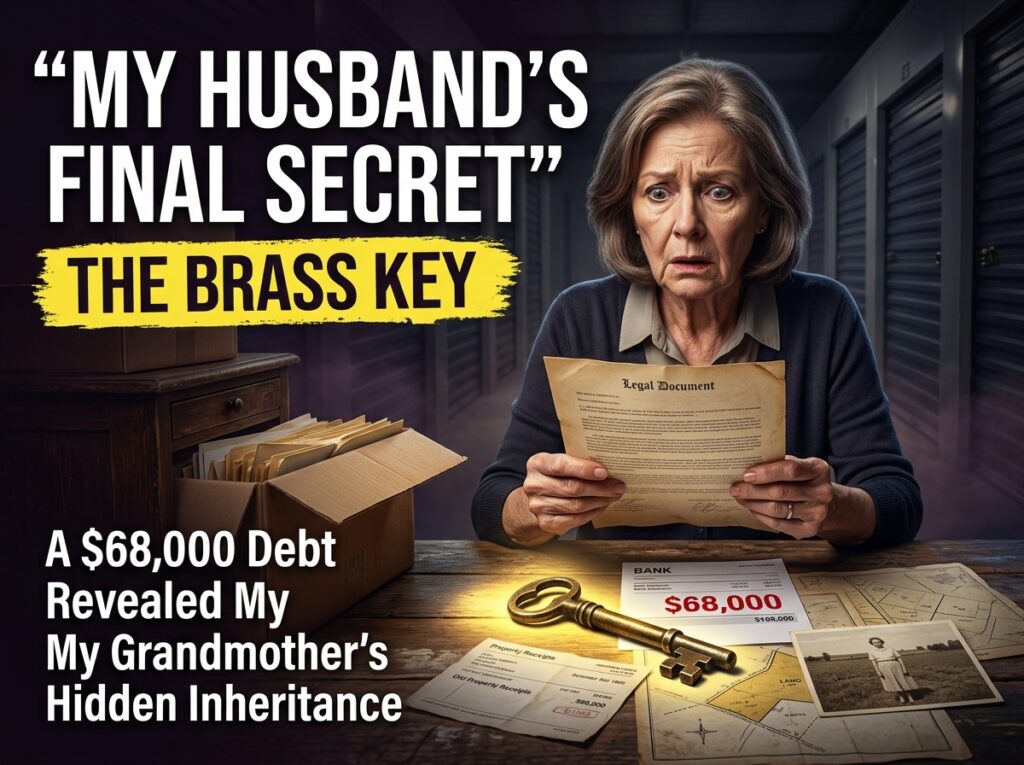
The morning after my husband’s funeral, I discovered that grief could be interrupted by a knock at the door.
For seven days, I had lived in a strange, quiet world where people brought casseroles, spoke in hushed voices, and told me how lucky I had been to spend forty-two years married to a good man. They said Daniel had been dependable, generous, and devoted to his family. They told me to rest, to take my time, and to remember the happy years.
I tried.
At seventy-four, I had expected to grow old beside him. We had talked about the little things we would do when work and family responsibilities no longer demanded so much of our time. We would visit the coast again, plant roses in the back garden, and spend more afternoons with our grandchildren.
We had made plans as if time were something we could arrange neatly on a calendar.
Then Daniel died at seventy-seven, and every plan became a reminder of what I had lost.
The knock came at ten in the morning.
When I opened the door, a man in a dark suit stood on the porch holding a leather folder.
“Mrs. Whitmore?”
“Yes.”
“My name is Andrew Collins. I’m a representative of the bank that holds your late husband’s outstanding loan.”
I looked at him without understanding.
“What loan?”
He opened the folder and showed me a statement.
The balance was $68,000.
For several seconds, I thought I had misread the number.
“I’m sorry,” I said. “There must be a mistake. My husband and I paid our mortgage off years ago. We don’t have a loan like this.”
“The loan was taken out recently,” he explained. “The bank’s records show that Mr. Whitmore borrowed the money to purchase a parcel of land.”
“Land?”
“Yes, ma’am.”
I took the statement from him.
Daniel had never mentioned purchasing land. We had discussed investments before, of course, but we had always agreed that we would not take on a substantial debt without talking to each other.
I read the document again.
The loan had been approved several months earlier. Payments had been made from an account I did not recognize, and the remaining balance was now due according to the terms of the agreement.
“Did my husband use our home as security?”
“No. The loan appears to have been secured against the parcel of land itself. However, the estate may have obligations that need to be reviewed.”
I gripped the doorframe.
“I don’t understand why he would do this.”
“I appreciate that this is difficult, Mrs. Whitmore. The bank is prepared to provide copies of the relevant documents to your solicitor.”
After he left, I sat at the kitchen table and placed the statement beside Daniel’s untouched coffee mug.
His reading glasses were still on the windowsill. A shopping list in his handwriting remained attached to the refrigerator with a small magnet shaped like a lemon.
Those ordinary things seemed impossible to reconcile with the number on the paper.
Sixty-eight thousand dollars.
I called our solicitor, who had helped us prepare our wills and settle the mortgage years earlier. She advised me not to pay anything until the estate’s obligations had been properly reviewed.
“You need to establish what the loan was for, whether the land was properly purchased, and whether the estate is legally responsible for the balance,” she said. “Don’t let anyone pressure you into making a payment before we understand the documents.”
I thanked her and ended the call.
Then I went upstairs to Daniel’s study.
He had always been organized. Bills were filed by month, insurance policies were kept in labeled folders, and every important document had a designated place. If he had borrowed $68,000, there should have been a file explaining why.
I searched his desk, the filing cabinet, and the drawers beneath the bookshelf.
I found tax returns, old bank statements, receipts for the car, and the paperwork from our house renovation. There was nothing about a land purchase.
By late afternoon, I began to wonder whether Daniel had hidden the loan because he knew I would object.
The thought hurt more than I expected.
We had disagreed about money before. I preferred to keep our savings accessible, while Daniel liked making long-term plans. But he had never made a major financial decision without discussing it with me.
At least, I had never believed he had.
That evening, our daughter, Rebecca, came over with groceries.
When I told her about the bank representative, she stared at me in disbelief.
“Dad borrowed sixty-eight thousand dollars?”
“That’s what the statement says.”
“For land?”
“Yes.”
She put the grocery bags on the counter.
“Did he ever mention anything about buying property?”
“No.”
“Maybe it was an investment.”
“Then why didn’t he tell me?”
Rebecca sat beside me.
“I don’t know, Mum.”
I wanted her to tell me that everything would make sense eventually. Instead, she looked as frightened as I felt.
After she left, I returned to Daniel’s study.
I opened the bottom drawer of his desk, which had been stuck for years. It moved only after I pulled hard on the handle.
Inside were old envelopes, a broken pen, and a small brass key taped to the bottom of a folded piece of paper.
The envelope had my name written across it.
Not Daniel’s.
Mine.
I peeled back the tape carefully. Inside was a single note in his handwriting.
“Don’t pay the loan until you open this.”
Beneath those words was a number.
No address. No explanation. Just a storage-unit number and a brass key.
I sat at the desk for a long time, listening to the house settle around me.
Daniel had known I would find the loan.
He had also left instructions telling me not to pay it until I opened whatever this key belonged to.
I looked at the note again.
If the land purchase had been a simple investment, why would my husband have left me a warning?
And why had he written my name on the envelope instead of his own?
For the first time since his death, I felt something stronger than grief.
I felt afraid of what I might discover about the man I had loved for forty-two years.
<h2>Part 2</h2>
I spent the next morning trying to identify the storage facility.
The number on Daniel’s note was incomplete. It consisted of three digits followed by a letter, with no street name or company logo. I searched through his address book and old calendars, but I found nothing that connected him to a storage business.
For a while, I wondered whether the number was a code rather than a unit reference.
Then I remembered a conversation from the previous winter.
Daniel had been sitting in his favorite chair, reading a newspaper, when he mentioned that he needed to collect something from storage.
“What storage?” I had asked.
“Just an old box of paperwork,” he replied.
“Why don’t you bring it home?”
“Because I have to sort through it first.”
I had been preparing dinner and barely paid attention.
“Sort through what?”
“Family documents.”
He had folded the newspaper and changed the subject.
At the time, I thought he was referring to old photographs or the boxes of papers we had kept after moving out of our first house. Daniel was sentimental about family history. He saved letters, wedding invitations, and even handwritten recipes from relatives who had died decades earlier.
Now I wondered whether he had been talking about the storage unit.
I called three facilities in the neighboring towns. None recognized the number. The fourth had changed ownership, and its records were incomplete. The fifth was too far away to make sense of the little information I had.
By lunchtime, I was exhausted.
I made tea, sat at the kitchen table, and studied the brass key.
It was heavier than an ordinary household key. Its surface was darkened with age, and a small number had been stamped near the bow.
1983.
I rubbed my thumb over the digits.
Why would a storage key have a year stamped on it?
I remembered the bank statement again. The land purchase was recent, but the key seemed much older. Had Daniel kept it for decades before finally using it?
I called Rebecca.
“Do you remember Dad mentioning a storage unit?”
She thought for a moment.
“He had boxes in a storage facility when we moved out of the old house. That was years ago.”
“Do you remember where?”
“I think it was near the industrial estate. Why?”
“I found a key in his desk.”
I heard her take a breath.
“Mum, are you sure you should be doing this alone?”
“I don’t know what else to do.”
“Let me come over.”
When she arrived, she examined the key and the note.
“Maybe Dad was storing something valuable,” she said.
“Then why didn’t he tell me?”
“Maybe he wanted to surprise you.”
I looked at her.
“Does a surprise usually come with a $68,000 debt?”
She gave me a small, apologetic smile.
“No.”
We searched the internet together and found an old business directory listing several storage facilities that had operated in the region since the early 1980s. Most had closed or been absorbed by larger companies.
One name caught my attention: Westbridge Storage.
It was located near an industrial estate about forty-five minutes from our home. The company had been operating for decades, although its website showed a modern building and no reference to its earlier premises.
I called the office.
A young man answered.
“Westbridge Storage. How can I help?”
I explained that my late husband might have rented a unit many years earlier and gave him the number stamped on the key.
He asked for Daniel’s full name.
When I told him, the keyboard stopped clicking.
“Could you hold for a moment, please?”
I waited, gripping the telephone.
A minute later, another voice came on the line. It belonged to an older woman.
“Mrs. Whitmore, my name is Helen. We have some archived records from the previous facility. Could you tell me when your husband might have rented the unit?”
“I don’t know. The key has the number 1983 on it, but I think he may have used it much later.”
She asked me to read the unit reference again.
Then she said, “I believe we may have a match, but the unit number was transferred during a change in ownership. We need to verify the records before allowing access.”
“Can I come in today?”
“You may come in to discuss it. Please bring identification, your husband’s death certificate, and the key.”
I thanked her.
Rebecca offered to drive me, but I told her I needed a little time to prepare.
That evening, I gathered the documents and placed them in a folder.
Before going to bed, I returned to Daniel’s study and opened the drawer where I had found the key. I searched the other envelopes more carefully.
One contained a photograph of Daniel standing beside a small wooden building. He looked younger, perhaps in his forties. The photograph had no date, and I could not identify the location.
On the back, he had written three words.
Keep it safe.
I turned the photograph over again.
The building stood beside a patch of open ground. There were trees in the distance, and a narrow dirt road crossed the foreground.
Something about the scene felt familiar, though I couldn’t say why.
I placed the photograph beside the key.
The next morning, I drove to Westbridge Storage.
The facility was larger than I expected, with long rows of metal doors and a reception area that smelled faintly of dust and disinfectant. Helen met me at the counter and examined my identification before leading me into a small office.
She had found a record showing that a unit had been rented under Daniel’s name several years earlier. The reference number matched the note, although the unit had since been reassigned in the company’s system.
“We’ll need to verify that the contents haven’t been affected by the transfer,” she explained. “The older records are incomplete, but the key may still work.”
She handed me a form.
I signed it, and she took me through a security door into the storage area.
The corridors were narrow and cool. Metal doors lined both sides, each bearing a number. I followed Helen past several rows until she stopped beside a door near the end.
“This is the unit associated with your husband’s old account.”
My hands trembled as I inserted the brass key.
It turned.
The door rolled upward with a low metallic rattle.
Inside were cardboard boxes stacked almost to the ceiling, several plastic containers, and a folded table covered with dust. A smell of old paper and dry wood drifted into the corridor.
I stood at the entrance, unable to move.
Daniel had been here.
He had opened these boxes, handled these papers, and chosen not to tell me what they contained.
Helen offered to leave me alone while I looked through the unit.
I thanked her and stepped inside.
The first box held family photographs and old letters. The second contained tax documents and receipts from the 1980s. The third was filled with maps, some folded into squares and others rolled inside cardboard tubes.
I recognized Daniel’s handwriting on several labels.
Then I found a folder marked with my maiden name.
My fingers went cold.
I had not used that name for more than forty years.
Inside the folder were copies of old land records, a faded photograph of my grandmother, and a letter dated decades earlier.
At the top of the letter was the name of a lawyer I had never heard of.
The first paragraph mentioned a parcel of land that had once belonged to my grandmother.
I read it twice.
My family had always told me that my grandmother lost her property before I was born. According to my mother, there had been a dispute over money, and the land had eventually passed into someone else’s hands.
The story had been repeated so often that I had never questioned it.
Yet Daniel had stored documents about that very property for years.
I sat on a box and stared at the letter.
Why had he kept it?
Why had he borrowed money to purchase a parcel of land connected to my grandmother?
And why had he left the key for me rather than explain the truth himself?
As I searched the remaining folders, I found a bank statement dated shortly before Daniel’s death.
The loan balance was listed at the top.
$68,000.
Below it was a reference number and a handwritten note.
Do not complete the transfer until Claire has seen the original.
I read the sentence again.
The transfer.
Not the payment.
Daniel had apparently intended for something to happen after I opened the storage unit.
But what?
I gathered the papers and continued searching until I found a thick envelope at the bottom of a box.
It contained a lawyer’s letter referring to an unresolved inheritance dispute.
My name appeared in the second paragraph.
I stared at it until the words blurred.
Daniel had not merely hidden a property purchase from me.
He had hidden a legal matter involving my own family.
And somewhere among those boxes was the reason he had believed I needed to discover it for myself.
<h2>Part 3</h2>
I returned to the storage facility the following morning with two empty folders, a notebook, and a list of questions.
I had barely slept.
Every time I closed my eyes, I saw my grandmother’s photograph beside the old land records. I remembered my mother’s voice explaining that the property had been lost long before I was born. She had spoken about it as an unfortunate family matter, something that could no longer be changed.
I had accepted her explanation because I had no reason not to.
Now I wondered whether the story had been repeated so often that even those telling it had begun to believe it.
Helen unlocked the unit and left me to work.
I organized the documents by date. The earliest records were from 1983, the year stamped on the key. They included handwritten notes, copies of correspondence, and a rough map showing a parcel of land near a country road.
The property was smaller than I had imagined. It appeared to consist of a few acres, with a narrow access road and a boundary that followed a stream.
There were no buildings marked on the original map.
I found a later survey showing changes to the boundary, but the copy was faded. Several handwritten annotations referred to a family name I recognized from old conversations: Mercer.
My grandmother’s maiden name was Mercer.
I turned to the next document.
It was a letter addressed to my mother, dated shortly after my grandmother’s death. The paper had yellowed, and the edges were brittle.
Dear Mrs. Whitmore,
We are writing to confirm that the matter concerning your mother’s land remains unresolved. The transfer recorded in the public register may not reflect the full circumstances under which the property was removed from her estate.
I stopped reading.
The letter continued with a warning that any claim would require original documents and evidence establishing the family’s rights.
At the bottom, someone had written in pencil:
Do not discard the original deed.
I searched the box again.
There was no original deed.
Instead, I found a series of receipts showing that someone had paid legal fees over several years. Some bore Daniel’s name. Others were addressed to my grandmother’s estate.
The payments were small at first, then larger as time passed.
I called the solicitor’s office that had handled Daniel’s estate.
A receptionist transferred me to a woman named Patricia, who explained that she had assisted with his affairs before his death.
“Did Daniel tell you about the land?” I asked.
She hesitated.
“I knew there was a property matter, but I wasn’t responsible for the original case.”
“Did he say why he borrowed $68,000?”
“He told us it was connected to acquiring an interest in a parcel of land. He wanted to make sure the transaction was properly documented.”
“Did he say the land belonged to my grandmother?”
There was a pause.
“I believe he mentioned that your family had an unresolved claim.”
“Why didn’t anyone tell me?”
“Mr. Whitmore asked that you be given the original documents before any further action was taken. He was concerned that you might make a decision before seeing the full history.”
I closed my eyes.
“Did he explain what decision?”
“No. He said you would understand once you had read the documents.”
I thanked her and ended the call.
Daniel had known I would be confused. He had known the papers might upset me. Yet he had left me to discover everything after he was gone.
I could not decide whether that had been an act of trust or another form of secrecy.
Later that afternoon, I found an old photograph of my grandmother standing beside a wooden fence. She was younger than I remembered her, wearing a light-colored dress and holding a hat against the wind.
Behind her stretched an open field.
On the reverse, Daniel had written a date: June 1983.
Beneath it were the words:
The last day she believed the land was hers.
I sat very still.
I had been a child when my grandmother died, and my memories of her were scattered fragments: the smell of her kitchen, her warm hands, the way she sang while folding laundry. I had never understood that she might have been carrying a fight over land that continued long after her death.
I searched the remaining folders for the original deed.
Instead, I found a copy of a document signed by two witnesses. The text was partly obscured by water damage, but a paragraph near the bottom remained legible.
It referred to an agreement between my grandmother and another member of the Mercer family.
The date was June 1983.
The signature beneath the agreement looked like my grandmother’s.
But there was a problem.
According to the family story, she had already lost the land by then.
I placed the document beside the letter from the lawyer.
The dates did not make sense.
If the property had been transferred before my grandmother’s death, why was she signing an agreement concerning it afterward? And if she still had rights to the land, why had my family insisted she had lost everything?
I needed someone who understood the legal history.
I called the number printed on the lawyer’s letter. The firm no longer existed, but an automated message provided the contact details of a successor practice.
A receptionist took my information and promised that someone would call me back.
An hour later, a solicitor named Michael Reed returned the call.
He explained that the original firm had been dissolved decades earlier, but some archived files had survived.
“I can’t promise we have your grandmother’s case,” he said. “However, the reference number on the letter appears to correspond with an inheritance dispute involving the Mercer family.”
“Can you tell me who brought the claim?”
“I would need to review the file.”
“My husband had documents from 1983. He borrowed $68,000 shortly before he died to purchase the land.”
Michael was quiet for a moment.
“Mrs. Whitmore, I think you should bring those documents to my office before taking any further steps. If the property is subject to an unresolved claim, there may be important restrictions on what can be transferred.”
I looked toward the boxes.
“Do you think my grandmother really lost the land?”
“I cannot answer that from a telephone conversation.”
“Then what can you tell me?”
“That the records you have described suggest the history may be more complicated than your family was led to believe.”
I made an appointment for the following week.
Before leaving the storage unit, I placed the documents in chronological order and locked the door.
As I walked toward the reception area, Helen called my name.
“Mrs. Whitmore, I thought you should know something.”
She showed me an archived rental record.
Daniel had not rented the unit only once.
He had renewed the agreement repeatedly over many years, including a renewal just three months before his death.
I looked at the signature.
It was unmistakably his.
My husband had not forgotten the boxes.
He had deliberately kept them.
And whatever he was trying to protect—or prepare me for—had mattered enough for him to preserve the evidence until the very end.
<h2>Part 4</h2>
Michael Reed’s office occupied the second floor of an old brick building near the town center.
I arrived early, carrying the folders in a canvas bag. The receptionist offered me tea, but I declined. My hands were already trembling, and I did not want to spill anything over the documents.
Michael was a careful man in his fifties, with silver at his temples and a habit of reading every page before speaking.
He examined the letter, the maps, and the copies of the old agreements.
After nearly forty minutes, he leaned back in his chair.
“The first thing you need to understand is that a family story and a legal record are not necessarily the same thing,” he said. “Your grandmother may have lost possession of the land without losing every legal interest in it. Alternatively, the original transfer may have been valid but subject to conditions that were never properly resolved.”
“So the land might still have belonged to her?”
“It might have remained subject to a claim. We need the original deed, the complete transfer record, and any documents explaining how the property was handled after her death.”
I showed him Daniel’s recent bank statement.
“What about the loan?”
“The loan is a separate issue. Borrowing money to purchase an interest in disputed land does not automatically establish ownership. We need to see exactly what Daniel purchased, from whom, and under what terms.”
I felt a cold knot forming in my stomach.
“Are you saying my husband might have paid $68,000 for something he couldn’t legally own?”
“I’m saying we cannot determine what he acquired until we examine the transaction.”
He returned to the papers.
The earliest records suggested that my grandmother, Eleanor Mercer, had owned the parcel jointly with her younger brother, Thomas. A later document indicated that Thomas had taken responsibility for certain expenses connected to the property.
Then came a transfer recorded in the public register.
According to the copy, the land had passed into another person’s name.
But there was no complete record explaining whether Eleanor had consented to the transfer, whether she had been paid, or whether any conditions had been attached to the transaction.
Michael pointed to the lawyer’s letter.
“This is likely why the dispute remained unresolved. Someone appears to have challenged the transfer, but I cannot yet tell you whether the claim was formally pursued to completion.”
“Why would my family say my grandmother lost the land?”
“They may have believed that the recorded transfer settled the matter. Or they may have known there were complications and chosen not to discuss them.”
His answer offered no comfort.
I thought of my mother repeating the story when I was young. She had never sounded angry about the land. She had spoken of it with a kind of tired acceptance, as though it were an old disappointment best left alone.
Could she have known more than she told me?
Michael asked whether I had any living relatives who might remember the original dispute.
“My mother’s sister died years ago. I have a cousin, Margaret, but we haven’t spoken much since our parents passed away.”
“Would she have access to family documents?”
“I don’t know.”
“Then it may be worth contacting her. But first, we need to establish what your husband actually purchased.”
He copied the reference numbers and arranged to request the surviving records.
Before I left, he asked me one question.
“Did Daniel explain why he wanted you to see these documents before the loan was paid?”
“No. He left a note telling me not to pay the loan until I opened the storage unit.”
Michael considered this.
“That suggests he believed the documents were material to the decision. It doesn’t tell us whether he intended you to repay the loan, challenge it, or take some other action.”
I nodded slowly.
For the first time, someone had acknowledged that Daniel’s instruction might have been about protecting me rather than confusing me.
Still, I could not shake the feeling that he had left me standing at the edge of a story whose most important chapter was missing.
That evening, I called my cousin Margaret.
She answered with surprise.
“Claire? I haven’t heard from you in ages.”
We exchanged a few awkward pleasantries before I mentioned my grandmother’s land.
The silence on the other end was immediate.
“What have you found?” she asked.
I gripped the phone.
“Why are you asking me that?”
“Because I thought nobody was looking at those papers anymore.”
I sat down.
“You knew about the dispute?”
“I knew there had been a dispute. My father used to talk about it when he was angry, but he wouldn’t explain everything.”
“What did he say?”
“That Eleanor had been cheated out of something. Then, years later, he said the matter had been settled and that nobody should bring it up again.”
“Who settled it?”
“I don’t know.”
I asked whether she had any documents.
She said she would look through her father’s old belongings.
Before we ended the call, she said something that stayed with me.
“Claire, if Daniel was involved, he must have had a reason. Your husband wasn’t the kind of man who spent money without knowing what he was doing.”
I almost laughed at the irony.
“I thought I knew him too.”
“I didn’t mean to upset you.”
“You haven’t.”
But after we hung up, I sat alone for a long time.
The man I had trusted most in the world had borrowed a substantial amount of money without telling me. He had preserved decades of documents in a storage unit. He had arranged for me to find the key only after his death.
I could not deny that he had hidden something important.
Yet the more evidence I found, the less I believed he had acted carelessly.
He had kept the papers in order. He had preserved the old legal correspondence. He had renewed the storage contract. And he had left a specific instruction about the debt.
Perhaps he had been preparing for a decision he knew I would eventually have to make.
The following morning, Michael called.
“We’ve located an additional reference in the archived index,” he said. “It relates to a document that was deposited with the county records office but never included in the file we received.”
“Can we obtain it?”
“We’ve submitted a request. There may be restrictions because it concerns an inheritance dispute.”
“How long will it take?”
“I can’t say. But there is another matter we need to discuss.”
He paused.
“The record suggests that the property may have been transferred subject to a condition involving the descendants of Eleanor Mercer.”
I stared at the wall.
“What condition?”
“We don’t know yet.”
My grandmother had been dead for decades. Daniel was gone. And the answer I needed seemed to be buried in a document nobody had examined in years.
I thanked Michael and ended the call.
Then I opened the old photograph of my grandmother again.
She stood in the field with her hat held against the wind, looking directly at the camera.
For the first time, I wondered whether she had known that the land might one day return to her family.
And whether Daniel had spent the final years of his life trying to make that possible.
<h2>Part 5</h2>
The document from the county records office arrived four days later.
Michael asked me to come to his office rather than discuss it over the telephone. When I arrived, he had placed a sealed envelope on the desk.
“This is a certified copy of a declaration associated with the original property transfer,” he explained. “It doesn’t resolve the entire dispute, but it provides information that wasn’t included in the earlier file.”
He opened the envelope.
The declaration was dated June 1983. It referred to Eleanor Mercer and her brother, Thomas, and described a temporary arrangement concerning the parcel of land.
According to the document, Thomas had been authorized to manage certain matters on Eleanor’s behalf while she dealt with a personal difficulty. The arrangement was not intended to transfer her entire interest in the property permanently.
But a later registration appeared to treat the transaction as a full transfer.
I read the paragraph several times.
“So my grandmother didn’t necessarily lose the land?”
“Correct. This document raises serious questions about the circumstances of the transfer. However, we still need to establish whether the declaration remained legally effective and how subsequent events affected the title.”
“Who signed it?”
“Your grandmother, your great-uncle, and two witnesses.”
I studied the signatures.
One of the witnesses was a solicitor whose name appeared on the earlier correspondence.
The other was unfamiliar.
“Why wasn’t this included in the original records?”
“That is what we need to establish. It may have been held separately, misfiled, or excluded from a later transaction. We should not assume misconduct until the full history has been examined.”
I understood the caution, but the discovery shook me.
For decades, my family had told a simple story: my grandmother had lost the land, and nothing could be done about it.
Now I had a document suggesting that the truth had been more complicated.
Michael turned to another page.
“There is also a reference to an intended beneficiary.”
“Who?”
He looked at me.
“The document refers to Eleanor’s granddaughter, Claire.”
My own name seemed strange on the page.
I had been a child when the arrangement was created. I had known nothing about the land, the legal dispute, or the promise attached to it.
“Why would my grandmother name me?”
“We don’t yet know. It may have been part of an estate-planning arrangement or a future interest in the property. The full instrument is necessary to determine what it means.”
I thought of Daniel’s note.
Don’t pay the loan until you open this.
He had known my name appeared in the records.
He had known that the property was connected to my grandmother.
And he had wanted me to see the documents before making any payment.
Michael advised me to contact the bank through my solicitor and request that collection activity be paused while the underlying transaction was reviewed. He also recommended that I avoid making statements about ownership until the records were complete.
I agreed.
That afternoon, I returned to the storage unit and searched for anything connected to the declaration.
Behind a box of old receipts, I found a smaller envelope marked For Claire — original documents.
Inside was a handwritten letter from Daniel.
The paper was dated only three months before his death.
My dearest Claire,
If you are reading this, I have not managed to explain everything to you myself. I am sorry for that.
I have spent years trying to understand what happened to your grandmother’s land. I believed for a long time that the family story was true, because it was the only story anyone was willing to tell.
Then I found a record that changed everything.
I borrowed the money because I needed to secure an interest in the property while the legal position was reviewed. I did not want to make a claim against your family or put anyone at risk. I wanted to preserve the possibility that something taken from your grandmother might one day be restored.
I know you will be angry that I did not tell you. I was afraid of raising your hopes before I knew whether the documents would stand up to scrutiny.
Please do not pay the loan simply because someone tells you it is owed. Read the papers. Ask the questions I should have asked sooner. Let the truth decide what happens next.
I love you.
Daniel.
I read the letter with tears running down my face.
He had not hidden the debt because he thought I was incapable of understanding it. He had hidden it because he had been uncertain whether the land could ever be recovered.
But his silence had left me to face the uncertainty alone.
I folded the letter carefully and placed it in my bag.
Then I noticed a final line written beneath his signature.
If the original declaration is missing, look for the blue folder.
I searched the boxes again.
There was no blue folder.
I checked every shelf, opened every container, and examined the space beneath the folded table.
Nothing.
I was about to give up when I noticed that one of the cardboard boxes was heavier than the others. Its bottom had been reinforced with a second layer of cardboard.
I lifted the contents out and turned the box over.
A narrow envelope had been taped underneath.
Inside was a small index card with a name and an address.
The name belonged to Thomas Mercer’s former solicitor.
Beneath it, Daniel had written:
Ask whether the original was ever returned.
I called Michael and read him the details.
He recognized the solicitor’s name. The man had died years earlier, but his files had been transferred to another firm.
Michael agreed to contact the successor practice.
Before we ended the call, he said, “Claire, there is something else. The $68,000 may not simply be the price Daniel paid for the land. The transaction records suggest it could also have involved the settlement of an older obligation.”
I looked down at the loan statement.
“What obligation?”
“We need the original contract to establish that.”
I put Daniel’s letter beside the statement.
The debt was no longer just an unexplained financial burden.
It was part of a transaction connected to a family inheritance, an uncertain property transfer, and a promise made more than forty years earlier.
And the missing original might be the only document capable of explaining how all three were connected.
<h2>Part 6</h2>
The successor law firm found a reference to Thomas Mercer’s file, but the original papers had been transferred more than once.
Michael submitted a formal request for the surviving documents. While we waited, he asked me to provide a complete list of everything I had found in the storage unit.
I spent an entire afternoon preparing it.
The task brought back memories of my early marriage to Daniel. We had lived in a rented apartment then, saving carefully for our first house. Daniel had been the person who kept receipts and organized our bills, while I managed the household and worked part-time.
We had built our life one careful decision at a time.
I had always trusted him because he had never treated our money as his alone.
That was why the $68,000 loan had hurt so deeply.
Yet his letter showed that he had been wrestling with a problem he did not know how to explain. He had feared raising my hopes, feared reviving an old family conflict, and feared losing the opportunity to secure the land while the legal dispute remained unresolved.
I could understand those fears without agreeing with his decision.
One afternoon, Rebecca came over and found me surrounded by documents.
“Have you eaten anything?” she asked.
“I had toast.”
“When?”
I looked at the clock.
“Some time this morning.”
She took the papers from my hands and carried them to the sideboard.
“Mum, you can’t spend every waking hour doing this.”
“I need to understand what Dad did.”
“You need to understand it, yes. But you don’t have to do it all today.”
I leaned back in the chair.
“I keep thinking that if he had told me, we could have worked through it together.”
Rebecca sat opposite me.
“Maybe he thought he was protecting you.”
“That’s what everyone says.”
“Do you think he wasn’t?”
I looked at Daniel’s letter.
“I think he was. I also think he was wrong.”
Rebecca nodded.
“Both things can be true.”
Her words stayed with me long after she left.
For weeks, I had been trying to decide whether Daniel’s secrecy was evidence of betrayal or love. Perhaps it was neither in its simplest form. Perhaps it was a frightened decision made by someone who wanted to do the right thing but could not face the possibility of being wrong.
That did not make the debt disappear.
It did, however, help me remember the man beyond the documents.
Two days later, Michael called with news.
The successor firm had located part of the original solicitor’s correspondence. The file contained a letter from Thomas Mercer discussing the temporary arrangement made with Eleanor.
It also contained a reference to a sealed document that had been returned to the family after the dispute was paused.
The recipient’s name was missing from the surviving copy.
“Could it have been my grandmother?” I asked.
“Possibly. But we cannot establish that from this letter alone.”
“Could it have been Daniel?”
“Not according to the date. The document was returned decades before Daniel became involved.”
I felt disappointed, though I did not know what I had expected.
Michael explained that the records indicated a settlement had been discussed but not fully documented in the surviving file. There were references to money changing hands, but no complete account of the final transaction.
It was possible that the original deed had been returned to Eleanor or another member of the family. It was also possible that it had been deposited elsewhere.
I asked whether the lawyer’s office had a record of the blue folder mentioned in Daniel’s note.
“No,” Michael replied. “But the reference to the sealed document gives us another avenue to investigate.”
I thanked him.
That evening, I called my cousin Margaret again.
She had found a box of her father’s papers in the attic.
“I haven’t opened everything,” she said, “but there are some letters here with your grandmother’s name.”
“Could you look for anything dated around 1983?”
“I’ll try.”
She called back the next afternoon.
“I found a letter from my father to your mother. It mentions the land, and it says that the family should not discuss the matter until the original papers had been located.”
I closed my eyes.
“Did it say where the papers were?”
“No. But there’s another sentence. It says that Eleanor wanted the documents kept somewhere only her granddaughter would think to look.”
I gripped the phone.
“Her granddaughter?”
“That is what it says.”
I asked Margaret to send me a copy.
When the letter arrived, I read it several times. The handwriting was my uncle’s, but the sentence was unmistakable.
Eleanor insists that the original must remain with the person who will understand what it represents. She has named her granddaughter, Claire, as the person who should receive it when the time is right.
I could hardly breathe.
My grandmother had died when I was young. I had no memory of her discussing property with me, and I had never been told that she had chosen me to receive any document.
I called Michael.
He listened as I read the letter aloud.
“This is important evidence of the family’s intentions,” he said. “But we still need to locate the original and determine its legal effect.”
“Where would she have kept it?”
“I can’t know that.”
I thought of the photograph in the storage unit, the one showing my grandmother beside a wooden building.
Then I remembered something from my childhood.
My grandmother had owned a small writing desk with a hidden compartment. She used to tell me that the most important things were not always kept in the biggest drawers.
After she died, the desk had gone to my mother.
And after my mother’s death, it had disappeared.
I called my cousin again.
“Do you remember what happened to Grandma’s writing desk?”
Margaret said she thought my mother had given it away years earlier.
“To whom?”
“I don’t know. Perhaps to a secondhand furniture dealer when she moved house.”
I stared at the letter.
If the original document had been hidden in the desk, it might have been lost decades ago.
But Daniel had kept a photograph of the land, a key to the storage unit, and records spanning more than forty years.
He had known where to look.
And he had left me a clue that suggested he expected me to find the next one.
<h2>Part 7</h2>
I spent the next three days trying to trace my grandmother’s writing desk.
The furniture dealer my mother had used was no longer in business. The building had been converted into offices, and the old business records had been discarded when the owner retired.
I called the local auction houses and described the desk: dark oak, brass handles, a narrow writing surface, and a hidden compartment beneath the top drawer.
Most people had no idea what I was talking about.
One woman remembered a similar piece being sold at an estate auction, but she could not confirm the date.
I began to wonder whether I was chasing another dead end.
Then I found a photograph in an old family album.
It showed my grandmother’s desk in the corner of her sitting room. On the wall above it hung a small framed picture of the land. The frame had a distinctive carved border, and the photograph appeared to be the same one Daniel had kept in storage.
I examined the image closely.
Beside the desk was a small wooden cabinet with a glass door. I remembered it from childhood. My grandmother had kept her letters and photographs inside, along with a few books and a porcelain clock.
I called Margaret.
“Do you remember the little cabinet beside Grandma’s desk?”
“Vaguely. Why?”
“Do you know what happened to it?”
She thought for a moment.
“My father kept it after Grandma died. It was in his study for years. I think he gave it to my brother when he moved.”
“Can you ask him?”
“I’ll try.”
The next morning, Margaret called back with a name and telephone number.
Her brother, Stephen, still had the cabinet.
I explained why I was looking for it.
He was silent for a moment.
“Are you talking about the cabinet with the glass door?”
“Yes.”
“I still have it in the spare room. Why?”
I told him about the documents and the possibility that my grandmother had hidden something connected to the land.
“I never noticed anything unusual,” he said. “But you’re welcome to come and look.”
I drove to his house that afternoon.
The cabinet was smaller than I remembered, its dark wood worn smooth along the edges. Stephen opened the glass door and removed several books and a stack of old envelopes.
There was nothing behind them.
I checked the shelves and the back panel. I examined the drawers beneath the cabinet, but they were ordinary storage spaces filled with miscellaneous papers.
Then I noticed a narrow wooden strip along the bottom.
It was slightly loose.
I pressed it with my thumb.
The strip moved inward with a faint click.
Behind it was a shallow compartment.
Inside lay a sealed envelope.
My name was written on the front.
I sat down.
The handwriting was my grandmother’s.
For a moment, I could not bring myself to open it. I had spent weeks looking for documents that might explain a secret I had never known existed. Now I was holding something my grandmother had apparently intended for me personally.
Stephen stood quietly nearby.
“Do you want me to leave?”
“No,” I said. “Please stay.”
I opened the envelope carefully.
Inside was a letter and a folded sheet of paper bearing an official stamp. The letter was short.
My dear Claire,
If this reaches you, the time has come for you to understand what happened to our land.
I was told that I had lost it. I was told that the matter was finished and that no one in the family should speak of it again.
But I never agreed to surrender everything that belonged to me.
The enclosed document explains what I was promised and what I intended to preserve for you. Do not accept another person’s version of the story without reading the original.
Your grandmother,
Eleanor.
I unfolded the second paper.
It appeared to be a certified extract from a property agreement. Several sections were difficult to read, but one paragraph referred to a continuing interest in the land.
The document was dated 1983.
My hands shook.
Stephen leaned forward.
“Is that what you were looking for?”
“I think so.”
I took photographs of the pages and sent them to Michael.
His reply came within twenty minutes.
Please do not alter, mark, or separate the document from the envelope. Bring both to my office as soon as possible.
I placed the papers back inside and closed the envelope.
For the first time, I felt that the pieces might finally fit together.
My grandmother had preserved the document. My uncle had known it existed. Daniel had spent years tracing the records and had borrowed money to acquire an interest in the property.
But one question remained.
If my grandmother had intended the land to pass to me, why had my family insisted that she had lost it?
And if the original document proved that the property remained subject to her rights, why had nobody acted on it before Daniel did?
The following morning, Michael examined the original.
He compared the stamp, the signatures, and the wording with the surviving records.
“This is significant,” he said. “It appears to be an authentic document connected to the original arrangement. However, we still need to verify its status and determine how later transactions affected it.”
“Does it mean I own the land?”
“I cannot say that yet. It may establish a continuing interest or a right that survived the transfer, but the full legal history must be reviewed.”
I nodded.
I had learned not to mistake a promising document for a final answer.
Michael arranged for the paper to be examined and requested the remaining title records.
Before I left, he returned the envelope to me in a protective sleeve.
“Your husband was right to tell you not to pay the loan before examining the evidence,” he said.
I looked at Daniel’s handwriting on the envelope.
“He should have told me himself.”
“Yes,” Michael replied. “But whatever his reasons, the instruction gave you an opportunity to understand the transaction before making a decision.”
I carried the document home.
That evening, I placed it beside Daniel’s letter and the brass key.
For the first time, I could see a possible connection between everything he had left me.
The loan.
The land.
The old storage unit.
The document my grandmother had hidden.
Daniel had not left me a solution.
He had left me the evidence I needed to ask the right questions.
And the answers were finally within reach.
<h2>Part 8</h2>
The legal review took several weeks.
Michael explained that the original document needed to be compared with the registered title, the later transfer, and the records connected to Daniel’s purchase. Each document answered one question while raising another.
The most important issue was whether my grandmother’s continuing interest had survived the later transfer and whether that interest could still be enforced.
I tried not to become impatient.
I had spent most of my life believing that the land was gone. A few weeks of waiting should not have felt unbearable, but the closer I came to understanding the truth, the more difficult it became to tolerate uncertainty.
During that time, the bank continued asking for information about Daniel’s loan.
Michael sent a formal notice explaining that the transaction was under review and that I was obtaining advice about the estate’s obligations. He requested copies of the original loan agreement, the purchase contract, and the documents showing what interest Daniel had acquired.
The bank cooperated, although it made clear that the outstanding balance remained subject to the loan’s terms until the matter was resolved.
I was grateful that Michael handled the correspondence. I did not want fear or grief to push me into making a financial decision I might later regret.
Meanwhile, Rebecca helped me organize Daniel’s remaining papers.
One evening, she found an old notebook tucked inside a box of tax returns.
“Have you seen this?”
I shook my head.
It was Daniel’s handwriting, dated several years earlier. The entries recorded telephone calls, meetings, and payments related to the property.
I sat beside her and began reading.
The notes showed that Daniel had contacted several offices while trying to locate the original agreement. He had spoken to retired solicitors, requested copies of public records, and written to people who might have known my grandmother.
He had been investigating the matter long before he borrowed the $68,000.
The final entries were especially revealing.
Original document may still exist.
Claire’s name appears in the declaration.
Need to establish what can be secured before transfer.
And then, written several months later:
Loan completed. Do not let Claire pay before she sees everything.
I covered my mouth.
Daniel had not made the purchase on a whim. He had spent years researching the land and trying to understand the legal history.
But the notebook also showed that he had been uncertain.
Some entries ended with question marks. Others referred to missing records and conflicting explanations. He had written down the advice he received, then returned to the same questions weeks later.
He had been trying to solve a puzzle with incomplete pieces.
“Why didn’t he tell you?” Rebecca asked.
“I don’t know.”
“Maybe he thought he could finish it first.”
“That seems to be what he wanted.”
She turned another page.
“Look at this.”
A name appeared beside a telephone number.
Thomas Mercer.
It was followed by a note:
Family representative at time of transfer. Possible explanation for missing deed.
I stared at the name.
Thomas was my grandmother’s younger brother, the man named in the original agreement. He had died many years earlier.
Could he have known that the transfer was incomplete? Had he tried to correct it? Or had he been the person responsible for the confusion?
The surviving documents did not provide an answer.
I called Michael the next morning and told him about the notebook.
He asked me to send copies of the relevant pages.
“These notes help establish Daniel’s understanding of the transaction,” he said. “They may also identify additional records we should request.”
He arranged for a title specialist to review the documents alongside the original declaration.
Several days later, Michael called me into his office.
The title specialist had identified a discrepancy between the registered transfer and the earlier agreement. The transfer appeared to describe a more extensive interest than the agreement authorized.
However, another later document complicated the picture. It suggested that someone had attempted to settle the dispute, but the surviving record did not show whether the settlement had been completed.
Michael placed the papers side by side.
“If the settlement was completed and legally effective, the later transfer may be valid despite the earlier discrepancy,” he explained. “If it was not, your grandmother’s rights may have continued. We need the missing settlement record to establish which situation applies.”
“Can we find it?”
“We have requested records from the relevant archive. We are also checking whether the original solicitor’s firm retained a closing ledger.”
I looked at the papers.
For decades, my family had treated the matter as settled. Yet the official records suggested that the most important step might never have been properly documented.
I thought of Daniel spending evenings in his study, reading the same letters and comparing the same dates.
He must have felt the same frustration I did.
Every answer seemed to lead to another missing piece.
Before I left, Michael showed me the latest bank documents.
The loan agreement identified the seller as a company that had acquired an interest in the parcel after the original transfer.
Daniel had paid $68,000 to secure that interest.
The purchase did not automatically establish ownership of the entire property. It did, however, give him a contractual position that could be relevant to the unresolved dispute.
“Your husband’s transaction may have been an attempt to prevent the interest from passing elsewhere while the title was reviewed,” Michael said. “But we need the complete contract and the seller’s authority before drawing conclusions.”
I thought of Daniel’s letter.
I wanted to preserve the possibility that something taken from your grandmother might one day be restored.
He had tried to preserve a possibility.
He had not known whether it would succeed.
And now, after his death, I had to decide whether to continue the work he had begun.
I left Michael’s office and sat in my car for several minutes.
The $68,000 debt was still real. The missing settlement record was still missing. And my grandmother’s land remained tied to a dispute that had outlived almost everyone who remembered its beginning.
But I was no longer simply trying to understand why my husband had borrowed the money.
I was trying to establish what my grandmother had actually lost—and whether the family story that had shaped my life had ever been true.
<h2>Part 9</h2>
The missing settlement record was found in a collection of documents transferred to a county archive after the closure of the original solicitor’s office.
Michael received a preliminary copy and asked me to meet him immediately.
When I arrived, he was reading the document with a concentrated expression.
“This appears to be the settlement reference we’ve been looking for,” he said. “But I want to be careful about what it proves.”
The record referred to an agreement made after the original transfer. It listed payments, legal expenses, and a commitment to resolve the outstanding property interest.
However, the final section was incomplete.
There was no clear confirmation that the required payment had been made, nor was there a signed release showing that Eleanor had surrendered every remaining claim.
Michael explained that the absence of a release did not automatically mean the claim remained valid. Other evidence might establish that the settlement had been completed. But without the missing documentation, the family’s long-standing account of the matter could not be accepted as a complete legal history.
“So we still don’t know whether my grandmother lost the land?”
“We know that the transfer was more complicated than your family story suggests. We also know that the surviving documents leave a material question unresolved.”
I looked at the papers.
For the first time, I understood why Daniel had kept searching for so long. He had found enough evidence to believe there was something worth protecting, but not enough to be certain that he could recover it.
The loan had allowed him to acquire an interest connected to the property, yet it had not erased the uncertainty.
“What happens now?” I asked.
“We continue the review. We need to establish the seller’s authority, the status of the original agreement, and the legal effect of the incomplete settlement record. Only then can we advise you about the loan and any possible claim.”
I nodded.
That evening, I sat at home with Daniel’s letter in front of me.
I read it slowly, paying attention to the sentences I had rushed through before.
He had written that he was afraid of raising my hopes before he knew whether the documents would stand up to scrutiny.
I finally understood the fear behind his decision.
He had wanted to give me back something he believed my family had lost. He had also known that if he failed, I would be left with a debt, disappointment, and questions about his judgment.
He had tried to protect me from that possibility by keeping the matter private.
Instead, his silence had made the loss of him more complicated.
I missed the man who would have sat beside me at the kitchen table and listened while I explained every document. I missed his habit of asking me to read important letters aloud because he liked hearing another person’s interpretation. I missed his quiet confidence, even when he was worried.
I also missed the chance to tell him that I would rather have faced the uncertainty with him than discover it alone after his death.
The following week, the bank provided additional correspondence related to Daniel’s purchase. It confirmed that the loan had been used for the transaction described in the contract.
There was no evidence in the records reviewed so far that the money had been used for an unrelated purpose.
That was reassuring, but it did not answer whether the transaction had been legally sound.
Michael advised me not to make any voluntary payment until the estate’s position had been properly assessed. He also explained that I should not assume the debt automatically became my personal responsibility simply because I was Daniel’s wife. The outcome would depend on the loan terms, any guarantees, the estate’s assets, and applicable law.
I followed his advice.
As the weeks passed, I began to accept that the investigation might not produce a simple answer. It might establish that my grandmother had a valid continuing interest, or it might show that later events had lawfully ended her rights.
Either outcome would require me to confront the past.
But I had stopped expecting the documents to tell me that everyone had been innocent or that one person had deliberately caused every problem.
Families were rarely that simple.
My grandmother might have signed an agreement without understanding every consequence. My great-uncle might have believed he was acting in the family’s best interests. My mother might have repeated the story she had been given. Daniel might have tried to correct an injustice without knowing whether the law would allow it.
And I might have accepted the family story because questioning it would have meant questioning the people I loved.
One afternoon, Michael called with an update.
“The archive has confirmed that the original deed referenced in your grandmother’s letter was deposited with a separate custodian,” he said. “We are attempting to locate the complete file.”
“Does that mean the original still exists?”
“It means there is a record that it was deposited. We have not yet confirmed its current location.”
I closed my eyes.
After everything we had found, the most important document was still missing.
Michael promised to continue the search.
When I hung up, I returned to the storage unit one last time to make sure we had not overlooked anything.
I checked the boxes, examined the folders, and looked beneath the table.
Everything had been catalogued.
There were no additional papers.
But as I prepared to leave, I noticed the photograph of my grandmother beside the wooden building.
I held it beneath the light.
On the back, beneath the words Keep it safe, Daniel had added a small reference number.
It matched the number on the incomplete settlement record.
I called Michael immediately.
He asked me to read the number again.
Then he went quiet.
“That reference may connect the photograph to the missing file,” he said. “We need to compare it with the archive’s index.”
For a moment, I felt hope rise again.
The document might still be found.
The question of the land might finally be answered.
But I had learned enough not to mistake a clue for a conclusion.
I placed the photograph in my bag and locked the storage unit.
Whatever the records eventually proved, I would not let anyone rush me into paying a debt or abandoning a claim before I understood what Daniel had actually purchased.
He had left me an instruction.
I intended to follow it.
<h2>Part 10</h2>
Michael called the following morning.
“The reference number you found matches an entry in the archive index,” he said. “We have located a file associated with the original deed. I can’t confirm that it contains the complete document yet, but we should know more after the archive examination.”
I sat down at the kitchen table.
“Can I see it?”
“Once the archivist has verified the file and we have permission to inspect it.”
“How long?”
“A few days, perhaps longer.”
I thanked him and ended the call.
Then I looked at Daniel’s photograph again.
For years, I had believed that the land belonged to a past my family had already explained. My grandmother had lost it. The dispute had ended. The property had passed into other hands.
There had been nothing left to investigate.
That was the story I had inherited.
Now I understood that I had inherited something else as well: a question that no one had been willing to answer.
I spent the next several days going through my grandmother’s old letters. Some were ordinary notes about birthdays and family visits. Others contained references to the land, though none explained the final settlement.
In one letter, she mentioned that she hoped to see the property again before she died.
In another, she wrote that she was tired of people telling her what had happened without showing her the papers.
I read that sentence several times.
It sounded like something I might have said myself.
Perhaps my grandmother had known more than the family realized. Perhaps she had understood that a document could be more reliable than the explanations people offered to make a painful story easier to accept.
I wished I had asked her about the land when I was young.
But I had been a child, and the adults had made the matter sound finished. By the time I was old enough to ask questions, my grandmother was gone, and my mother had moved on to other responsibilities.
The family story had become part of our history simply because nobody challenged it.
On the fourth day, Michael called again.
“The archive has confirmed that the file contains an additional document,” he said. “We have arranged an inspection.”
I felt my heart begin to race.
“Is it the original deed?”
“I cannot say until we examine it.”
He asked me to come to his office the next morning.
I barely slept that night.
At breakfast, I placed Daniel’s letter beside the brass key and read his instructions one more time.
Please do not pay the loan simply because someone tells you it is owed. Read the papers. Ask the questions I should have asked sooner. Let the truth decide what happens next.
I had followed those instructions as carefully as I could.
I had not paid the loan.
I had found the storage unit.
I had uncovered the old agreements, the lawyer’s correspondence, and the document my grandmother had hidden.
Now I was about to see the final piece of the record.
The next morning, I arrived at Michael’s office carrying the original envelope and the photograph of my grandmother.
He greeted me and led me into a meeting room.
On the table lay a sealed archive folder.
An archivist had confirmed that it contained a document associated with the original land transaction. The paper had been preserved separately from the later transfer records, which explained why earlier searches had failed to locate it.
Michael opened the folder carefully.
Inside was a document bearing my grandmother’s name.
I leaned forward.
The first page contained the familiar description of the parcel of land, the original boundary measurements, and references to the temporary arrangement made in 1983.
The second page included a declaration concerning the intended beneficiary.
My name appeared in the text.
I read the paragraph slowly, then returned to the beginning and read it again.
The wording was not enough, by itself, to establish that I owned the land. Michael explained that the legal effect would depend on the full document, the subsequent transactions, and whether the relevant conditions had been satisfied.
But the document clearly contradicted the simple version of events I had heard throughout my life.
My grandmother had not merely lost the property and walked away.
There had been an arrangement involving her continuing interest and a future beneficiary.
And the beneficiary named in that arrangement was me.
I looked at Michael.
“Why would my family tell me she lost everything?”
He did not pretend to know.
“People sometimes simplify complicated events over time. Sometimes they misunderstand what happened. Sometimes they choose not to discuss matters they find painful. We need more evidence before deciding which explanation applies here.”
I nodded, although I felt as if the room had shifted around me.
Michael turned to the final page.
There was a reference to another document that should have accompanied the declaration. The reference number matched the one Daniel had written on the back of the photograph.
But the accompanying document was not in the folder.
The archivist had found a record indicating that it had once been attached to the file. There was no note explaining when it had been removed or where it had gone.
I stared at the empty space in the folder.
Even now, the truth was incomplete.
Michael explained that the legal review would continue. The bank would need to be given the verified documents, the estate’s position would need to be assessed, and the property records would have to be examined before anyone could determine what rights remained.
There was no guarantee that the land would return to my family.
There was no guarantee that the $68,000 loan could be set aside.
But there was finally evidence that the story I had believed for decades was not the whole truth.
I left Michael’s office carrying copies of the verified documents.
On the drive home, I thought about Daniel.
He had known enough to believe that the land mattered. He had borrowed the money, preserved the papers, and left me the key because he wanted me to see the evidence for myself.
He had not been able to complete the work.
Now it was my responsibility to decide what to do with what he had left.
When I reached home, I placed the brass key, the old photograph, and the copies of the documents on the kitchen table.
I opened Daniel’s letter one last time.
For a long while, I sat without moving.
I was still grieving my husband. I was still frightened by the debt. And I was still trying to understand why the people who raised me had told me that my grandmother’s land was gone forever.
But I was no longer willing to accept that explanation simply because it was familiar.
I opened the folder to the final document.
The wording was formal, the handwriting faded, and the reference numbers difficult to follow. Yet one paragraph stood out clearly enough to make me stop breathing for a moment.
It referred to an agreement that had supposedly ended my grandmother’s interest in the property.
The date was wrong.
The signature was not where the records said it should have been.
And the final line contained a condition that appeared to have been ignored in every account of the dispute I had ever heard.
I read it once.
Then again.
My grandmother’s land might never have been lost in the way my family had always claimed.
Daniel had spent years trying to understand that possibility.
And the document in front of me suggested that the truth had been hidden in the records all along.
I closed the folder and looked at the brass key.
My husband had left me a debt, a key, and an instruction.
I had opened the storage unit.
I had found the documents.
Now I finally understood why he had asked me not to pay the loan before reading them.
The debt was only the beginning.
The real inheritance was the truth my family had spent decades avoiding.
And as I looked at the final document once more, I realized that the story I had believed about my grandmother—and the land she had supposedly lost before I was born—might never have been true at all.