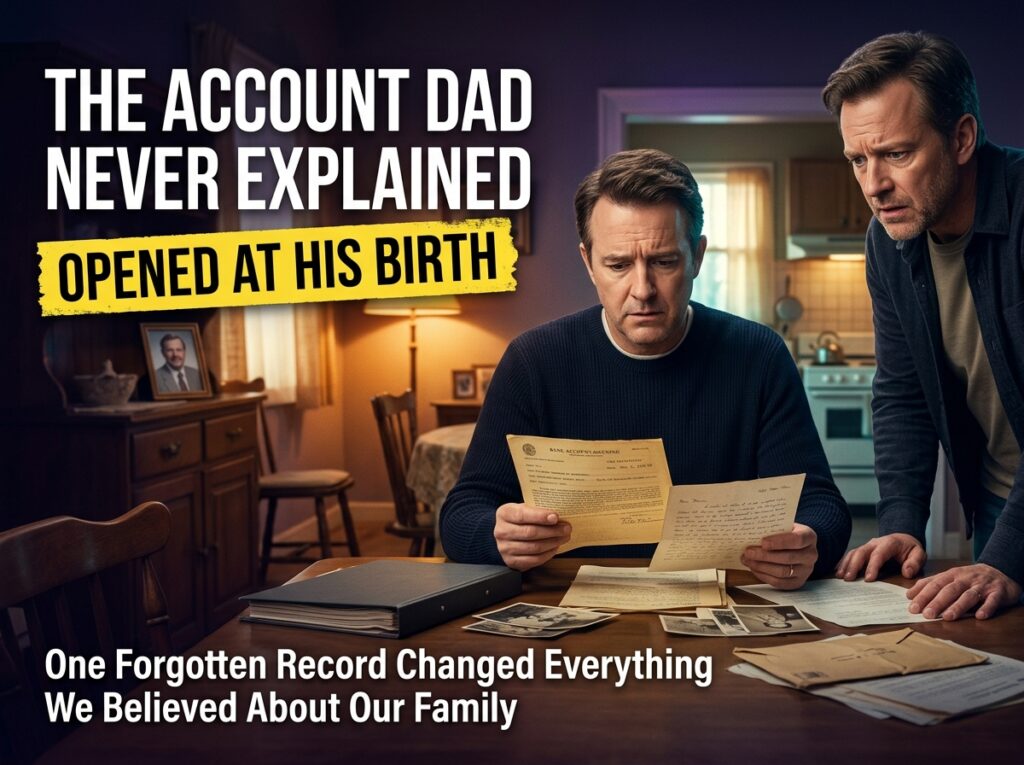
I never cared much about family wealth.
If you had asked me what I wanted from my family, I would have told you I wanted the old photographs, the stories around the dining table, and a reason for everyone to keep coming home.
I wanted to hear my father’s laugh from the kitchen again. I wanted my brother, Daniel, to stop checking his watch whenever he visited. I wanted my sister, Claire, to put her telephone away long enough to listen to a story she had probably heard a hundred times.
Most of all, I wanted the family home to remain a place where nobody needed to prove what they were worth.
My father, Thomas, had believed in that idea, too—or at least I thought he had.
He spent nearly forty years working as a maintenance supervisor for a manufacturing company. He was not wealthy, but he was careful with money. He repaired broken furniture instead of replacing it, kept every important receipt in labeled envelopes, and regarded unnecessary debt as a personal insult.
When I was a child, he used to sit at the dining table on Sunday evenings, sorting through household bills while my mother prepared tea.
“Money isn’t the thing that makes a family,” he would tell us. “But the way people behave when money appears will tell you a great deal about them.”
Daniel usually rolled his eyes.
“That’s because you never let us buy anything,” he would reply.
My father would smile without looking up.
“And yet, somehow, you’re still alive.”
Those conversations belonged to a happier time, before my parents grew old, before family visits became complicated, and before every discussion about the future seemed to end with somebody feeling accused.
My father died in the early autumn, after a short period of declining health. He had spent his final weeks at home, surrounded by familiar furniture and the photographs he had collected throughout his life.
I was there when he took his last breath.
Daniel arrived later that evening. Claire came the following morning.
We stood together in the living room, looking at the framed photographs on the mantelpiece. One showed us as children beside our parents at a seaside holiday. Daniel was missing a front tooth, Claire had her arms wrapped around our mother’s waist, and I was holding a wooden boat my father had carved for me.
For a moment, we were simply three children who had lost their father.
Then Daniel asked about the will.
I remember how quickly the question changed the room.
“Have you heard anything from the solicitor?” he asked.
I shook my head.
“Not yet.”
“He told me Dad had sorted everything out years ago.”
“Then we should wait until we know what the documents say.”
Daniel looked at me with an expression that suggested I had deliberately avoided answering.
“Easy for you to say.”
I did not understand what he meant.
Our father had never promised me an inheritance. He had never told me that I would receive the house or a particular amount of money. If anything, he had spent years reminding us that we should build our own lives rather than depend on what our parents might leave behind.
I had taken him at his word.
Daniel, however, seemed to have a different understanding.
At the first family meeting with the solicitor, he sat forward in his chair and listened as the estate was explained. The documents were ordinary enough: household possessions, savings, the family home, and a few remaining financial obligations.
There was no spectacular fortune.
There was no hidden mansion or investment portfolio.
My father had lived carefully, and what remained reflected a lifetime of work rather than extraordinary wealth.
Daniel looked almost offended.
“So that’s it?” he asked.
The solicitor explained that the documents before us represented the estate being administered, subject to the usual checks.
Daniel shook his head.
“Dad told me there would be something else.”
“What something else?” I asked.
He ignored me.
He insisted that our father had promised him a larger share. He claimed there had been conversations about a separate account and said he had spent years believing that his father intended to recognize his contribution to the family.
I asked whether he had anything in writing.
He looked at me as if I had betrayed him.
“Not everything in a family needs to be written down.”
“Then how are we supposed to know what Dad intended?”
“Because I was the one who spoke to him.”
I wanted to remind Daniel that I had spoken to our father, too. I had driven him to appointments, helped repair his house, and spent countless afternoons listening to his memories.
But I knew that listing my own sacrifices would accomplish nothing.
Instead, I asked the solicitor to explain the documents again.
After the meeting, Daniel cornered me outside the building.
“You always do this,” he said.
“Do what?”
“Act as if everything has to be proved before you believe me.”
“I believe you think Dad promised you something. That isn’t the same as knowing what he actually intended.”
His expression hardened.
“He left me nothing.”
“We haven’t even finished reviewing the records.”
“Exactly. And you seem perfectly happy to let everyone forget what he owed me.”
I watched him walk away.
That evening, I returned to the family home and opened the old photograph album.
I found the seaside photograph and sat with it for a long time.
I remembered my father’s hands guiding mine as I learned to repair the wooden boat. I remembered Daniel laughing when I dropped it in the bath. I remembered our mother telling us that one day we would look back and understand how fortunate we had been.
I had never thought those memories needed a financial explanation.
But as I turned the pages, I began to wonder why Daniel was so certain our father had left him something important.
And why he seemed frightened that the rest of us might never find it.
The next morning, a message arrived from the family solicitor.
He had been contacted by our father’s accountant, who wanted to review an additional set of historical financial records before the estate administration proceeded further.
The message did not mention an inheritance.
It did not mention a fortune.
It simply said that the accountant had identified a transaction requiring clarification.
I called the office to arrange a meeting.
The receptionist gave me an appointment for the following afternoon.
Before ending the call, she added one sentence.
“The accountant asked us to tell you that the original account was opened on a date that may be significant to your family.”
I asked which date.
She checked her notes.
“It was opened on the day your brother Daniel was born.”
I stood very still.
Until that moment, I had believed our father’s estate was a straightforward matter of dividing what remained and preserving the memories that mattered.
Now I realized that a financial record connected to Daniel’s birth had survived for decades.
And nobody in the family had ever mentioned it.
<h2>Part 2</h2>
The accountant’s office was on the second floor of a narrow building above a pharmacy.
I arrived ten minutes early and spent most of that time watching people pass the window. A delivery driver carried boxes into the shop below. Two women stopped to discuss something on a telephone. An elderly man struggled with an umbrella that refused to close.
Ordinary life continued, and I envied everyone who seemed to have nothing more complicated to worry about than getting home before the rain.
At half past two, a woman opened the office door.
“Are you Thomas’s son?”
I nodded.
“I’m Margaret Ellis, the accountant who handled some of your father’s financial affairs.”
She was in her late sixties, with silver hair tied neatly behind her head and a pair of reading glasses hanging from a chain around her neck. Her office was crowded with filing cabinets, paper folders, and boxes labeled with dates.
She offered me a seat.
“I should begin by explaining that I cannot make assumptions about what your father intended,” she said. “My responsibility is to establish what the records show.”
“That’s all I want.”
She gave me a searching look.
“Your brother may feel differently.”
I wondered whether Daniel had already contacted her.
“Has he spoken to you?”
“Yes. He called yesterday and asked whether I had discovered anything that would support his understanding of your father’s wishes.”
“What did you tell him?”
“That I was reviewing the records and would not reach a conclusion before the review was complete.”
She opened a folder.
Inside were photocopies of bank statements, old account-opening forms, and handwritten notes. Some pages were yellowed with age, while others appeared to have been copied from documents stored digitally.
Margaret explained that my father had maintained several accounts during his lifetime. Most were ordinary household accounts, but one historical record did not fit the pattern.
It was the account opened on Daniel’s birth date.
“Why wasn’t it included in the initial estate paperwork?” I asked.
“Because the account does not appear to have been active in the ordinary sense for many years. The original bank’s surviving records are incomplete, and there was no obvious reason to connect it with your father’s estate until I found a reference in his personal papers.”
She slid a page toward me.
The document showed the account-opening date, the account holder’s name, and a handwritten notation beside the signature.
My father’s name was printed at the top.
Below it was a reference to a second person whose details had been partially obscured by an old fold.
“Was this a joint account?” I asked.
“The surviving form suggests that another person was associated with the arrangement, but I cannot yet confirm the precise legal status. We need the original bank records or a certified archival copy.”
I studied the page.
There was something familiar about the handwriting beside the signature.
It looked like my father’s, but the letters were narrower, more deliberate.
“Do you know who opened it?”
“The account was opened in your father’s name. That much is clear. The remaining documentation may establish who was present and what instructions were given.”
“And the money?”
Margaret placed another sheet on the desk.
The records indicated that funds had been deposited over time. There were references to periodic contributions, but the surviving statements did not provide a complete transaction history.
I had expected to find a large balance.
Instead, I found a collection of incomplete entries that raised more questions than they answered.
“Could the account have been closed?” I asked.
“Possibly. But the records we have do not establish that conclusively.”
“Could the money have been transferred elsewhere?”
“That is another possibility.”
“Then how can we know whether it was an inheritance?”
Margaret folded her hands.
“We cannot call it an inheritance simply because an account existed. We need to establish who owned the funds, what happened to them, and whether your father left any valid instructions concerning them.”
I appreciated her honesty.
For the first time since my father’s death, I felt that someone was willing to admit what was unknown rather than filling the gaps with confident guesses.
She turned to another document.
“This is where the matter becomes more complicated.”
The paper was a photocopy of an old letter, dated several months after the account had been opened.
It was addressed to my father and signed by a person whose name I recognized immediately.
Our mother.
She had died years earlier, and I had never seen the letter before.
Margaret explained that it had been found among papers stored with the historical account records.
The letter referred to the importance of keeping certain financial arrangements separate from the family’s ordinary savings. It mentioned a promise made around the time of Daniel’s birth.
But the language was indirect.
There was no explicit declaration that Daniel owned the account.
There was no clear statement that the money belonged to me or to our sister.
Instead, our mother had written that the arrangement should be reviewed when the children were old enough to understand the circumstances.
I read the sentence twice.
“Why would she write this?”
Margaret shook her head.
“I can tell you what the document says. I cannot tell you why your mother chose those words.”
I asked whether there were other letters.
She nodded.
“There is one more document I would like you to see, but I want you to understand that it may change how you interpret the first.”
She removed a folded sheet from a separate envelope.
The paper had been carefully preserved.
At the top was a date that fell less than a week after Daniel’s birth.
Below it, our father had written a sentence in his familiar handwriting.
If anything happens to me, make sure the children are told why this account exists before anyone signs a final settlement.
I looked up.
“Who was supposed to tell us?”
Margaret pointed to the bottom of the page.
There was a name written beside the instruction.
It was not my father’s.
It was not our mother’s.
And it was not Daniel’s.
It belonged to someone I had always believed was merely an old family friend.
<h2>Part 3</h2>
I recognized the name as soon as I saw it.
George Whitmore had been my father’s closest friend for much of his adult life. He lived three streets away when we were children and often joined us for Sunday dinner.
He was the sort of man who remembered birthdays without needing a calendar. He brought small gifts for the children, helped my father repair the garden fence, and sat with our mother whenever my father worked late.
After our mother died, George continued visiting.
He attended family gatherings, helped organize the funeral, and checked on my father when the house became too quiet.
I had always regarded him as part of the family.
But I had never known that my father had entrusted him with an instruction concerning a bank account opened on Daniel’s birth date.
“Is George still alive?” I asked.
Margaret nodded.
“According to the contact information attached to the old file, he is. I have not spoken to him about the account.”
“Why not?”
“Because I wanted to understand the available documentation first. I also needed to establish whether contacting him would interfere with the estate process.”
I stared at the name.
“Do you think he knows what happened to the money?”
“I think he may know why your father established the arrangement. That is different from knowing what happened to the account afterward.”
I understood the distinction.
Still, I felt an urgent need to speak with George.
Before leaving the office, I asked Margaret to make copies of the documents I was entitled to receive. She agreed and reminded me not to treat an incomplete financial record as proof of wrongdoing.
“I don’t intend to accuse anyone,” I told her.
“I hope you won’t. Families often suffer more from assumptions than from the original problem.”
I carried the copies home in a plain folder.
That evening, I spread them across my dining table.
My father’s letter lay beside our mother’s note, and the account-opening form sat between them.
I tried to reconstruct the day Daniel was born.
I had been too young to understand the financial circumstances, but I remembered the excitement in our house. Our mother had returned home carrying a small bundle wrapped in a pale blanket. My father had stood beside her, looking exhausted and happier than I had ever seen him.
Daniel had been a quiet baby at first.
Our father used to hold him near the window and talk to him about the garden.
“You’re going to grow up strong,” he would say. “And you’re going to learn that being a good man means more than having money.”
I had never connected those memories with a bank account.
I wondered whether the account had been intended to provide for Daniel’s future.
Perhaps our father had started saving for his youngest child.
Perhaps he had made an arrangement with George to ensure that the money would remain protected.
But if that were true, why had Daniel spent years insisting that our father had left him nothing?
And why had he become so angry when the estate documents failed to show the inheritance he expected?
I called him.
He answered on the second ring.
“Have you found something?” he asked.
His question came so quickly that I knew he had been waiting for my call.
“I found an account opened on the day you were born.”
There was silence.
Then he said, “What kind of account?”
“I don’t know yet. Margaret is still reviewing the records.”
“Did she show you the opening form?”
“Yes.”
“Was Dad’s signature on it?”
“Yes.”
Another silence followed.
“Did you find George’s name?”
I sat up straighter.
“How do you know George is involved?”
Daniel exhaled.
“I remember Dad mentioning him when I was younger.”
“What exactly did Dad say?”
“That George had helped him with something important.”
“What something?”
“I don’t know.”
I could hear the frustration in his voice, but I could also hear something else.
Fear.
“Daniel, why have you been telling everyone Dad left you nothing?”
“Because that’s what the estate papers say.”
“But you believed there was something else.”
“I was told there was something else.”
“By whom?”
He hesitated.
Then he said, “I need to speak to George.”
I felt a chill move through me.
“Why?”
“Because if he is the person Dad named, he may be the only one who can explain what the account was meant to do.”
I asked Daniel whether he had known about the account before our father’s death.
He said he had heard a reference to it years earlier, but he had never seen a statement or an account number.
He had assumed it was part of our father’s ordinary savings.
When the estate papers showed no separate inheritance, he became convinced that something had been withheld.
He had not known whether the account had been closed, transferred, or simply forgotten.
I asked why he had not contacted George himself.
“Because I didn’t want to involve him without knowing what I was accusing anyone of.”
For the first time, I understood that Daniel’s anger might have come from uncertainty rather than greed alone.
He believed our father had made a promise.
He had no proof that the promise had been fulfilled.
And the more the family dismissed his questions, the more determined he became to find an answer.
Before ending the call, I told him I intended to speak with George.
Daniel asked me to let him know what I learned.
I agreed.
The next morning, I drove to George’s house.
I found him sitting at a small table near the front window, reading a newspaper.
He looked older than I remembered, but his expression was unchanged.
When he saw me, he smiled.
“Come in,” he said. “I was wondering when one of you would visit.”
I stopped in the doorway.
“What do you mean?”
George folded the newspaper carefully.
“I mean your father always said this day might come.”
He looked toward the chair opposite him.
“Sit down. I think it’s time I told you why he opened that account.”
<h2>Part 4</h2>
George did not begin with money.
He began with a memory.
The year Daniel was born had been one of the most difficult periods of my parents’ marriage. My father had been working long hours, our mother had been struggling with health problems, and the family finances were tighter than anyone wanted to admit.
My father had recently discovered that an important contract at work might be canceled. The loss would not have destroyed us immediately, but it threatened the savings he had set aside for the children’s education and the house.
At the same time, George was facing difficulties of his own.
His wife had been ill, and he had accumulated debts covering medical expenses and missed work. He feared losing the home where his children had grown up.
My father and George had been friends for years. They had helped each other through ordinary troubles, but this crisis was different.
Both men needed money.
Neither wanted to ask his family for help.
“They were proud men,” George said. “Sometimes too proud for their own good.”
I asked what the account had to do with Daniel’s birth.
George explained that my father had proposed a formal arrangement.
Rather than lending George money directly and leaving the terms to memory, he wanted a separate account where contributions and repayments could be recorded.
The arrangement would protect both families.
If George recovered financially, he would repay what he could.
If my father’s work situation improved, he would continue setting aside money for his children.
The account would provide a record of what each person contributed and what remained outstanding.
It was intended to prevent a friendship from being damaged by uncertainty.
“That sounds sensible,” I said.
“It was,” George replied. “At first.”
He explained that the account’s opening date coincided with Daniel’s birth because my father had chosen that day to formalize the arrangement.
He wanted to remember the beginning of his son’s life as a moment when he had made a commitment to the future.
The account was not simply a savings fund for Daniel.
It was a record of an agreement between two families, with the possibility that any remaining money might eventually be used for the children’s benefit.
That distinction explained some of the confusion.
Daniel had been told about an account associated with his birth, but he had never been given the full explanation.
He had assumed that the money belonged to him.
Our father had never made that promise.
“Then why did Dad say the children should be told about it?” I asked.
George looked down at his hands.
“Because the arrangement changed.”
He explained that my father and George had initially agreed to review the account after several years. But George’s financial difficulties lasted longer than expected, and repayments became irregular.
Eventually, the account’s purpose expanded.
It was used to record contributions, repayments, and certain expenses connected with the original agreement. The records were no longer as straightforward as either man had intended.
My father became concerned that the account might eventually be misunderstood.
He wrote the instruction to make sure the children learned the truth before anyone signed a final settlement.
But then our mother became ill.
The family focused on her care, and the financial review was postponed.
After she died, my father could not bring himself to reopen the subject.
“He told me he would explain everything when the time was right,” George said. “But every time he thought about doing it, he worried that someone would misunderstand and accuse the other family of taking advantage.”
I thought of Daniel’s anger.
He had spent years believing he was owed something that had been hidden from him.
George had spent years believing he was protecting the memory of a friendship.
My father had spent years hoping the records would eventually explain themselves.
Nobody had intended for the account to become a source of division.
But because nobody had explained it properly, it had become exactly that.
I asked George whether he knew the account’s current balance.
He shook his head.
“I haven’t seen a statement in years. Your father told me that the records were being reviewed, but he never said what the final position was.”
“Did he tell Daniel about it?”
“Not directly. I think he mentioned the account to him once, perhaps when Daniel was asking about the future. I warned your father that the explanation was incomplete.”
“Why didn’t you tell us?”
George looked genuinely ashamed.
“Because your father asked me not to speak until he had gathered the records. I believed he would do it himself.”
“And then he died.”
George nodded.
“And then he died.”
The room fell quiet.
I looked at the framed photographs on the wall. One showed George standing beside my father at a family gathering decades earlier.
They were both smiling.
I realized that I had spent years thinking of my father’s financial life as something simple: a collection of savings, debts, and decisions that could be understood by reading a will.
But a person’s financial history was also a history of relationships.
Money moved because people trusted one another, made promises, faced difficulties, and sometimes failed to keep proper records.
The account might contain money that belonged to someone.
It might contain funds already repaid.
It might contain an unresolved obligation.
We could not know until the records were complete.
George stood and went to a cabinet.
He returned with a small envelope.
“Your father gave me this several years ago,” he said. “He told me to keep it until the family was ready to review the account.”
My name was written on the front.
I recognized my father’s handwriting.
“Why didn’t you give it to me when he died?”
“Because I thought the account would be reviewed first. I didn’t want the letter to influence the process.”
I took the envelope.
The paper was still sealed.
Before I left, George made one final request.
“Whatever the records show, don’t let this become a fight about who deserves more. Your father wanted the account understood, not used as a reason to divide the family.”
I promised to remember his words.
But as I drove home, I wondered why my father had addressed the envelope to me rather than Daniel.
If the account had begun on Daniel’s birth date, and Daniel believed it was connected to his inheritance, why had our father entrusted the final explanation to me?
I placed the envelope on the passenger seat.
I had a feeling that the answer would change the way I understood my father’s intentions.
<h2>Part 5</h2>
I waited until I reached home before opening my father’s envelope.
The letter inside was dated five years earlier, written during a period when his health had begun to decline but he was still living independently.
It began with an apology.
I should have explained the account to you a long time ago. I kept believing that if I waited until the records were complete, I could tell the story without hurting anyone. Instead, the years passed, and my silence allowed everyone to imagine a different story.
I read the paragraph twice.
My father had understood the danger of leaving the arrangement unexplained.
He had simply failed to find the courage to resolve it.
The letter continued.
He explained that the account had never been intended to represent a guaranteed inheritance for Daniel. It had begun as a practical arrangement between two families and had gradually acquired a symbolic meaning because of the date on which it was opened.
Daniel’s birth had given my father a reason to think about the future.
He wanted his son to grow up with opportunities that he himself had not enjoyed. He wanted to save money for education, a first home, and the unexpected difficulties that life might bring.
But he had also wanted to help George through a financial crisis.
The account had been created to keep those purposes separate.
Over time, the distinction became blurred.
My father had continued making deposits when he could. George had made repayments when his circumstances allowed. Some funds had been used for the original obligation, while others were intended to remain available for future family needs.
The records were supposed to make the arrangement clear.
Instead, incomplete documentation had allowed different expectations to develop.
Daniel believed the account represented a promise of financial security.
George believed it was evidence of a friendship that had survived a difficult period.
My father knew that neither interpretation fully described the arrangement.
He had intended to explain this to us, but he had postponed the conversation repeatedly.
The next paragraph was addressed directly to me.
You have always been the one who asks questions even when everyone else would prefer to move on. I sometimes found that difficult, but I also trusted your judgment. If I am no longer here when the account is reviewed, I want you to help the family understand what happened without deciding in advance who is right or wrong.
I put the letter down.
I had spent much of my adult life trying to keep peace between my siblings. I often agreed to things I disliked because I did not want another family argument.
My father knew that about me.
He also knew that I could become stubborn when I believed something was unfair.
He was asking me to do something harder than choose a side.
He was asking me to discover the truth without allowing my affection for any one person to determine what I believed.
The letter continued with instructions to contact the accountant, obtain the original transaction records, and make sure that any remaining obligations were handled properly.
Then I reached the final page.
My father had written about the photographs in the family album.
He said that when he thought about what he would leave behind, he worried less about the money than about the memories that might be lost when people became angry with one another.
He remembered the years when we all gathered around the same table, arguing about food, laughing at old jokes, and making plans for the future.
He wanted those traditions to survive.
But he knew that memories could not be used to excuse dishonesty.
Do not preserve peace by pretending that something is true when it is not. If the account belongs to someone, make sure that person receives what is rightfully theirs. If the money has already been repaid, do not let anyone demand it again. And if we cannot establish the answer, be honest about what we do not know.
The final sentence was simple.
I hope you will remember that your brother is more than what he believes he is owed.
I sat quietly for a long time.
Daniel’s anger had frustrated me, but I could now see that he had been living with an expectation he could neither prove nor abandon.
My father had left him with the idea of an account but without the explanation that would have helped him understand it.
Daniel had filled the silence with his own interpretation.
I had responded by dismissing his concerns because I did not want money to divide us.
Both of us had contributed to the misunderstanding.
I called Daniel and asked him to come over the next evening.
I told him I had spoken with George and found a letter from our father.
He agreed to visit.
Before ending the call, he asked whether the account contained money.
“I don’t know yet,” I said. “The records are incomplete.”
“Do you think Dad intended it for me?”
“I think he intended it to be reviewed properly. We need to find out what the documents establish.”
Daniel sighed.
“I just want to know whether he meant what he told me.”
“So do I.”
That night, I placed my father’s letter beside the accountant’s documents.
For the first time, I had a clearer understanding of the original arrangement.
But the question of ownership remained unresolved.
We still needed the account’s transaction history, evidence of the repayments, and a reliable explanation of the funds that had passed through it.
Until then, no one could honestly claim to know the final answer.
The following morning, Margaret called.
She had received a response from the institution that held the surviving archive.
They had located an additional document connected to the account.
It was not a statement.
It was a signed instruction.
And according to Margaret, it had been written only a few days after the account was opened.
<h2>Part 6</h2>
I returned to Margaret’s office that afternoon.
She had placed the newly discovered document inside a clear protective sleeve.
The paper was thinner than the others, and its edges had darkened with age. At the bottom were two signatures and a date.
One signature belonged to my father.
The other belonged to George.
Margaret explained that the document appeared to record the original terms of the arrangement. It did not establish the account’s current balance, but it provided important evidence about why the account had been created.
I leaned forward.
The instruction stated that the account would be used to record funds contributed by both men and repayments connected to an agreed financial obligation.
Any money remaining after that obligation was settled would be reviewed jointly before being distributed or transferred elsewhere.
There was no provision naming Daniel as the sole beneficiary.
There was no promise that the account would automatically become his inheritance.
The document did, however, mention that my father intended to contribute toward his children’s future when his circumstances permitted.
I read the page carefully.
“Does this mean Daniel has no claim?” I asked.
Margaret shook her head.
“It means we cannot establish a claim for him solely from the account’s opening date or the assumption that it was created as his personal inheritance. We still need to determine who contributed the funds, what withdrawals were made, and whether any later instructions changed the original arrangement.”
I appreciated the distinction.
The document did not settle everything.
But it challenged the belief that Daniel had been promised a separate fortune.
Margaret showed me another record.
It contained several entries from the years immediately following the account’s creation. The amounts were modest, and some were described only by handwritten abbreviations.
A few entries appeared to be deposits from my father.
Others were associated with George.
Several withdrawals had been made to cover expenses related to the original agreement.
The records were not complete enough to establish a final balance.
However, they confirmed that the account had been used for more than one purpose.
I asked whether the money might have been transferred to another account before my father’s death.
“That remains possible,” Margaret said. “But we have no verified evidence of a final transfer. The next step is to compare these entries with the records held by the original bank and establish whether the account was closed or moved.”
I left her office with a copy of the original instruction.
For the first time, I had a document that explained the account’s purpose in my father’s own words.
It also showed that the family had been arguing about an assumption rather than an established fact.
Daniel had believed the account was his.
I had believed there was nothing important enough in the records to justify the conflict.
Neither of us had known what the document actually said.
When Daniel arrived at my house the next evening, I showed him the original instruction and my father’s letter.
He read both documents without speaking.
When he finished, he returned them to the table.
“So Dad never promised me the money?”
“The documents don’t establish that he did.”
Daniel stared at the page.
“He told me there was an account.”
“That part appears to be true.”
“He said it was opened when I was born.”
“That is true, too.”
“Then why would he tell me those things if the money wasn’t meant for me?”
I understood his question.
Our father might have wanted Daniel to feel secure about the future. He might have discussed the account as a symbol of that intention without explaining the legal and financial details.
But I could not know exactly what had been said during their private conversations.
“I don’t know,” I told him. “We need to separate what Dad actually promised from what either of us remembers him saying.”
Daniel looked hurt.
“I thought he wanted to leave me something.”
“He may have wanted to help you. But that doesn’t mean we can assume the account belonged to you.”
He pushed his chair back.
“Everyone keeps telling me what Dad didn’t do. Nobody seems interested in what he told me.”
I allowed him to speak.
He explained that when he was younger, our father had once taken him to the bank. He remembered sitting in a waiting area while our father spoke with a manager. On the way home, his father had told him that he was making arrangements to ensure that his children would not have to begin their adult lives with the same financial worries he had experienced.
Daniel had carried that memory for years.
When he later heard about the account, he connected the two conversations.
He had assumed that the money was meant to provide him with security.
I could understand why.
But a memory of an intention was not the same as proof of ownership.
“Daniel,” I said, “I don’t think Dad wanted you to feel that he had forgotten you. But I also don’t think he wanted us to fight over money that we haven’t even established exists.”
He looked away.
“What if there is money?”
“Then we will find out who is entitled to it.”
“And if it isn’t mine?”
“Then we will have to accept what the records show.”
He did not answer.
After a few moments, he asked whether George had known the full terms of the arrangement.
I told him what George had explained.
Daniel listened, then shook his head.
“I don’t think George told us everything.”
“Why do you say that?”
“Because Dad trusted him with the final explanation. And if George knew the arrangement had changed, why did he never tell us?”
It was a fair question.
I had assumed that George’s silence came from a desire to honor my father’s wishes.
But perhaps he had his own reasons for avoiding the subject.
I promised Daniel that we would ask George again.
After he left, I sat alone at the table.
The original instruction had brought us closer to the truth, but it had not resolved the account.
It had also revealed something uncomfortable about our family.
For years, we had allowed a financial arrangement to become a story about who was loved most, who had sacrificed the most, and who deserved to receive something in return.
We had treated money as evidence of affection.
But our father had never intended the account to carry that burden.
I looked at his letter again.
He had asked me to help the family understand what happened without deciding in advance who was right.
I was beginning to understand why that instruction mattered.
The next step was to determine what had actually happened to the money.
And to do that, I needed George to explain one more thing.
Why had he kept the original documents for so many years without telling us what they meant?
<h2>Part 7</h2>
George agreed to meet us at his house on Saturday afternoon.
Daniel arrived first and sat near the window. I came a few minutes later, carrying copies of the original instruction and our father’s letter.
George greeted us with tea.
For several minutes, nobody mentioned the account.
We spoke about the weather, the garden, and the changes in the neighborhood. George asked Daniel about his work, and Daniel answered politely.
It was the sort of conversation our families had shared for decades.
Yet I could feel the question waiting beneath every ordinary sentence.
Eventually, I placed the documents on the table.
“We need to understand why you kept these records,” I said. “And why you never explained the arrangement after Dad died.”
George looked at the papers.
“I thought your father would explain everything himself.”
“But he didn’t.”
“No.”
“Then why didn’t you tell us?”
George rubbed his forehead.
“Because I was afraid the truth would be misunderstood. I had contributed money to the account, your father had contributed money, and there had been withdrawals over the years. I did not want anyone to believe I had taken money that belonged to your family.”
Daniel leaned forward.
“Did you take any of the money?”
George met his eyes.
“I received repayments for expenses and debts covered by the original agreement. I did not take money that I believed belonged to your father without his permission. But I cannot tell you what the final balance should be. I don’t have complete records.”
“Then why didn’t you insist on a proper accounting?”
“Because I believed your father had one.”
George explained that he and my father had exchanged documents for years. When repayments were made, they recorded them in separate notebooks and occasionally confirmed the amounts by letter.
But neither man maintained a complete consolidated record.
Some payments were made in cash.
Some were made through bank transfers.
Others were handled through arrangements involving expenses rather than direct repayment.
When our father became ill, he asked George to keep the original documents safe.
He intended to reconcile the records with the bank.
But the review never happened.
Daniel looked frustrated.
“So all this time, you knew there was an account, but you couldn’t tell us how much was in it?”
“I knew the account existed. I knew why it had been opened. I did not know its final balance.”
“Did you know Dad wanted me to receive the money?”
George paused.
“I knew your father wanted his children to have opportunities. I never heard him say that the entire account belonged to you.”
Daniel’s expression tightened.
George continued.
“I remember him talking about your future when you were born. He wanted to put money aside for all of you if he could. But the account was also part of our agreement. I cannot turn that into a promise he did not make.”
Daniel looked down at the documents.
I could see that he was struggling to accept the answer.
For years, he had interpreted the account as proof that our father had made a financial commitment to him. The documents did not support that certainty.
But they did not erase his memory of the conversation, either.
I asked George whether he had any remaining bank statements or correspondence.
He nodded and brought out another folder.
Inside were letters exchanged between him and my father over several years.
Some concerned repayments.
Others referred to the account’s purpose and the need to keep the records separate from ordinary household savings.
One letter contained a handwritten note from my father.
The money must never become a reason for the children to measure our love by what each one receives.
I passed it to Daniel.
He read it quietly.
The note did not mean that our father had never intended to help him.
It meant that he had worried about the possibility of financial assistance being interpreted as a judgment of affection.
I thought about our childhood.
Daniel had often believed that our father was harder on him than on the rest of us. He remembered the times he had been told to work harder, spend less, or stop expecting life to be easy.
I remembered those conversations differently.
Our father had worried about Daniel because Daniel was ambitious and impatient. He wanted his son to succeed, but he feared that an easy solution might leave him unprepared for difficulties.
Perhaps both interpretations contained some truth.
George gave us permission to have the remaining documents reviewed by Margaret and the independent accountant.
He also agreed to provide a written statement describing what he remembered about the original arrangement.
That was the first practical step we had taken together without arguing about who deserved what.
Before we left, Daniel asked George one final question.
“Did Dad ever say why he trusted you with the account instead of keeping it entirely in his own name?”
George smiled sadly.
“Because he knew I would tell him when he was wrong.”
He explained that their friendship had survived because neither man had been expected to agree with the other about everything.
My father trusted George to question him, challenge his assumptions, and insist on keeping records when emotions made it easier to avoid the truth.
That trust had been the foundation of the arrangement.
But over time, both men had become so concerned about protecting their friendship that they stopped asking the difficult questions.
They had preserved the papers.
They had preserved the promise.
They had not preserved the clarity that made the promise useful.
As Daniel and I walked to our cars, he said he needed time to think.
I told him I understood.
For the first time, he did not accuse me of trying to take something away from him.
And I did not tell him that he should stop asking questions.
We had finally begun to listen to each other.
But the financial review was not finished.
The remaining statements could still reveal whether the account contained money, whether the original obligation had been settled, and whether any funds were owed to either family.
We had learned why the account existed.
Now we needed to establish what had become of it.
<h2>Part 8</h2>
The independent accountant began reviewing the additional documents the following week.
Margaret coordinated the process, while Daniel, George, and I provided the information we had gathered.
It was not a quick investigation.
The oldest statements were incomplete, and some transaction references could not be matched to surviving records. The accountant had to compare the bank documents with the handwritten notebooks, letters, and receipts that George had preserved.
We agreed that no one would make a claim about the account’s ownership until the review was complete.
For Daniel, that was difficult.
He wanted a clear answer. He wanted to know whether our father had intended him to receive money and whether that intention had been ignored after his death.
I understood his impatience.
But I also understood that a wrong answer could create a new injustice.
One afternoon, Daniel came to my house carrying a photograph.
It showed him as a newborn in our mother’s arms. My father stood beside her, looking down at his son with an expression I had rarely seen in photographs.
Daniel placed it on the table.
“I’ve been thinking about what Dad said to me,” he explained. “I remember him telling me that he wanted me to have a better start than he did.”
I nodded.
“He wanted that for all of us.”
“I know. But I always thought the account was his way of doing it.”
I looked at the photograph.
“Perhaps it was part of what he hoped to do. But the documents suggest it was never as simple as that.”
Daniel sighed.
“I think I made the account mean more than it did because I wanted to believe Dad had made a special plan for me.”
He spoke quietly.
“I spent years trying to prove that I could succeed. When the estate papers showed nothing, I felt as though he had forgotten me.”
I had never heard him admit that before.
I remembered how often Daniel had compared himself with other people. He measured his success by the houses they bought, the businesses they built, and the financial security they appeared to possess.
Our father had tried to teach him that a person’s worth could not be measured by money.
But perhaps Daniel had interpreted that lesson as a criticism of his ambition.
“Did Dad ever tell you that you had to earn his love?” I asked.
“No.”
“Did he ever say you were worth less because you struggled?”
Daniel shook his head.
“Then don’t turn an uncertain bank account into a judgment he never made.”
He looked at me for a long moment.
“I wish he had explained it properly.”
“So do I.”
We spent the next hour looking through the photograph album.
We found pictures of our parents at their wedding, Daniel holding a toy car, Claire wearing a school uniform, and the three of us standing beside a tree our father had planted.
The photographs reminded us of things we had forgotten.
Our father had helped Daniel repair his first bicycle. He had taught Claire to drive. He had taken me to the library every Saturday when I was young.
None of those memories could tell us who owned the account.
But they reminded us that the account was only one small part of a much larger life.
A few days later, Margaret called.
The accountant had completed the preliminary reconciliation.
The results did not establish a single, clearly documented inheritance waiting for Daniel. Instead, they showed that the account had been used for the original financial arrangement and that several deposits and withdrawals had been made over the years.
Some transactions could be verified.
Others could not.
The accountant had also identified periods when the balance appeared to have changed significantly, but the missing statements prevented a definitive explanation of every movement.
There was insufficient evidence to conclude that anyone had deliberately taken money belonging to another person.
The final balance and the legal ownership of any remaining funds would need to be confirmed through the appropriate banking and estate procedures.
Margaret emphasized that the review had not established a hidden fortune.
It had established the existence of an old arrangement whose purpose had become confused over time.
I asked whether Daniel could still have a legitimate claim.
She explained that any claim would depend on the complete records, the account’s legal status, and any valid instructions that could be established.
The opening date alone did not prove ownership.
Neither did our father’s general intention to help his children.
I thanked her for the explanation.
When I told Daniel, he was quiet for a long time.
“I suppose I wanted the answer to be simpler,” he said.
“So did I.”
“Do you think Dad was trying to leave me something?”
“I think he wanted to help his family. I think he also wanted the original agreement to be handled properly. We may never know every conversation he had about it.”
Daniel nodded.
For the first time, he seemed willing to accept that uncertainty did not automatically mean someone had wronged him.
We agreed to let the remaining legal and financial questions be resolved through the proper process.
No one would claim money that could not be shown to belong to them.
No one would be asked to repay a debt that had already been settled.
And no one would be accused of wrongdoing without evidence.
It was not the dramatic answer Daniel had imagined.
But it was the fairest answer we could reach.
That evening, I returned to my father’s letter.
He had asked me to help the family understand what happened without deciding in advance who was right.
I realized that the most difficult part of that instruction had not been investigating the account.
It had been accepting that the truth might not confirm the story any of us wanted to believe.
<h2>Part 9</h2>
The remaining financial and legal questions took several more weeks to address.
The bank reviewed the historical account information available to it. The accountant organized the supporting documents, and the solicitor explained what could and could not be established from the evidence.
The process did not produce a perfect record.
Some statements had been lost over time. Several handwritten entries could not be matched to verified transactions. The surviving documents provided a reliable outline of the arrangement but did not explain every movement of money.
Eventually, we reached a practical agreement about how to proceed.
Any funds that could be verified as belonging to the estate would be handled through the ordinary estate process. Any unresolved obligation would require proper evidence before it could be enforced. The family would retain the records so that future questions could be answered from documents rather than recollections.
Daniel accepted the outcome, although it took time.
He had not received the clear inheritance he had expected, but he had learned that his father’s intentions were more complicated than he had believed.
He also understood that the account had never been established as his exclusive property simply because it had been opened on the day he was born.
I hoped that understanding would allow him to stop treating the account as a measure of how much our father had loved him.
One afternoon, Daniel came to visit without bringing any documents.
He sat in the kitchen while I made tea.
“I’ve been thinking about Dad,” he said.
“So have I.”
“I used to believe he was harder on me than he was on you and Claire.”
I waited.
“When I was younger, I thought he didn’t trust me. He was always telling me to save money, avoid debt, and stop trying to impress people.”
“He worried about you.”
“I know that now. But at the time, I thought he was trying to keep me from doing better than he had.”
I remembered those arguments.
Our father had been cautious, sometimes excessively so. Daniel was ambitious and wanted to build a life that looked different from the one he had inherited.
They had loved each other, but they often spoke as if they were defending opposing positions rather than trying to understand one another.
“Did you ever tell him how you felt?” I asked.
“Not properly.”
“Why not?”
Daniel looked down at his cup.
“I thought I needed to prove him wrong before I could admit that I wanted his approval.”
I understood more than he realized.
I had spent years avoiding disagreements because I wanted to preserve the peace. Daniel had spent years pursuing success because he wanted to prove that he deserved respect.
Neither approach had given us what we wanted.
Our father had died before we learned to talk honestly about those feelings.
“I wish we had discussed the account while he was alive,” Daniel said.
“So do I.”
“Maybe he would have explained everything.”
“Maybe. Or perhaps he would have found it difficult to explain. We can’t know now.”
Daniel nodded.
For a while, we listened to the clock ticking above the kitchen door.
Then he asked whether I still had the old seaside photograph.
I went to the living room and returned with the album.
We found the picture together.
Daniel laughed when he saw the wooden boat in my hands.
“I remember that thing. Dad spent hours making it.”
“He said it was supposed to float.”
“It did float. You just kept putting it in places where it didn’t belong.”
I laughed, too.
For the first time since our father’s death, the memory did not lead us back to the inheritance.
We talked about the holiday, the terrible weather, and the meal our mother had packed for the journey.
We remembered our father repairing the boat’s mast after it broke and insisting that we learn how to fix it ourselves the next time.
The photograph had survived decades of moves, renovations, and family disagreements.
It had no financial value.
Yet it reminded us of something the account had almost made us forget.
Our father had left behind more than documents.
He had left a lifetime of ordinary moments that none of us could inherit exclusively.
A week later, Claire joined us for dinner.
She had followed the investigation from a distance and admitted that she had been afraid it would end with the family divided.
“Every time someone mentioned the account, I thought another argument was coming,” she said.
“I think we all felt that way,” I replied.
Daniel nodded.
“I wanted an answer so badly that I stopped listening to anything that didn’t fit the answer I expected.”
Claire reached across the table and touched his hand.
“At least we’re talking now.”
We spent the evening discussing our parents, looking at photographs, and sharing memories that had not been told in years.
Nobody mentioned money until the meal was nearly finished.
When the subject finally came up, we discussed the remaining paperwork calmly.
We agreed that the documents should be preserved and that any future questions should be handled through the solicitor and accountant.
Then Claire suggested that we make copies of the photographs for everyone.
Daniel offered to scan them.
I agreed to organize the originals.
It was a small plan, but it gave us something positive to do together.
After everyone left, I returned to the dining room.
The account’s history remained imperfectly documented. We might never discover every detail of the original arrangement, and we could not change the years during which our father had delayed the explanation.
But we had stopped allowing the missing information to become an excuse for accusing one another.
I opened my notebook and wrote down what we had learned.
I recorded the facts, the unanswered questions, and the steps we had taken to resolve the matter.
Then I added one final sentence.
An incomplete story should never be treated as proof that the person we distrust is guilty.
I closed the notebook.
For the first time, I felt that my father’s request had been fulfilled.
We had not discovered a hidden fortune.
We had discovered why a family had spent so many years arguing about one.
<h2>Part 10</h2>
Several months after the investigation began, I returned to the family home with a small box of photographs.
I had spent the previous weekend organizing them by year.
Some showed my parents as young adults. Others captured birthdays, holidays, school ceremonies, and the ordinary gatherings that had once seemed too unimportant to preserve.
I placed the photographs in the living room.
The house was quiet.
My father had been gone for months, and I still sometimes expected to hear him moving around in the kitchen or calling from the garden.
Grief had changed the shape of ordinary days.
But the family had begun visiting again.
Daniel came on Sundays when work allowed. Claire called more regularly. We had started sharing photographs and stories without turning every conversation into a discussion about the estate.
The financial review had taught us to distinguish between what we knew and what we merely suspected.
It had also forced us to acknowledge how easily a misunderstanding could become a family legend.
Daniel had believed our father promised him an inheritance.
I had believed there was nothing in the financial records worth fighting about.
George had believed silence was the best way to protect an old friendship.
Our father had believed that one day he would explain everything properly.
Each of us had carried a different version of the story.
None of those versions was complete.
The documents helped us understand the original arrangement, but they could not restore every missing statement or recover every conversation.
We had to accept that some details would remain uncertain.
What mattered was that we had stopped treating uncertainty as permission to invent an answer.
I took my father’s photograph from the mantelpiece.
It showed him standing beside the garden fence, wearing an old jacket and holding a pair of pruning shears. He was smiling at something outside the frame.
I wondered what he had been thinking when the photograph was taken.
Perhaps he had been worried about money.
Perhaps he had been planning the next family gathering.
Perhaps he had simply been enjoying a quiet afternoon.
I would never know.
For years, I had believed that understanding a person meant knowing the reasons behind every important decision they made.
Now I understood that people could love one another deeply and still make mistakes that were difficult to explain.
My father had tried to protect his family by postponing an uncomfortable conversation.
Daniel had tried to protect his sense of worth by insisting that the account represented a promise.
George had tried to protect a friendship by keeping the records safe and waiting for the right time.
I had tried to protect family peace by refusing to ask questions that might upset someone.
All of us had been trying to preserve something valuable.
And all of us had discovered that silence could damage the very thing we hoped to protect.
I put the photograph back on the mantelpiece.
Then I placed the account documents in a folder beside the old letters.
I kept copies of the original instruction, the accountant’s findings, and my father’s final note. The records would remain available if anyone needed to understand the arrangement in the future.
I also included a written explanation of what we had established and what remained uncertain.
It was important to me that the next generation would not inherit the same confusion.
I wanted my grandchildren to know that family history should not be rewritten to make one person look generous and another look selfish.
The truth was often more complicated.
Sometimes people made good decisions for imperfect reasons.
Sometimes they made mistakes while trying to help.
Sometimes they believed they were protecting others when they were really avoiding a difficult conversation.
And sometimes the most loving thing a person could do was admit that they did not have all the answers.
That evening, Daniel arrived with a small package.
Inside was a restored copy of the seaside photograph.
He had repaired the damaged edges and improved the contrast without changing the original image.
“I thought we should each have one,” he said.
I examined it carefully.
The wooden boat was visible in my hands. Daniel’s missing tooth showed when he smiled. Claire was standing beside our mother, and our father was looking toward us rather than the camera.
It was a photograph of an ordinary day.
No inheritance had been discussed.
No bank account had been opened in front of us.
Nobody had asked who deserved what.
We had simply been a family.
Daniel sat beside me.
“I used to think Dad’s account would prove that he had planned something special for me,” he said.
I waited.
“Now I think I was trying to find proof that I mattered to him.”
I looked at my brother.
“You mattered to him long before any account existed.”
He nodded, and I could see that he was finally beginning to believe it.
We spent the rest of the evening looking through the photographs.
We talked about our parents, our childhood, and the people who had helped our family through difficult years.
We did not pretend that the investigation had repaired everything.
Some hurt remained.
Some conversations should have happened long ago.
But we were no longer allowing an old financial arrangement to decide how we treated one another.
Before Daniel left, he helped me put the photographs away.
We placed the originals in the cabinet and kept the restored copies on the table.
Then he hugged me.
It was a simple gesture, but it reminded me of something our father had understood better than we had.
Family was not a collection of assets to be divided when someone died.
It was the people who remembered your childhood, challenged your decisions, helped you through difficult years, and sometimes disappointed you because they were struggling with their own fears.
The money had mattered because it had been connected to real obligations and real promises.
But it could not tell us everything about our father’s love.
The account opened on Daniel’s birth date had become a symbol of what we believed we were owed.
The truth was that its original purpose had been more practical, more complicated, and less certain than any of us imagined.
We had spent months looking for a hidden answer.
What we found was a reason to stop assuming that the worst explanation was the only explanation.
I turned off the living-room light and stood for a moment in the doorway.
The family photographs remained on the table, ready to be shared.
I thought about my father’s words from years earlier.
The way people behaved when money appeared would tell you a great deal about them.
He had been right.
But I had come to understand another lesson.
The way people behaved when the truth appeared told me something, too.
We could use it to punish one another for the past.
Or we could use it to make better decisions about the future.
I had spent most of my adult life wanting a reason for everyone to keep coming home.
Now I knew that reason could not be an inheritance, a promise of wealth, or a bank account with an uncertain history.
It had to be something we chose to build together.
I locked the front door and walked into the quiet evening.
For the first time since my father’s death, I no longer felt that an unfinished financial mystery was standing between me and the people I loved.
The records had been preserved.
The questions had been addressed as honestly as possible.
The remaining uncertainties had been acknowledged rather than hidden.
And the family had begun telling its story again—not as a tale about who received the most, but as a reminder of how much could be lost when love was measured in money.
I had never cared much about family wealth.
I wanted the old photographs, the stories around the table, and a reason for everyone to keep coming home.
In the end, those were the things worth protecting.