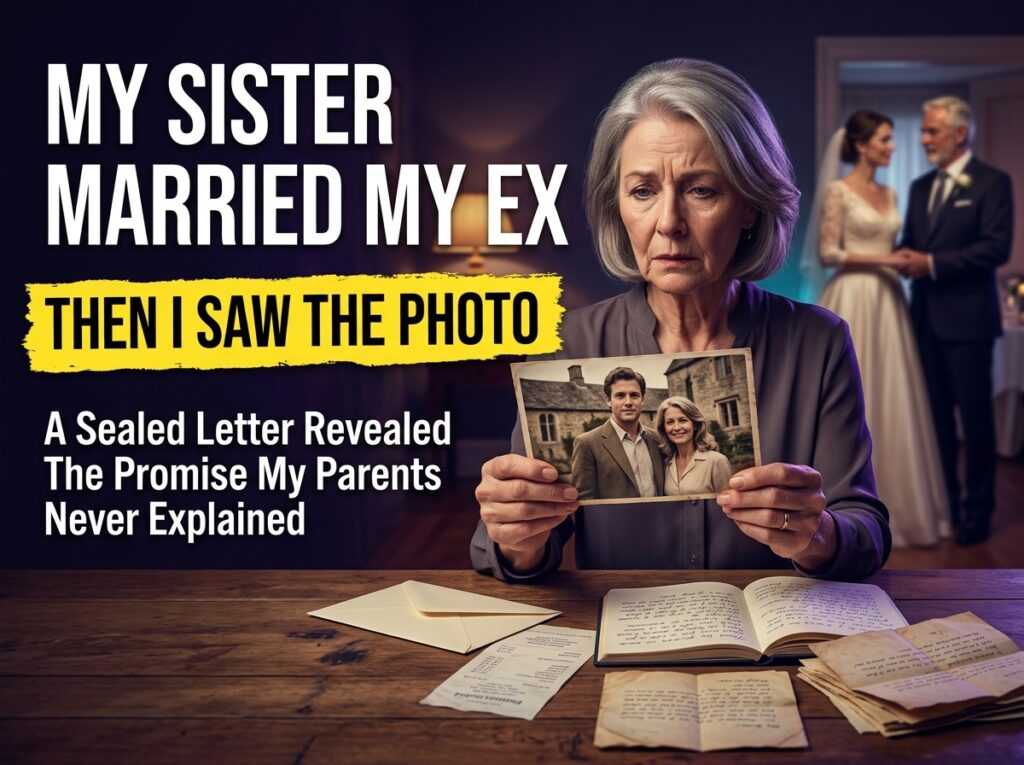
At seventy, I had learned that the past rarely stayed where you left it.
Sometimes it returned in the smell of a familiar coat, the sound of a song coming through an open window, or the sight of a photograph you had not looked at for decades. Sometimes it arrived in a telephone call from someone you had not expected to hear from again.
And sometimes it arrived at Sunday lunch, when your younger sister placed her cup on the table, smiled as if she were about to announce a holiday, and told you she was going to marry the man you had once loved.
My sister, Helen, was sixty-four. She had always been the more daring of us, the one who could make a decision in an afternoon that I would spend three months considering. She had married once, divorced once, and spent several years insisting she would never marry again.
I had believed her.
That Sunday, she sat opposite me in my kitchen wearing a cream-colored blouse and a gold necklace our mother had given her years earlier. She looked nervous, but beneath the nervousness was an unmistakable excitement.
“I have something to tell you,” she said.
I was cutting an apple. “You’ve bought another house?”
“No.”
“A new car?”
She laughed. “You always think everything is about money.”
“At our age, it usually is.”
She reached across the table and took my hand.
“I’m getting married.”
The knife stopped in my fingers.
For a moment, I thought I had misunderstood her.
“Married?”
“Yes.”
“To whom?”
She glanced toward the window, then back at me.
“Martin.”
I did not immediately recognize the name. Then she said his surname, and the kitchen seemed to become very small.
Martin Hale.
My former partner.
The man I had loved when I was young enough to believe that a promise made sincerely would always be kept. The man I had expected to grow old beside before our relationship ended and life carried us in different directions.
I put the knife down.
“Martin?”
Helen nodded.
“How long has this been going on?”
“Nearly a year.”
A year.
For twelve months, my sister had visited my home, asked about my health, complained about the weather, and listened while I told her stories about the past. She had sat across from me at Christmas dinner and helped me clear the plates. She had asked whether I still kept the old photograph albums in the upstairs cupboard.
And throughout all that time, she had been seeing Martin.
“You could have told me,” I said.
“I wanted to make sure it was serious first.”
“Serious enough to marry him, apparently.”
Her face tightened.
“I knew you’d react like this.”
“How exactly did you expect me to react?”
“I expected you to remember that you and Martin haven’t been together for years.”
She was right about the years.
We had not been together for a long time. Our relationship had ended without the dramatic confrontation that people sometimes imagine follows a great love. There had been disappointments, practical difficulties, and a growing distance neither of us had known how to repair.
Eventually, Martin left.
I remained behind, trying to understand how something that had once felt so certain could become impossible to hold.
I had rebuilt my life. I had worked, cared for people I loved, buried people I had never imagined losing, and learned to live with the quiet spaces that remained.
I had not spent every day waiting for Martin to return.
But the knowledge that he had chosen my sister brought a particular kind of pain, one that seemed to reach backward through the years and disturb memories I had carefully put away.
“Does he know how this looks?” I asked.
Helen withdrew her hand.
“He knows we were together. He also knows that relationship ended a long time ago.”
“That isn’t what I asked.”
She stood and walked toward the window.
“Martin didn’t come into my life to hurt you.”
“Perhaps not. But you knew how I would feel.”
“I knew you might be upset. I didn’t think you’d treat me as if I’d stolen something.”
I wanted to answer immediately, but no words came.
She was my sister. I loved her, even when I could not understand her choices.
And Martin was not a possession I could claim after all those years.
I knew that.
What hurt was not simply the thought of them together. It was the realization that Helen had allowed me to remain outside a part of her life that would inevitably affect mine.
“Have you set a date?” I asked.
“Six weeks from Saturday.”
I looked at her.
“That soon?”
“We don’t want a big wedding. Just family and a few friends.”
She hesitated before adding, “I really want you there.”
I looked down at my hands.
I had imagined many things happening when I turned seventy. I had imagined growing older, perhaps moving into a smaller house, perhaps traveling to places I had postponed visiting while working and raising a family.
I had never imagined being asked to watch my younger sister marry my former partner.
“I need some time,” I said.
Helen nodded, though disappointment crossed her face.
“Of course.”
She left shortly afterward.
I remained at the table long after the door closed.
The apple had turned brown where I had cut it. My tea had gone cold. Outside, the afternoon light moved slowly across the garden wall.
I tried to convince myself that the matter was simple.
Martin and I had ended our relationship. Helen was an adult. They had the right to build a life together.
But the photograph albums upstairs kept coming to mind.
Years earlier, before Martin and I had met, someone had told me that the important events of our family history had all happened in a certain order. My parents had moved into their first home, my father had made a financial decision, and a difficult period had followed. I had accepted that sequence without questioning it.
The dates were written in my old notebook, alongside names, addresses, and brief explanations I had recorded whenever my parents shared a memory.
I had kept the notebook because I feared forgetting things.
At the time, I had never considered that the memories themselves might be incomplete.
The following morning, Helen called to ask whether I would help her review the wedding arrangements.
I almost declined.
Then I remembered how few opportunities remained for us to share important moments. We had lost our parents, and we had spent too many years allowing small disagreements to become long silences.
“I’ll help,” I told her. “But I need you to understand that this is difficult for me.”
“I do understand.”
I wanted to believe her.
Three days later, we met at the hotel where the wedding would take place.
The wedding planner greeted us in the lobby and led us into a bright room overlooking the gardens. She showed Helen the seating arrangements, explained the schedule, and asked whether we had any special family photographs to include in the decorations.
Helen began discussing flowers.
I was looking through the printed schedule when the planner stopped speaking.
She had noticed something on the page in my hand.
“Excuse me,” she said. “Are you the bride’s sister?”
“Yes.”
She studied my face with an expression I could not interpret.
“Would you mind coming with me for a moment?”
Helen glanced up.
“Is something wrong?”
“I don’t think so,” the planner replied. “I just need to show her something privately.”
I followed her into a small office behind the reception desk.
She closed the door, opened a drawer, and removed a plain envelope.
“I was asked to give this to you if you came here with the bride,” she said.
My stomach tightened.
“Who asked you?”
She shook her head.
“I was told that the person who received it would understand why it mattered. I haven’t opened it.”
She slid a photograph from the envelope.
It showed Martin standing beside a woman in front of a building I did not recognize. He looked younger, perhaps in his late twenties, and wore a dark jacket over a white shirt.
The woman beside him was smiling.
I stared at the photograph.
It had been taken years before Martin and I met.
And yet the woman beside him looked so familiar that I felt certain I had seen her somewhere before.
I turned the photograph over.
There was a date written on the back.
Below it were four words in faded blue ink.
Before you knew the truth.
I looked at the wedding planner.
“Who gave you this?”
Her expression changed.
“I was hoping you could tell me.”
Then she added something that made the room seem to tilt around me.
“The person who left it said that if you recognized the woman, you should check the date against your old notebook.”
<h2>Part 2</h2>
I returned to the main room with the photograph hidden inside my handbag.
Helen was comparing flower arrangements when I walked in.
“Everything all right?” she asked.
I looked at my sister and wondered whether she knew anything about the photograph.
“Yes,” I said. “Just a misunderstanding.”
The lie came easily.
That frightened me more than I wanted to admit.
For most of my life, I had considered myself an honest person. I believed that difficult truths were better spoken than hidden, even when they caused temporary discomfort.
Yet there I was, standing beside my sister and pretending that nothing had happened.
I could not explain why I had kept the photograph secret. I only knew that the image had unsettled me in a way I could not yet describe.
The woman beside Martin was familiar.
I was certain of it.
But I could not place her face.
Helen continued talking about flowers, chairs, and the number of guests. I nodded when she expected an answer and asked questions when silence would have made my distraction obvious.
By the time we left the hotel, I had agreed to help her organize the family photographs for the reception.
It was the last thing I wanted to do.
That evening, I took my old notebook from the cupboard above the stairs.
It was a thick, blue-covered book with a worn spine. I had begun using it decades earlier, after my father complained that our family was forgetting too much of its own history.
He had always enjoyed telling stories about his childhood, the places where he had worked, and the people who had helped him when money was scarce.
I began recording those stories because I thought they might matter to the next generation.
Over time, the notebook became a mixture of family history and practical information.
There were dates of births and deaths, addresses of old houses, notes about repairs, and copies of details from documents I no longer possessed.
My mother had once called it my second memory.
“If you keep writing everything down,” she said, “you’ll forget how to remember things yourself.”
I had laughed.
Now I wondered whether writing everything down had allowed me to preserve a version of events without ever questioning it.
I opened the notebook to the year Martin and I first met.
The photograph’s date was several years earlier.
I found the corresponding page and began reading.
At first, there was nothing unusual. I had recorded my father’s employment, a family holiday, and a note about a loan he had taken to repair the roof of our first home.
Then I noticed a date that matched the photograph.
Beside it was a short entry about a visit my parents had made to another town.
I had never thought much about the visit. My mother had described it as an ordinary trip to see an old friend, and my father had mentioned it only once.
But the photograph had been taken in that same town.
I checked the address written beside the entry.
It belonged to a building near the one visible in the photograph.
My hands began to tremble.
The woman beside Martin was standing in front of a doorway with a distinctive stone arch. I had passed that doorway once, years later, while visiting relatives in the area.
I remembered it because my mother had stopped outside and stared at the building for several seconds before telling me we needed to hurry.
At the time, I had assumed she was remembering something from her childhood.
Now I wondered whether she had been remembering someone.
I read the notebook entry again.
My father had recorded the date of the visit, but not the reason.
Several pages later, I found another reference to the same address. This time, the entry was connected to a financial transaction.
The note was brief.
A payment had been made, and a document had been placed in a sealed envelope for safekeeping.
There was no explanation of the payment’s purpose.
I checked the following years.
The same address appeared again.
Then again.
The dates were separated by months and, in some cases, years. Each entry referred to a payment, a meeting, or a document that had been stored somewhere outside our family home.
I had never noticed the pattern before.
I had treated each entry as a separate memory.
Together, they suggested that my parents had been involved in something that continued for years.
I reached for my telephone and searched for Martin’s number.
I had deleted it long ago, but I still knew how to contact him through an old mutual friend.
I stopped before making the call.
What would I ask?
Why had he been photographed with a woman I could not identify?
Why had someone connected the photograph to my family history?
And why had the wedding planner been instructed to give it to me now, just as Martin was preparing to marry my sister?
I had no proof that Martin had done anything wrong.
A photograph taken before we met could mean many things.
The woman could have been a colleague, a relative, or a friend. The building could have been a place he had visited for an entirely ordinary reason.
But the date in my notebook made the photograph more than a coincidence.
Someone had known about both records.
Someone had deliberately brought them together.
I went back to the cupboard and removed a small box containing my parents’ old papers. I had kept it after their deaths because I could not bear to throw away anything that might have belonged to them.
Inside were letters, receipts, a few bank documents, and envelopes with handwriting I recognized immediately.
My mother’s writing was neat and slanted.
My father’s was heavier, with letters that sometimes leaned into one another.
At the bottom of the box, beneath a bundle of utility bills, I found a small card bearing the same address from my notebook.
The card had no name.
Only a date and a reference number.
I compared it with the photograph.
The dates were close enough to suggest that the documents might be connected.
But the reference number was unfamiliar.
I wrote it in my notebook.
Then I noticed a folded piece of paper tucked inside the card.
It was a brief note in my mother’s handwriting.
If the original is ever requested, do not send a copy. The date matters more than the amount.
I read it again.
What original?
What amount?
And why had my mother believed that a date could be more important than money?
I had spent decades preserving these records without understanding their significance.
Now, as I sat alone at my dining table, I began to suspect that my family had not simply forgotten an old story.
Someone had made a deliberate choice about what we were allowed to know.
The next morning, I called the wedding planner.
I asked whether the person who had left the photograph had provided any contact details.
She hesitated.
“I was given another envelope,” she said. “I was instructed to deliver it only after you had seen the photograph.”
“Do you still have it?”
“Yes.”
“What does it contain?”
“I don’t know. But it has your name on it.”
I asked her not to open it or send it anywhere.
Then I drove to the hotel.
The planner was waiting in her office with a sealed envelope on the desk.
My name was written across the front.
Below it was a date I recognized from my notebook.
And beside the date was the same reference number I had found on my mother’s card.
<h2>Part 3</h2>
I did not open the second envelope at the hotel.
I took it home, placed it beside the photograph, and made myself a cup of tea.
For nearly an hour, I did nothing but look at the two objects.
The photograph showed Martin standing beside an unidentified woman. The envelope contained my name, a date from my family notebook, and a reference number that appeared on one of my mother’s old cards.
I could not imagine how these things were connected.
I could imagine even less why someone had chosen my sister’s wedding as the moment to bring them together.
Eventually, I opened the envelope.
Inside was a short letter, a photocopy of a receipt, and a small sheet of paper bearing several dates.
The letter was unsigned.
It began:
You have spent years believing that the important decisions in your family’s history were made for the reasons you were given. Before you attend the wedding, you should understand that the photograph is not proof of a betrayal. It is evidence of a connection that existed long before you knew either person.
I read the paragraph twice.
The letter continued.
The receipt records an original transaction. The date matches the entry in your notebook. The amount is not the important part. What matters is the decision made at the time, and the promise that followed it.
There was no further explanation.
I turned to the receipt.
It was an old photocopy, faint around the edges. The document recorded a payment made by my father to an organization I did not recognize. The date matched the one on my mother’s card.
The amount was modest by modern standards.
The reference number was identical.
I searched through the box of family papers again, looking for the original receipt, but I found only copies of ordinary household bills.
The letter had warned me not to mistake the photograph for proof of betrayal.
I tried to remember whether Martin had ever mentioned the town where the photograph had been taken. He had traveled for work before we met, but he had never spoken in detail about his life before our relationship.
I had never asked.
When we first fell in love, I had been more interested in the person standing in front of me than in the people he had known before.
Perhaps that had been a mistake.
But I did not want to accuse him of something simply because I had discovered a photograph.
I called Helen.
She answered cheerfully.
“Have you found the photographs for the reception?”
“Some of them.”
“Wonderful. Martin wants a few pictures from his younger days, too. He says he has boxes of them somewhere.”
My heart tightened.
“Does he?”
“Yes. Why?”
“No reason. I was just wondering whether he had any old family pictures.”
Helen laughed.
“He says he was never very good at keeping things. His mother used to save everything, but he threw away most of his old papers when he moved.”
I looked at the photograph on my table.
“Does he remember the town where he grew up?”
“Of course. Why are you asking so many questions?”
I almost told her everything.
Instead, I said that I was trying to organize the photographs in chronological order.
Helen accepted the explanation, but I could hear a note of suspicion in her voice.
After we ended the call, I returned to the letter.
The writer had used the word connection, not relationship.
That distinction mattered.
The photograph could have been connected to my family through work, a financial transaction, or an event involving someone else.
The receipt suggested that money had changed hands.
The notebook suggested that the transaction had been revisited over a period of years.
And the letter suggested that the original decision had involved a promise.
I needed to know what that promise was.
The following morning, I contacted the organization named on the receipt. It had since changed its name, but the office still maintained some historical records.
I explained that I was trying to identify an old transaction involving my father.
The person who answered asked for the date and reference number.
After a brief pause, she told me that the surviving index contained a matching entry.
“Can you tell me what the payment was for?” I asked.
“I’m afraid I can’t discuss the details until we establish your connection to the original record.”
I gave her my father’s name and the address listed in my notebook.
She asked me to send copies of the documents and proof of my relationship to him.
I did so that afternoon.
Two days later, she called me back.
“The original file has been located,” she said. “It contains a reference to an agreement signed by your father and another person.”
“Who?”
She read the name aloud.
I felt my breath catch.
It was the name of the woman standing beside Martin in the photograph.
I asked whether she could tell me what the agreement concerned.
“The surviving record indicates that it involved a financial arrangement and a decision concerning the future of a property. However, the file contains restrictions, and we need to review the original document before releasing further information.”
“Was Martin involved?”
There was a pause.
“His name appears in the supporting correspondence.”
I closed my eyes.
The photograph was no longer simply an old image of my former partner with a woman I did not know.
It connected Martin to a transaction involving my parents.
But I still did not know why.
I asked whether I could visit the office to examine the records.
The woman explained that an appointment would be necessary.
She offered me a time the following week.
I accepted.
After the call, I sat quietly at the table.
For the first time, I understood why someone had wanted the photograph delivered before the wedding.
The person who sent it was not necessarily trying to prevent Martin and Helen from marrying.
They might have been trying to ensure that I understood something about the past before a new family decision made it harder to discuss.
I returned the photograph to its envelope.
Then I opened my notebook and marked every entry connected to the reference number.
There were more than I remembered.
Some dates appeared beside payments.
Others appeared beside visits to the town.
One was recorded next to a note about a conversation my mother had described as a private family matter.
The final entry was written in my father’s handwriting.
It contained only one sentence.
If this ever becomes necessary, the original must be shown to her.
I stared at the words.
My father had not written my name.
But the sentence appeared on a page where the other entries referred to me.
I wondered whether he had known that one day I would need to understand the transaction.
And if he had, why had he never explained it while he was alive?
I had spent years believing the biggest surprises of my life were behind me.
Now I was beginning to understand that the past had been waiting for the right moment to speak.
<h2>Part 4</h2>
The office that held the historical records was in the town where my parents had once lived.
I drove there on a rainy Tuesday morning, taking the photograph, the letters, my notebook, and the receipt.
The building was smaller than I expected. A receptionist checked my appointment and directed me to a room where an archivist named Susan was waiting.
She was a careful, serious woman who seemed accustomed to people arriving with old documents and difficult questions.
After examining my identification, she placed a folder on the table.
“This file has been preserved because it contains an agreement involving several parties,” she explained. “Some information can be released to you as a family member, but we must be careful not to treat every note in the file as an established fact.”
I nodded.
“I understand.”
She opened the folder.
The first document was a copy of the receipt. The second was a letter from my father requesting that a particular payment be recorded separately from his ordinary financial affairs.
The third document was a memorandum referring to an agreement involving a property.
I recognized the address immediately.
It was the address my mother had written in the notebook.
The property had belonged to an organization that provided temporary accommodation and practical assistance to families facing financial difficulties.
My father had volunteered there for a time. He had never told us much about the work, describing it simply as helping people who needed somewhere to turn.
The records indicated that he had contributed money toward a long-term arrangement involving one of the organization’s properties.
The arrangement was intended to protect the property from being sold immediately while a family connected to it worked through a difficult period.
The agreement had been reviewed several times.
Each review generated another entry in my notebook.
I began to understand why my parents had made repeated visits to the town.
They had not been conducting secret business for their own benefit.
They had been helping someone maintain a place to live.
But the documents raised a new question.
Why was Martin’s name connected to the agreement?
Susan showed me a letter dated several years before Martin and I met.
It had been written by a woman who had served as a volunteer at the organization. She described a young man who had helped with repairs and administrative work.
The man’s name was Martin Hale.
I read the letter carefully.
It did not establish that Martin had been involved in the financial arrangement itself. It simply showed that he had volunteered at the property and had helped organize some of the records.
The woman in the photograph had also been associated with the organization.
Her name was Margaret.
I did not recognize it immediately, but Susan explained that Margaret had been responsible for keeping some of the original documents.
She had worked with my parents on several occasions.
The photograph had probably been taken during a visit to the property.
I felt a small measure of relief.
There was no evidence of a romantic relationship between Martin and Margaret.
But I still could not explain why the photograph had been delivered to me, or why the letter described a decision that could change the future of everyone I loved.
Susan turned to another page.
“This is the part that may interest you most,” she said.
The document recorded a later decision concerning the property.
Several years after the original agreement, the organization had considered selling the building. My father had objected because he believed the sale would affect a family that had come to depend on the arrangement.
He and another person had signed an instruction delaying the decision until certain conditions were met.
The surviving file did not contain every detail of those conditions.
However, it included a reference to a payment made on the same date as the receipt in my possession.
I asked whether the payment had been made by my father.
“That appears to be the case.”
“Was it a loan?”
“The document describes it as a contribution under the agreement. We cannot determine from this page whether the entire amount was later repaid.”
I looked at the date.
It was the date my mother had recorded beside the address.
The date from the photograph was different, but it fell within the same period.
The woman standing beside Martin had been involved in preserving the records.
She might have known something about the agreement.
And Martin, who had helped at the property, might have known more than he had ever told me.
I asked Susan whether there was a final document.
She searched the folder and removed a sealed archival sleeve.
Inside was a copy of a letter that had been added to the file many years later.
The letter was written by my mother.
It referred to a promise made by my father and explained that the family had agreed not to discuss the arrangement until the property question had been resolved.
The letter did not say that the agreement would remain secret forever.
It said that the people involved had wanted to avoid making the family dependent on a decision that had not yet been finalized.
I read the sentence again.
My parents had not hidden the matter because they wanted to deceive us.
They had withheld details because they believed that speaking too soon might create expectations they could not fulfill.
But years had passed, and the explanation had never been given.
The original property arrangement had eventually been changed.
The family who depended on it had moved elsewhere.
The organization had continued operating, but the records showed that the property was no longer part of its active program.
I asked Susan what had happened to the original agreement.
She pointed to a reference on the final page.
“The original appears to have been returned to one of the signatories. We have a copy, but not the document itself.”
“Do you know who received it?”
She checked the record.
“The file says it was collected by Margaret.”
The woman in the photograph.
I left the office with copies of the documents I was permitted to receive.
On the drive home, I thought about the photograph again.
The image no longer looked like evidence of a hidden romance.
It looked like a record of an event I had never known about.
But I still did not understand why the wedding planner had been chosen as the messenger.
And I could not ignore the final question.
If the original agreement had been returned to Margaret, where was it now?
<h2>Part 5</h2>
I called Helen that evening.
I told her I had found evidence that Martin had volunteered at a property connected to my parents years before we met.
She listened without interrupting.
When I finished, she asked, “Is that why you’ve been acting strangely?”
“Partly.”
“Do you think Martin has been hiding something from me?”
“I don’t know.”
She sighed.
“I wish you would stop saying that.”
“What would you prefer me to say?”
“That you’ve found something important. That you know what it means.”
“But I don’t know what it means yet.”
Helen was quiet.
Then she said, “Martin told me he spent some time helping a community organization when he was younger. He never mentioned your parents.”
“Did he mention a woman named Margaret?”
“No.”
I asked whether he had ever spoken about the property.
She said he remembered the building but had not visited it in years.
I could hear that she was becoming uncomfortable.
“Why are you investigating his past?” she asked.
“Because someone gave me a photograph and a letter connected to our family.”
“Could it be a mistake?”
“Possibly.”
“Then why not ask Martin directly?”
I had no good answer.
I had been afraid that confronting him would make me appear jealous, suspicious, or unwilling to accept the marriage.
But avoiding the question would not make the documents disappear.
“I think I should speak with him,” I said.
“Then do that. But please don’t turn this into something it isn’t.”
After we ended the call, I contacted Martin.
He agreed to meet me the following afternoon.
We chose a quiet café near the park where we had once spent many Sunday mornings together.
When I arrived, he was already waiting.
He looked older than the man in the photograph, but I recognized the same expression around his eyes. He had always watched people carefully before answering difficult questions.
He stood when I approached.
“Thank you for coming,” he said.
I sat opposite him.
“I need to ask you about something.”
He nodded.
I placed the photograph on the table.
His face changed.
For a moment, he said nothing.
Then he picked it up.
“Where did you get this?”
“The wedding planner gave it to me.”
“Who asked her to?”
“I don’t know.”
He looked at the photograph for a long time.
“That’s Margaret,” he said.
“I know her name now.”
Martin placed the photograph back on the table.
“She worked at the organization where I volunteered. Your parents helped there, too.”
“Why didn’t you tell me?”
“I never thought it was relevant to our relationship.”
“Did you know my parents were involved in the property agreement?”
“Not at first. I learned about the arrangement later, when I helped Margaret organize some records.”
“Did you know about the payments?”
“Some of them. I was never responsible for the financial decisions.”
I studied his face.
He seemed sincere, but I knew sincerity was not the same as a complete explanation.
“What was your relationship with Margaret?”
“She was a friend and colleague. Nothing more.”
I asked whether he had ever been romantically involved with her.
“No.”
The answer came immediately.
“Then why was this photograph sent to me now?”
Martin shook his head.
“I don’t know.”
I showed him the letter.
He read it, then looked at the date.
“I remember Margaret saying that the original documents needed to be preserved. She was worried that the property arrangement would be misunderstood if the records were separated.”
“Why would someone say that now?”
“I don’t know.”
I asked whether he had kept any documents from that period.
He thought for a moment.
“I had some old papers when I moved away. I may still have a box in storage.”
“Would you look for it?”
“Yes.”
He paused.
“But I need you to understand something. I never knew that you were connected to the arrangement when I first met you. I didn’t recognize your family name at the time because the documents I handled did not include your full details.”
I believed that might be true.
Our relationship had begun years after the original property arrangement. Martin had never given me reason to suspect that he had known my parents before we met.
Still, I could not stop thinking about the photograph.
“What did Margaret want to protect?” I asked.
Martin looked toward the window.
“She believed the property had been used to help a family who had nowhere else to go. She thought the agreement should be honored, even after the original people involved were no longer able to manage it.”
“Was that why my father made the payments?”
“That was my understanding.”
“Then why did my mother say the original document should never be replaced by a copy?”
Martin looked back at me.
“Because a copy could show what had been written, but not whether the original had been changed or whether the final conditions had been met.”
The answer made sense.
It also reminded me that the photograph and the receipt were only pieces of a larger record.
Before we left, Martin promised to search for the old box.
I returned home feeling both relieved and unsettled.
I had found no evidence that Martin had betrayed me.
But I had discovered that he had been connected to a part of my family’s history I had never understood.
The following morning, Helen called.
She sounded anxious.
“Martin told me about your meeting,” she said.
“I’m sorry if that upset you.”
“It did. Not because you asked him questions, but because he told me something else afterward.”
I waited.
“He said Margaret contacted him last month. She told him that someone had been asking about the original agreement.”
“Who?”
“She didn’t say. But Martin believes the person may be planning to bring the document to the wedding.”
I looked at the photograph on my table.
“Why the wedding?”
“Because everyone who needs to hear the explanation will be there.”
I felt a chill move through me.
The wedding had been presented as a new beginning for Helen and Martin.
Now it seemed that someone intended to use the gathering to bring an old decision into the open.
And I still did not know whose future that decision might change.
<h2>Part 6</h2>
Martin called me three days later.
He had found the box.
It was stored in a cupboard at his home, among old photographs, certificates, and documents he had kept without a clear reason.
He invited me to examine it with him.
I went alone.
The box contained nothing dramatic at first glance. There were receipts from ordinary purchases, letters from former colleagues, and photographs from places I did not recognize.
Then Martin found a folder labeled with the name of the community organization.
Inside were copies of the property agreement, several letters from Margaret, and a note written by my father.
Martin handed me the note.
My father’s handwriting was unmistakable.
The note explained that the arrangement had been established to protect a family during a period of financial difficulty. The property was not to be treated as an ordinary investment, and the money contributed toward it was not intended to create a private benefit for any individual.
Instead, the arrangement was meant to ensure that the property remained available until the family could make a secure transition.
My father had been concerned that, once the original people involved were gone, the agreement might be misunderstood as a debt or a claim to ownership.
He wanted the records preserved so that no one would be pressured into paying money twice or giving up rights they had already been promised.
I looked at Martin.
“Did you know all this?”
“Not in detail. I saw parts of the agreement when I helped Margaret organize the file. I didn’t know your father had written this note.”
I read it again.
The final paragraph was addressed to the person who would eventually review the records.
The purpose of this arrangement was to help a family regain its footing, not to make another family wealthy. If the property is ever transferred, the original terms must be examined before anyone decides who is entitled to anything.
I felt an unexpected sadness.
My father had understood how easily good intentions could become confused when people focused only on money.
He had tried to protect the agreement from that confusion.
But his decision not to explain it to us had allowed the uncertainty to grow.
I asked Martin whether the box contained the original document.
He shook his head.
“Only copies. Margaret kept the original.”
“Do you know where she is now?”
“She moved away several years ago. I haven’t seen her recently.”
I examined the dates in the folder.
The earliest matched my notebook.
The latest was from several years after Martin and I had separated.
The arrangement had continued long after I had assumed the story was over.
I found a letter from Margaret explaining that the organization had changed its procedures and that the property agreement needed to be reviewed.
She had asked my father to confirm whether the original terms still applied.
His response was brief.
He wrote that the arrangement should be honored until the relevant parties had agreed to a final decision.
The next letter was from my mother.
She said that the family would not seek any personal benefit from the arrangement and that she wanted the original records preserved.
I had never known my mother to be involved in anything that complicated.
She was practical, careful, and protective of our family. She disliked arguments and preferred to settle difficulties quietly.
I could understand why she had wanted to avoid discussing the arrangement before it was resolved.
But I wondered whether she had underestimated how much silence could change the story.
I asked Martin why he had kept the documents.
“Because Margaret asked me to preserve them,” he said. “She told me that someone might need them later.”
“Did she say who?”
“No.”
He looked uncomfortable.
“I should probably tell you that she contacted me again last week.”
“What did she say?”
“She asked whether I would attend the wedding with the original photograph and any documents I could find.”
“Why?”
“She said that the people involved had spent years waiting for the right time to explain the arrangement. She believed the wedding might be the last opportunity to bring everyone together.”
I looked at the folder.
“Did she say the document could change the future of our family?”
Martin shook his head.
“Not in those words. She said it could change how we understood the past.”
I asked for Margaret’s contact details.
He gave me an old telephone number and an address.
When I called, the number was no longer in service.
The address belonged to a house that had since changed ownership.
I tried the organization again.
The person who answered explained that Margaret had retired and was living in another part of the country. They could not provide her personal contact information without permission.
I left a message asking her to contact me.
Two days later, I received a letter.
It was handwritten and addressed to my home.
The envelope contained a single page.
Margaret explained that she had been responsible for keeping the original agreement because she feared it might be lost or misunderstood. She had watched the property arrangement become more complicated as the years passed.
She had not wanted the document to be used to make accusations.
She wanted it examined so that the original decision could be understood in its proper context.
The final paragraph read:
I am sending you the date of the original transaction because it is the one detail that connects the records you already have. Compare it with your notebook, and you will see why the decision was made when it was. The photograph is not the answer. It is the reason you began asking the question.
I sat at the table for a long time.
The date had been in my notebook for decades.
The photograph had made me notice it.
The receipt had connected it to a financial arrangement.
And my father’s note had explained the purpose of that arrangement.
Yet one important question remained unanswered.
What had actually been decided in the original document?
I looked at the wedding invitation on the counter.
Six weeks earlier, I had believed the most difficult thing I would face was watching my sister marry the man I once loved.
Now I understood that the wedding had become the place where an old family decision might finally be examined.
I could refuse to attend.
I could pretend that none of the documents mattered.
Or I could go, listen to the people involved, and allow the original record to speak for itself.
I decided I would be there.
But before the wedding, I wanted to compare the dates one more time.
Something in my father’s notebook suggested that the transaction had not been the end of the arrangement.
It had been the beginning of a promise.
And that promise might still matter.
<h2>Part 7</h2>
I spread the documents across my dining table the evening before the wedding.
The photograph lay beside the receipt. My father’s note was underneath the letter from Margaret, and my notebook was open to the page where I had first recorded the address.
I compared the dates carefully.
The original transaction had taken place shortly before my parents made a significant change in their own financial arrangements. They had postponed repairs to our home, reduced their household expenses, and stopped discussing a move they had once planned.
At the time, I had assumed those changes were connected to my father’s work.
Now I realized that the timing was also consistent with his decision to help protect the property.
The payments had not been random.
They formed a pattern that stretched across several years.
Each payment was followed by a review, a letter, or a change in the arrangement. My parents had contributed what they could, but they had also insisted that the property’s future be decided according to the original agreement.
The dates suggested that they had continued to honor that commitment long after the immediate crisis had passed.
I wrote the dates on a separate sheet and placed them in chronological order.
The final entry in my notebook was the most important.
It referred to a meeting held after the property had been considered for sale.
My father had recorded that a decision had been reached, but he had not written what the decision was.
He had simply noted that the original document had been returned to Margaret.
I wondered why he had left the entry so incomplete.
Perhaps he had intended to return to it later.
Perhaps he had believed that the document itself would always be available.
Or perhaps he had wanted to protect the identity of the family involved.
I could not know.
The following morning, Helen called.
“Are you still coming?” she asked.
“Yes.”
She sounded relieved.
“I know this has been difficult. I want you to know that Martin and I never intended to hurt you.”
“I believe you.”
“Then can we please put the past aside for one day?”
I looked at the documents on the table.
“I hope we can. But I think we need to understand something first.”
“What?”
“That putting the past aside is not the same as pretending it never happened.”
Helen was quiet.
Then she said, “I suppose you’re right.”
She told me the ceremony would begin at three in the afternoon. The reception would follow in the hotel’s main ballroom.
I promised to arrive early.
Before leaving home, I placed the photograph, my notebook, and the letters in a folder.
I did not know whether I would need them.
But I had learned that the details people considered unimportant could sometimes explain what the larger story had concealed.
When I arrived at the hotel, the wedding planner greeted me at the entrance.
She looked relieved to see me.
“Thank you for coming,” she said.
“Did Margaret contact you again?”
The planner nodded.
“She called yesterday. She said the original document had been sent to the person who would bring it today.”
“Who?”
“She didn’t tell me.”
I looked toward the ballroom.
Guests were beginning to arrive. Helen stood near the entrance in her wedding dress, speaking with a friend. Martin was greeting relatives on the other side of the room.
For a moment, I felt the familiar ache of seeing them together.
But it no longer felt like the only important thing happening.
The photograph had brought me into a story that began long before Martin and I met.
Whatever the original document contained, it deserved to be understood without being used to punish either of them.
I approached Helen.
She hugged me carefully, mindful of her dress.
“I’m glad you’re here,” she whispered.
“So am I.”
Martin joined us a moment later.
He looked nervous.
“I found something else in the box,” he said quietly.
“What?”
He handed me a small envelope.
Inside was a photocopy of a letter from my father.
The letter referred to the original transaction and the family’s decision to preserve the property arrangement.
But the final paragraph contained a sentence I had never seen before.
If the arrangement is ever reviewed by the next generation, they must be told that the decision was made to protect someone’s future, not to claim a reward for the past.
I read it twice.
The words matched the purpose described in the other documents.
But they also suggested that the person who had benefited from the arrangement might still be affected by the final decision.
I asked Martin whether he knew who the person was.
He shook his head.
“I only found the letter this morning.”
I looked around the room.
My family had gathered to celebrate a marriage.
Yet someone had arranged for an old document to arrive at precisely this moment, when the people connected to the past were all in one place.
I wondered whether the person carrying it would ask us to reverse an old decision, recognize an obligation, or simply acknowledge something our parents had never explained.
Then the wedding planner approached us.
She was holding a large brown envelope.
“I’ve been asked to deliver this before the ceremony begins,” she said.
She handed it to me.
The envelope was sealed.
My name was written on the front, and beneath it was the same reference number that had appeared on the receipt.
I looked at Helen.
She had gone pale.
“Do you know what that is?” I asked.
She shook her head.
“No. But I think Martin does.”
Martin stared at the envelope.
Then he looked toward the ballroom doors.
“I recognize the handwriting,” he said.
“Whose is it?”
He swallowed.
“Your father’s.”
<h2>Part 8</h2>
The envelope was heavier than I expected.
I held it carefully, aware that the people around us had begun to notice that something unusual was happening.
Helen looked from me to Martin.
“Should we open it now?”
I glanced toward the ballroom.
The ceremony was due to begin in less than half an hour. Guests were taking their seats, and the musicians were preparing to play.
“I think we should,” I said.
We moved into a quiet room beside the reception area.
The wedding planner followed us but remained near the door.
I broke the seal.
Inside was a copy of the original agreement, a letter from my father, and a separate page bearing the signatures of the people who had approved the final decision.
I recognized my father’s signature immediately.
The document described the arrangement in precise terms.
The property had been protected so that the family who depended on it could remain there while they worked toward a more secure future. My parents had contributed money, time, and administrative help. Margaret had preserved the records, and Martin had assisted with organizing the documents.
The agreement had been reviewed several times because the original conditions had not been fulfilled as quickly as expected.
Eventually, the organization had faced a decision.
It could sell the property and use the proceeds for other needs, or it could honor the original arrangement and allow the family connected to it more time to establish a stable home elsewhere.
My father had argued for honoring the agreement.
He believed that the promise made at the beginning mattered more than the convenience of ending it early.
The final document showed that the arrangement had been extended and that the property had later been transferred according to the agreed conditions.
There was no evidence that my parents had expected to receive a financial reward.
Instead, they had accepted the cost of their contributions because they believed the family should not lose its home simply because the process had taken longer than expected.
I felt a wave of emotion.
My father had never told us that he had been involved in something so complicated.
He had explained his decision to help in ordinary terms, but he had kept the details private because he did not want the family to become involved in a dispute over money or ownership.
The letter explained that the original document had been preserved to prevent later generations from mistaking the arrangement for a private investment.
It also explained why the date mattered.
The original transaction had marked the moment when the parties agreed that the property would be protected until the family could move forward safely.
The date was not merely an accounting detail.
It was the beginning of a promise.
I turned to the final page.
There was a name listed beside the family that had benefited from the arrangement.
I recognized it from the earlier records.
It was the name of a woman who had worked with Margaret at the organization.
But beneath it was another name.
A name I knew from my own childhood.
I read it again, certain I had misunderstood.
Helen leaned closer.
“What is it?”
I could barely speak.
The person whose future the agreement had been designed to protect was connected to our own family.
The arrangement had not simply been an act of kindness toward strangers.
It had been part of a decision made to help someone whose circumstances had affected my parents deeply.
The document did not suggest that the person had been entitled to money from our family.
It did not establish any wrongdoing.
But it revealed that the original decision had been made for reasons far more personal than I had imagined.
I looked at Martin.
“Did you know about this?”
He shook his head.
“No. I never saw this page.”
Helen reached for the letter.
As she read it, her expression changed.
“I remember our mother mentioning that name,” she said. “She told me there was someone we should never judge without knowing the whole story.”
I turned toward her.
“When did she say that?”
“Years ago. I was still young. I asked why she kept an old photograph in her desk, and she told me that some people had helped our family before we knew we needed help.”
I stared at my sister.
She had remembered something I had forgotten.
The photograph of Martin and Margaret had led us toward the property agreement, but the agreement had led us toward a much older family story.
I asked Helen whether she remembered anything else.
She shook her head.
“Only that Mum said the truth would eventually make sense if we kept the records.”
I looked at the documents again.
My father had not written the name of the person in his notebook. He had left the final entry incomplete, perhaps because he believed the original agreement would explain it.
The document had now revealed the connection.
But it also raised another question.
Why had the original agreement been sent to me on the day of Helen’s wedding?
The letter from my father offered a possible answer.
He had written that the arrangement should be reviewed by the next generation when the original decision could be understood without fear or pressure.
The wedding had brought together several people connected to the old agreement.
Martin had known the records.
Helen had remembered the family story.
I had preserved the dates.
And someone had decided that the time had come for us to see the original.
The wedding planner appeared in the doorway.
“There is someone outside asking for you,” she said.
“Who?”
She hesitated.
“She says her name is Margaret.”
I looked at Martin.
He stood immediately.
“She’s here.”
I gathered the documents and followed him into the corridor.
At the end of it stood an elderly woman holding a walking stick and a small leather folder.
Her hair was white, and her face was lined with age.
But I recognized her from the photograph.
Margaret had come to explain the part of the story that the documents could not tell.
<h2>Part 9</h2>
Margaret greeted us with a quiet smile.
“I hoped we would have the chance to speak before the ceremony,” she said.
I asked why she had waited so many years to reveal the agreement.
She looked at the folder in her hands.
“Because your father believed that the decision should speak for itself. He wanted the original terms preserved, but he did not want the family to feel responsible for a promise that had already been fulfilled.”
“Then why send the photograph?”
“Because the photograph was the only surviving image that connected the people who had worked on the arrangement. I knew you would recognize Martin, and I hoped that would lead you to the records.”
She explained that she had been responsible for keeping the original documents because she feared they might be lost when the organization changed its procedures.
She had seen how easily a good intention could be misunderstood when people examined only the money involved.
Some believed the arrangement was a loan.
Others thought it represented an investment.
A few had assumed that my parents would eventually receive the property or a financial reward.
None of those interpretations captured the full purpose of the agreement.
The property had been protected so that a family could move forward without losing its home during a difficult period.
My parents had agreed to contribute what they could, and the organization had accepted responsibility for maintaining the arrangement until the conditions were met.
The final document showed that the agreement had been completed according to its terms.
No additional payment was owed to my parents.
No claim to the property remained outstanding under the arrangement.
But the family connection recorded in the document had never been explained to us.
I asked Margaret why.
She paused before answering.
“Your parents wanted to protect someone who had already experienced more hardship than most people knew. They believed that revealing the person’s circumstances without permission would have been cruel.”
I looked at the name on the document.
It was connected to a person from my childhood, someone whose absence from family gatherings had once been explained as a matter of distance and personal choice.
I had accepted that explanation without question.
Margaret continued.
“The arrangement was never meant to make anyone feel indebted. Your father believed that helping someone should not become a way to control them. He wanted the family to understand that the promise had been fulfilled, not to demand gratitude.”
I asked whether the person named in the agreement had known about the help.
“Yes,” Margaret replied. “But not every detail. The person understood that your parents had helped protect the property, but the full financial arrangement was kept among the people responsible for administering it.”
I thought about my mother’s note.
The date matters more than the amount.
Now I understood why.
The date marked the beginning of a commitment. The amount was only one part of the practical arrangement.
I asked Margaret whether the photograph had anything to do with Martin’s relationship with me.
She shook her head.
“No. Martin was a volunteer. He helped organize records and preserve documents. He was never romantically involved with me, and he was not responsible for the original financial decision.”
Martin looked relieved, though I suspected he had been carrying the weight of that misunderstanding since I first showed him the photograph.
Margaret turned to Helen.
“Your sister was never meant to be hurt by this. I wanted her to know that the photograph did not prove a betrayal.”
Helen’s eyes filled with tears.
“I wish someone had explained that before all this.”
“So do I,” Margaret said. “But your parents were afraid that the story would become an argument about who deserved what. They thought silence would protect the family.”
I looked at the original document.
Their intentions had been understandable.
Their decision had also left us with years of uncertainty.
The past had not been deliberately constructed to deceive us, but it had been simplified until important details disappeared.
I thought of all the times my mother had told us not to judge people without understanding their circumstances.
I had believed she was speaking about ordinary disagreements.
Now I realized that she had been referring to something much more personal.
Margaret explained that the family connected to the property had eventually found another home. The original arrangement had been fulfilled, and the documents were preserved as evidence of the decision.
She had waited to release the original because she wanted the people who reviewed it to understand its purpose rather than focus only on the financial details.
“I didn’t want the agreement to become a weapon,” she said.
I understood.
The document could have been used to make accusations, demand repayment, or reopen a matter that had already been resolved.
Instead, it showed that my parents had made a difficult choice to help someone, and that the people involved had worked to honor the promise.
I asked Margaret whether she believed the family should keep the original.
She nodded.
“Your father wanted the next generation to understand what happened. He wanted the records preserved, but he also wanted you to remember why the decision was made.”
I closed the folder.
For weeks, I had believed I was investigating a secret connected to Martin and Helen’s marriage.
Instead, I had uncovered a story about my parents, a property, and a promise that had been fulfilled long before I understood its importance.
I turned toward my sister.
She was crying quietly.
I reached for her hand.
“I think we have been looking at the wrong question,” I said.
“What question should we have asked?”
I looked at the photograph.
“Not why someone kept this secret, but what they were trying to protect.”
For the first time, Helen nodded without arguing.
The ceremony was about to begin.
We returned to the ballroom with the original document safely inside its folder.
The wedding would go ahead.
But the story we carried into it was no longer the one we had believed when the day began.
<h2>Part 10</h2>
The wedding ceremony was smaller than I had expected.
Helen walked down the aisle with a calm expression, though I could see that her eyes were still red from crying.
Martin waited at the front of the room.
When he saw her, he smiled.
For a moment, I remembered the man I had loved years earlier. I remembered our long walks, the conversations that lasted past midnight, and the plans we had made before life carried us in different directions.
I felt sadness, but it was no longer the sharp pain I had experienced when Helen first told me about the marriage.
I understood that our relationship belonged to the past.
It had mattered.
It had shaped me.
But it did not give me the right to decide what Martin’s future should look like.
Helen and Martin exchanged their vows.
I listened quietly.
When the ceremony ended, the guests applauded, and the couple turned toward one another with expressions of relief and happiness.
I clapped with everyone else.
I was not pretending that the situation had been easy.
I was choosing not to let the past decide how I would treat the people in front of me.
At the reception, Margaret joined us at a table near the window.
She had brought a copy of the final document for the family records.
I placed it beside my notebook.
For the first time, the two documents seemed to belong together.
The notebook recorded the dates my parents had chosen to preserve.
The original agreement explained why those dates mattered.
Together, they told a story that had been incomplete for decades.
My parents had helped protect a property during a difficult period. They had done so because they believed a promise should be honored even when fulfilling it required sacrifice.
They had kept the details private because they did not want the person they helped to feel indebted or exposed.
Margaret had preserved the records because she feared the arrangement might be misunderstood.
Martin had kept the documents because he had been asked to protect them.
And I had carried the notebook because I wanted our family’s memories to survive.
None of us had possessed the entire story.
But each of us had held a piece of it.
During the reception, Helen came to sit beside me.
“I owe you an apology,” she said.
I turned toward her.
“For what?”
“For the way I told you about Martin. I knew it would hurt you, and I acted as if you had no right to feel anything about it.”
I took her hand.
“I wish you had told me sooner.”
“I know.”
She looked toward Martin, who was speaking with Margaret.
“I didn’t plan to fall in love with him. It happened gradually. I kept telling myself that enough time had passed, but I was afraid you would think I had betrayed you.”
I considered her words.
“I was hurt because you were my sister, and I felt that you had kept something important from me. But I don’t believe you set out to hurt me.”
Helen began to cry again.
I hugged her.
We had spent too many years assuming that love meant avoiding difficult conversations.
Now I understood that sometimes love required us to have those conversations, even when the answers were uncomfortable.
Later, Martin approached me.
“I am sorry that the photograph brought you so much worry,” he said.
“You didn’t create the arrangement.”
“No. But I should probably have told you more about my work with the organization.”
“Perhaps. But neither of us understood how the records connected to your family.”
He nodded.
“I hope you know that I never wanted to hurt you.”
“I do.”
We stood quietly for a moment.
Then he thanked me for helping Helen through the day.
I wished them both well.
It was not a dramatic reconciliation.
There were no speeches about destiny, no promises that every painful memory had disappeared.
There was simply an acknowledgment that our lives had taken different paths and that we could respect those paths without rewriting the past.
After the wedding, I returned home with the photograph, the original document, and my notebook.
I placed them in a box beside the old family albums.
I wrote a new entry explaining what we had discovered.
I recorded the dates, the purpose of the agreement, the people involved, and the fact that the arrangement had been completed according to its terms.
I also recorded what we still did not know.
I wanted the next person who opened the box to understand the difference between evidence and assumption.
At the bottom of the page, I wrote one final sentence.
Some secrets are kept to protect people, but even a well-intentioned silence can become a burden when nobody explains the truth.
I closed the notebook.
In the months that followed, Helen and Martin began building their life together. They visited occasionally, and I learned to see them as a couple rather than as a reminder of what I had lost.
I still had difficult days.
Certain songs brought back memories of my relationship with Martin. Certain places reminded me of the years when I had believed our future was already decided.
But I no longer felt that I had to choose between honoring those memories and accepting the life that existed now.
The investigation had taught me that a person’s past could contain many stories at once.
A photograph could record a friendship rather than a betrayal.
A payment could represent a promise rather than a debt.
A decision could be made from kindness and still leave confusion behind.
And a family could repeat a story for so long that everyone forgot to ask whether it was complete.
I had believed I was looking for an explanation of why my sister was marrying my former partner.
What I uncovered was a choice my parents had made years earlier to protect someone’s future.
That choice had been fulfilled, but the reason for it had remained hidden.
The discovery changed how I understood my parents. It reminded me that they had lived through difficulties I had never fully known, and that some of their most important decisions had been made quietly, without expecting recognition.
It also changed how I understood myself.
I had spent years believing that keeping the peace meant leaving difficult questions unanswered.
Now I knew that peace built on uncertainty was fragile.
Sometimes the kindest thing we could do was examine the past honestly, acknowledge what we did not know, and allow people to move forward without carrying an old misunderstanding into the next generation.
At seventy, I had expected the biggest surprises of my life to be behind me.
Instead, I had learned that understanding could arrive at any age.
It could arrive through an old photograph, a sealed letter, or a date written in a notebook.
It could arrive when someone you once loved began a new life with someone you cared about.
And it could arrive when you finally realized that the truth was not always waiting to punish you.
Sometimes it was waiting to set you free.
I still keep the photograph.
I keep it beside the original agreement and the notebook that first led me to the truth.
Whenever I look at it, I remember the day my sister told me she was marrying Martin. I remember the confusion, the hurt, and the fear that something from my past was about to destroy the future I had tried so hard to protect.
But I also remember what happened afterward.
I remember the documents that explained my parents’ decision. I remember Margaret’s patience, Martin’s honesty, and Helen’s apology.
Most importantly, I remember that I was able to ask questions without allowing those questions to become accusations.
The photograph no longer represents a mystery.
It represents the moment I began to understand my family’s history more honestly.
And the original agreement reminds me that a promise can matter long after the people who made it are gone.
My parents could not explain their decision to me themselves.
But they had preserved enough of the truth for me to understand why they made it.
That was the inheritance I had not expected.
Not money.
Not property.
Not a claim on someone else’s future.
A clearer understanding of the people I loved—and the freedom to let the past remain part of my life without allowing it to control everything that came next.
I had once believed the biggest surprises of my life were behind me.
I know better now.
As long as we are willing to look carefully, listen honestly, and question the stories we have always accepted, there may still be something important left to discover.
And sometimes, the greatest gift we can leave the people who come after us is not a fortune or a house.
It is the truth, preserved carefully enough that they can finally understand it for themselves.