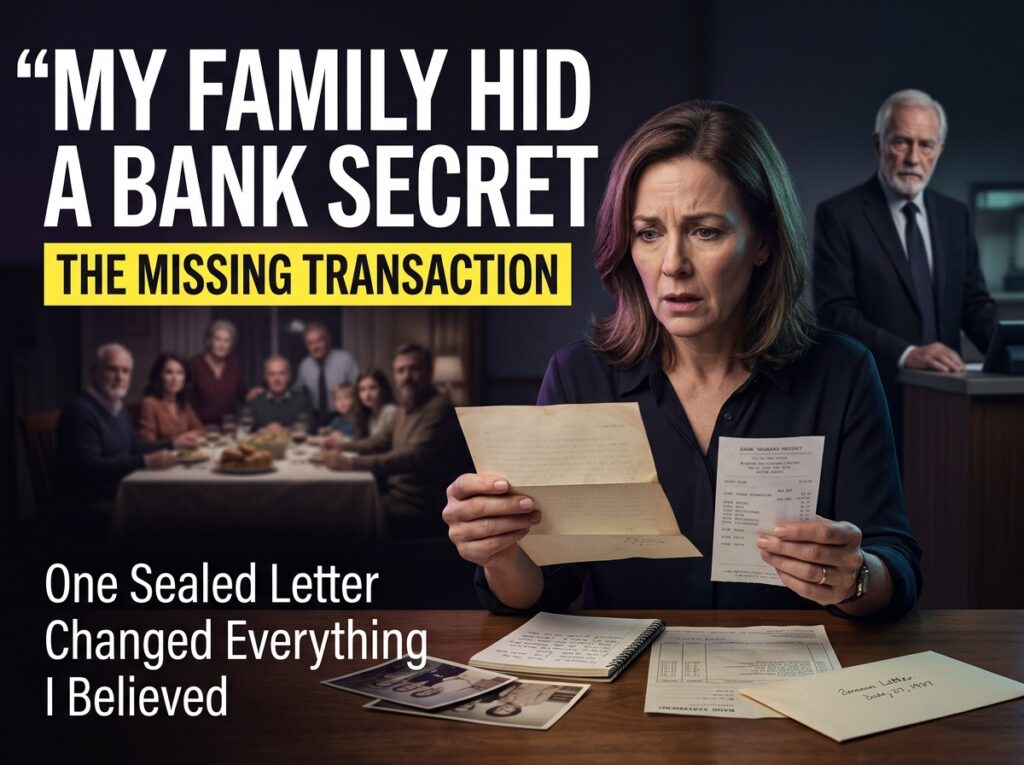
I never cared much about family wealth.
That was the first thing I told myself when my uncle’s old papers began appearing in my mailbox, when relatives who had barely called me in years suddenly wanted to discuss property, and when my cousin started reminding everyone that the family house had supposedly been promised to him.
I wanted something much simpler.
I wanted the old photographs that sat in my mother’s wooden cabinet. I wanted the stories my father used to tell around the dining table, especially the ones he pretended to have forgotten until someone asked the right question. I wanted the familiar sound of relatives arriving on Sunday afternoons, carrying cakes, bags of groceries, and news that had somehow become everyone’s business by the time dinner was served.
Most of all, I wanted a reason for everyone to keep coming home.
Our family had once been good at that.
My parents’ house stood on a quiet street lined with old trees. The paint was fading, the garden gate needed repairing, and the kitchen table had a permanent mark left by a hot saucepan my mother had placed directly on the wood years earlier.
None of those things mattered.
The house was where my brother Daniel had learned to ride a bicycle in the driveway. It was where my sister Margaret had cried after her first serious heartbreak. It was where my father had announced his retirement and where my mother had insisted that every birthday deserved a proper cake, even when money was tight.
After my mother died, I continued visiting my father every weekend.
He became quieter as the years passed, but he still enjoyed sitting beside the kitchen window with a cup of tea. Sometimes he would ask me to bring down one of the old photograph albums, and we would spend an hour trying to remember who had been standing beside whom at a wedding forty years earlier.
Those afternoons were precious to me.
My father was not a wealthy man, but he had always been careful with money. He kept receipts in envelopes, recorded household expenses in a small ledger, and disliked borrowing anything he could save for himself.
He also believed that family disagreements should remain inside the family.
“If people outside hear only half a story,” he used to say, “they will spend the rest of their lives arguing about the wrong half.”
I never thought much about that advice.
Then, five years after my mother’s death, my father passed away.
The funeral brought relatives together who had not sat at the same table in years. For a few days, the house filled with flowers, food, and the sound of people telling stories about him.
I believed we were grieving together.
I did not realize that some of those conversations had already turned toward his estate.
The first sign came when Daniel asked me to meet him at the family house.
He arrived carrying a folder and a list of expenses. He explained that there were outstanding bills, property taxes, and several documents that needed to be signed before the estate could be settled.
“I’ve been handling most of it,” he said. “Dad wanted things kept simple.”
I looked through the papers.
Some were ordinary. Others referred to accounts and transactions I had never heard about.
“What are these?” I asked.
“Old banking matters.”
“Which banking matters?”
Daniel gathered the papers into a neat pile.
“Nothing you need to worry about.”
I had heard those words before.
I asked whether our father had left any outstanding debts.
Daniel said there was nothing significant.
I asked whether the family house would be sold.
He said we would discuss that later.
I asked whether the estate had been formally recorded.
He told me not to make a difficult period harder by asking too many questions.
I remember looking at him across the dining table and realizing that our conversations had changed.
We were no longer two children trying to understand what our father had left behind.
We were two adults, each holding a different version of the same history.
I did not want a fight.
So I let him take the folder.
Over the following months, Daniel became the person everyone contacted about the estate. He spoke with the lawyer, arranged appointments, and distributed copies of documents to relatives who requested them.
Whenever I asked for the complete financial records, he said they were being organized.
Whenever I asked whether our father had maintained another bank account, he said there was no reason to believe that.
Whenever I mentioned a document that did not seem to match the information we had been given, he reminded me that grief could make ordinary details appear suspicious.
I began to doubt myself.
Perhaps I was remembering things incorrectly. Perhaps my father had changed his arrangements without telling me. Perhaps the missing documents had been misplaced during the weeks after his funeral.
I wanted to believe that my brother was doing his best.
After all, he was family.
And family, I had always thought, was supposed to be the one place where a person did not have to prepare for betrayal.
The turning point came on an ordinary Tuesday.
I had gone to the bank to close an old savings account that my father had once helped me open. I expected the visit to take fifteen minutes.
Instead, an elderly employee approached the counter while I was waiting for a printed statement.
He looked at me carefully.
Then he glanced at the identification I had placed on the desk.
“Are you the daughter of Arthur?”
I nodded.
He lowered his voice.
“I thought that was you.”
He introduced himself as Thomas. He had worked at the bank for more than forty years and remembered my father from the days when customers still brought handwritten instructions into the branch.
“I haven’t seen you since you were young,” he said.
I smiled politely.
Then his expression changed.
“There is something you should know about your father’s account.”
I waited.
Thomas looked toward the other employees before leaning closer.
“Your family asked the bank to erase a transaction.”
For a moment, I thought I had misunderstood him.
“Erase a transaction?”
He nodded.
“It was an unusual request. I remember it because the original record had already been processed, and someone wanted the entry removed from the account history.”
“Who asked for it?”
Thomas did not answer immediately.
“I cannot discuss every detail at this counter. Some of the records are old, and I would need to check what can legally be disclosed. But I remember your face, and I remember your father.”
My hands tightened around the statement.
“Was the transaction fraudulent?”
“I didn’t say that.”
“Then what happened?”
Thomas looked toward the office behind him.
“Before you accept the explanation you’ve been given, find the original transaction date. There is a difference between correcting a mistake and asking someone to make a record disappear.”
He stepped away before I could ask another question.
I stood at the counter, staring at the paper in my hands.
For five years, I had accepted my brother’s explanations because I wanted to believe that our father had left us a straightforward estate.
Now an employee who had known my father was suggesting that someone had tried to remove a transaction from the bank’s history.
I left the branch without closing the account.
On the drive home, I kept hearing Thomas’s words.
There is a difference between correcting a mistake and asking someone to make a record disappear.
That evening, I searched my father’s old papers.
I found bank statements, tax records, insurance documents, and several envelopes marked with dates. Most of them concerned ordinary household expenses.
Then I discovered a sealed letter tucked inside an old family photograph album.
My name was written across the front.
The handwriting was my father’s.
Beneath my name was a date I recognized from the bank statement Thomas had printed for me.
I sat at the kitchen table, surrounded by the photographs I had wanted to preserve for the family.
For the first time, I wondered whether my father had left me something more important than an inheritance.
Perhaps he had left me the one record that could explain why someone had wanted the truth erased.
And I had a terrible feeling that opening the letter would change the way I remembered everyone I loved.
<h2>Part 2</h2>
I did not open the letter that night.
I placed it beside the photograph album and spent nearly an hour staring at my father’s handwriting.
The envelope was old but carefully preserved. There were no tears along the edges, no marks suggesting that it had been opened and resealed. The date beneath my name was written in the same neat style he had used on birthday cards and household records.
I remembered that handwriting from childhood.
My father wrote grocery lists in capital letters, recorded measurements in the margins of newspapers, and labelled every box he stored in the attic. When he wanted to make a point, he underlined a word twice.
The letter had no explanation on the outside.
Only my name and the date.
I wondered why he had hidden it inside a photograph album rather than placing it with his legal papers.
Perhaps he had forgotten it.
Perhaps he had intended to give it to me and changed his mind.
Or perhaps he had known that the letter would be discovered only when someone began looking for the truth.
The next morning, I returned to the bank.
Thomas was not at the counter. A younger employee told me he was working in the archives and would be available later that afternoon.
I asked whether I could arrange an appointment to review my father’s historical records.
She explained that the bank could not release confidential information simply because I was a relative. I would need to establish my legal authority or provide the necessary estate documentation.
I understood.
I had no intention of demanding access to accounts that did not belong to me. I wanted to know whether the transaction Thomas remembered was connected to my father’s estate and whether the bank retained an original record.
I showed her the statement from my old account and asked whether the date on the letter matched any transaction reference.
She checked the information and asked me to wait.
After several minutes, she returned with a form requesting details about the deceased account holder and the purpose of my inquiry.
I completed it.
Before I left, I asked whether an old transaction could be deleted from a bank’s historical records.
The employee looked uncomfortable.
“Corrections can be made if there is a documented error,” she said. “But a properly recorded transaction should have an audit trail. A request to remove an entry would need to be reviewed.”
“Would the bank keep a record of who made the request?”
“Depending on the age and type of record, there may be correspondence or internal notes.”
I thanked her.
It was not a complete answer, but it gave me something I had not possessed before: a specific question that could be investigated without relying on family memories.
When I returned home, I opened my father’s letter.
Inside was a single page folded into thirds.
The first paragraph read:
If you are reading this, I have either run out of time or failed to explain something I should have explained years ago.
I stopped.
I could almost hear his voice.
He wrote that there had been a transaction involving the family years earlier. The transaction had been legitimate when it was made, but the circumstances surrounding it had later become a source of disagreement.
He did not give me the full explanation.
Instead, he wrote that the original record should be compared with the family accounts and that I should not accept a copy if the original could still be located.
The date matters more than the amount, he wrote. And the signature matters more than the story people have attached to it.
I read that sentence several times.
The next paragraph mentioned a person who had helped him when the family faced a difficult period.
My father described the person as someone who had acted out of loyalty, even when the decision brought no recognition and created considerable personal risk.
He did not name that person.
He simply wrote:
Do not assume that the person who benefited from a transaction was the person who arranged it. And do not assume that the person who signed a document understood everything it would later be used to prove.
The letter ended with an instruction.
If anyone tells you that the record no longer exists, ask to see the original transaction date and the authorization attached to it. Then speak to someone who was present when the record was first created.
There was no signature at the bottom.
My father had never needed one.
I knew his handwriting.
I folded the letter and returned it to the envelope.
The message did not prove that my brother had done anything wrong. It did not establish that anyone had committed fraud or that the bank had actually erased a transaction.
But it confirmed that my father had anticipated questions about a record and wanted me to examine the original evidence.
I took out my notebook and wrote down the date.
Then I compared it with the papers Daniel had given me after the funeral.
The transaction date fell several months before my mother became seriously ill.
I remembered that period clearly. Our family had been struggling financially. My father had reduced his working hours, and my mother had been worried about keeping the house.
Daniel had recently started a small business and was constantly talking about loans, investments, and opportunities.
Margaret had been helping our mother with appointments.
I had been living in another town, visiting when I could and sending money when my parents needed help.
There were many reasons why a financial arrangement might have been made during that time.
What troubled me was not the existence of the transaction.
It was the possibility that someone had later tried to remove it from the record.
I called Daniel.
He answered quickly.
“Have you found something?” he asked.
His question surprised me.
“I was going to ask you the same thing.”
“What do you mean?”
“I visited the bank yesterday. An employee remembered Dad’s account and told me that someone in the family had asked the bank to erase a transaction.”
Silence.
Then Daniel said, “You shouldn’t listen to rumors.”
“Was it a rumor?”
“I don’t know what the employee thinks he remembers.”
“Do you know anything about the transaction?”
“All the estate accounts were reviewed.”
“That wasn’t my question.”
He sighed.
“We have been through this already. Dad’s affairs were complicated, and the paperwork took time. There is no point reopening old matters.”
I looked at the sealed envelope.
“Dad left me a letter about an original transaction.”
Daniel’s voice changed.
“What letter?”
I told him the letter’s date but did not read the contents aloud.
He asked whether I had taken it to the bank.
“Not yet.”
“You should be careful. Old documents can be misunderstood.”
“I know.”
“Then please don’t make accusations before you understand what you’re looking at.”
I felt a familiar frustration.
“I haven’t accused anyone.”
“Not yet,” he said.
The call ended shortly afterward.
I sat motionless, thinking about his reaction.
Daniel had not denied that the transaction existed.
He had not asked which transaction the bank employee remembered.
He had simply told me not to investigate it.
Perhaps he was worried that I would misinterpret an old record.
Perhaps he was protecting someone.
Or perhaps he was afraid of what the record might reveal about him.
I could not know.
But I understood that I would never find the answer by asking the same questions and accepting the same vague explanations.
I needed the original record.
And I needed to find the person my father had trusted enough to mention in his final letter.
<h2>Part 3</h2>
The bank arranged an appointment for the following Monday.
By then, I had gathered every document I could find that mentioned my father’s finances. I brought the sealed letter, the old statement, a copy of the estate paperwork, and my family notebook.
Thomas met me at reception.
He looked older than I remembered from our first conversation, perhaps because the seriousness of the matter had changed the way I saw him.
“I’ve spoken with the records manager,” he said. “We can review the historical information that is available, but I need you to understand that some parts of the file may remain confidential.”
“That’s fair,” I replied. “I’m not asking for anything I am not entitled to see. I want to establish what happened and whether the transaction was properly recorded.”
He led me into a small office.
A folder lay on the table.
Thomas opened it and showed me a copy of the original transaction entry. The date matched the one on my father’s letter.
The record indicated that money had been transferred from an account associated with the family to an account held under a separate arrangement.
The amount was significant, but the document did not identify the final beneficiary in a way I could immediately understand.
A reference number appeared beside the transaction.
Below it was a note indicating that additional authorization documents had been filed separately.
I leaned forward.
“Is this the transaction someone asked you to erase?”
Thomas shook his head.
“This is the original transaction. I can confirm that a request was later made to review or amend the historical entry. I cannot tell you, from this page alone, that the request was intended to erase a legitimate transaction.”
“Who made it?”
“The surviving notes identify a family representative, but the authorization record needs to be examined before I can confirm the person’s role.”
I looked at him.
“Could the transaction have been corrected without being deleted?”
“Yes. If there was a genuine error, the bank could have recorded a correction while preserving the original audit trail.”
“And if someone wanted the original entry removed?”
“That would raise questions. But we should not assume that was the purpose without reviewing the full file.”
I appreciated his caution, even though I wanted a more direct answer.
Thomas turned to another page.
It contained a brief summary of correspondence relating to the account. One note indicated that a family member had requested a review after a disagreement about ownership.
Another mentioned a signature that had been questioned.
A third referred to a sealed letter submitted with supporting documents.
My father’s letter.
I recognized the description.
“Was this the letter he submitted?”
Thomas checked the reference.
“It appears to have been attached to a later inquiry, but I cannot establish that it is the same document without examining the original correspondence.”
“Can we see that correspondence?”
“The records manager is reviewing the request. Some of the papers may be released to the estate representative, but we need to confirm the authorization.”
I looked down at the transaction record.
The evidence did not yet establish who had made the request, why the request had been made, or whether the bank had acted on it.
But it confirmed that the original transaction existed and that a later review had taken place.
For the first time, I understood why my father had emphasized the date.
The transaction had not been an isolated event. It had been followed by correspondence, a question about a signature, and an attempt to change the way the record was understood.
The history was more complicated than the estate summary suggested.
I asked Thomas whether he remembered the person who had visited the bank.
He thought for a moment.
“I remember a woman and a man coming in together. That was many years ago. I cannot say with certainty who they were.”
“Did you know them?”
“I recognized one of them as a member of your family. I remember the other because they seemed reluctant to speak.”
“What happened?”
“They asked whether a transaction could be reviewed without reopening the entire account history. The request was referred to a manager.”
“Did they ask for it to be erased?”
Thomas looked at the folder.
“I remember the word being used, but I cannot tell you who said it or whether they were describing the requested outcome accurately. That is why the written record matters.”
I nodded.
The distinction was important.
A person might ask for an entry to be erased because they believed it was incorrect. Another might use the same words because they wanted a record concealed.
The request itself was not proof of wrongdoing.
The supporting documents would have to establish the purpose.
Thomas gave me a reference number for the records request and explained that I would be contacted when the review was complete.
Before I left, I asked whether he could tell me anything about the signature.
He hesitated.
“The note says the signature was questioned, but it does not say that it was proven false.”
I thanked him.
Outside, I sat on a bench and opened my notebook.
I wrote down four facts.
The transaction existed.
A later review had been requested.
The file contained a question about a signature.
And someone had submitted a sealed letter as supporting evidence.
I did not write Daniel’s name beside any of them.
I had spent too many years allowing suspicion to become certainty before I had the evidence to support it.
This time, I wanted to be careful.
When I arrived home, I found a message from Margaret.
She wanted to know whether I had discovered anything about the bank transaction.
I called her.
She listened while I explained the records that had been reviewed.
Then she said, “There is something you should know about Daniel.”
I waited.
“He was not the only person handling Dad’s affairs.”
“Who else was involved?”
“Someone who used to visit Dad regularly. Someone he trusted with documents.”
“Why didn’t you mention this before?”
“Because I didn’t think it mattered. I believed Daniel had taken care of everything.”
I asked for the person’s name.
Margaret hesitated.
Then she said, “I don’t want to accuse anyone. But if you are looking for the person who knew about the original transaction, you should speak to Aunt Helen.”
I sat very still.
Aunt Helen had been our father’s closest living relative. She had helped him with appointments after our mother died and had attended almost every family gathering.
She had also been the person who repeatedly told me to stop asking questions about the estate.
I had trusted her judgment.
Now I wondered whether she had known more than she had ever admitted.
<h2>Part 4</h2>
Aunt Helen lived in a small house near the edge of town.
She had been close to my parents for as long as I could remember. When I was young, she brought homemade biscuits to our house every Sunday. When my mother became ill, Helen helped organize appointments and drove my father to the hospital when he was too tired to make the journey alone.
After my mother’s death, she became one of the few people who could persuade my father to leave the house.
I had never thought of her as someone who might conceal a family secret.
When I called, she sounded pleased to hear from me.
“I was wondering when you would come by,” she said.
The comment unsettled me.
“Why?”
“I haven’t seen you in weeks.”
I told her I would visit that afternoon.
When I arrived, she had already made tea.
We sat in the living room, surrounded by framed photographs of relatives and old friends. A photograph of my father stood on the mantelpiece beside one of my mother.
Helen asked about my health and whether I was still working. She mentioned a neighbor who had recently moved away and complained about the rising cost of groceries.
For nearly twenty minutes, we spoke about ordinary things.
Then I placed the bank statement on the table.
“I’ve been looking into Dad’s financial records,” I said.
Her hands stopped moving.
“Why?”
“Because I found a letter he left me, and the bank confirmed that someone requested a review of an old transaction.”
Helen stared at the document.
For a moment, I thought she might deny knowing anything about it.
Instead, she asked, “What did Thomas tell you?”
I felt my stomach tighten.
“You know Thomas?”
“Everyone who dealt with your father knew Thomas.”
“Did you ever visit the bank with Dad?”
She looked toward the photograph on the mantelpiece.
“Yes.”
“When?”
“Many years ago.”
“Were you there when the transaction was made?”
Helen did not answer immediately.
“I helped your father with paperwork from time to time.”
“Was the transaction legitimate?”
Her eyes returned to mine.
“It was real.”
“That isn’t the same as answering my question.”
She sighed.
“Your father believed he was doing the right thing.”
“What did he do?”
Helen folded her hands in her lap.
“He helped someone when they were in trouble. He believed that if he did not act, that person’s life would be damaged in a way they might never recover from.”
“Who?”
“I cannot tell you everything without explaining what your father was trying to protect.”
“Then explain it.”
She shook her head.
“Not yet.”
I felt anger rising.
“Everyone keeps telling me that. Dad wrote that I should look at the original transaction. Daniel says I should stop asking questions. Now you say you cannot explain anything.”
Helen’s eyes filled with tears.
“I know how it sounds.”
“Then help me understand.”
She stood and walked to the window.
For several moments, she watched the street outside.
Finally, she said, “Your father made a promise. He believed that keeping the promise meant protecting a person whose circumstances were private. He did not want that person’s name dragged into a family argument.”
“Did the bank make a mistake?”
“No.”
“Did someone forge a signature?”
“I don’t know.”
“Did you ask the bank to erase the transaction?”
She turned toward me.
“No.”
The answer came quickly.
I believed she was telling the truth, but I could not know whether she understood exactly what I was asking.
“Then why have you been telling me to stop investigating?”
“Because I know what happens when families turn old mistakes into accusations. People choose sides. They remember only the details that support the person they already believe. Before long, nobody is trying to understand the truth. They are trying to win.”
I thought about my father’s advice.
If people outside hear only half a story, they will spend the rest of their lives arguing about the wrong half.
Perhaps he and Helen had both been trying to prevent that.
But their silence had created another problem.
They had left the family with incomplete information, and the people who controlled the records had been allowed to tell the story without explaining the missing pieces.
“I am not trying to win,” I said. “I want to know what happened.”
Helen returned to her chair.
“Then you need to find the person your father helped.”
“Who is that?”
She looked at me for a long time.
“I cannot tell you without breaking a promise I made to your father.”
I stood.
“Then I will find out another way.”
Helen reached for my hand.
“Please don’t mistake silence for guilt.”
I pulled my hand back gently.
“And please don’t mistake my questions for an accusation.”
Neither of us spoke for several seconds.
When I left, Helen did not walk me to the door as she usually did.
I drove home feeling more uncertain than before.
Her denial of the bank request might be genuine. Her explanation about a promise might be true. But she had confirmed that she knew about the transaction and had helped my father with paperwork.
That meant she was connected to the events I was trying to understand.
I returned to my father’s letter and read it again.
Do not assume that the person who benefited from a transaction was the person who arranged it.
The sentence seemed more important now.
Perhaps Daniel had been blamed for something he had not initiated.
Perhaps Aunt Helen had been protecting the person who received the money.
Or perhaps both of them had been trying to protect my father from a decision he regretted.
I could not determine the answer from the letter alone.
That evening, I called the bank and asked for an update on the records request.
The employee said the review was still underway.
I asked whether the sealed letter mentioned in the file had been preserved.
She said it had been listed as an attachment, but its contents had not yet been verified.
I requested a copy if the bank could legally provide one.
Then I opened my notebook and recorded everything Helen had told me.
I did not write that she was guilty.
I wrote that she had known about the transaction, had helped my father with paperwork, and had refused to identify the person he had helped.
It was a small distinction.
But I was beginning to understand that small distinctions could determine whether a family preserved the truth or destroyed it.
<h2>Part 5</h2>
The next week, a letter arrived from the bank.
It contained a notice that the historical review had located additional correspondence. The bank could provide certain records once my legal authority to receive them had been verified.
I gathered the estate documents and returned to the branch.
Thomas met me in the same office as before.
He placed a new folder on the table.
“We’ve located the authorization associated with the original transaction,” he said. “It does not resolve every question, but it clarifies several important details.”
I opened the folder.
The first page recorded the transaction date and amount. The second identified the account from which the money had been transferred. The third contained an authorization signed by my father and witnessed by another person.
The signature appeared genuine.
I recognized the shape of my father’s capital A, the long tail of the final letter in his surname, and the slight upward angle of the date.
But the witness’s signature was unfamiliar.
“Who signed this?”
Thomas pointed to the name.
“That is the person whose identity we are still verifying.”
I read the name again.
It was not Daniel’s.
It was not Aunt Helen’s.
It belonged to someone who had worked with my father years earlier and who had disappeared from our family life after a disagreement.
I asked Thomas whether the bank had attempted to remove the transaction.
He explained that the original entry had never been deleted from the system. A request had been made to review the record and change the way the transaction was classified.
The request had been placed on hold because the supporting documents were incomplete.
“So the transaction was not erased?”
“Not from the original record. The surviving file indicates that someone requested a change, but the change was not finalized.”
I felt a mixture of relief and anger.
The family story had become more dramatic with every retelling. Someone had supposedly erased the transaction. Others had insisted there was nothing unusual in the records.
The truth was more precise.
A request had been made to change the entry, but the bank had preserved the original record.
The distinction mattered.
I asked whether the bank had documented who made the request.
Thomas showed me a copy of the correspondence.
The request had been submitted by an authorized family representative, but the letter stated that the transaction should be reclassified because the account holder believed the original description did not accurately reflect the arrangement.
The signature on the request was not my father’s.
It was Daniel’s.
I stared at the page.
For a moment, the room seemed to grow smaller.
Daniel had told me that the estate accounts had been reviewed. He had told me not to listen to rumors. He had never mentioned that he had submitted a request concerning the transaction.
But the letter did not establish that he had tried to conceal wrongdoing.
It stated that he wanted the entry reclassified.
I asked Thomas what the original description had been.
He showed me the relevant line.
The transaction had been recorded as a transfer under a family assistance arrangement. The requested classification described it as a temporary advance pending a later settlement.
The difference might have been important for the estate accounts.
But it did not, by itself, prove that money had been stolen or that the bank had acted improperly.
I asked why the request had not been completed.
Thomas turned to the next page.
The bank had asked for additional documentation confirming the beneficiary’s identity and the conditions of the agreement.
Those documents had never been supplied.
I looked at Daniel’s signature again.
He had been involved in the request.
That fact could not be ignored.
But I also remembered the sentence in my father’s letter: the person who benefited from a transaction was not necessarily the person who arranged it.
I needed to understand Daniel’s role before deciding what his signature meant.
I called him from the bank’s parking lot.
He answered almost immediately.
“The bank has a copy of a request you submitted,” I said.
He was silent.
“It concerns the original transaction. You asked for the entry to be reclassified.”
“Yes.”
“Why didn’t you tell me?”
“Because the request was never completed.”
“That doesn’t explain why you kept it from me.”
He sighed.
“Dad asked me to help organize the records. The transaction had been described in a way that did not match the final agreement. He believed it should be classified as a temporary advance until the settlement was complete.”
“Was that true?”
“As far as I understood, yes.”
“Why didn’t you provide the additional documents?”
“I tried to get them. The person who had the original agreement stopped responding.”
“Who was that person?”
“I can’t give you an answer I cannot prove.”
I closed my eyes.
“Daniel, I am not asking you to guess. I am asking what you knew.”
He paused.
“I knew Dad had helped someone. I knew there was supposed to be a final settlement. I did not know that the missing documents would become a problem years later.”
“Did you ever ask the bank to erase the transaction?”
“No. I asked them to reclassify it. The original record was supposed to remain.”
His answer matched the documents.
I still had questions, but I no longer had reason to treat the bank’s request as proof that he had attempted to hide money.
“What happened to the person who held the agreement?” I asked.
Daniel’s voice became quieter.
“I believe that person is still alive.”
“Who?”
“I don’t know whether they want to be identified.”
I thought of Aunt Helen.
She had said that my father was protecting someone whose circumstances were private.
I asked Daniel whether he had spoken to Helen about the transaction.
“Yes.”
“What did she tell you?”
“That Dad wanted the matter settled without turning it into a family dispute.”
“Did she know who received the money?”
He paused.
“She knew more than I did.”
I ended the call with no clear resolution.
Daniel had submitted the reclassification request, but the original transaction remained intact. The bank had not erased it. The missing documentation had prevented the review from being completed.
That was what the evidence showed.
Yet the reason the original agreement had never been returned remained unknown.
And the person who had signed as witness had not been identified.
I returned to the records office and asked whether the witness’s signature could be verified.
Thomas said the bank would continue checking its surviving files.
Before I left, he looked at me with an expression I had not seen before.
“There is another document,” he said. “It was submitted several years after the original transaction. It contains a statement from someone who was present when the agreement was made.”
“Can I see it?”
“We’re still verifying the authorization. But if the statement can be released, it may explain why the final settlement was never recorded.”
I thanked him.
For the first time, I felt that the investigation was moving toward an answer.
But I also knew that the next document might reveal something I had not prepared myself to hear.
<h2>Part 6</h2>
The bank called three days later.
Thomas said the records manager had approved the release of the witness statement, subject to the usual restrictions on confidential information.
I arranged to visit that afternoon.
The statement was only two pages long.
It had been written several years after the original transaction and signed by a person who identified themselves as someone who had helped prepare the agreement.
The statement explained that the transaction had been made to protect a family member from losing a home during a period of financial difficulty.
My father had provided the money, but the arrangement had involved another person who was responsible for managing the documents and ensuring that the final settlement was completed.
The statement also explained why the original agreement had not been returned.
The person holding it had become concerned that the family would interpret the transaction as a gift rather than a temporary advance. They feared that the beneficiary would be pressured to repay money that had already been accounted for through a separate arrangement.
The statement did not identify the beneficiary by name.
Instead, it referred to the person as the younger member of the family whose future was at risk.
I read the sentence twice.
The wording sounded familiar.
I remembered my father’s conversations about Daniel’s business, Margaret’s financial difficulties, and my own struggles to pay for education when I was younger.
Any one of us could have been the person described.
I asked Thomas whether the original agreement contained a full name.
“It does,” he said. “But the bank has not yet verified whether the person named in the statement is the same person recorded as the beneficiary. We need to compare the records.”
“How long will that take?”
“I can’t give you an exact date.”
I took the statement home and placed it beside my father’s letter.
The phrase the younger member of the family whose future was at risk stayed with me.
My father had helped me when I was younger. He had paid some of my school expenses and helped me find work when I struggled to support myself.
He had also helped Daniel when his business nearly failed.
Margaret had received assistance after her divorce.
Perhaps the transaction concerned one of those events.
But the letter referred to a person who had helped my father and a signature that might not have meant what people believed it meant.
I wondered whether the beneficiary had ever known that the arrangement was recorded as a temporary advance.
If they had believed it was a gift, the later dispute might have been the result of a misunderstanding rather than deliberate deception.
I called Margaret.
She listened carefully while I explained the witness statement.
Then she said, “There is something I never told you about the year Dad made that transaction.”
I waited.
“I was in serious trouble at the time. My marriage had ended, and I was about to lose my apartment. Dad gave me money, but he insisted that I sign several documents. He said they were necessary to protect the arrangement.”
My heart began beating faster.
“Do you remember what the documents said?”
“Not exactly. I was upset, and I trusted him. He told me the money was temporary and that we would discuss it again later.”
“Did you receive the money through a bank transfer?”
“I don’t remember. He handled most of the paperwork.”
I asked whether Daniel had been involved.
“Yes. He was helping Dad with the accounts.”
I looked at the witness statement.
“Did you ever sign a document saying that you had received a loan?”
Margaret was quiet.
“I may have. I thought Dad was helping me until I could get back on my feet. I didn’t realize there was a formal arrangement.”
“What happened afterward?”
“I repaid some money, but Dad told me that the rest had been settled. I never asked for the details.”
I felt a cold wave of realization.
Margaret might have been the person described in the statement.
But there was still a problem.
The bank’s transaction record did not show that the entire amount had gone directly to her. The money had been transferred through a separate arrangement, and the final beneficiary remained unconfirmed.
I asked Margaret whether she had ever seen the original agreement.
“No.”
“Did you know that someone had asked the bank to change the transaction record?”
“No. I didn’t even know there was a dispute.”
Her answer sounded genuine.
I thanked her and ended the call.
For the first time, I understood how a family could end up arguing about the same transaction for years without anyone knowing exactly what had happened.
My father might have believed he was helping Margaret.
Daniel might have believed he was correcting an accounting description.
Aunt Helen might have been protecting the person who held the original agreement.
And the person who had signed as witness might have known that the final settlement had been completed in a way the bank’s surviving records could not show.
None of those possibilities proved that anyone had acted dishonestly.
But the missing original document remained a serious gap.
That evening, I returned to the old family house and searched the attic.
I found boxes of books, old toys, and household items my parents had kept for reasons I could no longer remember.
Behind a stack of folded blankets was a metal document case.
Inside were copies of tax returns, insurance policies, and letters from the period when my parents had been struggling financially.
At the bottom lay a folded sheet of paper with a reference number written across the top.
It matched the bank transaction.
The document was not the original agreement.
It was a receipt acknowledging that the temporary advance had been settled.
The date was several years after the original transfer.
At the bottom were two signatures.
One belonged to my father.
The other belonged to the witness whose name I had not yet been able to verify.
I stared at the receipt.
If it was genuine, it suggested that the financial arrangement had been completed.
But why had the bank never received it?
And why had the original agreement disappeared?
I turned the receipt over.
On the back, in my father’s handwriting, was a single sentence.
If they ask who received the benefit, do not confuse the person named on the account with the person whose future was protected.
I read it again.
The receipt suggested that the money had been settled.
The statement suggested that someone had been protecting a younger family member.
And my father’s letter had warned me not to assume that the person who benefited was the person who arranged the transaction.
I was beginning to suspect that the family had spent years arguing about the wrong person.
But I still did not know who had been protected.
<h2>Part 7</h2>
The following morning, I returned to the bank with the receipt.
Thomas examined it carefully.
He compared the reference number, the signatures, and the date with the surviving records.
After several minutes, he called the records manager into the room.
They reviewed the document together.
Finally, the manager looked at me.
“This appears consistent with the supporting records, but we cannot authenticate the signatures solely from the copy you have brought. We will need to compare it with the bank’s retained documents.”
“Does it change your understanding of the transaction?”
“It suggests that a settlement may have taken place. We need to verify the details before drawing a conclusion.”
I understood.
The receipt was important, but it was not enough by itself.
I asked whether the bank had located the original authorization.
The manager said they had found a record identifying the person who submitted the original transaction documents.
The name was Eleanor Brooks.
I recognized it immediately.
Eleanor had been a close family friend for decades. She had lived near my parents when we were children and had helped my mother during difficult periods. She had never been part of the family by blood, but she had attended birthdays, holidays, and weddings as though she belonged to us.
She had also disappeared from our lives after an argument with my father more than twenty years earlier.
I had been told that the disagreement concerned money.
No one ever explained the details.
I remembered asking my mother about it once.
She had told me that adults sometimes disagreed about things that children did not need to understand.
After that, Eleanor’s name rarely came up.
I looked at Thomas.
“Are you certain she submitted the documents?”
“The surviving record identifies her as the person who delivered the original agreement. We are still checking the witness signature and the final receipt.”
I asked whether the bank had an address for her.
The records manager said the address was old and might no longer be valid.
I thanked them and left.
At home, I searched the family photograph albums.
Eleanor appeared in several pictures. She was standing beside my mother at a summer picnic, sitting with my father at a birthday dinner, and holding a baby at a family gathering.
In one photograph, she was standing beside Margaret, who looked barely twenty.
On the back, my mother had written a date and a short note.
Eleanor stayed until everything was settled.
I stared at the words.
Everything had been settled.
Perhaps the note referred to an ordinary family matter. But the date was the same year as the final receipt.
I called Aunt Helen.
When I told her that the bank had identified Eleanor as the person who submitted the original agreement, she became silent.
Then she said, “I wondered when you would find her name.”
“Why didn’t you tell me?”
“Because your father asked me not to.”
“Was Eleanor the person he was protecting?”
Helen sighed.
“She was protecting someone else.”
“Who?”
“I don’t know every detail. I only know that she believed your father had made a promise that needed to be kept.”
I felt frustration rising again.
“Why does everyone know part of the story but refuse to explain it?”
“Because we were all afraid of what would happen if we said the wrong thing.”
“That fear has already caused damage.”
Helen did not argue.
After a long pause, she gave me Eleanor’s last known address.
It was in a neighboring town, less than an hour away.
I drove there the following afternoon.
The house was small and well maintained, with flowerpots beside the front steps and a narrow path leading to the door.
An elderly woman answered.
She looked at me for several seconds before speaking.
“You look like your mother,” she said.
I introduced myself.
She nodded as though she had been expecting me.
“I wondered whether you would come one day.”
I asked whether she was Eleanor Brooks.
“Yes.”
I showed her the bank receipt.
She looked at it, then invited me inside.
We sat at a small table in her kitchen.
For several minutes, she said nothing.
Then she asked, “Has the bank confirmed that the original transaction was legitimate?”
“They have confirmed that the transaction exists. They are reviewing the final receipt.”
Eleanor nodded.
“Your father was a careful man. He wanted everything documented.”
“Then why did the records disappear?”
“They didn’t disappear,” she said. “Some were kept by the bank, some by your father, and some by me. The problem was that the documents were never brought together.”
“Why not?”
She looked toward the window.
“Because your father was trying to protect someone who did not want the family to know what had happened.”
I waited.
Finally, she said, “The person your father helped was not the person everyone blamed.”
<h2>Part 8</h2>
Eleanor went to a cabinet beside the kitchen and returned with a small folder.
Inside were copies of the original agreement, a letter from my father, and a statement confirming that the arrangement had been settled.
She placed the documents in front of me.
“I kept these because your father asked me to,” she said. “He believed the family might eventually need them.”
I examined the agreement.
The transaction had been created to prevent a property from being sold during a period of financial difficulty. My father had provided money to cover an immediate obligation, while Eleanor had coordinated the paperwork and arranged for the eventual settlement.
But the person whose future was being protected was not identified by name in the main agreement.
Instead, the document referred to a beneficiary whose identity was recorded in a separate authorization.
I asked Eleanor whether she knew the beneficiary.
“Yes.”
“Can you tell me who it was?”
She folded her hands.
“I can tell you what the documents establish. I cannot tell you what another person has never agreed to reveal without understanding why you need to know.”
I felt a familiar frustration.
“Someone asked the bank to change the record. My brother signed the request. My father left me a letter telling me to investigate. I have been told to stop asking questions by people who knew about the transaction. I think I have a right to understand what happened.”
Eleanor nodded slowly.
“You have a right to understand the transaction. That does not necessarily mean every private detail belongs to you.”
I considered her words.
She was right about the distinction, but I could not ignore the fact that the missing information had affected the entire family.
“What can you tell me?”
She pointed to the final receipt.
“The arrangement was completed. Your father did not lose the money, and the beneficiary was not required to repay more than the agreement specified. The later request to reclassify the transaction was made because the original description did not explain the final settlement.”
“Then why did my father leave me a letter suggesting that someone had tried to erase the transaction?”
“He wanted you to find the original record. He was afraid that if the transaction were discussed without the supporting documents, someone would be accused of taking money that had already been accounted for.”
I thought of Daniel.
Perhaps he had submitted the request because he wanted the accounts to reflect the final arrangement.
But that still did not explain why he had never told me about it.
“Did my father know who asked for the reclassification?”
“Yes.”
“Did he approve it?”
Eleanor opened the folder and showed me a letter.
My father’s handwriting was unmistakable.
He had written that he agreed the transaction should be reclassified once the final settlement was verified, provided that the original record remained available and the supporting documents were preserved.
The letter was dated several months before the bank’s review.
I read it twice.
Daniel had not acted entirely on his own. My father had agreed that the classification might need to change.
The family story had made the request sound like an attempt to erase evidence, but the documents suggested that it had been part of an effort to correct an incomplete account.
That did not mean every decision had been wise.
It did mean that the accusation was not supported by the evidence I had seen.
I asked Eleanor why my father had not simply explained this to everyone.
“He tried,” she said. “But some people believed that revealing the arrangement would damage the beneficiary. Others believed that keeping it private would protect the family. By the time your father realized how much confusion the silence had created, the people involved had become afraid of being blamed.”
I looked down at the letter.
The pattern was painfully familiar.
Everyone had believed they were protecting someone.
Everyone had withheld part of the truth.
And the result was that the family had been left to invent explanations for the missing details.
I asked Eleanor whether she had ever told Aunt Helen the beneficiary’s identity.
She hesitated.
“Yes.”
“Did she tell anyone else?”
“I don’t know.”
I asked whether the beneficiary had ever known about the arrangement.
Eleanor nodded.
“They knew enough to understand that help had been provided. They did not know how the bank recorded it or why the final documents were important.”
“Why was the name kept separate?”
“Because the person was young, and your father did not want a temporary financial problem to become something that followed them for the rest of their life.”
I felt a strange sense of sadness.
My father had tried to protect someone from shame, but his secrecy had created a different kind of burden.
I asked Eleanor whether she would allow me to take copies of the documents to the bank.
“Yes,” she said. “The bank needs them to complete the record.”
She placed the folder in my hands.
Before I left, she gave me one more piece of paper.
It was a handwritten statement from the witness who had signed the original agreement.
The name was now visible.
I recognized it.
It belonged to someone who had been close to our family for years, someone who had repeatedly insisted that my father had handled the transaction properly.
Someone I had never suspected of being involved in the decision to keep the beneficiary’s identity hidden.
I looked at Eleanor.
“Why didn’t you tell me this person was the witness?”
“Because I promised your father I would not reveal the name unless the original records were being reviewed.”
I looked at the signature again.
The witness had not been Daniel.
It had not been Aunt Helen.
It was someone else.
And if that person had signed the original agreement, they might be able to explain why the family had spent years arguing about a transaction that had already been settled.
<h2>Part 9</h2>
I returned to the bank with Eleanor’s documents.
Thomas and the records manager reviewed the original agreement, the final receipt, and my father’s letter authorizing the reclassification.
They compared the reference numbers and dates.
After several hours, they confirmed that the documents were consistent with the surviving bank records. The original transaction had been legitimate, and the supporting evidence indicated that the arrangement had later been settled.
The bank’s records had not been erased.
The request to change the transaction’s classification had not been completed because the supporting documentation was missing.
The new documents explained why the request had been made and provided evidence that the settlement had occurred.
It was not proof that every person involved had acted perfectly.
But it was enough to establish that the original accusation—that someone had simply made the transaction disappear—was not supported by the complete record.
I thanked the records manager.
Before leaving, I asked whether the witness’s identity could be confirmed.
Thomas looked at the signed statement Eleanor had provided.
He nodded.
“The signature matches the name recorded in the original file.”
I read the name again.
Aunt Helen.
For several seconds, I could not speak.
Helen had told me that she knew about the transaction, that she had helped my father with paperwork, and that she was protecting a promise.
She had not told me that she had witnessed the agreement.
I felt anger, but beneath it was something more complicated.
Helen had not been the person who asked the bank to reclassify the transaction. She had not been the beneficiary. She had not erased the original record.
She had been present when the arrangement was created.
She had signed as a witness.
And she had kept silent for years.
I drove to her house that afternoon.
She opened the door and took one look at my face.
“You found the documents,” she said.
“Yes.”
I placed the witness statement on the table.
“You signed the original agreement.”
Helen sat down slowly.
“Yes.”
“Why didn’t you tell me?”
“Because your father asked me to protect the beneficiary’s identity.”
“Did you know that Daniel had submitted the reclassification request?”
“Yes.”
“Did you know that the bank never completed it?”
“Yes.”
I looked at her.
“You knew the transaction had not been erased, but you allowed me to believe that something terrible might have happened.”
Helen closed her eyes.
“I didn’t know what the bank had told you. I was afraid that if I explained the arrangement without the documents, I would make things worse.”
“You could have told me that the original transaction was real and that the settlement had been completed.”
“I should have.”
Her answer surprised me.
I had expected another explanation, another warning about family disagreements, another reminder that I should stop asking questions.
Instead, she admitted that she had made a mistake.
“I thought keeping quiet was the safest thing to do,” she continued. “Your father believed the same. We were trying to protect someone who had already been through a difficult time. We didn’t want a private financial problem becoming a permanent family accusation.”
“But it became one anyway.”
Helen nodded.
“I know.”
I sat across from her.
“Who was the person you were protecting?”
She looked at the witness statement.
Then she said the name.
Margaret.
My sister.
I stared at her.
Margaret had told me that she remembered receiving help from our father, but she had not known the full details of the arrangement. She had been struggling financially after her marriage ended, and she had signed documents without understanding how they would later be interpreted.
But the beneficiary listed in the separate authorization was not Margaret.
It was someone else whose future my father had wanted to protect.
Helen explained that Margaret had been the person who received the initial help, but the money was intended to protect a younger family member who depended on her.
The arrangement had been structured to prevent the family property from being lost while the beneficiary’s circumstances were resolved.
My father had wanted to protect both Margaret and the person who depended on her.
The witness statement identified that person.
It was me.
I felt the room go silent.
Years earlier, I had been struggling to pay for my education and support myself. My father had told me that he had arranged some assistance, but I had believed it was a simple family gift.
I had not known that the money had been routed through a formal arrangement involving Margaret, Eleanor, and Aunt Helen.
I had not known that the transaction had been recorded as a temporary advance.
And I had not known that the final settlement depended on documents that had never been brought together.
My father had tried to protect me from the embarrassment of needing help.
But the protection had created a record that, without its supporting documents, looked suspicious.
I looked at Helen.
“Why didn’t Dad tell me?”
“Because he knew you would feel responsible. He did not want you to believe that your future had come at the expense of someone else’s security.”
I thought of the old photographs, the family dinners, and the years I had spent believing that the adults around me had handled the difficult parts of life without involving me.
I had thought they were protecting me.
In some ways, they had been.
But they had also denied me the chance to understand the decisions that affected my life.
I asked Helen whether Margaret had known that I was the beneficiary.
“She knew that the arrangement was intended to help you, but she did not understand the banking details. Your father wanted the financial records kept separate from the family conversations.”
“Did Daniel know?”
“He knew that the arrangement concerned you. He did not know every private detail, and he did not have the original agreement when he submitted the reclassification request.”
I sat back.
The person I had suspected of betrayal had been trying to correct an incomplete record.
The person I had trusted to explain the estate had withheld information because she believed silence was safer.
And the person who had seemed most closely connected to the mystery—my father—had been trying to protect me from a burden he feared I would carry.
But in trying to protect me, he had left me with a mystery that threatened the trust between every member of our family.
I looked at Helen.
“I don’t know whether I can forgive everyone immediately.”
She nodded.
“I wouldn’t expect you to.”
“But I understand what happened now.”
For the first time, I felt that the family story was no longer a collection of competing accusations.
It was a sequence of decisions, each made for a reason, each carrying consequences that nobody had fully anticipated.
And the person I had never suspected had not been hiding a crime.
She had been hiding the fact that she had witnessed an agreement designed to protect me.
<h2>Part 10</h2>
The following weeks were quieter than I expected.
There was no dramatic family meeting in which everyone confessed to years of deliberate deception. There were no sudden discoveries of hidden fortunes or secret properties.
Instead, there were difficult conversations.
I spoke with Daniel about the reclassification request and the documents that had finally been found. He explained that he had believed he was helping our father complete the estate records, not conceal a transaction.
I told him that I understood the difference, but that his refusal to explain the situation had made it difficult to trust him.
He apologized.
Not because I demanded it, but because he finally understood how his silence had affected me.
I spoke with Margaret about the assistance our father had arranged years earlier. She admitted that she had been frightened by the financial difficulties she had faced and had allowed our father to handle the paperwork because she trusted him.
She had not intended to conceal anything from me.
She had simply believed that the arrangement was complete and that there was no reason to revisit it.
I told her that I understood, but that I wished someone had explained the arrangement before it became the subject of suspicion.
She cried.
I held her hand.
We were not able to recover the years during which the family had misunderstood the transaction, but we could stop allowing the misunderstanding to determine our future.
Aunt Helen gave me copies of the correspondence she had kept. She did not ask me to promise that I would never discuss the matter again. Instead, she helped me arrange the documents so that anyone reviewing them in the future could understand what had happened.
The bank completed its review and attached the supporting documents to the historical file.
The original transaction remained visible.
The reclassification request was preserved with the explanation that it had never been completed because the required documentation was missing.
The final settlement was recorded.
There was no need to erase anything.
The truth had been preserved not by removing the uncomfortable parts, but by placing them in the correct order.
That became the principle I used when organizing my father’s papers.
I kept the old photographs, the letters, the receipts, and the family notebook. I added a written explanation of the transaction and included copies of the documents that established the arrangement’s purpose and final settlement.
I did not write that my family had been innocent of every mistake.
I wrote that the surviving evidence showed no basis for treating the original transaction as proof of theft or deliberate concealment. I recorded that several people had withheld information, that the incomplete records had created suspicion, and that the final documents had clarified what happened.
It was important to me that the account remained honest.
My father had wanted to protect me.
Daniel had wanted to complete the paperwork.
Helen had wanted to keep a promise.
Margaret had wanted to escape a difficult financial period without becoming a burden to the family.
Eleanor had wanted to preserve the dignity of the person who needed help.
Each had been trying to protect something.
But protection without explanation had allowed the family to build an inaccurate story around a transaction that could have been understood much earlier.
I often thought about the letter my father had left me.
The date matters more than the amount. And the signature matters more than the story people have attached to it.
At first, I had understood those words as a warning about money.
Now I understood that they were also a warning about memory.
A signature could prove that someone had agreed to something, but it could not explain every reason behind the decision.
A bank statement could show that money had moved, but it could not tell the entire story of why it had moved.
And a family could repeat a version of events for years without realizing that the most important evidence had been sitting in an envelope, waiting for someone to ask the right question.
One Sunday, I invited everyone to my house.
I placed the old photograph albums on the dining table and asked each person to bring any letters or records they still had from our parents.
At first, the atmosphere was awkward.
Daniel arrived carrying a folder. Margaret brought a box of photographs. Helen came with a bundle of letters tied together with ribbon.
We sat around the table and began sorting everything by date.
As we worked, stories emerged.
Someone remembered a birthday dinner. Someone else remembered the winter our parents nearly lost the house. Daniel recalled a conversation with our father about the importance of keeping the original documents. Margaret remembered how frightened she had been when her marriage ended.
The financial transaction became one part of a much larger history.
It was no longer the story that defined our family.
We talked about our parents’ generosity, their mistakes, their fears, and the ways they had tried to help us. We remembered the people who had supported them and the promises they had made when times were difficult.
There were disagreements.
Some relatives believed our father should have explained the arrangement from the beginning. Others believed that his desire to protect me had been understandable.
I did not insist that everyone agree.
I had learned that understanding the past did not require every person to interpret it in exactly the same way.
It required us to distinguish what the records established from what we believed about the people involved.
Before everyone left, I placed the sealed letter beside the photograph album.
I had considered throwing the envelope away after the bank completed its review.
Instead, I kept it.
It reminded me that the truth had not arrived as a dramatic confession or a sudden revelation of wealth.
It had arrived through an old transaction date, a surviving receipt, a witness statement, and a group of people who finally became willing to explain what they knew.
I still do not care much about family wealth.
I care about the old photographs, the stories around the table, and the reason everyone keeps coming home.
But I understand now that a family history is not preserved simply because people remain together.
It is preserved when people are willing to tell the truth about the decisions they have made, even when that truth is uncomfortable.
My father had wanted to protect me from shame.
My brother had wanted to complete the records.
My aunt had wanted to honor a promise.
None of those intentions was meaningless.
But none of them could replace the honesty our family needed.
The bank never erased the original transaction.
What had nearly disappeared was our ability to understand it.
For years, we had allowed an incomplete record to become a story about betrayal. We had treated silence as evidence, suspicion as certainty, and a missing explanation as proof that someone must have done something wrong.
When the documents were finally brought together, the truth was less dramatic than our fears.
It was also more important.
The transaction had been real. The arrangement had been completed. The missing records had created confusion, and the people involved had made mistakes by withholding information.
But the evidence did not support the accusation that someone had simply stolen our family money and erased the trail.
The person my father had tried to protect was me.
The person who had witnessed the agreement was my aunt.
And the person whose signature had raised suspicion had been trying to correct an incomplete record.
I had begun the investigation believing that someone in my family had betrayed me.
I finished it understanding that people can harm one another without intending to, especially when they confuse secrecy with kindness.
I still wish my father had told me the truth himself.
I wish Daniel had explained the request before I discovered it through a bank employee.
I wish Helen had trusted me enough to tell me what she knew.
Those wishes are part of the story, too.
But I no longer need to turn them into accusations.
The documents are preserved. The family has a clearer account of what happened. And the old photographs are once again being passed around the dining table, accompanied by stories that are sometimes funny, sometimes painful, and occasionally incomplete.
When I look at those photographs now, I no longer ask whether the people in them were hiding something.
I ask what they were trying to protect, what they were afraid to say, and whether the people who came after them will learn to handle difficult truths differently.
Because money can be transferred, property can be sold, and signatures can be questioned.
But trust is built through something much less complicated.
It is built when people tell one another what they know, admit what they do not know, and refuse to let an incomplete story become the final word on someone else’s life.
I wanted a reason for everyone to keep coming home.
I found it in the very thing that had threatened to divide us.
We came back because the truth mattered more than winning the argument.
We stayed because the people we loved were more complicated than the stories we had told about them.
And we began again because a family history, once misunderstood, can still be made honest.