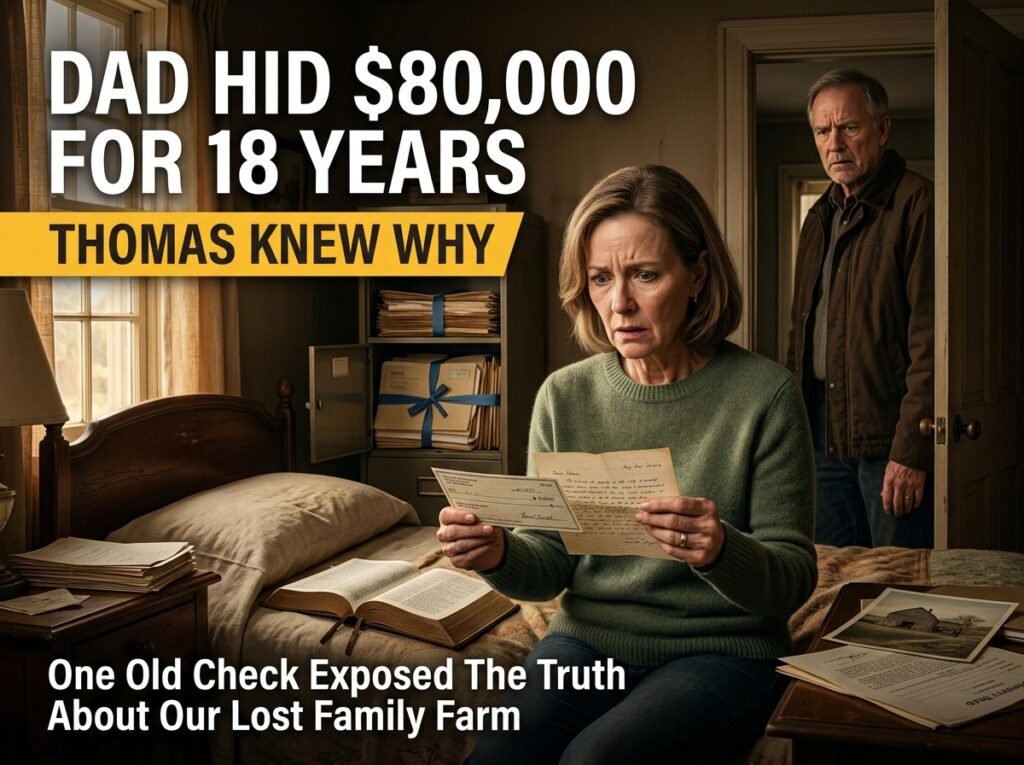
The house smelled of old books, furniture polish, and the peppermint sweets my father had kept beside his bed for as long as I could remember.
Even after moving into care, Dad had insisted that nobody throw anything away. Every drawer contained something he believed might matter someday: receipts folded into squares, envelopes tied with string, photographs with names written on the back, and notebooks filled with figures that no longer seemed connected to anything.
I had promised him I would sort through the house slowly.
But the estate agent was coming the following week, and I needed to make a start.
At ninety, Dad had finally accepted that the farmhouse was too much for him. His knees hurt when he climbed the stairs, and he sometimes forgot whether he had eaten breakfast. Moving him into care had been difficult, but he had agreed after one frightening winter night when he slipped beside the kitchen sink and couldn’t get up until a neighbor found him.
He had cried when we locked the front door behind us.
“I thought I’d die in that house,” he had whispered.
I had held his arm and promised that the house would always be his, no matter where he slept.
Now, standing alone in his bedroom, I wondered how many of his belongings I could preserve.
His Bible sat on the bedside table, its leather cover cracked at the corners. I picked it up, intending to place it in the box marked PERSONAL, when something slipped from between the pages.
A check.
At first, I thought it was an old receipt. Then I saw the amount.
$9,000.
The check was payable to my father and dated eighteen years earlier. The name of the person who had issued it was printed clearly across the top.
Walter Harris.
I knew that name.
Walter had been a local businessman when I was young. He had owned several properties around the county and had been involved in agricultural investments. He was also one of the few people Dad refused to discuss.
Whenever his name came up, Dad would become quiet and change the subject.
I turned the check over.
On the back, written in my father’s familiar, careful handwriting, were the words:
“I cannot accept this until Thomas knows.”
I read the sentence again.
Why would Dad refuse nine thousand dollars? And what did Thomas need to know?
My brother was sixty-three, three years older than me, and had spent most of his life acting as though he were responsible for every decision our family made. When our mother died, he organized the funeral. When Dad’s health began to decline, Thomas handled the bills and told the rest of us not to interfere.
I had often been grateful for his help.
But there was a reason I had stopped asking him questions about our family’s finances.
Every time I did, he made me feel as though I were accusing him of something.
I took a photograph of the check and called him.
He answered after two rings.
“What is it?”
“I’m cleaning Dad’s room. I found something in his Bible.”
“Then put it in a box.”
“It’s an old check from Walter Harris. Nine thousand dollars.”
The silence was immediate.
“Where did you find it?”
“Inside Dad’s Bible.”
“Throw it away.”
I moved the phone away from my ear, thinking I had misunderstood him.
“What?”
“You heard me. It’s eighteen years old. The bank won’t accept it. There’s no point keeping it.”
“Why did Dad write that he couldn’t accept it until you knew something?”
Thomas didn’t answer.
“Thomas?”
“That was a long time ago,” he said finally. “You don’t understand what you’re looking at.”
“Then explain it.”
“I don’t have time for this.”
He hung up.
I stood in the middle of Dad’s bedroom, holding the check between my fingers.
It wasn’t the money that frightened me.
It was the speed with which my brother had told me to destroy the evidence.
I returned to the bedside table and opened the drawer. Beneath a stack of old photographs lay a small brass key. It fitted the lock on Dad’s filing cabinet, which I had never been able to open.
Inside were dozens of folders.
And on the top folder, written in Dad’s handwriting, were three words that made my stomach tighten.
THE FARM. 1986.
<h2>Part 2</h2>
Our family farm had been gone for nearly forty years.
I was twenty-two when the bank took possession of the property. Dad had borrowed money to expand the dairy operation, expecting a good harvest and a profitable year. Then the weather turned against us. Feed prices rose, a machinery repair cost more than he could afford, and the bank refused to extend the loan.
By the time the final notice arrived, the debt had grown beyond anything he could repay.
I remembered him sitting at the kitchen table with the letter in his hands.
Thomas had stood beside him, furious.
“You should have listened to me,” he said. “I told you the expansion was too risky.”
Dad didn’t answer.
Our mother cried quietly in the pantry, believing we couldn’t hear her.
Within months, the farm was gone.
The bank sold the land, and our family moved into a smaller house in town. Dad took whatever work he could find. Thomas left for a while, saying he needed to build a life that didn’t depend on our father’s mistakes.
I stayed close to home, helping our mother and working two jobs.
For years, we told ourselves that the bank had taken everything.
Now, opening the folder, I found letters that suggested our understanding of that year had been wrong.
The first was a bank statement. The second was a notice of foreclosure. The third was a letter from Walter Harris dated several months after the sale.
It referred to a payment made toward Dad’s outstanding loan.
I read the amount.
It was the exact balance the bank had demanded.
Someone had paid the loan in full.
Yet the farm had still been sold.
I searched through the folder, my hands growing colder with every page. There were receipts, correspondence with solicitors, and handwritten notes recording conversations with people whose names I barely remembered.
Then I found a letter addressed to Dad.
The debt has been settled as agreed. The transfer following foreclosure is a separate matter. Please do not contact the new owner until the conditions have been met.
There was no signature on the copy.
Only a date and a reference number.
I sat down.
If the loan had been paid, why had the bank proceeded with the sale? Had the payment arrived too late? Had the legal process already become irreversible? Or had someone arranged the sale while knowing that the debt was no longer outstanding?
I couldn’t tell.
The next folder contained the checks.
There were seven in total, each issued by Walter Harris over several years. The amounts varied from $5,000 to $15,000. Together, they came to almost $80,000.
Every check had been left untouched.
On the back of each one, Dad had written a short note.
Not until Thomas knows.
Wait for the truth.
Do not spend this money.
The handwriting grew shakier over time.
I opened the bottom drawer of the cabinet and found a bundle of letters tied with faded blue ribbon.
The first was dated shortly after our mother died. The second was from a solicitor. The third was in Walter Harris’s handwriting.
The money is not payment for the land. It is the amount we agreed should be held until the original transaction can be explained to both sons.
Both sons.
I had never known there was an original transaction.
A separate envelope contained a list of dates and amounts. The final entry was written in Dad’s hand.
Thomas must hear it from me. I cannot leave him believing the lie.
I leaned back in the chair.
For the first time, I wondered whether Thomas had known about the checks all along.
His reaction to the first one suggested he had.
I called him again.
He rejected the call.
I sent a message asking him to come to Dad’s house and explain what he knew.
No reply came.
I continued sorting the letters until I found an envelope marked FINAL.
Inside was a single sheet of paper, dated just two years after the farm was sold.
It contained a name, a property reference, and a statement confirming that the land had been purchased privately after foreclosure.
The buyer’s identity was written at the bottom.
I stared at the name.
Then I heard a car pull into the driveway.
Thomas had arrived.
<h2>Part 3</h2>
My brother came through the front door without knocking.
He still had the broad shoulders and confident walk I remembered from childhood, but age had softened his face. His hair was almost entirely gray, and he leaned slightly to one side when he removed his coat.
He looked at the open filing cabinet.
Then he looked at the papers scattered across the table.
“What have you done?”
“I’m sorting Dad’s records.”
“You were supposed to clear the bedroom, not go digging through old business.”
“I found the checks.”
His jaw tightened.
“And the farm documents.”
He placed his coat over the back of a chair.
“Put them away.”
“Why?”
“Because none of this concerns you.”
The words struck harder than they should have.
I had spent my adult life helping our parents. I had cared for our mother when she was ill, driven Dad to appointments, and paid bills when his pension arrived late. Yet Thomas could still make me feel like a child who had wandered into a conversation meant for adults.
“I’m Dad’s daughter,” I said. “I think I have a right to know why he kept almost eighty thousand dollars in checks he never deposited.”
Thomas rubbed his forehead.
“Walter made an arrangement with Dad. It went wrong. That’s all.”
“What arrangement?”
“An old business matter.”
“The farm loan was paid in full.”
His hand stopped moving.
I watched his expression change.
“Where did you see that?”
“In the letters.”
“Those letters are incomplete.”
“Then give me the complete story.”
He pulled out a chair but didn’t sit down.
“You don’t understand how things worked in 1986. Dad was desperate. He had debts everywhere. People were threatening to take him to court. Walter offered to help him, but the deal wasn’t simple.”
“What deal?”
Thomas looked toward the bedroom.
“Some things should have stayed buried.”
I felt a surge of anger.
“Dad is ninety years old. He has spent his life carrying something that frightened him so much he couldn’t even accept a check. If there’s a reason, I want to hear it.”
Thomas stared at the papers.
For a moment, I thought he might finally explain.
Instead, he gathered several letters into a pile.
“These aren’t yours to keep.”
I took them from him.
“Don’t.”
He looked at me as though he couldn’t believe I had challenged him.
“You’re making a mistake.”
“Then help me understand it.”
He walked to the window and looked out at the garden.
When we were children, that garden had been our mother’s pride. She grew roses beside the fence and kept a vegetable patch behind the shed. After the farm was sold, she planted flowers in every corner of the smaller garden, as though she could replace the fields she had lost.
Thomas had always said the farm’s failure broke her heart.
I had believed him.
Now I wondered whether there had been another reason for her sadness.
“Did you know Walter was paying Dad?” I asked.
Thomas didn’t answer.
“Did you know about the checks?”
He turned.
“I knew he had offered money.”
“Why didn’t Dad accept it?”
“Because accepting it would have meant admitting what he did.”
“What did he do?”
Thomas’s face hardened.
“You need to stop asking that question.”
I stared at him.
Then I noticed something in his expression that I had never seen before.
Fear.
Not anger. Not annoyance.
Fear.
I lowered my voice.
“Thomas, what are you protecting?”
He looked at the documents again.
For a moment, his eyes rested on the letter naming the buyer of the farm.
Then he said, “You don’t know what Dad sacrificed to keep that land in the family.”
My heart began to pound.
“Who bought it?”
Thomas reached across the table and took the final letter.
Before I could stop him, he folded it and placed it inside his coat.
“Forget you ever saw this.”
He walked toward the door.
I followed him.
“If the bank had been paid, why did we lose the farm?”
He stopped with his hand on the handle.
Without turning around, he said, “Because someone had already promised it to another person.”
Then he left.
I stood in the silent house, listening to his car disappear down the road.
On the table, one small piece of paper remained beneath the folder.
It was a receipt.
And the date on it was three months before the bank’s foreclosure sale.
<h2>Part 4</h2>
I spent the next morning at the county records office.
The clerk who helped me was a young woman named Emily. She listened patiently while I explained that I was researching a property transfer involving my father in 1986.
“Do you have the parcel number?” she asked.
I handed her the receipt I had found beneath the folder.
She typed the number into her computer, frowned, and asked me to wait.
When she returned, she carried a thin file.
“The property changed ownership twice that year,” she explained. “The first transaction was the foreclosure sale. The second was a private transfer several months later.”
“Who purchased it?”
She turned the file toward me.
The name was the same one I had seen on the letter.
Walter Harris.
I felt a strange mixture of relief and confusion.
Walter had bought the farm after the foreclosure. That much was clear. But the letters suggested that the purchase had been connected to an arrangement involving my father.
“Was the transfer legal?” I asked.
“According to the recorded documents, yes. There is a deed, a payment record, and a signed agreement.”
“Can I see the agreement?”
Emily searched the file.
“The original isn’t here. There is a reference to a separate instrument held by a solicitor.”
She wrote down the solicitor’s name.
It was a man named Arthur Bell, who had died many years earlier.
I thanked her and returned to the car.
For a while, I sat behind the steering wheel, looking at the papers on my lap.
Walter had purchased the farm.
He had issued Dad nearly eighty thousand dollars in checks over the following years.
And Dad had refused to accept the money until Thomas knew the truth.
The pieces were connected, but I still couldn’t see the full picture.
I called Walter Harris’s office.
A woman answered and told me that Walter had died eight years earlier. His business was now managed by his daughter, Helen Harris.
I explained who I was.
There was a long pause.
“I remember your father,” Helen said. “My father spoke about him often.”
“Did he ever mention the farm?”
“Yes.”
“Can we meet?”
She agreed to see me the following afternoon.
Before we ended the call, she added, “Bring whatever documents you have. My father left instructions that someone from your family might come asking questions one day.”
I felt my pulse quicken.
“What instructions?”
“I don’t know everything. But there is a file in his private archive that I was told not to open unless one of your father’s children came forward.”
The following afternoon, I arrived at Helen’s office with copies of the checks and the letters.
She was in her fifties, with dark hair and a calm, thoughtful manner. She led me into a small conference room and placed an old leather folder on the table.
“My father kept records of every major transaction,” she explained. “He believed that memories changed, but documents didn’t.”
She opened the folder.
Inside was a copy of the original farm loan, a receipt showing payment of the outstanding balance, and a signed purchase agreement dated shortly before the foreclosure sale.
The documents appeared to contradict one another.
The bank had accepted payment, yet the property had been sold.
Helen watched me study the papers.
“My father told me he purchased the farm to protect it,” she said.
“Protect it from whom?”
“From people who wanted to divide the land and sell it in pieces.”
I looked up.
“Who wanted to do that?”
She hesitated.
“Your father believed that if the farm were sold in pieces, your family would lose the last thing that connected it to your grandparents.”
“But why didn’t he buy it himself?”
“Because he didn’t have the money.”
I stared at the agreement.
Walter had paid the loan, then purchased the land. The arrangement seemed designed to preserve the property, not take it away.
Yet our family had been left believing that the bank had taken everything.
“Did Walter ever intend to return the farm to my father?” I asked.
Helen closed the folder.
“That depends on what your father told you.”
“He told us nothing.”
She looked genuinely saddened.
“Then there is more to this story than I was allowed to explain.”
She opened a second drawer and removed a sealed envelope.
On the front was written my father’s name.
Below it were five words.
Only give this to Thomas.
<h2>Part 5</h2>
I did not take the envelope immediately.
For several seconds, I stared at my father’s name, written in Walter’s careful handwriting.
“Why was this meant for Thomas?” I asked.
Helen folded her hands.
“My father believed your brother was the only person who could decide what should happen next.”
“Decide what?”
“I don’t know. He never explained the full arrangement to me.”
“Did Thomas know Walter?”
“Yes. They met several times over the years.”
I felt a familiar anger rising inside me.
Thomas had known about the checks. He had known Walter was connected to the farm. He had known there were documents Dad refused to discuss.
And every time I asked a question, he told me to stop.
I took the envelope.
“Can I read it?”
Helen shook her head.
“My father left specific instructions. If you found this envelope, it was to be delivered to Thomas unopened.”
I wanted to argue, but something stopped me.
The envelope had been sealed for years. Whatever it contained, Walter had believed Thomas needed to read it himself.
I placed it inside my bag.
On the drive home, I called my brother.
He didn’t answer.
I sent a message telling him I had met Walter’s daughter and had been given a letter addressed to him.
His reply arrived almost immediately.
Do not open it.
I pulled the car to the side of the road.
Then tell me why it exists, I typed.
He didn’t respond.
When I arrived at Dad’s house, I found the front door unlocked.
Thomas was sitting at the kitchen table.
He looked at the envelope in my hand and went pale.
“Where did you get that?”
“Walter’s daughter.”
He stood so quickly that his chair fell backward.
“She gave it to you?”
“She said it was meant for you.”
“Then you should never have brought it here.”
I placed it on the table.
“Read it.”
Thomas shook his head.
“I can’t.”
“Why?”
He sat down again and covered his face with both hands.
For the first time in my life, my older brother looked completely lost.
“Because once I read it, I won’t be able to pretend anymore.”
I pulled out the chair opposite him.
“Thomas, I’ve spent two days finding documents Dad hid for nearly forty years. I’ve learned that the farm loan was paid, that Walter purchased the land, and that Dad refused almost eighty thousand dollars. I deserve to know what happened.”
Thomas stared at the envelope.
Then he whispered, “I was there.”
“Where?”
“When Walter met Dad about the farm.”
I waited.
“I was twenty-six. Dad had already lost the farm, and he was drinking more than he should. Walter offered to purchase the property and keep it intact until Dad could repay him.”
“Then why did Dad believe the bank had taken it?”
“Because the foreclosure sale was real. The bank had started the process before the payment arrived. Walter settled the debt, but the legal sale was already moving forward. He bought the land through the arrangement that followed.”
I frowned.
“That explains the sale. It doesn’t explain the checks.”
Thomas looked at the envelope.
“Walter believed Dad should be compensated for the money he had already invested in the farm. Dad refused because he thought accepting it would make him look as though he had profited from the loss.”
“But the money was owed to him?”
“Not exactly. Walter believed it was fair. Dad believed it was a debt he could never repay.”
I thought of the notes on the backs of the checks.
Not until Thomas knows.
“What do I have to do with it?”
Thomas took a long breath.
“Because I was the reason Dad borrowed the money in the first place.”
The words hung between us.
I remembered Thomas’s confident plans, the promises of expanding the farm, and the machinery purchases that had strained our finances.
“You told me Dad made the decision alone.”
“He did make the final decision,” Thomas said. “But I pushed him. I convinced him the expansion would make us successful. I told him we would never have another chance like it.”
His voice broke.
“When the farm failed, I blamed him because I couldn’t bear admitting that I had been wrong.”
I stared at him.
For forty years, I had believed Dad had made a reckless financial decision and lost everything.
Now my brother was telling me he had helped create the disaster.
“Why didn’t you tell him that?”
Thomas looked toward the window.
“I did. Once.”
“When?”
“Years later, after Walter started sending the checks.”
He swallowed.
“Dad told me he would forgive me if I stopped pretending the farm was lost because of him alone.”
I looked at the envelope again.
“Then why did you tell me to throw the check away?”
Thomas’s eyes filled with tears.
“Because I was afraid you’d discover what I did after the farm was sold.”
<h2>Part 6</h2>
I waited for Thomas to continue.
He didn’t.
The kitchen clock ticked above us, and the late-afternoon light fell across the table where our mother used to sort vegetables from the garden.
Finally, I asked, “What did you do?”
Thomas rubbed his face.
“After Walter purchased the farm, Dad refused to discuss it. He wouldn’t accept money, wouldn’t visit the land, and wouldn’t let anyone mention the old house. He said that if we were ever going to rebuild our lives, we had to stop living in the past.”
“And you?”
“I couldn’t stop thinking about it.”
He explained that he had returned to the farm several times during the years after the sale. He watched the fields from the road and spoke with the people who worked there. Walter had kept the land largely intact, but the original farmhouse had deteriorated.
Thomas had convinced himself that he could eventually buy the property back.
He worked overtime, saved money, and approached Walter with an offer.
Walter refused.
“He said the farm wasn’t a prize to be won,” Thomas told me. “He said it was a responsibility, and I hadn’t yet learned what that meant.”
“So you became angry with him?”
“I became angry with everyone.”
Thomas had married young, divorced several years later, and spent much of his life trying to prove he could succeed without our father’s help. He had started businesses that failed, borrowed money he couldn’t repay, and blamed circumstances whenever his plans collapsed.
I had always thought he was simply stubborn.
Now I could see how much of his life had been shaped by shame.
“What happened to the money Walter sent?” I asked.
Thomas looked at the checks.
“Dad never accepted it because he believed it belonged to the family, not to him personally. He wanted me to know that the farm had been protected because of Walter’s generosity, not because we had somehow earned another chance.”
“Then why didn’t you tell me?”
“Because I was ashamed.”
He said the word quietly.
“I spent years telling everyone Dad had lost the farm through his own mistakes. I let you believe the bank had taken everything. If you found out Walter had protected the land, you’d ask why we hadn’t tried to bring it back.”
I looked at him.
“Would that have been wrong?”
“No. But I was afraid you’d discover how much I had contributed to the loss.”
I wanted to be angry. I wanted to remind him that our father had carried the blame for decades while Thomas remained silent.
Instead, I looked at the envelope.
“What does Walter’s letter say?”
Thomas reached for it, then stopped.
“I don’t know.”
“Then read it.”
He took a small knife from the kitchen drawer and carefully opened the seal.
The letter was short.
Thomas,
Your father has spent many years refusing money that I believe he has every right to accept. I have respected his decision, but I cannot keep sending checks forever.
The land is still intact. The original agreement remains valid. When your father is ready, the property can be transferred according to the conditions we agreed upon.
But there is one matter you must settle first.
You must tell your sister what happened in 1986.
Until she knows the truth, the farm cannot return to the family.
Thomas read the final sentence aloud.
Then he put the letter down.
I looked at him.
“What truth?”
He shook his head.
“I thought the letter would explain everything.”
“It explains why Dad wouldn’t accept the money. It doesn’t explain why the farm was never returned.”
Thomas stared at the page.
Then he noticed something written on the back.
A reference number.
And a name.
Arthur Bell, the solicitor who had handled the original transaction.
I remembered the name from the county records office.
“Arthur is dead,” I said.
Thomas nodded.
“But his firm still exists.”
He turned the letter over.
Beneath the reference number was an address and a handwritten instruction.
Ask for the original trust agreement.
I felt a sudden chill.
“What trust agreement?”
Thomas looked at me.
“I think,” he said, “we’ve been searching for the wrong document.”
<h2>Part 7</h2>
The solicitor’s firm had moved twice since 1986, but its archive remained intact.
When Thomas and I arrived, the receptionist asked us to wait while a senior partner reviewed our request.
We sat in a quiet room lined with shelves of legal books. Neither of us spoke.
I was still angry with Thomas, but I was also beginning to understand why he had spent so many years avoiding the past. He had built an entire life around the belief that he had failed our father.
That did not excuse his silence.
But it explained the fear behind it.
The senior partner, a woman named Margaret Lewis, arrived carrying a thick file.
“My predecessor handled several matters involving your family,” she explained. “Most were closed decades ago. However, one agreement was retained because its conditions had not been fully satisfied.”
She placed the file on the table.
Inside was a document dated 1986.
It established a private trust connected to the farm.
The property had been purchased by Walter after the foreclosure, but it was not simply his personal investment. Under the terms of the agreement, he was required to preserve the land until the original loan dispute and the family’s financial responsibilities had been resolved.
The farm was to remain intact.
It could not be divided or sold without following the conditions written into the trust.
I read the document slowly.
There were references to payments, property maintenance, and a future transfer.
But one paragraph was different.
It required both of Dad’s children to acknowledge the circumstances that led to the original financial loss before the property could be transferred back to the family.
I looked at Thomas.
He stared at the table.
“Why would the agreement require that?” I asked.
Margaret explained that the arrangement had been designed to prevent either sibling from claiming the farm without acknowledging the family’s shared responsibility.
The trust was not simply about preserving land. It was about preventing the same conflict from happening again.
The final pages contained signatures from Walter, Dad, and the solicitor.
There was also a handwritten note.
The children must understand that the land was preserved for them, not promised to either one individually.
I read it twice.
All those years, Thomas had believed the farm could be returned to him if he worked hard enough to buy it back.
But the agreement had never promised him personal ownership.
It had been intended for both of us.
“What about the checks?” I asked.
Margaret examined the records.
“They appear to be voluntary payments offered by Mr. Harris under the terms of the arrangement. Your father did not deposit them. That does not necessarily mean the money is still owed in a legal sense, but it does mean his refusal was documented.”
“Can the farm be transferred now?”
“Not automatically. We would need to verify the current title, the trust’s status, and whether all conditions can still be satisfied. But this agreement gives us a clear starting point.”
Thomas leaned forward.
“What happens if we cannot agree?”
Margaret looked at him.
“Then the matter could become more complicated. The agreement anticipates disagreement, but it also makes clear that neither of you can simply claim the property for yourselves.”
I watched my brother absorb that.
For years, he had been fighting to regain something he believed he had lost.
Now he was learning that the farm had never been intended as a reward for his sacrifice or a punishment for his mistakes.
It had been preserved for both of us.
Margaret closed the file.
“There is one more document,” she said. “It was placed in a sealed section of the archive at your father’s request. We were instructed to release it only when both children appeared together.”
She brought out a smaller envelope.
Our names were written on the front.
Inside was a letter from Dad.
To my children,
If you are reading this together, then perhaps I have finally succeeded in bringing you to the same table.
The farm was never the only thing we lost in 1986. We lost our ability to speak honestly to one another.
I blamed myself because I was the father. Thomas blamed me because he was ashamed. And you, my daughter, were left believing that the bank had taken everything.
I cannot change what happened. But I can ask you not to repeat it.
The land is not worth more than your relationship.
If you can agree on what happened, and if you can forgive one another without pretending the past never existed, then you may decide what should happen next.
Your loving father.
Thomas lowered the letter.
For the first time since we had arrived, he began to cry.
<h2>Part 8</h2>
We drove back to Dad’s care home without speaking.
The letter lay between us on the passenger seat, folded along its original creases.
I had imagined many possible explanations for the checks. I had wondered whether Walter had been trying to buy our silence, whether Dad had been hiding a debt, or whether Thomas had somehow benefited from the farm’s loss.
The truth was more complicated.
Dad had made a financial decision that failed. Thomas had encouraged him and then blamed him. Walter had stepped in to preserve the property, but the arrangement had become entangled in years of shame, pride, and silence.
No single person had created the entire problem.
But everyone had contributed to keeping it alive.
When we arrived, Dad was sitting beside the window in the common room, watching the rain fall across the garden.
He looked smaller than I remembered from the farmhouse, his shoulders rounded beneath a brown cardigan. But when he saw us, his face brightened.
“You both came,” he said.
Thomas sat beside him.
I placed the trust agreement on the table.
“Dad, we found it.”
He looked at the document for a long time.
Then he closed his eyes.
“I thought I would be gone before you found that.”
“Why didn’t you tell us?” I asked.
He opened his eyes.
“Because I thought I was protecting you.”
I sat on his other side.
“You protected the secret. You didn’t protect us from it.”
Dad nodded slowly.
“I know.”
Thomas took his father’s hand.
“I should have told her years ago.”
Dad squeezed his fingers.
“Yes.”
The answer was simple. There was no attempt to excuse Thomas or soften what he had done.
For a while, we sat together in silence.
Then Dad began to tell us what had happened in 1986.
The farm had been struggling long before the final loan. Thomas had encouraged him to expand, believing the family could compete with larger operations. Dad had agreed because he wanted to leave something substantial for his children.
When the expansion failed, he had felt that he had betrayed everyone who depended on him.
Walter had offered to settle the debt and purchase the land through a separate arrangement. The agreement gave him control of the property while protecting it from being divided or sold in pieces.
Dad had accepted the arrangement because he believed it was the only way to preserve the farm.
But he could not accept the checks.
He believed the money belonged to the family as a whole, and he feared that depositing it without Thomas’s knowledge would look like a private settlement.
He had hoped to explain everything once his son was ready to hear it.
Years passed.
Then our mother became ill.
Dad devoted himself to caring for her, and the farm documents were pushed into the filing cabinet. After she died, he found himself unable to reopen the matter.
“I thought I had more time,” he said.
Thomas looked down.
“I made you carry the blame.”
“You were young,” Dad replied.
“I was old enough to know better.”
Dad did not disagree.
I asked about the nearly $80,000 in checks.
Walter had continued offering money as part of the arrangement, Dad explained, but he had never treated the checks as ordinary payments. They were connected to the unresolved agreement, and he believed that accepting them before Thomas understood the truth would create another misunderstanding.
“So you left them in the Bible?” I asked.
Dad smiled faintly.
“I needed somewhere I wouldn’t forget them.”
“Did you think we’d find them?”
“Eventually.”
His answer made me laugh despite myself.
For the first time in days, the tension eased.
But there was still one decision to make.
The trust agreement allowed the land to be transferred only after both siblings acknowledged what had happened and agreed on how the property should be managed.
Dad looked at us.
“I won’t tell you what to do with it. That choice belongs to you.”
Thomas turned to me.
“I don’t want to own the farm alone.”
I believed him.
He had spent decades trying to prove he deserved something he thought he had lost. Now he seemed tired of fighting.
“Neither do I,” I said.
We agreed to meet with Margaret again and begin the formal review. We would not rush the process or sell the property simply because it represented a painful past.
For the first time, we would decide together.
As we prepared to leave, Dad called me back.
“There is one thing I need you to understand.”
I returned to his chair.
“The checks were never the most important part,” he said. “Walter was trying to give us a way to begin again. I was too ashamed to accept it.”
He looked toward Thomas.
“And my son was too ashamed to tell the truth.”
Neither of us spoke.
Dad reached for my hand.
“Don’t make the same mistake.”
<h2>Part 9</h2>
The legal review took several weeks.
Margaret verified the current title, examined the original trust, and contacted the relevant authorities to establish whether the conditions could still be fulfilled. Walter’s estate records confirmed the payments and the purchase arrangement. Nothing suggested that the land had been acquired through fraud, although the original foreclosure and subsequent transfer required careful legal interpretation.
The checks themselves presented another problem.
Most were too old to deposit. The bank confirmed that they could not simply be cashed as ordinary checks. Walter’s estate had to review the payment records and determine whether any amount remained payable under the original arrangement.
For once, nobody in our family tried to force an immediate answer.
Thomas and I met every Sunday to review the documents.
At first, our conversations were awkward. We had spent so long avoiding the truth that even ordinary questions felt like accusations.
But slowly, we began talking about other things.
We remembered our mother teaching us to make apple pies. We laughed about the time Thomas tried to drive a tractor before he was tall enough to reach the pedals properly. We talked about the old barn, the creek behind the eastern field, and the oak tree where our father had carved our initials.
Those memories had survived even when our understanding of the farm had not.
One afternoon, Thomas arrived with a box of photographs.
“I found these in my garage,” he said.
Inside were pictures of the farm before the foreclosure. Our parents stood beside the barn, younger and smiling. There were photographs of the cows, the machinery, and the fields after a summer rain.
At the bottom of the box was a photograph of Thomas and me sitting on the farmhouse steps.
I was holding a small wooden toy, and he had his arm around my shoulders.
On the back, our mother had written:
They will have different lives, but I hope they always have a place to come home to.
Thomas sat quietly after reading it.
“I thought getting the farm back would make everything right,” he said.
I looked at the photograph.
“Maybe we thought the land was the only thing we’d lost.”
He nodded.
The trust was eventually confirmed as a valid arrangement, subject to the legal requirements for completing the transfer. Walter’s estate cooperated with the process, and the old payments were formally documented rather than treated as a collection of forgotten checks.
The nearly $80,000 had become a symbol of something much larger than money.
Dad had refused it because he believed accepting it without honesty would be another way of avoiding responsibility.
Thomas had feared the truth because he thought it would expose him as the person who helped lead the family into financial ruin.
I had believed the bank took the farm because that was the story everyone repeated.
Now we understood that the property had been preserved through an agreement that none of us had fully understood.
The remaining question was what we should do with it.
Thomas wanted the farm restored, but he knew the cost would be substantial. I wanted the land protected, but I didn’t want either of us to become trapped by the past.
We discussed leasing part of it to a local farmer while preserving the farmhouse and the fields surrounding the old oak tree. We considered a shared ownership arrangement, with independent management to prevent future disputes.
The plan wasn’t final, but it was the first proposal that made both of us feel hopeful.
When I told Dad, he listened without interrupting.
Then he asked, “Have you agreed on everything?”
“No,” I admitted.
He smiled.
“Good. Families that agree on everything usually aren’t telling each other the truth.”
I laughed.
Thomas did too.
For the first time in years, we were not arguing about who had failed our father or who deserved the land.
We were trying to decide what to do with what remained.
And that, I realized, was exactly what Dad had wanted all along.
<h2>Part 10</h2>
The first time I returned to the farm after the legal review began, the gate was rusted and difficult to open.
Thomas stood beside me while I pushed against it. Beyond the entrance, the old track curved toward the farmhouse, its surface broken by weeds and patches of gravel.
The barn still stood, although part of the roof needed repair. The fields were being maintained, but the place felt quieter than I remembered.
I had expected to feel angry.
Instead, I felt grief for the years we had spent believing the land was gone forever.
Thomas walked ahead of me toward the oak tree.
“This is where Dad taught me to drive the tractor,” he said.
“You nearly ran it into the fence.”
He laughed.
“I told him the steering was faulty.”
“He told everyone you were a terrible driver.”
We stood beneath the branches, remembering the life we had once shared.
For decades, the farm had represented our father’s failure. Then it became a mystery. Now it was simply a place where our family had lived, worked, argued, and loved one another imperfectly.
The property arrangements were still being finalized, and the checks would never become the effortless solution I had imagined when I first discovered them. Their value had to be assessed through the proper legal process, and the land required practical decisions about maintenance, ownership, and future use.
But the important thing was that we were no longer hiding from those decisions.
Thomas had apologized to Dad.
He had also apologized to me, not with one grand speech but through the small, difficult act of answering questions honestly.
I forgave him slowly.
Forgiveness did not erase the years of silence, nor did it make every memory easier. It simply meant I was willing to stop letting the past decide every conversation we had in the present.
Dad lived long enough to learn that the farm would not be sold without our agreement. When we showed him the proposed plan, he held the papers in both hands and studied them carefully.
“So you’ll keep the oak tree?” he asked.
“We’ll keep the tree,” I promised.
He smiled.
“Your mother would have liked that.”
A few months later, Thomas and I returned to the farmhouse to begin clearing the remaining rooms. We found old tools, gardening books, and a tin of buttons our mother had collected. In the kitchen cupboard, behind a stack of chipped plates, I found a small envelope with her handwriting on it.
Inside was a note.
To my children,
If the farm ever becomes yours again, remember that a home is not made valuable by the land beneath it. It is made valuable by the people who are willing to tell the truth inside it.
Do not let what happened to us become the story you tell about yourselves forever.
I read the note aloud.
Thomas looked away, blinking rapidly.
We placed it in the same folder as the trust agreement, the letters from Walter, and Dad’s final explanation.
The checks remained part of the record, each one evidence of a decision made in fear, pride, and hope.
I no longer saw them as money Dad had foolishly refused.
I saw them as the years he had spent waiting for his family to be ready.
The nearly $80,000 had never been a simple gift. The farm had never been merely a piece of property. And Thomas had never been only the brother who told me to throw the evidence away.
We had all been carrying different versions of the same story.
It took an old check tucked inside a Bible to make us realize that none of those versions was complete.
On our final afternoon at the farmhouse, Thomas stood beside the front door while I locked it.
“Do you think Dad knew we’d find everything?” he asked.
“I think he hoped we would.”
“Why didn’t he just tell us?”
I looked back at the house.
“Maybe he thought the truth would hurt us.”
Thomas nodded slowly.
“And maybe he was wrong.”
We walked toward the car together.
The farm was not restored overnight. The legal work continued, the fields needed attention, and the future remained uncertain. But we had stopped treating the land as a prize one of us had to win.
We would make decisions together.
We would preserve what mattered.
And when the next difficult question came, we would answer it before silence had another forty years to grow around it.
The last time I visited Dad, I brought him a photograph of the farm beneath the old oak tree.
He held it for a long time.
“Is the gate still difficult to open?” he asked.
“Very.”
He smiled.
“Some things never change.”
Then he reached for my hand.
“Thank you for finding the checks.”
I squeezed his fingers.
“I nearly threw them away.”
“But you didn’t.”
He looked toward the window, where the afternoon light rested on the garden.
“That’s what matters.”
When I left his room, I understood something I had missed when I first found that old check.
My father had spent eighteen years refusing money because he believed his family needed the truth more than it needed another payment.
He had not known how to begin that conversation.
Neither had Thomas.
Neither had I.
But eventually, we had found a way to speak.
And that was worth more than any check Walter Harris had ever written.