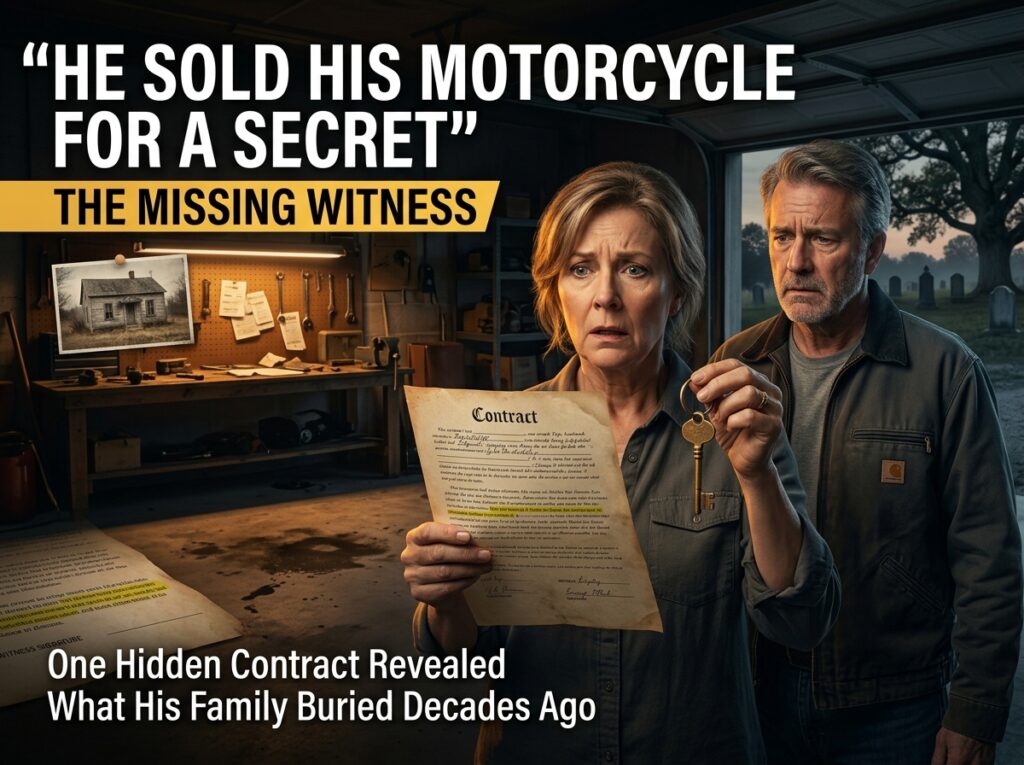
The first thing I noticed was the empty space in the garage.
For twenty years, my husband, Daniel, had kept his motorcycle beneath the same old canvas cover, polishing its chrome on Sunday mornings and checking its tires before every long ride. He had bought it when he was thirty, using money he had saved from years of working overtime. It was the one possession he had never considered selling, not even when we struggled to pay our mortgage.
Yet on a Tuesday evening, the space beneath the cover was empty.
I stood in the garage holding a basket of laundry, staring at the clean rectangular patch on the floor where the motorcycle had stood.
When Daniel came home, I was waiting in the kitchen.
“Where’s your bike?”
He stopped halfway through removing his jacket.
“What?”
“Your motorcycle. It’s gone.”
He looked toward the garage door, then back at me.
“I sold it.”
For a moment, I thought he was joking.
“You did what?”
“I sold it this afternoon.”
“Without telling me?”
He put his keys on the counter. “I needed the money.”
“We have savings.”
“Not enough.”
“Enough for what?”
He looked away.
That was the moment I knew this wasn’t an ordinary financial decision.
Daniel had always been careful with money. We weren’t wealthy, but we had built a comfortable life through patience and hard work. Our house was nearly paid off, our children were grown, and we rarely made significant purchases without discussing them.
Selling the motorcycle wasn’t just a decision about money. It was like watching him surrender a part of himself.
“How much did you get?” I asked.
“Eight thousand.”
“And where did it go?”
He rubbed the back of his neck.
“I made a payment.”
“To whom?”
“Someone who needed it.”
I waited for him to explain, but he picked up his keys and walked into the living room.
“Daniel, you cannot sell something you’ve loved for twenty years and refuse to tell your wife why.”
He turned toward me.
“I know how it looks.”
“Then help me understand.”
His expression softened, and for a second I thought he would finally tell me everything.
Instead, he said, “Please trust me.”
I wanted to.
We had been married for thirty-one years. I knew the sound of his footsteps on the stairs, the way he hummed when he repaired something, and the small crease that appeared between his eyebrows whenever he was worried. I had watched him sit beside his dying mother for three nights without sleeping. I had trusted him with our children, our home, and every difficult decision we had faced.
But trust wasn’t supposed to mean accepting a mystery without question.
That night, Daniel barely touched his dinner. He went to bed early, claiming he had a headache. I stayed at the kitchen table, remembering the conversations we had shared over the previous month.
He had started receiving calls that he took outside.
He had begun checking the mailbox before I woke up.
And twice, I had found him sitting alone in the garage, staring at the motorcycle.
I had assumed he was worried about his aging father, whose health had been declining. Daniel had always been protective of his family, especially his older sister, Helen, and his cousin Robert.
Now I wondered whether those calls had something to do with the money.
The following morning, I opened the household account on my computer. Our savings were untouched, but I found a transfer of eight thousand dollars from Daniel’s personal account to a recipient identified only by initials.
The transaction had occurred the same afternoon he sold the motorcycle.
I printed the statement.
Then I found an envelope tucked behind the telephone on his desk. It contained a handwritten reference number and an address I didn’t recognize.
Beneath the address was a single sentence.
The original must be verified before anything changes hands.
I read it three times.
Before I could decide what to do, my phone rang.
It was Helen.
“Have you found anything in Daniel’s papers?” she asked.
I froze.
“What papers?”
There was a pause.
“The old documents. I thought he might have left something at home.”
I hadn’t told Helen about the motorcycle, the payment, or the envelope.
I hadn’t told anyone.
“Why are you asking me that?” I said.
Her voice became quieter.
“Because if Daniel has started looking again, you need to be careful.”
Then she hung up.
I stared at the phone.
Someone knew about Daniel’s secret.
And someone was afraid of what I might discover.
<h2>Part 2</h2>
I waited until Daniel left for work before returning to his desk.
His drawers contained the usual things: instruction manuals, old photographs, insurance documents, and a collection of receipts he refused to throw away. Beneath a stack of papers was a thin folder labeled PROPERTY RECORDS.
Inside were photocopies of a contract, several letters, and a map showing a piece of land on the outskirts of town.
I recognized the location.
My mother-in-law, Margaret, had owned a small cottage there before she died. The property had been sold years earlier, and Daniel had always told me the sale was straightforward. His father had needed money for medical expenses, the family had agreed to sell, and the proceeds had been divided according to the will.
I had never questioned that explanation.
The contract in the folder carried the names of Daniel’s father, Edward, and a man named Samuel Reed. The date was thirty-four years earlier.
At the bottom of the second page, someone had highlighted a paragraph in yellow.
No transfer of funds, land, or related property shall be considered final until the missing witness has confirmed the original agreement and the circumstances under which it was signed.
I read it slowly.
A missing witness?
The contract contained three signatures, but the space beside the witness declaration was blank.
On the last page, a handwritten note read:
Witness not present at final meeting. Original retained separately.
I searched the folder for another document, but there was nothing.
The address from Daniel’s envelope appeared on the back of the contract. It belonged to an office building that had been demolished years earlier.
I was about to put everything away when I noticed a small mark beside the witness clause.
A circle had been drawn around the words family burial ground.
Below it was a date.
The same date as the day Daniel’s father had died.
My stomach tightened.
Edward had been buried in the family cemetery on the northern edge of town, beside his wife and his parents. Daniel visited the cemetery every year on his father’s birthday, always bringing white flowers.
Was the phrase literal?
Had someone hidden the original contract near the cemetery?
I photographed every page and returned the folder to its place.
Then I called Robert, Daniel’s cousin.
He answered cheerfully.
“How are you?”
“I need to ask you something about Edward’s old property.”
His tone changed.
“What property?”
“The cottage that was sold thirty-four years ago.”
“That was a long time ago.”
“I found a contract with a missing witness clause.”
Silence.
“Where did you find that?” he asked.
“In Daniel’s papers.”
“You shouldn’t be looking through those.”
I felt a cold sensation move down my arms.
“Why not?”
“Because you don’t understand the situation.”
“Then explain it.”
Robert exhaled sharply.
“Listen to me. Whatever Daniel is doing, let him finish. Don’t contact the solicitor, don’t visit the property, and don’t go to the cemetery.”
I gripped the phone.
“Why the cemetery?”
He said nothing.
“Robert?”
“Some things were buried for a reason.”
The call ended.
I stood beside the desk, hearing those words again.
Some things were buried for a reason.
I had expected family secrets to involve money, perhaps an unpaid debt or a disputed inheritance. But this was different. The contract seemed to connect a financial agreement to a missing person, and two relatives had independently warned me not to investigate.
That afternoon, I drove to the address printed on the contract. The office building was gone, replaced by a small parking lot beside an old pharmacy.
A woman working at the pharmacy remembered the former business.
“It was a solicitor’s office,” she said. “Mr. Bell worked there. He retired years ago.”
“Do you know where his records went?”
She thought for a moment.
“Some were transferred to a firm downtown. Others went to his daughter, I believe.”
She wrote down a name and an address.
Arthur Bell’s daughter was named Claire.
I found her listed in the local directory.
When she answered the door, she seemed unsurprised by my visit.
“You’re Daniel’s wife,” she said.
I stared at her.
“How do you know that?”
“My father told me someone might come asking about the Reed contract.”
She stepped aside and invited me in.
Then she said something that changed everything.
“The witness wasn’t missing when the contract was signed. The family made sure nobody could find him afterward.”
<h2>Part 3</h2>
Claire Bell lived in a narrow house filled with books, framed photographs, and boxes of old legal records. She led me to a sitting room where a wooden cabinet stood against the wall.
“My father retired twenty years ago,” she explained. “He kept certain files because he believed some agreements were never properly resolved.”
“Did he know Daniel’s father?”
“Very well. Edward came to see him several times after the contract was signed.”
“About the missing witness?”
Claire nodded.
“About the witness, the payment, and the property.”
I sat down.
“Who was the witness?”
She opened a folder and removed a photograph.
It showed three men standing outside a small cottage. One was Edward, younger than I had ever seen him. Another was Samuel Reed, the man named in the contract.
The third man stood slightly behind them.
His face was familiar, but I couldn’t place it.
“His name was Peter Lawson,” Claire said. “He worked for the family when Edward was young. He knew who paid for the cottage and why the ownership was arranged the way it was.”
“Where is he now?”
“Nobody knows.”
She explained that Peter had disappeared shortly after the contract was signed. His belongings were found in a rented room, but there was no record of him leaving town. His bank account had been closed, and his relatives had been told he had moved abroad.
“Did he leave voluntarily?”
“My father never believed that.”
I looked at the photograph again.
“What did the contract actually concern?”
Claire hesitated.
“The cottage was only one part of it. The agreement involved a larger piece of land that had been divided among several relatives. Some of the transfers were legitimate. Others depended on a promise made by Edward’s father.”
“What promise?”
“That the property would remain available for the descendants of a child who had been sent away.”
I felt as though the room had tilted.
“A child?”
Claire nodded.
“Your husband may not know the entire story. But his father did.”
I asked her to explain, but she said she could only tell me what appeared in the documents.
The family had once owned a small estate consisting of the cottage, several acres of farmland, and a house where Edward’s grandparents had lived. During a difficult period, one branch of the family had been forced to leave the property. A child was placed in the care of another household, and the adults agreed that the land would eventually be returned to the child’s descendants.
The agreement was never completed.
Years later, when the property was sold, the contract was meant to preserve that promise.
Peter Lawson had witnessed the original agreement and knew the identity of the child.
But after his disappearance, the family treated the contract as though it were final.
“Why would Daniel sell his motorcycle to make a payment now?” I asked.
Claire looked at me.
“Because someone has contacted him.”
“Who?”
“I don’t know. But your husband came here three weeks ago.”
My chest tightened.
“He came here?”
“He asked whether the original contract still existed. He also asked if there was any way to correct the transfer without bringing the family into a public dispute.”
I thought of Daniel’s late-night calls, his sudden silence, and the envelope on his desk.
“Did you give him anything?”
Claire opened a small drawer and removed a receipt.
It was dated the previous week.
The payment was for eight thousand dollars.
The recipient was identified as a private legal representative.
“Daniel said the money was required to preserve a document until the missing witness could be located,” Claire explained. “He was afraid the original might disappear.”
I stared at the receipt.
My husband hadn’t sold his motorcycle to pay an ordinary debt.
He had sold it to protect evidence.
But why hadn’t he trusted me enough to explain?
Claire placed the photograph back inside the folder.
“There is something else you should know,” she said.
“What?”
“The person who contacted Daniel knew where the original contract was kept. They also knew that Peter Lawson had left behind a key.”
“A key to what?”
Claire looked toward the window.
“My father believed it opened a compartment beneath the old family cemetery.”
<h2>Part 4</h2>
I returned home with copies of the documents and more questions than answers.
Daniel was waiting in the kitchen.
He had placed two cups of tea on the table, although neither had been touched.
“Where have you been?” he asked.
“Claire Bell’s house.”
His expression changed immediately.
“You shouldn’t have gone there.”
“Why didn’t you tell me about the contract?”
He looked down.
“Because I didn’t know how much of it was true.”
“You sold your motorcycle and sent eight thousand dollars to a stranger. Helen called me about documents I hadn’t mentioned. Robert told me to stay away from the cemetery. How much more am I supposed to discover on my own?”
Daniel sat down.
“I was trying to protect you.”
“From what?”
He didn’t answer.
I placed the photograph of Peter Lawson on the table.
“Who is this man?”
Daniel stared at it.
For several seconds, he seemed unable to speak.
Then he whispered, “My father said he was dead.”
“Claire believes he disappeared.”
Daniel nodded.
“When I was a child, I asked about him. Dad told me Peter had stolen money and run away. But years later, I found an old letter suggesting he had been paid to leave.”
“Paid by whom?”
“I don’t know.”
“Then why are you investigating now?”
Daniel looked toward the hallway, as if he expected someone to be listening.
“Three weeks ago, I received a letter with no return address. It said the original contract had been found and that the family had been relying on an incomplete version of the agreement for decades.”
“Who sent it?”
“The person asked to remain anonymous until the witness could be located.”
I sat opposite him.
“And you believed them?”
“I didn’t know what to believe. But the letter included a detail that nobody outside the family should have known.”
“What detail?”
Daniel reached into a drawer and took out a folded piece of paper.
It contained a sentence written in his father’s handwriting.
The child must never be told why she was sent away.
I read it twice.
“What child?”
Daniel shook his head.
“I don’t know. The letter said the child was a girl, and that she might still be alive.”
I felt a sudden wave of unease.
The family had always spoken of an aunt who died young, but nobody agreed on her age or where she had been buried. Some said she had died during childhood. Others claimed she had moved away with distant relatives.
I had never paid much attention to the story.
Now I wondered whether the missing child had been part of the agreement.
“Why didn’t you tell me this when you received the letter?”
“Because I thought it might be a scam. Then Helen called me and asked whether I had found the original contract. She said Robert was worried about the property.”
“And you believed her?”
“I believed she knew something.”
Daniel explained that the anonymous contact had arranged a meeting through a solicitor. The eight thousand dollars was a deposit to secure the original document and prevent it from being transferred elsewhere before the agreement could be examined.
He had sold the motorcycle because he didn’t want to use our shared savings without knowing whether the claim was genuine.
It was a terrible decision.
But it wasn’t the decision of a man who had stopped caring about his marriage.
It was the decision of someone frightened that a secret could destroy the people he loved.
I reached for his hand.
“You should have trusted me.”
“I know.”
“Whatever happens, we face it together.”
He squeezed my fingers.
Then his phone rang.
He looked at the screen and went pale.
The caller’s number was hidden.
He answered.
A man’s voice spoke briefly.
Daniel listened without interrupting.
Then he said, “No. She knows now.”
He ended the call and looked at me.
“The original contract has been moved.”
“Where?”
Daniel swallowed.
“The cemetery.”
<h2>Part 5</h2>
We drove to the cemetery just before sunset.
The grounds were surrounded by a low stone wall, and the old trees cast long shadows over the paths. Edward’s grave stood near the northern boundary, beside the headstone of his wife.
Daniel placed a hand on the stone.
“I’m sorry, Dad,” he whispered.
I stood behind him, watching the light fade.
“Where would someone hide a key?”
He looked toward the oldest section of the cemetery.
“My father used to say the family had three kinds of memory. The things we told children, the things we told strangers, and the things we buried.”
“Did he ever explain what that meant?”
“No.”
We walked toward a small stone structure near the boundary wall. It had once been used to store gardening tools, but the door was locked and the roof had partly collapsed.
Daniel examined the ground around it.
There were no fresh footprints, no disturbed soil, and no sign that anyone had recently visited.
I noticed a small metal plate attached to the wall. It carried a number matching the reference on the contract.
“Daniel.”
He came over.
The plate was loose at one corner. When he pulled it away, a narrow cavity appeared behind it.
Inside was a brass key.
I held it in my palm.
It was old, darkened by age, and heavier than I expected.
Beneath it lay a folded note.
If you have found this, the family has finally started asking the right questions. Do not take the key to the house. Go where the old names were recorded.
The note was signed with the initials P.L.
Peter Lawson.
We searched the cemetery office the following morning. The groundskeeper remembered an old register stored in a locked cabinet, containing records of burials, relocations, and family plots dating back more than a century.
The key fitted the cabinet.
Inside the register, a page had been marked with a narrow strip of paper.
It contained the names of several family members, including Edward’s grandparents.
But one name had been crossed out.
A girl named Eleanor.
Beside her name was a note indicating that she had been buried in an unmarked plot before the cemetery records were reorganized.
Daniel stared at the page.
“Eleanor was my father’s sister,” he said. “At least, that’s what I was told.”
“Was she the child who was sent away?”
“I don’t know.”
We found another entry in the register: a reference to a small memorial stone near the oldest oak tree at the back of the grounds.
The stone had no visible name.
Only a date.
And beneath the date was a short inscription.
Not lost. Not forgotten.
I knelt beside it and brushed away the leaves.
A second brass plate was fixed to the base, almost hidden beneath the soil. It contained a small keyhole.
The key from the cabinet fitted it.
A narrow compartment opened.
Inside was a sealed envelope and a photograph.
The photograph showed a young woman standing beside Peter Lawson. She was holding a baby wrapped in a white blanket.
On the back, someone had written:
Eleanor and her daughter. Before they left.
Daniel looked at me.
“She had a child.”
I turned the envelope over.
It was addressed to the missing witness.
Peter Lawson.
But the letter inside had been written by Edward’s father.
The first line read:
Peter, if you are reading this, then I have failed to bring my granddaughter home.
<h2>Part 6</h2>
We took the envelope to Claire Bell.
She read the letter in silence, her face growing paler with every paragraph.
The writer explained that Eleanor had become pregnant before her family had approved of the man she intended to marry. Her father feared a scandal and arranged for her to leave the estate temporarily.
The family told everyone that she had died.
But Eleanor had not died.
She had been sent away with her baby, and Peter Lawson had been asked to arrange the journey. He was supposed to ensure that Eleanor and the child had enough money to begin a new life.
The property agreement had been created to protect the land and preserve Eleanor’s daughter’s future inheritance.
But the plan had fallen apart when the family began arguing over the estate.
One relative wanted to sell the property. Another insisted that Eleanor had forfeited her rights by leaving. Edward’s father attempted to prevent the land from being divided, but he died before the dispute was resolved.
The contract remained unfinished.
Peter disappeared.
And Eleanor’s daughter was never told who she was.
“Do we know where they went?” I asked.
Claire examined the final page.
“There is an address, but it may no longer exist.”
The address was in another county, beside a small railway town.
Daniel recognized the name.
“My father used to receive letters from there.”
“Did you ever see them?”
“Only once. He burned them after reading them.”
We decided to visit the town.
Before leaving, I called Helen and asked whether she knew anything about Eleanor.
She was silent for so long that I thought the call had disconnected.
Then she said, “You found the photograph.”
It wasn’t a question.
“Yes.”
“Then you know why the contract matters.”
“Do you know where Eleanor’s daughter is?”
Helen began to cry.
“I was told she had died.”
“Who told you?”
“Robert.”
I closed my eyes.
Another family member had known more than they admitted.
Helen explained that Robert had been the person responsible for maintaining the family’s property records after Edward became ill. He had told her that the old agreement was invalid and that the missing witness had disappeared permanently.
She had believed him.
But a few months earlier, Robert had asked her to sign a statement confirming that the family had no outstanding claims to the property.
She had refused.
“Why didn’t you tell us?” I asked.
“Because I didn’t know what was true. And I was afraid Robert would accuse me of trying to take the land.”
I understood her fear.
For decades, the family had treated the property as a source of shame and suspicion. Everyone seemed to possess one piece of the truth, but nobody trusted anyone enough to share it.
That evening, Daniel and I drove to the railway town.
We found the address on an old street map. The original house had been replaced by a row of modern homes, but a retired shopkeeper remembered the family who had once lived there.
“Eleanor?” she repeated. “Yes. She lived here with her daughter. The girl grew up and moved away.”
“Do you know where?”
The woman thought for a moment.
“She worked as a nurse. Her name was changed when she was young.”
She wrote down a name on the back of a receipt.
Margaret Lawson.
Daniel stared at it.
“Lawson?”
The shopkeeper nodded.
“She was raised by a man who called himself Peter. I believe he was her guardian.”
We had found the missing witness’s family.
But the shopkeeper had one more thing to tell us.
“Margaret came back here a few months ago,” she said. “She was looking for someone from her mother’s family.”
<h2>Part 7</h2>
Margaret Lawson lived in a small house overlooking a river.
She was in her late sixties, with silver hair and careful, measured movements. When she opened the door and saw Daniel, her expression changed.
“You look like Edward,” she said.
Daniel stood still.
“You knew my father?”
“Not personally. My guardian spoke about him.”
She invited us inside.
The living room was filled with photographs, books, and framed certificates from her years as a nurse. On a shelf stood a photograph of a young woman holding a baby.
It was the same photograph we had found at the cemetery.
Margaret sat opposite us.
“My mother told me very little about her family,” she explained. “She said she had been sent away because the people she loved were afraid of what the neighbors would say. She never blamed them, but she never forgave them either.”
“Did she know about the property agreement?” Daniel asked.
“Yes. Peter told her there was a document that might one day restore her inheritance. But she refused to pursue it.”
“Why?”
Margaret looked toward the photograph.
“She didn’t want money from people who had pretended she was dead.”
I understood that feeling.
“What happened to Peter?” I asked.
“He died when I was twenty. Before he passed away, he told me the truth about my mother’s family. He gave me a copy of the original agreement and asked me to keep it safe until someone came looking for it.”
“Why didn’t you contact us?”
“I tried.”
She showed us a stack of returned letters addressed to Edward. Every envelope had been marked undeliverable or returned to sender.
“My mother had asked me not to force the family to acknowledge her. I respected her wishes. But after she died, I began to wonder whether the truth should remain hidden forever.”
She opened a drawer and removed a sealed document.
It was the original contract.
The signatures were intact, and the missing witness clause was followed by a handwritten declaration from Peter Lawson confirming that Eleanor and her daughter had been sent away under an arrangement intended to preserve their rights.
The contract also contained a condition that had been omitted from the copy held by the family.
The property could not be transferred until Eleanor’s descendants had been given the opportunity to accept or reject their inheritance.
“That means the sale may not have settled everything,” Daniel said.
Margaret nodded.
“My guardian believed the transfer was incomplete. But he also believed the family would have to acknowledge what happened before the agreement could be resolved.”
I looked at the document.
The money Daniel had paid was not intended to purchase the contract. It was a deposit to secure the document while the legal representative arranged for it to be authenticated and preserved.
But someone else had been trying to prevent that from happening.
“Who knew you were coming?” I asked.
Margaret shook her head.
“I told nobody.”
“Then how did Helen and Robert know we were investigating?”
She looked at the contract.
“The family solicitor contacted them. Someone had requested the original file weeks before Daniel came to see Claire.”
Daniel leaned forward.
“Who requested it?”
Margaret handed him a copy of the correspondence.
The request had been submitted under Robert’s name.
He had been searching for the contract before Daniel received the anonymous letter.
And he had known that Margaret was still alive.
<h2>Part 8</h2>
We returned home with copies of the original agreement and a statement from Margaret confirming her identity.
For the first time, we had enough evidence to understand the legal problem.
The old transfer had been completed without satisfying the clause protecting Eleanor’s descendants. The exact consequences would need to be determined by a solicitor, but the missing witness and the original agreement could no longer be dismissed as irrelevant.
Daniel wanted to confront Robert immediately.
I asked him to wait.
“If we accuse him without understanding what he did, he will deny everything.”
“What else do you need to know?”
“Why he was looking for the contract before us.”
We arranged a meeting with the solicitor who had been handling the old property records. He examined the original agreement, compared it with the filed copy, and confirmed that the witness declaration had been omitted from the version used during the later transfer.
The omission did not automatically prove fraud, but it raised serious questions about whether the conditions of the agreement had been properly satisfied.
The solicitor also found a letter written by Robert several months earlier.
It asked whether the family could complete the sale of the remaining land without notifying Eleanor’s descendants.
The answer had been no.
The solicitor had warned that the original agreement needed to be reviewed.
Robert had not responded.
Instead, he had contacted Helen and asked her to sign a statement declaring that no other heirs existed.
Helen had refused.
Now we understood why she had called me after Daniel sold the motorcycle.
She had been frightened that Robert would discover we had found the original contract.
But the most disturbing discovery came from a second letter.
Robert had been making payments to a property company for several years. The company had been purchasing small parcels of land around the old estate, apparently preparing to consolidate the property for development.
If the remaining land could be transferred without resolving the original agreement, the company stood to make a substantial profit.
Daniel stared at the documents.
“He was trying to sell the property.”
“Possibly,” the solicitor replied. “The records suggest that he was attempting to establish clear ownership before proceeding. We cannot determine his full intentions from these documents alone.”
But the evidence was enough to justify a formal investigation.
We contacted Helen and Margaret. Both agreed to provide statements.
Then Daniel called Robert.
“I need to see you,” he said.
Robert sounded annoyed.
“What is this about?”
“The original contract.”
There was a pause.
“That document is irrelevant.”
“Then you won’t mind meeting us at the solicitor’s office.”
Robert refused.
Daniel ended the call.
A few minutes later, my phone rang.
It was an unknown number.
A man spoke quietly.
“You’re making a mistake by trusting Margaret Lawson.”
“Who is this?”
“You think you’ve found the missing witness. You haven’t.”
I gripped the phone.
“Peter Lawson is dead.”
“I know.”
“Then what are you talking about?”
The man lowered his voice.
“Peter wasn’t the only witness.”
The call ended.
Daniel looked at me.
I told him what the caller had said.
For a long moment, neither of us spoke.
Then Daniel returned to the documents and turned to the final page of the original contract.
Beneath Peter’s declaration was a second signature.
One we had never noticed before.
It belonged to someone still alive.
Someone who had attended our family gatherings for decades.
<h2>Part 9</h2>
The second signature belonged to Helen.
She was twenty-two when the contract was signed, working as a clerk for the family solicitor. Her name appeared beside a declaration confirming that Eleanor had been informed of the arrangement and had accepted the conditions of leaving the estate.
But Helen had never told us she had signed anything.
When we showed her the document, she stared at it as though she had never seen it before.
“I don’t remember signing this.”
The solicitor examined the signature carefully.
“It appears consistent with the examples we have. But the circumstances require further investigation.”
Helen began to cry.
“I was young. I worked in the office for only a few months. My father told me to sign papers that had already been approved.”
“Did you meet Eleanor?” I asked.
“No. I was told she had agreed to everything.”
She explained that she had been given a stack of documents to sign and return to the solicitor. She had never been shown the complete contract.
Someone had used her signature to support the claim that Eleanor had accepted the arrangement.
But whether Helen had knowingly participated in the deception remained uncertain.
We asked her to help establish what had happened.
She agreed.
Over the next several days, we gathered old employment records, correspondence, and statements from people who had worked in the solicitor’s office. The evidence suggested that the second signature had been added to a copy of the agreement after the original meeting.
It was possible that Helen had signed a different declaration.
It was also possible that someone had used her signature without permission.
The matter would need formal examination.
Robert refused to cooperate.
Then, one evening, he arrived at our house.
He stood on the doorstep holding a small box.
“I think you should have this,” he said.
Daniel didn’t invite him inside.
“What is it?”
“Something your father left with me.”
Robert opened the box.
Inside was an old ledger containing payments made to the family over several decades. Some entries matched the amounts listed in the contract. Others referred to maintenance expenses and legal fees.
At the bottom of the ledger was a letter from Edward.
It explained that he had discovered the missing witness clause shortly before his death. He had wanted to correct the record but feared that reopening the dispute would destroy what remained of the family.
He had asked Robert to preserve the documents until the truth could be established.
Robert claimed he had been trying to protect the property from being sold to strangers.
But when Daniel asked why he had requested a transfer without notifying Margaret, he could not answer.
“I thought I could resolve it before anyone was hurt,” he said.
“You knew she existed,” Daniel replied.
Robert looked at the floor.
“Yes.”
“And you knew the contract protected her.”
“I believed the agreement was no longer valid.”
“But the solicitor told you it needed to be reviewed.”
Robert’s face tightened.
“I was trying to save the land.”
“By pretending the rightful heir didn’t exist?”
Robert said nothing.
For a long time, I thought he would apologize.
Instead, he placed the box on the table and left.
We had learned enough to understand that the family had not simply forgotten the past. Some relatives had actively avoided confronting it because the truth threatened their plans for the property.
Yet the documents still left one question unanswered.
Why had Daniel been asked to make the payment?
The solicitor eventually traced the recipient to a legal representative acting on behalf of a preservation fund established by Peter Lawson before his death. The payment was intended to secure the original contract and cover the cost of an independent review.
It was not a bribe.
It was not hush money.
It was an attempt to ensure that the document survived long enough for the truth to be heard.
Daniel had sold his motorcycle because he believed the evidence mattered more than the possession he loved.
I finally understood why he had been so frightened.
He hadn’t been hiding a betrayal from me.
He had been trying to prevent another one.
<h2>Part 10</h2>
The legal proceedings lasted several months.
The original contract was authenticated, the missing witness declaration was examined, and the circumstances surrounding the later property transfer were reviewed. Helen provided a statement about her work in the solicitor’s office, and Margaret supplied the original documents Peter had preserved.
No single document answered every question.
But together, the records established that Eleanor had not simply disappeared from the family story. She had been sent away under an arrangement intended to protect her future rights, and the conditions governing the property had never been properly resolved.
The solicitor advised the family to negotiate a settlement that recognized Margaret’s position and prevented the remaining land from being sold until the dispute was concluded.
Robert eventually agreed to participate.
He admitted that he had wanted to complete the transfer before the original contract resurfaced. He insisted that he believed he was protecting the family from a long and expensive legal battle.
Perhaps he believed that.
But his fear of losing control had led him to conceal information that belonged to everyone affected by the agreement.
Helen forgave him slowly, though she refused to sign any further documents without independent legal advice.
Daniel and I visited Margaret again.
She showed us a photograph of her mother standing outside the old cottage, holding a baby beneath a flowering tree.
“I used to wonder why she never went back,” Margaret said.
“Do you think she wanted to?”
“Sometimes. But she also wanted to live a life that wasn’t defined by the people who had sent her away.”
She looked at the photograph.
“I don’t want the property to become another reason for the family to hate one another.”
Neither did we.
The settlement eventually recognized Margaret’s claim under the original agreement and established a process for determining the property’s future. The land would not be divided or sold until the relevant rights had been resolved.
The outcome did not restore the years Eleanor had lost.
It could not return Peter Lawson or erase the decades of silence.
But it corrected the official record and gave Margaret something her mother had never received: acknowledgment that she belonged to the family from which she had been separated.
Daniel and I returned to the garage one Sunday morning.
The empty space where his motorcycle had stood was still there.
He ran his hand along the workbench.
“I miss it,” he admitted.
“I know.”
“I thought selling it would make me feel as though I’d given up something important.”
“Did it?”
He considered the question.
“No. It made me realize what I was willing to give up to protect something more important.”
I took his hand.
“Next time, tell me first.”
He laughed softly.
“Next time, I’ll try.”
We never bought another motorcycle. The money could not simply be recovered, and neither of us wanted to pretend that the sacrifice had never happened.
Instead, we kept a copy of the original contract in a folder at home, alongside a photograph of Margaret’s mother and the letter Peter had preserved.
It became a reminder that family history is not always the story people repeat at dinner. Sometimes it is hidden in a document, a missing signature, or a payment made by someone who has waited decades for the truth to be acknowledged.
One evening, Daniel and I visited the cemetery again.
We stood beneath the old oak tree where we had found the key and looked toward the unmarked stone.
“I used to think our family had buried its mistakes here,” Daniel said.
“What do you think now?”
He considered the question.
“I think we buried the people we were afraid to remember.”
We stood together for a while.
Then we left the cemetery and walked toward the car.
The family still had disagreements. Robert and Helen did not suddenly become different people, and the past did not disappear because the documents had been corrected.
But we had stopped allowing silence to make our decisions.
Daniel had sold his beloved motorcycle to preserve a contract that could change a stranger’s life. I had followed the evidence even when relatives warned me to stop. And Margaret had finally learned that the family she had spent her life wondering about had not forgotten her entirely.
They had simply been afraid of what remembering would cost them.
I once believed the most painful family secrets were the ones that destroyed trust.
Now I understood that sometimes the greater damage came from protecting a lie long after everyone had forgotten why it began.
The key had led us to the place where our family buried its most painful memory.
But the truth had not been waiting beneath the stone.
It had been waiting for someone to stop being afraid of it.