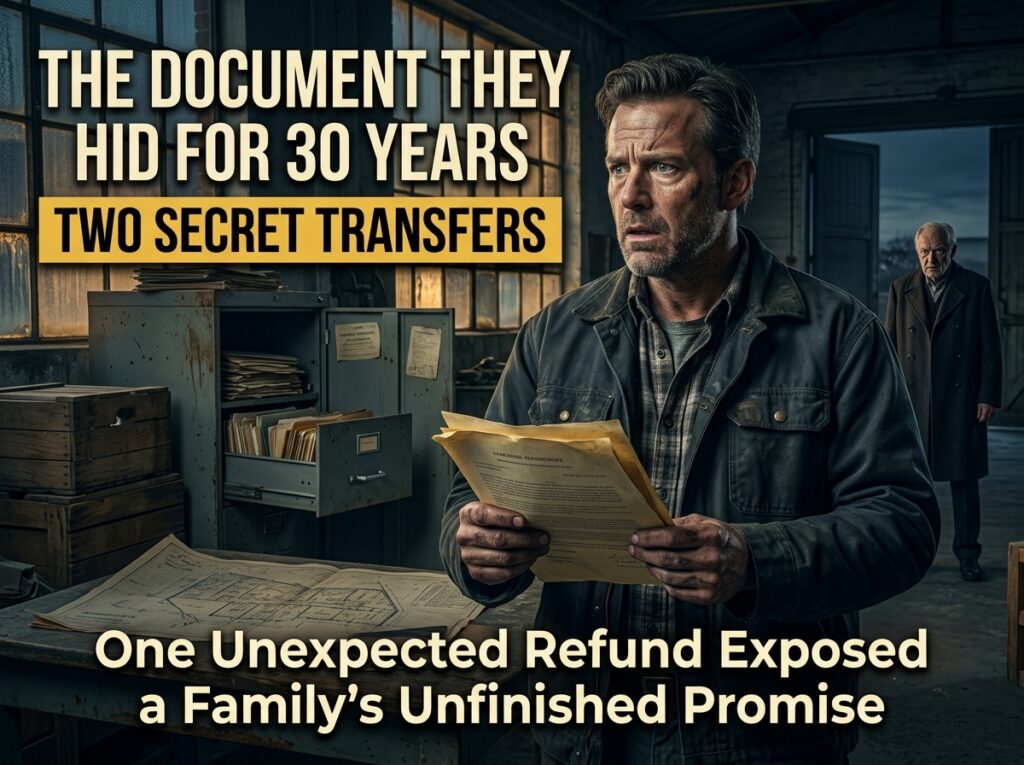
The refund arrived on a Tuesday morning, tucked between an electricity bill and a notice from my supplier.
I almost threw it away.
My repair shop was small enough that I knew every envelope that entered through the front door. The shop occupied the ground floor of an old brick building on the edge of town, squeezed between a bakery and a shuttered travel agency. I repaired lawnmowers, generators, washing machines, and just about anything else people brought in when replacing it cost more than fixing it.
The work was honest. The money was rarely impressive, but it paid the bills.
That Tuesday, I was trying to coax an ancient generator back to life when the postman called through the open doorway.
“Something good for you today, Daniel.”
I wiped the grease from my fingers and accepted the envelope.
The refund was larger than I expected. Not a fortune, but enough to cover several months of rent and replace the compressor that had been making a terrible noise for weeks.
I checked the amount twice.
Then I read the letter.
The payment had been issued following a review of an old business tax account. The account number meant nothing to me. Neither did the business name printed beneath it.
Harrow Industrial Supplies.
I had never owned a company by that name.
I had never worked for one, either.
The letter explained that the business had ceased trading decades earlier and that a historical adjustment had resulted in a credit. The payment had been directed to my current business because, according to the accompanying record, my shop was connected to the former company’s registered account.
I read the paragraph again.
My repair shop had been operating under its present name for eleven years. Before that, I had worked in a garage with my father. There was no obvious connection between our little business and an industrial supplier that had disappeared thirty years ago.
I called the number printed on the letter.
After twenty minutes on hold, a woman answered.
“Tax accounts department. How can I help?”
I gave her the reference number.
Keys clicked in the background.
“Yes, Mr. Mercer. I can see the adjustment.”
“Could you tell me why a payment intended for Harrow Industrial Supplies was sent to my repair shop?”
There was a pause.
“According to the record, your business is associated with a successor account.”
“What does that mean?”
“It means the original business was closed, but a linked account remained active.”
“Linked to whom?”
“I’m afraid I can’t establish that from the summary available to me.”
I looked at the letter again. The account number was old enough to have been typed on a machine, yet someone had apparently connected it to my business.
“Can you send me the original record?”
“I can request the archived file. It may take several days.”
“And the document authorizing the transfer?”
Another pause.
“That document isn’t attached to the current file.”
“Where is it?”
“I can’t say, sir. The archive indicates it was removed for safekeeping.”
I sat down on the wooden stool beside my workbench.
“Removed by whom?”
“I don’t have that information.”
“Then who does?”
“I’m sorry. You’ll need to contact the public registry.”
When the call ended, I remained still for a long time.
Outside, a delivery van reversed into the bakery’s loading space. Somewhere upstairs, a child was practicing the same piano passage over and over. Ordinary sounds filled the street, and the ordinary world seemed strangely indifferent to the fact that a business closed thirty years earlier had somehow reached into my present life.
I searched the name on my phone.
Harrow Industrial Supplies appeared in a few old directory entries and one scanned newspaper notice announcing the closure of its warehouse. The business had once occupied a substantial plot near the eastern railway line. It had supplied construction materials, metal fittings, and industrial equipment to businesses throughout the region.
The closure notice was dated thirty years earlier.
The company had gone out of business after a period of financial difficulty. The article mentioned unpaid invoices and a dispute over its principal warehouse, but it gave no details about the final settlement.
At the bottom was a name.
Arthur Bell, company director.
I knew that name.
Arthur Bell had attended our last family dinner.
He had sat at the far end of the table, eaten almost nothing, and left before dessert. I remembered him because my mother had insisted that everyone stay until the coffee was served, yet Arthur had looked at his watch several times and finally stood up without explanation.
When my father asked whether he was leaving already, Arthur had replied, “Some things don’t improve by staying longer.”
My father had put down his fork.
“Not at this table, Arthur.”
The room had gone quiet.
At the time, I assumed it was an old disagreement between two men who had known each other for years.
Now I wondered whether that dinner had been the last occasion on which they were willing to sit in the same room.
I called the public registry the following morning.
The clerk asked me to submit a written request, provide proof of my business registration, and explain why I believed the records were relevant to me.
I spent my lunch break assembling the documents.
Before closing the shop, I received an email confirming that my request had been accepted. The clerk had located the historical company file, but several pages were missing.
One of those pages was the original document authorizing the transfer of the property.
I stared at the screen.
The refund had been an administrative adjustment, I told myself. The missing page was probably a clerical inconvenience. The connection to Arthur Bell might have been nothing more than an old business relationship.
But when I opened the attached registry summary, I found a note written in the margin of a scanned page.
The handwriting was unfamiliar, though the words were clear.
Refer to subsequent conveyance before releasing original.
A conveyance was a transfer of property.
I printed the page and laid it beside the tax letter.
The two records referred to different transactions, but both carried the same old reference number.
That evening, I took them home.
My father had died six years earlier. My mother had died the following winter. Their house was now mine, although I had never been able to make myself change much inside it. Their coats still hung in the hallway cupboard, and the kitchen clock still lost three minutes every day.
I sat at the kitchen table where our family had eaten for decades.
Then I remembered the last dinner.
Arthur’s watch. My father’s expression. My mother’s sudden insistence that we talk about the weather.
I had always believed that the evening had ended badly because of an argument about money.
For the first time, I wondered whether the argument had been about something much larger.
The next morning, I returned to the registry office and asked to see the complete property history.
The clerk looked at my request, then at me.
“You’re asking for more than the tax file now.”
“I know.”
“Why?”
“Because the refund doesn’t make sense.”
She studied my face for a moment before turning to her computer.
“Mr. Mercer, there are two registered transfers connected to this property. The first is old. The second was recorded much later, under a different name.”
“Who owned it between the transfers?”
She stopped typing.
“That’s the part the missing document appears to explain.”
She closed the file on her screen.
“And if you want to understand why that document disappeared, you should find out who removed it before you ask anyone else about it.”
<h2>Part 2</h2>
The registry clerk’s warning followed me back to the shop.
I had spent most of my adult life believing that paperwork was the most dependable thing in the world. Machines broke. People changed their stories. Memories became unreliable. But a signed document, properly witnessed and officially recorded, was supposed to leave a trail.
Now I was looking at a trail that seemed to have been deliberately interrupted.
I called the registry again and asked for the names associated with both transfers.
The first transfer had occurred shortly before Harrow Industrial Supplies closed. The property had been conveyed to a company that no longer appeared in the current business register.
The second transfer had occurred years later.
The name attached to that transaction was Mercer Holdings.
My surname.
I felt the room become strangely small.
My family had never owned a holding company. My father had repaired farm machinery, driven delivery trucks, and eventually managed a small workshop. My mother worked in a school kitchen before retiring. They had owned a modest house and an old car. When my father died, there had been enough savings to cover his funeral and a few outstanding bills, but nothing that suggested an undisclosed commercial property.
“Are you certain about the name?” I asked the clerk.
“That’s what the register says.”
“Could it be a different Mercer family?”
“Certainly. The surname alone doesn’t establish a connection.”
That was reasonable. Mercer was not an unusual name.
I requested the company’s registration number.
It had been dissolved, but its original filing address was still available. I copied it into my notebook.
The address was my childhood home.
I read it several times, hoping that one digit had been entered incorrectly.
It hadn’t.
My parents had lived in that house for nearly forty years. It was where I learned to ride a bicycle, where my mother kept jars of homemade preserves in the pantry, and where my father taught me to replace a broken plug rather than throw away an appliance.
It was also where Arthur Bell had visited on several occasions when I was young.
I remembered him bringing a leather briefcase and asking my father to talk privately in the back room. I remembered my mother sending me outside with a list of groceries, even when the weather was terrible.
When I returned, the adults were always sitting farther apart than before.
I had never asked why.
That afternoon, I called my father’s former accountant, Mr. Hales. He was retired now, but he still lived in town and occasionally helped small businesses with old records.
He answered after the fourth ring.
“Daniel? Is something wrong?”
“I need to ask you about an old company called Mercer Holdings.”
Silence.
Not a long silence. Just long enough for me to know that he recognized the name.
“Where did you hear about that?”
“The public registry.”
“Why were you looking there?”
I explained the tax refund, the missing document, and the two property transfers.
He listened without interrupting.
When I finished, he sighed.
“Your father told me never to discuss that company unless you came to me with a specific document.”
“Did he tell you why?”
“No.”
“Did he leave anything with you?”
“Not that I can recall.”
“Then why did he mention me?”
“Because he said you might someday need to understand what happened.”
My fingers tightened around the phone.
“What happened, Mr. Hales?”
“I don’t know the entire story, Daniel. I handled your father’s ordinary accounts. I never managed Harrow Industrial Supplies, and I never saw the original conveyance.”
“But you knew about Mercer Holdings.”
“I knew it existed. I was told it was created for a temporary purpose.”
“What purpose?”
“I wasn’t given one.”
I stood and walked to the shop window.
A customer was loading a repaired washing machine into the back of a van. The bakery next door was filling the street with the smell of fresh bread.
Everything looked as it always had.
“Who would know?” I asked.
“Arthur Bell might have known. Your father certainly knew more than he told me.”
“Arthur is still alive.”
“Then be careful how you approach him.”
“Why?”
“Because the last time I heard that company mentioned, your father said there were people who believed the property had been taken from them. He said he would rather lose everything than let the wrong person claim it.”
I lowered my voice.
“Did my father steal it?”
“I didn’t say that.”
“Did he?”
“I don’t know.”
His answer frightened me more than a denial would have.
Before ending the call, Mr. Hales gave me one more piece of information. He remembered that a solicitor had handled the second transfer. The solicitor’s name was Miriam Shaw, and her office had once stood beside the old courthouse.
I found the office address online.
The firm had closed several years earlier, but Miriam herself was still listed as a practising solicitor at a smaller office on the other side of town.
I called her receptionist and requested an appointment.
The receptionist asked what the matter concerned.
“An old property transfer involving Harrow Industrial Supplies and Mercer Holdings.”
She placed me on hold.
When she returned, her tone had changed.
“Ms. Shaw can see you tomorrow at eleven.”
The following morning, I arrived ten minutes early.
Miriam Shaw was in her seventies, with silver hair, narrow glasses, and the careful manner of someone who weighed every word before speaking. Her office smelled of paper and furniture polish. Files filled two tall cabinets behind her desk.
I placed the registry documents in front of her.
She examined the first page, then the second.
When she reached the signature, she removed her glasses.
“Where did you obtain this?”
“The public registry.”
“Is this a certified copy?”
“Yes.”
She read it again.
“Have you spoken to Arthur Bell?”
“Not yet.”
“Then don’t.”
“Why does everyone tell me not to speak to him?”
“Because you don’t yet know which version of the truth you’re looking for.”
I leaned forward.
“Did you handle this transfer?”
“I handled a transaction involving Mercer Holdings. That much I can tell you. But I cannot discuss confidential client matters simply because you’ve found an old record.”
“Was my father your client?”
She looked at me for a long moment.
“Your father was one of the people who came to my office. He was not the only person involved.”
“Who else?”
“I would need to review the file.”
“Can you?”
“The file was transferred to secure storage when my former firm closed. I can request access, but I cannot promise what remains.”
I asked about the missing document.
Her expression tightened.
“Some documents are removed from ordinary files because they are held separately under an undertaking. That doesn’t necessarily mean wrongdoing occurred.”
“Who held this one?”
“I don’t know without checking.”
I rose, frustrated.
Miriam lifted a hand.
“Daniel, listen to me. A property can be transferred twice for legitimate reasons. A company can be dissolved without every connected transaction being fraudulent. And a missing document is not proof of a crime.”
“I understand.”
“No, I don’t think you do. You’re looking at a collection of facts and trying to make them tell one story. That is dangerous when the people involved are dead, elderly, or unable to defend themselves.”
I thought of my father.
“Then help me find the facts.”
She considered my request.
“I will request the archived file. In the meantime, obtain the complete company history and every recorded conveyance. Do not sign anything, do not agree to transfer anything, and do not accept anyone’s explanation without seeing the underlying document.”
She returned my papers.
As I reached the door, she spoke again.
“One more thing. You said the name Mercer Holdings was registered at your childhood address.”
“Yes.”
“Was your father the only person living there when the company was created?”
“No. My mother was there. I was there.”
“And was there anyone else?”
I thought of Arthur’s briefcase, my mother’s grocery lists, and the mysterious visitors who had always been sent away before dinner.
“Not permanently.”
Miriam nodded, as though my answer had confirmed a concern.
“Then find out who signed the original registration.”
That afternoon, I submitted a request for the company’s founding papers.
The registry estimated that it would take up to ten working days.
I returned to the shop and tried to concentrate on a customer’s broken generator. I checked the fuel line, cleaned the carburettor, and replaced a damaged gasket.
For nearly an hour, the work quieted my mind.
Then my phone rang.
It was an unknown number.
“Daniel Mercer?”
“Yes.”
“My name is Peter Vale. I understand you’ve been asking about Harrow Industrial Supplies.”
I straightened.
“Who gave you my number?”
“Someone who believes you should stop looking.”
“Who?”
“I can’t tell you over the phone.”
“Then why call me?”
“Because the second property transfer wasn’t the end of the matter.”
I looked at the papers scattered across my workbench.
“What do you know?”
Peter lowered his voice.
“I know the document you’re looking for exists. I also know that the people who signed those transfers agreed to something that was never recorded in the public register.”
“What agreement?”
“A promise that was supposed to protect someone.”
“Who?”
He hesitated.
Then he said, “If you want to know, bring the original tax letter to the address I’m sending you. And come alone.”
The call ended.
A message arrived seconds later with an address on the edge of town.
I recognized the street.
It was where Arthur Bell had lived before moving away.
<h2>Part 3</h2>
I did not go to the address that evening.
Peter Vale had given me no reason to trust him, and the instruction to come alone sounded less like an invitation than a warning. Instead, I called the registry clerk and asked whether Peter’s name appeared anywhere in the historical company records.
She could not disclose personal information from the file, but she confirmed that a Peter Vale had been listed as a witness on a document connected to the original property dispute.
That was enough to make me reconsider.
The following morning, I drove to the address.
It was a modest office above a pharmacy, with a narrow staircase and a frosted glass door. The lettering on the door had faded, but I could still read the name: Vale Records and Accounts.
Peter was waiting inside.
He was a thin man in his late sixties, with a neatly pressed shirt and hands that trembled slightly when he poured the tea. He did not offer an explanation for his phone call until I placed the tax letter on the desk.
“You’re Daniel,” he said.
“Yes.”
“You have your father’s eyes.”
I had heard that before. I had never liked it.
“How did you know my father?”
“I worked with Arthur Bell for several years. I was a junior accounts clerk when Harrow Industrial Supplies began experiencing financial difficulties.”
“Was my father involved in the company?”
“Not at first.”
“Then how did Mercer Holdings become connected to it?”
Peter folded his hands.
“Because your father was asked to help.”
“Help whom?”
“The people who stood to lose their homes if the company collapsed.”
I stared at him.
“An industrial supplier owned property. Why would its collapse threaten people’s homes?”
“Because the company had borrowed against the warehouse and surrounding land. Several smaller properties were included in the security arrangement. Some belonged to people who had never understood the documents they signed.”
“Was my father one of them?”
“No. Your father was asked to organize an arrangement that would prevent the properties from being sold immediately.”
“An arrangement that involved a company registered at our house?”
Peter nodded.
“Your father agreed to act as an intermediary. He believed he was protecting people who had been caught in a business failure they could not control.”
“Why was that kept secret?”
“Because some creditors would have challenged the arrangement, and because Arthur believed that public disclosure would make the situation worse.”
I thought of the official closure notice, the unpaid invoices, and the missing conveyance.
“Who actually owned the land?”
“That is precisely what the missing document established.”
“Then where is it?”
Peter glanced toward the door.
“Your father kept a copy. Arthur kept another. The original was placed in secure custody under an agreement between the parties.”
“Who held it?”
“Your mother knew.”
The words struck me harder than I expected.
“My mother?”
“She helped arrange the original custody agreement. She was the person everyone trusted to keep the document safe.”
I remembered her kitchen notebook, the careful lists of groceries, the way she always kept important letters in a locked drawer.
“Where is the drawer key?”
Peter shook his head.
“I don’t know. But I believe she left instructions.”
I leaned back.
“You’ve told me that my father was trying to help people. You’ve told me my mother knew where the document was. Yet the property was transferred twice under different names. Why?”
“Because the first arrangement was temporary. The second was supposed to restore the property to its rightful owner.”
“Supposed to?”
Peter looked down at the tax letter.
“The transfer was completed, but the person who should have received the property never came forward to claim it.”
“Why not?”
“That is the question your family has avoided for thirty years.”
I asked him to name the rightful owner.
He refused.
“Not until you have the original document.”
“Why?”
“Because names were deliberately omitted from copies of the agreement. The original contains a clause that determines who can make a claim. Without it, you could accuse the wrong person, and the person who actually suffered would remain unprotected.”
I felt anger rising.
“You expect me to accept all this without proof?”
“No. I expect you to find the proof.”
Peter opened a drawer and took out a small envelope.
Inside was a photocopy of a ledger page. It listed dates, payments, and references to the property. Several entries had been marked with a red pencil.
One entry appeared beside my father’s name.
Another appeared beside Arthur Bell’s.
The final entry carried the words custody confirmed.
“Who wrote this?” I asked.
“Your mother.”
I recognized the handwriting immediately.
I had seen it on birthday cards, grocery lists, and notes tucked into my school lunches.
“Why would she keep accounts of a property she didn’t own?”
“Because she was responsible for making sure the agreement was followed.”
Peter took the photocopy back.
“There’s something else. After the second transfer, payments continued to be made against the property. They weren’t mortgage payments. They were payments connected to the original agreement.”
“Who made them?”
“Different people at different times.”
“Why?”
“To keep the arrangement alive.”
I thought about the tax refund that had brought me here.
“Was the refund one of those payments?”
“No. It was a correction to an old account. But the correction exposed a link someone had tried to remove.”
“Someone?”
Peter gave me a tired look.
“Daniel, your family wasn’t the only family involved. The property was valuable, but the agreement concerned more than ownership. It concerned a person who had been promised something and then disappeared from the official story.”
“Who was that person?”
Peter stood and moved to the window.
“I cannot answer that without the original.”
I gathered my papers.
At the door, I turned back.
“If my mother knew where the document was, why didn’t she tell me?”
Peter’s expression softened.
“Perhaps she intended to. Perhaps she was waiting for the right moment. Or perhaps she believed that keeping the secret was the only way to protect you.”
“Protect me from what?”
He did not answer.
Instead, he wrote a name on a piece of paper.
Miriam Shaw.
“Your solicitor may be able to retrieve the custody agreement. Ask her to search under your mother’s name, not your father’s.”
I drove straight to Miriam’s office.
She was reading a letter when I arrived. After I explained my meeting with Peter, she closed the office door and asked me to sit down.
“I requested the archive file yesterday,” she said. “It arrived this morning.”
She opened a folder.
Inside were copies of the two property transfers, a company registration form, and a letter from my mother.
Miriam placed the letter on the desk.
“Your mother instructed my former firm to hold the original agreement separately. She also specified that it must not be released merely because a family member requested it.”
“Who could request it?”
Miriam turned the page.
“The person named in the final clause.”
I looked at her.
“Who is that?”
She reached the end of the letter and stopped.
“Daniel, your mother did not name that person in this copy. She wrote that the name was contained in the original document.”
I stared at the signature at the bottom.
It was my mother’s.
Beneath it was a date, followed by a short handwritten note.
If the property is questioned again, the truth must be established before another transfer takes place.
Miriam looked up.
“Someone has already made an inquiry about this file.”
“Who?”
She slid a second sheet across the desk.
It was a request for access to the archive, submitted three weeks earlier.
The applicant’s name was clearly printed at the bottom.
Arthur Bell.
<h2>Part 4</h2>
For the next two days, I could think of little else.
Arthur had requested the archive before I received the tax refund. That meant he had known something was changing, or he had been searching for the document long before I entered the picture.
I tried calling him.
His number was no longer in service.
I asked an old neighbor whether she knew where he lived. She told me he had returned to town recently and was staying with a relative.
“Has he been visiting anyone?” I asked.
She thought for a moment.
“He went to see your father’s old friend last week. The man who used to run the hardware store.”
I knew exactly whom she meant: George Palmer, a retired businessman who had attended our family dinners for years.
I visited George that afternoon.
He opened the door wearing a cardigan and holding a newspaper. When I mentioned Arthur’s name, he stepped aside without asking me to explain.
“Come in,” he said. “I’ve been expecting someone to ask.”
His living room was crowded with books and old photographs. On the mantelpiece stood a picture of my parents at a summer fair, smiling beside a stall of handmade toys.
George noticed me looking at it.
“Your mother took that photograph,” he said. “She insisted we all stand together, even though half of us had been arguing that morning.”
“What were you arguing about?”
“Money. Property. The same things that divide families when nobody is willing to admit what they fear losing.”
I sat down.
“Did Arthur come here last week?”
“Yes.”
“What did he want?”
“He asked whether I still had the papers your father gave me.”
“What papers?”
George rubbed his forehead.
“Daniel, I promised your father I would keep quiet until the agreement was challenged. He believed the day would come when someone would need to know what really happened.”
“Then tell me.”
George stood and walked to a cabinet. He opened a lower drawer and removed a brown envelope secured with a length of string.
“I was given this after the second transfer,” he said. “Your father asked me to keep it somewhere separate from the official records.”
Inside were three letters and a handwritten account of the events surrounding Harrow Industrial Supplies.
The account described a financial crisis that had begun long before the company closed. The business had borrowed heavily to expand its warehouse operations. When several major contracts fell through, the company could no longer meet its obligations.
The land was placed at risk.
Arthur Bell had wanted to sell the warehouse and surrounding properties immediately. My father had argued that some of the properties were not truly the company’s to sell. They had been included in a broader arrangement intended to secure a loan, but the people connected to those properties had not understood what they were agreeing to.
The disagreement had become bitter.
Arthur accused my father of interfering in business matters he did not understand. My father accused Arthur of putting the interests of creditors above the people who had trusted him.
Eventually, they reached a private agreement.
Mercer Holdings was created to hold the property temporarily while the parties worked out the claims. My father acted as the intermediary. My mother kept the records. George was asked to retain a separate copy of the correspondence.
But the arrangement had a condition.
The property could not be transferred permanently until the person whose interests it had been intended to protect was identified and given an opportunity to claim it.
That person was not named in the copies George had.
“Why would they keep the name out?” I asked.
“Because naming the person publicly would have exposed them to pressure,” George replied. “Your father believed they needed time to decide whether to come forward.”
“Who were they?”
“I don’t know. Your father never told me.”
I read the account again.
There were references to payments made over the years. Some had been made by Arthur. Others came from an account associated with Mercer Holdings. The amounts varied, but the pattern was consistent: the money was being used to preserve the property and cover costs while the original claim remained unresolved.
“Did my father steal anything?” I asked.
George’s face tightened.
“Your father was not a saint, Daniel. He could be stubborn and secretive. But I never believed he took that property for himself.”
“Then why did the second transfer use a different name?”
“Because the first company was dissolved, and the property had to be placed somewhere while the agreement remained in force. The paperwork was complicated. I never saw the final conveyance.”
I looked at the letters.
One was from Arthur to my father, written shortly before the company closed.
You have asked me to trust a promise that cannot be recorded publicly. If this goes wrong, we will both be blamed. I hope you understand what you are asking me to risk.
My father’s reply was brief.
I understand. I also understand what happens if we do nothing.
The third letter was from my mother.
The document is safe. The name remains sealed. Until the proper person comes forward, no one has the right to call this matter finished.
I put the letters down.
For thirty years, my family had lived with a secret that was larger than a business failure. Yet nobody had ever told me enough to understand it.
“Why did Arthur come looking for these papers now?” I asked.
George folded his newspaper.
“Because someone has started moving money again.”
“What money?”
“The payments connected to the property. Arthur told me that the latest transfer had been made under a name he didn’t recognize.”
I felt the familiar chill of uncertainty.
“Was it mine?”
“I don’t know.”
George leaned forward.
“But he said one thing that frightened me. He said that if the original document surfaced, someone would lose the protection they’d enjoyed for thirty years.”
“Who?”
“He wouldn’t say.”
I took the papers to Miriam.
She examined them carefully and explained that the account was consistent with a temporary property arrangement, but it was not enough to establish ownership. The original agreement was still essential.
She also discovered that the second transfer had been recorded shortly after a change in the company’s legal status. The signature appeared in a form that did not match the usual signatures on file.
“Could it have been forged?” I asked.
“It could have been copied, authorized under a power of attorney, or signed by someone acting for the company. We cannot conclude anything from appearance alone.”
“But the same unusual signature appears on both transfers.”
“That is precisely why we need the original documents and the notary’s records.”
She contacted the notary’s office. The notary was still alive and had agreed to review the old register, but he would not discuss the matter by telephone.
We arranged a meeting for Friday.
Before I left, Miriam handed me a photocopy of my mother’s letter.
“Your mother was very careful,” she said. “She made it clear that the property should not be transferred again until the original agreement was examined.”
“Then why did the registry allow two transfers?”
“Because the documents submitted to the registry appeared to satisfy the formal requirements. The private condition may have been held separately. That is why the missing document matters.”
I drove home with the letters on the passenger seat.
For the first time, I understood why my father had never explained the matter. He had been protecting an agreement that depended on secrecy, but the secrecy had outlived the people who understood it.
That evening, I searched the house for my mother’s records.
I found old insurance policies, receipts for household repairs, and a notebook filled with dates and amounts. At the back was a list of payments linked to a reference number I recognized from the property file.
The final entry was dated only weeks before my mother died.
Beside it, she had written:
Arthur says the original must be returned before another transfer is made.
I checked the date.
Arthur had requested access to the archive three weeks before I received the refund.
The next morning, I called him again.
This time, someone answered.
“Daniel?” Arthur said.
“Yes.”
“I was wondering when you’d call.”
“Why did you request the original document?”
He was silent for a moment.
“Because I believe someone is about to make a mistake your father spent thirty years trying to prevent.”
“Who?”
“I can’t tell you over the phone.”
I gripped the receiver.
“Then tell me where to meet you.”
Arthur gave me an address.
It was the small office on the edge of town.
The same office Peter Vale had directed me toward.
<h2>Part 5</h2>
I arrived at the office shortly before noon.
The building stood behind a row of aging shops, its windows dusty and its front steps worn smooth by years of use. A brass plaque beside the door carried a name I had not seen since the family dinner.
Arthur Bell — Private Accounts and Property Records.
My hands had gone cold before I touched the handle.
Arthur opened the door himself.
He looked older than I remembered, with deep lines around his mouth and a slight stoop in his shoulders. But his eyes were alert, and when he saw the folder under my arm, his expression changed.
“You found George’s papers.”
“Yes.”
“Good. Then you know your father didn’t take the property for himself.”
“I know he was involved in an arrangement. I still don’t know who the property was meant to protect.”
Arthur stepped aside.
“Come in.”
The office contained two desks, a filing cabinet, and a table covered with old maps. A framed photograph of Harrow Industrial Supplies hung on the wall. In it, a younger Arthur stood outside the warehouse beside several workers.
He noticed me looking.
“Those were good people,” he said. “Some of them lost everything when the company collapsed.”
“Did my father save the land?”
“He tried.”
Arthur poured water into two glasses and sat down.
“I was responsible for the company when its finances began to fail. I had debts, contracts, employees, and creditors demanding answers. Your father believed the land could be preserved if we separated the disputed properties from the company’s remaining assets.”
“Was that legal?”
“It could be, if the claims were properly documented and the people involved agreed. That was the purpose of the original agreement.”
“Who was supposed to receive the property?”
Arthur looked at the maps.
“Someone who had been promised it long before the company failed.”
“Why didn’t they claim it?”
“Because they were told they had no right to it.”
“By whom?”
He rubbed his forehead.
“That is where the story becomes difficult.”
I waited.
Arthur explained that the disputed property had originally been acquired under a complicated arrangement involving several people. One person had contributed money, another had provided the land, and a third had signed documents that allowed the company to use the property as security.
The records did not clearly distinguish ownership from the right to use the land. When the company faced financial trouble, the distinction became crucial.
Some believed the property belonged entirely to Harrow Industrial Supplies. Others believed the company had only been permitted to use it temporarily.
My father had discovered evidence supporting the second interpretation.
“He came to me with a ledger,” Arthur said. “It showed payments that had been made long before the company existed. Your mother had kept the receipts. Together, they suggested that the land was connected to a private agreement that had never been properly recorded.”
“Why wasn’t it recorded?”
“Because the person who should have been named refused to come forward.”
“Why?”
Arthur’s expression became distant.
“Fear. Shame. Family pressure. I never knew which mattered most.”
I thought of the final dinner, the silence around the table, and my mother’s insistence that nobody leave before coffee.
“Was that why you argued with my father?”
“Partly. I wanted the matter settled. He wanted to preserve the property until the person named in the agreement could claim it. I believed we were running out of time. He believed rushing would destroy the only chance of making things right.”
“Who was right?”
Arthur gave a sad smile.
“Neither of us, entirely.”
He opened a drawer and removed a small leather notebook.
“This is a copy of the payment ledger. Your mother kept the original. Every entry was recorded with a date, an amount, and the initials of the person who authorized it.”
I examined the pages.
The payments continued for decades after the business closed. Some were small, covering taxes and maintenance. Others were larger, apparently intended to settle outstanding obligations connected to the property.
The latest entry had been made only a month earlier.
Beside it were the initials A.B.
“You made this payment?”
“Yes.”
“Why?”
“Because the agreement required it.”
“Who received the money?”
Arthur hesitated.
“That is the part I cannot disclose without the original document.”
I felt anger rising again.
“Everyone keeps telling me that. You all expect me to trust a story that nobody will finish.”
“I understand.”
“No, you don’t. My parents died without telling me why our surname was connected to a property I never knew existed. My mother’s final records mention an agreement. My father’s old accountant refuses to explain it. The registry has a missing document, and now you’re making payments against the property thirty years after the company closed.”
Arthur listened without interrupting.
When I finished, he said quietly, “Your father made me promise that the property would never be used to punish the person it was meant to protect.”
“What does that mean?”
“It means the person who should have received the land may have spent thirty years believing they had no claim to it.”
I stared at him.
“Are they still alive?”
“Yes.”
“Do they know about the agreement?”
“I believe they do.”
“Then why haven’t they come forward?”
Arthur stood and walked to the filing cabinet.
“Because someone has been paying them to stay away.”
The room seemed to tilt.
“Who?”
“I don’t know for certain. The payments were made through accounts I did not control. I only learned about them when the tax adjustment exposed the connection.”
He removed a sheet of paper and placed it on the table.
It was a copy of a bank transaction, dated several weeks earlier. The amount was modest, but the reference number matched the one in my mother’s notebook.
The recipient’s name had been obscured on the copy.
“Who gave you this?”
“Peter Vale.”
I looked up.
“Peter is involved in this?”
“He has been keeping accounts for the arrangement since the early years. He knows more than he has told you.”
“Then why did he send me to you?”
“Because he wants the original document found before another payment is made.”
Arthur turned the paper over.
On the back, someone had written a short message.
The next payment must not be released until the missing person is identified.
I read it twice.
“Who wrote this?”
Arthur shook his head.
“I don’t know. But I believe it was added after your mother died.”
I put the paper down.
For a moment, neither of us spoke.
Then Arthur opened a second drawer and took out a sealed envelope.
“This was delivered to me after the last family dinner,” he said. “I was instructed to keep it until the property was questioned again.”
“Who gave it to you?”
“Your mother.”
The envelope was addressed to Arthur in my mother’s handwriting. The seal was intact.
I watched him place it between us.
“She said I could open it only when you came looking for the truth.”
I stared at the envelope.
My mother had known that this day might come.
Arthur pushed it toward me.
“Daniel, whatever you discover, don’t assume the person who benefited from the arrangement was the person who designed it. Your father understood that distinction. I hope you will, too.”
I broke the seal.
Inside was a single page.
The first sentence read:
If Daniel has reached this point, the original agreement must be returned to the person who has the right to decide what happens next.
Below it was a location.
Not an office or a registry.
A residential address.
And beneath the address, my mother had written a name I had not heard spoken in my family for almost thirty years.
<h2>Part 6</h2>
I recognized the name, but I could not immediately place the person.
It belonged to someone from the edges of my childhood, a name that had appeared occasionally in old conversations and then disappeared whenever I asked a question.
Arthur watched me read the letter.
“Do you know who that is?”
“I think so.”
“Then you understand why your mother kept the name out of the public records.”
I shook my head.
“No. I understand that everyone has been keeping secrets. I don’t understand why.”
Arthur leaned back.
“The person named in that letter was connected to your family before the company existed. They were promised an interest in the property, but they never received the documents proving it. When the company collapsed, your father tried to preserve their claim. The arrangement depended on keeping their identity confidential until they chose to come forward.”
“Who paid them to stay away?”
“That is what we need to establish.”
I folded the letter and placed it in my pocket.
“Why did my mother leave it with you instead of telling me?”
“Because she knew you would ask questions before you understood the danger of the answers.”
“What danger?”
Arthur looked toward the window.
“Your family was not the only one with something to lose. The property was worth considerably more than it had been when the original agreement was signed. If the rightful claimant appeared, several people could face financial consequences. Some had inherited assets they believed were theirs. Others had received money from accounts connected to the land.”
I thought of the two transfers.
“Did someone deliberately put the property under different names?”
“Yes, but not necessarily for the reason you think.”
“Then explain.”
“The first transfer separated the property from the failing business. The second was intended to place it under a new arrangement while the original claim was resolved. The problem is that the final condition was never completed.”
“Because the person never came forward.”
“Correct.”
“Or because someone made sure they couldn’t.”
Arthur said nothing.
That silence was answer enough to make me uneasy.
I drove to the address in my mother’s letter.
It was a small house on a quiet street beyond the old railway crossing. The garden was overgrown, and the front gate sagged on one hinge. A bicycle leaned against the wall beside the door.
I knocked.
An elderly woman answered.
For a moment, she stared at me as though she had seen a ghost.
Then she said my father’s name.
“You look like him.”
“My name is Daniel Mercer.”
“I know.”
Her voice trembled.
“Come inside.”
The house was modest and meticulously clean. Family photographs lined the hallway, but several frames had been turned toward the wall. She noticed me looking.
“Some memories are easier to live with when you don’t see them every day,” she said.
I showed her the letter.
She read it slowly, then sat down.
“Your mother kept her promise.”
“Who are you?”
“My name is Eleanor Vale.”
Peter’s surname.
I felt my stomach tighten.
“Are you related to Peter Vale?”
“He is my nephew.”
“Did you know about Harrow Industrial Supplies?”
She nodded.
“Your father came to see me when the company was in trouble. He explained that the property could be preserved, but the original agreement would have to remain confidential until the legal claim was established.”
“Why was your name involved?”
Eleanor looked at the photographs on the hallway table.
“Because the land belonged to my family before it became part of the company’s business arrangements. My husband and I had invested money in the property when we were young. We were promised that our contribution would be recognized, but when the company needed security for its loans, the documents were written in a way that made the ownership unclear.”
“Why didn’t you challenge it?”
“I did. For years. But every time I asked, someone produced a document showing that the land had been transferred. I couldn’t afford a legal battle, and I had children to raise.”
“Who transferred it?”
“I never knew whether the signatures were genuine. Your father believed the records had been altered.”
I thought of the identical signatures on the two transfers.
“Was my father involved?”
“Your father was the only person who tried to help me.”
Her eyes filled with tears.
“He came to my house with your mother. They brought copies of receipts, account statements, and a ledger that showed my family’s payments. They told me that I had not imagined what happened. They said the land could be returned if we followed the proper process.”
“Then why didn’t they return it?”
“Because I was afraid.”
“Of whom?”
Eleanor looked toward the window.
“Of the people who had benefited from the arrangement. I had already lost my savings. I couldn’t bear the thought of losing my home as well.”
She told me that she had received payments for years. They were described as compensation for the original investment, but the amounts were never enough to establish a clear settlement. When she asked for an explanation, she was told that the arrangement was temporary and that the documents would eventually be corrected.
After her husband died, she stopped asking.
“I thought the matter had ended,” she said. “Then the payments stopped for several months, and Peter told me the old account had been reviewed.”
“Was the tax refund connected to those payments?”
“Not directly. But it appears the review exposed the account that linked the property to your father’s company.”
I sat quietly.
The woman my family had nearly forgotten had spent decades living with an unresolved claim to land that might have changed her life.
“Do you still want the property?” I asked.
Eleanor looked surprised.
“I want the truth established. If I have a legal claim, I want it recognized. If I don’t, I want to know why. I don’t want another family to lose everything because people are afraid to admit what they did.”
She rose and went to a small cabinet.
From it, she removed an old photograph.
It showed a younger Eleanor standing beside a man in front of a low stone wall. Behind them was a field with a line of trees and a narrow road.
I recognized the landscape from the property maps.
On the back was a date and a handwritten note.
The land we built our future on.
“Your mother gave me this photograph,” Eleanor said. “She told me to keep it safe until the original agreement could be found.”
I turned the picture over.
A second line had been added in different handwriting.
The person who comes forward must be allowed to choose.
“Choose what?” I asked.
Eleanor’s face became guarded.
“Whether to claim the property, accept a settlement, or let the matter go. Your father insisted that the decision belonged to me, not to the people who had controlled the paperwork.”
I thought about Arthur’s warning.
The person who benefited from the arrangement was not necessarily the person who designed it.
I had assumed that someone had stolen the land. Now I wondered whether the truth was more complicated: a property held in trust, a rightful claimant who had been afraid to come forward, and a family whose silence had protected both the vulnerable and the people who profited from that silence.
Before I left, Eleanor gave me a small key.
“Your mother asked me to keep this until the day you arrived.”
“What does it open?”
“The storage cabinet at the old registry annex. Your father left something there before he died.”
I closed my fingers around the key.
“Why didn’t you tell me sooner?”
“Because I was told that you would find me when you were ready to hear the truth.”
She paused.
“And because I was afraid someone would discover that I had kept it.”
I returned to the registry annex that afternoon.
The building was scheduled for renovation, and a clerk had to unlock a room filled with old cabinets. The key fitted a narrow drawer marked with the reference number from my mother’s notebook.
Inside was a sealed packet.
On the front, in my father’s handwriting, were the words:
For Daniel, if the original agreement is ever questioned again.
I opened it carefully.
The first page was a statement from my father, written shortly before his death.
It described the property arrangement, Eleanor’s claim, and the condition that had prevented the transfer from becoming final.
The final paragraph read:
The missing document is not evidence of who stole the land. It is evidence of who was entrusted to return it.
Beneath the statement was a list of names.
One was Arthur Bell.
Another was Peter Vale.
The third was someone who had attended our last family dinner.
<h2>Part 7</h2>
I took the packet straight to Miriam Shaw.
She read my father’s statement twice and asked me to explain where I had found it. When I told her about Eleanor and the storage cabinet, she made several notes and began comparing the dates with the registry records.
“The statement supports the existence of a private agreement,” she said. “But it does not establish that the two transfers were invalid. We need the original.”
“Can the original be recovered?”
“It should be possible, if the custody arrangements were followed.”
She contacted the archive and requested an urgent search. Then she called the notary who had witnessed the second transfer.
He agreed to meet us the following morning.
I spent the night reading my father’s statement.
He had described the day he first met Eleanor. Her husband had died recently, and she had been trying to settle debts connected to the property. She brought receipts and bank records showing that her family had contributed money to the original purchase.
My father had initially assumed the matter could be resolved through a straightforward financial settlement. But the records revealed that the land had been used as security under terms that were not clearly explained to Eleanor.
Arthur believed the company had acquired sufficient rights to sell the property. My father believed that the agreement imposed conditions that had never been satisfied.
They had argued for months.
Eventually, they created Mercer Holdings as a temporary vehicle to preserve the land while the dispute was investigated. The company was never intended to own the property permanently.
My mother was responsible for keeping the records. George Palmer held copies of the correspondence. Peter Vale tracked payments. Arthur managed the remaining obligations of Harrow Industrial Supplies.
Everyone had a role.
But one name appeared repeatedly in the margins of my father’s statement.
Martin Cole.
I remembered Martin immediately.
He had attended our last family dinner with Arthur Bell. He was a quiet man who worked as an accountant and occasionally helped my father with complicated tax returns. He had arrived late that evening, spoken privately with my mother, and left shortly after Arthur.
I had not seen him since.
The next morning, Miriam and I met the notary at his office.
He was in his eighties, with a hearing aid and a habit of checking every document before answering a question. He examined the copies of the two transfers and then opened a large ledger.
After several minutes, he found the relevant entries.
“The signatures were witnessed here,” he said. “The first transfer was signed by an authorized representative of the company. The second was signed under a power of attorney.”
“Who held the power of attorney?” Miriam asked.
The notary turned a page.
“Martin Cole.”
I felt my throat tighten.
“Was my father involved?”
“Your father attended the meeting, but he did not sign the transfer.”
“Who did?”
The notary showed us the signature.
It was the same unusual mark that appeared on both documents.
Miriam examined it carefully.
“This signature is identical on the two transfers.”
“Yes,” the notary replied. “I noticed that at the time. I was told it had been reproduced from the company’s authorization papers.”
“Was that permitted?”
“It depends on the authority granted and the documents presented. I recorded what I witnessed, but I did not independently investigate the underlying ownership dispute.”
“Did you see the original agreement?”
The notary’s expression changed.
“Yes.”
“Where is it now?”
“I was instructed to return it to the appointed custodian after the second transfer.”
“Who was the custodian?”
He checked the ledger.
“Martin Cole.”
I stared at him.
Martin had not merely attended the family dinner. He had held the document that could determine whether the property had been transferred lawfully.
“Did he return it?” I asked.
The notary closed the ledger.
“I received confirmation that the document had been delivered. I cannot tell you what happened afterward.”
Miriam asked for a certified copy of the relevant entry. The notary agreed to prepare one.
Outside, I stood beside the car and watched people crossing the street.
Martin had been trusted by my father. He had handled financial matters for our family. He had sat at our table and listened while the adults argued about money.
Could he have altered the records?
Or had he been trying to protect Eleanor’s claim?
Miriam broke into my thoughts.
“We need to speak with him before drawing conclusions.”
I called the number I found in an old directory. It rang several times before a woman answered.
“Mr. Cole is unavailable.”
“My name is Daniel Mercer. I need to speak with him about an old property agreement.”
The woman went quiet.
“Who told you to contact him?”
“No one. I found his name in the registry records.”
“Mr. Cole is no longer handling those matters.”
“Is he still in town?”
“I cannot give you that information.”
She ended the call.
Miriam suggested that we send a formal letter requesting access to any documents he held. We did so that afternoon.
Two hours later, I received a message from an unknown number.
You have found the wrong person to blame.
I read it several times.
A second message followed.
Ask Arthur why the final transfer was never completed.
I called Arthur immediately.
He answered after the first ring.
“Did you send me a message?”
“No.”
“Someone says I should ask you why the final transfer was never completed.”
Arthur sighed.
“Because the person who had the right to claim the property refused to sign the final acknowledgment.”
“Eleanor?”
“Yes.”
“Why?”
“She believed the agreement had been changed. She was afraid that signing would prevent her from challenging the earlier transfers.”
“Was she right?”
“I don’t know. I never saw the final version of the document after it left Martin’s custody.”
“Then why did you keep making payments?”
“Because the agreement required the property to be maintained until the dispute was resolved.”
“Who received the payments?”
“Eleanor received some. Others covered taxes, legal costs, and maintenance.”
“Did Martin receive any?”
Arthur hesitated.
“He was paid for managing the accounts.”
“How much?”
“I don’t know the total.”
I thought of the missing document and the identical signatures.
“Arthur, did Martin benefit from the property transfers?”
“I believe he was compensated for his work. Whether he received anything beyond that, I cannot say.”
The answer was unsatisfying.
That evening, I returned to my parents’ house and searched my mother’s desk again. Behind a stack of old stationery, I found a small notebook with a red cover.
Inside were entries that matched the payment ledger, but there was one additional column I had not seen before.
Beside several payments, my mother had written the words administration fee.
The amounts were small at first.
Then they increased.
The last entry was dated shortly before the final family dinner.
It read:
Martin says the account must be closed. Arthur disagrees. Daniel must not be involved until the original is recovered.
I sat back.
My mother had known that Martin wanted the account closed. She had also known that Arthur disagreed.
And she had written my name.
I turned the page.
There was a final note.
If the original cannot be found, follow the newest payment.
I looked again at the tax refund, the registry records, and the address Peter had given me.
The newest payment had led to Arthur’s office.
But Arthur had not been the final person connected to it.
The next morning, I called the bank and requested a complete statement of the historical account linked to Mercer Holdings.
The representative confirmed that a recent payment had been made to a private account.
The recipient’s name was available.
I wrote it down.
Martin Cole.
<h2>Part 8</h2>
For the first time, the evidence pointed toward a specific person.
Martin had held the original document. He had signed the power of attorney. He had received administration fees for years. And the newest payment had gone to an account in his name.
Still, I remembered Miriam’s warning.
A suspicious pattern was not proof of wrongdoing.
I took the bank statement to her office.
She examined the transaction dates and compared them with the registry entries. Several payments had been made shortly before important changes in the property’s legal status. Others had been made after the company closed.
“These payments require an explanation,” she said. “But we need to establish what they were for before making any accusation.”
“Can we compel Martin to produce the original document?”
“That depends on whether he still holds it and what legal obligations apply. We can send a formal demand, and we can ask the court to preserve relevant records if there is evidence that the document may be concealed or destroyed.”
She drafted a letter requesting the original agreement, the custody records, and an accounting of payments made under the property arrangement.
We sent it by registered post.
Three days later, Martin called.
His voice was calm, almost friendly.
“Daniel. I understand you’ve been asking questions about an old transaction.”
“I need the original agreement.”
“I don’t have it.”
“The notary’s records say you received it.”
“I received a document for safekeeping. I returned it.”
“To whom?”
“I cannot remember the details of a transaction that took place decades ago.”
“You were still receiving payments last month.”
“Those payments were administrative fees.”
“For what work?”
“Maintaining records and managing the outstanding obligations.”
“Who authorized them?”
“Arthur Bell.”
“Then why did my mother write that you wanted the account closed?”
Martin was silent.
“Your mother was worried about many things,” he finally said. “She was a good woman, but she did not understand the legal complexities.”
“Did you transfer the property twice under different names?”
“I acted under a power of attorney.”
“Did you have permission to do so?”
“That is a matter for the documents.”
“Which you say you no longer have.”
“Correct.”
I gripped the phone.
“Martin, my father spent thirty years trying to protect someone. My mother kept records until she died. Eleanor Vale has been waiting for an explanation. If you have nothing to hide, help us find the agreement.”
He sighed.
“Your father wanted to do the right thing. I respected him. But good intentions do not resolve complicated legal matters.”
“Neither does hiding documents.”
“Be careful, Daniel.”
The call ended.
I immediately told Miriam what he had said.
She advised me not to contact Martin again without her present. She also recommended that we arrange a formal meeting with Arthur, Peter, George, and Eleanor so that everyone could give their account of the arrangement.
We chose a neutral conference room at the solicitor’s office.
Arthur arrived first, carrying the payment ledger. Peter came next, followed by George. Eleanor arrived with a small handbag and the photograph of her family property.
When Martin entered, the room fell silent.
He was older than I remembered, but his posture was straight and his expression composed. He greeted everyone politely and took the chair opposite Eleanor.
Miriam began by explaining the purpose of the meeting.
“We are here to establish the history of the property, identify the original agreement, and determine what steps are necessary to protect any legitimate claims. No one is being asked to admit wrongdoing today. We are asking for accurate information.”
Martin nodded.
“Of course.”
Arthur placed the payment ledger on the table.
“These entries show that money continued to be paid after the company closed.”
Martin examined the pages.
“Those were legitimate administrative payments.”
“Who authorized them?” Arthur asked.
“I did, under the authority granted to me.”
“By whom?”
“The parties to the agreement.”
“Then where is the agreement?”
Martin folded his hands.
“I have already explained that I returned it.”
“To whom?” Eleanor asked.
He looked at her.
“Mrs. Vale, I understand that this has been difficult for you, but the matter was handled according to the information available at the time.”
“Then why was I never given the final document?”
“Because you did not complete the acknowledgment required by the agreement.”
Eleanor’s face went pale.
“You told me that signing would mean I had accepted the settlement.”
“That was my understanding.”
“My husband and I paid for that land. You told me I had no right to claim it, and then you asked me to sign a document that would have ended my claim.”
Martin’s expression tightened.
“The legal position was complicated.”
“Was it?” Eleanor asked. “Or was it convenient?”
Nobody spoke.
Miriam intervened.
“Mr. Cole, did you receive the original agreement after the second transfer?”
“I did.”
“Did you return it to the appointed custodian?”
“I believe so.”
“Who was that?”
Martin looked down.
“I don’t recall.”
Miriam placed the notary’s certified entry before him.
“This record states that you received the document and were responsible for its safekeeping. It also records the date of the transfer. The following month, a new payment was made from the property account to an account associated with you.”
Martin read the page.
“That payment was for administrative services.”
“Can you provide an invoice?”
“I would need to check my records.”
“Can you provide a copy of the original agreement?”
“No.”
“Can you explain why the signature on both property transfers is identical?”
Martin closed the folder.
“I cannot explain the appearance of a signature on a document I did not personally prepare.”
Arthur leaned forward.
“You signed the power of attorney.”
“I acted under it.”
“That is not what I asked.”
Martin’s voice sharpened.
“I did what I believed was necessary to preserve the property. Without the transfers, the creditors could have taken everything.”
“Then why did you never complete the final acknowledgment?” I asked.
Martin looked directly at me.
“Because the claimant refused to sign.”
“Was that Eleanor’s decision?”
“Yes.”
Eleanor shook her head.
“You never gave me the original agreement. You gave me copies with sections missing.”
Martin did not answer.
Miriam asked him to provide any remaining documents within seven days.
He agreed, but before leaving, he turned toward me.
“Your father understood that some decisions have consequences. You should think carefully before you destroy the arrangement he spent his life protecting.”
After he left, George whispered, “That sounded like a threat.”
Miriam shook her head.
“It sounded like a warning. We must distinguish the two.”
The meeting had produced no confession, no original document, and no clear answer about the payments.
But it had established something important.
Martin had acknowledged receiving the original agreement. He had acknowledged acting under a power of attorney. And he had failed to explain why the document had never been returned.
That evening, I went home and opened my mother’s notebook again.
I compared the dates of the payments with the dates on the property transfers.
A pattern emerged.
Every time a transfer was recorded, a payment followed within days. The amounts were not random. They appeared to correspond to a percentage of the property’s assessed value.
The most recent payment was different.
It was larger than the others and carried a reference number that did not appear anywhere in the old ledger.
I called the bank.
The representative confirmed that the payment had been authorized from an account linked to the property, but she could not disclose further details without a formal request.
I asked Miriam to prepare one.
The next afternoon, she received a response.
The account had been funded by a deposit made shortly before the first transfer.
The deposit had come from a person whose name was not listed among the original parties.
Miriam read the name aloud.
Martin Cole.
He had not merely received administration fees.
He had contributed money to the arrangement himself.
And the deposit was large enough to suggest that he had a financial interest in what happened to the property.
<h2>Part 9</h2>
The new evidence changed the direction of the investigation.
Until then, we had assumed Martin had been paid for managing the agreement. Now it appeared that he had put his own money into the arrangement before the property transfers took place.
That did not automatically mean he had acted improperly. He might have lent money to preserve the property, covered expenses that nobody else could afford, or invested under an agreement that had never been properly documented.
But the possibility that he had benefited from the transfers could no longer be ignored.
Miriam requested the original deposit record from the bank and asked the registry to preserve every remaining document connected to the property.
She also advised Eleanor to obtain independent legal representation so that her interests would not be confused with those of the other people involved.
Eleanor agreed.
“I don’t want revenge,” she told me. “I want the chance to make a decision based on the truth.”
We met at her house that evening.
She brought out a small box containing old receipts, bank statements, and letters from my parents. Many had faded, but the dates were still legible.
One letter, written by my father to Eleanor’s husband, described a payment made decades earlier.
This money is not a purchase price. It is a temporary contribution intended to keep the land from being sold until the ownership question is resolved.
The letter was signed by my father and witnessed by Arthur.
Eleanor’s husband had signed beneath them.
I handed it to Miriam the following morning.
She examined the wording carefully.
“This supports the argument that the money was not intended to purchase the property outright,” she said. “But we still need the original agreement to determine the exact conditions.”
“Can the two transfers be challenged?”
“Possibly. If the transfers were made contrary to the agreement, or if the signatures were not properly authorized, there may be grounds to seek a review. But the legal position will depend on the evidence and the applicable limitation rules.”
I asked how long the process might take.
“Months, possibly longer. There may be hearings, expert handwriting analysis, and a detailed accounting of the payments.”
I looked at the documents spread across her desk.
“Then we need to find the original.”
Miriam nodded.
“Yes.”
She contacted Martin again and gave him a final opportunity to identify the custodian. He responded in writing that he had returned the document to a representative of the family but could not remember the person’s name.
The statement was vague.
Worse, the date he gave did not match the date in the notary’s register.
Miriam pointed out the discrepancy in a formal letter.
Martin did not respond.
A week later, Peter Vale called me.
“I think I know where the document is,” he said.
“Where?”
“In the old Harrow warehouse.”
“The warehouse was sold.”
“Part of it was. The rear office remained under a separate lease for years. Your father used it to store records before the building was cleared.”
“Why didn’t you tell me earlier?”
“Because I wasn’t certain the document was still there.”
“Are you certain now?”
“I found a reference in the payment ledger. The storage fee was paid until the year your mother died. After that, the payments stopped.”
I told Miriam, and she arranged for us to inspect the building with the current owner.
The warehouse stood near the railway line, its brick walls darkened by decades of weather. The main entrance had been replaced with a metal shutter, but a side door still led to the old administrative rooms.
The owner unlocked it.
Inside, dust covered the floor, and broken shelves leaned against the walls. We searched the cabinets, opened old drawers, and examined boxes marked with dates from the company’s final years.
Most contained invoices and shipping records.
Then Peter found a narrow metal cabinet behind a stack of wooden crates.
It was locked.
The owner said the cabinet had been there when he acquired the building, but he had never opened it because it appeared to contain old business records.
Miriam asked him to confirm that we had permission to inspect it.
After he agreed, a locksmith was called.
The cabinet contained a bundle of envelopes, a ledger, and a sealed packet wrapped in oilcloth.
My hands trembled when I saw the handwriting on the label.
It was my mother’s.
Original agreement. Do not release without verifying the claimant’s identity.
Miriam examined the seal.
“It appears intact,” she said. “We should document its condition before opening it.”
She photographed the packet and recorded its location. Then, with the owner and Peter present, she carefully removed the wrapping.
Inside was a thick document bearing the signatures of the original parties.
The first pages described the property and the financial arrangement. The middle section established the temporary transfers. The final pages set out the conditions under which ownership could be confirmed.
Miriam read silently for several minutes.
Then she looked up.
“The original agreement was never completed.”
“What does that mean?” I asked.
“It means the transfers were conditional. The property was to remain under the temporary arrangement until the claimant was identified and the final acknowledgment signed.”
“Was Eleanor named?”
Miriam turned to the final page.
“Yes.”
Eleanor’s name appeared clearly in the document.
Beside it was a clause stating that she had the right to choose whether to accept the property, receive a settlement, or decline the claim.
But the acknowledgment section was blank.
No signature.
No date.
No evidence that the condition had ever been fulfilled.
I felt a mixture of relief and anger.
For thirty years, the property had been transferred twice, payments had continued, and people had been told that the matter was settled.
Yet the agreement itself showed that the final decision had never been made.
Miriam continued reading.
“There is another clause.”
She turned the document toward me.
It stated that any person who managed the property or handled payments under the agreement had to disclose any personal financial interest before the final transfer could be completed.
Beneath the clause was a list of the original parties.
Arthur’s name appeared.
My father’s name appeared.
And beneath them was Martin Cole’s.
He had been required to disclose any interest he held in the property before the final acknowledgment could be signed.
But the disclosure section was blank.
I stared at the page.
“Does that mean he hid his investment?”
“It means the document does not record a disclosure. We need to establish whether a separate disclosure exists and whether his investment was permitted under another agreement.”
Peter looked sick.
“I never knew he had put money into the property.”
Arthur, standing beside the cabinet, said nothing.
Miriam carefully placed the document back in its protective wrapping.
“This is significant evidence,” she said. “But we must not assume the final legal outcome. The original needs to be authenticated, the signatures examined, and the payment history reviewed.”
I looked at the blank acknowledgment.
Eleanor had never been given the choice that the agreement promised her.
The question was no longer merely who had transferred the property.
It was who had prevented the final decision from being made.
Before we left the warehouse, Peter noticed a small envelope tucked into the back of the cabinet.
It had been hidden beneath the ledger.
The envelope was addressed to my mother.
Inside was a note written by Martin.
The document is safe. The claimant has been informed. The remaining payments will continue until the matter is resolved.
There was no date.
No signature beyond Martin’s initials.
And no explanation of why the claimant had never been given the original.
Miriam photographed the note and placed it with the other evidence.
Then my phone rang.
It was Arthur.
“Have you found it?” he asked.
“Yes.”
“Then you need to know something before you show it to Eleanor.”
“What?”
Arthur’s voice was strained.
“The money Martin invested wasn’t his own.”
I stopped walking.
“Whose money was it?”
He took a breath.
“It came from an account belonging to someone in your family.”
<h2>Part 10</h2>
The revelation forced us to examine the records one final time.
Arthur explained that, shortly before Harrow Industrial Supplies closed, my father had transferred money from a family account to help preserve the property. The payment was recorded as a temporary contribution, not a purchase. Martin had later managed the account and made additional deposits, but Arthur had never been certain where the money originated.
The discovery meant that Martin’s investment might not have been an investment at all. Some of it could have been money entrusted to him for a specific purpose.
We returned to Miriam’s office with the original agreement, the payment ledger, and the recovered note.
She arranged for the document to be examined by an independent specialist. The signatures were compared with known examples from the period, and the paper and ink were assessed. The expert’s report supported the conclusion that the agreement was consistent with the date recorded on its first page.
The bank also supplied a more complete transaction history after the necessary authorizations were obtained.
The records showed that the initial deposit had come from an account connected to my parents. Later payments included money from Arthur, contributions from Martin, and funds associated with the property’s maintenance.
Some payments had been legitimate expenses.
Others required further explanation.
Miriam did not promise that every question would be answered quickly. She explained that any claim would have to be assessed through the appropriate legal process, especially because the transactions had occurred over several decades.
But the original agreement established something that had been missing from every earlier discussion.
Eleanor had never surrendered her right to decide what happened to the property.
The transfers had not, by themselves, completed that decision.
When we showed Eleanor the document, she sat quietly for a long time.
Then she touched the page bearing her name.
“I thought they had taken even the right to ask away from me,” she whispered.
Miriam explained the clause in plain language. Eleanor could seek recognition of her claim, negotiate a settlement, or decide not to pursue the property. Whatever she chose, it had to be an informed decision, made with independent advice.
Eleanor looked at me.
“Your father promised me that I would have that choice.”
“He tried to keep his promise,” I said.
“Then why did nobody tell me the document had survived?”
I had no answer.
Arthur lowered his eyes.
“I believed Martin had returned it to the appointed custodian. I should have insisted on seeing proof.”
Peter admitted that he had continued maintaining the payment ledger without checking whether the final acknowledgment had ever been signed.
George said that he had trusted my father to ensure that the agreement was completed.
Each of them had held a piece of the truth. None had possessed the whole picture, and none had followed the matter through to its conclusion.
The secret had survived because everyone believed someone else was responsible for protecting it.
Martin was asked to provide a full accounting of the money he had received and to explain the missing disclosure. He initially maintained that he had acted under the authority granted to him. When the original agreement and the payment records were presented, he agreed to provide additional documents through the solicitors.
The matter was referred for formal legal review.
No one could promise Eleanor an immediate transfer of the property, and no one could determine the final financial outcome until the records had been fully examined. But the evidence was no longer hidden, and the decision was no longer being made without her.
Over the following months, the solicitors worked through the documents.
The two property transfers were examined separately. The authority under which they had been signed was reviewed. The payments were reconciled against the ledger, and the parties were asked to account for the funds they had handled.
Some discrepancies were explained by old administrative costs. Others remained unresolved and required further investigation.
The process was slow, frustrating, and expensive.
There were days when I wondered whether my parents would have wanted me to continue. They had spent years preserving the agreement quietly, and bringing it into the open had unsettled relationships that had endured for decades.
But whenever I considered giving up, I remembered Eleanor’s words.
She had not asked for revenge.
She had asked for the truth.
Eventually, Eleanor chose to pursue formal recognition of her claim while remaining open to a settlement that would reflect the original agreement. Her decision was made with independent legal advice, not under pressure from the people who had managed the property.
The process did not restore the years she had spent believing that her family had lost everything. It could not return the money her husband had earned or erase the fear that had shaped her life.
But it gave her something she had been denied for thirty years: the right to decide what happened next.
I returned to my repair shop.
The generator I had been fixing when the tax refund arrived was still sitting beside my workbench. I replaced its worn gasket, cleaned the fuel line, and started the engine. It coughed twice before settling into a steady rhythm.
The familiar sound made me smile.
For months, I had been living among old documents, disputed signatures, and questions that seemed to multiply whenever I answered one. The shop reminded me that some problems could still be solved by patience, careful work, and a willingness to examine what had gone wrong.
I kept copies of the recovered agreement and the relevant correspondence in a secure place, following Miriam’s advice. The original remained under proper custody while the legal process continued.
I also began visiting Eleanor occasionally.
We talked about her husband, the years when the property had been part of their plans, and the people who had helped them when the business failed. She never spoke of my father as a hero. She remembered his stubbornness, his mistakes, and the way he sometimes made decisions for people without asking what they wanted.
“He wanted to protect me,” she said one afternoon. “But protection without a choice can become another kind of prison.”
I thought about that for a long time.
My mother had kept the records because she believed the truth needed to survive. My father had helped preserve the property because he believed the person with the rightful claim deserved a chance. Arthur had tried to manage a failing company without allowing its collapse to destroy everyone connected to it. Peter had kept accounts because he believed the arrangement was still being honored.
Martin’s role remained a matter for the formal review. The evidence had raised serious questions about the payments and the transfers, but the final conclusions would have to rest on verified records, not assumptions.
The lesson was not that every secret concealed a villain.
It was that good intentions could not replace accountability, and that a promise was not fulfilled simply because people stopped talking about it.
Months later, I returned to the old warehouse.
The building was being prepared for renovation. The cabinet where we had found the agreement had been removed, and the dusty office was almost empty.
I stood in the doorway and thought about the document that had survived three decades of silence.
It had not been a magical answer. It had not erased the disputes or restored every lost opportunity. It had simply established what had been agreed, what had not been completed, and who deserved the chance to make the next decision.
That was enough to change the direction of the story.
When I returned home, I took out my mother’s notebook and turned to the final page.
Beneath the last payment entry, I found a sentence I had overlooked before.
One day, Daniel may ask why we kept this secret. Tell him that the purpose was never to keep the truth from him forever. It was to make sure the truth reached the person who had the right to act on it.
I read the sentence twice.
For years, I had believed my parents’ silence meant they did not trust me. Now I understood that they had been trying to preserve a decision that did not belong to them.
They had not always handled it perfectly. Their secrecy had allowed confusion to grow, and their failure to explain the arrangement had left other people carrying questions they should never have had to carry alone.
But they had left enough evidence for the truth to be found.
I placed the notebook beside the recovered copies and closed the drawer.
The unexpected tax refund had seemed like a clerical error, a small piece of money that had arrived from a business long forgotten. Instead, it had led me through a chain of old transfers, hidden payments, and promises that had never been properly fulfilled.
The refund itself was no longer important.
What mattered was that the property could finally be examined on the basis of the original agreement, and that Eleanor could make her own decision without someone else deciding what was best for her.
I still run my repair shop. I still keep receipts, although I no longer assume that a tidy file means the whole story is known. When a customer brings in a broken machine, I listen carefully before deciding what needs to be repaired.
The same principle applies to families.
Sometimes the problem is not the thing everyone argues about. Sometimes it is the missing part no one has bothered to examine.
And sometimes the most important document is the one everyone has been told no longer exists.
The old property dispute is not a story I tell for entertainment. It is a reminder of what can happen when people confuse silence with peace and secrecy with protection.
The truth did not arrive as a dramatic confession or a single sentence that explained everything.
It arrived as a tax refund, a registry entry, a repeated signature, a ledger, and a document hidden in an old warehouse.
Piece by piece, it gave us the chance to correct a story that had remained unfinished for thirty years.
And for the first time, the person who had waited longest was finally allowed to decide how it should end.