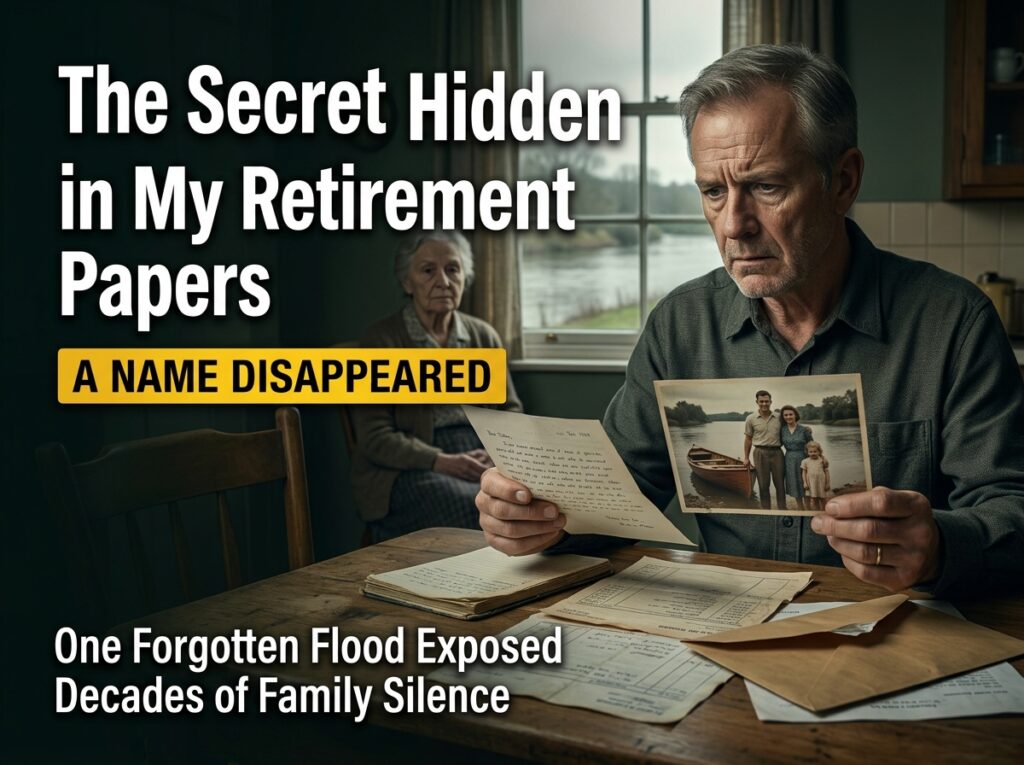
The envelope arrived on a Thursday afternoon, three days after my retirement party.
I had spent thirty-seven years working in the same municipal office, beginning as a junior records clerk and eventually becoming the person everyone called when a file had disappeared, a signature looked suspicious, or an old decision needed to be explained. I had always believed that careful records could protect people from misunderstandings. Dates did not forget. Numbers did not become embarrassed. Ink could not change its story simply because someone had become uncomfortable with the truth.
At least, that was what I believed before I opened the envelope.
My former colleague, Martin Hale, had handed it to me as we were leaving the restaurant where my coworkers had celebrated my retirement. He had waited until the others were collecting their coats before approaching me.
“Take this home,” he said.
I smiled, assuming it contained photographs or one of those sentimental notes people exchanged when a long career ended.
“What is it?”
“Copies of payments made in your name.”
His expression made me stop smiling.
“What payments?”
“That’s what I hope you’ll find out.”
Martin had worked in the municipal finance department for nearly as long as I had worked in records. He was not a man who enjoyed mysteries, and he certainly was not someone who made dramatic announcements without reason.
“Are you saying someone used my identity?”
“I’m saying your name appears on records you should know about. I made copies before the original files were moved.”
“Why didn’t you tell me earlier?”
He glanced toward the restaurant door. “Because I wasn’t certain who I could trust.”
I waited for him to explain, but he only pressed the envelope into my hands.
“Don’t throw anything away,” he added. “And don’t assume the person who benefited from these payments was the person whose name appears on the paperwork.”
That last sentence followed me home.
My house felt unusually quiet that evening. My wife, Helen, had died four years earlier, and I had grown accustomed to the silence she left behind. Retirement had made it more noticeable. There were no morning meetings to attend, no colleagues waiting for my opinion, and no unfinished files demanding my attention.
I made tea, sat at the kitchen table, and opened the envelope.
Inside were photocopies of bank transfers, payment authorizations, and several old account summaries. My name appeared repeatedly. Some documents were dated decades earlier, when I had barely started working. Others were much more recent.
The amounts were not identical. Some payments were modest, while others were large enough to have changed the direction of someone’s life.
At first, I thought they might be pension contributions, forgotten reimbursements, or administrative payments associated with my employment. But the reference numbers did not match any account I recognized.
Then I noticed something stranger.
The payments had been made to different destinations, yet several carried the same authorization code. On two documents, the beneficiary field had been copied over with a different typeface. On another, a strip of paper had apparently covered the original entry before the page was photocopied.
Someone had not merely made a mistake.
Someone had wanted a particular name to disappear.
I spread the documents across the table and began arranging them by date. The earliest transfer I could identify was from a year I remembered clearly, although not for any reason connected to money.
It was the year the river flooded.
I had been a young employee then, still learning how to manage my responsibilities and support my family. The flood had destroyed homes, damaged roads, and left entire neighborhoods struggling to recover. For months, people talked about missing records, emergency payments, displaced families, and promises that had never been fulfilled.
I remembered helping organize documents in the aftermath. I remembered my father warning me not to repeat rumors about the people who had received assistance. I remembered one particular family being discussed in lowered voices.
But I could not understand why a payment bearing my name had been made during that same period.
The following morning, I took the envelope to the person who had known my family longer than anyone else.
Her name was Eleanor Brooks. She was eighty-six, lived alone in the old house at the end of Maple Street, and had known my parents before I was born. She had attended family weddings, sat beside hospital beds, and remembered disagreements that everyone else preferred to forget.
When I placed the documents on her table, she put down her cup without touching the papers.
“Where did you get these?” she asked.
“An old colleague gave them to me.”
She examined the first page, then the second. Her expression changed gradually, as though she were watching a door open onto a room she had spent decades avoiding.
Finally, she looked at me.
“Did you also find the record from the year the river flooded?”
My stomach tightened.
“Why would that matter?”
Eleanor folded her hands.
“Because if you have those payments,” she said, “then somebody has finally started looking for the person we promised never to name.”
<h2>Part 2</h2>
I left Eleanor’s house with more questions than answers.
She had refused to tell me who the unnamed person was. Instead, she asked me to bring every document Martin had given me and promised that she would explain what she could after seeing the complete set.
“You cannot understand a single payment without understanding what happened before it,” she said.
“What happened before it?”
She looked toward the window. “Your father believed silence could protect a family. Sometimes it protected the wrong person.”
I wanted to press her, but she had already stood up. At eighty-six, she moved carefully, using the edge of the table to steady herself.
“Give me until tomorrow,” she said.
I returned home and called Martin.
He answered immediately.
“Have you looked at them?”
“I have. Why were you keeping copies?”
“Because I came across the original payment schedule while reviewing archived records. Your name was listed as the authorizing contact, but the signature attached to it didn’t look like yours.”
“It wasn’t mine.”
“I know that now.”
“Who signed it?”
“I can’t establish that from the copies I have. The original authorization page is missing.”
I leaned back in my chair.
“Martin, somebody used my name to move money. I need to know where it went.”
“I understand. But there’s something else you should know. The payments were not all made to the same person. Several went through an account that was later closed. Others were redirected after the river flooded.”
“Redirected to whom?”
“That information is missing from the versions currently held in the archive.”
The room seemed to grow smaller.
“How can an official payment record have no beneficiary?”
“It shouldn’t,” Martin replied. “That’s why I copied them.”
He told me that the payments had been reviewed at least twice over the years. Each review had produced a short administrative note stating that the transactions had been reconciled. No explanation accompanied those notes, and the original supporting documents were unavailable.
“Someone kept closing the question without answering it,” I said.
“Exactly.”
After we hung up, I returned to the papers.
The earliest payment was dated in late autumn, shortly before the flood. A second appeared several weeks later. A third had been made the following spring, when emergency assistance was being distributed to displaced residents.
The pattern continued for years.
Some payments were separated by months. Others arrived on the same day, divided into amounts that seemed deliberately arranged to avoid attracting attention.
I recognized the name of one financial institution, although it had since merged with another bank. I recognized the municipal department that had processed several transactions. I even recognized the initials of an administrator who had worked in the same building as my father.
What I did not recognize was the reason my name had been attached to any of it.
I had never controlled an emergency fund. I had never managed relief payments. I had never authorized money to be sent to a private account.
Yet the documents suggested that somebody had used my identity as part of a process that continued long after the floodwaters had receded.
I searched my personal files for old employment records. I found appointment letters, tax statements, pension contributions, and a notebook in which I had recorded important dates from my early career.
One entry stopped me.
It was dated the week after the flood.
My handwriting was younger and less steady than it was now, but I recognized it immediately.
The note read: Father says the matter is settled. Do not ask about the relief account again.
I stared at the words.
I remembered writing the note, but I could not remember why. I had been young, tired, and overwhelmed by the damage the flood had caused. My father had been dealing with family matters while I concentrated on my new job.
Perhaps he had asked me to stop repeating a rumor. Perhaps he had been protecting someone from an accusation.
But if the matter had truly been settled, why had payments continued for years?
I called Eleanor again.
She did not answer.
I tried once more an hour later, then sent a message explaining that I had found an old notebook entry connected to my father.
Her reply came shortly before sunset.
Do not bring those papers to your house tonight. Someone may know you have them.
I read the message twice.
Before I could respond, another message appeared.
Meet me tomorrow morning. There is something you must understand before you speak to your family.
That night, I barely slept. Every sound outside seemed unusually distinct. A car slowing near the house, footsteps on the pavement, the telephone vibrating on the bedside table—all of them made me wonder whether somebody was watching me.
At seven the next morning, I returned to Eleanor’s house.
She was waiting at the kitchen table with an old photograph and a folded letter.
The photograph showed a group of people standing beside the river before the flood. My father was there, younger and thinner, with one hand resting on the shoulder of a woman I did not recognize.
Beside the woman stood a child.
Eleanor turned the photograph over.
On the back, someone had written a date and a single sentence.
“This was taken two months before everything changed,” she said.
I looked at the child again.
“Who is this?”
Eleanor’s eyes filled with tears.
“Someone your family spent decades pretending had never belonged to it.”
Then she placed the folded letter in front of me.
“And before you ask,” she added, “the payments were never meant to benefit your father.”
I did not open the letter immediately.
For a moment, I could only stare at the photograph. The woman beside my father had a narrow face, dark hair pinned behind her ears, and an expression that seemed strangely familiar. The child beside her held a small wooden boat, the kind children made from scraps of timber.
“Was she a relative?” I asked.
Eleanor nodded slowly.
“Her name was Margaret Vale. She grew up near your father’s family. They were close long before you were born.”
“Why have I never heard of her?”
“Because people can erase someone from a family story without erasing them from the world.”
I looked again at the child.
“And the child?”
Eleanor’s fingers tightened around her cup.
“That is the question your father never wanted answered.”
I unfolded the letter. The paper was yellowed, and the ink had faded at the folds. It was addressed to my father, Thomas, and dated several weeks before the flood.
The writer explained that a family property near the river was in danger because of an unpaid loan. The property had been used as security for money borrowed years earlier. If the debt was not settled, the lender could take possession of the land.
The letter also mentioned a second person whose future depended on what happened to the property.
That person’s name had been cut from the copy.
“Who removed it?” I asked.
“I don’t know,” Eleanor replied. “I only know that the original letter once had a name there.”
“Was the property connected to the payments?”
“Yes.”
“Then why didn’t anyone tell me?”
“Your father believed he had a good reason. At first, perhaps he did. But a secret kept for a few weeks can become a burden that lasts a lifetime.”
I read the letter again. The writer had asked my father to attend a meeting before the loan deadline. At the bottom was a sentence that had been underlined twice.
If the money is accepted in my name, it must be recorded in full. No one else should be made responsible for what happens afterward.
I felt a chill.
“Someone accepted money in my name,” I said. “Could that have been connected to this agreement?”
“It could have been.”
“But the payments continued long after the loan should have been settled.”
Eleanor nodded.
“That is why you must find the original record from the year of the flood.”
She explained that the flood had destroyed several buildings, including a small office where local property agreements and relief documents had been stored. Afterward, some records were reconstructed from copies. Others were transferred to a municipal archive.
During that process, a dispute arose over the river property. One family claimed the land had been surrendered to settle a debt. Another insisted the debt had already been paid.
The disagreement had never been resolved publicly.
Instead, the payments began.
“Who received them?” I asked.
Eleanor looked at the photograph.
“That is what the missing beneficiary would tell you.”
I left her house carrying the photograph and a copy of the letter. She insisted on keeping the original until we could determine how it had survived for so long.
Before I reached my car, she called after me.
“One more thing. Your father wasn’t the only person who knew about the arrangement.”
“Who else?”
She hesitated.
“Your uncle Richard.”
Richard had died fifteen years earlier. I remembered him as a quiet man who rarely attended family gatherings and who had spent the last years of his life living in another town.
“He never spoke about this,” I said.
“No,” Eleanor replied. “But he kept records.”
That afternoon, I searched the boxes I had inherited after Richard’s death. Most contained ordinary papers: insurance policies, old photographs, receipts, and correspondence. Near the bottom of one box, I found a small notebook wrapped in brown paper.
The first pages contained household expenses.
The middle pages listed dates and amounts that matched the payments in Martin’s envelope.
And on the last page, Richard had written a sentence that made my hands tremble.
The money has been paid, but the person who deserves it has never received it.
<h2>Part 4</h2>
Richard’s notebook changed the investigation from a collection of suspicious documents into something much more personal.
I spent the following days comparing his entries with the payment records Martin had given me. The dates aligned with remarkable precision. Whenever a transfer appeared in the municipal files, Richard had recorded a corresponding amount in his notebook.
Some entries included short descriptions.
River account.
Property settlement.
Family protection.
Others contained only a date and a figure.
The most troubling entries were those marked with a small letter M.
I initially assumed the letter stood for money. Then I found a page on which Richard had written, M must not be forgotten again.
I returned to Eleanor.
When she saw the notebook, she closed her eyes.
“Richard knew more than he ever admitted,” she said.
“Was Margaret the beneficiary?”
“Margaret was connected to the arrangement. But you must be careful about assuming that the person who was supposed to receive the money was the person who signed the agreement.”
I asked her to explain.
She told me that before the flood, Margaret had been trying to protect a child whose future had become entangled in the dispute over the property. The child had a legitimate connection to the land, but several relatives opposed acknowledging that connection.
The property was valuable, even then. It included a house, a stretch of fertile ground, and access to a road that connected the riverside community with the town.
When the flood damaged the area, the dispute became more urgent. The lender wanted repayment. The family wanted to prevent the property from passing into outside hands. Margaret wanted to protect the child.
Everyone claimed to be acting for the family’s benefit.
But their intentions were not the same.
“Your father was young,” Eleanor continued. “He believed he could find a compromise. Richard believed the truth should be recorded, even if it hurt people. Other relatives believed that acknowledging the child would destroy the family’s reputation.”
“And what did Margaret believe?”
“That the child deserved a future that wasn’t decided by other people’s shame.”
I thought about the photograph. The child holding the wooden boat had looked directly at the camera, unaware of the arguments that would eventually surround the child’s identity.
“Why was my name used?”
Eleanor shook her head.
“I cannot tell you that with certainty. Your father may have agreed to act as an intermediary. Someone may have used his records without his permission. Or the original agreement may have been changed after it was signed.”
Each possibility raised a different question.
I contacted Martin and asked whether the original payment authorizations might still exist in another archive.
He said he would investigate.
Two days later, he called with news.
“The records office has an index for the original transactions,” he said. “The index lists a document that isn’t in the file.”
“What document?”
“A beneficiary declaration.”
“Whose name was on it?”
“That is the problem. The index has been amended. The original entry was removed, but the amendment number is still there.”
“Can you retrieve the earlier version?”
“I have requested it. However, the request has been flagged for review.”
“By whom?”
“I don’t know. Someone has asked why you are looking into records that were closed decades ago.”
My stomach tightened.
“I have a right to understand why my name appears on them.”
“I agree. But I wanted you to know that your questions are no longer private.”
That evening, I examined Richard’s notebook once more. On the inside cover, almost hidden beneath a faded library stamp, were three words.
Ask about the bridge.
I remembered the old bridge that crossed the river. It had been rebuilt after the flood and was now used mostly by farmers and local residents.
I had driven across it hundreds of times without thinking about its history.
The following morning, I went to the municipal planning office and requested the old flood reconstruction maps.
The clerk brought me a large folder containing survey plans, photographs, and lists of damaged properties.
One map showed the riverside property from Margaret’s letter. A handwritten annotation indicated that a section of the land had been temporarily reserved for emergency access during reconstruction.
Beside that annotation was a reference number.
It matched the missing beneficiary declaration.
I asked the clerk to check the corresponding file.
She searched the index, frowned, and then searched again.
“This document should be here,” she said.
“Should be?”
“It was logged into the archive. The file was later marked as transferred to another department.”
“Which department?”
She looked at the screen.
Then she turned toward me.
“The office that handled compensation claims.”
That office had been closed years earlier.
Its records were supposed to have been transferred to a central repository, but nobody could confirm where the original files had gone.
Before leaving, I asked the clerk to print the transfer history.
At the bottom of the page was a name I recognized from Richard’s notebook.
Martin Hale.
<h2>Part 5</h2>
For several minutes, I considered the possibility that Martin had deliberately brought me into the investigation to conceal his own involvement.
It was an unpleasant thought. He had been my colleague for decades, and I had trusted him with matters I would not have discussed with most members of my family.
I called him immediately.
“Your name appears on the transfer record for the missing beneficiary declaration.”
There was a long silence.
“I wondered when you would find that,” he said.
My grip tightened around the phone.
“You knew?”
“I knew the document had passed through my department. I didn’t know what had happened to it afterward.”
“Why didn’t you tell me?”
“Because I was trying to establish whether the transfer was legitimate before involving you.”
“That isn’t an answer.”
“No,” he admitted. “It isn’t.”
He asked me to meet him at a small café near the municipal building. When I arrived, he had brought an old file of his own.
Inside were photocopies of internal correspondence from the years when the compensation records were being reorganized.
One letter instructed staff to separate the payment schedules from the beneficiary declarations. Another requested that several disputed transactions be marked as reconciled while an ownership review remained incomplete.
The signatures were genuine, but the instructions were troubling.
“Who issued these orders?” I asked.
“The department director at the time.”
“And did you follow them?”
“I processed the transfers I was instructed to process. I did not approve the original payments, and I did not decide who should receive them.”
“Did you know the beneficiary’s name had been removed?”
“Not then. I discovered that years later, when I was reviewing an unrelated complaint.”
“Why didn’t you report it?”
Martin lowered his eyes.
“I did report it. The complaint was closed because the transactions had been classified as historical and the original supporting documents could not be located.”
“So you accepted that explanation?”
“I accepted that the investigation had been formally closed. I never believed that meant the questions had been answered.”
His honesty did not entirely reassure me, but the documents supported his account. His name appeared on the transfer history because he had handled the administrative movement of the records, not because he had authorized the payments.
“Why give the copies to me now?”
“Because I retired last year, and the files were being reorganized again. I found evidence that the same payment reference had been used long after the original dispute should have ended.”
He pointed to a schedule showing payments made over several decades.
“The money didn’t stop when the debt was supposedly settled,” he said. “It continued under a reference connected to your name.”
“Who was receiving it?”
“That is what nobody has been willing to explain.”
I studied the final entries. The most recent payment was made only months earlier.
The amounts had changed over time, but the reference remained the same.
Someone had continued maintaining an arrangement created before I had fully understood what it meant.
“Could the payments have been compensation for the property?”
“Possibly. But if so, the beneficiary should have been recorded. The original declaration should also have been preserved.”
“And if the payments were intended for the child Margaret was protecting?”
“Then someone may have spent decades deciding that the child was not entitled to know.”
The thought left me deeply unsettled.
I had spent much of my career helping people resolve disputes through documents. I had believed that an official record, once corrected and signed, could bring an argument to an end.
Now I was beginning to understand how a record could be used to prevent an argument from ever being heard.
Before I left, Martin handed me a second envelope.
“I found this in the file attached to the transfer request,” he said. “It was never entered into the official index.”
Inside was a handwritten note.
The writer explained that the payments were not intended to enrich the family members named in the surviving records. They were supposed to protect a person whose claim had been deliberately excluded from the settlement.
The note ended with a warning.
If the beneficiary is still alive, do not tell the family before speaking to them. They have waited long enough.
There was no signature.
But the handwriting looked remarkably similar to the writing in Richard’s notebook.
I took the note to Eleanor.
She studied it for a long time.
“Richard wrote this,” she said.
“Are you certain?”
“I watched him write hundreds of letters. I would recognize his handwriting anywhere.”
“Did he know where the beneficiary was?”
Eleanor folded the paper carefully.
“Yes.”
“Where?”
She looked at me with an expression I could not interpret.
“He told me that if the truth ever came out, the person would come looking for you.”
Before I could ask another question, my phone rang.
The number was unfamiliar.
I answered.
A man’s voice spoke quietly.
“You have the note, don’t you?”
I said nothing.
“I know you’ve been looking at the payment records. I also know what Eleanor told you.”
“Who is this?”
“You need to stop asking the archive for documents. The original beneficiary declaration was not the only record that disappeared.”
“What else disappeared?”
The caller paused.
Then he said, “The document that proves who signed your name.”
<h2>Part 6</h2>
I did not sleep that night.
The caller had refused to identify himself. When I tried to call the number back, it was unavailable. I considered going to the police, but I had no evidence that a crime had occurred beyond the suspicious documents and the anonymous warning.
I also knew that I could not simply stop investigating.
Someone had used my name in financial records for decades. The payments had continued long after the original property dispute. A beneficiary had been removed from official copies, and someone believed the original signature document could reveal who was responsible.
The next morning, I contacted an independent solicitor named Patricia Webb. She had handled property disputes for several people I knew and had a reputation for being careful rather than dramatic.
I showed her the payment copies, Richard’s notebook, the letters, and the transfer history.
She reviewed each document before speaking.
“You should not confront anyone yet,” she said.
“Why?”
“Because you have evidence of irregularities, but not yet enough to establish what happened. We need to distinguish between an altered record, an unauthorized payment, an improperly administered settlement, and an intentional fraud. Those are not necessarily the same thing.”
“Can you help me locate the missing documents?”
“I can help you make formal requests and preserve the evidence. But we must avoid making accusations that the records do not yet support.”
She recommended that I create a complete inventory of every document, including the date I received it and the person who provided it. She also advised me to keep the originals secure and work from copies whenever possible.
For the first time since opening Martin’s envelope, I felt that the investigation had a clear direction.
We began with the property itself.
The old riverside land had changed hands several times. Some transfers appeared legitimate. Others referred to agreements that were not available in the public records.
Patricia arranged for a property specialist to examine the surviving deeds. The specialist discovered that one parcel had been described differently in two documents dated only weeks apart.
The boundary change was small, but it affected the portion of land that provided access to the bridge.
That access had become considerably more valuable after the flood reconstruction.
A second document showed that the property had been used as security for a loan. A later record described the loan as settled, but no complete receipt could be found.
“Someone may have paid the debt privately,” Patricia explained. “That would not necessarily make the later transfers invalid. We need to know what the original agreement required.”
We requested the lender’s surviving account records.
Several days later, the institution responded that its historical files were incomplete. However, it provided a reference to an archived correspondence bundle held by a successor organization.
The bundle contained a letter from the original lender confirming receipt of a substantial payment.
The date matched an entry in Richard’s notebook.
But the payment had not been made by my father.
It had been made by a person whose name had been removed from the municipal copies.
The letter stated that the debt was considered satisfied, subject to a condition concerning the rightful ownership of the property.
That condition had been omitted from the later summary.
Patricia read the relevant paragraph twice.
“This is important,” she said. “It suggests that the debt settlement and the ownership dispute were linked. But we still need the complete agreement.”
I thought of the anonymous caller.
“The document proving who signed my name may be the agreement itself.”
“Or an authorization attached to it.”
We began tracing the reference numbers.
The search led to an old records depot on the edge of town. Most of its contents had been digitized, but several cabinets still held paper files awaiting review.
The depot manager allowed Patricia to submit a formal search request.
Two days later, she received a response.
A document matching the missing reference had been located.
However, it was stored in a sealed file associated with a closed administrative inquiry.
Access required approval from the office responsible for the original investigation.
Patricia prepared the request.
While we waited, Eleanor called me.
“I have remembered something,” she said.
“What?”
“Your father received a visitor the evening before the flood reached its highest point. I was at the house when the person arrived.”
“Who was it?”
“I could not see clearly through the rain. But I remember the sound of the visitor’s voice.”
She paused.
“It was someone your father trusted enough to give a key to.”
I asked whether she could remember anything else.
“Yes,” she whispered. “When the visitor left, your father said, ‘If anyone asks, the original is safe.’”
My heart began to pound.
“What original?”
Eleanor did not answer immediately.
Then she said, “I think the document you’re searching for was never supposed to leave the family.”
<h2>Part 7</h2>
The approval to inspect the sealed file arrived the following week.
Patricia and I went to the records depot together. The manager led us to a small consultation room and placed a thick folder on the table.
A red label across the cover indicated that the inquiry had been closed decades earlier.
Inside were the documents we had already seen, along with several pages that had never appeared in the public archive.
The first was a statement concerning the disputed river property. It described the loan, the flood damage, and an agreement to protect the interests of a child connected to the land.
The second was a payment authorization.
My name appeared on it.
But the signature was not mine.
It resembled my handwriting closely enough that someone unfamiliar with my work might have accepted it. Yet the shape of the final letter was wrong, and the signature lacked a small mark I had used consistently throughout my career.
Patricia examined it carefully.
“This needs expert verification,” she said. “But I agree that there are reasons to question its authenticity.”
The authorization contained a second signature beneath mine.
That signature had been partially obscured by a stamp.
The records manager adjusted the document under a desk lamp.
A name emerged beneath the faded ink.
Richard Hale.
I stared at it.
“That’s my uncle’s name.”
Patricia looked at me.
“Did he have authority to sign on your behalf?”
“Not that I know of.”
The document did not establish whether Richard had signed the authorization himself or whether someone had placed his name on it. But it created another question that could not be ignored.
Why had my uncle’s name appeared beside a signature falsely attributed to me?
We continued through the folder.
A handwritten statement from Richard explained that the payment arrangement had been created to preserve the property’s value while the ownership dispute was resolved. The money was supposed to remain available until the beneficiary’s claim could be formally recognized.
The statement did not name the beneficiary.
Instead, it referred to the person as the child whose right cannot be surrendered by silence.
At the bottom, Richard had added a note.
No transfer should be considered final until the original beneficiary has been informed and given an opportunity to respond.
That condition was missing from every later summary.
The next page contained a list of payments. Beside each entry were initials, dates, and short notes indicating whether the payment had been received, held, or redirected.
The amounts matched Richard’s notebook.
Some had been marked as delivered.
Others had been marked as pending.
A number of payments had no explanation at all.
“Could these be payments to the beneficiary?” I asked.
“They could be,” Patricia replied. “But we need independent bank records to establish who actually received the money.”
The file contained one final document: a letter from a former administrator requesting that the inquiry be closed because the family had reached a private understanding.
There was no evidence that the beneficiary had agreed to that understanding.
There was also no evidence that the person had ever been informed of it.
I felt a deep sense of unease.
For years, I had assumed that family secrets were usually personal matters—an argument, an old betrayal, a relationship someone wanted to hide. This was different. A decision made in private appeared to have shaped official records, financial payments, and the ownership of property.
It had also determined who was allowed to know the truth.
As we prepared to leave, the records manager handed Patricia an additional sheet.
“It was attached to the back of the file,” he said. “It wasn’t listed in the original inventory.”
The page was a request to contact a witness if the inquiry was ever reopened.
The witness’s address was old, but a forwarding note had been added in recent years.
Patricia read the name.
Then she looked at me.
“This person may still be alive.”
I recognized the surname.
It belonged to someone who had attended my retirement party.
Someone who had stood beside me, smiled for photographs, and congratulated me on a lifetime of honest work.
Someone who had never mentioned the river, the property, or the payments.
When I asked Patricia whether we should contact the witness immediately, she shook her head.
“First, we must establish whether this person is the beneficiary, a relative, or someone who simply witnessed the agreement.”
She placed the page in a protective sleeve.
“Because if this person has been waiting for decades, the truth may be more complicated than the documents suggest.”
<h2>Part 8</h2>
I spent the next two days trying to remember everything I knew about the witness.
The surname belonged to Daniel Mercer, a former colleague who had retired several years before me. He had worked in the municipal engineering department and had attended my retirement party with his daughter.
Daniel had been polite and reserved that evening. He had congratulated me, shaken my hand, and left early.
I remembered that he had once mentioned growing up near the river, but I had never asked him about his childhood.
I called him.
He answered after several rings.
“Daniel, it’s me. I need to ask you something about the year the river flooded.”
The silence on the other end lasted long enough for me to wonder whether the call had disconnected.
“Where did you hear about that?” he asked.
“I found some old records.”
“Which records?”
“Payments made in my name. A missing beneficiary declaration. And a witness request with your name on it.”
He breathed out slowly.
“I wondered whether this day would come.”
My pulse quickened.
“Do you know who the beneficiary was?”
“Yes.”
“Who?”
“I cannot explain this over the phone.”
“Then let’s meet.”
“Not yet,” he replied. “There is someone you need to speak to first. She has waited much longer than I have.”
“Who is she?”
He gave me an address.
It was in the old riverside district, in a neighborhood that had been rebuilt after the flood. The house stood on a narrow street lined with mature trees. Its paint was weathered, but the garden was carefully maintained.
An elderly woman opened the door.
She introduced herself as Margaret Vale.
For a moment, I could not speak.
I recognized her from the photograph Eleanor had shown me.
Her hair had turned white, and she walked with the help of a cane, but her eyes were unmistakable.
“You have your father’s face,” she said.
I told her that I had found the payment records and the missing beneficiary declaration.
She invited me inside.
The living room was filled with books, framed photographs, and small objects that looked as though they had been kept for sentimental reasons. On the mantelpiece stood a photograph of a young child holding a wooden boat.
It was the same child from Eleanor’s photograph.
Margaret followed my gaze.
“That was my son,” she said.
I sat down slowly.
“Was he the beneficiary?”
“He was the person the arrangement was supposed to protect.”
She explained that before the flood, her family had held a legitimate interest in the riverside property. When the debt threatened to take the land, she had sought help from people she believed she could trust.
Her son was young, and the family dispute had placed his future at risk. The arrangement was supposed to preserve the property until his claim could be recognized.
But the flood changed everything.
Records were lost. Families were displaced. People who had promised to help began arguing over what had been agreed.
Margaret said she had been told that the debt had been paid and the matter settled.
For a while, she believed it.
Then the payments began arriving irregularly. Some were delivered through intermediaries, while others never reached her.
When she asked questions, she was told that the money had been redirected to cover expenses associated with the property.
Later, she was told that the original agreement could no longer be found.
“Did you ever receive the full amount?” I asked.
“No.”
“Did you know my name was being used?”
“Not at first. I learned that years later, when someone showed me a copy of an authorization.”
“Why didn’t you report it?”
Margaret looked down at her hands.
“I did try. But every office I contacted told me that the matter had already been reviewed. They said the payments had been reconciled and the beneficiary had no outstanding claim.”
“Did you believe them?”
“No. But I had no original document, no money to pay for a long legal fight, and a child to raise. Eventually, I had to choose between continuing to fight and giving my son a life that wasn’t built around an old dispute.”
Her voice remained steady, but her eyes filled with tears.
“I chose my son.”
I asked what had happened to him.
Margaret told me that he had grown up, left the area, and built a life elsewhere. He had been told that the property dispute was a private matter that could no longer be challenged.
“He knows some of what happened,” she said. “But he doesn’t know everything.”
“Why not?”
“Because I never wanted him to spend his life hating people he had never met.”
She stood and returned with a small box.
Inside was a letter, several receipts, and a photograph of the riverside property before the flood.
The letter contained a handwritten promise from my father.
He had pledged that the beneficiary’s claim would be preserved until the original agreement could be restored.
At the bottom, he had written:
If I cannot correct this while I am alive, I ask whoever finds this letter to make sure the person who was excluded is finally heard.
Margaret placed the letter in front of me.
“Your father knew the truth,” she said. “But he never found the courage to finish what he started.”
<h2>Part 9</h2>
I left Margaret’s house carrying copies of her documents and a feeling I could not easily describe.
For years, I had remembered my father as a hardworking man who believed in keeping the family together. He had rarely spoken about money, and he had taught me that a person’s reputation was built through years of ordinary decisions.
Now I had to consider the possibility that he had allowed a serious injustice to continue because he feared what the truth would do to his family.
I returned to Patricia and explained what Margaret had told me.
She listened carefully, then examined the letter and receipts.
“These documents strengthen the connection between the payments and the property dispute,” she said. “But we still need to determine who received the money and whether any legal rights remain enforceable.”
“What about the missing beneficiary declaration?”
“We know the original file existed. We know the surviving copies were altered or incomplete. And we have evidence that the beneficiary was not properly informed of the settlement. Those facts justify further investigation.”
She recommended that we arrange a meeting with Margaret, Daniel, Martin, and the relevant records officials.
Before we could do that, Daniel called me.
“I have something your father gave me,” he said. “I should have brought it forward years ago.”
We met at his home.
Daniel produced a small envelope that had been stored in a locked drawer. Inside was a signed statement from my father, dated several years after the flood.
It explained that the original beneficiary declaration had been removed from the file after a disagreement about how the property should be managed.
My father had not removed it himself, but he had known the identity of the person responsible.
The statement named an administrator who had worked with the compensation office.
The administrator had died many years earlier.
However, the letter included a second name: the person who had requested the file be closed.
It was the name of a living relative.
I stared at the page.
“Why would someone in our family want the inquiry closed?”
Daniel looked exhausted.
“Because the property had become valuable, and acknowledging the original beneficiary would have forced everyone to reconsider the settlement.”
“Did my father know that?”
“Yes.”
“Then why did he sign the statement?”
“Because he wanted the truth preserved, even though he could not bring himself to reveal it publicly.”
I asked Daniel why he had kept the letter for so long.
He admitted that he had promised my father not to release it unless the original beneficiary’s rights were threatened again.
“I believed the matter would eventually be corrected,” he said. “But years passed. The records disappeared. The payments continued. And every time I considered speaking, someone reminded me that reopening the dispute would hurt people who had done nothing wrong.”
“Did you agree with them?”
“No. I was afraid.”
His honesty made me think of Eleanor’s warning about silence. People did not always remain quiet because they believed a lie. Sometimes they remained quiet because they feared the consequences of telling the truth.
I asked Patricia to review the statement and advise us on the next steps.
She confirmed that we had enough evidence to request a formal review of the historical payments and the disputed property records. She also warned that the review might expose mistakes made by several people, not just the person who had originally removed the beneficiary’s name.
“We must be prepared for the possibility that the documents will clear some people and implicate others,” she said.
That afternoon, I called Eleanor and told her what we had found.
She did not sound surprised.
“Your father spent the last years of his life carrying that decision,” she said. “He believed he was protecting the family by waiting for a better time to tell the truth.”
“Was there ever a better time?”
“No,” she answered. “There was only the moment when somebody finally decided that silence had done enough damage.”
We agreed to hold a family meeting.
I wanted every surviving relative to see the same documents, hear Margaret’s account, and understand why the original beneficiary had been excluded.
I also wanted to give them an opportunity to explain anything the records did not show.
The meeting was scheduled for Saturday afternoon at Eleanor’s house.
Before I could send the invitations, an unfamiliar number appeared on my phone.
I answered.
The voice was the same one that had called me before.
“You’ve found Margaret,” the caller said.
I felt my stomach tighten.
“Who are you?”
“Someone who knows why the payments continued.”
“Then tell me.”
“Not over the phone.”
I waited.
The caller lowered his voice.
“You have the wrong idea about who benefited from the arrangement. Margaret was wronged, but the person who profited most was not the person you think.”
“Who was it?”
“You will find out at the meeting.”
The call ended.
I looked at the documents on my desk.
For the first time, I wondered whether the family member who had requested the inquiry be closed had acted alone—or whether someone else had used that decision to conceal a much larger arrangement.
<h2>Part 10</h2>
The family meeting began shortly after two o’clock.
Eleanor sat at the head of the table. Margaret sat beside her, holding the small box containing her original letters and receipts. Daniel arrived with the statement from my father, while Martin brought the copies of the payment records and the archive transfer history.
My relatives arrived one by one.
Some looked curious. Others appeared irritated that an old dispute had been brought back into the open.
One of them, my cousin Peter, placed his coat over the back of a chair and said, “I hope this doesn’t turn into another argument about property. We have all moved on.”
Margaret looked at him.
“Some of us were never given the chance to move on.”
The room fell silent.
I began by explaining how Martin had given me the envelope after my retirement party. I described the payments, the missing beneficiary declaration, and the connection to the flood.
I did not accuse anyone of stealing money. Instead, I placed the documents on the table and explained what they established and what remained uncertain.
Patricia had advised me to separate evidence from interpretation, and I followed her advice carefully.
The payment records showed that transactions had been made under my name. The signature on one authorization appeared inconsistent with my genuine signature. The original beneficiary declaration had been removed from the file. The surviving records did not establish that the intended beneficiary had received the full amount.
Finally, I explained that Margaret’s documents connected the payments to the disputed property.
Peter shifted in his chair.
“Those records are old. You can’t expect us to solve everything now.”
“No,” I replied. “But we can stop pretending that the questions were answered.”
Another relative insisted that our father had acted to protect the family.
Margaret listened without interrupting.
When the relative finished, she opened her box and placed the letter from my father on the table.
“He promised that the claim would be preserved,” she said. “I trusted him. I trusted the family. And when the payments stopped reaching me, I was told that everything had been settled.”
She paused.
“I did not come here to demand that anyone hate your father. I came because the person who was excluded deserves to have the truth acknowledged.”
Nobody spoke.
Then Daniel placed his statement beside the letter.
He explained how the original beneficiary declaration had disappeared and how the inquiry had been closed despite unresolved questions.
Martin added the payment schedule.
The pattern was now visible to everyone.
For decades, the transactions had continued under the same reference. The money had been redirected, the beneficiary’s name had disappeared from official copies, and administrative notes had repeatedly declared the matter settled without establishing whether the intended recipient had been paid.
Peter looked toward the window.
“Who authorized the changes?” he asked.
“We don’t yet know who made every alteration,” Patricia replied. “The documents establish irregularities, but responsibility must be determined through a proper review.”
I appreciated her caution. The evidence was serious, but it would have been wrong to replace one family story with another accusation unsupported by the records.
We agreed to submit the documents for an independent examination. The relevant institutions would be asked to trace the surviving payments, verify the signatures, and determine whether the property settlement had been properly completed.
We also agreed that Margaret would be included in any further discussions about the beneficiary claim.
It was not a complete resolution. No one could restore the years she had lost, and we did not yet know whether the missing money could be recovered.
But for the first time, her account was being heard alongside the official documents.
As the meeting ended, the doorbell rang.
A man stood outside holding a thin folder.
He introduced himself as the son Margaret had spoken about.
He had traveled back after learning that the family was reviewing the old records. He had brought documents his mother had never seen, including a letter from the original lender and a receipt for a payment that appeared to have settled the disputed debt before the family claimed it remained unpaid.
Patricia examined the receipt.
The date matched one of the earliest entries in Richard’s notebook.
The amount matched the loan balance.
And the reference number matched the missing beneficiary declaration.
It was significant evidence, but Patricia cautioned that it would still need to be authenticated and compared with the lender’s surviving records.
Margaret reached for her son’s hand.
For a long moment, neither of them spoke.
Then she said, “I thought you would never come back.”
“I thought there was nothing left to come back for,” he answered.
Their reunion was quiet. There were no accusations, no triumphant speeches, and no sudden promise that every loss could be repaired.
There was only the recognition that a person whose name had been removed from a family story had finally returned to the room where that story was being told.
Later that evening, I sat alone with my father’s letter.
I thought about the man who had written it. He had tried to protect his family, but he had also allowed fear to shape his decisions. His silence had not erased the original injustice. It had only made the truth harder to find.
I could not change what he had done.
I could, however, decide what happened next.
The following morning, I delivered the complete set of documents to Patricia so she could begin the formal review. I included Martin’s copies, Richard’s notebook, the letters from Margaret, Daniel’s statement, and the newly discovered receipt.
Then I wrote to every relative who had attended the meeting.
I told them that the investigation would continue until the records had been properly examined. I asked them not to destroy documents, repeat unverified accusations, or pressure Margaret’s family to withdraw its claim.
Finally, I wrote one sentence that I wished someone had written decades earlier.
No family should have to choose between protecting its reputation and telling the truth.
Months later, the review was still ongoing. Some records had been authenticated, others remained disputed, and the full history of the payments had not yet been established.
But the beneficiary was no longer missing from every conversation.
Margaret’s name appeared in the correspondence. Her son’s documents were part of the official review. The disputed property was being examined with the original agreement in mind rather than a summary that had concealed its most important condition.
And I finally understood why Eleanor had asked about the year the river flooded.
The flood had destroyed buildings, scattered families, and damaged the records that might have settled the dispute. But it had not created the silence that followed. That silence had been chosen, year after year, by people who believed they were protecting something valuable.
They had protected a reputation.
They had protected an arrangement.
They had protected themselves from difficult questions.
What they had not protected was the person who had waited for decades to be acknowledged.
At my retirement party, people had congratulated me for a lifetime of keeping records accurate. I had accepted their praise with pride, believing that my work had helped preserve the truth.
Now I understood that keeping records and telling the truth were not always the same thing.
A record could be altered. A name could be removed. A payment could be marked as settled even when the person entitled to receive it had never been heard.
The truth survived in other places—in a notebook, a letter, a photograph, a receipt, and the memories of people who had been told to remain silent.
My retirement had not given me the peaceful ending I expected.
Instead, it had given me one final responsibility: to make sure the missing name was no longer treated as an inconvenience.
I could not promise Margaret that every question would receive a satisfying answer. I could not promise that the money would be recovered or that every person involved would accept responsibility.
But I could promise that the documents would be examined, that her account would be heard, and that the family would no longer pretend the matter had been settled simply because the official file said so.
Sometimes, the most important inheritance is not a house, a bank account, or a piece of land.
It is the truth someone tried to leave behind.
And sometimes, the first step toward justice is simply refusing to let a missing name remain missing.