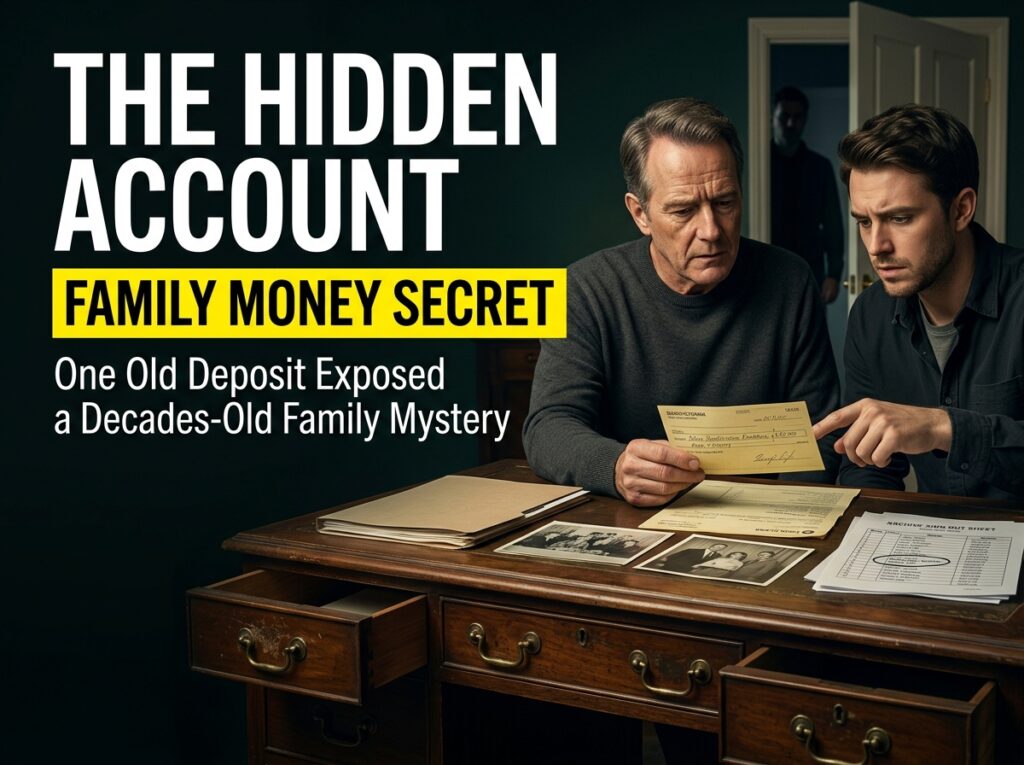
The desk arrived on a rainy Thursday afternoon, its dark wooden surface scratched and its brass handles tarnished by years of use.
My son, Daniel, had found it at a second-hand furniture shop on the edge of town. He was twenty-eight, practical, and always convinced that something useful could be rescued from what other people threw away.
“It only needs a little work,” he told me as the delivery men carried it into my study. “A new finish, perhaps. Maybe replace the handles.”
I ran my hand over the top.
The desk smelled faintly of dust and old paper. One of its drawers stuck halfway, and the bottom compartment appeared to have been repaired at some point with a different shade of wood.
“Where did you find it?”
“An estate sale. The owner had cleared out an old office. The shopkeeper said nobody wanted the furniture because it was too heavy.”
Daniel smiled.
“I thought you’d appreciate something solid.”
He was right. I had spent most of my life surrounded by furniture that had been handed down, repaired, or purchased only after something else had broken. I liked things that lasted.
That evening, Daniel returned to help me clean the desk.
He removed the drawers one by one and placed them on an old blanket. I wiped the runners while he examined the joints.
Then he called my name.
“Dad, come and look at this.”
He was holding a narrow strip of paper that had slipped from beneath the bottom drawer.
At first, I thought it was a receipt. The paper was yellowed, and one corner had been folded inward. But when Daniel flattened it on the desk, I saw a bank logo and a series of handwritten figures.
It was a deposit slip.
The account number was unfamiliar, but the company name printed above it made my stomach tighten.
Bellweather Manufacturing.
I had not heard that name spoken aloud in years.
The company had belonged to my grandfather’s generation. It had manufactured agricultural equipment and employed dozens of people from our town before financial difficulties brought it down. According to the story I had heard all my life, the company collapsed after a failed expansion, leaving unpaid debts and bitter arguments between relatives.
My grandfather, Arthur, had supposedly lost almost everything trying to save it.
The family had treated the bankruptcy as an unfortunate chapter that was best left behind.
I had never questioned that version.
“Isn’t that the company Grandpa used to talk about?” Daniel asked.
“Yes.”
“Then why is there a bank deposit slip in this desk?”
I examined the date.
The deposit had been made years after the company was officially declared bankrupt.
I checked the amount.
It was not enormous, but it was enough to make the document significant. Someone had deposited money into an account connected to a business that, according to our family, no longer existed.
Daniel turned the paper over.
There was a handwritten note on the back.
“Continue as agreed. Do not alter the original.”
I read the sentence twice.
“Maybe it belonged to the person who sold the desk,” Daniel suggested.
“Maybe.”
But I did not believe it.
The date matched a period when my family had been struggling financially. My father had told me that the bankruptcy had forced him to sell a piece of land he had hoped to leave to his children. My aunt had once described the company as a burden that had consumed years of my grandfather’s life.
If the business had still been receiving money, why had no one mentioned it?
Daniel searched the remaining drawers. He found a few rusted paper clips, a broken fountain pen, and an empty envelope bearing the faded name of a local bank.
There were no other documents.
I placed the deposit slip in a folder and locked it in my study cabinet.
“Should we ask someone at the bank?” Daniel said.
“Tomorrow.”
He looked at me.
“Are you all right?”
I nodded, though I could feel the first threads of unease tightening inside me.
For decades, I had accepted my family’s explanation because everyone repeated the same story. My father had told it. My aunts and uncles had confirmed it. Even the older neighbors spoke of Bellweather Manufacturing as though its failure had been a settled fact.
Now one small piece of paper had challenged everything.
The following morning, I called the bank.
The clerk who answered asked for the account number and the company name. After I provided both, she placed me on hold.
When she returned, her voice had changed.
“Sir, this account appears in our historical index, but I cannot provide any details without further verification.”
“Can you tell me whether it was closed?”
“I can confirm that the account reference has not been fully reconciled in our system.”
“What does that mean?”
“It means we need to examine the original records.”
I asked whether the company had continued making deposits after the bankruptcy.
“I cannot confirm that from the information available to me.”
Before ending the call, I asked where the original records were kept.
“The county archive may hold the associated business documents,” she said. “Our older banking records were transferred there for preservation.”
I thanked her and hung up.
Daniel was waiting in the doorway.
“What did they say?”
“They want to check the original records.”
“And?”
I looked down at the deposit slip.
“And I think we need to find out why a supposedly bankrupt company was still connected to a bank account years later.”
I had no idea that, by asking that question, I was about to reopen a family dispute that someone had spent decades trying to keep buried.
Part 2
The county archive occupied an old stone building beside the courthouse.
I had visited it once before, years earlier, when I needed a copy of my grandfather’s property records. The building had changed little since then. Its narrow windows let in weak daylight, and the corridors smelled of paper, furniture polish, and damp stone.
Daniel came with me.
We carried the deposit slip, a copy of Bellweather Manufacturing’s bankruptcy notice, and the few family records I had managed to find at home.
A clerk named Margaret listened to our explanation.
“Bellweather Manufacturing,” she repeated. “That file has been requested before.”
“Recently?”
She checked her computer.
“I can’t see the full history from this terminal. The original business file is stored separately.”
“Can we examine it?”
“If you can establish your connection to the company and identify the purpose of your request, I can submit an application.”
I explained that my grandfather had been associated with the business and that we had discovered a deposit slip suggesting that the account might have remained active after the bankruptcy.
Margaret examined the document carefully.
“Do you have any idea who made this deposit?”
“No.”
She entered the company name into the system.
After several minutes, she found an index entry.
Bellweather Manufacturing had indeed been declared bankrupt. Its remaining assets were supposedly distributed among creditors, and the company was recorded as closed.
However, another reference appeared several years later.
It was labeled simply: Associated financial records.
“What’s that?” Daniel asked.
Margaret opened the entry.
The screen displayed a date and a reference number, followed by a note indicating that certain documents had been transferred to a restricted archive.
“Why would the records be restricted?” I asked.
“Some files contain private financial information, property disputes, or documents that require additional authorization before release.”
“Does the file contain the bank account?”
“I can’t tell from the index.”
She asked us to complete the application and provide proof of our relationship to my grandfather.
We submitted everything and were told to wait for a response.
Before leaving, I asked whether the archive retained records of who had requested restricted files.
Margaret nodded.
“We maintain a sign-out sheet for original documents that are removed from storage for authorized examination.”
“Can we see it?”
“Not without approval. It contains information about other researchers and sensitive records.”
I understood the restriction, although I felt frustrated.
On our way home, Daniel asked whether I thought my grandfather had hidden money.
“I don’t know,” I said. “He might have kept a separate account for legitimate reasons.”
“Then why did nobody mention it?”
“Because people sometimes keep financial matters private.”
Daniel glanced at me.
“Or because someone wanted us to believe the company was completely finished.”
I did not answer.
That evening, I called my aunt Margaret, my father’s older sister. She was the last surviving person in our immediate family who had worked near the company before its closure.
She answered cheerfully until I mentioned the deposit slip.
Then she became quiet.
“Where did you find that?”
“In a desk Daniel bought.”
“Was the desk from your grandfather’s office?”
“The shopkeeper didn’t know.”
My aunt sighed.
“You should not be looking into Bellweather again.”
“Why?”
“Because that business nearly destroyed this family.”
“Was it really bankrupt?”
“Of course it was.”
“Then how do you explain a deposit made years afterward?”
She did not answer immediately.
“Some people continued dealing with the company’s debts after the closure. That doesn’t mean there was money left.”
“Who continued dealing with them?”
“I don’t remember.”
“You remember the bankruptcy, but not who handled the remaining finances?”
Her voice hardened.
“You were young. You don’t understand how complicated things were.”
“Then help me understand.”
“No. Your father wanted that chapter closed, and I intend to respect his wishes.”
She ended the call.
I sat in the study long after Daniel went to bed.
My father had died seven years earlier, leaving behind a modest house, a small pension, and a collection of personal papers. He had never spoken much about Bellweather Manufacturing except to say that it had taught him how quickly money could divide a family.
He had also told me that my grandfather had been betrayed by someone he trusted.
But he never named that person.
I had assumed the betrayal involved the company’s bankruptcy and the sale of the family land.
Now I wondered whether the financial records contained another explanation.
The next afternoon, Margaret from the archive called.
“Our preliminary review has located a reference to the account,” she said. “The file is older than our current catalog, so we need to retrieve it manually.”
“Can you tell me when it will be available?”
“We hope to complete the retrieval within a few days.”
“Has anyone requested it recently?”
She hesitated.
“The index indicates that the file was examined not long ago.”
“By whom?”
“I can’t disclose that until the original sign-out records have been reviewed.”
After the call, I told Daniel what she had said.
He frowned.
“Someone else is looking at the same account.”
“Yes.”
“Do you think they know about the deposit slip?”
“I don’t know.”
He picked up the paper and examined the handwritten note.
“Then maybe we should ask the person who owned the desk.”
I called the second-hand shop.
The owner remembered the desk, but he had purchased it from an estate clearance company that handled furniture from several properties. He could not identify the original owner.
He did, however, remember a small metal label beneath the back panel.
“Bellweather Office Furniture,” he said. “I thought it was just a manufacturer label.”
I asked him to send me a photograph.
When it arrived, I enlarged the image.
Beneath the company’s name was a serial number.
I compared it with the deposit slip.
The final four digits were identical to the reference written in the corner of the paper.
The desk had not merely belonged to someone connected to Bellweather Manufacturing.
It had been associated with the company’s financial records.
And whoever had hidden the deposit slip inside it had apparently wanted the document to survive.
Part 3
The serial number became the next thread in my investigation.
I sent the photograph to the county archive and asked whether it matched any historical inventory. Margaret replied that the number corresponded to a desk recorded in Bellweather Manufacturing’s administrative office during the final years of the business.
The discovery unsettled me.
The desk Daniel had purchased had not simply passed through an unrelated estate sale. It had once stood inside the company itself.
Someone had removed it, sold it, or transferred it after the bankruptcy. Somewhere along the way, the deposit slip had remained hidden inside its structure.
I asked the archive whether the desk had been included in the company’s asset inventory.
Margaret promised to check.
Meanwhile, Daniel began researching the company’s history through newspaper archives and old business directories.
He found advertisements for Bellweather equipment, photographs of workers outside the factory, and a short report about the company’s closure.
The newspaper described the bankruptcy as the result of failed investments and unpaid obligations.
My grandfather, Arthur, was mentioned only once.
He had been a director.
A later report stated that the creditors had recovered most of the company’s remaining assets. However, it did not identify the final recipient of the proceeds from the sale of the administrative office equipment.
Daniel found that omission suspicious.
“If the company was closed properly, there should be a record of what happened to everything,” he said.
“Perhaps there is one.”
“Then why is the archive taking so long to find it?”
“Because the records are old.”
He gave me a skeptical look.
“You sound like Aunt Margaret.”
I laughed despite myself.
For a moment, the investigation felt less frightening. Daniel and I had always been close, but we rarely discussed the deeper history of the family. My father had believed that children should be spared the arguments of older generations. I had followed that principle, telling myself that silence was a form of protection.
Now I wondered whether silence had allowed the wrong story to survive.
That afternoon, I visited Mr. Collins, a retired accountant who had worked with Bellweather Manufacturing during its final years.
He lived in a small house near the old railway line. His hands trembled slightly as he poured tea, but his memory was sharp.
When I mentioned the deposit slip, he stared at it for a long time.
“I wondered when someone would find that,” he said.
My heart began to race.
“You know what it is?”
“I know what it might mean.”
“Can you explain?”
He set down his cup.
“Your grandfather believed the company had money left after the bankruptcy. He suspected that some of the transactions recorded as debt repayments were actually transfers into a separate account.”
“Who made those transfers?”
“I don’t know for certain.”
“Did you tell anyone?”
“I told your father.”
“What did he say?”
Mr. Collins looked toward the window.
“He asked me never to repeat the conversation.”
“Why?”
“Because he believed that exposing the account would reopen a dispute that had already hurt too many people.”
I asked whether my father had ever seen the original bank records.
Mr. Collins nodded.
“He examined a statement once. He said the dates were wrong.”
“What dates?”
“The dates associated with the company’s final transactions. Some of the payments appeared to have been made after the accounts were supposed to be closed.”
I showed him the handwritten note on the deposit slip.
“Does this handwriting look familiar?”
He studied it.
“I can’t say.”
“Could it belong to my grandfather?”
“Possibly. But there were several people in the office who used similar handwriting.”
I asked about the hidden account.
Mr. Collins explained that the company had maintained more than one account during its final years. Most were closed during the bankruptcy proceedings, but certain payments had been handled through a separate administrative arrangement.
He could not confirm that the deposit slip belonged to that arrangement.
However, he remembered a meeting shortly before the company closed.
My grandfather had arrived carrying a folder and demanded an explanation for a series of transfers. The meeting ended with raised voices and an agreement to review the records.
The review never appeared in the official paperwork.
“Who attended the meeting?” I asked.
Mr. Collins named three people.
My grandfather.
The company accountant.
And my father’s older brother, Robert.
Robert was still alive.
He lived several hours away and rarely attended family gatherings. When I was younger, he had been the relative who brought expensive gifts and told stories about business opportunities. After the bankruptcy, he stopped discussing the company altogether.
I called him that evening.
He answered on the fourth ring.
“It’s been a while,” he said.
I asked whether he remembered the meeting Mr. Collins had described.
Silence followed.
Then Robert laughed briefly.
“Your grandfather held dozens of meetings.”
“This one concerned transfers made before the bankruptcy.”
“I don’t remember.”
“Mr. Collins remembers you being there.”
Robert’s voice became cold.
“Mr. Collins should be careful about what he claims to remember.”
I asked whether he knew about the separate account.
He hung up.
I sat staring at the telephone.
Aunt Margaret had warned me to stop searching. Mr. Collins had revealed that my father knew about the disputed transfers. Robert had refused to discuss the meeting.
The family story was beginning to unravel.
That evening, Daniel found another detail in the newspaper archive.
A report about the bankruptcy included a photograph of the company’s final administrative meeting. My grandfather stood beside the accountant, looking exhausted. Robert stood behind them, his expression unreadable.
Daniel enlarged the photograph.
“Look at the folder,” he said.
My grandfather was holding a dark leather folder with a metal clasp.
On its front was the same serial number printed beneath the second-hand desk.
I felt a chill.
The deposit slip, the desk, and the missing financial records were connected.
And Robert had been present when the original documents were handled.
Part 4
Robert called me the following morning.
His voice was calmer than it had been the night before, but there was an urgency beneath it.
“I want to explain something about the company,” he said. “But you need to understand that your grandfather was not the only person who made mistakes.”
“Then tell me what happened.”
“Not over the telephone.”
We agreed to meet at a café halfway between our homes.
Daniel offered to come with me, but I asked him to stay behind. I wanted to hear Robert’s explanation before introducing another person into the conversation.
He arrived carrying a leather briefcase.
For several minutes, we discussed ordinary matters. He asked about my health, complained about the weather, and mentioned a neighbor who had recently sold a house.
Then I placed the deposit slip on the table.
He stared at it.
“Where did you get that?”
“Inside the desk Daniel bought.”
Robert closed his briefcase.
“The company records should have been destroyed after the bankruptcy.”
“Why?”
“Because they contained private financial information.”
“Who decided to destroy them?”
He looked toward the window.
“There was a lot of confusion. Your grandfather wanted to preserve everything. Other people thought it was better to close the matter properly and move on.”
“Was there a hidden account?”
Robert took a long breath.
“There was an account that did not appear in the final bankruptcy summary.”
“Who funded it?”
“I cannot tell you that.”
“Why not?”
“Because I don’t know who made every deposit.”
I showed him the list of dates from the deposit slip.
He examined them carefully.
“These transactions continued longer than I expected.”
“You recognize the dates?”
“Some of them.”
“Then you know more than you’re telling me.”
He rubbed his forehead.
“Your grandfather believed that money had been diverted from the company. He thought someone was using the separate account to protect assets that should have been available to creditors.”
“Was he right?”
“I don’t know.”
“Did you attend the meeting Mr. Collins remembers?”
Robert nodded.
“Yes.”
“What happened?”
He explained that the company had been struggling for several years. Suppliers demanded payment, workers worried about their jobs, and the directors disagreed about whether the business could be saved.
My grandfather had insisted that the remaining assets be distributed fairly.
Others argued that certain funds needed to be reserved for outstanding obligations.
The meeting ended without agreement.
“Your grandfather believed someone had lied about the account,” Robert said. “But he couldn’t prove it.”
“Who did he suspect?”
Robert looked at me.
“He suspected the accountant.”
“Did the accountant make the deposits?”
“I don’t know.”
“Then why did you tell me the records should have been destroyed?”
“Because I was told they were no longer needed.”
“By whom?”
He did not answer.
I asked whether my father had known about the separate account.
Robert nodded.
“He knew there was a dispute. He did not know everything.”
“Did he see the records?”
“Yes.”
“Why did he tell Mr. Collins to remain silent?”
Robert looked down at the table.
“Because he believed that revealing the account would cause another fight over the family property.”
I thought about the land my father had sold after the bankruptcy. If the company had retained money that could have paid its debts, perhaps the sale had not been necessary.
“Was the hidden account connected to the land?”
Robert hesitated.
“Possibly.”
I asked him to explain.
He told me that the company had held a mortgage against a piece of family property. When the business failed, the property was sold to settle some of its obligations. But there had been disagreement about whether the mortgage had been paid before the sale.
My father had always believed the debt remained outstanding.
Robert could not confirm whether that belief was correct.
“Why didn’t anyone check?” I asked.
“Because the original records disappeared.”
The answer chilled me.
I asked whether he had taken the files.
He shook his head.
“No.”
“Did you know who did?”
“No.”
I watched his face, searching for a sign of deception.
“Then why are you afraid of the account?”
He leaned forward.
“Because the person who controlled it may still be alive. And if you prove that the money belonged to the company, you may discover that someone in this family benefited from the bankruptcy.”
“Who?”
Robert stood.
“I’ve told you everything I can.”
“You haven’t told me anything that explains the deposits.”
He put the slip on the table.
“Then perhaps the bank will tell you.”
He left before I could ask another question.
When I returned home, Daniel was waiting with a message from the archive.
The original file had been located.
It contained references to the separate account, a list of transactions, and a note indicating that a supplementary document had been removed from the folder decades earlier.
The archive had scheduled an examination for the following week.
I felt a fragile sense of hope.
For the first time, we had a path toward the truth.
But that hope lasted only until I checked my telephone.
There was a missed call from an unknown number and a voicemail.
The caller’s voice was distorted by static.
“Stop looking for the account. The money was never yours.”
I replayed the message.
Then I noticed something in the background.
A clock chimed twice.
The sound was familiar.
It was the clock that stood in the hallway of Robert’s house.
Part 5
I did not confront Robert immediately.
The voicemail was unsettling, but it was not proof that he had made the call. The clock could have been a coincidence, or the recording could have come from somewhere else.
The solicitor advised me to preserve the message and avoid making accusations until we had stronger evidence.
I followed her advice.
The next week, Daniel and I returned to the county archive.
Margaret met us at the reception desk and explained that the original Bellweather file had been retrieved from secure storage. We were permitted to examine selected financial documents because of our established family connection, but the archive would retain the originals.
The file was thicker than I expected.
It contained invoices, company letters, bank references, property records, and correspondence about the bankruptcy. Many pages were marked with handwritten annotations.
The deposit slip’s account number appeared in a ledger near the back.
Several deposits had been made over a period of years.
The earliest entry predated the bankruptcy announcement. The later deposits continued after the company had supposedly ceased operating.
Each entry contained a reference to an administrative transaction.
The amounts varied, but the pattern was consistent.
Someone had continued placing money into the account.
Daniel compared the dates with the bankruptcy notice.
“Look at this,” he said.
The most recent historical deposit in the archive was recorded on a date when the company was officially listed as inactive.
Another entry referred to a transfer made after the company’s remaining assets had been distributed.
I asked Margaret whether the archive had any documents identifying the source of the payments.
She checked the file index.
“The source may be recorded in the supplementary ledger, but that document is missing.”
“Can you check the transfer references?”
“We can compare the available records, but some of the original bank details may no longer exist.”
She brought us a second folder containing a summary of the company’s final transactions.
The document listed several accounts and the names of the people authorized to access them.
My grandfather’s name appeared first.
The company accountant’s name appeared second.
Robert’s name appeared beside a later authorization.
I felt my stomach tighten.
“What did this authorization allow him to do?”
Margaret read the note.
“It appears to have allowed him to request information and submit instructions concerning the administrative account.”
“Did he have authority to withdraw money?”
“The document doesn’t say that clearly.”
I copied the reference number and asked the bank to investigate.
Before leaving the archive, I requested the sign-out sheet associated with the original file.
Margaret explained that the sheet was maintained separately and that access required a supervisor’s approval.
She submitted the request.
“We’ll contact you when the review is complete,” she said.
That afternoon, the bank confirmed that the hidden account had received deposits from more than one source. Some transactions appeared to be connected to the company’s remaining financial arrangements, while others could not be linked conclusively to the original business.
The account had not simply been abandoned after the bankruptcy.
It had continued to exist.
The bank could not tell us who had made every payment, but it agreed to provide a formal record of the transactions that could be verified.
Daniel and I spent the evening comparing the bank statement with the archive ledger.
We identified several dates that appeared in both documents.
Then we found a discrepancy.
One deposit had been recorded in the bank’s system, but the corresponding entry was missing from the archive ledger.
The amount was substantial enough to matter.
Beside the bank transaction was a short notation.
“Adjustment authorized.”
There was no signature.
“Someone changed the record,” Daniel said.
“Or someone recorded an adjustment without attaching the authorization.”
“That’s still a problem.”
He was right.
I contacted the archive and asked whether the missing entry had been documented elsewhere.
Margaret promised to investigate.
The next morning, she called me.
“We have located a reference to the adjustment,” she said. “It appears in the sign-out records for the original file.”
“Does it identify who made it?”
“Yes.”
My heart began to pound.
“Who?”
“I cannot read the name over the telephone. You will need to review the sheet in person.”
I asked when I could come.
“Tomorrow morning.”
I thanked her and hung up.
For the first time since discovering the deposit slip, I felt that the evidence might lead to a specific person rather than another collection of suspicions.
Then Daniel received a message from an unfamiliar number.
It contained a photograph of the desk.
The photograph had been taken inside my study.
Someone had entered my house or had access to an image taken from within it.
Beneath the photograph were six words.
“Some records should stay where they are.”
Part 6
I contacted the police to report the photograph and explain that someone might have entered my home without permission. The officer advised me to preserve the message, check the locks, and avoid confronting anyone I suspected.
Nothing appeared to have been stolen.
The desk remained in place, and the folder containing the deposit slip was still locked inside my cabinet.
Yet the photograph made one thing clear: someone knew what I had found and wanted me to stop searching.
Daniel was angry.
“Why would anyone care about an old bank account unless there was something to hide?”
“Because people are afraid of being accused, even when they haven’t done anything wrong.”
“Then they can explain themselves.”
I understood his frustration, but I knew how quickly suspicion could damage relationships.
We decided to continue through the archive and bank rather than confront relatives based on incomplete evidence.
The following morning, we returned to Margaret’s office.
She led us into a small records room and placed a photocopy of the sign-out sheet on the table. The original remained secured, but the copy showed the entries associated with the Bellweather file.
Most of the names were unfamiliar.
One was not.
Robert Bellweather.
His name appeared beside the reference number for the original financial ledger. The recorded time was late in the afternoon, shortly before the archive closed.
I checked the date.
It was the same day Robert had told me he was sitting beside me at my father’s house, helping me sort through family photographs.
I remembered that afternoon clearly.
We had spent hours looking through boxes in the living room. Robert had complained about his back and refused to leave his chair. At one point, he had fallen asleep while I prepared tea.
He could not have been at the archive at the same time.
“Could the date be wrong?” I asked.
Margaret examined the entry.
“It’s possible, but the surrounding entries appear consistent.”
“Was Robert authorized to examine the file?”
“He had submitted an access request. The approval was granted for a limited review.”
“What did he remove?”
“The sheet records that the original file was returned, but it doesn’t list every document examined.”
I looked at the signature.
It was Robert’s handwriting.
Or something close enough to resemble it.
I asked Margaret whether the archive had a record of the person’s identification.
“The original request includes identification details, but those are restricted. The supervisor can review them if there is a formal concern about the entry.”
I requested that review.
Margaret agreed to forward the discrepancy to the archive supervisor.
Outside the building, Daniel was silent.
Finally, he said, “He lied to you.”
“The record says he was there. It doesn’t prove he signed the sheet himself.”
“Dad, he told you he was sitting beside you.”
“I know.”
“Then why are you defending him?”
“Because I want proof, not another family argument.”
We returned home.
I examined the photograph from the unknown number and compared its background with the layout of my study. The desk was clearly visible, but the angle suggested that the photograph had been taken from the doorway.
The door had been locked the previous evening.
I asked Daniel whether he had taken the picture.
He shook his head.
I checked the house’s security system. The camera covering the front entrance had recorded a brief interruption during the previous night. The recording resumed several minutes later, but no visitor appeared in the available footage.
The interruption could have been a technical fault.
Still, I arranged for the locks to be checked and the system inspected.
That evening, my aunt Margaret called again.
“I heard you went to the archive,” she said.
“Who told you?”
“Robert.”
I asked her whether she knew that he had signed out the file on the day he claimed to be with me.
She went quiet.
“Robert was helping you that afternoon.”
“He told me he was.”
“Then why are you questioning him?”
“Because the archive records show him somewhere else.”
My aunt sighed.
“You are making a terrible mistake.”
“What mistake?”
“Assuming that a document tells you everything about a person.”
I asked whether she knew who had funded the hidden account.
She did not answer.
“Did you ever make deposits into it?”
“No.”
“Did Robert?”
“I don’t know.”
“Then how can you be certain he did nothing wrong?”
Her voice broke.
“Because I don’t want this family destroyed by another investigation.”
I understood then that she was not offering evidence. She was asking me to choose peace over certainty.
I could not blame her for wanting that.
But the account had existed, the payments had continued, and the archive file had been examined by someone who claimed to be elsewhere.
Before ending the call, I asked her one final question.
“Do you know why Grandfather kept a separate account after the bankruptcy?”
She whispered, “He said the money belonged to the person who had been cheated.”
Then she hung up.
Part 7
The archive supervisor contacted me two days later.
Her name was Helen Ward, and she had spent more than twenty years managing historical records. She invited me to a meeting with Margaret present and explained that she had reviewed the original sign-out sheet, the access request, and the file’s return record.
The signature appeared consistent with Robert’s other archived signatures.
However, the archive could not establish that Robert had physically attended the office at the recorded time.
The identification details had been entered into the system, but the visitor log was incomplete.
“Could someone have signed his name?” I asked.
“Yes. We cannot rule that out.”
“Was the file complete when it was returned?”
Helen examined the return record.
“The folder was marked complete, but the document inventory did not list every page. We cannot establish with certainty whether the supplementary ledger was present at the time of return.”
I felt a wave of frustration.
The records showed that someone had accessed the file, but they did not conclusively establish who had removed the missing document.
Helen agreed to preserve the sign-out sheet and provide a certified copy of the relevant entries.
She also recommended that the discrepancy be investigated formally if we believed the record had been falsified.
I thanked her.
The meeting had not proved Robert’s guilt, but it had confirmed that the archive could no longer guarantee the file’s completeness.
When I returned home, I found my aunt waiting in the study.
She had brought a small box containing letters my grandfather had written during the bankruptcy.
“I should have given these to you years ago,” she said.
Inside were several letters addressed to my father. Most concerned ordinary family matters, but one referred to the hidden account.
My grandfather wrote that the account had been established to preserve money that should not have been included in the company’s final distribution until a disputed claim had been resolved.
He did not identify the claimant.
He explained that he had continued monitoring the deposits because he feared that the money would be transferred before the dispute was settled.
The letter ended with a warning.
“If the original file disappears, the account must not be treated as abandoned. The person who holds the missing statement will know why.”
I read the final sentence again.
“The person who holds the missing statement,” I said. “Who is that?”
My aunt shook her head.
“I don’t know.”
“Did Grandfather tell you about the statement?”
“He told me it existed. He never showed it to me.”
“Did he tell you who the claimant was?”
“No.”
I examined the envelope.
It had been opened and resealed at some point. A handwritten notation appeared beside the date.
“Second copy delivered.”
The phrase suggested that the original statement had been duplicated.
I asked my aunt whether she had ever seen another copy.
She hesitated.
“Your father once received a letter from someone connected to the company. He kept it in his study, but after he died, I don’t know what happened to it.”
I searched my father’s old papers that evening.
Most had already been sorted, but a small box of correspondence remained untouched in the attic. I found letters from relatives, insurance notices, and several documents related to the sale of the family land.
At the bottom lay a sealed envelope bearing my grandfather’s handwriting.
Inside was a copy of a bank statement.
The account number matched the deposit slip.
Several payments were highlighted in pencil, and beside the largest was a handwritten note.
“Held pending confirmation of ownership.”
There was also a reference to a second document.
The missing statement.
I showed the papers to Daniel.
“This is what they wanted to find,” he said.
“Possibly.”
We took the documents to the solicitor.
She compared the bank statement with the archive ledger and confirmed that the entries matched several known transactions. The statement supported the existence of a disputed fund, but it did not establish who legally owned the money.
To determine that, we needed the missing statement and the original authorization.
The solicitor advised us to request a formal review of the account’s ownership history.
Before we left, she examined the handwritten notation.
“Second copy delivered,” she said. “This may indicate that another person received a copy of the same statement.”
“Who?”
“We need to establish who was involved in the original transaction.”
I thought of Robert’s name on the sign-out sheet.
Then I remembered my father’s statement about being betrayed by someone he trusted.
The account might have been created to protect the person who had lost money.
But if that person had never been identified, the fund could have remained in limbo for decades.
The following morning, the bank sent a written confirmation that the account had received a new deposit the day before the deposit slip was discovered.
The money had come from a source connected to the original company.
Someone was still paying into the hidden account.
And whoever it was had known the archive file was incomplete.
Part 8
The new deposit changed the investigation.
Until then, I had believed we were dealing with a financial arrangement that had survived because no one had properly closed it. The recent payment suggested that someone was deliberately maintaining the account.
The solicitor requested a meeting with the bank’s records team.
We provided copies of the deposit slip, the historical statement, and the archive references. The bank agreed to examine the available transaction history and determine whether the recent deposit came from an identifiable source.
Because the account involved historical records and potentially disputed ownership, the review would take time.
Meanwhile, Daniel searched the public company register for any business that might have continued operating under Bellweather’s name.
He found a small firm established several years after the original company’s bankruptcy. It had used a similar business description but was registered under a different name.
The company had later closed.
Its listed director was someone neither of us recognized.
However, one address matched the office where the original company accountant had worked.
We brought the information to the solicitor.
She cautioned us against assuming that the later business was connected to the hidden account simply because it shared an address.
“We need a documented connection,” she said.
The bank’s preliminary review eventually provided one.
Several deposits into the hidden account had originated from a business account associated with the later company. The connection was not sufficient to establish ownership, but it confirmed that the money had continued moving through an identifiable financial channel after Bellweather Manufacturing closed.
The solicitor requested further records.
At the same time, the archive supervisor reported a discrepancy in the original sign-out sheet.
The entry bearing Robert’s name had been made in a different ink from the surrounding entries. That alone did not prove anything, but the handwriting expert consulted by the archive could not confidently attribute the signature to Robert.
The archive opened a formal review.
Robert called me that evening.
“You need to stop telling people I signed that file out.”
“I have not accused you of signing it.”
“You showed the record to the solicitor.”
“Because it was relevant.”
“You’re turning a clerical problem into an accusation.”
“Then help me understand why your name appears beside a time when you were supposedly with me.”
He fell silent.
Finally, he said, “I was not at the archive that afternoon.”
My heart began to pound.
“Then who signed your name?”
“I don’t know.”
“Did you authorize anyone to examine the file?”
“No.”
“Did you know the file had disappeared?”
“No.”
I asked whether he had ever held the missing supplementary ledger.
He denied it.
I wanted to believe him, but I remembered how quickly he had ended our earlier conversation.
“Why didn’t you tell me the truth from the beginning?”
“Because I was afraid you would blame me for everything that happened to the company.”
“Did you know about the hidden account?”
“Yes.”
“Did you make deposits into it?”
“No.”
“Then who did?”
He breathed heavily into the telephone.
“I believe your grandfather was trying to protect someone. He never told me who. He said the money could not be released until the original claim was verified.”
“Did he tell you who held the claim?”
“No.”
“Did you ever see the missing statement?”
A long silence followed.
Then he said, “I saw a copy once.”
“When?”
“Before the bankruptcy was finalized.”
“What did it say?”
“I don’t remember the exact wording.”
“Who gave it to you?”
He refused to answer.
I asked whether the statement had named the person who was entitled to the money.
Robert said nothing.
Then the call ended.
The next morning, my aunt brought another envelope to my house.
She said she had found it inside a box of my father’s belongings.
The envelope contained a letter addressed to my grandfather, written by the company accountant shortly before the bankruptcy.
The accountant explained that the hidden account had been established to hold funds connected to a disputed transaction. The money was not to be released until the claimant’s identity and entitlement were confirmed.
The letter also stated that the original statement had been delivered to a person whose name was omitted from the surviving copy.
I showed the letter to the solicitor.
She read it carefully.
“This confirms that the account was not simply an abandoned business account,” she said. “It was connected to a specific claim.”
“Can we identify the claimant?”
“Not from this letter alone.”
I looked at the signature.
The accountant had signed his full name.
At the bottom of the page, however, was a second signature.
It belonged to my father.
He had witnessed the letter.
That meant he had known the account was connected to a disputed claim, even if he had not known every detail.
And he had kept the letter hidden among his personal papers for years.
Part 9
The discovery of my father’s signature changed how I understood the family silence.
He had not simply inherited a story about the bankruptcy. He had seen evidence that contradicted it and had chosen not to discuss what he knew.
I wanted to understand why.
My father had always been a quiet man, especially when money was involved. He believed that family disagreements should be settled privately, without involving outsiders. When I was younger, I had mistaken that silence for certainty.
Now I wondered whether he had been carrying the same fear as my grandfather.
I returned to the solicitor with the letter and asked her to help establish the identity of the original claimant.
She explained that the bank could examine the account’s transaction history, while the archive could review the missing-document references. The two investigations needed to proceed together.
The bank eventually confirmed that the recent deposit had come from an account associated with the later company connected to Bellweather’s former premises.
However, the account holder’s identity could not be disclosed without the appropriate legal basis.
The solicitor prepared a formal request based on the documented dispute.
While we waited, I visited Mr. Collins again.
He listened as I described the letter and my father’s signature.
Then he nodded slowly.
“Your father knew more than he admitted,” he said.
“Why would he keep it secret?”
“Because he believed that the original claimant had been treated unfairly, and he was afraid that revealing the truth would expose the person who had benefited from the arrangement.”
“Who benefited?”
Mr. Collins shook his head.
“I never knew the name. Your grandfather told me only that the money belonged to someone who had been denied what was rightfully theirs.”
I asked whether he believed the bankruptcy had been deliberately manipulated.
He took a long breath.
“I believe some people used the confusion to protect themselves. Whether they intended to destroy the company, I cannot say.”
That answer stayed with me.
The story I had grown up hearing was simple: the company failed, the family lost money, and everyone moved on.
The evidence suggested something more complicated.
There had been a disputed fund, an unresolved claim, and a promise that the money would remain untouched until the rightful owner could be identified.
The deposits had continued long after the company closed.
Someone had maintained the account.
Someone had removed or misplaced the original file.
And someone had signed the archive sheet using Robert’s name.
The solicitor called two days later.
The bank had identified a historical transfer reference that connected the hidden account to a second set of records. The reference matched a document that had been listed in the archive index but was not present in the physical file.
It was the missing supplementary statement.
The bank could not produce the original, but it had preserved a record of the transaction associated with it.
The document had been transferred to a separate custodian decades earlier.
The custodian’s name had been redacted in the surviving archive copy.
The solicitor submitted a request to establish the custodian’s identity.
That evening, Robert arrived at my house.
He looked older than I remembered, and the usual confidence in his manner had disappeared.
“I need to tell you something,” he said.
I invited him into the study.
He looked at the desk Daniel had purchased.
“Your grandfather would have recognized that immediately.”
“Did it belong to his office?”
“Yes.”
“Did you know the deposit slip was inside?”
“No.”
He ran his hand over the wooden surface.
“I thought all the records had been removed before the office was cleared.”
“Who cleared it?”
“The company accountant arranged the disposal of the furniture.”
“Did he know about the hidden account?”
“Of course. He helped establish it.”
I asked whether Robert had ever taken any money from the account.
He shook his head.
“No.”
“Then why have you been so afraid of this investigation?”
He sat down.
“Because I signed documents that I did not fully understand. I was told the account was temporary, and I believed the money would be returned or distributed once the dispute was settled.”
“Who told you that?”
“My father.”
I stared at him.
“Grandfather?”
Robert nodded.
“He said the money belonged to someone who had been wronged. He asked me to help preserve the account, but he never gave me the claimant’s name.”
“Did you close it after he died?”
“No. I never had the authority to close it.”
“Then who did?”
“I don’t know.”
I believed that he was telling me something important, but I still could not explain the archive entry.
Robert looked at the deposit slip.
“I think someone wanted you to find this. The account has been maintained for years, and the most recent payment was not an accident.”
“Who would want that?”
He shook his head.
“Someone who believes the time has finally come to settle the claim.”
Before leaving, he gave me a small envelope.
Inside was a handwritten note from my grandfather.
It contained only one sentence:
“The money must go to the person named in the original statement, not to the person who can produce the most convincing story.”
I read the words again.
The original statement was still missing.
And until we found it, the account could not be settled fairly.
Part 10
The solicitor contacted the archive and the bank one final time, providing my grandfather’s note and the complete chronology we had assembled.
The request led to the identification of the separate custodian.
The custodian was a retired solicitor who had preserved certain documents from the original bankruptcy proceedings. He confirmed that he had received the supplementary statement many years earlier and had kept it separate because the document contained information about a disputed financial claim.
He agreed to transfer the statement to the solicitor for examination.
When the document arrived, we reviewed it in the presence of the solicitor and a representative from the bank.
The statement explained that the hidden account had been created to preserve money connected to a transaction whose ownership had never been conclusively resolved. The claimant had not been included in the ordinary bankruptcy distribution, and the funds were to remain protected until the claim could be verified.
The document also explained why the deposits had continued.
The payments were not evidence that the bankrupt company had secretly resumed trading. They were contributions intended to preserve the disputed fund while the original claim remained unresolved.
The most recent deposit had been made by someone who believed that the records were finally ready to be examined.
The statement named the person entitled to make the claim.
The solicitor reviewed the name privately and began the process of verifying the person’s identity and legal rights. Because the claim involved historical financial records and potentially sensitive family information, she did not disclose the name to the wider family until the necessary checks were completed.
The investigation also established that the archive sign-out sheet had been altered. The entry bearing Robert’s name could not be authenticated, and there was no reliable evidence that he had removed the original file.
Robert had lied about the history of the account in some conversations, but the records did not prove that he had taken the money or deliberately removed the statement.
The distinction mattered.
For years, I had believed that finding the person responsible would resolve everything. Instead, I learned that an incomplete record could make an innocent person look guilty and that a family rumor could survive long after the evidence had changed.
The bank completed its review and confirmed the transactions that could be verified. The solicitor then worked with the appropriate parties to determine the proper handling of the disputed funds.
I never learned every private detail of the claimant’s life, and I did not demand them.
The purpose of the investigation had not been to satisfy my curiosity. It had been to make sure the money was not treated as abandoned simply because the original records had disappeared.
My grandfather had understood that distinction.
He had preserved the account because he believed someone had been wronged. He had kept the records because he feared that the truth would be lost. And he had left behind a warning that the most convincing explanation was not always the correct one.
When the legal review was complete, Daniel and I returned the desk to my study.
We repaired the loose drawer, polished the brass handles, and secured the remaining documents in a labeled archive box. The deposit slip went into a protective sleeve beside the bank statement and my grandfather’s letter.
Daniel stood back to admire the desk.
“Funny,” he said. “I bought it because it was cheap.”
I smiled.
“And it turned out to be worth more than we expected.”
“Not because of the wood.”
“No.”
He looked at the folder.
“Do you think Grandpa knew someone would eventually find the papers?”
“I think he hoped someone would.”
For the first time in months, the study felt peaceful.
The company remained bankrupt. The losses suffered by my father and grandfather could not be undone. The land that had been sold was not automatically returned, and the years of silence could not be recovered.
But the account was no longer an unexplained mystery.
The missing statement had been found. The transactions had been examined. The claim could finally be considered on its evidence rather than on the strength of family opinions.
I thought about the sign-out sheet and the person whose name had appeared beside a time when they claimed to be sitting beside me.
The discrepancy had been important, but it had not told the whole story.
It had shown us that someone had accessed the file, not necessarily who had altered it or why.
That was the lesson I carried forward.
A name on a document can raise a question. A deposit can reveal a pattern. A missing page can suggest that someone wanted a truth concealed.
But none of those things should become a verdict before the evidence is complete.
My father had spent years trying to protect the family from another argument. My grandfather had tried to protect a disputed claim. Robert had feared being blamed for a decision he did not fully understand.
Each of them had allowed silence to take the place of an explanation.
I could not change their choices.
I could only make a different one.
I decided to preserve the records, keep the claimant’s private information confidential, and allow the financial process to follow its proper course. If another person eventually asked about Bellweather Manufacturing, I would not repeat the old story as though it were the whole truth.
I would tell them what we knew, what the documents proved, and what remained uncertain.
That evening, I opened the desk’s bottom drawer one last time.
There was nothing hidden beneath it now.
Only the smooth wooden base, the repaired joint, and the faint outline where the deposit slip had rested for years.
I closed the drawer gently.
For most of my life, I had believed that the past was fixed. The company had failed, the money had been lost, and the family had moved on.
But the past was not as simple as the stories we inherited.
Sometimes, a single document could reveal that the accepted version had left someone out. Sometimes, a missing record could make an entire family doubt what it remembered. And sometimes, the most important discovery was not the identity of the person who had lied, but the recognition that we had been repeating an incomplete story for decades.
My son had bought an old desk.
Inside it, we found a question that had waited years for an answer.
And when the answer finally came, it did not erase the past.
It gave us the chance to stop passing the silence on.