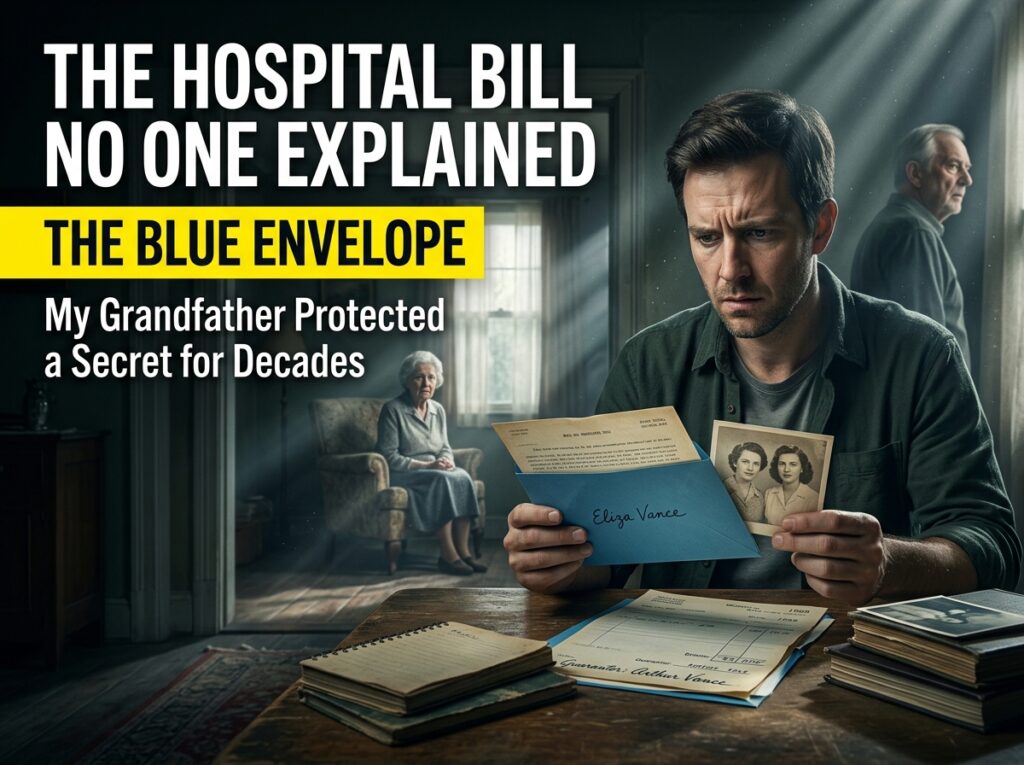
The bill arrived on a Tuesday morning, tucked between an electricity statement and a supermarket advertisement.
At first, I assumed it was another mistake.
The envelope carried the name of a hospital I had never visited. Its return address belonged to a medical institution on the other side of the county, a place I knew only because its name appeared occasionally in local news reports.
I opened it while standing beside the kitchen counter.
The first page contained a final payment notice. The second listed the patient’s account number, several dates, and a record of payments made over many years.
Then I saw the guarantor’s name.
My grandfather.
I read it again, hoping the letters would somehow rearrange themselves into someone else’s name.
They did not.
My grandfather had been dead for eleven years.
He had spent most of his life repairing farm equipment, tending his vegetable garden, and saving money for emergencies. He was not wealthy, but he was careful. He kept receipts in labeled envelopes and wrote the date on everything he believed might matter later.
When he died, our family spent several weeks sorting through his belongings. We found tax records, bank statements, insurance policies, and notebooks filled with small calculations.
Nothing suggested that he had ever guaranteed a hospital bill.
I called the number printed on the notice.
A woman answered after several rings.
“Accounts department. How may I help you?”
I explained that I had received a statement bearing my grandfather’s name and wanted to know why.
“Could you provide the account number, please?”
I read it aloud.
Her keyboard clicked in the background.
“Thank you. I can confirm that this account has been marked for final review.”
“Who was the patient?”
“I’m afraid I can’t disclose medical information without the appropriate authorization.”
“I understand. But my grandfather is listed as the guarantor. He died eleven years ago.”
The woman paused.
“I’m sorry to hear that. According to the payment history, the guarantor’s information was entered when the account was opened.”
“When was that?”
Another pause followed.
“I’m not able to discuss the patient’s details. However, I can tell you that the original account dates back several decades.”
“How many?”
“I would need to refer your inquiry to our records department.”
She gave me a reference number and promised someone would call back.
I thanked her and hung up.
For several minutes, I stood motionless in the kitchen.
There were ordinary explanations for strange bills. Records were copied incorrectly. Names were entered under the wrong accounts. Old debts sometimes resurfaced because someone had failed to update a file.
I wanted one of those explanations.
My grandfather had always been a private man, but he was not secretive about money. He had helped relatives when they needed it, and he occasionally paid medical expenses for neighbors who could not afford treatment.
Perhaps this had been one of those cases.
Yet the words final payment notice troubled me.
If the account was decades old, why had the hospital contacted us only now?
I searched the document again.
The payment history listed small amounts at irregular intervals. Some payments were made annually, while others appeared several years apart. The latest entry was dated only two months earlier.
That was impossible.
My grandfather had been dead for eleven years.
I checked the account number against the reference number given by the hospital. They matched.
Then I noticed a short handwritten notation in the margin beside the oldest entry.
“Original guarantor confirmed.”
The handwriting looked familiar, but I could not identify it.
I placed the bill inside a folder and drove to my mother’s house.
She was sorting vegetables at the kitchen table when I arrived. She looked up, smiled, and asked whether I wanted tea.
I declined.
“Do you remember a hospital called St. Catherine’s?” I asked.
Her hands stopped moving.
Only for a moment, but I noticed.
“Why?”
“I received a bill from them. Grandfather is listed as guarantor.”
She put down the knife.
“That’s impossible.”
“That’s what I thought.”
“Your grandfather never had dealings with that hospital.”
“Do you know the name?”
“I’ve heard it mentioned.”
“By whom?”
She began gathering the vegetables into a bowl.
“I don’t remember.”
I showed her the payment history.
She glanced at the dates and immediately pushed the paper back toward me.
“Don’t get involved in this.”
Her reaction frightened me more than the bill.
“Why?”
“Because your grandfather handled things privately. Whatever he did, he had his reasons.”
“Then you know something.”
“I know that digging up old matters rarely helps anyone.”
I asked her whether the hospital account belonged to a relative.
She stood and carried the bowl to the sink.
“No.”
“Then who was the patient?”
“I said I don’t know.”
Her voice had sharpened.
I had grown up believing my mother was the person who answered difficult questions honestly, even when the answers hurt. Seeing her avoid a simple question made me feel as though I had entered a room where everyone else already knew what had happened.
Before leaving, I asked one final question.
“Did Grandfather ever tell you about someone he helped at St. Catherine’s?”
She turned off the tap.
For several seconds, she did not move.
Then she said, “If you value your peace, let that bill go.”
I drove home with the folder on the passenger seat.
That evening, I searched my grandfather’s old papers. His notebooks were still stored in a cabinet in my spare room, along with receipts and photographs that my family had never bothered to sort.
Most contained ordinary records.
Then, inside a notebook from the late 1980s, I found a page with a hospital name written across the top.
St. Catherine’s.
Below it was a list of dates, payment amounts, and initials.
At the bottom of the page, my grandfather had written a sentence:
“Never allow them to say the patient did not exist.”
I read it several times.
Then I noticed that the page had been carefully cut away from the notebook beside it.
Whatever my grandfather had recorded there, someone had removed it.
And for the first time, I wondered whether the hospital bill had not been sent to correct a mistake at all.
Perhaps it had been sent because someone, somewhere, was finally ready to make us remember.
Part 2
The next morning, I returned to the hospital.
I carried the bill, my grandfather’s notebook, and the reference number from my telephone conversation. At the reception desk, I explained that I was trying to establish why a deceased man had remained connected to a medical account for decades.
The receptionist directed me to the records department.
A clerk named Susan listened patiently while I explained the situation. She was middle-aged, wore reading glasses on a chain, and seemed accustomed to people arriving with confusing paperwork.
When I showed her the handwritten notation, she stopped smiling.
“Where did you get this?”
“It was written beside the payment history.”
She examined the page without touching the ink.
“I’ll need to check the archived file.”
“How long will that take?”
“I can’t promise anything. Some of these records were transferred from the old administration system.”
She entered the account number into her computer.
After several minutes, she printed a short summary.
The patient was identified by an account number rather than a full name. The hospital had retained records of payments, but the personal information had been restricted during a later records conversion.
The guarantor field contained my grandfather’s full name.
The account had been opened more than thirty years earlier.
“Why is there no patient name?” I asked.
Susan examined the screen.
“It may have been omitted during the conversion, or the original record may have been incomplete. I can’t tell from this summary.”
“But you have the original file?”
“Possibly. It would be stored separately.”
She asked me to submit a written request and provide proof of my grandfather’s death and my relationship to him. I completed the forms, attached copies of the relevant documents, and left my contact information.
Before I went, I asked about the most recent payment.
“Can you tell me who made it?”
“Not without authorization. The payment details are restricted.”
“Was it made by a person or an organization?”
Susan looked at the record again.
“It appears to have been an electronic transfer.”
“From where?”
“I can’t release that information today.”
I left disappointed, but the visit had confirmed something important: the account was real.
At home, I began asking the oldest people in town what they remembered about St. Catherine’s.
My first visit was to Mr. Collins, a retired shopkeeper who had known my grandfather for nearly fifty years. He sat in a sunroom filled with old newspapers and photographs of his grandchildren.
When I mentioned the hospital, he frowned.
“Your grandfather used to go there,” he said.
I leaned forward.
“When?”
“Years ago. Not for himself, I don’t think.”
“Do you remember who he visited?”
Mr. Collins rubbed his chin.
“There was a young woman. Or perhaps a child. It’s difficult to remember after all this time.”
“Do you know the name?”
He shook his head.
“Your grandfather never spoke much about it.”
I showed him the bill.
His expression changed when he saw the guarantor field.
“Where did you find this?”
“It arrived in the mail.”
He pushed the paper away.
“You should put it back in the envelope.”
“Why?”
“Because there were people who wanted that matter forgotten.”
“Who?”
Mr. Collins looked toward the hallway, although we were alone.
“I can’t help you with that.”
He refused to answer any more questions.
My next visit was to Mrs. Bennett, a retired schoolteacher who had lived beside my grandparents before moving into a smaller house near the town center.
She remembered my grandfather helping people who could not afford medical treatment.
“He used to say that illness could take a person’s money, dignity, and future all at once,” she told me. “He believed no one should lose their dignity just because they needed help.”
“Did he ever mention St. Catherine’s?”
She thought for a long time.
“Yes. There was a disagreement about a patient. Your grandfather was very upset, and he said the hospital had made a promise.”
“What promise?”
“I don’t remember the exact words. But he said he had signed something to protect someone.”
“Was it a financial guarantee?”
“Possibly.”
I asked whether she knew the patient’s name.
Her expression became guarded.
“I don’t think I should tell you what I remember.”
“Why not?”
“Because your grandfather asked me not to discuss it unless someone came looking with the original papers.”
“What original papers?”
She shook her head.
“I’ve already said too much.”
By the time I returned home, I had heard the same warning from three different people.
Leave it alone.
Don’t ask questions.
Some matters are better forgotten.
Yet none of them seemed surprised that the account existed.
That evening, my mother called.
“Have you been talking to people about the hospital?”
I looked at the telephone.
“Who told you?”
“That doesn’t matter.”
“It matters to me.”
“You’re making people uncomfortable.”
“Why would an old hospital bill make anyone uncomfortable if nothing happened?”
She sighed.
“Your grandfather did what he thought was right. You don’t need to turn his kindness into a family scandal.”
“Then tell me who he helped.”
She remained silent.
I asked whether the patient was someone related to us.
“I cannot answer that.”
“Cannot, or will not?”
“Please stop.”
Her voice broke on the final word.
I almost gave in.
Then I remembered the sentence in my grandfather’s notebook.
Never allow them to say the patient did not exist.
Whatever he had done, he had been afraid that someone would deny it.
I told my mother I would not stop until I understood the bill.
She hung up.
Later that night, I searched the internet for the hospital’s historical records. Most of the old material had been removed, but a local newspaper archive contained a brief report about a dispute involving St. Catherine’s and an unnamed patient.
The report was dated the same year as the earliest entry in my grandfather’s notebook.
It mentioned an inquiry into financial responsibility for a patient’s treatment.
The patient’s name had been withheld.
A handwritten note appeared in the digitized margin of the newspaper clipping.
I enlarged the image until the words became visible.
“Witness requested. Statement not received.”
The following line had been cut off.
I sat back in my chair.
The bill was not simply a debt.
It was connected to a case in which someone had tried to establish what had happened, but a witness had never come forward.
And if my grandfather had guaranteed the patient’s account, he might also have known why that witness disappeared.
Part 3
I began my search with the newspaper archive.
The article was brief, but it contained a date, a reference to a hospital inquiry, and the name of the official who had overseen the investigation. That official was long retired, yet a public directory listed his former address.
His name was George Miller.
I found him in a modest house overlooking the river. He was in his eighties, walked with a cane, and looked at me as though he had expected my arrival.
When I explained that I was the grandchild of the man named as guarantor on the hospital bill, he invited me inside.
“You look like him,” he said.
“Did you know my grandfather?”
“I knew him well enough to understand that he would never have signed such a document without a reason.”
I showed him the bill and the notebook entry.
He read the handwritten sentence and closed his eyes.
“Your grandfather was a decent man,” he said. “He was also stubborn. Once he believed someone was being treated unfairly, he could not let the matter rest.”
“What happened at St. Catherine’s?”
Miller sat beside the window.
“There was a patient whose identity became the center of a dispute. The hospital had provided treatment, but the question of who would pay for it became tangled with a family matter.”
“What family?”
“I cannot tell you that from memory alone. It has been many years.”
“Was my grandfather involved?”
“Yes. He offered to guarantee the account while the patient’s situation was being resolved.”
“Why would he do that?”
“Because the patient needed help, and no one else was willing to take responsibility.”
I asked whether the patient had been a child.
Miller did not answer directly.
“There were conflicting statements about the patient’s age, family connections, and legal identity. Some documents were incomplete. Others appeared to have been changed after the inquiry began.”
“Changed by whom?”
“That was never established conclusively.”
I felt a chill move through me.
“Was there a witness?”
“Yes.”
“Who?”
Miller looked down at his hands.
“The witness could have clarified the entire matter. But before a formal statement could be taken, the person disappeared from the process.”
“Did you ever find them?”
“No.”
“Did my grandfather know where they went?”
Miller hesitated.
“I believe he suspected that the witness was being pressured not to speak.”
I showed him the newspaper clipping.
He examined the reference number and recognized it.
“This is from the original inquiry file,” he said. “The hospital should have retained a copy, although the file may have been transferred to the county archive.”
“Could we request it?”
“You can try. But the most important document was never included in the public record.”
“What document?”
“The witness’s original statement.”
He stood slowly and walked to a cabinet. From a drawer, he removed a small notebook filled with dates and brief notes from his years as an investigator.
He turned several pages and stopped at an entry from the year the inquiry began.
Beside the hospital’s name were the initials of my grandfather and a reference to an envelope.
“Blue envelope,” he murmured.
My heart began to pound.
“What does that mean?”
Miller stared at the page.
“I remember the phrase, but not the details. Your grandfather carried a blue envelope when he came to see me. He said it contained information that could protect the patient.”
“Did you see inside?”
“No. He asked me to keep the envelope safe until the witness could be located.”
“What happened to it?”
Miller looked at me.
“I gave it back to him.”
“Why?”
“He said he had received a warning. He believed the witness would be placed in danger if the envelope remained with me.”
I thought of the hospital bill and the strange urgency with which my mother had told me to stop investigating.
“Did he ever tell you who threatened him?”
“No. He said only that the person knew where his family lived.”
I asked whether the witness was a relative.
Miller shook his head.
“I don’t know. Your grandfather never told me the person’s name.”
Before I left, he gave me the reference number for the old inquiry file and permission to use his recollections in my request to the archive.
I returned to the hospital with the new information.
Susan was not at her desk, but another clerk helped me locate the records office. After checking my authorization, she confirmed that the hospital had retained a limited archive of older account documents.
The original file was not immediately available.
However, the system contained a note indicating that a separate envelope had once been stored with the account.
The note had no explanation.
It simply said:
“Additional document removed by authorized request.”
The date beside it was twenty-seven years old.
“Who requested the removal?” I asked.
The clerk examined the record.
“The name isn’t visible in this system. We would need to retrieve the archived paper file.”
“Can you tell me whether the document was returned?”
“I can’t determine that.”
I submitted another request.
As I walked out of the hospital, my phone rang.
It was an unfamiliar number.
A man’s voice spoke quietly.
“You have been asking about a patient who was never supposed to be discussed.”
“Who is this?”
“You need to stop.”
“Why?”
“Because the account is not the most important thing you will find.”
I asked him to identify himself.
Instead, he said, “Your grandfather promised that the blue envelope would remain hidden until the witness was safe.”
My throat tightened.
“Where is the envelope?”
The caller paused.
“Ask your mother what happened the night your grandfather came home without it.”
Then he disconnected.
I stood in the hospital car park, unable to move.
I had not told anyone about Miller’s reference to the blue envelope.
I had not mentioned it to the hospital clerk.
And yet the caller knew exactly what I had discovered.
Someone had been following my investigation from the beginning.
Part 4
My mother did not answer when I first asked about the night my grandfather came home without the blue envelope.
She was standing in her garden, cutting dead leaves from a row of plants. When I repeated the question, she put down the scissors.
“Who told you about that?”
“A person who knew my grandfather.”
“Which person?”
“I don’t know. The caller wouldn’t give me a name.”
She looked toward the house.
“Come inside.”
We sat at the kitchen table where I had shown her the hospital bill. For several minutes, she arranged and rearranged the cups without making tea.
Finally, she spoke.
“Your grandfather came home late one evening when I was still living with my parents. He was upset. He had been carrying a blue envelope, but it was gone when he arrived.”
“What did he say?”
“He said someone had taken it.”
“Who?”
“He wouldn’t tell us.”
“Did he report it?”
“He said the envelope had to remain missing until the person who needed it was safe.”
I leaned forward.
“Who was that person?”
My mother pressed her lips together.
“I don’t know.”
“You must have some idea.”
“I was young. Your grandfather didn’t explain everything to me.”
“Then why did you react the way you did when I showed you the bill?”
She looked at me for a long time.
“Because I remember what happened afterward.”
“What happened?”
“The family stopped talking about the hospital. Your grandfather received letters, and sometimes he would leave the house without telling anyone where he was going. When we asked him, he said he was trying to protect someone.”
“Did he ever say the patient’s name?”
“No.”
“Did he tell you why the patient needed protection?”
My mother shook her head.
“He said that some people were willing to let another person suffer rather than admit what they had done.”
The words sounded like something my grandfather might have said.
I asked whether she had ever seen the blue envelope again.
“No.”
“Did anyone ask for it?”
She looked away.
“Your uncle came to the house once. He and your grandfather argued in the study. I heard them shouting, but I couldn’t understand everything.”
“What did they argue about?”
“The hospital. The account. And a document that your grandfather refused to sign.”
I had never heard of this argument.
“Why didn’t you tell me?”
“Because your grandfather asked us to leave the matter alone.”
“Did he say why?”
“He believed that revealing the truth without the witness would make things worse.”
I thought of the missing statement and the caller’s warning.
“Was the witness a member of our family?”
My mother stood and walked to the sink.
“I don’t know.”
Her answer sounded sincere this time, but it did not ease my concern.
I asked who had taken the blue envelope.
She turned off the tap.
“I never saw the person. But your grandfather believed it was someone who had been inside the house.”
The possibility was disturbing.
The envelope had not been lost in a public office or misplaced in the hospital archive. It had disappeared from the possession of a man who believed his own family was connected to the secret.
I asked my mother whether my uncle had ever spoken about the patient.
She refused to answer.
Instead, she told me that she was tired and asked me to leave.
I drove to the county archive that afternoon.
The reference number from George Miller led to a file containing correspondence between the hospital, the inquiry office, and several unnamed representatives. The patient was referred to by initials rather than a full name.
One letter stated that the guarantor had agreed to cover the medical expenses temporarily.
Another stated that the payment arrangement could not be finalized until the witness provided a signed declaration.
A third letter, dated several months later, reported that the witness could not be located.
There was no explanation of what had happened to the person.
I examined the dates carefully.
The missing witness had disappeared from the records shortly before the blue envelope was removed.
The final letter in the file had been written by my grandfather.
It was short and direct.
He stated that he would continue making payments until the patient’s identity and legal rights were properly established. He also insisted that the hospital preserve the original account documents.
At the bottom, he had added:
“If the witness cannot be found, do not assume that the statement was never made.”
I felt a deep sadness reading those words.
My grandfather had spent years trying to keep a promise that no one else seemed willing to honor.
But why had he continued paying after the witness disappeared?
And why had someone made the final payment only two months before the bill arrived?
I copied the relevant pages and returned home.
There was an envelope waiting on my doorstep.
It was blue.
No return address appeared on the front. My name had been written in careful handwriting, and the flap was sealed.
I carried it inside and placed it on the table.
For several minutes, I simply stared at it.
Then I opened the flap.
Inside was a photograph of my grandfather standing outside St. Catherine’s. Beside him was a person whose face had been scratched away.
On the reverse, someone had written:
“The witness is alive.”
Beneath the sentence was an address.
And below the address were five words that made my hands go cold.
“Do not tell your mother.”
Part 5
I did not sleep that night.
The blue envelope lay on the kitchen table, its contents spread beneath the light. I examined the photograph repeatedly, hoping the damaged face might reveal something through the remaining details.
The person standing beside my grandfather appeared to be wearing a dark coat. One hand rested against the hospital’s stone wall. The other held a folded document.
The photograph was old enough that its edges had begun to curl.
I turned it over again.
“The witness is alive.”
The handwriting did not belong to my grandfather. It was narrower, with letters that leaned slightly to the right.
I placed the photograph beside the notes from the county archive.
The address on the envelope led to a residential district outside town. It was an ordinary street of small houses, many of them built decades earlier. I searched public records and found that the property had belonged to several different people over the years.
The most recent registered resident was listed only by initials.
I decided to visit the address, but I did not go alone. The solicitor who had helped me obtain the hospital records agreed to accompany me, and we arranged to meet the resident in a public place if anyone answered the door.
The house stood at the end of a quiet lane.
A small garden surrounded it, and the curtains were drawn. There was no car in the driveway.
I knocked.
No one answered.
I tried again.
After several moments, the door opened a few inches.
An elderly woman stood behind it.
She had silver hair, pale eyes, and a face that seemed familiar in a way I could not explain.
“Yes?”
I introduced myself and explained that I was researching an old hospital account connected to my grandfather.
Her expression changed immediately.
“What was his name?”
I told her.
She closed her eyes.
Then she opened the door wider.
“Come in.”
The house was quiet and carefully maintained. Family photographs covered one wall, but several frames had been turned backward. The woman led us into a sitting room and asked us to wait while she brought tea.
I placed the photograph on the table.
When she returned, she stopped at the sight of it.
“You found the envelope,” she whispered.
I stared at her.
“You sent it?”
She sat down slowly.
“Yes.”
“Are you the witness?”
She looked at me for a long time.
“I was.”
My heart began to race.
“What is your name?”
She gave me her full name, but it meant nothing to me.
“I don’t understand,” I said. “My family says no one connected to that hospital ever existed.”
“That is exactly why I have waited for someone to come.”
She explained that she had known my grandfather many years earlier, when she was a young woman. She had been present during an event that led to the hospital inquiry, and she had given a statement about what she had witnessed.
The statement had disappeared.
Afterward, people connected to the inquiry began telling others that she had never been involved. Her name was removed from later records, and her attempts to correct the account were ignored.
“I tried to speak to your grandfather,” she said. “He believed me. He promised that he would keep the account open until the truth could be established.”
“Why didn’t you come forward?”
“Because I was warned that speaking would put someone else in danger.”
“Who?”
She shook her head.
“I need to know what you brought with you before I tell you more.”
I showed her the hospital bill and the notebook entry.
She studied the handwriting.
Then she looked directly at me.
“You have his eyes.”
The words made me think of George Miller.
“Everyone keeps saying that.”
“Because you look like him. And because he trusted you enough to leave you a trail.”
I asked her what had happened to the patient.
She looked down at her hands.
“The patient was not the person your family believed.”
“What does that mean?”
“The account was created to protect someone whose identity could not safely be recorded under their real name. Your grandfather agreed to guarantee the expenses while the matter was investigated.”
“Why was the identity hidden?”
“Because the family involved wanted the person erased from the record.”
I thought of the line in my grandfather’s notebook.
“Never allow them to say the patient did not exist.”
“Was the patient related to us?” I asked.
The woman did not answer.
Instead, she asked whether I had brought the original hospital bill.
I handed it to her.
She read the account number, then opened a drawer and removed a folded sheet of paper.
The numbers matched.
“This is a copy of the original account reference,” she said. “Your grandfather gave it to me years ago.”
“Why?”
“He wanted me to be able to prove that the account existed if anyone ever tried to erase it.”
I asked whether she had the original witness statement.
She nodded.
“I kept a copy. But the document alone is not enough. It proves what I reported, not why your family chose to deny knowing me.”
“What else is needed?”
She looked toward a closed door at the end of the hallway.
“The person who made the decision must explain it.”
“Who made the decision?”
Before she could answer, a telephone rang in another room.
She stood to answer it.
I heard her speak quietly, then stop.
When she returned, her face had gone pale.
“You must leave,” she said.
“What happened?”
“Someone knows you’re here.”
“Who?”
She handed me the copy of the account reference.
“Take this. Do not show it to your family until you have read the original statement.”
I asked her where the original was.
She pointed toward the closed door.
“In that room.”
Then she whispered the words I would remember for the rest of my life.
“Your grandfather was not protecting the person who owed the money. He was protecting the person your family refused to acknowledge.”
Part 6
I returned to the woman’s house the following morning.
The solicitor had advised me not to take any documents without permission, and I had promised to respect that. I wanted the truth, but I did not want to repeat the mistakes that had caused the original records to disappear.
The woman welcomed me inside.
She introduced herself as Eleanor.
We sat in the same sitting room, and she placed a thick folder on the table.
Inside were copies of letters, payment receipts, and the witness statement she had kept for decades.
The statement described what she had seen at St. Catherine’s. It explained why the patient’s identity had been protected and why my grandfather had agreed to guarantee the account.
The patient had arrived at the hospital under circumstances that made the family connection difficult to document. There had been conflicting claims about responsibility for the treatment, and the people involved had disagreed over what information should be made public.
Eleanor had witnessed a private agreement intended to protect the patient while the matter was investigated.
She had signed a statement confirming that the agreement existed.
But the family later claimed that no such witness had ever been involved.
“Why?” I asked.
“Because the agreement contradicted the story they wanted everyone to believe.”
“What story?”
“That your grandfather had made a simple financial arrangement with the hospital and that the patient was someone outside the family.”
I looked at the statement.
“Who was the patient really?”
Eleanor folded her hands.
“I cannot tell you without showing you the original letter.”
“Where is it?”
“Your grandfather gave it to me before the blue envelope disappeared. I kept it separate because he believed the envelope might be taken.”
She opened another drawer and removed a sealed document.
The paper was yellowed, and the signature at the bottom was my grandfather’s.
I read the letter slowly.
He wrote that the patient had been placed in the hospital’s care under a protected arrangement. The family had agreed to keep the person’s identity confidential until a specific legal question could be resolved.
He had guaranteed the account because he feared that the hospital would stop providing care if the financial responsibility remained disputed.
He also wrote that the witness statement must be preserved because the family had later denied the agreement existed.
The letter did not name the patient.
“Why not?” I asked.
“Because your grandfather believed that the name should not be revealed until the person was safe.”
I looked at Eleanor.
“Is that person still alive?”
She did not answer immediately.
“I believe so.”
My hands trembled.
“Do you know where they are?”
“I know where they were last living. I have not seen them in years.”
“Why didn’t you contact them?”
“Because I was told that doing so could put them at risk.”
I asked who had given the warning.
Eleanor took a breath.
“Your uncle.”
The room seemed to grow colder.
“My uncle knew about the patient?”
“He knew about the agreement. He also knew that your grandfather had continued paying the account.”
“Did he threaten you?”
“He told me that if I spoke publicly, the family would claim that I had fabricated the statement. He said no one would believe an old woman whose name had been removed from the records.”
“Was he responsible for removing it?”
“I cannot prove that. But he was present when the family decided to deny the agreement.”
I thought of my mother’s reaction when I showed her the bill.
She had not simply been uncomfortable.
She had been afraid.
Eleanor gave me permission to take copies of the documents to the solicitor. We agreed that the originals would remain in her possession until their authenticity could be independently assessed.
At the solicitor’s office, we compared the witness statement with the hospital’s archived account references. The dates matched. The payment history supported the existence of a long-running financial arrangement, and the letter confirmed that my grandfather had intended the guarantee to remain in place until the patient’s situation was resolved.
The solicitor explained that the documents could justify a formal investigation into the missing records and the identity of the patient.
But she also warned me that the hospital’s duty of confidentiality still mattered. We could not simply publish the patient’s name or distribute the medical records to relatives.
“We need to establish what happened while protecting the person’s privacy,” she said. “The evidence should be examined through the proper process.”
I agreed.
Then she pointed to a reference at the bottom of the letter.
It was a second account number.
“This may be connected to the original arrangement,” she said.
I looked at the digits.
The hospital bill contained only one account number, but the handwritten notation in my grandfather’s notebook referred to another.
The second account appeared to have been opened several years after the first.
I asked the hospital to investigate the connection.
Two days later, Susan called.
“We located an additional record,” she said. “It appears to have been linked to the original guarantor.”
“Does it identify the patient?”
“The file contains a name, but we cannot release it over the phone.”
“Can I come in?”
“Your request has been referred to our records supervisor. We will contact you when we can provide an authorized response.”
I thanked her.
Before ending the call, she added, “There is something else you should know.”
“What?”
“The second account was closed shortly after your grandfather’s death.”
I felt my stomach tighten.
“Who closed it?”
“We are still reviewing the paperwork.”
“Was the closure authorized?”
“We have not completed that determination.”
The call ended.
I looked at the copy of my grandfather’s letter.
He had continued paying for years because he believed someone needed protection. The second account suggested that the arrangement had changed, but no one had explained why.
And now someone had closed it immediately after his death.
Part 7
The records supervisor contacted me three days later.
She asked me to attend a meeting with the hospital’s legal representative and the solicitor handling my inquiry. The meeting would not disclose confidential medical details beyond what I was authorized to receive, but it could clarify the history of the guarantor arrangement.
I arrived carrying copies of my grandfather’s notebook, the bill, and Eleanor’s statement.
The supervisor introduced herself as Mrs. Grant. She explained that the hospital had located the original guarantor form and several supporting documents that had been stored separately from the main account.
The form contained my grandfather’s signature.
Beneath it was a handwritten note stating that the guarantee was temporary and connected to a private agreement.
The second account had been created to handle later payments.
“Why was it closed after his death?” I asked.
Mrs. Grant turned to the closure record.
“The instruction was submitted by someone who claimed to have authority over the account.”
“Who?”
She checked the paperwork.
“The name is restricted pending verification. We are reviewing whether the person had the right to request closure.”
The solicitor asked whether the hospital had received a final payment.
Mrs. Grant nodded.
“Yes. That payment settled the outstanding balance recorded under the original account.”
“Who made it?”
“The source is being verified. We cannot provide the details until the review is complete.”
I felt both relief and frustration.
At least the account was real, and the hospital was taking the inquiry seriously. But the central question remained unanswered: who was the patient?
Mrs. Grant explained that the original file had been created under a restricted identity arrangement. The hospital had maintained the account number even when later administrative systems could not display the patient’s name.
“Was the identity intentionally removed?” I asked.
“We have found evidence that the record was transferred between systems without all its original fields. We have not yet determined whether that was an administrative error or a deliberate act.”
The solicitor requested that the original file be preserved and that the hospital provide a written chronology of the account’s history.
Mrs. Grant agreed.
After the meeting, I visited Eleanor.
She listened as I described the hospital’s findings.
“The second account was meant to protect the patient,” she said. “Your grandfather agreed to it because he feared the original arrangement would be exposed before the person was ready.”
“Who knew about it?”
“Your grandfather, the hospital, and a small number of people involved in the agreement.”
“Was my uncle one of them?”
Eleanor looked down.
“Yes.”
“Did he know the patient’s real identity?”
“I believe he did.”
“Then why would he close the account?”
She shook her head.
“I don’t know what he did after your grandfather died. I only know that he wanted the matter to remain hidden.”
I returned home determined to speak with my uncle.
He lived in a large house outside town and rarely visited the family unless there was a celebration or a financial matter to discuss. When I arrived, he was sitting in his study with a newspaper folded beside him.
He listened to my explanation without interrupting.
Then I placed the hospital bill on his desk.
“Why did you tell everyone that no one in our family had ever visited St. Catherine’s?”
He stared at the document.
“Because it was a private matter.”
“Why was Grandfather listed as guarantor?”
“He helped someone.”
“Who?”
“That is not your concern.”
I showed him a copy of Eleanor’s witness statement.
His expression changed.
“Where did you get that?”
“From the witness.”
He stood abruptly.
“You have no idea what you’re doing.”
“Then explain it to me.”
He walked toward the window.
“The arrangement was made to protect someone. Your grandfather understood that. He promised not to reveal the person’s identity until the matter could be resolved.”
“Then why did you deny that the arrangement existed?”
“I never denied that he helped someone.”
“You told my mother the hospital account was a mistake.”
He turned toward me.
“Because I believed the matter should remain closed.”
“Who was the patient?”
He did not answer.
I asked whether the patient was related to us.
He closed his eyes.
When he opened them, his expression was different. The anger had faded, leaving something that looked like exhaustion.
“You think knowing the name will solve everything,” he said. “It won’t.”
“Then tell me what will.”
He returned to his desk and opened a drawer.
Inside was a stack of envelopes tied together with string. He removed a blue one and placed it between us.
I could barely breathe.
“Where did you get that?”
“Your grandfather gave it to me.”
“When?”
“Shortly before he died.”
“Why?”
“He wanted me to keep it safe until the patient was ready to come forward.”
I stared at the envelope.
“Why didn’t you tell us?”
“Because I was afraid.”
“Of what?”
He looked at me.
“Of what the truth would do to this family.”
I reached for the envelope.
He pulled it back.
“Not yet,” he said. “There is something you must understand first.”
“What?”
He placed his hand over the seal.
“The person your grandfather protected was not the only person who would be hurt if the truth came out.”
Part 8
My uncle refused to give me the blue envelope.
He said he would consider releasing it only after speaking with the hospital and confirming that the patient’s privacy would be protected. I agreed to let the solicitor contact him, but I would not agree to abandon the inquiry.
That evening, my mother called.
“Your uncle says you’ve been accusing him of hiding documents.”
“I asked him why the account was closed.”
“He says the account was handled according to the agreement.”
“Then why did he tell us the hospital bill was a mistake?”
She did not answer.
I asked her whether she knew the patient’s identity.
For a long time, I heard only her breathing.
Then she said, “I knew there was someone your grandfather helped. I never knew the whole story.”
“Did you know about the blue envelope?”
“Yes.”
“Why didn’t you tell me?”
“Because your grandfather asked me not to reveal anything until the person was safe.”
I asked whether she had ever met the patient.
She began to cry.
“No.”
“Did you know who they were?”
“I knew the name, but I never met them.”
I felt my chest tighten.
“Tell me the name.”
“I can’t.”
“Why not?”
“Because your grandfather made me promise. And because I don’t know whether the person wants to be found.”
I sat silently for several seconds.
The promise had been repeated so many times that it had become a wall around the truth. Everyone claimed to be protecting someone, but no one could explain whether that protection was still necessary.
I asked my mother what she thought would happen if the truth were finally revealed.
She answered quietly.
“I think we would discover that the person we were told to forget was someone we should have been looking for all along.”
The next morning, the solicitor received a message from my uncle.
He agreed to bring the blue envelope to a meeting, provided that Eleanor and the hospital representative were present.
We arranged the meeting at the solicitor’s office.
My uncle arrived carrying the envelope in a document case. Eleanor sat opposite him, her hands folded on the table. The hospital representative joined us by video call, and the solicitor recorded the chain of custody for the documents.
My uncle placed the envelope in front of him.
“I have kept this safe for years,” he said. “I was told not to open it unless the patient came forward or the hospital requested it.”
“Who told you that?” I asked.
“Your grandfather.”
Eleanor looked at him.
“Your grandfather gave it to you because he trusted you to protect the person, not because he wanted you to control the truth.”
My uncle lowered his eyes.
The solicitor asked him to confirm that he had not altered the envelope.
He said he had not.
She photographed the seal and opened it carefully.
Inside were three items.
The first was a copy of the original hospital guarantee.
The second was a letter from my grandfather.
The third was a folded document bearing a name and a date.
The solicitor read the letter first.
My grandfather explained that the guarantee had been created to ensure the patient would receive care while a family matter was resolved. He had agreed to continue payments because the patient had no safe way to claim the support that had originally been promised.
He also stated that the patient had not been abandoned by choice.
Someone had made the decision to keep the person’s identity out of the family record.
The letter did not name that person, but it included instructions for the witness to confirm the account if the patient ever came forward.
I looked at my uncle.
“Why did you keep this hidden?”
He rubbed his forehead.
“I thought I was following your grandfather’s wishes.”
“Did he tell you to deny the patient existed?”
“No.”
“Did he tell you to close the account?”
My uncle did not answer immediately.
“I requested the closure because I believed the outstanding balance had been settled and the arrangement was no longer necessary.”
“Did you know the patient was still alive?”
“I didn’t know.”
“Did you try to find out?”
He looked at Eleanor.
“No.”
The admission hung in the room.
Eleanor said nothing, but I could see the hurt in her face.
The solicitor unfolded the third document.
It was a copy of a statement written by the witness years earlier. It confirmed that the patient had been placed under a protected arrangement and that my grandfather had agreed to guarantee the hospital account.
At the bottom was a reference to a second document that was not included.
The statement ended with a warning:
“The identity may be disclosed only after the patient has been informed and has agreed to speak.”
I understood why my grandfather had been careful.
The account was not simply a matter of money. It involved a person whose identity had been concealed for reasons that might still matter.
The solicitor contacted the hospital representative, who confirmed that the institution would review the documents and attempt to contact the patient through the appropriate channels.
We agreed not to publish the name or distribute the papers.
For the first time, my uncle appeared relieved.
But the meeting was not over.
The solicitor turned to the payment history.
“There is still one unexplained issue,” she said. “The account was settled recently. We need to establish who made that payment and why it was made now.”
My uncle stared at the table.
“I didn’t make it.”
“Do you know who did?”
He shook his head.
Then the solicitor pointed to a reference written in the corner of the document.
It was a bank transaction number.
The same number appeared on the final page of my grandfather’s notebook.
I recognized the handwriting beside it.
It was my mother’s.
Part 9
My mother arrived at the solicitor’s office the following morning.
She looked exhausted, as though she had spent the night arguing with herself about whether to come.
When the solicitor showed her the transaction number, she did not deny recognizing it.
“I made the final payment,” she said.
I stared at her.
“Why?”
“Because the hospital contacted me several months ago. They said the account needed to be reviewed, and I was the only person they could reach through the contact information they had.”
“Why didn’t you tell me?”
“Because I had promised your grandfather that I would protect the patient.”
“Did you know who the patient was?”
She nodded.
“Did you ever meet them?”
“No.”
“Then how could you know what they wanted?”
She looked down.
“I didn’t. I only knew what your grandfather had told me.”
The solicitor asked whether my mother had received any documents from the hospital.
She took a folded letter from her bag.
The letter explained that the old account had been identified during a records review. It asked the person responsible for the outstanding balance to confirm whether the guarantee remained valid and whether the final payment could be accepted.
My mother had paid the balance because she feared that leaving it unresolved might expose the patient’s identity.
“I thought settling the account would protect them,” she said. “I didn’t realize it would bring everything back.”
I felt a mixture of anger and sadness.
“You knew the bill was real when I showed it to you.”
“Yes.”
“You knew Grandfather had helped someone.”
“Yes.”
“And you let me believe the hospital had made a mistake.”
She closed her eyes.
“I was afraid that if you asked the wrong person, the patient would be hurt again.”
“Who told you that?”
“Your grandfather.”
“Before he died?”
She nodded.
“He said the person had been forced to live without a name in our family. He believed that revealing the truth before the person was ready would take away the little peace they had left.”
I asked whether the patient had ever contacted her.
“No. The hospital contacted me because my details were linked to the payment records. I made the payment, and I thought that would be the end of it.”
“But the account was never the whole story.”
She looked at me.
“No.”
The solicitor examined the letter and confirmed that the payment had been recorded. She explained that settling the financial balance did not resolve the questions about the missing witness or the patient’s identity.
We needed to determine whether the original arrangement had been honored and whether the records had been properly maintained.
The hospital agreed to continue its review.
Over the following days, we gathered the remaining documents and checked them against the original account. The evidence showed that my grandfather had guaranteed the expenses, that payments had continued for many years, and that the patient had been protected by an agreement whose details were missing from the ordinary family record.
The hospital could not confirm every detail from its surviving files, but it agreed to contact the patient through the information preserved in the restricted archive.
Then, one afternoon, the solicitor called.
“The patient has been located,” she said.
I sat down.
“Are they willing to speak?”
“They have agreed to meet, but only with the witness present.”
I asked when.
“Tomorrow afternoon.”
The meeting was arranged in a private room at the hospital.
Eleanor attended, along with the solicitor and a representative from the records department. My mother asked to come, but the patient had not agreed to meet family members, so she remained outside.
I waited in the corridor.
After nearly an hour, the solicitor came out.
She looked thoughtful rather than triumphant.
“The patient has confirmed the original arrangement,” she said. “They also provided information that explains why your grandfather continued paying the account.”
“What information?”
“The person was placed under the arrangement because a family decision had made it unsafe for them to return home. Your grandfather believed that paying the hospital expenses was the only way to ensure the person received care without being forced into a public dispute.”
“Who made that decision?”
“The patient has not authorized us to disclose every detail. But they have agreed that the hospital may correct the account history and preserve the original guarantee.”
I wanted to ask more, but I understood that the patient had a right to privacy.
The solicitor continued.
“The witness has also provided a statement confirming that the family was informed of the arrangement. That statement contradicts the claim that no one knew about the patient.”
I felt my chest tighten.
“Who was informed?”
“The surviving records identify several people, including your grandfather and your uncle. We are still examining the evidence concerning the other names.”
I thought of my mother’s fear, my uncle’s silence, and the years during which the family had repeated that the patient never existed.
The truth was no longer a rumor.
It was documented.
Yet the story was still incomplete.
That evening, I returned home to find a message from an unknown number.
It read:
“You have the account. You have the witness. But you still don’t have the document that explains who made the original decision.”
A second message arrived moments later.
“Meet me tomorrow. Bring the blue envelope.”
I showed the messages to the solicitor.
She advised me not to meet the sender alone and arranged for any further contact to take place through her office.
Before we could respond, the doorbell rang.
A stranger stood outside holding a sealed folder.
“I was told you would be looking for this,” the stranger said.
I looked at the folder.
On its front was my grandfather’s name.
And beneath it, in handwriting I recognized from the hospital bill, were the words:
“Original family decision.”
Part 10
The stranger was not someone I recognized.
He introduced himself as a retired records clerk who had worked with the county archive decades earlier. He had been asked to preserve the folder after the original inquiry was closed, but he had never been given permission to release it.
“I was told to wait until the witness was found,” he explained. “I didn’t know whether that would ever happen.”
I did not take the folder immediately.
I called the solicitor and asked her to join us. When she arrived, she examined the seal, recorded the date and time, and asked the clerk to explain how the document had remained in his possession.
He described a series of transfers between offices, each accompanied by a note that the folder should remain separate from the ordinary family records.
The instructions had been written by my grandfather.
The solicitor opened the folder.
Inside was the original statement that had been missing from the public file.
It confirmed that the patient had been placed under a protected arrangement after a family decision had made returning home unsafe. My grandfather had agreed to guarantee the hospital account because he believed the person needed care and time before deciding whether to reveal their identity.
The statement also recorded that the family had been informed of the arrangement.
The people who signed it had agreed that the patient’s identity would remain confidential until the patient chose otherwise.
But a later note had been added to the file.
It claimed that the arrangement had ended and that the patient had no further connection to the family.
The note had no supporting signature from the witness.
The solicitor compared it with the other documents.
“This is the contradiction we needed,” she said. “The original agreement was signed, but the later statement was not confirmed by the witness. We will need to determine who added it and whether it was authorized.”
The retired clerk pointed to the bottom of the page.
“There is a reference to a second signature.”
We looked closer.
The reference led to a document stored in the hospital’s restricted archive. It was the final piece of the original record, and it identified the person who had authorized the later change.
The solicitor contacted the hospital and requested that the document be preserved for formal examination.
When the record arrived, the signature was clear.
It belonged to my uncle.
He had signed the later instruction after my grandfather’s death, believing that he was completing an arrangement that had already served its purpose. The document did not prove that he had known every detail of the original decision, but it established that he had helped close the account without obtaining the witness’s confirmation.
When confronted with the record, my uncle admitted signing it.
“I thought the person was safe,” he said. “I thought the arrangement had ended.”
“Why didn’t you check?” I asked.
“Because I was afraid that opening the matter again would hurt everyone.”
I thought of all the people who had used fear as a reason for silence.
My grandfather had tried to protect someone by preserving the account. My mother had paid the final balance because she believed it would prevent further harm. My uncle had closed the record because he thought the danger had passed.
Each had made a decision without asking the person at the center of the story what they wanted.
The solicitor explained that the records would be formally corrected where appropriate and that any further legal questions would be handled through the proper channels. The hospital agreed to preserve the original guarantee, the witness statement, and the later closure instruction.
No one could promise that every lost detail would be recovered.
But the family could no longer say that the patient had never existed.
Several weeks later, the patient agreed to meet me.
We met in a quiet room at the hospital, with the solicitor nearby. The person was older than I had imagined, with tired eyes and a gentle voice.
They did not want their name published, and I respected that.
“I knew your grandfather,” they said. “He treated me as a person when everyone else treated me as a problem.”
I asked why they had never contacted the family.
“Because I was told that I had been forgotten. Eventually, I stopped believing anyone wanted to hear from me.”
I told them that my grandfather had continued paying the account because he believed the arrangement should remain in place until the truth was acknowledged.
They looked down at their hands.
“He kept his promise.”
The words stayed with me long after the meeting ended.
My mother later apologized for hiding what she knew. My uncle admitted that his fear had led him to make a decision he should never have made without the witness’s consent. Neither apology erased the years of silence, but both were a beginning.
The hospital corrected the account history to reflect the verified guarantee and preserved the evidence of the original arrangement. The financial matter was closed, but the family still had to live with what the documents revealed.
I returned to my grandfather’s notebooks one final time.
The missing page had never been recovered, but the remaining entries were enough to show that he had not forgotten the patient. He had recorded payments, dates, and references because he believed that someone would eventually need to know what had happened.
I placed the hospital bill beside the notebook and wrote a note explaining the verified facts. I did not include the patient’s private identity. That belonged to them, not to the family or to me.
Then I placed the blue envelope in a protective folder with the witness statement and the original guarantee.
For years, I had believed an inheritance was something a person received after a loved one died.
Now I understood that some inheritances are responsibilities.
My grandfather had left me no fortune connected to the hospital account. He had left me a promise that had remained unfinished for decades.
The promise was not to expose every secret or force every person to confess.
It was to ensure that someone who had been erased from the family story would no longer be denied the truth.
I closed the folder and placed it with the family records.
Outside, the afternoon was quiet. The world continued as it always had, with people going to work, children returning from school, and neighbors exchanging greetings without knowing how much history could be hidden behind an ordinary envelope.
I thought about the people who had refused to speak, the witness who had waited, and the stranger who had finally brought the missing document into the light.
The truth had not arrived all at once.
It had come through an old bill, a handwritten note, a missing page, a blue envelope, and the patience of people who refused to let a person disappear completely.
My grandfather could not explain his decisions now. But his records had spoken for him.
And I finally understood the sentence he had written in his notebook:
“Never allow them to say the patient did not exist.”
He had not been asking me to protect a secret forever.
He had been asking me to protect a person until the truth could be told safely.
That was the promise I chose to keep.