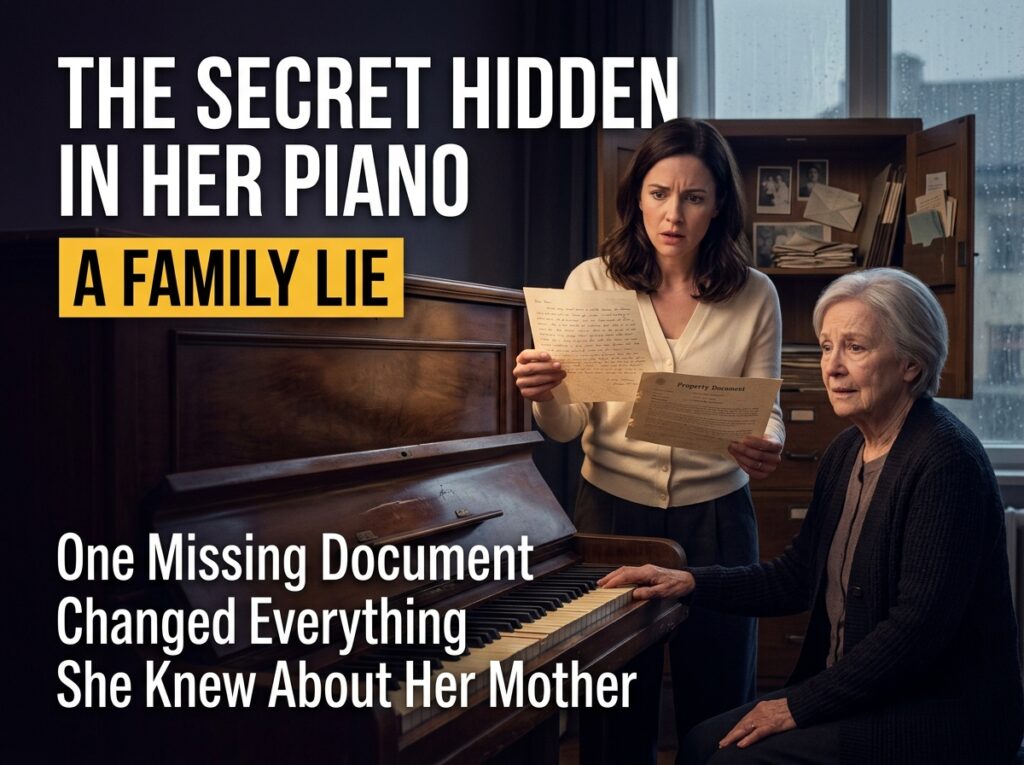
My aunt Margaret had owned the same piano for nearly sixty years, and she would rather have given away every piece of furniture in her apartment than let anyone take it.
The piano was an old upright instrument with dark wooden panels, ivory-colored keys, and a small scratch above the middle C. Its polished surface had faded over the years, and one of its legs had been repaired twice. Yet whenever someone suggested selling it, Aunt Margaret reacted as though they had insulted a member of the family.
“You don’t understand,” she would say, placing one thin hand on the piano’s lid. “Some things cannot be replaced.”
By the time she moved into a small apartment near the town center, she could no longer play. Arthritis had stiffened her fingers, and even sitting at the piano for more than a few minutes caused pain in her back. The instrument occupied nearly half her living room, leaving little space for the comfortable chair she preferred or the walking frame she needed to move around.
My cousin Daniel believed the piano had become a burden.
“She doesn’t even use it anymore,” he told me one afternoon. “We could sell it and use the money to make her apartment more comfortable.”
I understood his argument. The piano was heavy, expensive to maintain, and increasingly impractical in such a small space.
But Aunt Margaret refused.
“That piano stays,” she said when Daniel raised the subject during Sunday lunch.
“Aunt Margaret, nobody is asking you to throw it away,” he replied. “We’re trying to make things easier for you.”
“Then stop trying to remove the one thing I have asked you to leave alone.”
Daniel looked at me for support, but I said nothing.
I had known Aunt Margaret all my life. She was my late mother’s older sister, a quiet woman who rarely discussed her childhood and became uncomfortable whenever anyone asked about the years before I was born.
She had never married and had no children. Most of her life had revolved around caring for relatives, working in a small bookkeeping office, and maintaining the old family house where my mother and her siblings had grown up.
After my mother died, Margaret became the person I visited whenever I needed to feel close to my family.
She remembered stories my mother had forgotten to tell me. She knew which flowers my mother had planted outside the kitchen window, which songs she hummed while cooking, and how she used to laugh when she made a mistake.
But there were subjects Aunt Margaret never touched.
Whenever I asked about my grandparents’ final years, she changed the conversation. Whenever I mentioned the family house, she became unusually quiet. And whenever I asked why my mother had left town for several years when she was young, Aunt Margaret would say only that some memories were better left alone.
I had accepted those answers because I thought she was protecting herself from painful memories.
Then, one Tuesday morning, she called me.
“I need your help with something,” she said.
Her voice sounded weaker than usual.
“What’s wrong?”
“Nothing is wrong. Not exactly. But Daniel came yesterday with another man who wanted to inspect the piano.”
I sat up in my chair.
“Without asking you?”
“He said he was only getting an estimate.”
“And what did you tell him?”
“I told him that if he wanted to sell something, he should start with his own belongings.”
I laughed despite my concern.
Then her voice became serious.
“There’s something else. I need you to look through the papers in the old cabinet. Not the piano, and not the photographs. The papers.”
“Why?”
She hesitated.
“Because your mother once told me that if the family ever tried to sell the piano, someone would need to find the truth.”
I stopped smiling.
“What truth?”
“I don’t know whether I can explain it over the telephone.”
“Then I’ll come over tonight.”
“No,” she said quickly. “Come tomorrow. And come alone.”
Before I could ask another question, she ended the call.
The next afternoon, I arrived at her apartment carrying groceries and a folder for the documents she wanted me to examine.
She was sitting beside the piano, staring at a framed photograph of my mother.
When I entered, she slipped the photograph beneath a newspaper.
“Aunt Margaret, what’s going on?”
She looked at the folder in my hands.
“Did you bring something to keep the papers in?”
“Yes.”
“Good. Because once you begin looking, you may find things you cannot put back where they were.”
I sat beside her.
“I don’t understand.”
She took my hand.
“Your mother believed that one day somebody would come asking about the piano. She said the person who asked the right questions would need to understand why it had never been sold.”
“Who would ask about it?”
Aunt Margaret looked toward the instrument.
“Someone who knows what happened before you were born.”
I felt a chill move through me.
“Who?”
She released my hand and slowly stood.
“Open the cabinet,” she said. “Start with the oldest documents. And if you find an envelope with your mother’s handwriting, do not throw it away.”
I opened the cabinet.
Inside were decades of receipts, photographs, tax records, and letters tied together with faded ribbons.
At first, everything looked ordinary.
Then I found a thin folder bearing the name of our family house.
The first page listed the original owner.
The second contained a property transfer.
The third page was missing.
I turned to Aunt Margaret.
“Why is this incomplete?”
She stared at the empty space where the document should have been.
For the first time in my life, I saw fear in her eyes.
“Because,” she whispered, “that is the page your grandfather spent the rest of his life trying to find.”
<h2>Part 2</h2>
I spent the next three hours examining the documents in Aunt Margaret’s cabinet.
The property records were more than forty years old. Some had been folded so many times that the creases threatened to tear the paper. Others carried faded stamps from offices that had since moved or closed.
I found references to the family house, a small plot of land behind it, and a financial agreement involving my grandfather.
At first, I could not understand why any of those records mattered.
Then I found a letter dated several months before my mother left town.
The handwriting was unmistakably hers.
Margaret,
Please do not let them sell anything until the original document is found. They will tell you it is only an old paper, but you know that is not true.
If the last page has disappeared, ask the person who kept the piano.
There was no signature, only my mother’s initials.
I read the letter twice.
“Aunt Margaret?”
She was standing in the doorway with a cup of tea.
“Did you know about this?”
She placed the cup on the table.
“Yes.”
“Why didn’t you tell me?”
“Because I promised your mother I would wait until you were old enough to understand.”
I felt frustrated.
“Understand what? That someone took a document?”
She sat opposite me.
“Your grandfather owned more than the family house. He owned a small piece of land near the old railway line. It wasn’t worth much when I was young, but the land became valuable after the town expanded.”
I looked at the property records.
“What happened to it?”
“Your grandfather believed he had transferred it to the wrong person. He spent years trying to correct the mistake.”
“Who was the person?”
She shook her head.
“That is what the missing page was supposed to explain.”
I returned to the folder.
There were two transfer records, both signed by my grandfather. One appeared to have been completed legally. The other contained an unusual signature beside the witness section.
I pointed to it.
“Who signed this?”
Aunt Margaret leaned closer.
“I don’t recognize the name.”
“But you said the piano was connected to the missing document.”
She looked toward the instrument.
“Your mother believed that the person who knew the truth had left something inside it.”
I stood immediately.
“You mean the piano?”
“Possibly.”
“Why didn’t you tell me that first?”
“Because I don’t know whether it is true.”
I approached the piano and examined its exterior. I opened the keyboard lid, checked beneath the music stand, and looked inside the small storage compartment where Aunt Margaret kept old sheet music.
Nothing.
Daniel arrived just after five.
He had apparently decided to visit without calling, and he looked surprised when he saw the documents spread across the table.
“What are you doing?” he asked.
I hesitated.
“Looking through Aunt Margaret’s old papers.”
He glanced at the property records.
“Why?”
“Because some documents are missing.”
Daniel’s expression changed.
It was a small movement, barely noticeable, but I saw it.
“What documents?”
“The original transfer papers for the family land.”
He walked to the table and picked up one of the folders.
“You shouldn’t be digging through all this. Most of it is outdated.”
Aunt Margaret stood.
“They are my papers, Daniel.”
“I’m only saying that old records can be confusing.”
“Then why are you worried about someone reading them?”
He put the folder down.
“I’m not worried.”
He spoke too quickly.
I watched him carefully.
“Do you know anything about the missing page?”
He stared at me.
“No.”
Then he looked toward the piano.
For one brief moment, his face changed again.
I followed his gaze.
“What?”
“Nothing.”
He walked into the kitchen and began asking Aunt Margaret about her medication.
The conversation shifted, but I could not forget the way he had looked at the instrument.
After he left, I asked my aunt whether Daniel knew about the documents.
“He knows the family has old property records,” she replied. “I don’t know whether he knows what your mother wrote.”
“Has he ever asked you about the piano?”
“Many times.”
“Why?”
She folded her hands.
“Because he believes it is valuable.”
I looked at the instrument.
It was old, scratched, and difficult to move. But perhaps its value had nothing to do with its age or appearance.
That evening, I searched the public property registry.
I found the family house, the old railway land, and several records of transfers made over the decades. The information was incomplete, but one detail stood out.
The land had been transferred twice under different names.
Both transactions carried the same unusual witness signature.
I printed the records and compared them with the papers from Aunt Margaret’s cabinet.
The signature matched.
Someone had used the same witness on both transfers, even though the transactions had occurred years apart.
I searched the name in the town directory.
The person was no longer listed at the address shown on the records.
I called the registry office the following morning.
A clerk listened while I explained what I had found.
“Do you have the original transfer document?” she asked.
“No. That’s the problem.”
She paused.
“Then you may want to request the archived file.”
“Can I see it?”
“If it still exists.”
I gave her the reference number.
She typed for several minutes.
Then she stopped.
“I’m sorry,” she said. “The original file is marked as removed for safekeeping.”
“Who removed it?”
“The record doesn’t say.”
“Can you tell me when?”
She gave me a date.
I wrote it down.
It was the same month my mother had left town.
When I told Aunt Margaret, she closed her eyes.
“I was afraid of that.”
“Why?”
She took a long breath.
“Because your mother didn’t leave town for the reason everyone told you.”
I stared at her.
“What reason?”
Aunt Margaret looked toward the piano.
“She left because she discovered who had taken the missing document.”
<h2>Part 3</h2>
I had grown up believing that my mother left town because she wanted a fresh start.
That was the explanation my family had always given me. She had been young, they said, and eager to see the world beyond the streets where she had grown up.
She eventually returned, married my father, and built a life that seemed ordinary from the outside.
I never questioned the story.
Now, sitting in Aunt Margaret’s apartment, I realized that the version of my mother’s life I had inherited might have been carefully edited.
“Who took the document?” I asked.
Aunt Margaret rubbed her hands together.
“I don’t know for certain.”
“But you said my mother discovered who it was.”
“She told me she had found proof. She didn’t tell me the name.”
“Why not?”
“Because she was afraid someone would take it from her.”
I looked at the old letters scattered across the table.
“Someone in our family?”
She did not answer.
That silence told me more than a denial would have.
I returned to the property registry and requested every available record connected to the railway land. The clerk warned me that some documents might be missing or restricted, but she agreed to prepare copies of the records that could be released.
Two days later, I received a thin envelope.
Inside were copies of the original transfers, tax assessments, and a statement from a notary who had witnessed one of the transactions.
The notary’s name was familiar.
He had attended my grandfather’s funeral.
He had sat beside my family at the reception, accepted a cup of tea from my mother, and spoken about how much my grandfather had loved the old house.
I remembered him as a quiet man with silver hair and thick glasses.
According to the records, he was still alive.
I called the number listed in the directory.
A woman answered.
“Hello?”
“I’m trying to reach Mr. Ellis. He witnessed a property transfer involving my grandfather many years ago.”
There was a pause.
“Who is calling?”
I gave my name.
The woman became quiet.
Then she said, “He has been expecting someone from your family to call.”
My heart began beating faster.
“Does he know about the missing document?”
“He knows more than I do.”
“Can I speak with him?”
She asked me to come the following afternoon.
I arrived at a small house near the edge of town. The garden was neatly maintained, and a wooden ramp led to the front door.
Mr. Ellis sat in a chair beside the window.
He was older than I remembered, but his eyes were still sharp.
When I introduced myself, he studied my face.
“You have your mother’s eyes,” he said.
I sat opposite him.
“Did you know my mother?”
“Very well.”
“Did you witness the transfer of my grandfather’s land?”
He nodded.
“Twice.”
“Why was the property transferred under different names?”
He looked toward the window.
“Because the first transfer was never meant to become permanent.”
I waited.
“My grandfather wanted to protect the land from creditors,” I said. “Is that what happened?”
“That is what he told people.”
“Was it true?”
Mr. Ellis sighed.
“No.”
The answer left me speechless.
He explained that my grandfather had entered into a private agreement with another person. The land had been placed under a different name temporarily, but the agreement required the property to be returned once certain financial obligations had been met.
The original contract contained a clause stating that the arrangement could not be finalized without the confirmation of a missing witness.
“Who was the witness?” I asked.
Mr. Ellis looked at me.
“Your mother.”
I felt the room grow cold.
“My mother?”
“She was present when the agreement was signed. She was young, but your grandfather trusted her. He believed she would protect the truth if anything went wrong.”
“Then why was the document removed?”
“Because someone wanted the transfer to appear permanent.”
“Who?”
Mr. Ellis leaned back.
“I cannot give you a name without showing you the original record.”
“Where is it?”
He shook his head.
“I don’t have it.”
“Then who does?”
He looked toward the hallway.
“Someone who has been waiting for your family to ask the right question.”
I felt frustration rising.
“Everyone keeps telling me that. Nobody will tell me anything directly.”
Mr. Ellis looked at me with sympathy.
“Because the person who took that document is still connected to your family.”
I stared at him.
“Are they alive?”
“Yes.”
“Do they know I’m looking?”
He nodded.
“They knew before you called me.”
My stomach tightened.
“How?”
He reached for a folder on the table beside him.
Inside was a photocopy of a letter addressed to my mother.
The date matched the month she had left town.
I recognized the handwriting from the note in Aunt Margaret’s cabinet.
At the bottom of the page, someone had written a single sentence.
If she tells the truth, the piano must never be sold.
I looked up.
“Who wrote this?”
Mr. Ellis hesitated.
Then he gave me a name.
It was the name of someone who had attended our last family dinner.
<h2>Part 4</h2>
I left Mr. Ellis’s house with the photocopied letter in my bag and a feeling that I had stepped into a story much older than myself.
The name he had given me belonged to Uncle Robert, my mother’s younger brother.
Robert had attended every important family gathering I could remember. He was the relative who made jokes during Christmas dinner, helped my father repair the fence, and always insisted that family disagreements should be settled privately.
He had also been the person most eager to sell Aunt Margaret’s piano.
I had assumed he simply wanted the money.
Now I wondered whether he knew something about the missing document.
I drove straight to Aunt Margaret’s apartment.
She was sitting beside the piano when I arrived.
“Did you find him?” she asked.
I placed the letter on the table.
“Mr. Ellis told me that my mother was the missing witness.”
Aunt Margaret closed her eyes.
“I was afraid she had been involved.”
“She wasn’t involved in stealing anything. She was supposed to protect the agreement.”
My aunt looked at the letter.
“Who wrote this?”
“Mr. Ellis believes it was connected to the person who removed the original document.”
I told her about Uncle Robert.
She did not look surprised.
Instead, she appeared deeply tired.
“Your mother loved Robert,” she said. “She spent years trying to protect him.”
“From what?”
Aunt Margaret rose and walked toward the piano.
“Before you were born, Robert was in serious financial trouble. He had borrowed money to start a business, and the business failed. Your grandfather feared Robert would lose everything.”
“So he transferred the land to protect him?”
“That was the original plan. But your grandfather never intended Robert to keep it.”
I thought about the two property transfers.
“Then someone changed the agreement.”
“Yes.”
“Was it Robert?”
Aunt Margaret remained silent.
I felt a wave of anger.
“If he took the land, why has everyone spent decades pretending it was lost?”
“Because your mother believed he had made a terrible mistake. She wanted to give him a chance to return what he had taken.”
“How could he return it if the documents were missing?”
“He couldn’t. Not without admitting what he had done.”
I looked toward the piano.
“Why did my mother say it must never be sold?”
Aunt Margaret gently lifted the keyboard lid.
“Because your grandfather hid something inside it.”
She reached beneath the wooden panel and pressed a small latch I had never noticed.
A narrow compartment opened.
Inside lay a folded piece of paper wrapped in faded cloth.
My hands trembled as I lifted it out.
The paper was brittle, but the writing remained clear.
At the top was the title of the original property agreement.
Below it were the names of my grandfather, Mr. Ellis, and my mother.
At the bottom was a clause written in careful handwriting.
No transfer shall be considered final until the missing witness confirms that the original agreement has been honored.
My mother had signed the document.
Beneath her signature was a date.
The same date the archive file had been removed.
I looked at Aunt Margaret.
“Why didn’t you tell me this was here?”
“Because your mother asked me to keep it safe until the family was ready to face the truth.”
“And you think they’re ready now?”
She looked toward the window.
“No. But I think someone has decided the waiting is over.”
My phone vibrated.
An unknown number.
I answered.
A man’s voice spoke immediately.
“You’ve been asking about the piano.”
I froze.
“Who is this?”
“Someone who knew your mother.”
“Then tell me your name.”
He ignored the question.
“Stop searching through those records. You don’t understand what you’re getting involved in.”
I tightened my grip on the phone.
“If you know what happened, why don’t you tell me?”
“Because some truths destroy more than they repair.”
“Who took the document?”
The man was silent for a moment.
Then he said, “Ask your aunt what happened the night your mother left town.”
The call ended.
I stared at my phone.
Aunt Margaret had heard every word.
“What happened that night?” I asked.
She slowly sat down.
For several seconds, she did not speak.
Then she whispered, “Your mother came here with a suitcase. She intended to leave town the following morning. But before she could go, someone came to the house and asked her for the original document.”
“Who?”
Aunt Margaret looked at the piano.
“Your grandfather.”
<h2>Part 5</h2>
I had always imagined my grandfather as a stern but honest man.
He had died before I was old enough to remember him clearly, but my family spoke about him with respect. He had worked hard, provided for his children, and kept the family house in good condition until his final illness.
I had never considered the possibility that he might have played a part in the secret surrounding the land.
“Why would he ask my mother for the document?” I asked.
Aunt Margaret folded her hands.
“Because he wanted to correct the mistake.”
“Then why did he take it away from her?”
“He didn’t.”
I frowned.
“You just said he came here asking for it.”
“He came asking her to return it to him. She refused.”
“Why?”
“Because she believed he would destroy it.”
I sat down.
Aunt Margaret explained that my grandfather had regretted the original agreement almost from the moment it was signed. He had wanted to protect Robert, but the arrangement had become more complicated when the business failed and debts accumulated.
Robert had promised to return the land once his finances improved.
Instead, the property was transferred again, this time under a different name.
My grandfather discovered the second transfer and demanded that the original agreement be restored.
But the person who had benefited from the land refused.
“Was that person Robert?” I asked.
Aunt Margaret nodded slowly.
I felt my stomach tighten.
“Then why didn’t my grandfather take him to court?”
“Because Robert was his son.”
The answer was simple, painful, and familiar.
My grandfather had spent years protecting his family from the consequences of their own decisions. He believed that if he kept the dispute private, he could eventually repair the damage without destroying the family.
Instead, the silence had allowed the problem to grow.
My mother had discovered the second transfer and insisted that the original agreement be honored. She wanted Robert to return the land or admit what he had done.
Robert refused.
My grandfather then asked my mother to give him the original document.
She believed he intended to destroy it to protect Robert.
So she hid it in the piano.
“Why did she leave town?” I asked.
Aunt Margaret looked down.
“Because she realized the family would never forgive her for telling the truth.”
I felt tears gathering in my eyes.
“She was trying to protect the land.”
“She was trying to protect everyone. She believed that if she left, the family would eventually settle the dispute without forcing her to choose between her father and her brother.”
“But they didn’t settle it.”
“No.”
Instead, the land remained under Robert’s control, the original agreement disappeared from the official records, and the family adopted a simpler story.
The land had been lost.
The missing documents were unimportant.
My mother had left because she wanted a different life.
For decades, the truth remained hidden.
I looked at the piano.
“Why did my mother tell you to keep it?”
“Because she knew the document might be the only proof left.”
I carefully folded the paper and placed it back inside its cloth wrapping.
“What should we do now?”
Aunt Margaret looked at me.
“That depends on whether you want the truth more than you want the family to remain comfortable.”
I thought about Uncle Robert, who had attended our last family dinner and laughed with everyone else. I thought about the years my mother had spent carrying a secret that no one had allowed her to explain.
“I want the truth.”
Aunt Margaret nodded.
“Then you must be prepared for what it costs.”
That evening, I contacted a solicitor who specialized in property disputes. I showed her the original agreement, the registry records, and the letter from Mr. Ellis.
She examined each document carefully.
“The clause is important,” she explained. “If this agreement is authentic, it may establish that the later transfer was not valid under the original terms.”
“Can the land be returned?”
“That depends on the complete chain of ownership, the dates, and the applicable law. We need to verify the documents before making any conclusions.”
I appreciated her caution.
For the first time, someone was treating the secret as a matter of evidence rather than family loyalty.
She recommended that I make certified copies of every document and avoid confronting anyone until the records had been reviewed.
I followed her advice.
But the next morning, I discovered that someone had already taken an interest in my search.
When I arrived at Aunt Margaret’s apartment, the compartment beneath the piano was open.
The cloth wrapping lay on the floor.
The original document was gone.
<h2>Part 6</h2>
I stood beside the piano, unable to move.
The compartment had been opened carefully. Nothing else appeared disturbed, and the key beneath the keyboard had been returned to its place.
Whoever had taken the document knew exactly where it was hidden.
I called Aunt Margaret.
She answered from her bedroom.
“What is it?”
“The agreement is gone.”
She came into the living room as quickly as her walking frame allowed.
When she saw the open compartment, her face went pale.
“No,” she whispered.
I searched the apartment again, checking the cabinets, the drawers, and the spaces behind the furniture.
Nothing.
I called the solicitor and explained what had happened.
“Did you make copies?” she asked.
“Yes. I sent them to your office yesterday.”
“Good. Keep the originals of any other records safe. And do not confront anyone yet.”
I wanted to argue.
Someone had entered my aunt’s apartment and taken a document that had been hidden for decades. The idea that I should wait quietly felt unbearable.
But I knew the solicitor was right.
If I confronted the wrong person without proof, I might lose the only chance to establish what had happened.
I returned to the apartment and checked the front door. There were no obvious signs of forced entry.
Aunt Margaret sat beside the piano.
“Who has a key?” I asked.
“Daniel has one. Robert has one. And the building manager has a spare.”
I looked at her.
“Why does Robert have a key?”
“Because he offered to help when I moved.”
I felt anger rise in my chest.
“Did you tell him about the document?”
“No.”
“Did you tell Daniel?”
“No.”
I called the building manager and asked whether anyone had entered the apartment that morning.
He checked the log.
“No one signed in,” he said.
“Could someone have used a spare key?”
He hesitated.
“It’s possible.”
I thanked him and ended the call.
Then I checked my phone.
There was a message from the unknown number.
You were warned.
I showed it to Aunt Margaret.
She closed her eyes.
“I knew this would happen.”
“Who is it?”
“I don’t know.”
“Do you recognize the number?”
“No.”
I called the solicitor again and forwarded the message.
She advised me to preserve it and report any further threats.
Then she told me something that changed the direction of the investigation.
“The copies you sent contain a partial reference to a second document,” she said. “It appears to have been filed with a different registry.”
“Where?”
She gave me the name of a nearby district.
I searched the public records that afternoon.
The second document concerned a small office building on the edge of town. The property had once belonged to my grandfather’s business and had been transferred several times after his death.
The latest owner was listed under a company name I did not recognize.
I searched the company registration.
The director’s name was Robert.
My uncle had not simply benefited from the land.
He had continued to hold interests in properties connected to the original agreement.
I sent the information to the solicitor.
She warned me that the records did not prove wrongdoing by themselves. The company might have acquired the property legally, and the transfer history needed to be examined in full.
I understood.
I did not want to accuse someone merely because the evidence looked suspicious.
But I also could not ignore what I had found.
That evening, Daniel arrived at Aunt Margaret’s apartment.
He looked worried when he saw us sitting beside the piano.
“What happened?”
I explained that the original document had disappeared.
His face changed.
“Who knew it was here?”
“A few people.”
He looked toward the piano.
“Did you tell Uncle Robert?”
“No.”
“Are you sure?”
I stared at him.
“Why would you ask that?”
He rubbed his forehead.
“Because he called me this morning.”
My heart began beating faster.
“What did he say?”
“He asked whether Aunt Margaret was planning to sell the piano. Then he asked whether anyone had been looking through the old documents.”
I stood.
“What did you tell him?”
“That I didn’t know anything.”
“Did he mention the missing agreement?”
“No.”
Daniel looked toward the door.
“I should have told you earlier.”
I felt anger rising again.
“Why didn’t you?”
“Because I thought he was just being curious. I didn’t realize he knew about the document.”
I stared at him.
“Daniel, this is exactly how secrets survive. Everyone sees something unusual, everyone decides it is probably nothing, and nobody tells the person who needs to know.”
He lowered his head.
“You’re right.”
He took out his phone.
“I still have his message.”
He showed it to me.
Uncle Robert had written:
Tell your cousin to stop searching. Some things should remain in the family.
I read it twice.
Then I looked at Aunt Margaret.
For decades, our family had protected the same secret by refusing to ask questions.
Now someone was trying to make sure the questions stopped again.
I put the phone down.
“This time,” I said, “we are not going to stop.”
<h2>Part 7</h2>
The solicitor arranged a meeting with Mr. Ellis and an independent document examiner.
We brought copies of the property records, the letters, and the photographs of the original agreement that I had taken before it disappeared.
The examiner compared the handwriting and signatures.
After several hours, she gave us her preliminary assessment.
“The signatures appear consistent with the known samples,” she said. “However, a definitive conclusion would require further examination of the original paper and additional records.”
I felt both relieved and frustrated.
The evidence was stronger than I had feared, but it was not yet enough to settle the dispute.
Mr. Ellis agreed to provide a formal statement about the original agreement and the role my mother had played as a witness.
He also told us that my grandfather had kept a second copy of the contract for a short period.
“Where?” I asked.
“In his office.”
“Does that copy still exist?”
He shook his head.
“Not in the archive. But I remember seeing it after the first transfer.”
I thought about the old office building.
“Could it have been stored there?”
“Possibly.”
The solicitor contacted the current property manager and requested access to the records associated with the building.
We waited several days.
Then permission was granted to inspect a storage room that had not been opened for years.
I went with the solicitor and a representative of the property manager.
The room smelled of dust and damp paper. Old boxes were stacked against the walls, and several filing cabinets stood beneath a narrow window.
We began with the oldest records.
Most were ordinary business documents, but near the bottom of a cabinet, I found a folder marked with my grandfather’s initials.
Inside were invoices, handwritten notes, and a small envelope.
The envelope contained a receipt for the transfer of the railway land.
On the back, my grandfather had written:
The original agreement must be restored when Robert fulfills his promise.
Below that sentence was another line.
If he refuses, Margaret must give the document to the family member who asks why the piano was never sold.
I read the words slowly.
My grandfather had anticipated that someone might eventually discover the truth.
He had not known who that person would be, but he had left a clear instruction.
The solicitor photographed the receipt and added it to the evidence file.
Then I found another document.
It was a letter from my mother to Mr. Ellis, dated shortly before she left town.
I have done what Father asked, but I cannot make Robert tell the truth. I am leaving because I cannot keep pretending that the land was lost when I know what happened.
Please make sure the agreement is not forgotten.
I felt tears fill my eyes.
My mother had not left because she wanted to abandon her family.
She had left because she could no longer live inside a lie.
I sat on a wooden crate and held the letter carefully.
For years, I had wondered why she rarely spoke about her childhood. I had thought she simply wanted to move on.
Now I understood that every family gathering might have reminded her of the truth she had been forced to carry.
The solicitor sat beside me.
“This letter is important,” she said gently. “But we need to establish its authenticity and how it relates to the property transfers.”
I nodded.
I knew that evidence had to be handled carefully.
Still, I felt as though I had finally heard my mother’s voice.
Not through a photograph or a story told by someone else.
Through her own words.
When we left the building, I called Aunt Margaret.
“I found a letter from Mother.”
She began to cry before I finished explaining.
“Read it to me,” she whispered.
I did.
When I reached the sentence about leaving town, neither of us spoke for several minutes.
Finally, Aunt Margaret said, “She always hoped someone would understand why she had to go.”
I looked back at the old office building.
“I understand now.”
But as I returned to my car, I noticed a man standing across the street.
He was watching me.
When our eyes met, he turned and walked away.
I did not recognize him.
Yet when I checked my phone, a new message was waiting.
The next document will tell you what your mother sacrificed.
<h2>Part 8</h2>
I showed the message to the solicitor.
She advised me to preserve it and avoid responding. She also recommended that I inform the police if the messages continued or if I felt unsafe.
I followed her advice.
Then I returned to the records office with the new evidence.
The clerk had found an additional reference connected to my grandfather’s original business. It pointed to a box of archived correspondence that had been stored separately from the property records.
The box had not been opened in decades.
I submitted a formal request.
Two days later, the clerk called.
“We found a letter addressed to your mother,” she said.
I felt my hands go cold.
“Can I see it?”
“You can review it at the office. You’ll need to sign for access.”
I arranged an appointment for the following morning.
The letter was sealed inside a protective sleeve. Its paper had yellowed, and the handwriting was faint, but the words were legible.
It was from my grandfather.
My dear daughter,
I know you believe I have chosen your brother over the truth. Perhaps I have. I wanted to save him from the consequences of his mistake, and in doing so, I allowed the mistake to become something larger than any of us could control.
You were right to insist that the agreement be honored.
If I had listened to you from the beginning, you would not have had to carry this burden.
I stopped reading.
My grandfather had admitted that he had protected Robert.
The letter continued.
I cannot ask you to remain here if staying means living inside a lie. If you leave, do not believe that you have abandoned us. You have done more to protect this family than anyone will ever know.
Keep the piano safe. One day, the person who asks the right questions will understand why.
I covered my mouth with my hand.
My mother had not been rejected by her father.
He had understood her decision, even if he had failed to correct the problem while he was alive.
The letter ended with a note about the land.
My grandfather had written that he intended to restore the original agreement after Robert repaid the money he had borrowed.
But there was no evidence that the repayment had ever been completed.
I took the letter to the solicitor.
She read it carefully.
“This supports the explanation that the original transfer was conditional,” she said. “It does not settle the ownership question by itself, but it gives us a stronger basis for investigating the later transactions.”
I asked what would happen next.
“We can request the complete registration history and formally notify the current owners that the transfer is disputed. Any legal claim will depend on the documents, the dates, and the applicable law.”
I nodded.
I wanted justice, but I understood that it would not come from a dramatic family confrontation alone.
It would require patience, evidence, and a willingness to let the facts speak for themselves.
That evening, I visited Aunt Margaret.
I read her the letter from my grandfather.
She cried quietly, then asked me to place it beside the piano.
“He wanted your mother to know she had done the right thing,” she said.
“Why didn’t he tell the rest of the family?”
“Because he was afraid of losing his son.”
I looked at the piano.
“And what did that fear cost everyone else?”
Aunt Margaret did not answer.
I sat beside her until the room grew dark.
Then she told me something she had never shared before.
After my mother left town, Uncle Robert had come to the apartment and demanded the piano.
He claimed that my grandfather had promised it to him.
Aunt Margaret refused.
Robert had threatened to take the matter to court, but he never followed through.
Instead, he spent years insisting that the piano was worthless and should be sold.
“He knew something was inside it,” I said.
“I believe he suspected it.”
“Why didn’t you tell me?”
“Because I was afraid he would take it before you were ready.”
I felt a deep sadness for my aunt.
She had protected the piano for decades, carrying a secret that had isolated her from her own family.
“You don’t have to protect it alone anymore,” I told her.
She squeezed my hand.
“I know.”
The next morning, the solicitor called.
She had received a response from the current owners of the railway land.
They were willing to meet.
But they had included one condition.
They wanted to know whether we could produce the original agreement.
I stared at the phone.
The document that could establish the terms of the transfer was still missing.
And without it, the family might once again be forced to rely on incomplete records.
<h2>Part 9</h2>
The meeting took place in the solicitor’s office.
Aunt Margaret came with me, carrying the small photograph of my mother that she had kept beside the piano for years.
Uncle Robert arrived fifteen minutes late.
He looked older than I remembered, and his expression was carefully controlled. He greeted the solicitor, nodded to Aunt Margaret, and sat opposite me.
“I understand you’ve been making accusations,” he said.
“I have been asking questions.”
“About land that was transferred decades ago.”
“About an agreement that was never properly resolved.”
He leaned back.
“You have no idea how complicated the situation was.”
“Then explain it.”
He looked at the solicitor.
She reminded him that the meeting was intended to discuss the disputed transfer and the documents supporting it.
Robert sighed.
“Your grandfather wanted to protect me from creditors. He arranged for the land to be transferred temporarily, but the business collapsed before I could repay everything.”
“Then why was the property transferred again?”
“Because I needed money.”
“Did you tell my mother?”
He looked away.
“No.”
I felt anger rise in my chest.
“She spent years believing the land had been stolen from the family because nobody would tell her what happened.”
Robert’s jaw tightened.
“Your mother was always convinced that the rules mattered more than people.”
“No,” I said. “She believed people deserved the truth.”
For the first time, he looked directly at me.
“Do you think I wanted this? I was drowning in debt. Your grandfather kept telling me he could fix everything, but he was getting older. I thought if I could hold onto the land long enough, I could repay what I owed and restore the agreement.”
“Did you?”
He said nothing.
The solicitor placed copies of the transfer records on the table.
“These documents show that the property was transferred twice under different names. We need to establish whether the second transfer complied with the original agreement.”
Robert stared at the papers.
Then he looked at Aunt Margaret.
“Where is the original document?”
She remained silent.
He turned toward me.
“You found it, didn’t you?”
I did not answer.
His expression hardened.
“I knew this would happen. Your mother should have destroyed it when she had the chance.”
Aunt Margaret stood abruptly.
“Don’t you dare speak about her that way.”
Robert looked startled.
“Margaret—”
“No. She carried your secret for years because she loved you. She left town because she could not bear to watch you destroy the family one lie at a time. And you still want to blame her?”
The room fell silent.
Robert looked down at his hands.
For the first time, he seemed less angry than exhausted.
“I never wanted her to leave,” he said.
“Then you should have told the truth.”
He did not respond.
The solicitor explained that the available evidence supported further investigation but did not yet establish every detail needed to resolve ownership. She proposed that the parties cooperate in locating the original agreement and preserving the remaining records.
Robert refused to make a commitment.
Instead, he stood and walked toward the door.
Before leaving, he turned to me.
“You think finding the document will make everything right.”
“No,” I said. “I think it will let everyone stop pretending they don’t know what happened.”
He left without another word.
Aunt Margaret sat down slowly.
I placed my hand on her shoulder.
“Are you all right?”
She nodded, though her eyes were wet.
“I waited a long time to hear someone say that.”
After the meeting, we returned to her apartment.
The piano stood in its usual place, its dark wood reflecting the afternoon light.
I opened the keyboard lid and looked at the compartment where the original agreement had been hidden.
It was empty.
But I no longer felt that the story was entirely lost.
We had copies, letters, testimony, and records that connected the transfers. We had evidence of my mother’s role and my grandfather’s regret. We had enough information to continue seeking the truth through the proper legal process.
That evening, I received a call from an unknown number.
I almost ignored it.
Then I remembered the first call, the one in which a stranger had used my mother’s private nickname.
I answered.
A woman spoke softly.
“Your mother asked me to wait until you found the letters.”
“Who are you?”
“My name is Helen. I worked in your grandfather’s office.”
I sat down.
“What do you know about the missing agreement?”
“I have the final page.”
My heart began beating faster.
“Where?”
“I cannot send it to you. There are things you need to understand first.”
“Then tell me.”
She paused.
“Your mother did not leave town with the document. She left town with a copy of something else—something that explains why your grandfather kept the piano.”
I looked toward the instrument.
“What did she take?”
Helen’s voice trembled.
“The original receipt proving that the land was supposed to come back to the family.”
<h2>Part 10</h2>
Helen agreed to meet me at a small café near the railway station.
I told the solicitor where I was going and arranged to meet Helen in a public place during the afternoon.
She arrived carrying a brown envelope.
She was in her seventies, with silver hair and a careful way of moving. When she saw me, she stopped beside the table and studied my face.
“You look like your mother,” she said.
I invited her to sit.
For several minutes, she spoke about working in my grandfather’s office. She remembered the ledgers, the smell of old paper, and the way my grandfather insisted on keeping copies of every important transaction.
“He believed records protected people,” she said. “But he also believed that family should be given every chance to correct its mistakes.”
“Did he know what Robert had done?”
“Yes.”
“Why didn’t he stop him?”
Helen looked down.
“Because he loved him. And because he believed he could repair the damage without making the truth public.”
I thought about Aunt Margaret, who had protected the piano for decades, and my mother, who had left town rather than continue living inside a lie.
“Did my mother know about the receipt?”
Helen nodded.
“She asked me to keep a copy after she left. She was afraid the original agreement would disappear, and she wanted evidence that the land had never been intended as a permanent gift.”
She opened the envelope.
Inside was a carefully preserved receipt, along with a short letter written by my mother.
The receipt matched the reference found in the archived records. Its date and transaction number were consistent with the property documents we had already collected.
The letter was brief.
If someone has finally asked why the piano was never sold, please give them this.
The piano was never the treasure. It was the place where we kept the truth safe until someone was ready to hear it.
I read the sentence twice.
Helen explained that my mother had given her the receipt before leaving town. She had asked Helen to keep it until someone in the family began asking questions about the missing agreement.
“Why didn’t you come forward sooner?” I asked.
Helen looked at me with sadness.
“Because your mother asked me not to expose the family while your grandfather was alive. After he died, I was afraid that speaking would destroy what remained of the family. Then the years passed, and I began to believe nobody would ever ask.”
I understood more than I wanted to.
Silence often began with fear. It continued because speaking became harder with every passing year.
I thanked Helen and took the receipt to the solicitor.
She compared it with the existing documents and confirmed that it was relevant evidence. It did not automatically settle ownership, but it supported the argument that the original transfer had been conditional.
The solicitor contacted the parties involved and arranged for the evidence to be formally reviewed.
The process took months.
There were further searches, legal discussions, and disagreements about the meaning of the old contract. We learned that some records had been incomplete for years, while others had been stored under unrelated reference numbers.
Not every question received an immediate answer.
But we no longer depended on family stories alone.
We had documents.
We had witnesses.
And we had my mother’s own words.
Eventually, the parties agreed to pursue a formal resolution of the property dispute based on the available evidence. I cannot say that every loss was repaired or that every relationship returned to what it had once been.
Some things could not be restored.
My mother was gone. My grandfather was gone. And the years Aunt Margaret had spent protecting the piano could never be returned to her.
But the lie that the land had simply been lost was no longer accepted as the whole story.
Uncle Robert eventually admitted that he had concealed the second transfer. He did not offer a perfect apology, and the family did not immediately forgive him.
Aunt Margaret told him that forgiveness would take time.
“For years, you asked us to protect you from the truth,” she said. “Now you must learn to live with it.”
Robert nodded.
For once, he did not argue.
As for the piano, it remained in Aunt Margaret’s apartment.
We arranged for a specialist to inspect it and make the necessary repairs. The instrument was still old, and Aunt Margaret could no longer play more than a few notes at a time, but she refused to let anyone replace it.
One afternoon, I sat beside her while she touched the keys.
“Your mother loved this piano,” she said.
“I know.”
“She used to play when she was worried. She said the music helped her think.”
Aunt Margaret pressed one key.
A soft note filled the room.
For a moment, I imagined my mother sitting there as a young woman, trying to decide whether to protect her family by remaining silent or protect the truth by leaving.
I understood why she had chosen to go.
And I understood why she had left a path for someone else to follow.
The piano had never been valuable because of its wood or its sound. It was valuable because it had carried a secret without allowing that secret to disappear completely.
Aunt Margaret looked at me.
“Do you think your mother would be proud?”
I took her hand.
“I think she would be relieved that we finally listened.”
She smiled, and tears filled her eyes.
After that, I visited her every Sunday.
Sometimes we talked about the case. Sometimes we looked through old photographs. And sometimes we simply sat beside the piano while sunlight moved across the floor.
I began to understand that family history was not a collection of perfect memories. It was made of mistakes, sacrifices, misunderstandings, and truths that people sometimes lacked the courage to face.
The important thing was not to pretend that every generation had done the right thing.
It was to learn enough from the past to stop repeating the same mistakes.
One evening, as I prepared to leave, Aunt Margaret called me back.
“There’s something I want you to remember,” she said.
I turned.
“Your mother didn’t leave because she stopped loving us. She left because she could no longer love us by lying.”
I stood quietly beside the door.
For years, I had believed that keeping a family together meant protecting its members from anything that might cause pain.
Now I understood that a family could remain together physically while the truth slowly separated everyone inside it.
My mother had chosen honesty, even when it cost her the home she had known.
Aunt Margaret had chosen patience, even when it meant carrying a burden for decades.
And I had chosen to ask questions, even when the answers threatened the comfortable version of my family’s history.
None of those choices had been easy.
But they had finally brought the truth into the light.
The piano remains in my aunt’s apartment today. Its keys are worn, its wood bears the marks of time, and its music is no longer as strong as it once was.
Still, she refuses to sell it.
Whenever someone asks why, she gives the same answer.
“Because some things are worth keeping.”
I used to think she meant the piano.
Now I know she meant the truth.
And every time I hear a note rise from its old wooden frame, I remember the woman who left town carrying a secret, the family that spent decades avoiding it, and the lesson that changed the way I understood love.
Sometimes, protecting your family means keeping a secret safe until the right person can uncover it. And sometimes, loving your family means finally refusing to keep it.