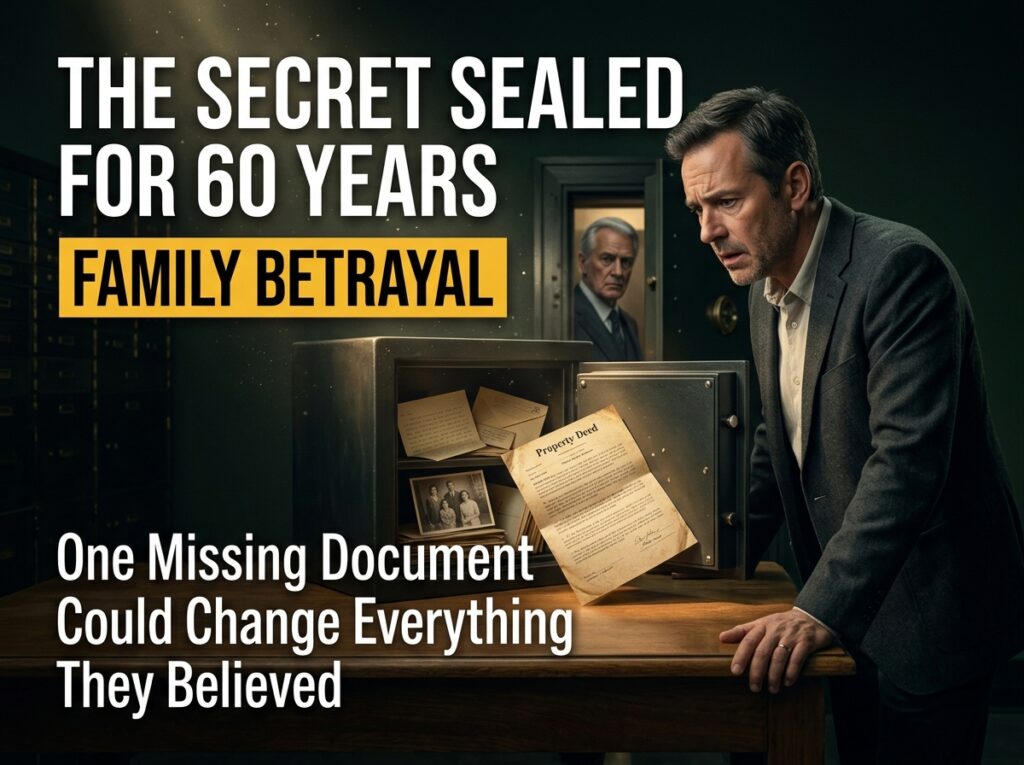
The call came on a Thursday afternoon, just as I was putting away the last of my mother’s old photographs.
I remember the hour because the kitchen clock had stopped at 3:17, and I had been promising myself for three weeks that I would replace its battery. The house was quiet, the kind of quiet that settles into rooms after someone has died and the people who once filled them with ordinary noise are gone.
My mother, Eleanor, had been dead for eleven months.
I was still discovering the small things her absence had changed. I no longer bought the tea she liked. I had stopped turning toward the hallway when I heard a floorboard creak. Sometimes I caught myself reaching for my phone to tell her something unimportant, such as the price of tomatoes or a neighbor’s ridiculous new fence, before remembering that there was nowhere to send the message.
I had spent most of the previous year sorting through her belongings. There were boxes of family photographs, birthday cards tied with faded ribbon, and envelopes containing bills she had paid decades earlier. She had kept everything, not because she was sentimental about paper, but because she believed that a person should be able to prove what had happened.
“Memory is a funny thing,” she used to tell me. “People remember whatever allows them to sleep at night. Paper doesn’t have that problem.”
At the time, I thought it was one of her ordinary observations about growing old. I had no idea how much she might have meant by it.
The telephone rang again before I could finish stacking the photographs.
“Hello?”
“May I speak with Mr. James Carter?”
“This is James.”
“My name is Robert Ellis. I’m the branch manager at the First County Bank. I apologize for contacting you unexpectedly, but we’ve discovered something in our older records that appears to be connected to your family.”
I glanced at the photographs on the table. My father stood in one of them beside a younger version of my mother. My older brother, Michael, was perched on a wooden fence, grinning at whoever had taken the picture. I was a little boy in the foreground, holding a toy airplane.
“What sort of records?” I asked.
There was a pause.
“An old safe-deposit box. It was registered under your family name, and the account has been sealed in our archive for approximately sixty years.”
“Sixty years?”
“That’s what the surviving documentation indicates. The box itself has remained inaccessible because the original authorization records are incomplete. During a review of our older accounts, one of our archivists found a document that allowed us to establish a connection to your family.”
I sat down.
My father had died when I was twenty-eight. My mother had always told us that he was a careful man who distrusted banks, kept receipts in labeled envelopes, and never signed anything without reading it twice. He had worked as an accountant for a small property company before retiring. If there had been a safe-deposit box, I could not remember him mentioning it.
“Why are you calling me?” I asked.
“Your name appears in the surviving family documentation. Before we proceed, we’d like you to come to the branch and verify your identity. There are procedures we must follow, and I don’t want to mislead you about what may or may not be inside.”
“Have you opened it?”
“No. We have located the box and confirmed the old registration. We have not examined its contents.”
His answer was careful enough to make me uneasy.
“When can I come?”
“Tomorrow morning, if that suits you.”
I agreed to arrive at nine.
After we hung up, I remained at the table, staring at the photograph of my parents. I tried to remember whether my father had ever taken me to the bank as a child. I recalled the smell of polished wood, the heavy doors, and the way he would lower his voice whenever he spoke about money. But I could not connect those memories to a particular visit or a particular box.
Then another memory surfaced.
I was about ten when I wandered into my parents’ bedroom looking for a book. My father sat at the desk with a brown envelope in front of him. My mother stood by the window, her arms folded.
“You said it was finished,” she told him.
“It should have been.”
“And if someone finds out?”
My father looked toward the doorway and saw me.
For years, I had remembered only the way he smiled and told me to go outside. I had forgotten my mother’s expression: not anger, exactly, but the strained look of someone who had been carrying a heavy object for too long.
I wondered whether the safe-deposit box had anything to do with that afternoon.
At dinner, I called my brother.
Michael answered on the fourth ring.
“Everything all right?” he asked.
“I got an unusual call from the bank today.”
“What bank?”
“First County. They found an old safe-deposit box registered under the family name.”
The silence that followed was brief, but unmistakable.
“What did you say?”
“They found a box. Apparently, it’s been sealed for sixty years.”
Michael cleared his throat.
“That sounds like some clerical mistake.”
“Maybe. They want me to verify my identity tomorrow.”
“You don’t need to get involved in that.”
I frowned. “Why not?”
“Because these old records are always a mess. They’ll have you signing forms, paying fees, and chasing documents for weeks. It’s probably nothing.”
He sounded irritated, not surprised.
“I haven’t even seen it yet.”
“Then leave it alone until you know more.”
“I’ll see what the manager says.”
“James, I’m serious.”
He rarely used that tone with me. Michael had always been the confident one, the brother who made decisions quickly and expected everyone else to accept them. Our father had trusted him with practical matters, and after our parents died, Michael had become the person who organized family meetings, handled estate paperwork, and told us when a question had already been settled.
I had never resented that role. I was younger, less interested in arguments, and more willing to believe that someone else knew what needed to be done.
But as I listened to my brother insist that I should avoid a box he claimed to know nothing about, I felt the first small crack in that old habit.
“Good night, Michael,” I said.
He did not return the greeting.
Instead, he asked one final question.
“Did the bank tell you which year the box was registered?”
I looked at the telephone in my hand.
“No,” I answered, although the manager had mentioned the surviving records dated back approximately sixty years.
“Good,” Michael said. “Don’t ask them.”
Then he ended the call.
<h2>Part 2</h2>
I slept badly that night.
Every time I closed my eyes, I heard Michael’s voice asking about the registration year. The question had been too precise. If he truly believed the bank had made a mistake, why would he care about the date?
At seven the next morning, I searched the drawers in my study for my father’s old paperwork. I found insurance policies, tax returns, and several property documents, all carefully arranged in folders. Most concerned the house where my parents had lived for nearly forty years. Others referred to a small piece of land outside town that my father had once described as an investment he regretted making.
I remembered the property vaguely. It was a narrow stretch of land near an old railway crossing, with a modest cottage and an overgrown garden. My father had visited it occasionally when I was young, but he stopped mentioning it after a dispute with a business partner.
Whenever I asked what had happened, he would say, “It’s finished, James. There’s no sense reopening something that cost everyone too much.”
My mother had been less dismissive.
Once, when I was sixteen, I found her studying a photograph of the cottage. She ran a finger along the edge of the picture before putting it away.
“Some things are lost because people make mistakes,” she said. “Other things are lost because someone decides the truth would be inconvenient.”
I had asked what she meant.
She kissed my forehead and told me to finish my homework.
Now I wondered whether the old bank records were connected to that forgotten property.
At nine, I walked into First County Bank. The building had been renovated since my childhood, but the heavy front doors remained. Robert Ellis met me near the reception desk. He was in his late fifties, with silver hair and the careful manner of someone accustomed to handling other people’s worries.
“Mr. Carter. Thank you for coming.”
He led me into a small office and closed the door.
“I want to explain something before we begin,” he said. “The existence of a safe-deposit box does not establish ownership of anything inside it. We need to verify the records and follow the appropriate process.”
“I understand.”
He placed several photocopied documents on the desk. The oldest was brittle and faded, its edges browned by time. My grandfather’s name appeared near the top, followed by my father’s name in a column marked family representative.
Below it was a date from sixty years earlier.
I studied the signatures. My grandfather’s handwriting was unfamiliar, but my father’s name looked exactly as I remembered it from birthday cards and notes he had left on the kitchen counter.
“What was the box used for?” I asked.
“We don’t know. The original contents inventory is missing.”
“Missing?”
“Some records were transferred between branches decades ago. We have a registration entry, a later reference to the box, and an authorization document. The inventory itself isn’t in the archive.”
“Who had access?”
Ellis folded his hands.
“That is one of the questions we’re trying to resolve.”
He showed me a photocopy of an old property reference. The address matched the cottage I had found in my father’s files.
I looked up.
“This property belonged to my father?”
“It was associated with a company he worked with. We have not established the full chain of ownership.”
“Who owned the company?”
“A man named Arthur Bell was listed as a principal. Your father appears to have handled its accounts.”
I knew the name. Arthur Bell had once been a regular visitor to our home. He had brought gifts at Christmas, sat beside my father at family dinners, and called my mother Eleanor as though they had known each other for a lifetime.
Then, sometime before my sixteenth birthday, he vanished from our lives.
My father said Arthur had moved away after a business disagreement. Michael later repeated that explanation whenever anyone mentioned him.
“Was Arthur involved in the safe-deposit box?” I asked.
Ellis pointed to a handwritten note attached to the file.
“His name appears in a separate property record. We cannot yet establish whether that record is directly connected to the box.”
I felt a strange mixture of excitement and dread.
“What happens now?”
“We need additional authorization before the box can be examined. Your identity has been verified, and your family connection is documented. I can arrange the next step, but I must warn you that this may take time.”
I signed the required forms.
As I stood to leave, Ellis hesitated.
“Mr. Carter, may I ask something?”
“Of course.”
“Have you spoken to anyone about this discovery?”
“Only my brother.”
His expression changed slightly.
“When?”
“Last night.”
“Did you tell him the registration date?”
“No. I told him the bank had found an old box. He asked me which year it was registered, and I said I didn’t know.”
Ellis looked down at the papers.
“Did he seem particularly concerned?”
“He told me not to investigate.”
The manager was silent for several seconds.
“I see.”
“What does that mean?”
“It may mean nothing. But if you discover anything that appears to involve property ownership or financial transactions, please keep the original documents secure and obtain independent legal advice before acting on them.”
I thanked him and left.
Outside, the morning was bright, and people hurried along the pavement carrying shopping bags and coffee cups. The ordinary world seemed strangely distant. I had expected a forgotten bank box to produce old photographs, perhaps a few family letters. Instead, I had found my father’s name attached to a property my family had never explained.
I walked to a nearby café and ordered coffee. Before the cup arrived, my phone rang.
It was my cousin, Peter.
“James, I heard you went to the bank.”
I froze.
“Who told you that?”
“No one. Michael mentioned you were looking into old records.”
“He knew I was visiting the bank. How did you know what I was doing there?”
Peter ignored the question.
“Listen to me. Whatever you found, don’t sign anything. Don’t let anyone persuade you that the property records are simple.”
I gripped the telephone.
“What property records?”
Peter went quiet.
Then he said, “You don’t know yet, do you?”
“Know what?”
He took a shaky breath.
“That cottage wasn’t sold once, James. It was transferred twice. And both times, someone used a signature that should never have appeared on those documents.”
<h2>Part 3</h2>
Peter refused to explain further over the telephone.
“Meet me somewhere,” I said. “Tell me what you know.”
“Not at your house. And don’t bring Michael.”
“Why would I bring Michael?”
“Because he always seems to arrive before the rest of us know something has happened.”
The comment unsettled me more than I wanted to admit.
We arranged to meet at a small café near the public library that afternoon. Peter arrived carrying a battered leather folder. He was older than me by five years, but grief had aged him more quickly. His wife had died three years earlier, and since then he had become a quieter man, someone who seemed to measure every sentence before allowing it into the world.
He sat opposite me and placed the folder on the table.
“I should have told you years ago,” he said.
“Told me what?”
“About Arthur Bell.”
I leaned forward.
“What happened to him?”
Peter opened the folder. Inside were photocopies of property records, a few bank statements, and a photograph of the cottage. The picture showed the building before its garden had grown wild. My father stood beside the front gate. Arthur Bell was next to him, smiling at the camera.
A woman stood slightly behind them. I recognized her immediately.
My mother.
She looked younger than I had ever known her, her dark hair gathered at the back of her neck, one hand resting on the shoulder of a small child.
The child was me.
I stared at the photograph.
“Why was my mother there?”
“Because the cottage wasn’t merely a business investment.”
Peter’s voice lowered.
“It was supposed to become a home for someone.”
“Who?”
He shook his head.
“That’s the question your family spent years avoiding.”
I turned to the documents. One showed an original transfer of the property to a company associated with Arthur. Another, dated several years later, recorded a transfer to a different company with a similar name. Both carried a signature that looked almost identical.
At first glance, the signatures appeared ordinary. But I noticed a small mark after the final letter of the surname, a short downward stroke followed by a tiny loop.
My father had made that mark whenever he signed his name.
He had also used it on the birthday cards he gave me every year.
“These are his signatures,” I whispered.
“That’s what everyone said.”
“And the transfers?”
“People accepted them. The first was described as a sale. The second was described as a correction. Nobody seemed to ask why the property changed hands twice or why the documents referred to different companies.”
“Did my father sign both?”
Peter looked uncomfortable.
“I don’t know.”
“Then why are you showing me this?”
“Because the notary who witnessed the transfers is still alive. His name is Harold Finch. He worked in town for decades, and he remembers more than he admits.”
I looked at the dates. The first transfer had occurred when I was a teenager. The second came several years later, after I had left home for college.
“Why didn’t anyone investigate?”
Peter gave a bitter laugh.
“Because your father was respected. Arthur was considered a difficult man, and the second company was controlled by people who knew how to make paperwork look respectable. Once the official story was repeated often enough, everyone accepted it.”
“And Michael?”
Peter did not answer immediately.
“Your brother was young when the first transfer occurred. He might not have understood it. But he was old enough to know something by the time the second one happened.”
I felt a cold pressure beneath my ribs.
“Are you saying he was involved?”
“I’m saying you should ask him what he remembers before you decide what to believe.”
Peter closed the folder.
“There is something else. A few months after the second transfer, Arthur Bell stopped coming to your family’s house. Your father told everyone that Arthur had left town. Your mother told a different story to one person.”
“Who?”
“My mother.”
Peter’s mother, Margaret, had been close to Eleanor. They had grown up in the same neighborhood and maintained their friendship long after their lives took different directions.
“What did she tell your mother?”
Peter looked toward the window.
“That Arthur had been promised something. When the promise was broken, he threatened to expose the transfers.”
“And what happened?”
“He disappeared from the family story.”
“That isn’t an answer.”
“It’s the only one I have.”
I gathered the papers, trying to make sense of the connections. The cottage, the box, the two transfers, my father’s signature, Arthur’s disappearance. Each piece seemed to belong to a puzzle whose picture someone had deliberately hidden.
Peter touched my arm before I stood.
“James, listen carefully. If you decide to investigate, keep copies of everything. Don’t rely on one person to tell you the truth. And don’t assume the person who appears most guilty is the one who benefited most.”
“Why are you warning me now?”
He looked ashamed.
“Because I received a letter last week. It mentioned the old property and said the family records would soon be reopened.”
“Who sent it?”
“I don’t know. There was no return address.”
He handed me a photocopy of the letter. Most of it was brief and formal. The final sentence was handwritten.
The second transfer was never meant to be the last.
I read it twice.
Then my phone vibrated.
A message from Michael appeared on the screen.
We need to talk. Come to my house tonight. Don’t bring Peter.
<h2>Part 4</h2>
Michael’s house stood at the end of a quiet street lined with mature trees. He had lived there for nearly twenty years, long enough for the neighbors to consider him part of the street’s furniture. His garden was immaculate, his windows always clean, and the brass number beside his front door polished every weekend.
As children, we had shared a bedroom, argued over toys, and protected each other from the occasional punishment our father delivered too quickly. Michael had been the one who taught me to ride a bicycle. When I fell and scraped my knee, he carried me home instead of leaving me to walk.
I had never imagined that I might one day enter his house wondering whether he had helped conceal a family secret.
He opened the door before I knocked a second time.
“You came.”
“You asked me to.”
He stepped aside.
The living room smelled of coffee and furniture polish. A folder lay on the table, beside two cups. Michael had prepared for this conversation, though he had not said so.
“Peter has been talking to you,” he said.
“Yes.”
“He’s always enjoyed making trouble.”
“He showed me the transfer documents.”
Michael’s expression tightened.
“Those papers are old.”
“They carry Dad’s signature.”
“Your father signed thousands of documents.”
“Both transfers?”
“I don’t know.”
“Then tell me why you asked about the registration year before I had even visited the bank.”
He looked away.
For a moment, I thought he might finally tell me everything. Instead, he picked up his coffee and took a slow drink.
“Because I knew the bank had been reviewing its old accounts.”
“How?”
“A letter came to the house last month.”
“What letter?”
“A notice saying some archived records were being reviewed. I didn’t think it meant anything.”
“Why didn’t you tell me?”
“Because you would do exactly what you’re doing now.”
“Investigating?”
“Digging up things that cannot be changed.”
I sat opposite him.
“Was Arthur Bell cheated?”
Michael’s silence lasted long enough to become an answer of its own.
“Arthur was not an easy man,” he finally said. “He made promises, changed his mind, and threatened people whenever he felt cornered. Dad tried to help him, but things became complicated.”
“That doesn’t explain the transfers.”
“No. It doesn’t.”
“Did Dad sign them?”
Michael rubbed his forehead.
“I was seventeen when the first one happened. I remember Dad coming home late. He and Mum argued for weeks. I heard Arthur’s name, and I heard the word signature. But I didn’t know what any of it meant.”
“And the second transfer?”
He stared at his hands.
“By then, I knew something was wrong.”
The words seemed to alter the air in the room.
“What did you know?”
“That the property was being moved between companies. That the paperwork wasn’t as straightforward as people claimed. I was working part-time for a local accountant, and I recognized some of the company names.”
“Did you help?”
“No.”
The answer came too quickly.
I waited.
Michael looked up, his eyes tired.
“I didn’t sign the documents, James. I didn’t arrange the transfers. But I knew enough to ask questions, and I chose not to.”
“Why?”
“Because Dad told me to stay out of it.”
“And you obeyed?”
“I was afraid.”
I had never heard my brother use that word about our father.
Michael leaned back and looked toward the window. Outside, a man was walking a dog along the pavement, stopping to let it sniff the base of a tree.
“Dad told me that if the truth came out, someone would lose everything. He said he was trying to protect the family. I believed him.”
“Did Mum believe him?”
Michael closed his eyes.
“No.”
The answer hurt more than I expected.
“She knew?”
“She suspected. She kept asking Dad to correct the records. They fought about it, and eventually he told her that he would make things right.”
“Did he?”
Michael shook his head.
“Not in the way he promised.”
I felt anger rising, but beneath it was something more painful: the realization that the people I had trusted had been living beside a truth I had never been allowed to see.
“What happened to Arthur?”
“I don’t know.”
“You’re lying.”
Michael’s face flushed.
“I haven’t spoken to him in years.”
“Then why are you frightened of what I might find?”
He stood abruptly and walked to the bookshelf. For several seconds, he pretended to examine a row of books.
Then he removed a thin envelope and placed it on the table.
“Mum gave me this shortly before she died,” he said. “She told me not to open it unless the bank contacted the family about the old box.”
My hands went cold.
“Why didn’t you tell me?”
“Because I hoped the box would never be found.”
I opened the envelope.
Inside was a single sheet of paper in my mother’s handwriting.
If the records are reopened, let James decide what to do. He deserves to know the truth, even if the truth changes everything.
Beneath the sentence was an address and a name.
Harold Finch.
The notary who had witnessed both transfers.
Michael watched me read it.
“There’s something else,” he said quietly. “Mum told me that if you ever went to see Finch, you should ask him about the original witness.”
“What original witness?”
Michael’s face had gone pale.
“The person whose name was removed from the first agreement.”
<h2>Part 5</h2>
Harold Finch’s office occupied the ground floor of a narrow brick building near the courthouse. The sign outside had faded, but the lettering remained clear enough to read. I arrived shortly after ten the next morning, carrying copies of the transfer documents and my mother’s letter.
A receptionist asked whether I had an appointment.
“No. I need to speak with Mr. Finch about two property transfers.”
She studied the documents without touching them.
“Mr. Finch doesn’t discuss old cases with people who aren’t his clients.”
“These documents carry his signature.”
Her expression changed.
She disappeared into the back office and returned several minutes later.
“He’ll see you for ten minutes.”
Harold Finch was in his late eighties, with a narrow face and hands marked by age. He wore a dark suit and sat behind a desk covered with neatly stacked folders. When I entered, he did not offer his hand.
“You are Eleanor Carter’s son.”
“Yes.”
“I wondered when someone would come.”
“Why?”
He motioned toward a chair.
“Because some records have a way of returning when the people who buried them believe everyone has forgotten.”
I placed the documents on his desk.
“Did you witness these transfers?”
He looked at the signatures.
“I witnessed two transactions involving that property.”
“Did my father sign them?”
“I remember your father being present.”
“That’s not what I asked.”
Finch removed his glasses and cleaned them with a handkerchief.
“Memory is less reliable than people imagine, especially after many years. I cannot certify the identity of a signature merely by looking at an old photocopy.”
“Did you witness the documents or not?”
“Yes.”
“Was Arthur Bell present?”
Finch hesitated.
“He was involved in the first agreement.”
“And the second?”
“I cannot discuss details without reviewing the original files.”
“Where are they?”
“One was returned to the property office. The other should have been kept in the county archive.”
“Should have been?”
He looked at me over his glasses.
“Mr. Carter, I advise you not to assume that every missing document was deliberately removed. Records get lost. Offices close. People make mistakes.”
“Then why did my mother leave me your name?”
The question struck him harder than the others.
For the first time, he looked genuinely troubled.
“Eleanor was a principled woman,” he said. “She believed that the truth should be recorded, even when it caused pain.”
“What did she know?”
Finch folded his hands.
“Your father believed he was protecting the family. Arthur believed he was protecting someone else. They disagreed about who deserved to be protected.”
“Who was the original witness?”
He rose slowly and went to a cabinet behind his desk. After searching through several folders, he returned with a small notebook.
“This is not an official record,” he said. “It is a private index I kept when I was younger. I have no idea whether it will help you.”
He opened it to a page marked with the date of the first transfer.
Three names appeared beside the property address.
My father’s.
Arthur Bell’s.
And a third name I had never seen before.
Rose Bennett.
“Who was she?”
Finch closed the notebook.
“Someone whose involvement was disputed.”
“Was she related to Arthur?”
“No.”
“To my father?”
“Not by blood.”
“Then why was she involved?”
He looked toward the office door.
“Because the original agreement was not simply a property sale. It was connected to a promise made to a woman who had no legal power to protect herself at the time.”
I leaned forward.
“What promise?”
Finch’s face hardened.
“I have said enough.”
“You can’t tell me that my family concealed something for sixty years and then refuse to explain it.”
“I can refuse to speculate about a matter that may still have legal consequences.”
He returned the documents to me.
“Find Rose Bennett. If she is alive, she may be able to explain why her name was removed from the official copies.”
“Do you know where she is?”
“No. But your mother did.”
He wrote an address on a piece of paper. It belonged to an old residential district near the river.
Before I left, Finch spoke again.
“Mr. Carter, there is something you should understand. The signature on those transfers may tell you who signed the papers. It will not necessarily tell you who benefited from them.”
I put the address in my pocket.
Outside, I stood on the pavement and called the number listed for the old address. A woman answered after several rings.
“Hello?”
“Is this Rose Bennett?”
There was a long silence.
“Who is asking?”
“My name is James Carter. My mother was Eleanor Carter.”
I heard a sharp intake of breath.
“Is Eleanor dead?”
“Yes. She died last year.”
The woman began to cry.
Then she whispered something that made me grip the telephone so tightly my fingers hurt.
“Your mother promised she would come back for me.”
<h2>Part 6</h2>
Rose Bennett lived in a small house overlooking the river. The front garden was filled with potted plants, and a blue bicycle leaned against the wall beside the door. When I arrived, she was waiting behind the glass, watching me approach.
She was in her late seventies, with silver hair and a face that seemed both familiar and entirely unknown. I recognized the shape of her eyes from the old photograph Peter had shown me, though I could not remember where I had seen them before.
She opened the door but did not invite me inside immediately.
“You look like your father,” she said.
“People have told me that.”
“Your mother always said you had her eyes.”
She stepped aside.
The sitting room was neat and modest. A framed photograph of a young woman stood on the mantelpiece beside a vase of dried flowers. Rose noticed me looking at it.
“That was my daughter,” she said. “She died many years ago.”
“I’m sorry.”
“She was very young.”
She sat down and folded her hands in her lap.
“What do you want to know?”
I explained the safe-deposit box, the two transfers, and the name in Finch’s notebook. She listened without interrupting.
When I finished, she closed her eyes.
“So they found it at last.”
“What was the property?”
Rose looked toward the river.
“Your father and Arthur bought the cottage because they wanted to provide a safe place for my daughter and me. My husband had died, and I was struggling to keep a roof over our heads. Arthur had known me for years. He promised that the cottage would belong to us once the legal arrangements were complete.”
“Why didn’t the property transfer happen?”
“It did. Once.”
She stood and went to a cabinet. From a drawer, she took a small photograph of the cottage. It showed the same front gate and the same garden, but the picture had been taken from the opposite side.
“Your father signed the original agreement,” she said. “Arthur signed it too. I was the witness because the arrangement was made for my benefit.”
“Then why was your name removed?”
“Because someone decided I had no right to the property.”
“Who?”
Rose gave a tired smile.
“That is what you have come to discover, isn’t it?”
She placed the photograph on the table.
“My daughter was ill. We needed a place where she could recover, and the cottage was supposed to be our home. Arthur paid for repairs. Your father handled the paperwork. For a little while, everything seemed settled.”
“What happened?”
“Arthur discovered that the company holding the property had been used to cover a debt that was not his. Your father had signed documents he believed were temporary. When he realized what they meant, he tried to reverse the transaction.”
“Was he responsible for the first transfer?”
Rose took a breath.
“Yes. He signed it. But he did not understand every consequence of what he signed.”
“And the second?”
“He did not authorize it.”
I stared at her.
“Then who did?”
Rose’s eyes filled with tears.
“Your brother was not involved in the original agreement. He was a boy. But someone later used your father’s signature to make the second transfer appear legitimate.”
“Who?”
“I cannot tell you without showing you something first.”
She went to a locked cabinet and returned with a small tin box. Inside were old letters, a folded property plan, and a photograph of my parents standing outside the cottage.
On the back of the photograph, my mother had written a date and one sentence:
We promised her a home.
Rose placed a letter in front of me.
The handwriting was my father’s.
He wrote that he had made a mistake by trusting the wrong person with the company’s records. He admitted that the first transfer had been signed with his consent, but he explained that the property was intended to remain available to Rose and her daughter. The second transfer, he wrote, had been made without his permission.
The letter ended with a warning.
If anything happens to me, Eleanor knows where the original agreement is kept. Do not let anyone convince her to destroy it.
I read the sentence several times.
“Where is the original agreement?” I asked.
Rose shook her head.
“I don’t know. Your mother said she had hidden it somewhere safe. She never told me where.”
“Why didn’t she come back for you?”
Rose looked down at her hands.
“Because your father died before he could put things right. Your mother was left with two children, debts, and a family that wanted the matter forgotten. She sent money when she could. Sometimes she came to see me. But she was frightened that if she exposed the truth, your family would lose everything.”
“Did she know the second transfer had happened?”
“She suspected it. She told me that the records had changed, but she couldn’t prove who had changed them.”
I felt anger toward my father, my brother, and the people who had allowed Rose to spend decades believing that a promise made to her had simply disappeared.
But I also felt sorrow for my mother. She had tried to protect everyone and had ended up carrying the secret almost alone.
“Why didn’t you tell the authorities?”
“I tried. The people I spoke to told me the property had been transferred legally. Without the original agreement, my word meant little. I had no money for a long legal battle, and my daughter needed me.”
Rose pushed another paper toward me.
“This is the address where your mother and I last met. She told me that if the box was ever opened, you would eventually come here.”
The address was not far from the bank.
I looked up.
“She expected me to find you?”
“She hoped you would.”
“Did she leave anything else?”
Rose reached for my hand.
“Only this: she said that when you finally understood what happened, you would have to choose between protecting your family and protecting the truth.”
<h2>Part 7</h2>
I returned home with copies of Rose’s documents and a mind full of questions.
The house seemed different when I entered. The photographs on the table no longer looked like simple reminders of a happy childhood. They were fragments of a history in which people had stood beside one another while keeping important truths hidden.
I spread the papers across my study desk.
The first transfer had been legitimate in the narrowest sense: my father had signed it. But the property was meant to serve a purpose that the official records did not preserve. The second transfer appeared to have used his signature without authorization. Rose’s name had vanished, and the promise of a home had been buried beneath company documents and legal terminology.
The safe-deposit box might contain the original agreement. If it did, it could explain what had happened and who had benefited.
At least, that was what I believed.
I called Robert Ellis at the bank and explained that I had found a witness connected to the property.
He listened carefully.
“That is significant,” he said. “But please remember that we cannot release the contents of a safe-deposit box simply because someone has identified a possible connection. We must follow the authorization process.”
“I understand. Can we arrange another meeting?”
“Yes. I will contact you tomorrow.”
After the call, I copied every document and stored the originals in a locked drawer. I also emailed digital copies to myself so that a single lost folder could not erase everything I had found.
Then I heard a knock at the front door.
Michael stood outside.
He looked exhausted.
“You’ve been to see Rose,” he said.
I did not invite him in.
“How do you know that?”
“Peter told me.”
“Peter said he didn’t know where she lived.”
“He didn’t. You did.”
I stepped back, allowing him to enter.
Michael looked at the papers on my desk and stopped.
“Did she show you the letter?”
“Yes.”
“Then you know Dad wasn’t innocent.”
“I know he signed the first transfer. I know someone used his signature on the second. I know Rose lost the home she was promised.”
Michael sat down heavily.
“I didn’t know about Rose.”
“Did you know about the second transfer?”
He rubbed his face.
“I saw a copy years ago. It was in Dad’s desk. I asked him about it, and he said it was a mistake that had already been corrected.”
“Did you believe him?”
“I wanted to.”
“That’s not the same thing.”
“No,” he admitted. “It isn’t.”
I showed him the handwriting on the second transfer. He stared at the unusual mark after our father’s surname.
“I’ve seen that mark before,” he said.
“Where?”
“In Dad’s old accounting books. He used to leave notes for himself in the margins. Sometimes he would write a name and put that little loop beside it.”
“Whose name?”
Michael shook his head.
“I can’t remember.”
I pushed the paper toward him.
“Try.”
He studied it for several minutes.
Then his face changed.
“Arthur.”
“Arthur Bell?”
“Yes. Dad used to mark Arthur’s entries that way. It meant the money was to be held until a particular condition had been met.”
“What condition?”
“I don’t know.”
I leaned back.
“You’re telling me that Dad used the same mark on the property documents and on entries connected to Arthur?”
Michael nodded slowly.
“Maybe.”
“Why didn’t you tell me this before?”
“Because I didn’t understand it. And because I was afraid of what it might mean.”
I wanted to accuse him of cowardice, but I could see the shame in his face. We had both grown up in a house where certain questions were met with silence. I had learned to avoid arguments. Michael had learned to obey our father. Neither habit had helped us discover the truth.
He looked at the documents again.
“James, there’s something I need to tell you about the family accounts.”
I waited.
“After Dad died, I helped Mum organize the paperwork. There was an account that received a small deposit every year. She told me it was for an old debt.”
“Whose debt?”
“She wouldn’t say.”
“How much?”
“Not much at first. A few hundred pounds. Then it increased. I assumed she was paying someone to keep the property dispute quiet.”
“Did you see the account number?”
He nodded.
“I wrote it down once because I thought the payments were coming from the wrong account.”
He took a folded piece of paper from his wallet.
The number was unfamiliar, but the final four digits matched a reference in the documents Rose had shown me.
“Where did the money go?” I asked.
Michael swallowed.
“I don’t know. But Mum made the final payment shortly before she died.”
“How much?”
He looked at me.
“Enough to make the bank notice.”
Before I could ask another question, my phone rang.
The caller ID showed an unfamiliar number.
I answered.
“Mr. Carter?” a man asked. “My name is David Marsh. I work in the county archive.”
“Yes?”
“We’ve located a reference to the original agreement connected to the cottage. Unfortunately, the file is incomplete.”
“What does that mean?”
“It means the document appears to have been removed from the archive decades ago.”
“Can you tell me who removed it?”
There was a pause.
“Yes,” he said. “The sign-out record contains a name.”
“Whose?”
“Your mother’s.”
<h2>Part 8</h2>
I could not speak for several seconds.
“My mother removed the original agreement?”
“The archive record indicates that Eleanor Carter signed for the file. The date is approximately thirty years ago.”
“That doesn’t make sense. Why would she remove it?”
“I can’t answer that. The record only confirms that the file was signed out. It doesn’t tell us whether it was returned to another office or kept privately.”
I thanked him and ended the call.
Michael was watching me.
“What happened?”
I told him.
He stood and walked to the window.
“Mum must have been trying to protect it.”
“Or hide it.”
“Why would she hide a document that could help Rose?”
“I don’t know.”
For the first time since the investigation began, I wondered whether my mother had made the problem worse rather than better. She had known the truth was dangerous, but perhaps she had also decided that keeping it hidden was safer than exposing the people involved.
I wanted to believe she had acted out of love. I also knew that love could lead people to make choices that hurt others.
That evening, I returned to her old bedroom.
The room had remained almost untouched since her death. Her sewing basket sat beside the wardrobe, and a small wooden desk stood under the window. I had cleaned the drawers months earlier, but I had never removed the desk from the wall.
Now I pulled it forward.
Behind it, the wallpaper had lifted slightly near the floor. I pressed the loose edge and found a narrow wooden panel. It opened with a soft click.
Inside was a shallow compartment.
There were three envelopes, a photograph, and a small brass key.
The first envelope contained letters between my parents. They discussed debts, the cottage, and Arthur Bell. Most were ordinary, but one sentence appeared several times in my mother’s handwriting:
The original must remain untouched until the right person asks for it.
The second envelope held a list of dates and payments. Each entry carried the same small mark my father had used beside Arthur’s name.
The third envelope was addressed to me.
My hands trembled as I opened it.
My dear James,
If you are reading this, the old records have finally begun to surface. I hope you will forgive me for leaving you with questions that should have been answered while I was alive.
Your father made a mistake. He trusted a man who was under pressure and signed a document without understanding how it could be used. When he learned what had happened, he tried to correct it. But other people had already become involved, and every attempt to put things right created another problem.
I removed the original agreement from the archive because I feared it would disappear. I did not destroy it. I could not bring myself to do that, because Rose had already lost too much.
I hid it where no one would think to look.
The key in this envelope belongs to a small storage cabinet at the old railway office. Your father used it for records before the company closed. If the cabinet still exists, the agreement may be inside.
Do not go alone. Do not accuse anyone until you have read every page. And remember that the person who appears to have caused the greatest harm may not be the person who made the final decision.
I am sorry I could not tell you sooner.
With all my love,
Mum
I read the letter again.
The old railway office had been closed for years. The building was now used for storage by the local council, and I had passed it countless times without considering that it might contain anything connected to my family.
The key was small and worn, with a number stamped into its metal head.
I placed it in my pocket.
Michael had been waiting in the living room.
When I showed him the letter, he read it in silence.
“She was trying to protect Rose,” he said.
“Then why didn’t she give the agreement to her?”
“Maybe she thought someone would take it from her.”
“Who?”
Michael looked at the list of payments.
“I think we should find out.”
We drove to the old railway office the following morning. The council clerk confirmed that a storage cabinet remained in the basement, though no one had opened it in years. After checking the authorization letter from the archive, she allowed us to inspect it.
The cabinet stood against a stone wall, beneath a row of dusty shelves. Its brass lock was tarnished, but the key turned.
Inside lay several folders, a bundle of old receipts, and a sealed envelope bearing my father’s name.
There was no original agreement.
Instead, we found a handwritten inventory that listed the agreement as being transferred to a different cabinet at the time the railway office closed.
At the bottom was a note in my father’s handwriting.
If this file is ever requested, deliver it to Arthur Bell. He knows what must be done.
Michael stared at the note.
“Arthur was supposed to receive the original?”
“Apparently.”
“Then why didn’t he?”
A sound came from behind us.
Someone had entered the basement.
We turned.
A man stood at the bottom of the stairs, holding a leather briefcase.
“I was hoping you’d find that note,” he said.
I recognized him from a photograph in Peter’s folder.
It was Arthur Bell.
<h2>Part 9</h2>
Arthur was older than I remembered from childhood, but his eyes were unmistakable. His hair had thinned, and he leaned slightly on a walking stick. Yet he carried himself with the same quiet confidence I remembered from family dinners.
For a moment, none of us spoke.
Then Arthur looked at Michael.
“You’ve grown into your father’s face,” he said.
Michael did not answer.
I held up the note.
“Why were you supposed to receive the original agreement?”
Arthur set his briefcase on a nearby shelf.
“Because I was the only person who knew what the first transfer was supposed to accomplish.”
“Rose told me the property was meant to become her home.”
“She was right.”
“Then why was it taken from her?”
Arthur looked down.
“Because I failed to protect the agreement when it mattered most.”
He opened the briefcase and removed a thick folder.
Inside were photocopies of financial statements, correspondence between the property company and the bank, and a document bearing my father’s signature.
“The first transfer was made to protect the cottage from a creditor,” Arthur explained. “The company I managed had accumulated debts, and a lender was preparing to seize its assets. Your father believed we could temporarily place the property under a separate company and return it to Rose once the debt was settled.”
“Was that legal?”
“It was supposed to be. But the person handling the second company changed the terms without my knowledge.”
“Who?”
Arthur looked at Michael, then at me.
“Someone your family trusted.”
I felt the familiar pressure beneath my ribs.
“Tell me the name.”
Arthur did not answer immediately.
“Before I do, you need to understand why your mother kept the original agreement hidden. It contained a clause that made the property transfer conditional. Rose was not merely a beneficiary. She was a witness whose approval was required before the cottage could be sold or transferred permanently.”
“Then the second transfer was invalid?”
“That is what the original agreement suggests. A solicitor would need to review the complete document and the relevant law before making a definitive determination.”
“Where is it?”
Arthur looked at the cabinet.
“I don’t have it. I thought your mother had given it to you.”
“She left me a key, not the agreement.”
Arthur closed his eyes.
“Then someone moved it again.”
Michael took a step forward.
“Who had access to the railway office?”
“Your father. Your mother. The archive clerk. And one other person.”
“Who?”
Arthur looked directly at me.
“Your uncle, Richard.”
The name struck me like a physical blow.
Richard Carter had been my father’s younger brother. He died when I was thirty, leaving behind two children and a reputation as a successful property investor. He had been generous at Christmas, quick with jokes, and always willing to lend money when someone in the family was struggling.
After my father’s death, Richard had helped Michael with the estate. He had attended every family gathering and often reminded us how important it was to preserve our father’s reputation.
I had never considered him a suspect.
“He was involved in the company?” I asked.
Arthur nodded.
“He handled some of the property accounts. He knew about the debt, and he knew the cottage had been placed in a separate company. When the second transfer was arranged, he claimed he was correcting an administrative error.”
“Did Dad know?”
“Not at first. By the time he discovered what had happened, the paperwork had already been accepted by several offices. He tried to challenge it, but Richard argued that the transfer had been necessary to settle the company’s debts.”
“Was it?”
“No.”
Arthur’s voice was quiet but firm.
“The debt had already been paid.”
Michael turned away, his face pale.
“Then Richard took the property even though he knew it wasn’t his?”
“He used the company structure to gain control of it. I cannot tell you every detail without the complete records, but the financial statements suggest that he later sold an interest in the property and used part of the proceeds to cover his own business losses.”
I stared at the papers.
“And everyone blamed you.”
“Yes.”
“Why didn’t you defend yourself?”
Arthur’s expression softened.
“I tried. But your father asked me to remain silent while he worked out a way to correct the records. He believed that if the dispute became public, Rose and her daughter would be dragged into it. Then he died, and your mother was left trying to protect everyone.”
“Why didn’t she tell me?”
“Because she feared that you would confront Richard before you had proof.”
I thought of the letters, the hidden compartment, and the decades of silence.
“Is Richard’s family still involved?”
Arthur looked at me for a long moment.
“His son is. He now manages the company that holds the property.”
Michael whispered, “Daniel.”
Our cousin Daniel had attended our last family dinner. He had sat beside me, asked about my retirement plans, and joked that the old family property was probably worth more as a parking lot than a cottage.
Now I understood why Arthur’s warning had mattered.
The person who had benefited from the lie was not merely someone from the past. He was still connected to the property, and he had reason to keep the original agreement hidden.
Arthur handed me the folder.
“Take these copies to an independent solicitor. Do not confront Daniel without advice. And do not assume that finding the agreement will automatically restore the property to Rose.”
“What happens if we find it?”
“Then you will finally know what your family promised, what it failed to do, and who must answer for it.”
I gathered the papers.
As Michael and I climbed the stairs, Arthur called after us.
“James.”
I turned.
“Your mother was not afraid of the truth,” he said. “She was afraid of what people would do to keep it hidden.”
<h2>Part 10</h2>
We took the documents to an independent solicitor named Helen Ward, whose office stood across the street from the courthouse. She listened to our account without interrupting, then examined the copies Arthur had given us.
“This is serious,” she said at last. “But we need to distinguish what the records establish from what they merely suggest. We must obtain the original agreement, verify the transfers, and determine whether any legal remedies remain available.”
“Can you help us find the original?” I asked.
“Yes. I can contact the archive and request a formal search. I can also advise Rose about her rights if the evidence supports her claim.”
For the first time, the investigation felt less like a family argument and more like a process that might lead somewhere.
Helen contacted the archive and requested the complete chain of custody for the property file. She also asked the bank to preserve any remaining records connected to the safe-deposit box.
Two days later, Robert Ellis called.
“We have completed the authorization review,” he said. “You may attend the branch with your solicitor to examine the contents of the box.”
Helen accompanied me.
The box was smaller than I had imagined. It was made of dark metal, with a brass number plate worn almost smooth. A bank employee placed it on a table in a private room and left us alone.
I opened the lid.
Inside were three envelopes, a photograph, and a folded document wrapped in protective paper.
The first envelope contained old financial statements. The second held letters between my parents and Arthur. The third was addressed to Rose Bennett.
I recognized my mother’s handwriting immediately.
Helen examined the folded document before allowing me to open it fully. It was the original agreement.
The paper had yellowed with age, but the writing remained legible. It stated that the cottage had been transferred to a separate company for a limited purpose and that permanent ownership could not be changed without the written approval of Rose Bennett, the designated beneficiary and witness.
The document also required that any outstanding debt be settled before the property could be sold.
Attached to it were receipts showing that the debt had been paid years before the second transfer.
Helen read the relevant passages twice.
“This is important evidence,” she said. “It supports the possibility that the second transfer was made contrary to the original agreement. We will need to verify the signatures and examine the complete corporate records.”
I sat back, overwhelmed by the weight of the document.
For sixty years, the truth had existed on paper. It had not vanished. It had simply been kept from the people who needed it.
The photograph inside the box showed my parents, Arthur, and Rose standing outside the cottage. My mother was holding a little girl by the hand. On the back, she had written:
For the home we promised, and the truth we must not lose.
I felt tears gathering in my eyes.
My mother had spent her final years protecting a promise that others had allowed to become a lie. She had not been able to repair everything, but she had made certain that the evidence survived.
Helen arranged a meeting with Rose, Arthur, and the relevant family members. Michael agreed to attend. Peter came as well, carrying the documents he had kept for years.
Daniel arrived late.
He looked around the room and immediately noticed the original agreement on the table.
“Where did you get that?” he demanded.
“From the bank’s safe-deposit box,” I said.
He stared at the document, then at me.
“That file should have been destroyed.”
The room went silent.
Helen spoke calmly.
“Why do you believe it should have been destroyed?”
Daniel seemed to realize what he had said.
“I meant it should have been archived properly.”
“Then you should have no objection to its examination,” she replied.
Daniel sat down without answering.
Helen explained the evidence, the two transfers, and the payments that had settled the debt before the property changed hands. She made it clear that the documents required further legal review, but their contents raised serious questions about the legitimacy of the second transfer.
Rose listened quietly.
When Helen finished, Rose turned to Daniel.
“Did you know my name was removed from the agreement?”
He stared at the table.
“I knew there had been a dispute.”
“That wasn’t my question.”
Daniel swallowed.
“My father told me the property had been acquired legally.”
“Did you know the debt had already been paid?”
He said nothing.
For a long moment, I thought he would deny everything. Then he looked at the original agreement and spoke in a voice so low that everyone leaned forward to hear him.
“I found the papers when I took over the company. I knew the dates didn’t match. I should have investigated.”
“Why didn’t you?” I asked.
“Because the company was in trouble. If the property dispute reopened, several transactions would have been questioned. I thought I could keep the business alive and resolve it later.”
“By leaving Rose without the home she was promised?”
Daniel lowered his head.
“I didn’t know her.”
“You knew her name was on the document.”
He had no answer.
Helen explained that the next steps would depend on a formal review of the property records and the available legal remedies. No one could promise an immediate outcome. But the evidence was now preserved, and Rose would no longer have to fight alone.
When the meeting ended, Daniel remained seated.
Rose stood slowly.
“I waited a long time for someone to ask me what happened,” she said. “I don’t know whether I can forgive your family. But I am glad the truth is finally being heard.”
She looked at me.
“Your mother would have been proud of you.”
I could not answer. I was thinking of the woman who had hidden a letter behind a desk, placed a key in an envelope, and trusted that one day I would understand why she had remained silent.
Outside, Michael walked beside me toward the car.
“I spent years thinking Dad’s reputation was the most important thing we had to protect,” he said. “I thought keeping the family together meant keeping certain things quiet.”
“And now?”
He looked back toward the courthouse.
“Now I think we confused silence with loyalty.”
I nodded.
For years, I had believed that the worst thing a family could lose was its money or property. I had been wrong. What we had nearly lost was the ability to tell the truth about ourselves.
The cottage still needed to be dealt with. The property records required legal review, and no one knew exactly how long the process would take. There would be difficult conversations, uncomfortable discoveries, and perhaps consequences none of us could yet predict.
But the original agreement was no longer missing.
Rose had been heard.
And the story my family had repeated for sixty years could finally be examined against the evidence.
That evening, I returned home and placed my mother’s photograph on the desk beside her letter. I turned the picture over and traced the words she had written on the back.
For the home we promised, and the truth we must not lose.
I thought about the people who had tried to protect the family by keeping the secret, the people who had benefited from it, and the woman who had spent decades waiting for someone to acknowledge what had been taken from her.
Then I understood what my mother had been trying to teach me.
A family is not made stronger by hiding its mistakes. It becomes stronger when someone is willing to face them, even when the truth is painful.
The safe-deposit box had remained sealed for sixty years.
But the promise inside it had never stopped mattering.