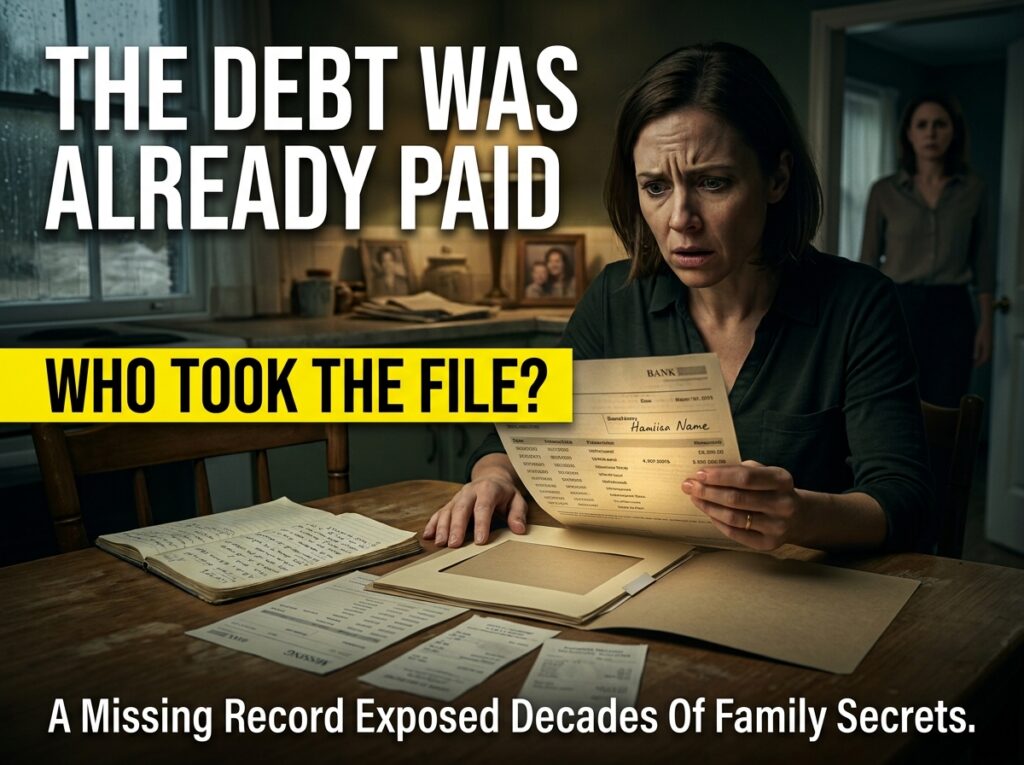
The first thing I noticed was the date.
It appeared halfway down a bank statement among ordinary deposits, household payments, and withdrawals that had once meant nothing more to me than numbers on a page. My mother’s name was printed at the top. The account number matched the records she had kept in a drawer for years.
But the withdrawal had been made on a day when she was supposedly in the hospital, unable to speak.
I checked the date against the small calendar I had saved from that difficult period. I remembered the hospital corridor, the smell of disinfectant, and the sound of nurses speaking quietly outside her room. I remembered sitting beside her bed and asking questions she could no longer answer.
That was not a day I could easily confuse with another.
I placed the statement on the kitchen table and opened the folder containing the rest of her banking documents. Several pages had been folded carefully in half. Others carried notes in her familiar handwriting. She had always believed that keeping records was a form of protection.
“If you know where your money has gone,” she used to tell me, “you can at least ask the right questions.”
I had smiled whenever she said it. I never imagined that one day I would be using her own advice to investigate something that had happened while she lay helpless in a hospital bed.
The withdrawal was not the only unusual entry. A reference number appeared beside it, followed by a notation I could not understand. I searched the remaining statements and found another entry connected to an older account.
That one took me back to the year the river flooded.
Our town had changed after that flood. The river had risen overnight, swallowing gardens, damaging roads, and filling the lower rooms of several houses with mud. People lost furniture, crops, tools, and the savings they had hidden in places they believed were safe.
My family had lost something, too.
For as long as I could remember, relatives had described that year as the beginning of our financial troubles. They spoke about an unpaid loan, a lender who refused to show mercy, and a dispute that divided people who had once trusted one another.
Whenever I asked for details, someone explained that the matter had been settled badly and that there was no reason to reopen it.
I accepted that explanation because everyone repeated it.
Now I was beginning to wonder whether repetition had replaced the truth.
I returned to the statement and studied the withdrawal again. I could not determine who had received the money or why it had been taken. The available copy was incomplete, and the bank would not provide additional information without a formal request.
I submitted one.
Then I gathered the papers and drove to see Margaret, the person who had known my family longer than anyone else I could think of.
Margaret had been my mother’s closest friend for decades. She had attended family celebrations, visited during difficult illnesses, and witnessed arguments that younger relatives were never told about. If anyone remembered what happened before the river flooded, it would be her.
She welcomed me into her sitting room and made tea. I placed the documents on the table between us.
“I need you to look at something,” I said.
She put down her cup.
I explained the withdrawal and showed her the date. I told her about the incomplete reference number and the older record connected to the flood.
Margaret listened without interrupting.
She did not ask whether I had misunderstood the statement. She did not suggest that the bank had made a simple error. She read every page carefully, sometimes returning to an earlier line as though she were comparing it with a memory.
When she reached the final document, she stopped.
For several seconds, she said nothing.
Then she looked directly at me.
“Did you also find the record from the year the river flooded?”
My stomach tightened.
“Why would that record matter?”
Margaret folded her hands.
“Because if you have found the withdrawal, you need to understand what happened to the original debt.”
“What debt?”
She glanced toward the window.
“The one your family was told had never been paid.”
I felt the room become strangely quiet.
All my life, I had believed that debt was the reason our family had fallen apart. I had heard the story from people who claimed to know exactly what happened. I had never imagined that the explanation itself might be wrong.
“Margaret,” I said, “what are you telling me?”
She looked back at the papers.
“I’m telling you that before you accuse anyone of taking money from your mother, you need to find out who continued collecting a debt after it had already been settled.”
<h2>Part 2</h2>
I barely slept that night.
Margaret’s words followed me through the dark hours, repeating themselves whenever I closed my eyes.
A debt that had already been paid.
I had heard the opposite story my entire life. The lender had supposedly demanded payment after the flood. My family had struggled to meet the obligation. The disagreement had grown bitter, and the people involved had eventually stopped speaking to one another.
The debt became the explanation for everything that followed.
It explained why certain relatives stopped visiting. It explained why my mother became uncomfortable whenever someone mentioned the old property. It explained why conversations about money were often ended before anyone could ask a second question.
Now Margaret had suggested that the debt might have been settled before the family dispute even began.
If she was right, someone had built an entire family history around a false claim.
The next morning, I called her.
“You said I needed the record from the flood year,” I reminded her. “Where can I find it?”
“I don’t know whether it still exists.”
“Who would have kept it?”
“Your mother kept copies of many things. So did the lender. There may also have been a record at the local archive.”
“Why didn’t you tell me about this before?”
“Because I was not certain what had happened to the original documents. And because your mother asked me not to repeat things I could not prove.”
“Did she know the debt had been paid?”
Margaret was silent.
“I believe she knew more than she told the family,” she finally said. “But you should not mistake my belief for proof.”
I understood her caution, but it was difficult to remain patient when every new answer seemed to reveal another unanswered question.
I returned to my mother’s house and searched the drawers where she had kept financial records. I found old receipts, bank letters, and handwritten notes about payments made over several years.
Some receipts were faded almost beyond recognition. Others had been preserved in plastic sleeves.
I arranged them chronologically.
The earliest belonged to the period immediately following the flood. They recorded payments made toward the disputed loan. The amounts varied, but the dates were clear.
Then I found a receipt with a handwritten note in the margin.
Final balance received.
I read the words several times.
The receipt bore the lender’s name and an official stamp. It included a reference number that matched the number on another document in my mother’s folder.
I searched for the corresponding payment in the bank statements.
There it was.
The amount and date matched.
For the first time, I had evidence that the family debt might genuinely have been settled.
But the next receipt made the situation more disturbing.
It was dated after the final balance had supposedly been received. It showed another payment made to the same lender, using a reference connected to the original loan.
I checked the dates again.
The payment had not been made before the final settlement. It had been made afterward.
A third receipt showed another payment.
Then a fourth.
The amounts were not identical, but the reference number remained the same.
I carried the papers to the table and began adding the figures. I wanted to know how much money had been collected after the debt should have disappeared.
The total was larger than I had expected.
I did not yet know whether every receipt belonged to the same arrangement, whether the later payments had been properly authorized, or whether some separate obligation had existed. I needed the lender’s records before I could make that determination.
Still, the pattern was unmistakable enough to justify further investigation.
Someone had continued paying money against an account that appeared to have been settled.
I placed each receipt in a separate sleeve and photographed it. Then I contacted the institution identified on the paperwork to ask whether it still held historical records.
The person who answered explained that older files might have been transferred to an archive.
“Can you tell me whether the account was closed after the final payment?” I asked.
“We would need to examine the original file.”
“And if the file no longer exists?”
“Then we would need to establish what other records remain.”
I gave them the reference number.
There was a pause while the employee entered it.
“I can see a historical entry,” she said, “but I cannot confirm the complete payment history from this screen.”
“Does it show that the debt was paid?”
“That would require an examination of the original records.”
I asked how long the search would take.
She gave me a reference number and explained that someone would contact me when the archive team had reviewed the request.
After the call, I returned to the receipts.
They were genuine documents. The dates were consistent. The stamps appeared on several pages, and the handwriting matched the other records.
Yet none of that answered the most important question.
Who had continued collecting money after the debt was paid?
I thought about the withdrawal from my mother’s account on the day she was unable to speak.
Perhaps the two matters were connected. Perhaps they were separate events that only appeared related because the paperwork had survived in the same drawer.
I refused to choose an explanation before I had the evidence.
But when I placed the receipts beside the bank statement, I noticed something that made my hands go cold.
The reference number on the suspicious withdrawal was connected to the same historical account.
My mother’s withdrawal had not merely appeared during a period of illness.
It had been linked, somehow, to the debt our family had been told was never paid.
And if the records were telling the truth, the money had continued moving long after the obligation should have ended.
<h2>Part 3</h2>
The archive called three days later.
I was standing in the kitchen, comparing the receipts with my mother’s handwritten notes, when my phone rang. The number was unfamiliar, but the caller introduced herself as an employee responsible for historical records.
“We have located several entries associated with the reference number you supplied,” she explained. “However, we need to examine the original file before we can provide a complete account.”
“Does the record confirm that the debt was paid?”
“I can confirm that a payment was recorded. I cannot yet confirm the legal status of the account after that payment.”
I gripped the edge of the table.
“What about the later payments?”
“Those entries also appear in the surviving records.”
“So someone kept collecting money?”
“I wouldn’t draw that conclusion yet. We need to establish who received the payments and under what authority.”
Her caution was reasonable. I knew that a sequence of receipts did not automatically establish wrongdoing. But the fact that the later payments existed meant I could no longer dismiss the matter as a misunderstanding.
I asked whether I could inspect the records in person.
She said that an appointment might be possible once the archive review was complete.
Before ending the call, I asked whether the original file had been accessed recently.
“I don’t have that information in front of me,” she replied.
I wrote down the question and her answer.
Then I called Margaret.
She listened while I explained what I had found.
“The receipts are genuine,” I told her. “The lender’s name is on them. The final payment appears to have been recorded, but money continued to be collected afterward.”
Margaret sighed.
“Then the family was not told the whole story.”
“Who knew?”
“I cannot tell you that.”
“Did my mother know?”
“I believe she suspected something. I remember her asking questions about the old debt years after everyone else had stopped discussing it.”
“Why didn’t she tell me?”
“Perhaps she was trying to protect you. Perhaps she was afraid she would not be believed. Or perhaps she did not have enough evidence to make an accusation.”
I looked at the stack of receipts.
“She had evidence.”
“She had pieces of evidence,” Margaret corrected gently. “You are finding out how difficult it is to turn pieces into the whole truth.”
I wanted to argue, but I knew she was right.
That afternoon, I examined the receipts again. Several contained signatures, but the names were abbreviated. One bore a stamp that appeared on documents from the original loan. Another had a different stamp, suggesting that the payment might have been processed through another office.
I made a list of every date, amount, reference number, and signature.
Then I noticed something that I had overlooked.
The payments did not always come from the same person.
Some receipts referred to my mother’s account. Others appeared to have been paid in cash. One carried a notation that matched the handwriting on the suspicious withdrawal record.
The pattern suggested that more than one person had been involved.
I brought the documents to an independent solicitor and explained the history as carefully as I could. I did not name anyone as responsible for the unexplained payments. I simply showed her the records and asked what needed to happen next.
She examined the receipts and compared their reference numbers.
“Your first priority is to preserve the original documents,” she said. “Do not write on them, separate pages that appear to belong together, or allow anyone to take them without a documented record.”
“I have photographed everything.”
“Good. Keep those copies in a separate place. We should also request written confirmation of the account’s payment history and the authority under which each later payment was collected.”
“What if the institution cannot find the original?”
“Then we establish what survives and whether other evidence can support the same conclusion.”
She asked me about the river flood.
I explained the story my family had repeated for years: the damage, the unpaid loan, the financial pressure, and the dispute that followed.
“Did anyone ever show you a statement proving the debt remained outstanding?” she asked.
“No.”
“Did you ever see a legal notice demanding payment?”
“Not until I found the old paperwork.”
“Then we should distinguish what the family believed from what the records actually establish.”
Those words stayed with me.
For decades, I had treated the family’s explanation as a fact because the people telling it had sounded certain. I had never asked to see the documents that supposedly supported it.
Now I was discovering that certainty could survive long after its evidence had disappeared.
Before I left, the solicitor asked me to bring any correspondence concerning the original loan, particularly documents dated around the flood.
I promised to search again.
That evening, I found a folded letter inside an old household account book. It had been placed between two pages and was nearly invisible against the faded paper.
The letter referred to the final settlement.
It also mentioned a person who had attended a meeting shortly before the payment was made.
The person’s name was familiar.
I read the sentence again, then checked the date.
It was the same day my family had always claimed that no agreement could be reached.
Someone had been present at a meeting that supposedly never resolved anything.
And according to the letter, that person had carried away a document that should have remained with the lender.
<h2>Part 4</h2>
I took the letter to Margaret the following morning.
She recognized the handwriting before she finished reading the first paragraph.
“Where did you find this?” she asked.
“In Mum’s old account book.”
She lowered the page.
“I haven’t seen this letter in years.”
“You know who wrote it?”
“I believe so.”
“Who?”
Margaret looked uncomfortable.
“It was written by someone who handled some of the family’s financial arrangements at the time. I don’t want to give you a name until we have established that the document is genuine.”
“The solicitor can examine it.”
“Then let her do that.”
I waited, but Margaret offered nothing more.
I had begun to understand that the older people in my town carried memories they did not always feel entitled to share. Some were protecting themselves. Others believed that repeating an old accusation could cause harm even if it was true.
I could respect their caution, but I could not let caution become another excuse for silence.
At the solicitor’s office, the letter was photographed and added to the evidence file. She compared its contents with the receipts and noted the date of the meeting.
“This may be significant,” she said, “but we need to establish who wrote it, what document was transferred, and whether the transaction it describes is the same one reflected in the bank records.”
“Can we find the person who attended the meeting?”
“We can begin by identifying everyone named in the surviving correspondence.”
She prepared requests for further records and explained how the archive could be asked to preserve any related documents while the investigation continued.
I left with a list of tasks and a feeling that the case was finally moving forward.
For several days, nothing happened.
I continued sorting the paperwork, making notes, and checking the dates. I also tried to speak with relatives who might remember the flood year, but most offered the same explanation: the loan had ruined the family, the argument had been painful, and everyone had eventually agreed to stop discussing it.
When I asked whether they had ever seen the final settlement receipt, they became evasive.
One relative insisted that the lender had never acknowledged full payment. Another said the receipts had been disputed for years. A third claimed that my mother had handled the money herself and therefore should have been the only person questioned about it.
None of them could explain why the surviving documents showed a final balance received.
I did not argue with them. I recorded what each person said and asked whether they could provide documents supporting their recollections.
Most could not.
Then my brother called.
“I hear you’ve been asking people about the flood,” he said.
“Who told you?”
“That doesn’t matter.”
“It matters to me. I’ve told very few people what I found.”
He sighed.
“You need to stop dragging the family into this.”
“I’m trying to establish what happened to the money.”
“The money was part of an old dispute.”
“The debt appears to have been paid.”
“According to some old receipts.”
“And payments continued afterward.”
He did not answer.
I asked whether he had ever seen the original loan file.
“No.”
“Did you know that a document was taken from the meeting?”
“I don’t know what you’re talking about.”
I told him about the letter.
His silence lasted several seconds.
“Where did you get it?”
“In Mum’s account book.”
“Then you should put it back.”
“Why?”
“Because you don’t know what it means.”
“That’s why I’m investigating.”
He lowered his voice.
“Some things were settled for a reason. If you keep pushing, you may discover that the people you think you’re helping were not innocent.”
I felt anger rise, but I forced myself to remain calm.
“Then the evidence should show that.”
He ended the call without answering.
I sat at the table for a long time afterward.
My brother’s warning could have meant that the old dispute involved mistakes on several sides. It could also have meant that he knew something he did not want me to discover. I had no right to choose between those possibilities without evidence.
That evening, I revisited the letter.
The final paragraph mentioned that the person who had carried away the document was expected to return it after the payment was recorded.
There was no confirmation that the return had ever happened.
The solicitor contacted the archive and asked whether the file contained any record of a document being removed or transferred. The request was acknowledged, and I was told that someone would respond after the relevant records had been checked.
The following morning, I received a call.
The employee explained that the archive had located a sign-out sheet associated with the historical file.
“Does it identify the person who removed the document?” I asked.
“It contains a name and a time.”
“Can you tell me who?”
“We need to verify the record before releasing the information.”
I felt my pulse quicken.
“Was the file removed recently?”
“The sign-out entry is dated several years after the original settlement.”
That was all she could confirm at that stage.
After the call, I sat down and wrote the date in my notebook.
Several years after the debt had supposedly been settled, someone had accessed the original file and signed it out.
The next question was whether that person had returned it.
<h2>Part 5</h2>
The archive appointment was scheduled for the following week.
I arrived carrying the receipts, the letter from my mother’s account book, and a written list of questions prepared with the solicitor. I wanted to establish the order of events, determine which documents remained available, and learn whether the original file had been altered or removed.
An archive employee met me in a small consultation room.
She explained that the surviving material had been gathered from several storage locations. Some records were complete; others had been damaged, transferred, or separated from their original folders over the years.
She placed a thin folder on the table.
“This is what we can currently confirm belongs to the account,” she said.
I opened it carefully.
There were copies of payment records, correspondence about the disputed loan, and an index listing documents that had once been stored with the file.
The final settlement appeared in the index.
So did the later payments.
The archive had preserved enough information to establish that both existed, although several pages were missing from the surviving collection.
I pointed to the later entries.
“Why would payments continue after the final balance was recorded?”
“The archive cannot determine the legal reason from these records alone,” she replied. “You would need the institution responsible for collecting the money to explain the authority for those transactions.”
“Does the file show whether the account was closed?”
“Not in the documents available here.”
I turned to the index.
One entry described an original agreement. Another referred to a witness statement. A third was marked as transferred to a separate file.
I asked to see the corresponding documents.
The employee checked the references and returned with another folder.
The witness statement was incomplete. It recorded that someone had attended a meeting during the period of the final settlement, but the page containing the person’s full account was missing.
The index indicated that the statement had once been attached to the original file.
“Was it removed at the same time as the agreement?” I asked.
“We cannot determine that from the surviving pages.”
I pointed to the sign-out sheet mentioned during the telephone call.
The employee retrieved a copy.
There it was: a name, a date, and a recorded time.
I recognized the name immediately.
It belonged to someone who had been part of my life for years, someone who had spoken confidently about the old debt and repeatedly insisted that the matter had already been settled.
I read the entry again.
The time was particularly troubling.
It was the same afternoon that person had claimed to be sitting beside me at a family gathering.
I remembered that day clearly. We had shared a meal, discussed ordinary matters, and spent several hours together. I had no reason at the time to question the account of where anyone had been before arriving.
Now the archive’s record appeared to place that person elsewhere.
I showed the copy to my solicitor, who had accompanied me.
“We need to verify the sign-out procedure and the accuracy of the recorded time,” she said. “An entry is evidence of access, not automatic proof of what happened to a document.”
I nodded.
I did not want another suspicion to become a conclusion before it had been examined.
Still, I could not ignore the coincidence.
I asked the archive employee whether the original file was still in storage.
She checked the inventory, then looked back at me.
“The file was listed in an earlier inventory, but it is not in its assigned location now.”
“Could it have been transferred?”
“There is no complete transfer record.”
“Could it have been destroyed?”
“There is no destruction record that we can locate.”
“Then where is it?”
She looked genuinely troubled.
“We don’t know.”
I sat back, trying to absorb what she had said.
The original file contained the agreement, the witness statement, and potentially the missing information about the final settlement. Someone had accessed it years after the debt was supposedly paid. Now the archive could not locate it.
I asked for a written record of the search and a copy of the sign-out sheet. The employee agreed to provide the available documentation through the proper process.
Before we left, she made one final check of the inventory.
Then she turned toward us.
“I need to tell you something,” she said. “The original file was recorded as present in an earlier inventory. The latest search has not located it.”
My solicitor asked whether the archive could preserve the remaining records and investigate the discrepancy.
The employee agreed.
I left the building with the copy of the sign-out sheet securely documented and the knowledge that the most important evidence had disappeared.
On the journey home, I thought about the person whose name appeared on the record.
I could still remember their face at the family gathering, the way they had smiled when someone mentioned the old debt, and the confidence with which they had claimed that the matter was finished.
I had believed them.
Now I had to find out whether their confidence came from knowing the truth—or from knowing which part of it the rest of us had never been allowed to see.
<h2>Part 6</h2>
I waited until I had discussed the archive findings with my solicitor before contacting the person whose name appeared on the sign-out sheet.
She advised me not to make accusations or reveal every detail of the investigation. The record established that the person had accessed the file, but it did not prove that they had taken it or caused its disappearance.
I understood the distinction.
I also understood that the person deserved an opportunity to explain the entry.
When we finally spoke, I began with a simple question.
“Do you remember visiting the archive several years ago?”
There was a pause.
“Why are you asking?”
“I’m investigating the old family debt. The archive has a sign-out sheet with your name on it.”
Silence followed.
I waited.
“I went there to look at some records,” the person finally admitted.
“Which records?”
“I don’t remember exactly.”
“The file connected to the loan was listed under your name.”
Another pause.
“That was a long time ago.”
“The file is missing now.”
“I had nothing to do with that.”
“I haven’t accused you of anything. I’m asking what happened.”
The person sighed.
“You should leave the matter alone.”
I closed my eyes.
“Everyone keeps saying that. Can anyone explain why?”
“Because the situation was complicated.”
“Then explain it.”
“I can’t.”
“Can’t or won’t?”
The answer came quietly.
“You don’t know what your mother was involved in.”
I felt the familiar shock of hearing someone challenge the version of events I had believed for so long.
“What do you mean?”
The person did not answer.
I asked whether they had known that the debt was paid before the family dispute began.
“I knew there had been a settlement.”
“Did you know money was collected afterward?”
“I don’t know what you’re talking about.”
“Did you see the original agreement?”
“I can’t discuss this over the telephone.”
“Then meet with me and the solicitor.”
“No.”
The call ended.
I sat at the table, trying to separate what I had learned from what I merely suspected.
The person had acknowledged visiting the archive. They had not explained why their name appeared on the sign-out sheet or what they had done with the file. Their refusal to meet did not establish guilt, but it left the central question unanswered.
That evening, Margaret came to see me.
She had heard that the archive had located the sign-out sheet and wanted to know whether I had discovered anything new.
I showed her the documented entry.
She read it, then closed her eyes.
“I was afraid this might happen,” she said.
“What do you mean?”
“I remember your mother saying that the original agreement had been taken away from the file. She was trying to get it returned.”
“When did she say that?”
“Years ago. I don’t remember the exact date.”
“Did she name the person?”
Margaret shook her head.
“She told me that the document was in the hands of someone who believed the family had no right to see it.”
I stared at her.
“Why didn’t you tell me this before?”
“Because I didn’t know who had taken it. I didn’t want to accuse someone based on a conversation I could not verify.”
“Did my mother know the debt had been paid?”
“She believed the receipt was genuine.”
“Then why did she keep investigating?”
“Because the payments continued. She wanted to know where the money was going.”
I looked at the stack of receipts.
The pattern was becoming clearer. My mother had not simply preserved old financial paperwork. She had kept records because she believed the settlement had been followed by unexplained collections.
She had also tried to recover the original document.
“Did she ever find it?” I asked.
Margaret looked down.
“I don’t know.”
I thought of the suspicious withdrawal made while my mother was in hospital. I thought of the archive file that had disappeared and the name on the sign-out sheet.
“Do you think the withdrawal was connected to the debt?”
“I think you need to establish that from the records,” Margaret said. “But I believe your mother was trying to protect something important.”
“What?”
“Perhaps the truth. Perhaps a person who had been blamed unfairly. Perhaps both.”
After Margaret left, I placed the sign-out sheet beside the receipt marked Final balance received.
The two documents had been created years apart, yet both seemed connected to the same unresolved question.
If the debt had been paid, why had money continued to be collected?
And if the original file could prove what happened, why had someone accessed it—and why could the archive no longer find it?
<h2>Part 7</h2>
The next morning, I received a letter from the institution responsible for the old loan.
It acknowledged my request for the payment history and confirmed that the records contained a final settlement entry. It also confirmed that later payments had been recorded under the historical reference number.
However, the letter did not explain who had received those payments or why they had been accepted after the settlement.
The institution requested additional time to examine the remaining records.
I took the letter to my solicitor.
“This is useful,” she said. “It confirms that the final settlement and later payments both appear in the surviving records. It does not yet establish whether the later collections were authorized or improper.”
“Can we recover the money?”
“That depends on who received it, the legal basis for the payments, the dates involved, and what the complete evidence establishes. We should not make a claim until those questions are answered.”
I understood, although part of me wanted to move immediately.
For years, my family had carried the consequences of the disputed debt. If money had been collected improperly, someone might have profited while others believed they were still struggling to repay what they owed.
But I could not undo the past simply by becoming angry about it.
I needed the original file.
The solicitor wrote to the archive requesting a formal explanation of the missing record and the steps taken to locate it. She also asked that the remaining documents be preserved and that the sign-out sheet be examined in context.
While we waited, I continued searching my mother’s belongings.
I found another notebook, smaller than the first, tucked behind a stack of old photographs. It contained dates and brief descriptions of telephone conversations. Most entries were ordinary, but several referred to the lender.
One entry read:
They say the balance remains. The receipt says otherwise.
Another, written months later, said:
Ask for the original. Do not accept another copy.
The final entry was dated shortly before my mother’s hospitalization.
If I cannot explain it myself, let the records speak.
I sat with the notebook open in front of me.
My mother had known that copies could be incomplete. She had understood that a person might dismiss one receipt or question one statement. She had kept multiple records because she believed they would eventually have to be compared.
And she had left them for someone to find.
I photographed every page and added the notebook to the evidence inventory. Then I called Margaret to tell her what I had discovered.
She listened quietly.
“Your mother was tired,” she said. “She had been asking the same questions for years. Every time she thought she was close to an answer, another document would be missing or someone would tell her that the matter had already been settled.”
“Did she ever say she was afraid?”
“Not in those words. But she worried about what would happen if she challenged the wrong person.”
I thought of the withdrawal on the day she was unable to speak.
“Do you think someone used her illness to access the account?”
Margaret took a long breath.
“I cannot tell you that. But if the bank record is accurate, the timing deserves a proper explanation.”
I agreed.
The bank was already examining the transaction. The solicitor had requested the remaining records, and the institution had confirmed that the debt settlement appeared in its historical entries.
For the first time, I had several independent lines of inquiry rather than a collection of family stories.
Then the archive called.
The employee explained that the search had been expanded to include associated files and transfer records. They had not located the missing original, but they had found an additional entry connected to the sign-out sheet.
“Does it identify another person?” I asked.
“It identifies a staff member who processed the file.”
“Can we speak to them?”
“We will need to determine whether the person is available and whether they can provide a formal statement.”
I thanked her.
The additional entry did not solve the mystery, but it suggested that the file’s disappearance might be investigated through more than one source. If someone had processed the sign-out, there might be a record of what happened next.
I informed my solicitor and waited for further instructions.
That afternoon, I received a message from my brother.
We need to talk about Mum’s withdrawal.
I read it several times.
Until that moment, he had refused to discuss the transaction. Now he was raising it himself.
I called him.
“Why do you want to talk about it?”
“I know something I should have told you earlier.”
“What?”
He hesitated.
“The withdrawal wasn’t the first time someone used Mum’s account in connection with the old debt.”
My throat tightened.
“What do you mean?”
“I’ll explain in person.”
“When?”
“Tomorrow.”
The call ended.
I stared at the phone, wondering whether my brother was finally ready to help—or whether he had another reason to make me stop searching.
<h2>Part 8</h2>
My brother arrived the next afternoon carrying a thin folder.
He looked tired. For once, he did not begin by telling me to stop investigating. He sat across from me at the kitchen table and placed the folder between us.
“I should have told you sooner,” he said.
I waited.
He explained that he had seen a reference to another payment years earlier, during a discussion about the family’s finances. At the time, he had believed the transaction was part of the original debt.
He had not questioned it because everyone around him treated the matter as settled.
“When did you see it?” I asked.
“Several years ago.”
“Why didn’t you tell me when I found the withdrawal?”
“Because I thought you would accuse the family before understanding the records.”
“Instead, you told me to stop.”
“I was afraid.”
The admission surprised me.
“Afraid of what?”
He rubbed his hands together.
“Of finding out that the story we grew up with was wrong. Of discovering that someone had lied. And of what that would mean for the people involved.”
I looked at the folder.
“What’s in there?”
“Copies of the papers I saw.”
I opened it.
There were two payment records and a short note describing a conversation about the old loan. The dates were consistent with the period I had been investigating, but the copies were incomplete.
I compared them with my mother’s receipts.
One reference number matched.
Another appeared to correspond with a later collection.
“Where did you get these?”
“They were among papers I kept after the family discussed the old property.”
“Why did you keep them?”
“I didn’t know what to do with them.”
“Did you know the debt had already been paid?”
“Not at the time.”
I examined the documents carefully.
“Did you ever visit the archive?”
“No.”
“Did you know someone had signed out the original file?”
He looked at the sign-out sheet I placed in front of him.
“I knew the person had been involved in the dispute. I didn’t know they had taken the file.”
“Why didn’t you tell me that before?”
“Because I didn’t know whether the record was accurate. I also didn’t want to make an accusation that could destroy the family.”
I thought about the way I had felt when I first discovered the withdrawal. I had wanted someone to tell me what had happened, but I had also feared the answer.
Perhaps my brother had been living with that same fear for years.
“Did Mum know about these payments?” I asked.
“I think she did. I remember her asking questions about the loan, but I never understood why she kept returning to it.”
“She believed the debt had been paid.”
He nodded slowly.
“Then she had a reason to keep asking.”
We spent the next hour comparing the records. My brother could not explain every reference, and some of the dates required confirmation. But his papers supported the possibility that the later payments were connected to the original account.
Before leaving, he looked at me.
“I know I haven’t helped you.”
“No,” I said. “You haven’t.”
He accepted the answer.
“I thought silence would protect everyone. I was wrong.”
I wanted to forgive him immediately, but I could not. His earlier warnings had made the investigation more difficult, and I still did not know what he had understood when he first saw the records.
“Will you tell the solicitor what you’ve shown me?” I asked.
“Yes.”
“Will you provide the original copies?”
He nodded.
After he left, I documented the transfer of the papers and informed the solicitor. She arranged to examine them and determine whether they could help establish the payment history.
That evening, I sat alone with the documents spread across the table.
For the first time, my brother had offered information instead of resistance. His admission did not prove that he was responsible for the withdrawal or the missing archive file. It did establish that the family had possessed more information about the old debt than I had been told.
I returned to the earliest receipt.
The words Final balance received remained clear.
Whatever had happened afterward, the settlement had been recorded.
The question was no longer whether the debt might have been paid. The surviving evidence increasingly supported that conclusion.
The question was why money had continued to be collected, who had benefited, and why the original file had disappeared.
The following morning, the archive contacted my solicitor with a request for a meeting.
They had located a surviving record connected to the staff member who processed the file’s removal.
It might not identify who had taken the original document.
But it could establish what happened immediately before the file vanished.
<h2>Part 9</h2>
The meeting took place in the archive’s administrative office.
My solicitor and I arrived with copies of the receipts, the letter from my mother’s account book, and the sign-out sheet. The archive manager had assembled the surviving inventory records and a statement from the employee who had processed the file years earlier.
The employee remembered the transaction.
They explained that the file had been requested for consultation and recorded as signed out. According to the procedure in place at the time, the file should have been returned to its assigned location or transferred under a documented reference.
Neither record could be found.
“Can you identify the person who requested it?” my solicitor asked.
The employee confirmed the name recorded on the sign-out sheet.
“Did you see the person take the file away?”
“I remember processing the request,” the employee said. “I cannot honestly say what happened after it left my desk.”
“Was the file returned?”
“I don’t remember receiving it back.”
The answer was frustrating, but it was honest. The employee could confirm the procedure and the recorded access, not the ultimate destination of the document.
The archive manager agreed to provide a written statement describing the missing file and the limits of the surviving evidence.
My solicitor thanked everyone and requested copies of the relevant records.
Outside the building, I felt both relieved and disappointed.
We had established that the original file had been accessed and that the expected return could not be documented. But we still could not prove who had caused it to disappear.
I had spent weeks hoping that a single missing document would reveal everything.
Instead, every answer had opened another question.
On the way home, I called Margaret and told her what the archive had confirmed.
“Your mother would have wanted you to keep going carefully,” she said.
“I don’t know how much more I can do.”
“You have already done something important. You have stopped accepting the family story without asking for evidence.”
“But I still don’t know who received the money.”
“Then that is the next question.”
Her calmness helped me more than she knew.
I returned home and began preparing a chronology for the solicitor. I listed the final settlement, the later payments, the suspicious withdrawal, the missing file, and every person who had provided information.
I separated confirmed facts from unverified recollections.
The final settlement was recorded in the receipts and the institution’s historical entries.
Later payments were also recorded.
The bank withdrawal had occurred on the date my mother was reportedly unable to speak.
The archive file had been accessed years later, and the original could not now be located.
The sign-out sheet contained a name I recognized, and the person had acknowledged visiting the archive.
Those were the facts I could support.
Everything else remained under investigation.
That evening, my brother returned with a short written statement confirming what he had told me about the additional payment records. He agreed to provide the originals to the solicitor.
He also admitted that he had once been told not to question the old debt because doing so would reopen a painful family dispute.
“Who told you that?” I asked.
He shook his head.
“I can’t be certain that I remember the conversation accurately. I won’t give you a name unless I can stand behind it.”
For once, I appreciated his caution.
We sat together for a while without speaking.
I thought about our mother, who had preserved receipts and notes while the rest of us repeated a story we had never properly investigated. I thought about the years that had passed while the debt remained part of our family’s identity.
“What if the person who collected the money was someone we loved?” my brother asked.
I looked at him.
“Then the evidence will still matter.”
“And what if the person who was blamed made mistakes, too?”
“Then those mistakes should be acknowledged as well. But they don’t make an unpaid debt out of one that was settled.”
He nodded slowly.
For the first time, I felt that we were asking the same question rather than fighting over who was allowed to ask it.
The next day, my solicitor received another letter from the archive.
The institution had completed an additional review of its historical index and found a reference to a separate document that had once been associated with the missing file.
The description was brief.
It referred to a witness record from the period of the final settlement.
The record had been transferred under a different reference number.
And unlike the original file, its location was still listed in the archive system.
<h2>Part 10</h2>
The witness record was not the complete answer I had hoped to find.
It was a surviving document, but it contained only a partial account of the meeting that had preceded the final settlement. Some information had been recorded in a separate attachment that was no longer available.
Even so, the document gave the solicitor another source to compare with the receipts and correspondence.
She arranged for it to be examined alongside the other surviving records. The institution responsible for the loan was asked to clarify the legal status of the final settlement and explain why later payments had continued to appear in its records.
The bank continued its separate investigation into the withdrawal from my mother’s account.
I had to accept that the two investigations might not reach their conclusions at the same time. They involved different records, different institutions, and questions that could not be answered simply by finding a familiar name on a page.
For weeks, I waited for updates.
I no longer searched my mother’s house in desperation or confronted relatives whenever a new detail appeared. I preserved each document, recorded each conversation, and allowed the evidence to be examined properly.
Some family members continued to avoid the subject. Others admitted that they had repeated the story about the debt without ever seeing proof that it remained unpaid.
Margaret helped me identify people who remembered the flood and the arguments that followed. Their recollections differed, but several confirmed that the dispute had continued long after the recorded settlement.
None could explain the later collections with certainty.
That uncertainty was difficult to live with, but it was better than pretending to know something the evidence did not establish.
One afternoon, I returned to the kitchen and opened my mother’s notebook.
The pages were filled with dates, reminders, and short sentences written in the careful handwriting I had known since childhood. I had once thought of those notes as ordinary household records. Now I saw them as an attempt to preserve a history that other people had allowed to become confused.
My mother had not left me a complete explanation.
She had left me enough to ask the right questions.
I remembered her words about money: if you know where it has gone, you can at least ask the right questions.
For years, I had understood that advice as a lesson in budgeting. Now I understood something more difficult.
Money could be repaid, transferred, or counted. Trust was harder to restore. Once a family accepted a false explanation, every year of silence made the truth more difficult to acknowledge.
I could not recover the years my mother had spent worrying about the old debt. I could not undo the arguments that had divided relatives or make everyone admit what they had believed without proof.
But I could refuse to repeat the same mistake.
I placed the notebook beside the receipts and wrote a new entry on a separate sheet.
The debt appears to have been paid before the dispute began. Later collections remain unexplained. The original file is missing. Further verification is required.
It was not a dramatic conclusion. It did not name a villain or settle every question.
It was simply the truth as I knew it.
And for the first time, that felt like enough to continue.
My mother’s withdrawal remained under investigation. The archive still had not recovered the original file, and the name on the sign-out sheet required further examination. The surviving records offered a path forward, but they did not justify a final accusation.
I would have to wait for the evidence.
That evening, I placed the documents in a secure folder and locked it away. I left my mother’s notebook on the table, open to the page where she had written about asking for the original.
I could almost hear her voice reminding me not to accept an answer merely because it was repeated often enough.
Outside, the town was quiet. The river that had flooded so many years earlier continued moving through the same landscape, carrying water past houses that had been rebuilt and roads that had long since been repaired.
The flood had become a convenient beginning for our family story. It explained the loss, the debt, and the bitterness that followed.
But it could not explain why a recorded settlement had been followed by further collections, why a file had disappeared, or why my mother’s account had been touched when she was unable to speak.
Those questions belonged to the people who had made decisions after the flood, and to the records that might finally reveal what they had done.
I did not know whether my family would ever agree about the past.
I did know that I would no longer confuse a familiar story with a proven fact.
My mother had spent years preserving the evidence. The least I could do was make sure it was examined fairly.
I closed the notebook and turned off the kitchen light.
The truth was not complete, and the investigation was not over. But the silence that had protected the old story for so long had finally been broken.
Whatever the remaining documents revealed, no one could honestly say that the questions had never been asked.
And no one could tell me again that the debt had to remain a mystery simply because our family had grown accustomed to living with it.