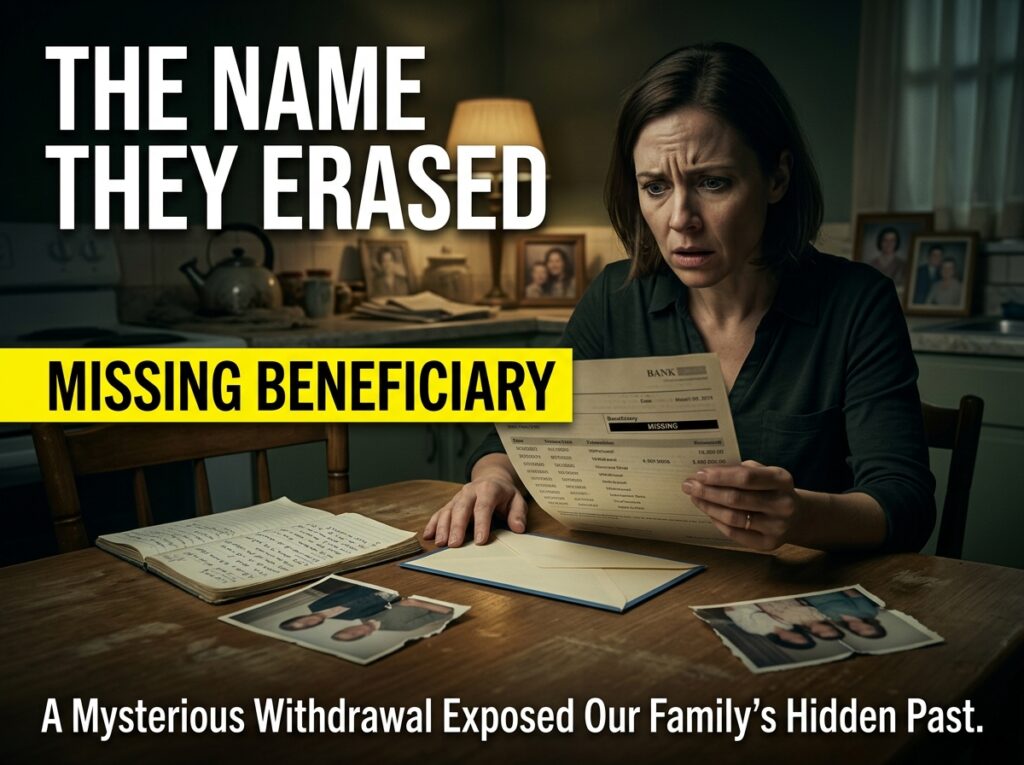
The first time I saw the withdrawal, I thought it was a mistake.
I was sitting at the kitchen table where my mother had spent countless mornings sorting bills, writing shopping lists, and reminding me that a person could survive almost anything if they learned to be careful with money. Her old bank records lay scattered in front of me. Some pages were yellowed at the edges, others were folded along the same lines she had made years earlier.
I had not intended to examine them so closely. I was looking for an ordinary statement, something that might help settle a small question about her remaining accounts. I expected familiar figures, old deposits, and the kind of minor banking errors that could be explained with a telephone call.
Instead, I found a withdrawal dated on the day my mother was supposedly in hospital, unable to speak.
I read the date again.
Then I checked it against the calendar I had kept during those difficult weeks.
There was no mistake. On that day, my mother had been too ill to hold a conversation. I remembered standing beside her hospital bed, watching the rise and fall of her chest, waiting for her to open her eyes and give me some sign that she understood what I was saying.
The doctors had explained that her condition made communication impossible. Even when she seemed to recognize me, she could not answer my questions.
Yet the bank record showed that money had left her account.
I leaned back and stared at the paper.
“Who did this?” I whispered.
The kitchen offered no answer. A clock ticked above the doorway, and outside, a car passed slowly along the road. Everything looked ordinary, which somehow made the discovery more frightening.
My mother had always kept her financial affairs private. She was not secretive in the way people became when they had something shameful to hide. She simply believed that money created arguments, and arguments could destroy relationships that had taken years to build.
Whenever I asked whether she needed help with her accounts, she gave me the same answer.
“Everything is in order. Don’t worry about things you don’t understand yet.”
I used to smile at that sentence. After her death, it became one of the many things I wished I could ask her to explain.
I picked up the statement and examined the transaction details. The amount was large enough to matter, but the recipient’s name was missing from the copy I possessed. There was a reference number, a date, and a short notation that appeared to have been added by hand.
Beside the date was a tiny mark.
It looked like a letter, perhaps an initial, but the ink had faded. I tilted the paper toward the light and traced the shape with my eyes. It was not part of the printed record. Someone had written it after the statement was produced.
I checked the next page. Then the previous one.
The same reference number appeared in a folder containing documents my mother had kept separate from her ordinary bills. Some pages concerned household expenses; others related to an account I barely remembered her mentioning.
At first, I assumed she had simply organized the paperwork in an unusual way.
Then I noticed the envelope.
It had been tucked beneath a stack of statements, its flap pressed down so neatly that I might not have questioned it if I had not recognized the paper. My mother used to buy envelopes in bulk, always choosing the same cream-colored kind with a narrow blue border.
This one was hers.
But it had been opened and resealed.
I lifted it carefully. A faint line of adhesive caught the light. Near the corner, another small handwritten mark matched the one beside the withdrawal date.
Someone had handled these papers after my mother was no longer able to explain them.
I looked toward the hallway, suddenly conscious of how quiet the house had become since her death. For years, I had believed that the worst part of losing her would be the absence of her voice. I had not understood that grief could also leave a person defenseless against unanswered questions.
I gathered the records and placed them back in the envelope.
I would call the bank in the morning. I would ask for the original transaction details, establish who had authorized the withdrawal, and find out whether the missing information could be recovered.
There was no reason to involve the family until I knew something definite.
That was what I told myself.
Before going to bed, I locked the envelope inside a drawer. I checked the lock twice, then stood in the darkened kitchen, trying to convince myself that daylight would make everything less frightening.
But the following morning, when I returned to the drawer, the envelope was no longer arranged the way I had left it.
Someone had opened it.
And beside the date on the withdrawal record, the small handwritten mark looked darker than it had the night before.
<h2>Part 2</h2>
I did not touch the papers immediately.
For several seconds, I stood with one hand resting on the drawer, listening to the house. There was no sound from the hallway, no movement upstairs, and no indication that anyone had entered. The windows were locked. The back door was secure.
I had been the last person in the kitchen the previous evening. I remembered placing the envelope inside the drawer and turning the key.
Yet something had changed.
I removed the records and compared them with the photographs I had taken on my phone. The mark beside the withdrawal date was definitely darker. It might have been an illusion caused by the morning light, but the envelope had also shifted, and the papers inside were no longer stacked in the same order.
I took another photograph.
Then I called the bank.
The woman who answered asked for my mother’s account details and explained that certain records could only be released after identity verification. I answered her questions, supplied the documents she requested, and waited while she checked the transaction.
When she returned, her voice had become more careful.
“I can confirm that a withdrawal was recorded on that date,” she said. “However, the information available to me is incomplete.”
“What does incomplete mean?”
“It means I cannot see the full beneficiary details on this copy.”
“Was the withdrawal authorized?”
“According to the record, yes.”
“By my mother?”
There was a pause.
“I cannot confirm that from the information currently displayed.”
I closed my eyes. “She was in hospital. She couldn’t speak. Her doctors can confirm that.”
“I understand your concern,” the woman replied. “I recommend that you submit a formal request for the archived transaction documents. There may be additional records available.”
“How long will that take?”
“Several working days, depending on the archive.”
Several days seemed an unreasonable amount of time to wait when someone might have taken advantage of my mother’s helplessness. Still, I understood that the woman on the telephone could not simply give me information she was not authorized to release.
I submitted the request.
Before ending the call, I asked one more question.
“Has anyone else requested these records recently?”
She said she could not discuss another person’s banking activity. I thanked her and hung up, feeling that I had learned almost nothing.
That afternoon, I went through my mother’s papers again.
She had left behind a lifetime of ordinary things: receipts folded into small squares, appointment cards, letters from relatives, and notebooks filled with dates. Her handwriting was unmistakable, with the capital letters leaning slightly to the right.
I found a notebook in which she had recorded household expenses alongside brief personal reminders.
Buy flour.
Call the doctor.
Return Margaret’s dish.
Ask about the account.
The last entry was dated several months before her hospitalization.
Beneath it, in smaller handwriting, she had added a sentence.
Make sure the original is kept safe.
I read it three times.
The original what?
The original statement? The original account document? A letter she had never shown me?
I searched the surrounding pages, but there was no explanation. The following entry concerned groceries, and the next was a reminder about a family birthday.
The sentence appeared to have been inserted between ordinary tasks, as though my mother had wanted to remember something important but had not felt able to write it plainly.
I returned to the envelope and examined the handwritten mark. Under a magnifying glass, it looked less like an initial and more like a small symbol beside a date.
I could not identify it.
That evening, I phoned my mother’s oldest friend, Margaret. They had known each other for decades, and Margaret had visited the hospital during the final days.
“Did my mother ever tell you about an unusual bank account?” I asked.
Margaret was quiet for so long that I wondered whether the call had disconnected.
“What makes you ask that?”
“I found a withdrawal made on the day she couldn’t speak. The bank can’t provide the full details.”
“I see.”
“Margaret, do you know anything?”
“I knew your mother kept things to herself.”
“That isn’t an answer.”
“No,” she admitted. “It isn’t.”
I asked whether anyone had visited my mother privately while she was in hospital. Margaret said she had not seen anyone unusual, but she could not be certain. She had not been there every day.
Before we ended the call, she asked me to promise that I would not accuse anyone without evidence.
“I have no intention of accusing anyone,” I said. “I just want to understand.”
“I hope that’s all you want,” she replied.
The words troubled me long after the conversation ended.
The following morning, an envelope arrived from the bank confirming that my request for archived documents had been received. It contained no new information, only a reference number and an estimated processing period.
I placed it beside my mother’s notebook.
For the first time, I wondered whether the withdrawal was not an isolated event at all.
Perhaps the missing details, the altered envelope, and my mother’s cryptic reminder belonged to the same story.
And perhaps someone in my family already knew what that story was.
<h2>Part 3</h2>
I decided to speak to my relatives individually.
A family meeting would have been easier, but I had a growing suspicion that putting everyone in the same room would produce rehearsed answers rather than honest ones. If the withdrawal meant nothing, a few questions should settle the matter.
I began with my older brother, who had always handled practical matters with the confidence of someone who believed every problem could be solved by taking charge.
He arrived at my mother’s house shortly after lunch. He wore the same dark jacket he used for important appointments and looked around the kitchen before sitting down.
“You said this was about Mum’s paperwork,” he began.
“It is.”
I showed him the transaction record.
He glanced at it, then pushed it back across the table.
“Banking errors happen.”
“This wasn’t an error. The bank confirmed the withdrawal.”
“Then somebody authorized it.”
“She was in hospital and unable to speak.”
He rubbed his forehead. “You don’t know what she could or couldn’t do at every moment.”
“I have the medical records.”
He looked at me sharply. “Why are you making this into something bigger than it is?”
“Because the beneficiary’s name is missing.”
For the first time, he stopped moving.
It was a small reaction, barely a second long, but I noticed it. He recovered quickly, asking whether the bank had supplied any other details.
“No,” I said. “That’s why I’m investigating.”
“You should leave it to them.”
“Why?”
“Because you don’t understand banking records.”
“I understand that money left her account while she was hospitalized.”
He stood and walked toward the window.
“Mum hated family arguments,” he said. “She wouldn’t want you digging through old paperwork and accusing people.”
“I haven’t accused anyone.”
“Then don’t start.”
He left shortly afterward, refusing to look at the document again.
I watched him walk down the path, feeling less certain than before. He might simply have been protecting the family from a misunderstanding. He might have known something he did not want to discuss. His reaction proved neither possibility.
Still, I wrote down the date and time of our conversation.
My mother had taught me to keep records whenever money was involved. At the time, I had thought she was being excessively cautious. Now I understood that she might have been trying to protect herself from a situation she could not explain.
That evening, I called my younger sister.
Her reaction was different. She asked whether the bank had made a mistake, whether I had contacted a solicitor, and whether I intended to tell the rest of the family.
When I mentioned the handwritten mark, she became silent.
“What mark?” she finally asked.
I described it.
“I don’t know,” she said quickly. “Maybe Mum wrote it.”
“Have you ever seen it before?”
“No.”
“Are you sure?”
“Why are you asking me like that?”
“Because I need the truth.”
She sighed. “You always do this. You find one little thing and turn it into a mystery.”
“Then help me solve it.”
“I can’t help you with something I know nothing about.”
She ended the call soon afterward.
I sat with the phone in my hand, listening to the empty line. Neither conversation had given me evidence of wrongdoing, but both had left me with the same feeling: the people I loved were more frightened of my questions than of the missing money.
The next day, I visited the hospital where my mother had been treated. I requested copies of the records confirming her condition on the date of the withdrawal.
The staff explained that the documents would have to be retrieved from storage. I completed the forms and waited.
While I was there, I remembered a nurse who had spoken gently to my mother during those final weeks. I asked whether she still worked there.
She did.
When we met, she recognized my face and offered her condolences again. I explained the bank transaction and asked whether my mother had been capable of giving instructions on the day in question.
The nurse listened carefully.
“I remember your mother,” she said. “She was very ill.”
“Could she have communicated with someone privately?”
“Not verbally, as far as I recall.”
“Could she have signed a document?”
The nurse considered the question.
“I wouldn’t want to answer without seeing the exact medical notes. I can tell you that she needed considerable assistance at that stage.”
That was not the absolute confirmation I had hoped for, but it was enough to justify continuing.
Before I left, the nurse asked whether the bank had identified the recipient.
“No.”
She looked down at the papers in her hands.
“Then you should find the original,” she said.
I stopped.
“Why?”
She seemed to regret the words immediately.
“I only mean that copies don’t always tell the whole story.”
“Do you know something about my mother’s account?”
“No,” she answered, meeting my eyes. “But if a name has disappeared from a document, someone should establish whether it was ever there.”
I walked out of the hospital with the feeling that I had come closer to the truth without actually reaching it.
That night, I searched my mother’s house for any reference to an original document.
Behind a row of old folders in her bedroom wardrobe, I found a narrow box containing letters, bank correspondence, and a small key wrapped in tissue paper.
The key had no label.
At the bottom of the box was a note in my mother’s handwriting.
If they say there was never another name, ask who kept the original.
I read the sentence until the words seemed to blur.
Then I realized that my mother had anticipated the exact question I was asking.
She had known the name could disappear.
And she had left me a way to find out who had removed it.
<h2>Part 4</h2>
The small key did not fit any lock in my mother’s house.
I tried the desk, the filing cabinet, the old jewelry box, and a metal case she had once used to store important certificates. Nothing opened.
For a while, I considered taking the key to a locksmith. Then I remembered that my mother had kept a safe-deposit box at a local bank years earlier. I had helped her complete some paperwork, although I could not remember whether she had ever closed the account.
The following morning, I visited the branch.
The building had changed little since my childhood. The same heavy glass doors opened onto a polished floor, and the counter still stood beneath a clock that always seemed to run several minutes fast.
I explained that I had found an old key among my mother’s documents.
The employee examined it and asked for her details.
After checking the records, he requested that I wait while he spoke with the branch manager.
I sat near the window, turning the key over in my palm. It was ordinary in appearance, with a small number stamped near its base.
When the manager finally invited me into his office, he carried a folder.
“Your mother did have a safe-deposit arrangement with us,” he said. “The records are old, and we will need to verify a few things before discussing the contents.”
“Is the box still here?”
“I can’t promise that until we finish the verification.”
He asked for identification and documents establishing my relationship to my mother. I supplied what I had brought, and he made copies.
While he worked, I asked whether the bank had retained historical records relating to the withdrawal.
“Some records are preserved in the archive,” he said. “Others may have been transferred to storage.”
“Would the original beneficiary details be there?”
“If they were recorded and retained, they may be.”
I placed the key on his desk.
“My mother left this with a note telling me to ask who kept the original.”
The manager’s expression changed.
It was not dramatic. He did not gasp or reach for the telephone. He simply stopped writing and looked at the key for several seconds.
“Did she leave any other instructions?”
“No. Just that note.”
He picked up the key, checked the number, and returned it to me.
“We will need to investigate this properly,” he said.
“Why does everyone keep telling me that?”
“Because old financial records can involve complicated legal questions.”
“Or because someone doesn’t want me to know what happened?”
He looked at me with an expression I could not interpret.
“I understand why you’re concerned,” he replied. “But you should not assume that every missing record was deliberately removed.”
“I haven’t assumed anything. I’m asking you to find out.”
He promised to review the archive and contact me.
As I stood to leave, he added one more thing.
“If someone contacts you about these documents, keep a record of the conversation.”
I turned back.
“Why would anyone contact me?”
“I cannot predict what might happen. I am simply advising you to preserve any information you receive.”
Outside, I stood on the pavement, watching people enter and leave the bank. I had come looking for a box and a name. I was leaving with another warning.
That afternoon, my brother phoned.
“Where have you been?” he asked.
“At the bank.”
“What were you doing there?”
I had not told him about the key or the safe-deposit box.
“How did you know?”
He hesitated. “I called Mum’s branch to ask about closing her old accounts. They said you had been making inquiries.”
The explanation sounded possible, but I wondered why he had called them at all.
“I found a key,” I said. “It may belong to a safe-deposit box.”
“Then let the bank deal with it.”
“They are.”
“Good. Don’t try to force your way into something you don’t understand.”
I felt anger rise in my chest.
“Why are you so determined to stop me?”
“I’m not stopping you.”
“You keep telling me to stop.”
“Because this family has already suffered enough.”
Before I could ask what he meant, he ended the call.
I returned to the kitchen and wrote down the conversation. Beneath it, I copied the sentence from my mother’s note.
Ask who kept the original.
The wording bothered me. She had not written, Find the original. She had written, Ask who kept it.
That suggested she had believed someone possessed it.
Someone who might still be alive.
Someone who might have known exactly what happened on the day she was unable to speak.
Late that evening, I received a call from the bank manager. The archive had located an old reference to my mother’s safe-deposit arrangement, but the record was incomplete. They needed additional time to establish whether the box had been transferred or closed.
Before hanging up, he asked whether I still had the original key.
“Yes.”
“Please keep it somewhere secure.”
“Has someone else asked about the box?”
He paused.
“I cannot discuss other customers.”
“That isn’t what I asked.”
“I understand,” he said quietly. “Please keep the key safe.”
After the call ended, I placed it in a sealed envelope and locked it away.
For the first time, I wondered whether the missing beneficiary had not merely been erased from a record.
Perhaps the person had been erased from the family’s memory as well.
And if my mother had left the key for me, she must have believed I would eventually be brave enough to open the door she had spent years keeping shut.
<h2>Part 5</h2>
The bank called three days later.
The manager asked me to return with my identification and the documents establishing my mother’s estate. I arrived early, carrying the key, the notebook, and every paper connected to the withdrawal.
This time, he took me to a room away from the main banking floor.
“We have located an archived reference,” he explained. “It confirms that your mother maintained a safe-deposit arrangement. We are still checking the history of the box.”
“Can I open it?”
“Not until the necessary authority has been confirmed.”
I understood the procedure, but my patience was wearing thin.
“My mother left me the key and a note. She wanted me to ask about the original. What more can I do?”
“Provide the information you have, which you have done. We must also protect the privacy and legal rights of anyone else connected with the records.”
“Anyone else?”
He glanced at the folder.
“The archive contains a reference to another party. The information is incomplete, and I cannot yet tell you more.”
My heart began to beat faster.
“Another beneficiary?”
“I cannot confirm that.”
“But you found another name.”
“I found a reference that requires further investigation.”
I wanted to press him, but I could see that he would not disclose anything until the bank had completed its checks.
I left the room feeling as though I had reached the edge of a locked door and could hear someone moving on the other side.
At home, I began organizing the evidence into separate groups: the withdrawal record, my mother’s notebook, the sealed envelope, the bank correspondence, and the hospital information I had requested.
When placed together, the papers suggested a pattern, although I could not yet explain it.
The withdrawal had occurred on the date my mother was unable to speak. A handwritten mark connected the transaction to an envelope that had been opened and resealed. My mother’s note referred to an original document and someone who had kept it.
None of these details proved that money had been stolen. They did, however, make it impossible to dismiss the incident as a simple error.
I called Margaret again.
This time, I told her about the key.
She sighed.
“I was afraid you would find something like that.”
“Something like what?”
“Your mother once told me that certain matters should be settled before they became family history.”
“Did she mention a beneficiary?”
“No.”
“Did she mention a person who had been excluded from the family?”
Margaret did not answer immediately.
“Why are you asking that?”
“Because the bank found a reference to another party.”
I heard her take a breath.
“There was someone your mother used to write to,” she said at last. “Many years ago.”
“Who?”
“I don’t know the full story. Your mother stopped mentioning the person after a disagreement in the family.”
“What disagreement?”
“I’m not certain. I only remember that she was upset. She told me once that people could make a terrible decision and then spend the rest of their lives defending it because admitting the truth would hurt too much.”
I wrote down every word.
“Did she give you a name?”
“No.”
“Did she tell you where the person lived?”
“No. And I don’t want you to think I know more than I do.”
I believed her, but the conversation gave me a new direction.
I searched the old correspondence in the box I had found in my mother’s wardrobe. Most of the letters concerned birthdays, household matters, and family visits. A few were from people whose names I barely recognized.
At the bottom of the box, I found a small photograph.
It showed my mother standing beside another person outside a building I could not identify. The image was old and faded. My mother looked younger than I had ever seen her in my adult life, and she was smiling in a way that made my chest ache.
The person beside her had been partly cut out of the photograph.
Someone had torn away the right-hand edge, leaving only a fragment of a shoulder and a hand.
On the back, my mother had written a date.
It matched the year of the earliest document in the bank’s archive.
I turned the photograph over again.
Whoever had stood beside my mother had mattered enough to be photographed, but someone had later decided that the person should not appear in the picture.
I placed it beside the withdrawal record.
For the first time, I began to suspect that the missing beneficiary was not merely a name attached to a bank account.
It was someone connected to my mother before the family story I had grown up believing had even begun.
<h2>Part 6</h2>
The following morning, I took the photograph to Margaret.
She was sitting in her living room when I arrived, a cup of tea cooling on the table beside her. I handed her the picture without explaining where I had found it.
She studied it for a long time.
“Where did you get this?”
“Among Mum’s papers.”
She touched the torn edge with one finger.
“I remember this photograph.”
“Who is the person beside her?”
Margaret looked toward the window.
“I don’t know whether I should tell you.”
“Please. Someone has removed a name from a bank record. My mother left instructions about an original document. I need to understand what happened.”
Margaret set the photograph down.
“There was a person who became a source of conflict in your family,” she said. “Your mother did not speak about them openly, but I knew the relationship had mattered to her.”
“Was it a relative?”
“I cannot be certain.”
“Was the person connected to the money?”
“I don’t know.”
Her answers were frustrating, but I could see that she was not inventing certainty to satisfy me. She remembered fragments, not a complete story.
“Why would Mum cut the person out of the photograph?”
“Perhaps she didn’t. Perhaps someone else did.”
That possibility stayed with me on the journey home.
I had assumed that my mother had kept the photograph because she wanted to remember the person. But the torn edge might have been the work of someone else who had searched her belongings.
The envelope had been opened and resealed. The records had been disturbed. The handwriting beside the date had changed—or seemed to have changed.
I began to wonder whether someone had been trying to discover what I had found.
I returned to the bank that afternoon and asked for an update. The manager explained that the archive team had located another reference connected to the original arrangement. It did not contain a complete name, but it confirmed that the transaction had involved more than one party.
“Can you tell me whether the other party was alive?” I asked.
“We have no reliable current information.”
“Then how can I find them?”
“The bank cannot conduct a personal search on your behalf. If you obtain additional identifying information, we can explain the formal process for submitting it.”
I thanked him and left.
At home, I examined the photograph under a magnifying glass. The torn edge had left a few letters from something printed on the back of the original image. I could make out only fragments.
I compared them with the letters on the bank record and the handwritten note.
The writing was not the same.
That mattered. It suggested the photograph had been altered by someone other than my mother, although I could not establish when or why.
I placed the image in a protective sleeve and wrote down its condition before putting it away.
Then I returned to the notebook.
The entry about keeping the original safe was surrounded by ordinary reminders, but I noticed a second detail I had overlooked. On the page opposite it, my mother had written a list of dates. Each was followed by a small mark similar to the one on the withdrawal record.
Some dates were years apart.
One matched the date on the photograph.
Another matched the week my mother had entered the hospital.
I copied the list and checked it against the bank papers. Several dates appeared to correspond with transactions, although the available records were incomplete.
The pattern suggested that the withdrawal might have been one event in a much longer sequence.
I was no longer investigating a single unexplained payment. I was trying to understand why my mother had kept a private record of dates connected to money, why an original document mattered so much, and why someone had altered a photograph.
That evening, I received a call from an unknown number.
I answered, but the caller remained silent for several seconds.
“Hello?”
A man finally spoke.
“You’ve been looking through your mother’s papers.”
My hand tightened around the phone.
“Who is this?”
“You found the bank record.”
“Who are you?”
“Have you found the photograph?”
I said nothing.
The man exhaled slowly.
“Then you need to understand something before you go any further. The person whose name was removed has been waiting a very long time.”
“Waiting for what?”
“For someone in your family to tell the truth.”
The call ended before I could ask another question.
I stood motionless in the kitchen, staring at the phone.
Whoever had called knew about the photograph, the bank record, and my investigation.
And they had spoken as though the missing beneficiary was still alive.
<h2>Part 7</h2>
I did not tell my brother about the call.
I knew that silence could make suspicion worse, but I could not ignore the possibility that someone in the family had already been sharing information about my investigation.
Instead, I wrote down the caller’s exact words and the time of the call. I checked the number, but it did not identify anyone I recognized.
Then I returned to the evidence.
The photograph, the notebook, the altered envelope, and the withdrawal record all pointed toward a person whose identity had been deliberately obscured. Yet I still had no proof of who that person was or what had happened to the money.
I needed the original document.
The bank manager contacted me the next day with an update. The archive had located a reference to a document that appeared to have been associated with the transaction. The document itself was not in the ordinary file.
“Does that mean it was removed?” I asked.
“Not necessarily. It could have been transferred to another archive, retained by a separate party, or recorded under a different reference.”
“Can you tell me who last accessed it?”
“The surviving record does not establish that conclusively.”
I thought of the handwritten mark and the envelope that had been disturbed.
“Could someone have changed the record?”
“We cannot determine that without examining the original and comparing it with the surviving copies.”
I thanked him for his honesty.
For the first time, someone had acknowledged the exact problem I was facing: without the original, I could not prove whether the missing name had been removed deliberately or lost through some other process.
That afternoon, I contacted a solicitor who specialized in estate and financial-record disputes. I showed her the documents and explained the sequence of events.
She listened without interrupting.
“You need to be careful not to draw conclusions before the evidence supports them,” she said. “A missing name is serious, but it does not automatically establish fraud.”
“I understand.”
“Keep the originals secure. Do not write on them, alter them, or give them to anyone without documenting the transfer. Make copies of everything and keep a record of where each document came from.”
I told her about the unknown caller.
“That makes preserving the evidence even more important,” she said. “It doesn’t prove that anyone has done something illegal, but you should not meet an unidentified person alone or hand over documents because someone pressures you.”
I agreed.
Before I left, she asked whether my mother had ever spoken about a person who had been excluded from the family.
I showed her the photograph.
She studied the torn edge and recommended that it be examined alongside the original bank documents if they could be located.
“We need evidence that can be verified independently,” she explained. “Your memories and your relatives’ recollections matter, but the records must be examined on their own terms.”
I returned home with a clearer plan.
The bank would continue searching its archive. The solicitor would help me preserve the evidence. I would investigate the dates in my mother’s notebook without accusing anyone prematurely.
For several hours, the plan made me feel calmer.
Then I found another change.
The protective sleeve containing the photograph had been moved from the drawer where I had placed it. Nothing appeared to be missing, but the sleeve had been turned over, and the photograph was facing the opposite direction.
I checked the drawer, the lock, and the window.
There was no obvious sign of forced entry.
I called the solicitor and told her what had happened. She advised me to document the incident and arrange for the original papers to be stored securely.
I followed her instructions.
That evening, I went through the notebook once more. The dates appeared in several clusters, and beside the final cluster was a sentence written in a hand that looked more hurried than the rest.
If the name is gone, look for the person who remembers the day.
I read it aloud.
The person who remembers the day.
Not the person who had signed the record. Not the person who had received the money. The person who remembered the day.
I began to understand that my mother might have anticipated the possibility that the paperwork would disappear. If so, she had left another way to establish the truth: a living witness.
But who had been present when the withdrawal was made?
Who had known that my mother was unable to speak?
And who could still remember a day that the official records seemed determined to obscure?
Before midnight, I received another message from the unknown number.
This time, it contained an address and a single sentence.
Ask for the person who kept the photograph before it was cut.
<h2>Part 8</h2>
The address belonged to a small office on the older side of town, in a building between a closed travel agency and a shop that repaired watches.
I did not go immediately.
I sent the details to my solicitor and arranged to meet the person during business hours. I also told a trusted friend where I was going and kept copies of the documents separate from the originals.
The next morning, I stood outside the building for several minutes before entering.
The office was narrow and quiet. A desk stood beside a filing cabinet, and a single framed certificate hung on the wall. Behind the desk sat an older man with silver hair and a face that seemed familiar without being recognizable.
He looked up when I entered.
“You found the photograph,” he said.
I felt my stomach tighten.
“Are you the person who called me?”
He nodded.
“Why did you contact me anonymously?”
“Because I wanted to know whether you had found the records before I revealed anything that could make your investigation harder.”
“That doesn’t explain why you know about the photograph.”
He gestured toward the chair opposite him.
“Please sit down.”
I remained standing.
“I want a name. I want to know why money was withdrawn from my mother’s account when she couldn’t speak. And I want to know who removed the beneficiary from the official documents.”
The man looked at me for a long moment.
“I can help you understand the history,” he said. “But I cannot prove everything from memory. That is why the original matters.”
“Do you have it?”
“Not here.”
“Where is it?”
“Safe.”
I felt anger rise.
“Everyone keeps telling me that. My mother wrote it in a notebook. The bank has a reference to it. My family refuses to discuss it. Now you tell me it exists, but you won’t show it to me.”
“I understand your frustration.”
“Then stop speaking in riddles.”
He lowered his eyes.
“Your mother knew that the record could be challenged. She also knew that if the wrong person obtained the original, the person named in it could be harmed again.”
“Who was named?”
“I cannot answer that without showing you the document.”
“Why not?”
“Because the name was removed from the copies for a reason, and I need to be certain you understand what you’re asking before I reveal it.”
I thought of my mother’s hospital bed, the withdrawal date, and the sentence written on the back of the photograph.
“You are not the first person to discover this.”
The man noticed my expression.
“Someone sent you that message?”
“Someone wrote it on a photograph of the document.”
He nodded slowly.
“Then you should know that other people have tried to find the truth.”
“How many?”
“More than one.”
“Did they succeed?”
“Not completely.”
I sat down at last.
He explained that he had known my mother many years earlier, when the original transaction had first been recorded. He had not been responsible for authorizing the withdrawal, and he did not claim to know every detail. What he remembered was a dispute involving a beneficiary whose identity had later become difficult to establish from the surviving records.
“Your mother was afraid of what would happen if the family discovered the full story,” he said.
“Afraid of whom?”
He did not answer directly.
“Fear can come from many places. Sometimes people are afraid of losing money. Sometimes they fear being exposed. Sometimes they are afraid that telling the truth will destroy the people they love.”
I thought about my brother’s reaction and Margaret’s warning.
“Did my mother authorize the withdrawal?”
“The original document may answer that question. So may the witness record.”
“Where is the witness?”
The man looked at me.
“The witness is alive.”
My breath caught.
“Do you know where?”
“Yes.”
“Then tell me.”
“I will, but first I need you to understand something. The person who has been waiting for an apology may not be the person your family has taught you to hate.”
The room seemed to grow smaller.
I remembered the photograph with its torn edge, my mother’s list of dates, and the missing beneficiary. I had imagined a financial dispute, perhaps an act of greed or a betrayal that someone had hidden for years.
Now I wondered whether the story had been reversed from the beginning.
“Who was blamed?” I asked.
The man reached into a locked drawer and removed a plain envelope.
“I can show you the next piece,” he said. “But after you read it, you must decide whether you’re ready to hear the whole story.”
He placed the envelope on the desk between us.
Across the front, in handwriting I recognized from my mother’s notebook, were the words:
For the person who finally asks.
<h2>Part 9</h2>
I stared at the envelope.
The handwriting was unmistakably my mother’s, but the paper was old, and the ink had faded to a soft brown. There was no date on the front, only the sentence and a small mark beside the lower corner.
The man did not encourage me to open it.
Instead, he explained that he had been asked to preserve certain papers until someone from my mother’s family came looking for the original. He had not been given permission to disclose the entire history to just anyone who asked.
“Why me?” I said.
“Because the instructions named you as the person who should receive the explanation if the record could no longer be found through ordinary channels.”
I felt a sudden chill.
“My mother named me?”
“Yes.”
“Why didn’t she tell me?”
“I cannot answer for her.”
I opened the envelope carefully.
Inside was a short letter and a photocopy of a document. The copy contained several lines of text, but the section where the beneficiary’s name should have appeared was partly obscured. Near the bottom was a handwritten notation that matched the mark on my mother’s bank record.
The letter was brief.
It said that the original document must not be treated as valid or invalid until the missing witness had been heard. It warned that the surviving copies did not contain the complete history of the transaction. It also asked that the person named in the original be given the opportunity to speak before any accusation was made.
I read the letter twice.
“Who wrote this?”
“Your mother.”
“Did she know the name had been removed?”
“She suspected that the copies would not remain complete.”
“Then why didn’t she report it?”
The man folded his hands.
“Because the situation was more complicated than a missing name. Your mother believed that an accusation without the original would create another injustice. She was trying to find a way to establish the truth without making the person she wanted to protect vulnerable again.”
I looked at the photocopy.
“Protect from whom?”
He met my eyes.
“From the people who had already decided what the story meant.”
I thought about the way my family had spoken of the past. There were certain names no one mentioned. Certain years were described as difficult, unfortunate, or best forgotten. Whenever I asked for details, someone changed the subject.
I had accepted those silences as ordinary family habits.
Now they seemed deliberate.
“Can I see the original?” I asked.
“Not until the witness agrees to participate and the appropriate arrangements are made. I will not risk losing it.”
“Then how can I verify anything you’ve told me?”
“You shouldn’t accept my word alone. Take the copy to your solicitor. Ask the bank to continue its search. Have the handwriting examined if the original becomes available. Every claim should be checked.”
His answer surprised me. I had expected him to demand my trust, not encourage me to question him.
“Who is the witness?”
He hesitated, then gave me a name.
I recognized the surname, although I could not immediately place it.
The man explained that the witness had known my mother before the family dispute and had been present when the original transaction was discussed. The witness had also tried to contact the family in the years that followed, but the attempts had not led to a resolution.
“Why not?”
“Because the person who wanted to be heard was told that the matter had already been settled.”
“By whom?”
“I cannot prove who gave that instruction. The witness can tell you what happened from their own perspective.”
I placed the letter back in the envelope.
For the first time, I had a name and a possible route to the truth. But I also had to confront the possibility that the story I had inherited was wrong.
My brother had insisted that the matter should be left alone. My sister had dismissed the missing details as a misunderstanding. Margaret remembered a person who had vanished from family conversations.
None of them had offered an explanation that matched the evidence.
I left the office with copies of the letter and the document. The originals remained with the man, who agreed to preserve them while my solicitor arranged the next steps.
On the way home, I called my brother and asked him to meet me.
“I’ve found someone who remembers the transaction,” I said.
His answer came too quickly.
“You shouldn’t be talking to anyone about this.”
“Why?”
“Because you don’t know what you’re getting involved in.”
“Then tell me what I need to know.”
He was silent.
I told him that the bank had located an archived reference, that I had found a letter written by our mother, and that a witness was prepared to explain what had happened.
My brother’s voice changed.
“Where did you get that letter?”
I had not told him that it existed.
I held the phone more tightly.
“How did you know there was a letter?”
He did not answer.
Instead, he said, “You need to stop before you make a mistake you can’t undo.”
Then he hung up.
I stood in the hallway, staring at the screen.
My brother had known about the letter before I had mentioned its contents.
And for the first time, I could no longer believe that his fear was simply about protecting the family from an unnecessary argument.
<h2>Part 10</h2>
I did not confront my brother immediately.
The solicitor advised me to keep the evidence secure and let the formal investigation continue. She arranged to review the photocopy and the letter, and she contacted the bank about the original transaction record.
The bank confirmed that the archive search was ongoing. It could not yet establish who had removed the beneficiary’s name, but it acknowledged that the surviving documents were incomplete.
That answer did not give me the certainty I wanted. It did, however, create a path toward an answer that could be supported by evidence rather than suspicion.
I contacted the witness through the arrangements provided by the man who had preserved my mother’s papers. We agreed to meet with the solicitor present.
The witness was older than I had expected. Their hands trembled slightly as they sat down, but their memory of the day was clear enough to begin explaining the events surrounding the original transaction.
They spoke about a family disagreement, a financial arrangement, and a person who had been promised an opportunity to explain their role before anyone reached a final conclusion. They described how the dispute had grown more painful as the years passed, until silence became easier than admitting that the original account might have been incomplete.
I listened without interrupting.
Some details were consistent with the documents. Others needed further verification. The solicitor asked careful questions, separating what the witness had personally seen from what they had heard from other people.
No one claimed that the entire case had been solved in a single conversation.
That was important.
I had spent days searching for a revelation that would make every confusing detail fall into place. Instead, the truth emerged slowly, one verified piece at a time.
The witness explained that the missing beneficiary had remained alive and had waited for someone in my family to acknowledge the harm caused by the years of silence. They did not ask me to accept every accusation without evidence. They asked only that the original record be examined and that the person named in it finally be allowed to speak.
I thought of my mother in the hospital, unable to answer my questions.
Perhaps she had understood how much damage silence could cause. Perhaps that was why she had left instructions about the original, the witness, and the person who needed to be heard.
I would never know exactly what she had intended to tell me. I could only follow the evidence she had preserved.
In the weeks that followed, the solicitor continued working with the bank and the witness. The original document remained central to the investigation. Until it could be authenticated and compared with the surviving copies, I refused to make a public accusation against any relative.
My brother did not apologize for his reaction. My sister continued to insist that the family should move on. Margaret admitted that she had been afraid of reopening an old conflict, although she could not explain why no one had tried to resolve it properly.
I could not force them to tell me everything they remembered.
I could, however, refuse to repeat their silence.
One evening, I returned to my mother’s kitchen and placed her notebook on the table. The house was quiet, just as it had been on the night I first discovered the withdrawal.
I opened the notebook to the page containing the sentence about keeping the original safe.
For years, I had believed that my mother’s most important legacy was the collection of ordinary things she had left behind: the photographs, the recipes, the handwritten reminders, and the memories of a family that had once gathered around the same table.
Now I understood that her legacy also included the questions she had been unable to answer.
The missing name was not merely an administrative detail. Behind it was a person who had lived with an incomplete story, a family that had repeated that story until it sounded unquestionable, and a woman who had left clues because she feared that the truth might disappear with her.
I could not change the years that had passed. I could not give my mother another chance to explain what she had written. And I could not promise that every relative would accept the findings once the investigation was complete.
But I could make one decision.
I would not allow the missing beneficiary to remain invisible simply because acknowledging the person would be uncomfortable.
I gathered the documents, placed them in a new folder, and wrote the date on the front. Beneath it, I added a sentence of my own:
The truth must be heard before the story can be settled.
Then I closed the folder and placed it beside the notebook.
For the first time since finding the withdrawal, I felt that I was no longer searching blindly. I was following a trail my mother had left behind, one careful step at a time.
I still did not know every answer. I did not know what the original document would ultimately prove, or whether my family would ever agree on what had happened.
But I knew that the person whose name had been removed deserved more than another generation of silence.
And I knew that the apology my mother had been unable to deliver could not begin with another secret.
It had to begin with the truth.