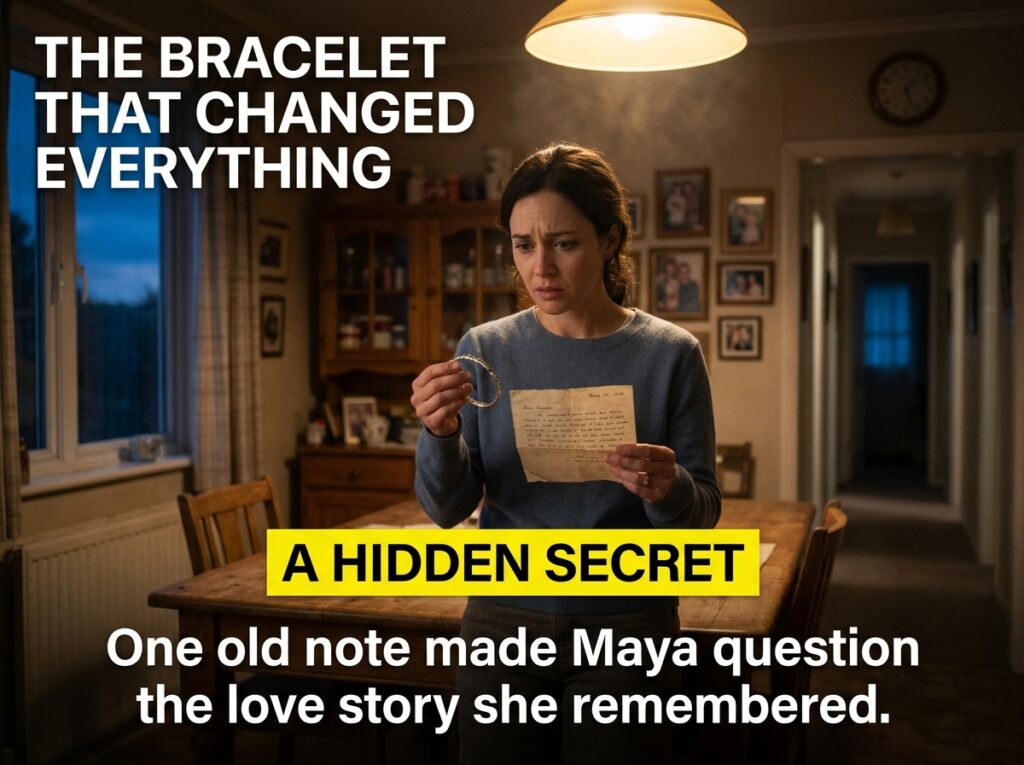
Maya, twenty-seven, had always believed that the worst things in life announced themselves loudly.
A slammed door. A phone call in the middle of the night. A suitcase left beside the entrance. The kind of argument that made neighbors stop talking and listen through the walls.
But the things that changed her life rarely arrived that way.
Sometimes, they appeared in the middle of an ordinary afternoon, when the kitchen smelled of old coffee, unpaid bills lay beneath a fruit bowl, and someone in the next room was asking whether there was enough bread for dinner.
That was how it began in the little house where Maya’s family gathered every Sunday.
The house had never been impressive. Its walls needed painting, the wooden floor creaked near the stairs, and the back door refused to close unless someone lifted it slightly before turning the handle. Yet it was the one place Maya had always associated with safety.
Her mother used to say that a home was not measured by its rooms but by the number of people who still wanted to return to it.
Maya had believed her.
Even after she grew older, found work, and learned that adulthood meant carrying worries nobody else could see, she continued to return to that house whenever life became too complicated.
There were always bills to pay. Someone always needed help. A relative would arrive with a problem and leave with advice, money, or a promise that Maya would try to find a solution.
She had become the dependable one almost without noticing.
At twenty-seven, she was tired in a way that sleep could not always repair. She worried about the household expenses, the future of the people she loved, and the growing number of memories that seemed to belong to a happier version of her life.
But she rarely complained.
Whenever someone asked how she was doing, she answered with the same small smile.
“I’m managing.”
It was easier than explaining that managing and being happy were two very different things.
The one subject she had learned not to discuss was her first love.
His name had once been part of nearly every conversation Maya had about her future. She had imagined the ordinary things with him: a home of their own, arguments over what to cook, quiet evenings after difficult days, and the comforting knowledge that they would grow older together.
Their relationship had not been perfect. They had disagreed, misunderstood one another, and occasionally said things they later regretted. But Maya had believed their love was stronger than those difficulties.
Then, one night, everything ended.
For years, she had carried a version of that breakup that seemed complete enough to live with. She remembered the pain, the confusion, and the awful feeling of being left with questions that nobody wanted to answer.
She had told herself that some relationships ended because two people changed.
She had told herself that love was not always enough.
Most importantly, she had told herself that there was no point reopening a story that had already hurt her once.
Her family had encouraged her to move forward. Some had said she deserved better. Others insisted that the past was past and that she should stop searching for reasons.
Eventually, Maya stopped asking.
She built a life around the silence.
Three weeks before the day everything changed, she had been cleaning the little house after another family gathering. The others had gone home, leaving behind cups on the table, folded chairs near the wall, and the familiar smell of food lingering in the kitchen.
Maya was collecting the last of the dishes when she noticed something beneath a cabinet.
At first, she thought it was a piece of silver-colored wire.
She bent down and reached into the narrow space between the cabinet and the wall. Her fingers brushed against something smooth and cold.
It was a bracelet.
A delicate silver bracelet, slightly tarnished, with a tiny clasp and a small mark near one end.
Maya sat back on her heels.
She knew the bracelet.
Not because she had seen it recently, but because she had spent years trying not to remember it.
She turned it over in her palm, studying the small mark. Her breathing changed. The kitchen seemed suddenly quieter, as if the house itself had noticed what she was holding.
“No,” she whispered.
She looked toward the doorway, half expecting someone to appear and explain that she had mistaken it for something else.
Nobody came.
The bracelet had belonged to the story she thought she had buried.
Maya remembered the final weeks of her relationship, the uncertainty she had tried to ignore, and the night everything fell apart. She remembered believing that she understood what had happened, even though certain details had never quite made sense.
For years, she had dismissed those inconsistencies as the ordinary confusion that followed heartbreak.
Now the bracelet lay in her hand, and the past no longer felt settled.
She searched the cabinet, the drawers, and the narrow gap behind the furniture. She found an old envelope tucked beneath a stack of household papers.
The envelope contained a note.
Its date was the exact day her first love and she had broken up.
Maya read the date twice.
Then she unfolded the paper.
One sentence had been underlined twice.
She stared at the words until they blurred, feeling the first sharp crack appear in the explanation she had trusted for years.
She did not yet understand what the sentence meant. She did not know who had written it, why it had been hidden, or how the bracelet had ended up in her family home.
But she understood one thing.
Someone had kept a piece of that night.
And someone had wanted it found.
<h2>Part 2</h2>
Maya carried the note upstairs and locked the bedroom door.
She could hear the refrigerator humming below her. A motorcycle passed outside, followed by the distant sound of children playing in the street. Ordinary life continued around her, completely unaware that the past had just returned.
She placed the bracelet beside the note and examined both objects under the desk lamp.
The bracelet was simple, the sort of jewelry someone might wear every day without thinking about it. Yet Maya remembered the way it had caught the light when its owner moved a hand while talking.
She remembered more than she wanted to.
She remembered the final weeks of her relationship, when conversations had become shorter and silences had grown longer. She remembered asking whether something was wrong and being told that everything was fine.
She remembered the breakup itself.
Most of all, she remembered how quickly the explanation had become fixed in everyone’s mind.
It had been presented as a painful but straightforward ending. There had been no reason to investigate, no reason to ask questions, and certainly no reason to keep returning to the same memories.
Maya had accepted that explanation because she had been exhausted. She had needed something definite, even if it hurt.
Now the note made that certainty feel foolish.
She unfolded it again.
The handwriting was neat, with letters that leaned slightly to the right. The paper had softened along its folds, and the ink had faded in places. Whoever had written it had done so carefully, as if the words mattered enough to preserve.
Maya read the underlined sentence once more.
It did not explain the breakup. It did not offer an apology. It simply pointed toward something that had happened that night, something she had never been told.
She checked the other side of the paper.
Nothing.
She held it against the light, hoping to see writing pressed into the fibers. There were faint marks, but no hidden message she could confidently read.
Her first instinct was to call her mother.
The thought stopped her.
Her mother was no longer there to answer the questions Maya had carried into adulthood. She had left behind photographs, recipes, familiar expressions, and a hundred small memories that seemed harmless until Maya looked at them differently.
The little house had preserved more than furniture and old papers. It had preserved the things nobody had known how to throw away.
Perhaps the note had been forgotten.
Perhaps the bracelet had been lost years ago.
Perhaps there was a simple explanation that would make her feel foolish for being frightened.
Maya wanted that to be true.
She put both objects in a drawer and tried to sleep.
The next morning, she woke before sunrise. She had dreamed about the night of the breakup, although the dream had been incomplete. She could remember a voice calling her name, a door closing somewhere, and the uncomfortable feeling that she had arrived too late to understand something important.
She made coffee and sat at the kitchen table.
The note remained in her mind.
By midmorning, she had decided to ask the people who had known her first love best. She would not accuse anyone. She would not make dramatic claims about hidden secrets. She would simply ask whether they remembered the bracelet.
Her first call went unanswered.
The second person listened to her question and then laughed nervously.
“Why are you asking about that now?”
“Because I found something.”
“What did you find?”
“A bracelet.”
There was a pause.
“Lots of people lose things, Maya.”
“This one belonged to someone I knew.”
“Then return it if you can. Don’t turn it into something it isn’t.”
The conversation ended shortly afterward.
Maya stared at her phone.
She had expected surprise, perhaps discomfort. What she had not expected was the immediate effort to stop the conversation before it had properly begun.
She tried another relative.
This time, the person asked whether Maya had been sorting through her mother’s belongings.
“Some of them,” Maya answered.
“Then be careful. There are things in that house that have nothing to do with you.”
Maya felt her stomach tighten.
“Why would you say that?”
“I mean old family matters. Things that are better left alone.”
“Like what?”
“I’m busy, Maya. We can talk another time.”
The call ended.
Maya sat motionless, listening to the silence that followed.
Two people had responded to a simple question as though she had touched something dangerous.
She looked toward the cabinet where she had found the bracelet. For the first time, she wondered whether it had been hidden there deliberately.
That afternoon, she returned to the note and examined the handwriting again.
A small mark appeared beside the date. It might have been an accidental stroke of the pen, but its placement seemed deliberate. She remembered seeing a similar mark in an old photograph, although she could not recall where.
She searched through a box of family photographs.
There were birthdays, holidays, school ceremonies, and Sunday gatherings. Her younger self appeared in several pictures, smiling beside people she had not seen in years.
Then she found a photograph taken around the time of the breakup.
The people in it looked ordinary. Nobody appeared angry. Nobody seemed frightened. Yet Maya noticed that one person had been standing farther away from the others than she remembered.
She turned the photograph over.
There was no caption, only a date.
It was the same date written on the note.
Her phone vibrated.
A message had arrived from an unknown number.
“Please don’t decide anything until you hear what happened that night.”
Maya read it once.
Then again.
Her fingers grew cold around the phone.
Whoever had sent it knew about the night she had spent years trying to forget.
And whoever it was had been waiting for her to ask the right question.
<h2>Part 3</h2>
Maya did not reply immediately.
She placed the phone on the table and walked to the window, trying to calm the thoughts racing through her mind. The street outside looked exactly as it always had. A neighbor carried groceries into her house. A delivery rider stopped near the corner. Somewhere nearby, someone was playing music.
Nothing had changed in the world.
Everything had changed inside Maya.
She returned to the table and typed a short message.
Who is this?
The reply did not arrive at once.
For several minutes, she watched the screen, feeling foolish for expecting an answer from someone who had contacted her anonymously. Then the phone vibrated.
“Someone who remembers that night.”
Maya swallowed.
“What happened?”
“Not by text.”
“Then tell me where to meet you.”
The answer came quickly.
“Tomorrow. The old bus shelter near the river. Four o’clock. Come alone.”
Maya looked at the message for a long time.
The river had always been part of her family’s life. In childhood, she had gone there with relatives on hot afternoons. Later, it became a place where people walked when they needed to think. The river had flooded years earlier, damaging homes and forcing families to rebuild.
Her family rarely discussed that flood except to mention how difficult the recovery had been.
Maya had never connected it to her breakup.
She put the phone away and spent the rest of the afternoon trying to work. Every task seemed to end with her staring into space, replaying old conversations and wondering whether the people she trusted had known more than they had admitted.
At dinner, a relative called to ask about her weekend.
Maya answered normally.
She listened to stories about work, groceries, and a neighbor’s new car. She even laughed at the appropriate moments. But when the conversation turned to the old house, the relative asked whether she had found anything unusual while cleaning.
Maya froze.
“I found some old papers,” she said carefully.
“What kind of papers?”
“Nothing important.”
The silence on the other end lasted a fraction too long.
“Good,” the relative replied. “Some things should stay where they are.”
After the call, Maya sat alone in the kitchen.
She had not told anyone about the note.
She had not mentioned the bracelet.
Yet people were beginning to ask questions.
That night, she gathered the objects and placed them inside a plain folder. She included the photograph, the note, and a page where she wrote down everything she remembered about the breakup.
She forced herself to separate facts from assumptions.
Fact: the bracelet had been found in the family house.
Fact: the note carried the date of the breakup.
Fact: one sentence had been underlined twice.
Fact: several relatives had reacted strangely when she asked about it.
Everything else remained uncertain.
It was a small list, but it gave her something solid to hold on to.
The following afternoon, Maya arrived at the river early.
The old bus shelter stood beside a narrow road, its faded paint peeling away from the metal frame. Beyond it, the river moved slowly beneath a gray sky. A few people passed in the distance, but the area was otherwise quiet.
Maya checked her phone.
Four o’clock.
She waited.
At first, she heard only the wind moving through the trees. Then she noticed someone standing on the opposite side of the road, watching her.
The person was older than Maya, perhaps in their late fifties or early sixties, dressed in a dark coat and holding a small brown envelope.
They approached slowly.
“You came,” the stranger said.
“You asked me to.”
The stranger looked at the folder beneath Maya’s arm.
“You found the bracelet?”
Maya tightened her grip.
“How do you know about it?”
“Because I knew it would eventually turn up.”
“Who did it belong to?”
The stranger glanced toward the river.
“That depends on which part of the story you believe.”
Maya felt frustration rising through her fear.
“I have spent years believing one version. Now people are telling me not to ask questions, and someone sends me messages as though I am supposed to understand a secret nobody will explain. I need a straight answer.”
The stranger nodded, as if the words confirmed something.
“Then you need to know what happened before the breakup. Not just what happened during it.”
Maya waited.
The stranger opened the envelope and removed a folded sheet of paper. It was an old photocopy, its edges worn and its text faded.
“This was written shortly before that night,” they said. “Your family was involved, although you may not have known it.”
Maya looked at the paper without touching it.
“What does my family have to do with my relationship?”
The stranger met her eyes.
“Your family knew something about the person you loved. And someone made a decision that changed what you were allowed to know.”
Maya’s heart began to pound.
“Who?”
Before the stranger could answer, a vehicle slowed on the road behind them.
The stranger’s expression changed.
They folded the paper and pushed it into Maya’s hand.
“Go home,” they whispered. “And don’t tell your family you met me.”
“Wait. You haven’t told me anything.”
“I have told you enough to understand that you’re not the only person who wants this story to remain buried.”
The vehicle stopped.
The stranger stepped away.
Maya turned toward the road, but when she looked back, the stranger was already moving down a narrow path beside the river.
She was left holding the photocopy.
And on its final line, she recognized the same small handwritten mark that appeared beside the date on the note.
<h2>Part 4</h2>
Maya returned home with the photocopy hidden inside her folder.
She did not know whether the stranger had been protecting her or using her. The meeting had answered almost none of her questions, yet it had made one thing impossible to ignore: the breakup had not happened in isolation.
Someone had connected it to her family.
Someone had also been watching her search.
She locked the front door and spread the papers across the kitchen table.
The photocopy appeared to be part of a longer document. Several lines were unreadable, and a corner had been torn away. What remained referred to a conversation, a date, and a decision that had been made before a certain person was allowed to speak.
The wording was formal, unlike the note she had found in the house.
Maya copied the visible details into her notebook.
Then she looked again at the photograph.
The person standing apart from the others had been someone she remembered vaguely from childhood. They had attended family gatherings for a time and then disappeared from the family’s social circle.
Maya could not remember anyone explaining why.
She searched old messages and found a relative’s contact information. After several minutes of hesitation, she called.
“Do you remember the people who used to come to the house when I was younger?” she asked.
“Which people?”
“The ones who stopped visiting.”
There was a long pause.
“Why are you asking about them?”
“I’m trying to understand something.”
“Understand what?”
Maya nearly told the truth. Instead, she asked whether the relative remembered a person connected to the date on the photograph.
The response was immediate.
“You should leave that alone.”
“Why does everyone say that?”
“Because you don’t know what you’re getting into.”
“Then explain it to me.”
“I can’t.”
“Or you won’t?”
The relative ended the call.
Maya lowered the phone slowly.
She had spent much of her life believing that families protected one another by keeping difficult things private. She had seen that silence as kindness, a way to prevent old pain from spreading into the present.
Now she wondered whether silence had protected the wrong people.
She contacted an older family friend who had known her mother for decades. The woman agreed to meet the next morning, but only after Maya promised not to bring anyone else.
They met at a small café near the market.
The woman arrived carrying a handbag and wearing the same cautious expression Maya remembered from childhood. She listened while Maya described the bracelet and the note, leaving out the stranger’s identity because she did not know it.
When Maya finished, the woman stared into her tea.
“Your mother worried about that night,” she said.
Maya felt the words land heavily.
“She never told me.”
“She thought she was protecting you.”
“Protecting me from what?”
The woman pressed her lips together.
“There were disagreements. People believed they knew what was best for you. Some thought your relationship would cause trouble for the family.”
“Who thought that?”
“I cannot tell you everything I remember. It would not be fair to people who are no longer here to explain themselves.”
Maya’s frustration sharpened.
“But it is fair to leave me with a story that might be a lie?”
The woman looked up.
“No. It isn’t.”
For the first time, Maya sensed genuine regret rather than simple fear.
The woman reached into her handbag and removed a small notebook.
“Your mother wrote things down,” she said. “Not everything. Just dates and reminders. She was afraid she might forget details that mattered.”
Maya recognized the notebook immediately. Her mother had used similar ones for shopping lists, birthdays, and household expenses.
“Where did you get this?”
“Your mother gave it to me years ago. She asked me to keep it safe, but she never explained when I should give it back.”
Maya opened the notebook.
Most pages contained ordinary entries: appointments, payments, reminders to call relatives. Near the middle, she found the date of her breakup.
Beside it was a brief sentence.
If Maya ever asks, tell her to look at the original.
Maya read it aloud.
“The original what?”
The older woman shook her head.
“I don’t know. I asked your mother once, and she told me that the answer would only make sense when the right person came forward.”
Maya turned the page.
A name had been written in the margin, followed by a telephone number that was no longer complete.
She recognized the surname.
It belonged to the person she had loved.
Before she could ask another question, the woman reached across the table and closed the notebook.
“There’s something else,” she said. “Your mother wasn’t the only person trying to preserve the truth.”
Maya looked at her.
“Who else?”
The woman hesitated, then whispered a name.
It was the name of the relative who had told Maya to stop asking questions.
<h2>Part 5</h2>
Maya left the café with her mother’s notebook pressed against her chest.
The name had followed her all the way home.
She remembered the relative’s kindness, the meals they had shared, and the times they had offered advice when Maya was struggling. It was difficult to place those memories beside the possibility that the same person had helped conceal something important.
She wanted to believe there was an innocent explanation.
Perhaps the relative had misunderstood the situation. Perhaps they had been trying to prevent another painful argument. Perhaps the older family friend had misremembered the conversation.
But the notebook contained her mother’s handwriting.
The date was real.
And the note beside it had been written long before Maya discovered the bracelet.
That evening, Maya called the relative.
“I need to ask you something about my mother.”
“Is something wrong?”
“I found an old notebook. It mentions the night my relationship ended.”
The silence was brief, but unmistakable.
“Where did you get that?”
“Why does that matter?”
“Because you shouldn’t be reading things without understanding the circumstances.”
“Then help me understand them.”
The relative sighed.
“Your mother was under a lot of pressure at that time. She worried about you. She did what she thought was right.”
“What did she do?”
“I don’t want to discuss this over the phone.”
“Then let’s meet.”
“Not now.”
“Tomorrow?”
Another pause.
“Fine.”
They agreed to meet at the family home.
Maya spent the rest of the evening organizing the evidence. She placed the note beside the photograph, copied the visible text from the photocopy, and made a list of questions.
She did not intend to accuse anyone without proof.
But she would no longer accept vague warnings as answers.
The following afternoon, the relative arrived carrying a box of groceries. They set it on the counter as though this were an ordinary visit, then glanced at the papers spread across the table.
“You have been busy,” they said.
“I have been trying to understand what happened.”
The relative pulled out a chair.
“Sometimes understanding everything doesn’t make life better.”
“Maybe not. But it might stop me from blaming the wrong person.”
That made them look up.
Maya placed the photograph between them.
“Do you remember this day?”
The relative studied it.
“Yes.”
“Who was standing beside the window?”
“I don’t remember.”
“You knew them.”
“I said I don’t remember.”
Maya took a breath.
“Why did you tell me to stop searching before I told you what I had found?”
The relative’s face tightened.
“I was worried about you.”
“Worried that I would discover something?”
“Worried that you would reopen an old wound.”
“Whose wound?”
For a moment, the relative seemed close to answering. Then they looked toward the kitchen window.
“Your mother made a difficult decision,” they said. “She believed it was the only way to protect you.”
“From my first love?”
“From what was happening around that relationship.”
“What was happening?”
“I cannot give you an answer that would satisfy you.”
“Because you don’t know, or because you don’t want to?”
The relative stood.
“You are turning this into something ugly.”
“No,” Maya replied. “I’m trying to find out whether it was already ugly.”
The words remained between them.
The relative picked up their coat and moved toward the door.
Before leaving, they turned back.
“If you find the original, do not assume that the person who kept it was trying to help you.”
Maya’s heart skipped.
“What original?”
The relative’s expression changed.
For one brief second, Maya saw fear.
Then the door closed.
She stood alone in the hallway, replaying the warning.
The original.
Her mother’s notebook had referred to it. The stranger had referred to a document. The relative had reacted as though the object were dangerous.
Maya returned to the kitchen and opened the folder.
The photocopy contained a partial reference number. She compared it with the date and the small handwritten mark, then searched the family papers for anything carrying the same details.
After an hour, she found a receipt tucked inside an old address book.
It showed that a document had once been stored at a records office.
The receipt was faded, but the office name was still legible.
Maya called the number listed on the paper.
A clerk answered.
She explained that she was trying to locate an old family document and read out the reference number.
The clerk asked her to wait.
When the line returned, the clerk’s voice had changed.
“That file is not available for public inspection.”
“Why not?”
“Because it was removed from the archive.”
“Who removed it?”
“I cannot discuss that over the telephone.”
Maya gripped the edge of the table.
“Can I make an appointment?”
Another pause followed.
“Yes,” the clerk said. “But you should know that someone else has already requested access.”
<h2>Part 6</h2>
Maya arrived at the records office the next morning with the receipt, her mother’s notebook, and copies of every document she had found.
The building stood between a pharmacy and a small accounting firm. Inside, the air smelled of paper and floor cleaner. A wall clock ticked above the reception desk, and shelves of labeled folders filled the corridor behind the counter.
A clerk led Maya into a narrow consultation room.
“I understand you’re asking about an old file,” the clerk said.
“Yes. I was told it had been removed.”
“That is correct.”
“Can you tell me why?”
The clerk folded their hands.
“The record was placed under restricted access many years ago. The original is not currently held in this office.”
“Where is it?”
“We don’t know.”
Maya stared at the clerk.
“How can a public record disappear without anyone knowing where it went?”
“It was signed out for safekeeping. The person who collected it was authorized at the time.”
“Who was that person?”
The clerk glanced at the documents.
“I cannot release that information without confirming the file’s status.”
Maya felt the old frustration returning. Every institution seemed to have a reason to withhold the very detail she needed.
She placed her mother’s notebook on the table and showed the clerk the entry referring to the original.
“I am not asking you to accuse anyone. I am asking you to tell me what I am allowed to know.”
The clerk studied the handwriting.
After several minutes, they left the room.
When they returned, they carried a thin folder.
“This is a copy of the access log,” the clerk said. “It does not contain the original document, but it records the last time the file was signed out.”
Maya opened the folder.
The entry included a date, a signature, and a reference to an authorized representative.
The signature looked familiar.
She read the name.
It belonged to the relative who had visited her the previous day.
For several seconds, she could not speak.
The clerk watched her carefully.
“Do you know this person?”
“Yes.”
“Then I suggest you consider what you want to do before confronting them. There may be legal implications, depending on the contents of the document and why it was removed.”
Maya took photographs of the access log where permitted and requested a certified copy of the available records. She thanked the clerk and left the office feeling as though the ground beneath her had shifted.
The relative had not merely known about the past.
They had physically handled the file that might explain it.
Maya walked to a nearby bench and called the older family friend.
“I found the access log,” she said.
“Did you find the original?”
“No. But I know who took it.”
The woman was silent.
“Does the name surprise you?” Maya asked.
“No,” the woman finally replied. “Not completely.”
Maya closed her eyes.
“Why didn’t you tell me?”
“Because I did not know whether the person still had it. And because your mother asked me not to make accusations without evidence.”
“Did she know who took it?”
“I believe she suspected.”
Maya looked down at the documents in her lap.
“What was in the original?”
“I never saw it.”
“Then how can you help me?”
The woman took a breath.
“Your mother once said that the document would show who had spoken for you when you were not allowed to speak for yourself.”
Maya felt a chill move through her.
“What does that mean?”
“I don’t know. But I remember something else. Your mother said the decision had been presented as a choice, even though you had never been given the chance to make it.”
Maya thought of the breakup.
She remembered how quickly the conversations had ended, how certain people had told her what she should believe, and how little space she had been given to ask questions.
She had assumed she was being treated like an adult who needed to accept a painful reality.
What if someone had decided what reality she was allowed to see?
Maya returned home and called the relative again.
This time, the call went to voicemail.
She sent a message.
I know you signed out the original file. I need to speak with you.
No answer came.
An hour later, her phone rang from an unknown number.
Maya answered cautiously.
“Hello?”
A familiar voice spoke.
It was the person who had met her beside the river.
“You found the access log,” the stranger said.
Maya stood.
“How did you know?”
“Because I told you where to look.”
“You knew the relative had taken it?”
“I knew someone in your family had it. I did not know whether it was the same person.”
“Then tell me what the document says.”
“I cannot. I have never seen the complete original.”
Maya felt anger rise.
“Everyone knows part of this story, and nobody will tell me the whole thing.”
“Because the whole thing belongs to more than one person.”
“What am I supposed to do?”
The stranger answered quietly.
“Find the person who wrote the note. They are still alive.”
Maya’s throat tightened.
“Who wrote it?”
The stranger gave her a name.
It was the name of her first love.
<h2>Part 7</h2>
Maya did not sleep that night.
She sat beside the window with the bracelet and the note on the table, wondering how many years she had spent grieving a story that might never have been complete.
Her first love had written the note.
That possibility changed the meaning of everything she had found.
The handwriting was still uncertain, but the stranger had spoken with enough confidence to make Maya question every assumption she had carried since the breakup.
She remembered the final conversation between them.
She remembered asking whether there was someone else.
She remembered the answer, the silence that followed, and the way she had tried to interpret his expression.
At the time, she had believed she was watching someone decide to leave her.
Now she wondered whether he had been trying to tell her something he could not say.
The next morning, Maya searched through her old belongings. She found a box of letters, greeting cards, and photographs that she had kept despite telling herself she no longer needed them.
Most were ordinary.
One envelope contained a short handwritten note from the year they separated. It had no date, but the paper and handwriting resembled the note found with the bracelet.
Maya compared the two.
Certain letters were formed in the same distinctive way. The lowercase r leaned forward, and the final stroke of each signature curved slightly upward.
She could not call it proof, but she could no longer dismiss the connection.
She searched for his current contact details.
The number she had saved years ago no longer worked. A social media profile appeared to belong to someone with the same name, but it contained little information. Maya hesitated before sending a message.
What would she say?
I found the bracelet.
I found the note.
Did you leave me because you wanted to, or because someone made the decision for us?
Every version sounded too small for the years that had passed.
Eventually, she wrote a simple message.
I need to ask you about the night we broke up. I found something that may belong to you.
She sent it.
Then she waited.
An hour passed.
Then two.
By evening, there was still no reply.
Maya tried to continue with her work, but she found herself checking the phone every few minutes. She hated the way the uncertainty brought back feelings she had worked so hard to put away.
At eight o’clock, a message arrived.
Where did you find it?
Maya answered honestly.
At the family house.
The reply took longer this time.
Do not show it to anyone else yet.
Her heart began to pound.
Why?
The answer appeared.
Because the bracelet was not the only thing left there.
Maya stood so quickly that her chair scraped against the floor.
She looked around the kitchen, suddenly aware of the cupboards, drawers, and old furniture that had been part of her life for as long as she could remember.
What else was left? she typed.
No answer came.
She called the number associated with the profile, but the call was declined.
A final message arrived.
Meet me tomorrow. I will explain what I can.
Maya stared at the screen.
She wanted to ask a hundred questions. She wanted to demand why he had waited so long and why he had allowed her to believe the relationship had ended for reasons she could never understand.
But she knew that anger alone would not reveal the truth.
She placed the phone beside the folder and opened her mother’s notebook again.
The entry about the original was followed by a second sentence she had overlooked.
The truth must be heard from the person who was there.
Maya read it twice.
Her mother had not written that she should trust the document alone. She had written that the truth needed a witness.
Perhaps the missing file was important because it recorded what had happened. Perhaps the people who had kept it hidden were afraid of what it proved.
Or perhaps the document contained only part of the story, and the person who had lived through the night was the only one who could explain the rest.
The next afternoon, Maya arrived at a small café on the edge of town.
She chose a table near the window and kept the folder closed beside her.
At three minutes past the agreed time, the door opened.
Her first love walked inside.
For a moment, Maya saw the person she remembered: the familiar way he scanned the room, the slight pause before he approached, the expression that once had made her feel as though she was the only person in the world.
Then he reached the table, and she noticed the years that had passed.
He looked older, more tired, and uncertain of what to say.
“Maya,” he began.
She did not stand.
“You wrote the note.”
He looked at the folder.
“Yes.”
“Why did you leave it in my family home?”
“I didn’t.”
The answer silenced her.
He pulled out the chair opposite her but did not sit until she nodded.
“I left it with someone who promised to give it to you when you were ready to know the truth,” he said. “I never knew whether they kept that promise.”
“Who?”
He looked toward the window.
“Your mother.”
Maya felt her eyes sting.
“My mother had it all these years?”
“I believe she did.”
“Then why didn’t she tell me?”
He looked back at her.
“Because she was afraid of what would happen if you knew who had made the decision that ended our relationship.”
Maya’s hands tightened around the folder.
“Who made it?”
He hesitated.
Then he said the name of the relative who had signed out the original file.
<h2>Part 8</h2>
Maya had imagined many versions of this conversation.
In some, she would shout. In others, she would cry. She had pictured herself demanding explanations until the person across from her finally admitted what had happened.
But sitting opposite the man she had once loved, she discovered that the most difficult part was remaining still.
“Tell me everything,” she said.
He looked down at his hands.
“I can tell you what I remember. I cannot promise that I understand every part of it.”
“Start with that night.”
He took a slow breath.
“In the weeks before we broke up, I knew something was wrong. People around us had begun asking questions. Some wanted to know whether we were planning to move away together. Others wanted to know whether I had made promises to you that I could not keep.”
“I never told anyone we were leaving.”
“I know. That was part of the problem.”
He explained that a private disagreement had developed between members of their families. What began as a concern about their future became a larger argument involving promises, expectations, and decisions that other people believed they had the right to make.
Maya listened without interrupting.
He did not claim that every person involved had acted maliciously. Some had believed they were protecting the family. Others had been afraid of embarrassment or conflict. But their fear had allowed them to interfere in a relationship that belonged to two people.
“Did you want to leave me?” Maya asked.
He looked at her for a long moment.
“No.”
The word was quiet, but it struck her harder than she expected.
“Then why did you?”
“Because I was told that staying would make things worse for you.”
“By whom?”
He repeated the relative’s name.
Maya looked away.
“He said he had information that could damage your family’s future. He showed me papers and told me that if I continued the relationship, you would be dragged into a dispute you knew nothing about.”
“Were the papers real?”
“Some were. I never saw the complete original. I only saw copies.”
“And you believed him?”
“I believed that he had the power to hurt you. I was young, frightened, and convinced that leaving would protect you.”
Maya felt tears gathering.
“You could have asked me what I wanted.”
“I should have.”
“You could have told me the truth.”
“I should have done that too.”
His voice broke slightly.
“I thought I was making one terrible choice to prevent something worse. I didn’t understand that I was taking away your right to choose.”
For years, Maya had imagined that she had been abandoned because she was not loved enough.
Now she faced a different possibility: that love had existed, but fear and interference had been allowed to speak louder than honesty.
It did not erase the pain.
It did not return the years they had lost.
But it changed the shape of the wound.
“Why did you leave the note?” she asked.
“Because I wanted you to know that I had not told you everything. I wrote it after I realized I had accepted someone else’s version of events without asking you what you knew.”
“Why didn’t you come back?”
He looked down.
“Because I was ashamed. And because the people involved convinced me that contacting you would reopen the dispute. By the time I understood how much damage the silence had caused, too much time had passed.”
Maya studied his face.
She wanted to blame him for every year of uncertainty. Part of her believed she had every right to do so. He had made a decision that affected her life without allowing her to participate in it.
But she could also see the regret he had carried.
Regret did not make his choice harmless.
It only made the truth more complicated.
He reached into his coat and removed a small envelope.
“I kept this because I thought you might need it one day.”
Inside was a copy of a letter, dated shortly before the breakup. It referred to a meeting and a document that had been placed under restricted access. The letter also mentioned a witness who had been present when the decision was discussed.
Maya recognized the reference number from the records office.
“This is connected to the original file.”
“Yes.”
“Who is the witness?”
He hesitated.
“I was told the witness had moved away. I never knew whether that was true.”
“Do you know their name?”
He nodded.
Maya waited.
He gave her the name of the older family friend who had handed her the notebook.
For a moment, Maya could not speak.
The woman had known more than she had admitted. She had preserved her mother’s notebook and helped Maya search, but she had never told Maya that she herself had witnessed the events.
Maya stood.
“I need to speak to her.”
He nodded.
“I understand.”
She gathered the papers, then stopped at the edge of the table.
“Did you ever love me?”
He looked at her without hesitation.
“Yes.”
The answer came too late to repair the past, but it was not meaningless.
Maya left the café with the letter in her folder and a painful new understanding of what had happened.
She had not been given the truth when it mattered.
Now she had a chance to hear it.
But before she could reach the family friend’s house, her phone rang.
It was the woman herself.
“Maya,” she said, sounding frightened. “Please don’t come here yet.”
“Why?”
“Someone has been asking about the notebook.”
“Who?”
The woman lowered her voice.
“The person who took the original file. They know you’ve spoken to him.”
<h2>Part 9</h2>
Maya drove to a public place and called the family friend back.
“I need to know whether you were the witness,” she said.
The woman did not answer immediately.
“Yes,” she finally replied.
Maya closed her eyes.
“Why didn’t you tell me?”
“Because I promised your mother I would not speak until you had enough information to understand what I was saying.”
“I have spent years believing a story that may have been deliberately shaped. How much more information did I need?”
“I know. And I am sorry.”
The apology sounded genuine, but Maya was too tired to accept it without answers.
“What happened at that meeting?”
The woman explained that the meeting had taken place before the breakup. Several relatives had gathered to discuss a disagreement involving private promises and family responsibilities. Maya and her first love were not present for the entire discussion.
The relative who later signed out the original file had argued that the relationship would cause additional trouble. The argument became personal, and people began making decisions about Maya’s future without asking her what she wanted.
The woman had objected.
She had said that Maya deserved to hear the truth directly, even if the truth was uncomfortable.
But the others insisted that they were protecting her.
“They said you were too young to understand what was at stake,” the woman told Maya. “I said that being young did not mean you had no right to decide your own life.”
“Then what happened?”
“Your mother asked everyone to stop arguing. She said she would speak to you herself.”
“But she never did.”
“No. She believed she could find a way to resolve the matter without hurting you. Then the original document disappeared from the archive, and everyone began blaming one another.”
Maya looked at the folder on the passenger seat.
“Was the document about my relationship?”
“Not entirely. The relationship was one consequence of a larger dispute. The document recorded what had been agreed, who had witnessed it, and what conditions had to be met before the matter could be considered settled.”
“Why would someone hide it?”
“Because the original was harder to challenge than the copies. It contained details that contradicted the explanation people had been repeating.”
Maya’s stomach tightened.
“Who had the most to lose?”
The woman was quiet.
“The person who wanted the family to believe the matter was finished.”
Maya knew the answer, but she needed the woman to say it.
“The relative who signed out the file?”
“Yes.”
The woman explained that the original included a record of the promises made during the meeting. It also identified the people who had agreed to those promises and the person responsible for ensuring that they were honored.
The relative had later told different people different versions of the story. Over time, the versions became accepted as facts. Anyone who questioned them was accused of reopening an old dispute.
Maya thought of her first love, her mother’s notebook, and the bracelet that had waited in the house for years.
The silence had not begun with one lie.
It had survived because people had repeated the lie until questioning it felt like betrayal.
“Where can I find the original?” Maya asked.
“I don’t know,” the woman replied. “But I know where your mother believed it might be.”
Maya sat upright.
“Where?”
“At the house.”
Maya thought of the cabinet, the old papers, and the narrow spaces where forgotten objects accumulated.
“I searched everywhere.”
“Not everywhere. Your mother once told me she had placed something somewhere nobody would look because it appeared too ordinary to matter.”
“What was it?”
“A book.”
Maya remembered the old address book and the receipt she had found inside it.
“Which book?”
“I don’t know. She never told me.”
The call ended after the woman promised to provide a written statement about what she had witnessed.
Maya returned to the family home before sunset.
She began with the cupboards, then moved through the drawers, shelves, and boxes. She examined old books one by one, searching for loose pages, envelopes, or signs that something had been hidden inside them.
Hours passed.
At last, she found an old household ledger beneath a stack of notebooks in the cabinet near the kitchen.
It contained years of ordinary entries: groceries, repairs, school expenses, and small payments made by her mother.
Maya turned the pages slowly.
Near the back, she noticed a section that had been carefully cut away. The missing pages left a narrow gap between the remaining sheets.
She opened the cover fully and ran her fingers along the inside lining.
Something hard pressed against the cardboard.
Maya fetched a small knife and gently lifted the loose edge.
A folded paper slipped out.
It was not the original document.
It was a handwritten instruction, dated several years earlier, telling whoever found it to contact the records office and request the file under the reference number Maya had already discovered.
Beneath the instruction was a second line.
If the original is no longer there, ask who signed it out. The answer will tell you who is afraid.
Maya sat down slowly.
Her mother had anticipated that the document might disappear.
She had left a path for Maya to follow, perhaps believing that one day her daughter would be ready to understand why the truth mattered.
Maya looked at the clock.
Then she heard a knock at the front door.
When she opened it, the relative stood outside.
They looked at the papers in her hand.
For a moment, neither of them spoke.
Then the relative said, “You were never supposed to find that.”
<h2>Part 10</h2>
Maya did not step aside.
For years, she had made room for this relative’s explanations, their warnings, and their insistence that certain questions were too painful to ask. She had accepted silence as a form of protection because she had wanted to believe that the people who loved her would never deliberately take away her choices.
Now the person stood in the doorway, looking at the instruction her mother had hidden.
Maya held the paper between them.
“Why?” she asked.
The relative looked past her into the house.
“Can we talk inside?”
“We can talk here.”
Their face tightened.
“You don’t understand what this could do to the family.”
“I understand that I spent years believing my first love left me because he no longer wanted me. I understand that my mother kept a secret she was afraid to explain. I understand that you signed out a document everyone else was told could not be found.”
Maya’s voice shook, but she continued.
“What I don’t understand is why you believed you had the right to decide what I was allowed to know.”
The relative lowered their eyes.
“I thought I was protecting you.”
“That is what everyone says.”
“Because it is true.”
“Then tell me the truth.”
For a long moment, the relative said nothing.
Finally, they stepped into the house and sat at the kitchen table. Maya remained standing.
The relative admitted that the original document had been removed after the family dispute became increasingly difficult to control. They had believed that keeping it out of circulation would prevent further arguments and protect several people from consequences they feared.
At first, they had intended to keep it safe.
Later, when questions began to arise, returning it became more complicated.
They had given different explanations to different relatives. Each explanation had been designed to calm a particular person, but together they created a story that nobody could fully defend.
When Maya’s relationship became part of the dispute, the relative had used the uncertainty to persuade her first love to leave.
They told themselves it was temporary.
They believed the separation would prevent a larger conflict and give everyone time to settle the underlying disagreement.
But the conflict did not disappear.
It simply moved into the silence between two people who had loved each other.
Maya listened, feeling anger and grief rise together.
“You could have told me,” she said.
“I thought you would be hurt.”
“I was hurt anyway.”
“I know.”
“No. You know that I was unhappy. You don’t know what it felt like to spend years wondering why I wasn’t enough.”
The relative’s eyes filled with tears.
“I never wanted you to believe that.”
“But you allowed me to believe it.”
The words fell heavily into the kitchen.
Maya thought of her mother, who had left instructions instead of explanations. She thought of the older family friend, who had waited until Maya found enough evidence to ask the right questions. She thought of the man she had loved, who had made a decision out of fear and then lived with the consequences.
Every person involved had carried a different piece of the truth.
Every person had also made a choice.
Some choices had been made to protect others. Some had been made to avoid shame. Some had been made because admitting a mistake seemed more frightening than allowing someone else to suffer.
None of those reasons could give Maya back the years she had lost.
“Where is the original?” she asked.
The relative looked toward the floor.
“I don’t have it anymore.”
“Who does?”
“I don’t know.”
Maya did not believe that the answer was complete, but she also understood that she could not force a confession by repeating the question.
She placed the instruction on the table.
“I am going to make sure the records office knows what happened. I am going to give them the access log, the copies, and the statement from the witness. If the original exists, it needs to be returned through the proper process.”
The relative looked frightened.
“You would expose the family?”
“I would stop asking everyone to pretend that silence is the same as love.”
They sat together for several minutes without speaking.
At last, the relative stood.
“I am sorry,” they said.
Maya wanted the apology to repair something. She wanted it to be enough to make the anger disappear.
It wasn’t.
But it was the first time anyone had admitted that she had been denied a choice.
“I hear you,” she replied. “I don’t know yet whether I can forgive you.”
The relative nodded and left.
In the weeks that followed, Maya submitted the documents to the records office and arranged for the witness statement to be formally recorded. She kept copies of everything and stopped discussing the matter with relatives who insisted that she should abandon the search.
The original document was still missing.
The full story remained incomplete.
But Maya no longer accepted the absence of an answer as proof that no answer existed.
She met her first love again, this time without the folder between them. They spoke about the years they had lost, the decisions they regretted, and the lives they had built separately. They did not pretend that discovering the truth meant they could return to the people they had once been.
Love could survive a revelation without becoming a promise to start again.
Maya understood that now.
She also understood that she did not have to decide the future of their relationship simply because the past had finally become clearer.
One Sunday, she returned to the little house and opened the windows. She cleaned the kitchen, repaired the loose cabinet door, and placed the silver bracelet in a small box beside her mother’s notebook.
She did not hide either object.
They were part of her history, and she no longer wanted to live as though the truth would destroy everything she loved.
That evening, as the light faded beyond the window, Maya read her mother’s instruction one final time.
The answer will tell you who is afraid.
For the first time, Maya understood that fear had never belonged to just one person.
Her first love had feared hurting her. Her relative had feared the consequences of the truth. Her mother had feared that honesty would create a pain she could not repair. Even Maya had feared asking the questions that might force her to rebuild her understanding of the past.
But fear had not protected them.
It had only kept them apart.
Maya closed the notebook and looked around the house where her family had gathered for so many years.
She still loved the people who belonged to it. She still missed her mother. She still felt the ache of the years she could never recover.
Yet something inside her had changed.
She no longer believed that family loyalty required her to accept every explanation without question. She no longer believed that a painful truth was automatically more dangerous than a comforting lie.
And she no longer measured love by how much silence a person could endure.
The bracelet remained in its box, a small silver reminder of a night that had shaped her life without her understanding why.
Maya did not know whether she and her first love would ever share another future. She did not know whether the original document would be found or whether every person involved would eventually tell the truth.
Those answers would come, or they would not.
For the first time, she knew that her life did not have to wait for them.
She could grieve what had happened, forgive when she was ready, and continue asking questions without allowing the past to decide who she would become.
The little house had once been the place where everyone gathered on Sundays.
It had also become the place where Maya learned that the truth could be hidden for years, but it did not have to remain hidden forever.
And when she finally turned off the kitchen light, she felt something she had not felt in a long time.
Not certainty.
Not perfect peace.
Just the quiet freedom of knowing that the next chapter would belong to her.