Part 1
Natalie, 35 never expected a rented room above a bakery to become the place where everything changed. I used to think love, loyalty, and family meant telling the truth. One document made me question that belief. For years, the older brother who always spoke for the family had been part of a story that seemed settled, but one detail had never made sense.
There were bills to pay, people depending on me, and memories I didn’t know how to explain. Even $800 seemed less important than the question nobody would answer: why had this been kept secret for so long? I tried to carry on as usual, but the silence around the subject only made it harder to ignore.
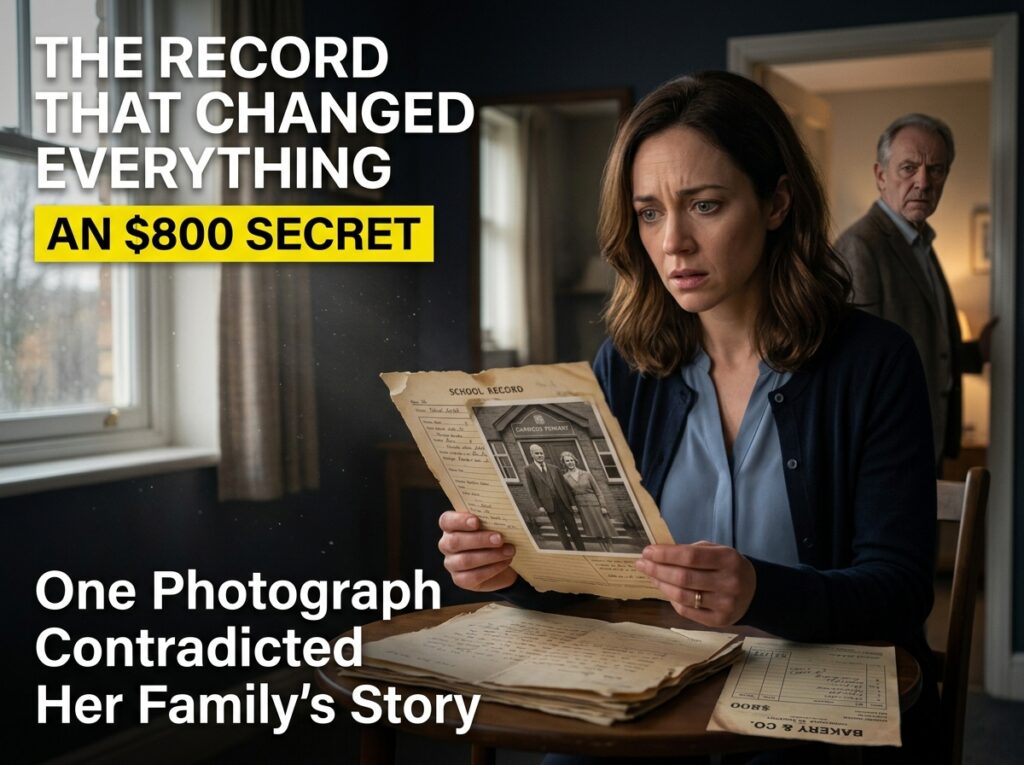
Then, the morning after the funeral, I found a school record. At first I assumed it belonged to an old argument or a forgotten promise, but the details did not fit. The photograph showed two relatives together on a day they claimed never to have met. Suddenly, the story I had been told for years felt incomplete, and I realized that asking the wrong person might make everything worse.
I placed the evidence on the table, and the loudest relative asked everyone to leave. I had to decide whether to confront the people closest to me or follow the clue quietly before it disappeared.
Part 2
The bakery downstairs opened at five every morning. By the time I woke, the smell of warm bread had already crept through the floorboards, mixing with the faint scent of coffee that came from the little kitchen beside my rented room.
Usually, that smell comforted me. It reminded me that even when life became difficult, people still got up, made something with their hands, and tried again.
That morning, it only reminded me that the world had continued moving while my family stood still around a secret.
My name is Natalie. I was thirty-five, old enough to recognize the difference between a disagreement and a lie, but apparently not old enough to understand how many years a family could build a life around the same false explanation.
The funeral had taken place the previous afternoon. Everyone had arrived dressed in dark clothing, carrying flowers and the familiar expressions people wore when they wanted to be seen grieving. My older brother, Martin, had organized almost everything. He spoke to the funeral director, answered questions from distant relatives, and decided who should sit where.
He had always been that way.
When we were children, Martin answered questions meant for me. When our parents disagreed about something, he explained what they really meant. As adults, when relatives argued over money or old promises, Martin usually ended the conversation by saying that there was no point reopening the past.
And most of us listened.
I had listened for years.
At the funeral, I noticed that Martin avoided one particular subject: the old school record connected to our family. I did not know why it had crossed my mind until I remembered a conversation from several months earlier.
Our aunt Helen had mentioned a payment of eight hundred dollars. She had been sorting through papers and asked whether I remembered what happened to the money. Before I could answer, Martin had interrupted.
“It was settled years ago,” he had said.
Helen lowered her eyes and returned to her papers.
I assumed the money had been part of some old family expense. Eight hundred dollars was significant, especially to people who had spent years worrying about rent, repairs, and unpaid bills, but it did not seem worth arguing about.
Now I wondered why Martin had answered so quickly.
After the funeral, I had helped gather the belongings left behind. There were old photographs, envelopes, school certificates, and a small collection of documents that nobody seemed interested in keeping. I placed them in a cardboard box, intending to sort them later.
I brought the box to my room above the bakery.
That night, I could not sleep. Every time I closed my eyes, I saw the faces at the funeral and remembered how carefully certain conversations had been avoided.
At first, I told myself grief was making me suspicious. Families were complicated. People remembered things differently. An old photograph could be misleading, and an unexplained payment did not automatically mean someone had done something wrong.
But the following morning, I opened the box.
Near the bottom lay a school record inside a thin paper folder. The edges were worn, and the paper had yellowed with age. A date had been written near the top, followed by the name of a school I recognized from stories about our childhood.
I turned the page.
A photograph had been attached to the record.
Two people stood outside a school entrance. One was a relative I knew well. The other was someone whose name had been mentioned at family gatherings, usually followed by a quick change of subject.
I stared at the photograph for a long time.
According to Martin, those two people had never met.
Not once.
He had repeated that explanation so often that the rest of the family treated it as an established fact. Yet there they were, standing together in a photograph dated to the very year he claimed their paths had never crossed.
I checked the date again.
Then I looked at the back of the photograph, hoping to find an explanation that would make everything ordinary.
Instead, I found a handwritten note.
It contained only a few words, but one of them was a date that matched the payment Helen had asked about.
The eight hundred dollars had not been a separate mystery.
It was connected to the school record.
And suddenly, the question I had been avoiding became impossible to ignore.
If Martin had been telling the truth, why did the photograph exist?
And if he had been lying, what else had he taught us to believe?
Part 3
I spent the next hour examining every page in the folder.
The school record was not a letter or a personal diary. It appeared to be an ordinary administrative document, the sort of paper a family might keep without thinking much about it. There were dates, handwritten notes, and a small section containing information about a school event.
The photograph seemed to have been attached later.
I could not tell who had placed it there or why.
What I could tell was that the two people in the picture were standing close enough to speak comfortably. One was holding a folder beneath an arm. The other appeared to be looking toward the photographer, almost smiling.
It was not a chance image of strangers passing on a street.
They looked as though they knew each other.
I remembered Martin’s voice at the funeral.
“There is nothing left to discuss.”
He had said it while speaking to Aunt Helen, who had asked whether anyone had found the missing paperwork. His tone had not been angry, exactly. It had been final, as if the question itself were an act of disrespect.
I had always admired his ability to keep the family together. When our circumstances became difficult, he found practical solutions. When someone needed help, he usually knew whom to call. He was the person relatives trusted with important documents because he was organized and confident.
Now I wondered whether his confidence had made it easier for him to control what everyone knew.
I called Aunt Helen.
She answered after several rings.
“Natalie? Is everything all right?”
“I found something in the papers from yesterday.”
There was a pause.
“What kind of thing?”
“A school record. It has a photograph attached.”
Another pause followed, longer than the first.
“Put it away for now,” she said.
I sat up straighter.
“Why?”
“Because you’ve had a difficult few days, and you don’t need another problem.”
“I only asked about a photograph.”
“Then leave it as a photograph.”
Her voice had changed. It was still gentle, but the warmth had disappeared.
I asked whether she remembered the eight hundred dollars.
“I don’t want to talk about money over the telephone.”
“Then tell me when we can talk.”
“Not today.”
She ended the call before I could ask anything else.
I stared at my phone, feeling a familiar frustration rise inside me. Every time I approached the subject, someone redirected the conversation. Nobody said the photograph was false. Nobody explained the date. They simply acted as though my questions were the real problem.
I decided to speak to Martin.
He lived across town in a comfortable house he had spent years renovating. I arrived just before lunch. He was in the kitchen, reading messages on his phone, and looked surprised when he saw me.
“You should have called,” he said.
“I need to ask you about something.”
“Can it wait?”
“No.”
I placed a copy of the school record on the table.
His expression changed so quickly that I nearly missed it. His eyes moved from the date to the photograph, then returned to the handwritten note.
For a moment, he said nothing.
Then he pushed the paper toward me.
“Where did you get this?”
“It was in the box from the funeral.”
“You shouldn’t be going through those things alone.”
“They were family papers.”
“And some things were private.”
“Private from whom?”
He stood and walked to the sink. His back was turned toward me, but I could see the tension in his shoulders.
“That photograph doesn’t prove what you think it proves.”
“Then explain it.”
“There were school events. People attended the same places. It doesn’t mean they had a relationship.”
“You told us they had never met.”
“I said they didn’t know each other.”
“That’s not what you said.”
He turned around.
“Are you really going to start this now? We have just buried someone we loved, and you want to dig through old papers looking for a reason to accuse people?”
“I’m not accusing anyone. I’m asking a question.”
“Then stop asking it.”
The words landed harder than I expected.
I had never heard Martin speak to me that way. Even during arguments, he usually maintained a calm, reasonable tone. He could make disagreement sound childish simply by lowering his voice.
This time, there was no attempt to explain.
I took the paper back.
Before I reached the door, he spoke again.
“Natalie, there are things you don’t understand about what happened back then.”
“Then help me understand.”
He looked at the photograph.
“I can’t.”
“Or you won’t?”
He did not answer.
I left his house with the document inside my bag and a feeling I could no longer dismiss.
Martin had recognized the photograph immediately.
He had known exactly what it was.
And whatever the record revealed, he was afraid of what might happen if I learned the rest.
Part 4
For two days, I tried to continue my ordinary life.
I worked, paid my bills, and helped the bakery owner carry flour deliveries up the narrow stairs. I answered messages from relatives who wanted to know how I was coping after the funeral. I even laughed at a joke one of my coworkers made, although the sound felt strangely distant.
All the while, the school record remained hidden inside a drawer beside my bed.
I had begun to understand why the family had kept the story settled for so long. A secret did not survive because nobody knew about it. Sometimes it survived because everyone who knew a little of the truth had agreed not to ask about the rest.
I needed someone who could look at the record without feeling obligated to defend my relatives.
I remembered Mrs. Ellis, a retired school administrator who had known our family for decades. She had attended several of our childhood events and once helped me obtain a replacement certificate when I lost an original document.
I found her number in an old address book.
When I explained what I had discovered, she did not interrupt.
“Can you bring the record to me?” she asked.
I visited her the following afternoon. Her house was small and neat, with framed photographs lining the hallway. She made tea, placed the school record on the table, and studied it carefully.
For several minutes, she said nothing.
Then she asked, “Who told you these two people had never met?”
“My brother.”
“Did he tell you why?”
“He said they had no connection.”
Mrs. Ellis looked at me.
“That isn’t quite the same thing.”
I felt a chill run through me.
“You recognize them?”
“I recognize one of them. The other person was mentioned during a difficult period at the school, although I never knew the whole story.”
“What happened?”
She turned the page over and examined the handwritten note.
“I can’t tell you what happened from this document alone. But I remember that there was a disagreement about responsibility for a student. Adults became involved, and the matter was handled privately.”
“What kind of responsibility?”
“I don’t know enough to say. I was not the person in charge.”
I leaned forward.
“Do you remember the eight hundred dollars?”
Her expression grew serious.
“That amount was discussed at the time. I remember because someone questioned why the payment had not been recorded in the usual place.”
“Who made it?”
“I can’t remember.”
“Was it connected to these two people?”
“I suspect it may have been, but suspicion is not evidence.”
For the first time since finding the record, I felt that someone was willing to acknowledge the mystery without trying to silence me.
Mrs. Ellis advised me to contact the school and ask whether an official archive still existed. She also warned me not to accuse anyone until I had established what the document actually proved.
“People can be wrong about dates,” she said. “They can misunderstand photographs. They can also lie. Your job is to discover which explanation fits the evidence.”
I thanked her and returned home.
That evening, I began sorting through the remaining papers. There were old bills, folded letters, and several envelopes containing receipts. Most were too faded to read clearly, but one envelope had been marked with the same date that appeared on the school record.
Inside was a receipt for eight hundred dollars.
The handwriting matched the note on the photograph.
I checked the name at the bottom.
It belonged to a relative who had always insisted that the two people in the photograph had never met.
I placed the receipt beside the school record and photographed both pages. Then I made copies and saved them separately, afraid that someone might take the originals.
I had finally found something that connected the date, the photograph, and the money.
But I still did not know what the payment had been for.
The next morning, I received a message from Martin.
“Come to the house tonight. Bring the papers. We need to settle this before it gets out of hand.”
I read the message twice.
He had spent years telling us there was nothing to discuss.
Now he wanted the documents back.
And I began to wonder whether he was trying to protect the family from the truth—or protect himself from what I might discover.
Part 5
I did not answer Martin immediately.
Instead, I took the documents to a small office that helped people obtain copies of old school and public records. The woman behind the counter explained that archived files were sometimes transferred to another location, especially when schools changed ownership or reorganized their administration.
“If you know the date and the names, we can start there,” she said.
I gave her the information from the photograph.
She entered it into a computer, checked a list of archived records, and asked me to wait while she searched another database.
When she returned, she looked uncertain.
“There’s a reference to an older file, but the original isn’t here.”
“Where is it?”
“The record says it was transferred to a central archive years ago. I can give you the reference number, but you’ll need to request access.”
I wrote down the number.
“Does the file mention a payment?”
“I can’t see the contents. Only the transfer information.”
It was not the answer I had hoped for, but it gave me a direction that did not depend on my brother’s willingness to speak.
Before leaving, I asked whether the archive could confirm the date of the photograph.
“The photograph is attached to the record you brought,” she replied. “We would need to examine the original file to establish how it was filed and whether any additional documents were attached.”
I understood. The photograph was a clue, not proof of the entire story.
That distinction mattered more than ever.
When I returned to my room above the bakery, I found Martin waiting outside the building.
He was standing beside his car, his hands in the pockets of his coat. He looked tired, but his expression hardened when he saw the folder under my arm.
“You went somewhere with those papers.”
“I asked about the archive.”
His jaw tightened.
“You were told to bring them to me.”
“You asked me to come tonight. You didn’t tell me I couldn’t look into them first.”
He glanced toward the bakery entrance.
“Let’s not do this here.”
“Then tell me what the photograph means.”
He shook his head.
“You’re turning something old into a crisis.”
“Why does everyone become frightened when I mention it?”
“Because you don’t know what you’re doing.”
“Then explain it to me.”
For a moment, he looked as though he might finally answer. His eyes moved to the folder, and something like regret crossed his face.
Then he stepped back.
“I’ll see you tonight.”
He drove away before I could say anything else.
I went upstairs and called Aunt Helen again. This time, she answered immediately.
“Did Martin come to see you?” she asked.
“Yes.”
“Did you give him the papers?”
“No.”
She sighed.
“Then you need to be careful.”
“Careful of what?”
“I can’t explain everything over the phone.”
“Everyone keeps saying that. What exactly am I supposed to be afraid of?”
She was silent for several seconds.
“Your brother believes he is protecting the family,” she finally said. “He has believed that for a very long time.”
“Protecting us from what?”
“I don’t know whether I should be the one to tell you.”
I gripped the phone.
“Did the two people in that photograph know each other?”
“Yes.”
The answer was so quiet that I almost missed it.
“Then why did Martin say they didn’t?”
“Because the truth was never simple.”
“Was the money connected to them?”
Helen began to cry.
I had never heard her cry like that. She was usually the person who comforted everyone else, the one who brought food after a funeral and remembered birthdays even when nobody remembered hers.
“A payment was made,” she said. “That much is true.”
“Who paid it?”
“I can’t tell you that until I know what else you’ve found.”
“What else do you think I found?”
She took a shaky breath.
“There’s a second document, Natalie. If it still exists, it will explain why everyone agreed to keep quiet.”
My heart began to pound.
“Where is it?”
“I don’t know.”
“Who does?”
She hesitated.
Then she said, “The person your brother has spent years pretending he never knew.”
The call ended.
I remained seated beside the window, listening to the bakery’s machinery rumble beneath the floor. Outside, people hurried past with shopping bags and umbrellas, unaware that my family had just become a collection of unanswered questions.
I looked again at the photograph.
Two people standing together.
A payment made on the same date.
A second document that might explain everything.
For the first time, I wondered whether the missing person in our family story had disappeared by choice—or whether someone had made sure nobody would ever look for them.
Part 6
I arrived at Martin’s house that evening with copies of the documents instead of the originals.
Aunt Helen was already there, sitting at the dining table with her hands folded in front of her. Two other relatives had joined them. Nobody had brought food, and nobody seemed interested in pretending this was an ordinary family gathering.
Martin stood beside the fireplace.
“Give me the papers,” he said.
“I’ll show them to everyone. But first, I want answers.”
He looked at Helen.
“You shouldn’t have encouraged her.”
“I didn’t,” Helen replied. “She found the record herself.”
I placed the school photograph on the table.
“This picture shows two people together on a date when we were told they had never met. The receipt shows an eight-hundred-dollar payment made on the same date. I want to know what happened.”
One relative shook his head.
“That was a long time ago.”
“Then it should be easy to explain.”
Martin pulled out a chair but remained standing.
“You’re treating this like a criminal investigation. It was a family matter.”
“Family matters still have facts.”
“Not every fact needs to be discussed.”
“That is exactly what someone says when they don’t want a fact examined.”
The room fell silent.
I had never spoken to Martin that way before. Even as an adult, I had often found myself softening my questions whenever he looked uncomfortable. I had mistaken his certainty for wisdom and his silence for restraint.
Now I saw how much power that habit had given him.
He finally sat down.
“The payment was intended to resolve a dispute,” he said.
“What dispute?”
“A disagreement involving the school.”
“Between whom?”
He looked at the photograph.
“Those two people.”
“What did they disagree about?”
“Something that happened years ago.”
“Martin, I know it happened years ago. I need to know what happened.”
He pressed his palms against the table.
“One person believed the other had made a promise. The other person denied it. Money was offered to settle the matter, and everyone agreed that the situation should end there.”
“Who offered the money?”
Nobody answered.
I looked at Aunt Helen. She was staring at the table, her eyes filled with tears.
“Was someone hurt?” I asked.
Helen nodded.
“Not physically,” she said. “But someone lost something important. Their reputation. Their place in the family. The chance to explain themselves.”
“Who?”
She looked at Martin.
He shook his head slightly, warning her to stop.
For a moment, I thought she would obey him.
Then she lifted her eyes.
“The person in the photograph was blamed for something they did not do.”
My stomach tightened.
“What were they blamed for?”
Helen opened her mouth, but Martin interrupted.
“That’s enough.”
“No,” I said. “It isn’t.”
He stood abruptly.
“You have no idea what you’re asking. This family survived because we made a decision. We could have spent the rest of our lives fighting over what happened, but instead we moved forward.”
“Who decided?”
“People who were there.”
“Was the person who got blamed allowed to decide?”
His silence answered me more clearly than words.
I turned to Helen.
“Did the eight hundred dollars settle the dispute?”
“It was supposed to.”
“Was it ever given to the person who was hurt?”
She wiped her eyes.
“I don’t know.”
That answer surprised me. I had expected denial, or perhaps another carefully rehearsed explanation. Instead, Helen seemed genuinely uncertain about what had happened to the money.
Martin walked to the window.
“The payment was made. The matter was closed. That’s what everyone agreed.”
“Then why does the archive contain another file?”
He turned around sharply.
“What file?”
I told them about the reference number and the central archive.
For the first time that evening, Martin looked frightened.
He moved toward the table.
“You need to stop this now.”
“Why?”
“Because if you open that file, you may discover that people you love made mistakes they can never undo.”
I looked at the photograph.
“Maybe they should have thought about that before they made everyone believe a lie.”
Martin stared at me for a long moment.
Then he said something I had never expected to hear.
“The person in that photograph wasn’t the only one who made a promise.”
He sat down slowly.
“And if you discover who the promise was really made to, you will understand why your family has spent so many years trying to forget.”
Part 7
The following morning, I submitted a formal request for the archived school file.
The process was slower than I expected. I had to provide identification, explain my connection to the people named in the record, and wait while the archive checked whether the documents could legally be released.
I did not tell Martin I had made the request.
I did not tell Aunt Helen, either.
For once, I wanted to discover something without allowing another person’s fear to decide what I was permitted to know.
While I waited, I returned to the receipt.
The paper was thin, but the handwriting was still legible. The payment had been recorded as a contribution toward a school-related expense. There was no clear explanation of why it had been made or who had ultimately received the money.
I began to understand that the eight hundred dollars might be important for reasons beyond its value.
Money could be returned. A debt could be settled. But if the payment had been used to silence someone, it could also represent the price a family had placed on an explanation nobody wanted to hear.
I searched through the remaining papers from the funeral.
Near the bottom of the box, I found a small envelope containing two old school notices. One listed a date for a meeting with a parent or guardian. The other had been folded so many times that the creases were almost torn through.
The second notice contained a name.
It belonged to the person Martin had insisted was never connected to our family.
Beside the name, someone had written a short sentence:
“Must be present before the matter is considered closed.”
I read it repeatedly.
The wording sounded official, but I could not tell who had written it or what matter it referred to. I placed it with the photograph and receipt, then took all three documents to Mrs. Ellis.
She examined the notice carefully.
“This is the kind of wording schools sometimes used when a meeting required a particular parent or guardian,” she said. “But I cannot tell you why this person was required to attend.”
“Could they have been involved in the dispute?”
“Certainly. But we need the original file to know how.”
I asked whether she remembered anyone being excluded from a school meeting around that time.
She considered the question.
“There was someone who stopped attending community events after a disagreement. I remember people saying that the family had decided to protect a child from further embarrassment. I never knew whether that was the whole truth.”
“What was the person’s name?”
She looked at the document again.
“I don’t want to guess. Give the archive a chance to answer.”
I left her house feeling both encouraged and frustrated.
Every clue suggested that the family had simplified a complicated event until only one version remained. Yet none of the documents revealed who had made the original promise, what the other person had been accused of, or why the payment had become so important.
That evening, Martin called.
“Have you requested the file?”
I froze.
“How do you know about that?”
He ignored my question.
“Cancel the request.”
“No.”
“Natalie, listen to me. The file won’t give you what you want.”
“How would you know?”
“Because I know what happened.”
“Then tell me.”
He exhaled sharply.
“I was trying to protect someone.”
“Who?”
He did not answer.
“Was it the person who was blamed?”
A long silence followed.
“You’re making a mistake,” he said.
“Maybe. But at least it will be my mistake, based on what I know, rather than yours, based on what you refuse to tell me.”
He ended the call.
For several minutes, I sat without moving.
Then my phone rang again. This time, the number was unfamiliar.
A woman introduced herself as Clara, an employee at the central archive.
“Your request has been reviewed,” she said. “We located the file, but there is a complication.”
“What complication?”
“The file contains an additional document that was not included in the original index. Before we release the material, we need to verify one detail with you.”
I gripped the phone.
“What detail?”
She paused.
“The record identifies you as a family contact, but the person who submitted the file for preservation requested that a particular relative be notified before any release.”
“Which relative?”
Clara read the name.
It was Martin’s.
Part 8
I spent that night wondering why Martin had been named as the person who needed to be notified.
If he had been trying to protect the family, perhaps he had volunteered to preserve the documents. But if he had done that, why had he spent years claiming the two people in the photograph had never met?
I called Clara the next morning.
“I want to understand why my brother’s name appears in the file.”
“I can only explain what the archive record says,” she replied. “The request was submitted many years ago. It contains an instruction to notify him if a family member asks to see the original documents.”
“Does it explain why?”
“Not in the index.”
“Can I see the instruction?”
“You can request it along with the file. I cannot interpret it for you.”
I thanked her and made the additional request.
While I waited, I visited Aunt Helen.
She answered the door wearing an old cardigan and carrying a cup of tea. When she saw me, she stepped aside without asking why I had come.
“I spoke to the archive,” I told her.
She closed her eyes.
“Then it’s happening.”
“What is happening?”
“The thing we all hoped would never happen.”
I sat at her kitchen table.
“Tell me the truth, Helen. Not the version Martin wants us to believe. Your version.”
She remained standing for a moment before taking the chair opposite me.
“When the school dispute began, everyone thought they understood what had happened. One person was blamed, and another person insisted they had done nothing wrong. There were arguments, accusations, and meetings that ended without an agreement.”
“Who was blamed?”
“The person in the photograph.”
“Why?”
“Because they were believed to have broken a promise.”
“What promise?”
Helen rubbed her forehead.
“I don’t know all the details. I was younger, and the adults would not explain everything to me. I only knew that someone had been hurt and that the family wanted the matter settled quietly.”
“Who paid the eight hundred dollars?”
She looked away.
“I was told it was meant to help resolve the dispute.”
“Who received it?”
“I don’t know.”
“How can you not know? Everyone has treated that payment as if it ended everything.”
“Because that’s what we were told.”
The answer made me feel suddenly cold.
“You mean Martin told you?”
Helen nodded.
“He said the money had been paid and the matter was finished. We trusted him.”
“Why?”
“Because someone had to take responsibility. Your parents were struggling. People were arguing. Nobody wanted another scandal. Martin was confident, and he promised he could handle it.”
I thought about all the years we had followed his lead.
“Did the person who was blamed ever get a chance to explain?”
Helen began to cry again.
“I don’t think so.”
“Did anyone try to contact them?”
“I remember a letter being sent, but I don’t know whether it reached them.”
“Where is that letter?”
“I don’t know.”
I leaned back, overwhelmed by the number of things nobody knew.
It was becoming clear that Martin might not have created the original dispute. He might have inherited it, as the person trusted to handle the family paperwork. But somewhere along the way, a promise to resolve the matter had become a story that everyone repeated without checking.
And if he had discovered the truth later, he might have chosen to protect the story rather than correct it.
I asked Helen whether the payment had anything to do with the $800 I had heard about before the funeral.
“That is the same amount,” she whispered.
“Then why did you act as though it was a separate issue?”
“Because I was afraid you would ask where it went.”
“Do you know where it went?”
She shook her head.
“I only know what Martin told us.”
I looked at her, searching for any sign that she was holding something back.
Finally, I asked the question that had been troubling me most.
“Why did you say there was a second document?”
She wiped her face.
“Because I saw it once. It was a letter, and it said the matter could not be considered settled until the person who had been blamed was allowed to speak.”
My pulse quickened.
“Who had the letter?”
“Your brother.”
The kitchen seemed to grow smaller around us.
“Martin had the letter all these years?”
“I believe so.”
“And he never told anyone?”
“He said it was no longer relevant.”
I stood and walked to the window. Outside, the street looked ordinary, filled with people carrying groceries and children heading home from school.
I had spent my entire life believing that family loyalty meant accepting what the people closest to me said.
Now I understood that loyalty could also become a reason to avoid the truth.
Before I left, Helen took my hand.
“Whatever you discover, remember that people can do terrible things because they’re afraid. That doesn’t excuse them, but it may help you understand them.”
I wanted to believe her.
But understanding was not the same as forgiveness, and I was not ready to offer either.
That afternoon, Clara called again.
“The file is ready,” she said. “However, there is a note attached to the release instructions. The person who deposited the file asked that you read the final page before discussing the contents with any relative.”
I stared at the wall.
“Who deposited it?”
Clara checked the record.
“The name is Martin.”
Part 9
I collected the file the following morning.
The archive office was quiet, with rows of shelves behind a counter and a clock that seemed louder than it should have been. Clara placed a sealed folder in front of me and asked me to sign a receipt confirming that I had received the documents.
I opened it carefully.
The first pages were ordinary school records. They confirmed the date of the photograph and identified the two people standing outside the school. There were references to a meeting, a complaint, and a payment of eight hundred dollars.
Then I found the letter Helen had described.
It was addressed to the person who had been blamed.
The letter explained that the dispute had never been properly resolved. The payment had been offered as a temporary settlement, but the school record showed that the matter could not be closed until the other person had been given an opportunity to respond.
There was no evidence that this had happened.
I read the letter twice.
The family had treated the payment as proof that the dispute was over, but the original record said something different. Money had changed hands, yet the essential question remained unanswered.
I turned to the final page.
There was a handwritten statement attached to the file, signed by Martin years after the original incident.
He acknowledged that he had been given the documents to preserve. He also acknowledged that he had been instructed to ensure the person who had been blamed received an opportunity to speak.
The statement did not explain why he had failed to do so.
It did, however, contain one sentence that changed the way I understood the entire story:
“I believed silence would protect the people who depended on me, but I knew the matter had never truly been settled.”
I sat motionless.
Martin had not simply inherited the family version of the story. At some point, he had learned that the matter remained unresolved. He had known the original documents contradicted the explanation he continued to give us.
And he had chosen silence.
I placed the papers back in the folder and walked outside.
The air was cold, and I stood on the pavement for several minutes, trying to decide what to do next. I could confront Martin immediately, but I knew how easily he could turn a difficult conversation into another argument about loyalty and family peace.
I wanted the truth to be understood, not merely shouted across a table.
So I called him.
“I’ve seen the file,” I said.
He did not ask which file.
“Then you know why I wanted you to leave it alone.”
“No. I know you were told to let someone speak, and you didn’t.”
He remained silent.
“Did you know the dispute was never settled?”
“Yes.”
“Did you know the person who was blamed never received a proper chance to explain?”
“Yes.”
“Why didn’t you tell us?”
He took a long breath.
“Because by the time I understood what the papers meant, everyone had already accepted the story. Changing it would have hurt people who had nothing to do with the original disagreement.”
“And leaving it unchanged hurt the person who was blamed.”
“I know.”
“Then why?”
His voice became quieter.
“Because I was afraid that if I opened the matter again, the family would fall apart.”
I closed my eyes.
“Martin, the family has been living with a lie. That isn’t the same as being together.”
He did not respond.
I told him I wanted everyone to meet that evening. I would bring copies of the original record, the receipt, and his statement. We would discuss what happened without interruptions, threats, or demands that the documents be destroyed.
For a moment, I thought he would refuse.
Then he said, “All right.”
The meeting took place at Aunt Helen’s house.
I placed the documents on the table, arranged in chronological order. I explained what the archive had confirmed and what remained uncertain. I made it clear that the records proved the dispute had not been properly resolved, but they did not establish every detail of what had happened.
Martin listened without interrupting.
When I finished, one relative began to cry. Another accused Martin of keeping the family divided for years. Someone else insisted that reopening the matter would only create more pain.
The arguments grew louder.
I waited until everyone had spoken.
Then I asked Martin one final question.
“Do you know where the person who was blamed is now?”
He stared at the table.
“I know where they are.”
“Have you spoken to them?”
“No.”
“Then why have you never told us?”
He lifted his eyes.
“Because they asked me not to contact them until I was ready to tell the truth.”
The room fell silent.
I looked at the file again, remembering the instruction attached to the final page. It had not demanded that we punish anyone. It had demanded that the missing person be allowed to speak.
I had spent weeks trying to understand what had happened in the past.
Now I realized the next decision belonged to the present.
I could continue arguing about what Martin had done, or I could help restore the one thing the family had denied someone for years: the opportunity to tell their own story.
I asked Martin for the person’s contact information.
He hesitated, then wrote an address on a piece of paper and pushed it toward me.
Before I could pick it up, he added something I had not expected.
“There’s one more thing you should know. The person who was blamed wasn’t the only one who lost something that day.”
Part 10
Nobody spoke for several seconds.
I looked at Martin, waiting for him to explain.
“What do you mean?” I asked.
He rubbed his hands together, a nervous habit I remembered from our childhood.
“The dispute damaged more than one relationship. The person in the photograph was blamed, but someone else was also affected. They were expected to accept the family’s explanation and move on, even though they knew it was incomplete.”
“Who?”
“I can’t answer that for them.”
For once, I believed he meant it.
The person who had been blamed deserved the chance to tell their own story. If there were others who had been hurt, they deserved the same opportunity. I could not repair the past by replacing one family-controlled explanation with another.
I took the address.
The next morning, I wrote a letter. I explained that I had found the school record and the receipt, and that the archive had confirmed the dispute was never formally settled. I did not demand forgiveness or ask the person to defend themselves. I simply offered to listen.
I sent the letter by registered post.
Then I waited.
The days that followed were difficult. Some relatives stopped speaking to me. Others called to say I should have left the past alone. Martin and I barely spoke, although he did not ask me to return the documents.
Aunt Helen remained in contact.
One evening, she visited my room above the bakery. She brought two cups of tea and sat beside the window while the last customers downstairs finished their bread and coffee.
“I keep thinking about how easily we accepted the story,” she said.
“Because we trusted Martin.”
“We trusted the family.”
I considered that.
Perhaps she was right. Martin had been the person who spoke for us, but the rest of us had also chosen not to ask questions. We had accepted the comfort of a settled explanation because the alternative required us to face uncertainty, disagreement, and the possibility that people we loved had been wrong.
“I don’t know if I can forgive him yet,” I admitted.
“You don’t have to decide that today.”
She placed her cup on the table.
“Sometimes people confuse forgiveness with pretending nothing happened. You can forgive someone without pretending the harm was imaginary.”
I thought about the person who had been blamed. For years, the family had repeated a version of events that left them without a voice. Even if Martin had acted out of fear, his intentions could not erase the consequences.
A week later, a letter arrived.
The handwriting was unfamiliar, and my name had been written carefully across the envelope. I recognized the address as the one Martin had given me.
Inside was a short note.
The writer thanked me for reaching out. They said they had kept their own copy of the original school correspondence and were willing to meet, provided that the conversation remained honest and nobody tried to control what could be discussed.
I read the letter several times.
Then I called Martin.
“The person has agreed to meet,” I told him.
He was silent.
“When?”
“Next week.”
“Will you tell them I want to apologize?”
I paused.
“That is something you should tell them yourself. I won’t speak for you.”
He accepted the answer without arguing.
The meeting took place in a quiet café near the old school. I arrived early, carrying copies of the records in a plain folder. Martin came a few minutes later and sat opposite me. For the first time in years, he looked less like the person responsible for holding the family together and more like someone who had spent too long carrying a decision he did not know how to undo.
When the other person arrived, I recognized them immediately from the photograph.
They were older now, with silver in their hair and a careful, reserved expression. They looked at Martin but did not offer their hand.
“I received your letter,” they said to me.
“Thank you for agreeing to meet.”
They placed a second folder on the table.
“I kept these because I knew one day someone might need to understand what happened.”
Inside were copies of letters, a record of the original payment, and a statement describing the events from their perspective. The documents did not answer every question, but they showed how the dispute had developed and why the person had felt abandoned by the family.
They explained that the eight hundred dollars had been offered to resolve the disagreement, but the promised conversation never took place. Instead, the payment became part of a story that suggested everything had been settled.
“I didn’t want the money to become the only thing people remembered,” they said. “I wanted someone to acknowledge that I had been blamed without being heard.”
Martin looked down.
“I should have contacted you.”
“Yes,” they replied.
“I thought I was protecting the family.”
“You were protecting the story the family wanted to believe.”
Martin closed his eyes.
For a long moment, nobody spoke.
Then he said, “I’m sorry.”
The words were simple, and they did not repair the years that had passed. The other person did not immediately forgive him. They asked questions, explained what the silence had cost them, and made it clear that any future relationship would depend on honesty rather than promises.
Martin listened.
He did not interrupt. He did not insist that everyone move forward. He did not tell anyone that the matter was settled.
For the first time, he allowed someone else to finish their story.
When the meeting ended, I gathered the documents and returned them to their owner. We agreed that the records should be preserved together so the next generation would not have to depend on a single relative’s version of events.
The eight hundred dollars could no longer be treated as proof that the past had been resolved. It was a reminder of how easily a payment could replace a conversation, and how long a family could mistake silence for peace.
In the weeks that followed, the arguments did not disappear overnight. Some relatives apologized. Others continued to defend the old explanation. Martin and I began speaking again, but our relationship changed. I no longer accepted his certainty as a substitute for evidence, and he no longer expected me to remain silent simply because he was uncomfortable.
I kept a copy of the school record in a folder above my desk.
Sometimes I looked at the photograph and wondered how many other family stories had been simplified, softened, or quietly abandoned because the truth seemed too difficult to face.
I never found an answer to every question.
But I learned something I had not understood at thirty-five: keeping a family together is not the same as keeping everyone comfortable. Love cannot require one person to carry the blame so that everyone else can live without questions.
The past cannot always be repaired. Lost years do not return simply because someone finally apologizes. But the truth can give people something the lie never could—a chance to decide for themselves what comes next.
And that was why I had opened the folder in the first place.
Not to destroy my family.
Not to prove that my brother was a bad person.
I wanted to understand why a photograph, a payment, and a missing conversation had been allowed to shape so many lives.
Now I understood the most important part.
The family had not been saved by silence. It had only been spared the discomfort of listening.
I could not change the years we had lost, but I could refuse to let the next generation inherit the same unfinished story.
And for the first time in a long time, that felt like a beginning.