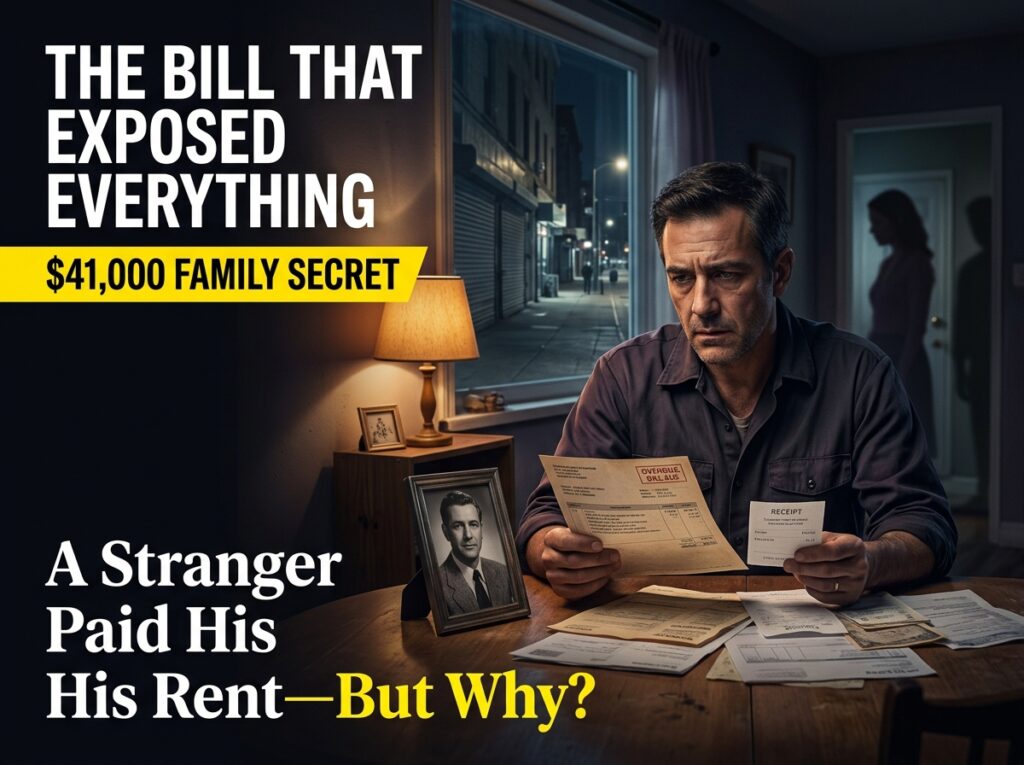
Part 1 — The Street That Went Quiet
Andre, 46 never expected a quiet street after the shops had closed to become the place where everything changed. For years, I accepted the family version because questioning it always ended in an argument. For years, the fiancé who suddenly changed had been part of a story that seemed settled, but one detail had never made sense.
There were bills to pay, people depending on me, and memories I didn’t know how to explain. Even $41,000 seemed less important than the question nobody would answer: why had this been kept secret for so long? I tried to carry on as usual, but the silence around the subject only made it harder to ignore.
Then, last Tuesday, I found an overdue bill. At first I assumed it belonged to an old argument or a forgotten promise, but the details did not fit. The receipt showed that someone had bought back the item I thought was gone forever. Suddenly, the story I had been told for years felt incomplete, and I realized that asking the wrong person might make everything worse.
Then the landlord asked why a stranger had paid three months of rent. I had to decide whether to confront the people closest to me or follow the clue quietly before it disappeared.
I stood in the narrow hallway of my rented apartment, holding the overdue bill as if the paper itself might explain what my family refused to discuss.
Outside, the street was almost empty. The bakery on the corner had switched off its lights, the small grocery store had pulled down its metal shutters, and the only sound came from a delivery truck turning onto the main road.
I had walked that street thousands of times. It was where my fiancé, Claire, and I had once planned to open a small shop together. It was where we had argued about money, laughed about our impossible dreams, and promised that we would never allow financial problems to destroy what we had built.
Then Claire changed.
She stopped discussing the future. She became protective of her phone. Whenever I mentioned the $41,000, she found a reason to leave the room.
My family insisted I should stop asking questions.
“Some things are better left alone,” my older brother, Michael, had told me.
At the time, I believed he was trying to protect me from more disappointment.
Now I was not so sure.
The bill carried a reference number I did not recognize, a date from several months earlier, and the name of a business I thought had disappeared from my life. At the bottom was a receipt showing that an item had been bought back.
I read the line again.
The item was the one thing I had believed I would never see again.
My hands began to shake.
I had sold it during the worst period of my financial troubles, when unpaid bills were piling up and Claire had started sleeping in the spare room. I had told myself it was only a temporary sacrifice. I would rebuild my savings, repay my debts, and one day buy it back.
But I had never managed to do that.
Or so I thought.
Someone had bought it back.
Someone had done so without telling me.
And now the landlord was asking about a stranger who had quietly paid three months of my rent.
I put the bill on the kitchen table and reached for my phone.
There was only one person who might know what the receipt meant.
Unfortunately, he was also the person who had told me to stop asking questions.
Michael.
Part 2 — The $41,000 Nobody Would Explain
I called my brother shortly after nine.
He answered on the fourth ring.
“Andre? What’s wrong?”
“I need to ask you about the money.”
He sighed.
“Not this again.”
“I found a receipt.”
“What receipt?”
“It says someone bought back the item I sold. The date is from several months ago.”
The silence that followed was unmistakable.
“What item?” he asked eventually.
“The one we discussed when everything went wrong.”
“You sold that item years ago.”
“I know what I did. That’s why I’m asking why there’s a receipt showing it was bought back.”
Michael took a slow breath.
“Where did you find it?”
“In an overdue bill.”
“Bring it to me tomorrow.”
“Why can’t you explain it now?”
“Because I need to see it.”
I looked at the paper on the table.
“Do you know who bought it?”
“No.”
His answer came too quickly.
“Michael, I can hear you thinking.”
“Then stop trying to turn every old problem into a mystery.”
He ended the call.
I stood motionless for a few seconds, listening to the faint hum of the refrigerator. I had spent most of my adult life trusting Michael’s judgment. He was organized, practical, and confident. When our parents had financial difficulties, he handled the paperwork. When family members disagreed, he negotiated. When Claire and I began struggling, he offered advice and told us which expenses to cut.
I had mistaken his confidence for certainty.
Now I wondered whether he had simply been better at keeping information to himself.
The $41,000 had first appeared in our conversations during a difficult period in my relationship. Claire and I had been saving for a business, but the plan collapsed after an unexpected financial setback. Money disappeared from the accounts we had been using, and we began receiving letters about unpaid obligations.
Claire said she had made a mistake.
Michael said the situation was complicated.
My mother told me that arguing would only make things worse.
Eventually, the family settled on a version of events that required no further explanation: the money had been lost, the business plan was finished, and everyone needed to move forward.
I had accepted it because I was exhausted.
I had bills to pay. I had work to keep. I had a relationship that seemed to be slipping away no matter how hard I tried to save it.
And I had no proof that anyone was lying.
Until the receipt appeared.
I returned to the bill and examined the business name. It belonged to a secondhand dealer that had once purchased valuable personal items from people facing financial trouble. I remembered walking through its doors with the item wrapped in a cloth bag. I remembered the manager explaining the price, the paperwork, and the conditions of the sale.
I remembered feeling ashamed.
The item had belonged to my father. He had given it to me shortly before he died, telling me that it was worth more for the memories it carried than for the money someone might offer.
When I sold it, I promised myself that I would buy it back one day.
I had never told Claire how much that decision hurt.
If someone had bought it back, they had either known where it was or had been watching the business that held it.
Why would anyone do that without telling me?
I searched the bill for a name.
There was none.
Only a transaction number, a date, and a reference to a payment that had already been completed.
I called the dealer the following morning.
The person who answered asked me to provide the transaction number. After a short wait, she confirmed that the receipt related to a completed purchase, but she could not disclose the buyer’s private information over the telephone.
“Can you tell me whether the item is still there?” I asked.
“I can check the current inventory status.”
Another pause followed.
“I’m sorry,” she said. “The item is no longer in our possession.”
“Was it sold to someone else?”
“I can’t discuss another customer’s transaction without authorization.”
I thanked her and hung up.
Someone had bought back the item.
Someone had removed it.
And the person might have been someone I knew.
Part 3 — Three Months of Rent
My landlord, Mr. Harris, called me that afternoon.
“Andre, I need to ask you something about your rent.”
I looked at the unpaid bills stacked beside my computer.
“I know I’m behind. I’m working on it.”
“That’s not what I’m calling about.”
He explained that three months of rent had been paid in advance. The payment had arrived through an arrangement made by someone who described themselves as a friend of mine.
“Who was it?” I asked.
“They asked not to be involved in any further discussion.”
“Did they give you a name?”
He checked his records.
“There was a name associated with the payment, but I don’t want to give you the wrong information. I’ll send you the receipt.”
When the message arrived, I opened the attachment.
The payment had been made several weeks earlier, shortly after Claire stopped answering most of my calls.
The name on the receipt was unfamiliar.
But the contact information was incomplete, and there was no message explaining why the person had paid.
I called Mr. Harris again.
“Did this person say why they wanted to help me?”
“Only that the rent should be covered while you dealt with a family matter.”
“What family matter?”
“I didn’t ask. I assumed you had someone looking out for you.”
I thanked him.
Someone had paid three months of rent without telling me. Someone had bought back my father’s item. And the same family members who had insisted the $41,000 was gone were now reacting strangely whenever I mentioned the past.
I wrote everything down in a notebook.
The date of the overdue bill.
The date the item was bought back.
The date the rent payment arrived.
The names of the people who had known about my financial troubles.
I tried to identify a connection, but the dates seemed scattered across several months.
Then I noticed something.
The rent payment had been made two days after a message from Claire that I had never answered.
I opened our old conversation and searched for the message.
It read:
“Andre, if you ever find out what happened, please don’t assume I did it to hurt you.”
I had read it at the time as an attempt to excuse herself. I had been angry, and I had not replied.
Now the words looked different.
What had Claire meant by “what happened”?
I called her.
The phone rang until voicemail answered.
I tried again later that evening.
This time, she picked up.
“Andre?”
“Someone paid three months of my rent.”
She said nothing.
“Did you arrange it?”
“No.”
“Do you know who did?”
A long pause followed.
“I think I do.”
“Who?”
“I can’t tell you over the phone.”
“Claire, I found a receipt showing that someone bought back my father’s item. I found an overdue bill. And now a stranger has paid my rent. I need you to tell me what’s going on.”
Her breathing became uneven.
“Where did you find the receipt?”
“In my paperwork.”
“Did you show it to Michael?”
“Not yet.”
“Please don’t.”
The fear in her voice was so clear that I stopped pacing.
“Why are you afraid of my brother?”
“I’m not saying I’m afraid of him.”
“Then why don’t you want me to show him the receipt?”
She was silent.
Finally, she said, “Because he might tell you something that isn’t true.”
Before I could ask what she meant, she ended the call.
I stared at the phone.
For years, I had believed Claire was the person who had changed and left me with unanswered questions. I had blamed her for the failed business, the lost money, and the promises that seemed to vanish overnight.
Now I wondered whether she had been trying to warn me.
Part 4 — The Last Conversation with Claire
Claire and I had been together for almost eight years.
We met at a small café near the street where the shops now closed early. She was working on a design project, and I was trying to decide whether to leave a job I hated. We talked for nearly two hours that first evening, mostly about the lives we wanted to build and the things we hoped never to become.
She had a way of making difficult plans seem possible.
When I told her I wanted to start a small business, she helped me calculate the costs, compare locations, and work out how long we could survive without regular income. We saved carefully and postponed holidays. We even began collecting secondhand furniture for the shop.
For a while, it seemed that we were moving toward the same future.
Then the money problem began.
At first, the differences were small. A payment appeared later than expected. A supplier claimed that an invoice had not been settled. A bank statement showed a transfer neither of us remembered authorizing.
Claire said she would investigate.
Michael offered to help.
My mother urged us not to turn the problem into a relationship argument.
I agreed with all of them because I wanted to believe the problem could be solved.
But the explanations kept changing.
Claire became withdrawn. She stopped discussing our wedding plans and began spending more time away from home. When I asked whether she still wanted to marry me, she said she needed time to think.
I took that as rejection.
I told myself she had lost faith in me because I could no longer provide the future we had planned.
The arguments became more frequent. Eventually, she moved out.
The family told me she had made her choice.
I did not ask enough questions.
Now I remembered our last serious conversation. We had been standing in the kitchen, and Claire had been holding a small envelope.
“I need to tell you something,” she said.
“Then tell me.”
“I can’t do it while Michael is involved.”
I had been angry enough to laugh.
“Michael is trying to help us.”
“Andre, you don’t understand.”
“Then explain it.”
She looked at the envelope in her hands.
“If I tell you what I know, you may lose people you love.”
I interpreted that as a threat or an excuse.
“Maybe I should decide that for myself.”
She looked as though she wanted to say more, but she placed the envelope in her bag and walked out.
I never saw it again.
Now I wondered whether the envelope had contained a document connected to the $41,000.
I went through my old messages, searching for the days surrounding her departure. Most of our conversations were ordinary: reminders about bills, arguments about the business, and questions about when she would collect her belongings.
But one message stood out.
It had been sent the evening before she left.
“I hope one day you understand that leaving was not the same as abandoning you.”
I had never answered it.
I had been too hurt to consider that she might have believed she was protecting me.
The following morning, I visited the old apartment we had shared. The building manager told me Claire’s remaining belongings had been collected months earlier.
“Who collected them?” I asked.
“A man came with a van. He said you had arranged it.”
“I didn’t.”
The manager looked concerned.
“He showed me a message. I assumed it was genuine.”
“Do you remember his name?”
She searched her records but could not find it.
I returned to my car feeling as though I had walked into a room where every piece of evidence had been carefully removed.
Someone had arranged the rent.
Someone had bought back my father’s item.
Someone had collected Claire’s belongings while claiming to act on my instructions.
I no longer believed these were unrelated events.
But I still had no proof of who had arranged them—or why.
Part 5 — The Name on the Receipt
I returned to the secondhand dealer and asked whether I could submit a formal request for information about the transaction.
The manager remembered the item once I described it. He explained that the business had a record of the sale and a separate record of the later purchase.
“We can’t give you another customer’s private details just because you’re curious,” he said. “But if you can establish that the item was originally yours, we can explain what documentation is required to review the transaction.”
I showed him my original sale receipt.
He examined it, checked the transaction number, and compared it with the information on the overdue bill.
“These appear to refer to the same item,” he said.
“Can you tell me who bought it back?”
“I can’t disclose that yet.”
“Can you tell me whether the buyer used my name?”
He checked the file.
“No. The purchase was recorded under another name.”
“Was it Michael?”
“I can’t tell you that.”
I understood the limits, but the answer still left me frustrated.
Before I left, the manager said something unexpected.
“The person who bought it back asked whether you had been contacted.”
“Contacted by whom?”
“The person who sold it originally, I assume. I don’t know the full circumstances.”
“What did you tell them?”
“That we couldn’t provide personal information without permission.”
I walked outside and called Claire.
She answered almost immediately.
“I went to the dealer,” I said. “They confirmed someone bought back my father’s item.”
She was quiet.
“Did you know?”
“Yes.”
The admission hit me harder than I expected.
“You knew it had been bought back?”
“I knew someone was trying to recover it.”
“Who?”
“I can’t give you the name without explaining everything else.”
“Then explain everything else.”
She breathed out slowly.
“I wanted to return it to you. But I couldn’t do that while the money issue was unresolved.”
“Why would buying back the item have anything to do with $41,000?”
“Because the item wasn’t the only thing that disappeared.”
I closed my eyes.
“What else?”
“Documents. Messages. Records that would explain what happened to the money.”
“Who took them?”
“I don’t know who took all of them. I know some were removed from the place where we kept our business papers.”
“Did Michael take them?”
“I saw him carrying a folder. I didn’t see what was inside.”
I sat down on the low wall outside the dealer.
“Why didn’t you tell me?”
“Because he said you had already agreed to let him handle the matter. He said you would never believe me if I accused him.”
I remembered Michael’s confidence during those months. He had told me not to worry about the paperwork. He had said he was speaking to the people involved and that I should concentrate on finding work.
I had trusted him.
“What happened to the money?” I asked.
“I can’t say exactly until we have the records. But I don’t believe it simply disappeared.”
“Then where is it?”
“I think part of it was used to cover obligations that were never explained to you. The rest may have been transferred through an account connected to the business.”
“Do you have proof?”
“I have copies of some documents. Not enough to prove everything.”
“Where are they?”
She hesitated.
“Somewhere safe.”
I was growing tired of half-answers.
“Claire, I have spent years believing you abandoned me. If you know something that can explain what happened, I need you to tell me the truth.”
“I will,” she said. “But you must understand that the truth may involve more than one person, and I don’t want you accusing anyone before we have the evidence.”
I looked down at the receipt in my hand.
“Then let’s find the evidence.”
Part 6 — The Stranger Who Paid My Rent
Claire agreed to meet me at a café on the opposite side of town.
She arrived early and sat near the window. She looked older than I remembered, not because of her face but because of the tiredness in her expression. For a moment, neither of us knew how to begin.
I ordered coffee.
She placed a small envelope on the table.
“I didn’t bring everything,” she said. “Only enough to show you why I left.”
Inside were copies of messages, a payment record, and a handwritten note. The documents did not establish the entire story, but they showed that the financial problem had involved decisions made by several people.
One record referred to a transfer connected to the business account. Another showed an obligation that had been described to me as paid, even though the supporting paperwork was missing.
The figures were incomplete, but the total was close enough to the amount we had argued about that I felt my stomach tighten.
“Why did you keep these?” I asked.
“Because I thought you might need them one day.”
“Why didn’t you give them to me?”
“I tried.”
“You gave me no explanation.”
“I tried to explain. You believed Michael.”
I wanted to deny it, but I remembered our arguments. Every time Claire questioned my brother’s version, I had defended him. I had insisted that he was helping us and that she was making the problem worse by refusing to cooperate.
I had been so afraid of losing my family that I had not listened to the person closest to me.
“I should have listened,” I said.
Claire looked down.
“Yes. You should have.”
There was no anger in her voice. That made the words hurt more.
I asked about the stranger who had paid my rent.
She took a long breath.
“I didn’t arrange the payment, but I know who might have.”
“Who?”
“A man named Peter. He worked with your father years ago. He knew about the item and the family dispute.”
“Why would he pay my rent?”
“Because he believed you were being left to carry the consequences of something you didn’t understand.”
“Did he tell you that?”
“Yes.”
“Where can I find him?”
Claire slid a small piece of paper across the table.
It contained an address and a telephone number.
I asked whether Peter was the person who had bought back my father’s item.
“I don’t know for certain,” she replied. “But he was trying to locate it.”
“Why?”
“Your father left instructions that it should eventually return to you. Peter believed the item had been sold under circumstances your father would never have wanted.”
I stared at her.
“My father left instructions?”
“That’s what Peter told me. I haven’t seen the original document.”
The mystery was growing more complicated, but at least the clues were beginning to connect.
The rent payment might have been an act of assistance rather than a threat. The item might have been bought back because someone believed it belonged with me. The $41,000 might be connected to financial records that had been removed or hidden.
And Claire had not simply vanished without explanation. She had been trying to protect evidence she believed would eventually matter.
I looked at her across the table.
“Do you want to come with me when I speak to Peter?”
She hesitated.
“If you are willing to hear the truth, even if it makes you angry, then yes.”
For the first time in years, I felt we might be able to have a conversation without one of us trying to win.
It was not forgiveness.
It was not a promise to get back together.
It was simply the beginning of honesty.
Part 7 — Peter’s Explanation
The address led to a modest house on a quiet street near the old industrial district. Peter answered the door after I knocked twice.
He was in his late sixties, with gray hair and a careful way of speaking. When I introduced myself, he studied my face for a moment before stepping aside.
“I wondered when you would come,” he said.
His living room was crowded with books, old photographs, and boxes of papers. He offered us tea, then sat opposite Claire and me.
I placed the overdue bill on the table.
“Did you buy back my father’s item?”
Peter looked at the receipt.
“Yes.”
“Did you pay my rent?”
“Yes.”
“Why?”
He folded his hands.
“Because your father asked me to look out for you if the family situation ever became difficult. I never expected to be involved in it this way.”
I struggled to process his answer.
“When did my father ask you that?”
“Before he died. We worked together for years, and he trusted me with certain responsibilities. He gave me instructions about the item and some documents connected to a financial arrangement.”
“Why didn’t you contact me directly?”
“I tried to find you, but I was told you did not want to be involved. Later, I learned that you were struggling financially. I paid the rent because I didn’t want you to lose your home while I worked out how to return the item.”
“Who told you I didn’t want to be involved?”
Peter looked at Claire.
“She may know more about that than I do.”
Claire shook her head.
“I never told him that.”
Peter nodded slowly.
“Then I may have been given incorrect information.”
I asked about the $41,000.
Peter did not claim to know the exact amount owed or where every dollar had gone. He explained that my father had once discussed a financial arrangement connected to the business and the family item. Some records had been kept separately, and he believed those records could clarify the dispute.
“Do you have them?” I asked.
“I have copies of some correspondence. I don’t have the complete account.”
He went to a cabinet and returned with a folder.
Inside were letters between my father and another person, copies of receipts, and a note that referred to an obligation requiring further review. The documents suggested that the financial issue had never been as simple as my family had told me.
One letter stated that a payment was intended to protect a specific asset until the business arrangement had been resolved. Another mentioned the possibility of returning the item to me when the dispute ended.
There was no single document proving that the entire $41,000 belonged to me. Nor did the papers establish exactly who had authorized every transaction.
But they offered a credible reason to investigate further.
I asked Peter whether he knew why Michael had become involved.
“Your brother contacted me several years ago,” he said. “He wanted to know what your father had told me. I explained that I would not hand over anything without understanding what the documents required.”
“What happened next?”
“He said the family had already resolved the issue. He asked me to stay out of it.”
“Did you?”
“For a while.”
Peter looked at me.
“I thought the matter would be handled properly. When I learned that you were struggling and that the item had been sold, I decided I could no longer assume everything was settled.”
I leaned back.
The rent payment, the bought-back item, and the old records were connected through Peter and my father’s instructions. But the most important question remained unanswered.
Had Michael deliberately hidden the truth, or had he convinced himself that he was protecting everyone by handling a complicated matter privately?
I could not decide that based on suspicion alone.
Peter offered to provide copies of his documents to an independent professional who could review them alongside the business records.
I agreed.
As Claire and I prepared to leave, Peter handed me a small envelope.
“This was found with your father’s papers,” he said. “I believe it was meant for you.”
My name was written across the front in my father’s handwriting.
For several seconds, I could not move.
I had spent years searching for explanations from people who were still alive.
Now I was holding a message from the one person who could no longer answer my questions.
Part 8 — My Father’s Letter
I opened the envelope at home.
Inside was a letter dated several months before my father’s death. The paper had been folded carefully, and his handwriting was familiar enough that I could almost hear his voice as I read.
He wrote about the business, the item, and his hope that I would one day understand why he had kept certain records separate. He explained that he had made an arrangement intended to protect something valuable to the family while a financial matter was being resolved.
He did not name anyone as a villain.
He did not accuse Michael.
He did not provide a complete accounting of the $41,000.
Instead, he wrote that he wanted the matter handled fairly and that I should not be pressured into accepting an explanation simply because it was convenient for others.
One sentence stayed with me:
“If people tell you a matter is settled, ask what was actually settled, and whether the people affected were allowed to understand it.”
I read the sentence again.
My father had not given me the answer. He had given me a way to look for it.
The following day, I contacted an independent accountant and a lawyer who had no connection to my family. I provided copies of the receipt, the financial records, Peter’s documents, and my father’s letter.
I asked them to help determine what could be established and what remained uncertain.
They warned me that the documents were incomplete. Some transactions could be traced, but others required additional records. The figure of $41,000 had been repeated in family conversations without a consistent explanation of whether it represented a loss, an outstanding obligation, or a combination of several transactions.
The review would take time.
For once, I accepted that.
I also called Michael and asked him to meet me.
He arrived at my apartment the following evening. I placed copies of the documents on the table and told him what Peter had said.
Michael listened without interrupting.
When I finished, he looked older than he had a week earlier.
“I knew Peter had some papers,” he admitted. “I didn’t know he had your father’s letter.”
“Why did you tell me the money was gone?”
“Because I believed the arrangement had failed.”
“Did you verify that?”
He looked down.
“No.”
“Did you know the item had been bought back?”
“I heard someone was trying to recover it. I didn’t know who had completed the purchase.”
“Did you tell the family?”
“No.”
“Why?”
Michael took a long breath.
“Because I thought the family would start fighting again. I thought if I could settle the bills and keep the business problem from spreading, everyone could move forward.”
“You made decisions for everyone without giving us the information.”
“I know.”
“Claire tried to tell me something was wrong, and I didn’t listen because you told me the matter was settled.”
Michael’s eyes filled with tears.
“I never wanted you to lose her.”
“But you helped create a situation where I believed she had betrayed me.”
He did not defend himself.
For the first time, I saw the difference between an explanation and an excuse. Michael had been frightened of the consequences, but his fear had not given him the right to control what everyone else knew.
I told him the independent review would continue. If the records established that money was owed or that an obligation remained unresolved, we would deal with it through the proper process.
He agreed.
Then he asked whether I could ever forgive him.
I looked at my brother, remembering the years we had spent trusting each other.
“I don’t know yet,” I said. “But I need you to stop asking me to forgive you before you’ve finished telling the truth.”
He nodded.
It was not a happy ending.
It was an honest one.
And that was more than we had managed in years.
Part 9 — The Truth Behind the $41,000
The independent review took several weeks.
The accountant compared the available receipts, bank records, and correspondence. The lawyer examined the documents connected to my father’s arrangement and advised us on what could be established under the applicable legal process.
The result was not as simple as I had hoped.
The evidence showed that the $41,000 figure had been associated with several financial matters, including an unresolved obligation connected to the business. However, the surviving records did not establish that the entire amount was owed directly to me, nor did they prove that every missing dollar had been taken by one person.
Some payments could be verified. Others lacked supporting documents. Certain records had never been preserved, and the people involved remembered events differently.
What the review did establish was that the family’s repeated claim that everything had been settled was not supported by the complete evidence available.
The matter needed to be addressed properly.
I accepted that conclusion, even though it did not give me the neat answer I had imagined.
The accountant prepared a report identifying confirmed transactions, unexplained amounts, and the additional records that would be required to reach a final determination. The lawyer explained the options available to the people affected and recommended that no one make further financial claims until the outstanding questions had been reviewed.
For the first time, the $41,000 was no longer a number used to end arguments.
It was a question being examined.
Claire and I met again after the review began. We spoke about the years we had lost and the ways we had hurt each other. She admitted that she should have found a clearer way to communicate what she knew. I admitted that I had allowed my trust in Michael to prevent me from hearing her.
Neither of us pretended that those mistakes could be erased.
“I thought you had chosen your family over me,” Claire said.
“I thought you had given up on us.”
“I didn’t know how to make you listen.”
“I should have listened before you had to prove everything.”
We sat quietly for a while.
I still loved her, but I did not ask her to return. She did not promise that we would rebuild our relationship. We agreed that any future between us would need to be based on honesty, patience, and the freedom to ask difficult questions.
It was the first agreement we had made in years that did not depend on hiding something.
A few days later, the dealer contacted me. After reviewing the original sale receipt and the later transaction, the business confirmed that the item had been purchased back by Peter through a documented transaction. With the appropriate paperwork completed, arrangements were made for it to be returned to me.
When I finally held it again, I was surprised by how ordinary it looked.
The item had not changed. My father’s memory had not changed. What had changed was the meaning of its return.
For years, I had believed that selling it was proof I had failed my family. Now I understood that someone had tried to preserve it because they believed my father’s wishes mattered, even when the people closest to me had stopped discussing them.
I placed it on a shelf beside the letter.
The mystery had not ended with a confession or a sudden fortune.
It ended with a clearer understanding of what we knew, what we did not know, and what we still had a responsibility to resolve.
Part 10 — The Street Became Quiet Again
Months later, I walked down the same street where the shops had once closed around me while I stood holding the overdue bill.
The bakery was open. A shopkeeper was sweeping the pavement, and a delivery driver was carrying boxes through a narrow doorway. Nothing about the street looked different.
Yet I felt as though I were seeing it for the first time.
The investigation had changed my relationship with my family. Some conversations became easier. Others remained painful. Michael and I began rebuilding trust slowly, with fewer promises and more honesty. We no longer treated his confidence as proof that every problem had been resolved.
He apologized to Claire as well. She accepted the apology, but she did not pretend that it erased the years of misunderstanding.
I respected her decision.
The financial review continued through the appropriate process, and we followed the professional advice we had received. We did not declare the entire $41,000 to be mine, and we did not accuse anyone of taking money that the evidence could not trace. We focused on the records, the obligations that could be established, and the questions that still needed answers.
That discipline was difficult at times. I wanted to know exactly what had happened. I wanted a single person to admit everything and explain every missing detail.
But the truth did not arrive in a neat package.
It came in fragments: a receipt, a rent payment, a letter from my father, and the testimony of a man who had quietly tried to help me.
The most painful discovery was not that my family had made mistakes.
It was that I had sometimes helped those mistakes survive by refusing to question the people I trusted.
I had believed loyalty meant standing beside my family even when their explanations made no sense. I had believed that asking questions would make me disloyal, ungrateful, or difficult.
Now I understood that loyalty without honesty can become a prison.
The overdue bill had seemed like an ordinary piece of paperwork. Instead, it led me back to the item I thought I had lost forever, to a stranger who paid three months of rent, and to the letter my father had left behind.
It also brought Claire and me to a conversation we should have had years earlier.
We did not return to the life we had planned. Some wounds were too deep, and too much time had passed. But we stopped treating each other as enemies. We learned to acknowledge what we had done wrong without pretending that one person’s mistakes erased another’s.
That mattered.
One evening, I placed my father’s letter in a protective folder and sat beside the window. The streetlights had come on, and the shops were beginning to close.
I remembered the first time I saw the overdue bill. I had been frightened that it would reveal another debt, another failure, another reason for my family to argue.
Instead, it revealed a question I had been afraid to ask.
Who had decided that I did not deserve to know the truth?
I never received a complete answer to every part of the mystery. Some records were missing, and some memories could not be verified. But I learned that uncertainty was not a reason to accept the easiest explanation.
It was a reason to keep looking carefully.
The item my father had given me now rests on the shelf beside his letter. I no longer see it as a symbol of the money I lost or the mistakes I made. I see it as a reminder that what matters most cannot always be measured by a receipt.
Sometimes, a person pays your rent because they believe you deserve time to find your way.
Sometimes, a former fiancé leaves because she cannot find a way to make you listen.
Sometimes, a family hides the truth because everyone is afraid of what will happen when it finally comes out.
But silence does not erase what happened. It only makes it harder for the people who come afterward to understand.
At forty-six, I learned that the hardest part of finding the truth is not discovering what other people did.
It is accepting how long you allowed yourself not to ask.
The street became quiet again that night.
This time, I did not mistake the silence for peace.
I knew that peace required something more: the courage to ask, the patience to listen, and the willingness to face an answer even when it changed everything.
And that was how I finally began to move forward.