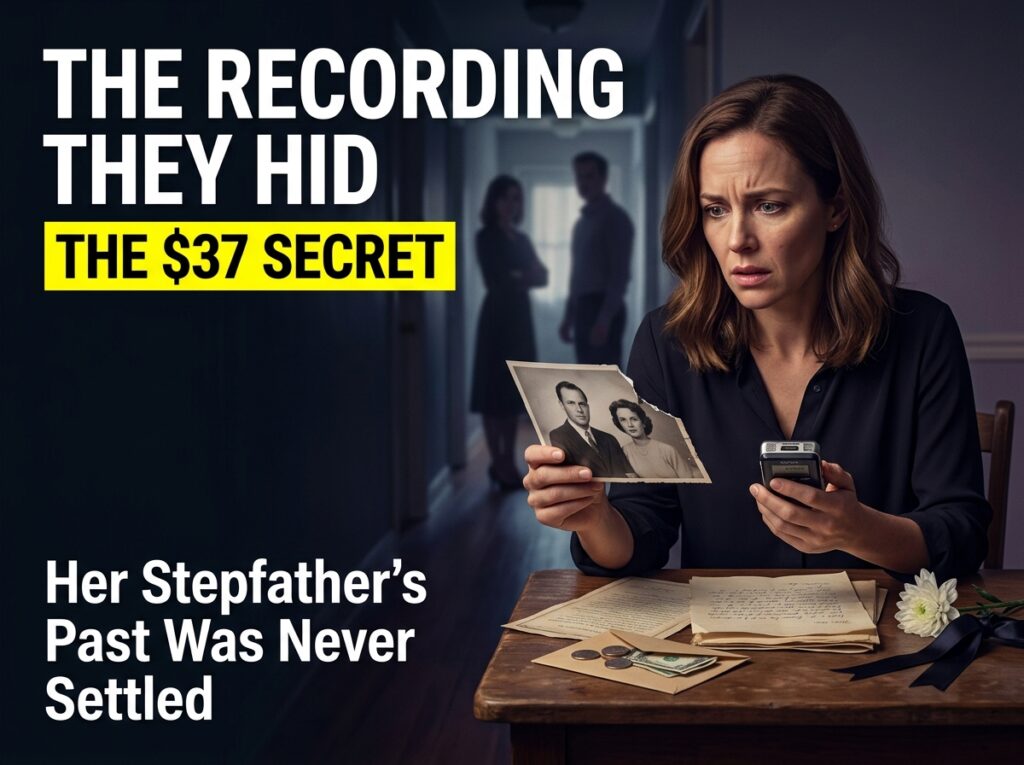
Part 1 — The Recording Nobody Was Supposed to Hear
Natalie, 35 never expected a rented room above a bakery to become the place where everything changed. I used to think love, loyalty, and family meant telling the truth. One document made me question that belief. For years, the stepfather who never discussed the past had been part of a story that seemed settled, but one detail had never made sense.
There were bills to pay, people depending on me, and memories I didn’t know how to explain. Even $37 seemed less important than the question nobody would answer: why had this been kept secret for so long? I tried to carry on as usual, but the silence around the subject only made it harder to ignore.
Then, the morning after the funeral, I found a photograph with a torn corner. At first I assumed it belonged to an old argument or a forgotten promise, but the details did not fit. The recording captured a conversation after everyone thought the room was empty. Suddenly, the story I had been told for years felt incomplete, and I realized that asking the wrong person might make everything worse.
The family went silent when I read the name at the bottom of the page. I had to decide whether to confront the people closest to me or follow the clue quietly before it disappeared.
I read the name again.
Then I looked up.
My aunt Margaret had stopped moving. My cousin Daniel, who had been collecting empty cups from the dining table, slowly lowered his hands. Even my older brother, Simon, who usually had an answer for everything, stared at the page as though he had never seen it before.
Only my stepfather’s chair remained empty.
He had died two days earlier.
For most of my life, I had known him as a quiet man who disliked discussing anything that happened before he married my mother. He had been patient with me when I was young, paid his share of the household bills, and never asked me to call him Dad. When relatives asked about his earlier life, he would smile politely and change the subject.
My mother had always explained his silence in the same way.
“Some memories are painful, Natalie. He doesn’t want to talk about them.”
I had accepted that explanation because it seemed kind. I thought respecting his privacy was part of loving him.
But the torn photograph and the recording suggested that his silence had concealed something more complicated.
The recording had been stored on a small digital device inside a cardboard box of funeral papers. It contained several minutes of muffled conversation, followed by a chair scraping across the floor and a voice saying a name.
The same name was written at the bottom of the page.
I pressed the playback button again.
A man’s voice emerged from the speaker.
“If Natalie ever finds out, she deserves to hear it from us.”
Another voice answered.
“Not yet. She doesn’t know what happened to the money.”
Then came a pause.
A third voice whispered, “And what about the thirty-seven dollars?”
The recording ended with a sharp click.
I stared at the device.
Thirty-seven dollars.
A photograph with a torn corner.
A name nobody wanted to discuss.
And a conversation recorded after everyone thought the room was empty.
I placed the device beside the photograph and looked at my family.
“Who is this person?” I asked.
Nobody answered.
Simon reached for the papers.
“Give me that.”
I pulled them toward me.
“No.”
His expression changed.
“Natalie, you’re grieving. You don’t understand what you’re looking at.”
“Then explain it.”
He glanced at Margaret.
She shook her head slightly, almost begging him not to speak.
That was when I understood something I had never considered before.
They were not confused by the name.
They recognized it.
And they were frightened that I had finally found it.
Part 2 — The $37 Nobody Remembered
I waited until the others had left before I examined the documents again.
The rented room above the bakery was small enough that I could hear the refrigerator clicking on and off from my bed. Normally, the smell of fresh bread drifting through the floorboards comforted me. That night, it reminded me that ordinary life continued even when everything you believed about your family began to collapse.
I placed the photograph beneath the desk lamp.
The torn corner had removed part of a person’s shoulder and the edge of a building. Three people remained visible. My stepfather stood on the left, younger than I had ever seen him in a photograph, with dark hair and a serious expression.
Beside him stood a woman I did not recognize.
The third person was mostly hidden by the torn edge.
On the back, someone had written a date and a short sentence:
“Keep the original until the amount is returned.”
I read it several times.
The wording was strange. What amount? Returned to whom?
I turned to the recording device.
The conversation was clearer when I connected it to a small speaker. I listened carefully, writing down every sentence I could understand.
The first voice sounded male and older.
“If we leave it like this, she will spend her life believing the wrong story.”
The second voice replied, “That was the agreement.”
“The agreement was about the money. It wasn’t permission to lie forever.”
A chair moved.
Then the third voice spoke.
“What happens if she finds the receipt?”
The recording ended shortly afterward.
I replayed it, hoping there was more hidden in the background. There was only static and the faint sound of someone closing a door.
I opened the box again and searched for a receipt.
There were funeral invoices, old household bills, handwritten notes, and a small envelope containing thirty-seven dollars in mixed notes and coins.
I almost laughed.
After all the fear and secrecy, the money seemed absurdly insignificant.
But the envelope had been carefully labeled with a date matching the one on the photograph.
Inside it was a folded slip of paper.
“Received: $37. To be held until the matter is corrected.”
There was no signature, only a set of initials.
I recognized one of them.
They matched my stepfather’s name.
I leaned back in my chair.
Why would someone preserve thirty-seven dollars for so many years? Why had the amount been mentioned in the recording as though it were part of a much larger dispute?
And why had everyone acted as if the money was irrelevant?
I called my mother.
She answered quietly.
“Natalie? It’s late. Is something wrong?”
“I found the photograph and the recording.”
There was a long silence.
“Where did you find those?”
“In the funeral box. Who is the person named on the page?”
My mother sighed.
“Please don’t start investigating old things.”
“I’m not trying to cause trouble. I need to understand.”
“Your stepfather had a difficult past.”
“I know that. But this recording says someone believed I deserved to hear the truth.”
Her breathing changed.
“What exactly did you hear?”
I repeated the words about the money and the agreement.
When I mentioned the $37, she said nothing.
“Mom?”
“I need to think.”
“You’ve had years to think.”
The words came out sharper than I intended.
My mother began to cry.
“I thought keeping you away from it would protect you.”
“Protect me from what?”
She did not answer.
Then she said, “Don’t speak to Simon until I can explain.”
The call ended.
I sat in the quiet room, looking at the photograph.
My mother had not denied knowing the name.
She had not denied the money.
She had simply asked me to stop.
And now I had a new question.
If my stepfather’s past was painful, why had the family chosen to preserve the evidence instead of destroying it?
Part 3 — The Man in the Torn Photograph
The following morning, I visited the small archive office where my stepfather had once stored personal records.
I knew about it because, years earlier, he had asked me to help organize some documents after a move. He had been unusually careful about keeping receipts and letters, placing each item inside a labeled folder.
At the time, I thought he was simply organized.
Now I wondered whether he had been preparing for a day when someone would need to understand his past.
The woman at the archive recognized his name but explained that she could not give me access to every record simply because I was related to him. She asked for documentation establishing my authority to request the relevant materials.
I provided what I could and asked whether the archive held anything connected to the date on the photograph.
She checked the catalogue.
“There is a reference to a personal file,” she said. “But the record is incomplete. Some items were removed when the collection was transferred.”
“Do you know who removed them?”
“Not from this entry.”
I wrote down the reference number.
Before leaving, I showed her a copy of the photograph.
She studied it carefully.
“I’ve seen this building before,” she said. “It looks like an old community office near the railway district. It was used for meetings and assistance appointments many years ago.”
“Can you tell who the people are?”
“No. But if you can identify the date, there may be other records.”
I thanked her and returned to my room.
I searched through the photograph box again, looking for anything that could establish where it had been taken. Beneath several envelopes, I found a small card bearing the name of a community center.
The address matched the district the archive worker had mentioned.
On the back was a telephone number and a handwritten note:
“Ask for Mr. Ellis. He remembers the original agreement.”
I called the number.
A man answered after several rings.
When I explained who I was, he became quiet.
“You’re the stepdaughter?”
“Yes.”
“I wondered whether someone would come looking eventually.”
“Do you know the person in the photograph?”
“I knew your stepfather.”
“Who are the other people?”
He hesitated.
“I can’t tell you the whole story over the telephone. But I can tell you this: the photograph was taken after a disagreement, not before it.”
“What disagreement?”
“The kind that happens when people believe they have been treated unfairly.”
“Was the $37 part of it?”
He exhaled.
“That amount was small. What it represented was not.”
I gripped the phone.
“What did it represent?”
“A promise.”
He agreed to meet me the following afternoon at the community center, provided I brought the original photograph and the note.
Before ending the call, he added one warning.
“Don’t assume that the person who stayed silent was the person who caused the harm.”
I thought about my stepfather, my mother, and Simon.
For years, I had interpreted my stepfather’s silence as proof that he wanted to forget the past. Now I wondered whether he had stayed silent because someone else had asked him to carry the blame.
That possibility frightened me more than the idea that he had simply made a mistake.
I had spent my childhood believing that my family story was settled.
But the photograph showed three people who had known one another, and the recording suggested that at least one of them believed the truth had been deliberately withheld.
I put the photograph inside my bag.
The next day, I would meet the man who remembered the original agreement.
And I hoped he would finally explain why thirty-seven dollars had become a secret worth keeping for years.
Part 4 — The Agreement That Was Never Finished
Mr. Ellis was waiting outside the community center when I arrived.
He was an elderly man with silver hair, a neatly pressed shirt, and the cautious expression of someone who had spent years deciding which things could safely be said aloud.
He led me into a small meeting room and closed the door.
I placed the photograph and note on the table.
He examined both.
“Yes,” he said. “That’s the photograph.”
“Who are the people?”
He pointed to my stepfather.
“This is him. The woman beside him was named Ruth. The third person was a young man who had come to the center seeking help.”
“Was he the person named on the page?”
Mr. Ellis nodded.
“His name was David.”
I had never heard the name before.
“What happened between them?”
“David had been promised help with a problem that affected his family. Your stepfather became involved because he believed the promise should be honored.”
“Then why did the family say they didn’t know him?”
Mr. Ellis folded his hands.
“Because the situation became embarrassing. People disagreed about who was responsible. Some wanted the matter resolved quietly. Others wanted an apology and an explanation.”
“Was the $37 the money David was owed?”
“Not exactly. It was a small amount connected to the original arrangement. It was meant to be returned once the disagreement was resolved.”
I looked at the note.
“Why did it never get returned?”
“Because the disagreement was never properly resolved.”
I asked whether the amount had grown into a larger financial problem.
Mr. Ellis shook his head.
“The thirty-seven dollars was not a fortune. But it became a symbol of the promise. People kept saying it was too small to matter, while refusing to acknowledge what it represented.”
I thought about the recording.
The agreement was about the money. It wasn’t permission to lie forever.
“Who made the recording?”
“I don’t know. I remember that people were worried about being overheard. Someone wanted a record of what had been said, but I never learned who kept it.”
“Did my stepfather cause the problem?”
Mr. Ellis considered the question.
“He was involved, but involvement is not the same as responsibility. He tried to help. Whether he made mistakes along the way is something you would need to establish from the records.”
“Why did he never tell me?”
“Perhaps he thought he was protecting you. Perhaps he was ashamed. Or perhaps he believed the matter would eventually be corrected without bringing you into it.”
“Did he know the story had become a lie?”
Mr. Ellis looked at the photograph.
“I believe he knew the family version was incomplete.”
The answer settled heavily between us.
I asked whether there were documents that could explain the agreement.
Mr. Ellis said the community center had once kept a record of assistance arrangements, but the files had been transferred to another office. He could not promise that the original document still existed.
Before we left the room, he gave me a copy of an old index entry.
It listed the names of my stepfather, Ruth, and David beside a note about an unresolved agreement.
At the bottom, someone had written:
“Do not close the file until the person affected has been heard.”
I read the sentence twice.
The family had not merely forgotten the matter.
Someone had explicitly recorded that it was unfinished.
And the next question was unavoidable.
Who had decided to close the file anyway?
Part 5 — Why My Mother Was Afraid
I returned home and found my mother waiting outside my apartment.
She looked exhausted. Her eyes were swollen, and she held a small handbag tightly against her chest.
“Can we talk?” she asked.
I let her inside.
For a few minutes, she looked around the room without speaking. The bakery downstairs had begun preparing for the afternoon rush, and the smell of warm bread drifted through the open window.
Then she sat at the table.
“I know you met Mr. Ellis,” she said.
“How?”
“He called me.”
I felt my frustration rise.
“Everyone seems to know what I’m doing before I do. Why has nobody simply told me the truth?”
My mother covered her face with her hands.
“Because I was afraid you would think badly of him.”
“Of my stepfather?”
She nodded.
“He was not a perfect man, Natalie. But he tried to do the right thing.”
“What did he do?”
“He agreed to help David. Something went wrong, and the family became involved. There were arguments, and people began blaming one another. Your stepfather believed that if he admitted what he knew, it would damage relationships that could never be repaired.”
“Did he do something wrong?”
My mother took a long breath.
“I don’t know every detail. I know he made a promise, and I know he regretted how the situation ended.”
“Then why did you tell me the past was settled?”
“Because he asked me to wait until he could make things right.”
“Did he ever make things right?”
She began to cry.
“No.”
I sat opposite her, unable to find words.
My mother explained that the $37 had been set aside as a reminder of the unresolved promise. It was not the full value of what David believed he had lost. It was the amount that had been discussed during one meeting, when everyone agreed that a small payment would be returned once the larger issue had been addressed.
But the larger issue had never been resolved.
Over time, the family stopped discussing David. His name became associated with an embarrassing disagreement, and people began calling him a stranger.
My stepfather had not corrected them.
My mother had allowed the explanation to continue because she believed that reopening the matter would cause more harm.
“Did you know about the recording?” I asked.
She shook her head.
“I knew someone had kept documents. I didn’t know there was a recording.”
“Who is the name at the bottom of the page?”
She looked away.
“David’s sister.”
I stared at her.
“Why is her name on the document?”
“Because she was the person who asked for the agreement to be reviewed. She was the one who wanted the family to acknowledge what happened.”
“Did she receive an answer?”
“No.”
“Where is she now?”
My mother hesitated.
“I don’t know. Your stepfather received a letter from her several years ago, but he never showed me the full contents.”
“Do you still have the letter?”
She reached into her handbag and removed a folded envelope.
“I kept it because I thought one day I might need to explain.”
The envelope was addressed to my stepfather. The handwriting matched the note on the photograph.
I opened it carefully.
The letter contained a simple request: David’s sister wanted the family to stop describing her brother as a stranger and acknowledge that the promise had never been fulfilled.
At the bottom, she had written:
“I am not asking you to remember him fondly. I am asking you to stop pretending he never mattered.”
I read the sentence aloud.
My mother lowered her head.
For years, I had believed the family silence was an attempt to protect my stepfather’s privacy.
Now I understood that it had also erased someone else’s place in our history.
And I could no longer accept that as an act of love.
Part 6 — The Person Behind the Name
I spent the next two days trying to locate David’s sister.
The letter contained an old address, but the building had been sold. The current residents had never heard of her. I contacted the community center again and asked whether the archive held any later correspondence.
Mr. Ellis searched the available index and found a forwarding address recorded several years after the original agreement.
It led to a small town outside the city.
I called the number listed beside it.
A woman answered.
When I introduced myself and explained that I had found a photograph connected to my stepfather, she became silent.
“Is this about David?” she asked.
“Yes.”
“After all this time?”
“I found documents and a recording. I want to understand what happened.”
She sighed.
“My name is Eleanor. I was David’s sister.”
I asked whether she would be willing to meet.
She agreed, but she warned me that she would not participate in another conversation where people asked her to forgive the family before acknowledging what had happened.
I promised that I would listen.
When we met, Eleanor brought a folder containing letters and copies of documents. She looked directly at me as she explained that David had once trusted my stepfather to help resolve a difficult situation.
The original problem was not a dramatic crime or a fortune hidden away. It was an agreement that had been made in good faith and then left incomplete after the people involved began arguing about responsibility.
David had believed he would receive an explanation and a small payment connected to the arrangement. Instead, he was told that the matter had been settled and that he should stop contacting the family.
He had tried several times to obtain a clear answer.
Eventually, he stopped.
“He wasn’t asking for the world,” Eleanor said. “He wanted someone to admit that a promise had been made.”
“What happened to him?” I asked.
“He moved away. He built a life elsewhere. But he never understood why people who had once offered to help him eventually acted as if they had never met him.”
I looked at the photograph.
“Did my stepfather deliberately hurt him?”
Eleanor took her time answering.
“I don’t know whether he intended to hurt David. I know he allowed the silence to continue. Sometimes people make a mistake, then become so afraid of admitting it that the mistake becomes a choice they repeat.”
I thought about my stepfather’s quiet manner, his reluctance to discuss the past, and the way my mother had always described him as a man who carried painful memories.
Perhaps he had carried guilt.
Perhaps he had believed that saying nothing was kinder than reopening an old wound.
But Eleanor had lived with the consequences of that silence, too.
She handed me a copy of a letter David had written before leaving the area.
The final paragraph read:
“If they cannot keep the promise, I can accept that. What I cannot accept is being treated as if I never existed.”
I felt tears rise in my eyes.
For years, my family had been protecting a version of the story that allowed everyone to avoid an uncomfortable conversation. In doing so, we had made another person’s pain invisible.
I asked Eleanor whether she wanted an apology from the family.
“I want the truth recorded,” she replied. “If someone apologizes, I want it to mean they understand what they are apologizing for.”
I promised to share her documents with the family and to make sure the unresolved agreement was no longer described as settled.
When I returned home, I listened to the recording one more time.
“If Natalie ever finds out, she deserves to hear it from us.”
For the first time, I understood who that sentence had been meant to protect.
Not my stepfather.
Not my mother.
Me.
But protection had become another word for exclusion, and I was ready to stop accepting it.
Part 7 — The Family Meeting
I asked everyone to meet at my mother’s house on Sunday afternoon.
Simon objected immediately.
“Why are we doing this again?”
“Because the matter was never resolved.”
“It’s been years.”
“That doesn’t make the documents disappear.”
He looked at my mother, hoping she would support him.
She did not.
For the first time since I had found the photograph, she told him that we needed to listen.
I placed the photograph, the recording device, the note about the $37, and Eleanor’s letters on the dining table.
Then I explained what I had learned.
I did not accuse anyone of committing a crime. I did not claim to know every detail of the original disagreement. I separated what the documents confirmed from what remained uncertain.
The photograph showed that my stepfather had known David and his sister.
The archive index showed that the agreement had been recorded as unresolved.
The note confirmed that thirty-seven dollars had been set aside in connection with the matter.
The letters showed that David’s sister had repeatedly asked the family to acknowledge the promise.
And the recording showed that at least some relatives knew the story had not been settled.
Simon stared at the documents.
“Who gave you the recording?”
“It was in the funeral box.”
“That doesn’t answer the question.”
“It is the answer I have.”
He pushed his chair back.
“You’re making this family look terrible.”
“No. I’m asking why we let a person become a stranger in our story when the records show he was part of it.”
My aunt Margaret began to cry.
She admitted that she had heard David’s name years earlier but had accepted the explanation that the matter was private and finished. She said she had never seen the original agreement.
Simon insisted that nobody had intended to hurt anyone.
Eleanor’s letter lay in front of him.
I asked him to read it.
He refused at first. Then, after my mother asked him quietly, he picked it up.
He read the final paragraph twice.
His face changed.
“I didn’t know she had written this,” he said.
“Did you know about the original agreement?”
He hesitated.
“I knew there had been an argument.”
“Did you know the file was never formally closed?”
“No.”
“Then why did you keep telling me there was nothing to discuss?”
He looked down at the table.
“Because that’s what I was told.”
“By whom?”
He did not answer.
I realized that Simon might not have known the entire truth. He had repeated the family version because it was the version he had inherited. Like me, he had been encouraged to believe that questioning it was disloyal.
But now he had the documents in front of him.
He could choose what to do next.
I played the recording.
The room filled with the sound of the voices discussing the agreement, the money, and the danger of leaving the story incomplete.
When the recording ended, nobody spoke.
Finally, my mother said, “We should have listened to David’s sister.”
It was the first time she had said the words without qualifying them.
I looked around the table.
The family had not suddenly become united. Some people still felt embarrassed. Others were angry that the matter had been reopened. But for the first time, nobody was demanding that the evidence be hidden.
I asked whether anyone knew where the original agreement had gone.
Simon looked at the photograph.
Then he said, “I might know where another copy is.”
Part 8 — The Missing Page
Simon explained that, several years earlier, he had helped my stepfather move a box of old papers from a storage room. He remembered a folder containing documents connected to David, but he had assumed they were ordinary correspondence.
He had placed the folder in a cabinet at my mother’s house.
Later, when the cabinet was cleared, the papers were moved into a box of household records.
“I never opened them,” he said. “I didn’t know what they were.”
We searched the storage room together.
The cabinet contained old tax documents, insurance papers, and receipts from household repairs. At the back of the lowest drawer, beneath a stack of envelopes, we found a thin folder marked with the same date as the photograph.
Inside was a copy of the original agreement.
The first page identified the people involved and described the promise that had been made. The second page contained the terms of the proposed resolution. The third page was missing.
I read the available pages carefully.
They confirmed that the $37 had been intended as a small payment associated with the agreement. The amount was not the full value of the matter, nor did the document suggest that it represented a large hidden fortune.
The real issue was that the agreement required a follow-up conversation and a written acknowledgment. Neither appeared in the records.
The missing third page was supposed to contain the final acknowledgment.
Without it, we could not establish whether the agreement had ever been completed.
My mother sat down.
“I remember your stepfather asking about this folder,” she said. “He said he couldn’t find the last page.”
“Did he look for it?”
“Yes. He searched for weeks.”
“Did he ever find it?”
She shook her head.
Simon turned the folder over.
There was a handwritten note on the back cover:
“Original to be returned to Eleanor after the final discussion.”
The words made the room feel smaller.
The document had not been intended to remain hidden forever. Someone had planned to return it to Eleanor after the matter was settled.
But the final discussion had never taken place.
I asked Simon whether he remembered seeing another envelope.
He thought for a moment, then pointed toward a shelf near the window.
“There was a small box of personal letters. I put it in the cabinet after the move.”
We searched again.
The box was hidden behind a stack of old magazines. Inside were several letters, a photograph of my stepfather with David, and a sealed envelope addressed to Eleanor.
The envelope had never been sent.
It contained a short letter written in my stepfather’s handwriting.
He acknowledged that the agreement had not been properly completed. He apologized for allowing the family to describe David as a stranger and said that he wanted to arrange a meeting to put the record straight.
The letter was dated several years before his death.
I read it slowly.
My stepfather had recognized the problem. He had intended to correct it. But he had never sent the letter, and the promise remained unfinished.
My mother covered her mouth.
“He wanted to fix it,” she whispered.
“Yes,” I said. “But wanting to fix it wasn’t the same as doing it.”
Nobody argued.
I placed the unsent letter beside Eleanor’s copy of David’s final message.
The two letters told a painful story. One person had asked to be acknowledged. Another had intended to apologize. Between them stood years of hesitation, fear, and silence.
I could not make the lost years return.
But I could make sure the letters finally reached the person they were written for.
Part 9 — The Apology That Came Too Late
I contacted Eleanor and told her we had found another copy of the agreement and an unsent letter from my stepfather.
She agreed to meet me again.
When I placed the letter in front of her, she did not open it immediately. She stared at the handwriting for a long time, tracing the edges of the envelope with one finger.
“He was going to write,” she said.
“He did write. He just never sent it.”
She closed her eyes.
“I spent years wondering whether he remembered us at all.”
“He remembered.”
“Then why did he wait?”
I could not give her a satisfying answer.
“He may have been afraid,” I said. “He may have believed there would be another opportunity. I don’t know.”
Eleanor finally opened the envelope.
She read the letter quietly. When she finished, she folded it and placed it back on the table.
“I believe he regretted what happened,” she said. “But regret doesn’t erase the years.”
“I know.”
She looked at me.
“Do you?”
I felt the question deeply.
For years, I had accepted my family’s explanation because it was easier than challenging the people I loved. I had mistaken silence for respect and avoidance for kindness.
“I am beginning to understand,” I replied.
We discussed the missing page and the documents that had survived. Eleanor wanted copies preserved with the archive so the agreement could be recorded accurately. She also wanted the family to acknowledge, in writing, that David had not been a stranger and that the matter had never been formally resolved.
I agreed.
My mother, Simon, and Margaret later signed a statement acknowledging the family relationship and correcting the version of events that had been repeated for years. The statement did not claim to answer every question. It simply recorded what the surviving documents supported and recognized that the promise had been left unfinished.
The $37 was returned according to the arrangement we could verify, not because the money itself could repair the past, but because the family had finally stopped pretending it did not matter.
When Eleanor received it, she did not smile.
“Thank you,” she said. “I wish someone had done this earlier.”
So did I.
Before we parted, she gave me the torn photograph.
“You should keep it,” she said. “Your stepfather is part of your history, too. You don’t have to remember him as perfect to remember that he mattered.”
I placed the photograph in my bag.
On the journey home, I thought about the recording. The voice had said that I deserved to hear the truth.
At first, I had assumed the recording would expose a terrible secret or reveal that someone had stolen money. Instead, it exposed something quieter and more familiar: the way a family can allow fear to become an excuse, then repeat the excuse until nobody remembers the original promise.
The truth was not that my stepfather had never cared.
It was that caring had not been enough.
He had known the matter remained unresolved. He had wanted to correct it. But he had waited, and the silence had continued long after he was gone.
I could mourn him without pretending he had done everything right.
I could love my family without agreeing to hide what happened.
And I could finally stop treating the truth as something that threatened our relationships.
Sometimes, it is the only thing that gives those relationships a chance to become honest.
Part 10 — What the Recording Left Behind
A month later, I returned to the rented room above the bakery with a folder of documents that no longer felt like a threat.
The photograph had been preserved. The agreement had been copied and placed with the archive records. Eleanor had received the letter intended for her, and the family had acknowledged that the matter had never been properly closed.
There were still questions we could not answer. The missing page had never been found, and the recording did not identify everyone who had been present when the conversation took place.
I decided not to invent answers simply to make the story feel complete.
Some parts of the past would remain uncertain.
But the central truth was no longer hidden.
David had known my stepfather. A promise had been made. The thirty-seven dollars had been set aside as part of an unresolved arrangement. The family had continued telling a simplified version of events even after documents showed that the matter remained unfinished.
That was enough to change the way I understood my childhood.
I remembered my stepfather sitting quietly at the kitchen table, sorting papers into neat piles. I remembered how he would pause when someone mentioned the years before he married my mother. I remembered believing that his silence was simply part of his personality.
Perhaps some of it was.
But I now knew that silence could also be a burden, a decision repeated until it became difficult to reverse.
My mother began speaking about the past more openly. She admitted that she had been afraid of damaging the family’s reputation and that she had hoped the matter would disappear if nobody discussed it.
Simon apologized for telling me to stop asking questions. He said he had believed he was protecting the family, but he understood that he had helped keep the truth from the person who needed to hear it.
Our relationships did not become perfect overnight.
Trust takes longer to rebuild than it takes to lose. Some conversations remained uncomfortable, and there were days when I wished I had never found the recording.
But I no longer wished the truth had remained hidden.
I placed the torn photograph in a frame and set it beside my stepfather’s letter. The torn corner remained visible. I could have tried to repair it, but I decided to leave it as it was.
The missing piece was part of the photograph’s history.
It reminded me that families are rarely complete pictures. We inherit stories, memories, and explanations from people who may not know everything themselves. Sometimes the missing details are accidents. Sometimes they are the result of fear. And sometimes, someone has deliberately removed the part that makes the rest of the story difficult to accept.
The important thing is not to pretend the picture is whole.
It is to be willing to look closely.
One evening, I listened to the recording again.
The voices were still faint. The chair still scraped across the floor. The same sentence emerged from the speaker:
“If Natalie ever finds out, she deserves to hear it from us.”
I had spent weeks wondering who had made the recording and why it had been kept. I never found a conclusive answer.
But I no longer needed to know every detail to understand what the recording had done.
It had interrupted a story that everyone had treated as settled.
It had given a forgotten person a place in our family history.
And it had forced me to question a belief I had carried for thirty-five years: that loyalty meant accepting what the people closest to me told me.
Now I understood that loyalty without honesty can become another form of silence.
The $37 was never the most important part of the mystery. The money mattered because it represented a promise that had been reduced to an insignificant detail. The photograph mattered because it proved that a connection existed. The recording mattered because it captured the moment someone admitted that the story was incomplete.
Together, they reminded me that even a small unresolved matter can grow into something much larger when people refuse to acknowledge it.
My stepfather had been part of my life for years. I could remember his kindness and still recognize his failure to finish what he had promised. I could grieve him without making excuses for the silence he left behind.
That was the hardest lesson.
Love does not require us to turn people into heroes. It asks us to see them honestly, with their good intentions, their mistakes, and the consequences of their choices.
The bakery downstairs closed for the night. The street grew quiet, and I sat by the window with the photograph beside me.
For the first time since the funeral, the silence did not feel like a warning.
It felt like space to think.
I had not uncovered a perfect ending. I had uncovered an unfinished promise, and we had done what we could to acknowledge it.
Sometimes that is the most honest ending a family can have.
Not every question receives an answer. Not every wound disappears. Not every apology arrives in time.
But the truth can still be spoken.
And once it is spoken, the people left behind can choose what to do with it.
I turned off the lamp and placed the photograph safely in its frame.
The past would always be part of my story.
It no longer had to remain a secret.