Tessa, 24 never expected a bank branch near the courthouse to become the place where everything changed. I wasn’t searching for a secret; I was only trying to settle one practical problem before the end of the month. For years, the partner who promised to stay had been part of a story that seemed settled, but one detail had never made sense.
There were bills to pay, people depending on me, and memories I didn’t know how to explain. Even $187,000 seemed less important than the question nobody would answer: why had this been kept secret for so long? I tried to carry on as usual, but the silence around the subject only made it harder to ignore.
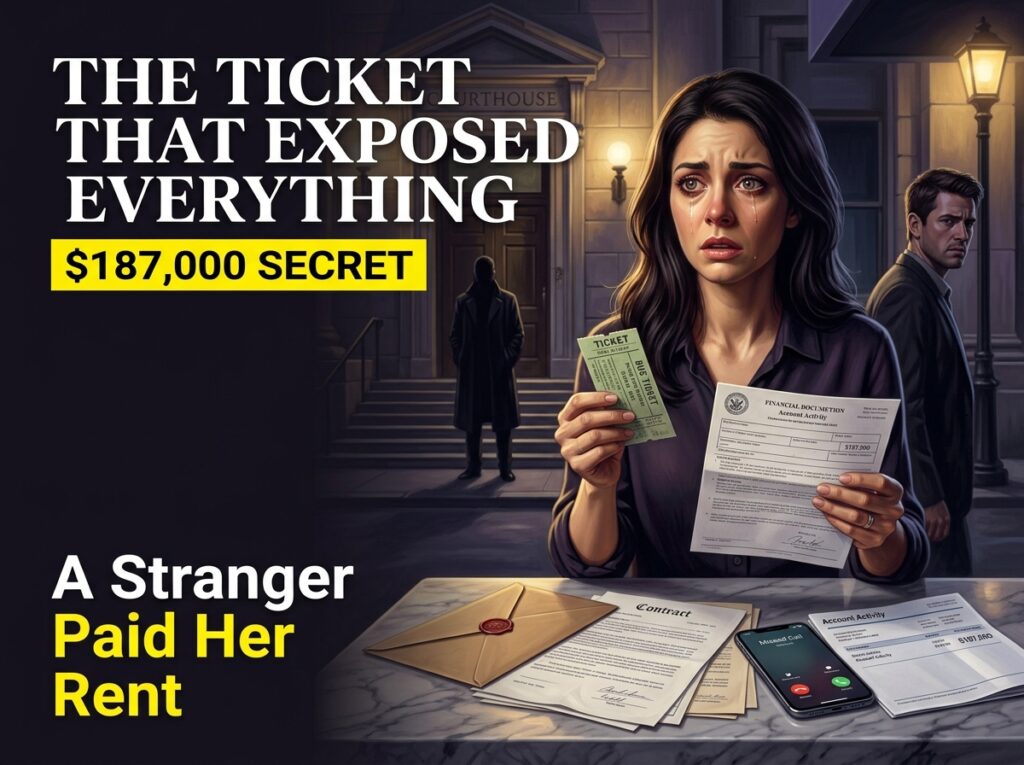
Then, last Tuesday, I found a bus ticket. At first I assumed it belonged to an old argument or a forgotten promise, but the details did not fit. The ticket was dated the day the partner claimed to be at work. Suddenly, the story I had been told for years felt incomplete, and I realized that asking the wrong person might make everything worse.
Then the landlord asked why a stranger had paid three months of rent. I had to decide whether to confront the people closest to me or follow the clue quietly before it disappeared.
The ticket was folded inside an envelope that had been shoved behind the bottom drawer of our bedroom dresser.
I found it while looking for the receipt from the electricity company. The bill was due in four days, and I had already promised myself I would stop putting off the practical things in my life. I was twenty-four, working long hours, and trying to keep my small apartment running while my partner, Adrian, insisted that we were only going through a difficult period.
He had always been good at making difficult periods sound temporary.
A delayed paycheck was temporary. A forgotten promise was temporary. A week of silence after an argument was temporary.
And the money he said he would explain later was always temporary, too.
But the bus ticket was dated three months earlier, on a Thursday when Adrian had told me he was working an extra shift across town.
I remembered that day because I had waited for him to come home with groceries. He had messaged at six in the evening to say his supervisor had asked him to stay late. At nine, he had called and told me not to wait up.
I had believed him.
The ticket showed a journey from our city to a town nearly two hours away. The time printed on it was 5:40 p.m.
I turned it over, hoping to find an explanation written on the back.
There was only a faint mark from a pen and a short handwritten number: 18.
I sat on the bedroom floor and stared at it.
The ticket did not prove Adrian had lied. He could have traveled for a legitimate reason, and I had no way of knowing whether the ticket belonged to him. But I knew the handwriting on the envelope in which it had been kept.
It was Adrian’s.
I put the ticket in my purse.
That evening, I asked him about the Thursday shift.
He was standing in the kitchen, scrolling through his phone while the kettle boiled.
“Do you remember the Thursday you worked late three months ago?” I asked.
He barely looked up.
“Which Thursday?”
“The one when you said your supervisor needed you.”
“I work late all the time, Tessa.”
“I know. I’m asking about that particular day.”
He turned off the kettle.
“Why?”
“I found something while looking for the electricity receipt.”
His expression changed.
“What did you find?”
“A bus ticket.”
For a second, he seemed to forget what he was doing.
Then he laughed, but the sound was forced.
“People keep tickets. It doesn’t mean anything.”
“It was dated the day you said you were at work.”
He set his phone on the counter.
“Maybe I bought it for someone. Maybe it was an old ticket. Why are you going through my things?”
“I was looking for a bill.”
“You could have asked me.”
“I am asking you now.”
He stared at me as though I had deliberately created a problem.
“I don’t have time for this tonight.”
He took his jacket from the chair and walked out.
I watched the door close.
For years, I had been afraid that asking too many questions would damage our relationship. Now I was beginning to understand that avoiding questions had not protected it. It had only given the unanswered things more room to grow.
I took the ticket from my purse and placed it beside the electricity bill.
The bill was still due in four days.
But for the first time, I could not concentrate on the practical problem in front of me.
I wanted to know where Adrian had gone that Thursday.
And why he seemed more frightened by a small piece of paper than by the possibility that I no longer trusted him.
Part 2 — Three Months of Rent
The next morning, my landlord called.
I expected him to remind me about the electricity-related maintenance charge that had been added to the rent. Instead, he asked whether I had arranged a payment in advance.
“I haven’t paid anything extra,” I said.
“That’s what I thought. Someone paid three months of your rent last week.”
I stopped walking.
“Who?”
“The payment came through an account that doesn’t match your name. The person said the money was meant to cover your rent while you dealt with a personal matter.”
“Did they leave a name?”
He checked his records.
“The payment reference includes the words ‘for Tessa.’ I can’t tell you more than the records permit, but I wanted to make sure you knew the account was settled for now.”
I thanked him and ended the call.
Three months of rent was more than I could easily spare. I had been counting every expense, deciding which bills could wait and which could not. The idea that someone had paid the money without telling me should have been a relief.
Instead, I felt uneasy.
I had not asked anyone for help.
Adrian had not mentioned arranging a payment.
And the landlord’s call came less than a day after I found the ticket.
I called Adrian.
He answered on the fourth ring.
“Did you pay three months of my rent?” I asked.
“No.”
“Do you know who did?”
“Why would I know?”
“Because the payment came after I found the ticket.”
He went silent.
I heard traffic in the background.
“What does the ticket have to do with your rent?” he asked.
“I don’t know. That’s why I’m asking.”
He exhaled sharply.
“Tessa, you’re connecting things that have nothing to do with each other.”
“Then explain the ticket.”
“I told you. It could belong to anyone.”
“Was it yours?”
“I have to go.”
“Adrian—”
He ended the call.
I stood on the pavement, holding my phone.
I wanted to believe that he was simply overwhelmed. We had been under pressure for months, and I knew that financial trouble could make even good people defensive. But the way he kept avoiding the simplest questions made me wonder whether I was the only person in our relationship who still believed honesty was necessary.
That afternoon, I visited the bank branch near the courthouse.
The branch was small and busy. People stood in line holding folders and envelopes, waiting to discuss loans, transfers, and paperwork they did not fully understand.
I had come to ask about a financial document Adrian had once shown me. It contained a figure of $187,000, though he had told me it related to a matter involving other people and had nothing to do with us.
I had not asked more questions at the time.
Now I wanted to understand why that amount had appeared in conversations that Adrian repeatedly shut down.
A bank employee explained that I could not access or investigate someone else’s private account simply because I knew a figure associated with it. If I had documents that raised a legitimate concern, I could provide them for appropriate review, but the bank could not disclose private account details without authorization or another proper basis.
I understood.
I had not come expecting a stranger to hand me confidential information. I wanted to know whether the paper Adrian had shown me was genuine and whether there was a lawful way to clarify my own connection to it.
The employee advised me to preserve the document and seek appropriate guidance if I believed I might have a legal or financial interest.
As I left the branch, I noticed a man standing near the courthouse steps.
He appeared to be in his fifties, wearing a dark coat and holding a plain envelope. He looked directly at me, then turned away when our eyes met.
I thought nothing of it until I reached the bus stop.
The same man was standing across the road.
He did not approach me.
He simply watched until the bus arrived.
I climbed aboard and took a seat near the window.
As the bus pulled away, I saw him open the envelope and look at a piece of paper.
It might have been a coincidence.
But the feeling that someone knew what I was searching for followed me all the way home.
Part 3 — The Number Nobody Explained
I kept the $187,000 document in a folder beneath my bed.
It was not an original bank statement, and it did not clearly establish who owned the money. It was a photocopied page with a reference number, a date, and a handwritten note that Adrian had once called “an old family matter.”
When I had asked him about it months earlier, he had told me that it was not his money and that I did not need to worry about it.
I had accepted that answer.
Now I wondered why he had kept the paper at all.
The following morning, I examined the document more carefully. The reference number matched neither my account nor anything in my own financial records. There was no clear explanation of the amount, no named beneficiary, and no confirmation that the money was available to anyone.
I photographed the page and stored a copy securely.
Then I called my older sister, Lena.
Lena had always been the practical one in our family. She was the person I called when I needed to make a decision without letting emotion take over.
I explained the bus ticket and the rent payment.
She listened without interrupting.
When I mentioned the $187,000, her voice changed.
“Where did you get that number?”
“From a document Adrian showed me months ago.”
“Did he tell you whose money it was?”
“No. He said it was connected to a family matter.”
Lena was quiet for a moment.
“Tessa, I think you should be careful.”
“Do you know something?”
“I know that people in our family have argued about money before. But I don’t know whether this is connected to that.”
“What kind of argument?”
She sighed.
“Years ago, there was a dispute about money that was supposed to be held until a legal matter was resolved. I was young, and nobody explained the details. All I remember is that certain people stopped speaking to one another.”
“Was the amount $187,000?”
“I don’t know.”
“Did Adrian know about it?”
“I don’t know that either.”
I felt frustration rising.
“Why does everyone know just enough to be frightened and not enough to answer a question?”
“Because sometimes people hear part of a story and spend years filling in the rest,” Lena replied. “Don’t assume the number proves anything. Find out where the document came from.”
She was right.
The amount was striking, but it was not proof of wrongdoing. I needed to establish how the paper was connected to Adrian and whether the bus ticket had any real connection to the money.
That afternoon, I returned to the apartment and searched the dresser more thoroughly.
Behind a loose panel, I found a second envelope.
It contained a photocopy of a letter addressed to a person named Martin Hale. The letter referred to an appointment at the courthouse and a request to preserve certain financial records until an agreement had been reviewed.
At the bottom was a date.
It was the same Thursday printed on the bus ticket.
I stared at the page.
The letter did not prove that Adrian had gone to the courthouse that day. It did not prove he had traveled to the town printed on the ticket. But it established that the date was connected to a legal matter involving records and money.
I searched the rest of the envelope.
There was a small note in Adrian’s handwriting.
“Do not discuss this with Tessa until the matter is settled.”
I read it again.
Then I sat on the edge of the bed.
The words hurt more than I expected.
Adrian had not merely avoided a conversation. He had written down an instruction to keep me in the dark.
I thought about the months we had spent talking about our future. I thought about the plans we had made, the bills we had divided, and the promises he had made when I worried about money.
Had he been protecting me from something?
Or had he been protecting himself from questions he did not want to answer?
I placed the note beside the bus ticket.
For the first time, I had a concrete connection between the date on the ticket and the document involving the courthouse.
I still did not know what the connection meant.
But I knew I could no longer accept Adrian’s assurance that there was nothing to explain.
Part 4 — The Man Outside the Courthouse
I returned to the courthouse two days later.
I did not know whether the man in the dark coat would be there again. I also did not know whether he had anything to do with the document or the rent payment.
I wanted answers, but I did not want to confront a stranger based on a feeling.
I went to the public information desk and asked how someone could find out whether a document related to a completed legal matter. The staff explained that access depended on the type of record, the relevant rules, and whether the person requesting it had a legitimate basis.
I provided the reference number from the photocopied page.
The clerk could not confirm private details immediately, but she explained the proper process for making an inquiry. I left my contact information and asked what documentation I should provide.
As I walked down the steps, I saw the man again.
He stood near a bench beneath a bare tree.
This time, he approached me.
“Tessa?”
I stopped.
“Who are you?”
“My name is Martin Hale.”
The name on the letter.
I tightened my grip on my bag.
“How do you know my name?”
“I’ve been trying to find a way to speak to you without causing more trouble.”
“Did you pay my rent?”
He looked surprised.
“No. I didn’t.”
“Then why are you looking for me?”
He glanced toward the courthouse entrance.
“Because I believe your partner has misunderstood an agreement that was supposed to protect you from being drawn into a dispute.”
“What agreement?”
Martin held out a business card.
“I worked with the people who handled the original records. I cannot discuss everything here, and I won’t ask you to trust me based on a few words. But I can tell you that the $187,000 figure is connected to a disputed financial arrangement. It is not proof that the money belongs to your partner, to you, or to any particular person.”
I looked at the card.
His name and office details were printed on it, but that alone did not establish that he was trustworthy.
“Why was Adrian traveling on the day he said he was at work?”
Martin lowered his eyes.
“I don’t know what he told you about that day. I do know that an appointment was scheduled, and someone attended it.”
“Was it Adrian?”
“I can’t confirm that without reviewing the relevant records.”
“Then why approach me?”
“Because someone asked me to make sure you knew the matter was not as simple as you had been told.”
“Who?”
He hesitated.
“I can’t give you a name yet.”
I almost walked away.
I had heard enough half-answers to last a lifetime.
But Martin seemed to understand my hesitation.
“You should verify everything I tell you,” he said. “Do not give me money, sign anything, or rely on promises. Start with the documents you already have. If there is a legitimate reason for you to be involved, it should be possible to establish it through proper channels.”
That was the first thing anyone had said that made sense.
I took his card.
“Did you arrange the rent payment?”
“No.”
“Do you know who did?”
“I have a suspicion, but I don’t have evidence.”
I studied his face.
“Then we’re in the same position.”
He nodded.
“Perhaps. But I think the person who paid your rent wanted you to have enough time to understand what was happening before the end of the month.”
He stepped away.
I watched him walk toward the courthouse doors.
The conversation had raised more questions than it answered. But Martin had not asked me to hand over the documents or trust him blindly.
He had told me to verify the evidence.
For the first time since finding the ticket, I felt I had a way forward.
I would not accuse Adrian without proof.
I would not assume the $187,000 belonged to me.
And I would not let an unexplained payment become another reason to ignore the truth.
Part 5 — Adrian’s Missing Thursday
Adrian came home late that evening.
I was sitting at the kitchen table with the ticket, the letter, and Martin’s business card arranged in front of me.
He stopped when he saw them.
“Who is Martin Hale?” I asked.
His face went pale.
“Where did you meet him?”
“At the courthouse.”
Adrian closed the door slowly.
“You shouldn’t have gone there.”
“Why?”
“Because you don’t understand what you’re getting involved in.”
“Then help me understand.”
He took off his jacket and placed it over a chair.
For several seconds, he said nothing.
Then he sat across from me.
“The $187,000 is connected to a dispute that began before we met,” he said. “It involves a financial arrangement between people who don’t trust one another. I was asked to help organize some documents.”
“Why didn’t you tell me?”
“Because I was told not to discuss it until the matter was settled.”
“Who told you?”
He looked away.
“Someone who thought it would be safer.”
“Safer for whom?”
He did not answer.
I pointed to the bus ticket.
“You told me you were at work that Thursday.”
“I was supposed to be at work.”
“That isn’t the same thing.”
“No.”
It was the first honest word he had given me in days.
He explained that he had taken the bus to attend a meeting connected to the financial dispute. He had not wanted to tell me because he believed the matter could be resolved without affecting our lives.
He said he had not taken the $187,000 and had no personal claim to it.
I asked why he had written the note telling someone not to discuss the matter with me.
“Because I thought you would worry,” he said.
“I did worry. I worried because you lied to me.”
He lowered his head.
“I know.”
I asked whether he had arranged the rent payment.
He shook his head.
“Not directly.”
“What does that mean?”
“Someone offered to help cover the rent while the dispute was being reviewed. I knew the offer existed, but I didn’t know who completed the payment.”
“Who made the offer?”
“I can’t tell you because I don’t know for certain.”
I stared at him.
“You keep saying you don’t know. But you knew about the ticket, you knew about the courthouse appointment, and you knew someone might pay my rent.”
“I know how it sounds.”
“It sounds like you’ve been making decisions about my life without letting me participate.”
He looked genuinely ashamed.
“I thought I was protecting you.”
“From what?”
“From a dispute that could become ugly. People have argued about the money for years. I didn’t want you dragged into it.”
I wanted to believe that he had acted out of fear rather than greed. But his intentions did not erase the fact that he had chosen secrecy over trust.
“What happens now?” I asked.
“I want to finish the paperwork and get out of it.”
“Then we’ll finish it properly. With records. With explanations. And without asking me to accept a story just because you say it’s safer.”
He nodded.
For the first time, we were discussing the problem instead of arguing about whether I was allowed to ask questions.
But one thing still troubled me.
If Adrian had not paid my rent, and Martin had not paid it, who had?
And why had that person chosen to remain anonymous?
Part 6 — The Stranger’s Message
The following morning, my landlord forwarded a message from the person who had arranged the rent payment.
The message did not reveal the payer’s full identity, but it contained a reference number and a short note.
“Please let Tessa know the payment is not a loan and does not create an obligation. She should have time to make her own decision before the end of the month.”
I read the note twice.
It was not a demand.
It was not an offer to buy my silence.
Whoever had paid the rent wanted me to have time.
I showed the message to Adrian.
He stared at it for a long moment.
“I think I know who this is,” he said.
“Who?”
“My aunt, Eleanor.”
I had met Eleanor only twice. She was a quiet woman who lived outside the city and rarely attended family gatherings. Adrian had told me that she and his father had argued about money years earlier and that they had not spoken regularly since.
“Why would she pay my rent?”
“Because she believed the dispute should never have affected you.”
“What dispute?”
Adrian explained that Eleanor had once helped manage a financial arrangement involving a relative’s estate. A sum of money had been held pending the resolution of a disagreement about an agreement and its beneficiaries. Over time, different family members had developed different versions of what had happened.
The figure of $187,000 appeared in the records connected to the dispute.
But Adrian had never been authorized to decide who owned the money, and neither had Eleanor. The amount was still subject to verification and the appropriate process.
“Did Eleanor tell you to keep it secret?” I asked.
“She asked me not to involve you until she understood whether you had any direct connection to the matter.”
“Then why did you tell me you were at work?”
He had no answer.
I called Eleanor using the number Adrian provided.
She answered after several rings.
“Tessa,” she said, sounding surprised. “I’ve been hoping you would call.”
“Did you pay my rent?”
“Yes.”
“Why?”
“Because I knew you were under pressure, and I didn’t want you forced into a decision because you were short of money.”
“Do I owe you anything?”
“No.”
“Why did you keep it anonymous?”
“Because I didn’t want the payment to influence you. I didn’t want you to feel you had to believe me or take my side.”
I sat down.
“What does the $187,000 have to do with me?”
Eleanor took a breath.
“I don’t want to tell you a story that I can’t prove. There are documents that may explain why your name became connected to the dispute, but the records need to be reviewed properly. I can help you understand what I know, and you should verify it independently.”
I appreciated that answer more than she could know.
She told me that she had offered to cover my rent for three months while the documents were being reviewed. She believed I should have enough time to decide whether I wanted to participate in the process without being pressured by immediate expenses.
She also confirmed that she had not bought the bus ticket and did not know exactly why Adrian had traveled that Thursday.
“Then why is everyone connected to this secret?” I asked.
“Because people kept making decisions for one another,” she said. “And every time someone tried to protect the family by withholding information, the story became harder to untangle.”
I looked at the ticket on the table.
For the first time, I understood that the stranger’s payment might have been an act of help rather than a hidden threat.
But I still needed to know why my name had become connected to the financial dispute and what the records could actually establish.
Eleanor agreed to meet me with the relevant documents.
I told her I would bring someone independent to help me understand them.
She agreed without hesitation.
That gave me more confidence than any promise could have.
Part 7 — The Documents at the Courthouse
Two days later, I met Eleanor near the courthouse.
She brought a folder of correspondence, copies of old agreements, and a list of questions that still needed to be resolved. I brought my bus ticket, the photocopied document showing the $187,000 figure, and the letter I had found behind the dresser.
Martin Hale joined us after Eleanor confirmed that I was willing to discuss the records.
We reviewed the papers one by one.
The documents indicated that the $187,000 was connected to a disputed financial arrangement that had been preserved while the parties sought to resolve an earlier disagreement. The amount was not simply cash sitting in a bank account waiting for me to claim it. Its current status and the identities of anyone entitled to it needed to be established.
One document referred to a meeting on the Thursday printed on the bus ticket.
Adrian’s name appeared in the correspondence as someone who had delivered supporting papers.
That confirmed why he had traveled that day.
It did not establish why he had lied about being at work.
When I asked him, he admitted that he had been afraid I would ask questions about the dispute before he understood it himself.
He had chosen the easier explanation.
The documents also showed that Eleanor had tried to arrange a review of the agreement. She had not been authorized to distribute the money, and she had not promised that I would receive it. Her role was to help ensure the records were examined rather than ignored.
I asked Martin whether the papers established that I had a financial interest in the $187,000.
He shook his head.
“They establish that your name is relevant to the history of the matter,” he said. “They do not, by themselves, establish that you are entitled to the money. That depends on the complete agreement, the verified records, and the applicable process.”
It was not the answer I had hoped for.
But it was the answer I needed.
I had spent days imagining that the mystery would resolve into a simple revelation: someone had stolen money, someone had hidden it, and I would finally discover who was responsible.
Instead, I found a complicated dispute that had grown more confusing every time someone tried to settle it privately.
The bus ticket was real.
Adrian had traveled that day.
He had not told me the truth about where he was going.
The rent payment had been made by Eleanor, who wanted me to have time and freedom to make my own decisions.
The $187,000 was connected to a genuine dispute, but the documents did not establish that it belonged to me.
For the first time, the facts were beginning to separate from the fears.
I asked for copies of every document I was permitted to receive and a clear explanation of the next steps.
I would not sign anything that day.
I would not agree to a claim that had not been verified.
And I would not let anyone use the rent payment to influence my decision.
Eleanor nodded.
“That is exactly what I hoped you would do.”
As we left the meeting, Adrian walked beside me.
“I should have told you about the trip,” he said.
“Yes.”
“I thought I could keep the problem away from you.”
“You kept the truth away from me. Those are not the same thing.”
He accepted that without arguing.
It was a small beginning.
But I knew that understanding the documents would be only one part of the problem.
The other part was deciding whether I could rebuild trust with someone who had been willing to lie when the truth became inconvenient.
Part 8 — What the Partner Who Promised to Stay Feared
Adrian and I met the following evening at the small café near our apartment.
We had agreed not to discuss the financial documents until we could do so calmly. I wanted to understand why he had lied, not simply hear another explanation designed to make the problem disappear.
He arrived early and ordered tea for both of us.
For a while, we talked about ordinary things: work, bills, the apartment, and the practical decisions waiting at the end of the month.
Then I asked him the question I had been carrying since finding the ticket.
“Why didn’t you trust me with the truth?”
He stared into his cup.
“Because I was afraid you would think I was involved in something dishonest.”
“Were you?”
“No. I delivered documents and attended a meeting. I wasn’t entitled to the money, and I wasn’t asked to decide who should receive it.”
“Then why not tell me that?”
“Because I didn’t understand the whole arrangement. I knew there was a dispute, and I knew people were angry. I thought if I told you, you would become involved before I could protect you from it.”
I thought about Eleanor’s payment and the way she had explained her intentions.
“She trusted me to make my own decisions,” I said. “You didn’t.”
Adrian lowered his head.
“I know.”
He admitted that he had been embarrassed by his own uncertainty. He had wanted to appear capable, especially because I was already struggling to manage bills and work. He thought that keeping the problem private would preserve our relationship.
Instead, his secrecy had made me question every promise he had ever made.
I told him that I could understand fear without accepting dishonesty.
“I don’t need you to know every answer,” I said. “I need you to tell me when you don’t know. I need you to say when something is complicated instead of inventing a simpler story.”
He nodded.
“I want to earn back your trust.”
“I can’t promise that will happen quickly.”
“I understand.”
We talked for another hour.
We did not solve everything. I did not suddenly stop feeling hurt, and Adrian did not receive immediate forgiveness simply because he had finally admitted what happened.
But the conversation was different from the arguments we had been having.
He answered questions directly.
He admitted where he had made assumptions.
And when I asked whether he would continue helping with the financial review, he agreed that any further involvement should be documented and discussed openly.
Before we left, I asked him about the $187,000.
“Do you believe I have a claim to it?” I asked.
“I don’t know,” he said. “And I shouldn’t have pretended that I did.”
I looked at him.
That was the first answer from him in weeks that made me feel I could believe what I was hearing.
We agreed to wait for the formal review before drawing conclusions.
I still did not know whether our relationship would survive the damage caused by the lies.
But I finally knew that the future could not be built on promises that depended on my refusing to ask questions.
Part 9 — The Money Was Not the Answer
The review continued over the following weeks.
Additional records were requested, and the parties involved were asked to clarify parts of the original agreement. The process was slower than I wanted, but it was necessary. The $187,000 could not be assigned to anyone based solely on a photocopied page, a bus ticket, or a private conversation.
I learned that the amount had been referenced in connection with a disputed arrangement, but the exact status of the funds and the rights of the people involved required proper verification.
I did not receive the money immediately.
I was not promised that I would.
And I began to understand that the mystery had never been only about money.
The stranger who paid my rent had given me something more immediate: time to make decisions without being overwhelmed by the next bill.
The bus ticket had shown that Adrian’s explanation of his whereabouts was false. It had not, by itself, proved that he had stolen money or committed a crime.
The documents had revealed that a dispute existed and that Adrian had been involved in delivering paperwork. They had not established that he owned the funds or that I was entitled to them.
Those distinctions mattered.
For years, my family and my partner had treated uncertainty as a reason to keep quiet. I had almost done the same thing by assuming that the first explanation that matched my fears must be the truth.
Now I was learning to wait for evidence.
Eleanor continued to answer my questions. She did not pressure me to take her side, and she never asked me to repay the rent.
Martin provided clarification about the process and explained which records could be accessed and which required authorization.
Adrian cooperated with the requests for information.
The review did not erase the damage to our relationship, but it allowed us to discuss the matter without making accusations that the evidence could not support.
One evening, I sat with Lena and told her what I had learned.
“So the money may or may not be connected to you,” she said.
“That’s right.”
“And Adrian lied about the trip.”
“Yes.”
“And Eleanor paid the rent because she wanted you to have time.”
“Yes.”
Lena thought for a moment.
“Then at least you know more than you did.”
I looked out the window.
I had wanted a single revelation that would make every confusing event fall into place. Instead, I had discovered several separate truths, each of which had to be understood on its own.
It was less dramatic than the answer I had imagined.
It was also more honest.
The money remained under review.
The relationship remained uncertain.
But I was no longer willing to let either uncertainty decide my life for me.
Part 10 — The Choice Tessa Made
The end of the month arrived without the dramatic resolution I had once expected.
The rent was covered for the three months Eleanor had arranged, and I had time to make a plan for the months ahead. I adjusted my budget, spoke with my employer about additional shifts, and began setting aside a small amount each week.
The financial review continued through the proper channels. The records still needed to establish the status of the $187,000 and whether I had any entitlement connected to the original agreement.
I stopped treating the amount as a fortune that might suddenly solve every problem.
It was a figure in a disputed arrangement, and until the evidence established more, that was all I could honestly say about it.
Adrian and I continued talking.
Some days were easier than others. I still remembered the bus ticket whenever he told me he had been somewhere, and I sometimes caught myself searching his face for signs that he was hiding something.
Trust did not return because he apologized.
It would have to be rebuilt through consistent actions, honest answers, and the willingness to let me participate in decisions that affected our lives.
I told him that I could not promise we would stay together.
He accepted that.
For the first time, he did not try to persuade me that everything would be fine if I simply stopped asking questions.
That mattered more than another promise.
A few weeks later, Eleanor invited me to meet her for coffee.
She asked whether I regretted accepting the rent payment.
“No,” I told her. “But I needed to understand why you did it.”
She smiled.
“I didn’t want you to feel that money gave me a right to decide your future.”
I thanked her for that.
She had helped me without asking for loyalty in return. Whatever happened with the financial dispute, I would remember that.
Before we parted, she gave me a copy of a letter explaining the purpose of her payment and confirming that it was not a loan. I kept it with my records, not because I expected another problem, but because I had learned the value of clear documentation.
That evening, I returned home and took the bus ticket from the folder where I had stored it.
I looked at the printed date.
It was still only a small piece of paper.
It could not explain every part of the $187,000 dispute. It could not tell me what Adrian had been thinking when he lied. It could not promise that our relationship would survive.
But it had done something important.
It had forced me to stop accepting an explanation simply because challenging it felt frightening.
I placed the ticket beside the landlord’s payment confirmation and the copies of the documents I was permitted to keep.
Then I closed the folder.
I was no longer waiting for someone else to decide when I deserved the truth.
I would continue the review until the records were properly understood. I would make my own decisions about Adrian based on what he did next, not on what he promised. And I would not treat a possible inheritance or a disputed financial arrangement as the foundation of my future.
At twenty-four, I had believed that love meant trusting someone enough not to ask difficult questions.
Now I understood that real trust required the opposite.
It meant being able to ask a question without being punished for asking. It meant admitting when an answer was unknown. It meant separating what the evidence proved from what fear suggested.
The stranger’s payment had given me time.
The bus ticket had given me a reason to question the story.
The documents had shown me that the truth could be complicated without being impossible to pursue.
And the choice that remained was mine.
I could confront the people closest to me without assuming they were guilty of everything I feared. I could seek answers without surrendering my judgment. I could love someone and still insist on honesty.
The $187,000 might eventually be explained.
The relationship might recover, or it might not.
But neither outcome would decide whether I was allowed to know the truth about my own life.
I put the ticket away and turned off the light.
For the first time in months, I was not waiting for a promise to make me feel safe.
I was building a future in which I could trust my own questions.
And that was worth more than any number printed on a mysterious document.